PART 2: HOA President Had My $400,000 RV Towed From My Own Driveway—Then the Sheriff Brought It Back to Her Door
PART 2
But Sarah had waited through deployments.
Missed anniversaries.
Birthdays celebrated over bad connections.
Nights when she didn’t know exactly where I was.
Years of planning a future we kept postponing.
Karen looked at that future as if it were an unsightly trash container.
I put my arm around Sarah.
“I’ll handle it.”
Karen gave a small laugh.
“I’m sure you will.”
Then she turned and walked away.
No apology.
No hesitation.
Clipboard swinging beside her.
I watched until she disappeared into her house.
Sarah whispered, “Jack, what are we going to do?”
I looked at the empty driveway.
“We’re going to find out whether she actually had the authority to do what she just did.”
“And if she didn’t?”
I looked toward Karen’s house.
“Then she’s going to wish she had read her own paperwork more carefully.”
I didn’t call the tow yard.
Not yet.
I didn’t call Karen.
I didn’t post anything online.
I went inside, carried my coffee into the spare room I used as an office, took out a yellow legal pad, and wrote three words across the top.
**OPERATION WANDERING STAR**
Sarah stood behind me.
Despite everything, she smiled.
“You named it.”
“I name things.”
“You named the campaign to recover our RV.”
“Yes.”
“Marine.”
“Guilty.”
Then I pulled the Oak Meadows covenants from a filing cabinet.
If Karen wanted to fight with paperwork, fine.
I had survived three decades in an organization that could turn paperwork into an art form.
I began reading.
Not skimming.
Reading.
Definitions.
Enforcement authority.
Architectural rules.
Parking.
Vehicles.
Fines.
Hearings.
Board powers.
Property descriptions.
Karen had quoted Section Seven correctly.
Open storage of RVs was prohibited.
That part was real.
But rules are only as powerful as the territory where they apply.
So I kept reading.
Near the beginning of the declarations, Section Two referenced the official subdivision plat recorded when Oak Meadows had been created.
That caught my attention.
The covenant described association jurisdiction by reference to the recorded map.
I pulled out the closing survey for our house.
The simplified copy showed the lot.
But not enough detail.
Something in the dimensions bothered me.
Our front yard was unusually deep.
The public right-of-way and utility easements were wider than normal.
I read until after midnight.
Sarah came in twice.
First with food.
Then to tell me to sleep.
“Soon.”
“You said that two hours ago.”
“I need the original plat.”
“Tomorrow.”
I looked at the clock.
She was right.
Barely.
The county recorder opened at eight.
I was there at eight-oh-three.
The clerk behind the counter was a patient woman named Denise who looked genuinely delighted to have something more interesting than a routine deed request.
“Oak Meadows?”
“Recorded around 1988.”
She typed.
Found the subdivision.
Opened the scanned plat.
Then zoomed in.
Lot 114.
Our house.
Our driveway.
Survey lines.
Utility easements.
Association boundary.
At first, I assumed I was reading it incorrectly.
“Can you zoom again?”
She did.
A dotted boundary line cut across my front lot.
The house sat inside the HOA.
Most of the lawn did too.
The garage sat inside.
But the association boundary stopped approximately ten feet beyond the garage apron.
From there to the street, the front strip of our parcel fell outside the covenant-controlled subdivision boundary as originally recorded.
The developer had created a broad access and utility strip.
Whatever historical reason produced that strange geometry, the line was clear.
I leaned closer.
“Is this the official recorded version?”
“Yes.”
“Legally controlling?”
“As far as the plat filing goes, yes.”
“Can I get certified copies?”
“How many?”
“Three.”
She looked at me.
“Neighbor dispute?”
“Something like that.”
Twenty dollars later, I walked outside holding three sealed copies.
I sat in my truck and compared the plat to photographs I had taken of the RV.
The Tiffin had been parked lengthwise down the driveway.
Its front half was squarely beyond the HOA boundary.
The precise area Karen ordered the tow company to enter was outside her association’s enforcement footprint.
That didn’t automatically make every legal question simple.
Property law rarely works that way.
But it changed the entire dispute.
She had not merely cited me for parking an RV inside the association.
She had personally directed a commercial towing company to remove a $400,000 vehicle from a location the recorded documents placed outside HOA-controlled territory.
I smiled.
Not because I had won.
Because now I had something better than anger.
A map.
Back in the Marines, terrain mattered.
You could have more men.
More equipment.
More firepower.
But if you misunderstood the ground, the ground could defeat you.
Karen had started a fight without understanding where her authority physically ended.
I wanted to know whether this was arrogance or habit.
So I started talking to people.
Across the street lived Mr. Henderson.
Seventy-eight.
Widower.
Retired accountant.
Meticulous front garden.
He was kneeling beside a row of petunias when I walked over.
“Morning.”
He looked up.
“Mr. Miller.”
“Jack.”
He smiled faintly.
“I saw the excitement yesterday.”
“My RV disappeared.”
“So I noticed.”
“Karen.”
His expression changed.
Not surprise.
Recognition.
“Ah.”
One syllable.
Entire history.
“She said it violated the covenants.”
Mr. Henderson studied the soil around his flowers.
“She is very committed to the covenants.”
That phrasing told me he was afraid of saying anything stronger.
I noticed a bright lime-green garden hose coiled beside his wall.
I remembered seeing Karen place an envelope on his door weeks earlier.
“She fined you for the hose?”
His head snapped up.
“How did you know?”
“I saw the notice.”
He looked toward Karen’s house.
Then lowered his voice.
“Twenty-five dollars.”
“For a garden hose?”
“Not an approved earth tone.”
He laughed once.
Bitter.
“My wife bought that hose.”
I knew his wife had died.
Two years earlier.
He touched the nozzle gently.
“Stupid thing. Brightest green she could find. Said I was always losing dark hoses in the grass.”
He swallowed.
“When Karen sent the notice, I almost replaced it.”
“Why didn’t you?”
“I paid the fine instead.”
“Why pay?”
Mr. Henderson looked at me as if the answer should have been obvious.
“Because if you fight her, it gets worse.”
He told me how appeals worked.
Karen controlled the meeting agenda.
Her closest allies dominated the board.
A resident challenged one fine and suddenly discovered three more violations.
Paint.
Fence stain.
Trash cans.
Landscaping.
“You keep your head down,” he said. “Eventually she looks somewhere else.”
I unfolded one certified plat copy on his patio table.
“Maybe not this time.”
He adjusted his glasses.
I showed him the line.
Explained where the RV had been.
His expression slowly changed.
“She towed it from outside the boundary?”
“That’s what this shows.”
He looked toward Karen’s house again.
Then back at me.
For the first time, there was something in his eyes besides resignation.
Hope.
“You’re going to fight her.”
“Yes.”
He nodded.
“Good.”
One conversation became ten.
The Garcias had been fined because their children’s plastic slide could be seen over a privacy fence.
Mrs. Gable received repeated warnings over wind chimes.
A retired nurse got cited because visiting family parked overnight twice in one month.
Then I met Dave Collins.
Former Army captain.
Two deployments to Afghanistan.
He was in his driveway dismantling a lawnmower with language that would have impressed a Marine.
I introduced myself.
He saw the retired-Marine plate on my truck.
“Gunny?”
“Once.”
He stood.
“Captain.”
“Once.”
We shook hands.
Different branches.
Same tribe.
I told him about the RV.
He didn’t laugh.
He looked angry immediately.
Then he told me about the basketball hoop.
Professional unit.
Cemented beside his driveway for his two sons.
Karen declared it an unapproved permanent structure.
Dave showed her six similar hoops.
Karen said those had been grandfathered.
His wasn’t.
Five-hundred-dollar fine.
Then daily penalties.
Then legal fees.
Then a lien threat.
His wife was pregnant.
They had savings, but not enough for a prolonged legal fight.
He removed the hoop.
Paid nearly two thousand more by the time everything ended.
“She broke me,” he said quietly.
I knew what he meant.
It wasn’t really about the hoop.
It was about being forced into a decision where every option felt humiliating.
“You didn’t lose.”
“Felt like it.”
“You protected your family.”
He stared at the dismantled mower.
“That’s what I tell myself.”
I unfolded the map on his hood.
“She made a mistake with me.”
He leaned over.
Studied it.
Then looked again.
“You’re serious?”
“Yes.”
“She had them tow it from outside the boundary?”
“Yes.”
Dave’s grin appeared slowly.
It was not a friendly grin.
“Gunny.”
“Captain.”
“You’ve got her.”
“Maybe.”
“No. You’ve got her.”
I folded the map.
“We have her if people stop fighting alone.”
His grin vanished.
Then returned stronger.
“That I can work with.”
That evening, I drafted two certified letters.
First to the HOA.
Formal records request.
Meeting minutes.
Budgets.
Enforcement records related to my address.
Correspondence about the tow.
Board authorization.
Legal basis for regulating the exact area shown on the certified plat.
I attached a copy.
Highlighted the line.
My question was simple.
**Please identify the recorded legal authority under which Oak Meadows directed removal of private property from the location shown outside the association boundary on the enclosed certified plat.**
Second letter went to Reliable Recovery.
I demanded:
The signed tow order.
Dispatch notes.
Driver records.
Photographs.
Location data if available.
Immediate preservation of my RV.
No disposal.
No auction process.
No further storage charges assessed against me.
And I informed them that ownership and authority to order the tow were disputed.
Then I waited.
I started a private email group.
Not a mob.
Documentation only.
No threats.
No insults.
No memes.
Dave canvassed.
People joined cautiously at first.
Then faster.
Fear is isolating.
The moment people realize everyone else is also afraid, fear changes.
Day ten.
A thick envelope arrived.
HOA lawyer.
Not records.
Cease-and-desist letter.
I sat at the kitchen table with Sarah.
Read it aloud.
They accused me of harassing Karen.
Interfering with association operations.
Encouraging dissension.
Misrepresenting the plat.
They claimed the RV affected neighborhood aesthetics regardless of where exactly it was parked.
Then came the best part.
Eight-hundred-fifty-dollar legal charge.
Added to my HOA account.
Sarah stared.
“They’re charging us for the letter threatening us?”
“Yes.”
“That can’t be real.”
I smiled.
“Oh, it’s real.”
“You look happy.”
“I am.”
“Why?”
“Because they put it in writing.”
The next day, my phone rang.
“Mr. Miller?”
“Yes.”
“This is Stan Krowski. Reliable Recovery.”
I walked into my office.
“Good morning.”
“It’s about your motor home.”
“I assumed.”
He sounded worried.
“We received your letter.”
“Good.”
“And my attorney reviewed the work order.”
“Excellent.”
“There seems to have been a misunderstanding.”
“No.”
Silence.
“No?”
“Misunderstanding means someone misunderstood. Karen gave your company an address. Your driver entered my property. You removed my RV. I understand all of that perfectly.”
He exhaled.
“Look, Mr. Miller, we tow hundreds of vehicles. HOA calls us, says they have authority, gives us a work order—”
“Did you verify?”
“The driver was shown where to hook.”
“Did he confirm the vehicle was on HOA-controlled property?”
“No.”
“Did he ask me?”
“No.”
“Did anyone call me?”
“No.”
Another silence.
Stan changed tone.
“What do you want?”
“First, you preserve the RV exactly as it is.”
“Done.”
“No storage fees.”
“Fine.”
“No tow fee.”
“Fine.”
“Second, I want a copy of the work order.”
He hesitated.
“Okay.”
“Third, I want a sworn statement identifying who ordered the tow, what she represented about her authority, and where she directed your driver to enter.”
“That’s a lot.”
“So is four hundred thousand dollars.”
He muttered something.
Probably not flattering.
Then said:
“I’ll have my lawyer prepare it.”
By evening, the affidavit arrived.
Karen Becker.
HOA president.
Direct instruction.
Signed tow authorization.
Driver directed to my driveway.
No evidence she disclosed uncertainty about boundary jurisdiction.
There it was.
The person who physically took the RV was now pointing directly back at the person who told him to do it.
Sarah stood beside me while I printed the affidavit.
“Now?”
“Now we get a lawyer.”
Dave recommended Ben Carter.
Former JAG.
Ran a small nonprofit legal group helping veterans with property, lending, employment, and housing disputes.
Ben’s office was modest.
The man was not.
Forties.
Sharp eyes.
Direct voice.
I placed the binder on his table.
“Start talking.”
I did.
RV.
Karen.
Bylaw.
Plat.
Tow company.
Records request.
Cease-and-desist.
Neighbors.
Affidavit.
He read everything.
Then went back to the plat.
Then the tow order.
Then the lawyer letter.
Finally he leaned back.
“Gunny.”
“Yes?”
“You have spent entirely too much time organizing this.”
“Compliment?”
“Absolutely.”
He tapped the map.
“This is the core.”
“I figured.”
“Not because it automatically resolves every covenant issue. Because it makes their decision to tow extremely hard to defend.”
He picked up the affidavit.
“And this is better.”
“Why?”
“The tow company doesn’t want to be your enemy.”
“No.”
“They want out.”
“Yes.”
“They’ll cooperate.”
He looked at the HOA lawyer’s letter.
Then smiled.
“And they charged you for threatening you.”
“Eight-fifty.”
“Outstanding.”
Sarah, sitting beside me, asked:
“What happens now?”
Ben became serious.
“We give them one clean exit.”
He drafted a letter.
Seventy-two hours.
Return RV at association expense.
Waive all tow and storage fees.
Rescind HOA fines.
Remove legal charges.
Pay for inspection and any damage caused during towing.
Written apology.
Recognition that the association would not attempt enforcement over the disputed outside-boundary strip absent lawful authority.
Sarah read it.
“That’s it?”
“That’s the off-ramp,” Ben said.
“And if they refuse?”
He looked at me.
“Then they’ve chosen escalation.”
Courier delivered it directly to Karen.
Seventy-two hours.
Hour one.
Nothing.
Hour twenty-four.
Nothing.
Hour forty-eight.
Nothing.
At hour seventy-one, email.
HOA lawyer.
Demands rejected.
Plat characterization disputed.
RV allegedly created a community-wide nuisance.
Potential claims against me for interference with HOA business.
Ben called.
“You see it?”
“Yes.”
“You angry?”
“No.”
“Good.”
“What now?”
He paused.
“Now we stop asking Karen for permission to recover your property.”
The next morning, he told me to go back to law enforcement.
Not screaming about HOA abuse.
Not claiming constitutional crisis.
Present a documented property-removal complaint.
Vehicle ownership.
Certified boundary.
Signed work order.
Tow company affidavit.
Written refusal to return.
Civil-law questions might remain, but Ben wanted investigators to see the evidence rather than dismiss it as “HOA drama” from the front counter.
The sheriff’s office assigned Detective Mike Rourke.
Fifties.
Coffee-stained tie.
Face of a man who had been disappointed by humanity professionally for twenty years.
He looked at my binder.
Then at me.
“HOA dispute?”
“Yes.”
He sighed.
I understood.
Then I opened the binder.
Bill of sale.
Four hundred thousand plus purchase value.
Registration.
Insurance.
Photos before tow.
Photos after.
Plat.
Declarations.
Affidavit.
Signed tow order.
Certified correspondence.
Refusal letter.
Rourke’s expression changed gradually.
He compared the map and photograph.
“Where exactly was the vehicle?”
I marked it.
“Here.”
“The front was beyond the association line.”
“Yes.”
“Tow truck entered where?”
“Here.”
“Who signed?”
“Karen Becker.”
He read Stan’s affidavit.
Then sat back.
“So let me make sure I understand your allegation.”
“Go ahead.”
“The HOA president personally ordered a private towing company onto this property to remove a vehicle you own from a location you contend falls outside HOA enforcement jurisdiction.”
“Yes.”
“The tow company now says she directed them.”
“Yes.”
“And after being given the plat and asked to return it, she refused.”
“Through counsel.”
“Yes.”
Rourke rubbed his face.
“You know what I hate?”
“HOAs?”
He almost smiled.
“Complicated ownership disputes.”
“Fair.”
“But this is more documented than most.”
He made phone calls.
Talked to Ben.
Talked to the tow company’s lawyer.
Reviewed the recorded parcel information.
About an hour later, he returned.
“We’re going to Reliable Recovery.”
I stood.
“Now?”
“Now.”
Sarah had been waiting outside in the truck.
I called her.
“We’re getting it.”
Her voice broke.
“Jack.”
“We’re getting it.”
“Is it okay?”
“I’ll know soon.”
“I love you.”
“Love you too.”
Rourke drove.
I followed to the impound yard.
Reliable Recovery sat behind chain-link fencing in an industrial strip.
Rows of cars.
Damaged pickups.
Delivery vans.
And there, taller than everything around it, sat the Wandering Star.
Dusty.
Huge.
Beautiful.
My chest tightened.
Stan came out.
Saw Detective Rourke.
Stopped walking.
The conversation was direct.
Rourke asked for the documentation.
Stan produced it.
Rourke asked whether the RV was being held for any law enforcement purpose.
No.
Any lien independent of HOA tow fees?
No.
Any ownership dispute?
No.
Then release it.
Stan did not argue.
He had already waived charges.
Within minutes, the gate rolled open.
I walked around the RV before starting it.
Small scuff on rear bumper.
One scrape near a lower trim panel.
Nothing catastrophic.
I climbed into the driver’s seat.
The familiar smell hit me.
Leather.
New cabinetry.
That weird clean smell expensive RVs have before people actually live in them.
I put my hand on the steering wheel.
For a second, I couldn’t move.
Sarah should have been beside me.
We were supposed to leave home together the first time.
Instead, my first drive after recovery was from an impound yard.
I turned the key.
The diesel engine came alive.
A deep rumble.
I closed my eyes.
Then laughed.
Relief does strange things to a man.
I pulled out.
Detective Rourke waited by his car.
He walked over.
“Everything good?”
“Mostly.”
“Take pictures of the damage.”
“I will.”
Then he said:
“We’re going to speak with Mrs. Becker.”
I looked at him.
“Now?”
“Yes.”
“Do you need me?”
“I’d like you present nearby because you’re the complainant and the property is recovered. Don’t argue with her.”
“I won’t.”
He looked at the forty-foot coach.
“You following me in that?”
“I don’t exactly have another vehicle here.”
Rourke stared at it.
Then laughed.
“This is going to be ridiculous.”
He was right.
We drove back to Oak Meadows.
Sheriff vehicle first.
Forty-foot Tiffin behind.
The Wandering Star filled the road.
When we turned into the subdivision, people noticed.
Of course they did.
Curtains moved.
Garage doors opened.
Phones came out.
Mr. Henderson stood in his garden holding that lime-green hose.
His mouth dropped open.
Then he raised one fist in the air.
Dave walked out of his garage.
Saw me behind the wheel.
Saw Rourke ahead.
Slow grin.
I expected Rourke to turn toward my house.
He didn’t.
We passed it.
My empty driveway slipped by on the left.
Then we stopped directly in front of Karen Becker’s immaculate colonial.
I parked the RV along the curb.
It was absurdly large.
Blocked half the view of her front landscaping.
Rourke got out.
I climbed down.
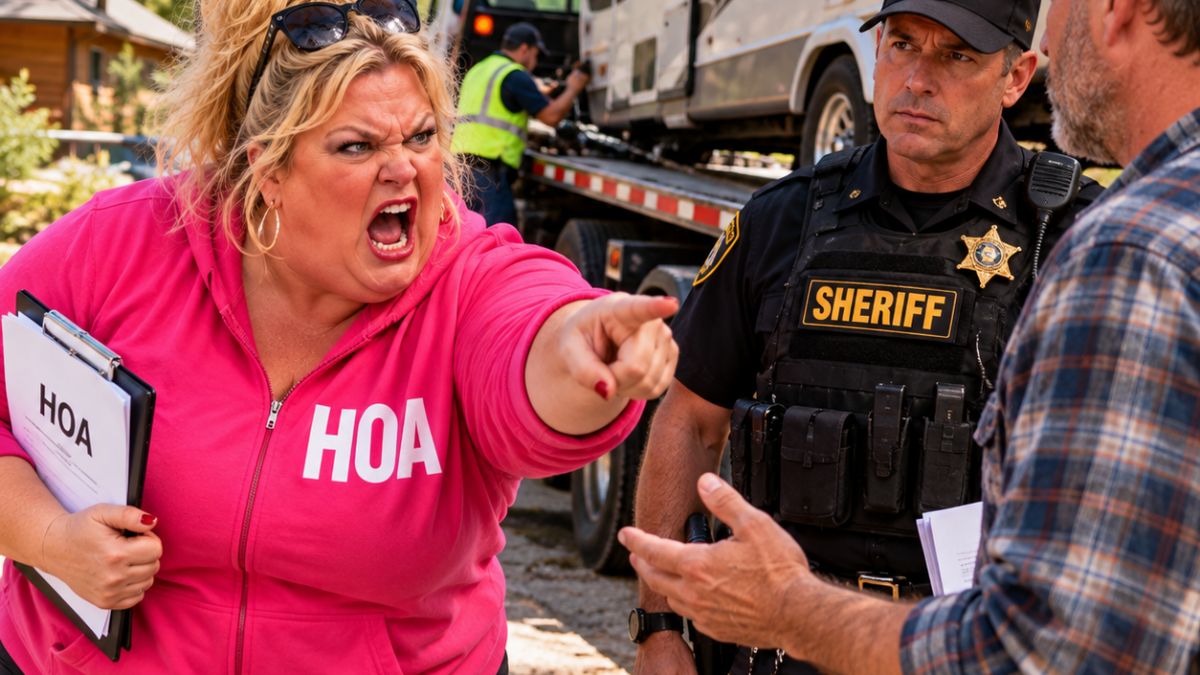
Karen opened her front door before we reached it.
Powder-blue tracksuit.
Pearl earrings.
Clipboard absent.
For once.
Her eyes moved from me to Rourke.
Then past us.
To the Wandering Star.
Her expression collapsed.
That is the only word.
Collapsed.
Two weeks earlier she had stood on my lawn wearing triumph like perfume.
Now she stared at the RV she had ordered taken, returned under official supervision.
“What is this?”
Rourke introduced himself.
“Mrs. Becker?”
“President Becker.”
He didn’t react.
“Karen Becker?”
“Yes.”
“I’m Detective Rourke with the sheriff’s office. I’m investigating the removal of Mr. Miller’s motor home.”
“This is an HOA civil matter.”
“We’ve recovered the vehicle.”
“I authorized that tow under our covenants.”
“That authority is disputed.”
“No, it isn’t.”
She pointed at me.
“He violated the RV restriction.”
Rourke kept his voice even.
“Mrs. Becker, I’ve reviewed the tow order with your signature, the recorded plat, the declarations, the tow company’s statement, and correspondence sent after you were notified of the boundary issue.”
Her face reddened.
“My attorney already explained—”
“I’m not here to debate your attorney.”
That stopped her.
Rourke continued.
“The issue we’re reviewing is whether you knowingly caused property to be removed from an area where you lacked lawful authority, then continued to exercise control over that property after being notified of the dispute.”
“I did not control the vehicle.”
“You ordered the tow.”
“As HOA president.”
“Your title doesn’t automatically create authority outside the association boundary.”
Karen looked at me.
“This is harassment.”
I said nothing.
Rourke glanced at me.
Good.
Silence was working.
Karen raised her voice.
“He has been organizing residents against me. He has threatened the stability of this entire neighborhood.”
“I’m not investigating neighborhood stability.”
“He owes fines.”
“That’s a civil issue.”
“He owes legal fees.”
“Also not why I’m here.”
She finally understood that none of her familiar weapons were landing.
Karen knew HOA language.
Violations.
Fines.
Hearings.
Liens.
A detective did not care about her vocabulary.
He cared about ownership, authority, instructions, documentation, and intent.
Her voice dropped.
“I was enforcing the rules.”
Rourke responded:
“Rules do not authorize you to take whatever property you want from wherever you want.”
“I didn’t take it personally.”
“You signed the work order.”
She went silent.
There it was.
Rourke handed her his card.
“You need to have your attorney contact me. Do not destroy any records related to this tow. Do not contact Reliable Recovery asking them to alter records. And do not retaliate against Mr. Miller because he made a complaint.”
Karen stared at the card.
“I would never retaliate.”
From across the street, Dave coughed loudly.
I nearly laughed.
Rourke ignored him.
Ben had arranged service of the civil filing separately, and a process server arrived later that afternoon rather than the detective serving it. That made more legal sense than turning the sheriff into my personal courier.
Karen received the complaint on her own porch.
By then half the neighborhood knew the RV was back.
That was enough.
I drove the Wandering Star home.
Sarah was standing in the driveway.
Hands covering her mouth.
I stopped.
Opened the door.
She climbed aboard.
Then she cried.
Not dramatic crying.
Quiet.
Face against my chest.
“I thought it was ruined.”
“It isn’t.”
“We haven’t even gone anywhere.”
“We will.”
“When?”
I looked toward Karen’s house.
“Soon.”
Sarah pulled back.
“No.”
“What?”
“Don’t let her decide when we leave.”
That hit me.
The whole reason we bought the Wandering Star was freedom.
If I delayed our life until Karen was fully defeated, she was still controlling it.
“We’ll take the trip.”
“Good.”
“But first I need two weeks.”
Sarah laughed through tears.
“Marine.”
“Always.”
The RV’s return changed Oak Meadows overnight.
My email group doubled.
Then tripled.
Neighbors who had stayed silent began forwarding old violation notices.
Dave organized a meeting at our house.
Dining table.
Certified plat.
Bylaws.
Coffee.
Mr. Henderson.
Garcias.
Mrs. Gable.
Eight others.
Then fifteen.
According to the bylaws, a special meeting to recall a director required signatures from twenty-five percent of homeowners.
Oak Meadows had roughly 150 homes.
We needed thirty-eight.
Dave said:
“We can get sixty.”
Mrs. Garcia shook her head.
“Getting signatures isn’t the hard part. Karen will scare people before the vote.”
“She’ll threaten fines,” Mr. Henderson said.
“Or tell them the HOA insurance will collapse,” someone added.
“She’ll say property values will fall.”
“She’ll call Jack dangerous.”
I listened.
Then said:
“So we don’t campaign against Karen.”
Dave stared.
“What?”
“We campaign for process.”
Silence.
I pointed at the plat.
“Facts. Records. Authority. Money. We make this about whether the board follows its own documents.”
Sarah, sitting at the far end of the table, nodded.
“If you make it revenge, people choose sides.”
Exactly.
We structured the effort.
Dave led the petition.
Mr. Henderson reviewed financials.
Ben advised on procedures.
I handled documentation.
The HOA’s records resistance weakened once litigation began.
Documents arrived.
Not voluntarily enough.
But enough.
Mr. Henderson found patterns.
Karen had used association counsel repeatedly in resident disputes where the legal expense dwarfed the underlying violation.
Hundreds to collect fifty.
Thousands to enforce cosmetic issues.
One line item involved landscaping consulting from a company connected to Karen’s brother-in-law.
Not necessarily illegal.
Definitely worth questions.
More important was the philosophy revealed by spending.
HOA money had become Karen’s enforcement budget.
Residents funded the machinery used to frighten them.
Then her counterattack arrived.
Every homeowner received a letter.
Thick paper.
Oak Meadows logo.
Karen wrote that I was leading a personal vendetta.
That I wanted to dismantle neighborhood standards.
That RVs would soon line every driveway.
That property values were under attack.
That “outside legal intimidation” threatened the community’s financial stability.
Sarah read it.
“She makes you sound like you’re invading Poland.”
“I do own a large vehicle.”
She laughed.
That was good.
We needed laughter.
Fear hates laughter.
Instead of answering with another letter, we held a barbecue.
Community pavilion.
Free hamburgers.
Hot dogs.
Potato salad.
Children running everywhere.
Nearly two hundred people.
No speeches for the first hour.
Just neighbors talking without worrying Karen might overhear.
Then Dave tapped the microphone.
I stood beside a blown-up copy of the plat.
No insults.
No military metaphors.
No “tyrant.”
No “war.”
I pointed to the line.
“This is the recorded map that defines Oak Meadows.”
People leaned forward.
“My RV was parked here.”
I pointed beyond it.
“Karen ordered it removed.”
Someone shouted:
“Is that outside the HOA?”
“According to the recorded plat, that portion falls outside the association boundary.”
Murmurs.
“I’m not asking anyone to believe me because I’m angry.”
I held up certified copies.
“I’m asking you to look at the documents.”
Then I held up the tow affidavit.
“The company that removed the RV states it acted under direct instructions from Karen.”
More murmurs.
Then the lawyer invoice.
“Eight hundred fifty dollars of association legal expense was charged to my account for a letter telling me to stop organizing with you.”
Now anger.
I lowered the paper.
“This isn’t really about an RV.”
Quiet.
“It’s about limits.”
I looked around.
“A homeowners association can be useful. Roads need maintenance. Common areas need care. Covenants can protect legitimate shared interests. But rules only work when the people enforcing them are also bound by them.”
Mr. Henderson spoke next.
Soft voice.
That made people listen harder.
He described the legal spending.
The strange consulting expenses.
The repeated use of HOA attorneys in personal enforcement fights.
Then he picked up his lime-green garden hose.
He had brought it.
Everyone laughed.
Karen once fined him for the color.
He explained that his late wife bought it.
The room changed.
A silly rule became human.
The Garcias talked about their children’s slide.
Dave talked about the basketball hoop.
Not bitterly.
Just honestly.
“I paid because I couldn’t risk my house over a hoop.”
Then he looked at the crowd.
“That is not consent. That is fear.”
That line carried through Oak Meadows faster than anything I said.
The petition collected ninety-four signatures.
More than half the neighborhood.
Karen attempted to challenge it.
Ben responded.
The meeting was scheduled.
Hotel conference room.
Tuesday night.
A hundred seats.
More than 120 homeowners arrived.
Karen sat at the front in a black pantsuit.
No tracksuit.
No casual superiority.
She looked exhausted.
Her attorney beside her.
Two allied board members.
Two others who suddenly seemed eager not to be photographed next to her.
She struck the gavel.
“Order.”
Conversations continued.
Again.
“Order!”
The room quieted.
She began with procedure.
Potentially invalid signatures.
Possible conflicts.
Questions about homeowner standing.
Ben remained in the back until Karen suggested the petition might not qualify.
Then he stepped forward.
“Madam President.”
Her eyes narrowed.
“My name is Ben Carter. I represent Mr. Miller and several residents on procedural issues. Could counsel please identify the provision permitting the board to disregard an otherwise qualifying recall petition without completing the verification process?”
Her attorney whispered.
Karen said:
“We are entitled to review.”
“Of course.”
Ben smiled politely.
“The signatures were accompanied by lot numbers and ownership records. If there are specific invalid signatures, identify them. Otherwise the meeting should proceed.”
Her lawyer whispered again.
Longer.
Karen’s face tightened.
The vote would happen.
She spoke first.
Years of service.
Thankless sacrifice.
Protecting property values.
Maintaining standards.
Attacks.
Harassment.
Outside influence.
Then she pointed at me.
“The man responsible for this entire circus purchased a forty-foot bus and parked it in plain view.”
I heard someone mutter:
“It’s his driveway.”
Karen continued.
“He has turned a simple rules issue into a personal campaign to destroy everything we built.”
When she finished, nobody applauded.
I walked forward.
Binder in hand.
I did not use the podium.
“My name is Jack Miller.”
I looked at Karen.
Then at the residents.
“I’m retired Marine Corps. I’m Sarah’s husband. And I’m your neighbor.”
I held up the binder.
“You already know about the RV.”
I set it down.
“So I’m not going to spend tonight telling you how angry I was.”
Karen looked surprised.
“This binder contains the plat map, the tow order, Reliable Recovery’s affidavit, the HOA’s letters, legal invoices, and our correspondence.”
I rested my hand on it.
“These are facts. They can be checked.”
Then I looked around.
“But tonight is not a court hearing.”
I pointed toward the ballots.
“It’s your decision about what kind of board you want.”
I glanced at Mr. Henderson.
“Do you want a board that fines a widower over the color of a hose his wife gave him?”
He lifted the green hose slightly.
Laughter.
Karen flushed.
“Do you want a board that forces a father to spend thousands removing a basketball hoop while threatening his home?”
Dave lowered his head.
“Do you want HOA funds used primarily to solve shared problems—or to punish residents who question leadership?”
Silence.
Then I said:
“The question isn’t whether Karen likes my RV.”
I looked directly at her.
“The question is whether any president should believe their title makes them more powerful than the documents that created their authority.”
I stepped back.
“That’s all.”
Paper ballots.
Neutral counters.
Longest twenty minutes of the entire fight.
Karen sat straight.
Didn’t look around.
Sarah held my hand.
Dave paced.
Mr. Henderson sat with eyes closed.
Then the results.
Recall Karen Becker from the Oak Meadows board:
**112 yes.**
**8 no.**
For one second, nobody reacted.
Then the room erupted.
Applause.
Some cheers.
A woman behind me began crying.
Dave hugged his wife.
Mr. Henderson just sat there smiling.
Karen remained still.
Then she stood.
Picked up her purse.
Walked out.
No speech.
No threat.
No final gavel strike.
The woman who had once controlled meetings through exhaustion and fear left without anyone asking permission.
The board reorganized.
Mr. Henderson was elected president.
He looked horrified.
Dave joined the board.
First major action:
Hire new independent counsel.
Second:
Review enforcement practices.
Third:
Freeze disputed fines pending audit.
Fourth:
Review legal expenditures.
Fifth:
Begin amendment process for vague cosmetic rules that had been weaponized.
The lime-green hose stayed.
The Garcia slide stayed.
Dave bought another basketball hoop.
This time, after the rules were changed.
He invited me over when it was installed.
His sons shot baskets until dark.
At one point he handed me the ball.
“Gunny.”
“No.”
“Coward.”
I took the shot.
Missed everything.
He laughed so hard he had to sit down.
“Marine Corps accuracy.”
“Different weapon system.”
The civil case settled.
Not for a fantasy fortune.
Enough.
HOA insurance covered documented towing damage.
My legal fees were paid.
All fines and charges disappeared.
Written apology issued to Sarah and me.
Association acknowledged that the tow should not have occurred.
Reliable Recovery repaired the scuffed bumper.
Stan personally called.
“Mr. Miller.”
“Jack.”
“I’m sorry.”
“You signed the affidavit.”
“Still.”
“Verify authority next time.”
“We changed our policy.”
“What policy?”
“HOA tows require proof of association authority and notice to registered owner except emergency cases.”
Good.
At least one system improved.
Karen’s criminal exposure took longer.
Real law rarely moves as fast as stories.
Investigators reviewed intent.
The boundary.
The communications.
The signed order.
Ultimately, the most serious potential charges were reduced.
She resolved the matter through a lesser offense, paid fines and restitution-related costs, and agreed as part of the broader settlement environment not to seek or hold Oak Meadows board office again.
I was satisfied.
People asked if I wanted prison.
No.
I wanted my RV.
My driveway.
My legal fees.
My peace.
Punishment beyond that belonged to prosecutors and courts.
Karen’s house went up for sale several months later.
Nobody threw a party.
At least not officially.
Sarah saw the sign first.
“Jack.”
“What?”
“She’s moving.”
I looked.
Small red-and-white real-estate sign.
That was all.
I expected satisfaction.
Instead, I felt tired.
Karen had consumed enough of our retirement.
Sarah touched my arm.
“Can we go now?”
I looked at the Wandering Star.
Parked exactly where the fight began.
Clean.
Repaired.
Loaded.
We had postponed the maiden trip through lawyers, meetings, affidavits, votes, interviews, insurance inspections, and more paperwork than I wanted to see outside the Corps.
“Tomorrow.”
Sarah smiled.
“Where?”
“West.”
“That’s not a destination.”
“It is if you spent thirty years being told exactly where to go.”
Next morning, we pulled out at eight.
Neighbors knew.
I don’t know who told them.
Probably Dave.
Mr. Henderson stood in his yard.
Lime-green hose proudly visible.
He raised both hands.
The Garcia children jumped beside their plastic slide.
Mrs. Gable rang one of the supposedly offensive wind chimes.
Dave came to the curb.
I stopped the RV.
Opened the window.
He saluted.
“Send pictures, Gunny.”
“You’d better keep the neighborhood standing, Captain.”
“No promises.”
Sarah leaned across.
“Don’t let him become Karen.”
Dave recoiled.
“Ma’am, that is deeply offensive.”
We laughed.
Then I drove.
Past Karen’s former house.
Past the entrance sign.
Out onto the highway.
For the first hour, Sarah said almost nothing.
She sat beside me looking through the windshield.
Fields.
Gas stations.
Strip malls.
Then open road.
Finally she whispered:
“We’re actually doing it.”
I looked over.
“Doing what?”
“Leaving without orders.”
I smiled.
“That’s the idea.”
Our first destination was not Yellowstone.
Not Glacier.
Not the coast.
We drove only four hours.
Stayed at a quiet campground beside a lake.
Nothing spectacular.
That made it perfect.
I leveled the coach.
Extended the slides.
Sarah opened a bottle of wine.
We sat outside.
Sunset reflected on the water.
No Karen.
No clipboard.
No HOA emails.
No certified mail.
Just frogs.
Birds.
A couple two campsites over arguing cheerfully about how to light a grill.
Sarah lifted her glass.
“To the Wandering Star.”
I raised mine.
“To late starts.”
She looked at me.
“Jack?”
“Yes?”
“Was it worth it?”
“What?”
“The fight.”
I thought.
If she meant money, no.
Legal disputes consume time.
If she meant satisfaction, maybe.
If she meant whether I would do it again, absolutely.
But the answer was more complicated.
“It was worth not surrendering.”
Sarah nodded.
“That’s different.”
“Yes.”
We watched the sun disappear.
Over the next year, we traveled thousands of miles.
Colorado.
Utah.
Arizona.
California.
Oregon.
Montana.
Each trip put more distance between the RV and the memory of the tow yard.
Every scratch became ours.
Every mile replaced humiliation with freedom.
Oak Meadows changed too.
Mr. Henderson turned out to be a surprisingly good president.
Mostly because he disliked being president.
He delegated.
Published financials.
Invited questions.
Held meetings at reasonable times.
Created an appeal committee without board officers.
Dave pushed for clear standards.
Objective measurements where possible.
No more phrases like “inconsistent with neighborhood character” without definitions.
The basketball-hoop rule was rewritten.
Garden hoses removed entirely from aesthetic regulation.
The legal budget dropped dramatically.
HOA dues remained stable.
Property values did not collapse.
Oak Meadows did not become a trailer park.
Nobody parked eighteen-wheelers on their lawns.
Civilization survived a green hose.
A year after the recall, Mr. Henderson called.
“Jack?”
“What broke?”
“Nothing.”
“Then why are you calling?”
“I need advice.”
“Dangerous.”
“We’re reviewing RV parking.”
I laughed.
“Careful.”
“No, seriously.”
“What about it?”
“We want a rule that handles long-term storage but gives reasonable loading and unloading time.”
“Sounds sensible.”
“What would you suggest?”
I thought about our first three days with the Wandering Star.
“Seventy-two hours before departure. Seventy-two after return.”
“For loading and maintenance?”
“Yes.”
“Exceptions for emergencies.”
“Yes.”
“Written warning before fines.”
“Yes.”
“Appeal before tow.”
“Absolutely.”
He wrote it down.
“Anything else?”
“Yes.”
“What?”
“Never tow a four-hundred-thousand-dollar vehicle without checking the map.”
He laughed.
“That’s going in bold.”
The new policy passed almost unanimously.
Irony has its uses.
One afternoon, more than two years after the fight, Sarah and I returned from a long trip through the Pacific Northwest.
We pulled the Wandering Star into the driveway.
I parked in the same place.
Three days.
No problem.
A small envelope appeared at our door.
For a second, my stomach tightened.
Old reflex.
I opened it.
Oak Meadows stationery.
Inside:
**WELCOME HOME. HOPE THE TRIP WAS GREAT. PLEASE REMEMBER THE 72-HOUR COURTESY WINDOW FOR RV UNLOADING. SAFE TRAVELS.**
No fine.
No threat.
No legal jargon.
Sarah read it.
“Look at that.”
“What?”
“A normal HOA.”
“I’ve heard rumors they exist.”
She laughed.
That letter went into the Operation Wandering Star binder.
Last page.
Then I closed it.
Years pass faster in retirement than you expect.
Maybe because for the first time, you’re paying attention.
The RV accumulated miles.
Sarah filled one cabinet with postcards.
I kept maintenance logs.
She mocked me.
I ignored her.
We slept beside oceans.
In forests.
Near mountains.
One winter in Arizona, another retired Marine recognized my cap.
We talked.
He told me his HOA was threatening him over a flagpole.
“What did you do?”
“Got mad.”
“That’s normal.”
“What should I do?”
“Read the documents.”
He looked disappointed.
“That’s it?”
“No.”
I pointed at him.
“Read everything before you argue.”
“Boring.”
“Boring wins.”
That became my real takeaway.
People love the scene where the sheriff returns with me.
I understand why.
It was satisfying.
The sight of Karen’s expression when she realized the RV was back is something I will probably remember until the day I die.
But that moment did not happen because I shouted louder.
It happened because I did boring things.
Read the covenant.
Found the plat.
Paid for certified copies.
Collected affidavits.
Sent certified letters.
Documented fees.
Got counsel.
Talked to neighbors.
Followed recall procedures.
Counted signatures.
Preserved records.
Karen had spent years convincing people power belonged to the person with the loudest title.
It didn’t.
Power belonged partly to documents.
Partly to votes.
Mostly to people willing to stop being isolated.
The title “President” had never been Karen’s real strength.
Fear was.
Mr. Henderson paid twenty-five dollars because he feared escalation.
Dave removed the basketball hoop because he feared a lien.
Families stayed quiet because they feared legal bills.
I had an advantage.
Not bravery.
Experience.
For thirty years, I had watched systems become intimidating when people don’t understand them.
The moment you reduce a system to its actual parts, the fear often shrinks.
What is the rule?
Where does it apply?
Who authorized it?
What is the appeal?
Where is the record?
Who voted?
What does the map show?
Karen hated those questions.
Bullies usually do.
Years later, I ran into her once.
Not in Oak Meadows.
At a grocery store twenty miles away.
Sarah and I were stocking the RV for another trip.
I turned a corner.
Karen stood near the produce.
Older.
Hair less aggressively blonde.
No clipboard.
She saw me.
We both froze.
I wondered whether she would leave.
Instead she said:
“Jack.”
I nodded.
“Karen.”
Long pause.
Then:
“I heard Henderson is still president.”
“He stepped down last year.”
“Oh.”
“Dave took a term.”
She looked away.
“They ruined the neighborhood.”
I almost argued.
Then didn’t.
“What makes you say that?”
“People do whatever they want now.”
“Within reasonable rules.”
She laughed bitterly.
“That’s what you think.”
I noticed what wasn’t in her voice.
Power.
The argument sounded tired now.
Not threatening.
Just sad.
Karen picked up a bag of apples.
Then said:
“I lost a lot because of you.”
I looked at her.
“No.”
Her eyes hardened.
“Yes, you organized everyone.”
“You ordered my RV towed.”
“You challenged me.”
“You fined people over hoses.”
“That is not what this is about.”
“It’s exactly what it was about.”
She shook her head.
I continued calmly.
“You didn’t lose because I fought you.”
She looked at me.
“You lost because once people compared notes, they realized they were all afraid of the same person.”
That landed.
Karen’s expression changed.
Not guilt.
Maybe recognition.
Maybe nothing.
I didn’t need it.
I picked up the coffee Sarah wanted.
“Take care, Karen.”
I walked away.
No victory line.
No threat.
No revenge.
Because by then, she truly had no control over my life.
That felt better than anything I could have said.
Sarah was waiting near checkout.
“You saw her.”
“Yes.”
“How was it?”
“Fine.”
“Did you argue?”
“Barely.”
She stared.
“You’re growing.”
“Don’t spread rumors.”
We left.
Loaded groceries into the Wandering Star.
Drove north.
The story became neighborhood folklore.
New homeowners heard versions.
Some said Karen had been arrested in handcuffs on her porch.
Not true.
Some said the sheriff impounded her car in retaliation.
Definitely not true.
One version had me parking the RV across her lawn.
Tempting.
Also false.
The truth was better.
She took something that represented thirty years of sacrifice.
She assumed her title made the action legal.
I found the line she had ignored.
The tow company stopped protecting her.
Law enforcement took the complaint seriously after seeing the documentation.
The RV came home.
The neighborhood saw that Karen could be challenged.
They voted.
She lost.
That is enough.
No embellishment needed.
Mr. Henderson died several years later.
His daughter invited us to the memorial.
His lime-green garden hose was still hanging beside the garage.
After the service, she walked me outside.
“Dad talked about you all the time.”
“I hope not.”
She smiled.
“He said you gave him his neighborhood back.”
“That was everyone.”
“He didn’t see it that way.”
She touched the hose.
“He kept this because of you.”
“No. Your mother.”
She looked surprised.
“He told you?”
“Yes.”
Her eyes filled.
“He wouldn’t replace it.”
“I know.”
She laughed softly.
“Karen hated that thing.”
“Made it better.”
She gave me the hose after the house sold.
I tried refusing.
She insisted.
It now hangs inside my garage.
Not because I need a thirty-year-old green hose.
Because sometimes absurd objects carry serious history.
The Operation Wandering Star binder sits on a shelf nearby.
I open it occasionally.
Not often.
The certified plat is yellowed at the edges.
Tow affidavit.
Lawyer letters.
Recall petition.
Vote results.
HOA apology.
Last page:
That simple welcome-home letter.
No threat.
No fight.
Just courtesy.
That is the document I value most.
Sarah once asked why.
“Because it proves the system got better.”
She smiled.
“You care about systems too much.”
“Engineer brain.”
“You were a Marine.”
“Same problem. Different equipment.”
The Wandering Star eventually passed 100,000 miles.
We celebrated in Wyoming.
Pulled to the side of a scenic turnout.
Sarah took a picture of the odometer.
I took a picture of her.
Mountains behind.
She looked older.
So did I.
Happy.
Very.
That night, sitting under stars, I remembered where the name came from.
That deployment call.
The promise.
Someday we wander.
It took us decades.
And one HOA president almost turned our first chapter into another obligation.
She failed.
Not because I crushed her.
Because I refused to let her redefine what we had earned.
That distinction matters.
The RV was never about a bus.
It was about time.
You cannot understand retirement dreams unless you understand how long some people wait to begin living them.
Sarah waited while I served.
I waited while duty came first.
We both waited through moves.
Deployments.
Financial planning.
Parents getting older.
Friends dying too young.
Then finally:
Our turn.
When Karen ordered that tow, she saw an oversized recreational vehicle.
I saw every postponed mile.
Every promise.
Every night Sarah slept alone.
Every morning I woke somewhere far from her.
That is why my anger was so deep.
And also why revenge alone would have been a poor ending.
If the story ended with Karen losing, she would still be central.
The real ending is Sarah and me driving away.
The Wandering Star heading toward somewhere new.
Oak Meadows fading in mirrors.
Karen irrelevant.
That is victory.
One autumn, many years after the original fight, Dave called.
“Gunny.”
“Captain.”
“You around?”
“Home until Thursday.”
“We’ve got a situation.”
I laughed.
“What did the HOA do?”
“Nothing.”
“Then why call me?”
“New homeowner bought a fifth-wheel.”
“Oh no.”
“He wants to know the parking rule.”
“Tell him seventy-two hours.”
“We did.”
“He upset?”
“No. He said thank you.”
I waited.
“That’s the whole story?”
“Yes.”
“You called me to tell me a normal interaction happened?”
“Thought you’d appreciate it.”
I did.
More than he knew.
A man asks rule.
Board provides rule.
Man follows rule.
Nobody threatens anyone.
Nobody hires lawyers.
Nobody tows $400,000 assets.
Boring.
Perfect.
“Thanks, Dave.”
“Safe travels.”
That Thursday, Sarah and I left again.
The same driveway.
Same road.
Different world.
We drove past Karen’s old house.
A young family lived there.
Bicycles scattered near the garage.
One bright red plastic slide visible above the backyard fence.
I laughed.
Sarah looked over.
“What?”
“Nothing.”
She saw the slide.
Then understood.
“Oh.”
“Civilization survived.”
“Barely.”
We kept going.
At the entrance, Oak Meadows sign passed on the right.
Then open road.
I looked ahead.
Not behind.
Because the lesson was never that every HOA is evil.
It wasn’t that every rule should be broken.
It wasn’t even that Karen was uniquely monstrous.
The lesson was simpler.
Authority has edges.
Good leaders know where they are.
Bad leaders believe the edges move wherever they stand.
Karen looked at my driveway and saw territory.
I looked at the plat and saw a line.
That line changed everything.
But the line on the map was only the beginning.
The more important line was the one the neighborhood finally drew together.
Enough.
Enough arbitrary fines.
Enough selective enforcement.
Enough legal threats financed with their own dues.
Enough fear.
A community can endure a bully longer than one person can.
But a bully cannot endure a community that stops being afraid.
That was the part Karen never understood.
She thought each resident was a separate problem.
Mr. Henderson and his hose.
Dave and his basketball hoop.
The Garcias and their slide.
Mrs. Gable and her wind chimes.
Me and my RV.
Separate violations.
Separate files.
Separate people to pressure.
Then we spoke to one another.
Suddenly she was facing one hundred homeowners comparing stories.
That was her real defeat.
The sheriff showing up was dramatic.
The recall vote was decisive.
But conversation was the beginning.
Every bully relies on silence between victims.
Break that silence and the math changes.
I sometimes wonder what would have happened if Karen simply knocked on our door that first morning.
“Jack, the rules restrict RV parking. Can we talk about how long you need it in the driveway?”
I would have shown her our departure plan.
She might have shown me the covenant.
I might have shown her the plat.
Maybe we would have discovered the weird boundary together.
Maybe the board would have amended the rule reasonably.
Five minutes.
Coffee.
No tow.
No detective.
No lawsuit.
No recall.
No sale sign.
That was always available.
Karen chose force because force had worked before.
Every previous surrender trained her to escalate.
Mr. Henderson paid.
Dave removed the hoop.
Others stayed quiet.
So when she saw the Wandering Star, she didn’t see a neighbor’s property.
She saw another opportunity to demonstrate control.
That is why standing up mattered beyond my driveway.
Not because my RV was more valuable than a garden hose.
It wasn’t.
The principle was the same.
Henderson’s hose mattered because it belonged to him.
Dave’s hoop mattered because it belonged to his family.
My RV mattered because it belonged to Sarah and me.
Property rights are not scaled by price.
Neither is dignity.
The $400,000 value got law enforcement’s attention.
But the emotional injury began long before anyone mentioned dollars.
It began when someone decided my “no” did not matter.
That is what I fought.
Today, the Wandering Star is older.
So are we.
The paint carries road scars.
One cabinet latch rattles no matter how many times I adjust it.
Sarah has an entire drawer filled with campground maps we could obviously keep digitally.
I have maintenance binders she calls my “second Marine Corps.”
We’ve watched lightning over New Mexico.
Sunrise in Maine.
Snow in Montana.
Fog move across the Oregon coast.
We have slept beside lakes whose names I still mispronounce.
Met people whose full names I never learned.
Shared coffee with strangers who became friends for one night because campers do that.
Every mile makes Karen smaller.
That may be the best measurement of healing.
Eventually the thing that hurt you occupies less space.
Not because it disappears.
Because life grows around it.
Like scar tissue.
Like trees around an old fence.
Like a neighborhood around a bad chapter.
One evening, parked near the Pacific, Sarah asked:
“If you could go back, would you buy the house in Oak Meadows again?”
I thought.
“Knowing Karen?”
“Yes.”
“Knowing everything.”
I looked at the ocean.
“Yes.”
She seemed surprised.
“Why?”
“Because we met Henderson.”
She nodded.
“Dave.”
“Yes.”
“The Garcias.”
“Yes.”
“And because?”
I smiled.
“Because I like the driveway.”
She laughed.
Then leaned against me.
The sun dropped.
Waves kept coming.
Somewhere behind us, the Wandering Star sat under tall trees.
No HOA.
No fines.
No tow trucks.
Just our temporary home.
Sarah whispered:
“We finally wandered.”
I kissed her forehead.
“Still wandering.”
That is the ending.
Not Karen’s face at the door.
Though I admit that was satisfying.
Not the recall vote.
Not the lawsuit.
Not even the moment the Wandering Star’s diesel engine started inside that impound yard.
The ending is freedom.
The kind Karen accidentally reminded us never to postpone again.
For thirty years, I served under legitimate authority.
Rank mattered.
Orders mattered.
Rules mattered.
That experience did not teach me to hate authority.
It taught me to respect the difference between authority and ego.
Real authority comes with responsibility.
Limits.
Accountability.
Karen wanted the power without the limits.
The neighborhood eventually corrected that.
Not with violence.
Not with threats.
With maps.
Affidavits.
Votes.
Receipts.
Neighbors.
And one forty-foot RV that refused to stay gone.
Sometimes, when we return home from a long trip, I still pause before turning into the driveway.
I remember that empty patch of concrete.
Sarah holding coffee.
Karen standing on the lawn.
“You had my property towed?”
Her smile.
The clipboard.
The confidence.
Then I look at the driveway now.
The Wandering Star parked there legally for unloading.
Lime-green hose hanging inside the garage.
Children playing basketball across the street.
Plastic slide visible two houses away.
Wind chimes ringing somewhere on the block.
And I think about how certain Karen had been that she was protecting Oak Meadows.
She wasn’t.
She was suffocating it.
The neighborhood did not collapse after she left.
It breathed.
That is the final irony.
The community became more valuable once residents stopped being terrified of violating someone’s personal preferences.
People maintained their homes because they cared, not because Karen patrolled them.
Meetings became shorter.
Legal fees fell.
Neighbors spoke.
Children played.
Standards remained.
Fear didn’t.
If Karen taught us anything, it was this:
Rules can protect a community.
But rules without restraint can also destroy one.
A title can help someone serve.
Or convince them they own the people around them.
A fine can correct a genuine problem.
Or become a weapon.
A boundary can divide neighbors.
Or protect enough space between them that respect becomes possible.
And sometimes one person crosses that boundary so arrogantly that everyone finally sees it.
Karen thought towing my RV would prove she controlled my driveway.
Instead, it forced me to open a plat map.
The plat map forced neighbors to compare stories.
Their stories became a petition.
The petition became a vote.
The vote ended her presidency.
And the very RV she tried to remove became the thing I drove out of Oak Meadows with Sarah beside me, headed toward the life we had spent thirty years waiting to live.
Every time I turn the key and hear that diesel engine wake up, I still think about the tow yard for half a second.
Then the engine settles.
The road opens.
And I remember something much better.
She took the Wandering Star for two weeks.
She almost took our peace with it.
But she never took the future it represented.
That part was always ours.