PART 2: HOA President Cut Off My Propane While My Elderly Mother Was Inside—Then the Prosecutor Made Her Answer for It
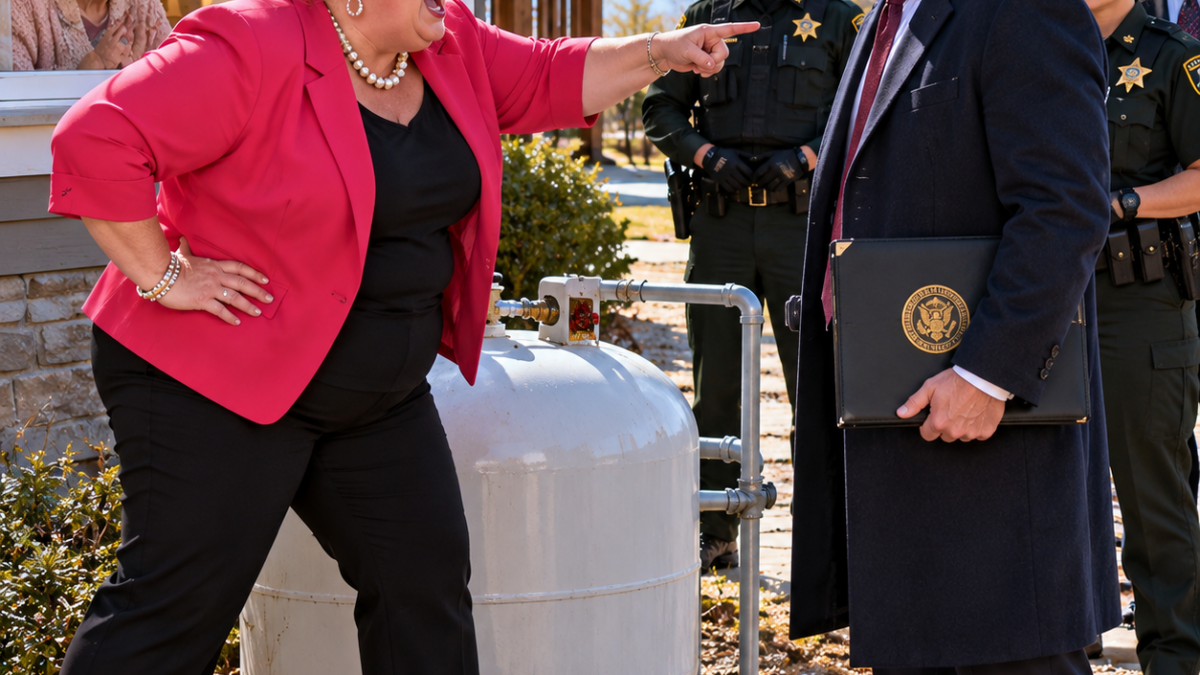
PART 2
The propane technician’s name was Bill Jensen, and he did not look like a man who exaggerated for effect.
He climbed out of the Heritage Propane service truck wearing heavy gloves, a dark work jacket, and the expression of someone who had seen enough bad decisions to know when a simple call had become something dangerous. He walked straight past Karen, straight past me, and straight to the tank.
Karen tried to stop him.
“Excuse me,” she said, putting that HOA-president edge into her voice, the one that made people step back at board meetings and apologize even when they had done nothing wrong. “This tank is under compliance review.”
Bill did not even turn around.
“Lady, unless you are licensed to work on propane systems, the only thing under review right now is why you are standing near a gas line with a pipe wrench.”
Her mouth opened.
Nothing came out.
That was the first good sound of the afternoon.
Bill crouched beside the tank, pulled a handheld gas detector from his bag, and swept it low over the frozen ground. The device chirped. Not a steady alarm, but enough to make him mutter something under his breath that I was glad my mother did not hear.
He looked up at me.
“Who touched this fitting?”
I pointed to Karen.
“She did.”
Karen threw both hands up. “I turned off a noncompliant utility fixture. That is all. This man has been ignoring HOA directives for weeks.”
Bill stood slowly.
The look he gave her was worse than shouting.
“You disconnected a supply line?”
Karen’s jaw tightened.
“I ensured the tank could not remain in use until it was properly approved.”
Bill stared at her for three long seconds.
Then he said, “You are very lucky nobody is dead.”
The wind moved through the yard, thin and bitter.
My mother sat in the passenger seat of my truck with the heat running, a blanket tucked over her lap. She watched through the windshield, one hand closed around her inhaler. Her eyes were frightened, and that nearly broke me.
I could handle Karen aiming her petty power at me.
I could handle letters, fines, threats, and meetings where she smiled while lying through her teeth.
But I could not handle my mother looking scared inside a truck because a woman with a title and a wrench had decided rules mattered more than breathing.
Bill inspected the valve, the regulator, the brass fitting, and the exposed line. Every few moments he shook his head.
“She scored the fitting,” he said. “Used too much force. This pigtail hose is compromised. I can’t just reconnect it.”
“How long?” I asked.
He glanced toward my mother.
“To do it legally and safely? I have to replace the damaged part, purge the system, pressure-test the line, then inspect the furnace, water heater, and stove before I can restore service. It is going to take hours.”
Karen folded her arms.
“That sounds excessive.”
Bill turned.
“It sounds like the law.”
Karen looked offended, as though the law had been rude to her personally.
“Also,” Bill continued, “my company will be filing a formal incident report with the state utilities commission and the fire marshal. Civilian tampering with propane equipment is not a neighborhood preference issue. It is a public safety issue.”
For the first time since I found her beside the tank, Karen looked uncertain.
Not sorry.
Not ashamed.
Just uncertain.
There is a difference.
Sorry people look inward.
Karen looked around for someone to blame.
The sheriff’s deputy arrived forty minutes later, long after Bill had started his work and long after my mother’s hands had finally stopped trembling in the heated truck.
The deputy was young, maybe late twenties, with a face that had not yet learned how dangerous boredom could be. He stepped out of his cruiser, glanced from Karen to me to the propane truck, and sighed like he had been called to settle a fence argument.
“Afternoon,” he said. “We got a call about a disagreement with the HOA?”
I felt my jaw tighten.
“No,” I said. “You got a call about trespass, utility tampering, reckless endangerment, and cutting heat to a medically vulnerable elderly woman in winter.”
He blinked once.
Karen immediately stepped toward him.
“Deputy, I am Karen Bishop, president of the Willow Creek Estates Homeowners Association. This resident has been repeatedly noncompliant with neighborhood standards, and I was simply carrying out board-authorized remediation.”
I almost laughed.
Board-authorized remediation.
She had a gift for making crimes sound like committee work.
The deputy looked at me.
“Do you have proof she touched the tank?”
I held up my phone.
“I have video.”
He watched it. His face did not change much, but something small shifted behind his eyes when the screen showed Karen standing beside the disconnected line with the wrench in her hand.
He handed the phone back.
“Well,” he said slowly, “technically, tampering with a utility can be a crime. But these HOA situations are often civil.”
“There is nothing civil about a gas line,” Bill said from behind him.
The deputy turned.
Bill pulled off one glove and walked over.
“I’m the senior technician on site. That fitting is damaged. The system was opened to atmosphere. There was residual vapor near the ground when I arrived. This could have gone very bad, very fast.”
The deputy looked less comfortable now.
Karen’s voice sharpened.
“He works for him. Of course he is exaggerating.”
Bill’s eyes narrowed.
“Ma’am, propane is heavier than air. It settles low. A vapor cloud can find ignition from a car starting, a water heater pilot, a static spark, anything. If you don’t understand that, you had no business touching the tank.”
The deputy wrote something down.
Still, I could see what he wanted to do. Take a report. Tell us to calm down. Hand it off to “civil court” and drive away.
I had seen it before.
People in authority sometimes fail to recognize danger when it wears ordinary clothes. A woman in a floral puffer jacket with an HOA badge in her purse did not fit his mental image of a criminal.
That would become Karen’s greatest shield.
And eventually, her greatest mistake.
The deputy took my statement, spoke briefly with my mother through the truck window, then crossed the street to Karen’s house with her following close behind, talking rapidly. Ten minutes later, he returned and gave me a report number.
“I’ll document everything,” he said. “But realistically, Mr. Davies, you may want to consult a civil attorney. If the HOA believes the tank violates bylaws—”
“The tank was installed fifteen years ago,” I cut in. “It is grandfathered, deed-exempt, and permitted. I have every document.”
He nodded in the way people nod when they are already halfway gone.
“Include that in your civil case.”
I looked at him for a moment, then took the card.
“Thank you, Deputy.”
He seemed relieved I was not going to argue.
That was fine.
I did not need him to understand the whole battlefield.
I only needed him to create the first official record.
By the time Bill finished, the sun had dropped behind the houses and my mother had fallen asleep in the truck from sheer exhaustion. Heritage Propane replaced the damaged hose, tested the system, inspected every appliance, and documented every step.
The bill came to $842.50.
Bill handed me the invoice and a copy of his preliminary report.
“I’ll write the full one tomorrow,” he said. “You need that in your file.”
“I do.”
He studied me for a second.
“You’re not letting this go, are you?”
I looked toward my mother.
“No.”
“Good,” he said. “Because people like that only stop when somebody makes them.”
After Karen finally disappeared into her house, I helped my mother inside. The furnace hummed again. Warm air moved through the vents. She settled back into her recliner, but her face was pale and tired.
I knelt beside her.
“You okay, Mom?”
She gave me the small smile she used when she wanted me to stop worrying.
“I’m warm now.”
“That is not what I asked.”
She looked toward the front window, where Karen’s house sat lit across the street.
“She knew I was here, didn’t she?”
The question landed harder than I expected.
I did not answer fast enough.
My mother nodded.
“She knew.”
“I’m sorry.”
“For what?”
“For bringing this fight into the house.”
Her hand, thin but still strong, settled over mine.
“Mark, you didn’t bring cruelty here. You just answered it.”
That night, after she went to bed, I turned the dining room table into a command center.
Old habits return quickly when there is a mission.
I laid out the deed exemption, the propane service records, the original county utility approval, the HOA covenants, Karen’s past violation notices, photos from the tank, the video file backed up on two drives, the deputy’s report number, Bill’s invoice, and the first page of his incident summary.
Then I added the letter from my mother’s pulmonologist.
I had called his office before they closed and explained what happened. By evening, he had emailed a signed note stating that a sudden loss of heat could trigger respiratory distress, pneumonia, or potentially life-threatening complications for a patient with my mother’s condition.
I printed it and placed it at the top of the stack.
My hands were steady.
That worried Sarah when she was alive.
My wife used to say I was calmest when someone should be most afraid of me. She had been gone three years by then, cancer taking her after a fight so long and cruel that even memory flinched from it. My mother had moved in after my father died, but also because we were both lonely in different ways.
This house was not fancy.
It was a three-bedroom ranch on the edge of Willow Creek Estates, with an acre of land, a workshop out back, and enough quiet for old wounds to breathe.
I had bought it ten years earlier because it felt safe.
Karen Bishop had turned safe into conditional.
That was unforgivable.
The next morning, Karen delivered her counterattack.
Not by knocking.
Not by calling.
She taped a red violation notice to my front door.
Inside the envelope were three documents.
The first fined me one thousand dollars for an unapproved propane tank under “Aesthetic Guideline 14C.”
There was no Aesthetic Guideline 14C.
I knew because I had read the covenants three times. The guidelines ended at 12.
The second document fined me five hundred dollars for “failure to cure” a violation within thirty days, referencing a warning letter I had never received.
It was backdated.
The third document was an invoice for three hundred dollars labeled “Board-Approved Remediation Service Fee.”
I read it twice at the dining room table.
Karen was charging me for the privilege of having my gas line illegally disconnected.
My mother sat across from me, wrapped in a sweater, watching my face.
“Mark?”
I placed the papers flat on the table.
“She’s not stopping.”
Mother’s eyes hardened in a way that reminded me of my father’s funeral, when she stood straight through the whole service because she refused to collapse in front of people who came to see how broken she was.
“Then neither are you,” she said.
I called my old friend David Miller.
Not the neighbor. Colonel David Miller, retired Judge Advocate General’s Corps. We had served together years earlier, in places where paperwork could matter as much as ammunition. He knew law, chain of command, and the particular stupidity of small people with borrowed authority.
He answered with his usual warmth.
“Mark Davies, you old bridge-builder. Tell me you finally got arrested for yelling at a city inspector.”
“Worse,” I said. “HOA.”
He groaned. “God help you. What did you do, paint something eggshell instead of cream?”
“Karen Bishop disconnected my propane line while Mom was inside the house.”
The joking stopped.
I walked him through everything.
The ramp dispute. The propane tank. The wrench. The video. The technician’s report. The fake guideline. The backdated notice. The remediation fee. The deputy brushing it off as civil.
David listened without interrupting.
When I finished, he was quiet for several seconds.
Then he said, “Mark, this woman is not an overzealous HOA president. She is a liability event with shoes.”
“I want her held accountable.”
“Good. Then don’t make it personal. Make it prosecutable.”
For the next hour, David gave me the framework.
Pay the fines under protest with cashier’s checks, he said.
I hated that part.
He explained why. Paying under protest created a clean financial injury. It showed that Karen’s fabricated enforcement had extracted money from me through false claims. That mattered if we wanted fraud and extortion taken seriously.
Then he told me to write three letters.
The first would go to the entire HOA board by certified mail, not just Karen. It would dispute the fines, demand reimbursement for the propane bill, notify them of potential criminal conduct, and place every board member on formal notice.
The second would go to the HOA’s insurance carrier, especially the directors and officers liability provider. Insurance companies did not enjoy discovering that volunteer board members were tampering with utilities and fabricating fines.
The third would go to the county prosecutor’s office.
Not the sheriff.
The prosecutor.
“Package the case,” David said. “Do not walk in saying your neighbor is crazy. Walk in with evidence of trespass, reckless endangerment, utility tampering, fraud, and a pattern of using HOA authority to extract money.”
“A pattern?”
“You think you’re the only person she’s done this to?”
I looked toward the window.
Across the street, Karen’s house sat behind perfect shrubs and bright white trim, like a dollhouse where something rotten lived inside.
“No,” I said. “I don’t.”
“Then find the others.”
That became the next phase.
Reconnaissance.
On Saturday morning, after making sure my mother was comfortable, I walked the neighborhood with a notebook in my pocket and no agenda on my face.
People talk when they sense someone is finally willing to listen.
My first stop was the Millers, an elderly couple who lived two blocks down and kept the neatest garden in Willow Creek. I found Mr. Miller pruning rose canes with the careful patience of a man who had learned time was precious. His wife came out with tea, and within minutes the subject of Karen came up without me forcing it.
Mrs. Miller’s face changed.
“That woman threatened to put a lien on our house,” she said.
“For what?”
“Garden gnomes.”
I thought I had misheard her.
“Gnomes?”
Mr. Miller’s mouth tightened.
“Our grandchildren gave them to us when they were little. We move them every spring. Karen said they were lawn clutter.”
“She fined you?”
“Two hundred dollars,” Mrs. Miller said. “Then she said if we did not remove them, the fines would become weekly and the HOA could place a lien.”
Her voice shook on the word lien.
They had lived there thirty-five years. Paid every bill. Kept their house immaculate. Raised children, hosted birthdays, buried friends, and watered flowers through drought summers.
Karen had made them afraid of losing their home over garden gnomes.
“Do you still have the notice?” I asked.
Mrs. Miller looked at me carefully.
“You’re doing something, aren’t you?”
“I’m collecting facts.”
Mr. Miller straightened.
“We have the notice.”
The Rodriguez family was next.
Carlos Rodriguez was loading his kids into the minivan when I stopped by. He looked tired in the way young parents look when life is already expensive enough without an HOA measuring their garage door.
Karen had fined him for a portable basketball hoop.
Then for the garage door being open too long.
Then for chalk drawings on the driveway after his kids played outside.
“She times us,” Carlos said, rubbing his forehead. “I’m not kidding. She sits there with her phone. One hour and five minutes with the garage open? Fifty dollars. My son drew a dinosaur in chalk? Violation. My daughter left a scooter by the porch? Violation.”
“Do you have copies?”
He hesitated.
“I don’t want more trouble.”
“The trouble is already here,” I said. “But if everyone keeps fighting it alone, she wins alone.”
That got him.
By sunset, I had seven statements, fifteen violation notices, screenshots of threatening emails, and one recording of Karen telling a homeowner that “community harmony sometimes requires financial pressure.”
Financial pressure.
She said it like a banker.
She meant fear.
The pattern was exactly what David suspected. Karen invented vague standards, issued disproportionate fines, threatened liens, then used the authority of the HOA to intimidate people into paying rather than fighting.
Most residents had paid because the amounts were too small to justify hiring a lawyer but too frightening to ignore.
That was her system.
Petty enough to dismiss.
Frequent enough to profit.
Cruel enough to control.
For two days, I built the prosecutor’s packet.
Thirty-two pages.
I wrote it like an engineering report because that was how my mind worked. Start with the incident. Define the hazard. Identify the responsible party. Establish timeline. Attach supporting documents. Show pattern. State requested action.
The cover page read:
Formal Criminal Complaint Regarding Reckless Endangerment, Utility Tampering, Fraudulent HOA Enforcement, and Extortionate Fine Practices by Karen Bishop, President of Willow Creek Estates HOA.
I included photos, the video transcript, Bill Jensen’s propane report, the doctor’s letter, the deputy’s report number, the fake 14C guideline, the backdated notice, the paid-under-protest checks, and the neighbors’ statements.
On Monday morning, I drove to the county courthouse.
Not angry.
Ready.
The receptionist at the prosecutor’s office looked at the thick folder in my hands and asked what the complaint involved.
“An HOA president who disconnected a propane line to a home occupied by a medically vulnerable elderly woman,” I said. “Then fabricated violations and collected money to cover it.”
Her expression changed.
Ten minutes later, Assistant District Attorney Nathan Chen walked into the waiting area.
He was younger than I expected, late thirties maybe, with a plain navy tie, serious eyes, and the focused stillness of a man who did not waste words.
“Mr. Davies?”
“Yes.”
He looked at the folder.
“Come with me.”
We sat in a small conference room with no windows.
He opened the packet.
For the first few pages, his face remained professional.
Then he reached the photograph of Karen with the wrench.
His pen stopped moving.
“She physically disconnected the line?”
“Yes.”
“Is there video?”
“On this drive, and backed up online. Transcript is in the appendix.”
He read Bill’s report next. Slowly. Twice.
When he reached the part about possible vapor accumulation and ignition risk, he leaned back in his chair and exhaled through his nose.
Then he read the doctor’s letter.
Then the fines.
Then the fake guideline.
Then the backdated notice.
By the time he reached the neighbors’ statements, he was no longer treating me like a citizen with a complaint.
He was treating me like a witness.
“Mr. Davies,” he said, tapping the page where Karen billed me a remediation fee, “this document was sent after she disconnected the line?”
“The next morning.”
“And she claimed the fee was board-approved?”
“Yes.”
“Do you have board minutes authorizing it?”
“No. I have reason to believe none exist.”
“We can subpoena that.”
Those words changed the air in the room.
Subpoena.
This was no longer a man at a table reviewing a strange HOA story.
This was the government beginning to look under the floorboards.
Chen closed the folder halfway and looked at me.
“I want to be clear. If we open this, it is no longer your personal fight. It becomes a case for the county. You will be a witness, your mother may be a witness, the propane technician will almost certainly be a witness, and your neighbors may be interviewed.”
“I understand.”
“It may take time.”
“I understand that too.”
He studied me.
“You were military?”
“Army Corps of Engineers. Twenty years.”
“That explains the packet.”
For the first time, he almost smiled.
Then he stood.
“I’m going to recommend opening a formal investigation.”
When I walked out of the courthouse, the sky had gone gray, but I felt the first clear shift since the day Karen touched that valve.
I had carried the evidence as far as I could.
Now someone with a badge and a subpoena power had picked it up.
A week later, Detective Laura Miller came to my house.
She was the opposite of the first deputy. Late forties, sharp-eyed, no nonsense, and deeply unimpressed by Karen’s title. She photographed the tank, the valve, the new fittings, the distance from the tank to the house, the driveway, the sightline from Karen’s yard, everything.
She treated my property not like a neighborhood squabble.
Like a crime scene.
Her interview with my mother nearly undid me.
Mother sat in her chair with a blanket over her lap, trying to look stronger than she felt.
Detective Miller spoke gently.
“Mrs. Davies, when you realized the heat was off, what did you feel?”
Mother looked down at her hands.
“Afraid.”
The detective waited.
“My breathing gets worse when I’m cold,” Mother continued. “I try not to panic because panic makes it worse. But I knew Mark was outside, and I knew something was wrong, and I could feel the house getting colder.”
She swallowed.
Then she said the word that stayed with everyone.
“It felt cruel.”
Detective Miller wrote that down.
Cruel.
That was what Karen’s paperwork had always tried to hide.
Not enforcement.
Not aesthetics.
Cruelty.
Over the next two weeks, Detective Miller interviewed the Millers, Carlos Rodriguez, the Peterson family, the HOA treasurer George Harrison, and several others. The neighborhood changed again, but this time in a quieter, more dangerous way for Karen.
People stopped whispering about her.
They started comparing notes.
The board members began calling one another in panic. George called me one evening, his voice shaking.
“Mark, what exactly is happening?”
“A criminal investigation.”
“Karen told us you were exaggerating. She said there was a leak and she shut the tank off for safety.”
I closed my eyes.
Of course she had.
“George, I have video of her saying the tank was an unauthorized exterior alteration. Bill Jensen found no preexisting leak. She created the hazardous condition by disconnecting the line.”
Silence.
Then George whispered, “Oh my God.”
“You need to talk to the HOA attorney,” I said. “And you need to decide whether you are board members or witnesses after the fact.”
“I didn’t know.”
“Then prove that.”
That was harsh.
It was also necessary.
Weak people often enable bullies not because they love cruelty, but because they prefer comfort over confrontation. George was not evil. He was afraid of Karen. But his fear had helped give her power, and now that power had nearly harmed my mother.
Two days later, Karen made the worst decision of her life.
She called an emergency HOA meeting.
The notice appeared on the neighborhood Facebook page under her name.
Emergency Community Meeting: Defamatory Attacks Against HOA Leadership and Defense of Covenant Authority.
She was going to put me on trial in public.
That was fine.
I had been ready for courtrooms before.
A clubhouse would do.
The meeting was packed.
Karen stood at the lectern in a bright red blazer, chin lifted, hands gripping both sides as if she were the captain of a ship instead of a woman standing over a hole she had dug herself. Her loyalists sat in the front corner, stiff-backed and smug. The rest of the room was uneasy. Curious. Angry. Unsure.
My mother insisted on coming.
I argued against it.
She won.
“Mark,” she said while I helped her into her coat, “that woman made me afraid in my own home. I want to watch her hear the truth.”
So I brought her, seated her near the back beside Mrs. Miller, and kept an eye on her breathing.
David Miller, my JAG friend, drove in and stood near the back wall in a suit. He was not representing me formally. He did not need to. His presence alone made Karen glance twice.
She began with performance.
“Thank you all for coming on short notice,” Karen said, her voice sweet and sharp. “As many of you know, our board has recently been the target of malicious accusations by a resident who has shown repeated hostility toward community standards.”
Every face turned toward me.
I did not move.
She went on for nearly ten minutes. Property values. Harmony. Volunteer leadership. Difficult residents. Outside interference. Taxpayer resources wasted by personal grievances.
She never said propane.
Never said wrench.
Never said Eleanor Davies.
That omission did more damage than she realized.
When she paused, I stood.
“Will residents be allowed to speak?”
Karen’s eyes narrowed.
“This is not a debate, Mr. Davies.”
Before I could answer, George Harrison rose from the board table.
His face was pale, but his voice held.
“According to our bylaws, any member in good standing may address the board during a special meeting.”
Karen turned on him.
“George.”
He swallowed.
“Mark has the floor.”
There are moments when power breaks audibly even without a sound.
That was one of them.
I walked to the front, not behind the lectern. I did not want Karen’s stage. I wanted my neighbors to see my face.
I opened my folder.
“Karen is right about one thing,” I began. “I did take this outside the HOA. I did that because what happened on February seventeenth was not an HOA matter.”
I held up the photo of the disconnected propane line.
“This is my home’s gas supply. Karen Bishop disconnected it with a pipe wrench while my seventy-two-year-old mother, who has COPD, was inside the house.”
The room stirred.
Karen snapped, “That is a gross mischaracterization.”
I held up my phone.
“Then let’s hear your characterization.”
I played the video.
Karen’s own voice filled the clubhouse.
“That tank is an unauthorized exterior alteration, Mr. Davies. I’m ensuring compliance.”
Nobody spoke when it ended.
Not even Karen.
I looked at the residents.
“She did not mention a leak. She did not mention danger. She did not call the gas company. She did not call the fire department. She used a wrench, cut off heat, damaged the fitting, and then sent me a bill for the service.”
A woman in the second row whispered, “My God.”
I held up the covenant book.
“She cited Aesthetic Guideline 14C. There is no 14C. The aesthetic section ends at 12.”
George lowered his head.
I held up the backdated notice.
“She claimed I had received warning thirty days earlier. I had not. The notice was created after the incident to make her actions look authorized.”
Karen found her voice.
“You are not a lawyer.”
“No,” I said. “That is why I went to the prosecutor.”
The word prosecutor moved through the room like a match flame.
I continued.
“The county prosecutor’s office has opened an investigation into reckless endangerment, fraud, and extortion related to Karen’s actions and her use of HOA authority.”
Karen’s face went gray.
I turned toward Mrs. Miller.
“Mr. and Mrs. Miller were threatened with a lien over garden gnomes.”
The Millers stood slowly.
I looked toward Carlos.
“The Rodriguez family was fined for a children’s basketball hoop, chalk drawings, and a garage door being open too long.”
Carlos stood.
Then the Petersons.
Then another homeowner.
Then another.
One by one, the people Karen had isolated became visible to one another.
This was no longer my accusation.
It was a room full of evidence breathing at the same time.
I held up Bill Jensen’s report.
“This is from Heritage Propane. It states that Karen’s actions damaged the fitting, required emergency repair, and created a serious risk of explosion or injury.”
I looked directly at Karen.
“You told everyone I was attacking the board because I don’t like rules. That is not true. I am standing here because rules without decency become weapons. You used this HOA to frighten elderly people, intimidate families, collect money under false authority, and endanger my mother.”
The clubhouse erupted.
Questions flew at Karen from every side.
“Did you disconnect the gas?”
“Where did the fines go?”
“Did the board approve this?”
“Were there minutes?”
“Did you lie to George?”
Karen tried to speak, but she had lost the room.
Then my mother stood.
I turned immediately.
“Mom—”
She lifted one hand to stop me.
The room quieted for her in a way it never had for Karen.
My mother’s voice was thin, but steady.
“I do not care about your mailboxes,” she said. “I do not care about your paint colors. I do not care who sits on what committee. I care that I was cold and frightened in my own home because someone wanted power more than she wanted to be kind.”
Karen stared at her.
Mother looked back without blinking.
“You did not enforce rules. You forgot people.”
No one clapped.
It was too honest for applause.
Karen sat down.
By the next morning, the remaining board members suspended her authority pending the investigation.
George called to tell me personally.
“We are rescinding every fine issued under Karen’s unauthorized guidelines,” he said. “We are reimbursing your fines and the propane bill.”
“That is a start.”
“I know.”
“And Karen?”
“She is no longer president.”
I looked across the street at her perfect house.
“She won’t accept that.”
“No,” George said quietly. “I don’t think she will.”
He was right.
Karen spent the next forty-eight hours posting long, frantic statements online. She called herself a victim. She called me unstable. She accused the Millers of lying, Carlos of exaggerating, my mother of being manipulated, and the prosecutor’s office of overreach.
Each post was worse than the last.
Each one helped prove what she was.
Then the warrants came.
It was a Thursday afternoon.
I was in my workshop cleaning a chisel when I saw the first unmarked county car pull up in front of Karen’s house. Then a sheriff’s vehicle. Then Detective Miller stepped out with a folder in her hand.
Neighbors began appearing on porches.
No one cheered.
No one shouted.
We simply watched.
Karen opened the door wearing a cream sweater and a face already prepared for outrage. Detective Miller spoke. Karen pointed toward my house. The other officer handed her a paper.
Even across the street, I saw the moment she understood.
Her shoulders dropped.
The expression she had worn for two years, that smug mask of absolute certainty, cracked all at once.
She shook her head.
Detective Miller did not argue.
The officer turned Karen gently but firmly and placed her hands behind her back.
The handcuffs closed.
My mother came to stand beside me in the doorway, leaning on her cane.
“She looks surprised,” Mother said.
“She is.”
“How can she be surprised?”
“People like Karen mistake getting away with something for permission to keep doing it.”
Mother watched as they guided Karen toward the car.
Then she said, “Good.”
Not loudly.
Not cruelly.
Just good.
The local news picked it up that evening.
Former HOA President Arrested on Fraud and Reckless Endangerment Charges.
Karen’s mugshot appeared on screen: stunned eyes, tight mouth, no authority left to hide behind. The charges included reckless endangerment of a vulnerable adult, fraud, extortion, and unlawful interference with a utility.
The trial took months to reach court.
During that time, Willow Creek began cleaning itself up.
The board hired outside counsel. They reviewed every fine Karen had issued. Many were dismissed. Some were refunded. An audit discovered that thousands of dollars in fine money had been moved into a “beautification reserve” account Karen controlled with minimal oversight.
There were receipts for projects nobody could find.
Planter boxes that did not exist.
Consulting fees to a landscaping business run by Karen’s nephew.
Administrative costs without invoices.
The prosecutor added more evidence.
Karen’s attorney tried to paint her as a misunderstood volunteer. A woman who cared too much. A neighborhood leader punished for enforcing standards.
That worked until the video played.
In court, her own voice became the first crack.
“That tank is an unauthorized exterior alteration, Mr. Davies. I’m ensuring compliance.”
ADA Chen let the words hang in the courtroom.
Then he asked the jury, “Does that sound like an emergency safety response?”
It did not.
Bill Jensen testified next.
He was plainspoken, steady, and devastating.
“In twenty-five years of working with propane systems,” he said, “this is one of the most reckless acts by an unlicensed civilian I have ever seen. We are fortunate this case is not about fatalities.”
My mother’s pulmonologist explained what cold air could do to a patient with COPD. He did not dramatize it. He did not need to.
“For Mrs. Davies,” he said, “a sudden loss of heat in winter was not an inconvenience. It was a medical risk.”
Then my mother took the stand.
She looked small up there, but her voice carried.
ADA Chen asked, “Mrs. Davies, what do you remember feeling that day?”
Mother folded her hands.
“I remember thinking I had survived so much already,” she said. “My husband’s death. Hospitals. Bad nights when I could not breathe. And then I was afraid in my own home because someone who did not even know me decided I did not matter.”
I looked down at my hands because I could not look at Karen.
Karen’s lawyer tried to suggest that my mother had not been in serious danger because the heat had been restored that day.
Mother looked at him with surprising sharpness.
“Sir,” she said, “if someone points a gun at you and misses, you do not thank them for missing.”
The jury heard that.
Everyone heard it.
George Harrison testified about the bylaws. There was no Guideline 14C. There were no board minutes authorizing Karen to touch anyone’s utility equipment. There was no approval for the remediation fee.
Then came the digital evidence.
The backdated notice had been created on Karen’s computer after the propane incident.
Not thirty days earlier.
After.
ADA Chen approached the witness stand when Karen testified in her own defense. She had insisted on taking the stand. Her attorney looked like he wanted to disappear into his own briefcase.
She said she smelled gas.
Chen played the video again.
She said she had authority.
Chen showed the bylaws.
She said the board knew.
George had already testified they did not.
She said the notice was legitimate.
Chen showed the file metadata.
Each answer trapped her deeper.
By the end, she was not a community volunteer.
She was a woman who had created a false paper trail after risking another person’s life.
The jury deliberated for less than two hours.
I sat beside my mother, holding her hand.
When the jury returned, Karen stared straight ahead.
The forewoman stood.
On reckless endangerment of a vulnerable adult: guilty.
On fraud: guilty.
On extortion: guilty.
On unlawful interference with a utility: guilty.
Karen made a sound I had never heard from her before.
Not rage.
Not command.
Fear.
Sentencing came three weeks later.
The courtroom was full of Willow Creek residents. The Millers came. Carlos and his wife came. George came. Even people who had once defended Karen sat in the back with their eyes lowered, as if embarrassed by how long they had mistaken cruelty for leadership.
Karen wore a plain gray suit and no expression at all.
Her lawyer asked for probation.
He called her misguided.
He called her devoted.
He called her a first-time offender who had already suffered public humiliation.
ADA Chen stood.
“Your Honor,” he said, “probation is for people who make mistakes and recognize them. Karen Bishop abused a position of trust, endangered a medically vulnerable woman, fabricated documents, extorted residents, and then lied to cover her conduct. This was not one bad afternoon. This was a pattern that finally became dangerous enough for the criminal justice system to see it clearly.”
Judge Albright looked at Karen for a long time.
Then she spoke.
“Ms. Bishop, you were given a small amount of authority over neighborhood rules. You turned that authority into a weapon. You did not protect property values. You attacked peace. You did not preserve order. You created fear. And when confronted, you did not show remorse. You manufactured excuses.”
Karen lowered her head.
The judge continued.
“The court cannot treat this as a misunderstanding. You interfered with a residential gas system and endangered a vulnerable adult. You then attempted to justify that act through fraudulent documents. A message must be sent that private authority does not place anyone above the law.”
The sentence was not symbolic.
Karen received two years, with one year to serve, followed by probation, restitution, and a ban from serving on any homeowners association board or similar residential governing body during her probation.
She also had to repay the victims.
When the bailiff led her away, I did not feel joy.
That surprised me.
For months, I had imagined that moment. I thought it would feel like victory, like the last scene in a war movie where the enemy flag comes down.
But what I felt was quieter.
Heavier.
Justice is not always a celebration.
Sometimes it is simply the moment a dangerous person can no longer reach the people she hurt.
Outside the courthouse, the Millers hugged my mother. Carlos shook my hand. George apologized again, this time with tears in his eyes.
“I should have stood up to her sooner,” he said.
“Yes,” I said.
He flinched.
Then I added, “But you stood up eventually. Now make sure nobody like her gets that power again.”
He nodded.
A month later, Willow Creek held a community meeting unlike any I had ever seen.
No red violation notices.
No lectern performance.
No threats wrapped in procedural language.
Just folding chairs, coffee, and neighbors who were tired of being afraid.
George resigned as acting president, saying the community deserved someone who had not failed to ask questions when it mattered. Mrs. Miller nominated me.
I immediately said no.
My mother immediately said, “Don’t be rude.”
The room laughed.
I stood there, cornered by eighty-year-olds, young parents, and one very stubborn woman with an oxygen bottle.
The vote was unanimous.
So I became the HOA president.
Reluctantly.
My first motion dissolved Karen’s Architectural Review Board and Compliance Committee. Their legitimate duties returned to the main board, where every decision had to be recorded, voted on, and published.
My second motion created a bylaw review committee made up of residents from different streets, different ages, different kinds of homes. No one person would ever again get to hide personal power inside vague language.
My third motion suspended all non-safety fines until the review was complete.
That got applause.
Real applause.
Not fear applause.
Not Karen applause.
The good kind.
Over the next few months, Willow Creek changed.
The Millers put their garden gnomes back out.
Carlos’s kids played basketball in the driveway until dusk.
The Petersons painted their playset bright blue because their daughter liked bright blue, and nobody’s property value collapsed from happiness being visible over a fence.
My mother planted climbing roses around a lattice screen I built near the propane tank. The screen followed every fire code clearance, because I was still me, but it softened the view and gave her something beautiful to tend.
One warm Saturday afternoon, I found her sitting on the patio watching bees move through the flowers.
The tank stood quietly where it had always stood, doing its job.
Heat. Hot water. Stove flame.
Ordinary things.
Sacred things, once someone tries to take them away.
My phone buzzed.
David had sent a link to an article.
Disgraced Former HOA President Ordered to Pay More Than $50,000 in Restitution to Residents.
I showed it to my mother.
She read it, then gave a satisfied nod.
“Good.”
“That’s what you said when they arrested her.”
“It was true then too.”
I laughed.
She smiled, but then her expression softened.
“Mark?”
“Yeah?”
“Promise me something.”
“Anything.”
“Don’t let this make you hard.”
That stopped me.
I looked out over the yard, at the roses, at the ramp I had built, at the quiet street beyond the fence.
“I don’t know if I can promise that completely.”
She reached for my hand.
“Then promise you’ll try.”
I squeezed her fingers.
“I’ll try.”
That evening, I walked through the neighborhood just before sunset.
Mr. Miller was adjusting one of his gnomes under a hydrangea bush. Carlos’s son waved from the basketball hoop. Mrs. Peterson was helping her daughter hang wind chimes from the playset. George was talking with a neighbor near the mailbox cluster, listening more than speaking.
For years, Karen had convinced people that peace meant obedience.
She was wrong.
Peace was children laughing without someone timing a garage door.
Peace was an elderly couple decorating their garden without fearing a lien.
Peace was my mother breathing easily in a warm house.
Peace was neighbors knowing rules existed to serve people, not the other way around.
When I got back home, my mother was still on the patio, wrapped in a light blanket, roses behind her and the last gold light touching her face.
“Everything okay?” she asked.
I looked across the street at Karen’s empty house. A For Sale sign stood in the yard now, the lawn trimmed by a company hired through her attorney. It looked perfect and hollow.
Then I looked back at my own house.
The ramp.
The roses.
The propane tank.
The warm windows.
My mother.
“Yeah,” I said. “Everything’s okay.”
For the first time in a long time, I meant it.
Karen Bishop had cut off my propane because she thought power meant being able to make people cold.
She learned, too late, that real power is different.
Real power is evidence gathered when you want to scream.
It is neighbors standing up one by one.
It is a prosecutor willing to call cruelty by its legal name.
It is a jury that sees through lies.
It is a frail old woman telling the truth in a courtroom with more strength than the bully ever had.
And sometimes, after the fines are refunded, the handcuffs are closed, the bylaws are rewritten, and the roses finally climb toward the sun, real power is nothing more dramatic than a warm house on a quiet street.
A house where my mother could breathe.
A house Karen Bishop never got to make cold again.