PART 2: HOA President Cut My Power Line and Smirked—24 Hours Later, She Was Facing Felony Charges
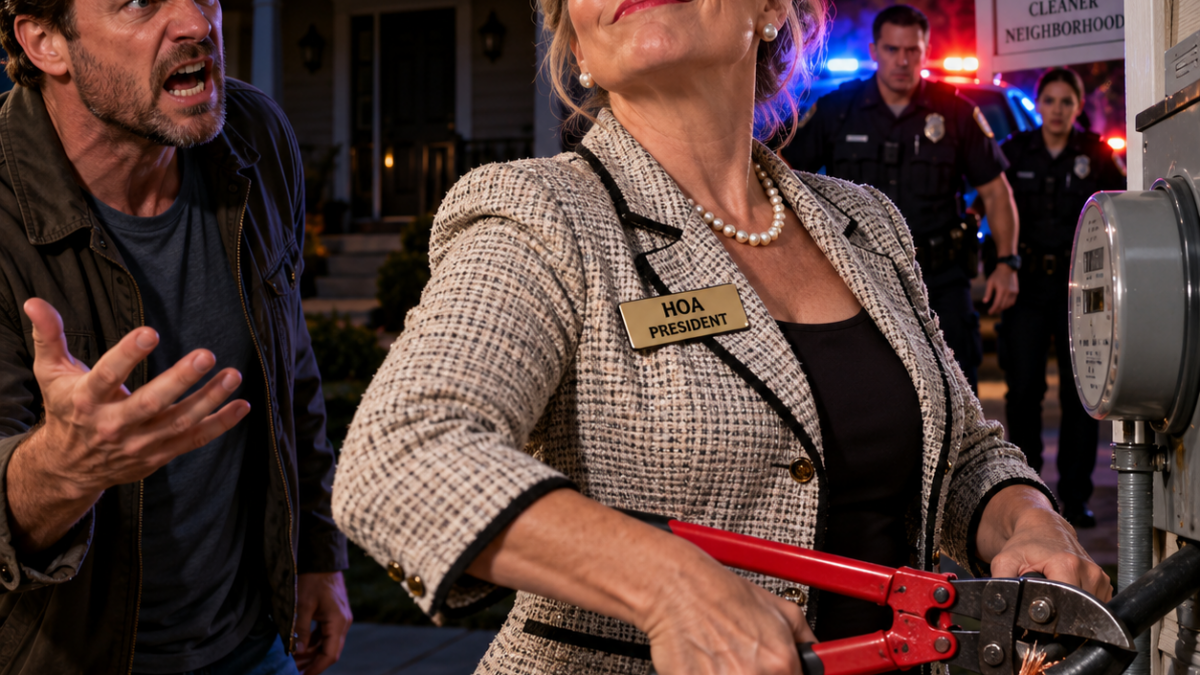
PART 2
The siren grew louder until blue and red lights washed across the perfectly trimmed lawns of Oak Creek Estates.
Neighbors began appearing.
Curtains moved.
Garage doors opened.
Phones came out.
Karen stared toward the entrance of the subdivision like she was waiting for someone to tell her this was all a misunderstanding.
She had spent years turning HOA notices into weapons.
In her world, every dispute ended the same way.
Karen issued a warning.
Karen threatened a fine.
The homeowner complained.
Then the homeowner surrendered.
She had apparently expected me to do the same thing.
A police cruiser stopped behind my truck.
The officer who stepped out was tall, broad-shouldered, and calm in the way people become when they’ve spent years walking into situations where everyone else is losing their mind.
He looked at me.
Then Karen.
Then the trench.
Then the bolt cutters.
“Who called?”
“I did,” I said.
Karen immediately stepped forward.
“Officer, thank goodness. I’m Karen Peterson, president of the Oak Creek Estates Homeowners Association. This resident has been operating an unauthorized industrial business, and I was correcting a serious electrical violation on common property.”
The officer looked at the severed cable.
“You cut that?”
Karen hesitated.
Only for half a second.
“Yes, but—”
He raised one hand.
“Don’t touch anything.”
“But I’m trying to explain—”
“Ma’am. Step away from the trench.”
For the first time, Karen obeyed.
I handed the officer my phone and showed him the recording.
Then I explained the easement, the permitted workshop, the commercial service, the certified letter I’d previously sent Karen, and the fact that the utility crew was on its way.
The officer listened without interrupting.
Karen kept trying.
“The HOA has authority—”
“Ma’am,” he said without looking at her, “I’ll speak with you in a minute.”
That sentence seemed to offend her more than anything else.
Karen wasn’t used to waiting.
Especially not while someone else controlled the room.
A white utility truck turned onto Oak Drive less than five minutes later.
The senior technician jumped down almost before the vehicle stopped.
He took one look into the trench.
Then he looked at the cutters.
Then he looked at Karen.
His face changed.
“Who cut this?”
Nobody answered for a second.
Karen finally raised her hand halfway.
“I did.”
The technician stared at her.
“You cut this with those?”
“Yes.”
He walked closer but stopped well outside the exposed area.
“Do you have any idea what this is?”
“An unauthorized electrical cable.”
“No.”
His voice was flat.
“This is a high-amperage service feeder.”
Karen opened her mouth.
He didn’t let her speak.
“You are unbelievably lucky to be standing here.”
That finally silenced her.
He pulled out a detector and carefully checked the exposed conductors.
After several tense seconds, he exhaled.
“Protection tripped upstream.”
He looked toward the officer.
“The system appears de-energized now.”
“Appears?” Karen repeated.
The technician turned toward her.
“Lady, you cut a power service with bolt cutters while standing in wet ground. Depending on exactly how the fault occurred, you could have been electrocuted. You could have caused an arc flash. You could have energized conductive material nearby. You could have gotten somebody else killed.”
The color drained from Karen’s face.
Her mouth opened.
Nothing came out.
The officer looked down at the cutters again.
Then at me.
“Estimated value of the damage?”
“I don’t know yet.”
The technician answered for me.
“If the conduit is crushed, this isn’t a splice-and-go repair. We could be talking about replacing the whole run.”
“Thousands?”
“Easily.”
Karen suddenly found her voice.
“This is ridiculous. I was acting for the association.”
The officer turned toward her.
“Did you have permission from the property owner?”
“I don’t need permission.”
“Did the utility company authorize you to cut this line?”
“No, because—”
“Are you a licensed electrician?”
“No.”
“Did you contact the city?”
“No.”
“Did you contact the power company?”
“No.”
“Did you obtain a court order?”
Her breathing became shallow.
“No.”
The officer nodded.
“Turn around.”
Karen stared at him.
“What?”
“Turn around and place your hands behind your back.”
She gave a nervous laugh.
It sounded almost childlike.
“You can’t be serious.”
“I’m serious.”
“I’m the HOA president.”
“Right now you’re also the person who admitted intentionally cutting electrical infrastructure belonging to someone else.”
Her face twisted.
“He violated the bylaws!”
“That is something your HOA can address through whatever lawful process exists. It doesn’t give you the right to cut utility lines.”
When he placed the handcuffs around Karen’s wrists, Oak Creek Estates became so quiet I could hear the utility truck idling.
Her eyes met mine.
The hatred in them was absolute.
“You did this,” she whispered.
“No,” I said.
“You did.”
She was guided toward the police cruiser while half the neighborhood watched.
Part of me felt satisfaction.
I’d be lying if I said otherwise.
For months, Karen had treated me like an intruder in my own home.
She’d criticized my truck.
My flag bracket.
My lawn.
My trash cans.
My workshop.
She had sent anonymous noise complaints and then quoted those complaints back to me as proof that my business was disruptive.
Seeing handcuffs close around her wrists felt like reality had finally entered the conversation.
But the feeling didn’t last.
Because when the senior utility engineer finished inspecting the damage, he walked over with an expression I didn’t like.
“I’m George.”
“Frank.”
He shook my hand.
“You’re the property owner?”
“Yes.”
“Come take a look, but stay behind me.”
We approached the trench.
George pointed toward the crushed conduit.
“See that deformation?”
I nodded.
“The cutters didn’t only damage the conductors. Whoever did this compressed the conduit too. We can’t guarantee the integrity of the remaining insulation, so we can’t just splice the section and bury it again.”
“Meaning?”
“Meaning the safest solution is replacing the run.”
“How much?”
He rubbed his jaw.
“Rough estimate? Fifteen thousand. Could be twenty.”
My stomach dropped.
“And how long?”
“A week if everything goes perfectly. Two if permits, inspection, or materials slow us down.”
I looked at the dark workshop.
Two weeks.
I had three customer jobs underway.
One was a restoration project for a collector who had already waited four months for specialized brackets I was machining.
Another was a custom gate with an installation deadline written into the contract.
The third was a run of components for a classic-car shop that could become my largest regular client if I delivered on time.
Karen hadn’t just cut electricity.
She had cut cash flow.
She had cut deadlines.
She had cut the fragile reputation of a new business that couldn’t afford to disappoint anyone yet.
George seemed to understand what I was thinking.
“We’ll document everything,” he said. “Police report, photographs, labor, material, replacement estimate. If the court orders restitution, you’ll have what you need.”
“Eventually.”
He nodded.
“Yeah. Eventually.”
Eventually didn’t pay this month’s mortgage.
Eventually didn’t keep customers.
Eventually didn’t replace two weeks of lost production.
When I went inside, Sarah was waiting in the kitchen.
She had kept the kids away from the windows after the police arrived, but she’d seen enough to understand what happened.
She hugged me.
Hard.
“Are you okay?”
“I’m fine.”
“She’s really arrested?”
“Yeah.”
Sarah pulled back.
“Good.”
I almost smiled.
Then she saw my face.
“What?”
I sat at the kitchen table.
“The whole line probably needs replacing.”
“How bad?”
“Fifteen to twenty thousand.”
Her eyes widened.
“And the shop?”
“Maybe two weeks.”
For several seconds, neither of us spoke.
Our daughter laughed somewhere upstairs.
That sound hit me harder than the repair estimate.
I had promised Sarah that leaving the military wouldn’t mean living in uncertainty forever.
We had moved here because I wanted stability.
A business.
A home.
A neighborhood where the kids could grow up.
And now a woman with a clipboard and a pair of bolt cutters had managed to threaten all three.
Sarah sat across from me.
“Okay.”
I looked at her.
“Okay?”
“Yes. Okay. We know the problem, so we solve the problem.”
That was Sarah.
She could turn panic into a checklist faster than anyone I’d ever known.
“Tomorrow morning, call the insurance company. Then rent the biggest generator you can legally put beside that workshop. Then call every customer personally and explain there was an electrical emergency, but you’re staying operational.”
“That generator will be expensive.”
“Losing your clients will be more expensive.”
She leaned closer.
“And then you get a lawyer.”
“For the criminal case?”
“No.”
Her eyes hardened.
“For Karen.”
That night, long after everyone went to sleep, I sat alone in my office with the HOA binder open in front of me.
Karen had given it to me two days after we moved into Oak Creek Estates.
She had arrived at my front door carrying the thing like Moses bringing commandments down from the mountain.
“These are our covenants, conditions, restrictions, architectural standards, and enforcement procedures,” she’d told me. “I recommend reading them carefully. We maintain high standards here.”
At the time, I’d thought she was irritating.
Now I understood something else.
Karen’s real power had never been the bylaws.
It was everyone else’s fear of them.
Most people didn’t read a sixty-page governing document.
They received a threatening letter, assumed the HOA must be right, paid the fine, and moved on with their lives.
Karen depended on that.
So I started reading.
Every section.
Every footnote.
Every amendment.
Every procedure.
Every sentence describing what the board could do.
More importantly, every sentence describing what homeowners could do.
At 3:12 in the morning, I reached the section on enforcement hearings.
Any owner disputing a violation had the right to written notice, supporting evidence, and a hearing before the board.
Interesting.
I kept reading.
Homeowners had inspection rights regarding association financial records.
Very interesting.
A special membership meeting could be triggered by a petition signed by twenty-five percent of owners.
Now I was awake.
The board could be removed by membership vote.
I sat back.
For months, I had treated the HOA binder like armor Karen wore.
I had been wrong.
It wasn’t armor.
It was a contract.
And contracts cut both ways.
The next morning, I rented a commercial diesel generator.
The thing was loud, ugly, expensive, and absolutely necessary.
By noon, extension feeds and temporary connections had restored enough power to operate part of the shop.
At 12:43 p.m., I found an envelope tucked beneath my windshield wiper.
Oak Creek Estates Homeowners Association.
OFFICIAL NOTICE OF VIOLATION.
I opened it.
Unauthorized industrial equipment visible from neighboring property.
Fine: $100 per day beginning immediately.
I actually laughed.
Not because it was funny.
Because it was insane.
Karen had destroyed the legal power supply to my workshop.
Now the HOA was fining me for the generator I needed because Karen had destroyed the legal power supply to my workshop.
There was a moment when I almost crumpled the paper.
Instead, I carried it inside.
I opened a new three-ring binder.
On the spine, I wrote:
HOA — INCOMING CORRESPONDENCE.
The generator notice became Exhibit One.
Then I drafted a response.
Not an angry response.
Not a sarcastic response.
A professional one.
I quoted their own temporary-equipment rules.
I quoted the emergency-mitigation clause.
I referenced the police incident number.
I attached photographs of the severed electrical line.
I attached the utility company’s preliminary repair estimate.
Then I wrote:
“Because this generator is necessary solely as a direct consequence of the intentional destruction of my permitted electrical service by the sitting HOA president, I dispute this violation in its entirety. I further request a formal hearing before the full Board of Directors pursuant to Article VII, Section 8.”
I sent it certified mail.
The next morning, another violation arrived.
Improperly stored construction materials.
They meant a stack of steel tubing behind my workshop.
The tubing had been there for weeks.
Nobody could see it from the street.
The next day:
Oil stain on driveway.
The stain was the size of a coin.
Then:
Improper garden hose storage.
Then:
Unapproved front-door color.
The door had been that color when I bought the house.
Then:
Children’s recreational item left on lawn outside permitted hours.
My son’s red bucket had sat beside the porch for ninety minutes.
Karen wasn’t just angry.
She was retaliating.
And she was doing it through the institution she controlled.
So I answered every notice.
Every single one.
Photographs.
Measurements.
Bylaw citations.
Certified mail.
Formal hearing request.
Within two weeks, the board owed me fourteen separate hearings.
I created a second binder.
HOA — OUTGOING CORRESPONDENCE.
Then a third.
EVIDENCE OF SELECTIVE ENFORCEMENT.
Sarah found me at the kitchen table one night surrounded by folders.
“You look happy,” she said.
“I’m not happy.”
“You are absolutely happy.”
I looked at the stack.
“I’m organized.”
“For you, that’s basically happiness.”
She kissed my forehead and went upstairs.
The more Karen pushed, the calmer I became.
Because something had changed.
I wasn’t reacting anymore.
I was documenting.
And Karen was giving me more evidence every day.
Then the neighbors started talking.
The first was Tom, who lived next door.
He walked over one evening while I was refueling the generator.
“Frank.”
“Hey.”
He looked toward Karen’s house before speaking.
“What she did to your power line was insane.”
“Agreed.”
“My wife and I just wanted you to know… we’re on your side.”
I put the fuel cap back on.
“Thanks.”
He hesitated.
“She did something similar to us.”
“Cut your electricity?”
“No. Nothing that crazy.”
He gave a bitter laugh.
“Our kids had a swing set. Brand new. We saved for it because the kids had been asking for one forever.”
I remembered seeing it when we moved in.
“Karen said the yellow slide violated the community’s earth-tone color palette. We appealed. She started issuing fines.”
“How much?”
“Five hundred before we gave up.”
“What did you do?”
“Bought a beige slide.”
The way he said it bothered me more than the dollar amount.
He was embarrassed.
Not because he’d done anything wrong.
Because Karen had made him feel weak.
Two days later, Dave Richardson stopped by.
Retired Air Force.
Quiet guy.
Rarely complained about anything.
He pointed toward the flag outside my house.
“Karen ever come after that?”
“Once.”
“What happened?”
“I sent her the federal statute.”
Dave smiled.
“Wish I’d known you five years ago.”
He told me Karen had forced him to remove a flagpole he’d had for almost a decade because she suddenly declared it an unauthorized permanent structure.
“Could’ve fought her,” he said. “But my wife was sick at the time. I didn’t have the energy.”
Then came Mrs. Gable.
She was in her seventies, lived three houses down, and had one of the most beautiful front gardens I’d ever seen.
Her husband had planted the roses before he died.
Karen fined her repeatedly because petals sometimes blew onto the sidewalk.
One evening, Mrs. Gable stood at my door holding a plate of cookies.
“I heard you’re fighting her.”
“I’m defending myself.”
“Sometimes that’s how fighting starts.”
Her eyes were gentle.
Then she told me Karen had threatened to place a lien on her house over accumulated landscaping fines.
Something inside me shifted.
This wasn’t just my problem.
Karen hadn’t suddenly become a tyrant when I moved into Oak Creek Estates.
She had been one for years.
I was simply the first person she’d attacked who happened to be stubborn enough—and prepared enough—to refuse surrender.
I invited Tom, Dave, and Mrs. Gable to my workshop.
The generator rumbled outside while we sat around my steel fabrication table.
I laid the binders in front of them.
Tom’s eyebrows rose.
“Jesus.”
“Fourteen violations,” I said. “Fourteen disputes. Fourteen hearing requests.”
Dave flipped through one binder.
“You answered all of these?”
“Every one.”
He smiled.
“You’re burying them in their own bureaucracy.”
“That’s the idea.”
Mrs. Gable touched one of the certified-mail receipts.
“What do you need from us?”
I opened the HOA bylaws.
“Information.”
They leaned closer.
“The rules give every member the right to inspect financial records, vendor contracts, and board meeting minutes.”
Tom laughed.
“Karen will never give those to you.”
“I know.”
He looked confused.
“Then why ask?”
“Because when she refuses, she creates another violation.”
Dave’s smile widened.
He understood.
“You’re forcing her to choose between exposing herself and breaking her own rules.”
“Exactly.”
We drafted the records request that night.
Five years of financial statements.
Bank records.
Vendor contracts.
Invoices.
Board minutes.
Executive-session records where legally disclosable.
Insurance policies.
Legal bills.
We gave them the deadline required under the governing documents and applicable state rules.
All four of us signed.
Then we sent it certified mail.
Ten business days passed.
Nothing.
Not even an acknowledgment.
By then, our small group had grown.
Neighbors who had spent years quietly paying fines began showing us their letters.
One family had been fined because Christmas decorations remained up until January 8.
Another because a basketball hoop faced the street.
Another because patio furniture cushions were supposedly the wrong shade of blue.
The pattern bothered me.
Karen’s most aggressive enforcement seemed directed at people least likely to fight back.
Young families.
Widows.
New owners.
Retirees.
Meanwhile, Karen’s closest allies on the board appeared to live in a magical violation-free zone where weeds, peeling trim, overflowing trash cans, and unauthorized decorations somehow became invisible.
Selective enforcement.
Retaliatory enforcement.
Potential misuse of HOA funds.
We needed an attorney.
I interviewed three.
The first wanted compromise.
The second suggested mediation.
Then I met Evelyn Reed.
She was in her late forties, precise, composed, and had spent most of her career litigating property disputes, condominium cases, and HOA governance fights.
I brought four binders.
She read silently for nearly forty minutes.
Every so often she placed a sticky tab on a page.
When she finished, she closed the last binder.
“Mr. Miller.”
“Yes?”
“Do you document everything like this?”
“Occupational habit.”
“Keep that habit.”
She tapped the binder.
“Most clients walk into this office with anger, assumptions, and half a dozen screenshots. You brought dates, signed receipts, photographs, governing documents, police records, repair estimates, and written admissions.”
“So we have a case?”
She leaned back.
“You have several.”
She started counting them.
“Property damage. Lost business income. Possible retaliatory enforcement. Potential breach of fiduciary duty. Possible abuse of association authority. Depending on what the financial records show, perhaps more.”
“And Karen personally?”
“Her biggest problem is that cutting your power line wasn’t a board vote executed through counsel. It appears to have been her personal intentional act.”
“So the HOA’s insurance may not protect her.”
“Correct.”
For the first time in weeks, I felt something close to relief.
Evelyn wasn’t emotional about the case.
That was what I liked most.
Karen operated through emotion.
Fear.
Embarrassment.
Intimidation.
Evelyn operated through leverage.
“We file,” she said.
“When?”
“Tomorrow.”
The lawsuit named the association and Karen personally.
We sought compensation for the electrical repairs, lost income, business interruption, legal costs, and damages associated with the alleged retaliatory campaign.
We also sought access to the records the board had refused to produce.
The moment Karen was served, the daily violation notices stopped.
Just stopped.
Fourteen days of harassment.
Then silence.
It was the most peaceful week I’d had since moving into Oak Creek Estates.
But peace wasn’t what Karen had bought.
She had bought discovery.
The HOA opposed our records request in court.
Their attorney claimed five years of financial documentation was excessive.
Judge Helen Mercer looked over her glasses at him.
“Did the homeowners request these records before filing suit?”
“Yes, Your Honor, but—”
“And did your clients respond?”
“They believed the request was—”
“Did they respond?”
A pause.
“No, Your Honor.”
Judge Mercer looked down at the paperwork.
“So members invoked a right created by your clients’ own governing documents, your clients ignored them, and now you’re arguing the members are unreasonable for asking the court to enforce that right.”
Their attorney shifted.
“That oversimplifies—”
“It simplifies it perfectly.”
She granted the motion.
Seven days.
Produce the records.
No games.
No selective production.
No further delay.
One week later, twelve banker’s boxes arrived at Evelyn’s office.
Karen’s board apparently hoped quantity would become camouflage.
It almost worked.
There were thousands of pages.
Invoices.
Canceled checks.
Landscaping contracts.
Attorney bills.
Meeting packets.
Insurance correspondence.
Bank statements.
Reserve-fund records.
Tax filings.
But Karen had made the same mistake twice.
She assumed nobody would look closely.
She didn’t know Arthur Benson.
Arthur lived on Willow Court and had spent thirty-four years as a certified public accountant.
Karen had once fined him over the model of his satellite dish.
When he heard we had five years of HOA financial records, he volunteered before I finished asking.
We turned my workshop into an audit room.
Folding tables filled the open floor between my equipment.
Tom scanned documents.
Dave created spreadsheets.
Mrs. Gable labeled boxes and fed everyone cookies.
Arthur sat beneath a work light with a calculator, reading glasses, and the happiest expression I’d ever seen on a retired accountant.
At first, the problems looked ordinary.
Sloppy approvals.
Missing signatures.
Weak recordkeeping.
Then Arthur stopped talking.
He pulled three invoices from a stack.
“Frank.”
I walked over.
“What?”
“Who is Prestige Greenscapes?”
“The HOA landscaping company.”
“Do you know who owns it?”
“No.”
He turned his laptop toward me.
The registered agent was Gary Peterson.
I stared at the last name.
“Karen’s husband?”
Arthur shook his head.
“Brother-in-law.”
We pulled the contract.
No competitive bids.
No disclosure of the family relationship in the minutes we could find.
The company had received the landscaping contract four years in a row.
Annual cost: more than $150,000.
Arthur started comparing invoices.
Five hundred dollars for replacement of one sprinkler head.
Thousands in monthly fertilization charges.
Repeated emergency maintenance surcharges.
Administrative fees layered over regular service fees.
Arthur circled figures.
“These rates are outrageous.”
“How outrageous?”
“Conservatively? Forty percent above what I’d expect for this property. Possibly more.”
Dave leaned over the table.
“How much over four years?”
Arthur scribbled.
Then he stopped.
“Potentially hundreds of thousands in excess payments.”
The room went quiet.
Tom whispered, “You’ve got to be kidding me.”
We kept digging.
Then we found a consulting contract.
Ten thousand dollars to a company registered to Carol Thatcher’s son.
Purpose: community satisfaction survey.
Nobody remembered completing a survey.
There was no report in the files.
No survey results.
No questionnaire.
Nothing.
Then legal bills.
Thousands upon thousands spent generating enforcement letters.
The HOA wasn’t merely harassing residents.
Residents were paying for the lawyers used to harass them.
But money wasn’t the discovery that changed everything.
The real breakthrough came after midnight on our third night.
Tom was sorting through a box labeled “Board Meeting Materials.”
He pulled out a thin folder.
“What’s this?”
The tab said DRAFTS.
Inside were handwritten notes.
Not official minutes.
Raw notes.
Things the board apparently never intended homeowners to see.
Mrs. Gable read one aloud.
“‘Gable—roses continue to create visual issue. Increase pressure until removed.'”
Her voice broke on the last word.
Nobody spoke.
Those roses had belonged to her husband.
Karen knew that.
Another note referenced Dave.
“Richardson flagpole—find structural violation if necessary.”
Then I saw my address.
120 Oak Drive.
I pulled the page closer.
“Miller workshop. Excessive industrial activity. Need stronger violation. Review boundary/easement options.”
My skin went cold.
Easement options.
I read it again.
Review boundary/easement options.
Karen hadn’t become obsessed with my power line because she thought it was ugly.
Something else was happening.
“Search everything with my address,” I said.
For the next hour, we pulled every reference.
Then Arthur found a folder relating to an assessment collected two years earlier for drainage improvements.
Inside were engineering reports.
Property maps.
A rezoning application.
I unfolded the first large map across my fabrication table.
Two acres at the rear of Oak Creek Estates were highlighted.
The wooded common area along the creek.
Karen had applied to rezone it.
From protected recreational common space to residential development.
“Was this ever voted on?” Tom asked.
We searched the minutes.
Nothing.
Arthur found another document.
A letter of intent.
Developer: Northbridge Residential Partners.
Proposed purchase price:
$1,200,000.
Nobody spoke.
My heartbeat became loud enough that I could hear it in my ears.
Then I looked at the proposed access route.
There was only one practical way to connect the development to the existing street.
The route crossed the edge of my parcel.
Exactly where my recorded utility easement ran.
I grabbed the laminated survey map from my filing cabinet.
Placed it beside the developer plan.
Everything aligned.
My electrical service wasn’t merely something Karen disliked.
It was an obstacle.
Dave saw it at the same moment.
“Frank.”
“I know.”
Tom looked between us.
“What?”
I pointed.
“Her development access road.”
Then I pointed to my survey.
“My utility easement.”
Mrs. Gable covered her mouth.
I thought back to Karen standing in the trench.
The cutters.
The smile.
“This unsightly cable was violating common-area aesthetics.”
No.
That wasn’t why she’d cut it.
At least, not if the documents meant what they appeared to mean.
She needed the easement gone.
Or weakened.
Or disputed.
My line physically and legally complicated her secret land transaction.
Suddenly the months of pressure made sense.
The noise complaints.
The attacks on the workshop.
The claims that my service was unauthorized.
The letter ordering me to remove it.
And finally, when I refused—
The bolt cutters.
Evelyn arrived at my workshop at seven the next morning.
She studied the documents without speaking.
When she finished, she looked at me.
“This changes the case.”
“How much?”
“Completely.”
She tapped the developer offer.
“Until now, Karen’s actions could be characterized as irrational HOA overreach. This provides a possible financial motive.”
“So she cut the line because she wanted the road.”
“We don’t state that as established fact until discovery supports it.”
She held up one finger.
“But we absolutely investigate it.”
“Can we show the neighborhood?”
“Most of these documents came from the HOA’s own records. Yes, but carefully. Present documents. Present dates. Present conflicts. Do not exaggerate.”
Dave smiled.
“Let the evidence do the damage.”
Evelyn looked at him.
“Exactly.”
I opened the bylaws again.
“There’s another option.”
Twenty-five percent of homeowners could petition for a special membership meeting.
Oak Creek Estates had 120 homes.
We needed thirty signatures.
We got fifty-eight.
In one weekend.
People didn’t just sign.
They told stories.
A mother who’d been threatened over sidewalk chalk.
A widower fined because his grass grew too long while he was recovering from surgery.
A family warned that their daughter’s graduation banner constituted unauthorized signage.
A couple who had repainted their shutters twice because Karen kept changing her interpretation of the approved-color chart.
For years, each family thought it was alone.
That was Karen’s genius.
Isolation.
She dealt with people privately so nobody realized how many others had suffered the same treatment.
Once they started talking, her power began collapsing before the meeting even happened.
We reserved the cafeteria at the local elementary school.
Neutral territory.
Every homeowner received formal notice.
Agenda:
Review of association finances.
Review of board conduct.
Discussion of pending governance concerns.
Vote of no confidence.
Karen sent her own letter three days later.
It described us as “a small faction of disgruntled homeowners attempting to destabilize community governance.”
That phrase probably added twenty people to our attendance.
The night before the meeting, I stood alone in my workshop.
The commercial generator was still running outside.
Most of my heavy machines were unusable.
Dust had settled across equipment that normally never sat quiet that long.
I ran my hand across the steel table.
I had bought this house because of this room.
After twenty years of following orders, sleeping wherever the Corps put me, moving when the Corps said move, leaving my family when the Corps said leave, this workshop was supposed to be mine.
My work.
My schedule.
My future.
Karen had nearly destroyed that because she assumed ordinary people would always be easier to intimidate than institutions were to challenge.
Sarah walked in.
“You ready?”
“No.”
She raised an eyebrow.
“That’s new.”
I smiled.
“I’m prepared.”
“That’s different.”
“Very.”
She handed me a coffee.
“What are you afraid of?”
I thought about it.
“That everybody gets angry.”
“Isn’t that the point?”
“No. Anger isn’t the point.”
I looked toward the stack of documents.
“If this turns into people screaming at Karen, she becomes the victim. We need them focused on what happened, not on how much they hate her.”
Sarah nodded.
“Then keep them focused.”
The next evening, nearly one hundred residents filled the cafeteria.
I’d never seen an HOA meeting with more than fifteen people.
Karen sat at the front beside Carol and Patricia.
Their attorney sat with them.
Karen wore a dark blazer and a look of forced confidence.
She had brought a gavel.
Of course she had.
I stood behind the podium.
Arthur sat beside the projector controls.
Dave and Tom were in the first row.
Mrs. Gable sat between them.
Evelyn remained at the back wall.
I looked across the room.
Then I started.
“My name is Frank Miller.”
A few people laughed nervously.
“Some of you know me as the guy whose electrical line was cut.”
More nervous laughter.
Karen glared.
I clicked the first slide.
The county survey appeared.
“This is the recorded survey of my property.”
Next slide.
The utility easement.
“This is the easement.”
Next slide.
Karen beside the severed cable.
“This is what happened to the electrical service inside that easement.”
Someone muttered, “Jesus.”
Karen started to interrupt.
Her attorney touched her arm.
I continued.
“I’m not asking anyone tonight to decide the criminal case. That’s for the justice system.”
That mattered.
I wasn’t conducting a trial.
I was showing them why we’d started asking questions.
“This incident made several homeowners wonder whether our association was being operated responsibly. We requested financial records.”
I showed the certified letter.
“We received no response.”
Next slide.
The court order compelling production.
“So we went to court.”
Silence.
“Then we received twelve boxes.”
Arthur took over.
He didn’t use dramatic language.
He didn’t need to.
He showed annual landscaping expenditure.
Then comparable market rates.
Then the no-bid contract.
Then Gary Peterson’s ownership information.
Somebody shouted, “Is that Karen’s brother-in-law?”
Arthur looked toward me.
I answered.
“According to the business registration, Gary Peterson is related to Karen Peterson. The documentation is on the screen.”
Karen shot to her feet.
“This is defamatory!”
Evelyn spoke from the back.
“Mr. Miller is displaying records produced by the association and publicly available corporate-registration information.”
Karen’s attorney whispered urgently.
Karen sat.
Next came Carol’s son’s consulting company.
Ten thousand dollars.
No survey report.
No supporting deliverables we could identify.
Then legal spending.
Then the handwritten notes.
When Mrs. Gable’s name appeared, I hesitated.
She had insisted we use it.
I read the sentence.
Increase pressure until removed.
Mrs. Gable stood.
She didn’t go to the microphone.
She simply turned toward the room.
“My husband planted those roses twenty-seven years ago.”
Her voice shook.
“He died six years ago.”
The cafeteria went completely silent.
“Karen knew that.”
Karen looked away.
Mrs. Gable sat down.
That was the moment the room changed.
Until then, people had been angry about money.
Now they understood what the power had done to people.
I showed the note about Dave’s flagpole.
Then the note about my workshop.
Review boundary/easement options.
Finally, I reached the developer documents.
“This is the two-acre green space behind Oak Creek.”
The map appeared.
Parents in the room recognized it immediately.
Kids rode bicycles there.
People walked dogs there.
Deer occasionally came through the trees.
“This is a rezoning application involving that parcel.”
Murmurs.
“This is a developer’s letter of intent.”
I clicked again.
The purchase price filled the screen.
$1,200,000.
The room erupted.
Karen stood.
“This is confidential negotiation material!”
That was probably the worst sentence she could have said.
Because it confirmed she knew exactly what they were looking at.
Someone shouted from the back.
“You were selling the park?”
Another voice.
“Who authorized this?”
Then another.
“Where was the vote?”
Karen grabbed her gavel.
“This meeting is out of order!”
Bang.
Nobody listened.
Bang.
“I said order!”
I stepped toward the microphone.
“Karen.”
She stopped.
I put the developer access map beside my easement survey.
The lines overlapped.
“My workshop service ran through the corridor shown here.”
The room gradually quieted.
“I can’t tell you tonight what was in Karen’s mind when she cut that power line. The criminal system will address that.”
Evelyn had insisted on that wording.
“But I can show you this. Before she cut it, the board’s internal notes referenced reviewing my easement. Before she cut it, this development proposal existed. Before she cut it, the proposed access route crossed the same corridor.”
I looked at Karen.
“And after I refused to remove the legal electrical service voluntarily, she cut it herself.”
Nobody shouted.
For a few seconds, silence was more powerful.
Then Tom stood.
“How much were they going to get?”
Karen’s attorney rose.
“There is no evidence that any board member would have personally received proceeds from a land transaction.”
Arthur answered.
“Then perhaps the former board can explain why the transaction was never disclosed to the membership.”
Former board.
I noticed Karen flinch.
People started standing.
“Resign!”
“Where did our money go?”
“Why wasn’t there a vote?”
“My dues paid your brother-in-law?”
The noise rose until it became impossible to hear individual voices.
I let it continue for several seconds.
Then I leaned into the microphone.
“Everybody stop.”
The room quieted gradually.
“We can scream for an hour.”
I held up the bylaws.
“Or we can use the authority we already have.”
I opened to the marked page.
“The governing documents allow members to remove directors by a two-thirds vote at a properly noticed special meeting.”
Karen’s attorney immediately moved toward the podium.
“This proceeding is invalid.”
Evelyn was already walking forward.
“On what basis?”
He stopped.
“This vote was not properly noticed.”
Evelyn held up the certified meeting notice.
“The agenda specifically states ‘vote of no confidence and removal of directors.’ Your clients received this twelve days ago.”
“The language—”
“Counsel.”
Her voice remained quiet.
“If you believe the vote is defective, you may challenge it through the appropriate legal process. You will not obstruct members from exercising the rights described in the governing documents your clients are obligated to follow.”
He stared at her.
Then stepped away.
We distributed ballots.
Karen Peterson:
RETAIN.
REMOVE.
Carol Thatcher:
RETAIN.
REMOVE.
Patricia Gable:
RETAIN.
REMOVE.
A teacher from Maple Lane volunteered to count.
People watched every ballot.
The first result:
Karen Peterson.
Remove: 89.
Retain: 4.
The room exploded in applause.
Karen sat motionless.
Carol received the same result.
Then Patricia.
Eighty-nine to four.
I returned to the microphone.
“Under the association’s governing documents, the directors are removed effective immediately.”
Karen finally spoke.
“You can’t do this to me.”
It wasn’t shouted.
That was what made it strange.
The woman who had spent years telling everyone else what they couldn’t do suddenly sounded confused that rules could operate against her too.
I looked directly at her.
“We didn’t.”
I glanced around the cafeteria.
“They did.”
Nominations opened for an interim board.
Tom nominated me.
I refused at first.
That surprised everybody.
“I didn’t start this because I wanted Karen’s chair.”
Dave stood.
“That’s exactly why you should have it.”
People applauded.
Sarah caught my eye from the back of the room.
She shrugged.
I knew that shrug.
It meant: You’re not getting out of this.
So I accepted.
Dave was elected.
Arthur was elected.
The vote was nearly unanimous.
By the end of the evening, the people who had spent years afraid of the HOA had taken control of it.
But Karen’s worst moment hadn’t happened yet.
As people left the cafeteria, Detective Russo was waiting near the side exit.
He had called earlier that day.
The district attorney had reviewed the electrical case.
Karen approached the door with Carol and Patricia.
Russo stepped forward.
“Ms. Peterson.”
She froze.
“What now?”
“I need to advise you that the district attorney’s office is proceeding with felony criminal-damage charges associated with the electrical-line incident, along with a reckless-endangerment allegation. Your attorney will receive the formal paperwork.”
Her face emptied.
For weeks, she had been telling people the arrest was an overreaction that would disappear.
Now it wasn’t disappearing.
It was moving forward.
Then the process server approached.
“Karen Peterson?”
She stared at him.
“You’ve been served.”
He handed her the civil complaint.
Karen looked down at the papers.
Then up at me.
There was no triumph in that moment.
Not for me.
I had imagined it many times.
The grand victory.
The satisfaction of seeing her understand that she’d lost.
Instead, all I felt was tired.
She had turned a neighborhood into a battlefield because she couldn’t tolerate anyone saying no.
Now lawyers, accountants, police officers, utility engineers, homeowners, and a judge were involved.
None of it had needed to happen.
Karen walked toward me.
Her attorney called her name.
She ignored him.
She stopped six feet away.
“You ruined my life.”
I stared at her.
“No.”
Her eyes narrowed.
“You humiliated me in front of everyone.”
“I showed them your records.”
“You turned them against me.”
“They voted.”
“You called the police.”
“You cut the line.”
For every accusation, the answer was the same.
Karen had spent years believing consequences were things she delivered to other people.
Now that consequences had found her, she couldn’t recognize them.
“You should have just complied,” she whispered.
That sentence erased whatever sympathy I might have felt.
I stepped closer.
“So should you.”
She left without another word.
The interim board met forty-eight hours later.
Our first decision was simple.
Ninety-day moratorium on all aesthetic fines unless there was an actual safety, sanitation, or property-damage issue.
Passed unanimously.
Second decision:
Terminate the association’s current legal counsel.
Passed unanimously.
Third:
Suspend all nonessential enforcement while we audited outstanding violations.
Passed unanimously.
Then Arthur opened the financial binders.
“This part is going to hurt.”
He was right.
It took weeks to unwind the mess.
Contracts had been renewed without competitive bids.
Certain expenses had been poorly documented.
Several enforcement actions appeared inconsistent with the governing documents.
We referred questionable financial transactions to appropriate professionals and authorities rather than pretending we were investigators.
Evelyn’s rule was simple:
Document.
Preserve.
Report.
Don’t speculate.
We terminated Prestige Greenscapes when its contract allowed.
Then we invited bids.
Three reputable companies responded.
The winning bid came in nearly forty percent below what Oak Creek had been paying.
Better service.
Lower cost.
Clearer reporting.
The first time Arthur showed the savings at an open meeting, residents applauded him like he’d won an election.
We rewrote enforcement procedures.
No anonymous violation notices without supporting evidence.
No fines without clear citation to a specific rule.
No selective exceptions for board members.
No secret reinterpretation of architectural standards.
No financial contract involving a board member’s relative without disclosure and independent review.
Board meetings would be open unless a legally valid reason required executive session.
Minutes would be published.
Budgets would be understandable.
We created term limits.
It turned out an HOA didn’t have to feel like a miniature dictatorship.
It could simply maintain shared property, manage common expenses, resolve genuine disputes, and then leave people alone.
Imagine that.
The power company restored permanent service to my workshop ten days after Karen cut the line.
The final bill was $18,742.
The morning they re-energized the system, George stood beside me.
“Ready?”
“Do it.”
He closed the disconnect.
For half a second, nothing happened.
Then the fluorescent fixtures blinked.
My compressor kicked on.
The ventilation system started.
Control panels glowed.
A familiar low electrical hum filled the room.
I had never realized how much I loved that sound.
Sarah stood near the door.
My son covered his ears when the compressor started.
My daughter cheered.
I turned on the plasma table.
Blue-white light flashed beneath the torch.
For the first time in ten days, my workshop was alive.
I should have started with the overdue customer jobs.
Instead, I took a piece of stainless scrap from the rack.
I drew a pattern.
Then another.
Then another.
By midnight, I had fabricated twelve steel roses.
Each flower was shaped by hand.
Curved petals.
Polished stems.
Small welded leaves.
The next morning I carried them to Mrs. Gable’s house.
She opened the door.
“Frank?”
“I made something for you.”
I handed her the first rose.
She stared.
Then covered her mouth.
“Oh.”
“They don’t drop petals.”
That made her laugh.
Then cry.
She hugged me.
We installed all twelve among the rose bushes her husband had planted.
For the first time since this started, I felt like we’d built something instead of merely destroying something bad.
My business recovered slowly.
I called every customer personally.
I explained what happened without turning it into an excuse.
Two extended their deadlines.
The classic-car shop owner surprised me.
“I heard about the HOA lady.”
“News travels.”
“Apparently.”
He paused.
“You still doing the parts?”
“Already machining them.”
“Then we’re good.”
That account eventually became one of my biggest recurring clients.
The criminal case moved slower.
Months.
Depositions.
Hearings.
Attorney meetings.
Karen’s lawyer challenged the value of the damage and disputed the reckless-endangerment theory.
But the evidence surrounding the electrical line was difficult to escape.
My video showed her admitting she intentionally cut it.
The utility technician documented the danger.
The survey showed the easement.
My certified letter proved she’d received the records before the incident.
Eventually, Karen accepted a plea agreement involving the felony property-damage charge.
The judge ordered probation.
Community service.
Fines.
And restitution.
Full restitution for the electrical repair.
$18,742.
The civil case followed.
Evelyn built the damages carefully.
Not imaginary numbers.
Not revenge numbers.
Invoices.
Canceled work.
Reduced production.
Generator rental.
Professional fees.
Documented lost income.
The retaliation notices.
The chronology.
Karen’s attorneys eventually realized the same thing Karen should have realized before touching the cutters:
Paper is powerful.
A person can lie about a conversation.
They can reinterpret an argument.
They can claim they forgot.
But a signed certified-mail receipt doesn’t forget.
A timestamped video doesn’t get intimidated.
A county survey doesn’t care who the HOA president is.
A bank statement doesn’t respond to threats.
By the time settlement negotiations began, Karen’s position was collapsing.
The civil judgment and related obligations ultimately left her responsible for a little more than $85,000 beyond the separate utility restitution.
For the first time, I actually felt uncomfortable.
Not because I thought she deserved to escape accountability.
She didn’t.
But $85,000 was real money.
A family could lose a house over numbers like that.
Sarah noticed my mood after Evelyn called with the result.
“You wanted her held responsible.”
“I did.”
“And?”
“I didn’t want to become somebody who enjoys watching another family fall apart.”
Sarah sat beside me.
“Then don’t.”
I looked at her.
“You can believe consequences were necessary without enjoying every consequence.”
That stayed with me.
A few months later, Karen’s house went on the market.
Nobody celebrated.
At least not around me.
I wouldn’t allow it at board meetings.
No jokes in official communications.
No victory signs.
No humiliating neighborhood newsletter.
We’d spent too much effort getting rid of Karen’s kind of leadership to imitate it the moment we had power.
One Saturday morning, I was driving outside town when I saw a roadside community-service crew.
Bright orange safety vests.
Trash bags.
Karen was among them.
Our eyes met through my windshield.
For a second, I saw the woman who had stood beside my trench with bolt cutters.
But she wasn’t smiling now.
She looked tired.
Older.
She looked away.
I drove on.
That was enough.
Several weeks later, the moving truck arrived.
Karen and her husband left Oak Creek Estates quietly.
The new owners were a young couple with three kids.
Two days after moving in, they installed a plastic swing set.
The slide was bright yellow.
I walked past it one evening and laughed so hard Dave thought something was wrong.
“What?”
I pointed.
He looked at the slide.
Then at me.
“Should we issue a violation?”
“Absolutely.”
He grinned.
“How much?”
“One hundred dollars per day.”
Mrs. Gable, who happened to be nearby watering her roses, shook her head.
“Don’t you dare.”
That yellow slide became the unofficial monument to the end of Karen’s administration.
The following year, we held the annual HOA meeting in the elementary-school cafeteria again.
Not because we expected a revolution.
Because people actually wanted to attend.
We presented the finances.
Revenue.
Expenses.
Reserve balance.
Contracts.
Everything.
Arthur announced that the association’s improved vendor agreements and reduced legal spending made it possible to lower annual dues by fifteen percent without reducing reserves.
People applauded.
Then came the green space.
The two acres Karen had tried to rezone.
We had spent months resolving the pending development paperwork.
The developer withdrew once it became clear the membership had never approved the transaction.
At the annual meeting, Dave introduced a motion to permanently designate the parcel as community green space.
Mrs. Gable amended it.
“I think it needs a name.”
Someone asked what she suggested.
She looked toward me.
“Liberty Park.”
I almost protested.
Then I noticed Dave smiling.
The motion passed.
We used part of the recovered savings to add a simple walking trail, benches, and a small picnic area.
Nothing fancy.
No giant entrance sign.
No expensive consultant.
Just a place where families could walk beneath the trees.
Children could play.
People could sit by the creek.
A piece of land that nearly became Karen’s secret development deal became the one place in Oak Creek Estates nobody was allowed to control.
One evening, almost exactly a year after the day she cut my power line, I was working late in the shop.
The gate project on my table was almost finished.
The welder crackled.
Sparks bounced across the concrete floor.
Outside, the October air was cool.
Through the open workshop door, I could hear kids playing in Liberty Park.
Dave’s flag flew across the street.
Tom’s children were screaming on their very non-earth-tone swing set.
Mrs. Gable was trimming the roses.
Sarah walked in carrying two beers.
She set one on the workbench.
“You know something weird?”
I lifted my welding hood.
“Lots of things.”
“Karen cutting your power line might have been one of the best things that ever happened to this neighborhood.”
I took the beer.
“I wouldn’t go that far.”
“Think about it.”
“I have.”
“You met half the neighborhood because of her.”
“True.”
“Mrs. Gable kept her roses.”
“True.”
“Dave got his flagpole back.”
I nodded.
“HOA dues went down.”
“Arthur will remind you that was his work.”
“And the park.”
I looked through the open door toward the tree line.
The sunset was turning the sky orange behind the branches.
A couple walked the new trail.
A little boy was chasing his sister across the grass.
None of those people knew how close that land had come to disappearing.
Sarah rested her elbows on the workbench.
“Would you do anything differently?”
That question took longer.
Finally, I answered.
“I would’ve called a lawyer sooner.”
She laughed.
“I’m serious.”
“I know.”
I took another drink.
“But no. Not really.”
I thought about the moment I’d arrived home and found Karen standing above that trench.
If I’d lost control then—if I’d screamed, threatened her, grabbed the cutters, done anything stupid—I might have turned myself into part of the problem.
Instead, I documented.
That decision had mattered more than any angry speech.
Karen always believed strength meant being the person who could force somebody else to obey.
The Marine Corps taught me something different.
Real strength is controlling yourself when somebody else has lost control.
It’s knowing when to move.
When to wait.
When to collect information.
When to let someone else’s mistake become the evidence that defeats them.
Karen’s biggest mistake wasn’t cutting the line.
Not really.
Her biggest mistake was believing that because she’d intimidated people before, she could intimidate everyone forever.
She thought my silence meant fear.
It didn’t.
I was reading.
She thought paperwork was boring.
I turned it into evidence.
She thought my neighbors were isolated.
We started talking.
She thought the HOA belonged to her.
We read the bylaws.
She thought her contracts were hidden.
We opened the books.
She thought the green space was just an asset nobody was paying attention to.
We turned it into a park.
And she thought cutting one electrical line would make my problem disappear.
Instead, that line connected everything.
The harassment.
The money.
The secret meetings.
The easement.
The developer.
The people she’d pushed around for years.
All of it.
I set down my beer and switched the welder back on.
Sarah started toward the door.
“Frank?”
I lifted the helmet again.
“What?”
She smiled.
“Try not to start another neighborhood revolution tonight.”
“No promises.”
She laughed and headed back toward the house.
I lowered my welding hood.
The arc ignited.
Bright white light filled my field of vision.
Steel heated beneath my hands.
Outside, children laughed beneath the trees of Liberty Park.
The sound mixed with the hum of my machines.
A year earlier, Karen had stood in my yard holding the severed ends of that power line and smiling because she thought she’d shut me down.
She had no idea what she’d actually switched on.
Not revenge.
Something much more dangerous to people like her.
Accountability.
And once an entire neighborhood discovered they didn’t have to be afraid anymore, there wasn’t a pair of bolt cutters in the world powerful enough to stop it.
My workshop kept humming.
Dave’s flag kept flying.
Mrs. Gable’s roses kept blooming beside twelve steel ones that would never lose their petals.
The yellow slide in Karen’s old backyard remained gloriously bright.
And the land she almost took from us remained exactly where it belonged.
Ours.
In the end, Karen did manage to change Oak Creek Estates forever.
Just not in the way she intended.
She cut one power line because she thought it stood between her and what she wanted.
Instead, she exposed every connection she had spent years trying to keep hidden.
And when those connections finally came into the light, her entire little empire went dark.
Mine didn’t.
The lights in my workshop came back on.
And this time, they stayed on.