PART 2: HOA President Changed My Gate Code—Then My Smart Lock Proved She Broke Into My Home
PART 2:
The first rule of a security breach is simple.
Do not panic.
The second rule is even simpler.
Preserve the logs.
People think evidence is dramatic. They imagine a smoking gun, a shouted confession, a villain caught in the act. Sometimes that happens. Most of the time, evidence looks like a dull little line of text on a screen.
2:18 p.m. New administrative code created: Karen_Master.
Device: Karen iPad Pro.
That was the line that changed everything.
I did not edit it. I did not screenshot only the convenient part. I exported the complete system log from the gate portal, then downloaded the raw access file, then saved both to an encrypted folder. I made three copies: one on my laptop, one on a cloud drive, and one on a physical external drive I kept in my fireproof safe.
Then I sat there for a long time in the blue glow of the monitor, listening to the quiet house around me.
Sarah had finally fallen asleep upstairs. Lily was in her room with her stuffed rabbit tucked under one arm, exhausted from crying and confusion she was too young to understand. To her, the gate was supposed to open because Daddy said it would. Home was supposed to let us in.
Karen had broken something larger than a keypad that afternoon.
She had made my little girl feel locked out of safety.
That was the part I could not forgive.
Still, forgiveness and strategy are separate subjects.
I did not storm across the neighborhood.
I did not send an angry email.
I did not call Karen and give her the satisfaction of hearing my voice shake.
I opened a new binder.
White spine.
Clear cover.
Fresh tabs.
On the front page, I wrote:
OAKMONT GATE INCIDENT.
Then I built the record.
Tab One: Original Approval.
I pulled up the modification request from the year before, when we bought the house. The previous HOA president, Mr. Abernathy, had been a kind, practical man who still believed an HOA existed to help neighbors live together, not to rule them like peasants. I had submitted a complete technical packet for the gate system: make, model, UL safety ratings, schematic, power backup, manual override procedure, and the smart lock audit features.
The system used encrypted rolling codes, which made it far more secure than the generic four-digit code shared by half the delivery drivers in Oakmont Estates. Every access attempt was logged. Every administrative change was recorded. Every successful entry had a timestamp and camera capture.
I had included all of that because security mattered to me.
Not as a hobby.
As a necessity.
After twenty years in uniform, after a blast injury that left me with a knee that predicted storms and a nervous system that sometimes mistook a slammed door for incoming fire, control over my immediate environment was not about luxury. It was about stability. It was about being able to sleep beside my wife without checking the windows three times. It was about teaching my daughter that home was safe even if parts of my mind still believed the world could turn hostile in a second.
Abernathy had approved it.
His email was short and human.
Looks great, Mark. Frankly, we could all probably use an upgrade like this. Approved.
I printed it.
Tab Two: Karen’s Violation.
I added the five-hundred-dollar fine she handed me at the gate. I added the invoice from Oakmont Secure Solutions, the “approved vendor” she claimed had standardized my access.
That company bothered me immediately.
The address was a P.O. box.
The business had been registered only two months earlier, right after Karen became HOA president. The registered agent was Frank Miller. A quick search showed Frank was married to Karen’s sister.
I printed the business registration.
Then I printed the photos from social media: Karen smiling beside Frank and his wife at a Christmas party, arms around each other, captioned “family forever.”
Tab Three: System Logs.
I printed the access log showing the deactivated family codes, the creation of Karen_Master, the device name Karen iPad Pro, and the login from an unrecognized device using the vendor account.
That part mattered.
The vendor account had been created for the original installer during setup. It was supposed to be temporary. I should have disabled it months earlier. That was on me. But forgetting to lock a service door does not give someone permission to walk into your house and rearrange the furniture.
Karen had not asked.
She had not notified me.
She had not obtained my consent.
She had seized administrative access to my private security system and created a code for herself.
That was not HOA governance.
That was control.
Tab Four: Costs.
I made an invoice.
Three hours of my time at a consultant rate of one hundred fifty dollars per hour. Diagnosing the illegal lockout. Performing manual override. Restoring temporary physical access. Documenting the breach. Total: four hundred fifty dollars.
Sarah came into the office while I was printing it.
She was wearing a robe, arms folded tight across her chest.
“You’re billing the HOA?”
“Yes.”
“They won’t pay it.”
“I know.”
“Then why?”
“Because Karen handed me a bill for violating a rule I didn’t break. I’m handing them a bill for the damage they actually caused.”
Sarah stared at the paper, then at me.
For the first time that night, she smiled.
It was small.
Tired.
But real.
“Good.”
The next morning, I mailed certified letters to every board member, not just Karen.
That was important.
Karen’s power depended on controlling information. If I sent the dispute only to her, she would bury it, distort it, or summarize it as “Mr. Henderson is being difficult.” So I made sure every board member received the same packet.
The letter was polite.
Numbered.
Cold.
I disputed the fine. I cited the prior approval. I demanded the restoration of our family access codes. I demanded deletion of Karen_Master. I demanded written confirmation that no HOA officer, board member, vendor, or contractor retained any access to my gate, garage, or property. I included the invoice for my time.
Then I waited.
The response came at the monthly HOA meeting.
Not by letter.
Not by email.
By ambush.
I went because I knew Karen would use the public stage. She could not help herself. Bullies who enjoy audiences eventually forget the danger of witnesses.
The clubhouse smelled of lemon cleaner and artificial flowers. About fifteen residents sat in folding chairs, most of them looking like they had come out of obligation rather than interest. Sarah sat beside me, her hand resting lightly on mine. My binder was on my lap.
Karen sat at the head table wearing a pastel blazer and the expression of a woman preparing to discipline a child.
“We have received a complaint from Mr. Henderson regarding a security compliance fine,” she began.
I noticed the framing immediately.
A complaint.
Not a formal dispute.
Not a documented breach.
A complaint.
“Mr. Henderson seems to believe,” she continued, “that because he is a veteran, our community standards do not apply to him.”
A murmur moved through the room.
I remained still.
“He installed a nonstandard electronic gate system that creates a security concern for Oakmont Estates. When the board acted responsibly to correct this issue, he responded with baseless accusations and a bizarre invoice for his own time.”
She lifted my letter and shook it as if it were contaminated.
Then she crossed a line I had not expected her to cross in public.
“We are also aware,” she said, lowering her voice into a fake tone of concern, “of Mr. Henderson’s medical struggles related to his service. We sympathize, of course. But stress can affect judgment. The board cannot allow one resident’s personal issues to compromise the safety and harmony of the entire neighborhood.”
The room went silent.
Sarah’s hand tightened around mine.
For a second, the edges of my vision narrowed.
Not because I was ashamed.
Because Karen had taken something private, something painful, something my family managed carefully and quietly, and used it as a weapon to make me look unstable.
I could feel the old heat rise in my chest.
Then I breathed once.
Slowly.
In through the nose.
Out through the mouth.
Karen wanted a reaction. She wanted me to stand up angry, to prove her point for her, to let the room see a veteran losing control.
I gave her nothing.
That bothered her more.
When the meeting ended and people began filing out, an older man approached me. He wore a tweed jacket despite the warm weather and carried himself with quiet legal gravity.
“Mr. Henderson,” he said. “George Franklin.”
I shook his hand.
“Mark.”
“I was legal counsel to this HOA for fifteen years before I retired.”
“That sounds like a sentence.”
He smiled slightly.
“Sometimes it was.”
Then his expression hardened.
“What she did tonight was disgusting.”
I looked toward Karen, who was still at the head table collecting papers like a victorious general.
“She overplayed her hand.”
George glanced at my binder.
“You keep records.”
“I do.”
“Then we should talk.”
We met the next morning at a café downtown, far from Oakmont’s gossip loop. George arrived with a legal pad. I arrived with the binder.
For two hours, we worked through the timeline.
Original approval.
Gate lockout.
Vendor invoice.
Family relationship.
System logs.
Karen_Master.
Karen’s public comments about my medical history.
George reviewed every page carefully. He had the patient hands of a retired attorney and the sharp eyes of a man who had spent decades watching people lie badly.
When he reached the printout showing Karen iPad Pro, he tapped it twice.
“This is more than HOA overreach.”
“I know.”
“She created access to your private property.”
“Yes.”
“And she used her brother-in-law’s company to do it.”
“Yes.”
“That is self-dealing at minimum. Breach of fiduciary duty. Possibly computer misuse depending on state law. But criminal trespass would require entry.”
I looked at him.
“She made herself a code.”
George’s eyes narrowed.
“You think she’ll use it.”
“I think she won’t be able not to.”
For a moment, he said nothing.
Then he leaned back.
“That is risky.”
“For her.”
“For you too.”
“I’m not inviting her in. I’m documenting what she already gave herself the ability to do.”
George studied my face.
“You are very calm about this.”
“I’m not calm. I’m trained.”
That seemed to satisfy him.
He asked one question.
“Do you want the fine removed, or do you want her removed?”
I thought about Lily crying in the car seat.
I thought about Sarah stranded outside the gate with groceries melting in the trunk.
I thought about Karen saying medical struggles into a microphone.
“I want the system that allowed her to do this dismantled.”
George nodded.
“Then we need more than your story.”
He gave me names.
The Millers, a young couple forced to dismantle their daughter’s backyard play set even though the bylaw referenced front yards only. Mrs. Gable, whose rose garden had been under threat because Karen declared her hybrid teas “nonconforming plantings.” Mr. Chen, fined for parking his plumbing van in his own driveway for more than an hour. A retired nurse cited over a blue front door. A family fined because a basketball hoop was visible after sunset.
I started knocking on doors.
I am not naturally social. I prefer systems to small talk, schematics to gossip, rules to rumors. But this was not gossip. This was intelligence gathering.
The Millers’ backyard looked empty in the saddest way. You could see the flattened patch where the play set had been. Their daughter watched from the sliding glass door while her father explained how Karen had threatened twenty-five dollars a day until it came down.
“She said her interpretation mattered more than the wording,” Emily Miller told me.
Her husband gave a humorless laugh.
“I thought rules were supposed to mean what they say.”
“They are,” I said. “When honest people enforce them.”
They agreed to write a statement.
Mrs. Gable agreed too.
She showed me the roses Karen wanted removed. They were beautiful, old, carefully tended, the kind of garden that carries someone’s life inside it. She had a letter from a previous board granting an exception years earlier. Karen had dismissed it because, in her words, “prior leniency does not bind current leadership.”
“She thinks kindness is a weakness,” Mrs. Gable said.
“No,” I said. “She thinks memory is.”
By the end of two weeks, my binder had doubled in size.
Affidavits.
Notices.
Photos.
Payment records.
Medical privacy notes.
Vendor filings.
A pattern.
Karen’s power came from isolation. She made each homeowner believe they were alone, unreasonable, and powerless. But once the stories sat side by side, the pattern became impossible to miss.
It was not governance.
It was domination.
Now I needed the final piece.
The trap.
Sarah hated that word.
“Don’t call it that,” she said one night while I checked the camera angles from my phone.
“What should I call it?”
“Documentation.”
I smiled.
“All right. Documentation.”
But it was a trap.
A legal one.
A clean one.
One she would enter only if she chose to break the rules.
We were scheduled to visit Sarah’s parents that weekend, three hours north. It had been planned for weeks. I did not invent the trip. I simply recognized the opportunity. Karen needed a reason to believe we would be gone. She also needed bait.
So I made small, visible changes.
New brushed-nickel house numbers.
A brighter motion-activated light over the garage.
A few boxes marked SECURITY UPGRADE placed just inside the garage where they could be seen if someone peered through the side window.
Then I planted the information where I knew it would grow.
Carol Whitcomb was Oakmont’s unofficial news service, a woman who could turn a mailbox conversation into a neighborhood-wide bulletin before lunch. She was loyal to Karen because Karen made her feel important. I saw Carol while checking the mail and gave her exactly what she wanted.
“Heading out of town this weekend?” she asked.
“For a few days,” I said. “Visiting Sarah’s parents.”
“Oh, how nice.”
“It’ll give me time to finish planning the new security setup when I get back.”
Her eyes sharpened.
“New security?”
I lowered my voice just enough.
“After what happened with the gate, I’m not taking chances. I’m putting in something completely independent. Military-grade. Once it’s installed, nobody touches my system again.”
Carol’s mouth formed a little O of interest.
I gave her a polite nod and walked away.
That information would reach Karen before dinner.
On Friday afternoon, before we left, I made the real preparations.
I installed two small cameras.
One in the garage, hidden high on a shelf between paint cans, with a wide view of the side door, workbench, storage cabinets, and the door into the house.
One inside the back hallway, aimed through the glass pane at the patio and garage entry.
I tested both feeds.
Clear.
Timestamped.
Cloud-backed.
Then I staged the garage.
Not illegally. Not dangerously. Nothing that invited entry.
Just bait for a snoop.
Blueprints from an old project spread on the workbench. A few electronic parts I had pulled from a junk drawer. A book on encryption placed where the title was visible. Enough to make a control freak believe she had discovered proof of defiance.
Finally, I checked the gate portal.
Karen_Master was still active.
I had not deleted it.
Not yet.
Sarah watched me from the doorway.
“Are you sure she’ll do it?”
I looked at the access log.
“She created a master code to my home. A person who creates a secret key usually wants to use it.”
“And if she doesn’t?”
“Then we still have enough to remove her politically.”
Sarah folded her arms.
“And if she does?”
“Then she removes herself.”
The drive to her parents’ house felt longer than three hours. Lily slept for part of it, her head tilted against the car seat. Sarah watched the road in silence.
I kept my phone face up in the cupholder.
Nothing happened Friday night.
Nothing happened Saturday morning.
Nothing happened Saturday afternoon.
By dinner, doubt started creeping in.
Maybe Karen was arrogant but not reckless.
Maybe Carol had not told her.
Maybe George was right and I was pushing too close to the line between strategy and obsession.
Then, at 7:32 p.m., my phone chimed.
Oakmont Gate System: Front gate access granted.
Code: Karen_Master.
I froze.
Sarah saw my face.
“Mark?”
I opened the camera app.
The garage feed showed nothing at first. Just the workbench, shelves, shadows, and the quiet rectangle of the side door.
Then another notification.
Garage side door access granted.
Code: Karen_Master.
“She programmed it into the garage too,” I whispered.
Sarah covered her mouth.
The side door opened.
Karen stepped inside.
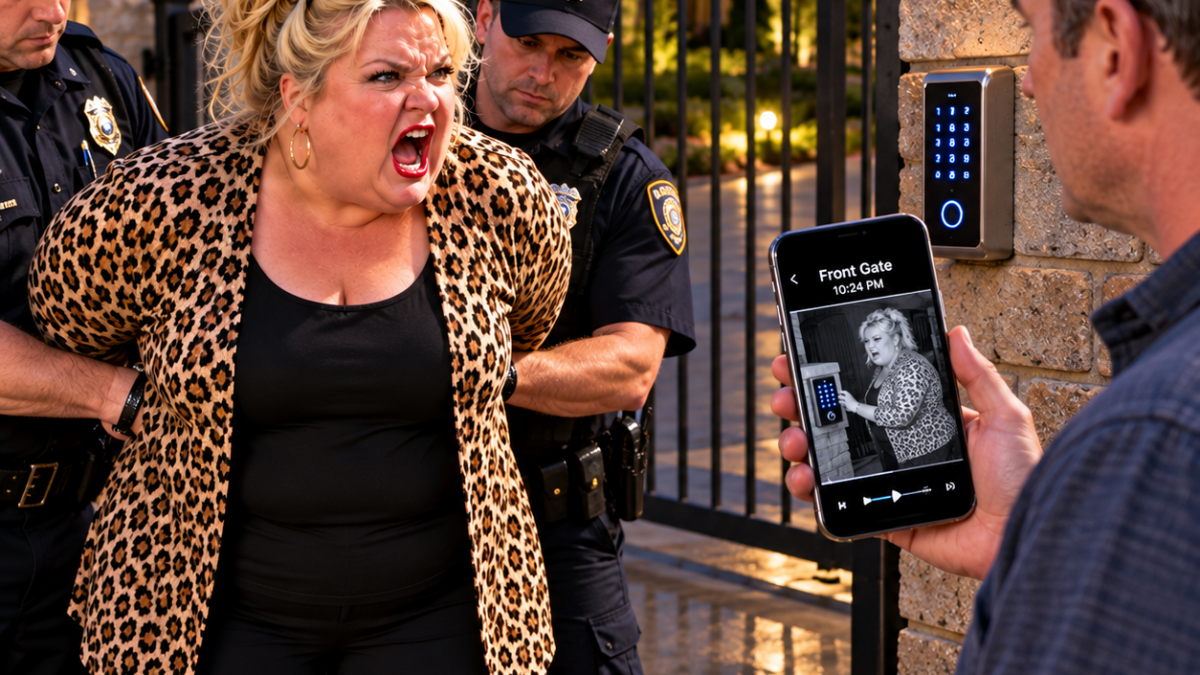
She wore a dark tracksuit and a visor pulled low as if that made her invisible. She paused, looked around, and closed the door behind her.
There are moments in life when anger becomes so clean it stops feeling like anger.
That was one.
I hit record on my phone, though the camera was already saving to the cloud.
Karen moved through my garage like she owned it.
She ran her hand over a toolbox.
Opened one cabinet.
Peered into a storage bin.
Then she found the workbench.
The decoy worked perfectly.
She picked up the blueprints, squinted at them, then lifted the encryption book.
The microphone caught her voice.
“Military grade,” she muttered. “Thinks he’s so clever.”
Sarah whispered, “Oh my God.”
Karen spent four minutes snooping.
Four minutes is a long time when someone is inside your sanctuary without permission.
Then she walked to the interior door leading into the house.
She tried the handle.
Locked.
The hallway camera caught her face through the glass. Clear. Frustrated. Unmistakable.
She jiggled the handle again.
Then she gave up, left through the garage side door, and locked it behind her.
The final notification appeared.
Garage side door locked.
I saved everything.
Raw footage.
Edited clip.
System logs.
Screenshots.
Cloud backups.
External drive.
Then I looked at Sarah.
“The trap is sprung.”
She did not smile.
Neither did I.
Because catching someone violating your home is not satisfying in the moment.
It feels dirty.
Like the air has changed.
When we returned Sunday, I walked through the garage slowly before letting Lily inside. Nothing seemed stolen. Nothing damaged. But that was not the point. The violation was not measured by missing tools. It was measured by Karen’s belief that she had the right to enter.
My first call Monday morning was to George.
“I have her,” I said.
There was silence.
Then: “Bring everything.”
We met in his study.
Books lined the walls. Old law journals. Property manuals. Bound volumes from a life spent turning chaos into argument. I played the footage once. George did not interrupt.
When Karen tried the house door, his jaw tightened.
When the video ended, he leaned back and said, very softly, “That will do.”
For two hours, we assembled the package.
Not just the video.
That would have been enough for a complaint, but George wanted no chance of anyone dismissing it as a neighborhood squabble.
The package included the original gate approval, Karen’s fine, the vendor invoice, the business registration linking the vendor to her family, the access logs showing Karen_Master, the device name, the timestamps, the affidavits from other homeowners, the HOA meeting summary where she publicly referenced my medical history, and the complete video file on a USB drive.
“We are not handing police a grievance,” George said. “We are handing them a case.”
He called Detective Miller in county property crimes.
Miller agreed to meet the next day.
The detective was a hard-faced man in his forties with the exhausted patience of someone who had seen every variety of human foolishness. He listened. He read. He watched the video.
When Karen tried the house door, he paused the footage.
“She attempted entry into the residence itself?”
“She tried the handle.”
“Was it locked?”
“Yes.”
He rewound and watched again.
Then he looked at the access logs.
“She created or used a code issued to herself?”
“The code was created after my family codes were disabled. Device name Karen iPad Pro.”
He nodded once.
“That’s clear.”
George said, “We are aware trespass may be charged as a misdemeanor depending on the facts. But the context matters. This was not accidental entry.”
“No,” Miller said. “It wasn’t.”
He put the USB drive into an evidence bag.
“We’ll speak with Ms. Peterson.”
I thought I would feel triumphant.
I did not.
I felt tired.
But the next phase moved quickly.
George drafted a cease and desist letter ordering Karen to stop all contact, stop defaming me, stop attempting access to my property, and preserve all records related to Oakmont Secure Solutions. A process server delivered it to her at the community pool in front of half her loyalists.
I was not there.
But Oakmont had no shortage of witnesses.
By evening, the neighborhood’s online page was burning.
“Did anyone else see Karen get served?”
“What happened?”
“Is this about the Henderson gate thing?”
“She did this to the Millers too.”
“She’s been harassing Mrs. Gable.”
Then two county police officers visited Karen’s house the next afternoon.
They did not handcuff her on the porch. This was not television. But they did issue a criminal trespass citation and notified her of the ongoing case.
That was enough.
Her aura shattered.
Within forty-eight hours, the remaining board members scheduled a special meeting to consider removing her.
The clubhouse was packed.
Standing room only.
Karen sat in the front row, not at the board table. That alone told the story. She wore a white jacket and a stiff expression, but her hands trembled in her lap.
The acting president, Arthur, looked like he might faint.
“Mr. Henderson,” he said, “you have the floor.”
I walked to the podium with my binder.
I did not show the video. That belonged to the criminal case. I would not jeopardize prosecution for the sake of spectacle.
But I did not need the video.
I had the logs.
The first slide read:
A PATTERN OF MISCONDUCT.
I began with the approval.
Then the fine.
Then the vendor.
Then the family connection.
Then the access log.
Front gate access granted.
Code: Karen_Master.
Garage side door access granted.
Code: Karen_Master.
A gasp moved through the room like wind through dry leaves.
“The president of this HOA created a secret administrative access code to my private property,” I said. “While my family and I were away, that code was used to enter my gate and my garage without permission. This is now the subject of an active criminal case.”
The room erupted.
Karen stood.
“This is a lie!”
Someone shouted, “Then why is there a code with your name?”
She pointed at me.
“He is unstable! I told you! This is exactly what I warned you about!”
That was her last mistake.
Mrs. Gable stood up.
She was small, elderly, and soft-spoken. But when she rose, people quieted.
“You said my roses were a violation,” she said. “You said the exception I had was worthless because you were in charge now. You made me afraid to open my mailbox.”
Karen’s mouth tightened.
Mrs. Gable looked around the room.
“I am not afraid tonight.”
The Millers stood next.
Then Mr. Chen.
Then the woman with the blue door.
One by one, the people Karen had isolated became visible.
That is the moment a bully truly loses power.
Not when someone argues louder.
When victims stop standing alone.
I returned to the microphone.
“This is not about one gate,” I said. “It is not about one fine. It is about whether this community belongs to all of us or to one person with a clipboard and a personal vendor list.”
Then I closed the binder.
“I move that Karen Peterson be removed from the board for conduct detrimental to the community.”
George seconded from the front row.
The vote was not close.
“All in favor?”
The room thundered.
Aye.
“All opposed?”
Silence.
Karen was removed immediately.
She gathered her purse and walked out without looking at anyone.
For the first time since moving to Oakmont, the room felt breathable.
The aftermath unfolded in layers.
The new board voided every disputed fine issued during Karen’s tenure. They terminated Oakmont Secure Solutions. They ordered a financial review of all vendor contracts. They issued formal written apologies to me, Sarah, the Millers, Mrs. Gable, Mr. Chen, and every resident who had been targeted.
Then they passed a digital privacy amendment.
No HOA officer, vendor, or board member could access, alter, disable, or demand control of a homeowner’s private electronic security system without a court order or a true emergency involving immediate risk to life or property.
People started calling it the Henderson Rule.
I hated that.
Sarah loved it.
Karen’s criminal case ended in a plea.
Criminal trespass.
Fine.
Probation.
Community service.
Most importantly, a restraining order barring her from contacting me, Sarah, Lily, or coming within one hundred feet of my property.
The first thing I did after the hearing was delete Karen_Master from the system.
The second thing I did was restore Sarah’s code.
Then Lily’s emergency code, which she would not use for years but insisted needed to be named PrincessGate.
I allowed it.
Karen and her husband sold their house two months later.
No dramatic farewell.
No public apology.
No final confrontation.
Just a moving truck, a lowered face, and the quiet knowledge that the neighborhood she tried to own had rejected her.
Oakmont changed after that.
The Millers rebuilt their daughter’s play set.
Mrs. Gable’s roses bloomed across the side of her house in red, pink, and white defiance.
Mr. Chen parked his work van in his driveway without fear.
The woman with the blue door repainted it an even brighter blue.
People talked at mailboxes.
Kids rode bikes in the street.
The HOA meetings became boring, transparent, and mercifully short.
And my gate?
It opened when I told it to.
One evening, months later, I stood in the driveway while Lily rode her bike in slow circles near the garage. Sarah came out and slipped her hand into mine.
“It’s quiet,” she said.
I watched Lily laugh as the gate lights blinked softly in the dusk.
“No,” I said. “It’s peaceful.”
There is a difference.
Quiet can be fear.
Peace is trust.
Karen had tried to turn my own gate into a weapon against my family. But in the end, that gate did exactly what I built it to do.
It kept a record.
It protected the line.
And when someone crossed it, it told the truth.