PART 2: HOA President Built a Dirt Wall to Steal My View—Then My Engineer Proved It Was Flooding Nine Homes
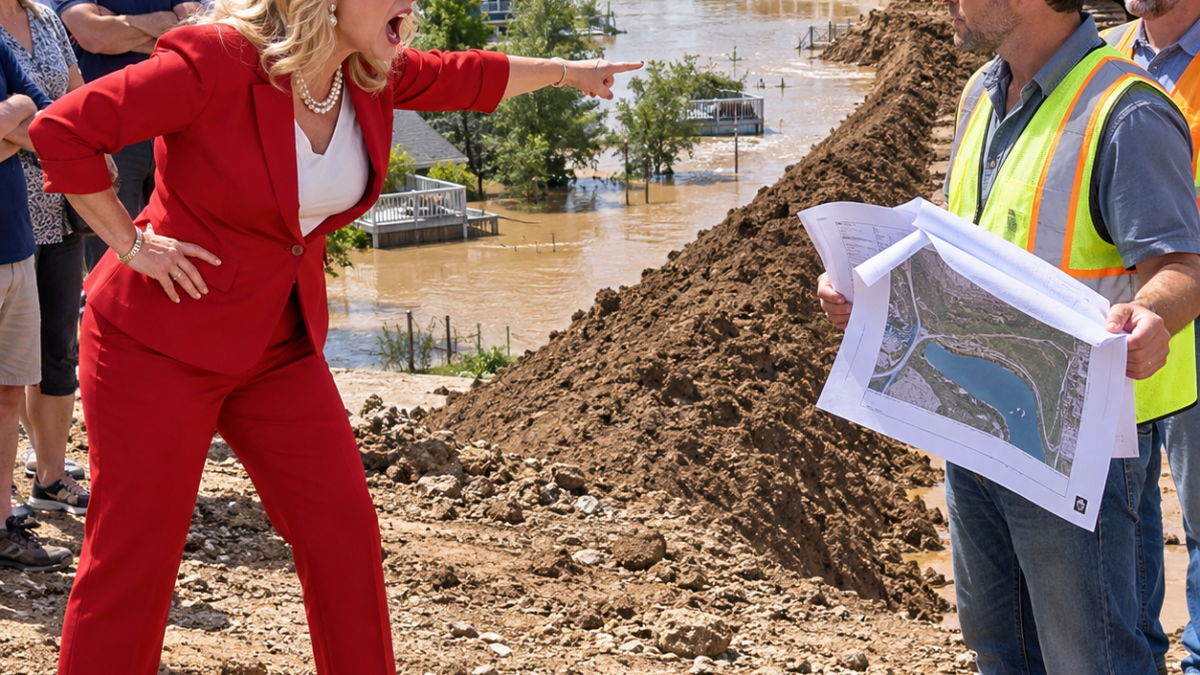
PART 2
I stared at Dr. Albright while Karen stood fifteen feet away, puffed up with rage and trying to pretend she still controlled the moment.
“What do you mean bigger than my yard?” I asked.
Dr. Albright pulled the soil probe from the ground and studied the dark, wet clay clinging to it. She didn’t answer immediately. That told me enough. Good engineers don’t guess in front of clients. They observe, measure, confirm, and then speak.
But her eyes had already changed.
The mild professional interest she had shown when she first arrived was gone. Now she looked focused in the way I had seen combat engineers focus when a bridge support didn’t look right or a roadbed sat too soft under weight. That look meant the problem wasn’t theoretical anymore.
It was real.
“I need to finish the survey,” she said. “But this berm isn’t just blocking sheet flow. It’s concentrating it. That changes everything.”
Karen let out a sharp laugh.
“Oh, please. It’s dirt. You people are acting like I built a dam.”
Dr. Albright finally turned and looked at her.
“You did.”
The backyard went silent.
Even Karen’s husband, who had appeared on their deck with a coffee mug in his hand, froze halfway through a sip.
Karen blinked. “Excuse me?”
“You built a compacted clay obstruction across a designed drainage path on a graded residential slope,” Dr. Albright said. “In plain English, yes. You built a dam.”
Karen’s mouth opened, then closed, then opened again.
I almost felt sorry for her.
Almost.
Because standing behind me, Sarah was looking at her drowned roses. The beds she had worked on for five years were sagging under brown water. The stone path she had laid by hand was invisible beneath a thin film of mud. Her grandmother’s rose bushes leaned like tired old women after a storm.
And Karen had the nerve to look offended.
“This project was approved by the Architectural Review Committee,” she snapped.
“Was that committee chaired by a licensed civil engineer?” Dr. Albright asked.
Karen stiffened.
“Was a drainage study performed?”
No answer.
“Was the county grading plan reviewed?”
Karen’s lips pressed into a hard line.
“Was a stormwater permit obtained before altering the grade?”
Karen looked at me, as if somehow I had trained Dr. Albright to ask these questions.
I had not.
That was the beauty of facts. You didn’t have to coach them.
They stood up on their own.
“The HOA has authority over community aesthetics,” Karen said, recovering just enough to sound condescending again. “This is a landscaping matter.”
Dr. Albright gave her the kind of smile doctors give patients who have diagnosed themselves on the internet.
“Water doesn’t care what you call it.”
Then she turned her back on Karen and went back to work.
For four hours, my backyard became a crime scene without police tape.
Dr. Albright and her assistant, a quiet young man named Milo, set up a tripod-mounted laser scanner that rotated with a low mechanical hum. They marked elevations. They photographed the berm from every angle. They measured the width, height, compaction, and slope. They took soil cores from my yard, from the legal edge of Karen’s property, and from Mr. Henderson’s yard next door after he gave permission.
Mr. Henderson was already standing on his patio when I walked over to ask.
He was a widower in his late seventies, a soft-spoken man with careful hands and the greenest lawn on the street. He had spent years turning that yard into something beautiful after his wife passed. Every line was neat. Every shrub was trimmed. Every flower bed looked like it had been loved into place.
Now a brown scar cut across the grass where the last storm had sent muddy water through it.
He looked at Dr. Albright’s equipment, then looked at me.
“She really did this, didn’t she?”
“Yes, sir,” I said. “And I think it may be worse than we thought.”
He nodded slowly.
“My Helen used to say water always tells the truth. You can hide a lot of things, Major, but not where water wants to go.”
I never forgot that.
By sunset, Dr. Albright packed her equipment into her mud-spattered Subaru and stood with me at the edge of the yard. Karen had retreated inside hours earlier, but I could still see her watching from behind the white curtains.
Dr. Albright followed my gaze.
“She’s going to fight this,” she said.
“She fights everything.”
“No,” she said. “I mean she’s going to fight it emotionally. She won’t fight it scientifically because she can’t.”
That was the first good thing I had heard all day.
“How bad is it?” Sarah asked softly.
Dr. Albright’s face gentled when she looked at my wife.
“I won’t give you conclusions until I finish the model,” she said. “But I can tell you this much. Your concern was valid. The berm changed the drainage pattern. The question now is how far the impact travels.”
Sarah folded her arms tightly, the way she did when she was trying not to cry.
“And the roses?”
Dr. Albright looked toward the flooded beds.
“They may survive if the water recedes and the soil can breathe again,” she said. “But the clay runoff is a problem. It can suffocate the roots.”
Sarah nodded, but her chin trembled.
I wanted to tear that berm apart with my bare hands.
Instead, I thanked Dr. Albright, walked her to the driveway, and asked when she would have the report.
“Two weeks,” she said. “Maybe sooner if the county records are clean.”
“They are,” I said.
She smiled faintly. “Engineers always hope that. We rarely get it.”
After she left, Sarah and I stood in the backyard until the last orange light faded off the valley we could barely see anymore. The berm sat there like a wound across the land.
“I feel stupid,” Sarah said.
I turned toward her. “For what?”
“For crying over flowers when other people have worse problems.”
I put my arm around her shoulders.
“You’re not crying over flowers.”
She looked at me then, and the tears finally slid down her face.
“She knew what this place meant to us.”
“I know.”
“She knew what that view did for you.”
“I know.”
“And she did it anyway.”
That was the part that settled deep in my chest.
Karen hadn’t made a mistake while trying to improve the neighborhood. She hadn’t misunderstood a rule or misread a boundary line. She had targeted the one thing in our home that mattered most and used the HOA to make it look official.
That night, I built a new binder.
The label on the spine read: VANCE BERM — EVIDENCE.
Inside went everything.
The original HOA notice. My objection letter. Karen’s denial. Photos of the dump trucks. Videos of the berm being built. Photos of Sarah’s flooded garden. Photos of Mr. Henderson’s ruined lawn. Weather data from the storm. Copies of the county grading plan. Screenshots of the HOA covenant that prohibited altering surface water flow.
Sarah watched me slide each document into a plastic sleeve.
“You look calm,” she said.
“I am.”
“That scares me a little.”
“It should scare Karen more.”
Three days later, another HOA envelope appeared under my doormat.
Not mailed. Not delivered professionally. Slid under the mat like a threat from someone too cowardly to knock.
The letter accused me of harassment, unauthorized surveying, and creating a hostile environment for the board president. It also fined me two hundred dollars for “conduct unbecoming of a resident.”
Sarah read it twice.
“Conduct unbecoming?” she said.
I took the page from her and placed it in the binder.
“She just gave us another exhibit.”
“You’re not paying it?”
“No.”
“She’ll add late fees.”
“Good.”
Sarah stared at me.
“Good?”
“Every dollar she adds to this makes her look worse when someone outside the HOA reads it.”
Sarah sat down across from me at the kitchen table.
“You’ve done this before,” she said quietly.
“Done what?”
“Waited for someone arrogant to make the wrong move.”
I thought about that longer than I expected.
In the military, people think discipline means obeying loudly barked orders. Sometimes it does. But more often, discipline means patience. It means letting a problem reveal itself completely before you act. It means not firing because you are angry. It means waiting until the target is clear.
Karen thought I was weak because I wasn’t shouting.
She didn’t understand that silence was part of the plan.
The report arrived eleven days later by courier.
It came in a blue professional binder with Dr. Albright’s firm logo embossed on the front. The title read:
Hydrological and Topographical Analysis of Lots 71–80, Oak Ridge Meadows.
Lots 71 through 80.
My stomach tightened before I even opened it.
Sarah stood beside me.
“Why does it say Lot 80?” she asked.
“Because she modeled the whole downhill path.”
We sat at the kitchen table together, and I opened the binder.
The first pages were technical: site observations, survey methods, soil composition, topographic mapping, rainfall event modeling. Then came the diagrams.
Pre-berm water flow looked exactly like the subdivision designers had intended. Rain moved in a broad, shallow sheet along the property swales. It spread naturally, slowed by grass and soil, then moved toward the greenbelt drainage system.
Post-berm flow was different.
Violently different.
The arrows on the map no longer spread gently. They collided with Karen’s berm, pooled against it, then redirected across my yard in one concentrated channel before spilling sideways into Mr. Henderson’s lot and then downhill through the next eight homes.
Sarah covered her mouth.
“Oh my God.”
I turned the page.
Dr. Albright’s conclusion was direct enough for a judge and clear enough for a child.
The berm diverted approximately eighty-five percent of runoff from a half-acre drainage basin directly onto my property, increasing peak flow across my yard by nearly four hundred percent. The concentrated discharge then materially affected nine additional downstream properties through erosion, soil saturation, and increased risk of basement flooding, foundation damage, landscape loss, and mold.
Nine additional properties.
Ten total, including mine.
Karen had built a wall to steal my view and had accidentally aimed a loaded stormwater cannon at a third of the neighborhood.
Sarah sat very still.
“What are you going to do?”
I closed the binder.
“Not I,” I said. “We.”
My first stop was Mr. Henderson’s house.
He opened the door in a cardigan and house slippers, and the smell of lemon polish drifted out behind him. His house was as careful as his lawn, everything neat, everything quiet, everything touched by memory.
I handed him a copy of the report.
He invited me in without a word.
We sat at his small kitchen table beneath a framed photograph of him and his late wife standing beside a rose-covered arbor. He read slowly. Every few minutes, his jaw tightened a little more.
When he reached the map of the ten affected lots, he took off his glasses.
“The Millers are Lot 74,” he said softly. “Their little girls play back there.”
“I know.”
“The Garcias just finished their basement.”
“I know.”
He looked at me then, and the sadness in his eyes had hardened into something stronger.
“What do we do?”
That word—“we”—changed everything.
“We inform them,” I said. “Calmly. With facts. We don’t accuse. We show them the report, show them the risk, and let Karen’s dirt wall speak for itself.”
Mr. Henderson stood up straighter than I had ever seen him.
“Give me ten minutes to change shoes.”
For the next two evenings, we went door to door.
At Lot 74, David Miller answered with a toddler on his hip and exhaustion under his eyes. His wife, Emily, stood behind him holding a plastic cup with cartoon bears on it.
At first, David looked skeptical.
“So this is about your view?” he asked.
“No,” I said. “It started that way. It isn’t anymore.”
I handed him the executive summary.
He read the first page with a polite frown. Then I asked him to walk with me to his backyard.
Behind the swing set, half hidden under the rubber mulch, a narrow rut had started cutting through the soil. It was small, but fresh. A line of muddy water had run exactly where Dr. Albright’s map said it would run.
David crouched and touched the damp ground.
“This wasn’t here last month,” he said.
“No.”
His little girl ran toward the swing set then, blond hair flying behind her, rain boots splashing in the mud.
“Daddy, can I swing?”
David looked at the rut. Then he looked at the report again.
His face changed.
Not loudly. Not dramatically. But completely.
“She put this through my kids’ play area?”
“She put it downhill,” I said. “Physics did the rest.”
He signed on before we left the yard.
At Lot 75, Mrs. Garcia listened with one hand on her chest while her husband flipped through the pages. Their basement had smelled damp since the storm, she told us. They had blamed the weather, maybe a bad seal around a window. But when I showed them the section about hydrostatic pressure and foundation saturation, her face went pale.
“We just spent twenty thousand dollars finishing that basement,” she said. “My mother stays down there when she visits.”
Mr. Garcia closed the report gently, like it might explode.
“What does the HOA say?”
Mr. Henderson answered that one.
“So far, they say we are making trouble.”
Mrs. Garcia looked out toward her backyard, where her son’s soccer goal sat in muddy grass.
“No,” she said. “Karen made trouble. We just found it.”
House by house, the same thing happened.
An elderly couple at Lot 76 worried about their azaleas and the crawlspace under their sunroom. A young woman at Lot 77 had been preparing to sell and nearly cried when she realized what “disclosure of known drainage issues” could do to her property value. At Lot 78, a family with a new puppy showed us the muddy channel that kept forming near their patio. At Lot 79, a retired teacher named Miss Coleman read the report twice and said only, “Bullies count on people being too embarrassed to compare notes.”
She was right.
By the end of the second night, ten homeowners had copies of Dr. Albright’s findings.
Ten homeowners understood the risk.
Ten homeowners agreed that Karen Vance was not going to bury this under HOA jargon.
We formed the Oak Ridge Meadows Concerned Homeowners Coalition at David Miller’s dining room table over burnt coffee, legal pads, and the kind of shared anger that starts to feel like courage once people realize they are not alone.
David, it turned out, was a paralegal.
That mattered.
He knew how to make a demand letter sharp without making it reckless. He knew which words created a record and which words only created noise. He helped me draft a formal notice addressed not just to Karen, but to every member of the HOA board.
We kept it clean.
No insults.
No emotion.
No mention of my view.
The letter stated that an artificial berm approved by the HOA had altered established stormwater drainage, damaged private property, and created continuing risk to ten lots. It referenced Dr. Albright’s report. It demanded immediate removal of the berm by a licensed, insured contractor and restoration of the original grade. It demanded reimbursement for the engineering report. It demanded inspections of all affected properties. It demanded a remediation fund for current and future damage.
Then came the line that made David tap his pen against the paper and smile.
Failure to act after notice may expose the Association and individual board members to claims of negligence, breach of fiduciary duty, and personal liability.
“That,” he said, “will get their attention.”
We sent fifty certified letters.
One from each affected household to each board member.
By the next afternoon, the neighborhood had changed.
People who used to wave politely from across lawns were now standing in driveways talking in clusters. Residents I had never met stopped me on my evening walk and asked if their property was at risk. Someone had clearly called someone who called someone else, and by dinner, Oak Ridge Meadows was buzzing.
Karen did what Karen always did when she felt control slipping.
She scheduled a meeting.
The flyer appeared under every door five days later.
SPECIAL COMMUNITY MEETING.
Topic: Addressing Recent Misinformation and Preserving Neighborhood Harmony.
Sarah stood in the hallway holding the flyer between two fingers like it smelled bad.
“She’s going to try to shame you.”
“Yes.”
“In public.”
“Yes.”
“And you’re smiling.”
“I was hoping she’d do this.”
Sarah stared at me.
“Sometimes I forget you’re scary.”
I kissed her forehead.
“Only when necessary.”
The night before the meeting, our coalition gathered at David’s house. Folding chairs filled his living room. Kids watched a movie upstairs. Someone brought cookies nobody ate. Copies of the report summary sat in neat stacks on the coffee table.
That was when I introduced Arthur Jennings.
He was a semi-retired real estate attorney I found through a veterans legal aid network. He was in his seventies, silver-haired, straight-backed, and had the calm expression of a man who had spent forty years watching arrogant people misunderstand paperwork.
He had reviewed Dr. Albright’s report and agreed to represent our coalition for the initial stage.
Pro bono.
His reason was simple.
“I dislike bullies,” he said.
Mrs. Garcia whispered, “Amen.”
Arthur laid his briefcase on the table and looked around the room.
“Karen Vance is going to do three things tomorrow,” he said. “First, she will minimize. Second, she will personalize. Third, she will try to isolate Major Davis as the problem.”
Everyone looked at me.
I nodded.
“She wants the room to think this is one angry veteran upset about his view.”
“Exactly,” Arthur said. “So we do not let this become about his view. We do not shout. We do not insult. We do not chase her distractions. We keep returning to drainage, risk, liability, and board duty.”
David leaned forward.
“What if she refuses to let us speak?”
Arthur’s smile was thin.
“Then she looks worse.”
Mr. Henderson sat in the corner with both hands folded over the top of his cane.
“And if they ignore us?”
Arthur looked at him.
“Then we file.”
Nobody said anything for a moment.
There it was.
The word that turns neighborhood drama into real consequences.
File.
Arthur continued, “But lawsuits are expensive, slow, and miserable. The goal tomorrow is not revenge. The goal is pressure. You want the rest of the board to understand that Karen has led them into personal danger. Once they realize that, she becomes their problem.”
I slept very little that night.
Not because I was afraid of Karen.
Because I kept thinking about Sarah standing in the kitchen with mud on her shoes, trying not to cry over roses her grandmother had grown from cuttings. I kept thinking about Mr. Henderson staring at the ruined lawn his wife used to love. I kept thinking about David’s little girl asking to swing above a channel of runoff that should never have been there.
Karen had taken something private from us.
But now the fight belonged to everybody.
The clubhouse was packed the next evening.
Karen had clearly expected a friendly crowd. Her closest supporters filled the back corner, arms crossed, already wearing expressions of rehearsed disapproval. The four other board members sat at a long folding table near the front. Frank Ellison, the treasurer, looked especially uncomfortable. He had always struck me as a decent man who preferred spreadsheets to conflict.
Karen stood at the lectern in a bright floral dress, smiling like she was hosting a charity luncheon.
Our coalition took the first two rows.
All ten households.
Together.
Arthur Jennings sat beside me with his briefcase on his lap.
Karen’s smile flickered when she saw him.
Only for half a second.
But I saw it.
“Thank you all for coming,” she began. “I know there has been some confusion in the neighborhood lately, and unfortunately, certain residents have chosen to spread fear instead of trust.”
A murmur went through the room.
Sarah reached for my hand.
I squeezed it once, then let go.
Karen continued for ten full minutes.
She talked about harmony. She talked about maintaining standards. She talked about the importance of respecting volunteer leadership. She never once said “berm.” She never once said “flooding.” She never once said “ten properties.”
That was her mistake.
She thought avoiding the word would avoid the problem.
Finally, with a gracious little tilt of her head, she looked at me.
“I believe Major Davis has been eager to share his concerns.”
She gestured toward the microphone in the aisle.
She wanted me isolated.
She wanted me standing alone in the middle of the room while she remained elevated at the lectern with the board behind her.
So I didn’t move to the microphone.
I stood where I was, in the front row, surrounded by my neighbors.
“Thank you, Karen,” I said. “We appreciate you calling this meeting. It gives us a chance to discuss facts in front of the homeowners whose property values and safety are being put at risk.”
The room quieted.
Karen’s smile tightened.
“We are not here to discuss rumors,” I continued. “We are here to discuss a hydrological report prepared by a state-licensed civil engineer with a doctorate in stormwater analysis.”
On cue, David and Mr. Henderson stood and began passing out copies of the executive summary.
Karen’s face went red.
“This material has not been approved for distribution at an HOA meeting,” she snapped.
Arthur Jennings stood up.
He didn’t say a word.
He didn’t have to.
He simply lifted one copy of the summary, adjusted his glasses, and remained standing beside me.
Frank, the treasurer, leaned toward another board member and whispered something fast.
I kept going.
“The report concludes that the berm approved by the HOA is illegally diverting stormwater onto my property and nine additional downstream properties. It has increased peak flow across my yard by nearly four hundred percent and created risk of erosion, foundation saturation, basement flooding, and mold.”
People started reading.
The room changed in real time.
Curiosity turned into concern.
Concern turned into anger.
A man in the third row raised his hand, but didn’t wait to be called on.
“Nine additional properties? Which ones?”
David answered from the aisle.
“Lots 72 through 80.”
A woman gasped.
“That’s my lot.”
Another voice said, “That’s the Millers.”
Mrs. Garcia stood up.
“It’s ours too. Our basement is already damp.”
Karen slapped her palm lightly against the lectern.
“Please. Everyone calm down. This is exactly the fearmongering I was referring to.”
I looked directly at her.
“Then release your engineering report.”
Her eyes narrowed.
“What?”
“The report your landscape consultant used to approve the berm. The drainage study. The county permit. The stormwater review. Release them to the homeowners so we can compare your data to Dr. Albright’s.”
The room went silent again.
Not confused silent.
Understanding silent.
Karen had no report.
Everyone could feel it.
“This is not the proper forum,” she said.
“It is exactly the proper forum,” I replied. “Because the homeowners in this room pay dues to an association that may now be liable for damage caused by a project you pushed through without due diligence.”
A board member named Linda leaned toward Frank and whispered, “Did we have a drainage study?”
Frank’s face had gone gray.
Karen heard her.
“The committee reviewed the matter,” Karen said sharply.
“That is not an answer,” Mrs. Garcia said.
Karen pointed at her. “You are out of order.”
David Miller stood then.
“No,” he said. “You are.”
The room erupted.
People began shouting questions.
“Are our dues paying for this?”
“Who approved it?”
“Was the county notified?”
“Why weren’t affected homeowners told?”
“What about insurance?”
Karen tried to speak over them, but her voice disappeared under the weight of the crowd.
Then Arthur Jennings finally stepped into the aisle.
He raised one hand.
Somehow, that was enough.
The room quieted.
“I represent the concerned homeowners,” he said. “The board has received certified notice of this condition. From this point forward, no board member can claim ignorance. I strongly recommend that the board stop treating this as a personality dispute and start treating it as a liability event.”
Frank put both hands on the table.
“Karen,” he said under his breath, but loud enough for the front rows to hear, “we need executive session.”
Karen turned on him.
“We do not.”
“Yes,” he said, standing. “We do.”
That was the first crack in her crown.
Linda stood next.
“So do I.”
Then the secretary.
Then the vice president.
Karen stared at them like they had betrayed a sacred oath.
Frank stepped to the microphone, his face pale but determined.
“This meeting is adjourned pending emergency executive review of the engineering report and the homeowners’ demand letter.”
People shouted objections, but Frank didn’t wait.
The board members gathered their papers and left the table.
All except Karen.
For one strange moment, she remained at the lectern alone, hands gripping both sides, staring out at a room that no longer feared her.
A few weeks earlier, she had stood on my lawn and told me privileges could be revoked.
Now she was learning that authority could be revoked too.
Our coalition met at my house afterward.
The mood was not celebratory, not exactly. It was heavier than that. Everyone understood the fight wasn’t over. Karen was humiliated, yes, but humiliated people can become dangerous when they still have access to power.
Sarah made coffee. Emily Miller brought brownies. Mr. Henderson sat by the window, looking out toward the dark shape of the berm beyond my backyard.
“That was Helen’s favorite kind of meeting,” he said quietly.
I looked over.
“Your wife?”
He nodded.
“She was a librarian. Sweetest woman you’d ever meet until somebody tried to ban a book. Then she’d put on her reading glasses and destroy them with policy.”
Everyone laughed, and the sound loosened something in the room.
Then my phone rang.
Unknown number.
I answered on speaker.
“Major Davis?” a man said.
“Yes.”
“This is Frank Ellison.”
The room went silent.
Frank sounded like he had aged ten years since the meeting.
“The board has reviewed the report.”
I waited.
“We were not aware of the extent of the issue.”
I closed my eyes for half a second.
There it was.
The first attempt to separate themselves from Karen.
“You were on the board that approved it,” I said.
“Yes,” Frank said. “And that is something we will have to answer for. But I want to be clear. Karen represented to us that this was a minor landscaping matter between adjacent lots. She told us you were objecting because of personal animosity.”
Mrs. Garcia whispered, “Unbelievable.”
Frank continued, “We did not see a drainage study because, apparently, no drainage study exists.”
Arthur, sitting at the kitchen island, made a small note on his pad.
“What is the board prepared to do?” I asked.
Frank exhaled.
“We are prepared to accept the coalition’s demands in principle. We need forty-eight hours to coordinate contractors, insurance, and escrow mechanics.”
“In principle is not enough.”
“I understand.”
“Say it plainly.”
Frank paused.
Then he did.
“The berm will be removed. The original grade will be restored by a licensed contractor under engineering supervision. The affected properties will be inspected. A remediation fund will be established. The HOA will reimburse Dr. Albright’s report cost and reasonable legal fees incurred to date.”
Nobody in my kitchen moved.
“And Karen?” I asked.
Another pause.
“The board has voted four to zero, with Karen not participating, to remove her as president pending a formal recall process.”
Sarah covered her mouth.
Mr. Henderson whispered, “Well, I’ll be damned.”
Frank’s voice dropped.
“Major, I’m going to be honest. We are trying to keep this association from collapsing into litigation. Some of us should have asked harder questions. We didn’t. That’s on us. But Karen is no longer authorized to speak for the board.”
I looked at Arthur.
He gave one small nod.
“Put it in writing tonight,” I said. “Signed by all four board members.”
“You’ll have it within the hour.”
We did.
At 10:47 p.m., Frank emailed a signed board resolution accepting the emergency remediation plan and suspending Karen’s authority.
Sarah read it three times before she believed it.
“She’s really out?”
“For now.”
“Will she fight it?”
“Yes.”
And she did.
The next morning, Karen sent a neighborhood-wide email from her personal account.
The subject line read: TRUTH ABOUT THE ATTACK ON YOUR HOA.
It was five pages of panic dressed as outrage.
She claimed I had manipulated elderly residents. She claimed Dr. Albright was a hired gun. She claimed the board had been intimidated by legal threats. She claimed the berm was harmless, beautiful, and necessary to preserve neighborhood standards.
Then she made another mistake.
She accused the nine downstream homeowners of fabricating damage to get free landscaping repairs.
By noon, the email had been forwarded all over Oak Ridge Meadows.
By two, Mrs. Garcia had replied-all with photos of her damp basement wall.
By two-thirty, David Miller replied-all with photos of the erosion behind his daughters’ swing set.
By three, Miss Coleman replied-all with a line so perfect people still quoted it months later.
“Karen, the water has been more honest than you.”
That ended the email war.
But Karen wasn’t finished.
Three days later, the county inspector arrived.
Not because we called.
Because Karen did.
She had apparently complained that I had hired unauthorized contractors, altered drainage, and harassed the HOA by conducting “illegal land investigations.”
The inspector was a broad-shouldered man named Luis Martinez who wore a county polo, carried a clipboard, and looked like he had heard every bad neighbor story in existence.
Karen met him in the street with a folder tucked under one arm and a smile so fake it could have cracked in sunlight.
“Inspector Martinez,” she said. “Thank goodness you’re here. This situation has become very hostile.”
He looked past her at me.
“Major Davis?”
“Yes, sir.”
“I understand there’s a drainage complaint.”
“There is,” I said. “But I don’t think it’s the one Mrs. Vance described.”
Karen’s smile stiffened.
I handed him Dr. Albright’s report.
He opened it right there in the street.
The first page got his attention.
By the third page, his eyebrows had drawn together.
By the diagrams, he stopped walking.
“Who built the berm?” he asked.
“The HOA approved it,” Karen said quickly. “As a beautification measure.”
“That is not what I asked.”
Her face flushed.
“A contractor installed it under my supervision.”
Inspector Martinez looked at the berm, then down the hill, then at the report again.
“Was a grading permit pulled?”
Karen blinked.
“For landscaping?”
“For grade alteration affecting drainage.”
Karen said nothing.
He wrote something on his clipboard.
Then he walked the property line.
I stayed quiet unless he asked a question. Karen did not. She followed him like a mosquito, buzzing about aesthetics, harassment, and malicious exaggeration.
Finally, he turned to her.
“Mrs. Vance, stop talking for a moment.”
Her mouth snapped shut.
It was the most beautiful sound I had heard all week.
Inspector Martinez crouched near the berm, pressed his boot into the clay, then looked down toward the affected lots.
“This needs to come out,” he said.
Karen laughed once, sharp and disbelieving.
“With all due respect, you can’t just—”
He stood.
“I can issue a notice of violation requiring restoration of the approved drainage pattern, and I can refer the matter for civil penalties if the alteration remains uncorrected. So yes, I can.”
Karen’s face drained of color.
He wrote the notice on the hood of his county truck.
Before he left, he handed copies to Frank, to me, and to Karen.
The county had now officially ordered the berm removed.
Karen’s personal war had become a government file.
Work began the following Monday.
The same neighborhood that had watched in stunned silence when the berm went in now came outside to watch it come out.
People brought coffee.
Lawn chairs appeared.
Children stood barefoot in driveways.
Mr. Henderson wore a button-down shirt like it was a holiday.
Dr. Albright’s firm supervised the work. A licensed grading contractor arrived with an excavator, two dump trucks, and a crew that clearly knew the difference between landscaping and liability. They did not rush. They shaved the clay down layer by layer, loaded it out, checked elevations, and restored the swale according to the original county plan.
Karen stood on her deck for the first hour with her arms crossed.
Nobody waved.
Nobody spoke to her.
That may have been worse than shouting.
Bullies feed on conflict because conflict makes them feel powerful. Silence starves them. The whole street simply watched her dirt wall disappear without giving her the dignity of a fight.
Sarah stood beside me on our porch.
When the excavator removed the final ridge and the valley opened again, she inhaled like she had been holding her breath for weeks.
The Blue Creek Valley stretched beyond our yard, green and gold under the morning light. Fog still clung to the lower trees. A hawk circled over the creek. The view was not just restored. It felt returned.
Sarah took my hand.
“You got it back.”
I shook my head.
“We got it back.”
Across the yard, Mr. Henderson raised his cane in salute.
David Miller’s daughters cheered because the big machine had finished.
Mrs. Garcia hugged her husband.
Miss Coleman clapped once, very firmly, like closing a book at the end of a satisfying chapter.
But the story wasn’t over.
Because once the berm was gone, the damage remained.
Sarah’s rose beds had to be dug out and amended. Mr. Henderson’s lawn needed regrading and new sod. The Millers’ play area had to be rebuilt with proper drainage. The Garcias’ basement required a moisture inspection and sealant work. Several properties needed foundation checks.
The remediation fund paid for it.
Every dollar.
Frank kept his word, partly because he was decent and partly because Arthur Jennings made sure every promise became a signed agreement. Dr. Albright inspected the completed work and confirmed the drainage path had been restored.
The HOA insurance covered much of the cost, but not all of it.
That created the next reckoning.
At the next official HOA meeting, Frank stood before the residents and explained the financial consequences. Premiums would rise. The association would need to tighten its reserve spending. Legal exposure had been narrowly avoided because the board acted quickly once notified, but mistakes had been made.
Then Miss Coleman raised her hand.
“Will Mrs. Vance be reimbursing the association for any portion of the expenses created by her unauthorized representations?”
The room went still.
Karen sat in the back row wearing a gray sweater and the expression of someone who had expected sympathy and found only mirrors.
Frank cleared his throat.
“The board is reviewing all available remedies.”
Arthur leaned toward me and whispered, “That means yes, if they can.”
Karen stood.
“I have been silent long enough.”
A few people actually laughed.
She turned slowly, wounded by the sound.
“I served this community for years,” she said. “I maintained standards. I protected property values. I gave my time, unpaid, while many of you did nothing but complain.”
Nobody answered.
Her voice grew sharper.
“And now I am being treated like a criminal because one man decided he couldn’t tolerate a landscaping improvement.”
Sarah’s hand tightened around mine.
I started to stand, but Mr. Henderson beat me to it.
He rose slowly, both hands on his cane.
For the first time since I had known him, his voice filled a room.
“No, Karen.”
Everyone turned.
Mr. Henderson’s shoulders were bent with age, but there was nothing weak in him.
“You are not being treated like a criminal because Major Davis wanted a view,” he said. “You are being treated like a neighbor who forgot she had neighbors.”
Karen’s mouth tightened.
He continued.
“My wife loved our yard. After she died, tending that grass and those flowers was how I kept moving. You watched your dirt wall send mud across it, and you did not knock on my door. You did not apologize. You did not ask if I was all right. You called it harmony.”
His voice trembled, but he did not stop.
“The Millers have children. The Garcias have family living in that basement. Sarah had roses from her grandmother. These were not obstacles to your authority. These were people’s lives.”
Karen looked away.
Mr. Henderson nodded once, as if disappointed but not surprised.
“You wanted control. What you lost was respect.”
No one clapped.
It was too honest for applause.
Karen sat down.
And somehow, that was the moment she truly lost.
Not when the board removed her.
Not when the county issued the violation.
Not when the berm came down.
She lost when the quietest man on the street stood up and told the truth plainly enough that no one could hide from it.
Two weeks later, the recall vote passed by a margin so wide it was almost merciful.
Karen was removed from the board entirely.
Frank became interim president, with a promise that his first job would be to rewrite the HOA procedures so no single person could weaponize the rules again. Architectural approvals would require documented review. Drainage changes would need professional evaluation. Homeowners would have appeal rights. Board meetings would be recorded. Financials would be published monthly.
Oak Ridge Meadows changed faster than I thought possible.
People started attending meetings.
Committees became real committees instead of Karen’s circle of friends.
The HOA website, which had once been a graveyard of outdated forms and threats about mailbox colors, became an actual resource. Frank posted minutes, budgets, project reviews, and contact information for county departments.
The neighborhood didn’t become perfect.
No neighborhood does.
People still argued about fence stains and parking and whether inflatable Halloween decorations should stay up past November first.
But the fear changed.
That mattered.
For years, residents had treated the HOA like bad weather. Annoying, unpredictable, but unavoidable. After Karen, they started treating it like what it was supposed to be: a tool that belonged to the homeowners.
A month after the berm came down, Sarah replanted her roses.
Mr. Henderson came over with a tray of cuttings from his own yard.
“These were Helen’s,” he said.
Sarah looked at the small green stems in their damp paper towels and immediately started crying.
Mr. Henderson panicked.
“Oh dear. I didn’t mean—”
She hugged him before he could finish.
After that, the rose bed became something new.
Sarah’s grandmother’s roses grew beside Helen’s roses. Lavender returned along the path. The soil took time to recover, but it did. Good things often do when someone finally stops poisoning the ground beneath them.
One evening, while Sarah worked in the garden, I saw Karen standing at the edge of her driveway.
She looked smaller than she used to.
Not physically, maybe. But the force around her had collapsed. No clipboard. No bright floral dress. No smug smile. Just a woman in a plain gray sweatsuit watching a neighborhood move on without asking her permission.
For a moment, I thought she might come over.
Part of me wanted her to.
Not because an apology would fix everything. It wouldn’t. But because Sarah deserved to hear one. Mr. Henderson deserved to hear one. The Millers, the Garcias, and everyone else deserved at least that much.
Karen took one step toward the sidewalk.
Then a car passed, and she seemed to remember that people could see her.
She turned and went back inside.
A week later, a sign appeared in her yard.
FOR SALE.
Not even a normal listing, either. A quick-sale company. Cash offer. Fast closing.
“She’s running,” David Miller said when he saw it.
“No,” Miss Coleman corrected him. “She’s retreating.”
The distinction made us all smile.
On moving day, a truck backed into Karen’s driveway. I watched from my office window as movers carried out boxes, patio furniture, and finally the pieces of that ridiculous gazebo she had wanted hidden from our view in the first place.
The irony was almost too clean.
Karen stood near the truck with a clipboard, trying to direct the movers with what little authority she had left. At one point, she looked up and saw me watching.
Our eyes met through the glass.
There was no shouting.
No final insult.
No dramatic confrontation.
Just a long, quiet look between the woman who had tried to take my peace and the man who had refused to surrender it.
I could have hated her in that moment.
Maybe a part of me still did.
But mostly, I felt tired.
Tired of bullies who mistake patience for weakness. Tired of petty people who climb into tiny positions of power and use them to make others feel small. Tired of watching decent neighbors apologize for wanting to be left alone.
Karen looked away first.
By sunset, she was gone.
That night, Sarah and I sat on the back porch with two mugs of coffee cooling between us. The valley spread open beyond the yard, washed in orange and violet. The creek caught the last light like a ribbon. The air smelled of fresh soil and lavender.
Sarah leaned her head against my shoulder.
“Do you think it was worth it?”
I knew what she meant.
The stress. The meetings. The money. The anger. The sleepless nights. The way our private little sanctuary had become the center of a neighborhood war.
I looked at the restored swale, now nearly invisible beneath new grass.
I looked at Mr. Henderson’s yard, green again under the evening light.
I looked downhill toward the Millers’ swing set, where two little girls were laughing as their father pushed them higher and higher.
I looked at Sarah’s roses, small but alive, their leaves catching the sunset.
“Yes,” I said. “I do.”
She was quiet for a long moment.
Then she said, “I hated seeing you go back into battle.”
I turned to her.
“This wasn’t that.”
“It looked like it sometimes.”
I took her hand.
“No,” I said. “This was different. I wasn’t fighting to survive. I was fighting to protect home.”
Her eyes softened.
Maybe that was the part Karen never understood.
A home is not just walls, paint, property lines, and resale value. A home is where your wife plants roses because she finally believes she won’t have to leave them. It is where an old man keeps his wife’s memory alive in the grass. It is where children should be able to run barefoot without a neighbor’s arrogance carving mud through their play area.
A home is peace.
And peace is worth defending.
Months later, the new HOA board held its first annual neighborhood picnic in the greenbelt. Frank insisted it was not mandatory, which immediately made more people want to come. Someone set up folding tables. Kids played near the creek. Mr. Henderson brought lemonade. Mrs. Garcia brought enough food for a small army. David Miller grilled burgers and somehow burned every third one.
Dr. Albright even stopped by for half an hour.
Sarah introduced her to everyone as “the woman who saved the valley.”
Dr. Albright laughed and shook her head.
“I just measured what the water was already saying.”
Mr. Henderson raised his cup.
“To listening sooner next time.”
Everyone lifted theirs.
I stood there, surrounded by neighbors who had once barely spoken beyond polite waves, and realized the berm had done something Karen never intended.
It had connected us.
Her wall had forced us to compare notes. Her arrogance had forced us to organize. Her attempt to block a view had opened our eyes to each other.
That did not excuse what she did.
But it changed what came after.
The next spring, Sarah’s roses bloomed harder than I had ever seen them bloom.
Red, pink, white, and yellow blossoms spilled along the path, mixed with Helen’s cuttings, bending toward the morning sun. Mr. Henderson came over every few days to inspect them with mock seriousness, offering advice Sarah pretended not to need.
One morning, I found a small wooden marker in the soil near the biggest rosebush.
Sarah had painted it by hand.
GRACE GROWS WHERE BULLIES FAIL.
I laughed when I saw it.
Then I stood there for a long time.
Because that was exactly what had happened.
Karen Vance had built a berm to take away our view.
Instead, she exposed herself.
She exposed the weakness of a board that had stopped asking questions. She exposed how many neighbors had been quietly bullied into silence. She exposed the danger of letting petty authority go unchecked simply because challenging it felt inconvenient.
And in the end, she lost everything she had tried so hard to control.
Her title.
Her board seat.
Her influence.
Her house.
Her little kingdom.
As for me, I got my view back.
Sarah got her garden back.
Mr. Henderson got his lawn back.
Nine other families got protection before the next storm could do real damage.
And Oak Ridge Meadows got something it had been missing for years.
A community.
The final satisfaction did not come from watching Karen leave, though I won’t pretend that wasn’t satisfying. It came on a quiet evening after a summer rain, when I stood on the porch and watched water move exactly the way it was supposed to move.
No pooling.
No mud river.
No flooded roses.
The rain slid through the grass, entered the restored swale, curved gently downhill, and disappeared toward the greenbelt like a problem finally solved.
Sarah stepped beside me and slipped her arm around my waist.
“Looks peaceful,” she said.
I nodded.
For the first time in a long time, it truly was.
And as the clouds broke open over Blue Creek Valley, sunlight spilled across every yard Karen had almost damaged, touching the grass, the gardens, the porches, and the homes of people who had finally learned what happens when neighbors stop being afraid.
Water had found its path again.
So had we.