PART 2: HOA President Blocked My Field With Boulders—48 Hours Later, a Judge Put Them on Her Perfect Front Lawn
PART 2
### Chapter One: The Road That Kept My Farm Alive
Before Karen Bishop ever placed those boulders across my access road, that strip of gravel was just another part of my daily life.
I drove it in the morning with coffee in the cup holder.
I drove it at night after checking equipment in the barn.
I drove it in spring when the ground smelled like rain and in August when dust hung behind the truck like smoke.
It was not scenic.
It was not fancy.
It was not the kind of road anyone would put on a brochure.
But it was mine to use.
That mattered.
The farm itself was a flag lot, which meant the main body of the land sat back from the highway, connected to the outside world by a narrow access corridor. That corridor had been recorded as an easement decades before I was born. The language in my deed was not vague. It guaranteed ingress and egress for agricultural, residential, and ordinary property use.
In plain English, it meant I had the legal right to use that road.
When I bought the land, the property next to the road was open field.
Then developers came.
At first, I did not mind.
People needed homes. I needed land. There was enough room for both.
Oak Meadows grew quickly. Streets appeared. Curbs were poured. Model homes went up. Then came sod, sprinkler systems, welcome signs, HOA documents, architectural controls, approved mailbox designs, and a clubhouse with pillars nobody had asked for.
My wife, Sarah, tried to be friendly.
She said, “They’re our neighbors now. We should at least go to the welcome barbecue.”
I went because I loved my wife and because brisket was mentioned.
That was the first time I met Karen Bishop.
She was not HOA president yet, but she already carried herself like she was waiting for the crown. She stood near the potato salad explaining approved shrub height to a young couple who looked like they had just discovered their mortgage came with homework.
When Sarah and I introduced ourselves, Karen’s eyes moved over my boots, my work shirt, and the faint grease stain on my jeans.
“Oh,” she said. “You’re the farmer.”
I smiled. “I own the land behind the subdivision.”
“Yes,” she said, in a tone that made it sound like I had confessed to a disease. “We’ve all wondered what would happen with that property.”
“Hay, mostly.”
She blinked. “Hay?”
“Yes, ma’am.”
Her smile tightened.
“Well, I’m sure we can all coexist if everyone respects community standards.”
I should have known right then.
People who begin neighborly relationships with standards rarely intend to do much respecting.
For the first year, things were tolerable.
Then Karen became HOA president.
Her first letter arrived about my mailbox.
It sat on my side of the access road, on my property, serving my farm, but according to her, it was “visually inconsistent with the Oak Meadows streetscape.”
I responded with a copy of my deed and the plat map.
Then came a letter about my barn being visible from certain second-story windows.
Another about my tractor parked temporarily near the gate while I opened it.
Another about dust from the gravel road.
Another about my hay trailers being “commercial in appearance.”
Each time, I replied calmly.
Each time, I included documents.
Each time, I reminded the board that my property was not part of the HOA.
And each time, Karen answered as if law were merely an opinion she had not yet approved.
Sarah saw the file before it had a name.
She came into my office one evening and found me placing letters in chronological order.
“What are you doing?”
“Organizing.”
“That looks like evidence.”
“It is.”
Her face changed.
“Jack.”
I looked up.
“This woman is not going away.”
Sarah sat across from me.
“You think she’s dangerous?”
“I think she’s used to people getting tired before she does.”
Sarah understood that immediately.
“Then don’t get tired.”
So I didn’t.
I made what I called the Karen file.
Letters.
Emails.
Photos.
Certified mail receipts.
Plat maps.
Copies of my deed.
Screenshots from county records.
Every time she overreached, I saved it.
Some men collect tools.
Some collect old coins.
For five years, I collected Karen Bishop’s mistakes.
I did not know then that those pages would eventually save my crop, expose her misconduct, and help an entire neighborhood take back its voice.
But I knew enough to keep the file.
In the Army, documentation was not paperwork.
It was armor.
### Chapter Two: The Morning of the Boulders
The morning I found the boulders was supposed to be simple.
I had checked the forecast before dawn.
Storm Thursday.
Heavy rain.
Possible flooding in low areas.
That gave me two days to cut and bale the alfalfa.
The crop looked good that year. Better than good. Thick, green, ready. Prices were strong, and I had already lined up a buyer. If I got it in before the storm, the season would carry us comfortably through equipment repairs, taxes, and the next planting cycle.
If I missed the window, I would lose most of it.
Farming teaches humility, because weather does not care how hard you worked.
Still, weather is honest.
Karen was not.
I climbed into the John Deere just after sunrise and headed down the gravel road toward the field. The machine rumbled beneath me, familiar and steady. For a few minutes, I felt the clean focus that comes before work.
Then I saw the rocks.
Three granite boulders.
Fresh scrape marks in the gravel.
Arranged in a precise line.
Not dropped.
Placed.
Behind them stood Karen.
I stopped the tractor.
For a few seconds, I just stared.
There are moments when your mind refuses to accept the image in front of you. It keeps looking for a reasonable explanation. Maybe construction. Maybe utility work. Maybe an accident.
But then Karen smiled.
And I knew.
She had done it.
She wanted me to know she had done it.
“That’s far enough, Mr. Thompson,” she said.
I stepped down from the tractor.
The air smelled like warm dust and cut grass. Birds were chirping in the trees as if the world had not just tilted sideways.
“Where did these come from?” I asked.
“Common-area improvement.”
“This road is not common area.”
“It borders Oak Meadows.”
“It serves my farm.”
“It visually impacts our community.”
I looked at the boulders again.
“These are blocking my equipment.”
“That is the point.”
She said it so casually that something inside me went still.
There was no misunderstanding to clear up. No neighborly conversation to have. No appeal to reason that would reach her.
She intended harm.
Not inconvenience.
Not symbolic protest.
Harm.
“Karen,” I said, “I have forty acres to harvest before Thursday.”
“That sounds like poor planning on your part.”
“You know this is my only access.”
“Yes.”
That one word settled between us like a confession.
I took out my phone and began recording.
Her eyes narrowed.
“What are you doing?”
“Documenting.”
“You do not have my consent.”
“You are standing beside an obstruction placed on my legal easement. I do not need your consent to document my own access road.”
She lifted her clipboard.
“According to Bylaw 7.14—”
“Stop.”
That surprised her.
I kept my voice calm.
“Your bylaws do not override recorded property rights. You know that. I have explained that in writing at least six times.”
She leaned forward.
“And I have explained that Oak Meadows will not be used as an industrial service corridor.”
“It was an agricultural access road before your subdivision existed.”
“Then maybe you should have sold when the developer made offers.”
I stared at her.
There it was.
The truth beneath the rules.
Karen did not want coexistence.
She wanted removal.
My farm was the last irregular edge in her symmetrical world. The barn, the tractors, the gravel, the hay, the practical reality of land use—all of it offended her because she could not control it.
I put the phone down long enough to call the sheriff.
Karen did not look worried.
That worried me.
### Chapter Three: “It’s a Civil Matter”
Deputy Evans arrived about an hour later.
He was young, polite, and visibly unhappy to find himself standing between a retired Army engineer, an HOA president, a tractor, and three boulders large enough to crush his cruiser.
I gave him the short version first.
“My deed includes this easement. These boulders were placed overnight. They block my only agricultural access. I have a crop to harvest before weather destroys it.”
I handed him copies of the deed, the plat map, and the easement language.
Karen approached before he could finish reading.
“Deputy, I’m Karen Bishop, president of the Oak Meadows HOA.”
Of course she introduced herself like a government official.
She handed him her binder.
“This is an HOA common area. Mr. Thompson has repeatedly violated community rules by operating commercial machinery through our neighborhood.”
“I’m not part of the HOA,” I said.
She talked over me.
“The board has authority to maintain common areas and protect residents from nuisance traffic.”
Deputy Evans looked from the binder to my documents, then to the boulders.
I could see the problem forming in his mind.
Law enforcement officers like clear situations.
A trespasser on someone’s porch.
A stolen car.
A broken window.
But a disputed easement with an HOA claiming common-area authority? That smelled like lawyers, judges, liability, and supervisors telling deputies not to touch anything without a court order.
He stepped aside and made a call.
Karen watched from her porch with her arms crossed.
I stood beside the tractor, feeling time bleed away.
Every hour mattered.
When Deputy Evans came back, his face told me the answer before he spoke.
“Mr. Thompson, I understand your position.”
“But?”
He exhaled.
“My sergeant says this appears to be a civil dispute over property rights. Without a court order, we can’t force the HOA to move the boulders.”
I nodded slowly.
Karen smiled.
“What about obstruction?” I asked.
“I understand. But because she’s claiming authority through the HOA and common-area maintenance, we can’t resolve ownership or easement priority out here on the road.”
“So she can block my access, and I have to sue while my crop rots?”
He looked genuinely sorry.
“I recommend seeking emergency injunctive relief.”
Karen’s smile grew wider.
She had counted on this.
That was her trick.
She had created a problem wrapped in enough legal fog that immediate enforcement became difficult. To her, delay was victory. If the storm came before I could get relief, the hay was gone. Even if I won later, the damage would already be done.
Most people would have panicked.
Some would have begged.
Some would have tried to move the boulders themselves and risked being accused of damaging HOA property.
I shook the deputy’s hand.
“Thank you for coming.”
He looked relieved, maybe surprised that I had not shouted.
After he left, Karen walked closer, stopping just short of the boulders.
“I told you,” she said. “The road is closed.”
I looked at her.
“No. You bought yourself a few hours.”
She laughed.
“You think some judge is going to rush to rescue your little hay field?”
I picked up my folder from the tractor step.
“I think you should enjoy those rocks while you can.”
Her smile faltered for half a second.
Then I turned away.
Sarah was waiting in the kitchen when I got home. She had seen the deputy leave. She had seen Karen still standing there.
“What happened?”
“It’s a civil matter.”
Her face fell.
“Oh, Jack.”
I laid the folder on the table.
“We’re not losing the hay.”
“How can you be sure?”
“I’m not.”
I opened the Karen file.
“But now we use everything she gave us.”
### Chapter Four: Marcus Cole
My next call was to Marcus Cole.
Marcus and I had served together in Iraq. He had been a JAG officer, and even back then he was the kind of man who could read a regulation the way other people read weather. Calm. Precise. Dangerous when necessary.
After retirement, he opened a small legal practice in the city.
He called it a general civil practice.
I called it targeted artillery.
He answered on the third ring.
“Cole Law.”
“Marcus, it’s Jack Thompson.”
“Jack. Tell me you’re calling to go fishing.”
“I wish.”
I explained everything.
The easement.
The boulders.
The harvest deadline.
The deputy.
Karen’s history.
Marcus stayed quiet until I finished.
Then he said, “She blocked your only agricultural access forty-eight hours before weather could destroy a fifty-thousand-dollar crop?”
“Yes.”
“With three granite boulders purchased through the HOA?”
“That appears to be the case.”
“Jack.”
His voice changed.
It became colder. Familiar.
“This is not just an easement dispute. This is tortious interference with business operations, intentional obstruction, and likely abuse of HOA authority. Depending on how she bought those boulders, it may be worse.”
“That’s what I was hoping you’d say.”
“You have documentation?”
“Five years’ worth.”
“I’m shocked.”
“No, you’re not.”
He gave a short laugh.
“No. I’m not.”
I heard him typing.
“We file for an emergency temporary restraining order and preliminary injunction. We show the easement, the obstruction, the imminent crop loss, and the history of harassment. We ask the court to order immediate removal.”
“Can we do it fast enough?”
“If your documents are as strong as you say, yes.”
I looked at Sarah.
She was watching me like the future of the farm was moving through the phone.
Marcus continued.
“But I want more.”
“More?”
“Karen did not become this bold overnight. Talk to the residents. Anyone she fined. Anyone she threatened. Anyone she bullied. I want affidavits showing pattern and malice.”
“I have maybe a day.”
“Then move.”
He paused.
“And Jack?”
“Yeah?”
“Do not move those boulders yourself. Do not touch them. Do not threaten her. Do not give her one photograph, one sentence, or one emotional outburst she can use against you.”
“I know.”
“I know you know. I’m saying it anyway.”
After we hung up, Sarah sat down.
“You’re going door to door?”
“Yes.”
“Will people talk?”
“Maybe not.”
She looked toward the window.
“They’re afraid of her.”
“I know.”
“But they also hate her.”
That was true too.
Fear and resentment often live side by side. The question was which one would speak first.
I put on a clean shirt, grabbed a notepad, and headed toward Oak Meadows.
The boulders still sat in the road, absorbing sunlight like monuments to Karen’s arrogance.
I walked past them without stopping.
Karen’s curtains moved as I passed.
Good.
Let her watch.
### Chapter Five: The Neighbors Who Had Been Waiting
The first house belonged to David and Lauren Harrison.
They were a young couple with two small children. I had seen their little girl riding a tricycle in the driveway a few times, pink helmet wobbling slightly as she pedaled.
David answered the door looking nervous.
“I’m Jack Thompson,” I said. “I own the farm behind the subdivision.”
“I know.”
His eyes flicked toward Karen’s house down the street.
“I’m asking neighbors about HOA enforcement issues. Karen blocked my access road this morning with boulders, and I’m filing in court.”
He started to close the door.
“I don’t want trouble.”
“I understand.”
I kept my voice low.
“I’m not asking you to start trouble. I’m asking if trouble already found you.”
That stopped him.
Behind him, Lauren appeared with a toddler on her hip.
David looked at her.
She gave the smallest nod.
He opened the door wider.
“Last month, we got fined two hundred dollars because Mia left her tricycle in the driveway overnight.”
I stared.
“A tricycle?”
He nodded.
“The notice called it an unauthorized wheeled vehicle stored in public view.”
Lauren’s jaw tightened.
“Mia thought she had done something bad. She cried when David put it in the garage.”
“Did you appeal?”
David laughed without humor.
“To who? Karen’s two best friends sit on the appeals committee.”
Lauren said, “We paid because we didn’t want a lien.”
I wrote it down.
“Would you be willing to sign a statement?”
David hesitated.
Lauren answered first.
“Yes.”
He looked at her.
She said, “I’m tired of being scared of her.”
That was the first yes.
The next came from Mrs. Gable, a widow in her seventies with a porch full of plants and eyes that looked gentle until she started talking about Karen.
“She fined me for my bird feeder,” Mrs. Gable said.
“Why?”
“Attracting vermin.”
She pointed toward Karen’s driveway.
“She said birds were leaving droppings on her Lexus.”
“How much?”
“Three hundred dollars.”
“Did you pay?”
“I did.”
Her voice cracked.
“My husband built that feeder before he passed. I took it down because I couldn’t afford to fight.”
I wrote carefully.
Then came the veteran on the corner, a former Navy corpsman named Alan Price. Karen had fined him five hundred dollars because his flagpole extended two inches beyond the allowed bracket length.
“She said rules preserve dignity,” he told me.
He looked toward the folded flag visible through his window.
“I served under that flag. She made me feel like I was doing something shameful by flying it.”
By noon, I had six statements.
By two, I had eleven.
By four, the dominoes began falling without me knocking.
David Harrison called.
“My neighbor wants to talk.”
Then Mrs. Gable called.
“Mr. Thompson, the Garcias have letters too.”
By evening, I had fourteen residents willing to sign affidavits.
Tricycle.
Bird feeder.
Flagpole.
Garden hose.
Wrong flowers.
Graduation party parking.
Children’s toys.
A memorial stone for a dog.
Every story was small enough that an outsider might dismiss it.
That was Karen’s method.
She did not start with one giant act of tyranny.
She built fear through a hundred little humiliations.
A fine here.
A threat there.
A lien warning.
An appeal denied.
A neighbor embarrassed in public.
By the time she placed three boulders across my road, the neighborhood had already been trained to look down, pay up, and stay quiet.
But something changed once people saw someone pushing back.
They had been waiting for proof that Karen could bleed.
My final stop was the most important.
George Bennett.
Retired civil engineer.
Former HOA board secretary.
He lived on the far side of Oak Meadows in a brick ranch house with a garage so organized it looked like a military supply room.
When I explained the situation, he did not seem surprised.
“Boulders,” he said, wiping his hands on a rag. “I wondered when she’d finally do something stupid enough to get caught.”
“You served with her on the board.”
“One miserable year.”
“What can you tell me?”
He looked toward a stack of labeled boxes in the corner.
“I can tell you she treated the HOA like a private army and a personal checking account.”
My pulse sharpened.
“Do you have proof?”
George smiled.
“I have minutes, invoices, budget drafts, and emails. I kept copies because I knew this day would come.”
He pulled a box labeled HOA 2022.
Inside were files arranged by month.
He removed a folder and handed me meeting minutes.
“Six months ago, Karen proposed a beautification project for the common area along your easement. Decorative boulders.”
I read quickly.
The board had voted it down.
Too expensive.
Unnecessary.
Likely to provoke conflict.
George handed me another document.
An invoice.
Three granite boulders.
Delivery and placement.
Paid from the HOA general maintenance fund.
Two days after the board rejected it.
My mouth went dry.
“She bought them anyway.”
“Yes.”
“Using HOA money.”
“Yes.”
“And placed them on my access road.”
George nodded.
“She did not just block you, Jack. She made the residents pay for the privilege.”
I looked at the invoice.
This was no longer just about access.
This was fiduciary misconduct.
This was the kind of arrogance judges remembered.
I called Marcus from George’s driveway.
When I finished explaining, he was silent for one long second.
Then he said, “Beautiful.”
“That’s one word.”
“Jack, this is perfect. She didn’t just step on a landmine. She bought it with HOA funds after her own board told her not to.”
“What now?”
“Now we file.”
### Chapter Six: Emergency Court
Marcus worked through the night.
I sent him scans of the affidavits, George’s records, the easement, the invoice, and every threatening letter in the Karen file.
At 6:10 the next morning, he emailed me the motion.
It was forty-three pages.
Temporary restraining order.
Preliminary injunction.
Emergency relief.
Declaratory judgment request.
Affidavits.
Exhibits.
Maps.
Crop-loss estimates.
Weather forecast.
Market pricing for alfalfa.
Marcus had built it like a bridge: each section supporting the next until the only reasonable path led to the conclusion that Karen had acted maliciously and had to be stopped immediately.
Sarah read the first few pages and looked up.
“He wrote this overnight?”
“Marcus doesn’t sleep when he smells blood.”
“That is both reassuring and disturbing.”
We met him at the courthouse at 8:30 a.m.
He wore a dark suit and carried himself with the calm of a man who had already argued the case in his head and won.
“Ready?” he asked.
“No.”
“Good. Means you understand the stakes.”
The clerk stamped the filing. Because of the crop deadline and alleged obstruction of a legal easement causing imminent financial harm, the emergency hearing was set for that afternoon.
Karen had only a few hours’ notice.
That mattered.
Bullies depend on controlling the room. She would not have time to control this one.
At 1:45 p.m., Sarah and I walked into Judge Marion Albright’s courtroom with Marcus.
I had heard of Judge Albright. Sharp. Fair. No patience for games.
Karen sat at the other table beside a polished attorney named Davies. She looked confident, almost bored. She gave me a small smile as if the hearing itself were proof that she had dragged me onto her battlefield.
She had no idea what Marcus was carrying.
Davies spoke first.
He framed it exactly as expected.
An HOA protecting common areas.
A farmer using oversized commercial equipment.
A disputed access path.
Community standards.
Peaceful residential enjoyment.
He called Karen a volunteer board president.
That phrase almost made me laugh.
Volunteer.
Karen wielded unpaid authority like a paid executioner.
Judge Albright listened without expression.
Then Marcus stood.
He did not begin with insults.
He began with the deed.
He explained the easement’s origin, its recorded language, its preexistence, and its agricultural purpose.
He introduced the weather forecast.
The crop value.
The two-day harvest window.
Then he placed photographs of the boulders before the court.
“Your Honor,” Marcus said, “this is not a theoretical dispute. My client’s sole agricultural access has been physically obstructed by three granite boulders placed at the direction of the HOA president less than forty-eight hours before a predicted storm could destroy a crop worth approximately fifty thousand dollars.”
Karen shifted.
Marcus continued.
“This obstruction did not arise from neutral maintenance. It arose from a five-year campaign of harassment against a nonmember landowner whose property Ms. Bishop has repeatedly attempted to control despite lacking jurisdiction.”
He lifted the affidavits.
Then came the neighbors.
David Harrison’s daughter and the tricycle.
Mrs. Gable’s bird feeder.
Alan Price’s flagpole.
The Garcias’ memorial stone.
The garden hose.
The party parking.
The wrong flowers.
Each affidavit was a small stone.
Together, they became an avalanche.
Karen’s smile was gone.
Davies looked unsettled.
Then Marcus produced George Bennett’s affidavit.
He read the board minutes aloud.
The boulder project was proposed.
The board rejected it.
Then he held up the invoice.
Two days later, Karen authorized purchase and placement anyway, using HOA funds.
Judge Albright leaned forward.
“Ms. Bishop,” she said, “did the board vote against purchasing these boulders?”
Davies stood. “Your Honor—”
The judge raised a hand.
“I am asking Ms. Bishop.”
Karen swallowed.
“It was a discretionary maintenance matter.”
“That is not what I asked.”
Karen’s face tightened.
Judge Albright’s voice became colder.
“Did the board vote against it?”
A long silence followed.
Then Karen whispered, “Yes.”
The courtroom changed.
Everyone felt it.
Even Davies.
Judge Albright looked at the invoice again.
“And you purchased them anyway?”
Karen said nothing.
“That will be taken as an answer unless your counsel wishes to correct the record.”
Davies stayed silent.
Marcus stepped forward.
“Your Honor, we ask for immediate removal at the HOA’s expense, a restraining order preventing further interference, and given the extraordinary misuse of these boulders as instruments of harassment, we ask that they be relocated to a place where they no longer obstruct my client and where the responsible party can preserve them pending further hearing.”
Judge Albright looked at him.
“Where?”
Marcus paused.
“Ms. Bishop’s front lawn.”
A murmur moved through the courtroom.
Karen’s mouth fell open.
Davies looked like a man who had swallowed a lemon whole.
Judge Albright looked down at the papers.
Then, for the briefest second, I saw the corner of her mouth move.
Not a smile.
Not exactly.
But close.
### Chapter Seven: The Order
Judge Albright’s ruling was precise, controlled, and devastating.
She found that my easement was valid, recorded, and not subject to HOA bylaws.
She found that blocking the access road created immediate and potentially irreparable harm.
She found that Karen’s actions appeared malicious and unsupported by proper HOA authority.
Then she addressed the boulders.
“The obstructions shall be removed from Mr. Thompson’s easement within forty-eight hours,” she said. “The cost shall be borne by the Oak Meadows Homeowners Association, subject to later determination regarding personal responsibility for unauthorized expenditure.”
Karen gripped the edge of the table.
Judge Albright continued.
“Pending the full hearing, the boulders shall be relocated to the residential property of Ms. Karen Bishop at 121 Blossom Lane.”
Karen shot to her feet.
“You can’t do that! My lawn—”
“Sit down, Ms. Bishop.”
“My roses—”
“Sit down, or I will hold you in contempt.”
Davies tugged her sleeve.
Karen sat.
The judge looked directly at her.
“You used association funds to purchase physical obstructions after your board declined the expenditure. You placed those obstructions in a manner that interfered with a recorded easement and threatened substantial economic harm. If you believed these boulders were appropriate community assets, you may preserve them at your residence until this court determines final responsibility.”
David Harrison, sitting behind me, made a sound that was either a cough or a suppressed laugh.
Judge Albright issued a temporary restraining order prohibiting Karen and the HOA from interfering with my access, contacting me regarding the easement, or issuing further violations connected to my agricultural operations.
Then she set the full hearing for one month later.
When the gavel fell, Karen looked stunned.
Not angry.
Not yet.
Stunned.
People like her are prepared for resistance.
They are not prepared for consequences.
Outside the courthouse, the neighbors gathered around us.
Mrs. Gable took my hand.
“Thank you,” she whispered.
I shook my head.
“This isn’t just me.”
Her eyes filled.
“It started with you.”
David Harrison clapped me on the back.
“My daughter wants to know if the rocks are going to Karen’s yard.”
I looked at Marcus.
He smiled.
“Yes. Yes, they are.”
My phone rang.
It was Gus from the heavy equipment company I had called that morning.
“Mr. Thompson?” he boomed. “Your lawyer says the court gave us a green light.”
“That’s right.”
“We’ve got the crane ready. Big one.”
“How soon?”
“Tomorrow morning.”
I looked toward the west.
The storm was still a day and a half away.
If the road cleared tomorrow, I could still save the hay.
I looked at Sarah.
For the first time since I saw the boulders, hope broke through the pressure in my chest.
“Bring the big one,” I told Gus.
He laughed.
“Oh, I planned to.”
### Chapter Eight: The Day the Rocks Moved
The next morning, Oak Meadows woke to diesel thunder.
At exactly 9:00 a.m., a sheriff’s vehicle rolled into the subdivision with lights flashing silently. Behind it came a massive yellow crane, tall enough to make the ornamental trees look embarrassed. A flatbed truck followed, and behind that came my dusty Ford F-250 with Marcus in the passenger seat.
People stepped out onto porches.
Curtains moved.
Garage doors opened.
Children pointed.
For a neighborhood accustomed to lawn crews and delivery vans, the arrival of heavy equipment under court order was practically a parade.
The convoy stopped at the boulders.
Gus climbed down from the crane cab.
He was a broad man with a white beard and the kind of face that looked permanently sunburned by work. He surveyed the rocks, then the road, then the gathering crowd.
“Well,” he said, “those are some stupidly placed rocks.”
Marcus handed him the court order.
Gus read it slowly, grinned, and folded it.
“Let’s make justice portable.”
Sheriff Miller personally oversaw the operation. He had heard about the case by then and apparently decided it deserved supervision from someone with enough rank to discourage theatrics.
Karen still attempted theatrics.
Her front door opened just as the crew started positioning straps around the first boulder.
She stormed down the sidewalk in a pink velour tracksuit, clutching a binder.
“You cannot bring this machinery into our community without HOA approval!”
Sheriff Miller stepped forward.
“Ms. Bishop, this equipment is operating under court order.”
“You are damaging common property!”
“No, ma’am. We are removing an obstruction from a recorded easement.”
“These men are violating noise regulations!”
“Court order.”
“They’re crushing the grass!”
“Court order.”
She looked around, desperate for support.
No one offered any.
That may have been the moment she truly understood what had changed.
For years, people had looked away when Karen raged.
That morning, they watched.
Not with fear.
With interest.
The first boulder lifted slowly.
The crane cables tightened, the engine growled, and the granite rose from the gravel like some ancient curse being pulled from the ground.
A small cheer went up.
David Harrison stood with his daughter on his shoulders. Mrs. Gable had brought a folding chair. Alan Price, the veteran whose flag had been targeted, stood beside her with his arms crossed and a smile he did not bother hiding.
The first boulder swung through the air and settled onto the flatbed.
Then the second.
Then the third.
Within an hour, the road was clear.
My road.
My legal access.
The path to my field.
I wanted to climb into the tractor immediately and get to work, but the court order had another paragraph to fulfill.
The flatbed rolled toward 121 Blossom Lane.
Karen followed on foot, almost running.
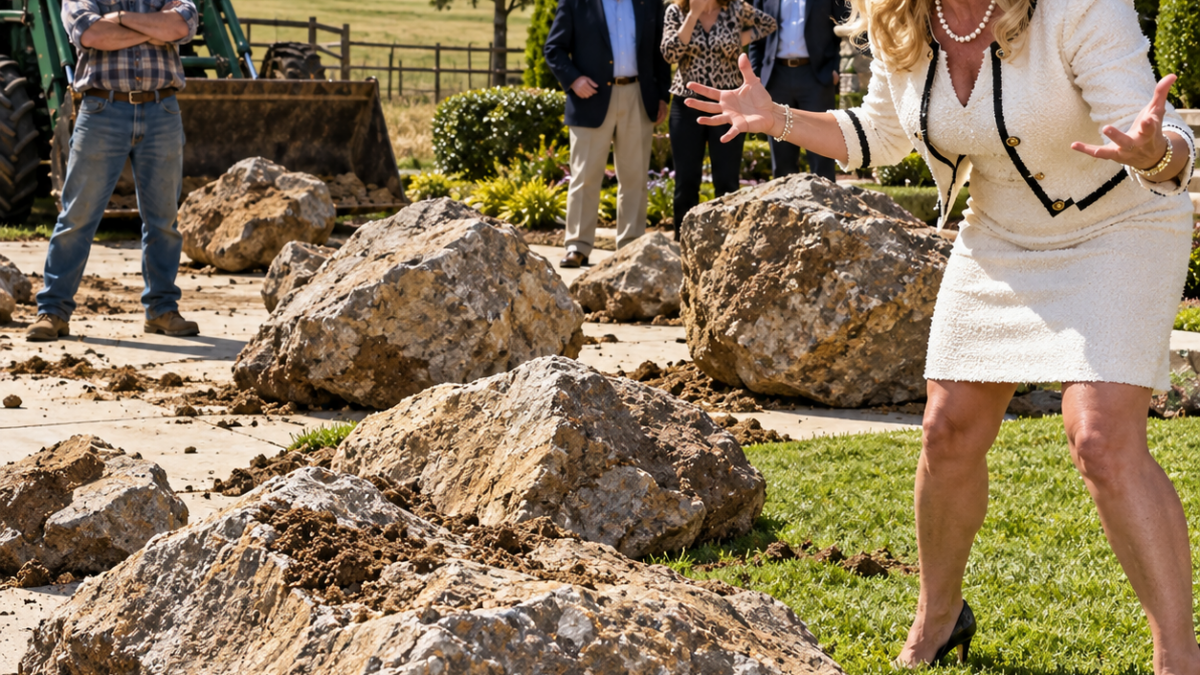
Her house was the showcase of Oak Meadows. Perfect lawn. Perfect edging. Perfect flower beds. Prize-winning roses arranged by color and height.
The crane parked at the curb.
Gus looked at the court order again, then at Marcus.
“Anywhere specific?”
Marcus glanced at Karen’s front yard.
“Visible from the street. Not blocking her door. No safety hazard.”
Gus nodded.
“Shame about the roses.”
Karen gasped.
“No. No, no, no. You will not touch my roses.”
Sheriff Miller stepped beside her.
“Ms. Bishop, do not interfere.”
The first boulder lifted from the truck.
It moved slowly over the lawn, casting a huge shadow across the rose bed.
Karen made a strangled sound.
Then the boulder descended.
It landed with a deep, final thud, crushing mulch, stems, and several carefully arranged pink roses.
The second boulder went onto the lawn near the walkway.
The third sat near the front window, not blocking access, not unsafe, but impossible to ignore.
Together, they looked like a monument.
Not to landscaping.
To arrogance.
A court-ordered sculpture titled: You Did This To Yourself.
Karen stood on the sidewalk with tears of fury in her eyes.
I did not smile.
I did not gloat.
I did not say a word.
I simply accepted the paid invoice from Gus, thanked Sheriff Miller, and looked once toward the now-open road.
Then I got into my truck and drove to my tractor.
The hay was waiting.
### Chapter Nine: Saving the Crop
The minute the access road cleared, I stopped thinking about Karen.
There would be time for legal fallout later.
Right then, I had weather to beat.
The John Deere fired up with a familiar rumble that felt almost like a heartbeat. I drove through the cleared easement, past the scrape marks where the boulders had sat, and into the field.
For the next thirty-six hours, my world narrowed to work.
Cutting.
Raking.
Baling.
Checking moisture.
Watching clouds.
Moving equipment.
Drinking coffee that had gone cold.
Eating sandwiches Sarah brought to the field because she knew I would forget.
Neighbors noticed.
That surprised me.
David Harrison showed up with bottled water.
Alan Price came with coffee.
George Bennett brought printed weather updates because, as a retired engineer, he did not trust phone apps.
Mrs. Gable sent muffins.
At one point, Tom Jackson arrived with his pickup and asked if there was anything he could haul.
I looked at him, then at the field.
“You ever moved hay before?”
“No.”
“You want to learn fast?”
He smiled.
“Yes.”
So he learned.
By the time the first heavy drops hit, the last bales were under cover.
I stood in the barn doorway with Sarah beside me, watching rain sweep across the field that Karen had tried to keep me from reaching.
The crop was saved.
Barely.
But saved.
Sarah leaned against my shoulder.
“You did it.”
I watched water run from the barn roof.
“We did it.”
She smiled.
“You hate accepting help.”
“I’m learning.”
The rain grew harder.
I thought about what would have happened if I had been alone.
If Marcus had not filed quickly.
If George had not kept records.
If the neighbors had not signed affidavits.
If the judge had not acted.
Karen had counted on isolation.
She had almost succeeded.
But almost is not enough when the people you underestimate start talking to one another.
### Chapter Ten: The Revolt at Oak Meadows
The boulders sat in Karen’s yard for a month.
Every morning, every resident driving past 121 Blossom Lane saw them.
Children whispered about them.
Adults pretended not to slow down.
Someone placed a tiny plastic garden gnome on the largest boulder one night. It held a fishing pole. Nobody claimed responsibility. Nobody removed it for three days.
Karen tried to have the boulders moved.
Marcus reminded her attorney that the court order required them to remain until the full hearing.
She tried to send a newsletter calling the relocation illegal.
George Bennett responded with a homeowners’ petition requesting an emergency meeting and forensic audit of HOA finances.
That meeting was held in David Harrison’s backyard because nobody trusted the community center anymore.
Nearly every household came.
There were folding chairs, coolers, paper plates, and the kind of tension that comes when people realize fear has been lying to them.
Marcus spoke first.
“This is not about revenge,” he said. “This is about governance. Rules can protect communities, but when rules become tools of personal punishment, the community has a duty to take them back.”
George laid out the financial concerns.
Unauthorized boulder purchase.
Landscaping contracts tied to Karen’s brother-in-law.
Consulting fees paid without clear approval.
Vague invoices.
Board minutes missing attachments.
People listened with growing anger.
Then the stories came.
The tricycle.
The bird feeder.
The flagpole.
The petunias.
The memorial stone.
The graduation party parking.
Each story, once private and embarrassing, became part of the public record.
By sunset, the recall petition had more than enough signatures.
George reluctantly agreed to serve as interim president if the recall succeeded.
His condition was simple.
“Full audit. Simplified bylaws. Transparent appeals. No retaliation.”
The crowd applauded.
I stood at the edge of the yard with Sarah.
“This is bigger than the road,” she said.
“It always was.”
Karen’s power had depended on everyone believing their problem was individual.
Once they saw the pattern, her authority collapsed.
The official recall happened two weeks later.
Karen did not attend.
Her two closest allies did, but they looked like people trying to distance themselves from a building already on fire.
The vote removed Karen from the presidency and the board.
George Bennett became interim president.
The crowd did not cheer wildly.
It was quieter than that.
More like a deep breath after years underwater.
### Chapter Eleven: The Full Hearing
The full hearing before Judge Albright took place a month after the emergency order.
This time, the courtroom was packed.
Oak Meadows residents filled the gallery behind us. On Karen’s side, only her new attorney sat with her. Davies had withdrawn, citing irreconcilable differences, which Marcus said was lawyer language for “my client lied and made my job impossible.”
Karen looked different.
Tired.
Pale.
Less polished.
The boulders had done more than damage her lawn. They had damaged the illusion that protected her.
The forensic auditor testified first.
He described irregular spending, missing documentation, unauthorized expenditures, no-bid contracts, and improper use of discretionary funds.
The boulder purchase was only the easiest example to explain.
There were landscaping contracts involving Karen’s brother-in-law.
Consulting payments with vague descriptions.
Legal expenses tied to enforcement actions against residents who had challenged fines.
The judge listened without interruption, but her expression hardened with every page.
Then Marcus argued for permanent relief.
He asked the court to permanently enjoin Karen and the HOA from interfering with my easement, hold Karen personally responsible for unauthorized actions, and award legal fees due to bad faith conduct.
Karen’s attorney tried to frame her as an overzealous volunteer who had made procedural mistakes while protecting community interests.
Judge Albright did not appear persuaded.
When she ruled, her language was measured but merciless.
The injunction became permanent.
My easement was affirmed.
The HOA was barred from obstructing or interfering with my agricultural access.
Karen was held personally responsible for the unauthorized boulder purchase and the final removal costs because she had acted against the board’s vote.
The judge also ordered her to pay my legal fees tied to the emergency action, citing bad faith and malicious obstruction.
Then she allowed the homeowners’ broader civil action concerning improper fines and HOA finances to proceed.
Karen sat completely still.
For once, she did not argue.
Maybe she had finally learned that courtrooms were not HOA meetings.
The boulders were removed from her yard two weeks later.
This time, she paid.
Personally.
No HOA funds.
No community maintenance account.
No hiding behind residents’ dues.
She bought the instruments of her own humiliation, then paid to have them hauled away.
The day the boulders left, Oak Meadows held a barbecue.
David Harrison’s daughter rode her tricycle up and down the sidewalk.
Mrs. Gable had two new bird feeders in her yard.
Alan Price flew his American flag from a new pole the HOA had approved unanimously.
The Garcias placed their memorial stone back beneath their tree.
It did not feel like a party over Karen’s defeat.
It felt like a community remembering how to be human.
### Chapter Twelve: After the Rocks
A few months later, life settled again.
The hay was sold.
The barn account recovered.
Sarah stopped waking up at night worried about legal bills.
The access road became just a road again, which was all I had ever wanted it to be.
George’s interim board rewrote the enforcement procedures. Fines required documented review. Appeals went before a neutral committee. Financial records were opened to residents. Any contract involving a board member’s relative had to be disclosed, reviewed, and voted on publicly.
The three-hundred-page rulebook did not disappear, but it lost its fangs.
Rules remained.
Tyranny did not.
One afternoon, I drove the truck down the easement and saw David Harrison’s daughter pedaling her tricycle on the sidewalk, pink helmet shining in the sun.
She waved.
I waved back.
A little farther down, Mrs. Gable was filling a bird feeder. Alan Price was adjusting his flag. George Bennett was standing near the clubhouse arguing with a landscaper about invoice transparency, which may have been the happiest I had ever seen him.
When I reached the field, I stopped the truck and looked back down the road.
No boulders.
No Karen.
No clipboard.
Just gravel, grass, and sunlight.
Sarah called as I was sitting there.
“Everything okay?”
“Yeah.”
“You sound far away.”
“I’m at the field.”
“Thinking?”
“Unfortunately.”
She laughed softly.
“About what?”
I looked across the alfalfa.
“About how three rocks almost cost us everything.”
“But they didn’t.”
“No.”
“Because you were ready.”
I thought about the Karen file.
Marcus.
George.
The neighbors.
The judge.
The crane.
The hay.
“No,” I said. “Because we were ready.”
Sarah was quiet for a moment.
Then she said, “Come home for dinner.”
I smiled.
“I can do that.”
### Epilogue: What the Boulders Really Moved
People still ask me about the boulders.
They want to know if it really happened.
If a judge really ordered them moved to Karen’s lawn.
If the rocks really crushed her roses.
If the neighborhood really watched.
Yes.
All of it happened.
But the part people remember most is not the part that matters most.
The rocks were dramatic.
The crane was satisfying.
Karen screaming about her lawn while Sheriff Miller held the court order was unforgettable.
But the boulders were only symbols.
What we really moved was fear.
Karen Bishop had spent years teaching people that resistance was expensive, that appeals were useless, that letters with official logos mattered more than common sense, and that the safest thing a neighbor could do was stay quiet.
She blocked my road because she believed I would face her alone.
She was wrong.
She believed her bylaws could erase my deed.
She was wrong.
She believed HOA funds were hers to use however she pleased.
She was wrong.
She believed everyone in Oak Meadows was too tired, too scared, or too divided to fight back.
That was her biggest mistake.
Because once the tricycle dad, the bird-feeder widow, the retired engineer, the veteran with the flagpole, my wife, my lawyer, and a farmer with a five-year file all stood on the same side, Karen’s kingdom was already finished.
The boulders just made the ending visible.
I still drive that gravel access road every day.
Sometimes in the tractor.
Sometimes in the truck.
Sometimes just to check the field and remind myself that peace is not always something you find.
Sometimes it is something you defend.
The road is open now.
The hay grows tall.
Oak Meadows is quieter, kinder, and far less afraid.
And somewhere in my office, in a file box labeled Bishop Matter, there are photos of three granite boulders sitting in the middle of Karen’s perfect front lawn.
I do not look at them often.
I do not need to.
Every time I drive freely to my field, I remember the lesson well enough.
Never mistake patience for surrender.
Never mistake paperwork for justice.
And never place a heavy burden in someone else’s path unless you are prepared for the day a judge orders it delivered straight back to your own front yard.
**THE END**