PART 2: HOA President Blocked My $4,200 Concrete Truck—Then Fined Me Another $4,200 for the Driveway She Refused to Let Me Finish
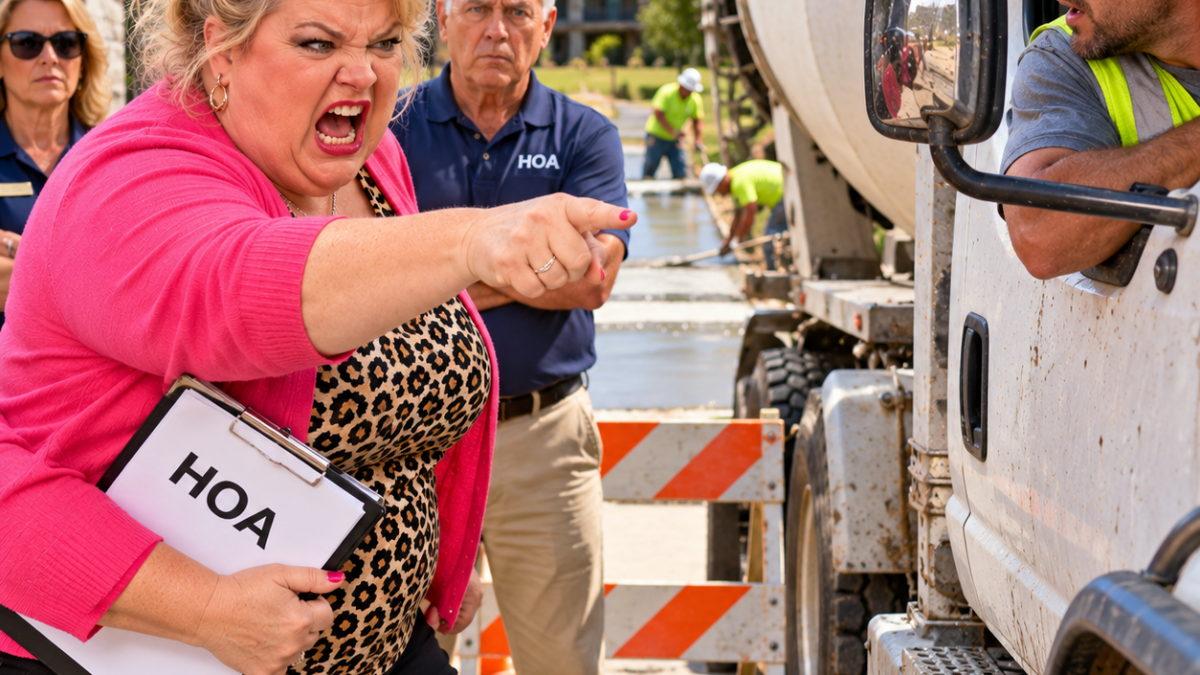
The HOA president parked her Lexus sideways across my driveway, looked straight at the concrete truck carrying $4,200 worth of fast-setting material, and told the driver that not one drop was entering my property.
She was the same woman who had personally signed the approval for the driveway my wife needed to walk safely to our car, yet now she was threatening foreclosure while deliberately sabotaging the project she had authorized.
What happened next started with ten cubic yards of concrete baking inside a spinning drum, but before it was over, an entire neighborhood would discover just how expensive one woman’s arrogance had become.
“This is a construction zone, Mr. Henderson, not a properly maintained residential property.”
Karen Miller stood at the end of my driveway with both hands folded over her stomach, looking far too pleased with herself.
Behind her, her white Lexus SUV was parked sideways across the entrance to my property.
Beyond the Lexus sat a fully loaded Semstone concrete mixer.
Ten cubic yards.
Rapid-set mix.
Four thousand two hundred dollars.
Already paid.
The drum kept turning.
Slowly.
Relentlessly.
Sal, the driver, leaned one elbow out of the cab window and looked at me with the expression of a man who had delivered concrete to hundreds of strange situations but had finally encountered one that surpassed his professional vocabulary.
He pointed at Karen’s Lexus.
Then he pointed at the concrete truck.
Then he shrugged.
The message was clear.
I can’t drive through a car.
Karen adjusted the sleeve of her beige pantsuit.
“That concrete will not be delivered today.”
I stared at her.
“You approved this driveway.”
“I approved a compliant architectural modification.”
“This is the modification.”
She shook her head as though explaining arithmetic to a stubborn child.
“The property is currently in violation of Section Twelve, Paragraph C. The exposed forms, dirt, construction materials, and unfinished surface constitute ongoing aesthetic blight.”
“The driveway is unfinished because we are pouring it today.”
“Not anymore.”
The mixer continued rotating.
I could almost hear money disappearing inside it.
Concrete does not care about neighborhood politics.
Once the ingredients are mixed, chemistry begins.
Cement hydrates.
Temperature rises.
The material starts setting.
There is no pause button while two homeowners debate bylaws.
And the autumn sun was already warmer than forecast.
I looked past Karen toward the truck.
“How long do we have?”
Sal glanced at the clock on his dashboard.
“Not long.”
Karen smiled.
That smile told me everything.
This wasn’t confusion.
It wasn’t a misunderstanding.
She knew exactly what she was doing.
My wife, Sarah, stood near the front door behind me.
She had her walker positioned on the porch, one hand gripping the handle.
She was watching the confrontation with a look that made my anger harder to control.
That driveway was not cosmetic.
It wasn’t some vanity project because I wanted nicer curb appeal.
The old asphalt had broken apart over decades.
Chunks were missing.
Gravel had migrated into low spots.
Cracks ran across the slope.
For me, it was annoying.
For Sarah, it had become dangerous.
Her mobility had worsened over the previous year. A walker wheel catching the wrong piece of loose stone could turn an ordinary trip to the car into a fall.
She had already stumbled twice.
The second time, I caught her.
Afterward she stood there shaking, furious at her own body and embarrassed that she needed help crossing fifteen yards of her own property.
That night I promised her I would fix it.
And I had.
Or I had tried.
I submitted the HOA architectural request.
Detailed drawings.
Contractor information.
Material specifications.
Drainage plan.
City permit information.
Dimensions.
Timeline.
I waited the full thirty days required by the covenants.
Then the approval arrived.
Signed by Karen Miller.
At the bottom she had written:
Please ensure work is completed promptly to minimize disruption and preserve neighborhood appearance.
I still had the original.
Now the woman who wrote those words was physically preventing the project from being completed.
“You need to move your car,” I said.
Karen raised one eyebrow.
“No.”
“You are blocking a scheduled concrete delivery.”
“I am preventing an unauthorized pour.”
“There is nothing unauthorized about it.”
“That determination belongs to the board.”
“You already made the determination.”
I pulled the approval from the folder sitting on my workbench and held it up.
Her signature was visible.
For the first time, her smile weakened.
Only slightly.
Then she recovered.
“Conditions have changed.”
“What conditions?”
“The work site does not meet temporary construction presentation standards.”
I almost laughed.
“Temporary construction presentation standards?”
“Yes.”
“Which section?”
Her eyes narrowed.
“You should have familiarized yourself with the governing documents before beginning work.”
“I have.”
“Clearly not well enough.”
Behind her, Sal shut off the truck’s engine for a moment, then restarted it.
The clock was running.
Karen took one step toward me.
“And understand this, Mr. Henderson. If you continue violating Section Twelve, the board will escalate enforcement. Continued unpaid fines can result in a lien. A lien can eventually lead to foreclosure.”
There it was.
She was threatening my home.
Over a driveway.
A driveway she had approved.
A driveway my wife needed.
And Karen was standing between me and the truck required to finish it.
I felt something inside me go cold.
Twenty-two years in the Army Corps of Engineers had taught me that anger is useful only when converted into a plan.
So instead of shouting, I reached into my pocket.
Pulled out my phone.
Opened the camera.
And pressed record.
Karen noticed.
Her confidence flickered.
“What are you doing?”
“Documenting.”
Her mouth tightened.
For the first time that morning, I smiled.
Because Karen had just made the mistake that would eventually cost her everything she actually cared about.
She had turned her own abuse of power into evidence.
PART 2
I kept the camera aimed low enough to capture Karen, the Lexus, my driveway, and the front of the concrete truck in one frame.
“Karen,” I said, keeping my voice deliberately even, “for the record, are you refusing to move your vehicle and allow the concrete delivery to enter my property?”
She looked at the phone.
Then at me.
“I am enforcing HOA regulations.”
“That wasn’t my question.”
“You don’t get to interrogate me.”
“I’m asking you whether you are intentionally blocking my driveway.”
Her lips compressed.
“The delivery is not authorized to proceed under current site conditions.”
“And your vehicle is intentionally preventing the truck from entering?”
“The president of this association has broad enforcement authority.”
Sal leaned out his window.
“Ma’am?”
She turned.
“Yes?”
“I’ve got concrete in here.”
“I’m aware.”
“If I can’t discharge it, I have to leave.”
“Then you should leave.”
He looked at me.
I could see the apology in his face.
Then he climbed down from the cab.
Sal was built like someone who had spent thirty years moving things heavier than most people’s furniture. Thick forearms. Gray mustache. Work boots powdered with cement.
He walked toward me holding a clipboard.
“I’m sorry, man.”
“I know.”
“I’ve got another site after this.”
“I know.”
“We’re already pushing it.”
Karen stood ten feet away listening.
Sal lowered his voice.
“If I sit here much longer, the load starts becoming a problem.”
I looked at the forms lining the excavated driveway.
Rebar tied in place.
Subgrade compacted.
Drainage correct.
Everything ready.
Weeks of planning.
Thousands in prep work.
All waiting on the material turning useless inside that truck.
“Can you document why you can’t deliver?”
Sal glanced toward Karen’s Lexus.
“Yeah.”
“Please do.”
Karen snapped, “You don’t need to involve him in your dispute.”
Sal slowly turned his head.
“Lady, I’m already involved.”
I almost smiled.
He filled out the delivery failure ticket.
Arrival time.
Attempted delivery.
Departure time.
Reason:
SITE INACCESSIBLE — ENTRANCE BLOCKED BY THIRD-PARTY VEHICLE.
I asked him to sign.
He did.
Then I photographed the document while it was still on his clipboard.
Sal tore off my copy.
“Dispatch will call you.”
“Thanks.”
“Sorry.”
“Not your fault.”
He climbed back into the mixer.
The truck backed away.
The sound of that diesel engine moving down the street felt like watching an ambulance leave while somebody you loved was still bleeding.
Karen waited until it disappeared around the corner.
Then she adjusted her jacket.
“I suggest you clean this up before the next inspection.”
I stared at her.
“You cost me forty-two hundred dollars.”
“That was your decision.”
I looked at the Lexus.
“My decision?”
“You scheduled a delivery before ensuring compliance.”
“You signed the approval.”
She sighed theatrically.
“You keep repeating that as though it eliminates your ongoing obligation to meet community standards.”
I looked toward Sarah.
She was still standing on the porch.
She had heard everything.
Something about that hurt more than losing the concrete.
This was supposed to make her life easier.
Instead she was watching our own neighborhood president turn her disability accommodation into a personal battlefield.
I looked back at Karen.
“Move your car.”
She smiled.
“The truck is gone.”
“I know.”
“There’s no longer an obstruction issue.”
“My driveway is still mine.”
Her smile disappeared.
She walked back to the Lexus.
Before getting inside, she pointed toward the unfinished driveway.
“You have fourteen days to restore the property to compliance.”
Then she drove away.
I stood at the curb until the white SUV disappeared.
Sarah called my name.
“Marcus.”
I walked toward the porch.
She looked at my face.
“You’re furious.”
“Yes.”
“You’re doing that thing.”
“What thing?”
“The calm thing.”
“I’m always calm.”
“No.”
She almost smiled.
“You’re normal when you’re calm. You get terrifyingly polite when you’re furious.”
That made me laugh once.
She looked at the driveway.
“What do we do?”
“First?”
“Yes.”
“We save everything.”
I held up my phone.
“Then we make her explain herself in writing.”
“And after that?”
I looked toward the street where the truck had disappeared.
“After that, we find out how much authority she actually has.”
The next morning Semstone emailed the final invoice.
No refund.
The load had been prepared.
The truck had been dispatched.
The material had ultimately been taken to an approved reclamation site and dumped because delivery was impossible.
Four thousand two hundred dollars.
Gone.
They offered a small discount on a future reorder.
It was generous.
It also didn’t replace the money.
I printed the invoice.
Printed Sal’s delivery failure report.
Printed photographs showing Karen’s Lexus blocking my driveway.
Saved the original video in three locations.
Then I took out the HOA approval letter.
Karen’s signature looked almost absurd beneath her handwritten note about timely completion.
I spread everything across the dining table.
Sarah rolled her walker beside me.
“What are you thinking?”
“That this is almost too clean.”
“What is?”
“The sequence.”
I arranged the documents.
“Here’s the approval.”
I placed it first.
“Here’s the contractor schedule.”
Second.
“Here are the forms, inspection, and permit.”
Third.
“Here’s Karen physically blocking the approved delivery.”
Fourth.
“Here’s the delivery failure receipt identifying a third-party vehicle.”
Fifth.
“And here’s the bill.”
Sixth.
Sarah stared.
“So?”
“So if she tries to blame us for the delay, she’s blaming us for something she created.”
Two days later, Karen did exactly that.
The certified envelope arrived in the afternoon.
Oakwood Estates Homeowners Association.
I signed for it.
Opened it at the kitchen counter.
Then laughed.
Sarah looked over.
“What?”
I handed her the first page.
She read.
Then slowly sat down.
“Is this real?”
“Yes.”
“They’re fining us?”
“Yes.”
“How much?”
I pointed.
Four thousand two hundred dollars.
Exactly the amount I had lost on the concrete.
Violation:
Failure to complete approved architectural modification within required timeline, resulting in prolonged aesthetic blight.
Fine:
$4,200.
I read it again.
Then again.
There was something almost artistic about the malice.
Karen had prevented me from completing the driveway.
Her interference cost me $4,200.
Then she fined me another $4,200 because the driveway she blocked remained unfinished.
Eight thousand four hundred dollars of financial pressure created by one woman standing in front of one truck.
Sarah’s eyes filled with tears.
Not because of the money alone.
Because she understood the message.
Karen wanted us to feel trapped.
“What if they put a lien on the house?”
“They won’t.”
“You don’t know that.”
“No.”
I sat beside her.
“But I know what they have to do before they get there.”
“What?”
“Give me a process.”
I took her hand.
“And process is something I understand.”
The monthly HOA meeting was six days away.
I prepared as if I were presenting an engineering incident investigation.
Chronology.
Evidence.
Relevant sections of the covenants.
Approval.
Permit.
Photos.
Video stills.
Delivery failure report.
Invoices.
Medical necessity documentation only to the extent Sarah was comfortable disclosing.
She didn’t want the room hearing details about her health.
Neither did I.
The board needed to know the driveway was accessibility-related.
They didn’t need the right to turn my wife’s private life into neighborhood gossip.
I organized everything in a binder.
Tabs.
Index.
Copies for each board member.
Sarah watched me from the couch.
“You miss the Army.”
“No.”
“You absolutely miss making binders.”
“That part maybe.”
The clubhouse meeting began at seven.
Oakwood Estates meetings were usually sparsely attended.
Maybe eight homeowners.
Karen sat at the center of a folding table draped with a navy cloth bearing the HOA logo.
To her right sat Gary, the treasurer.
Thin man.
Glasses.
Nervous hands.
Brenda, the secretary, sat beside him typing minutes.
Two other board members, Phil and Ron, were drinking coffee and eating glazed donuts.
Karen had a small wooden gavel.
A ridiculous object.
But she used it constantly.
The meeting dragged through landscaping schedules, holiday decoration dates, pool maintenance, and a complaint about somebody leaving trash cans visible nineteen hours after pickup instead of the permitted eighteen.
Then homeowner concerns opened.
I stood.
Karen saw the binder.
Her eyes changed.
“Mr. Henderson.”
“Madam President.”
I walked to the front.
Distributed the copies.
“I am formally appealing the $4,200 fine issued against my property.”
Karen leaned back.
“Your appeal has already been reviewed.”
“It hasn’t.”
“The board reviewed the matter.”
“I was never given notice of an appeal hearing.”
“You’re receiving one now.”
Gary looked toward Karen.
That appeared to be news to him.
Good.
I began.
“My driveway replacement was formally approved thirty-seven days before the scheduled pour.”
I displayed the signed approval.
“Demolition and preparation were completed according to submitted plans.”
Photos.
“City inspection was completed.”
Document.
“Concrete delivery was scheduled for 9:00 a.m. Tuesday.”
Invoice.
“The truck arrived.”
Photo.
“Delivery could not occur because Karen Miller parked her Lexus across my property entrance and refused to move it.”
Photo.
The room shifted.
Karen interrupted.
“That characterization is inaccurate.”
I looked at her.
“Would you prefer the video?”
Silence.
Someone in the audience turned around.
Karen’s cheeks reddened.
I continued.
“The concrete supplier documented the reason for failed delivery.”
I held up Sal’s signed receipt.
“The HOA then fined me the exact amount of the lost concrete for failing to finish the project.”
Gary looked at the number.
Then at Karen.
Brenda stopped typing.
Even Phil put down his donut.
I finished.
“I respectfully request immediate rescission of the fine and written confirmation that the driveway may be completed under the approval already issued.”
For perhaps five seconds, reason had a chance.
Then Karen cleared her throat.
“Mr. Henderson, while we sympathize with your frustration, you are omitting critical information.”
“What information?”
“Your work zone was non-compliant.”
“How?”
“The traffic safety equipment did not meet association standards.”
I stared at her.
“What safety equipment?”
“The cones.”
“What about them?”
“They were the wrong color.”
Phil actually frowned.
I waited.
Karen continued with complete seriousness.
“Approved temporary construction cones must be tangerine orange.”
I looked at Gary.
He looked back.
His expression said exactly what mine did.
What?
“The contractor used standard construction orange,” Karen said. “This created a visual inconsistency.”
I almost thought she was joking.
Then I realized she wasn’t.
Or worse—she was lying and expecting everyone to pretend she wasn’t.
“Which rule requires tangerine cones?”
“Appendix G.”
I knew the covenants.
I had read them before we bought the house.
“There is no Appendix G.”
Her eyes sharpened.
“There is.”
“No.”
“The architectural guidelines were amended.”
“When?”
“The board has broad authority—”
“When was Appendix G adopted?”
She banged the gavel.
“This is not a cross-examination.”
“No.”
I held up the signed approval.
“It’s a simple question.”
Karen looked at the other board members.
Nobody helped her.
“Your contractor did not comply.”
“My contractor’s cones were compliant with city safety standards.”
“This is a private community.”
“The city issued the work permit.”
“The HOA has additional requirements.”
“Then produce Appendix G.”
Her jaw tightened.
“The board is not required to justify every internal standard during homeowner comment.”
“It is if you’re fining me $4,200 based on it.”
The room went silent.
Gary suddenly became fascinated by his papers.
I knew then.
He knew.
There was no Appendix G.
Karen looked down at the binder I had given her.
Then closed it.
“The fine stands.”
I stared at her.
“You’re refusing to address the evidence.”
“I have addressed it.”
“No. You invented a cone-color rule.”
The gavel came down hard.
“Watch yourself.”
“Is that another rule?”
A couple of people laughed.
Karen’s face darkened.
“The board considers the matter closed.”
She hit the gavel again.
“Next.”
I remained standing for another second.
Not angry.
Not outwardly.
Just disappointed.
I had spent twenty-two years working inside systems where procedures existed because bad decisions could hurt people.
Rules weren’t sacred because they were rules.
They were valuable because they were supposed to create predictable, fair outcomes.
Karen had reversed that.
To her, rules were whatever language justified what she already wanted.
I collected my original binder.
As I turned, Gary briefly looked at me.
There was something in his face.
Embarrassment.
Fear.
Maybe both.
Outside, the night air felt cold.
Sarah was waiting at home.
I sat in the truck for five minutes before starting the engine.
That meeting changed something.
Until then, I had wanted the driveway.
Now I wanted answers.
The next morning I began photographing Karen’s house.
That sentence sounds worse than it was.
I did not hide in bushes.
I did not peer into windows.
I did not trespass.
I walked public streets.
Everything I documented was visible to any neighbor.
The first thing was her mailbox.
Oakwood rules were painfully specific.
Black.
Post-mounted.
No decorative painting.
No attachments.
No deviations.
Karen’s mailbox was fuchsia.
Not red.
Not dark pink.
Fuchsia.
Flowers were hand-painted along the side.
A ceramic butterfly was attached to the post.
If another homeowner had installed it, Karen probably would have issued three separate notices.
I photographed it.
Date.
Time.
Public sidewalk.
Next came her landscaping.
Section Eight prohibited vegetation obstructing traffic-control signs.
At Karen’s corner, overgrown azaleas nearly swallowed a stop sign.
I stood across the intersection for ten minutes.
Three cars failed to stop fully.
One minivan nearly collided with the mail truck.
I recorded the near miss.
Then came the commercial vehicle.
Oakwood prohibited business-marked vehicles parked overnight unless fully enclosed in a garage.
Karen had enforced that rule viciously.
I knew because Tom Alvarez, a former Army medic who now worked as an EMT, told me about his neighbor.
The man was a plumber.
Small business.
His work van had a company logo on the side.
Karen fined him repeatedly until he rented off-site parking.
Meanwhile, every night, Karen’s own driveway contained a minivan wrapped in enormous colorful LuLaRoe graphics.
Apparently she or a relative sold clothing.
The logo covered both sides.
You could see it from fifty yards away.
I photographed the van at 5:15 a.m.
Next morning.
Again.
Next.
Again.
Two weeks.
Same result.
Commercial vehicle.
Overnight.
No enforcement.
I started talking to neighbors.
Not campaigning.
Listening.
Mrs. Gable was eighty-two and lived three houses down from Karen.
I found her filling a bird feeder.
“Morning.”
She smiled.
“You’re Sarah’s husband.”
“Yes, ma’am.”
“How is she?”
“Doing okay.”
“I heard about the driveway.”
Of course she had.
Oakwood gossip traveled faster than broadband.
“What did you hear?”
“That Karen stopped the truck.”
“Accurate.”
Mrs. Gable looked toward the street.
Then lowered her voice.
“She fined me for this.”
She touched the feeder.
“For what?”
“Attracting nuisance wildlife.”
“Birds?”
“Apparently.”
She gave a sad smile.
“My Harold gave it to me our last Christmas together.”
Her husband had died three years earlier.
“He sat in that chair every morning and watched cardinals.”
She pointed toward her kitchen window.
“I paid the two hundred dollars.”
“Why?”
“Because fighting her would have cost more.”
That sentence stuck with me.
The Rodriguezes lived two streets over.
Their ten-year-old son had a portable basketball hoop.
Karen demanded it be rolled behind the privacy fence immediately after each use.
One evening it remained visible for two hours.
Twenty-five-dollar fine.
Then another.
Then another.
They were paying weekly penalties because their son wanted to shoot baskets after dinner.
Tom Alvarez had been fined because his grass measured a quarter-inch above the maximum.
The citation arrived the morning after he completed a twenty-four-hour emergency shift responding to a multi-vehicle crash.
“I got home at six,” he told me.
“Showered. Slept three hours. Woke up to a violation notice on the door.”
“Did Karen know you were working?”
“She knew.”
“How?”
“I told her the week before. Asked for two extra days.”
“What did she say?”
“Standards don’t take vacations.”
He smiled without humor.
I photographed documents.
Copied fines with permission.
Wrote down dates.
Patterns emerged.
The people who challenged Karen got more notices.
People close to her received warnings.
Sometimes nothing.
The same rules were applied differently depending on who you were.
My binder grew.
Then I called Dave Sullivan.
Dave and I had served together years earlier.
He had left active duty before I did, gone to law school, and built a litigation practice downtown.
We hadn’t seen each other in almost three years.
His office was on the nineteenth floor of a glass building where the chairs looked expensive enough to require financing.
He saw the binder.
“Still doing Army paperwork?”
“Habit.”
He opened it.
“Why am I looking at a pink mailbox?”
“Fuchsia.”
“Important distinction?”
“Apparently color distinctions are critical in Oakwood Estates.”
I told him everything.
The driveway.
Sarah.
Approval.
Concrete.
Lexus.
Fine.
Appendix G.
Selective enforcement.
Neighbors.
He stopped joking around halfway through.
When I finished, he went back to the beginning.
“Karen personally signed the approval?”
“Yes.”
“And personally blocked the contractor?”
“Yes.”
“Video?”
“Yes.”
“Delivery ticket?”
“Yes.”
“Then fined you the same amount you lost?”
“Yes.”
“Based partly on a rule that doesn’t exist?”
“That appears to be the case.”
He looked through Karen’s violations.
“Commercial van.”
“Yes.”
“Mailbox.”
“Yes.”
“Visibility obstruction.”
“Yes.”
“And she enforces those same rules against others?”
“Repeatedly.”
Dave leaned back.
“This isn’t just hypocrisy.”
“What is it?”
“Potential selective enforcement, breach of fiduciary duty, malicious conduct depending on facts, possibly tortious interference with your contractor relationship, accessibility implications, and probably half a dozen procedural violations I haven’t even looked at yet.”
“So?”
“So we don’t sue.”
I frowned.
“Not yet,” he added.
He smiled.
“That’s better.”
“What do we do?”
“Make them write.”
“What?”
“People like Karen are dangerous when everything stays verbal because she can reinvent yesterday. We force every position onto paper.”
That week, five certified letters went out.
The first disputed my $4,200 fine formally.
The second requested the full text and adoption history of Appendix G and the alleged tangerine-orange construction-cone requirement.
The third requested violation statistics for the previous twenty-four months with privacy-protected identifying information.
The fourth requested twelve months of board meeting minutes.
The fifth asked the board to preserve all records relating to my driveway approval, the later enforcement action, Karen’s obstruction, and internal discussion of the fine.
Dave explained each move.
“The money isn’t the point yet.”
“What is?”
“Consistency.”
He tapped the letters.
“If their explanation is legitimate, we’ll see it.”
“And if it isn’t?”
“They’ll start contradicting themselves.”
They did.
The fine appeal was denied.
No hearing.
No explanation.
The Appendix G request received this response:
Relevant architectural safety requirements are currently undergoing administrative consolidation and will be provided when practicable.
Dave laughed for a full minute.
“That means it doesn’t exist.”
The violation-record request was denied as burdensome.
Meeting minutes were delayed.
Preservation request ignored.
Every response went into the binder.
“Beautiful,” Dave said.
“You have a strange sense of beauty.”
“I bill by the hour. Paper is gorgeous.”
Then he asked:
“When are you pouring the driveway again?”
“I’m not losing another forty-two hundred.”
“You won’t.”
He leaned forward.
“We’re going to do it so legally that Karen will need permission from Congress to interrupt.”
First came the city.
I applied for a temporary public right-of-way permit covering the portion of street in front of our house during the pour.
The permit gave the contractor authority to temporarily control traffic for four hours.
Then I hired a licensed traffic-control company.
Mike, the supervisor, arrived the day before to inspect the site.
“What kind of cones do you need?” he asked.
I looked at him.
“Tangerine.”
He frowned.
“What?”
“Nothing.”
I showed him the HOA letter.
Mike read it.
Then looked at me.
“This is made up.”
“I know.”
“Traffic cones are regulated by visibility standards. Nobody calls them HOA tangerine.”
“I know.”
“You want extra cones?”
“Absolutely.”
He grinned.
“I like you.”
We planned signage.
WORK ZONE AHEAD.
LANE CLOSED.
FLAGGER AHEAD.
Official high-visibility cones.
Everything placed according to city permit requirements.
I mounted a GoPro inside the front window.
Continuous recording.
Dave drafted advance notice to every HOA board member individually.
Certified.
Signed.
Delivery receipts preserved.
The language was deliberately friendly.
The Henderson property will complete its previously approved driveway replacement on Tuesday, October 18, from approximately 10:00 a.m. to 2:00 p.m.
All city permits are attached.
Licensed traffic-control personnel will be present.
We appreciate the board’s cooperation in allowing the previously approved project to reach timely completion.
No request.
No negotiation.
Notice.
Karen signed for hers.
So did Gary.
Brenda.
Phil.
Ron.
At nine thirty Tuesday morning, Mike arrived.
Signs went up.
Cones deployed.
At 9:55, the Semstone mixer arrived.
Different driver.
Same company.
The truck backed into position.
This time the road was controlled legally.
The front of my property was clear.
Sarah sat near the living-room window.
She had insisted on watching.
“You think she’ll come?” she asked.
“Yes.”
“How sure?”
“Very.”
“Why?”
“Because if she stays home, she admits she never needed to stop the first truck.”
At 10:05, a white Lexus came around the corner too fast.
Sarah looked at me.
“You know her disturbingly well.”
Karen stopped outside the work zone.
The driver’s door opened.
She marched toward Mike.
“What is going on?”
Mike pointed toward the sign.
“Permitted lane closure, ma’am.”
“I am the president of the homeowners association.”
“Congratulations.”
I almost laughed.
Karen didn’t.
“This work is unauthorized.”
Mike held out the laminated city permit.
“It’s authorized.”
“Not by me.”
“I don’t work for you.”
Her face purpled.
Then she saw me.
“You!”
I walked from the garage.
Phone recording.
“Morning, Karen.”
“You were instructed not to proceed.”
“No. I was fined for not proceeding.”
“That is not funny.”
“I agree.”
She pointed toward the truck.
“I am ordering this project stopped.”
Mike stepped between her and the work zone.
“Ma’am, please remain outside the cones.”
She stared at him.
“Do you know who I am?”
“Yes.”
“No, you don’t.”
“You just told me.”
Several neighbors had appeared on porches.
Curtains moved.
Phones came out.
Karen’s voice rose.
“This is a private community. The city does not control our streets.”
That was false.
Oakwood streets were city-maintained.
The HOA had decorative control over some common spaces.
Not municipal jurisdiction.
I pointed toward the permit.
“Karen, you received this a week ago.”
“I objected.”
“No, you didn’t.”
“I do now.”
“That doesn’t revoke a city permit.”
She stepped toward the cones.
Mike held one hand out.
“Ma’am.”
“You move away from me.”
“Do not enter the work zone.”
“I own property here!”
“So does he.”
Then a police cruiser appeared.
Karen froze.
I had called the non-emergency line earlier.
Not requested an officer.
Only informed dispatch that a permitted traffic-control operation would occur and that a previous obstruction dispute had happened.
Apparently somebody decided prevention was easier than paperwork.
Officer Daniels stepped out.
Tall.
Calm.
Late thirties.
“What’s going on?”
Karen practically ran toward him.
“Thank God. This homeowner is illegally closing a private street and conducting unauthorized construction.”
The officer looked at me.
I handed him the permit.
No speech.
No argument.
He read it.
Looked at Mike.
Looked at signs.
Looked at cones.
Then asked Mike:
“You licensed traffic control?”
Mike showed credentials.
The officer nodded.
Then he returned to Karen.
“Ma’am, the permit is valid.”
Karen blinked.
“That’s irrelevant.”
“No.”
“It’s private HOA property.”
“The road is municipal.”
“The association governs—”
“Not traffic law.”
The neighbors heard every word.
Officer Daniels continued.
“The work appears lawful. You need to remain outside the controlled zone.”
“I am the president.”
“I understand.”
“You clearly don’t.”
He paused.
That was when Karen lost him.
His tone cooled.
“Ma’am, your HOA title does not authorize you to interfere with a city-permitted work operation.”
Silence.
Pure, beautiful silence.
Karen’s face drained.
Officer Daniels pointed toward her Lexus.
“If your vehicle obstructs the work zone, it may be cited or towed.”
Someone across the street laughed.
Not loudly.
But Karen heard it.
She spun toward the houses.
Nobody looked away.
For the first time in years, Karen Miller was publicly powerless.
No gavel.
No board.
No captive audience.
Just a city permit and a police officer explaining the boundary of her authority.
She looked at me.
“This isn’t over.”
“I hope the driveway is.”
Her nostrils flared.
Then she returned to her Lexus.
Drove away.
Mike watched her disappear.
“Friend of yours?”
“Community leader.”
“Looks exhausting.”
The concrete poured.
Gray material flowed down the chute into the forms.
Crews spread it.
Screeded.
Floated.
Worked edges.
Controlled slopes.
Finished joints.
I stood near the garage watching.
It was absurd how emotional concrete could become.
To most people it was a slab.
Aggregate.
Cement.
Water.
To me, it represented Sarah crossing from the house to the car without fear.
That was the only reason I started any of this.
The first section was finished by noon.
By one thirty, the final surface was being broomed.
Sarah came to the doorway.
She looked at the smooth expanse.
Her eyes watered.
“You okay?”
She nodded.
“I just wish it hadn’t taken all this.”
“So do I.”
She leaned into me.
“But it’s beautiful.”
I laughed.
“It’s concrete.”
“It’s beautiful concrete.”
The police confrontation spread through Oakwood faster than any official newsletter.
Tom called first.
“I watched her get shut down by a cop.”
“You sound happy.”
“I’m a public servant. I support lawful municipal administration.”
“You’re enjoying this.”
“Deeply.”
The Rodriguezes emailed.
Mrs. Gable showed up carrying cookies and her bird-feeder citation.
She stood on the old walkway because the concrete was still curing.
“I’m not taking it down.”
“The feeder?”
“Yes.”
“Good.”
Her chin lifted.
“What do we do?”
That was the moment the resistance became real.
Two weeks later, sixteen homeowners were sitting in my living room.
Mrs. Gable.
Tom.
Carlos and Elena Rodriguez.
A retired accountant named Susan Park.
A teacher.
An airline mechanic.
A software engineer.
Several others.
Everyone brought paper.
Violation letters covered my coffee table.
Bird feeder.
Basketball hoop.
Grass height.
Holiday wreath.
Trash-can placement.
Driveway oil stain.
Fence stain color.
One homeowner had been fined because a visiting nurse parked on the street for too long.
Another because a child left sidewalk chalk visible overnight.
Sarah sat beside me.
Not as the reason for the fight.
As part of the room.
Dave joined our second meeting.
He listened.
Then stood in front of the fireplace.
“Karen’s authority rests on three things.”
He held up one finger.
“People believe she has more power than she actually has.”
Second finger.
“The board supports or tolerates her.”
Third.
“She controls information, especially financial information.”
Tom leaned forward.
“So?”
“We already cracked number one.”
“The police officer.”
“Exactly.”
Dave smiled.
“Now we attack two and three.”
He explained our rights.
Association records.
Financial ledgers.
Contracts.
Meeting minutes.
Special meetings.
Recall procedures.
Voting thresholds.
State statutory requirements.
Homeowners who had spent years fearing the bylaws suddenly started reading them.
That was Karen’s nightmare.
Rules are intimidating when only the person using them has read them.
Knowledge changes the balance.
We created the Oakwood Estates Concerned Homeowners Committee.
I hated the name.
It sounded like we sold cookies at school fundraisers.
But it was deliberately boring.
Boring looked reasonable.
Reasonable wins.
Our first joint letter carried fifteen homeowner signatures.
It requested three years of financial ledgers.
Vendor contracts.
Board minutes.
Executive-session records where legally available.
Violation statistics.
Fine revenue.
Legal expenditures.
Karen responded within four days.
Her letter accused us of harassment.
Malicious interference.
Disruption.
A coordinated campaign to undermine elected leadership.
She refused most of the records request.
Dave read it.
Smiled.
“Thank you, Karen.”
Carlos frowned.
“Why are you thanking her?”
“She just refused a legitimate records request in writing.”
“So?”
“So now we stop arguing with her.”
Dave drafted the next notice.
Copies went to the board.
Management company.
Registered insurance carrier.
The letter explained that association leadership was refusing required access to financial records and that homeowners were evaluating judicial remedies.
Two days later, Gary called me.
Not Karen.
Gary.
His voice sounded like he hadn’t slept.
“Marcus?”
“Yes.”
“The board has reconsidered your records request.”
“Oh?”
“Management company will provide access.”
“That’s good.”
“There are conditions.”
“Send them in writing.”
Silence.
Then:
“Why does everything have to be in writing?”
“Because you work with Karen.”
He didn’t answer.
The records review took six hours.
Three boxes.
Bank statements.
Invoices.
Contracts.
Expense reports.
At first, ordinary.
Pool service.
Landscaping.
Insurance.
Electricity.
Management fee.
Then Tom stopped turning pages.
“Marcus.”
“What?”
“Look.”
Recurring monthly payment:
MILLER CREATIVE SOLUTIONS — CONSULTING — $500.
Twenty-four consecutive months.
Twelve thousand dollars.
“Karen?” Carlos asked.
Susan, the retired accountant, shook her head.
“Not necessarily.”
I searched the company registration.
Owner:
Robert Miller.
Karen’s brother.
Nobody spoke for several seconds.
Tom whistled.
“That’s not subtle.”
We kept digging.
Community Garden Enhancement Project.
Three thousand dollars.
Mulch.
Soil.
Japanese maples.
Decorative stone.
Delivery address:
Karen Miller’s home.
Susan read it twice.
“You have to be kidding.”
Carlos stared.
“She used HOA money to landscape her backyard?”
“Looks that way,” Susan said.
“We need invoices.”
We copied everything.
Then the insurance policy.
Dave had told us exactly where to look.
Directors and Officers liability coverage.
Coverage for board decisions made in official capacity.
Then exclusions.
Dishonest acts.
Fraudulent acts.
Criminal conduct.
Malicious or intentionally wrongful acts.
Tom read the paragraph aloud.
“So if she acted maliciously…”
“Coverage may be disputed,” I said.
Susan’s face changed.
“Not just hers.”
“No.”
“The board?”
“Potentially depending on claims and facts.”
Gary had sat in meetings while Karen operated.
Brenda too.
Phil.
Ron.
Suddenly their silence had financial consequences.
Karen had made them feel safe by telling them the HOA protected them.
The insurance language suggested something very different.
Dave reviewed our copies that night.
He called me at 9:30.
“Now we have leverage.”
“How bad?”
“The brother payments require explanation.”
“And landscaping?”
“Very problematic.”
“Insurance?”
“Not automatic. Coverage law is complicated. But the exclusion is enough to terrify a board that realizes intentional conduct may leave people personally exposed.”
“What do we do?”
“Special meeting.”
We needed twenty-five percent of homeowners to force one.
We got nearly fifty percent in forty-eight hours.
People who had once hidden Karen’s violation notices inside kitchen drawers were now asking where to sign.
The petition stated three purposes.
Review homeowner concerns regarding selective enforcement.
Present findings relating to association finances.
Vote on leadership confidence.
Management scheduled the meeting on the final permissible date.
Tuesday.
Seven p.m.
Standing room only.
Karen sat at the center table.
Gary beside her.
Brenda.
Phil.
Ron.
Karen wore navy.
Pearls.
Full makeup.
Gavel.
She looked defiant.
But her hands trembled slightly when she adjusted the microphone.
I stood at the front beside a projector.
Dave remained in the back.
Not speaking unless necessary.
That was deliberate.
This had to belong to the homeowners.
I started with the driveway.
Photo:
Karen’s Lexus blocking my concrete truck.
Next:
Signed approval.
Next:
Delivery failure ticket.
Next:
$4,200 loss.
Next:
HOA $4,200 fine.
The crowd murmured.
Then the nonexistent Appendix G.
I displayed our formal request for adoption records.
Then the HOA response avoiding the question.
“Did Appendix G exist?” someone shouted.
Karen struck the gavel.
“Questions will be taken afterward.”
I continued.
Slide:
Rodriguez basketball hoop.
Beside it:
Karen’s commercially marked van.
Slide:
Mrs. Gable’s bird feeder.
Beside it:
Karen’s fuchsia mailbox.
Slide:
Tom’s slightly tall grass.
Beside it:
Karen’s azaleas blocking a stop sign.
Video:
Mail truck nearly colliding with a minivan.
The room grew louder.
Karen interrupted.
“These comparisons are intentionally misleading.”
I looked at her.
“We’ll give you time to respond.”
That answer irritated her more than an argument would have.
Then finances.
Miller Creative Solutions.
$500 per month.
Twenty-four months.
Company registration.
Robert Miller.
Karen’s brother.
The room erupted.
Karen stood.
“He provided legitimate consulting services.”
I looked at Gary.
“Were competitive bids obtained?”
Gary stared downward.
Karen answered for him.
“That was not required.”
“Were conflicts disclosed in meeting minutes?”
“Everyone knew.”
“Where?”
She struck the gavel.
“This is becoming defamatory.”
I displayed the landscaping invoice.
Three thousand dollars.
HOA expense.
Delivery:
Karen’s address.
A woman in the front row shouted:
“You bought trees for yourself with our money?”
Karen’s face turned red.
“They were temporary staging materials.”
Susan Park stood.
“Temporary staging materials?”
“Yes.”
“For a community garden project?”
“Yes.”
“At your house?”
“The vendor made a logistical decision.”
Susan folded her arms.
“Then produce delivery transfer records.”
Karen stared at her.
Susan had spent thirty years auditing corporate accounts.
Karen had finally met a vocabulary she couldn’t bluff.
Then I displayed the D&O policy exclusion.
One paragraph.
I explained carefully.
“No one here should assume insurance coverage will automatically protect this board from every claim.”
Silence.
“Claims involving allegedly malicious, fraudulent, dishonest, or intentional conduct may trigger exclusions.”
I looked at Gary.
Then Brenda.
Then Phil and Ron.
“If homeowners sue over selective enforcement, misuse of funds, or deliberate interference with approved projects, the association may face coverage disputes.”
Someone shouted:
“What does that mean for us?”
“It may mean legal costs come from association reserves.”
Another voice:
“And if reserves run out?”
“Special assessment.”
That was the moment Karen truly lost the room.
Nobody likes HOA politics.
Everybody understands a surprise bill.
People began shouting questions.
“How much money is left?”
“What have you spent?”
“Who approved her brother?”
“Why are we paying for her backyard?”
“How much went to lawyers?”
Karen hammered the gavel.
“ORDER!”
Nobody stopped.
“ORDER!”
Tom stood.
“Gary.”
The room slowly quieted.
Tom looked directly at the treasurer.
“Did you approve the payments to Karen’s brother?”
Gary looked at Karen.
She stared back.
“Gary,” Tom repeated.
His voice was calm.
“Did you know Miller Creative Solutions belonged to her brother?”
Gary swallowed.
“I…”
Karen interrupted.
“This is inappropriate.”
Tom raised his voice.
“I asked the treasurer.”
Gary looked toward hundreds of eyes.
Then something inside him broke.
“I questioned it.”
Karen went still.
The room did too.
Gary continued.
“I asked Karen about the vendor.”
Karen hissed:
“Gary.”
“She told me it was pre-approved.”
“Gary, stop.”
“She said the service was necessary.”
Karen slammed the gavel.
“YOU ARE OUT OF ORDER.”
Gary looked at her.
Then at us.
“I never saw competitive bids.”
That was it.
Karen’s own treasurer had abandoned her.
Not because he suddenly became brave.
Because self-preservation finally outweighed fear.
Phil leaned into his microphone.
“I wasn’t informed the vendor was related.”
Ron nodded.
“Neither was I.”
Karen stared at them.
“You all approved the budget.”
Brenda whispered:
“Not with that disclosure.”
The board began collapsing in real time.
For ten years Karen had presented herself as Oakwood.
She decided.
They ratified.
Homeowners obeyed.
Now everyone wanted distance.
Mrs. Gable stood.
She was tiny.
Eighty-two.
Voice shaking.
“I have a motion.”
Karen looked at her with disbelief.
Mrs. Gable continued.
“I move for a vote of no confidence in Karen Miller as president.”
The room exploded in applause.
Karen pounded the gavel.
“This motion is procedurally invalid!”
Dave spoke from the back for the first time.
“No, it isn’t.”
Karen turned.
“Who are you?”
“Counsel assisting several association members.”
The room became quiet.
Dave continued.
“The petition notice specifically listed leadership confidence as meeting business. The motion is properly within scope.”
Karen’s face went pale.
“You people planned this.”
I answered.
“Yes.”
She stared at me.
“At least you admit it.”
“You blocked the first concrete truck.”
“I enforced standards.”
“You fined me for the delay.”
“You violated—”
“You invented Appendix G.”
Her mouth opened.
No words came.
I continued.
“You targeted Mrs. Gable.”
“She violated—”
“The Rodriguezes.”
“The hoop—”
“Tom.”
“His lawn—”
“Your own mailbox violates the same rules.”
“That is irrelevant.”
“No.”
I looked around the room.
“That is the entire point.”
Applause.
Karen pointed at me.
“This is revenge.”
I shook my head.
“No.”
My voice stayed low.
“I wanted one thing.”
I looked toward the clubhouse window.
Our house was several streets away, but in my mind I could see Sarah standing at the edge of that old broken driveway, trying not to fall.
“I wanted my wife to be able to walk safely from our front door to our car.”
The room quieted.
“I followed your rules.”
I held up the approval.
“You signed this.”
Karen looked at it.
“I hired contractors.”
“I obtained permits.”
“I paid for concrete.”
“I scheduled the work.”
“And you parked your vehicle across my driveway and stopped it.”
Nobody moved.
“Then you fined me the exact amount I lost because the driveway was unfinished.”
Karen’s eyes flickered.
“For weeks, I thought this was about me.”
I looked at Mrs. Gable.
Tom.
Carlos.
Elena.
“It wasn’t.”
I turned back to Karen.
“You made the same mistake over and over.”
She swallowed.
“You thought everyone standing alone meant everyone was weak.”
No gavel.
No interruption.
“Turns out we just hadn’t compared paperwork yet.”
Someone laughed.
Then applause began.
Slow at first.
Then louder.
Karen sat down.
For perhaps the first time in ten years, she looked small.
The motion proceeded.
Secret ballot this time.
Management supervised counting.
Karen protested every step.
Dave answered procedural questions when necessary.
The result:
Overwhelming no confidence.
Then a second motion.
Removal from the board under applicable procedures.
Again:
Overwhelming.
Karen stared at the final count.
No screaming.
Not immediately.
The silence was worse.
Her identity had been constructed around authority.
Now the people she had ruled were calmly voting it away.
Gary submitted his resignation the next morning.
Phil and Ron followed.
Brenda stayed temporarily.
She handed the concerned homeowners committee boxes of records and said:
“I should have spoken years ago.”
Tom asked:
“Why didn’t you?”
She looked at the floor.
“Because every time someone challenged her, she found a way to make their life miserable.”
“That happened anyway.”
“I know.”
Emergency elections created an interim board.
Tom.
Carlos Rodriguez.
Susan Park.
Brenda temporarily for continuity.
Their first vote:
Rescind my $4,200 fine.
Unanimous.
Second:
Issue a written apology to Marcus and Sarah Henderson for board interference with an approved accessibility-related property improvement.
Unanimous.
Third:
Hire an independent forensic accountant.
Unanimous.
Fourth:
Suspend disputed punitive fines pending review.
Unanimous.
The apology arrived by certified mail.
Sarah opened it.
Read silently.
Then handed it to me.
“Does it help?”
I thought about it.
“Yes.”
“Really?”
“No.”
She smiled.
“Thought so.”
“What helps?”
She looked through the front window.
“Driveway.”
By then the concrete had cured.
Forms removed.
Edges clean.
The first day Sarah used it alone, I stood near the garage pretending I was busy with a toolbox.
She knew.
“Stop hovering.”
“I’m working.”
“You’re holding the same wrench you were holding five minutes ago.”
“Important wrench.”
She rolled her eyes.
Then put the walker down on the new concrete.
One step.
Then another.
The wheels moved smoothly.
No gravel catching.
No cracks.
No sudden dips.
She walked all the way to the passenger door of our SUV.
Stopped.
Turned.
Her eyes were wet.
“So?”
I asked.
“It’s boring.”
“What?”
She laughed.
“It’s just a driveway.”
I walked toward her.
“Exactly.”
That was the best review I could have received.
It was supposed to be boring.
Safety is supposed to be boring.
Accessibility is supposed to be ordinary.
You shouldn’t have to fight a neighborhood government for the privilege of moving safely across your own property.
The forensic audit came back three months later.
Miller Creative Solutions could not produce adequate documentation supporting much of the consulting work.
Several payments had been approved with incomplete conflict disclosure.
The backyard landscaping expense had indeed been charged improperly.
Additional questionable reimbursements appeared.
Personal meals.
Decor purchases.
Mileage.
A laptop classified as HOA administrative equipment that apparently never left Karen’s house.
The total amount requiring repayment exceeded ten thousand dollars.
Not millions.
Not some giant criminal conspiracy.
Something much more ordinary.
A woman who spent years believing the rules applied downward.
Never upward.
The new board consulted independent counsel.
They negotiated repayment.
Karen paid more than ten thousand dollars back into association reserves rather than face more aggressive civil action.
She also reimbursed certain disputed costs as part of the final resolution.
Mrs. Gable received every dollar of her bird-feeder fine back.
The letter accompanying it said:
The association recognizes that reasonable bird-feeding activity does not constitute a nuisance violation absent documented harm.
She framed it.
I’m not kidding.
She hung the letter beside Harold’s photograph.
The feeder remained outside.
Cardinals returned that winter.
The Rodriguez family received refunds.
The basketball-hoop rule was rewritten.
Kids could leave portable equipment visible until a reasonable evening cutoff.
Tom’s lawn-height fine was reversed.
A hardship and emergency-work provision was added to enforcement policy.
If someone worked a twenty-four-hour shift saving lives, the HOA could survive an extra day of grass.
The fuchsia mailbox?
Gone.
Within one week of her removal, Karen replaced it with the standard black model.
Tom photographed the change.
Sent it to me.
Caption:
COHESION RESTORED.
I laughed for five minutes.
Her azaleas were cut back.
The stop sign became visible.
The LuLaRoe van disappeared from the driveway.
Nobody knew whether it went into the garage or somewhere else.
Nobody cared.
Karen stayed in Oakwood for roughly two months.
She stopped attending community events.
People stopped inviting her.
Not through an official boycott.
It simply happened.
Her power had been social as much as procedural.
Once the title vanished, neighbors remembered every humiliating letter, every public reprimand, every threat.
One afternoon I saw a realtor placing a FOR SALE sign in her yard.
I stood in my driveway watching from a distance.
Sarah came outside.
“She’s leaving?”
“Looks that way.”
“Does that make you happy?”
I thought about it.
“No.”
“Disappointed?”
“No.”
“What then?”
“Finished.”
She leaned against me.
“That sounds healthier.”
Karen moved out three weeks later.
I saw her once before she left.
I was checking the mailbox.
Black.
Standard.
Very compliant.
Her Lexus slowed beside me.
Window came down.
For several seconds neither of us spoke.
Then she said:
“I hope you’re proud.”
“Of what?”
“Turning the neighborhood against me.”
I looked at her.
“No one needed my help with that.”
Her jaw tightened.
“You made me look like a criminal.”
“I showed documents.”
“You humiliated me.”
“You blocked a concrete truck in front of half the street.”
“I was enforcing standards.”
I shook my head.
“You still believe that.”
“What am I supposed to believe?”
“That you crossed a line.”
Her eyes flashed.
“I spent ten years keeping this place from falling apart.”
“And now?”
She glanced toward the homes.
Kids rode bicycles farther down the street.
Mrs. Gable’s feeder hung from a pole.
A basketball bounced.
Somebody’s trash cans were still visible thirty minutes after the approved window.
Civilization had not collapsed.
Karen looked away.
“They’ll regret removing me.”
“Maybe.”
“You think that committee can run an HOA?”
“I hope they barely run it at all.”
She gave me a disgusted look.
“You don’t understand communities.”
I almost smiled.
“No.”
I glanced toward my smooth driveway.
“I understand concrete.”
The Lexus window went up.
She drove away.
I never spoke to her again.
Oakwood changed slowly.
That was good.
Revolutions sound exciting.
Good governance is mostly boring.
The new board published financial statements.
Meeting minutes went online.
Violation notices included specific covenant citations.
Homeowners received a warning before most fines.
Appeals were heard by more than one person.
Board members had to disclose financial relationships with vendors.
Large contracts required multiple bids.
Executive decisions were recorded.
No more mystery appendices.
At one meeting, Carlos proposed creating an Appendix G as a joke.
Susan threatened to resign.
The motion died.
Our Concerned Homeowners Committee dissolved after a year.
That was one of the things I was proudest of.
Organizations created to fight abuse can become attached to fighting.
We had done what we needed.
There was no reason to preserve a permanent opposition faction after the system improved.
Tom went back to night shifts.
Carlos coached youth basketball.
Susan became treasurer for one term and transformed the budget into a spreadsheet so clear even I thought it was excessive.
Mrs. Gable continued feeding birds.
Dave returned to billing people who could actually afford him.
And I went back to being Sarah’s husband.
That mattered.
For months, the HOA conflict had occupied our home.
Dinner conversations.
Mail.
Phone calls.
Documents.
Meetings.
Appointments.
Karen had invaded our life without entering the house.
Once the fight ended, Sarah and I had to relearn how not to discuss it.
One evening she said:
“What do you want for dinner?”
I answered:
“The policy should require—”
She stared.
I stopped.
“Pizza.”
“Good.”
We both laughed.
Six months after the special meeting, we sat on the front porch.
Sunset.
Kids biking.
A dog barking somewhere.
Cardinals around Mrs. Gable’s feeder.
Sarah rested her hand on mine.
“You know what’s funny?”
“What?”
“You never wanted to lead anybody.”
“No.”
“You became chairman of a homeowner revolt.”
“I prefer temporary administrative coordination.”
“That is the most Army Corps answer possible.”
I looked at the driveway.
Smooth.
Gray.
Perfectly ordinary.
“I just wanted to pour concrete.”
Sarah smiled.
“I know.”
She stood.
Placed her walker on the driveway.
Then looked over her shoulder.
“Race you to the car.”
“You have a head start.”
“Scared?”
“Deeply.”
She moved forward.
I walked beside her.
Not holding her arm.
Not hovering.
Just beside her.
That was the real victory.
Not Karen losing an election.
Not the insurance clause.
Not the financial audit.
Not watching her mailbox become black.
Sarah crossed our driveway without looking down at every step.
No fear of gravel.
No catching wheels.
No balancing around broken asphalt.
Just movement.
Ordinary movement.
Independence.
That was worth more than every dramatic moment before it.
People later asked whether I felt guilty about Karen losing her position and eventually moving.
No.
I also didn’t feel triumphant.
Those are different things.
I never wanted her house.
Her money.
Her humiliation.
I wanted her to stop.
If Karen had walked into that first board meeting, looked at the photos, admitted she had been wrong, rescinded the fine, and allowed the driveway to finish, everything could have ended there.
No surveillance of her visible HOA violations.
No committee.
No financial records.
No special meeting.
No forensic audit.
No repayment.
No resignation.
Probably no moving truck.
She had dozens of exits.
She refused every one because each exit required one thing she could not tolerate.
Admitting someone else had the right to say no.
That was Karen’s real problem.
Not rules.
Not aesthetics.
Not property values.
Control.
The mailbox mattered because she controlled it.
The basketball hoop mattered because she controlled it.
Grass mattered.
Bird feeders mattered.
Construction cones mattered.
Even the shade of orange mattered because authority had become inseparable from her identity.
The moment somebody questioned her interpretation, she didn’t hear disagreement.
She heard insubordination.
My driveway became dangerous to her for the same reason.
I followed the process.
She approved it.
Then somewhere along the line she decided I had become too confident.
Maybe I questioned too many details.
Maybe she resented the medical necessity giving the project moral weight.
Maybe she simply wanted to remind me that approval could be taken away.
Whatever the reason, she stood in front of a truck carrying concrete my wife needed and chose power over decency.
That decision destroyed her authority more completely than any lawsuit could have.
The police officer didn’t remove her from office.
He did something worse for a person like Karen.
He demonstrated that her office had boundaries.
In front of witnesses.
Once people saw those boundaries, fear began to disappear.
That was the turning point.
The rest was paperwork.
A lot of paperwork.
Years later, I still had the binder.
It lived on a shelf in my home office.
Label:
OAKWOOD DRIVEWAY / HOA.
Sarah hated it.
“Why are you keeping that?”
“Records.”
“The case is over.”
“You never know.”
She pointed toward the recycling bin.
“I know.”
I refused.
Eventually she put a small sticky note on the binder.
MARCUS’S EMOTIONAL SUPPORT PAPERWORK.
I left it there.
One day our nephew visited.
He saw the binder.
“What happened?”
I gave him the short version.
“Someone blocked a concrete truck.”
He stared at the thick binder.
“All that over a driveway?”
“Yes.”
“That’s insane.”
“Yes.”
“Who won?”
I thought about it.
“Concrete.”
He laughed.
But I meant it.
The driveway remained.
Karen didn’t.
The rules remained.
Abuse didn’t.
The HOA remained.
Fear didn’t.
That was the right outcome.
A year after Karen left, the new board held a neighborhood picnic.
They almost didn’t invite me because Carlos thought I would refuse.
Sarah accepted for both of us.
There were folding tables in the common area.
Kids played basketball.
Dogs ran around.
Someone brought a portable speaker.
Mrs. Gable brought cookies.
Tom showed up halfway through wearing his EMT uniform because he had just finished work.
Susan stood near the food table complaining that nobody had submitted receipts for the paper plates.
Some habits survived reform.
Carlos raised a plastic cup.
“I want to say something.”
Everyone groaned.
“Relax. Short.”
He pointed toward me.
“This guy cost us a lot of sleep.”
I shouted:
“I didn’t block the truck.”
Laughter.
Carlos continued.
“He also reminded us that an HOA isn’t the board.”
He looked around.
“It’s us.”
More serious now.
“And if we stop paying attention because we don’t want the hassle, we shouldn’t be surprised when the people who love authority most become the people exercising it.”
Susan raised her cup.
“That was almost intelligent.”
“Thank you.”
Mrs. Gable said:
“To bird feeders.”
Tom:
“To legal grass.”
Elena Rodriguez:
“To basketball hoops.”
Sarah looked at me.
“To concrete.”
Everyone laughed.
We drank.
I looked around the neighborhood.
Different people.
Different lives.
Different priorities.
Not chaos.
Community.
The distinction seemed obvious now.
Karen had believed community meant uniformity.
Same paint.
Same mailbox.
Same landscaping.
Same obedience.
But real community is messier.
It has basketball hoops.
Bird feeders.
EMTs sleeping through mowing schedules.
Disabled people who need modifications.
Kids leaving chalk outside.
Families running businesses.
Old women remembering husbands through cardinals.
Rules have to make room for human beings.
Otherwise the humans eventually revolt.
Our driveway aged normally.
A hairline crack appeared near the street after two winters.
I repaired it.
Sarah made a joke about notifying the architectural committee.
I told her not to summon demons.
Eventually she began using a mobility scooter more often than the walker.
The driveway handled it perfectly.
That smooth slope became one of the most important parts of our house.
Delivery drivers never noticed.
Neighbors barely noticed.
Future buyers might call it “nice concrete.”
That was fine.
Its value was invisible.
Independence usually is.
One spring morning I watched Sarah ride the scooter from the garage to the sidewalk.
She stopped beside me.
“What?”
“You did it again.”
“What?”
“The hovering.”
“I’m drinking coffee.”
“You’re monitoring.”
“I’m observing.”
“Military word for hovering.”
She drove off.
I smiled.
Then I looked down at the concrete.
I remembered the mixer idling at the curb.
Karen’s Lexus.
Sal checking the clock.
The first truck driving away with $4,200 of useless material hardening inside it.
I remembered the fine.
The invented Appendix G.
The second pour.
Officer Daniels.
The committee.
The audit.
The meeting.
The vote.
Strange how much can grow from one act of unnecessary cruelty.
Karen wanted to remind me who had authority.
Instead she reminded an entire neighborhood that authority had to be accountable.
She wanted my unfinished driveway to become an example.
It did.
Just not the example she intended.
It became proof that one person could document.
Then another could speak.
Then another.
Then fifteen.
Then half the neighborhood.
Bullies depend heavily on isolation.
That applies everywhere.
HOAs.
Workplaces.
Schools.
Organizations.
Families.
If each person believes the treatment is unique, they ask:
What did I do wrong?
Once people compare experiences, the question changes.
Why is the same person doing this to everyone?
That question destroyed Karen’s system.
Not rage.
Not revenge.
Pattern recognition.
There’s something satisfying about that from an engineering perspective.
One failure can be random.
Repeated failures with the same characteristics indicate a system problem.
And system problems require redesign.
Oakwood got redesigned.
Better records.
Better appeals.
Better financial controls.
Limits on individual authority.
Transparency.
Common sense.
Nothing heroic.
Just stronger structure.
Exactly what should happen after a failure.
Five years after the concrete truck incident, Dave called me.
“Henderson.”
“What?”
“I need your binder.”
“No.”
“Legal seminar.”
“Absolutely not.”
“I’m speaking about HOA governance disputes.”
“You want to show my binder?”
“I want a photograph.”
“No.”
“Why are you so protective?”
“Emotional support paperwork.”
Silence.
Then:
“Sarah named it, didn’t she?”
“Yes.”
“Smart woman.”
“Always.”
He laughed.
Then became serious.
“You know, your case is useful.”
“It wasn’t a case.”
“You know what I mean.”
“Why?”
“Because people think these disputes require dramatic litigation.”
“They don’t?”
“Sometimes.”
He paused.
“But often the strongest move is making the other side document what they’re doing.”
I looked toward the office shelf.
“That sounds familiar.”
“You know how many clients call after months of screaming matches with no records?”
“A lot?”
“Almost all of them.”
“So what do you tell them?”
“Stop talking. Start writing.”
I smiled.
Karen had taught us both something.
Documentation is not glamorous.
Certified mail doesn’t feel dramatic.
Minutes are boring.
Receipts are boring.
Timestamps are boring.
Insurance clauses are boring.
But when someone relies on intimidation, boring evidence becomes devastating.
Karen was strongest in a hallway confrontation.
A driveway argument.
A board meeting where only she knew the procedures.
She became weaker every time a document appeared.
Approval.
Receipt.
Photograph.
Permit.
Invoice.
Bank statement.
Insurance exclusion.
Those pieces did not shout.
They simply stayed true after Karen changed her story.
That was why we won.
One evening near our tenth anniversary in the house, Sarah and I sat on the porch again.
She had a blanket over her knees.
The sunset turned the driveway almost gold.
She said:
“If we ever move, do you think the new people will know?”
“Know what?”
“The driveway story.”
“I hope not.”
“Really?”
“Yes.”
“Why?”
“Because then it’s just a driveway.”
She smiled.
“That’s kind of sad.”
“No.”
I looked down the smooth slope.
“That means it worked.”
She thought about that.
Then nodded.
The best infrastructure disappears into daily life.
You notice a bad bridge.
You don’t notice a good one.
You notice a broken road.
You don’t think about a smooth one.
You notice accessibility barriers.
The goal is to stop noticing them.
That driveway became invisible.
Exactly as intended.
Sarah reached for my hand.
“You still hate her?”
“Karen?”
“Yes.”
I thought carefully.
“No.”
“Did you?”
“For a while.”
“What changed?”
“She left.”
“That’s all?”
“No.”
I looked toward the houses.
“Everything she controlled survived without her.”
Sarah smiled.
“That must have annoyed her.”
“Probably.”
The truth was deeper than that.
Hating Karen meant continuing to give her influence.
I had spent enough time studying her letters.
Predicting her moves.
Preparing responses.
Thinking about her.
Once she was gone, I wanted that mental real estate back.
So I took it.
That was another form of victory.
Our home became ours again.
Not a battlefield.
Not evidence.
Home.
Oakwood eventually elected a president named Denise Walker.
Denise taught middle school.
She hated conflict.
Her first meeting lasted twenty-eight minutes.
George from two streets over called me afterward.
“Worst president we’ve ever had.”
“What happened?”
“Nothing.”
“Perfect.”
“No gavel drama.”
“Excellent.”
“No angry letters.”
“Terrific.”
“She asked for volunteers.”
“Terrifying.”
He laughed.
Boring leadership became a joke around the neighborhood.
We loved it.
At one point Denise emailed residents because a streetlight was out.
The message read:
Streetlight at Oakwood and Maple has failed. City notified. No action needed by homeowners.
I forwarded it to Sarah.
Subject:
AUTHORITARIAN REGIME ESCALATES.
She replied:
REPORT THEM TO APPENDIX G.
Some scars eventually become jokes.
That doesn’t erase the original harm.
It means the harm no longer owns the memory.
Mrs. Gable died several years later.
Ninety.
Her daughter sold the house.
Before moving, she came to see me.
Held out the bird feeder.
“Mom wanted you to have this.”
I stared at it.
“I can’t.”
“She wrote your name on the bottom.”
She turned it over.
Sure enough.
MARCUS.
Written in shaky black marker.
“Why?”
Her daughter smiled.
“She said you helped her keep it.”
I took the feeder.
For a while it hung in our backyard.
Cardinals found it within days.
Sarah loved that.
One morning she pointed through the kitchen window.
“Harold’s birds.”
I knew exactly what she meant.
That feeder reminded me of the part of the story that mattered most.
Karen’s fines had rarely been about money.
Two hundred dollars hurt.
But humiliation hurt differently.
Mrs. Gable had been made to feel foolish for loving something her husband gave her.
Tom had been made to feel irresponsible because he chose an emergency shift over mowing grass.
The Rodriguezes had been made to feel like bad neighbors because their son played basketball.
Sarah had been made to feel as though her need for safer access was an inconvenience to neighborhood aesthetics.
That was Karen’s real damage.
She turned ordinary life into something people had to justify.
The new board’s greatest success wasn’t refunding fines.
It was ending that feeling.
People stopped apologizing for existing imperfectly.
That mattered.
The $4,200 fine became a neighborhood legend.
New residents occasionally heard about it.
The story changed over time.
In one version, Karen physically stood in front of the concrete truck.
In another, she chained herself to it.
Someone eventually claimed the police arrested her during the second pour.
None of that happened.
Reality was better.
She wasn’t arrested.
She was simply told no.
Publicly.
Legally.
Calmly.
For someone who had built an empire on never hearing that word, it was devastating enough.
Officer Daniels probably forgot the whole thing by lunchtime.
To us, it changed everything.
That is the strange thing about authority.
Sometimes one official boundary being enforced teaches everyone else they are allowed to enforce boundaries too.
Karen told us what we could do with our homes.
Then a police officer told Karen what she could do with a city street.
Suddenly her authority had edges.
Once we saw the edges, we started asking where all the others were.
That led to the bylaws.
Then records.
Then money.
Then the vote.
Karen lost not because we became stronger than her.
She lost because we stopped imagining she was stronger than she actually was.
There’s a difference.
If I had to do it again, I would change one thing.
I would start documenting earlier.
I spent too much time assuming good faith.
Mailbox complaints.
Landscaping letters.
Neighborhood gossip.
I thought Karen was merely annoying.
I didn’t understand how thoroughly she had trained residents to avoid challenging her.
By the time she blocked the truck, she had spent a decade learning one lesson:
Nobody stops me.
That lesson made her reckless.
She believed approval could be reversed verbally.
She believed a made-up appendix would go unchallenged.
She believed the board would support anything.
She believed neighbors would remain silent.
She believed I would pay.
Each assumption had once been reinforced.
Then suddenly all of them failed at once.
That is why consequences sometimes look disproportionate from the outside.
People see Karen losing her position.
Repaying money.
Selling her house.
Leaving.
They ask:
All that over concrete?
No.
The concrete revealed everything underneath.
The truck was the trigger.
The fine was the taunt.
The invented rule was evidence.
The police confrontation broke fear.
The records exposed money.
The neighbors created accountability.
Karen’s downfall was not punishment for one driveway.
It was the accumulated cost of ten years of people deciding they finally had enough.
That distinction matters.
If we had simply retaliated because we disliked her, we would have become another faction fighting for control.
Instead, the system changed.
That was the measure of success.
No new Karen.
No Marcus regime either.
I did not run for the board.
People asked.
Repeatedly.
I refused.
Tom cornered me at the picnic.
“You’d win.”
“I know.”
“Then run.”
“No.”
“Why?”
“I’ve met HOA presidents.”
He laughed.
“You’d be different.”
“Everybody says that before becoming unbearable.”
Sarah overheard.
“He’s already unbearable.”
“See?”
Tom gave up.
I had spent enough of my life responsible for systems.
Retirement meant choosing which systems I wanted.
The driveway?
Mine.
Sarah’s safety?
Mine.
The HOA?
Someone else could have the gavel.
One autumn afternoon, a Semstone truck came down Oakwood Lane again.
I was washing the car.
The truck stopped at a house two doors away.
New patio project.
The driver backed in.
No confrontation.
No Lexus.
No police.
No committee.
Concrete poured.
Normal.
I stood watching longer than necessary.
The homeowner waved.
“You need something?”
“No.”
I smiled.
“Just appreciating infrastructure.”
He looked confused.
That was fine.
Some victories are best when nobody remembers why ordinary things became ordinary again.
That evening, Sarah and I took a slow walk to the sidewalk.
She paused at the end of our driveway.
Looked back toward the house.
“You know what I remember most?”
“What?”
“Not the truck.”
“Really?”
“No.”
“Not the fine?”
“No.”
“Karen yelling?”
“No.”
“What?”
“The first time I crossed this driveway after it dried.”
I looked at her.
She smiled.
“I didn’t think about falling.”
That hit me harder than every courtroom-style victory speech ever could.
She continued.
“That was the whole point, right?”
“Yes.”
“That’s what you should remember.”
So I do.
Not Karen’s Lexus.
Not her gavel.
Not the insurance exclusion.
Not her brother’s company.
Not the vote.
I remember Sarah placing her walker on smooth concrete.
Rolling forward.
No hesitation.
No fear.
That image makes every document worthwhile.
Every certified letter.
Every late-night meeting.
Every stupid photograph of a fuchsia mailbox.
Because revenge was never the objective.
Safety was.
Peace was.
Fairness was.
The neighborhood got those things too.
That was simply a larger outcome than I expected.
A decade after the first failed pour, I finally recycled some of the duplicate paperwork.
Sarah celebrated like a national holiday.
“You’re healing.”
“Copies only.”
“I’ll take it.”
I kept the originals.
Approval.
Fine.
Concrete invoice.
Delivery-failure report.
City permit.
Officer incident number.
Audit summary.
Apology letter.
Not because I expected another fight.
Because engineering people keep records.
That’s what we do.
Inside the front cover, Sarah had written something.
I had never noticed.
In black ink:
ALL THIS BECAUSE ONE WOMAN WOULDN’T MOVE HER CAR.
Underneath, years later, I added:
AND BECAUSE EVERYBODY ELSE FINALLY DID.
Move.
Speak.
Vote.
Pay attention.
Stand together.
That was the larger story.
The driveway remained exactly where it belonged.
Gray.
Unremarkable.
Useful.
The neighborhood moved on.
Children grew up.
Board members rotated.
Homes changed owners.
Rules were revised.
Mrs. Gable’s cardinals still visited our yard.
And Karen became less a person people feared than a story people told whenever somebody on the board started becoming too impressed with their own title.
“Careful,” someone would say.
“Remember Karen.”
That was probably a better safeguard than any new paragraph in the bylaws.
Memory can be governance too.
On warm evenings, Sarah and I still sat on the porch.
Sometimes neither of us spoke.
The street was quiet.
A basketball bounced.
A dog barked.
A lawn mower stopped.
A car rolled over the stop line Karen’s bushes once concealed.
Then the neighborhood settled.
No war.
No uprising.
No gavel.
Just people living.
And every time I looked at that driveway, I remembered the absurd beginning.
Ten cubic yards of concrete.
A blocked truck.
Forty-two hundred dollars hardening inside a drum.
A white Lexus parked sideways.
A woman threatening foreclosure while preventing the work she claimed needed to be completed.
Karen thought that morning was proof she controlled Oakwood Estates.
She believed stopping my truck would remind me who made the rules.
Instead, she created the first piece of evidence in the case that ended her reign.
She cost me $4,200.
Then fined me $4,200.
Then invented a rule because she thought nobody would ask where it was written.
That was the moment she crossed from powerful into reckless.
And reckless power always leaves paperwork behind.
We followed it.
Page by page.
Fine by fine.
Invoice by invoice.
Until the woman who once told me I could lose my home over an unfinished driveway was the one packing boxes into a moving truck.
I never needed to block it.
I never needed to stand in her way.
I simply watched her leave.
Then I went inside.
Sarah was waiting.
She asked:
“Is she gone?”
“Yes.”
“Good.”
That was all.
No celebration.
No toast.
No victory speech.
We had already won the part that mattered.
Our house was still ours.
Our neighbors had their voices back.
Our HOA finally understood that rules were supposed to serve people rather than frighten them.
And Sarah had a clear, safe path from the front door to the car.
Sometimes justice arrives with judges.
Sometimes with police.
Sometimes with elections.
And sometimes justice is just a smooth stretch of ordinary gray concrete beneath the wheels of the person you love.
That was enough for me.
More than enough.
Because Karen had spent years believing power meant making people move when she told them to.
In the end, the neighborhood learned something better.
Real power was finally being able to tell a bully, calmly and together:
No.
Move your car.
We have a life to finish building.