PART 2: HOA Ordered My Weather Station Down—Then the National Weather Service Told Them What They Were About to Lose
PART 2
Article Four, Section Three was broader than I liked.
No structure, fence, wall, antenna, mast, pole, or exterior improvement could be erected without written approval of the Architectural Control Committee.
On that language alone, Karen had an argument.
Not necessarily a winning one.
But an argument.
I had installed the station after moving in.
I had not submitted an architectural application because, frankly, it had never occurred to me that scientific instrumentation would be treated like a gazebo.
That part was on me.
What interested me was everything around the rule.
The committee had discretion to judge “harmony of external design.”
There was no objective definition.
No height standard.
No separate weather-equipment category.
No published safety criteria.
More importantly, appeals existed.
Members could submit documentation.
The board had to hear the appeal.
Records of the decision were supposed to be maintained.
The fine schedule was less clear.
Daily penalties were authorized after notice, but the language surrounding contested violations was sloppy enough that I immediately wondered whether they were supposed to accrue during an unresolved appeal.
I opened a spreadsheet.
Sarah came downstairs around eleven.
“You made a spreadsheet.”
“Yes.”
“That’s bad.”
“Why?”
“Because normal people just write angry emails.”
“Normal people lose documentation.”
She looked over my shoulder.
Columns:
Covenant.
Authority claimed.
Required procedure.
Appeal right.
Board discretion.
Potential conflict.
Related state law.
“You’re enjoying this.”
“I am not.”
“You absolutely are.”
I pointed at Article Four.
“This language is terrible.”
“To normal people that does not qualify as entertainment.”
She kissed my head.
“Try to sleep before Tuesday.”
I didn’t.
Monday morning, I started drafting.
No emotion.
No accusation.
My Air Force reports had taught me something valuable:
If you believe a decision is wrong, make it difficult for the next person in the chain to defend it.
I acknowledged the notice.
Described the equipment.
Included manufacturer specifications.
Grounding information.
Installation details.
Distance from structures.
Then I explained what the station actually did.
After retiring from active military weather work, I had registered it with a citizen observation network used to distribute local meteorological data.
The point was not that my single station controlled tornado warnings.
It didn’t.
Weather warning systems rely on radar, satellite, automated networks, spotters, forecast offices, emergency management and other sources.
But neighborhood-level ground observations are useful.
Especially when weather changes rapidly.
Wind shifts.
Pressure falls.
Rainfall rates.
Hail reports.
Surface conditions.
Radar sees enormous amounts of information above us.
Ground observations tell forecasters what the atmosphere is actually doing at specific points below.
My station was one piece.
A small one.
But legitimate.
I attached its identifier.
Registration documentation.
Data history.
A plain-language explanation.
Then my closing paragraph:
**Because the station serves a documented meteorological and public-safety function, I respectfully request that the board consider either a variance, a specific approval conditioned upon continued safe maintenance, or reasonable screening alternatives rather than forced removal.**
Fair.
Measured.
Reasonable.
I sent it certified mail.
Kept the receipt.
Scanned the package.
Saved everything.
The response arrived by email four days later.
One sentence.
**Your appeal will be heard at the next monthly meeting. Fines continue to accrue pending resolution.**
I read it.
Then printed it.
Sarah watched.
“You print email?”
“When it becomes evidence.”
“There’s that word.”
“What?”
“Evidence.”
I looked at the accumulating folder.
She was right.
Something in me had already stopped treating this as a disagreement.
Not because Karen challenged the station.
Reasonable people can disagree about structures.
It was how she challenged it.
No technical questions.
No compromise.
No screening discussion.
No concern about safety.
Just:
Remove.
Pay.
Obey.
The board meeting was held in the clubhouse.
Beige walls.
Brown folding chairs.
Old coffee.
About twenty residents.
Karen sat at the center of a long table.
To her left, Brenda McMillan.
Best friend.
Architectural committee.
To her right, Karen’s husband, Paul.
Board secretary.
Also on the Architectural Control Committee.
Three-person ACC.
Karen.
Her husband.
Her best friend.
That was comforting.
The meeting opened at seven.
Pool maintenance.
Entrance flowers.
Trash complaints.
Financial report.
Then:
“Violation appeals.”
Karen lifted my packet.
“Lot Seventy-Two.”
She did not say weather station.
She said:
“Unapproved structure.”
That framing mattered.
“Mr. Jackson erected a large metal mast in his backyard without permission.”
She sighed dramatically.
“He has provided a substantial amount of material attempting to justify an exception.”
Attempting.
Before I spoke, she announced:
“The Architectural Control Committee has reviewed the request and unanimously recommends denial.”
I stood.
“Was the appeal already decided?”
Karen looked irritated.
“The committee recommendation is unanimous.”
“My appeal is to the board.”
“The committee advises the board.”
“Then I’d like to address the board.”
She looked at Paul.
Then Brenda.
“Two minutes.”
I walked forward.
“My name is Jack Jackson, Lot Seventy-Two.”
Several people looked up.
“I’m not asking for permission to ignore the rules.”
That sentence mattered.
“I’m asking for a reasonable application of them.”
I described the station.
My background.
Data use.
Safety.
Then compromise.
“I’m willing to discuss paint, visual screening at the lower section, inspection of the installation, even a written maintenance agreement.”
Karen interrupted.
“Your time is nearly up.”
I looked toward the residents.
“The question is whether we treat every vertical object as aesthetically unacceptable regardless of function.”
A man in the back raised his hand.
Gray hair.
Athletic build.
I had seen him jogging.
“What does he mean about warnings?”
Karen frowned.
“Mr. Henderson—”
He continued.
“We get tornado watches every spring. If the thing helps weather monitoring, shouldn’t we at least understand that?”
“Thank you.”
Karen snapped.
“Mr. Jackson’s two minutes are over.”
I stayed calm.
“The station is professionally installed.”
Karen struck the gavel.
“The decision stands.”
“Has the board voted?”
Paul lifted his hand.
Brenda did the same.
Karen raised hers.
“Unanimous.”
Three people.
Two related by marriage.
One best friend.
Fine now:
$1,700.
Karen leaned toward the microphone.
“Remove the mast or enforcement will continue, including lien remedies.”
You could feel the room change.
Even residents who did not care about weather stations understood the word lien.
I returned to my seat.
The jogger—Henderson—gave me a slight nod.
Not much.
But it mattered.
Back home, Sarah was waiting.
“Well?”
“Denied.”
“All of them?”
“Three to zero.”
“Did they discuss anything?”
“No.”
“The safety stuff?”
“No.”
“Screening?”
“No.”
She sat at the table.
“How much?”
“Seventeen hundred.”
Her face changed.
This was no longer theoretical.
We had savings.
But we also had a mortgage.
Two children.
Cars.
College planning.
The normal expensive machinery of family life.
“What if they lien the house?”
“They’ll have to follow procedure.”
“That isn’t what I asked.”
I sat across from her.
“No. It isn’t.”
She looked tired.
“Jack, maybe we take it down temporarily.”
I did not answer immediately.
She continued.
“I know what it means to you.”
“It isn’t about meaning.”
“I know.”
“It’s the way they’re doing it.”
“I know that too.”
I took her hands.
“We are not losing this house over a weather station.”
“Promise?”
“Yes.”
That promise frightened me more than Karen.
Because now I had to win without gambling the thing Sarah had spent years waiting for.
I opened a folder on the computer.
Named it:
**OAKMONT RECORDS.**
I refused Sarah’s suggestion of **OPERATION WEATHERVANE**.
I started with records.
Meeting minutes.
Budgets.
Contracts.
Fine history.
Committee appointments.
Applicable state property law.
The association’s own member inspection provisions allowed access to substantial financial and governance records.
I requested five years.
Karen responded by requiring an administrative fee and a two-hour supervised viewing window on a Tuesday morning.
Five hundred dollars.
Sarah stared at the fee notice.
“They’re charging you five hundred dollars to look at our own HOA records?”
“Apparently.”
“Can they?”
“Some copying and administrative charges may be allowed.”
“Five hundred?”
“That part is interesting.”
“You say interesting when you mean irritating.”
“Also true.”
I paid under protest.
Tuesday morning, I arrived with a laptop and high-speed portable scanner.
The assistant at the clubhouse office looked at the scanner.
Then at me.
Then smiled.
Karen had expected me to sit with a notepad.
I scanned.
Budgets.
Invoices.
Contracts.
Minutes.
Violation logs.
Collections.
Legal bills.
Foreclosure records.
I scanned until the two-hour mark.
Then went home.
For two weeks, after the kids slept, I analyzed.
At first, I expected procedural abuse.
What I found was money.
Landscaping contract.
Same vendor.
Year after year.
No competitive bid documentation.
Price increases.
Company owner shared Karen’s brother-in-law’s surname.
Then clubhouse maintenance.
More family-connected vendors.
Then enforcement.
New residents disproportionately cited within their first year.
Small problems.
Trash can.
Garden hose.
Decorations.
Mailbox finish.
Lawn.
Those who paid quickly disappeared from the enforcement list.
Those who appealed accumulated fees.
Several cases eventually escalated into liens.
Three properties had been foreclosed after disputes that began with less than five hundred dollars in fines.
I sat staring at one file.
Sarah came behind me.
“What is it?”
I showed her.
“Original fine: two hundred seventy-five.”
“And they lost the house?”
“Eventually.”
Her hand went to her mouth.
“How?”
“Attorney fees. Daily fines. Collection charges. Interest.”
“That can’t be right.”
“Whether it was legally proper is different from whether it happened.”
I printed the case.
Then another.
Sarah whispered:
“Jack.”
“Yeah?”
“This isn’t about our weather station anymore.”
“No.”
It wasn’t.
I started talking to neighbors.
Carefully.
David Henderson—the man who spoke up at the meeting—was first.
Retired firefighter.
Fifteen years in Oakmont.
I caught him washing his car.
“Thanks for saying something at the meeting.”
He looked toward Karen’s house.
“I already paid for it.”
“What?”
He pointed at his driveway.
A hairline crack.
“Violation notice.”
“For that?”
“Two hundred if I don’t resurface by the end of the month.”
I stared.
“When did it arrive?”
“Day after the meeting.”
Retaliation was difficult to prove from timing alone.
But timing is where patterns start.
David laughed bitterly.
“She’s predictable.”
“How long?”
“Eight years.”
“Since she became president?”
“Pretty much.”
He leaned against the car.
“This used to be normal.”
“What changed?”
“People stopped coming to meetings.”
That sentence stayed with me.
People stopped coming.
Karen didn’t conquer Oakmont.
Oakmont stopped showing up.
David told me about higher dues.
Pool closures.
Preferred vendors.
Residents moving after prolonged harassment.
“She doesn’t have to win arguments.”
he said.
“She just has to make them expensive.”
I understood that very well.
“Do you have old notices?”
“Boxes.”
“Would you let me copy them?”
David studied me.
“You really going after this?”
“I’m trying to understand it.”
He smiled.
“Same thing.”
Next:
Mrs. Gable.
Small widow.
Beautiful roses.
Garden full of gnomes.
Karen hated them.
Of course she did.
Mrs. Gable’s late husband collected them.
Each one came from a trip.
A birthday.
An anniversary.
Karen saw “aesthetic nonconformity.”
Mrs. Gable saw forty years of marriage.
The violation file was thick.
Warnings.
Fines.
Photographs taken from the sidewalk.
Demand letters.
Thousands accumulated over time.
“Why haven’t you removed them?”
I asked.
Mrs. Gable touched one little ceramic figure.
“Harold gave me this one in Vermont.”
Her voice trembled.
“He was terrible at gifts.”
I smiled.
“He thought this was romantic.”
The gnome held a heart.
“It is, in a way.”
She wiped one eye.
“I already lost him.”
Then she looked toward Karen’s house.
“I’m not throwing away the things he left me because that woman thinks they’re tacky.”
There it was.
A line.
Everybody has one.
Sometimes all a bully accomplishes by pushing long enough is helping people finally find it.
Mrs. Gable signed an affidavit.
David signed one.
Others followed.
Then my phone rang.
“Jack Jackson?”
“Yes.”
“Marcus Thorne.”
I recognized the name.
Retired Army JAG.
Oakmont resident.
Twenty-five years.
David had mentioned him.
“I hear you’re poking the bear.”
“That phrase has been used.”
Marcus laughed.
“Come over tomorrow.”
“What time?”
“Eight.”
“Morning?”
“If you come at eight at night, you’ll miss breakfast.”
Marcus lived on Chestnut Lane.
Perfect yard.
Perfect hedge.
American flag.
Flagpole.
I stopped on the sidewalk and smiled.
When he opened the door, I pointed toward it.
“You know that might technically be an unapproved pole.”
He stared at me.
Then laughed.
“Good. You read the bylaws.”
His dining table was covered with documents.
My kind of person.
For two hours, I gave him everything.
Violation.
Appeal.
Board response.
Fine accumulation.
Financial records.
Vendor links.
Foreclosures.
Mrs. Gable.
David.
Marcus asked questions.
Specific.
No drama.
Then he leaned back.
“Karen made three mistakes.”
“Only three?”
“Three large ones.”
He raised a finger.
“One, she concentrated too much authority among people with personal relationships.”
Second finger.
“Two, she appears to have tolerated or directed related-party contracting without sufficient transparency.”
Third.
“Three, she used aggressive enforcement so long that she created a large class of motivated witnesses.”
“What about the weather station?”
Marcus smiled.
“That’s the fourth mistake.”
He stood.
“Your station is why we can make people understand all of this.”
“How?”
“You told me you’re part of an observer network.”
“Yes.”
“Get an expert letter.”
“From whom?”
“Whoever actually receives or uses the data.”
I thought of Dr. Aris Thorne.
No relation.
National Weather Service meteorologist I had worked with during regional severe-weather coordination.
Marcus pointed at me.
“Not a friendly note.”
“I know.”
“Formal.”
“I know.”
“Specific.”
“I know.”
“And Jack?”
“What?”
“No exaggeration.”
That mattered.
A single private station does not turn sirens on or off.
It does not replace radar.
It does not control emergency warning systems.
If we claimed that, Karen could attack the science and make us look dishonest.
The real case was strong enough.
My station provided useful local observations.
That was the truth.
I emailed Dr. Thorne.
Described the dispute.
Attached station information.
Asked him to explain, accurately and without advocacy, what value neighborhood-level observations provided and what would be lost if the station disappeared.
He responded the next afternoon.
Formal letter.
National Weather Service letterhead.
I read it three times.
The language was careful.
Professional.
Exactly what we needed.
My station was one of several useful ground-level observation points within the local network.
Its wind, pressure, precipitation and severe-weather observations could assist forecasters in verifying local surface conditions.
Loss of a reliable station would create a local observational gap.
It would not cripple operations.
But it would remove a source of ground truth in a populated corridor.
Marcus read it.
“Perfect.”
“Not dramatic enough for Karen.”
“That’s why it’s perfect.”
We sent copies to every board member.
Certified.
Our cover letter requested immediate withdrawal of fines and an accommodation allowing the station to remain subject to reasonable safety and maintenance conditions.
Ten business days.
No response.
Day eleven:
Karen’s letter.
She dismissed the NWS information as “outside commentary.”
Stated HOA covenants governed private structures regardless of third-party operational preference.
Accused me of trying to use military and government affiliations to intimidate volunteers.
Fine total:
Over five thousand dollars.
Final enforcement hearing scheduled.
Sarah read it.
“She called the National Weather Service irrelevant?”
“Basically.”
“She knows tornadoes happen here.”
“Yes.”
“She doesn’t care.”
I folded the letter.
“No.”
Sarah looked at me.
“What now?”
I thought of Marcus.
“Now she says it in front of everybody.”
The next meeting filled the clubhouse.
Triple attendance.
David talked.
Mrs. Gable baked cookies and knocked on doors.
Marcus gathered member signatures to add my matter to the agenda.
Karen noticed the crowd.
Her smile was tight.
She rushed through business.
Then attempted:
“There are no appeals scheduled tonight.”
Marcus stood.
“Point of order.”
Karen closed her eyes for half a second.
“Mr. Thorne.”
“Twenty-seven members request discussion of Violation 72A under the member agenda provision.”
He held up the signatures.
Whispers.
Karen glared.
“Five minutes.”
Marcus sat.
I walked forward.
Laptop.
Projector.
No military theatrics.
No insults.
First slide:
Map.
Oakmont circled.
Second:
Weather radar image from a past severe event.
Third:
Simple diagram.
Radar observes storms aloft and precipitation structure.
Ground stations report local surface conditions.
Spotters provide visual confirmation.
Forecast offices integrate multiple sources.
I said:
“My station is not the tornado warning system.”
Karen almost smiled.
I continued.
“It is one small piece of observational data that professional meteorologists have confirmed is useful.”
Then the NWS letter.
Highlighted passages.
Reliable observation point.
Ground truth.
Local data gap if removed.
Useful for verification.
I turned to the room.
“This is not my opinion.”
Then I displayed Karen’s response.
**Outside commentary.**
**Irrelevant to covenant enforcement.**
The reaction was immediate.
A woman near the front asked:
“Did the board actually receive the federal letter?”
“Yes.”
I answered.
Karen struck the gavel.
“No cross-examination.”
A man shouted:
“Did you read it?”
Karen:
“This is a property issue.”
David stood.
“Safety is a property issue.”
Applause.
Karen banged harder.
I changed slides.
Final:
**If a safe accommodation exists, why is removal the only answer?**
That question hurt her more than anything dramatic could have.
Because there was no good response.
Paint the lower mast?
Maybe.
Additional landscaping?
Maybe.
Annual safety certification?
Fine.
Those were governance solutions.
Karen didn’t want a solution.
She wanted submission.
“This meeting is adjourned.”
she snapped.
Marcus stood.
“No.”
The room went silent.
Karen’s face changed.
Marcus held a folder.
“We have additional association business.”
“You do not control this meeting.”
“Neither do you personally.”
He turned toward residents.
“Mr. Jackson’s weather station is why many of you came tonight.”
Then he raised the folder.
“It is not the only reason you should stay.”
Karen went pale.
Marcus outlined the records.
Related-party vendors.
Inflated landscaping rates.
Fine patterns.
Foreclosures.
Lack of transparent bidding.
He did not accuse Karen of theft.
He didn’t need to.
“Members have the right to demand an independent audit.”
David stood.
“I make that motion.”
Several voices:
“Second.”
Karen’s husband whispered to her.
She ignored him.
Then Marcus delivered the part she truly didn’t see coming.
Insurance.
A week earlier, based on the board’s insistence on ignoring a documented safety argument while escalating toward forced removal, Marcus had notified the HOA’s directors-and-officers insurer of a potential liability dispute.
Not “a tornado will happen.”
Not “people will die.”
Nothing sensational.
Just facts.
Board has notice that equipment provides documented public-safety-related observational value.
Board refuses any accommodation.
Board continues creating financial and legal exposure.
Question:
Would the insurer defend claims alleging reckless board conduct if foreseeable damage later became an issue?
The insurer responded.
Policy under review.
Potential premium impact.
Need for risk clarification.
Marcus held up the correspondence.
Karen looked like she stopped breathing.
“Would you like to tell the membership about the insurer’s letter?”
Silence.
Homeowners understood insurance better than atmospheric science.
Higher premiums.
Special assessment.
Coverage review.
Personal liability.
Those words moved the room.
A resident shouted:
“Are we losing coverage over a pole?”
Another:
“How much would premiums go up?”
Another:
“Why didn’t you tell us?”
Karen raised the gavel.
“This is hysteria.”
Marcus answered:
“No.”
His voice was quiet.
“This is governance.”
Then Mrs. Gable stood.
Small.
Eighty-something.
Garden dirt probably still beneath her fingernails.
“I would like to make a motion.”
Karen’s eyes narrowed.
Mrs. Gable’s voice shook.
But it carried.
“I move that this membership remove Karen Smith and the current directors under the removal provision of our bylaws.”
David:
“Second.”
Karen actually laughed.
“You cannot remove an elected board from the floor.”
Marcus opened the binder.
“Article Three, Section Five.”
Karen stopped laughing.
Members read.
Whispers spread.
Two-thirds vote.
Regular meeting.
Proper membership participation.
The procedure was available.
Karen stood.
“This is a coup.”
David answered:
“No, Karen.”
He looked around the room.
“This is voting.”
Ballots were improvised according to the governing documents.
Membership verified.
Votes counted openly.
Sarah sat beside me.
My leg wouldn’t stop moving.
“You nervous?”
she whispered.
“Yes.”
“Good.”
“Why?”
“Means you’re not enjoying this too much.”
Forty-eight votes to remove.
Four against.
Karen stared at the tally.
Then at Marcus.
Then me.
“You did this.”
I shook my head.
“You did.”
That was the only cruel thing I said that night.
Maybe cruel.
Maybe simply true.
She collected her purse.
Her husband followed.
Brenda left behind them.
The clubhouse door closed.
The room exhaled.
Marcus was nominated interim president.
He objected.
Loudly.
Nobody cared.
David became vice president.
A young accountant named Priya Shah became treasurer.
First motion:
Cancel every fine related to my weather station.
Unanimous.
Second:
Suspend any lien action.
Unanimous.
Third:
Recognize the station as an approved scientific installation subject to written safety standards.
Unanimous.
Someone shouted:
“Make it a community weather station!”
Laughter.
For the first time in months, I laughed too.
Sarah leaned into me.
“You kept your promise.”
“What promise?”
“The house.”
That hit harder than the vote.
We had not lost it.
The next morning, I stood beneath the mast.
Same metal.
Same sensors.
Same neighborhood.
But everything felt different.
Mrs. Gable arrived carrying a box.
“For you.”
Inside:
garden gnome.
Tiny telescope.
Pointed toward the sky.
“No.”
“Yes.”
“I don’t want a gnome.”
“Harold would have liked you.”
That ended the argument.
I placed him at the base of the mast.
Sarah named him Doppler.
I objected.
Nobody listened.
The forensic audit began.
For years, Karen’s administration had spent association money through vendors with family and social connections.
Not every contract was fraudulent.
That distinction mattered.
Some work had actually been performed.
Some prices were merely high.
Some records were incomplete.
Others were deeply problematic.
The landscaping contract was one.
Repeated no-bid renewals.
Prices above comparable market rates.
Owner connected to Karen’s brother-in-law.
Maintenance invoices with vague descriptions.
A discretionary fund receiving fine revenue and paying expenses with weak documentation.
The preliminary questioned amount crossed fifty thousand dollars.
Marcus called a town hall.
No victory speech.
No revenge show.
Just numbers.
Priya stood at a projector.
“This invoice is missing support.”
Click.
“This contract has no documented competitive process.”
Click.
“This reimbursement has no receipt.”
Click.
“This legal expense concerns enforcement against residents.”
People became angrier with every slide.
Because numbers remove ambiguity.
Karen had always described herself as protecting property values.
Residents now watched their money flowing into avoidable legal fights and poorly controlled contracts.
Marcus announced:
“Independent counsel has advised referral of certain matters to appropriate authorities.”
No cheering.
Good.
This was serious.
Removing somebody from an HOA board is neighborhood politics.
Financial misconduct is different.
Let investigators decide.
The bylaws were rewritten next.
Not destroyed.
Rewritten.
That mattered to Marcus.
“Bad governance is not fixed by no governance.”
Objective rules.
Clear heights.
Clear architectural categories.
Scientific and communications equipment evaluated by safety and reasonable visibility standards.
Notice before fines.
Cure periods.
Appeal without daily escalation in defined circumstances.
Independent review for liens.
Mandatory competitive bids over thresholds.
Conflict disclosures.
No board member participating in vendor decisions involving relatives.
Open records.
Published budgets.
Mrs. Gable’s gnome rule disappeared.
At the meeting where that happened, she brought all fourteen of them.
Marcus stared.
“Ma’am.”
“They are stakeholders.”
The room laughed.
Oakmont changed slowly.
Fear takes longer to leave than leadership.
For years, people had learned not to draw attention.
Now they had to relearn normal neighbor behavior.
Kids left chalk drawings on sidewalks.
People talked at mailboxes.
Basketball hoops remained outside.
A potluck happened in the park.
No mandatory dress theme.
No clipboard inspection.
David grilled burgers.
Marcus pretended not to be president for one afternoon.
Someone raised a cup.
“To Jack and his ugly metal monstrosity.”
Applause.
I hated it.
Sarah loved it.
The kids loved it more.
“Dad!”
My daughter yelled.
“You’re famous!”
“Terrible.”
A boy from two houses down pointed toward the mast visible above the rooftops.
“Can it tell if a tornado is coming?”
“Not by itself.”
“Then what does it do?”
Finally.
A question I actually wanted to answer.
I pulled out my tablet.
“See this pressure?”
“Yes.”
“And this wind direction?”
“Yes.”
“Weather people look at a lot of information together.”
“Like clues?”
“Exactly.”
“Your thing is one clue?”
“That’s exactly right.”
He smiled.
“Cool.”
That became my neighborhood role.
Not activist.
Not HOA destroyer.
Weather guy.
Kids stopped at the driveway.
“Mr. Jack, rain today?”
“Maybe.”
“That’s not an answer.”
“It is the most scientifically responsible answer you will ever hear.”
I created a simple public weather webpage.
Temperature.
Wind.
Rain.
Pressure.
No dramatic forecasting claims.
Just data.
We installed a soil-moisture sensor for the new community garden.
That was David’s project.
Mrs. Gable grew tomatoes.
Badly.
She blamed atmospheric conditions.
I blamed overwatering.
We nearly ended the alliance over it.
Months passed.
Karen’s house went up for sale.
Sarah noticed.
“Feel vindicated?”
“Less than I expected.”
“That’s probably healthy.”
The local news eventually picked up the story.
Former HOA board.
Weather station dispute.
Insurance concerns.
Audit.
Reform.
A reporter interviewed me beside the mast.
“Did you think all this would happen when you received the first violation?”
“No.”
“What did you think would happen?”
“I thought I’d write a letter and explain what the station did.”
“What changed?”
“The board chose power over problem-solving.”
That line aired.
Marcus called.
“You sound almost wise.”
“Editing.”
Karen and her husband moved.
The financial investigation continued after they left.
Some questioned expenditures were reimbursed through settlements.
Other matters did not produce charges.
Again:
proof matters.
Suspicion is not conviction.
The community eventually recovered substantial money and adopted controls to prevent the same concentration of authority.
That should have been the ending.
It wasn’t.
The ending came with weather.
Late May.
Hot afternoon.
Dew point climbing.
Southerly flow.
Storms developing west.
I noticed the atmosphere before my phone alerted.
Old habit.
The air felt heavy.
Sky had that strange, dirty green-gray color.
Not every green sky means tornado.
Not every tornado produces green sky.
But after decades watching storms, some combinations wake something primitive inside you.
My station pressure fell quickly.
Wind direction shifted.
Gust.
Temperature dropped.
I opened the regional weather chat.
Reports.
Radar.
Storm-relative velocity.
Spotters.
The NWS had already issued a severe thunderstorm warning farther west.
Then a tornado warning was being considered as rotation tightened.
My station data showed the surface wind response.
Other nearby observations showed similar behavior.
I sent a report through the proper channel.
Sarah saw my face.
“What?”
“Get the kids.”
“Closet?”
“Now.”
No debate.
That is marriage after military weather service.
She knew the tone.
Phones screamed.
**TORNADO WARNING.**
Seconds later, outdoor sirens began.
Not because of me.
Not because of my station alone.
Because the warning system worked as a system.
Radar.
Forecasters.
Observers.
Emergency management.
Communications.
Multiple pieces.
My station was one of them.
A text from David:
**Sheltering. You seeing this?**
I typed:
**Yes. Stay down.**
Wind hit.
Hard.
Rain slammed sideways.
Power flickered.
We sat in the downstairs interior closet.
Sarah.
Me.
Kids.
Shoes on.
Helmets for the children.
Weather radio.
Phones.
My daughter held Sarah’s hand.
My son looked at me.
“Is it coming here?”
“I don’t know.”
Honest answer.
“We stay here until they clear us.”
The wind roared.
Not freight-train movie noise.
Just heavy atmospheric violence.
Then gradually eased.
My phone buzzed.
Spotter report.
Tornado confirmed north of us.
Moving northeast.
Damage reported.
Oakmont outside the direct track.
David texted:
**Scanner says tornado about five miles north. Warning came with time to spare. We’re okay.**
I read it twice.
Then leaned my head against the closet wall.
Sarah whispered:
“You okay?”
“Yes.”
I wasn’t.
Not emotionally.
Because months of HOA conflict had turned the station into a symbol.
A fight.
A legal file.
A piece of evidence.
I had almost forgotten what it was actually for.
Observation.
Service.
Watching.
That night, after the all-clear, I went outside.
Branches everywhere.
No major damage.
Mast still standing.
Anemometer still turning.
Doppler the gnome had fallen face-first into mulch.
I picked him up.
David came down the sidewalk.
“You got data?”
“Yes.”
“They used it?”
“They used the network.”
“Your station included?”
“Yes.”
He looked up.
“Imagine if Karen had won.”
I didn’t answer immediately.
Because that sentence could become mythology too easily.
The tornado warning still would have existed without my station.
Radar still worked.
Other observers still worked.
Professionals still worked.
But one local source would have been gone.
One pair of eyes, electronically speaking.
One set of surface measurements.
Systems become resilient by having many pieces.
Not by deciding each piece is individually essential.
“That’s not the point.”
I said.
David frowned.
“What is?”
“The point is there was no good reason to remove something useful when a reasonable accommodation existed.”
He looked up.
“Still sounds like you won.”
I smiled.
“We all won.”
The storm damaged roofs north of us.
Trees down.
Power lines.
No fatalities in our immediate area.
That mattered more than everything.
The next board meeting opened with an emergency-preparedness review.
Not because of my lawsuit.
Because the tornado scared everyone.
Marcus invited county emergency management.
A meteorologist joined remotely.
We discussed:
Weather radios.
Shelter plans.
Sirens.
Phone alerts.
Difference between watch and warning.
Why outdoor sirens are not designed to wake sleeping people indoors.
Why multiple warning methods matter.
My station was a small part.
Exactly where it belonged.
Afterward, a woman approached me.
I knew her face but not her name.
“Can I ask you something?”
“Sure.”
“My husband works nights. I’m home with two kids. What do I need?”
I gave her the simplest answer.
“Reliable alert source inside the house. Know your safest room. Shoes near shelter. Flashlights. Helmets for kids if you have them.”
“What about the sirens?”
“Useful outdoors.”
“But not enough?”
“Never rely on one thing.”
That sentence became the real moral of everything.
Never rely on one thing.
Not one siren.
Not one weather station.
Not one radar.
Not one board president.
Not one lawyer.
Not one person.
Redundancy protects systems.
Weather taught me that first.
Oakmont taught me again.
A year later, I stepped down from every unofficial reform committee.
Marcus objected.
“You started this.”
“Exactly.”
“That makes no sense.”
“If reform depends on me staying angry forever, we failed.”
He stared.
“I hate when you sound reasonable.”
“Same.”
Priya became HOA president after Marcus’s term.
Accountant.
Quiet.
Terrifying with spreadsheets.
Her first annual budget meeting lasted forty-six minutes.
No shouting.
No scandals.
No gavel.
I told her it was perfect.
She looked offended.
“Nothing happened.”
“Exactly.”
Mrs. Gable’s gnome collection grew to twenty-three.
One wore a tiny raincoat.
She placed it near Doppler during storms.
I told her weather instrumentation required a sterile observation environment.
She told me to file a complaint.
Years passed.
The weather station changed.
Sensors replaced.
Firmware updated.
New mast hardware.
Lightning grounding checked every spring.
The kids grew.
One summer, my son helped me calibrate the rain gauge.
“Why does it have to be exact?”
“Because bad data is worse than no data.”
“Why?”
“Bad data looks trustworthy.”
He thought about that.
“That’s like Karen.”
I stopped.
“What?”
“She had paperwork that looked official.”
I laughed.
“Your mother has been telling stories.”
“Everybody tells that story.”
“Unfortunately.”
He pointed at the gauge.
“So correct information matters because people make decisions from it?”
“Yes.”
“That’s your whole personality.”
Sarah yelled from the porch:
“He finally figured you out!”
I pretended not to hear.
The original violation notice remains in my filing cabinet.
Not framed.
I’m not that sentimental.
Sarah says I absolutely am and simply lack wall space.
The document is yellowing slightly.
$100.
Then $100 a day.
What seemed enormous at the time now looks almost silly.
But I don’t keep it because it’s funny.
I keep it because it represents the moment I almost made the easiest choice.
Take the station down.
Avoid conflict.
Protect the house.
Move on.
There would have been nothing shameful in that.
Family comes first.
Sometimes compromise is wisdom.
But what bothered me was not simply losing the mast.
It was being told that reasonable discussion was unnecessary because authority had already spoken.
That mindset had infected everything.
Fines.
Contracts.
Foreclosures.
Gardens.
Driveways.
Money.
The weather station did not destroy Karen’s board.
The weather station revealed how the board responded when someone asked them to justify themselves.
They failed.
Again.
And again.
And again.
Years later, a new family moved into Karen’s old house.
Nice couple.
Two daughters.
The husband stopped me one afternoon.
“You’re the weather guy?”
“I’m afraid so.”
He looked up at the mast.
“Karen hated that?”
“So I’ve been told.”
He laughed.
“My youngest loves storms.”
“Bring her by.”
Saturday morning, they came.
Eight-year-old girl.
Notebook.
Serious expression.
“What’s that?”
“Anemometer.”
“What does it measure?”
“Wind speed.”
“That?”
“Wind direction.”
“That?”
“Rain.”
“That?”
“Temperature and humidity.”
She wrote everything.
“Can it see tornadoes?”
“No.”
She frowned.
“Then how do you know?”
“Lots of tools.”
I pointed toward the sky.
“Radar.”
Then my station.
“Surface observations.”
Phone.
“Reports.”
Weather radio.
“Warnings.”
People.
“Spotters.”
She thought.
“So nobody knows alone?”
I smiled.
“Exactly.”
That little girl understood in thirty seconds what Karen never did.
No one system owns the truth.
You collect evidence.
You compare.
You question.
You update.
You respect uncertainty.
Meteorology makes arrogant people uncomfortable because the atmosphere does not care about titles.
A president cannot vote away wind.
A committee cannot fine pressure into rising.
A gavel cannot stop a supercell.
Reality eventually arrives.
The best we can do is observe honestly and prepare.
That was the principle underneath every part of my fight.
Karen said the mast was ugly.
Maybe it was.
Aesthetics are subjective.
But she treated subjective preference as objective authority.
Then she treated authority as immunity from questions.
That was the failure.
Not that she disliked my weather station.
She was allowed to dislike it.
She was not allowed to make every other value disappear because of that dislike.
Function mattered.
Safety mattered.
Fair process mattered.
Financial duty mattered.
Other homeowners mattered.
Evidence mattered.
One October evening, many years after the tornado, a cold front approached.
Nothing severe.
Just the first real autumn air.
I stood near the mast watching clouds move.
Sarah came outside with two coffees.
“You still do that.”
“What?”
“Stand there like you’re briefing the sky.”
“I’m observing.”
“You’re retired.”
“The atmosphere isn’t.”
She handed me a mug.
Doppler the gnome sat at the base.
Paint faded.
Tiny telescope cracked.
Sarah looked at him.
“He needs replacing.”
“Never.”
“He looks terrible.”
“Aesthetic harmony.”
She almost spit out her coffee.
“Careful.”
We stood quietly.
The neighborhood around us had changed.
Trees taller.
Children grown.
Cars different.
Karen’s board almost forgotten by newer residents.
That was success.
Not everyone knowing the story.
People no longer needing to.
The safeguards remained even after the anger faded.
Transparent bids.
Open records.
Appeals.
Conflict disclosures.
Insurance reviews.
Objective architectural standards.
No daily fine runaway during unresolved disputes without defined process.
The system remembered even when people moved on.
That is what good reform looks like.
Eventually, Dr. Thorne retired too.
He sent a brief email.
**Keep the data clean.**
That was it.
Perfect.
I printed that one.
Sarah saw me.
“You print email.”
“When it becomes evidence.”
She shook her head.
Some traditions matter.
The last major storm I worked closely as an observer came years later.
Not a tornado.
Flash flooding.
Training thunderstorms.
Rain totals climbing faster than models expected in one narrow corridor.
My gauge reported intense rainfall.
I submitted the observation.
Other stations did too.
Reports helped forecasters understand what was happening locally.
Again:
one point.
Part of a network.
That is enough.
Service does not require being the hero.
In the military, young people sometimes imagine every mission needs a hero.
Older people learn most successful operations need reliable specialists doing boring jobs correctly.
Weather works that way.
Communities should too.
The person keeping minutes accurately matters.
The treasurer checking invoices matters.
The resident asking one inconvenient question matters.
The elderly widow refusing to throw away her late husband’s gnomes matters.
The homeowner reading the insurance letter matters.
Nobody needs to save the neighborhood alone.
They just need to stop pretending somebody else always will.
When I think about Karen now, I don’t remember her final vote first.
I remember that Saturday morning.
Sunlight.
Light wind.
Pliers in my hand.
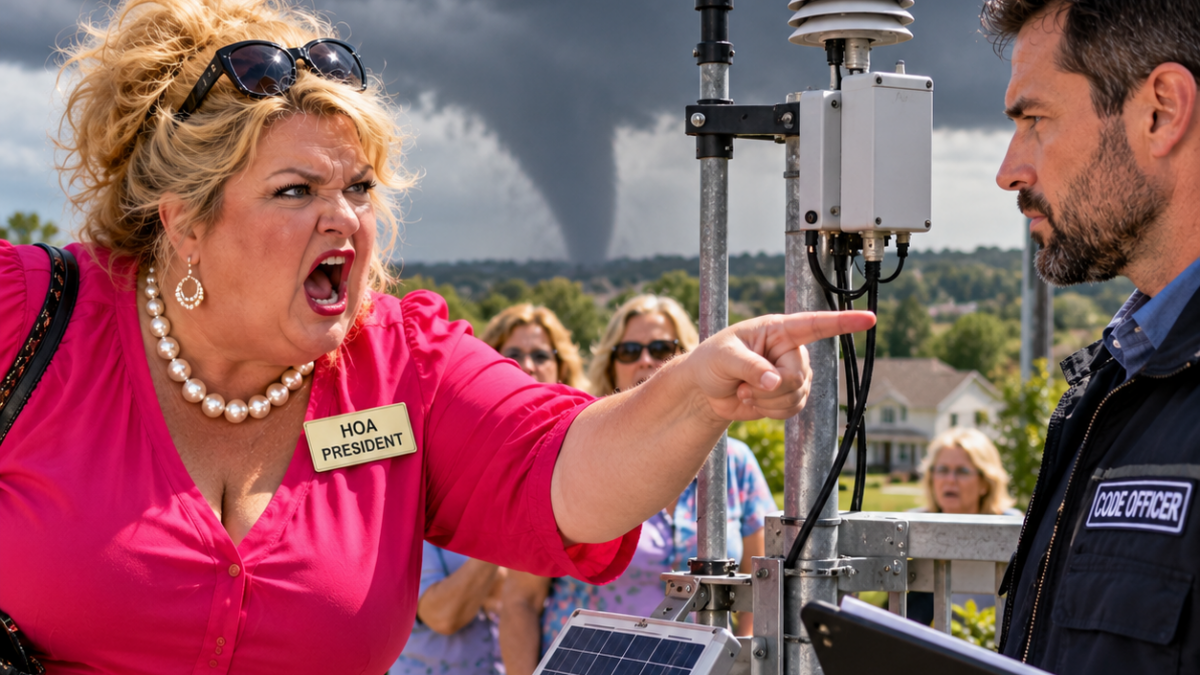
Her finger pointed toward the mast.
“That thing comes down.”
At the time, it sounded like an order.
Years later, it sounds like the opening line of an education.
Mine as much as hers.
I learned that owning a home does not isolate you from other people.
It connects you to systems.
Neighbors.
Local government.
Weather warnings.
Insurance.
Associations.
Utilities.
Emergency management.
Data networks.
The question is not whether those systems exist.
The question is whether people inside them remain accountable.
Karen forgot.
Oakmont remembered.
I kept the station.
But that alone would have been a small victory.
We kept the houses.
The gardens.
Mrs. Gable kept Harold’s gnomes.
David kept his cracked driveway until he chose to repair it.
The neighborhood kept its money under better controls.
Homeowners kept their right to ask questions without becoming targets.
And when storms came, we built more ways—not fewer—to warn each other.
Weather radios were purchased in bulk.
Shelter information posted.
New residents received emergency guides.
The HOA paid for a community weather-awareness seminar every spring.
Not because my mast was sacred.
Because preparation was.
That was the part Karen could never have imagined.
She wanted the station gone because she believed it made Oakmont look less perfect.
Instead, the fight over it helped Oakmont become more prepared, more transparent and more human.
Perfection is mostly decorative.
Resilience is useful.
Give me useful.
Every time.
One evening my daughter, grown and home from college, stood with me beneath the mast.
“You know this is old-fashioned now.”
“I know.”
“New sensors are smaller.”
“I know.”
“You could replace the whole system.”
“I have replaced most of it.”
“The mast.”
“What about it?”
“It’s ugly.”
I looked at her.
She smiled.
“I wanted to see your face.”
“Your inheritance has been revoked.”
She laughed.
Then looked up.
“Are you ever taking it down?”
“Eventually.”
“When?”
“When it stops being useful.”
Not when somebody finds it ugly.
Not when somebody needs obedience.
When its function ends.
That is a better standard for many things.
Maybe someday the station will come down.
Technology changes.
Networks change.
Needs change.
When it does, I will unbolt the mast.
Break the concrete if necessary.
Restore the yard.
Doppler may remain.
Mrs. Gable would insist.
And I will not feel like I lost.
Because keeping a thing forever was never the point.
Choosing based on evidence rather than intimidation was.
The same principle saved the station.
Changed the HOA.
Protected our home.
And, during more than one storm, contributed one small piece of information to a much larger system watching over thousands of people.
Karen called it an ugly metal monstrosity.
She wasn’t entirely wrong about the ugly part.
Galvanized steel is not subtle.
But usefulness rarely asks permission from beauty.
Fire hydrants aren’t elegant.
Storm drains don’t improve landscaping.
Weather radios don’t match kitchen décor.
Shelter rooms aren’t glamorous.
Some things exist because when the day goes bad, appearance becomes the least important thing in the world.
That is what I tried to explain to Karen.
She refused to hear it.
So the documents explained it for me.
Then the neighbors.
Then the insurer.
Then the vote.
And months later, when the sky turned green-gray and warning tones screamed from our phones while the outdoor sirens began to wail, the atmosphere delivered the final lesson without saying a word.
My family sheltered.
Our neighbors sheltered.
Forecasters worked.
Emergency managers worked.
Radar worked.
Spotters worked.
Observation networks worked.
My station kept sending data.
No single piece saved us.
All of them mattered.
That is the ending I prefer.
Not Karen leaving.
Not her house going up for sale.
Not the audit.
Not even the forty-eight-to-four vote.
A family in a dark closet.
A warning received in time.
A neighborhood that knew what to do.
A weather mast standing outside in the storm because, months earlier, a group of ordinary people had finally decided that one person’s obsession with appearances was not more important than reason.
When the storm passed, I walked outside.
Rain dripped from the mast.
The anemometer slowed.
Pressure began recovering.
Clouds pulled east.
Behind me, Sarah opened the door.
“All clear?”
“Yeah.”
She looked at the station.
“Worth it?”
I thought about the sleepless nights.
The fines.
The lawyers.
The fear in her face when the lien letter arrived.
Mrs. Gable crying over Harold’s gnomes.
David getting retaliatory notices.
Marcus buried in bylaws.
The insurance letter.
The vote.
The audit.
Then I thought about the warning.
The children in shelters.
The data still moving.
Our neighborhood finally functioning like a community.
“Yes.”
Sarah smiled.
“Good.”
Then she pointed down.
Doppler was lying face-first in the mud again.
“Your guardian failed.”
“He maintained his post.”
“He’s ceramic.”
“Still counts.”
I stood him upright.
Sarah went inside.
I stayed under the mast for another minute.
The storm was moving away.
Stars were beginning to appear behind it.
For twenty years in the Air Force, I had watched weather because people were depending on me.
I thought retirement meant that responsibility was over.
I was wrong.
Responsibility just got smaller.
Closer.
My own backyard.
My own neighbors.
My own family.
That was enough.
More than enough.
The HOA once demanded I tear down my weather station because it disturbed the view.
Years later, the mast is still there.
The fines are gone.
The lien never happened.
Karen is gone.
The old board is gone.
The dangerous contracts are gone.
The fear is gone.
What remained was the thing none of them expected.
Trust.
And when the next storm rolls over Oakmont Meadows, the station still turns into the wind.
Quiet.
Accurate.
Unimpressed by politics.
Doing exactly what it was built to do.
Watching.