PART 2: HOA Ordered My “Spy Deck” Torn Down—Then an Air National Guard Colonel Stood Up at Their Vote
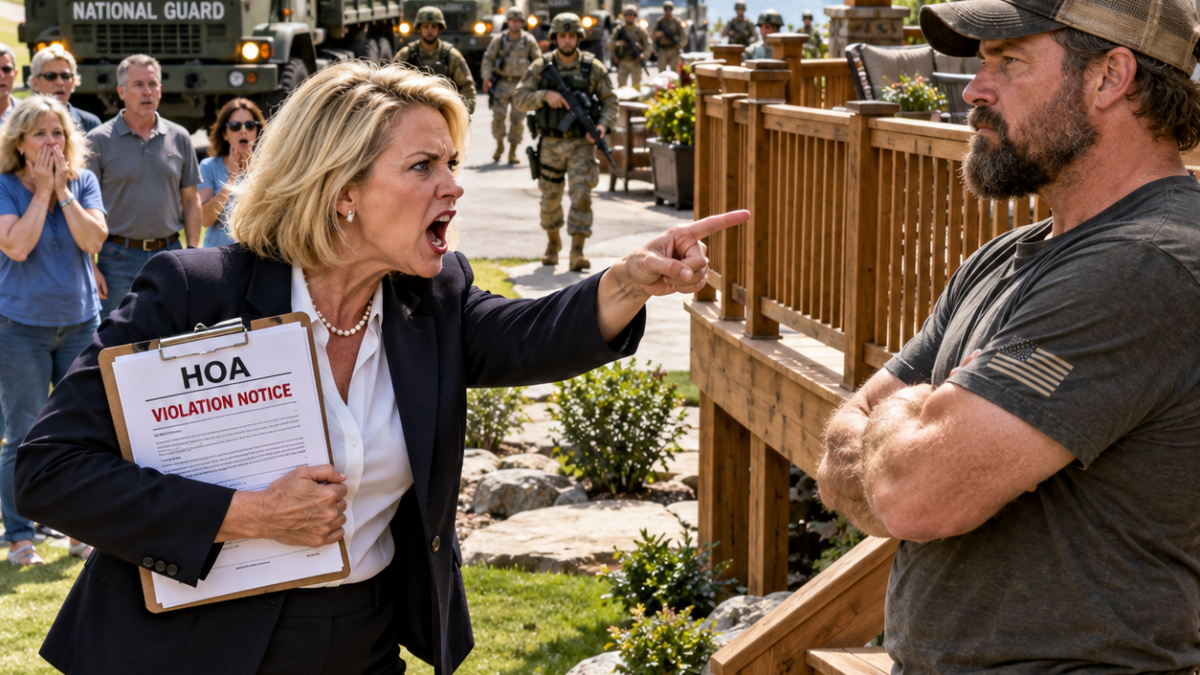
PART 2
Sarah was sitting at the kitchen table when I walked inside.
She had lived with me through enough military assignments to recognize my mood before I spoke.
“What happened?”
“Karen.”
She closed the novel she had been reading.
“Of course.”
“She wants the platform removed.”
For a moment she simply stared at me.
“The weather platform?”
“Yes.”
“The one that was on the original house plans?”
“Yes.”
“The one the HOA approved?”
“Yes.”
“The one the county approved?”
“Yes.”
“The one you’ve been using for two years without anybody complaining?”
“That would be the one.”
Sarah leaned back.
“What does she think it is?”
“A spy tower.”
She blinked.
Then laughed.
Not politely.
Actually laughed.
I waited.
When she finally stopped, she wiped one eye.
“I’m sorry.”
“No, you’re not.”
“Not even a little.”
“She says residents are worried about privacy.”
Sarah looked toward the back windows.
Beyond them was nothing but our yard and the endless green wall of the state forest.
“To spy on whom?”
“Apparently Karen.”
“Can you see Karen’s house?”
“I can barely see the direction her house is in.”
“She knows that?”
“She doesn’t care.”
Sarah’s smile faded.
That was the part that worried both of us.
Karen Thompson had been elected HOA president six months earlier.
Before her, Eagle’s Landing had been largely forgettable.
That was one reason we bought there.
The developer sold us Lot 112 as the premium edge property because the entire rear boundary touched protected state forest.
No house behind us.
No future construction.
No golf course.
No shopping center.
Just trees.
The house itself was something Sarah and I had designed after years of living in government quarters, temporary rentals, base housing, and places where “home” meant wherever our boxes happened to be that year.
I wanted a workshop.
Sarah wanted a large kitchen and windows facing the forest.
Both of us wanted a first-floor bedroom so we wouldn’t have to move again when stairs became annoying.
And I wanted the observation platform.
I had spent twenty-four years working weather.
Not television weather.
Operational meteorology.
Forecasts for flight operations.
Storm avoidance.
Training ranges.
Emergency response.
I had stood in briefing rooms at two in the morning explaining to pilots why conditions that looked harmless on a map might become deadly forty minutes later.
I had watched hurricane pressure fall like a rock.
I had studied desert winds that could erase visibility in minutes.
I had learned to treat weather not as scenery, but as a living system.
When I retired, I could not simply stop watching the sky.
So the station became my bridge between who I had been and who I was trying to become.
For two years, it worked perfectly.
Every morning, I made coffee and walked into my second-floor office.
Data streams filled three monitors.
Wind profiles.
Ceiling height.
Temperature gradients.
Pressure.
Cloud movement.
The National Weather Service could access selected data, and I maintained an informal but valuable sharing arrangement with the nearby Air National Guard base.
The unit commander, Colonel James Evans, had been my commanding officer years earlier.
We had stayed friends.
More than once, my station caught small, local weather changes that larger networks did not resolve quickly enough.
One event in particular mattered.
A microburst had developed near a low-level training corridor.
My instruments showed the wind signature before the broader network made the danger obvious.
I called the base weather desk.
They adjusted the training sequence.
Two aircraft diverted.
No drama.
No television cameras.
No medals.
Just people doing their jobs and two pilots going home.
That was enough for me.
Karen knew none of this when she arrived at my house.
And apparently she did not intend to learn.
A week after our confrontation, the certified letter arrived.
Four pages.
Article Seven, Section Three.
Unapproved elevated structure.
Aesthetic incompatibility.
Privacy intrusion.
Failure to maintain neighborhood harmony.
The language was almost impressive in its ability to turn nonsense into something official-looking.
She included a photograph.
My house from the street.
The platform circled in red.
Then an arrow pointing vaguely toward a mass of trees with the words LINE OF SIGHT TO PRESIDENT THOMPSON RESIDENCE.
I stared at it.
Sarah came over.
“What is that?”
“Apparently geography.”
“Her house is there?”
“No.”
“Where is it?”
I pointed several inches outside the photograph.
Sarah shook her head.
“She’s not very good at spying.”
The fine was $100 per day.
Retroactive to Karen’s verbal warning.
Total:
$700.
Removal deadline:
thirty days.
I did what years of military work had trained me to do.
I removed emotion.
Then I built the answer.
Original architectural plans.
Approved.
Original HOA architectural approval.
Signed.
County permit.
Final inspection.
Equipment registrations.
NOAA identification.
FAA-related documentation.
Then I created a panoramic image from the platform.
North.
State forest.
East.
State forest.
South.
Our roof.
West.
My own yard and neighboring rooftops partially screened by trees.
Karen’s property was invisible.
I added a GIS map.
Calculated line of sight.
Tree canopy.
Distance.
Elevation.
The result was almost comical.
To see Karen’s swimming pool from my platform, I would have needed to remove several acres of protected forest and probably install military reconnaissance equipment.
I drafted a polite letter.
I did not call her accusation ridiculous.
I wanted to.
Instead:
I believe the current enforcement action is based on an understandable misunderstanding concerning the function, prior approval, and sight lines of the observation platform.
Sarah read it.
“Understandable?”
“I’m being diplomatic.”
“It is not understandable.”
“I know.”
“You’re better than me.”
“No. I just like evidence.”
I mailed it certified.
Then waited.
I expected the board to retreat.
Maybe quietly.
No apology necessary.
Just a short letter saying the violation had been rescinded.
Two weeks later, another envelope arrived.
Not a discussion.
An invoice.
$2,100.
Attached was an unsigned note:
THE BOARD HAS REVIEWED YOUR RESPONSE AND FOUND IT INSUFFICIENT.
THE PRIVACY OF OUR RESIDENTS IS NOT NEGOTIABLE.
REMOVAL REMAINS REQUIRED.
They did not mention the approved plans.
Not once.
No answer to the county permit.
No answer to the registration.
No answer to the photographs.
No answer to the line-of-sight evidence.
Sarah stood beside me.
“So they’re ignoring everything.”
“Yes.”
“What now?”
I looked at the invoice.
“Now I stop treating this like a misunderstanding.”
I bought a heavy three-ring binder.
Sarah saw it.
“Oh, no.”
“What?”
“You bought a binder.”
“Yes.”
“That means you’re happy.”
“I’m not happy.”
“You’re organizing.”
“Organization is not happiness.”
“For you, it is extremely close.”
I labeled it:
EAGLE’S LANDING—OBSERVATION PLATFORM DISPUTE.
Section One:
Communications.
Section Two:
Governing Documents.
Section Three:
Approvals and Permits.
Section Four:
Technical Evidence.
Section Five:
Enforcement Comparisons.
Section Six:
Board Conduct.
Sarah leaned in the doorway.
“Should I be concerned you have a section called Board Conduct?”
“Not unless you’re on the board.”
“I married a terrifyingly boring man.”
“That is why our taxes are always filed on time.”
I downloaded all one hundred twenty pages of the HOA’s governing documents.
Then read them.
Every paragraph.
Every footnote.
Karen’s problem was that she liked rules as weapons.
My advantage was that I actually read them.
Article Nine contained something interesting.
Scientific, governmental, and public-utility structures could receive special exemptions.
The wording was imperfect.
At the board’s discretion.
But it mattered.
More important was the architectural-review procedure.
Approval, once granted and construction completed in reliance on that approval, was not something a new board could casually pretend never existed.
Then came selective enforcement.
If similar structures or larger modifications had been tolerated, Karen’s position became even weaker.
I began thinking about her backyard.
Karen’s property was one of the largest in the subdivision.
The previous owner had been a widower with a small concrete patio.
Since Karen bought it, the backyard had transformed.
Huge deck.
Gazebo.
Outdoor kitchen.
In-ground pool.
Retaining walls.
Lighting.
I had never thought about permits.
Now I did.
My attorney friend would later call that moment “the beginning of Karen’s worst month.”
Before contacting him, I called Colonel Evans.
He answered from his office.
“Mark Franklin. Retired life finally too relaxing?”
“I’m under attack.”
“Marriage?”
“Worse.”
“HOA?”
“Much.”
He laughed.
“What did you do?”
“Built the weather station we’ve been using for two years.”
“That thing saved our backside last month.”
“They’re calling it a spy tower.”
Silence.
Then another laugh.
“You’re joking.”
“I wish.”
I explained.
Fines.
Removal order.
Privacy claim.
Evans became serious.
“They want you to dismantle the station?”
“Yes.”
“Absolutely not.”
“That was my reaction.”
“Mark, we use that data.”
“I know.”
“Our pilots use that data.”
“I know.”
“Emergency response has used that data.”
“Yes.”
He paused.
“What do you need?”
“A letter.”
“Official?”
“Very.”
“What do you want it to say?”
“The truth.”
“That’s usually dangerous.”
“Explain the station’s operational value. Weather safety. Low-level training. Emergency response. No classified details.”
“I can do that.”
Then he added:
“And Mark?”
“Yes?”
“Don’t turn this into one of your campaigns.”
“It’s already a binder.”
He groaned.
“Oh, she’s doomed.”
My second call went to Michael “Mack” Bell.
Former JAG officer.
Old friend.
Now a civil litigation attorney.
I emailed the file.
He called forty minutes later.
“I hate HOAs.”
“Good afternoon to you too.”
“No, seriously. Give me a military procurement dispute. Give me a contract fight. Give me people suing over millions. But an HOA fight?”
“You sound excited.”
“They’re vicious because nobody is rational about their home.”
“What do you think?”
“You have written approval?”
“Yes.”
“County permit?”
“Yes.”
“Final inspection?”
“Yes.”
“No changed use?”
“No.”
“Privacy evidence?”
“None.”
“Then their case is terrible.”
“Karen doesn’t seem bothered.”
“People with terrible cases are often the most confident before discovery.”
That line turned out to be prophetic.
Mack told me to make formal records requests.
Board minutes.
Financial statements.
Architectural applications.
Approvals.
Denials.
Five years.
“Don’t just prove you’re right,” he said. “Prove she isn’t neutral.”
“Selective enforcement.”
“Exactly.”
Then he asked:
“Anything questionable on her property?”
“A thousand-square-foot deck, gazebo, outdoor kitchen, pool.”
“Permits?”
“I don’t know.”
“You do now.”
I filed public-record requests with the city.
My property.
Karen’s.
Another board member who had a giant metal sculpture on his lawn that Karen apparently considered tasteful.
Then I started walking the neighborhood.
Not campaigning.
Listening.
Dave Chen was the first.
Carpenter.
Work van in his driveway.
Bright orange violation sticker on the window.
“Commercial vehicle,” he said.
“You use it every day?”
“Every single day.”
“The rule has an employment exception.”
He stared at me.
“What?”
I showed him.
He read it.
Then again.
“That woman knows this.”
“Maybe.”
“She knows everything else.”
“Put your response in writing.”
Dave did.
Fine rescinded.
That got his attention.
Then the Millers.
No relation to anyone involved.
Retired couple.
Garden full of little ceramic gnomes.
Karen fined them for “excessive lawn ornamentation.”
Twenty-five dollars a day.
Mrs. Miller looked embarrassed when she showed me the notice.
“My grandchildren buy these for us.”
There were perhaps eighteen.
A fisherman.
A nurse.
One holding a tiny lantern.
A ridiculous little gnome reading a newspaper.
“They make us happy,” she said.
“So keep them.”
“Karen says they lower property values.”
I looked across the street.
Another board member had a ten-foot abstract metal sculpture in his front yard.
“Interesting.”
“What?”
“Take pictures.”
Within three weeks, my dining room hosted five households.
Dave.
The Millers.
A young couple who had been warned about their basketball hoop.
Arthur Lane, retired CPA.
And me.
Sarah served coffee.
Then sat down beside me.
I opened the binder.
For the first time, people compared experiences.
Karen targeted the work van but ignored a luxury boat.
Targeted gnomes but ignored board-member sculptures.
Targeted children’s equipment but allowed expensive architectural changes by favored owners.
“This isn’t enforcement,” Arthur said.
“No,” I answered. “It’s preference.”
Dave crossed his arms.
“So what do we do?”
“Document.”
He groaned.
“That sounds slow.”
“It is.”
“I want fast.”
“Fast feels good.”
I looked around the table.
“Good isn’t the objective.”
“What is?”
“Effective.”
We created a group.
Eagle’s Landing Homeowners for Fair Governance.
Sarah hated the name.
“It sounds like a congressional committee.”
“It sounds respectable.”
“It sounds sixty years old.”
The Millers loved it.
Name survived.
Then Colonel Evans’ letter arrived.
Official Department of the Air Force letterhead.
Clear.
Professional.
The observation station supported local weather awareness and contributed valuable meteorological data relevant to Air National Guard flight safety and emergency-response readiness.
The final line was perfect:
We trust the Eagle’s Landing Homeowners Association will work constructively with Major Franklin to ensure uninterrupted operation of this valuable community and aviation-safety resource.
Sarah read it.
“That sounds polite.”
“It is.”
“It also sounds like, ‘Don’t be stupid.’”
“Exactly.”
I attached it to my appeal.
Karen’s response came from the HOA lawyer.
They rejected everything.
Then added $500 for continued noncompliance.
And another $500 for legal expenses.
Sarah read the letter.
“They’re charging you for the lawyer they hired to tell you they’re ignoring the Air Force?”
“Yes.”
“Can they?”
“Mack says not like this.”
“So?”
“So we keep going.”
The records request produced a box.
An actual box.
Thousands of pages.
Unorganized.
Meeting minutes mixed with receipts.
Architectural applications shuffled randomly.
Invoices upside down.
Duplicates everywhere.
Arthur looked inside.
“Document dump.”
“Think they expect us to quit?”
He smiled.
“I retired from forensic accounting.”
Sarah set coffee on the table.
“Oh, Karen.”
Arthur spent an entire weekend with us.
Dave reviewed architectural applications.
The Millers sorted minutes.
Arthur did finances.
I built indexes.
It was miserable.
And beautiful.
Patterns emerged.
Favored residents received approvals quickly.
Others waited months.
Board members had exceptions.
Karen critics received citations soon after speaking at meetings.
Then the city permit records arrived.
My file:
Thick.
Complete.
Karen’s:
Thin.
Very thin.
Original home construction.
Sprinkler permit.
Nothing else.
No deck permit.
No gazebo permit.
No outdoor-kitchen permit.
No pool permit.
I checked again.
Nothing.
I called the city clerk.
“Could older permits be missing digitally?”
“These records include paper archives.”
“So no pool?”
“No permit on file.”
“Deck?”
“No.”
“Gazebo?”
“No.”
“Outdoor gas kitchen?”
“No.”
Sarah watched my face.
“What?”
I turned the papers around.
Karen had built a backyard resort without permits while threatening to demolish my approved weather station.
Dave whistled.
The Millers laughed.
Arthur did not.
He was looking at invoices.
“Mark.”
Something in his tone silenced us.
He placed several sheets together.
PRESTIGE LANDSCAPING AND DESIGN.
Spring planting:
$5,000.
Masonry repairs:
$8,000.
Storm-drain remediation:
$12,000.
Other charges.
Total above $30,000.
Arthur pointed to dates.
“This one.”
The $8,000 masonry invoice occurred during the period Karen’s outdoor kitchen had been constructed.
“This one.”
$12,000 storm work during pool excavation.
Dave frowned.
“I never saw Prestige trucks.”
“Neither did I.”
Arthur turned his laptop.
State registration.
Prestige Landscaping and Design.
Registered officer:
Frank Thompson.
Karen’s husband.
The room went quiet.
Sarah finally said:
“Are you saying HOA money may have paid for Karen’s backyard?”
Arthur raised one hand.
“I’m saying invoice timing, vendor ownership, and the absence of visible corresponding common-area projects justify a forensic audit.”
CPA language.
Translation:
It looked terrible.
Suddenly the spy-tower fight made more sense.
Karen didn’t merely dislike the station.
She disliked me.
More accurately, she disliked that I did not scare easily.
Every letter I challenged forced more records into the light.
Every appeal created scrutiny.
Every neighbor I helped created another person willing to ask questions.
Karen’s real danger was never my lidar.
It was attention.
My refusal to surrender was redirecting community attention toward her.
She needed me beaten publicly.
Then she handed us the perfect opportunity.
SPECIAL COMMUNITY STANDARDS ENFORCEMENT MEETING.
Single agenda item:
Lot 112.
Mark Franklin.
Authorization for legal action.
Lien.
Forced removal of unauthorized structure at owner expense.
The notice described my platform as:
An intrusive surveillance installation threatening privacy, aesthetics, and the safety and comfort of families.
Sarah dropped the notice on the table.
“She’s putting this to a vote?”
“Yes.”
“In front of everybody?”
“Yes.”
“She really is.”
“What?”
“Overconfident.”
I smiled.
“Finally we agree.”
Karen gave us seven days.
We needed fewer.
We did not send angry flyers.
No accusations.
Just a simple note:
Before voting on Lot 112, please attend and hear all relevant facts concerning prior approval, selective enforcement, board transparency, and association finances.
Then I called Evans.
“I have a strange favor.”
“You need another letter?”
“No.”
“What?”
“Would you attend an HOA meeting?”
Silence.
Then:
“You cannot be serious.”
“You don’t need to say much.”
“What uniform?”
“Jim.”
“That’s a yes?”
“What time?”
Thursday night.
The clubhouse was packed.
More people than I had ever seen there.
Karen sat at the front between her two loyal board members.
She wore a dark suit.
Gavel.
Folders.
Prepared statement.
Theater.
She opened dramatically.
“It is always regrettable when an association must take enforcement action against one of its own residents.”
I almost admired the performance.
She described me as combative.
Uncooperative.
Militaristic.
That one was creative.
Then the station.
“Surveillance equipment.”
“Tower.”
“Threat to children.”
She read two anonymous letters from residents claiming they were afraid to use their yards because they believed I might be watching.
I looked around.
Nobody claimed them.
Karen finished.
“We have tried reason.”
No.
“We have tried compromise.”
No.
“We have provided repeated opportunities for voluntary compliance.”
Remove it or pay us.
“Unfortunately, Mr. Franklin has responded with defiance.”
That part was accurate.
“Therefore, I ask this community to authorize the board to protect our rights, our privacy, and our property values.”
She lifted the gavel.
“I now call the vote.”
I stood.
“Point of order.”
Karen’s eyes narrowed.
“This is not a debate.”
“Article Three, Section Four.”
I held up the bylaws.
“An affected homeowner receives five minutes before an enforcement vote.”
She looked toward the HOA lawyer.
He leaned over.
Whispered.
Karen’s jaw tightened.
“Five minutes.”
“Thank you.”
I walked forward.
Placed my binder on the podium.
Then plugged in my laptop.
“My name is Mark Franklin.”
A few people laughed quietly.
“I live at Lot 112.”
The first slide showed my platform.
Not Karen’s grainy street photograph.
A professional image taken at sunrise.
Weather instruments silhouetted above the forest.
“For twenty-four years, I served as an Air Force meteorologist.”
I explained the equipment.
Wind lidar.
Ceilometer.
Sky camera.
Sensors.
No jargon beyond necessity.
Then:
“The station does not record your backyards.”
Panoramic image.
Trees.
“Karen’s home is not visible.”
GIS line.
Forest obstruction.
Then approval stamp.
“This structure was reviewed and approved before construction.”
Murmurs.
Karen interrupted.
“The current board—”
I looked at her.
“My five minutes.”
A few people applauded.
She stopped.
Then I said:
“I understand some of you may reasonably wonder why I care so much about what looks like a private weather hobby.”
I looked toward the back.
“So I invited someone who can explain that better than I can.”
“Colonel Evans?”
Every head turned.
Colonel James Evans stood.
Dress blues.
Decorations.
Calm.
The room went absolutely still.
Karen’s face changed.
He did not threaten.
Did not mention federal authority.
Did not lecture.
He simply spoke.
“Good evening. I command the nearby Air National Guard unit that receives meteorological data from Major Franklin’s station.”
Major.
That word caused several heads to turn toward me.
Evans continued.
“His equipment has identified localized weather conditions relevant to flight safety that are not always captured as quickly by broader regional systems. That data supports training decisions and may also assist emergency-response awareness.”
He looked around.
“This is a privately operated station, but it provides a genuine public-safety benefit.”
Then:
“We appreciate his continued service.”
He sat.
No applause at first.
The room needed a second.
Then applause started.
Not explosive.
Respectful.
Karen stared at me.
I could have stopped there.
Won the station vote.
Probably.
But Karen had made the meeting about rules.
So we were going to talk about rules.
I clicked.
Karen’s property appeared on the screen.
Satellite image.
Deck.
Gazebo.
Outdoor kitchen.
Pool.
Red outlines.
Karen’s head snapped toward the projector.
“What is this?”
“These are permanent structures at Lot 42.”
Her house.
I continued.
“Since tonight’s vote is based on the importance of consistent architectural enforcement, I checked public permit records.”
Click.
CITY RECORD RESPONSE:
NO PERMITS LOCATED FOR DECK EXPANSION, GAZEBO, OUTDOOR KITCHEN, OR SWIMMING POOL.
A gasp moved through the room.
Karen stood.
“This has nothing to do with your violation.”
“Actually, it has everything to do with selective enforcement.”
“My property is not under discussion.”
“Mine wasn’t supposed to involve national security either, but here we are.”
Laughter.
She slammed the gavel.
“Sit down.”
Dave stood.
“Let him finish.”
Others joined.
“Finish.”
“Let him speak.”
My five minutes had technically expired.
But the room no longer belonged to Karen.
I clicked again.
Prestige Landscaping invoices.
Arthur stood.
His voice was quiet.
Which made people listen.
“My name is Arthur Lane. I’m a retired certified public accountant.”
Karen went pale.
Arthur explained only what could be supported.
The HOA paid more than $30,000 to Prestige Landscaping and Design.
Some descriptions referenced common-area masonry, drainage, and landscaping.
The company’s registered officer was Frank Thompson.
Karen’s husband.
Several invoice dates corresponded with private construction occurring at Karen’s property.
And our review had not identified matching common-area projects explaining certain charges.
Arthur did not say embezzlement.
He didn’t need to.
Someone shouted:
“Did our dues pay for your pool?”
Karen grabbed the microphone.
“No!”
Another:
“Then show us the work those invoices paid for!”
Karen’s lawyer leaned toward her.
She ignored him.
“This is a coordinated smear campaign by disgruntled homeowners.”
Mrs. Miller stood.
“We’re disgruntled because you fined us for garden gnomes!”
Laughter and applause.
Dave stood.
“You fined my work van even though your own covenant exempted vehicles used for daily employment.”
A young mother:
“You threatened us over a basketball hoop!”
Another resident:
“What about the legal bills?”
Arthur raised another document.
That became the next question.
Karen tried to adjourn.
Nobody allowed the conversation to die.
Her gavel struck repeatedly.
Meaningless little wooden impacts.
For years, people had obeyed the sound.
Now they understood it was only wood hitting wood.
Dave raised his voice.
“I move for an immediate vote of no confidence in the current board.”
The room erupted.
Karen shouted:
“That motion is out of order!”
Mack, sitting quietly near the side wall, spoke for the first time.
“Actually, under your bylaws, a removal motion may be introduced at a properly noticed special membership meeting if quorum is present.”
Karen stared.
“Who are you?”
“Counsel for Mr. Franklin.”
That did not improve her evening.
The secretary checked attendance.
Quorum.
The motion was seconded.
Then thirded.
Then essentially seconded by half the room.
Karen demanded delay.
Residents demanded vote.
The HOA attorney whispered urgently.
Finally the vote happened.
Hands rose.
Almost every hand in the room.
No confidence.
Then removal proceedings.
Karen’s two board allies looked around and understood the political landscape had vanished beneath them.
One abstained.
The other voted against Karen.
That was the moment she broke.
“You cowards!”
She pointed at them.
“I built this community!”
No one answered.
“You people begged me to clean this place up!”
Mrs. Miller crossed her arms.
“We asked you to fix the streetlights.”
Laughter.
Karen’s face twisted.
Then she looked at me.
“This is because of him.”
I stayed quiet.
“He brought the military into a private community dispute!”
Evans remained seated.
I said:
“You brought my weather station into the dispute.”
“You orchestrated this.”
“No.”
I looked around.
“You did.”
That was all.
The interim board formed that night.
Arthur became temporary president because everyone trusted the accountant.
His first act:
Suspend enforcement against Lot 112.
Second:
Rescind my fines pending formal review.
Third:
Independent forensic audit.
Fourth:
Preserve all financial and electronic records.
That final motion came from Mack.
Very important.
Karen left before adjournment.
Frank followed.
No golf cart.
No clipboard.
No gavel.
Just two people walking through a room full of neighbors who had finally stopped looking away.
Sarah found me in the parking lot afterward.
“You okay?”
“I think so.”
“You won.”
“Not yet.”
“The deck?”
“Safe.”
“The fines?”
“Going away.”
“Karen?”
“That’s bigger.”
Colonel Evans walked over.
He shook my hand.
“You owe me dinner.”
“For sixty seconds?”
“I wore dress blues to an HOA meeting.”
“Fair.”
Sarah hugged him.
“Thank you.”
He pointed toward me.
“I only came because your husband apparently cannot enjoy retirement without creating operations.”
“I have been saying this for years.”
The audit took six weeks.
Arthur refused to discuss preliminary findings publicly.
Smart.
But every few days his expression became worse.
Prestige Landscaping invoices were only part of it.
Legal expenses had ballooned under Karen.
Repeated consultations over petty enforcement.
Association money used to support personal vendettas.
Expenses with vague descriptions.
Vendor relationships that had not been properly disclosed.
Then the auditors examined Prestige.
Some legitimate work existed.
Not every invoice was fake.
That mattered.
Truth is stronger when you don’t exaggerate it.
But enough invoices lacked supporting proof to trigger serious concern.
Work orders described common-area projects that could not be located.
Payments aligned with construction at Karen’s house.
Material descriptions resembled materials used in her backyard.
The new board turned everything over to law enforcement.
Police opened an investigation.
The city opened its own file.
Karen’s backyard suddenly received more official attention than my weather station ever had.
Inspectors found:
Unpermitted deck expansion.
Unpermitted permanent gazebo.
Outdoor gas installation requiring review.
Pool constructed without complete permit history.
Electrical and setback questions.
Utility-easement encroachment issues involving pool equipment.
One morning, an orange municipal notice appeared on Karen’s front door.
Dave sent me a photograph.
NO ONE IS ABOVE THE RULES, he texted.
I replied:
Don’t become her.
He called immediately.
“That hurt.”
“It should.”
He laughed.
“You’re right.”
That became important.
There is a danger after defeating someone abusive.
You can start enjoying their pain enough to become smaller yourself.
I wanted accountability.
Not a new bully wearing our colors.
The civil suit followed.
The HOA sought reimbursement for improperly spent funds.
The insurance carrier became involved.
Lawyers multiplied.
Karen and Frank sold assets.
Negotiations happened.
I stayed out of most of it.
My part had been the station.
The board formally reviewed the original approval.
Unanimous decision:
Valid.
All fines rescinded.
Then Arthur proposed a bylaw amendment.
Residents called it the Franklin Resolution.
I hated the name.
It protected structures primarily used for scientific research, weather observation, amateur radio, or public-safety support, provided they complied with county safety rules and reasonable placement standards.
“Do we need this?” I asked.
Arthur nodded.
“Yes.”
“Why?”
“Because someday you’ll sell.”
That stopped me.
“And somebody else will live in Lot 112.”
He continued.
“Rules should protect people even when the people who wrote them are gone.”
That was a very accountant thing to say.
Also wise.
Passed overwhelmingly.
Dave’s work van got written clarification.
Allowed.
The Millers’ gnomes received no special legal protection because, as Arthur said, “I refuse to write the phrase ‘ceramic gnome’ into a recorded covenant.”
Instead, the entire decorative-object rule was narrowed.
Temporary and minor lawn decorations were no longer subject to aesthetic approval unless they created safety hazards.
Mrs. Miller responded by purchasing six more gnomes.
“Celebration,” she said.
One wore a military uniform.
She placed it facing my house.
I begged her to rotate it.
She refused.
The neighborhood changed.
Not overnight.
People had spent months learning to avoid one another.
Karen’s leadership encouraged anonymous complaints.
Photographs submitted secretly.
People watching each other.
After she left, the habits remained for a while.
Then gradually:
Driveway conversations.
Borrowed tools.
Children playing together.
Dave repaired the Millers’ fence for free.
Arthur held a budget workshop that nobody wanted to attend but everyone appreciated afterward.
Sarah started a monthly coffee morning.
I tried not to become involved.
Failed.
My station kept running.
That was the part I cared about most.
Every morning, data.
Cloud base.
Wind.
Pressure.
Visibility.
The sky didn’t know Karen existed.
One afternoon, about a month after the board transition, I was on the observation deck replacing a sensor cable.
Clear blue sky.
Cool wind.
Pressure beginning to fall ahead of a distant front.
Below me, Sarah was gardening.
Dave’s van sat in his driveway three streets away.
I could see its roof between houses.
The Millers’ gnome collection had become, in my opinion, a national-security concern.
Then I heard engines.
Different from commercial aircraft.
Familiar.
Low.
Heavy.
I looked east.
Two A-10s appeared beyond the tree line.
They were not dangerously low.
Not doing anything reckless.
Just lower than their usual transit path and directly aligned with our part of the neighborhood.
Sarah stepped into the yard.
I raised a hand.
The lead aircraft banked gently.
Left wing dipped.
Then leveled.
The second followed.
Seconds later, they were gone.
Sound rolled over the forest.
Sarah looked up at me.
“Was that for you?”
“No.”
She crossed her arms.
“Mark.”
“Possibly.”
I smiled.
Colonel Evans denied arranging anything.
Which meant he absolutely knew.
That little wing dip mattered more to me than the vote.
Because it reminded me what the platform represented before Karen turned it into a conflict.
Service.
Continuity.
Purpose.
Retirement had been harder than I admitted.
People imagine retirement from the military as relief.
No alarms.
No transfers.
No deployments.
And yes, there is relief.
But there is also subtraction.
One day, people depend on your judgment.
Your experience matters.
Your phone rings because weather is changing and someone needs an answer.
Then suddenly nobody needs you at 0430.
You can sleep.
And sometimes that feels like losing part of yourself.
The station gave me a small piece of that purpose back.
Karen saw aluminum railings and instruments.
I saw a way to remain useful.
That was why her demand hurt more than I initially showed Sarah.
Not because I feared losing construction money.
Because Karen was unknowingly asking me to dismantle one of the few parts of my old life that still felt meaningful.
One night after everything settled, Sarah said:
“You never told me that.”
We were sitting on the back porch.
“Told you what?”
“That taking down the station would have felt like retiring twice.”
I looked at her.
“Where did you get that?”
“You think I don’t know you?”
“I try not to make it obvious.”
“You spent three weeks sleeping four hours a night over an HOA violation.”
“That could mean anything.”
She smiled.
“No.”
She took my hand.
“I was worried the fight was becoming the purpose.”
That hit harder.
“Was it?”
“For a while.”
I couldn’t disagree.
She continued.
“That’s why I’m glad it’s over.”
“So am I.”
“No.”
She looked directly at me.
“I mean really over.”
She was right.
Karen had occupied too much mental space.
Binder.
Meetings.
Records.
Strategy.
Every dinner conversation had become enforcement.
Every walk became intelligence gathering.
Every neighbor became an ally or unknown variable.
Military instincts are useful.
They can also become habits you forget to switch off.
So I put the binder in a cabinet.
Not destroyed.
I am not insane.
Archived.
Then I returned my office to weather.
The criminal investigation into Karen and Frank continued.
Eventually charges were filed involving fraud-related conduct and misuse of association funds.
The exact numbers debated through lawyers and auditors were less important to me than they seemed to everyone else.
Some allegations narrowed.
Some expenses proved legitimate.
Others did not.
The HOA recovered a substantial amount through settlement and civil claims.
Karen faced penalties.
Frank’s company disappeared.
Their backyard became its own bureaucratic nightmare.
The city required permits, engineering review, corrections, and partial demolition where compliance could not be achieved.
The irony was obvious.
But I didn’t drive past to look.
Dave did.
Frequently.
“Updates?” he would ask.
“No.”
“The gazebo has orange tape.”
“Dave.”
“The pool equipment—”
“Stop surveilling Karen.”
He stared.
“From the spy-tower man?”
“Exactly.”
We both laughed.
Eventually Karen and Frank sold their house.
The closing required resolution of city issues and financial claims.
The sale price became neighborhood gossip.
I never checked.
One morning, a moving truck appeared.
Sarah saw it first.
“You want to watch?”
“No.”
“Really?”
“Yes.”
She studied me.
“You’re getting healthier.”
“Don’t ruin it.”
Karen left Eagle’s Landing quietly.
No final confrontation.
No apology.
No dramatic speech.
For a while that disappointed people.
Everyone likes closure shaped like a movie.
Real closure is often a moving truck turning a corner and never coming back.
Arthur stayed president for one term.
He hated every minute.
Perfect qualification.
At the end, he refused reelection.
“I have grandchildren.”
“That didn’t stop you before.”
“I’ve seen the budget.”
Fair.
Dave was nominated.
He declined.
Mrs. Miller suggested me.
I almost moved.
Eventually a woman named Rachel Foster became president.
Civil engineer.
Practical.
First speech:
“If you see a problem, talk to your neighbor before you photograph it.”
I liked her immediately.
Under Rachel, meetings returned to boring.
Financial statements online.
Vendor contracts published.
Conflict disclosures mandatory.
Architecture decisions written with reasons.
Appeals heard by members who were not involved in the original decision.
Nobody had absolute discretion.
That mattered.
Power should encounter friction.
One summer storm demonstrated why my station had always mattered.
It began as a humid afternoon.
Nothing dramatic on regional radar.
But surface conditions near the forest changed quickly.
Pressure falling faster than expected.
Wind profile showing instability.
Cloud base dropping.
I sent an alert to my contacts.
The Air National Guard adjusted local training.
County emergency staff received the feed.
Twenty minutes later, severe wind moved through.
Trees came down.
Power failed in sections of the county.
No catastrophe.
But preparation mattered.
The next HOA meeting, Rachel mentioned it.
“Apparently the spy tower predicted the storm.”
Everyone laughed.
I said:
“I will resign from the neighborhood.”
“You’re not on the board.”
“Then I’ll resign from something else.”
The name stuck.
Spy Tower.
I hated it.
Then eventually I stopped hating it.
Dave made a small wooden sign:
FRANKLIN SPY TOWER
WEATHER ONLY
Sarah tried to hang it near the platform stairs.
I confiscated it.
She bought another.
Marriage.
Years passed.
Eagle’s Landing aged.
Trees grew.
Children became teenagers.
The Millers eventually moved closer to their daughter.
Before leaving, they held a yard sale.
I bought one gnome.
Sarah thought I had lost my mind.
“Why?”
“Historical artifact.”
It was the newspaper-reading one.
I placed it near the base of the platform.
Dave saw it.
“Karen wins.”
“Leave.”
The observation equipment evolved.
I upgraded sensors.
Improved backup power.
Added redundant communications.
The Air National Guard changed personnel.
Evans eventually retired.
At his retirement ceremony, he introduced me to a young major from the weather unit.
“This is Franklin.”
The major smiled.
“Spy tower?”
I stared at Evans.
“You told them?”
“Everybody knows.”
The major shook my hand.
“We still use your feed.”
That meant more than he knew.
Evans leaned over.
“See? You’re still useful.”
I punched him lightly in the shoulder.
“Retire badly.”
“I plan to.”
He did.
Two months later he bought an RV and started sending me photographs of terrible weather from national parks.
Every photograph came with:
YOUR STATION MISSED THIS.
I stopped replying.
The HOA conflict gradually turned into community folklore.
New residents would occasionally ask:
“Is it true the National Guard came to an HOA meeting?”
“One colonel.”
“In uniform?”
“Yes.”
“Did helicopters land?”
“No.”
“Someone told me tanks came.”
“Absolutely not.”
“Police?”
“Later, unrelated to my platform.”
“Did Karen get arrested at the meeting?”
“No.”
Stories inflate.
That’s why records matter.
The actual story was dramatic enough.
One woman believed authority allowed her to erase prior approval.
One homeowner refused.
That refusal led neighbors to compare experiences.
Comparison led to records.
Records led to money.
Money led to accountability.
No tanks required.
The most emotional moment for me came years later.
Not the A-10 salute.
Not the meeting.
Not Karen leaving.
It happened on an ordinary autumn afternoon.
A teenager knocked on my door.
His name was Eric.
I knew his parents casually.
He was applying to college.
“Mr. Franklin?”
“Yeah?”
“Can I ask you about the weather station?”
“Sure.”
He had become interested in meteorology after the storm a few years earlier.
He wanted to study atmospheric science.
Could he see the instruments?
I took him upstairs.
Showed him the lidar.
Ceilometer.
Data software.
Explained vertical wind profiles.
Cloud detection.
Quality control.
He asked good questions.
Very good questions.
Then:
“My dad said the HOA almost made you tear this down.”
“Yes.”
“Why?”
I looked at the equipment.
“That’s a longer lesson than meteorology.”
He smiled.
“Was it worth fighting?”
That question stayed in the room.
I could have said yes immediately.
But the truth was more complicated.
The fight cost time.
Money.
Stress.
Sleep.
It strained my marriage for a while.
It pulled me back into a combat mindset I thought I had left behind.
But I looked at Eric.
A kid standing on the platform because the equipment had made him curious about the sky.
“Yes.”
“Because the Guard uses it?”
“Partly.”
“Why else?”
“Because sometimes you protect something not only for what it does today, but for what it might mean to someone tomorrow.”
He nodded slowly.
Years later, Eric graduated with a degree in atmospheric science.
He emailed me a photograph from his first job.
National Weather Service office.
Message:
STILL BLAMING THE SPY TOWER.
I showed Sarah.
She cried.
I did not.
According to me.
The neighborhood continued becoming less interesting.
That is the highest compliment I can give an HOA.
One year, the biggest debate concerned whether the entrance landscaping should use native plants.
Three meetings.
Two surveys.
One horticultural presentation.
Nobody threatened a lien.
Eventually they chose native plants.
The Millers would have approved.
Dave complained they didn’t include enough gnomes.
Rachel ignored him.
My platform remained at fifteen feet.
Same footprint.
Same basic design.
The paint has been refreshed twice.
Still matches the house.
The forest behind us grew taller.
Karen’s old house changed owners again.
The new family installed a small telescope platform in their backyard.
Properly permitted.
Properly approved.
At the architectural meeting, Rachel asked me:
“Any objection?”
“To a telescope?”
“You are the community surveillance expert.”
“Approve it before I sue you.”
Approved unanimously.
The father later invited me over.
We looked at Saturn.
Beautiful.
No scandal.
That was another kind of victory.
Rules functioning normally.
One winter, Sarah and I finally cleaned the office cabinets.
She found the binder.
“Still have it.”
“Evidence doesn’t expire emotionally.”
“That sentence makes no sense.”
“It sounded good.”
She opened it.
First violation.
Spy tower.
$700.
Then $2,100.
Legal fees.
Air Force letter.
Permits.
Records.
Photographs.
She flipped pages slowly.
“We were younger.”
“It was not that long ago.”
She looked at me.
“We were definitely younger.”
She found the special-meeting notice.
“Forced removal.”
Then the meeting notes.
Then the rescission.
Finally the Franklin Resolution.
She closed the binder.
“Throw it away?”
I considered.
“No.”
“Of course not.”
“But attic.”
She smiled.
“Progress.”
We carried it upstairs.
History.
Not active threat.
That distinction mattered.
By then, I had finally understood what Sarah feared during the fight.
Preparedness can protect you.
It can also consume you.
There is always another possible threat.
Another document.
Another strategy.
At some point, peace requires accepting that you do not control every future storm.
Meteorologists understand that better than most.
We do not stop weather.
We observe.
Model.
Warn.
Adapt.
Then the front passes.
The same was true of Karen.
She was a storm.
Not the first.
Probably not the last person in the world who would confuse a little authority with ownership.
But storms pass faster when you don’t pretend the sky is clear.
The National Guard connection remained active well into my retirement.
Not dramatic.
Mostly data.
Occasional phone calls.
Emails.
Sensor maintenance.
Once, during a statewide emergency exercise, my station feed became part of the situational-weather picture.
Colonel Evans, already retired, called afterward.
“Heard your illegal deck is still threatening civilization.”
“Barely.”
“You know what the funniest part is?”
“What?”
“She called it useless.”
“She called it spying.”
“That too.”
He paused.
“You were always bad at retirement.”
“I’m excellent.”
“You built a weather station linked to military aviation.”
“Normal hobby.”
“Sure.”
We laughed.
Then his tone softened.
“I’m glad you fought.”
“So am I.”
Not because I won.
Because I learned what I was protecting.
At first I thought it was a structure.
Then rights.
Then fairness.
Eventually I understood it was purpose.
Karen wanted the platform removed because it offended her authority.
I fought because the platform connected my past to my present.
It allowed a retired officer to still contribute something.
That was personal in a way no HOA rule could measure.
And oddly, the fight gave Eagle’s Landing something similar.
Before Karen, residents treated the HOA like background machinery.
Pay dues.
Ignore meetings.
Assume someone responsible is paying attention.
That apathy created the opening Karen exploited.
After her, people paid attention.
Budgets mattered.
Elections mattered.
Minutes mattered.
Not because everyone became suspicious.
Because everyone understood stewardship requires participation.
That may have been the best legacy of the whole mess.
At one annual meeting, years later, a new homeowner complained that financial documents were too detailed.
“Do we really need forty pages?”
Arthur, sitting in the audience as a civilian again, raised his hand.
“Yes.”
Everyone laughed.
The new homeowner looked confused.
Rachel said:
“Trust us.”
Forty pages remained.
One afternoon, I saw Dave standing in his driveway beside a newer work van.
No sticker.
No violation.
He waved.
“You know what I miss?”
“What?”
“Nothing.”
“Good answer.”
He pointed toward my house.
“Spy tower still spying?”
“Only on atmospheric instability.”
“That sounds suspicious.”
“Go build something.”
“I did.”
He showed me photographs of a deck he had built for a client.
Beautiful.
Permit visible in the photo.
“Very compliant.”
“Trauma.”
We laughed.
The Millers mailed us a Christmas card every year after moving.
Always featured at least one gnome.
One year:
A gnome holding binoculars.
Caption:
WE’RE WATCHING YOU.
Sarah framed it.
I considered divorce.
Then came the day Colonel Evans died.
Sudden heart attack.
Years after retirement.
His wife called.
I went to the funeral.
Uniforms.
Flags.
Old friends.
Stories.
At the reception, his son found me.
“You’re Franklin?”
“Yes.”
“My dad talked about you.”
“That’s unfortunate.”
“He told the HOA story constantly.”
“Even more unfortunate.”
His son handed me an envelope.
Inside was a photograph.
Two A-10s.
Taken from the base.
On the back, in Evans’ handwriting:
FOR MARK—KEEP WATCHING THE WEATHER. SOME OF US STILL NEED THE WARNING.
I had to walk outside.
For years, I had thought the wing dip was the emotional ending to the whole conflict.
I was wrong.
That photograph became the thing I kept beside my monitors.
Karen’s notice went to the attic.
Evans stayed on my desk.
That told me what mattered.
Enemies consume attention while they are present.
Friends remain after.
The weather station became quieter technology over time.
Better sensors.
Smaller equipment.
More automation.
But I still climb onto the platform myself.
Sarah tells me not to.
My knees agree with her.
I ignore both carefully.
One evening, I stood there as another front approached.
Pressure dropping.
Clouds thickening.
Wind shifting south.
The forest moved below me.
Not individual trees at first.
Whole sections breathing with gusts.
From that height, Eagle’s Landing was mostly hidden.
Rooftops between trees.
Streetlights.
A few backyard grills.
Someone bouncing a basketball.
Normal life.
No one looking up at me in fear.
No one believing I was watching.
Just a retired meteorologist watching weather.
Exactly what I had always been doing.
Sarah stepped onto the office balcony below.
“Storm?”
“Later.”
“How long?”
“Two hours.”
“Bad?”
“Wind.”
“Should we bring the chairs in?”
“Yes.”
She nodded.
Then smiled.
“Useful tower.”
I looked down.
“Spy tower.”
“Right.”
She went inside.
I watched another minute.
Justice had not arrived like lightning.
It came through envelopes.
Public records.
Neighbors.
Accountants.
A colonel willing to stand up.
A lawyer who read bylaws.
A carpenter who realized his work van was protected.
An elderly couple unwilling to throw away their gnomes.
It was ordinary people comparing facts.
That is less cinematic than revenge.
But more durable.
Karen thought she controlled the neighborhood because she held the gavel.
She learned that a gavel only matters while people accept the legitimacy behind it.
The moment trust disappeared, the sound became what it had always physically been:
A small piece of wood hitting another piece of wood.
Nothing more.
The Air National Guard never invaded Eagle’s Landing.
No convoy arrived.
No soldiers surrounded the clubhouse.
One colonel stood up in a crowded suburban meeting and told the truth about a weather station.
That was enough.
Because truth did not need an army.
It only needed five minutes before the vote.
Karen had given me those five minutes herself.
Her own bylaws required it.
That remains my favorite irony.
She weaponized rules against everyone around her.
Then the rules forced her to let me speak.
And once I did, she never recovered.
People still ask whether I planned everything from the beginning.
No.
I planned the next responsible step.
Document approval.
Answer letter.
Request records.
Talk to lawyer.
Talk to neighbors.
Check permits.
Follow invoices.
Invite expert.
Present facts.
One step revealed the next.
That is how most victories actually happen.
Not a master plan.
Discipline.
Karen thought my calm meant I was intimidated.
It meant I was working.
Years later, the observation platform officially appears in Eagle’s Landing historical meeting minutes under a wonderfully boring entry:
LOT 112 SCIENTIFIC OBSERVATION PLATFORM—PERMANENT EXEMPTION CONFIRMED.
No spy tower.
No privacy crisis.
No threat.
Just an approved structure.
Exactly what it had been from day one.
Sometimes when I see that line, I think of Karen standing on my lawn promising to have the structure torn down and bill me for it.
She was so certain.
Confidence without knowledge is dangerous.
Authority without accountability is worse.
But neither survives sustained scrutiny very well.
The platform is still there.
The forest is still behind it.
My instruments still measure wind moving above the trees.
The neighborhood is still there.
The HOA is still there too.
Better.
Not because HOAs are inherently evil.
They aren’t.
A community needs roads maintained.
Budgets managed.
Shared areas repaired.
Rules for genuine hazards.
What it doesn’t need is someone using collective authority to settle private preferences.
That is the line Eagle’s Landing finally learned to see.
Karen tried to make everything uniform.
What replaced her was something messier.
Dave’s van.
Gnomes.
Basketball hoops.
Native plants.
A telescope.
My weather station.
Different people.
Different lives.
Shared roads.
Shared responsibility.
That felt more like community than Karen’s version ever had.
On the anniversary of the special meeting, nobody holds a ceremony.
Thank God.
Usually I forget the date.
That may be the strongest sign we won.
When oppression is active, every day is about resistance.
When freedom becomes normal, people have better things to think about.
Soccer games.
Dinner.
Weather.
Work.
Grandchildren.
That is where Eagle’s Landing eventually arrived.
Normal.
Boring.
Alive.
I once believed retirement meant finding a place where nobody could bother me.
The fight taught me that peace is not isolation.
Peace is knowing the people around you will speak when something is wrong.
Knowing rules have limits.
Knowing authority can be questioned.
Knowing you don’t have to stand alone.
The platform helped military pilots.
The fight around it helped my neighbors.
Neither outcome was something I planned when Sarah and I drew that rectangle onto our original blueprints.
Funny how structures acquire meanings.
To Karen, it was a spy tower.
To me, it was work.
To the Guard, it was data.
To the neighborhood, eventually, it became proof that saying no can matter.
Tonight the sky is clear.
Pressure steady.
Wind light from the northwest.
Ceiling unlimited.
Nothing interesting.
The best kind of forecast.
The all-sky camera continues quietly recording cloud conditions.
The lidar continues reading wind.
The station sends its data.
Somewhere, somebody may use it.
Most nights, I never know who.
That is fine.
Service does not always come with applause.
Sometimes it is a number arriving on a screen at the right moment.
Sometimes it is standing in an HOA clubhouse and telling the truth.
Sometimes it is simply refusing to dismantle something valuable because one loud person insists she has the authority to make you.
Karen ordered my deck removed.
She threatened fines.
A lien.
Forced demolition.
Then she called the entire neighborhood together to authorize my defeat.
Instead, an Air National Guard colonel stood up in the back of the room.
An accountant opened the books.
Residents opened their eyes.
And the woman who thought she controlled every rule in Eagle’s Landing discovered that the one thing she could never control was what happened after people finally saw the evidence for themselves.
Her reign ended.
The fines disappeared.
The money trail was exposed.
The community changed.
And my observation platform never moved an inch.
Years later, when aircraft pass overhead and I hear the distant sound of engines rolling across the forest, I still look up.
Sometimes they are military.
Usually they aren’t.
But every time, I remember Evans standing in that clubhouse.
Calm.
Straight-backed.
No threats.
Just facts.
Karen wanted a show of force.
What defeated her was credibility.
That difference matters.
The wind is beginning to shift now.
Another front is coming tomorrow.
I can see the first thin clouds forming along the western horizon.
So I’ll do what I have always done.
Watch.
Measure.
Prepare.
Then let the storm arrive.
Because storms always pass eventually.
The important thing is knowing what should still be standing when they’re gone.