PART 2: HOA Ordered Me to Tear Down My 130-Year-Old Tobacco Barn—Then They Learned the State Had Put It on the Heritage Trail
—
PART 2
—
The formal violation arrived three days later.
Certified mail.
Heavy cream paper.
Embossed HOA logo.
Harmony Creek liked making threats look expensive.
I stood at my grandfather’s old desk and read it.
**FAILURE TO MAINTAIN AESTHETIC UNIFORMITY.**
**UNAPPROVED AGRICULTURAL STRUCTURE.**
**VISUAL BLIGHT AFFECTING COMMUNITY PROPERTY VALUES.**
The first fine was one hundred dollars per day.
After thirty days, five hundred.
At the bottom, in bold letters:
**FAILURE TO CURE MAY RESULT IN PROPERTY LIEN AND ASSOCIATION-ORDERED REMEDIATION AT OWNER EXPENSE.**
I read that line twice.
Then I walked to the kitchen.
My wife, Sarah, was making coffee.
She had married me fourteen years into my military career, which meant she had developed an extraordinary ability to recognize trouble from the way I folded paper.
“What?”
I put the notice on the table.
She read.
Then looked out the window toward the barn.
“They’re serious?”
“Karen is.”
“Can they really do that?”
“I don’t know yet.”
That answer bothered her.
I usually knew.
Or at least acted as if I knew.
“Your grandfather would lose his mind.”
“Probably.”
“He’d call her something unprintable.”
“Definitely.”
She handed me coffee.
“What are you going to do?”
“Read.”
Sarah smiled.
“Poor Karen.”
For two nights, I read every recorded Harmony Creek document I could obtain.
Declarations.
Covenants.
Amendments.
Plat notes.
Development agreements.
Road-maintenance provisions.
Architectural rules.
Most of the restrictions had obviously been written for the subdivision lots.
Quarter-acre parcels.
New houses.
Approved fences.
Roof colors.
Shrubs.
Sheds.
But our ten acres had never been part of the original development.
The developers had built around us.
My grandfather eventually signed an agreement linking our parcel to the HOA for private-road maintenance and certain shared services, but the recorded addendum contained language protecting existing agricultural uses and structures from restrictions that would unreasonably interfere with their continued character.
I read it again.
Then again.
Sarah came into my office.
“You found something.”
“Maybe.”
“That’s your happy legal face.”
“I don’t have a happy legal face.”
“You do.”
I showed her the paragraph.
She read.
“That seems pretty clear.”
“It seems clear to us.”
“Karen won’t care.”
“No.”
That was the problem.
Rules only protect you when the people enforcing them believe rules apply in both directions.
Karen believed the covenants gave her power.
She had no interest in the provisions limiting it.
So I needed more than an argument.
I needed history.
I climbed into the attic.
The attic above the farmhouse had become the resting place for everything too sentimental to throw away and too inconvenient to display.
Old uniforms.
Christmas decorations.
Farm ledgers.
Photographs.
A rusted tobacco knife.
My grandmother’s sewing machine.
And one cedar chest.
Inside were journals.
Dozens.
Some belonged to my grandfather.
Some to his father.
Three had belonged to Samuel Miller.
The handwriting was difficult.
Ink faded brown.
But eventually I found it.
October 1890.
Samuel described the barn raising.
Neighbors arriving before sunrise.
Oak beams cut locally.
Men fitting timber joints by hand.
Women bringing food.
Children carrying water.
A structure built not by one man, but by a community.
One entry ended:
**If maintained, this barn ought to stand for the children of our children’s children.**
I sat there for a long time.
Technically, I was exactly that.
The child of his children’s children.
And somebody in a pink tracksuit wanted me to bulldoze it because gray wood didn’t match vinyl siding.
I found photographs.
The barn alone in open farmland.
The barn behind a mule team.
The barn beside my grandfather when he was seven.
The barn full of hanging tobacco.
The barn during my father’s childhood.
Then me.
Age six.
Sitting on a tractor tire with my grandfather.
Same barn.
Same doors.
Different century.
Sarah found me.
“You’ve been up here two hours.”
I handed her the journal.
She read Samuel’s line.
Her eyes softened.
“Okay.”
“What?”
“I was already on your side.”
“I know.”
“Now I’m angry.”
“Good.”
“No, that’s not good.”
“Feels useful.”
We built the response.
Not emotional.
Not sentimental.
Two pages.
I cited the agricultural-property addendum.
Attached the relevant recorded section.
Included photographs proving the barn predated Harmony Creek by more than a century.
Explained that it was structurally maintained.
Requested the HOA rescind the violation.
Then I added one sentence:
**If the Association contends that the barn is structurally unsafe, please provide the report of the licensed professional upon whose assessment that conclusion is based.**
There was no report.
I knew there wasn’t.
Certified mail.
Return receipt.
Paper trail started.
Karen didn’t answer directly.
She waited for the next board meeting.
The Harmony Creek clubhouse was what happens when beige becomes architecture.
Beige walls.
Beige carpet.
Brown folding chairs.
Fake ficus tree.
A landscape painting so generic it could have depicted anywhere and therefore depicted nothing.
Thirty residents sat scattered through the room.
Karen sat at the center board table.
Navy blazer.
Large gold HOA pin.
Two women beside her.
And Gary.
Gary always looked as though he had walked into the wrong building and was afraid admitting it would be rude.
The meeting began with petunias.
Twenty minutes.
Petunias.
Then a basketball hoop.
Then a garage door someone had left open too long.
Karen enjoyed every second.
Finally:
“New business. Miller property.”
She looked at me.
I stood.
Karen lifted my certified letter.
“Mr. Miller has provided what he believes is an exemption from the association’s rules.”
“I don’t believe it. It’s recorded.”
She ignored me.
“The board has reviewed the documents.”
“With counsel?”
“We are not required to disclose privileged communication.”
That meant no.
She continued.
“The exemption relates to ongoing agricultural operations.”
“Where does it say ongoing?”
Karen’s jaw tightened.
“You will have an opportunity to speak.”
“I thought I was speaking.”
“Sit down.”
I sat.
She continued.
“The barn is presently being used primarily for storage and therefore does not qualify as an agricultural-use structure.”
Interesting.
New argument.
Meaning the first argument wasn’t working.
When homeowners were finally allowed to comment, I stood again.
“The addendum doesn’t say the structure loses protection because tobacco isn’t hanging from the rafters every October.”
Karen said nothing.
“It protects the pre-existing agricultural character of the parcel.”
“The board interprets it differently.”
“Based on what language?”
Her face reddened.
“President Brewster,” one of the other directors said quietly.
Karen looked at her.
“Maybe we should ask the association attorney specifically about the addendum.”
Karen’s stare froze her.
“The board has reviewed it.”
Then an older man behind me spoke.
“Can I say something?”
Karen exhaled.
“Mr. Henderson.”
He stood.
“I bought my house because of that barn.”
Karen blinked.
Henderson continued.
“My realtor called it part of the rural character of the development.”
A few people nodded.
Karen said:
“That is anecdotal.”
“My wife liked the view.”
“Again—”
“So I’m just saying, if the argument is property values, I don’t necessarily agree that removing it helps.”
A murmur spread.
Karen struck the gavel.
“The demolition order stands.”
That was it.
No reasoning.
No legal interpretation.
No inspection.
Just authority.
As I left, Henderson caught up with me.
“She’s a nightmare.”
“Apparently.”
“Keep fighting.”
Then a woman I didn’t know whispered:
“A lot of us are tired of her.”
That sentence stayed with me.
A lot of us.
I had assumed my barn dispute was isolated.
It wasn’t.
The next morning, I drove to the county courthouse.
If Karen wanted paper, I’d give her paper.
Old deeds.
Plat maps.
Agricultural records.
Tax documents.
I traced Miller ownership back to the nineteenth century.
Then I drove to the Rutherford County Historical Society.
The building was modest.
Brick.
Old courthouse annex.
Inside smelled like paper, dust, and furniture polish.
A woman named Eleanor Vance met me.
Late sixties.
Wire-rim glasses.
Sharp eyes.
I explained the barn.
Before I finished, she interrupted.
“The Miller tobacco barn?”
“You know it?”
“Of course I know it.”
That stopped me.
She stood.
“Come with me.”
We walked into an archive room.
She opened a filing cabinet.
M.
Miller Farm.
There was a folder.
An actual folder.
Newspaper clippings.
Agricultural survey sketches.
Old photographs.
An article about my grandfather’s soil-conservation work.
A 1930s hand-drawn architectural study of the barn’s joinery.
Eleanor touched the drawing.
“Do you understand what you have?”
“A barn.”
She looked offended.
“You have one of the better surviving late nineteenth-century tobacco barns in this county.”
“Karen says it’s a fire hazard.”
“Karen who?”
“Brewster.”
Eleanor’s expression changed.
“Harmony Creek?”
“Yes.”
“She’s trying to demolish it?”
“Yes.”
“Why?”
“Because apparently history clashes with beige.”
Eleanor removed her glasses.
“I’m not sure whether to laugh or call somebody.”
Then she opened another drawer.
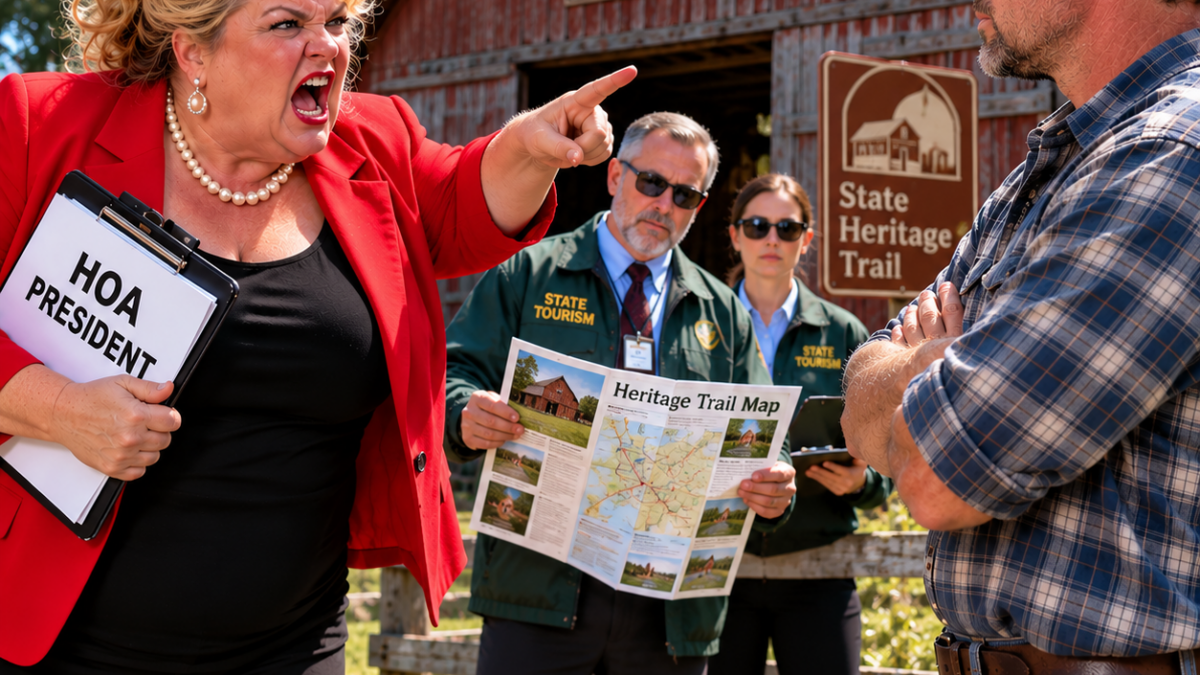
She pulled out a glossy brochure.
Rutherford County Heritage Trail.
The front cover showed three photographs.
A courthouse.
A stone church.
And my barn.
I stopped breathing for a second.
Eleanor handed it to me.
“Page inside.”
Number seven.
**MILLER FAMILY TOBACCO BARN.**
The description called it a surviving example of late nineteenth-century agricultural construction and noted that it remained privately owned by descendants of the original farming family.
A scenic-road map showed the route passing my property.
“How long has this existed?”
“Seven years.”
“I didn’t know.”
“Your grandfather did.”
That surprised me.
“He never mentioned it.”
“He didn’t like attention.”
That sounded exactly right.
“The state tourism office helps fund distribution.”
“What does that mean legally?”
Eleanor was careful.
“It doesn’t automatically make the building untouchable.”
Good.
I trusted her more immediately because she didn’t exaggerate.
“But it means state agencies already recognize it as a significant tourism resource. And our society has been trying for years to formalize its preservation status.”
She looked directly at me.
“If somebody is threatening demolition, I need to notify the State Historic Preservation Office.”
My heartbeat increased.
“What would that do?”
“At minimum?”
She smiled.
“Make your HOA’s week much more complicated.”
She gave me fifty brochures.
A formal letter from the historical society followed two days later.
Then came communication from the state preservation office acknowledging the issue and requesting documentation.
I called David Chen.
Dave and I served together years earlier.
After leaving the Army, he became a property attorney.
When I told him the story, he laughed for almost a full minute.
“She wants to demolish a tourism-board barn?”
“Her words are ‘non-compliant accessory structure.'”
“Beautiful.”
“Legally, how protected is it?”
“That depends on designation status, your recorded exemptions, local preservation law, and the HOA’s actual authority.”
“Meaning?”
“Meaning don’t let Facebook tell you that being in a brochure magically federalizes your barn.”
“Wasn’t planning to.”
“But.”
I waited.
“Your property-rights case already looks strong.”
“Good.”
“The heritage evidence makes her ‘property values and aesthetics’ argument look ridiculous.”
“Better.”
“And if preservation agencies start acting?”
“Best?”
“Potentially.”
Dave agreed to represent me.
First instruction:
“Stop writing Karen.”
“Gladly.”
“Everything through me.”
The next letter went to Harmony Creek counsel.
Agricultural exemption.
Barn history.
Historical Society.
Heritage Trail.
Pending preservation review.
No permission for HOA entry.
No permission for contractor access.
Demand to cease fines and withdraw demolition threat.
The HOA attorney responded.
Aggressively.
They called the historical claims irrelevant.
Said the Heritage Trail had no authority over covenant enforcement.
Claimed the barn remained a nuisance regardless of age.
And then:
**If the violation is not cured by the stated deadline, the Association intends to exercise self-help remedies, including removal of the non-compliant structure and assessment of all associated costs against the property.**
Dave called.
“They put it in writing.”
“I can read.”
“No, Jack. They really put it in writing.”
“Meaning?”
“Meaning their lawyer just confirmed they intend to enter private property and demolish a disputed structure after receiving notice that their authority is contested.”
“Is that as stupid as it sounds?”
“Worse.”
He sent a response.
Association counsel.
Board.
State preservation office.
Historical society.
County attorney.
Copies everywhere.
The letter made three things clear.
One: we disputed their authority.
Two: the barn was the subject of preservation review and recognized on a state-supported heritage trail.
Three: any attempted entry or demolition without a court order would be met with immediate injunctive action and claims for trespass and property destruction.
The fines stopped arriving.
For five days.
Silence.
I should have felt relief.
Instead, I felt uneasy.
People like Karen don’t become quieter because they’ve learned humility.
They become quieter while deciding how to avoid admitting defeat.
Earl Schmidt called me.
He owned five acres beside mine.
Seventy-five.
Old farmer.
Mouth like sandpaper.
“Your girlfriend drove by my place three times today.”
“Karen?”
“Unless you’ve got another angry woman in a white SUV.”
“Not recently.”
“She’s cooking something.”
Earl had his own history.
Karen once cited his John Deere tractor for being visible from the road.
His response:
“If she wants it hidden, she can finish baling my hay by hand.”
The violation disappeared.
Earl had grown up beside my grandfather.
“My daddy helped your people with that barn.”
“So I’ve heard.”
He nodded toward it.
“Nobody’s tearing it down.”
That mattered.
Slowly, neighbors started talking.
Henderson told me about fines for his garage door.
A family described being cited over sidewalk chalk.
Another over a garden gnome.
Someone else had been threatened because Christmas lights remained until January eighth.
Petty.
Ridiculous.
But expensive enough to make people obey.
Karen’s strength wasn’t the bylaws.
It was fatigue.
Most people would rather pay two hundred dollars than spend twenty hours proving they don’t owe two hundred dollars.
Karen understood that.
Then she came after something nobody could replace.
The barn.
I spent the next week cleaning it.
Not because Karen was right.
Because touching the old wood calmed me.
I oiled hinges.
Replaced one loose board.
Cleared brush from the foundation.
Climbed into the loft.
Sunlight passed through narrow siding gaps.
Dust floated.
I could smell tobacco that had been gone for decades.
Sarah came in carrying water.
“You know it’s already clean.”
“Maintenance.”
“You’ve maintained the same hinge three times.”
“It’s an important hinge.”
She leaned against a beam.
“You’re nervous.”
“No.”
“Jack.”
“Yes.”
She looked around.
“I never really understood why this place mattered so much to you.”
I waited.
“Until Karen tried to take it.”
“Funny how that works.”
She touched one of the beams.
“Your grandfather would’ve liked the fight.”
“He would’ve hated the attention.”
“Also true.”
The excavator arrived at seven in the morning.
I heard diesel from the kitchen.
Not a pickup.
Not landscaping.
Heavy equipment.
I looked through the window.
Yellow Caterpillar.
Flatbed behind it.
Three workers.
For a second, I didn’t move.
Sarah came in.
“What?”
I pointed.
Her face changed.
“No.”
I grabbed my phone.
Started recording.
Called Dave.
Then the sheriff’s non-emergency number.
Then walked outside.
The excavator stopped near my driveway.
The crew foreman approached.
“Jack Miller?”
“Yes.”
“We’ve got a work order for demolition.”
“No, you don’t.”
He held up paper.
“Harmony Creek.”
“That is not authorization to enter my property.”
“We’re contracted.”
“I’m the property owner.”
He hesitated.
Good.
I kept recording.
“Your client has been formally notified that the structure is disputed and that they do not have permission to enter.”
Behind us, a white SUV arrived.
Karen.
Of course.
She stepped out dressed as if attending a business meeting.
Fuchsia jacket.
Black pants.
Perfect hair.
She looked at the excavator.
Then me.
“It’s over.”
“Morning, Karen.”
“You were given every opportunity.”
“To do what?”
“Comply.”
“Your lawyer received our notice.”
“My attorney has advised us of our rights.”
“I doubt that.”
Her eyes narrowed.
“Excuse me?”
“I doubt your attorney advised you to bring an excavator onto disputed private property before obtaining a court order.”
The foreman looked from me to Karen.
She ignored him.
“The bylaws authorize self-help.”
“My attorney disagrees.”
“Then litigate it afterward.”
There.
That was the sentence.
Dave would love that sentence.
I kept the phone steady.
“Karen, I’m telling you directly. You do not have permission to enter.”
“Noted.”
“Your contractor does not have permission.”
“Noted.”
“The barn is under active preservation review.”
“Your tourism brochure means nothing.”
“Maybe.”
I looked at the foreman.
“But if you cross that line, you’re doing it after being told you don’t have the owner’s consent.”
He stepped backward.
Karen snapped:
“Ignore him.”
The foreman looked uncomfortable.
“Ma’am, I’m not catching a trespassing charge for an HOA job.”
“You have a contract.”
“We have a contract to perform authorized work.”
“It is authorized!”
Then two cars turned onto the road.
One was Dave’s.
The other was a sheriff’s cruiser.
Karen stopped talking.
Dave parked badly.
Rare for him.
He jumped out holding a folder.
The deputy moved slower.
Sheriff Brody.
I’d known him through the local veterans’ community.
He nodded at me.
“Jack.”
“Morning.”
He looked at the excavator.
“Interesting day?”
“Getting there.”
Karen stepped forward.
“Deputy, this is a private HOA enforcement matter.”
Brody held up a hand.
“Ma’am, I’m going to hear everybody.”
Then to the foreman:
“You crossed onto his property?”
“No, sir.”
“Good.”
“Don’t.”
The foreman nodded immediately.
Karen’s face flushed.
Dave reached us.
“Nobody moves.”
He was breathing hard.
“You got it?” I asked.
He held up papers.
“Signed twenty-six minutes ago.”
Emergency temporary restraining order.
The judge had barred Harmony Creek, its officers, agents, contractors, or representatives from entering my property or altering the barn pending hearing.
Dave gave Karen a copy.
Her hand shook.
She read.
“This is temporary.”
“Yes.”
She looked relieved.
Dave smiled.
“That’s usually how emergency orders work.”
“This proves nothing.”
“No.”
He looked toward the excavator.
“But it proves that machine isn’t touching Jack’s barn today.”
The foreman walked back to his truck.
Engine off.
The excavator went silent.
It was astonishing how loud quiet can be after a diesel engine stops.
Karen stood between the sheriff, my attorney, the contractor, and my phone camera.
I watched her realize she had lost the scene.
Not the entire fight.
But the scene.
And people like Karen lived through scenes.
Public dominance.
Visible compliance.
The moment somebody resisted publicly and survived, the spell weakened.
She pointed at me.
“This is not finished.”
“No.”
I lowered the phone.
“It’s finally starting.”
The local news arrived that afternoon.
Not because I called.
Dave did.
Sarah Jenkins, investigative reporter.
She watched the footage.
Read the HOA letters.
Read the historical society documents.
Read the Heritage Trail brochure.
Then looked at the barn.
“This is the ugly structure?”
“Apparently.”
She laughed.
The camera crew filmed hand-hewn beams.
Mortise-and-tenon joints.
Old ventilation gaps.
The original tobacco rails.
Samuel’s faded 1890 inscription.
Eleanor from the Historical Society came out.
The interview changed everything.
Eleanor didn’t sound angry.
She sounded offended.
“This barn predates virtually every modern structure visible from the property.”
She stood beside me.
“It represents the agricultural history that existed here before residential development. The idea that it should be removed because it doesn’t match a recently constructed subdivision is exactly backwards.”
The story aired at six.
They opened with Karen:
**”It’s over, Mr. Miller.”**
Then showed the excavator.
Then sheriff.
Then injunction.
Then Heritage Trail brochure.
Then my grandfather.
I showed them a photograph.
He was eighteen.
Standing in front of the barn.
News stories need images.
We had generations.
Harmony Creek’s online community page exploded.
Not just outsiders.
Residents.
People who had stayed silent.
**Why are our HOA dues paying lawyers for this?**
**Who approved demolition?**
**Did the full board vote?**
**Why did nobody tell residents the barn was on the Heritage Trail?**
**How much are we exposed to?**
Then someone asked the question that truly frightened the board:
**Who owns the demolition company?**
Henderson called me at nine that night.
“Jack.”
“Yeah?”
“I’ve been looking.”
“At what?”
“The contractor.”
“What about them?”
“Parent company.”
I sat up.
“Go on.”
“Brewster Construction Group.”
Karen’s husband.
Silence.
“You sure?”
“State corporate records.”
I rubbed my forehead.
“Send it to Dave.”
Already done.
That wasn’t proof Karen had stolen anything.
But it was a conflict so obvious it could be seen from space.
The HOA president had pushed an aggressive demolition project.
Board money would pay for demolition.
The contractor connected to her husband’s business stood to receive the work.
And she had insisted on proceeding even after legal notice.
Harmony Creek residents stopped being merely annoyed.
They became interested.
Interested homeowners are an HOA tyrant’s natural predator.
Requests started.
Board minutes.
Vendor bids.
Invoices.
Conflict disclosures.
Legal fees.
Contracts.
The board resisted for exactly two days.
Then Gary resigned.
I almost felt bad for him.
His resignation email essentially said:
**I joined the board because someone asked me to help select pool furniture.**
That might have been the most honest document Harmony Creek ever produced.
One of the two women directors publicly said she had not known the demolition crew would arrive.
The other claimed Karen told them the HOA attorney approved everything.
Association counsel released a careful statement saying they had advised the board to comply with all applicable court orders and laws.
Translation:
Karen was becoming radioactive.
Residents circulated a recall petition.
Required threshold?
Thirty percent.
They got sixty-eight percent in four days.
Emergency meeting.
Same clubhouse.
Completely different atmosphere.
People lined the walls.
Local news attended.
Karen sat at the front.
Black dress.
No pink.
No fuchsia.
No gold president pin.
Maybe coincidence.
Maybe instinct.
She struck the gavel.
People kept talking.
She struck again.
Still talking.
Eventually Henderson shouted:
“Let her speak.”
The room quieted for Henderson.
Not Karen.
That had to hurt.
Karen began.
“I have devoted years of unpaid service to protecting Harmony Creek.”
A man shouted:
“From barns?”
Laughter.
She continued.
“The Miller matter has been grossly distorted.”
Another voice:
“You sent an excavator!”
“I acted under legal advice.”
Dave, sitting beside me, whispered:
“Bold.”
Karen continued.
“The barn remains structurally inconsistent with our standards.”
Eleanor Vance from the Historical Society sat near the aisle.
She raised her hand.
The vice president recognized her.
Eleanor stood.
“Have you ever entered the barn?”
Karen hesitated.
“No.”
“Have you commissioned a structural inspection?”
“No.”
“Have you reviewed the 1937 agricultural survey?”
“No.”
“The county preservation file?”
“No.”
“The Heritage Trail documentation?”
“I have reviewed the material Mr. Miller provided.”
Eleanor nodded.
“So the answer is no.”
Applause.
Karen’s face tightened.
Then Henderson stood.
He held corporate filings.
“Harmony Creek homeowners deserve an answer regarding the demolition contractor.”
Karen said:
“Vendor selection is an administrative function.”
“Is your husband financially connected to Brewster Construction Group?”
The room became still.
Karen looked toward the other directors.
Nobody helped.
“My husband’s business interests are irrelevant.”
Henderson laughed once.
“No.”
He held up the documents.
“They are extremely relevant when HOA funds are paying a company under his corporate umbrella.”
People erupted.
Karen struck the gavel.
“Order!”
Henderson continued.
“Did you disclose that relationship before the contractor was engaged?”
“It was common knowledge.”
“That’s not what I asked.”
Karen stared at him.
“Did you recuse yourself?”
Silence.
There are silences that answer better than words.
Dave spoke next.
He explained the legal position.
No theatrics.
Temporary order.
Pending preservation review.
Property exemption.
Potential trespass and destruction claims.
Potential uninsured exposure if directors acted knowingly outside their authority.
Then the worst part.
“If Harmony Creek loses substantial litigation because officers acted willfully, association reserves may not be enough.”
Someone shouted:
“What does that mean?”
Dave looked at the homeowners.
“It can mean special assessments.”
That changed the room.
People tolerate injustice longer than invoices.
Suddenly Karen’s personal crusade had a potential dollar amount attached to every house.
A woman near the back stood.
“My husband and I just had a baby. We can’t afford a five-figure assessment because she hates an old barn.”
Another:
“Neither can we.”
Then me.
I hadn’t planned a speech.
I stood.
Looked at my neighbors.
“My grandfather refused to sell because he believed there should still be one piece of the old farm left when all the development was finished.”
Karen looked away.
“I inherited that responsibility.”
I pointed toward the window.
“You don’t have to love my barn.”
Nobody moved.
“You don’t have to care about tobacco farming.”
I looked at Karen.
“You don’t even have to like me.”
Somebody laughed softly.
“But you should care whether the people you elect can invent authority when the written rules don’t give it to them.”
Silence.
“This was never about whether Karen thinks gray wood is ugly.”
I paused.
“It became a question of whether one person can use everybody else’s money to destroy something she personally dislikes.”
I sat.
That was enough.
Motion for recall.
Second.
Vote.
It wasn’t close.
Karen lost.
Nearly every eligible vote cast supported removal.
She sat motionless.
Then gathered her papers.
No final speech.
No threat.
She walked out.
The door closed.
The entire room exhaled.
Not cheered immediately.
Exhaled.
Then applause came.
Henderson became interim president.
He hated the idea.
Perfect qualification.
First motion:
Rescind every fine against the Miller parcel related to the barn.
Passed.
Second:
Terminate all demolition authority and contracts.
Passed.
Third:
Independent financial review of vendor relationships and legal expenses.
Passed.
Fourth:
Create conflict-of-interest disclosure rules.
Passed.
Fifth:
Form a committee to rewrite the architectural standards.
Somebody groaned.
Henderson smiled.
“Democracy is less exciting than rebellion.”
The historical preservation process continued.
This part was slower than the fight.
Forms.
Site visits.
Architectural documentation.
Structural review.
Photographs.
Historical research.
The state didn’t simply wave a wand and declare the barn immortal.
That’s not how preservation works.
But agencies took the site seriously.
A preservation architect inspected it.
His report was almost insulting to Karen’s original claim.
The barn was old.
Yes.
Weathered.
Yes.
But structurally sound.
Several roof components needed maintenance.
Some siding required careful stabilization.
No immediate demolition hazard.
Dave handed me the report.
“Frame it.”
“I might.”
“Send Karen a copy?”
“No.”
He looked at me.
“Growth.”
The temporary court order became unnecessary after the new HOA formally withdrew all claims against the barn.
I could have pursued damages aggressively.
Legal costs.
Emotional distress arguments.
Potential punitive claims.
Dave was ready.
“Jack, we can keep going.”
“I know.”
“She sent heavy equipment.”
“I know.”
“The HOA exposed you to months of harassment.”
“I know.”
“Why do I feel a ‘but’ coming?”
I looked toward Harmony Creek.
“Most of the people paying the settlement would be the same people who removed her.”
Dave sighed.
“You’re ruining my fun.”
“Karen can deal with separate investigations into vendor conflicts.”
“Still boring.”
“You’re a lawyer.”
“Exactly.”
The HOA proposed settlement terms instead.
All fines voided.
Legal fees reimbursed.
Formal acknowledgment of the agricultural exemption.
Permanent preservation language preventing future architectural enforcement against documented historical features without independent professional review.
Funding for a proper historical survey.
Funding for a roadside marker.
I accepted.
Not because Harmony Creek deserved forgiveness.
Because it was becoming something different.
Henderson called me.
“We’d also like to discuss the National Register.”
“Federal?”
“Nomination.”
“Doesn’t that mean tourists?”
“You already have tourists.”
Fair.
Eleanor handled most of the process.
The barn eventually received stronger formal recognition after review.
The Heritage Trail designation remained the part I loved most.
Not because it was legally strongest.
Because it was poetic.
Karen called the barn a blight.
The state tourism brochure called it a destination.
Those two interpretations had existed simultaneously.
The difference was knowledge.
One saw weathered wood.
The other saw history.
The news attention faded.
Thank God.
For several weeks, strangers drove by constantly.
Most respectful.
Some less so.
One family walked halfway up my driveway for a closer picture.
I installed a small sign:
**PRIVATE PROPERTY — PLEASE VIEW BARN FROM ROAD**
Eleanor laughed.
“Congratulations. You’re officially an attraction.”
“I hate this.”
“You love it.”
“Parts.”
The bronze marker arrived in October.
Autumn light.
Cool air.
Leaves starting to turn.
The whole neighborhood was invited.
I almost cancelled.
Ceremonies made me uncomfortable.
Military retirements had given me enough speeches for three lifetimes.
Sarah insisted.
“Your grandfather would’ve come.”
“He would’ve complained.”
“While coming.”
True.
The marker stood near the road.
Not huge.
Tasteful.
It described the barn’s construction.
The Miller family’s agricultural history.
Local tobacco culture.
Community barn-raising traditions.
Preservation.
Henderson said a few words.
Eleanor spoke.
Earl Schmidt arrived wearing overalls that might have been older than several guests.
He stood near the microphone.
“I don’t do speeches.”
Then talked for nine minutes.
He told everyone his father helped my grandfather repair the barn roof after a 1954 storm.
He described men hauling slate.
Women bringing sandwiches.
Children picking up nails.
“Back then,” Earl said, “if your neighbor’s barn was hurt, you fixed it.”
He looked toward Harmony Creek.
“Didn’t matter whose name was on the deed.”
That was better than any prepared speech.
Then Henderson called me.
I hated him immediately.
“Jack.”
“No.”
“Come up.”
“No.”
People laughed.
Sarah shoved me.
I stood beside the marker.
Looked at the barn.
Then at the houses behind the crowd.
New Harmony Creek.
Old Miller land.
For decades, those two worlds had moved toward each other.
Not always gracefully.
I spoke.
“My grandfather made me promise I wouldn’t let this land disappear.”
My throat tightened unexpectedly.
“I thought that meant saying no to developers.”
I looked toward the new houses.
“Turns out that was too simple.”
People listened.
“A place can change without being erased.”
I touched the marker.
“And something old can stay without preventing something new from belonging beside it.”
That surprised me as I said it.
Maybe because I finally believed it.
“The mistake we made wasn’t development.”
I paused.
“The mistake was thinking everything had to look the same before we could call it a community.”
Nobody applauded immediately.
Then they did.
Sarah cried.
Earl pretended he had dust in his eye.
The new HOA changed.
Slowly.
Not magically.
There were still arguments.
Paint colors.
Parking.
Pool rules.
Dog waste.
One meeting spent forty-five minutes debating whether inflatable Christmas decorations should be limited in size.
Democracy is exhausting.
But people showed up.
That was the difference.
Nobody allowed three people to quietly make every decision anymore.
Financial statements went online.
Vendor contracts required disclosure.
Large work required multiple bids.
Board members with relationships to vendors had to recuse.
Enforcement decisions could be appealed to people who hadn’t issued them.
The old agricultural parcels received clearer exemptions.
Historic features received separate review.
Karen’s husband lost HOA contracts.
The independent review found questionable procurement practices and inadequate disclosure.
Some matters went to state authorities.
Others were handled civilly.
I followed very little of it.
By then, Karen wasn’t my problem anymore.
She and her husband listed their house.
I saw the sign from my tractor.
Earl called that evening.
“You see it?”
“Yep.”
“Want me to buy it?”
“Why would you?”
“Turn it into a pig farm.”
I laughed.
“HOA wouldn’t approve.”
“Exactly.”
Karen moved in winter.
No dramatic confrontation.
No final curse.
No moving truck blocked by police.
She simply disappeared from the neighborhood she’d once controlled.
A few people wanted me to feel victorious.
I didn’t.
I felt relieved.
There is a difference.
I didn’t want Karen ruined.
I wanted the barn safe.
Once it was, her downfall became background noise.
The first spring after she left, I opened the barn doors before sunrise.
Cold air.
Old wood.
Birds outside.
I climbed into the loft.
Found Samuel Miller’s 1890 writing.
Still there.
For the first time in months, I wasn’t looking at it as evidence.
Not Exhibit A.
Not historical documentation.
Not something that needed defending.
Just writing.
From family.
I sat on one of the beams.
Closed my eyes.
And remembered my grandfather.
He was difficult.
Stubborn.
Could rebuild an engine but refused to learn how voicemail worked.
He believed grocery-store tomatoes represented moral decline.
When I joined the Army, he said:
“Don’t volunteer for anything stupid.”
Then cried when I graduated basic training.
Near the end of his life, he became smaller.
That frightened me.
Men like my grandfather weren’t supposed to become small.
The last serious conversation we had happened in his bedroom.
He looked toward the window.
You could see part of the barn.
“This place’ll be worth money.”
“I know.”
“They’ll come.”
“Who?”
“Everybody.”
He coughed.
“Developers. Lawyers. Neighbors who don’t like looking at work.”
I smiled.
“What does work look like?”
“Ugly.”
Even dying, he was funny.
Then serious.
“This land has a soul.”
I rolled my eyes.
“Don’t.”
“I’m serious.”
“It’s dirt.”
“No.”
He squeezed my hand.
“Land remembers what people do on it.”
I didn’t understand then.
I do now.
The barn remembered hands.
Thousands of them.
Samuel’s.
My grandfather’s.
Neighbors.
Laborers.
Children.
Mine.
Even Karen had become part of the story, though not the part she wanted.
Maybe that was the real revenge.
She wanted to erase the barn because it didn’t fit her vision of Harmony Creek.
Instead, her attack made the barn more visible than ever.
Tourism increased.
The historical society expanded its programming.
School groups occasionally scheduled off-site history stops where students viewed the barn from designated areas.
A local photographer published a book about disappearing agricultural architecture and used the Miller barn on the cover.
I hated the attention.
Grandfather would’ve hated it more.
But the barn survived.
One summer afternoon, I found a family standing near the roadside marker.
Parents.
Two kids.
One boy maybe ten.
He stared at the barn.
I was repairing fence nearby.
“Sir?”
I looked up.
“Yeah?”
“Is that really from 1890?”
“Parts of it.”
“That’s really old.”
“Thanks.”
His father laughed.
The boy pointed.
“Did they have tractors?”
“No.”
“Electricity?”
“Not here.”
“Phones?”
“Not in that barn.”
He looked horrified.
“What did they do?”
“Work.”
His mother laughed.
“See?”
The boy ignored her.
“Why didn’t they tear it down?”
I looked at the barn.
“Because every generation decided not to.”
That answer stayed with me.
Preservation sounds passive.
It isn’t.
Things don’t survive because nobody touches them.
They survive because people repair roofs.
Replace foundations.
Treat timber.
Fight insects.
Spend money.
Say no.
Sometimes loudly.
Sometimes legally.
Every generation chooses whether something remains.
Karen forced me to make my choice sooner than expected.
The barn needed work.
Real work.
The preservation architect had identified several projects.
Roof repairs.
Drainage improvements.
Some timber stabilization.
I could have left it untouched and romantic.
Eventually it would’ve become the dangerous structure Karen claimed it already was.
That irony bothered me.
So I invested.
Not in making it new.
In helping it stay old.
Specialists replaced only what needed replacing.
Traditional joinery where possible.
Compatible materials.
No suburban vinyl.
No fake rustic finish.
Weathered wood remained weathered.
One carpenter named Ben spent three days restoring a single joint.
I watched.
“Three days?”
He looked offended.
“It lasted one hundred thirty years.”
“Fair.”
“You want quick?”
“No.”
“Good.”
The barn became stronger.
Subtle.
Most people couldn’t see what changed.
That was the point.
One evening Sarah stood in the doorway.
“It looks exactly the same.”
“Thank you.”
“That was a compliment?”
“The best one.”
She smiled.
“Your grandfather would’ve approved.”
“Maybe.”
“He’d complain about the bill.”
“Definitely.”
Harmony Creek began using the barn differently too.
Not inside.
It remained private.
But symbolically.
The new HOA logo changed.
Not my idea.
I hated it at first.
Henderson brought me the proposed design.
A stylized tree.
Several rooflines.
And in the distance, a small barn silhouette.
“No.”
He stared.
“Why?”
“You’re not putting my barn on HOA stationery.”
“Technically it’s a generic agricultural structure.”
“It’s my roofline.”
“Coincidence.”
“Arthur.”
He smiled.
Residents voted.
I lost.
The new Harmony Creek logo included a barn.
Earl nearly injured himself laughing.
“So Karen tried to demolish it and now it’s the logo?”
“Apparently.”
“That’s biblical.”
“No idea what that means.”
“Neither do I.”
Property values didn’t fall.
That mattered because it had been one of Karen’s loudest claims.
In fact, local listings began describing Harmony Creek as a neighborhood blending “modern amenities with preserved rural heritage.”
Real-estate language.
Mostly nonsense.
But buyers liked the barn.
Henderson reminded me constantly.
“I told you.”
“Once.”
“At the meeting.”
“You were right.”
“Say it again.”
“No.”
Years passed.
The subdivision matured.
Young trees became actual shade trees.
Children grew into teenagers.
Some families left.
Others arrived.
Earl slowed down.
Eventually sold most of his remaining property to his daughter.
Not a developer.
He made her promise.
Family habit.
Henderson served one term as HOA president.
Then quit.
His resignation speech:
“I have developed a profound respect for anyone who never runs for office.”
Maria Torres succeeded him.
She lasted eighteen months.
Her main achievement was getting meetings under ninety minutes.
A triumph.
The historical marker weathered.
The barn remained.
My relationship with it changed again.
At first, it had been inheritance.
Then responsibility.
Then battlefield.
Then evidence.
Eventually it became simply the barn again.
I stored tools.
Old furniture.
Seasonal equipment.
On certain days I opened both doors and let wind pass through.
One autumn, my niece asked whether she could take wedding photographs there.
Then another family asked.
Then another.
I said no to almost everyone.
Not because I wanted to hoard history.
Because some places should not become event venues simply because social media finds them attractive.
Still, my niece got the photographs.
Grandfather would’ve complained about the dress touching barn dust.
The Heritage Trail grew.
More sites added.
Old mills.
Churches.
Farmhouses.
Stone bridges.
Eleanor retired.
At her farewell dinner, she handed me the original copy of the brochure she’d shown me years before.
Same one.
Slight crease.
My barn on the cover.
“I kept it.”
“I see that.”
“Frame it.”
“Everybody wants me to frame paperwork.”
“Because paperwork saved your barn.”
“No.”
She looked at me.
“What did?”
“People.”
Eleanor smiled.
“Better answer.”
I framed it anyway.
It hangs inside the farmhouse now.
Beside a photograph of my grandfather.
The irony is beautiful.
He hated tourism.
Now his barn is tourism material.
He would find that deeply offensive.
Sometimes people ask whether I wish Karen had succeeded in nothing at all.
Whether I’d prefer the fight never happened.
Yes.
Absolutely.
Conflict makes good stories because stories end.
Real conflict stays in your nervous system.
Months of letters.
Watching mailboxes.
Checking cameras.
Wondering whether someone would appear with equipment.
Calculating legal costs.
Seeing Sarah worry.
Feeling responsible for exposing neighbors to HOA litigation.
That wasn’t fun.
It wasn’t satisfying while it happened.
Victory is often enjoyable only in retrospect.
During the fight, I slept poorly.
I woke hearing engines that weren’t there.
I checked the barn at night.
Once at two in the morning, Sarah found me standing outside with a flashlight.
“What are you doing?”
“Thought I heard something.”
“You heard a raccoon.”
“Potentially hostile raccoon.”
She took the flashlight.
“Inside.”
I obeyed.
Retirement had been supposed to teach me how not to live in defensive posture.
Karen accidentally brought it back.
That was part of why I stopped pursuing her personally once the barn was safe.
I wanted my life back more than I wanted punishment.
Revenge keeps the enemy central.
Accountability lets you move on.
The state investigation into procurement created consequences.
Her husband’s company lost contracts.
There were repayments and legal expenses.
Harmony Creek revised its insurance and governance practices.
Karen moved.
Enough.
The thing I cherish most happened almost ten years later.
My grandson was six.
He visited during summer.
We walked to the barn.
He carried a wooden toy tractor.
I unlocked the doors.
He stepped inside.
Looked upward.
The roof seemed impossibly high to him.
“Whoa.”
Good reaction.
He walked to one beam.
“Did you build this?”
I laughed.
“No.”
“Grandpa did?”
“My grandpa?”
“Yeah.”
“No.”
“His grandpa?”
“Closer.”
I showed him the 1890 inscription.
He couldn’t read the cursive.
“What’s it say?”
“The year.”
“Why’d he write it?”
“Probably so we’d know.”
He ran his hand near the timber.
Not touching because I’d told him not to.
“How old is it?”
“Older than me.”
“Everything is older than you.”
Brutal.
“True.”
We climbed to the lower loft platform.
I showed him photographs stored in protective sleeves.
Samuel.
My grandfather.
Me.
Different times.
Same barn.
My grandson studied the one of me sitting on a tractor tire.
“That’s you?”
“Yep.”
“You had weird hair.”
“Thank you.”
He looked around.
Then:
“Mom said a mean lady tried to knock this down.”
Children always find the version adults hope they’ve forgotten.
“Long time ago.”
“Why?”
“She thought it didn’t belong.”
He frowned.
“But it was here first.”
“That was part of the disagreement.”
“Did she hate barns?”
“I don’t know.”
“Did the barn win?”
That question stopped me.
Did the barn win?
I smiled.
“Yeah.”
He nodded.
Satisfied.
Children don’t need nuance all the time.
We walked outside.
A car slowed near the marker.
Tourists.
The driver waved.
I waved back.
My grandson looked at me.
“Do you know them?”
“No.”
“Why are they here?”
“To see the barn.”
He looked proudly at the structure as though he had personally built it.
“Because it’s famous?”
“Local famous.”
“Am I famous?”
“No.”
Disappointed.
Then he ran toward Sarah.
I stayed.
Evening light touched the siding.
Silver wood turned gold.
For a moment, I could see exactly why the tourism photographer chose that angle.
Karen had looked at the same building.
She saw decay.
Eleanor saw architecture.
My grandfather saw livelihood.
I saw family.
My grandson saw something that had simply always been there.
All true.
Except maybe Karen.
Age and neglect are not the same thing.
That distinction became important to Harmony Creek too.
The neighborhood had spent years chasing newness.
New houses.
New landscaping.
Uniform finishes.
Fresh paint.
Perfect edges.
Then an old barn forced everyone to ask whether newness was the same thing as value.
It isn’t.
Sometimes scratches are history.
Faded timber is history.
Wear is history.
Imperfection is evidence that something survived people.
Karen wanted Harmony Creek to look as though nobody had lived there before yesterday.
The barn refused.
Maybe that’s why she hated it.
You couldn’t look at it without remembering the subdivision was temporary in the scale of things.
The land had a before.
It would have an after.
HOA presidents feel powerful when the only timeline they consider is their term.
History shrinks that ego quickly.
One hundred thirty years.
Six years as president.
Not comparable.
The barn didn’t know Karen existed.
That amused me.
One morning years later, Harmony Creek’s newest president came to my house.
Young guy.
Software engineer.
Nice.
Nervous.
His name was Kevin.
“Jack?”
“Yeah?”
“We have an issue.”
I braced.
“What?”
“The heritage marker landscaping.”
I stared.
He quickly continued.
“Not the barn.”
“Good.”
“The mulch around the marker is washing into the drainage ditch.”
“Okay.”
“We want to replace it with stone.”
“Sounds reasonable.”
“But technically the marker is partly inside the road easement and our policy says—”
I began laughing.
Kevin stopped.
“What’s funny?”
“Nothing.”
“Should I be worried?”
“No.”
I put a hand on his shoulder.
“You’re doing great.”
That was progress.
A president nervous about authority rather than intoxicated by it.
We fixed the mulch.
No lawyers.
No sheriff.
No excavator.
Ten-minute conversation.
That is what functioning communities look like most days.
Boring solutions to small problems.
Harmony Creek finally lived up to its name.
Mostly.
Earl still fought everybody about his tractor.
Some traditions deserve preservation.
I eventually wrote down the barn story.
Not this version.
A shorter one.
For the family.
Names.
Dates.
Documents.
Grandfather’s promise.
The demolition morning.
Heritage Trail.
The marker.
I put it in the cedar chest with the journals.
My grandson may read it someday.
Or his children.
Maybe they’ll think the whole thing ridiculous.
I hope so.
I hope the idea that an HOA would send an excavator after a family barn seems absurd to them.
That would mean we learned something.
Samuel Miller wrote that the barn should last for his children’s children.
He never imagined an HOA.
He couldn’t.
But he understood preservation.
You build carefully.
You repair when necessary.
You pass responsibility forward.
That’s all legacy really is.
Not ownership forever.
Stewardship temporarily.
Karen believed ownership meant the power to erase whatever didn’t suit her.
My grandfather taught the opposite.
Owning something old means you may sometimes have less freedom, not more.
You owe something to the past.
And maybe to people who come after you.
That is why I eventually supported formal preservation restrictions on the barn.
People were surprised.
“You’re limiting your own property rights?”
Yes.
Because someday I’m dead.
The next owner might need the same reminder Karen needed.
Not everything valuable should depend on one person’s taste.
The final preservation agreement allowed reasonable maintenance, adaptive agricultural use, and safety improvements while requiring review before major demolition or character-altering changes.
Fair.
I signed.
Sarah said:
“Your grandfather would complain.”
“Of course.”
“But sign too.”
“Eventually.”
The morning I signed the paperwork, I went to the barn.
Placed my hand on the eastern beam.
Near 1890.
No speeches.
No dramatic promises.
Just:
“Still here.”
That was enough.
If you want revenge in this story, I suppose Karen got it.
She lost power.
Lost contracts.
Lost social standing.
Moved away from the neighborhood she’d tried to control.
Her own attempt to destroy the barn became the reason it received more attention and stronger protection than it had before.
That’s poetic.
But the part that satisfies me isn’t her loss.
It’s the reversal.
She said the barn lowered property values.
Now realtors advertise it.
She called it a blight.
Now tourists stop to photograph it.
She called it obsolete.
Now preservation students study it.
She called it non-compliant.
Now Harmony Creek’s rules protect it.
She said it didn’t belong in the future.
She was the one who left.
The barn stayed.
That’s better than revenge.
One autumn afternoon, almost twenty years after the fight, I stood near the marker.
My hair gray.
Knees complaining.
The barn older but stronger.
A family stopped.
A little girl read the plaque aloud.
Slowly.
Her father pointed toward the barn.
“Imagine how many people worked in there.”
The girl asked:
“Does somebody still own it?”
I was standing ten feet away.
I said:
“Temporarily.”
They looked at me.
The father laughed.
“You’re the owner?”
“Current caretaker.”
He nodded like he understood.
Maybe he did.
They walked back to the car.
I looked toward Harmony Creek.
Modern roofs beyond old fields.
Children riding bikes.
Trees grown taller than houses.
A community built where farms once stood.
Change.
Not destruction.
Change.
The distinction took us years to learn.
Wind moved through the barn siding.
That particular sound is difficult to describe.
Not a whistle.
Not a creak.
Something between breath and memory.
I used to hear it as a child.
I heard it when my grandfather was alive.
I heard it the morning Karen ordered me to tear the barn down.
I hear it now.
Same sound.
Different world.
That barn survived winter storms.
Economic collapse.
Agricultural decline.
Developers.
And one HOA president with a clipboard and too much confidence.
It will not survive forever.
Nothing does.
But forever was never the promise.
The promise was to protect what could be protected while it was mine to protect.
I did.
And when the day comes that someone else stands where I stood, running a hand across those old oak beams, they’ll know people before them cared enough to say no when no mattered.
Karen thought the story was about whether one weathered structure matched a neighborhood aesthetic.
She never understood the scale.
The barn wasn’t standing in Harmony Creek.
Harmony Creek was standing around the barn.
It had been there first.
It remembered the fields.
The farmers.
The seasons.
The people who raised it together in 1890.
And when one woman tried to erase that history because it offended her idea of uniformity, the history pushed back.
Through deeds.
Through journals.
Through neighbors.
Through the Historical Society.
Through a tourism map.
Through a judge’s signature.
Through a sheriff standing beside a silent excavator.
Through an entire community finally deciding that preserving harmony meant more than obeying the loudest person in the room.
The last thing Karen ever told me about the barn was that it didn’t belong.
She was wrong.
It belonged to my family.
It belonged to the history of the land.
It belonged on that Heritage Trail map.
And in a strange way, after everything we went through, it belonged to Harmony Creek too.
Not as property.
As memory.
That’s why it is still standing.
And every evening when the sun hits those silver boards and turns them gold, I think about my grandfather’s final request.
Don’t let them take the last piece.
They didn’t.
The land is still here.
The barn is still here.
The promise is still here.
And long after Karen’s name disappeared from HOA minutes, the old tobacco barn she called a blight was still standing beside the road, quietly reminding everyone who passed it that history doesn’t need to be pretty, new, or uniform to deserve a future.