PART 2: HOA Ordered Me to Demolish My 130-Year-Old Tobacco Barn—Then They Learned the State Had Put It on the Heritage Trail
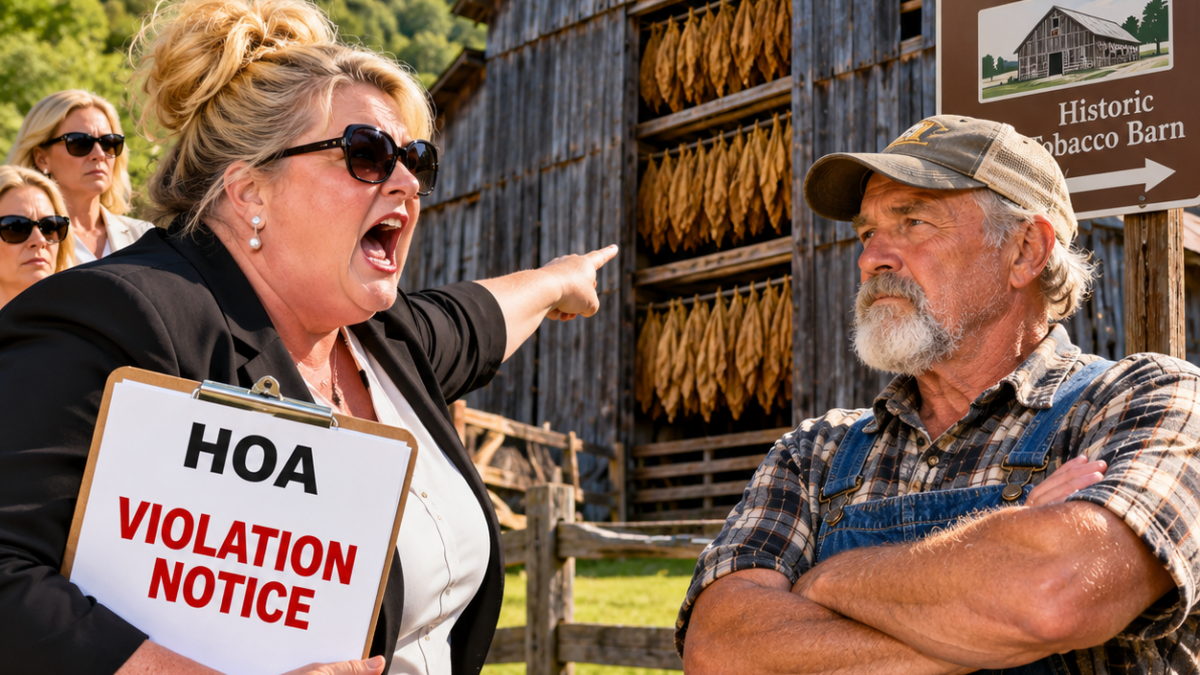
PART 2
Three days later, the certified letter arrived.
It was heavy cream-colored paper with the Harmony Creek logo embossed in gold across the top, the sort of stationery designed to make petty authority feel expensive. Beneath a picture of a perfectly symmetrical tree and perfectly symmetrical house were five dense paragraphs of legal language accusing me of violating aesthetic standards, maintaining an unauthorized agricultural structure, creating a potential fire hazard, and negatively affecting neighborhood property values.
The fines began at one hundred dollars per day.
After the thirty-day compliance period, they would climb to five hundred dollars per day.
If I still refused, the association threatened to place a lien against my property, hire a contractor, demolish the barn, and charge every dollar back to me.
I read the letter twice.
Then I placed it on my grandfather’s old oak desk.
That desk had been in the farmhouse longer than I had been alive. The surface was scarred from decades of farm ledgers, seed catalogs, unpaid bills, coffee mugs, and pocketknives. When my grandfather died, I had left most of the scratches exactly as they were.
I pulled the Harmony Creek covenants from a filing cabinet and set them beside Karen’s letter.
Then I made coffee.
If Karen wanted a fight based on rules, I was going to read every rule she had.
The Army had taught me something else: before you engage an enemy, understand the terrain.
So for two nights, I barely slept.
I read every article, subsection, amendment, footnote, restriction, and definition in the HOA documents. I learned more than any reasonable adult should ever know about approved mailbox dimensions, acceptable fence stains, lawn height, holiday decoration schedules, basketball hoop placement, front-yard flower varieties, exterior light temperature, and garbage-can visibility.
Harmony Creek had regulations for things I had never imagined anyone would want to regulate.
But sometime after midnight on the second night, buried inside the original development documents, I found the sentence Karen had either missed or hoped I would never discover.
It was in an addendum covering my property.
The Miller parcel had existed long before Harmony Creek. My grandfather had refused to sell when developers bought the surrounding farms, and eventually the subdivision had been constructed around our ten acres. To resolve road access and infrastructure issues, his property had been included within the HOA’s geographic boundary for limited purposes.
But the addendum specifically recognized the parcel as an existing agricultural property.
More importantly, it exempted us from architectural and landscaping restrictions that would unreasonably interfere with preexisting agricultural use or character.
I read the language again.
Then a third time.
A slow smile crossed my face.
“Well,” I whispered to the empty room. “There you are.”
Karen had quoted Section Four at me like scripture.
She had conveniently ignored the part written specifically for my land.
That was her first mistake.
Her second was assuming the barn was merely old.
The next morning, I climbed into the farmhouse attic.
Dust hung in the air beneath the rafters. Boxes of Christmas decorations sat beside old tools, quilts, Army memorabilia, and things nobody in the family had been willing to throw away because each object seemed attached to somebody’s memory.
Against the far wall sat my grandfather’s cedar chest.
When I opened it, the smell hit me immediately: dry paper, wood, and the faint sweet trace of tobacco that seemed permanently woven into everything on the farm.
Inside were family journals.
My great-great-grandfather’s handwriting filled some of the earliest books. The ink had faded brown, but the entries were still readable.
I found one dated September 1890.
He described cutting timber.
He wrote about neighbors arriving before sunrise.
He listed family names I recognized from old county roads and cemetery stones.
He wrote about the barn raising, about women bringing fried chicken, biscuits, beans, pies, and coffee. He described the moment the final roof timber went into place and everyone stopped working long enough to look at what they had built.
One line stayed with me.
*If the Lord is willing and our sons care for it, this barn ought to be standing when none of us are.*
I sat on the attic floor for a long time after reading that.
The men who raised the barn were gone.
Their children were gone.
Most of their grandchildren were gone.
But the barn remained.
And so did the responsibility they had passed down with it.
I found old photographs: my grandfather as a boy leaning against a tractor tire, my great-grandparents standing beneath tobacco leaves hung to cure, cousins sitting on the barn steps in clothes from another century. One photograph showed the structure almost exactly as it stood today, except the landscape behind it was open farmland instead of suburban rooftops.
Karen called it visual blight.
I called it evidence.
I drafted my response carefully.
No anger.
No insults.
No threats.
Just facts.
I quoted the agricultural exemption word for word. I attached the appropriate pages from the covenants. I included photographs showing the barn predating the subdivision by more than a century. I explained that the structure remained integral to the historic agricultural character specifically protected by the development agreement.
Then I wrote one final paragraph.
*Accordingly, I will not demolish, materially alter, or disguise the Miller tobacco barn in response to the association’s current notice. I respectfully request that all fines and enforcement actions related to this matter be immediately withdrawn.*
I mailed it certified with return receipt requested.
For about forty-eight hours, I allowed myself to believe reason might prevail.
Then the next HOA meeting happened.
The Harmony Creek clubhouse was everything my farm was not: spotless, air-conditioned, aggressively neutral, and completely devoid of personality. Thirty folding chairs faced a long table beneath a sign that read COMMUNITY THROUGH HARMONY.
I almost laughed.
Karen sat in the center wearing a navy blazer and an oversized gold HOA president pin.
Two board members sat beside her, both women who nodded whenever Karen spoke.
At the far end was Gary, the treasurer, who looked as though he had accidentally wandered into the wrong meeting three years earlier and had never found a polite way to leave.
I took a seat in the third row.
The first twenty minutes were almost surreal.
Karen publicly reprimanded a homeowner over a basketball hoop that was supposedly the wrong shade of black.
Another resident was warned that a decorative planter exceeded approved dimensions.
Then the board spent nine minutes discussing petunias.
Finally Karen looked down at the agenda.
“We now move to the Miller property matter.”
Her eyes found me immediately.
A faint smile touched her mouth.
“Mr. Miller has submitted a lengthy interpretation of our governing documents in which he claims his barn is exempt from community standards.”
She lifted my letter like it was an amusing piece of fan mail.
A few people chuckled nervously.
I didn’t.
Karen continued.
“The board has reviewed his assertions and determined that they are without merit. The structure is not currently being used for active tobacco production. Therefore, its agricultural exemption does not apply.”
I raised my hand.
She ignored me.
“The demolition order remains in effect, and fines will continue to accrue.”
“Karen.”
Her head snapped toward me.
“You are not recognized.”
“The exemption doesn’t say anything about tobacco currently being grown.”
“Mr. Miller—”
“It protects preexisting agricultural character. That is the exact language.”
“You will address me as President Brewster.”
That drew the first genuine laugh of the evening.
It came from somewhere behind me.
Karen’s face reddened.
I stood.
“I’ll address the document instead. The document says my property is exempt from restrictions that unreasonably interfere with its existing agricultural character. That barn has been part of that character since 1890.”
“You are using it for storage.”
“That doesn’t turn a tobacco barn into a garden shed.”
She banged her gavel.
“This is not a debate.”
“Then why are we having a meeting?”
A murmur moved through the room.
Her voice sharpened.
“The board has voted. The decision is final.”
That was when an older man in the back stood slowly.
I recognized him as Robert Henderson, who lived two streets over.
“President Brewster?”
She looked irritated.
“Yes?”
“My wife and I bought our house eighteen months ago. Our realtor specifically mentioned the view of the Miller barn as a feature of the property.”
Karen blinked.
Robert continued.
“She called it historic rural character. We liked it.”
Several people nodded.
Karen gripped her pen tighter.
“That is anecdotal.”
“It’s also my property value you keep claiming to protect.”
A few people laughed.
This time Karen didn’t bother hiding her anger.
“The board’s official position is that the structure negatively affects Harmony Creek.”
Robert shrugged.
“I guess the board never asked us.”
That sentence changed the room.
Not dramatically.
Not yet.
But something shifted.
For the first time, people seemed to realize Karen’s authority depended heavily on everyone assuming everybody else supported her.
After the meeting, three residents approached me.
A woman named Melissa looked over her shoulder before whispering, “Keep fighting her.”
Robert shook my hand.
“She’s been bullying people for years.”
“Why does nobody challenge her?”
His expression was tired.
“Because every challenge turns into another fine.”
That stayed with me on the walk home.
Karen wasn’t enforcing standards.
She was training people not to resist her.
The next morning, I stopped defending.
I started investigating.
My first trip was to the county courthouse.
For hours I worked through deeds, plats, surveys, and property records. I traced the Miller parcel backward until the chain of ownership reached the 1850s. I found agricultural records. Old tax assessments. Survey references. Even documentation tied to the barn’s original construction.
Then I went to the Rutherford County Historical Society.
The building was small, brick, and filled with the comforting smell of old paper.
A woman named Eleanor Vance met me at the desk.
She was in her late sixties, with wire-rimmed glasses and the focused expression of somebody who had spent her life remembering what everybody else forgot.
“I’m looking for information on the old Miller farm.”
She studied me.
“Miller?”
“Jack Miller.”
Her eyebrows rose.
“You’re *that* Miller?”
I wasn’t sure whether that was good.
“My grandfather was Samuel Miller.”
Her face softened.
“Oh, my goodness. Come with me.”
She led me through a doorway into an archive room and pulled open a wide metal drawer.
Inside was a folder.
MILLER FARM.
My family had a folder.
That fact alone surprised me.
Then Eleanor began removing documents.
Newspaper articles about tobacco yields.
A photograph of my grandfather receiving a soil conservation award.
An agricultural survey from the 1930s.
Architectural sketches.
She adjusted her glasses and looked at me.
“You still have the barn?”
“Still standing.”
“In good condition?”
“Very.”
She smiled.
“That may be one of the best surviving cantilevered tobacco barns in this part of the state.”
I stared at her.
“You know it?”
“Of course I know it.”
I almost laughed.
The HOA president who lived half a mile away claimed my barn was meaningless.
The county historian recognized it from memory.
I explained what was happening.
The fines.
The demolition order.
Karen.
By the time I finished, Eleanor’s smile had vanished.
“They want to tear it down?”
“That’s the plan.”
“For aesthetics?”
“Apparently old wood offends them.”
Eleanor muttered something under her breath that I’m fairly certain was not intended for historical preservation records.
Then she turned, crossed the room, and opened a cabinet.
“Wait here.”
She returned holding a glossy brochure.
The cover read:
**RUTHERFORD COUNTY HERITAGE TRAIL — A JOURNEY THROUGH OUR PAST**
And there, beneath the title, glowing gold beneath a sunset, was my barn.
I honestly forgot to breathe.
Eleanor handed it to me.
I opened the brochure.
A county map showed twelve numbered historic points along a scenic driving route.
Number seven was printed beside my road.
**MILLER FAMILY TOBACCO BARN.**
The description called it a remarkable example of late nineteenth-century agricultural architecture, noted that it had remained in the same family for five generations, and asked visitors to view respectfully from the public road.
I looked at Eleanor.
“How long has this existed?”
“Years.”
“I’ve never seen it.”
“You don’t spend much time at tourist information centers, do you?”
“Apparently not.”
She smiled.
“Fifty thousand copies are distributed annually.”
My eyes returned to the photograph.
Then she said the sentence that completely changed the battle.
“The state tourism board co-sponsors the trail.”
I looked up.
“The state?”
“Yes. Funding, promotion, distribution. Your barn appears in state tourism materials.”
I leaned back in the chair.
Karen wanted the old building removed because she said it embarrassed the neighborhood.
Meanwhile, the state was telling tourists to come look at it.
Eleanor must have seen something happening in my expression.
“Mr. Miller?”
“I think President Brewster is about to have a very bad month.”
Eleanor laughed.
Then her face grew serious again.
“I’ll write a letter.”
“About what?”
“About the barn’s historical significance. Officially.”
She tapped the brochure.
“And I’ll contact the State Historic Preservation Office.”
I looked down at that picture again.
My grandfather had hated attention.
He would have thought being in a tourism brochure was ridiculous.
But I could almost imagine him standing beside me, smiling that crooked smile of his.
*Don’t let them pave it over.*
I drove home with a stack of brochures on the passenger seat.
For the first time since Karen crossed my fence line, I didn’t feel like a man defending something.
I felt like a man preparing a counterattack.
But I had learned enough about Karen to know one dangerous truth.
Facts alone would not stop her.
People like Karen rarely retreat when proven wrong.
They escalate because being wrong feels like humiliation, and humiliation feels intolerable.
So instead of taking the brochure to her immediately, I called David Chen.
Dave and I had served together years earlier. After leaving the Army, he used the GI Bill to go to law school and became a property attorney with a reputation for enjoying difficult fights slightly more than was healthy.
I called his office.
His assistant put me through.
“Jack Miller,” he said. “Either you’re getting divorced, arrested, or sued.”
“HOA.”
There was a pause.
“Worse.”
I told him everything.
By the time I reached the Heritage Trail brochure, he was laughing.
“Wait. Stop.”
“What?”
“She wants to demolish something featured in a state tourism publication?”
“That’s correct.”
“And your original land agreement contains an agricultural exemption?”
“Correct.”
“And she’s already been given a copy?”
“Certified mail.”
“Jack.”
“What?”
“I need you to understand how much I love this.”
“It isn’t funny from where I’m sitting.”
“No, but legally? This woman is building our case for us.”
“I don’t want a case. I want her away from my barn.”
“Then stop talking to her.”
“I barely talk to her now.”
“I mean completely. From this moment on, every communication goes through me.”
His voice changed.
The joking disappeared.
“Do not threaten her. Do not insult her. Do not argue on social media. Do not give her a single sentence she can twist. You become the calmest man in Tennessee.”
“I already am.”
“I’ve seen you assemble patio furniture.”
“Fair point.”
He laughed.
Then he said, “Send me everything.”
I did.
The violation notices.
The bylaws.
The agricultural addendum.
The photographs.
The historical society letter.
The Heritage Trail brochure.
Two days later, Dave called back.
“She’s in trouble.”
“How much?”
“If she listens to competent counsel, this ends quietly.”
“And if she doesn’t?”
He paused.
“Then we let her keep digging.”
While Dave worked, I started talking to neighbors.
Not to organize some angry mob.
I just wanted to understand how deep Karen’s influence actually went.
The first person I visited was Earl Schmidt.
Earl was seventy-five, still farmed five acres beside mine, and regarded most modern technology as an elaborate scam designed to make people weaker.
I found him in his workshop sharpening a chainsaw.
He listened while I explained the situation.
Then I handed him the Heritage Trail brochure.
He stared at the picture.
Finally he grunted.
“Your granddaddy knew about this?”
“I’m not sure.”
Earl nodded slowly.
“My father helped Samuel’s father repair that north wall after the storm of ’58.”
He ran one thick finger over the picture.
“That barn’s been standing longer than half the families around here have been in this county.”
“Karen says it lowers property values.”
Earl snorted.
“Karen says my tractor is unauthorized outdoor equipment.”
“Is it?”
“It’s a tractor, Jack. It doesn’t need authorization.”
I laughed.
He handed the brochure back.
“That woman’s got clipboard poisoning.”
“Clipboard poisoning?”
“Common illness. Usually affects people who get a tiny amount of authority and suddenly think God appointed them regional manager.”
I laughed harder.
Then Earl’s expression softened.
“Don’t let her touch that barn.”
“I don’t intend to.”
“My daddy helped work on it.”
“I know.”
“No.” He shook his head. “I mean *really* don’t let her touch it.”
The emotion in his voice surprised me.
And it reminded me that I wasn’t the only person whose memories lived inside those walls.
Next I visited Robert Henderson.
He and his wife invited me in for coffee.
Within twenty minutes they were telling stories.
Violation notices because their garage door remained open too long.
A warning over their grandchildren’s sidewalk chalk.
A dispute about a garden ornament.
A fine because a trash can had been visible from the street for twenty-seven minutes beyond the collection window.
Robert shook his head.
“We moved here because we thought an HOA would keep things maintained. We didn’t realize we were electing a government.”
“Why hasn’t anyone voted her out?”
“She controls the board.”
“How?”
“Most people don’t attend meetings. Karen’s friends do.”
His wife leaned forward.
“And people are scared of retaliation.”
That was when I understood the real stakes.
Saving the barn mattered to me.
But to Karen, destroying it had become something else.
It was a demonstration.
If she could force the owner of the oldest property in the area to destroy a 130-year-old family landmark, nobody else would question her again.
That realization made me angrier than the fines.
But anger was useless unless disciplined.
So we kept building the record.
On Dave’s advice, I formally notified the State Historic Preservation Office and the state tourism board that a feature promoted on a state-sponsored Heritage Trail was facing threatened demolition.
We attached Karen’s notices.
We attached the HOA documents.
We attached Eleanor’s letter.
We requested guidance.
Then we waited.
Karen kept sending fines.
One hundred dollars.
Then another.
Then another.
Her neighborhood posts grew increasingly aggressive.
She never named me directly.
Instead she wrote about “certain residents who believe they are above community standards.”
She warned that “neglected structures” endangered home values.
Her supporters dutifully commented beneath her posts.
*Rules are rules.*
*Why should one person get special treatment?*
*If you don’t like an HOA, don’t live in one.*
That last comment amused me.
My family had lived there before the HOA, before the subdivision, and before the person writing it had probably been born.
I didn’t respond.
Then the letter arrived at Dave’s office.
It came from the HOA’s attorneys.
High-priced city firm.
Heavy letterhead.
Expensive language.
Same arrogance.
They dismissed the Heritage Trail as irrelevant, rejected the historical arguments, and insisted the association possessed the contractual authority to remove the barn.
Then they made the mistake Dave had been waiting for.
They put their demolition threat in writing.
If I failed to remove the structure by the stated deadline, the HOA would exercise what they called its “self-help remedy,” hire contractors to enter the property, demolish the barn, and recover the costs through a lien.
Dave called me.
His first words were, “She did it.”
“Did what?”
“She put the whole thing in writing.”
“Is that good?”
“For us? Extremely.”
“For the barn?”
“Only if we move quickly.”
His response letter went out the following day.
Copies went to the HOA’s counsel, Karen, every board member, the State Historic Preservation Office, the tourism board, and relevant county officials.
Dave quoted the Miller exemption.
He documented the barn’s historic significance.
He advised them that any unauthorized entry onto my property for demolition would be treated as trespass.
He warned that destruction of the structure after formal notice of its recognized historical significance could expose both the association and individual decision-makers to serious civil liability.
And then he made one thing unmistakably clear.
They had now been warned.
There could be no later claim of misunderstanding.
No accidental destruction.
No “we didn’t know.”
If they touched the barn after receiving that package, they would be doing it knowingly.
Every copy was sent by certified mail and email.
Read receipts.
Delivery confirmations.
Everything documented.
The daily fine notices suddenly stopped.
Karen’s online posts stopped.
For almost a week, Harmony Creek went quiet.
Earl noticed it too.
He called one morning.
“You hear anything?”
“Nothing.”
“That worries me.”
“Why?”
“Snakes are quiet before they strike.”
“That’s not actually how snakes work.”
“You know what I mean.”
I did.
The silence didn’t feel like surrender.
It felt like pressure building behind a wall.
Dave spent that week preparing an emergency injunction in case the HOA attempted to act.
I spent mine at the barn.
I cleaned the surrounding brush.
Checked the roof.
Repaired a hinge.
Ran my hands over the support beams the same way my grandfather used to.
One evening, I found myself standing beside his old workbench.
I remembered the last conversation we had about the land.
He had been in hospice by then.
Thin.
Tired.
But still stubborn enough to argue with nurses.
He reached for my hand.
“Jack.”
“I’m here.”
“You keeping the place?”
“Of course.”
“Developers will come again.”
“I know.”
“They always do.”
“I won’t sell.”
His grip tightened surprisingly hard.
“I don’t mean just dirt.”
I looked at him.
“This place tells people we were here.”
His voice was barely above a whisper.
“Don’t let somebody erase us because they’ve got more money.”
I promised him.
Three days later, he died.
Standing inside the barn now, I finally understood the full weight of what he had meant.
Legacy isn’t about refusing change.
It is about refusing unnecessary erasure.
I touched the old workbench.
“I’m trying, Grandpa.”
The next morning, at exactly 7:04, I heard a diesel engine.
Not a pickup.
Not a delivery truck.
Something heavy.
I walked to the kitchen window.
A yellow Caterpillar excavator was coming down the road.
Behind it was a flatbed truck carrying equipment and three men wearing hard hats.
For half a second, my brain rejected what I was seeing.
Then the excavator slowed.
And stopped beside my property.
My entire body went cold.
They had done it.
After everything.
After the letters.
After the warnings.
Karen had actually sent a demolition crew.
I grabbed my phone.
Called Dave first.
“Excavator.”
“What?”
“Yellow Caterpillar. Three-man crew. Outside my driveway.”
There was silence for less than a second.
“Do not touch anybody. Do not block machinery with your body. Record everything. I’m calling the court.”
“I know.”
“Call the sheriff.”
“Already next.”
I disconnected and made the second call.
Then I walked outside with my phone recording.
The excavator’s engine idled like some huge mechanical animal.
A thickset foreman climbed from the accompanying truck holding paperwork.
He started toward my driveway.
I met him several feet inside my property line.
“Morning,” he said.
“Morning.”
“We’ve got a demolition order for the barn.”
“You do not have permission to enter this property.”
His expression shifted.
“We’re contracted by Harmony Creek.”
“Harmony Creek doesn’t own this property.”
He held out the paper.
“Association says they have remediation authority.”
“Your client has received formal legal notice that entering this property for demolition is prohibited.”
The man looked uncomfortable.
“That’s between you and them.”
“No. The moment your crew crosses this line, it becomes between you and me too.”
He glanced toward the barn.
“We’re just doing our job.”
“I understand. That’s why I’m telling you before you make a mistake.”
Then a pearl-white SUV appeared.
Of course.
Karen.
She parked behind the flatbed.
The door opened.
She stepped out in a bright fuchsia jacket, dark slacks, oversized sunglasses, and heels completely inappropriate for grass.
She walked toward us like she had been waiting weeks for this moment.
The foreman looked relieved to see whoever was actually paying him.
Karen smiled at me.
“It’s over, Mr. Miller.”
My phone kept recording.
“What is?”
“Your refusal to comply.”
She turned toward the foreman.
“You may proceed.”
He hesitated.
I said, “I wouldn’t.”
Karen’s smile vanished.
“Stay out of the way.”
“Your attorney received our notice.”
“Our attorney reviewed your intimidation letter.”
“It wasn’t intimidation.”
“You have been given every opportunity.”
“So have you.”
She stepped closer.
“Your ridiculous tourism brochure does not supersede the covenants.”
“This has gone beyond a brochure.”
“No, it hasn’t.”
“Karen, your board has been formally warned. Your lawyers have been warned. The county has been notified. The state has been notified.”
She laughed.
“You’re trying to scare me with paperwork.”
I almost smiled at the irony.
She was accusing me of using paperwork.
The woman who had threatened my family history with Section Four, Article C, Paragraph Two.
She turned sharply toward the foreman.
“Start.”
He looked between us.
“Ma’am, he’s saying there’s a legal dispute.”
“There is always a legal dispute when someone refuses to follow rules. You have a valid work order.”
I looked directly at him.
“You have now heard me state on camera that you do not have permission to enter this property.”
Karen threw up her hands.
“This is absurd.”
“No,” I said. “What happens next could be.”
One of the workers walked toward the excavator.
My pulse hammered, but I kept my voice steady.
I wasn’t going to give Karen what she wanted.
No screaming.
No pushing.
No dramatic confrontation she could later edit into a story about an unstable veteran threatening HOA workers.
Just evidence.
“Final warning,” I said. “Do not enter.”
Karen pointed toward the barn.
“Proceed.”
And then a sheriff’s cruiser turned onto the road.
No siren.
Just blue lights.
The worker stopped walking.
Karen stared at the cruiser.
Her face changed.
Not much.
But enough.
The vehicle angled across the road in front of the excavator.
Deputy Bill Brody stepped out.
I knew him from the VFW.
He was tall, calm, and possessed the kind of personality that made excited people lower their voices without understanding why.
He walked toward us.
“Jack.”
“Bill.”
Karen stepped forward.
“Officer, thank goodness. This resident is interfering with authorized HOA enforcement.”
Bill looked at her.
Then at the excavator.
Then at the barn.
“I’ll need everybody to stay where they are while I understand what’s happening.”
“I can explain.”
“I’m sure you can.”
She didn’t seem to realize that wasn’t an invitation.
Bill turned to the foreman.
“Sir, please shut down the equipment.”
“We haven’t entered the property.”
“Good. Let’s keep it that way for the moment.”
The engine died.
The sudden silence felt enormous.
Karen folded her arms.
“This is a civil matter.”
Bill nodded.
“It may be.”
“Then you have no authority to interfere.”
“I have authority to prevent a situation from escalating while ownership and access rights are disputed.”
“Our attorney—”
A car came around the corner much too fast.
Dave.
He stopped behind Karen’s SUV, climbed out before the engine seemed completely off, and hurried toward us carrying a briefcase and several sheets of paper.
His tie was crooked.
I had never been happier to see an improperly dressed lawyer.
“Jack.”
“Morning.”
“President Brewster.”
Karen stared at him.
“Mr. Chen.”
Dave held up a document.
“I assume your counsel has checked email.”
“I don’t know.”
“They should.”
“What is that?”
“Temporary emergency injunction.”
Everything stopped.
Even Karen.
Dave walked toward the foreman and held out a copy.
“Signed by a judge this morning. Harmony Creek Homeowners Association, its officers, agents, contractors, and representatives are restrained from entering the Miller property or taking any action to alter, remove, damage, or demolish the barn pending further proceedings.”
The foreman read the first page.
His face drained.
He looked at Karen.
“We’re done.”
Karen’s mouth opened.
“You have a contract.”
“And he has a court order.”
“This is temporary.”
“So is jail,” Earl’s voice called from behind us.
I hadn’t even noticed him arrive.
He stood at the edge of his property holding a coffee mug.
“Morning, everybody.”
Karen glared at him.
Bill looked like he was trying not to smile.
Karen turned back to Dave.
“This is harassment.”
“No,” Dave said. “This is judicial review.”
“You deliberately waited until today.”
“You deliberately sent an excavator before your own deadline.”
That landed.
The foreman looked at Karen.
I looked at Karen.
Bill looked at Karen.
Dave continued quietly.
“The deadline stated in your attorney’s letter is next week.”
Her eyes flickered.
For the first time, the workers seemed to understand that they might have been sent there not to enforce an expired deadline, but to destroy the barn before a court could intervene.
The foreman folded his paperwork.
“We’re leaving.”
“You’ll breach the contract,” Karen snapped.
He stared at her.
“Ma’am, you failed to disclose an active legal dispute and a possible injunction.”
“It wasn’t active when I hired you.”
“It is now.”
He motioned to his crew.
They started preparing to leave.
Karen stood in the middle of my driveway, watching control slip through her fingers in real time.
I should have felt triumphant.
Instead I felt strangely tired.
I looked past her at the barn.
Still standing.
That was enough.
Karen pointed at me.
“This isn’t over.”
I lowered my phone.
“No,” I said. “Now it actually starts.”
She got into her SUV and slammed the door.
The demolition crew left ten minutes later.
Bill took statements.
Dave documented the work order.
And I stood beside the road while the yellow excavator disappeared over the hill.
Earl walked over.
“That was fun.”
“That’s your definition of fun?”
“At my age, yes.”
He looked toward the barn.
“Samuel would’ve enjoyed that.”
I smiled despite myself.
“No. Grandpa would’ve hated the attention.”
Earl thought about it.
“True.”
Then he grinned.
“But he would’ve liked watching her leave.”
That afternoon, Dave called a reporter he knew.
Sarah Jenkins worked investigative stories for a local television station. She had covered government waste, fraudulent contractors, predatory lending, and several ugly property disputes.
Dave sent her the recording.
He sent the notices.
The Heritage Trail brochure.
Eleanor’s letter.
The injunction.
The agricultural exemption.
Sarah called me less than an hour later.
“Mr. Miller?”
“Yes.”
“This is Sarah Jenkins from Channel Eight.”
“I know who you are.”
“I just watched your video.”
I waited.
She said, “Would you be willing to speak on camera?”
“I don’t really want attention.”
“I understand.”
“I just want the barn left alone.”
“That may be exactly why you should talk.”
By four that afternoon, a news van was sitting where the excavator had been.
Sarah stood with me in front of the barn.
The camera operator photographed the roofline, the hand-cut joints, the support beams, and the weathered gray siding.
Sarah asked about my grandfather.
That was harder than talking about Karen.
“What did he tell you about this place?”
I looked toward the barn doors.
“That land remembers people longer than people remember themselves.”
She waited.
I continued.
“My grandfather believed keeping the property meant keeping some record of the people who built it. I promised him I wouldn’t sell it to developers.”
“Did you imagine that promise would include fighting your HOA?”
I laughed softly.
“No.”
“Why not just replace the barn with a newer structure?”
I looked at her.
“Because you can replace lumber. You can’t manufacture 130 years.”
That sentence ended up in the broadcast.
So did Karen.
They used my phone footage.
Her voice ordering the crew to proceed despite repeated warnings.
The program showed the Heritage Trail brochure beside footage of the barn.
Then Eleanor appeared.
Calling it a significant surviving example of regional agricultural architecture, she said destroying it because its weathered appearance offended a suburban aesthetic would represent a profound failure to understand the county’s history.
The reporter approached Karen’s house for comment.
The broadcast showed Karen opening her front door, seeing the camera, and slamming it shut.
By the end of the six o’clock report, the story was no longer mine.
It belonged to everyone watching.
The response was immediate.
The station’s website filled with comments.
Some were angry about HOAs in general.
Others were angry specifically about the attempted demolition.
People shared their own stories.
Fines for basketball hoops.
Flags.
Garden beds.
Work trucks.
Mailboxes.
A reporter from another station called.
Then a regional newspaper.
Then a national outlet.
Within forty-eight hours, people were driving the Heritage Trail specifically to see the barn.
Families stopped along the public road.
Motorcyclists took photographs.
An elderly couple from two counties away pulled over while I was checking the mailbox.
The man rolled down his window.
“You the barn guy?”
“I guess.”
He raised his thumb.
“Beautiful building.”
“Thank you.”
His wife leaned across him.
“Don’t let those people tear it down.”
“I won’t.”
For decades, the barn had stood quietly.
Now Karen’s attempt to erase it had made thousands of people notice it.
The irony was almost perfect.
But the real consequences were unfolding inside Harmony Creek.
Residents discovered how much money the HOA had already spent on legal fees.
They learned that Karen’s confrontation had potentially exposed the association to a lawsuit.
They started demanding board records.
Meeting minutes.
Contracts.
Legal invoices.
Authorization for the demolition crew.
And that was when the situation turned from bad to catastrophic for Karen.
Robert Henderson called me one evening.
“You sitting down?”
“No.”
“Sit down.”
I sat.
“What happened?”
“I found the demolition company.”
“What about it?”
“You know Brewster Development Group?”
“Yes.”
Karen’s husband had been involved in construction around Harmony Creek.
“The demolition contractor is controlled by a subsidiary tied to Brewster Development.”
I didn’t respond.
Robert continued.
“I’m still confirming ownership, but Karen apparently hired a company connected to her husband.”
“For the barn?”
“For the barn.”
“Was there board approval?”
“That’s the question.”
Dave confirmed it two days later through corporate filings.
The structure was complicated enough to create plausible deniability but simple enough that nobody looking closely could miss the connection.
Karen had directed HOA business toward a company financially connected to her family.
Whether that violated criminal law would be someone else’s determination.
But politically, inside Harmony Creek, it was fatal.
The board started collapsing.
One director issued a statement saying she had never voted to authorize early demolition.
Another said Karen had represented the contractor as independent.
Gary, apparently discovering courage after years of confusion, sent residents a copy of an email showing he had raised concerns about legal exposure before the excavator appeared.
Karen was becoming isolated.
Then residents submitted a petition demanding an emergency meeting.
More than two-thirds of the neighborhood signed it.
The agenda had one principal item:
**Removal of Karen Brewster as HOA President and Director.**
The meeting occurred on a Thursday night.
I arrived with Dave.
Earl insisted on coming even though technically he had minimal reason to attend.
“I want to see the funeral.”
“It isn’t a funeral.”
“Depends how attached she is to that gavel.”
Robert met us at the entrance.
The clubhouse was packed.
Every chair had been taken.
Residents stood along the walls.
People filled the hallway.
A television camera waited near the back.
At the board table sat Gary and the two other directors.
All three looked exhausted.
Then Karen entered.
The room went silent.
She wore a simple black dress.
No bright suit.
No tracksuit.
No oversized president pin.
Just black.
For a moment, seeing her without the armor of authority made her look smaller.
Older.
Almost sympathetic.
Almost.
Then she reached the table, picked up the gavel, and the old Karen returned.
“This meeting will come to order.”
Someone shouted, “Not by you.”
Applause followed.
Karen’s jaw tightened.
The vice president leaned toward her.
“Karen, under the petition procedure, I’m supposed to chair.”
Karen stared at her.
“You are not removing me from my own meeting.”
“It isn’t your meeting.”
The room reacted again.
That sentence might have hurt Karen more than anything Dave had written.
The vice president reached for the gavel.
After several seconds, Karen released it.
The meeting began.
Residents spoke one after another.
A father described being fined because his daughter’s bicycle had been visible beside the garage.
An elderly woman described receiving repeated warnings over a bird feeder.
Another resident accused the board of wasting thousands enforcing trivial violations while ignoring actual maintenance issues.
The frustration had apparently existed for years.
My barn had simply cracked the dam.
Then Robert stood.
He held several documents.
“I’d like to address the demolition contract.”
The room quieted.
He described the contractor.
Then the ownership structure.
Then the connection to Karen’s husband.
When he finished, somebody near the back said, “You’ve got to be kidding.”
Karen immediately reached for her microphone.
“This is a malicious distortion.”
Robert looked at her.
“Did you disclose the financial connection?”
“The company was competitively qualified.”
“That wasn’t my question.”
“I had no obligation—”
“Did you disclose it?”
Her face reddened.
“The board knew my husband worked in construction.”
People erupted.
The vice president repeatedly struck the gavel.
Eventually Dave was recognized.
He walked to the front carrying no dramatic exhibits.
No theatrical briefcase.
Just several sheets of paper.
“My name is David Chen. I represent Mr. Miller.”
Boos came from a few Karen supporters.
Dave waited.
Then spoke quietly.
“I am not here tonight to tell you how to vote.”
The room settled.
“I am here to make sure every homeowner understands what has happened legally.”
He explained the injunction.
He explained that the HOA had been formally warned before the demolition attempt.
He explained the agricultural exemption.
He explained the potential litigation.
Then he explained something that instantly focused every homeowner in the building.
Money.
“Association insurance may cover ordinary negligence,” Dave said. “It may not cover intentional conduct undertaken after explicit legal notice.”
A man in the second row raised his hand.
“What does that mean for us?”
“It means that depending on the final findings, some financial exposure might ultimately fall on the association.”
“Meaning homeowners?”
“Potentially.”
The room exploded.
Karen stood.
“This is fearmongering!”
Dave looked at her.
“No, President Brewster. The fear came from ordering an excavator onto private property after receiving formal notice of a dispute.”
“You are threatening these residents.”
“I’m explaining the consequences created by the board.”
“By Mr. Miller’s refusal to comply!”
That was when I stood.
I hadn’t planned to interrupt.
But something inside me had finally had enough.
“No, Karen.”
The room quieted.
I walked to the microphone.
“This did not happen because I refused to obey you.”
She glared at me.
I looked around at the residents instead.
“This happened because the first time somebody told her no, she decided no wasn’t allowed.”
Nobody moved.
I continued.
“When Karen first came to my property, I could have painted the barn. I could have covered it in vinyl siding. I could have spent money making a building from 1890 look like it belonged behind a house built in 2019.”
A few people smiled.
“But then it wouldn’t have been the Miller barn anymore.”
I looked toward Robert.
Then the other residents.
“I wasn’t trying to embarrass this community.”
My voice tightened unexpectedly.
“I was trying to keep a promise.”
I stopped for a second.
The room remained silent.
“My grandfather raised me on that land. When he died, he asked me not to let anybody erase the last piece of our farm. I gave him my word.”
I swallowed.
“I thought that promise meant fighting developers. I never imagined I’d have to fight my own neighbors.”
Several people looked down.
“This community did not build that barn. I don’t say that disrespectfully. I say it because history matters. It stood there before Harmony Creek. It stood there before any of us. And if we’re lucky, it will still be standing after all of us are gone.”
I looked directly at Karen.
“You called it an eyesore.”
Her expression didn’t move.
“You told people it lowered their property values. You fined me. You publicly mocked me. You sent lawyers. And when the law became inconvenient, you sent an excavator.”
Someone shouted, “Exactly!”
I raised my hand slightly, and the room settled.
“This stopped being about wood the day that machine appeared.”
Then I looked at everyone.
“It became about whether one person with a title gets to decide that rules apply only in whatever way gives her the most power.”
I stepped away from the microphone.
“I don’t want money from my neighbors. I don’t want revenge against families who had nothing to do with this. I want my property left alone. I want the rules followed honestly. And I want nobody else in this room to be afraid of the people they elected to serve them.”
I returned to my seat.
For several seconds, there was nothing.
Then Earl started clapping.
Of course Earl started.
Robert joined him.
Then his wife.
Then somebody behind us.
Within seconds, nearly the entire room was on its feet.
I hated being the center of attention.
But I stood anyway.
Not because it felt like victory.
Because it felt like the moment my grandfather’s promise stopped belonging only to me.
When everyone sat again, an older woman rose.
“I move for an immediate vote of no confidence in Karen Brewster and her removal from the board.”
“Second,” somebody shouted before she had completely finished.
The vice president looked toward legal counsel seated nearby.
He nodded.
The vote proceeded.
“All homeowners in favor?”
Hands rose.
Dozens.
Then more.
Almost every person in the room.
Karen stared.
Her face had gone completely still.
The vice president counted.
Then asked, “Opposed?”
Three hands.
One belonged to Karen.
The motion passed overwhelmingly.
There was no dramatic speech.
No apology.
No final threat.
Karen slowly collected her papers.
Her hands trembled.
She pushed her chair back.
For one strange second our eyes met.
I expected anger.
Instead I saw disbelief.
I think that was the first time she truly understood that the authority she had treated like personal property had never belonged to her.
It had been borrowed.
And the people who loaned it to her had just taken it back.
She walked toward the door.
Someone started applauding.
Then others joined.
I didn’t.
Neither did Dave.
There was satisfaction in seeing abuse of authority end, but humiliation wasn’t what I had fought for.
The door closed behind her.
The room exhaled.
Earl leaned toward me.
“You’re no fun.”
“What?”
“You didn’t even clap.”
“Go home, Earl.”
He smiled.
“Best HOA meeting I’ve ever attended.”
Two weeks later, Robert Henderson was elected president.
His first meeting lasted forty-three minutes.
Earl called that his greatest achievement.
Robert’s first major action was to propose rescinding every fine issued against me in connection with the barn.
Passed unanimously.
His second was a formal written apology.
His third mattered most.
Harmony Creek amended its governing documents to create explicit protection for documented historic and agricultural structures that predated the development.
The vote was overwhelming.
During discussion, a resident asked whether that meant the Miller barn could never be painted.
Robert looked at me.
I said, “You touch it with beige paint and we’re starting this whole thing over.”
The room laughed.
It was the first HOA meeting I attended where laughter didn’t sound nervous.
But there were still unresolved legal issues.
The attorney general’s office had requested records related to the demolition contract and potential conflicts of interest.
The state preservation office continued reviewing the barn.
Our civil case remained open.
Dave and I had several long conversations.
“You can pursue damages,” he told me.
“How much?”
“Enough to make everyone uncomfortable.”
“Who pays?”
“Depends. Insurance. Association assets. Potentially individuals.”
“Could homeowners be assessed?”
“Possibly.”
I looked toward the farmhouse window.
Across the road, a young couple pushed a stroller past the subdivision entrance.
I shook my head.
“I’m not making families pay because Karen hates my barn.”
“That’s your decision.”
“What do I actually want?”
“You tell me.”
I already knew.
“I want permanent protection.”
Dave leaned back.
“Then let’s negotiate for that.”
The new board agreed.
Instead of a large financial settlement, Harmony Creek would fund a professional historical and architectural survey of the barn. The association would cooperate with preservation authorities. A permanent historical marker would be installed along the road in a safe viewing area.
Most importantly, the HOA would permanently recognize the Miller parcel’s original agricultural exemption and waive any claim to architectural control over the historic barn.
When the agreement was signed, Dave slid the paperwork toward me.
“You realize you could have taken more money.”
“I know.”
“You sure?”
I looked outside toward the old silver boards.
“My grandfather didn’t ask me to get rich.”
Dave smiled.
“No. I suppose he didn’t.”
The professional historians spent weeks examining the structure.
They photographed joinery.
Measured beams.
Catalogued repairs.
Studied the roof.
Compared construction techniques with other surviving agricultural buildings in the region.
One afternoon, an architectural historian climbed down from the loft and wiped dust from her jeans.
“You understand this isn’t just sentimental, right?”
“What do you mean?”
“This thing is remarkable.”
I laughed.
“My grandfather would’ve said it was a barn.”
“That’s what makes places like this important.”
She looked up toward the beams.
“Ordinary people rarely think their buildings are history while they’re living inside them.”
I thought about that for days.
Maybe that was the entire problem.
Karen saw age and thought deterioration.
My grandfather saw continuity.
The historian saw evidence.
Tourists saw beauty.
I saw home.
Same building.
Different values.
The marker was installed in October.
It was bronze, mounted on a stone base near the public road.
At the top:
**THE MILLER FAMILY TOBACCO BARN — CIRCA 1890**
Below was a short history of the structure, the farming families who built it, and its significance to the region.
The dedication was supposed to be small.
It wasn’t.
Neighbors arrived.
Eleanor came from the Historical Society.
Representatives from the preservation office attended.
A local reporter returned.
Even a few people who had once supported Karen showed up quietly near the back.
Robert gave a short speech.
“We spent too much time asking whether this barn matched our neighborhood.”
He looked toward the structure behind us.
“We should have been asking whether our neighborhood was worthy of standing beside it.”
That line got applause.
Then Earl walked to the microphone.
Nobody had invited Earl to speak.
That never stopped Earl.
He cleared his throat.
“My daddy helped repair that north wall in 1958.”
He pointed toward the barn.
“Storm came through and peeled boards off like paper. Samuel Miller thought the whole thing was done.”
He glanced at me.
“Your granddaddy cried.”
I stared at him.
I had never heard that.
Earl nodded.
“He’d deny it if he were alive.”
People laughed softly.
“But he cried because he thought his father’s barn was gone.”
Earl looked toward the silver-gray wall.
“Then neighbors came.”
His voice roughened.
“One had lumber. One had tools. One had nails. My daddy brought two cousins and a truck. Nobody sent invoices. Nobody had a committee. They just came.”
The crowd was silent.
“By dark, they had half that wall standing again.”
He rested both hands on the podium.
“That’s what a community used to mean around here.”
Then he looked at the Harmony Creek residents.
“I reckon maybe it can mean that again.”
He stepped away.
There wasn’t loud applause this time.
Something better happened.
People stood quietly for several seconds.
Then they clapped.
Not for me.
Not even for the barn.
For the idea.
Afterward, a woman approached me.
I recognized her as one of the people who had supported Karen online.
She looked uncomfortable.
“Mr. Miller?”
“Jack is fine.”
“I owe you an apology.”
“You don’t owe me anything.”
“I called your barn junk.”
I remembered the comment.
She looked at the ground.
“I never actually walked down here and looked at it.”
I glanced behind us.
“You’re looking now.”
She smiled weakly.
“My son thinks it’s the coolest thing in the neighborhood.”
A boy of about nine stood several feet away staring at the loft.
“He wants to know if people really hung tobacco all the way up there.”
“They did.”
“Would you mind telling him about it?”
I looked at the boy.
“Sure.”
He came running over.
For the next fifteen minutes I showed him how the interior worked, where tobacco was hung, how air moved through the structure, and why the siding had intentional gaps.
The building Karen called ugly was teaching a child how people once lived.
That seemed like a good ending.
But life rarely ends where a story feels like it should.
There was still Karen.
For several months I barely saw her.
Her SUV remained in the driveway, but curtains stayed closed.
She stopped attending community events.
Her husband’s business became the subject of uncomfortable questions related to the HOA contract. I never followed the investigation closely enough to know every detail, and Dave advised me not to speculate.
What I knew for certain was simpler.
Karen had lost the board.
Lost her authority.
Lost the ability to use association machinery against people who irritated her.
And eventually, she and her husband listed their home for sale.
Earl brought me the listing printed on paper.
“Why did you print this?”
“So you can frame it.”
“I’m not framing their real-estate listing.”
He pointed to the description.
“Read.”
I did.
Near the bottom, the realtor had written:
*Located near the scenic Rutherford County Heritage Trail with views of the historic Miller tobacco barn.*
I stared.
Earl began laughing before I finished reading.
“You’ve got to frame it.”
I laughed too.
I couldn’t help it.
The barn Karen claimed destroyed property values was now being used to sell her house.
That might have been the universe’s sense of humor.
A young family bought the property.
The first time they met me, their daughter—maybe seven years old—asked, “Are you the man with the famous barn?”
Her father looked embarrassed.
“Sorry. She saw the news clip.”
“It’s okay.”
The girl looked past me.
“Is it haunted?”
“Only by people who hate beige paint.”
Her parents laughed.
She didn’t understand.
“Can I see it?”
“With your parents.”
They came over the following weekend.
I showed them the main floor.
The hand-hewn posts.
The old tools.
The place where my grandfather carved measurements into wood.
When the little girl discovered my childhood height marks, she put her back against the same post.
Her mother laughed.
“You’re smaller than he was at eight.”
“That’s not fair. He’s old.”
I decided not to take offense.
Later, after they left, I stood alone inside the barn.
Sunlight entered through the narrow gaps between boards.
Dust floated in the beams.
For the first time in months, there were no court dates to think about.
No fines.
No certified letters.
No lawyers waiting for documents.
No excavators.
Just quiet.
I walked to the post where my grandfather had marked my height.
The pencil lines had faded.
I could still read the dates.
1987.
1989.
1991.
1993.
Beside the highest line, in his handwriting, he had written:
*Jack — finally taller than his grandmother.*
I laughed out loud.
Then, unexpectedly, my eyes filled with tears.
Maybe it was exhaustion.
Maybe grief waits until the fight is finished before it decides you are finally safe enough to feel it.
I put my hand against the beam.
For months, I had been telling reporters and lawyers and neighbors that I was defending history.
But inside that barn, history wasn’t abstract.
It was my grandmother bringing lemonade to the field.
My grandfather teaching me to drive an old tractor.
My father cursing after dropping a wrench through the floorboards.
My cousins hiding in the loft.
The smell of cured leaves.
The sound of rain against the roof.
The first place I came after deployment because the silence there made the world feel normal again.
That was what Karen had nearly ordered into a dumpster.
Not because she understood it and rejected its value.
Because she had never bothered to understand it at all.
I looked upward.
“You were right, Grandpa.”
The words echoed softly.
“This place does have a soul.”
Outside, a car slowed beside the historical marker.
A family stepped out.
A father read the plaque while two children stared toward the barn.
One of them pointed.
I watched from the doorway.
Then something occurred to me.
My great-great-grandfather had written that if his sons cared for the barn, perhaps it would remain after all of them were gone.
He had been right.
He was gone.
His sons were gone.
Their sons were gone.
My grandfather was gone.
Someday I would be too.
The promise was never really about keeping the barn for myself.
It was about handing it forward.
That following spring, the Historical Society organized a small preservation day.
Volunteers came to clear invasive brush and learn traditional repair techniques from restoration specialists. Harmony Creek residents joined farmers whose families had lived in the county for generations.
Earl sat in a lawn chair giving everybody advice they had not requested.
Robert walked over carrying two coffees.
“Think your grandfather would believe any of this?”
I looked around.
Children were taking photographs beside the marker.
A preservation carpenter was demonstrating an old mortise-and-tenon joint.
Neighbors chatted beneath the same trees where people had gathered generations before.
“No.”
Robert laughed.
“Mine either.”
He handed me a coffee.
“Funny how close we came to losing it.”
“Closer than I like thinking about.”
He nodded toward Harmony Creek.
“You know what else almost got lost?”
“What?”
“The neighborhood.”
I looked at him.
He continued.
“People barely talked before all this. Everyone was afraid somebody would report them for something.”
“I noticed.”
“Now meetings are packed.”
“That sounds terrible.”
He smiled.
“Usually is.”
We laughed.
Then his expression grew thoughtful.
“But people pay attention now. They read the budget. They question contracts. They actually vote.”
“Good.”
“It took a barn to teach a subdivision civics.”
“Grandpa always said farming teaches everything eventually.”
Robert lifted his coffee toward the old building.
“To the barn.”
I touched my cup to his.
“To paying attention.”
Months turned into a year.
The national attention disappeared, exactly as attention always does.
Another outrageous story replaced mine.
Then another.
The satellite trucks stopped coming.
My phone stopped ringing.
I was grateful.
The barn remained.
Tourists still occasionally pulled over to read the marker.
The Heritage Trail updated its brochure with a newer photograph.
The text now included the preservation work and formal recognition.
Eleanor mailed me several copies.
I put one in my grandfather’s cedar chest.
Beside the journals.
Beside the photographs.
Beside that 1890 entry.
I thought about writing a note explaining everything.
Karen.
The fines.
The machine.
The injunction.
The meeting.
But suddenly that felt unnecessary.
Instead I took a blank sheet of paper.
I wrote one sentence.
*Still standing.*
Then I dated it.
I placed the paper inside the journal and closed the chest.
That evening, I sat outside while the sun dropped behind the western field.
The barn turned from silver to gold, then orange, then nearly black against the sky.
Harmony Creek’s houses lit up one by one beyond the trees.
For years, I had resented those houses.
I thought of them as an invading army of vinyl siding that had swallowed the farms around us.
But now children from those houses rode bicycles past my fence.
Robert waved from his truck.
A neighbor brought vegetables from a garden Karen once would have complained was too visible.
Someone had placed a ridiculous ceramic frog beside their mailbox.
Apparently the new board had decided civilization could survive it.
I smiled.
Maybe the neighborhood didn’t have to be the enemy.
Maybe the mistake had always been allowing one person to convince everyone that difference was disorder and control was harmony.
Real harmony was messier.
An old farm beside new houses.
Retirees beside working families.
A tractor visible from the road.
Children drawing chalk suns on sidewalks.
A 130-year-old tobacco barn standing where a woman in a pink tracksuit once declared it unacceptable.
That was the part Karen never understood.
A community doesn’t become beautiful because everything looks the same.
It becomes worth protecting when the people inside it learn that not everything valuable needs to match.
I stayed outside until darkness covered the field.
Then I walked to the barn one last time before going inside.
I touched the old door.
The wood was cool beneath my hand.
I remembered Karen standing by the fence that first morning.
Thirty days, Mr. Miller.
She had believed the countdown belonged to me.
Thirty days to surrender.
Thirty days to erase the barn.
Thirty days until she won.
Instead, that deadline became the beginning of the end of everything she had built her little kingdom on.
Her authority vanished.
Her rules were rewritten.
Her secretive contracts were exposed.
Her neighbors stopped being afraid.
And the barn she wanted removed became more protected, more recognized, and more loved than it had been before she ever noticed it.
People sometimes call that revenge.
I don’t.
Revenge would have been destroying something she loved because she tried to destroy something I loved.
I never wanted that.
What happened to Karen was consequence.
She tried to use rules selectively, so people read the rules.
She tried to isolate me, so neighbors began talking to one another.
She tried to erase history, so historians came to preserve it.
She tried to send an excavator, so a judge sent an injunction.
She tried to prove nobody could tell her no.
An entire neighborhood eventually did.
And in the end, the thing she attacked became stronger.
That is better than revenge.
Some nights, when the wind moves through the gaps in the siding, the barn makes an old familiar sound.
Not a creak exactly.
More like a low wooden sigh.
My grandfather used to say every old building speaks if you spend enough time listening.
I never believed him when I was young.
Now I do.
Because when I stand there beneath those hand-hewn beams, surrounded by the work of men whose names survive mostly in journals and cemetery stones, I don’t hear a ruined structure.
I hear continuity.
I hear stubbornness.
I hear laughter.
I hear my grandfather telling me not to let them pave it over.
And every time I look toward the bronze marker beside the road, I think about how close I came to being the generation that failed the promise.
I wasn’t.
The barn survived.
The land survived.
The community changed.
And somewhere between a certified violation letter and an excavator parked at the edge of my driveway, a neighborhood discovered that the oldest structure around them wasn’t holding them back.
It was reminding them where they stood.
My name is Jack Miller.
My great-great-grandfather helped raise that tobacco barn in 1890.
My grandfather asked me to protect it.
An HOA president gave me thirty days to tear it down.
Today, tourists still stop along the road to photograph it.
Children still ask how tobacco was hung inside.
Neighbors still gather beneath its shadow.
And whenever somebody asks me whether fighting Karen was worth everything it cost, I look at those weathered oak beams and give them the same answer.
“Ask me again in another hundred years.”
Because the barn is still standing.
And I kept my promise.