PART 2: HOA Karen Tried to Shut Down My 150-Year-Old Sugar Shack for “Smoke”—Then She Saw the Governor’s Grant Letter
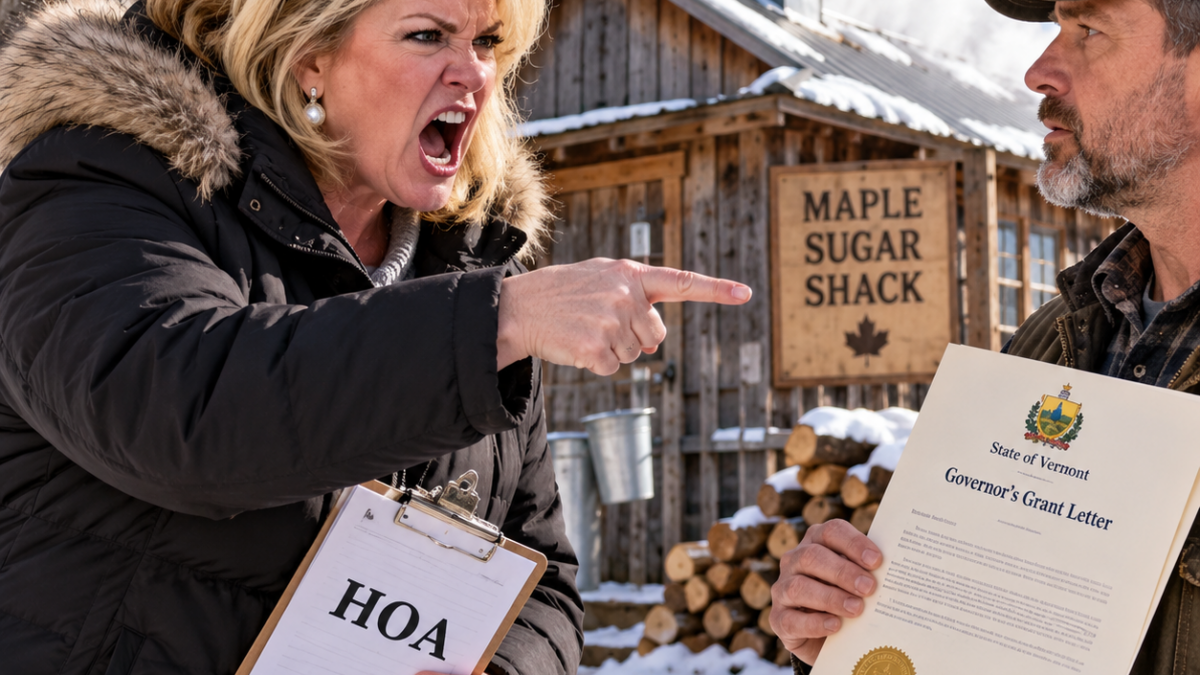
PART 2
My name is Jack Thorne, and before Oakwood Bluffs existed, my family had already been boiling maple sap on that hillside for more than a century.
My great-great-grandfather, Elias Thorne, came home from the Civil War carrying injuries he rarely spoke about and a land grant for roughly two hundred acres of rocky northern ground that most people would have considered more trouble than it was worth.
Elias saw maple.
He saw timber.
He saw water.
And apparently he saw a future.
In 1873, he built the sugar shack.
There was nothing impressive about it by modern standards. No architectural drawings survived. No engineer stamped plans. No building inspector signed off.
Elias cut hemlock and pine from his own property, shaped the timbers by hand and raised the structure with help from neighboring farmers.
The building was made for one purpose.
Boil sap.
My great-grandfather improved the evaporator.
My grandfather converted part of the collection system from buckets to tubing.
My father added stainless equipment while preserving the original framing.
Every generation modernized what needed modernizing and protected what didn’t.
That balance mattered.
The sugar shack wasn’t a museum frozen in time.
It was living history.
When I was eight years old, my father woke me before sunrise during my first real sugaring season.
I complained the entire time I was getting dressed.
It was dark.
Cold.
My boots felt too heavy.
My gloves made my fingers useless.
Then we stepped inside that shack.
I remember the heat first.
Then the smell.
Wood smoke, wet wool, sap, hot metal and maple sugar.
Steam hung beneath the rafters.
My grandfather stood at the evaporator holding a long skimmer.
“About time,” he said.
“It’s five in the morning.”
“That’s what I said.”
My father laughed.
That morning became one of the clearest memories of my childhood.
Years later, when I joined the Army and eventually found myself working engineering assignments thousands of miles away, I could still close my eyes and remember that smell.
It meant home.
After twenty years with the Corps of Engineers, I retired as a lieutenant colonel.
I had worked on projects where mistakes cost millions.
Sometimes lives.
I had learned how to read contracts, spot structural problems, document disputes and survive bureaucracies without losing my mind.
What I wanted afterward was quiet.
My parents were getting older.
The farm needed somebody.
My wife Sarah surprised me by being the person most enthusiastic about moving back.
She had grown up in the city.
The first time I brought her to the farm while we were dating, she looked at the sugar shack and asked why the building appeared to be “intentionally leaking.”
“Ventilation.”
“It has holes everywhere.”
“Correct.”
“And that’s good?”
“For a sugar shack.”
She looked at me like I had joined a cult.
Ten years later, she could finish syrup better than I could.
Our children grew up around the same evaporator.
For me, keeping the operation alive wasn’t nostalgia.
It was continuity.
Then Oakwood Bluffs appeared.
In the late 1990s, developers bought approximately five hundred acres bordering our farm.
Fields disappeared.
Roads appeared.
Then houses.
Dozens at first.
Eventually hundreds.
Most were large, attractive suburban homes, and I had no particular objection to them.
People needed places to live.
The problem was the boundary.
An old stone wall had separated our land from the neighboring tract longer than anyone alive could remember.
My father said the original developer walked the line with him before construction began.
Dad was a handshake man.
He believed a person’s word should weigh more than twelve pages of legal language.
According to him, the developer agreed that the subdivision—and therefore the future HOA—would stop at the stone wall.
For nearly twenty years, that understanding held.
Then the development company went bankrupt.
Original managers disappeared.
Records became messy.
A new survey was commissioned after Karen became HOA president.
That survey used modern county GPS mapping and claimed the official boundary reached approximately seventy-five feet beyond the stone wall at one corner of our property.
Unfortunately, that narrow wedge contained the sugar shack.
We immediately commissioned another survey.
Our surveyor used physical monuments, historical deeds and the stone wall.
His conclusion was the opposite.
The shack was ours.
Completely.
Karen called our survey “self-serving.”
Our attorney called hers “questionable.”
For a while, neither side pushed harder.
The dispute remained what lawyers politely call unresolved.
Then I received the Governor’s Heritage Farming Grant.
That changed everything.
Two years before Karen arrived at my sugar shack in her presidential golf cart, I applied for a state program supporting farms that preserved historically significant agricultural practices.
The application process was brutal.
I submitted farm records, photographs, family documentation, structural reports, educational plans and evidence of ongoing agricultural production.
Inspectors visited.
Historians inspected the shack.
Agricultural specialists reviewed the maple operation.
Months passed.
Then a letter arrived.
We had been selected.
The award included funding to stabilize several original structural components, upgrade visitor safety and expand the educational program we ran for local schools during sugaring season.
The governor came for a publicity event.
My mother cried.
My father, who had already become too sick to work a full boil, insisted on wearing his cleanest flannel shirt.
The governor shook his hand beneath the same beam Elias Thorne had helped raise in 1873.
“This is what preservation should look like,” he said.
“Not just saving a building, but keeping the knowledge inside it alive.”
A bronze plaque was mounted afterward.
**THORNE FAMILY SUGAR HOUSE
GOVERNOR’S HERITAGE FARMING INITIATIVE
RECOGNIZED LIVING AGRICULTURAL HERITAGE SITE**
My father died eleven months later.
The last full batch of syrup he ever tasted came from that shack.
That plaque meant more to me than Karen could possibly understand.
And legally, the operation had another layer of protection.
Our parcel remained agriculturally zoned.
Maple production was permitted.
Direct farm-product sales were permitted.
Most importantly, state Right-to-Farm protections existed specifically because people often moved next to farms and then discovered, to their horror, that farms made noise, produced odors, generated equipment traffic and did not operate according to suburban expectations.
That didn’t give farmers permission to behave recklessly.
It did prevent newer residential neighbors from weaponizing nuisance complaints against normal, established agricultural operations.
Karen either didn’t know that.
Or didn’t care.
The morning after our confrontation, the certified letter arrived.
Three violations.
Three thousand dollars.
Violation one:
**UNAPPROVED DETACHED STRUCTURE.**
According to Karen, the sugar shack violated Oakwood Bluffs requirements because it did not match the main residence in exterior materials, roofing style or paint.
I laughed when I read that.
Matching my 1873 sugar shack to my farmhouse would have required either making the shack look like it was built in 2004 or making our house look like it survived Reconstruction.
Neither seemed practical.
Violation two:
**PROHIBITED COMMERCIAL ACTIVITY.**
Our syrup operation supposedly altered the residential character of Oakwood Bluffs.
That was an impressive argument considering I did not live in Oakwood Bluffs.
Violation three:
**NUISANCE—SMOKE, ODOR AND EXCESSIVE NOISE.**
That one almost offended me professionally.
The visible plume from the cupola during normal operation was overwhelmingly water vapor.
Yes, there was wood smoke from the arch.
It was a wood-fired evaporator.
But it was operated correctly and had passed inspections.
The “industrial noise” consisted mainly of a blower and pumps.
I took out a legal pad.
Then I started building the response.
For the structure violation, I copied the historic deed and our licensed boundary survey.
I added documentation from the county historical society.
Then I included the Governor’s Heritage Farming Grant letter.
Not the publicity brochure.
The actual signed award letter.
I placed the bronze plaque photograph directly behind it.
For the commercial activity claim, I obtained certified zoning records showing that direct sales of agricultural products were allowed.
Then I attached the applicable Right-to-Farm provisions.
For the nuisance complaint, I included inspection records and operating specifications.
Then, because I am human and perhaps slightly petty, I included photographs from Karen’s own summer barbecue the previous year.
Two large smokers.
Thick black cooking smoke.
Cars lining both sides of the street.
Outdoor music.
I had taken the pictures for an entirely unrelated reason involving an argument over access to one of our field gates.
Now they became useful.
My letter said:
*The Thorne maple operation produces primarily water vapor and ordinary combustion exhaust associated with a lawful agricultural process. If Oakwood Bluffs wishes to establish that occasional smoke, odor and seasonal traffic constitute prohibited nuisances, I request confirmation that the association intends to apply the same standard uniformly to residential grilling, outdoor smokers, lawn equipment and community events.*
Sarah read that paragraph.
“You enjoyed writing this.”
“No.”
“You absolutely did.”
“Maybe a little.”
Each response went separately by certified mail.
Karen signed for all three.
Then nothing happened.
For six days.
On the seventh morning, a white county vehicle pulled into my driveway.
A second vehicle followed.
Karen’s golf cart appeared less than three minutes later.
Sarah saw it through the kitchen window.
“Oh, this should be good.”
“Please don’t say that.”
“You’re thinking it.”
I walked outside.
The first man introduced himself as Paul Mercer from county environmental health.
The second was Dana Whitfield, an agricultural compliance officer who worked with state and county agencies.
Karen parked near the stone wall and marched toward us carrying another folder.
“I’m glad you’re here,” she announced.
Paul glanced at me.
“You Mr. Thorne?”
“Yes.”
“We received a complaint concerning smoke emissions, unlicensed commercial processing and a potentially unsafe structure.”
“From me,” Karen said.
Paul looked at her.
“I assumed.”
She frowned.
“I’m Karen Holloway, president of Oakwood Bluffs.”
“Okay.”
The lack of reverence seemed to disappoint her.
Dana pointed toward the sugar shack.
“May we take a look?”
“Absolutely.”
Karen started following.
I stopped.
“You’re not invited onto my property.”
“This inspection is because of my complaint.”
“And you can observe it from your side of the disputed line.”
Dana looked at Paul.
Paul looked at Karen.
Karen’s face reddened.
“This is HOA property.”
Dana raised an eyebrow.
“Is ownership part of the complaint?”
“It’s inside our association.”
I handed Dana a copy of our survey.
“It’s disputed.”
He studied the first page.
“Then Ms. Holloway should remain off the parcel while we conduct the inspection.”
The expression on Karen’s face almost made the previous week worthwhile.
She walked back toward the stone wall.
We entered the shack.
Paul inspected the evaporator.
Dana checked the equipment.
I provided permits.
Agricultural registration.
Zoning records.
Ventilation documentation.
Fire safety records.
Paul looked toward the roof.
“Cupola operating correctly?”
“Yes.”
He watched the steam.
“Complaint says black smoke continuously crosses into the subdivision.”
“It doesn’t.”
“Any photos?”
“I have security footage for most operating hours.”
“Good.”
Dana walked toward the main beam.
Then stopped.
He looked at the bronze plaque.
“Oh.”
Paul turned.
“What?”
Dana read it.
Then looked at me.
“You’re the Thorne grant site?”
“Yes.”
He laughed.
“I reviewed part of your renewal packet last year.”
From outside came Karen’s voice.
“What’s going on?”
Nobody answered immediately.
Dana pointed toward a framed document on the wall.
The Governor’s Grant award letter.
“Can I see that?”
I took it down.
We stepped outside.
Karen was waiting.
“This operation needs to be suspended immediately,” she said. “Residents have respiratory concerns.”
Paul asked, “Do you have documented medical complaints?”
“I have emails.”
“Any emergency calls?”
“No.”
“Air-quality readings?”
“That’s your job.”
Paul remained expressionless.
Dana handed the governor’s letter back to me.
Karen saw the seal.
Her eyes moved across the heading.
Then stopped.
“What is that?”
I held it where she could read.
Her mouth opened slightly.
Dana answered for me.
“Mr. Thorne’s operation participates in the Governor’s Heritage Farming Initiative.”
Karen’s face changed.
Not dramatically.
Just enough.
The certainty disappeared.
“This is a state-recognized agricultural heritage operation?” Paul asked.
“Yes,” Dana said.
I handed them the supporting packet.
Dana continued reading.
“And this parcel is agriculturally zoned.”
“Yes.”
Karen recovered.
“That doesn’t exempt him from HOA regulations.”
Dana looked toward her.
“Whether HOA regulations apply is a property and contract question. I’m not resolving your boundary dispute.”
“Exactly.”
“But normal maple-syrup production on agricultural land is not automatically an actionable nuisance merely because nearby residents see vapor or smell wood smoke.”
Karen’s face tightened.
Paul added, “I’m also not seeing anything requiring an emergency shutdown.”
“You’ve been here ten minutes.”
“Yes.”
“Then inspect longer.”
“We will.”
She pointed toward the cupola.
“You can see the smoke!”
Paul stared upward.
“Mostly steam.”
I looked down so Karen wouldn’t see me smile.
Dana walked closer to the stone wall but remained on my side.
“Ms. Holloway, when did Oakwood Bluffs begin?”
“Nineteen ninety-eight.”
“How long has maple production occurred here?”
Karen looked at me.
I answered.
“Family records go back to 1873.”
Dana nodded.
“That matters under Right-to-Farm analysis.”
Karen folded her arms.
“You’re taking his side.”
“No.”
He looked directly at her.
“I’m telling you the law doesn’t begin at your subdivision entrance.”
That landed.
Gerald had followed Karen in another golf cart.
He stood behind her now.
His eyes moved from the governor’s letter to Karen.
“You knew about this?”
She ignored him.
Dana and Paul stayed for almost two hours.
They documented everything.
No emergency violation.
No shutdown.
No condemnation.
No order to stop boiling.
When they were finished, Paul handed me his card.
“If we need anything else, we’ll contact you.”
“Thank you.”
Karen stepped toward him.
“What about my complaint?”
“You filed it. We inspected.”
“And?”
“You’ll receive the appropriate response.”
“That’s it?”
“For today.”
She looked furious.
Then her eyes returned to the governor’s letter in my hand.
The same letter she had failed to discover before threatening to dismantle the building.
Her expression said she finally understood that her fight had escaped the small world of HOA newsletters and landscaping committees.
She got back into the golf cart.
Gerald didn’t immediately follow.
Instead, he approached me.
“Jack.”
“Yes?”
“I didn’t know about the grant.”
“You’re on the board.”
“I know.”
“You voted for the fines?”
He hesitated.
Then nodded.
“Karen told us the building was an illegal commercial structure.”
“You didn’t check?”
His face reddened.
“No.”
“Maybe start.”
He left without answering.
I thought the failed inspection might end it.
I underestimated Karen.
A week later, I was served with a civil complaint.
Oakwood Bluffs HOA wanted an injunction ordering me to cease maple operations while the boundary dispute and alleged covenant violations were litigated.
Sarah read the paperwork at our kitchen table.
“She’s suing us.”
“She’s suing the farm.”
“She’s suing our farm.”
“Yes.”
Our daughter Lily sat silently at the other end of the table.
She was thirteen.
Old enough to understand fear but young enough to think adults were supposed to have answers.
“Can she take the sugar shack?”
Sarah and I looked at each other.
“No,” I said.
“Are you sure?”
I wanted to say absolutely.
I couldn’t.
That mattered to me.
Children remember when adults promise outcomes they cannot control.
So I said, “I’m sure we’re going to fight.”
Lily looked toward the window.
Sugaring equipment waited outside.
“What if we lose?”
“Then we deal with what happens.”
She nodded slowly.
Then asked, “Would Grandpa have shut it down?”
That answer I knew.
“No.”
She smiled faintly.
“Then don’t.”
The next morning, I called Ben Carter.
Ben had served as a JAG officer and later specialized in property and association disputes.
We had worked together briefly years earlier.
He came to the farm instead of making me drive to his office.
For three hours, we reviewed everything.
Boundary surveys.
Deeds.
HOA notices.
State statutes.
Inspection results.
Grant documentation.
Karen’s court complaint.
Finally Ben leaned back.
“She went straight for an injunction?”
“Yes.”
“Did they complete the internal appeal process?”
“No.”
“Interesting.”
“That good?”
“It’s arrogant.”
I smiled.
“That sounds like her.”
Ben tapped the governor’s letter.
“This is excellent politically and useful factually, but don’t misunderstand it.”
I nodded.
“It doesn’t magically erase property law.”
“Exactly.”
The grant does not make you sovereign territory. We still prove the boundary. We still prove agricultural rights. We still attack their procedure.”
“That’s why I called you.”
“Good.”
He looked toward the old shack through the window.
“Is that really from 1873?”
“Most of the frame.”
Ben whistled softly.
“And she called it an unapproved outbuilding?”
“Apparently Elias Thorne failed to submit architectural review paperwork.”
“Reckless man.”
For the first time in days, I laughed.
Then Ben became serious.
“We need the HOA records.”
“For the injunction?”
“For everything.”
That started the next phase.
Mrs. Gable was first.
Eighty-two years old.
Sharp mind.
Sharper tongue.
She lived two doors from Karen.
I called her after Ben suggested we identify residents who had experienced selective enforcement.
“Jack Thorne?”
“Yes, ma’am.”
“I heard Karen tried to shut down the sugar shack.”
“News travels.”
“She told Mildred Conway you were operating an illegal factory.”
“It’s a maple evaporator.”
“I know what it is. Your father gave Harold syrup every Christmas for twenty years.”
Her late husband.
I remembered him.
“Mrs. Gable, would you be willing to tell me about your own experiences with the HOA?”
There was silence.
Then:
“How much time do you have?”
I visited that afternoon.
She brought out a folder.
Garden gnomes.
Three wooden figures Harold had bought for her during trips they took after retirement.
Karen had fined her because they were not of “uniform approved design.”
A wind chime had generated another warning.
Then a decorative birdhouse.
“She doesn’t like things she didn’t choose,” Mrs. Gable said.
“Why keep complying?”
Mrs. Gable looked toward a photograph of Harold on the mantle.
“After he died, I didn’t have the energy to fight people.”
That sentence stayed with me.
Next came Marco and Elena Garcia.
They had two young children and a backyard playset.
Karen’s problem?
The wood stain.
Sierra Redwood.
Approved color?
Cedar Natural.
I stood in Marco’s garage looking at photographs.
“They fined you five hundred dollars over this?”
“Half a shade.”
Elena stepped out carrying their baby.
“They ordered us to sand the whole thing.”
“You did?”
Marco pointed toward the backyard.
“Started yesterday.”
“Stop.”
He stared at me.
“What?”
“Until you verify the actual rule and whether it was properly adopted.”
He laughed.
“You sound like a lawyer.”
“I brought one.”
I explained my case.
When I finished, Elena didn’t hesitate.
“We’re in.”
My most important ally was Mark Jessup.
Retired Marine gunnery sergeant.
Mark and I had disagreed about almost everything since meeting at a Fourth of July picnic.
Which was why I trusted him.
People who always agree with you are either lying or not listening.
He reviewed Karen’s notices at my kitchen table.
Then our survey.
Then the lawsuit.
“She’s overextended.”
“Ben said the same thing.”
“She thinks you’ll get scared by legal expense.”
“Probably.”
“Are you?”
“Yes.”
Mark looked surprised.
“You admitted that fast.”
“Fear is information.”
He smiled.
“Army finally taught you something.”
“Marine Corps teach you paperwork?”
“No. We steal smart people from other branches.”
Mark helped organize the records request.
HOA budgets.
Contracts.
Minutes.
Vendor invoices.
Enforcement logs.
Karen resisted.
Then delayed.
Then provided incomplete summaries.
Ben sent a formal demand citing the homeowners’ inspection rights under the governing documents and applicable law.
More records arrived.
Richard Henderson, a retired CPA in the neighborhood, quietly joined us.
He spent three days reviewing expenses.
Then called.
“Come over.”
His dining table looked like an audit office had exploded.
He pointed to the landscaping contract.
“Hundred and six thousand last year.”
“Normal?”
“No.”
“How abnormal?”
“Depends on scope.”
He placed another sheet beside it.
“Prior contractor performed substantially similar work for seventy-four thousand.”
“Inflation?”
“Not that much.”
“Who owns the new company?”
He turned his laptop.
Green Pastures Landscaping LLC.
Registered owner:
Gerald Smith.
Karen’s brother-in-law.
I leaned back.
“You’re sure?”
“Public corporate record.”
“That proves conflict?”
“Not by itself.”
Richard tapped another invoice.
“Emergency tree removal. Twelve thousand eight hundred.”
“For what?”
“I don’t know.”
“Any board approval?”
“Meeting minutes say ‘grounds emergency expenditure approved.’ No detail.”
“Could be legitimate.”
“Could be.”
He smiled slightly.
“That’s why accountants ask for receipts.”
We requested them.
Then another pattern emerged.
Residents Karen disliked were fined aggressively.
People close to her received warnings—or nothing.
Mrs. Gable’s gnomes made the enforcement log.
The Garcias’ playset appeared.
My sugar shack occupied almost two full pages.
A complaint concerning Karen’s adult son parking a lifted pickup truck across the lawn for more than a week?
Nothing.
A complaint about repeated late-night parties at a board member’s home?
Nothing.
A storage trailer belonging to Karen’s friend that appeared to violate the same exterior-structure language she was using against my 1873 shack?
Approved retroactively.
Mark stared at the files.
“It’s not enforcement.”
“It’s leverage,” I said.
Richard nodded.
“Rules for opponents. Exceptions for allies.”
We did not yet have proof of theft.
I refused to use that word.
But we had enough to question governance.
Then came the fence letter.
Twenty feet of old split rail stood near the disputed boundary.
My father had installed it decades earlier.
Karen’s newest notice claimed all grandfathered fencing had to be painted in the “Oakwood Bluffs Heritage Brown” palette.
I read that title twice.
Then I started laughing.
Sarah came into the kitchen.
“What?”
I handed her the letter.
She read it.
Her expression remained serious.
Then she reached “Heritage Brown.”
She laughed too.
“That’s a real color?”
“Apparently.”
“What are you going to do?”
“Nothing.”
Ben disagreed.
He saw opportunity.
“The fence is on the disputed strip?”
“Yes.”
“And Karen is now affirmatively exercising architectural authority over it?”
“Correct.”
“Respond.”
“With what?”
“The survey. Again. Demand that they refrain from entering or altering the fence until ownership is resolved.”
“And if they ignore it?”
Ben looked at me.
“Then they help us.”
We sent the letter.
Certified.
Received Monday.
Thursday morning, Mark called.
“Truck by your fence.”
I was inside the sugar shack.
“What kind?”
“Maintenance.”
I walked out.
Two contractors stood beside the split rail fence.
One held a power washer.
Another had cans of brown stain.
Karen stood with them.
Of course she did.
I activated my phone camera before approaching.
“Morning.”
Karen looked irritated rather than surprised.
“We’re correcting the violation.”
“You received my attorney’s letter.”
“Our counsel determined the association has maintenance authority.”
“On disputed property?”
“Association records control until a court decides otherwise.”
“That isn’t how possession works.”
She gestured toward the worker.
“Proceed.”
I looked at him.
“Did anyone tell you ownership of this strip is being litigated?”
He froze.
Karen snapped, “Do not engage with him.”
I addressed the contractor.
“My attorney sent written notice prohibiting entry. I am now telling you directly.”
He looked at Karen.
She said, “You have a valid work order.”
He looked at me.
“I’m just here to stain a fence.”
“I understand. I’m not angry with you. I’m informing you there is a legal dispute.”
The man set down the sprayer.
“I’m calling my boss.”
Karen’s face flushed.
“You were contracted to complete this work.”
“And I’m not getting dragged into a property lawsuit over twenty feet of fence.”
He walked toward the truck.
Karen stared at me.
“You intimidate everyone.”
“No.”
I kept recording.
“I provide information you leave out.”
Mark had arrived at the edge of the field.
He leaned against a post with his arms folded.
Karen pointed toward him.
“And what is he doing?”
“Existing.”
“He’s threatening.”
Mark called back, “Ma’am, I haven’t said a word.”
She turned toward me.
“You think this is clever.”
“No.”
“You’re trying to make me look unreasonable.”
I nearly answered.
Then realized silence was better.
Karen continued speaking.
That was another thing my military career taught me.
When somebody is damaging themselves, don’t interrupt unless safety requires it.
“You’ve been obstructing this community for years,” she said. “Your father did it. You do it. You think because your family was here first, you own everything.”
“I own my property.”
“You refuse modernization.”
“I run vacuum tubing into a stainless reverse-osmosis system connected to an evaporator my great-great-grandfather wouldn’t recognize.”
Her mouth tightened.
“You know what I mean.”
“No. I know what you want.”
“What?”
“You want the stone wall moved on paper because seventy-five extra feet makes your authority reach the shack.”
She stared at me.
“That is conspiracy nonsense.”
“Then let the court resolve the line.”
“I don’t need your permission to enforce association rules.”
The contractor returned.
“We’re leaving.”
Karen spun around.
“What?”
“My office says no work until ownership is clarified.”
“You’re breaching the contract.”
“Talk to the office.”
They loaded the equipment.
Karen watched them drive away.
Her humiliation was complete.
And entirely self-inflicted.
The fence remained unpainted.
More importantly, my recording captured Karen acknowledging that the disputed strip was precisely why she intended to exercise HOA authority before the court had ruled.
Ben loved it.
“She really said she doesn’t need permission?”
“Word for word.”
He smiled.
“Save three copies.”
The court hearing on the injunction took place nine days later.
Karen arrived with two board members and the HOA attorney.
Sarah came with me.
Ben carried three binders.
I carried nothing.
That was his job now.
The judge began by asking the HOA what emergency harm required immediate cessation of the maple operation.
Their lawyer emphasized smoke, traffic, commercial activity and safety.
Ben responded with the county inspection.
No emergency violation.
Then agricultural zoning.
Then Right-to-Farm protections.
Then our survey.
Then the historical documentation.
Finally, he handed up the Governor’s Heritage Farming Grant paperwork.
The judge studied it.
“How old is the structure?”
“Approximately 1873, Your Honor.”
The judge looked toward HOA counsel.
“And your association seeks an order requiring cessation of an operation occurring there before your subdivision existed?”
Their attorney shifted.
“We dispute whether current commercial intensity is comparable to historic use.”
Reasonable argument.
Ben had anticipated it.
He produced production records.
Our maple output had fluctuated but remained within the scale of the historical family operation.
Educational visits had increased because of the grant, but state funding specifically supported that component.
The judge then asked the most important question.
“Who owns the land under the sugar house?”
Both lawyers answered at once.
We say us.
The HOA says them.
The judge removed his glasses.
“That seems rather central.”
Ben agreed.
The court denied the HOA’s request for an immediate shutdown.
Not our entire case.
Not final ownership.
Just the emergency injunction.
But it mattered.
Then the judge issued a preservation order.
Until the boundary dispute was resolved, neither party could alter structures, fencing or physical monuments within the disputed area without agreement or further court approval.
Karen’s face changed.
Her fence stunt had just become impossible to repeat.
Outside the courthouse, a local reporter approached.
I declined an interview.
Karen did not.
She said the HOA would “continue defending the rights and property values of Oakwood Bluffs homeowners against incompatible commercial intrusion.”
That evening, the quote appeared online.
Under it was a photograph.
Karen leaving court.
Behind her, Ben was carrying a binder with the governor’s seal visible on top.
The story spread locally.
Not viral.
But enough.
**HOA SEEKS TO SHUT DOWN 150-YEAR-OLD MAPLE OPERATION RECOGNIZED BY STATE HERITAGE PROGRAM**
People started calling the farm.
Teachers.
Former customers.
Parents who had visited as children.
A retired agriculture professor who remembered my father.
Then something happened that Karen could never have predicted.
The governor’s agricultural office called.
Not the governor personally.
I want to be clear.
A program director.
They had seen the coverage.
Because state grant funds had been used to preserve the sugar shack and expand educational access, they wanted information regarding any threatened structural changes.
I sent everything.
Three days later, a letter arrived.
It did not say the governor owned my shack.
It did not magically invalidate the HOA.
What it did say was powerful enough.
The state reaffirmed the site’s good standing under the Heritage Farming Initiative.
It confirmed that continued maple production and educational programming were central purposes of the grant.
It expressed concern that forced cessation or alteration of the structure could undermine the publicly funded preservation project.
And it requested notification of any legal action affecting the site.
I made copies.
At the upcoming annual HOA meeting, one copy went into my folder.
One went to Ben.
One went to Richard.
One went to Karen.
She opened hers at the front table.
I watched her eyes move across the governor’s letterhead.
Then stop.
The room was packed.
Normally, maybe twelve homeowners attended.
That evening there were more than a hundred.
Mrs. Gable sat in the first row with one of her forbidden garden gnomes in her lap.
I asked why.
“Moral support.”
“For you?”
“For all of us.”
The Garcias came.
Mark sat beside me.
Richard carried spreadsheets.
Karen opened the meeting.
She looked tired but defiant.
“The board will not permit this meeting to become a circus.”
Mrs. Gable whispered loudly enough for half the row to hear:
“Then why did she bring herself?”
Mark nearly choked.
Karen began with ordinary business.
Minutes.
Landscaping update.
Pool maintenance.
Nobody cared.
Then Richard stood.
“Point of order.”
Karen’s shoulders stiffened.
“Mr. Henderson.”
“Before approving the financial report, I request clarification regarding related-party vendor contracts.”
A murmur swept through the room.
Karen looked toward Gerald.
He looked down.
Richard continued.
“Green Pastures Landscaping received approximately one hundred six thousand dollars last year.”
“That contract has been discussed.”
“Not the ownership.”
Silence.
“Is Gerald Smith, the principal of Green Pastures Landscaping, your brother-in-law?”
Karen lifted her chin.
“That relationship is irrelevant to the quality of services provided.”
Someone said, “So yes.”
Karen banged the gavel.
“Order.”
Richard did not raise his voice.
“Was the relationship disclosed before contract approval?”
“I disclosed everything legally required.”
“Where?”
“What?”
“In which meeting minutes?”
Karen looked toward the secretary.
No answer.
Richard held up documents.
“I reviewed three years.”
Karen’s face reddened.
“This is harassment.”
“No.”
Richard had learned from me.
“It is accounting.”
People laughed.
Then he asked about the emergency tree-removal invoices.
Then maintenance costs.
Then no-bid contracts.
He made no accusations.
He simply asked questions Karen could not answer clearly.
Gerald finally interrupted.
“I was told competitive bids had been reviewed.”
Every head turned.
Karen stared at him.
Richard asked, “Did you see them?”
Gerald swallowed.
“No.”
That was the first crack in her board.
Then the homeowner forum began.
Mrs. Gable spoke about the gnomes.
The Garcias spoke about the playset.
A man named Dennis talked about being fined because his boat remained visible for three hours while he repaired a trailer.
A woman described being ordered to remove a memorial bench dedicated to her daughter because it had not received architectural approval.
That one silenced the room.
Karen looked increasingly isolated.
Then my name was called.
I carried one folder to the microphone.
“My name is Jack Thorne.”
A few people laughed because everyone knew.
I looked around.
“This started because Karen says my sugar shack produces smoke.”
Then I held up the inspection report.
“County environmental officials inspected it.”
I placed it down.
“No emergency violation.”
Agricultural zoning.
“County records confirm agricultural use.”
Right-to-Farm documentation.
“State law recognizes that established farms create sounds, smells and traffic that newer residential development cannot automatically declare a nuisance.”
Boundary survey.
“Our licensed survey places the stone wall—and the sugar shack—outside HOA jurisdiction.”
Then the Governor’s Heritage Farming Grant letter.
Karen looked at it.
I held it high enough for people behind me to see the seal.
“And while none of this puts me above the law, the State of this state spent public money helping preserve that building specifically so maple production could continue.”
Silence.
“That matters.”
I looked toward Karen.
“You called it a hovel.”
She stared back.
“My great-great-grandfather built it.”
“My grandfather worked inside it.”
“My father taught children inside it.”
“He died less than a year after standing beside the governor beneath those beams.”
My throat tightened.
I hadn’t expected that.
Sarah watched from the third row.
I continued.
“My daughter learned to grade syrup there.”
“My son can now run the evaporator almost without me.”
“And if we do our job right, someday their children will stand in the same building.”
I placed the letter down.
“This isn’t about whether Karen likes smoke.”
Then I looked around the room.
“It isn’t even about my farm anymore.”
Richard knew what was coming.
So did Mark.
I opened the second half of the folder.
Enforcement records.
Contracts.
Invoices.
Photos.
“This is about what happens when rules stop being standards and become weapons.”
Karen hit the gavel.
“You will not make defamatory accusations.”
“I’m not.”
I looked directly at her.
“I’m using your records.”
That quieted her more effectively than shouting would have.
I explained selective enforcement.
Mrs. Gable’s gnomes cited.
Karen’s son’s truck absent.
Garcias fined.
Friendly storage trailer approved retroactively.
I displayed the landscaping contract.
The family relationship.
The missing competitive-bid documentation.
Then the fence recording.
I did not play it.
I summarized it.
“After receiving written notice that ownership was disputed, the president attempted to send a maintenance contractor onto the disputed land anyway.”
Karen said, “That is false.”
Ben stood from the back.
“We have video.”
She stopped.
Then I finished.
“I spent twenty years in the Army Corps of Engineers.”
I looked around.
“The most dangerous structures are rarely the ones with visible cracks.”
“They’re the ones where everyone sees warning signs and decides somebody else will handle them.”
The room was completely quiet.
“For years, people here received ridiculous notices and paid because fighting seemed harder.”
“Board members approved decisions because questioning the president was uncomfortable.”
“Homeowners stopped attending meetings because they believed nothing would change.”
“And every time someone stayed silent, this system became a little stronger.”
I looked at Karen.
“She did not build that power alone.”
Then back at the residents.
“We gave it to her.”
That made some people uncomfortable.
Good.
I didn’t want a mob.
I wanted accountability.
“And if this community wants something different, it has to do more than remove one person.”
“It has to pay attention after she’s gone.”
I stepped away.
No applause at first.
Then Mrs. Gable stood.
She held the garden gnome against her hip with one arm and clapped with the other.
Marco stood.
Elena.
Richard.
Then dozens more.
Karen hammered the gavel.
“Order!”
The applause continued.
She stood.
“This meeting is adjourned.”
Richard raised his voice.
“Not yet.”
Karen froze.
He held up a petition.
“Under Article Eleven, homeowners representing the required percentage of the association membership request a special meeting for a vote of no confidence and removal proceedings.”
Karen stared.
“How many signatures?”
“Eighty-seven.”
The room reacted.
Her face drained.
Gerald looked at Brenda.
Brenda looked at Karen.
For the first time, nobody moved because Karen told them to.
The special meeting was scheduled.
Between meetings, the legal case changed rapidly.
An independent boundary expert appointed through the litigation reviewed both surveys.
He studied deeds.
Stone-wall alignment.
Original development maps.
Historic physical monuments.
The old developer’s planning documents.
One faded planning exhibit became crucial.
It showed the subdivision line following the stone wall.
Exactly where my father had always said.
The expert’s preliminary opinion favored our interpretation.
The sugar shack was outside the HOA.
Not partly.
Not seventy-five feet inside.
Outside.
When Ben called, I was boiling.
“Jack.”
“What?”
“You sitting?”
“No.”
“Sit.”
I shut the firebox door and sat on a woodpile.
“The court expert filed his report.”
“And?”
“Stone wall.”
For several seconds, I said nothing.
“You sure?”
“Read it yourself when I email it.”
I looked across the floor toward the beam where my father used to hang his coat.
“Dad was right.”
“Looks that way.”
Sarah found me ten minutes later still sitting there.
“What happened?”
I handed her my phone.
She read.
Then covered her mouth.
“Oh my God.”
I nodded.
“They never owned this corner.”
She sat beside me.
For twenty years, that old handshake had existed only as family memory.
Now documentary evidence backed it.
Sarah leaned against my shoulder.
“What happens now?”
“We keep going.”
“You really are incapable of celebrating.”
“I’m boiling syrup.”
She laughed.
Then cried.
Then I did too.
Not much.
Enough.
The HOA’s injunction case was suddenly in serious trouble.
But Karen had larger problems.
The independent audit homeowners demanded uncovered sloppy financial practices and undisclosed related-party dealings.
Not every rumor proved true.
That is important.
We found no suitcase of stolen cash.
No secret offshore account.
Reality is usually less cinematic.
What the audit did find was serious enough.
Contracts had been awarded without adequate competition.
Family relationships had not been transparently disclosed.
Several emergency expenditures lacked proper board documentation.
Enforcement procedures had been applied inconsistently.
Karen had repeatedly exceeded authority delegated to the president without recorded board votes.
Green Pastures Landscaping agreed to refund certain unsupported charges rather than fight over them.
The HOA’s insurer informed the board that some litigation expenses related to intentional or unauthorized acts might not be covered.
Suddenly Bob and Brenda—two board members who had always supported Karen—wanted separate lawyers.
Gerald resigned first.
His letter was short.
He admitted he had relied too heavily on Karen’s representations.
Brenda followed four days later.
That left Karen.
Alone.
Still president technically.
But president of a board that could barely function.
The special meeting took place on a Friday night.
Every chair was occupied.
People stood along the walls.
Some watched from the doorway.
A neutral parliamentarian had been brought in because nobody trusted Karen to run her own removal vote.
She sat at the front in a navy suit.
No gold lettering.
No golf cart.
No smile.
The moderator explained the process.
Then homeowners were allowed statements.
Mrs. Gable went first.
She placed her garden gnome on the podium.
Everyone laughed.
Even the moderator.
Karen did not.
“My husband Harold bought this in Vermont.”
Mrs. Gable touched the gnome’s red hat.
“Karen fined me because she said it was not consistent with approved landscaping decor.”
Karen looked away.
Mrs. Gable continued.
“I paid.”
“Not because she was right.”
“Because I was tired.”
Her voice softened.
“My husband died.”
“I didn’t want another fight.”
She looked around.
“I think a lot of us confused being tired with agreeing.”
That sentence hit harder than anything I had said.
The Garcias spoke.
Richard spoke.
Mark spoke briefly.
Then I was called.
I had prepared notes.
I left them in my chair.
“I don’t want revenge.”
Karen finally looked at me.
Maybe she expected that word.
People often do.
“I want my family left alone to farm land that belongs to us.”
“I want Oakwood Bluffs homeowners to know where their money goes.”
“I want board members to understand that a title does not turn preference into law.”
“And I want everybody in this room to remember something after tonight.”
I paused.
“The next Karen might not look like Karen.”
A few people smiled.
“I mean that seriously.”
“The next person who abuses authority might be popular.”
“They might be your friend.”
“They might be me.”
I looked at Richard.
“They might be whoever you elect next.”
“So don’t build a better community by finding a nicer person to obey.”
“Build one where nobody can accumulate this much unchecked power.”
That was my final statement.
Ballots were distributed.
Karen remained still.
The counting took fifteen minutes.
It felt longer.
Then the moderator stood.
“The membership has voted to remove Karen Holloway from the office of president and from the board.”
A wave of sound moved across the room.
Not screaming.
Relief.
The vote was not close.
Karen’s face remained frozen.
The moderator continued with procedural language.
I barely heard it.
Karen stood.
She looked toward me.
“You destroyed this community.”
The room fell quiet.
I didn’t answer immediately.
Then I said, “No.”
She waited.
“I stopped you from treating it like it belonged to you.”
Her eyes filled with anger.
Or tears.
Maybe both.
“You think they’ll thank you six months from now when dues go up because of your lawyers?”
“If dues go up, they’ll get to ask why.”
She grabbed her bag.
Then walked toward the exit.
Mrs. Gable’s gnome watched her leave from the podium.
I could not have planned a more ridiculous symbol.
The door closed.
Nobody applauded.
I appreciated that.
Humiliation wasn’t the point.
Accountability was.
Richard Henderson became interim president until a special election.
He hated every second.
Which was one reason people trusted him.
“I retired so I wouldn’t have meetings,” he complained at my kitchen table.
“You volunteered.”
“Mrs. Gable threatened me.”
“She does that.”
“She said she would nominate herself if I refused.”
“Then you saved the neighborhood.”
Richard glared at me.
The new board’s first acts were practical.
Independent contract review.
Mandatory disclosure of relationships between vendors and board members.
Competitive bidding above established thresholds.
Clearer appeal procedures.
Recorded votes on significant enforcement actions.
A suspension of disputed fines issued under Karen’s unilateral policies.
Then came my case.
With the boundary expert’s report, the HOA had little reason to continue.
Ben negotiated.
The association formally acknowledged that the sugar shack lay outside its enforceable boundary.
The nuisance claims were withdrawn.
All fines against me were canceled.
The HOA agreed to contribute to my reasonable legal expenses because its president had continued enforcement despite documented disputes.
More importantly to me, the settlement contained a permanent acknowledgment of the historic stone-wall boundary, subject to recording with the appropriate property documents.
No future board would get to restart the same fight because somebody found another GPS coordinate.
Karen was not part of that negotiation anymore.
Her personal legal exposure regarding unauthorized actions and financial governance was resolved separately.
The details were confidential.
I will say only that nobody went to prison.
Nobody lost a house.
This wasn’t television.
But the consequences were real.
Financial.
Reputational.
Permanent.
Karen could never again pretend nothing happened.
The following sugaring season arrived slowly.
Cold nights.
Mild days.
Perfect sap weather.
We tapped the first trees in February.
Ethan drove the utility tractor.
Lily inspected lines.
Sarah managed the filter press.
On the first full boil, I arrived before sunrise.
The shack was dark.
I opened the old doors.
Cold air rushed inside.
For a moment, everything looked exactly as it had when I was eight.
Then I turned on modern lights.
Started pumps.
Checked the reverse-osmosis system.
Loaded wood.
History and technology sharing the same room.
That was always the point.
At seven thirty, a school bus appeared.
Then another.
The educational program had resumed.
More schools wanted visits after the publicity.
I pretended to be annoyed.
Sarah didn’t believe me.
A group of fourth graders gathered outside.
Their teacher pointed to the bronze plaque.
“Who knows how old this building is?”
A boy shouted, “A thousand!”
Another said, “From dinosaur times!”
Ethan whispered, “Accurate.”
I gave him a look.
Then I told the children about 1873.
About Elias.
About buckets.
About how forty gallons of sap might produce roughly one gallon of syrup depending on sugar content.
About evaporation.
Boiling points.
Forestry.
Weather.
They listened.
Mostly.
One girl raised her hand.
“Is this the building the lady tried to shut down?”
The teacher looked horrified.
I smiled.
“Sometimes grown-ups disagree about rules.”
“What happened?”
“We read the rules.”
The teacher laughed.
The girl looked disappointed.
Apparently she wanted excavators or police.
I changed subjects.
At noon, a black SUV pulled into the farm.
For a second, old tension returned.
Then the door opened.
A representative from the governor’s agriculture office stepped out.
Not the governor.
Again.
Reality.
Her name was Rachel Moore.
She had come to present renewal paperwork for the heritage grant and announce additional support for educational programming.
Local media followed.
Rachel stood beneath the old beam.
She talked about preserving working farms as communities expanded.
She talked about Right-to-Farm protections and cooperation between agricultural and residential neighbors.
Then she handed me a framed renewal letter.
I glanced toward the road.
Several Oakwood Bluffs residents stood watching.
Mrs. Gable.
The Garcias.
Richard.
Mark.
Dozens more.
No Karen.
After the ceremony, Richard approached.
“I have a board question.”
“Absolutely not.”
“You don’t even know what it is.”
“Still no.”
He handed me a paper.
The HOA wanted to include the sugar shack on a new community heritage walking map.
I stared at him.
“You’re kidding.”
“No.”
“The building you sued me over?”
“Previous administration.”
“The smoke nuisance?”
“Maple steam.”
“The illegal commercial operation?”
“Historic agricultural resource.”
I laughed.
“You people have no shame.”
“Is that a yes?”
I looked toward the children standing near the evaporator.
“Only if the map clearly says private property and visits require permission.”
“Done.”
“And no golf carts.”
Richard smiled.
“Especially presidential ones?”
“Especially.”
That spring became our busiest season ever.
People stopped at the farm store.
Families came for scheduled tours.
Teachers brought students.
Older residents told stories about buying syrup from my grandfather decades earlier.
One afternoon, an elderly man named Arthur drove in.
He was ninety-one.
He walked slowly with a cane.
“I knew your father.”
“A lot of people did.”
“No.”
He shook his head.
“I knew your grandfather.”
That got my attention.
Arthur looked toward the shack.
“Worked one season in there.”
“When?”
“Nineteen fifty-three.”
He laughed.
“Worst job I ever loved.”
I brought him inside.
He touched the main beam.
His eyes filled.
“I thought they’d tear this place down when the houses came.”
“So did my father.”
Arthur nodded.
“Your grandfather worried too.”
I had never known that.
“He said one day people would look at smoke from a sugar house and complain because they’d forgotten what made the smoke.”
That sentence stayed with me.
Because that was exactly what happened.
Karen saw smoke.
My family saw work.
She saw an ugly shack.
The governor’s program saw living heritage.
She saw commercial traffic.
Teachers saw education.
Children saw steam rising through a cupola and learned that syrup did not originate in a plastic bottle shaped like somebody’s aunt.
Same place.
Different understanding.
Not everything Karen believed was malicious.
That realization took me time.
Months after she was removed, I saw her at the county grocery store.
I nearly walked the other direction.
Then she saw me.
We stood beside the produce section like two people trying to remember which war they had survived.
“Jack.”
“Karen.”
She looked older.
Less polished.
Or maybe just ordinary.
“How’s the sugar shack?”
“Still standing.”
“I saw the article.”
I nodded.
She picked up an apple.
Then put it down.
“I really did get complaints.”
“I believe you.”
That surprised her.
“Several residents complained about the smoke.”
“I know.”
“You always make it sound like I invented everything.”
“I never said nobody complained.”
“Then why was I wrong to act?”
There it was.
The question beneath everything.
I considered my answer.
“You weren’t wrong to investigate.”
She waited.
“You were wrong when you decided the outcome before investigating.”
Her eyes shifted.
“You treated complaints as proof.”
“You treated your survey as final.”
“You treated the HOA’s authority as unlimited.”
“And every time somebody challenged you, you assumed the challenge itself proved they were a problem.”
She said nothing.
I continued.
“That’s the difference.”
For a moment, I thought she would argue.
Instead she nodded once.
“My brother-in-law lost the landscaping contract.”
“I know.”
“He blames me.”
“I can imagine.”
“I lost friends.”
I didn’t answer.
Then she looked at me.
“Do you hate me?”
“No.”
That was true.
I had hated what she was doing.
Hatred afterward felt like letting the fight continue rent-free in my head.
“I was furious.”
She waited.
“I’m not anymore.”
She looked down.
“I still think the golf cart lettering was tasteful.”
I stared at her.
Then laughed.
She smiled despite herself.
“Take care, Jack.”
“You too.”
That was the last real conversation we ever had.
Karen eventually sold her Oakwood Bluffs house.
Her son helped her move.
A young family bought it.
They had two children.
The first fall after they moved in, the children came to our harvest festival.
Their little boy became obsessed with the evaporator.
His mother apologized because he asked approximately forty-seven questions in six minutes.
I liked him immediately.
Oakwood Bluffs changed too.
Not perfectly.
Nothing does.
People still argued over rules.
Someone complained about a neighbor’s shed.
Two homeowners nearly started a civil war over overnight street parking.
Richard threatened to resign president at least once a month.
Mrs. Gable kept submitting proposals to eliminate restrictions on garden ornaments, which everyone knew was revenge for the gnome incident.
But the process changed.
Questions were answered.
Votes were recorded.
Financial statements became understandable.
Vendor relationships were disclosed.
And the board stopped pretending rules were commandments written on stone tablets.
The Garcias never refinished the playset.
Sierra Redwood remained Sierra Redwood.
No civilization collapsed.
Mrs. Gable placed all three gnomes back in her front garden.
One held a tiny sign.
**NON-COMPLIANT AND PROUD**
Richard begged her to remove the sign.
She refused.
He decided some battles were not worth fighting.
Smart man.
Mark Jessup joined the architectural committee.
That surprised everyone.
His explanation was simple.
“Best way to prevent stupid rules is to be in the room before they’re written.”
I joined nothing.
Twenty years of military committees had satisfied my lifetime quota.
My contribution was syrup.
Every December, Oakwood Bluffs held a community dinner.
The first year after the lawsuit, Sarah suggested donating maple syrup.
“Why?”
“Because normal people live there.”
“I know.”
“You still talk about the neighborhood like it personally sued your ancestors.”
I donated syrup.
At the dinner, Richard presented me with a plaque.
I nearly left.
“No.”
“You haven’t even seen it.”
“I have enough plaques.”
Mrs. Gable blocked the aisle.
“Sit.”
I sat.
The plaque read:
**TO THE THORNE FAMILY
FOR PRESERVING A PIECE OF OUR SHARED COMMUNITY HISTORY**
I looked at Richard.
“You understand the irony.”
“Entirely.”
“Your HOA tried to dismantle it.”
“Previous administration.”
“You keep saying that.”
“It keeps being useful.”
Everyone laughed.
I took the plaque home.
Sarah hung it in the farmhouse.
Not the sugar shack.
“That building already has enough paperwork on the walls,” she said.
Years passed.
Ethan left for college.
Engineering.
Of course.
Lily studied environmental science.
Neither promised to take over the farm.
I didn’t ask them to.
My father never demanded that of me either.
Tradition becomes a prison when children inherit obligation instead of choice.
One winter break, Ethan came home early.
I found him inside the shack checking tubing equipment.
“What are you doing?”
“Vacuum readings were uneven.”
“You’re on vacation.”
“So?”
I smiled.
Maybe the future would take care of itself.
The governor’s grant remained active.
The program helped us replace part of the foundation without changing the historic frame.
We installed safer visitor walkways.
Improved ventilation.
Added interpretive displays.
One display included a timeline.
1873: Sugar shack built.
1912: Larger arch installed.
1958: Storm repairs.
1979: Tubing collection introduced.
2019: Heritage grant awarded.
2021: Educational program expanded.
Sarah suggested adding:
**2023: HOA unsuccessfully attempts to destroy civilization over maple steam.**
I vetoed it.
Barely.
The official display simply said:
**Boundary and preservation protections formally clarified.**
Less entertaining.
More accurate.
One March evening, near the end of a long boil, I stood alone inside after everyone went home.
The fire had burned low.
Steam moved gently through the rafters.
Outside, snow reflected moonlight.
I could hear the tick of cooling metal.
I picked up my father’s old skimmer.
The wooden handle had darkened from decades of use.
I remembered him standing beside the governor.
Thin from illness.
Trying to look stronger than he felt.
After the ceremony that day, when cameras had gone, he sat on a bucket inside the shack.
“Well,” he said.
“What?”
“Government finally paid us for being stubborn.”
I laughed.
“That’s your takeaway?”
“What else?”
Then his expression changed.
“Keep it going.”
“I will.”
“Not because it’s old.”
I remember looking at him.
“Then why?”
“Because it still works.”
At the time, I thought he meant the evaporator.
Years later, I understood.
Tradition that serves no purpose becomes decoration.
The sugar shack mattered because it still worked.
It produced syrup.
It taught children.
It gathered family.
It connected generations.
It gave my father a place to stand near the end of his life and know something he loved would continue.
Karen almost made me forget that.
During the worst months of the fight, the shack became evidence.
Exhibit.
Parcel reference.
Historical structure.
Protected operation.
Photograph A.
Survey marker B.
Legal description C.
I spent so much time proving what it was that I nearly stopped experiencing what it was.
That evening I poured a small amount of fresh syrup into a metal cup.
Still warm.
Dark amber.
I tasted it.
Same flavor I remembered from childhood.
Not exactly.
Nothing is ever exactly the same.
But close enough to carry memory.
Outside, headlights appeared.
A car stopped near the designated visitor area.
I walked out.
A father and a little girl stood beside the heritage sign.
“Sorry,” he said. “Are you closed?”
“For tours, yes.”
The girl looked disappointed.
“We were on the Oakwood heritage map.”
Of course they were.
“What do you want to see?”
“The steam.”
I looked at her.
“The steam?”
“My teacher said they boil tree water.”
Her father laughed.
“She refuses to believe it.”
I opened the door.
“Five minutes.”
Her face lit up.
Inside, I showed her the evaporator.
Explained sap.
Showed her a maple tap.
Let her smell fresh syrup.
She stared upward as a small cloud of steam curled toward the cupola.
“That’s the smoke?”
“Some people call it that.”
“It smells good.”
“Yes.”
Then she asked:
“Why would anybody complain?”
I laughed.
“That is a much longer lesson.”
Her father smiled.
“We have time.”
I shook my head.
“Not tonight.”
They left ten minutes later carrying a small bottle of syrup.
I watched their taillights disappear.
Then I looked toward Oakwood Bluffs.
Porch lights glowed between trees.
The neighborhood no longer looked like an invading force.
It was just a neighborhood.
People.
Families.
Good decisions.
Bad decisions.
Arguments.
Apologies.
Exactly like anywhere else.
And beyond the stone wall stood the sugar shack.
Still where Elias built it.
Still ours.
The next morning, Mrs. Gable arrived in Richard’s golf cart.
I nearly dropped a bucket.
“Where did you get that?”
“Borrowed it.”
“Does Richard know?”
“No.”
The side had a piece of cardboard taped over the door.
In thick marker she had written:
**GNOME ENFORCEMENT UNIT**
I stared.
She smiled.
“Get in.”
“No.”
“We’re going to inspect the maple smoke.”
“You’re eighty-six.”
“And you’re boring.”
I climbed in.
She drove terribly.
We made one slow lap around the farmyard.
Mark saw us and asked whether I had finally lost my mind.
Probably.
But for the first time, the old HOA golf-cart image did not make me angry.
It made me laugh.
That was when I knew the fight was truly finished.
Not when the court report favored us.
Not when Karen lost the presidency.
Not when the fines disappeared.
Not when the grant was renewed.
A battle ends legally when papers are signed.
It ends emotionally when the symbols that used to make your stomach tighten become ordinary again.
Karen once rolled onto my land in a golf cart and told me I had twenty-four hours to extinguish a fire my family had been tending, in one form or another, for one hundred and fifty years.
She saw smoke and thought nuisance.
She saw an old building and thought violation.
She saw my refusal and thought disobedience.
Then she saw the Governor’s Grant letter.
And for the first time, she realized the world outside Oakwood Bluffs had rules too.
Larger rules.
Older rights.
History she had not created.
Boundaries she could not move simply because they inconvenienced her.
But the letter itself did not defeat Karen.
Neither did the governor.
Neither did I.
What ended her reign was simpler.
People started checking.
Checking surveys.
Checking contracts.
Checking invoices.
Checking statutes.
Checking whether rules were actually approved.
Checking whether everybody was being treated equally.
Karen’s power had survived for years because people assumed somebody else had checked.
Once they stopped assuming, everything changed.
That was the lesson I carried from the whole mess.
Authority doesn’t become dangerous only when bad people obtain it.
It becomes dangerous when everyone else becomes too exhausted, distracted or intimidated to ask where it ends.
These days, whenever March arrives and the nights fall below freezing while the afternoons warm, I walk into the sugar bush before sunrise.
Sap starts moving.
Lines begin dripping.
The tanks fill.
We light the evaporator.
Steam rises.
Sometimes the wind carries it toward Oakwood Bluffs.
Nobody calls environmental health.
Nobody arrives with violation notices.
Occasionally a resident walks down with children.
They watch through the doorway.
They ask questions.
They buy syrup.
Mrs. Gable still claims she gets a senior discount.
She does not.
I simply charge her less because arguing with her is dangerous.
Richard eventually escaped the presidency.
He lasted three years.
At his final meeting, residents gave him a cake.
Across the top were the words:
**THANK YOU FOR READING THE BYLAWS BEFORE ENFORCING THEM.**
I contributed the maple frosting.
The Garcias’ children eventually outgrew the playset.
Marco offered to help tear it down.
His daughter refused.
“Karen hated it,” she said.
“So it stays.”
It remained another year.
Then rot finally did what the HOA could not.
They removed it voluntarily.
That difference mattered.
You should be able to decide when your own harmless things have reached the end of their usefulness.
Not have somebody else erase them simply because they fail to match a color chart.
My own children grew.
My mother grew older.
The farm changed.
Trees fell.
New maples reached tapping size.
Equipment improved.
Some traditions vanished.
Others returned.
But every spring, the fire still burns beneath the evaporator.
And every spring, when the first white cloud rises from the cupola, I stop for a second and watch it.
Because I know exactly what it is.
Not toxic smoke.
Not visual pollution.
Not evidence of a violation.
It is forty gallons of sap slowly becoming one gallon of syrup.
It is heat.
Water.
Sugar.
Labor.
Science.
History.
It is my great-great-grandfather splitting wood in 1873.
My grandfather teaching my father.
My father teaching me.
Me teaching Ethan and Lily.
Children from Oakwood Bluffs pressing their faces toward the evaporator because they have never seen tree sap boil.
It is a living thing passing from one generation to the next.
Karen wanted me to extinguish it in twenty-four hours.
Instead, the state renewed the heritage grant.
The boundary was permanently recorded.
The HOA rewrote its governance procedures.
Residents reclaimed their association.
The sugar shack became an official stop on a local agricultural heritage map.
And the smoke Karen reported became the very sight families drove out to see every spring.
People ask sometimes whether that feels like revenge.
Maybe a little.
I won’t pretend I never enjoyed the irony.
Karen called the shack a nuisance.
Years later, Oakwood Bluffs put it in a brochure.
She said the steam damaged the neighborhood.
Now residents photograph it.
She tried to use the HOA’s money and authority to force my family to stop making maple syrup.
Today, the association buys several cases from us every December for its community breakfast.
That part makes Mark laugh harder than anything.
But real revenge would have meant wanting Karen to lose everything.
I never wanted that.
What I wanted was the right to keep what was mine.
My land.
My work.
My family’s history.
And my children’s choice about whether that history continues after me.
I got that.
Which is better.
One late March afternoon, Lily came home from college.
I was finishing the last major boil of the year.
She stepped through the doorway carrying her backpack.
“Need help?”
I looked at her.
“You came home voluntarily?”
“Don’t make this weird.”
I handed her my father’s skimmer.
She took it.
For a second, four generations seemed to overlap inside that building.
My father.
Me.
Lily.
And people I knew only from photographs.
Outside, steam rose through the cupola.
Lily looked toward it.
“You know what I remember most about the Karen thing?”
“What?”
“Being scared she was going to take this away.”
I nodded.
“I was scared too.”
“You never looked scared.”
“Army training.”
She smiled.
Then became serious.
“Thanks for not letting her.”
I looked at my daughter.
Then at the old beams.
“I didn’t save it alone.”
“I know.”
She stirred the pan carefully.
“Still.”
I put another piece of maple into the firebox.
The flames rose.
The boil strengthened.
And through the open door, beyond the old stone wall, I could see the roofs of Oakwood Bluffs glowing in the evening light.
No enemy.
No battlefield.
Just neighbors.
That was the ending I would never have believed possible on the morning Karen arrived screaming from her golf cart.
Back then, I thought victory would mean defeating her.
I was wrong.
Victory was reaching the day when defeating her no longer mattered.
The sugar shack was still standing.
The family was still boiling.
The neighbors were welcome.
The rules were clearer.
The money was accounted for.
The boundary was settled.
And the governor’s letter—the document that had wiped the smug expression from Karen’s face the first time she finally understood what she had attacked—now rested inside a protective frame beside my father’s photograph.
Sometimes visitors stop and read it.
They usually notice the official seal first.
I notice something else.
A small coffee stain near the bottom left corner.
My father spilled it the morning we received the award.
I remember Sarah yelling.
He laughed and said:
“If the governor wants perfect paper, he shouldn’t send it to farmers.”
We never replaced the letter.
I’m glad.
Perfection was never the point.
Not for the letter.
Not for the farm.
Not for Oakwood Bluffs.
And certainly not for that battered old sugar shack.
The point was that it survived.
Karen demanded that I extinguish the fire.
I didn’t.
And five generations after Elias Thorne first boiled maple sap on that hillside, the steam is still rising.