PART 2: HOA Karen Tried to Seize My Family’s 135-Year-Old Ranch on Christmas—Then Froze When Someone Called Me “Governor”
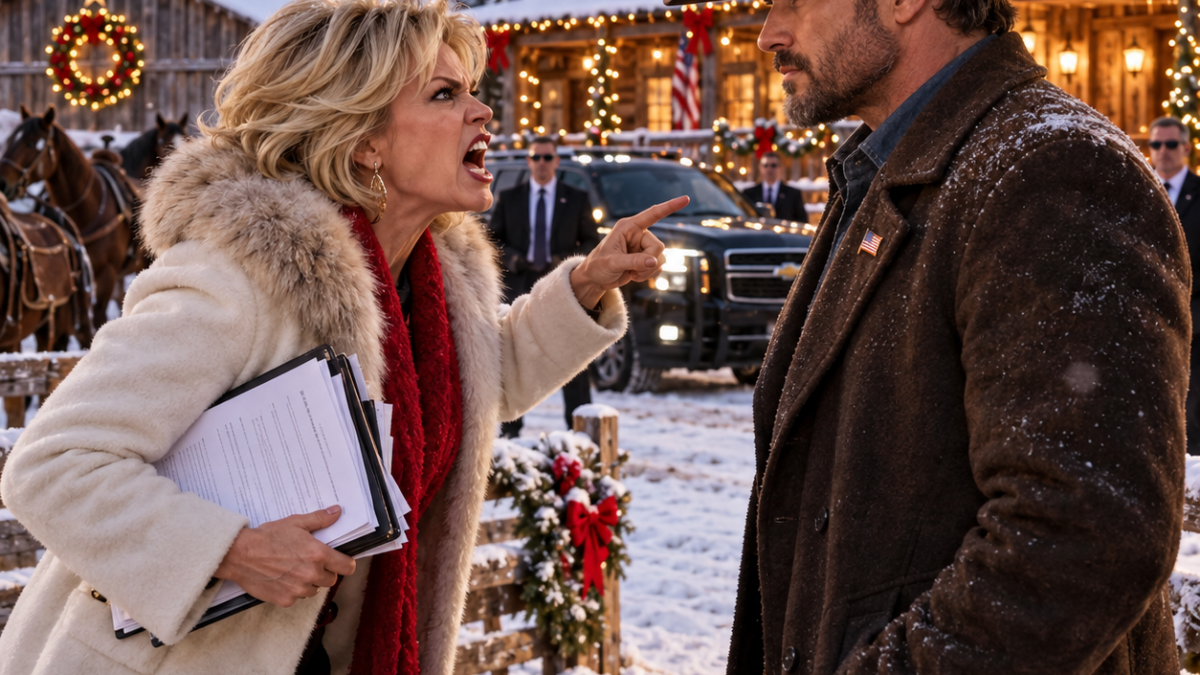
Three black SUVs rolled onto my family’s ranch on Christmas Eve, and the woman who stepped out told me I had twenty-four hours to surrender control of land my ancestors had owned for 135 years. She brought a security guard, two HOA board members, and a folder thick enough to make her threats look official, but there was something about the way she smiled that told me she had already decided how this would end. What I discovered in that folder would turn the quietest Christmas of my life into a battle that threatened to destroy everything my family had spent five generations protecting.
My name is Elias Mercer, and Red Hollow Ranch has belonged to my family since 1891. It sits in a remote Montana valley where winter arrives early, the fences stretch farther than most people can see, and the mountains turn purple just before sunset. I was fifty-seven years old, and every Christmas I could remember had begun with the same sounds: horses shifting in their stalls, wind brushing against the farmhouse windows, and the old kitchen clock ticking above the fireplace.
That Christmas Eve, snow had been falling since noon. I’d finished feeding the horses, checked the barn heaters, and hung the last string of golden lights along the porch. The same wooden sign my grandfather had restored decades earlier hung above the front door: RED HOLLOW RANCH — EST. 1891. It wasn’t fancy, but it meant something to me. My father had once told me that land wasn’t something you truly owned. It was something you borrowed from the people who came before you and protected for the people who would come afterward.
At 7:43 p.m., I heard tires grinding over the frozen gravel.
I looked through the kitchen window and watched three black SUVs approach the farmhouse, their headlights cutting through the snowfall. Nobody visited Red Hollow without calling first, especially on Christmas Eve. I set down my coffee, pulled on my worn canvas coat, and stepped outside.
The woman climbing out of the first SUV wore an expensive cream-colored coat and boots that had probably never touched a barn floor. Her name was Marbel Voss, president of the homeowners association in the newer residential development bordering my eastern pasture. Behind her stood two board members and a broad-shouldered security guard who looked distinctly uncomfortable.
“Mr. Mercer,” Marbel announced, “we’ve given you more than enough opportunities to cooperate.”
I glanced at the vehicles, then at the snow collecting on her shoulders.
“Cooperate with what?”
She opened her folder dramatically.
“Your property is in serious violation of community regulations. Your fencing is deteriorating, your livestock facilities are inconsistent with neighborhood standards, your commercial vehicles are improperly parked, and those Christmas lights exceed our permitted brightness levels.”
I looked toward my porch, where a few warm yellow bulbs illuminated the old wreath hanging beside the door.
“You’re here on Christmas Eve because of my Christmas lights?”
“Don’t trivialize this,” she snapped. “Your entire operation is incompatible with our community’s future.”
Something about that sentence bothered me more than the ridiculous complaints.
Our community’s future.
My family had been raising cattle in this valley more than a century before her subdivision existed. The HOA wasn’t formed until 1998. Its boundaries ended at the eastern fence line, and I’d personally reviewed those records when the first houses went up.
“Marbel,” I said, “my ranch isn’t part of your association.”
Her smile tightened.
“That’s where you’re mistaken.”
She handed me a violation notice listing thousands of dollars in potential fines, followed by threats of legal action, structural removal, and property liens if I refused to comply.
Then she offered me a pen.
“Sign here, and we can begin resolving this peacefully.”
I didn’t touch it.
“I’m not signing anything.”
Her eyes hardened. “Then you’re making a very expensive mistake.”
For a moment, neither of us spoke. Snow collected on the porch railing while the engines behind her continued running. I could see the security guard staring at the ground, and one of the board members nervously rubbing his hands together.
I finally asked, “Have you actually checked the deed to this property?”
“I know the regulations, Mr. Mercer.”
“That wasn’t my question.”
She stepped closer.
“People like you always think being here first gives you special privileges.”
Those words landed harder than she probably intended.
I’d buried family members who had spent their lives keeping this ranch alive. I’d watched my father repair fences with bleeding hands after blizzards destroyed whole sections. And now a woman who’d lived in the county for only a few years was standing on my porch, talking about my inheritance as though it were an inconvenience.
I turned toward the house.
“Stay right there.”
When I returned, I carried a leather folder containing original property records, surveys, and ownership documents dating back to 1891. I laid them across the porch railing beneath the light.
Marbel barely glanced at them.
Instead, she reached into her own folder and pulled out a yellowed document bearing what appeared to be an official government seal.
“We have an agreement signed by your family,” she declared. “And it gives us authority over this land.”
I took the paper from her.
At first glance, it looked authentic.
Then I noticed something beneath the seal that made my blood run cold.
PART 2
I had spent enough years reviewing official documents to recognize when something wasn’t right, and the problem wasn’t the age of the paper. It was the government office named in the notarization. According to the document, a Mercer ancestor had signed an agreement granting the HOA partial management rights over portions of Red Hollow Ranch in exchange for access to community infrastructure. The agreement supposedly dated back decades, long before the association had been organized. Yet the seal at the bottom belonged to a style introduced much later, and the agency responsible for certifying the agreement hadn’t even existed when the signature was supposedly made. I held the document beneath the porch light and read the relevant paragraph a second time. If the agreement were genuine, it might establish a narrow legal obligation affecting part of my land. But every instinct I had told me that somebody had gone to considerable trouble to create a document that could survive a casual inspection.
“Where did you get this?” I asked.
Marbel folded her arms.
“From our legal consultant.”
“What’s his name?”
“That’s confidential association business.”
“You’re claiming this document gives your organization authority over my family’s property, and you won’t tell me who prepared it?”
“Mr. Mercer, your attempts to intimidate me aren’t going to work.”
I looked at her for a moment, then lowered the paper. “I’m not trying to intimidate you. I’m trying to understand why you’re standing on my porch with a document that doesn’t make sense.”
One of the board members, a gray-haired man standing beside the second SUV, cleared his throat. “Marbel, maybe we should have somebody verify the paperwork before—”
“Richard, please,” she interrupted. “We’ve already discussed this.”
The man fell silent.
I noticed that. I also noticed how quickly she looked back at me, as though afraid I might see uncertainty spreading among the people she’d brought to support her.
“Your association was established in 1998,” I said. “My family registered this property in 1891. Those are matters of public record. If you believe there’s been some later agreement affecting the ranch, I’ll have it reviewed. But you aren’t going to enforce anything tonight.”
Marbel laughed, although there wasn’t much humor in it.
“You’re living in the past, Mr. Mercer. Communities evolve. Standards improve. And sometimes older properties need to adapt to the realities around them.”
I glanced toward the barn, where I could hear one of my horses striking a hoof against the stall floor. My father had built that barn’s western extension when I was a teenager. He had never finished the work before the first snowfall, and I still remembered spending three evenings with him beneath a temporary work light, our fingers nearly numb as we secured the last boards. Those memories weren’t valuable because the lumber was old. They were valuable because every post represented somebody who had sacrificed something to keep this place alive.
“You can build a hundred neighborhoods around this ranch,” I said. “That doesn’t give you the right to rewrite its ownership.”
Her cheeks reddened.
“Ownership isn’t the question. Compliance is.”
“Compliance with rules I never agreed to?”
“Compliance with the future of this county.”
I would remember that answer later, because it was the first time she stopped pretending her interest was limited to fences and Christmas lights.
She took the suspicious document back and returned it to her folder. Then her expression changed. The anger softened into something practiced and almost sympathetic.
“Elias,” she said, suddenly using my first name, “I understand you’re emotionally attached to this property.”
I didn’t respond.
“But maintaining an old ranch isn’t easy. These structures are aging. Your taxes aren’t getting any lower. And a man your age ought to be thinking about enjoying the years he has left instead of struggling to maintain something that no longer fits its surroundings.”
I felt my jaw tighten.
She didn’t know how many mornings I had spent before sunrise repairing frozen water lines. She didn’t know about the spring flood that washed out our southern fence or the wildfire that nearly took the western pasture. She didn’t know the nights my father had sat at the kitchen table, calculating whether the year’s cattle prices would cover the next season’s feed. But she had looked at the peeling paint on my barn and decided she understood what it meant to own Red Hollow.
“What are you trying to say?” I asked.
She reached inside her coat and removed a white envelope.
“I have an alternative that benefits everyone.”
She handed it to me.
Inside was a formal offer from a real estate development company to purchase Red Hollow Ranch outright. The price was substantial, far more than the ranch would ordinarily command based on its current agricultural income. Someone had clearly done the math, and not just the math involving livestock, acreage, or buildings.
I read the offer twice.
Then I looked up.
“What’s your interest in selling my land to this company?”
Marbel tilted her head.
“My interest is in responsible development.”
“Then why bring the offer yourself?”
“Because the association supports the project.”
“What project?”
For the first time that evening, she looked genuinely annoyed at having to explain herself.
“A development that will bring new businesses, tourism, construction jobs, and higher property values into this valley. Something more productive than endless pasture and deteriorating fences.”
“And where exactly is this development supposed to go?”
“That isn’t your concern unless you want to participate.”
I looked toward my eastern pasture. Beyond the fence, the lights of the subdivision glimmered through the trees. During the last several years, construction had expanded steadily across the valley. More houses had appeared, then paved roads, ornamental stone entrances, and signs advertising exclusive mountain living. I’d never opposed people building homes on land they legitimately owned. But I’d begun noticing real estate signs appearing on neighboring ranches where families had lived for generations.
Now I understood why somebody might be particularly interested in the largest undeveloped piece of land between those properties.
“You want my ranch because it’s sitting in the middle of something,” I said.
Marbel smiled.
“You’re beginning to understand.”
“No,” I replied. “I’m beginning to understand why you’re really here.”
She mistook my silence for hesitation and took out a pen. She crossed out the original figure on the offer and wrote a higher one beneath it.
“There. That’s a very generous adjustment, and I can probably have the company approve it. You could retire somewhere warm, travel, buy yourself a beautiful house. You wouldn’t have to worry about another winter here.”
I stared at the number.
I thought about my great-great-grandfather arriving in the valley with little more than a wagon, two horses, and the determination to build something permanent. I thought about the photograph above my fireplace showing my grandparents on their wedding day, standing in front of the same farmhouse with the first apple tree they’d planted beside the porch. I thought about the day my father put his hand on my shoulder and told me that someday every decision about Red Hollow would belong to me.
Money could have purchased a beautiful home anywhere.
It couldn’t purchase another childhood in that kitchen.
It couldn’t bring back one Christmas morning when my mother was alive and my father’s laughter filled the house.
And it certainly couldn’t buy back the feeling of standing on land where five generations of my family had worked, celebrated, suffered, and been laid to rest.
I folded the offer and returned it to her.
“Red Hollow isn’t for sale.”
Her expression went flat.
“Everybody has a price.”
“Then you’re talking to the wrong man.”
She stepped toward me. “Do you have any idea how difficult you can make this for yourself?”
I looked directly at her.
“Do you?”
The security guard shifted uncomfortably. Richard looked toward the waiting SUVs, clearly wishing he’d stayed home.
Marbel’s voice sharpened.
“Starting tomorrow, we’ll file formal violations with the appropriate offices. We’ll challenge your operating permits, demand inspections of your facilities, and pursue every available legal remedy. The fines alone could become devastating. If you think a sentimental story about your grandfather is going to stop that, you’re very mistaken.”
“You’re threatening my livelihood on Christmas Eve.”
“I’m explaining the consequences of refusing to cooperate.”
I took a breath. For nearly thirty years, I’d learned the importance of controlling my temper when someone else was determined to lose theirs. Anger might have felt satisfying for a few seconds, but it wouldn’t help me establish why a homeowners association with no apparent jurisdiction had appeared on my property carrying a suspicious historical agreement and a purchase offer from a company I’d never heard of.
“Marbel,” I said quietly, “I’m going to ask you one more time. Have you personally verified any of the legal claims you’re making?”
She straightened.
“I don’t need to explain myself to some stubborn old rancher.”
There it was. The contempt she’d been trying to hide beneath all that professional language.
I looked at the documents in her hands.
“Be careful what you put your name on.”
She gave me a thin smile.
“Is that supposed to frighten me?”
“No. It’s advice.”
She turned sharply and started toward her SUV. Then she stopped, faced me again, and delivered the words she probably intended to be her final victory.
“You’re just a rancher, Mr. Mercer. You should remember that.”
I felt something settle inside me. Not rage. Not humiliation. Something colder and far more deliberate.
“Are you absolutely sure,” I asked, “that you know who you’re dealing with?”
She laughed.
“Good night, Elias.”
The three SUVs backed down the driveway, their taillights disappearing behind the falling snow. I remained on the porch until the last engine faded into the distance. Then I walked to the barn, checked that the animals were settled, and returned to the kitchen.
The farmhouse felt unusually quiet.
I stood beside the stove, staring at the old Christmas photograph hanging near the doorway. My father had been smiling in it, holding a young calf that had somehow escaped its pen on Christmas morning. He’d always told me that the worst thing a person could do with authority was mistake it for ownership of somebody else’s life.
I’d understood those words differently when I was younger.
That night, they felt painfully immediate.
I picked up my phone and called a number that wasn’t listed anywhere in the county directory.
A man answered on the second ring.
“Good evening, sir.”
“I need the complete planning and zoning history for Red Hollow Ranch,” I said. “And I need somebody to verify a historical agreement that was presented to me tonight.”
His tone changed.
“Is there a security concern?”
“Not yet. But somebody is attempting to use an HOA to assert control over private property it doesn’t appear to have any authority over.”
“Would you like the governor’s office to handle the matter directly?”
I looked out at the snow-covered driveway.
“No,” I said. “I want the records preserved, and I want proper independent review. Nobody gets special treatment because of me.”
“Understood, Governor.”
I ended the call.
What Marbel Voss hadn’t understood was that I wasn’t merely a rancher defending inherited land.
I was the sitting governor of Montana.
I had spent much of my adult life in public service, and the ranch had remained my private refuge throughout it. My job took me to the state capital, legislative meetings, disaster sites, and countless events where people shook my hand because of my title. But whenever I came home to Red Hollow, I put away the tailored suits, pulled on my old work boots, and became the same man who’d once followed his father through these fields.
My security arrangements were discreet, and the people working closest to me understood how much I valued a little ordinary life. I wasn’t hiding my identity from the world. My face was on public broadcasts and official photographs. But Marbel had arrived so convinced she was dealing with a powerless rancher that she apparently hadn’t bothered to recognize the man standing in front of her.
I didn’t plan to use my office to settle a private property dispute. That would have violated everything I believed about the responsibility I carried. If the HOA’s claims were fraudulent, independent investigators and the courts would need to establish that through evidence, not because a governor was angry about being threatened on Christmas Eve.
Still, one thing was becoming unmistakably clear.
Someone had built an elaborate scheme around the assumption that I would be frightened enough to surrender my family’s land.
And I intended to find out who.
Christmas morning arrived beneath a sky the color of cold steel.
I woke before sunrise, as I always did at Red Hollow. Outside, the snow had stopped, leaving the ranch covered in a stillness so complete I could hear the wind moving through the pine trees. I fed the horses, broke ice along a water trough, and stood for a few minutes beside my father’s old workbench.
I’d hoped to spend the day alone, preparing Christmas dinner and enjoying the peace that had become increasingly rare in my public life. Instead, I found myself thinking about the document Marbel had presented.
A forged agreement was one possibility.
An actual agreement misunderstood or misrepresented was another.
Either way, I needed facts.
At a little after nine, my phone rang. The caller was a member of my legal team who had agreed to help obtain the public records through ordinary channels.
“We’ve checked the county’s recorded subdivision boundaries,” she said. “Red Hollow Ranch isn’t included.”
“Any amendments?”
“None affecting your acreage. We’re requesting the original documents behind the agreement you described.”
“What about the association?”
“Its recorded restrictions appear to apply only to properties within the development. We haven’t found any recorded instrument extending them to your ranch.”
I thanked her and ended the call.
I was still standing by the kitchen window when I heard engines coming up the road again.
For one brief moment, I actually thought I was imagining it.
Then the familiar black SUV appeared through the trees.
Behind it came another vehicle, followed by a white van.
I closed my eyes.
“On Christmas Day,” I muttered. “Of all days.”
Marbel climbed out before the first vehicle had fully settled into the driveway. She was wearing another expensive coat, this one dark blue, and her expression suggested she’d spent the night preparing for a confrontation.
But she wasn’t alone.
A lawyer carrying a leather briefcase stepped out beside her. A young cameraman emerged from the van, adjusting his equipment. Near the rear of the group stood a man in a dark overcoat whose polished appearance didn’t fit the holiday morning or the rural surroundings.
He wore no HOA identification.
He watched the barn, the house, and the surrounding fields with the calculating attention of someone evaluating assets.
I recognized the look.
I’d seen it often enough in negotiations involving development proposals.
Marbel pointed toward my porch.
“Start recording,” she told the cameraman.
I opened the door.
“Good morning,” I said. “Merry Christmas.”
She ignored the greeting.
“Mr. Mercer, we’re here to document your continued refusal to comply with lawful association requirements.”
I looked at the camera.
“You’re filming on my private property?”
“We’re documenting violations.”
“Did I give you permission to bring a camera here?”
Her lawyer stepped forward.
“We have a legitimate interest in preserving evidence of noncompliance.”
“Then you can preserve it from somewhere you have permission to stand,” I answered. “This is a private ranch, not a public sidewalk.”
The cameraman lowered his equipment slightly, uncertain whether he should continue.
Marbel raised her voice.
“You’re deliberately obstructing an official inspection!”
I looked at the lawyer.
“Official according to whom?”
He adjusted his glasses.
“The homeowners association has asserted jurisdiction under a historical management agreement.”
“Have you independently verified that agreement?”
His eyes flicked toward Marbel.
“We’ve reviewed the documents supplied to us.”
“That wasn’t my question.”
He hesitated.
I stepped inside and retrieved the folder containing my family’s records. Returning to the porch, I laid out the surveys, deeds, tax documents, and the original map showing exactly where the subdivision ended.
“Here’s the ranch boundary,” I said. “Here’s the association boundary. Here’s the date your association was created. And here are the recorded ownership transfers stretching back to 1891. If you believe an enforceable agreement changes those boundaries or gives you authority over this land, identify the actual recorded instrument.”
The lawyer studied the documents.
I watched his face change.
He didn’t admit he was wrong. But he became significantly more careful about what he said.
Marbel, unfortunately, did not.
“Your family history doesn’t exempt you from modern law!” she shouted.
“No,” I replied. “And your position as HOA president doesn’t exempt you from it either.”
She stepped closer, forcing the cameraman to adjust his angle.
“Do you understand the consequences of challenging an organization with the resources to pursue this through every level of government?”
I almost smiled.
“Every level?”
“County, state, whatever it takes.”
“Then I suggest you make sure your documents are accurate.”
She pointed at me.
“We’ll take this all the way to the governor’s office if we have to!”
I looked at her for a long moment.
“You’re welcome to contact the governor’s office,” I said.
Her face flushed.
“You think you’re clever, don’t you?”
“No, ma’am. I think you should stop making threats until someone has established whether you have the authority you’re claiming.”
The man in the dark overcoat began moving toward the vehicles. He had been listening quietly, but something in the conversation had apparently made him uncomfortable.
Before he reached the SUV, another car turned into the driveway.
It was a black sedan, but not one of Marbel’s vehicles.
The man who emerged wore a dark suit beneath a winter coat. I recognized him immediately as Daniel Hayes, a senior member of my protective detail, who’d come to speak with me about the previous night’s security incident.
He scanned the vehicles, the camera, the strangers gathered at my porch, and finally me.
Then he walked directly toward the house.
“Governor,” he said, “is everything all right?”
The entire driveway seemed to go silent.
The cameraman stopped moving.
Marbel’s lawyer turned toward Daniel.
Richard, standing near the second SUV, looked from Daniel to me with his mouth slightly open.
And Marbel Voss stood perfectly still.
“Governor?” she repeated.
Daniel glanced at her, then returned his attention to me.
“Sir, we were told there had been an unexpected confrontation here last night. Do you need us to address a security issue?”
“No, Daniel,” I said. “Nobody’s threatened me physically. But I do need these visitors to respect the property boundary.”
Marbel’s face had gone pale.
“Wait,” she whispered. “You’re…?”
I met her eyes.
“Elias Mercer.”
Her lawyer took a step backward.
Daniel spoke evenly. “Governor Mercer is spending Christmas at his private residence.”
Nobody said anything.
The cameraman was still holding his equipment, and the little red recording light remained illuminated.
Marbel looked at me as though she were trying to reconcile two completely different people.
The man in the worn coat.
The rancher she’d mocked.
The person she’d threatened with a complaint to the governor.
And the elected official standing directly in front of her.
“I didn’t know,” she finally said.
Her voice was so different from the night before that I almost didn’t recognize it.
I stepped off the porch and approached her slowly.
“Marbel, can I ask you something?”
She nodded.
“If I weren’t the governor, would you have treated me any differently?”
She opened her mouth.
Nothing came out.
I waited.
Behind her, the cameraman lowered his camera. Richard stared at the ground. Even the lawyer looked as though he wanted to disappear inside his expensive coat.
“If I were just a rancher,” I continued, “would you still have come here on Christmas morning with threats, financial penalties, and papers you haven’t properly verified?”
Her eyes filled with tears, though whether they came from fear, embarrassment, or something closer to regret, I couldn’t yet tell.
“Governor, I was only doing my job.”
“Then why are you suddenly apologizing?”
She looked away.
I let the silence settle before speaking again.
“My title isn’t what makes this property mine,” I told her. “My family owned Red Hollow before I was born. They’ll still have that history when I’m no longer governor. The law doesn’t change because you discover somebody has a title worth respecting.”
She began to say something, then stopped.
“And if the person standing here had been an eighty-year-old widow with no money for lawyers, would you have given her the same respect you’re trying to show me now?”
That question seemed to hurt more than the revelation itself.
I looked at the lawyer.
“I suggest you review every document your client has used to threaten property owners in this valley. And if any of those papers are false, I suggest you preserve them exactly as they are.”
He swallowed.
“Of course, Governor.”
Then I turned to Daniel.
“Please make sure everyone leaves safely. No confrontation. No unnecessary spectacle.”
Marbel stared at me.
“Are you going to have me arrested?”
I shook my head.
“I’m not a judge, Marbel. And my office doesn’t give me the right to order someone arrested because they insulted me.”
Her shoulders sagged.
“But if somebody has been using forged documents to steal land from ordinary families, that’s a different matter. And whoever is responsible will have to answer for it.”
She said nothing.
As the vehicles began pulling away, I noticed the man in the dark overcoat speaking urgently into his phone.
He turned his face away when he saw me looking.
That small gesture confirmed something I’d suspected since Christmas Eve.
Marbel was not acting alone.
And the people behind her were already beginning to panic.
By the time the last SUV disappeared beyond the eastern pasture, I was shaking.
Not from fear. Not entirely from anger, either.
There was a particular kind of exhaustion that came from standing on your own property and being forced to prove that you belonged there. I had spent years listening to citizens describe that feeling in different forms: elderly homeowners facing predatory liens, small business owners overwhelmed by fees, families who couldn’t afford to challenge a legal notice even when they suspected it was wrong. I had heard those stories in meetings and read them in reports. But hearing someone tell you that your own family home might be taken away was different. It reached inside you and touched something no argument could easily protect.
I went back into the farmhouse and shut the door. The silence that followed was almost painful.
A small Christmas tree stood in the corner of the living room, decorated with ornaments accumulated over generations. Near the top hung a wooden horse my mother had painted when I was seven. One of its legs had broken years earlier, and she’d carefully glued it back together rather than throw it away. I picked it up and turned it over in my hand.
My mother had always insisted that nothing was truly worthless simply because it had become old, scratched, or inconvenient.
Marbel had looked at this ranch and seen obsolete buildings, weathered fences, and an opportunity to clear a profitable piece of land.
My mother would have seen the photographs on the walls, the marks on the kitchen doorway showing how tall my brothers and I had grown, and the small initials carved into the barn’s eastern support beam by a boy who’d eventually become governor.
I put the ornament back and sat down.
For the first time since those black SUVs had arrived, I allowed myself to feel angry.
Not because Marbel hadn’t recognized me.
Because she’d believed that recognizing me was the only reason to stop.
That afternoon, I made several calls, careful to separate my personal interests from my official responsibilities. I asked my private attorney to secure the property records and preserve every document relevant to the HOA’s claims. Separately, I referred the possibility of forged government records and coordinated real estate fraud to the appropriate independent authorities. My office’s legal counsel immediately raised the conflict of interest that everyone involved would need to avoid.
“Governor,” she told me, “if the investigation involves your private property, you cannot direct the outcome.”
“I understand.”
“We’ll need independent oversight, and any prosecutorial decisions must be made without your involvement.”
“That’s exactly what I want.”
There was a pause.
“Sir, you realize this could become politically uncomfortable.”
I looked at the Christmas tree.
“Then it becomes politically uncomfortable. I’m not going to ignore possible fraud because the first victim happened to be me.”
Over the following forty-eight hours, the first pieces began falling into place.
The historical agreement Marbel had displayed was not merely questionable. Several of its identifying details were impossible. The named certifying office had been established years after the agreement was supposedly executed. The seal’s design belonged to a later period, and investigators could find no corresponding record in the county’s historical land instruments.
The document referred to infrastructure rights that were never recorded against my property.
It also attempted to connect an agricultural parcel to an HOA whose original charter didn’t give it authority over privately held ranch land outside the subdivision.
Somebody had taken genuine-looking legal language, attached a historical date, and wrapped it in enough official decoration to discourage anyone from asking questions.
Then came the second discovery.
The so-called legal consultant wasn’t licensed to practice law in Montana.
The address printed on his letterhead led to a vacant office suite two counties away. It had been rented for six months by a corporation whose name revealed almost nothing about its actual operations. The telephone number forwarded to a voicemail service, and the signature on the correspondence could not initially be matched to any identifiable attorney.
That alone was troubling.
But when public corporate records and financial disclosures began pointing toward the owners behind the office lease, a connection emerged.
The consulting operation was linked through multiple holding companies to the same development firm whose representative had stood on my driveway on Christmas morning.
I was sitting in my study when my attorney explained it.
“So the company trying to buy my ranch is connected to the people manufacturing the paperwork that supposedly gives the HOA authority over it?”
“That’s what the records indicate.”
I stared at the fire.
“And Marbel?”
“We don’t know exactly how much she understood. But there are documents suggesting she was involved in discussions about the development well before the association began issuing demands.”
I closed my eyes.
I had wanted to believe I was dealing with one arrogant HOA president who didn’t understand the legal limits of her authority. That would have been infuriating, but manageable.
What I was hearing sounded organized.
Patient.
Deliberate.
Someone had recognized that the ranch was valuable enough to justify a long campaign of pressure, and they’d chosen a homeowners association as the instrument.
“Keep following the evidence,” I said. “And make sure everything that belongs with independent investigators gets there.”
The next day, my attorney arrived at the ranch with a large map of the valley.
We spread it across the kitchen table, moving aside my coffee mug and a plate of Christmas cookies that I’d barely touched.
Red Hollow lay in the center.
Around it were smaller parcels, new residential developments, wooded lots, and stretches of pasture that had once belonged to neighboring families.
Several parcels had recently changed hands.
At first glance, there was nothing particularly unusual about that. Land changed ownership constantly. People retired, inherited property, moved away, or accepted attractive offers.
But when we compared those transactions with the proposed resort layout, a distinct pattern appeared.
The purchased parcels formed an irregular ring around Red Hollow.
The development company’s proposed cabins, road access, commercial spaces, and recreation areas depended on connecting those separate properties into a single continuous site.
And my ranch stood directly in the middle.
My attorney placed a finger on the map.
“Without Red Hollow, the project doesn’t connect the way they designed it.”
I leaned forward.
“How much of this was planned before Marbel became HOA president?”
“We’re still establishing the timeline.”
She slid another document across the table.
It was an early conceptual plan for the resort, prepared nearly three years before the confrontation.
Red Hollow Ranch was marked at the center of the proposed development.
I stared at the page.
For three years, I’d been repairing fences, managing cattle, and coming home whenever I could escape the responsibilities of office.
Meanwhile, strangers had been drawing roads through my family’s fields.
I traced a line running across the southern pasture.
“That’s where my grandfather taught me to ride.”
My attorney said nothing.
Another line cut near the old orchard.
“Those trees were planted before my father was born.”
I looked at the central section.
The farmhouse had been represented by a small gray shape, as insignificant on that expensive drawing as an abandoned shed.
A proposed internal road appeared to pass directly through the place where my mother had grown roses.
I folded my hands.
“Do they know what they’re planning to destroy?”
My attorney looked at me.
“I don’t think they’re thinking about it that way.”
That was the part I couldn’t stop hearing.
To the people behind the project, Red Hollow wasn’t an inheritance, a home, or a collection of human lives.
It was an obstacle between separate parcels.
A problem to be solved.
A holdout to be pressured.
I looked at the map again and realized something else.
If they’d been willing to pressure me this aggressively, what had they done to families who couldn’t afford an attorney?
I asked for copies of the transactions connected to the association’s enforcement activity. Some homeowners had complained publicly about escalating violations, disputed fees, and aggressive demands to correct minor property conditions. Other records suggested that property owners had sold soon after repeated pressure.
None of those circumstances, standing alone, proved wrongdoing. But together they deserved scrutiny.
That evening, I called an old neighbor whose family had once owned a small parcel along the eastern creek.
Her name was Evelyn Parker.
She had known my mother, and when I was a boy, she’d occasionally brought warm cinnamon rolls to the ranch during the winter.
She answered after several rings.
“Elias? Well, this is a surprise.”
“Merry Christmas, Evelyn.”
A faint laugh came through the receiver.
“A little late, but I’ll take it.”
I asked how she was doing.
She hesitated.
Then I asked about the property her family had sold the previous spring.
The silence changed.
“Oh,” she said softly. “That.”
“Would you mind telling me what happened?”
For several seconds, I heard only the quiet sound of her breathing.
Finally, she spoke.
“I couldn’t keep up with them anymore, Elias.”
“Who?”
“The association. Their letters. Their inspections. Every time I fixed something, they found something else.”
I leaned forward.
“What did they tell you?”
“That my drainage ditch violated new community standards. Then it was the fence. Then they said the shed my husband built forty years ago didn’t belong where it was. They made it sound like I’d spend the rest of my life paying fines.”
I looked at the map lying beside me.
“Was your property actually inside the HOA?”
“I’m not sure anymore. They kept saying there were agreements attached to the old subdivision boundary.”
A cold feeling settled in my stomach.
“Did they show you those agreements?”
“They showed me papers. Lots of papers. You know how I am with that sort of thing.”
Evelyn had worked most of her life as a school cafeteria manager. She knew more about stretching a dollar, remembering children’s birthdays, and showing up for neighbors than most people with college degrees ever would. But she’d never needed to interpret land-use restrictions written in dense legal language.
“What happened next?” I asked.
“A man from a development company came by. Said he’d heard I was having trouble. Offered to buy the property before things got worse.”
Her voice trembled.
“I didn’t want to sell, Elias. That little place was all I had left of Harold.”
Harold had been her husband. He’d died several years earlier, and the two of them had spent most of their marriage building a modest home beside the creek.
“Why didn’t you call me?” I asked gently.
She gave a sad little laugh.
“You’re running a state, honey. I wasn’t going to bother you with an old woman’s fence trouble.”
I felt something tighten behind my ribs.
“You wouldn’t have been bothering me.”
“I know you mean that.”
“Did you get a fair price?”
She didn’t answer immediately.
“Enough to find a little apartment. They told me I was fortunate to have an offer at all.”
I covered my eyes with one hand.
My dispute with Marbel was no longer an abstract question of HOA jurisdiction or property boundaries.
A woman who’d spent four decades building a home had been frightened into leaving it.
And somebody had apparently treated that as progress.
“Evelyn,” I said, “would you be willing to speak with an independent investigator about what happened?”
“Do you think I did something wrong?”
“No.”
“Then why would they want to talk to me?”
“Because somebody may have done something wrong to you.”
Her breathing caught.
For a moment, I thought she was going to cry.
Instead, she asked a question that stayed with me for months.
“Elias, if the papers weren’t real, does that mean I never had to leave?”
I looked at my family’s photograph on the mantle.
“I don’t know yet,” I answered. “I won’t make you a promise I can’t keep. But I think you deserve to know the truth.”
When the call ended, I sat alone for a long time.
It was nearly midnight before I finally stood, put on my coat, and walked outside.
The sky was clear, and the stars hung above the valley like tiny pieces of glass. Across the snow-covered pasture, the old fences stood in silent rows.
I thought about Evelyn’s voice.
I thought about her little home beside the creek.
And I thought about Marbel Voss telling me that an aging rancher ought to consider moving somewhere warm.
The cruelty of it wasn’t merely that they wanted our property.
It was that they had convinced people their own homes were burdens they should be grateful to escape.
The next morning, I asked my attorney to make sure Evelyn’s account was preserved and forwarded through the appropriate investigative channels.
Then another document arrived.
This one was far more damaging than anything we’d seen before.
It was a set of planning notes containing a list of targeted properties across the valley.
At the very top was Red Hollow Ranch.
Beside the name, someone had written:
ACQUISITION PRIORITY NO. 1.
Below it were notes about the anticipated resistance of the owner, the use of HOA enforcement pressure, and the timing of an eventual purchase proposal.
The notes were dated months before Marbel ever appeared at my door.
I read the entire page without speaking.
Then I read it again.
The property wasn’t merely part of a development opportunity.
It had been selected as the central target of a coordinated effort.
Someone had considered my family’s attachment to the ranch, concluded it might interfere with their profit, and planned to use legal pressure to break that attachment.
I looked at the words “anticipated resistance” and felt a sudden, almost unbearable sadness.
They’d reduced five generations of loyalty to a line item.
At the bottom of the document was another name.
Marbel Voss.
She had been included in the planning process.
Whatever she had believed about helping the community, there was no longer any reasonable explanation for her presenting herself as a neutral enforcer of neighborhood rules.
I placed the document on the table and turned toward the window.
The snow outside was beginning to melt beneath a pale winter sun.
For the first time since Christmas Eve, I understood that protecting Red Hollow might require something more difficult than simply defending my own property.
I might have to confront an entire system that had been quietly hurting my neighbors.
And the evidence suggested the system had been built deliberately.
Two days after Christmas, the investigation took a turn I hadn’t expected.
A retired schoolteacher named Thomas Whitaker called me at the ranch.
Thomas had served as president of the neighboring homeowners association before Marbel took control. He was seventy-two, soft-spoken, and the kind of man who’d once considered it a major community crisis when somebody painted a mailbox the wrong shade of green. I had known him for years. He used to stop by Red Hollow with his grandchildren to watch the horses, and I remembered him as someone who believed neighborhood associations should settle minor disagreements, not create enemies.
“Elias,” he said, “I’ve heard what’s happening. I think there are some things you should know.”
I invited him to come by.
He arrived an hour later in an aging pickup, carrying a small cardboard box filled with documents he’d kept after leaving the board. He looked older than I remembered, and when he stepped into the farmhouse, he took off his hat and held it awkwardly in both hands.
“I never thought this would happen,” he said.
I poured him coffee.
“What happened to the association, Tom?”
He stared down at the cup.
“It started small. New residents wanted improvements. Better landscaping. More consistent maintenance. There was talk about encouraging responsible development. Nothing unusual.”
“Then?”
“Then people started showing up at meetings who didn’t live in our neighborhood. Consultants. Real estate people. They told us the valley was being underused. Said we’d be foolish not to position ourselves for future growth.”
He opened the box and removed several sets of meeting minutes.
“They wanted the association to support annexing adjacent properties and extending certain enforcement standards. I kept telling them that we couldn’t just claim land because it was nearby. That wasn’t what our charter allowed.”
“What did they say?”
“That I was standing in the way of progress.”
I looked at him.
The phrase was becoming painfully familiar.
Thomas rubbed his forehead.
“Then the complaints started. Residents were told I was preventing their property values from increasing. Somebody circulated a letter accusing me of being too old to manage the organization. They made every meeting miserable.”
“Did Marbel organize that?”
“She was involved. But there were other people behind it. People with money, attorneys, connections. I couldn’t prove anything at the time.”
He looked up.
“I finally resigned because I couldn’t stand the fighting anymore. I thought if I stepped aside, things would settle down.”
His voice broke slightly.
“Instead, I handed them the whole thing.”
I shook my head.
“You didn’t hand them anything, Tom. You refused to do something you believed was wrong.”
“But I left.”
“You were a volunteer trying to protect your neighbors. You weren’t responsible for what other people later decided to do.”
He pushed the box toward me.
“I kept copies of everything. I don’t know whether any of it’s important.”
My attorney later reviewed the documents and arranged for the relevant originals and copies to be transferred to the independent investigative team.
They mattered.
The minutes showed how a formerly ordinary HOA had gradually become preoccupied with real estate acquisition, expanded enforcement authority, and cooperation with outside development interests. The shifts hadn’t happened overnight. They’d been introduced one resolution at a time, each framed as a minor administrative improvement.
A new committee to review surrounding land use.
An updated compliance policy.
An advisory relationship with planning consultants.
A proposal to promote neighborhood property values by reducing allegedly incompatible neighboring uses.
Individually, each could be made to sound reasonable.
Together, they told a different story.
They showed how an organization created to manage common landscaping and subdivision maintenance had been redirected toward pressuring owners far beyond its actual legal authority.
And they helped explain why Marbel had become so confident that she could stand on my porch and threaten to seize property her association had never controlled.
Before Thomas left, he paused beside the Christmas tree.
He studied the old wooden horse hanging near the top.
“Your mother made that, didn’t she?”
I nodded.
“She did.”
He smiled sadly.
“I remember her bringing pies to our first neighborhood picnic. She said it didn’t matter whether people lived on ten acres or in a little house on a quarter-acre lot. We were all neighbors.”
I felt my throat tighten.
“That sounds like her.”
Thomas put on his hat.
“She wouldn’t recognize what we’ve become.”
I walked him to the door.
“Maybe we can give this valley a reason to recognize itself again.”
He looked at me for a moment.
Then he reached out and shook my hand.
I stood in the doorway watching his truck disappear down the road, thinking about how easily a community could be persuaded to trade its own character for promises of wealth.
Nobody had to announce that fairness was no longer important.
They simply had to convince enough people that fairness was expensive, inconvenient, or bad for business.
By that afternoon, the independent investigators had obtained additional records through voluntary disclosures, public filings, and properly authorized requests. The materials began connecting financial activity to individuals who had been presenting themselves as neutral HOA officials.
Several board members had acquired nearby parcels through relatives or business entities.
Some of those properties were directly inside the proposed resort footprint.
The timing was difficult to ignore.
Those purchases had been made while the same board members participated in decisions that could significantly influence neighboring land values.
And at least three individuals appeared in records connecting them to accounts associated with the development operation.
My personal attorney summarized the situation carefully.
“There may be undisclosed conflicts of interest. The investigators will have to establish exactly what was exchanged and why.”
I leaned back in my chair.
“But the board members were participating in enforcement decisions involving property that could benefit their investments?”
“That’s what the records suggest.”
“And the homeowners paying association fees didn’t know?”
“Not from anything we’ve reviewed.”
I looked toward the window.
The people in that subdivision had trusted their board to maintain shared property, establish predictable rules, and protect the neighborhood from genuinely harmful conduct.
They hadn’t voted to turn it into a private acquisition department for developers.
They hadn’t agreed to subsidize a campaign against elderly neighbors.
And they certainly hadn’t authorized anyone to invent legal rights over land the association didn’t own.
For a moment, I imagined how it would feel to discover that a portion of the dues you paid every month had supported threats against someone like Evelyn Parker.
The betrayal would be difficult to describe.
I picked up the association’s old charter.
There were ordinary provisions about maintenance, dues, and common areas. Nothing extraordinary.
Nothing resembling permission to threaten a family ranch into submission.
“This was supposed to help people live beside one another,” I said.
My attorney nodded.
“That’s generally what organizations like this are intended to do.”
“Then somewhere along the way, somebody decided it would be more profitable to make people afraid of one another.”
She didn’t disagree.
Later that evening, the development company issued a carefully worded public statement.
I read it on my phone while sitting beside the fireplace.
The company expressed concern about what it called “recent public misconceptions” surrounding a project that promised economic development, construction employment, increased tourism, and long-term community investment.
It suggested that opposition to the resort was being driven by personal interests and resistance to necessary modernization.
It did not mention the suspicious historical agreement.
It did not mention the vacant law office.
It did not explain why several board members had privately acquired land positioned to gain value from the proposed development.
And it certainly did not mention Evelyn Parker.
By the next morning, the story had begun attracting attention outside the county.
Some reports focused on the confrontation at my ranch. Others highlighted the proposed resort. A few questioned whether a sitting governor should be involved in a personal land dispute that might affect development and employment in the state.
Those questions were legitimate.
I knew how the situation could look.
A governor owned a valuable ranch.
A development company wanted to buy it.
An HOA dispute erupted.
State agencies began examining the company’s activities.
Without safeguards, the public could reasonably wonder whether the machinery of government was being used for my personal advantage.
That was why I had insisted from the beginning that independent authorities control the investigation and that I remain outside prosecutorial decisions.
The same laws that protected my property had to protect the rights of the people accused of wrongdoing.
If I wanted a fair outcome, I couldn’t demand fairness only when it benefited me.
At a short press availability unrelated to the case, a reporter asked about Red Hollow.
“Governor Mercer, are you using state resources to retaliate against a private developer because it wants to purchase your family property?”
I stood behind the microphones and answered without notes.
“No. My personal property dispute will be handled through private counsel and the courts if necessary. Any investigation into alleged fraudulent documents or coordinated misconduct is being conducted by independent authorities under established procedures. I will not direct their findings.”
Another reporter raised her hand.
“Do you oppose the resort because it would change the area around your ranch?”
“I oppose anyone using false claims or coercion to acquire land. That’s true whether the land belongs to me, a farmer, a retiree, or a family that owns a single small house.”
“Are you planning to sell?”
“No.”
“At any price?”
I thought about the offer Marbel had placed in my hand.
“Red Hollow has never been for sale.”
The reporter nodded.
“Some people say you’re standing in the way of economic growth.”
I looked into the cameras.
“Growth shouldn’t require taking away somebody’s right to say no.”
I didn’t raise my voice.
I didn’t mention Marbel by name.
But when I returned to the ranch that afternoon, I found a message waiting from Evelyn Parker.
It was short.
She said she’d watched the press conference.
And for the first time since selling her home, she’d cried because somebody had publicly said she should have been allowed to refuse.
I sat with that message for a long time.
It mattered more to me than any favorable headline.
That evening, my attorney called again.
“The regional director of the development company appears to be coordinating the response. He’s contacted several association board members and arranged private meetings.”
“Is that unusual?”
“Not necessarily. But given the evidence we’ve seen, the investigators will likely want to know what those conversations involve.”
I looked at the map still spread across my kitchen table.
“Then I hope everyone involved starts telling the truth.”
What I didn’t know that evening was that Marbel Voss had already begun losing the confidence of the people who’d encouraged her to confront me.
I would learn the details later, when she gave her account to investigators.
After the video at my ranch, Marbel had traveled to a real estate office two counties away. She was summoned to a private room upstairs, where the men directing the development strategy demanded an explanation.
One of them placed his phone on the conference table.
On the screen was a still image from Christmas morning.
Me standing beside my porch.
Daniel at my side.
Marbel facing us, visibly shaken.
“You told us the owner would eventually cooperate,” the man said.
“I didn’t know he was the governor.”
“That isn’t the point.”
“He can bring the entire state down on us!”
“He can make noise,” another man replied. “That doesn’t mean the deal is finished.”
Marbel later described the moment she realized her own fear wasn’t shared by the men in that room.
They weren’t frightened because she’d threatened someone who didn’t deserve it.
They were angry because she’d threatened someone with enough resources to challenge them.
One of them reportedly leaned across the table and said, “You were supposed to secure the property, not turn it into a public spectacle.”
Marbel tried to explain that the documents had come from the consultant they recommended.
That the acquisition proposal had been prepared according to the plan.
That she’d followed the instructions given to her.
The answer she received was devastatingly simple.
“You signed the notices, Marbel.”
She looked at them.
“What?”
“You’re the HOA president. You approved the enforcement strategy. You personally delivered the documents.”
“But you provided those documents.”
“Then you should have verified them.”
She sat frozen.
The men who had encouraged her aggression were now preparing to describe it as an independent decision she’d made.
The very confidence that had elevated her inside the association was becoming the mechanism of her downfall.
According to her later account, she asked whether the development company intended to support her legal defense.
Nobody promised anything.
One man merely told her to avoid making additional statements until corporate counsel had reviewed the situation.
Another said that if investigators contacted her, she should remember which decisions had formally belonged to the HOA.
For the first time, she understood what those signatures at the bottom of the violation notices might cost her.
She had made herself the visible face of a scheme whose most powerful beneficiaries remained behind layers of corporations and intermediaries.
And now those people were moving away from her.
When she returned home that night, she went through the files she’d accumulated during her presidency.
Meeting invitations.
Internal presentations.
Emails discussing specific acquisition targets.
Draft enforcement notices.
Correspondence from the mysterious consultant.
At first, she told investigators, she’d convinced herself she was helping the community prosper. New businesses would arrive. Property values would rise. The valley would become a destination rather than a forgotten place outside the city.
She liked being the person developers called.
She liked being invited to meetings where expensive plans were spread across polished conference tables.
She liked hearing people describe her as an essential leader.
The attention had become something she depended on.
And when warnings began appearing in front of her, she found reasons not to see them.
A board member questioning the jurisdictional map was “afraid of progress.”
A homeowner complaining about excessive fines was “resisting accountability.”
An elderly neighbor refusing to sell was “being unreasonable.”
A rancher protecting land that had belonged to his family for 135 years was “standing in the way.”
She’d repeated those phrases often enough that she’d stopped hearing how cruel they sounded.
But now, alone with the documents, she could no longer pretend the entire arrangement was an ordinary effort to improve a neighborhood.
There were messages discussing enforcement pressure before violations had even been identified.
There were acquisition estimates calculated alongside projected legal expenses for resisting owners.
There were references to properties outside the HOA’s boundaries as though bringing them under association control were a matter of strategy rather than law.
And there were conversations in which the eventual purchase of Red Hollow Ranch was treated as inevitable.
Marbel found herself staring at one email in particular.
It described my property as the “last significant obstacle to full project integration.”
She remembered me standing on the porch, holding my family’s old records.
She remembered the wooden sign.
She remembered the horses moving inside the barn.
Most of all, she remembered asking me to sign a paper that would have made it easier to force the next stage of their plan.
She had believed she was standing in front of an aging rancher who would eventually run out of money, options, or courage.
Now she knew she had been wrong about my identity.
But she was beginning to understand that she’d been wrong about something far more important.
It shouldn’t have mattered who I was.
The documents in front of her were troubling regardless of whose name appeared on the deed.
Late that night, my phone rang.
The number was unfamiliar.
I answered.
“Elias?”
I recognized her voice immediately.
“Marbel.”
There was a pause.
“I need to speak with you.”
I looked at the clock.
It was almost ten.
“About what?”
“About the documents.”
“Then speak with the investigators.”
“I will. But there’s something I need to tell you first.”
Her voice sounded strained.
“Please. I need to come alone.”
I glanced through the window toward the empty driveway.
My first instinct was to refuse.
The last time she’d arrived uninvited, she’d brought a convoy and threatened to dismantle my life. Now she wanted a private conversation while the matter was under investigation.
I told her that any evidence would need to be handled properly and that the conversation could not become a negotiation over responsibility.
She agreed.
I also notified my attorney that Marbel had requested the meeting and made sure there would be an appropriate record of what was offered.
Then I told her she could come.
Forty minutes later, a single vehicle appeared through the trees.
No convoy.
No security guard.
No camera.
Just one woman driving slowly through the snow toward the farmhouse she’d once threatened to take away.
When I opened the door, she was standing beneath the porch light.
She wore an ordinary dark coat, her hair pulled back carelessly, and her eyes looked as though she hadn’t slept in days.
For a moment, she stared at the wooden sign above me.
Then she whispered, “Can I come in?”
I stepped aside.
The same kitchen where she’d tried to purchase my family’s history now became the place where her own carefully constructed authority began falling apart.
She sat across from me at the old wooden table.
The clock ticked.
The wind pressed softly against the windows.
I poured her a cup of coffee, although she didn’t touch it.
Finally, she said, “They lied to me.”
I studied her.
“Who?”
“The developers. The consultants. The people who told me everything we were doing was legal.”
I waited.
She lowered her eyes.
“They said the ranch was the missing piece. They said the development would create jobs and help the county. They told me that you were an unreasonable owner who just needed enough pressure to understand that selling was the sensible choice.”
“And you believed them.”
“At first.”
I leaned forward.
“What about later?”
She swallowed.
“Later, I started seeing things that didn’t make sense.”
“Like what?”
“Documents arriving already signed. Enforcement recommendations written before inspections happened. Board members suddenly buying land near the proposed project. People being told their properties were subject to restrictions I couldn’t find in our charter.”
I let the silence lengthen.
“Why didn’t you stop?”
She looked up, and for the first time, I saw something beneath the arrogance I’d come to associate with her.
Shame.
“Because I liked what I was becoming,” she whispered.
I said nothing.
“Before I joined the board, nobody in this town knew who I was. Then people started calling me Madam President. Developers invited me to meetings. Lawyers returned my calls. Important people told me I was helping shape the future of the valley.”
Her eyes glistened.
“I thought that meant I mattered.”
I thought about Thomas Whitaker leaving the association after years of quiet service.
About Evelyn Parker packing her belongings because she couldn’t afford another battle.
About the neighbors who had trusted Marbel to represent them fairly.
“And what did those people tell you to do with someone who said no?” I asked.
She covered her mouth.
I could see tears forming, but I didn’t offer reassurance.
Not yet.
“I need you to understand something, Marbel,” I said. “Whatever those men told you, you stood on my porch and threatened my home. You signed notices against people who may never have been subject to your rules. You helped make them afraid.”
“I know.”
“Do you?”
She nodded, crying quietly.
“Because there are families who no longer have their homes.”
“I know.”
“People who didn’t have an attorney’s number saved in their phone. People who believed you because you held an official-looking folder.”
She wiped her face.
“I know.”
I sat back.
“Then what are you going to do about it?”
She reached into her coat and removed a small flash drive.
She placed it on the table between us.
For several seconds, neither of us moved.
“Everything I still have,” she said. “Emails, acquisition plans, meeting records, payment references, names of the people who gave us instructions. Copies of the documents they wanted me to destroy.”
I looked at the drive.
“Did someone tell you to destroy evidence?”
She hesitated, then nodded.
“They told me to clean up our records before the next audit.”
“Who?”
She gave me the name of a senior executive connected to the resort project.
I didn’t reach for the device.
Instead, I pushed a clean envelope across the table and asked her to preserve the evidence in its original form for the investigators.
“If this is what you say it is, it needs to go directly into the proper chain of custody,” I said. “You should have independent legal representation when you cooperate.”
She looked frightened.
“Are you going to protect me?”
I took a long breath.
“I won’t promise you protection from consequences.”
Her shoulders dropped.
“But I will insist that you’re treated fairly. The same as everyone else.”
She looked at me for a long time.
Then she asked, barely above a whisper, “Do you hate me?”
I glanced toward the hallway where photographs of five generations of Mercers lined the wall.
I thought about my father’s hands, rough from years of work.
My mother’s Christmas ornaments.
Evelyn’s voice when she’d asked whether she ever really needed to sell her home.
“I hate what was done,” I said. “And I’m angry about what you chose to do. But hatred isn’t going to put anybody’s life back together.”
She began crying again.
“Can you forgive me?”
I was quiet for a moment.
“That’s not something you can ask me to decide tonight.”
She nodded.
“I understand.”
“Giving evidence doesn’t erase what happened,” I continued. “If you participated in wrongdoing, you’ll have to face that. If you can help people who’ve been harmed, you should.”
She stared at the envelope.
Then she whispered, “If I tell the truth, they won’t let me walk away clean.”
“No,” I answered.
Her fingers trembled as she moved the drive toward the envelope.
For a moment, I thought fear would win.
Then she drew a deep breath.
“I’ll tell them everything.”
When Marbel finally left, I remained at the kitchen table, looking at the untouched cup of coffee.
I’d expected to feel triumphant.
After everything she’d said to me, there should have been some satisfaction in watching her discover that the men she’d trusted were willing to abandon her.
But all I felt was tired.
She had spent years trying to become powerful.
And now, at the precise moment when she could no longer pretend she was in control, she’d finally done something that might help the people she had hurt.
It wasn’t redemption.
Not yet.
But it was a beginning.
The next morning, I received confirmation that Marbel had contacted independent counsel and arranged to provide her evidence to investigators.
She had also submitted a preliminary statement acknowledging that the HOA had attempted to enforce restrictions beyond the boundaries shown in its recorded governing documents.
I was told she had spent several hours answering questions.
Some answers apparently surprised the investigators.
Others confirmed things they had already begun to suspect.
The most important difference was that they now had information from someone who’d been inside the organization during the planning process.
She could explain how the documents reached the board.
Who had encouraged the enforcement actions.
Which meetings had taken place outside the normal association process.
And how the development firm’s representatives had influenced decisions supposedly made for the benefit of homeowners.
Within days, subpoenas began going out through the appropriate legal channels.
The development company could no longer rely on carefully prepared public statements to explain away the questions.
Its ownership structure, financial relationships, and correspondence concerning the resort project were becoming matters of formal investigation.
My attorney advised me that a separate civil action could be brought to establish that Red Hollow Ranch was not subject to the HOA’s claimed restrictions and to prevent further improper enforcement while the dispute was resolved.
I agreed.
I wanted the record to be unmistakable.
Not because I needed another document proving my ancestors had owned this land.
But because the next person threatened by an aggressive association might not have the money to spend months fighting over something that should never have been disputed.
I also asked my attorney to determine whether other affected property owners might benefit from independent legal assistance.
That was a private matter, separate from my official position. I could help cover certain reasonable costs through personal funds, provided everything was handled transparently and without attempting to influence investigators or the courts.
When she asked why I wanted to do that, I thought of Evelyn Parker.
“Because I don’t want somebody’s bank balance to determine whether their deed means anything.”
The days between Christmas and New Year’s were normally quiet in the valley.
Families visited relatives. Children played in the snow. Most businesses operated shorter hours, and the county building was usually nearly empty.
That year, everything felt different.
The dispute had become the subject of conversations in grocery stores, churches, gas stations, and kitchen tables.
People who’d barely paid attention to their homeowners association began reading the bylaws they’d signed when they bought their houses.
Some discovered that the board had claimed powers far beyond anything written in the governing documents.
Others began asking why their dues had been spent on consultants associated with development proposals.
Several homeowners wanted a full accounting.
And people who had sold property under pressure began comparing the letters they’d received.
The similarities were disturbing.
Different addresses.
Different owners.
Different alleged violations.
But the same language about escalating financial consequences.
The same warnings that continued resistance could become expensive.
And, in more than one case, a timely approach from someone offering to purchase the property before the situation got worse.
Fear had been distributed like standardized paperwork.
I remember reading that description in a statement prepared by one former homeowner.
It was painfully accurate.
The campaign hadn’t required physical force.
It had depended on convincing people that they could no longer afford to defend their own homes.
By the end of the week, a public meeting was scheduled at the county administration building.
It was intended to address the association’s jurisdictional claims, mounting concerns from property owners, and the need for transparency surrounding the proposed development. Representatives of the relevant county offices would explain what the existing records established, while association members would have an opportunity to demand answers from their leadership.
The independent criminal investigation would remain separate.
I agreed to attend, though my attorney warned that the meeting could become contentious.
“People are angry,” she said.
“They have reason to be.”
“Some of them are angry at the developers. Others think you’re trying to stop a project that could bring jobs.”
“Then they deserve to hear the facts.”
“And Marbel?”
“She’ll have to decide what she’s prepared to say publicly. That’s not my decision.”
The night before the meeting, I walked through the ranch carrying a flashlight.
Snow crunched beneath my boots. The horses shifted gently when I entered the barn, and the warm smell of hay wrapped around me.
I stopped beside an old chest near the tack room.
My father had kept family records in it before we moved most of them into protective storage. Inside were a few old photographs, a rusted horseshoe, and a leather-bound notebook containing handwritten accounts of ranch expenses from decades earlier.
I opened it carefully.
One entry recorded money spent repairing the barn after a winter storm.
Another described feed purchased during a particularly difficult season.
There were notes about lost cattle, broken equipment, and payments postponed because cash had been short.
Then, on one page near the back, my grandfather had written a simple sentence in the margin.
We made it through another winter. That’s enough to be thankful for.
I stood there for several minutes.
He had written those words during a year when the ranch had barely survived.
There was no mention of wealth.
No concern about prestige.
No ambitious development plan.
Just gratitude that his family was still there.
I imagined how he would react if he could see the valley now, with its expensive subdivisions and people measuring success by how many acres they could consolidate into a resort.
He wouldn’t have objected to honest business.
My grandfather had traded with everyone and respected anyone willing to work.
But he would have understood the difference between offering a person a fair price and using fear to make refusing impossible.
I closed the notebook and placed it carefully back inside the chest.
“Tomorrow,” I whispered, “we finish telling the truth.”
The county building was overflowing when I arrived.
Cars lined the street for several blocks. News vans occupied the parking spaces nearest the entrance, and people stood in small groups beneath the gray winter sky, talking with the urgency of neighbors who’d recently discovered they might have been deceived.
Some recognized me immediately.
Others simply nodded as I passed.
Inside, the meeting room was packed.
Homeowners sat beside ranch families, local business owners, county employees, and journalists. Several people held folders much like the one Marbel had brought to my porch, except these contained their own violation notices, property records, and correspondence.
I recognized Thomas Whitaker near the front.
He gave me a tired smile.
Evelyn Parker sat beside him.
When I saw her, I stopped.
She stood slowly, leaning on a cane.
“Elias,” she said.
I crossed the aisle and took her hand.
“How are you?”
“Nervous.”
“You didn’t have to come.”
She looked around the room.
“I know. But somebody told me I spent too many years letting other people speak for me.”
I smiled.
“Sounds like good advice.”
She squeezed my hand.
Then she said quietly, “I brought Harold’s picture.”
She opened her purse and showed me a small photograph of her late husband standing in front of their old home.
He was smiling beside the little porch he’d built himself.
“I thought maybe if I started getting scared, I could look at him and remember why I came.”
I felt my chest tighten.
“He’d be proud of you.”
She nodded, blinking away tears.
“I hope so.”
Across the room, several HOA board members were gathered around a table.
Richard was among them.
But their usual confidence was gone.
They whispered urgently, looked toward the doors, and occasionally glanced at the reporters.
Two of the members whose property purchases were being scrutinized sat together, visibly unhappy.
At the rear of the room stood several representatives of the development company. Their suits were immaculate, their expressions carefully neutral, and one of them appeared to be studying the audience as though calculating how many supporters remained.
Then Marbel entered.
The entire room noticed.
Conversation fell away in uneven waves.
She wasn’t wearing the expensive coat I’d first seen on Christmas Eve.
She wore a plain gray jacket and carried a modest folder.
No entourage walked beside her.
No security guard followed.
She looked exhausted.
For a moment, she paused just inside the doorway, visibly struggling with the attention.
Then she walked to an empty chair in the middle of the room and sat down.
A woman near the back muttered something angry.
Another shook her head.
Marbel didn’t respond.
I watched her lower her eyes to the table.
Whatever happened that morning, she had already lost the position from which she’d once intimidated people.
The meeting began with an explanation of the county’s recorded property boundaries.
A county official displayed the original subdivision map, the association’s governing documents, and the separate survey establishing Red Hollow Ranch’s boundaries.
The presentation was clear enough that even people who knew nothing about property law could follow it.
The HOA had been organized in 1998.
Red Hollow’s title history extended back to 1891.
The county had no recorded instrument establishing the broad management rights the association had claimed over my ranch.
And the disputed historical agreement, because of its serious inconsistencies, had been referred for formal examination.
People began whispering.
A man two rows behind me said, “Then why were they threatening him?”
Another replied, “Because they thought he couldn’t stop them.”
The county official called for quiet.
He explained that lawful recorded restrictions could not simply be invented by an HOA board vote, and that neighboring property didn’t automatically become subject to association rules because a development plan would benefit from including it.
The room listened.
Then the floor opened for questions.
A woman from the subdivision stood.
“My husband and I paid thousands in fees after we were told our property violated new standards. Were those standards actually approved by the membership?”
One of the remaining board members cleared his throat.
“We’ll need to review the specific provisions.”
She stared at him.
“You sent us five letters demanding payment. You threatened legal action. Now you need to review the provisions?”
Applause broke out.
Another homeowner stood.
“Who authorized the consulting expenses?”
A third asked whether board members had disclosed their financial interests in nearby development parcels.
Then someone near the front called out, “How much of our money went to people who were trying to buy these properties?”
The questions came faster.
The meeting moderator repeatedly asked everyone to allow responses.
But the board members had difficulty giving direct answers.
Finally, Richard stood.
His hands trembled slightly as he adjusted the microphone.
“I need to say something.”
The room settled.
“I was on the board when some of these decisions were made. I accepted explanations I should have questioned. I knew there were concerns about the ranch boundary, and I didn’t insist on resolving them before the president proceeded.”
He glanced toward me.
“Mr. Mercer, I owe you an apology.”
I nodded.
Richard continued.
“I also owe the homeowners one. This association was never created to frighten our neighbors out of their property.”
The room was quiet.
He took a breath.
“I’m turning over the documents I still possess, and I’m resigning from the board.”
There was scattered applause.
Not celebration.
More the sound of people acknowledging that someone had finally begun accepting responsibility.
One of the other board members stood abruptly.
“This is ridiculous,” he announced.
Several heads turned.
“We’re allowing a political figure to destroy a legitimate development opportunity simply because he doesn’t want change in his backyard.”
The room erupted.
The moderator struck the table and asked for silence.
The man continued.
“Do you people understand how much investment this project could bring? How many jobs? How much the entire valley could benefit?”
I listened without interrupting.
Then he pointed toward me.
“Governor or not, he shouldn’t get to dictate the future of this community!”
I stood slowly.
“May I respond?”
The moderator nodded.
I approached the microphone.
“You’re correct about one thing,” I said. “I don’t get to dictate the future of this community.”
The board member looked satisfied for half a second.
“Neither do you,” I continued.
The room grew still.
“And neither does a private development company. You can support new businesses, advocate for construction, or encourage investment. But you cannot make up legal authority over somebody else’s property because their refusal makes your plans less profitable.”
The man opened his mouth.
I continued before he could interrupt.
“Now, I have a question. Did you disclose to the association members that you had acquired an interest in land near the proposed resort footprint while serving on the board?”
His expression changed.
“That has nothing to do with this discussion.”
“It has everything to do with whether the people in this room were told whose interests you were representing.”
He stepped away from the microphone.
The moderator reminded everyone that the underlying financial questions were still subject to investigation and that no final finding had been made.
I agreed.
“We should not decide guilt in this room,” I said. “But the homeowners have every right to demand the records necessary to understand what their association has been doing.”
Then I returned to my seat.
I didn’t feel victorious.
I felt sad that the simplest principles had become the most difficult ones to defend.
After several more speakers, Evelyn Parker raised her hand.
The moderator recognized her.
She rose slowly from her chair, gripping her cane.
A county employee offered to bring the microphone closer, but she shook her head and walked forward.
I wanted to help her.
Instead, I remained where I was.
She had come to tell her own story.
She deserved to do it in her own voice.
“My name is Evelyn Parker,” she began. “My husband and I owned a small piece of land beside Willow Creek for forty-one years.”
Her voice was soft, but the room was so quiet that everyone could hear.
“We weren’t rich people. Harold worked for the county road department. I worked in the school cafeteria. We saved for that property, and we built most of the house ourselves.”
She unfolded the photograph she’d shown me earlier.
“This is my husband standing on our porch.”
She held it up.
“He’s gone now. But when I looked at that house, I still saw him.”
Several people lowered their eyes.
“Last year, I started getting letters. They said the fence was wrong. Then the drainage ditch. Then the shed. Every time I fixed something, another notice arrived.”
Her hand shook.
“I was told I could end up owing more money than I had. I was afraid I wouldn’t be able to keep the house.”
Nobody moved.
“Then somebody came and offered to buy it. They said I should be grateful because the place was going to become a problem anyway.”
She looked toward the board members.
“I believed them.”
Her voice cracked.
“I sold my home because I thought I didn’t have a choice.”
A woman in the front row began crying.
Evelyn looked down at the photograph.
“I don’t know whether what happened to me was legal. I know the investigators will have to figure that out. But I want the people who sent those letters to understand something.”
She raised her head.
“My husband didn’t spend forty years building a home so somebody could frighten his widow out of it.”
The room fell completely silent.
Then she added the words I would remember for the rest of my life.
“If your idea of progress requires an old woman to leave the last place she felt close to her husband, maybe you need to ask what you’re progressing toward.”
Nobody applauded immediately.
The silence was too heavy.
I saw Thomas reach for a handkerchief.
A reporter lowered her pen.
Even the developers standing in the back appeared uncertain what to do with the moment.
Then one person began clapping.
Another joined.
Soon the entire room was on its feet.
Evelyn stood motionless, holding Harold’s photograph against her chest.
I stood with everyone else.
And I felt tears sliding down my face.
I hadn’t cried during the confrontation at Red Hollow.
I hadn’t cried when I discovered the suspicious agreement or when I saw the development plans crossing my family’s fields.
But watching Evelyn stand before the people who had once frightened her into silence broke something open inside me.
I understood then that the worst harm done by schemes like this wasn’t always measured in money.
Sometimes it was measured in the loss of belonging.
The loss of confidence.
The terrible moment when someone began believing they were no longer entitled to stand in the home they’d spent their life building.
When Evelyn returned to her seat, I took her hand.
She squeezed mine.
For several minutes, neither of us said anything.
Then the moderator called Marbel Voss to the microphone.
The room’s mood changed immediately.
I felt Evelyn’s hand tense.
Marbel rose slowly.
She carried her folder to the front of the room and placed it on the table.
She looked toward the board members, then toward the homeowners, and finally toward the place where Evelyn sat.
“Before I say anything else,” she began, “I owe an apology to the people this association was supposed to serve.”
A few people shifted in their seats.
Marbel swallowed.
“I approved enforcement notices without adequately verifying the association’s authority. I accepted representations from outside consultants that I should have investigated. I allowed development interests to influence decisions that should have been based on the needs and rights of homeowners.”
Her voice trembled.
“I was told we were improving the community. But that doesn’t excuse the choices I made.”
She paused.
“I wanted influence. I wanted people to respect me. And when others gave me that feeling, I stopped asking enough questions about what they expected in return.”
She looked toward Evelyn.
“Mrs. Parker, I’m sorry.”
Evelyn sat very still.
Marbel’s eyes filled.
“I can’t give you back the months you spent afraid. I can’t undo the decision you made based on the information you were given. But I can cooperate with the investigation and tell the truth about how those notices were prepared.”
Then she looked toward me.
“Governor Mercer, I treated you with contempt because I believed you were someone I could pressure without consequences. When I learned who you were, I became frightened for myself.”
Her voice broke.
“That’s when I understood how completely I’d failed to treat people with the respect they deserved.”
I said nothing.
She took a shaky breath.
“I’m resigning as president of the association, effective immediately.”
A murmur moved through the room.
“I have provided investigators with the evidence in my possession. I will continue cooperating. I understand that doing so doesn’t absolve me of responsibility.”
One of the homeowners called out angrily.
“You should have thought of that before you ruined people’s lives!”
Marbel nodded.
“You’re right.”
The answer seemed to surprise everyone.
She didn’t argue.
She didn’t insist she’d been misunderstood.
She didn’t claim to be the real victim.
She looked at the man and repeated, “You’re right.”
Then she stepped away from the microphone.
The room remained quiet.
Her resignation didn’t resolve the investigation or repair the damage she’d caused. But it marked the end of the false authority she’d carried onto my porch on Christmas Eve.
The meeting continued with a discussion of the association’s governance, an independent financial audit, and the steps homeowners could take under their bylaws to establish new leadership.
County officials also explained how affected property owners could provide documents to the investigative team.
Near the end, I was invited to make a brief statement.
I walked to the front of the room carrying a single piece of paper.
It was a copy of the oldest surviving recorded description of Red Hollow Ranch.
“One hundred thirty-five years ago,” I began, “my ancestors established a home on land that many people considered too difficult to work.”
I looked toward the audience.
“They had no idea what the valley would look like in our lifetime. They couldn’t have imagined paved subdivisions, mountain resorts, or all the changes that have come with a growing state.”
I held up the page.
“But they understood something we should never forget. The right to own property means very little if powerful people can frighten you into surrendering it whenever they want something you have.”
I lowered the document.
“I am fortunate. I have resources. I know attorneys. I understand government procedures. And yes, I hold public office.”
I paused.
“Most people don’t have those advantages. They shouldn’t need them to be treated fairly.”
I looked toward Evelyn.
“This isn’t about whether a governor can defend a ranch. It’s about whether a widow, a retired teacher, a small farmer, or a family with a modest home can expect the same protection.”
The room was silent.
“Legitimate development can create opportunity. Honest associations can help communities thrive. But neither should become an excuse to erase people’s rights.”
I took a breath.
“I don’t want vengeance carried out through political power. I want documents examined, misconduct established where the evidence supports it, and people who’ve suffered losses given a lawful path to seek relief.”
Then I looked toward the back of the room, where representatives of the development company stood.
“And I want everyone who believes their money makes them more important than their neighbors to understand that a person’s right to say no is not an inconvenience you can simply purchase or threaten away.”
For a moment, nobody moved.
Then Thomas began to applaud.
Evelyn joined him.
Soon the sound filled the room.
I stood there holding my family’s old property record, overwhelmed by a feeling I hadn’t expected.
The ranch had brought me into the fight.
But it wasn’t the only thing worth protecting anymore.
The public meeting ended shortly before sunset, but its consequences were only beginning.
By the next morning, the homeowners association had lost most of the credibility its former leadership had spent years building. Residents who once accepted every violation notice without question were demanding access to the records behind those notices. Several board members resigned. Others were asked to explain financial interests that had never been disclosed to the people they represented.
The independent investigators continued following the documents, and the evidence began revealing just how carefully the development operation had been structured.
Three separate holding companies had been used in connection with nearby land acquisitions. On paper, they appeared to be unrelated businesses. One purchased rural parcels. Another managed consulting arrangements. The third held interests connected to the proposed resort development.
But financial records and corporate filings linked their activities.
The false legal consultant’s office was connected to the same network.
So were several payments involving people associated with the HOA’s expansion efforts.
The most revealing evidence wasn’t a single forged document or suspicious transfer. It was the relationship between them.
A property would be identified as valuable to the development.
Association representatives would begin raising compliance concerns.
The owner would receive increasingly aggressive notices.
And a purchasing intermediary would appear, presenting a sale as the simplest solution to an otherwise expensive problem.
In some cases, the sequence was merely suspicious and required further investigation. In others, correspondence gave investigators reason to believe the pressure had been planned.
The most disturbing messages treated homeowners’ fear as something that could be predicted and exploited.
One internal discussion estimated how long an owner might resist before legal expenses became too burdensome.
Another referred to escalating enforcement pressure as a way to encourage cooperation.
I read the excerpts my attorney was permitted to discuss with me and felt my stomach turn.
These weren’t people arguing openly over what land should be developed.
They were discussing how to make refusal financially painful.
I thought again about Evelyn Parker standing in front of the county meeting, holding her husband’s photograph.
Someone had apparently looked at a woman like her and calculated how much pressure she could endure before surrendering the place she loved.
That knowledge would stay with me longer than any insult Marbel had directed at me.
Within the following weeks, the resort project was formally suspended pending a comprehensive review.
The decision didn’t come from me.
It followed concerns raised through the relevant planning and legal processes, including the unresolved questions surrounding land acquisitions, project representations, and documents used to support the development effort.
When I heard the news, I was standing in the barn repairing a broken latch.
My attorney called.
“The current development approvals are on hold,” she said.
I set down my wrench.
“For how long?”
“There’s no definite timeline. It depends on what the review establishes.”
“And the people whose land was acquired?”
“The civil claims are moving forward. Some owners may have grounds to challenge their sales, depending on the facts of each transaction.”
I looked at the horses.
“Good.”
“There’s something else.”
“What?”
“The company has retained new counsel. Its representatives are attempting to distance the development firm from the activities of certain consultants and HOA officials.”
I gave a humorless laugh.
“Of course they are.”
“That doesn’t mean the explanation will hold up. The records will determine what happened.”
I leaned against the stall door.
“That’s all I’ve wanted from the beginning.”
After the call, I stayed in the barn for a while.
I wasn’t celebrating the collapse of a development proposal.
I knew that some local families had hoped the resort would bring jobs. Small business owners had imagined more customers. Construction workers had looked forward to contracts. Not everyone who supported the project knew about the questionable tactics surrounding the land acquisitions.
Those people deserved honesty, too.
It was possible to want investment in the valley without endorsing intimidation.
It was possible to believe in economic growth while insisting that the people pursuing it obey the law.
I had always believed those ideas could exist together.
Now I understood how easily powerful interests tried to persuade communities that they had to choose between them.
A few days later, an attorney representing several affected landowners approached my private counsel about coordinated civil proceedings.
Evelyn was among those considering legal action.
So were other families who had received questionable enforcement notices before agreeing to sell.
One couple had inherited a small orchard from the husband’s parents. They had sold after months of disputes over access and maintenance requirements that later appeared to have questionable legal foundations.
Another family had accepted an offer for property they’d planned to pass down to their children.
They’d believed selling was the only way to avoid financial consequences they couldn’t afford.
The details differed, but the emotional damage sounded painfully familiar.
People had been made to feel powerless in places where they should have felt safest.
I asked my attorney whether helping these families with legitimate legal expenses would interfere with the investigation or create an ethical problem.
She explained the safeguards that would be required.
I followed them.
I didn’t want to direct anyone’s lawsuit or influence what they said.
I simply wanted people with valid claims to have a reasonable opportunity to pursue them without being defeated by the cost of asking a court to hear their case.
My father had once helped a neighboring rancher through a terrible winter by lending equipment and taking feed over when the man’s cattle were starving.
The neighbor had tried to repay him.
Dad had refused.
When I asked why, he said, “Someday we’ll be the ones who need help. That’s what neighbors are for.”
I thought about that conversation often during those weeks.
Helping the affected landowners wasn’t about becoming their hero.
It was about refusing to let money decide whose story mattered.
Meanwhile, the men behind the development were discovering that their carefully arranged corporate structure could not necessarily protect them from scrutiny.
Records were requested from companies that had previously communicated only through intermediaries.
Financial transfers that once appeared unrelated were examined together.
The supposed independent consultant became an especially serious concern.
Investigators established that the office address had been rented through a corporate arrangement connected to the development company’s regional leadership.
The person named as legal consultant had no valid state law license.
And the historical document used against Red Hollow contained defects that could not be explained as ordinary drafting errors.
The official seal was inconsistent with the period.
The government agency did not exist when the agreement supposedly had been signed.
No authentic record of the asserted grant of authority appeared in the county land records.
The more carefully investigators examined the document, the less credible its claimed history became.
My family’s old deeds, meanwhile, remained exactly what they’d always been.
Recorded.
Traceable.
Consistent.
Five generations of ownership stood against a document that couldn’t withstand a serious examination.
One afternoon, my attorney brought me a copy of an independent survey prepared for the civil property dispute.
I spread it across the kitchen table.
Every fence line, boundary marker, access point, and recorded parcel description had been carefully examined.
The conclusion supported what I’d said on Christmas Eve.
Red Hollow Ranch had never been brought within the HOA’s subdivision boundaries.
The broad authority Marbel claimed was unsupported.
I stared at the survey for a long time.
Then I picked up the oldest Mercer deed and placed it beside the modern map.
The papers were separated by more than a century.
Yet they told the same story.
My ancestors had established this ranch in 1891.
The land had passed through the family lawfully.
And nothing the HOA had presented gave it the power to take control of that inheritance.
For a moment, I pictured Marbel standing beneath the porch light with her expensive coat and outstretched pen.
Sign here, and we can begin resolving this peacefully.
I remembered the contempt in her voice when she called me “just a rancher.”
Then I looked at the two documents side by side.
She had spent so much effort trying to make me feel small.
But the truth had never needed to shout.
It had been there all along.
The court proceedings and related negotiations continued, and the HOA’s attempt to assert authority over Red Hollow effectively collapsed under the weight of the records.
My attorneys took the necessary steps to secure the property’s position against further unsupported association enforcement.
The broader investigation remained ongoing.
I was careful not to confuse those two things.
Winning the right to be left alone on my ranch did not automatically establish every allegation against the developers.
Those questions would require evidence, legal proceedings, and fair opportunities for the accused parties to respond.
But the first battle was over.
The association had no lawful basis for imposing the sweeping demands Marbel had made.
Red Hollow wasn’t theirs to control.
And it never had been.
I expected to feel an enormous surge of relief.
Instead, when my attorney called with the news, I was standing outside repairing a section of fencing near the eastern pasture.
I listened.
I thanked her.
Then I returned to work.
There were still horses to feed.
Still fences to mend.
Still winter storms that didn’t care how many lawyers had been involved in a dispute.
Life at Red Hollow had never waited for the world to settle down.
That was one of the reasons I loved it.
The next significant development came from the homeowners association itself.
The remaining members, faced with an independent financial review and mounting pressure from residents, began restructuring their governance.
The association’s authority was formally brought back within the limits of its governing documents and applicable law.
New leadership was chosen through the established procedures.
Financial controls were strengthened.
External consulting arrangements received closer scrutiny.
Homeowners were given clearer access to meeting records, spending information, and the process for challenging disputed violations.
Thomas Whitaker was asked whether he would consider returning to help guide the transition.
He called me after the meeting.
“You know what they asked me?” he said.
“What?”
“They wanted me to be president again.”
I laughed.
“What did you tell them?”
“That I’m seventy-two years old, and I’ve already done my time.”
That made me laugh harder than anything had in weeks.
Then his voice softened.
“I told them I’d help with the transition if they wanted, but they needed somebody younger who understood what the job was actually for.”
“That sounds sensible.”
He paused.
“You think the neighborhood can recover from this?”
I looked through the window at the lights of the subdivision across my eastern pasture.
“I think it can,” I said. “But people are going to have to work at trusting one another again.”
Thomas sighed.
“Funny how long it takes to build trust and how quickly somebody can spend it.”
He was right.
For years, residents had attended HOA meetings without worrying about what happened behind the scenes.
They’d assumed that board members were acting in the neighborhood’s interest.
Now every decision came with questions.
Every expense attracted scrutiny.
Every new proposal had to overcome the suspicion created by people who’d abused their positions.
Repairing that kind of damage would take much longer than replacing a few board members.
But there were encouraging signs.
Residents who had once been divided over the development were beginning to talk to one another again.
Some apologized for dismissing neighbors who had complained about enforcement pressure.
Others volunteered to review the bylaws and help establish clearer procedures.
People started attending meetings not because they wanted more power, but because they wanted to make sure no small group could quietly claim it for themselves again.
The association would never return to the innocent simplicity Thomas remembered.
Perhaps that wasn’t entirely a bad thing.
A community that had seen how easily authority could be misused might become more determined to keep it accountable.
As January continued, the investigation moved beyond the HOA’s internal misconduct and deeper into the development company’s relationships with the various holding companies.
The regional director who had overseen the resort acquisition strategy became a central figure in the expanding inquiries.
His name appeared in correspondence, corporate filings, and discussions involving land purchases around Red Hollow.
The same name had surfaced in records associated with the vacant office used by the supposed legal consultant.
The director had once remained comfortably removed from the public conflict, allowing Marbel and the association to deliver the threats.
Now his connection to the arrangement was being examined directly.
He stopped appearing at local development events.
His representatives continued issuing statements emphasizing the company’s commitment to lawful business practices.
But those statements could not answer the central questions.
Who had authorized the disputed documents?
Who had directed the consultants?
Who had approved the strategy of applying enforcement pressure to property owners who resisted selling?
And who had benefited financially from the resulting transactions?
Those questions followed the records, not the headlines.
In the months that followed, formal legal proceedings addressed different parts of the scheme.
Certain individuals associated with the falsified documents and acquisition arrangements faced official investigation.
Civil claims were brought by affected landowners.
The development remained suspended while the underlying concerns were examined.
Some disputed transactions began moving toward negotiated reversals or other remedies.
Others remained tied up in litigation.
There were no instant miracles.
No single courtroom speech resolved everything.
Some families faced months of uncertainty.
Some of the money that had changed hands was difficult to trace.
And some property owners discovered that restoring a legal title was far more complicated than signing the papers that had originally transferred it.
But something fundamental had changed.
Before Christmas, people like Evelyn had believed they were fighting alone.
Now the documents were being examined openly, the financial relationships were under scrutiny, and the people who’d controlled the process could no longer assume their decisions would escape review.
That mattered.
A great deal.
One morning in late January, I found an envelope in my mailbox.
It was plain, without a business logo or return address.
Across the front were four handwritten words.
From the Voss family.
I recognized Marbel’s handwriting from the violation notices she’d brought to my porch.
For a moment, I considered putting the envelope aside.
I’d already listened to her explanation.
I’d heard her public apology.
And I didn’t need another statement telling me that she regretted what happened.
Still, I carried it inside.
I sat at the kitchen table and opened it.
The letter was several pages long, written by hand rather than printed on official stationery.
Marbel began by acknowledging that she’d resigned from the association and was continuing to cooperate with investigators.
She didn’t describe herself as a victim.
She didn’t suggest that the developers’ influence erased her responsibility.
Instead, she wrote about the choices she’d made long before Christmas Eve.
She admitted that she’d enjoyed humiliating people who questioned her authority.
She’d convinced herself that homeowners who disagreed with her were obstacles to improvement rather than neighbors entitled to their own opinions.
She had mistaken obedience for respect.
And she’d allowed that mistake to grow until she could stand in front of a stranger’s home and threaten to take it away without considering what the place meant to him.
One passage caught me off guard.
She wrote about my question on Christmas morning.
If you hadn’t been governor, would I have treated you differently?
Her answer was painful in its simplicity.
Yes.
She admitted that she probably would have continued escalating the pressure if I’d been an ordinary rancher with limited resources.
She would have used the association’s attorneys, fines, and public claims to make resistance seem hopeless.
She might even have convinced herself that forcing me to sell was ultimately for my own good.
But she’d stopped when she learned I was someone whose power frightened her.
And that realization had forced her to confront the kind of person she’d become.
I read that paragraph twice.
Then I continued.
She wrote that she was not asking to be excused from whatever lawful consequences followed.
She was prepared to provide documents, testify truthfully where required, and assist with efforts to understand what had happened to other affected property owners.
She acknowledged that cooperation alone could not restore Evelyn’s home or undo the fear she’d caused.
Near the end, she wrote something I hadn’t expected.
I thought being important meant having the power to make people do what I wanted. You showed me that authority means nothing if it isn’t restrained by the obligation to treat people fairly.
I set the letter down.
For a while, I simply listened to the old clock.
I couldn’t say I forgave her completely.
Forgiveness wasn’t a switch a person could flip because someone finally expressed regret.
The damage had been real.
People had lost money.
Families had been frightened.
Some had lost homes.
And Marbel’s apology did not erase the decisions that had contributed to those outcomes.
But I was relieved she had stopped lying to herself.
I folded the letter carefully and placed it in the drawer beside the kitchen table.
Not as a souvenir of victory.
As a reminder that accountability and the possibility of change could exist at the same time.
I never told anyone that Marbel was innocent.
She wasn’t.
I never suggested that her cooperation entitled her to avoid legal consequences.
It didn’t.
But I also refused to turn her into a convenient symbol of every wrongdoing connected to the scheme.
There had been people with greater resources and deeper knowledge who had deliberately encouraged her misconduct.
They had benefited from her willingness to intimidate.
And when the consequences arrived, they’d tried to leave her standing alone.
Holding Marbel accountable meant examining her choices.
Holding everyone accountable meant refusing to stop there.
That distinction became especially important when the development company’s representatives attempted to attribute the questionable enforcement activity entirely to independent HOA decisions.
The records told a more complicated story.
Communications connected company representatives to the planning process.
The consultant’s operation had ties to the broader development network.
And the proposed resort plans demonstrated why acquiring Red Hollow and neighboring parcels was financially important to the project.
Not every allegation had yet been resolved.
But the idea that the developers were strangers to the association’s conduct became increasingly difficult to reconcile with the available evidence.
I watched those developments from a distance.
I had returned to my normal schedule at the capital, and Red Hollow remained my refuge whenever I could get away.
The first time I drove home after several demanding weeks, I arrived just after sunset.
Snow lay along the road shoulders, and the mountains were nearly invisible beneath low winter clouds.
As I turned onto the ranch driveway, I noticed the porch lights.
They were still there.
The same warm golden bulbs Marbel had once called a violation.
The old wooden sign hung above the door.
The barn stood behind the farmhouse, weathered but sturdy.
Nothing about the place looked especially impressive by modern standards.
The driveway needed grading.
One fence post leaned slightly.
The farmhouse paint had begun peeling near the western window.
To somebody searching for a profitable resort location, those details might have seemed like evidence that the property was ready to be replaced.
To me, they meant I was home.
I parked, climbed out, and stood for several minutes in the cold.
No black SUVs waited beside the porch.
No strangers held clipboards.
No one demanded that I sign away my family’s future.
There was only the wind moving through the pines.
I walked toward the house and noticed that the Christmas wreath had slipped from its hook.
I picked it up.
Some of the evergreen branches had dried, and a few red berries had fallen onto the snow.
I could have thrown it away.
Instead, I straightened the ribbon and hung it back above the door.
Then I looked up at the wooden sign.
RED HOLLOW RANCH — EST. 1891.
I ran my fingers across the worn lettering.
For years, I’d walked beneath that sign without giving it much thought.
Now I understood how easily an ordinary detail could become precious when somebody tried to take it away.
Inside, I built a fire, warmed a cup of coffee, and sat beside the window.
The room smelled of pine and old wood.
The photographs along the hallway seemed to watch over me.
My father.
My grandfather.
The relatives who’d survived the drought years.
The family who’d rebuilt after the terrible winter that nearly wiped out their herd.
Every one of them had faced problems I would never fully understand.
They’d worked through hardship with little assurance that their efforts would be rewarded.
But they’d kept the ranch.
Not because it was always profitable.
Not because it was easy.
Because it was home.
And because every generation had accepted the responsibility of leaving something meaningful for the next.
As the fire settled into glowing embers, I thought about Marbel’s letter.
Then I thought about Evelyn.
I wondered whether she’d ever stand on the porch Harold built again.
I had made peace with the possibility that the answer might be no.
The legal questions surrounding her sale were complicated, and even successful claims couldn’t always restore what had been lost.
Still, I hoped.
I hoped she would recover something that made the years of fear feel less final.
I hoped the other families would find some measure of justice.
And I hoped our valley could rebuild without pretending that everything old had to disappear to make room for something new.
Winter eventually began to loosen its grip.
By March, the snowdrifts were shrinking along the south fence.
The horses spent more time outside, the creek ran faster, and the first patches of green appeared beneath the trees.
One afternoon, while I was inspecting a section of pasture, my phone rang.
It was Evelyn.
Her voice sounded unusually bright.
“Elias?”
“Hello, Evelyn.”
“I have something to tell you.”
I sat down on the tailgate of my truck.
“Go ahead.”
She took a breath.
“The lawyers called.”
I felt myself tense.
“What did they say?”
“The company that bought my property has agreed to a settlement. The transaction can be reversed under the terms they’ve negotiated.”
For a moment, I couldn’t speak.
She continued, her voice trembling.
“I can get my house back.”
I closed my eyes.
“Evelyn…”
“I don’t know how to explain it. There are still papers to sign and things to settle. But they told me it’s happening.”
I looked out across the pasture.
My throat tightened.
“That’s wonderful.”
She laughed, then began crying.
“I keep thinking about Harold.”
I didn’t interrupt.
“He used to say we’d grow old together on that porch. After he died, I thought at least I could stay in the house he built. Then I lost it, and I felt like I’d failed him.”
“Evelyn, you didn’t fail him.”
“I know that now.”
She took a shaky breath.
“I know that now.”
I sat on the tailgate for several minutes after the call ended.
I had received countless pieces of good news during my public career.
Budgets passed.
Projects completed.
Emergency funding approved.
Programs that helped families find work or housing.
Those victories mattered.
But hearing an elderly woman say she could return to the home she’d shared with her husband was different.
It wasn’t a statistic.
It wasn’t a headline.
It was a person getting back something she’d been convinced she had lost forever.
Several weeks later, after the remaining legal arrangements were completed, Evelyn invited me to visit.
I drove to the little house beside Willow Creek on a clear spring morning.
The road was muddy from melting snow, and the grass had begun turning green along the fence line.
When I pulled into the driveway, Evelyn was standing on the porch.
She wore a pale blue sweater.
Her cane rested against the railing.
And in her hands was a small framed photograph of Harold.
I climbed out of the truck.
She smiled.
“Welcome home,” I said.
Her eyes filled immediately.
“I was hoping you’d say that.”
I walked up the steps and gave her a hug.
She held on for a long time.
Then she stepped back and looked around.
The house needed work.
The garden beds were overgrown.
A section of fence had been damaged during the winter.
But the porch was still there.
The windows looked out toward the same creek.
And the old wind chime Harold had hung beneath the roof still moved gently in the breeze.
Evelyn reached up and touched it.
“He put that there the summer after he retired.”
I stood beside her.
“I remember.”
“He said it would remind me when the wind was changing.”
She smiled through her tears.
“I used to complain it kept me awake.”
We both laughed.
Then she looked toward the yard.
“I missed that sound more than anything.”
I didn’t know what to say.
There was nothing I could add that would make the moment more meaningful.
So I stood beside her and listened to the wind chime.
After a while, she reached for my hand.
“Elias, I know there are still people fighting over their property. I know everyone hasn’t gotten their home back.”
“That’s true.”
“And I know you can’t fix everything.”
I nodded.
“But you listened when I thought nobody would.”
I looked down.
She squeezed my hand.
“Sometimes that’s where everything starts.”
I thought about my father refusing payment when he helped a struggling neighbor.
I thought about Thomas Whitaker bringing his box of documents to the farmhouse.
I thought about Marbel placing the flash drive on my kitchen table.
And I thought about all the ordinary decisions that had eventually exposed a scheme built on the belief that people could be frightened into silence.
Evelyn was right.
None of us could fix everything.
But sometimes the difference between losing hope and finding a way forward was discovering that someone was willing to listen, ask questions, and keep asking when the answers became uncomfortable.
As I prepared to leave, Evelyn stopped me at the bottom of the porch steps.
“One more thing.”
I turned.
She disappeared inside and returned carrying a small brown paper bag.
“What’s this?”
“Cinnamon rolls.”
I laughed.
“Evelyn, you didn’t have to.”
“Your mother loved them. And I figured a governor ought to eat something better than whatever you make for yourself.”
I looked inside the bag.
They were still warm.
The smell brought back childhood mornings when she’d stopped at Red Hollow with a tray wrapped in a clean kitchen towel.
For an instant, I could almost hear my mother calling from the kitchen.
I swallowed hard.
“Thank you.”
Evelyn smiled.
“Your mother would be proud of you.”
That was the moment I finally cried.
Not because of the ranch.
Not because of the investigation.
Not because I’d won a fight against people who thought their money gave them the right to decide other people’s futures.
I cried because a woman who had lost almost everything was standing on the porch of her restored home, offering me the same kindness she’d shown my family when I was a boy.
The world had changed around us.
But something important had survived.
I hugged her once more.
Then I drove home with the cinnamon rolls on the passenger seat.
I took the long road through the valley.
The proposed resort development remained suspended.
Several disputes involving other properties continued through civil proceedings.
The investigations into the falsified documents, undisclosed financial relationships, and acquisition activities had not yet reached their final legal conclusions.
The people responsible would have to answer through the proper processes, and the results would take time.
Marbel was no longer HOA president.
The association was operating under reformed governance and closer scrutiny.
The families who had been intimidated finally had access to information they’d once been denied.
Some had regained property.
Others were pursuing compensation or waiting for court decisions.
The outcome wasn’t perfect.
Real life rarely offered the kind of ending where every wrong was corrected in a single afternoon.
But the scheme that had once appeared unstoppable had been exposed.
The people behind it could no longer use the HOA to threaten Red Hollow into submission.
And the valley had begun remembering that progress meant very little if it required sacrificing the rights of the people who already called it home.
When I reached Red Hollow, I drove slowly past the eastern pasture.
A few horses grazed near the fence.
The barn roof shone in the afternoon sunlight.
The old farmhouse stood at the end of the drive, with its weathered wood siding and familiar porch.
I parked beneath the cottonwood tree and climbed out.
For a moment, I just stood there.
One hundred thirty-five years.
Five generations.
Blizzards.
Droughts.
Hard winters.
Lean years.
Birthdays, funerals, weddings, Christmas mornings, and all the ordinary days that rarely appeared in photographs but somehow became the most important memories of a lifetime.
This land had held all of it.
Marbel had arrived on Christmas Eve believing she could reduce that history to a violation notice.
The developers had seen the ranch as a missing piece in an expensive project.
They’d believed enough financial pressure would force me to surrender it.
But they’d misunderstood something fundamental.
Red Hollow wasn’t an obstacle in somebody else’s future.
It was the home my family had spent generations building.
And I had every right to protect it.
I carried Evelyn’s cinnamon rolls into the farmhouse and placed them on the kitchen table.
Then I took down the old leather-bound notebook I’d found in the barn.
I turned to the page where my grandfather had written about surviving another winter.
We made it through another winter. That’s enough to be thankful for.
I sat there reading those words until the afternoon light began fading.
For most of my life, I’d measured success through the responsibilities I carried.
In public office, that meant legislation, budgets, emergencies, and decisions affecting people I’d never meet.
At the ranch, it meant healthy animals, sound fences, and enough hay to make it through the cold months.
Both kinds of responsibility mattered.
But the ordeal with Marbel had reminded me of something I’d nearly forgotten.
The deepest victories weren’t always the ones announced from a podium.
Sometimes they happened quietly.
An elderly woman returning to her porch.
A retired teacher discovering his community could still choose honesty.
A neighbor finding the courage to question an unfair demand.
A family keeping the home its ancestors built.
I closed the notebook.
Outside, the sun was disappearing behind the mountains.
I went to the porch and switched on the golden string lights.
They glowed softly against the old wooden railing.
For a moment, I remembered the woman standing in the snow, insisting those lights violated her community’s standards.
I almost laughed.
Of all the threats she’d made that Christmas Eve, the complaint about the lights had seemed the most ridiculous.
Now those little bulbs had become a reminder of something far more important.
They had continued shining through the entire ordeal.
Through the accusations.
Through the investigations.
Through every attempt to turn my family’s home into somebody else’s investment.
And now they illuminated the same porch they had always illuminated.
I stood beneath the wooden ranch sign and looked out across the valley.
Somewhere beyond the fields, families were eating dinner in their homes.
Evelyn was probably sitting on Harold’s porch, listening to the wind chime.
Thomas was enjoying the peace of retirement.
And the people who had once controlled the HOA were facing the consequences of decisions they had believed nobody would question.
I thought about Marbel.
I didn’t wish her ruin.
I wished she’d understood the value of treating ordinary people with dignity before she’d helped cause so much damage.
I hoped she’d continue telling the truth.
But I also knew that regret didn’t eliminate responsibility, and the people she’d harmed deserved more than an apology.
They deserved the chance to rebuild.
As for me, I wanted nothing more than to enjoy a quiet evening in the place where I’d grown up.
I went inside, poured myself a cup of coffee, and sat beneath my family’s photographs.
The house settled around me with familiar creaks.
The fireplace warmed the room.
And for the first time in months, I felt the kind of peace that didn’t depend on winning an argument.
It came from knowing I’d done what I could to protect something worth keeping.
My father used to say that one day I’d understand why he never wanted to sell even a single acre of Red Hollow.
When I was young, I thought he was simply stubborn.
Later, I thought he was sentimental.
Now I understood.
He had known that every generation would face people who measured the value of land only by what it could be sold for.
He’d also known that one day someone in our family would have to decide whether the promise of money was more important than the responsibility of keeping a home alive.
On Christmas Eve, Marbel Voss had made that decision seem like a battle over power.
She’d arrived believing her position made her important enough to ignore the rights of a man she considered beneath her.
She hadn’t known I was governor.
But that was never the most important part of the story.
The most important part was that I shouldn’t have needed to be governor to make her respect my rights.
Evelyn shouldn’t have needed a public investigation to be treated fairly.
Thomas shouldn’t have needed to resign to defend the association’s original purpose.
And no family should have to discover that the people claiming authority over their homes are secretly working to profit from taking them away.
The law had finally begun catching up with the people who believed they were above it.
Their development was on hold.
Their documents were being examined.
Their financial arrangements were under scrutiny.
And the association they’d used as a weapon had been forced to confront the limits of its authority.
But my greatest satisfaction didn’t come from watching them lose control.
It came from seeing people regain their own.
That evening, I returned to the porch one last time.
The stars were beginning to appear above the Montana mountains.
A cool breeze moved through the trees, carrying the distant sound of horses settling in the barn.
I looked at the sign above the door.
The paint was faded.
The edges were worn.
And the wood carried the marks of more than a century of winters.
I reached up and rested my hand against it.
“Still here,” I whispered.
For a moment, I could almost hear my father’s voice answering from somewhere inside the house.
That’s all we ever asked of you, son.
I stood there with tears in my eyes and a smile on my face.
I had been called governor in crowded rooms filled with important people.
I had shaken hands with leaders, signed legislation, and stood behind microphones while cameras flashed.
Those responsibilities were an honor.
But standing beneath that old sign, I remembered who I had been long before any election.
I was Elias Mercer.
A rancher’s son.
A grandson.
A fifth-generation caretaker of a place my family had loved for 135 years.
And when the time came for someone else in my family to inherit Red Hollow, I wanted them to know that I had never forgotten the promise.
Not when someone threatened me.
Not when someone offered me a fortune.
Not when the entire valley seemed to be changing around us.
I had protected the place they would one day call home.
I lowered my hand, stepped inside, and closed the door against the evening wind.
Above me, the wooden sign remained exactly where it belonged.
RED HOLLOW RANCH — EST. 1891.
And for the first time since that terrible Christmas Eve, I knew the old ranch would greet another morning without anyone standing at the gate demanding that I surrender it.
I wasn’t keeping Red Hollow because I was the governor.
I was keeping it because I was a Mercer.
And 135 years of family history had never been for sale.
THE END