PART 2: HOA Karen Tried to Seize My Daughter’s 4-H Sheep—Then Her Own Signature Destroyed Her
PART 2
Chapter One: The Little Farm Karen Couldn’t Control
When Sarah and I decided to leave military life behind, we did not dream about a perfect subdivision.
We dreamed about quiet.
That may sound simple, but after twenty years of orders, deployments, base housing, moving boxes, temporary addresses, and goodbye ceremonies, quiet becomes more than silence. It becomes a kind of medicine. It becomes the difference between sleeping lightly and actually resting. It becomes watching your child run across a yard without wondering how long before the next reassignment changes everything again.
Lily was ten when we bought the property.
She had never really had roots. She had friends in three states, school photos in four different districts, and the strange maturity military kids develop when they learn early that every place might be temporary.
I wanted better for her.
Sarah wanted better too.
So we found five acres on the edge of Whispering Pines Estates, a strange little holdout from the farmland that had existed before the developer arrived with beige stucco, decorative stone signs, identical mailboxes, and a rulebook thick enough to stop a door.
The real estate agent warned us about the HOA.
I warned the agent I could read.
The property was unusual. It sat inside the broader footprint of Whispering Pines, but it had been carved out of older farmland and retained its AG-1 agricultural zoning. It came with limited HOA obligations for shared road maintenance and drainage, but the land-use rights were grandfathered. My lawyer made that point very clearly.
“The HOA can tell you where to put a trash can if the covenant applies,” he said. “It cannot erase agricultural zoning or ban lawful farm activity protected by the county.”
“Put that in writing,” I told him.
He did.
I kept it.
That was how I handled everything after the Marines.
Documents first.
Emotion later.
We moved in at the end of spring. The house was modest, but the land felt huge to us. There was a small pasture area, an old shed, mature oaks, and enough open ground for a garden, chickens someday maybe, and Lily’s dream of raising animals.
She discovered 4-H through a flyer at school.
At first, I thought she would pick rabbits. Maybe chickens. Something small.
Instead, she came home with a packet about sheep.
“Dad,” she said, eyes bright, “they teach responsibility, grooming, feeding, record keeping, public speaking, and livestock care.”
She had clearly memorized the brochure.
Sarah looked at me over Lily’s head.
I knew that look.
It meant Do not crush this child’s joy unless you have a very good reason.
So I asked Lily, “Do you understand this is daily work?”
“Yes.”
“Not just when it’s fun.”
“I know.”
“Rain, heat, early mornings.”
“I know.”
“If they get sick, that means care. If they’re messy, that means cleaning. If they’re stubborn, that means patience.”
She lifted her chin.
“I can do it.”
I believed her.
That was how Agnes and Bertha came into our lives.
Agnes was calm and dignified, if any sheep can be called dignified. Bertha was more curious and had an impressive talent for finding exactly the thing she was not supposed to chew. Lily loved them immediately. She brushed them, talked to them, filled water buckets, measured feed, and kept a notebook with careful handwriting.
For weeks, things were peaceful.
Then Karen Miller noticed.
Karen was HOA president of Whispering Pines Estates, though she carried the title like it had been issued by Congress. She was a large woman with a sharp voice, a stiff walk, and a way of looking at other people’s property as if she were mentally rearranging it without permission.
Her first violation notice arrived in a white envelope with the HOA logo.
Unapproved livestock.
Article 7, Section 4.
Removal required.
I read it once, sighed, and pulled out the binder.
I responded politely. I included the deed, county zoning map, legal opinion letter, and the relevant ordinance. I explained that the sheep were part of my daughter’s 4-H agricultural project and that the property’s grandfathered AG-1 zoning allowed the activity.
I thought that would be enough.
That was my mistake.
I had assumed Karen was confused.
She was not confused.
She was offended.
My fence represented a border she could not cross. My land represented an exception she could not control. Agnes and Bertha were not just sheep to her. They were proof that her authority had limits.
And people like Karen cannot tolerate limits.
Chapter Two: Forty-Eight Hours
The day Karen came in person, the air was heavy and wet, the kind of summer afternoon where even the flies seemed irritated.
I was repairing a latch on the side gate when her golf cart rolled to a stop on the sidewalk beyond my fence. Whispering Pines allowed golf carts because nothing says suburban authority like driving three hundred yards in a vehicle designed for retirement communities and miniature flags.
Karen stepped out, clipboard already in hand.
“Mr. Thompson.”
I kept tightening the latch.
“Karen.”
Her mouth pinched. She disliked being addressed without a title.
“I am here regarding your continuing violation.”
“I responded to that.”
“You sent irrelevant paperwork.”
I stood slowly.
That made her take half a step back, though she tried to hide it. I am not a small man. Twenty years in the Marines had left me with bad knees, broad shoulders, and a face that tends to make door-to-door salesmen reconsider.
But I kept my voice calm.
“It was not irrelevant. It established county zoning and agricultural use rights.”
“The HOA board has reviewed the matter.”
“Did the board review the deed?”
“The board reviewed the governing documents.”
“That was not my question.”
Her eyes hardened.
“Our covenants prohibit livestock.”
“My land is zoned agricultural.”
“You live in Whispering Pines.”
“I live beside Whispering Pines.”
“You pay assessments.”
“For limited maintenance obligations. Not for land-use surrender.”
She gave a short laugh.
“Mr. Thompson, men like you always think you can find some loophole.”
That sentence revealed more than she intended.
Men like me.
I had met that tone before. Officers who disliked being corrected by enlisted men. Bureaucrats who disliked field reality. People who heard calm disagreement as disrespect.
“It is not a loophole,” I said. “It is the legal status of the land.”
Karen looked past me toward Agnes and Bertha.
“They smell.”
“They are animals.”
“They attract flies.”
“It is summer.”
“They are lowering property values.”
“They have been here three weeks.”
“They are livestock, and livestock are not allowed.”
“On HOA lots.”
Her fingers tightened around the clipboard.
“You have forty-eight hours to remove them.”
“No.”
She blinked.
Maybe people usually waited longer before refusing.
“I beg your pardon?”
“No.”
“The fines will begin at five hundred dollars a day.”
“You have no authority to impose them.”
“I will have them impounded.”
That was the moment my calm changed temperature.
It did not break.
It froze.
Behind me, I heard the porch door open softly.
Lily had come out.
She heard enough. I could feel it without turning around.
I looked Karen directly in the eyes.
“You will not touch my daughter’s sheep.”
Karen smiled as if I had finally given her the reaction she wanted.
“Then comply.”
She turned and drove away in her golf cart, leaving tire marks on wet grass near the sidewalk she probably would have fined someone else for touching.
When I turned, Lily was standing on the porch with tears in her eyes.
“Dad, can she take them?”
I walked back up slowly and knelt in front of her.
“No.”
“But she said—”
“I know what she said.”
“What if she brings a truck?”
“Then she will learn something important.”
Lily wiped her face with the back of her hand.
“What?”
I looked toward the pasture, where Agnes and Bertha were still grazing as if the world were reasonable.
“That rules are only powerful when they are real.”
Chapter Three: The Binder
That evening, the dining room table became a command center.
Sarah knew the look.
She had seen versions of it during my years in uniform, usually when I was packing before deployment or reviewing paperwork after some officer decided urgency was a substitute for planning.
She placed a glass of iced tea beside me.
“Are we in trouble?”
“No.”
“Are you saying that because it’s true or because Lily can hear us?”
I looked toward the hallway.
Lily’s bedroom door was closed, but I knew she was awake.
“Both.”
Sarah sat across from me.
“Mark.”
I exhaled.
“The law is on our side. The deed is clear. The zoning is clear. Karen has no authority to impound anything.”
“But she might try.”
“Yes.”
Sarah’s face tightened.
“She scared Lily.”
“I know.”
That was the part I could not file neatly in the binder.
The fear in Lily’s eyes had changed this from a property dispute into something personal. Karen had aimed at me, but she had hit my child. That meant I would be careful, precise, and absolutely relentless.
I drafted a new letter.
This one went not just to Karen, but to the entire HOA board and the management company, Prestige Community Management. I kept the language polite because anger in writing is a gift to your opponent.
I stated the facts.
The property was AG-1.
The agricultural use was grandfathered.
The sheep were part of a registered youth agricultural education project.
The HOA covenants could not override county zoning.
Any fines would be unauthorized.
Any attempt to seize livestock would be treated as trespass and theft.
I attached the deed.
The zoning map.
The ordinance.
The lawyer’s opinion letter.
Photographs of Agnes and Bertha in clean pasture.
A copy of Lily’s 4-H enrollment confirmation.
Then I sent it certified mail.
Return receipt requested.
It cost eight dollars and change.
Best money I spent that week.
While I waited, I documented everything.
I took video of the pasture.
I recorded water trough placement.
I photographed fencing, shelter, feed storage, and the distance from the animals to neighboring houses.
I made a log.
Date.
Time.
Weather.
Animal condition.
HOA contact.
Any witnesses.
That may sound excessive.
It was not.
In bureaucratic conflict, the side with the cleanest record usually wins after the shouting ends.
For a few days, nothing happened.
No impound truck.
No fine.
No golf cart.
I allowed myself one brief moment of optimism.
Then the email arrived from Prestige Community Management.
Dear Mr. Thompson,
Your correspondence has been reviewed. The Board maintains its position that the presence of livestock is a violation of the community governing documents. Your failure to comply within the initial timeframe has resulted in a $500 fine. A further fine of $100 per day will be assessed until the violation is cured.
No discussion of zoning.
No response to the ordinance.
No acknowledgement of the deed.
No mention of Lily’s 4-H project.
They had ignored the law and repeated Karen’s position like a printer with no brain attached.
Sarah read it and looked at me.
“We can’t pay fake fines forever.”
“We are not paying them.”
“What if they place a lien?”
“It would be fraudulent.”
“What if they do it anyway?”
“Then they make our case stronger.”
She hated that answer because it was true and not comforting.
I printed the email and placed it in the binder.
Then I wrote on a yellow sticky note: They are choosing notice.
That mattered.
Mistakes can be forgiven.
Actions after notice are different.
Karen was no longer ignorant.
She was committed.
Chapter Four: Lily and 4-H
The thing that finally revealed Karen’s weakness did not come from legal research.
It came from the gymnasium of Northwood Elementary School.
Wednesday night was 4-H meeting night, and Lily had been looking forward to it all week until Karen’s threats changed the shape of her excitement.
She wore jeans, boots, and a green 4-H shirt that was still too large for her. In the car, she held her project notebook on her lap and picked at the corner.
“What if everyone finds out about the fines?”
“Then they will find out Karen is wrong.”
“What if they think I did something bad?”
I glanced at her in the rearview mirror.
“Lilybug, raising Agnes and Bertha is not bad.”
“But Karen said they’re illegal.”
“Karen said a lot of things.”
“Adults are supposed to know.”
I gripped the steering wheel.
That sentence hurt.
Children should not have to learn too early that adults can be wrong loudly.
When we walked into the gym, it was full of the chaotic energy only youth clubs can produce. Kids clustered around tables, talking about rabbits, goats, robotics, baking projects, sewing, livestock judging, and the county fair. Parents stood around holding coffee and pretending not to be tired.
At the front was Mrs. Helen Gable, the 4-H club leader. She was a practical woman with kind eyes, a no-nonsense ponytail, and the unmistakable authority of someone who could organize thirty children, six goats, three folding tables, and a bake sale without raising her voice.
She clapped twice.
“All right, everyone, settle down.”
The room quieted.
“We have several announcements tonight. First, fundraising for the county fair is off to a wonderful start, and I want to thank our head of community outreach, who has already secured three new local sponsors for the program. Let’s give a hand to one of our most dedicated volunteers, Karen Miller.”
The room applauded.
I froze.
Near the stage stood a poster board titled Volunteer Spotlight.
On it was a photograph of Karen.
Same helmet hair.
Same pearls.
Same smile she never used at my fence.
The caption read: Karen Miller — Helping Our Kids Grow.
For a moment, the sound in the gym faded.
Karen Miller.
HOA president.
Threatener of sheep.
Star 4-H volunteer.
I looked down at Lily, who was clapping politely because she did not yet understand what I understood.
The hypocrisy was almost elegant.
Karen had built two lives that did not touch.
In one, she was the benevolent community volunteer supporting youth agriculture.
In the other, she was threatening to impound a child’s 4-H sheep because they offended HOA aesthetics.
There it was.
The vulnerability.
Not the law.
Not the board.
Not even the fines.
Her reputation.
After the meeting, Lily showed photos of Agnes and Bertha to Mrs. Gable, who smiled and asked thoughtful questions about feed, grooming, and fair preparation.
I waited until they finished.
“Mrs. Gable,” I said, keeping my tone casual, “I want to make sure all our paperwork is in order. Since Lily’s sheep are being kept on our property, is there any host-site documentation the club needs?”
Her face brightened.
“That is very responsible of you to ask. Yes, we do have a project host agreement. It’s mostly for records and insurance.”
She handed me a two-page form.
Northwood County 4-H Agricultural Project Host Agreement.
It identified our property as the approved host location for Lily’s sheep project. It required a parent signature, club representative signature, and volunteer lead approval.
I read it quickly.
It was perfect.
“This needs a volunteer lead signature?” I asked.
“Yes. I can sign, or Karen usually handles those. She is very organized with outreach paperwork.”
Of course she was.
I almost laughed.
Instead, I nodded.
“If Karen usually handles it, I’ll leave it for her. Better to follow your process.”
Mrs. Gable beamed.
“That would be wonderful.”
I filled out our portion at home that night.
Then I made copies.
The next week, I returned the form through the club’s paperwork folder.
For several days, nothing happened.
Then Mrs. Gable emailed a scanned copy.
Signed.
Approved.
Volunteer Lead: Karen Miller.
Her signature curled across the line with the same self-important loops I had seen on HOA notices.
Karen had just personally authorized the official 4-H host site for the sheep she was trying to remove.
I printed the form.
I placed it in the binder.
Sarah read it and covered her mouth.
“She signed it?”
“Yes.”
“Did she know it was Lily’s?”
“No.”
Sarah looked at me.
“Mark.”
“I know.”
“That is…”
“Beautiful?”
“I was going to say terrifying.”
“Also true.”
The trap was no longer theoretical.
It had a signature.
Chapter Five: The Neighborhood Files
Karen did not limit herself to letters.
She began surveillance.
I would be filling water troughs and see her standing two hundred feet away on the sidewalk, holding her phone like she was gathering evidence for a trial at The Hague. Sometimes she rode by slowly in her golf cart. Sometimes she stopped and pretended to check messages while photographing the fence.
I waved every time.
Cheerfully.
That seemed to make her angrier.
One afternoon, George Maxwell saw me waving and laughed from his driveway.
George was a retired Army combat engineer in his seventies, widowed, sharp-eyed, and built from the same stubborn material as old bridges. He lived two houses down inside Whispering Pines, which meant he was subject to Karen’s rule in a way I legally was not.
“You’re enjoying that,” he called.
“A little.”
“She hates cheerful resistance.”
“I noticed.”
He looked toward Karen’s retreating golf cart.
“She got me too.”
“For what?”
He pointed to an empty patch of mulch beside his front walk.
“My gnome.”
I stared.
“Your what?”
“My wife’s garden gnome. Helen bought it twenty years ago. Silly little thing. Red hat, blue coat, fishing pole. Karen said it was aesthetically unpleasing.”
“She fined you over a gnome?”
“Two hundred dollars.”
Something in his voice caught me.
It was not about the gnome.
It was about Helen.
George’s late wife had loved that little ornament, and Karen had stripped it away because her personal taste had mutated into policy.
“Did you get it in writing?” I asked.
George’s eyes sharpened.
“You really are military.”
“Retired.”
“You ever really retire from paperwork?”
“No.”
He smiled.
“You bet I got it in writing.”
That conversation opened a door.
Once George started talking, others followed.
Carlos and Maria Rodriguez had been fined because their son’s portable basketball hoop was left visible overnight, even though another board member’s nephew had kept one in the driveway for years without a single warning.
A young couple on Willow Bend had been ordered to repaint their front door because Karen claimed the blue was not harmonious, even though it appeared on the approved palette.
An elderly woman had received a violation for wind chimes.
A family had been warned about a backyard playset.
A disabled veteran had been told his ramp needed architectural review despite already meeting accessibility requirements.
Each story alone sounded small.
That was how Karen operated.
Small enough that people felt silly fighting.
Expensive enough that they paid.
Humiliating enough that they stayed quiet.
I invited George, the Rodriguezes, and two other residents to our house for coffee. Sarah baked something because Sarah believed every revolution needed snacks.
We spread documents across the dining room table.
My binder.
George’s folder labeled The Dictator.
Carlos’s fines.
Maria’s emails.
Copies of bylaws.
Architectural standards.
Appeal provisions.
Special meeting rules.
Karen had one advantage: most people did not read the documents she used against them.
We read them.
For two hours, we mapped her pattern.
Selective enforcement.
Subjective standards.
Lack of proper appeal.
Improper fines.
Board rubber-stamping.
Management company indifference.
Then I said, “She is counting on everyone staying isolated.”
George nodded slowly.
“Divide and fine.”
“Exactly.”
Carlos leaned forward.
“So what do we do?”
“We coordinate. We appeal publicly. We use her own bylaws. We document each case and present them one after another.”
Maria glanced toward my binder.
“What about the sheep?”
“Not yet.”
They all looked at me.
I pulled out the 4-H host agreement but kept my hand on top of the signature line.
“That is the final round. We do not fire it until she escalates in public.”
George’s grin was slow and wicked.
“You’re setting an ambush.”
“Yes.”
He sat back.
“I miss the Army sometimes.”
“So do I,” I said. “Then I remember meetings.”
Chapter Six: The First Public Crack
The next HOA meeting was held in the clubhouse, a beige room with beige walls, beige carpet, beige folding chairs, and the spiritual warmth of a tax office.
Karen sat at the front table between Barry and Brenda, her two loyal board allies. Barry handled the budget like a man terrified of numbers. Brenda nodded whenever Karen spoke, as if powered by invisible strings.
Our group sat together in the second row.
Folders in our laps.
Quiet.
Organized.
Karen saw us but did not see the threat.
That was her mistake.
The meeting began with ordinary business. Minutes. Landscaping budget. Pool reminders. Yard sale success. A lecture about trash cans.
Then Karen asked, “Does anyone have new business?”
Her tone suggested the correct answer was no.
George stood.
“George Maxwell, 214 Willow Creek Lane. I do.”
Karen’s eyebrows rose.
“Please be brief.”
George held up a photo of the garden gnome.
A few people chuckled.
Karen’s face hardened.
“I am appealing the fine issued for this item,” George said.
“That matter has already been resolved.”
“No, Madam President. According to Section 9.3 of the bylaws, homeowners are entitled to appeal fines before the full board at a public meeting. This is that appeal.”
The room shifted.
Karen was not used to residents quoting bylaws back to her.
“The item was aesthetically unpleasing,” she said.
George opened his folder.
“That phrase is not defined in the covenants, bylaws, or architectural standards. The fine is subjective and arbitrary. Also, the gnome belonged to my late wife. It stood there for twenty years without complaint until you personally decided you disliked it.”
The room went quiet.
Karen looked uncomfortable for the first time.
Before she could recover, Carlos stood.
“Carlos Rodriguez, 188 Oak Bend Drive. The Maxwell fine is not isolated. My family was fined three hundred dollars over a basketball hoop that was allowed under community rules. Meanwhile, identical violations by friends of this board have never been enforced.”
Karen banged the gavel.
“You are out of order.”
Maria Rodriguez stood beside her husband.
“We have photographs and dates.”
She held up a folder.
“Selective enforcement is not governance. It is harassment.”
Murmurs spread through the room.
People looked at one another with the shock of realizing their private frustrations were not private at all.
Karen tried to regain control.
“This meeting will not become a platform for baseless attacks.”
George’s voice cut through.
“These are not baseless. They are documented.”
I said nothing.
That was deliberate.
Karen’s eyes kept flicking toward me. She knew I was involved, but I had given her nothing to interrupt, nothing to quote, nothing to twist.
For thirty minutes, residents spoke.
Not many.
But enough.
A door had opened.
Karen eventually forced the meeting forward, but the room had changed. People were no longer looking at her with fear alone. Suspicion had entered the mix.
That is how authority begins to collapse.
Not all at once.
First, people wonder.
Then they compare notes.
Then they stop believing.
After the meeting, Karen cornered me near the door.
“You think you’re clever.”
“I think George made a strong appeal.”
“You organized this.”
“I attended a public meeting.”
Her voice dropped.
“You are going to regret making an enemy of me.”
I looked down at her.
“Karen, you did that part yourself.”
Chapter Seven: The Lawyer Letter
Karen did not calm down.
She escalated.
Two weeks after the meeting, a certified letter arrived from Franklin, Dean & Associates, a downtown law firm with heavy paper and expensive language. The envelope alone seemed designed to make ordinary people feel poor.
The letter demanded immediate removal of the sheep, payment of accumulated fines now totaling more than four thousand dollars, and warned that the HOA would pursue a lien against my property if I did not comply.
It also accused me of damaging the aesthetic reputation of Whispering Pines.
I read that sentence twice.
Aesthetic reputation.
Agnes had more dignity than that phrase.
Sarah stood beside me.
“Is this bad?”
“It is useful.”
“That is not an answer normal people give.”
“It means Karen hired a lawyer who did not check the zoning.”
“Can we afford a lawyer?”
I folded the letter carefully.
“We cannot afford not to.”
My lawyer was Ben Carter.
I knew him through the Veterans Community Project, where I volunteered occasionally. Ben was former JAG, now a property and contract attorney with a reputation for dismantling abusive HOAs and enjoying it more than professional ethics probably encouraged.
His office was on the second floor of a restored warehouse. No mahogany. No intimidation theater. Just books, files, coffee cups, and a large desk that looked like serious work happened there.
He greeted me with a firm handshake.
“Gunny.”
“Ben.”
“I hear you’ve got a livestock rebellion.”
“Sheep insurgency.”
“Even better. Show me.”
I placed the binder on his desk.
For the next hour, I walked him through everything.
The deed.
Zoning.
HOA notices.
My letters.
Certified receipts.
Management company email.
Karen’s surveillance.
Neighbor files.
Meeting notes.
Lawyer letter.
Ben read the Franklin Dean letter last.
A slow smile spread across his face.
Not kind.
Effective.
“This is a gift.”
“Sarah said normal people don’t say that.”
“Sarah is correct. But legally, this is beautiful.”
He tapped the letter.
“They formally assert authority they likely do not possess, threaten fines they likely cannot collect, and threaten a lien that may be fraudulent, all after receiving documentary notice of county zoning.”
“That’s what I thought.”
“Then they dragged a law firm into it without doing basic due diligence.”
“That’s also what I thought.”
He leaned back.
“What else?”
I pulled the 4-H host agreement from the back pocket of the binder and slid it across the desk.
Ben read it.
His eyebrows rose.
Then he saw Karen’s signature.
He looked at me.
“No.”
“Yes.”
“She signed this?”
“Yes.”
“Authorizing the host site for the sheep?”
“Yes.”
“The same sheep?”
“Yes.”
He stared at the paper for another second, then started laughing quietly.
“Mark, this is not evidence. This is art.”
“We haven’t used it yet.”
“Good. Don’t. Not until she commits further.”
“She already threatened impoundment.”
“Threatened, yes. We need her to act or create a public written record of intent.”
“She will.”
Ben looked at me carefully.
“You sound sure.”
“She thinks backing down is death.”
He nodded.
“Then we prepare.”
We drafted a response to Franklin Dean.
It was not defensive.
It was a counterattack.
Notice of intent to sue.
Breach of fiduciary duty.
Selective enforcement.
Harassment.
Tortious interference with property rights.
Intentional infliction of emotional distress related to threatening a child’s educational agricultural project.
Improper fines.
Fraudulent lien threat.
We named the HOA.
We named Karen personally.
That was important.
Ben explained it plainly.
“If she acted willfully outside her authority, insurance may not protect her. Personal liability changes the temperature.”
We attached the deed, zoning documents, county ordinance, and examples of selective enforcement.
We did not attach the 4-H form.
That remained the kill shot.
Ben mailed the letter.
Then we waited.
Karen did exactly what we expected.
She doubled down.
Chapter Eight: Seventy-Two Hours
Karen called an emergency board meeting.
According to George’s source—because every neighborhood has at least one open window and one person willing to text afterward—the meeting lasted less than ten minutes. Karen, Barry, and Brenda voted to “take decisive action” regarding the livestock violation.
Two days later, a notice appeared on the clubhouse bulletin board.
One of our allies sent me a photo.
Due to ongoing noncompliance at 312 Pioneer Road, the Board has contracted with a private nuisance animal removal service. Unauthorized livestock will be humanely impounded in 72 hours if not voluntarily removed.
The notice ended with Karen’s favorite kind of language:
The Board will act to protect the aesthetic integrity and property values of our community.
Lily saw the text over my shoulder.
“She’s going to steal Agnes and Bertha.”
Her voice was barely above a whisper.
That was the moment my discipline came closest to breaking.
I wanted to drive straight to Karen’s house. I wanted to put the paper in her face and tell her exactly what kind of person threatens a child’s animals to satisfy her own ego.
Instead, I forwarded the notice to Ben.
His reply came fast.
Do not warn them. Do not respond. Let her proceed. Call sheriff, zoning, and 4-H. We are ready.
I called the sheriff’s office and asked for Deputy Miller, a man I knew from veterans’ events. I explained calmly: an HOA president intended to enter AG-1 property and seize livestock belonging to a 4-H project.
I sent him the notice, deed, zoning documents, and lawyer letter.
He said, “She’s doing what?”
That question told me we were in good shape.
Next, I called Frank Evans at County Planning and Zoning.
I gave him the same facts.
He grew silent, then angry in the controlled way competent public officials get angry when private organizations invent powers.
“Mr. Thompson,” he said, “an HOA does not enforce private covenants against county zoning, and they absolutely cannot send a private company to seize animals from your property. I will be there.”
Finally, I called Mrs. Gable.
I told her everything.
The threats.
The fines.
Karen’s role as HOA president.
The impound notice.
The fact that Karen had signed Lily’s 4-H host agreement.
For a long moment, Mrs. Gable said nothing.
Then her voice came back cold enough to frost glass.
“She is doing this to Lily’s project?”
“Yes, ma’am.”
“And she signed the host agreement?”
“Yes.”
“She told me she was pleased to see new families getting involved.”
“I know.”
“No,” Mrs. Gable said. “No, she is not taking those sheep.”
The next seventy-two hours moved slowly.
I prepared without looking like I was preparing.
I moved Agnes and Bertha to the back pasture, where they were safe and visible but not near the road. I checked the locks. I set a camera on a tripod in the living room window facing the gate. I told Sarah and Lily to stay inside no matter what happened.
Lily hated that.
“They’re my sheep.”
“I know.”
“I should be with them.”
“Your job is to stay safe.”
Her eyes filled again.
“Dad, what if they get scared?”
I knelt in front of her.
“Agnes and Bertha are going to be fine.”
“How do you know?”
“Because this time, Karen is not the only one showing up.”
On the morning of the third day, I stood on the porch with coffee.
I wore jeans, boots, and a plain shirt.
No anger visible.
No weapon.
No performance.
Just a man on his own porch waiting for someone to make the mistake he had already documented.
At 9:03 a.m., a flatbed truck rolled down the street.
The side read: Area Nuisance Animal Removal.
Behind it came Karen’s white SUV.
She stepped out in a navy pantsuit, clipboard in hand, triumphant enough to glow.
A man from the removal company began lowering the ramp.
Karen called toward the house, loud enough for neighbors to hear, “This is your final opportunity, Mr. Thompson. Surrender the animals voluntarily, or we will remove them.”
I took a sip of coffee.
I did not answer.
My silence bothered her.
Good.
Then the sheriff’s cruisers arrived.
One parked in front of the flatbed.
One behind it.
A county sedan pulled in next.
Another car behind that.
Deputy Miller stepped out first.
Frank Evans from Planning and Zoning followed, clipboard in hand.
Then Mrs. Gable emerged from her sedan holding a folder, her face like a storm front.
Karen froze.
The removal driver stopped lowering the ramp.
The neighbors began appearing.
George on his porch.
The Rodriguezes at the sidewalk.
Curtains moving everywhere.
Deputy Miller approached Karen.
“Ma’am, are you Karen Miller?”
She swallowed.
“Yes.”
“We received a report that you are directing an attempt to enter private property and seize livestock. Is that correct?”
Karen lifted her clipboard.
“The HOA is enforcing—”
Frank Evans stepped forward.
“No, it is not.”
Karen blinked.
He held up his county identification.
“I’m Frank Evans, Director of County Planning and Zoning. This property is zoned AG-1. The agricultural use is lawful. Your private HOA covenants do not supersede county zoning in this matter.”
“Our attorney said—”
“Your attorney is wrong.”
The removal driver raised both hands.
“Whoa. Nobody said anything about county zoning.”
Deputy Miller looked at him.
“Sir, if you enter that property and remove those animals, you may be participating in theft of livestock.”
The man’s face drained.
“Theft?”
Karen snapped, “They are unauthorized livestock!”
Frank Evans said, “They are lawful livestock on properly zoned land.”
Mrs. Gable stepped forward then.
Karen saw her and went pale in a different way.
“Helen,” Karen said weakly. “What are you doing here?”
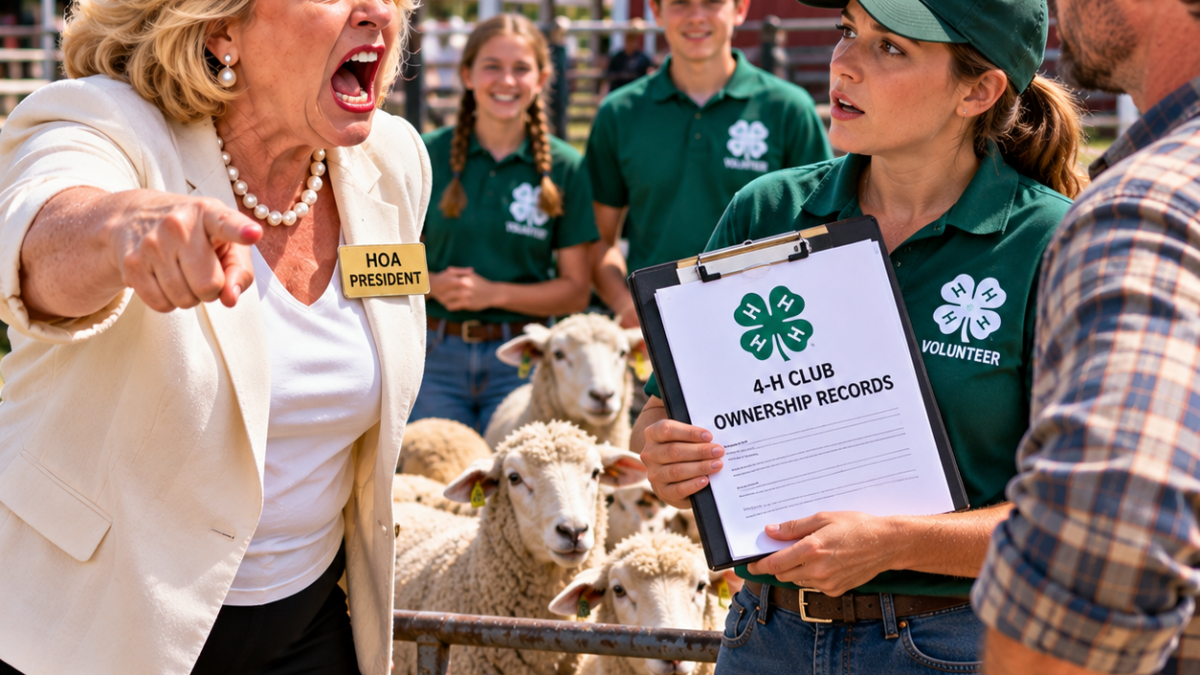
Mrs. Gable held up the 4-H host agreement.
“I am here because my head of community outreach is trying to seize sheep belonging to a child’s 4-H project.”
The street went silent.
Mrs. Gable’s voice shook, not with fear, but fury.
“Is this your signature, Karen?”
Karen stared at the paper.
There it was.
Her name.
Her approval.
Her own hand authorizing the host site.
“You signed this,” Mrs. Gable continued. “You personally approved the Thompson property as the official host location for Lily’s sheep project. You told me you were thrilled to see new families participating. Was that a lie?”
Karen opened her mouth.
Nothing came out.
The removal driver backed away from his own ramp.
“I’m leaving,” he said. “I don’t know what this is, but I’m not catching a felony over sheep.”
He raised the ramp faster than he had lowered it, climbed into the cab, and drove away.
Karen stood alone.
No truck.
No authority.
No control.
Then Ben Carter arrived.
He stepped from a black sedan in a gray suit, briefcase in hand, calm as a judge’s signature.
He walked directly to Karen.
“Karen Miller?”
She looked at him like she had forgotten how names worked.
“You’ve been served.”
He placed a thick envelope in her hands.
Then he turned to Brenda, who had crept out from her house to watch.
“And this is for the Whispering Pines Estates Homeowners Association.”
Brenda accepted the second envelope like it might explode.
Ben faced the neighbors.
“For the record, we have filed suit against the Whispering Pines Estates HOA for breach of fiduciary duty, selective enforcement, and harassment. We have also named Mrs. Karen Miller personally for tortious interference and intentional infliction of emotional distress arising from a targeted campaign against my client, his family, and his daughter’s registered 4-H project. Today’s attempted seizure will be added as a primary exhibit.”
Nobody spoke.
Karen looked down at the envelope.
Then at Mrs. Gable.
Then at me.
I stood on my porch, coffee in hand, saying nothing.
Because the record was speaking for me.
Chapter Nine: The Story Breaks Open
The local news found the story irresistible.
An HOA president tried to seize a little girl’s 4-H sheep.
That same HOA president volunteered for the 4-H club.
That same volunteer had signed the paperwork approving the sheep project.
The facts were almost too perfect.
Ben never admitted he tipped off the reporter.
He also never denied it.
That evening, the headline ran across the local station:
HOA PRESIDENT SUED AFTER ATTEMPT TO SEIZE CHILD’S 4-H SHEEP.
The segment showed my fence, Agnes and Bertha grazing, Lily brushing Agnes with her face blurred for privacy, and Mrs. Gable standing outside the 4-H meeting hall looking furious in the dignified way only longtime volunteers can manage.
“She signed the project host agreement herself,” Mrs. Gable told the reporter. “These children work hard. They learn responsibility, care, discipline, and community values. To threaten a child’s animals over a private HOA dispute is unacceptable.”
Frank Evans from zoning appeared next.
“The property is zoned agricultural. The activity was lawful.”
Then came a shot of Karen’s house.
She did not comment.
That was probably the smartest decision she had made in months.
Inside Whispering Pines, the story detonated.
People who had been silent suddenly started talking.
The community Facebook group filled with posts.
She tried to take a child’s sheep?
Is this why my appeal was denied?
How much have we paid in legal fees for Karen’s vendettas?
Can the HOA be sued?
What other fines were improper?
George and the Rodriguezes moved quickly. Using the bylaws we had studied, they gathered signatures for an emergency meeting. The bylaws required ten percent of homeowners.
They got more than sixty percent in a single afternoon.
Fear had changed into anger.
Anger organized.
The emergency meeting was scheduled for the following week.
Karen did not attend.
That alone told everyone she was finished.
Barry and Brenda sat at the front table, pale and stiff, looking less like board members and more like witnesses waiting outside a courtroom.
The clubhouse was packed. Over a hundred residents filled the room, standing along walls and spilling into the hallway.
George stood first.
He did not rant.
That would have weakened him.
He simply opened his folder and read the record.
Selective enforcement.
Improper fines.
Denied appeals.
Karen’s threats against my property.
The attempted sheep seizure.
The 4-H signature.
The lawsuit.
Carlos spoke next.
Then Maria.
Then residents began standing one after another.
The gnome.
The basketball hoop.
The front door.
The wind chimes.
The playset.
The ramp.
The holiday decorations.
The garden bench.
The stories were small individually, but together they became overwhelming.
That was the moment Whispering Pines stopped being a neighborhood under Karen’s shadow and became a community telling the truth.
Barry resigned first.
His voice shook.
“I did not understand the full legal implications of the enforcement actions taken.”
George said, “You voted for them.”
Barry looked down.
“Yes.”
Brenda resigned next, crying quietly.
No one comforted her much.
An interim board was elected that night.
George became president, despite trying to nominate anyone else.
Maria Rodriguez joined the board.
So did a fair-minded neighbor named Ellen Price, who had spent years avoiding HOA politics but finally decided avoidance had become complicity.
Their first motion rescinded every fine issued under Karen’s selective aesthetic enforcement from the previous two years pending review.
Their second motion terminated the relationship with Prestige Community Management.
Their third motion suspended all enforcement actions until the bylaws could be audited.
The room applauded after each one.
Not wildly.
Relieved.
There is a difference.
Chapter Ten: Karen’s Bill Comes Due
The lawsuit moved faster than I expected.
Ben said that was because the HOA’s insurance carrier looked at the facts and decided trial would be financial suicide.
Karen’s signature on the 4-H host agreement became the centerpiece.
Not legally the only issue, but emotionally unstoppable.
A jury might debate covenant language.
A jury would not like a grown woman threatening to seize a child’s sheep after signing the paperwork approving them.
The HOA settled.
Legal fees covered.
Damages paid.
Unauthorized fines voided.
Written apology issued.
Permanent acknowledgment of my agricultural rights recorded in the HOA files.
Karen personally contributed to the settlement because her conduct was deemed willful and outside ordinary board protection.
That mattered.
People like Karen often hurt others with community money. This time, she had to write a check herself.
I did not keep the settlement money beyond covering costs.
The remainder went to the Veterans Community Project and to the Northwood County 4-H scholarship fund.
When I told Lily, she smiled.
“So other kids can do projects?”
“Yes.”
“With sheep?”
“If they want.”
She looked toward the pasture.
“Agnes and Bertha are heroes.”
“I wouldn’t tell them that. Bertha already has an ego.”
Lily giggled.
That laugh was worth more than the settlement.
Karen’s house went up for sale a month later.
A white sign in the front yard.
Perfectly centered.
Perfectly tragic.
She did not come to the next HOA meeting. She did not attend the 4-H banquet. She resigned from all volunteer roles through an email that used phrases like “personal reasons” and “unfair hostility.”
Mrs. Gable read it once, deleted it, and moved on with the efficiency of a woman who had no time for nonsense during fair season.
We never saw Karen again.
A new family moved into her house months later. Young couple. Two kids. The first thing they did was put a wooden swing set in the backyard.
Nobody sent a violation notice.
George restored his gnome.
He placed it proudly in the mulch by his front walk. The gnome had a fresh coat of paint and a tiny fishing pole. George told anyone who asked that it was now a monument to constitutional order.
Carlos’s son left his basketball hoop in the driveway overnight.
No fine.
The blue front door stayed blue.
The ramp stayed untouched.
The wind chimes rang.
Whispering Pines did not fall apart.
Property values did not collapse.
Civilization survived the presence of color, play, memory, accessibility, and two sheep nearby.
Imagine that.
Chapter Eleven: The County Fair
The county fair came in October.
For Lily, it was the biggest day of the year.
She had worked hard through heat, stress, and fear. She had fed Agnes and Bertha before school. She had learned to lead them properly, groom them, keep records, answer questions, and stand in a show ring without looking at me every five seconds for reassurance.
The morning of the fair, she was nervous enough to forget breakfast.
Sarah packed extra snacks.
I loaded supplies.
Agnes resisted the trailer for seven dramatic minutes, then walked in as if the entire conflict had been my fault. Bertha followed because Bertha believed all roads led to food.
At the fairgrounds, Lily changed.
Not all at once.
But I saw it happen.
She stood straighter. She checked her notes. She brushed Agnes carefully. She answered a judge’s question about feed ratios. She explained hoof care. She talked about responsibility, consistency, and how animals notice when you are upset.
When the judge asked what the hardest part of her project had been, Lily paused.
My stomach tightened.
She looked toward me, then back at the judge.
“The hardest part was being scared someone might take them away,” she said. “But I learned that if you do the work and keep good records, people can help protect what’s right.”
The judge looked at her for a long moment.
Then he smiled gently.
“That is a very important lesson.”
Lily won a blue ribbon for her sheep project.
When they handed it to her, Sarah cried.
I did not.
Not officially.
George, who had come to the fair wearing a hat that made him look like a retired cowboy accountant, clapped loudly.
Mrs. Gable hugged Lily.
“You earned this,” she said.
Lily held the ribbon like it was made of gold.
On the way home, she fell asleep in the back seat, the ribbon still in her hand.
Sarah looked at me from the passenger seat.
“She needed this.”
“Yes.”
“So did you.”
I kept my eyes on the road.
“Yes.”
For all the legal satisfaction, all the public vindication, all the strategic success, that quiet drive home was when I finally felt the fight leave my shoulders.
Karen had tried to make Lily feel small.
The fair gave her back something bigger.
Confidence.
Chapter Twelve: What the Sheep Changed
By spring, Whispering Pines looked different.
Not dramatically.
No one painted every house purple or turned the clubhouse into a barn.
But the air changed.
People talked at mailboxes.
Kids left bikes in driveways without parents sprinting to hide them before Karen’s imaginary inspection rounds.
The HOA rewrote its enforcement procedures. Fines required documentation. Appeals were real. Selective enforcement complaints had to be reviewed. Management contracts were transparent. Board members had to disclose conflicts. No single president could issue threats like royal decrees.
George hated meetings but ran them fairly.
Maria Rodriguez was organized enough to terrify vendors.
Ellen Price insisted every resident receive plain-English summaries instead of dense legal fog.
Together, they made the HOA boring.
That was the highest compliment I could give them.
A good HOA should be boring.
Road maintenance.
Insurance.
Shared landscaping.
Pool schedule.
Drainage.
Not personality cults.
Not vendettas.
Not sheep wars.
Neighbors began treating us normally. Some apologized. Some did not. I learned to accept both. Shame is complicated. Not everyone knows what to do with it.
Bob from the next street—one of Karen’s old quiet supporters—came by one day with a bag of feed treats for Agnes and Bertha.
“I owe your daughter an apology,” he said.
Lily looked at me.
I nodded.
Bob took off his cap.
“I believed things I shouldn’t have. I thought rules were rules. I didn’t ask whether they were being used fairly. I’m sorry.”
Lily studied him with the serious expression of a child deciding whether adults deserve mercy.
Then she said, “You can give Bertha one treat, but watch your fingers.”
Bob laughed nervously.
Bertha nearly took half his glove.
Peace sometimes begins that way.
Not with speeches.
With a sheep almost eating a grown man’s hand while a child forgives him.
Epilogue: The Line at the Fence
People still ask me if I enjoyed watching Karen fall.
The honest answer is yes.
Part of me did.
I enjoyed seeing the impound truck drive away.
I enjoyed watching Karen stare at her own signature like it had betrayed her.
I enjoyed seeing her finally understand that a clipboard is not a crown.
But that is not the part I remember most.
What I remember most is Lily on the porch asking if Karen could take her sheep.
That fear is what made the fight matter.
Agnes and Bertha were never just livestock.
They were responsibility.
They were stability.
They were proof that my daughter finally had something rooted in one place.
Karen saw them as a violation because she could not imagine a world where children’s growth mattered more than her aesthetic control.
She tried to use rules to crush something good.
So we used better rules to stop her.
Real rules.
County zoning.
Property rights.
4-H documentation.
Due process.
Public accountability.
Evidence.
Truth.
The funny thing is, Whispering Pines did not become worse after Karen left.
It became better.
The lawns still looked nice.
The houses still stood.
The sidewalks did not crumble because a gnome returned to a flower bed.
Property values did not collapse because a blue door stayed blue.
The neighborhood survived two sheep, a basketball hoop, a swing set, wind chimes, and basic human decency.
As for us, our little farm stayed exactly what it was meant to be.
A home.
A place where Sarah’s garden grew beside the fence.
A place where Lily learned that courage can be quiet and paperwork can be powerful.
A place where Agnes and Bertha grazed in peace, entirely unaware they had helped bring down the most feared woman in Whispering Pines.
Sometimes, in the evening, I stand at that split-rail fence and watch the sheep chew grass under the oaks.
The world is calm then.
No golf cart.
No clipboard.
No threats.
Just the soft sound of animals, the smell of cut grass, and my daughter laughing somewhere near the barn.
Karen once stood at that fence and gave me forty-eight hours.
She thought that was the beginning of my surrender.
It was actually the beginning of the end of her reign.
Because she forgot something simple.
A fence does not only keep animals in.
Sometimes it marks the line where a bully finally learns she has gone too far.
THE END