PART 2: HOA Karen Tried to Drive Me Off My Farm—Then My Prize Cattle Started Collapsing One by One
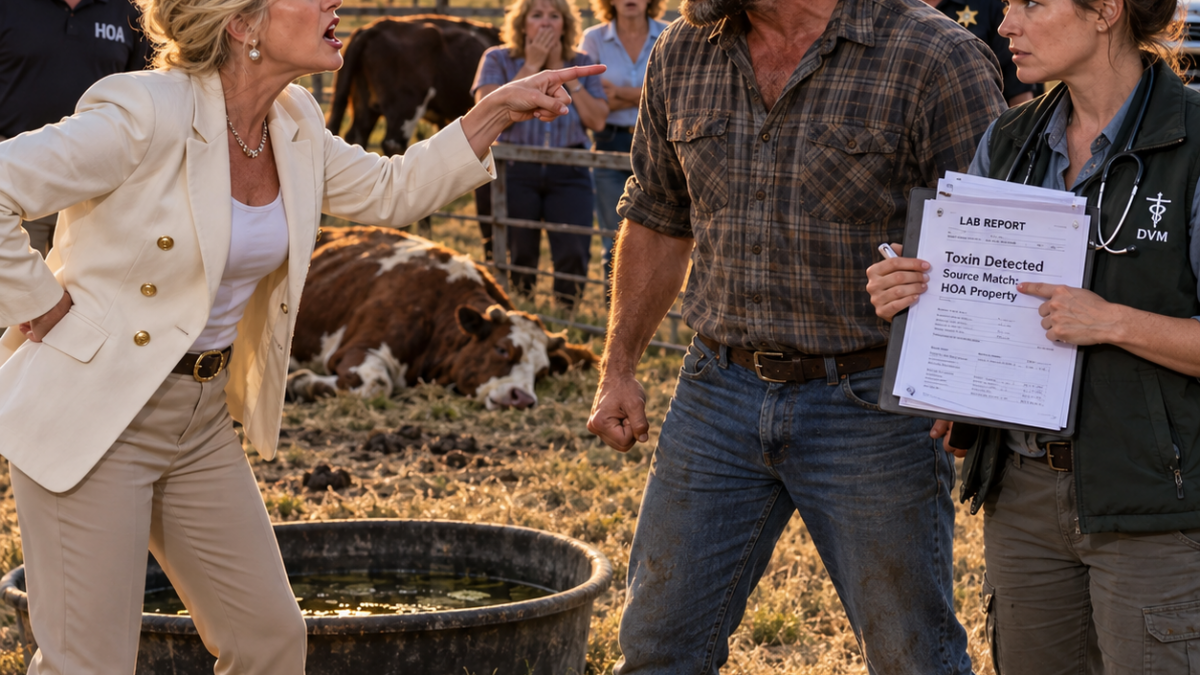
PART 2
Six months earlier, Whispering Creek had seemed harmless.
Annoying, maybe.
Overplanned.
Too clean.
But harmless.
I had bought my ten acres because I wanted distance from exactly that kind of life.
For twenty years, almost every part of my existence had been scheduled by someone else.
Wake-up times.
Convoys.
Briefings.
Flights.
Meals.
Training cycles.
Deployments.
I spent years falling asleep to generators, helicopters, radios, trucks, voices behind thin walls, and the strange constant awareness that you were never completely off duty.
When I retired, I didn’t want a luxury house.
I wanted land.
A farmhouse.
A barn.
Animals.
Quiet.
The ten acres on County Route 18 checked every box.
Rolling pasture.
An old red barn.
Two fenced paddocks.
A creek at the western edge.
Oak trees.
And enough distance from town that nighttime actually became dark.
The only problem was the eastern property line.
Whispering Creek Estates.
The subdivision had been built around my parcel because the previous farmer refused to sell.
Technically, my property was not part of the HOA.
I did not vote in its elections.
I did not pay normal HOA assessments.
But during development, the county had approved a zoning variance containing a vague provision that gave the HOA limited aesthetic review over properties directly bordering the development.
The intent was obvious.
If I stacked junk cars along the subdivision boundary or put up a fifty-foot flashing billboard, residents had some recourse.
Karen interpreted it differently.
To Karen, “limited aesthetic review” apparently meant monarchy.
Our first conflict involved wildflowers.
I had intentionally left a two-foot strip along the eastern fence line unmowed.
Black-eyed Susans.
Blue flax.
Milkweed.
Native grass.
Good for pollinators.
Good for soil.
Pretty, in my opinion.
Karen disagreed.
The first letter arrived on expensive cream stationery.
WHISPERING CREEK HOMEOWNERS ASSOCIATION.
NOTICE OF EXTERIOR NONCOMPLIANCE.
My “unmanaged vegetation” exceeded four inches.
Fine:
$100.
I laughed.
Actually laughed.
Then wrote a polite reply explaining that my land was a registered agricultural parcel and the flowers were part of a managed native buffer.
I cited county code.
Attached photographs.
Thanked the board for its concern.
I assumed that would end it.
Two weeks later:
Second notice.
Original fine increased to $250.
New violation.
The barn.
My barn was red.
Classic farm red.
Weathered white trim.
Tin roof.
Karen included a color chart.
Five approved shades.
Every one beige.
Sandstone.
Desert cream.
Warm linen.
Mushroom taupe.
Heritage almond.
I stared at the swatches.
Then at my red barn.
The notice gave me thirty days to repaint.
Fine if I refused:
$500.
Daily penalty afterward:
$25.
That was when I realized I wasn’t dealing with misunderstanding.
I was dealing with obsession.
I sent a stronger letter.
Three pages.
County agricultural protections.
State right-to-farm statute.
Recorded parcel status.
Survey.
Zoning.
Limits of the aesthetic-review clause.
I sent it not only to Karen, but every HOA board member and the management company.
Karen’s response came seven days later.
Not a letter.
A tow truck.
I was in the barn when I heard diesel outside.
By the time I reached the gravel pad, the driver had already backed toward my stock trailer.
“What are you doing?”
He held up paperwork.
“HOA tow authorization.”
“That trailer is on my property.”
“Sir, I just have a work order.”
I read it.
Commercial agricultural vehicle visible from community roadway.
Removal authorized.
“This is private property.”
He shrugged.
“You need to talk to the HOA.”
“You need to leave.”
He hesitated.
Then Karen’s white SUV appeared at the edge of my driveway.
She stepped out holding her clipboard.
“Mr. Bennett.”
My name was Garrison.
She knew that.
The wrong name was deliberate.
“You were given repeated opportunities to comply.”
“You sent a tow truck onto private farmland.”
“The trailer is visible from Whispering Creek.”
“So is the barn.”
“Exactly.”
I stared at her.
“You are not taking that trailer.”
She smiled.
“The driver has authorization.”
“From someone who doesn’t own the property.”
Her smile vanished.
“You are bordering an HOA-controlled community.”
“That doesn’t make my farm yours.”
“We have oversight.”
“Limited oversight.”
“Our legal counsel disagrees.”
“Then let your legal counsel come tow it.”
The driver looked increasingly uncomfortable.
Karen snapped:
“Proceed.”
He did.
I could have physically blocked him.
I didn’t.
Instead I photographed everything.
License plates.
Truck number.
Time.
Karen.
Location.
Trailer.
Boundary stakes.
Then I called the sheriff.
Deputy arrived.
Looked at Karen’s documents.
Looked at mine.
Used the sentence every property owner hates.
“This sounds civil.”
The trailer disappeared.
It cost me $300 in towing and storage.
Karen added another $200 violation.
That night, I stopped writing angry drafts.
I began building a case.
I bought a scanner.
Fireproof document boxes.
External hard drives.
Every letter scanned.
Every envelope.
Certified-mail receipt.
Fine.
Photograph.
Date.
Statement.
I made a spreadsheet.
Sarah—my sister, who visited every few weeks—walked into my dining room one Saturday and stared at the folders covering the table.
“What happened to eating here?”
“Karen.”
“Of course.”
She picked up a binder.
“You labeled this one ‘Harassment Timeline.’”
“Yes.”
“You need hobbies.”
“I have cattle.”
“Healthy people have hobbies that don’t generate affidavits.”
She wasn’t wrong.
But the documentation began revealing a pattern.
At monthly HOA meetings, I started sitting in the back.
I didn’t speak.
I watched.
Karen ruled with irritation.
People asked about broken sprinklers.
She dismissed them.
Streetlight outage.
Tabled.
Drainage problem.
Not budgeted.
Then she spent twenty minutes discussing mailbox conformity.
Residents complained about fines.
Karen interrupted.
“The board’s interpretation is final.”
That sentence appeared constantly.
One elderly man named George Whitaker caught my attention.
He lived three houses from Karen.
Retired woodworker.
Quiet.
Good hands.
He had a beautiful cedar bench outside his front door.
Hand-carved back.
Curved arms.
I passed one Saturday and found him tearing it apart with a pry bar.
“What are you doing?”
He looked embarrassed.
“Getting rid of it.”
“Why?”
“Karen.”
He handed me the violation letter.
Exterior furniture had to come from an approved vendor.
His handmade bench did not.
Fine threatened:
$1,000.
“This bench is nicer than anything in the catalog.”
“I know.”
“Why not fight it?”
He looked toward Karen’s house.
“I’m tired.”
That word again.
Tired.
We moved the bench pieces into his garage.
Then drank coffee.
George finally told me the rest.
Karen had asked him to donate the bench to the community garden.
He declined.
One month later, the exterior-furnishings rule appeared.
Targeted.
Vindictive.
He showed me emails.
I asked permission to copy them.
He hesitated.
“What are you doing?”
“Building a record.”
“Against Karen?”
“Against abuse.”
He stared at me.
Then nodded.
“Copy everything.”
George became the first neighbor willing to put his name behind evidence.
Others followed.
Young couple with a blue swing set.
Fine:
$2,000.
Single mother working night shifts.
Fined because trash cans went out the evening before pickup rather than the approved morning.
Retired teacher threatened over a basketball hoop.
Family with medical debt hit with landscaping penalties.
People had stories.
I collected them.
Slowly, residents stopped feeling isolated.
Then I found the landscaping contract.
Lush Green Lawns LLC.
Five-year exclusive agreement.
Thirty percent above the previous contractor.
Pushed through under Karen’s presidency.
I went to county business records.
Owner:
Robert Miller.
Karen’s husband.
I checked property records.
Same address.
Same Robert.
I sat back.
That was different.
Petty fines were one thing.
Steering community contracts toward your spouse at inflated rates was another.
I needed proof the board knew.
Meeting minutes showed Karen presented Lush Green as an independent premium provider.
No disclosure of family ownership appeared.
The contract bore her signature.
So I requested an agenda slot at the next HOA meeting.
Topic:
Vendor Contract Transparency and Financial Audit Proposal.
Boring.
Impossible to reject without drawing attention.
Karen approved five minutes.
I prepared like a mission brief.
Slide one:
HOA mission statement.
Harmony.
Community.
Property values.
Slide two:
Fine revenue.
Year before Karen:
small.
First year under Karen:
huge.
Second year:
nearly nine times higher.
Slide three:
map of violations.
Concentrated around people who had challenged Karen.
Then anonymous stories.
Bench.
Swing.
Trash cans.
Finally:
Lush Green Lawns LLC business filing beside the HOA contract.
ROBERT MILLER.
KAREN MILLER.
Same address.
Same family.
The clubhouse was packed.
Word had traveled.
Karen sat at the front with her gavel.
“All right,” she said. “Next we have Mr. Garrison with a proposal concerning finances. Five minutes.”
I plugged in.
“Good evening.”
The mission statement appeared.
“We hear a lot about community.”
I clicked.
Fine chart.
“But in the past twenty-four months, this community has collected nearly nine times more in fines than it did before the current administration.”
Murmurs.
Karen’s eyes lifted.
Click.
Violation map.
“Those fines do not appear random.”
I pointed.
“They cluster around residents who challenged enforcement decisions, requested records, or publicly disagreed with leadership.”
Karen interrupted.
“This is defamatory.”
“I’m presenting HOA records.”
“You have two minutes.”
I continued.
Stories.
The bench.
George stood.
“That one is mine.”
People turned.
Karen’s face hardened.
Then the swing.
The young couple raised their hands.
The nurse.
She stood too.
One by one, anonymous stories gained faces.
The room shifted.
Fear becomes fragile when people realize it is shared.
Then I asked:
“Where is the money going?”
Karen grabbed the gavel.
“Your time is up.”
I clicked the final slide.
Lush Green Lawns.
Contract.
Business registration.
Robert Miller.
Karen froze.
I pointed.
“Our HOA awarded a five-year landscaping contract at roughly thirty percent above prior market cost to a company owned by President Miller’s husband.”
Silence.
Then noise.
“Is that true?”
“What?”
“Did you disclose this?”
Karen stood.
“This is a malicious personal attack.”
George shouted:
“Answer him!”
More voices.
Karen slammed the gavel.
“Meeting adjourned!”
Nobody moved.
A woman near the front yelled:
“Recall!”
Then someone else.
“Recall!”
Within seconds:
“Recall! Recall! Recall!”
Karen stood behind the table, face red, eyes wide.
The authority disappeared in real time.
Two days later, the recall petition had enough signatures to force a vote.
Then Karen began fighting for survival.
Cease-and-desist letters.
Defamation threats.
Claims we had forged signatures.
Claims the petition was invalid.
An emergency board meeting announced with less than twenty-four hours notice.
My attorney stopped that.
The management company, suddenly terrified of liability, advised the board in writing not to proceed.
One frightened board member leaked Karen’s email response.
WE NEED TO CRUSH THIS INSURRECTION NOW.
The phrase spread through the neighborhood.
Two board members resigned.
Karen was becoming isolated.
That was when the vandalism started.
My fence was cut.
Clean cut.
Not weather.
Not cattle.
Wire cutters.
Two steers wandered out.
I spent three hours recovering them.
Police report.
Photographs.
Camera installed.
One week later, the stock-water valve was closed at the main connection.
Nobody accidentally walks half a mile off the road and closes a livestock water line.
Another report.
More cameras.
I suspected Robert’s landscaping crew.
Couldn’t prove it.
So I watched.
Karen’s SUV sometimes slowed near my farm.
She never stopped.
I started checking locks twice.
The quiet I had bought the land for disappeared.
At night, I listened.
Truck?
Wind?
Gate?
Nothing.
Then the morning came when Bessie stood with her head down.
Back in the barn, Dr. Cole worked for hours.
The young steer responded slightly to treatment.
Martha stabilized.
Bessie worsened.
Her muscles began contracting.
She couldn’t stand.
Dr. Cole looked at me.
“We may have to make a decision.”
“No.”
“Jack.”
“Give her time.”
“I will.”
Another hour.
Bessie deteriorated.
I knelt beside her.
She knew my voice.
I’m certain of that.
Maybe people who don’t work with cattle won’t understand.
That’s okay.
Animals know routines.
Sounds.
Hands.
Safety.
I placed my palm against her forehead.
“Easy, girl.”
Dr. Cole stood behind me.
“We’re hurting her by continuing.”
I closed my eyes.
“How sure?”
“Very.”
I nodded.
Bessie died with my hand against her head.
There are moments when anger becomes too large for shouting.
I felt empty.
Dr. Cole removed his gloves slowly.
“I’m sorry.”
I looked toward the feed shed.
“Write everything.”
“What?”
“Diagnosis. Symptoms. Samples. Treatment. Everything.”
He nodded.
“I already am.”
“Chain of custody?”
He looked at me differently.
“Yes.”
“You think this might go criminal.”
“I know it might.”
I went home.
Didn’t cross the road.
Didn’t confront Karen.
That earlier impulse was gone.
Dr. Cole had stopped me from making a mistake.
Instead, I put on gloves.
Collected feed.
Sample from trough.
Sample from bag.
Water.
Minerals.
Sealed.
Labeled.
Photographed.
Then I opened the security footage.
Hours.
Wind.
Raccoon.
Fox.
Tree branches.
At 2:17 a.m., motion alert.
A person emerged from the eastern tree line.
Dark jacket.
Hood.
Gloves.
They stayed outside the main barn light.
Smart.
They approached the feed shed.
Tried the padlock.
Failed.
Kicked the door.
Then paced.
The figure moved toward the corral trough.
For three seconds, light from a distant porch reflected off my aluminum trailer and illuminated the person’s side profile.
Heavy build.
Short stride.
Distinct forward lean.
I paused.
Zoomed.
Watched again.
Karen.
My pulse changed.
The footage wasn’t perfect facial identification.
But there was more.
She pulled a small container from her jacket.
Opened it.
Dumped material into the trough.
Stirred it with a stick.
Then left.
I watched the clip twelve times.
Sarah called while I was making copies.
“How are the cows?”
I couldn’t answer immediately.
“Jack?”
“Bessie’s gone.”
Silence.
“Oh, no.”
I swallowed.
“She didn’t make it.”
“I’m sorry.”
Then:
“Do you know what happened?”
“Yes.”
“What?”
I looked at Karen frozen on my monitor.
“I have video.”
Sarah’s voice changed.
“Of who?”
“Karen.”
“Call the sheriff.”
“I am.”
Detective Walter Miller handled agricultural crimes for the county.
No relation to Karen.
He was fifty-eight.
Gray mustache.
Old-school notebook.
A reputation for hating animal cruelty.
We met at my farm, not a diner.
He inspected everything.
I gave him the harassment file first.
He flipped through it.
“Most of this is civil.”
“I know.”
“Landscaping contract might interest the DA.”
“I know.”
“Why are you showing me?”
“Motive.”
Then I gave him the video.
He watched.
Once.
Again.
Zoomed.
“She’s identifiable?”
“I believe so.”
“Clothing?”
“Similar jacket appears in neighborhood footage.”
“Vehicle?”
“No vehicle visible.”
“Any camera on eastern access?”
“One.”
We checked.
At 2:08 a.m., Karen’s white SUV passed the county road camera from a neighbor’s system.
At 2:32, it passed back.
Better.
Dr. Cole provided his statement.
Lab testing began.
Then Detective Miller told me:
“Do not confront her.”
“I won’t.”
“Do not post.”
“I won’t.”
“Do not tell the recall group.”
I hated that.
But agreed.
For five days, I attended recall planning meetings while knowing a criminal case was forming.
George talked about ballots.
The nurse organized volunteers.
People debated procedure.
I sat there thinking about Bessie.
Karen still posted in the HOA group.
False accusations.
Claims of political persecution.
She wrote:
Certain individuals will stop at nothing to seize control of this community.
I stared at the sentence.
Then closed my laptop.
Martha improved.
The steer survived.
Both lost weight.
Both would need months.
Bessie was buried beyond the western pasture under an oak.
I built a simple marker.
BESSIE
GOOD COW.
Sarah read it.
“That’s all?”
“She was.”
“It’s perfect.”
The lab confirmed deliberate contamination.
A toxic herbicide formulation used by Lush Green Lawns.
That connection mattered.
Detective Miller subpoenaed purchase records.
Robert’s company had bought the chemical.
Inventory records didn’t reconcile.
Then one landscaping employee talked.
Robert had instructed him to leave a container in Karen’s garage.
“Pest-control use.”
The employee thought nothing of it.
Search warrant.
Thursday.
5:00 p.m.
Detective Miller called.
“We’re moving.”
At 4:45, I sat on my porch.
George had rebuilt his cedar bench after the recall movement began.
He gave me a smaller matching chair.
That was what I sat in.
No beer.
No celebration.
Just coffee I forgot to drink.
At 5:02, two sheriff’s SUVs turned into Whispering Creek.
No sirens.
They stopped at Karen’s house.
Detective Miller approached with two deputies.
Knocked.
Karen opened.
Even from my porch, I saw her posture change when he showed the warrant.
She tried to close the door.
They stopped it.
Then disappeared inside.
Neighbors emerged.
A dog walker stopped.
Curtains moved.
Fifteen minutes later, deputies carried out chemical containers.
Documents.
A laptop.
Then Karen came out.
She was shouting.
I couldn’t hear every word.
I heard:
illegal.
lawsuit.
president.
rights.
Then the cuffs went on.
Karen looked across the road.
Saw me.
She screamed my name.
Not like a greeting.
Like an accusation.
I didn’t smile.
Didn’t wave.
Didn’t stand.
I nodded once.
That was all.
Robert was detained later that evening.
The story spread instantly.
HOA PRESIDENT ARRESTED IN LIVESTOCK POISONING INVESTIGATION.
Local reporters appeared.
I declined interviews.
Bessie was dead.
I didn’t feel like turning her death into television.
George handled community statements.
His first was simple.
“This is no longer an internal HOA dispute. We trust law enforcement and will proceed with the recall process according to our bylaws.”
He sounded more presidential than Karen ever had.
The recall vote happened anyway.
Karen lost by an overwhelming margin.
She was removed.
Remaining board members resigned.
Emergency election.
George became president.
First meeting under George happened in the park.
Not the beige clubhouse.
Picnic tables.
Sunlight.
Kids running.
He stood on a table.
“I have one motion.”
People laughed.
“Repeal every rule change and fine schedule adopted under the previous administration unless it is specifically reapproved after public review.”
Applause.
Vote:
Unanimous.
Exterior furniture rule?
Gone.
Five-color palette?
Gone.
Wildflower restriction?
Gone.
Trash-can madness?
Gone.
Retroactive fines?
Gone.
George looked toward me.
“And for the record, barns can be red.”
Huge applause.
I hated that I laughed.
The forensic review of HOA finances moved forward.
Lush Green’s contract was terminated.
Records showed overbilling.
Payments for work residents said was never completed.
Related-party relationship undisclosed.
Civil claims followed.
The management company cooperated quickly.
Companies become very transparent when prosecutors start asking questions.
Robert’s role in the poisoning remained less direct than Karen’s, but evidence showed he supplied the chemical and participated in earlier property interference.
The criminal cases narrowed over time.
They always do.
Headlines said one thing.
Plea negotiations produced something more precise.
Karen ultimately pleaded guilty to felony animal cruelty and related property offenses.
Robert entered a separate agreement tied to unlawful conduct and financial matters.
The court ordered restitution.
Vet bills.
Value of Bessie.
Treatment for Martha and the steer.
Damaged fencing.
Legal expenses tied directly to the criminal conduct.
People asked how much Bessie was worth.
That question always bothered me.
Insurance and courts need numbers.
Breeding value.
Market value.
Prize history.
Genetics.
But Bessie was not just a number.
Still, restitution has to speak the language money understands.
Karen received probation, extensive community service, restrictions, and a felony record under the plea arrangement.
Some people thought the sentence was too light.
Others thought losing her home, position, reputation, and future opportunities was enough.
I didn’t spend much time thinking about what was enough.
Nothing brought Bessie back.
Karen and Robert sold their house at a loss.
Moving day came in October.
I was repairing fence.
Their truck passed.
Karen sat passenger.
She looked toward my farm.
I looked back.
No gestures.
No words.
Then she disappeared down the road.
I never saw her again.
Whispering Creek changed.
The blue swing set stayed blue.
George rebuilt his bench.
This time he put it directly in front of his house.
No approval.
He sat there every evening.
The nurse changed her work schedule slightly, but the new HOA also changed trash rules so night-shift workers weren’t punished for having jobs.
The community Facebook group, once full of violations and arguments, became boring.
Lost dog.
Free tomatoes.
Who has a ladder?
Block party Saturday.
That was progress.
My farm changed too.
For months, I could not walk past Bessie’s oak without stopping.
Martha survived.
The steer survived.
They never fully returned to their old condition.
Dr. Cole said stress and toxicity could do that.
I bought a young heifer the next spring.
Red-and-white Hereford.
Strong legs.
Curious.
Sarah came with me.
“What are you naming her?”
“I’m not.”
“You name all of them.”
“I’ll wait.”
The heifer walked over and started chewing on Sarah’s jacket sleeve.
Sarah pushed her away.
“She has personality.”
“That’s one word.”
“Bessie Two?”
“No.”
“Karen?”
I stared.
Sarah laughed so hard she nearly dropped the halter.
Eventually I named her Grace.
Not because I felt graceful.
Because I needed some.
The following spring, wildflowers returned along the fence.
Black-eyed Susans.
Milkweed.
Flax.
Bees.
Butterflies.
Karen’s first target.
I stood there one afternoon while George’s pickup approached.
He parked.
Walked over.
“Looks terrible.”
“Absolutely.”
“Very noncompliant.”
“Tragic.”
We leaned against the fence.
Cattle grazed beyond us.
Grace among them.
George stared across the pasture.
“Quiet.”
“Yes.”
He nodded.
“For a long time I thought what I wanted was revenge.”
I looked at him.
“Against Karen?”
“Yeah.”
“What changed?”
He pointed toward the houses.
“People talk again.”
A neighbor waved from across the road.
George waved back.
“She forced us to become neighbors.”
I thought about that.
Karen spent years dividing residents so they wouldn’t compare notes.
Her biggest mistake had been pushing too many people too far at the same time.
She created the resistance she feared.
“You know what still makes me angry?” I asked.
“What?”
“Your bench.”
He laughed.
“Not Bessie?”
“That hurts.”
I looked toward the oak.
“The bench makes me angry because it shows how long she got away with smaller things.”
George nodded.
“That’s how people like her work.”
“Tiny pieces.”
“Until someone notices the pile.”
Exactly.
A year after Karen left, Whispering Creek held a community picnic.
George insisted I attend.
I hated organized fun.
Sarah made me go.
The park was full.
Children.
Dogs.
Grills.
Music.
Blue swing-set family brought desserts.
The nurse brought potato salad.
George displayed one of his new benches.
Nobody asked whether it came from an approved vendor.
At some point, he climbed onto the picnic table.
I groaned.
“Don’t.”
He had a microphone.
Of course.
“I want to recognize Jack Garrison.”
People applauded.
I looked for escape.
Sarah blocked me.
George continued.
“He’ll tell you he didn’t do this alone.”
Correct.
“He’ll tell you he just documented things.”
Also correct.
“He’ll tell you the law did the rest.”
Mostly.
“But before Jack started asking questions, a lot of us were afraid.”
The park quieted.
“We were afraid of fines.”
“Letters.”
“Liens.”
“Lawyers.”
He looked at his bench.
“Some of us destroyed things we loved because keeping them became too expensive.”
Then toward me.
“Jack reminded us that one person standing alone is easy to pressure.”
He looked around.
“A neighborhood standing together isn’t.”
Applause.
I hated every second.
Mostly because he was right.
Afterward, the nurse approached me.
“You saved my house.”
“No.”
“I was going to sell.”
“I didn’t know.”
“I couldn’t handle another year.”
She looked toward her daughter playing nearby.
“Then people started talking.”
That was the real victory.
Not Karen’s arrest.
Not the recall.
Not restitution.
People talking.
I had bought the farm because I wanted isolation.
Ironically, the fight taught me connection mattered more.
Years passed.
George served two terms as HOA president.
He ran meetings badly.
In the best way.
Agenda.
Budget.
Questions.
Vote.
Done.
If someone started talking about color palettes, George threatened to resign.
Nobody risked it.
I remained outside the HOA.
My farm never became a member.
The ambiguous aesthetic clause was eventually clarified with county approval.
Agricultural activity explicitly protected.
No future Karen could pretend otherwise.
I paid my own road-share obligations.
Nothing more.
Boring.
Perfect.
Dr. Cole became a friend.
Every year on the anniversary of Bessie’s death, he somehow found a reason to stop by.
Vaccines.
Paperwork.
Coffee.
One year, I finally asked:
“You plan this?”
“What?”
“The date.”
He pretended confusion.
“You’re terrible at lying.”
“Veterinarians aren’t trained for espionage.”
We walked to the oak.
Bessie’s marker had weathered.
GOOD COW was still visible.
Ethan looked at it.
“You know, she probably saved the others.”
“How?”
“You noticed her first.”
He nodded toward the herd.
“If Bessie hadn’t shown symptoms where you saw her, you might not have checked the feed quickly.”
I had never thought of that.
Martha lived three more years.
The steer became one of my calmest animals.
Maybe Ethan was right.
Maybe Bessie’s suffering gave me the minutes that saved the others.
I don’t know.
Sometimes meaning is something survivors build afterward.
Grace became a great cow.
Not Bessie.
No animal replaces another.
Different.
Strong.
Gentle.
She had her first calf on a cold April morning.
Sarah helped me towel him dry.
“He’s ugly.”
“All newborn calves are ugly.”
“That’s not true.”
“It is.”
“He looks like his ears were attached by committee.”
I laughed.
The calf stood.
Wobbled.
Fell.
Tried again.
Grace nudged him.
He stood longer.
The sun came over the pasture.
There was something about watching new life in the same field where I had once watched Bessie suffer that broke something open in me.
I turned away.
Sarah saw.
“Jack.”
“I’m fine.”
“You’re crying.”
“Wind.”
“No wind.”
“Dust.”
“Wet grass.”
“Leave me alone.”
She hugged me.
That morning was the first time I felt the farm belonged to peace again rather than evidence.
For a long time, cameras had covered every angle.
Motion alerts.
Locks.
Checks.
I gradually removed some.
Kept enough for ordinary security.
Stopped patrolling at midnight.
Stopped waking at every engine.
Safety returned slowly.
That is something people don’t understand about harassment.
The event ends before the vigilance does.
Karen left.
But for months, part of me still expected the next move.
Another cut fence.
Another valve.
Another shadow.
Eventually, nothing happened long enough that silence became silence again.
Not warning.
Just quiet.
One evening, I sat on the porch.
Freight train in the distance.
Cattle moving through grass.
Crickets.
No subdivision drama.
No sirens.
No legal email.
I remembered why I bought the place.
Peace.
But it wasn’t the same peace I expected.
I once thought peace meant no one needing me.
No conflict.
No neighbors.
Land as a wall.
Instead, the peace I earned involved George stopping by without calling.
The nurse bringing extra tomatoes.
Children visiting calves.
HOA residents buying hay from me.
People checking fences during storms.
Community.
Karen had tried to force uniformity.
What replaced her was cooperation.
Big difference.
Years later, somebody new moved into Karen’s old house.
Young couple.
Two kids.
They knew nothing about her.
One afternoon their daughter’s soccer ball came over my fence.
The father walked to the gate.
“Mr. Garrison?”
“Jack.”
“My daughter kicked a ball over.”
“Go get it.”
He hesitated.
“You sure?”
“Yes.”
He entered.
Retrieved it.
Then noticed the wildflowers.
“These are beautiful.”
I laughed.
“What?”
“Long story.”
They eventually became good neighbors.
Their lawn was not chemically perfect.
Their kids left bicycles outside.
One year they planted sunflowers.
Karen would have hated them.
I loved them.
A decade after the whole nightmare, George died.
Heart failure.
Eighty-four.
His daughter asked me to speak at the memorial.
I said no.
She ignored me.
I stood in the community park beside one of George’s benches.
The original bench he had dismantled years earlier had eventually been rebuilt.
People sat on it throughout the service.
When it was my turn, I looked at the crowd.
“I met George because Karen made him tear apart a bench.”
Laughter through tears.
“He was tired.”
I paused.
“So was everyone.”
I looked at the bench.
“But he put it back together.”
That became my entire speech.
“Turns out that was what he did for the neighborhood too.”
I stepped down.
Afterward, George’s daughter gave me his old crowbar.
“The one he used on the bench.”
I laughed.
“Why would I want this?”
“He said you’d understand.”
I did.
It hangs in my barn now.
Not because I need a crowbar.
Because it reminds me how damage and repair can use the same hands.
I’m older.
Farm is still mine.
Red barn still red.
Wildflowers taller than four inches.
Grace is gone now too.
That’s farming.
Animals arrive.
They become part of your days.
Then eventually they leave them.
Bessie’s oak is bigger.
Her marker almost unreadable.
I could replace it.
I haven’t.
GOOD COW is enough.
People still occasionally find the old news story online.
They ask:
“Did your vet really trace the poison to the HOA president?”
The answer is more complicated.
Ethan identified deliberate poisoning.
The lab identified the chemical.
Cameras identified Karen.
Purchase records connected the chemical to her husband’s landscaping company.
Investigators built the chain.
That matters.
Because justice wasn’t one magical clue.
It was evidence connecting.
One piece at a time.
Exactly the way Karen’s abuse had been exposed.
One fine.
One letter.
One contract.
One witness.
One video.
One lab result.
People ask:
“Were you happy when she was arrested?”
No.
Relieved.
There is a difference.
Bessie was dead.
Karen in handcuffs didn’t change that.
But knowing she couldn’t come back the next night with another container mattered.
Knowing neighbors no longer had to fear her mattered.
Knowing she couldn’t hide behind HOA authority mattered.
People ask:
“Was losing everything enough punishment?”
I don’t know.
That is not my job.
Courts punish.
Farmers keep working.
That distinction helped me move on.
The day after Karen’s arrest, the cattle still needed water.
Fence still needed repair.
Hay still needed moving.
Life refuses to become a movie ending.
It continues.
That saved me.
Work gave anger somewhere to go.
Fence post.
Gate hinge.
Veterinary schedule.
Pasture rotation.
Hay cutting.
Eventually the Karen file moved from my dining room to a storage box.
Then from the storage box to the attic.
I kept it.
Not because I expected another fight.
Because history matters.
Sarah jokes that if anyone opens the attic after I die, they’ll think I spent retirement hunting an international crime syndicate.
“Six binders?”
“She generated paperwork.”
“You made color-coded indexes.”
“That was efficiency.”
“You laminated the timeline.”
“Durability.”
She shakes her head.
Some things don’t change.
The HOA changed its name after George died.
Whispering Creek Community Association.
No enforcement authority over neighboring agricultural parcels.
Residents voted to simplify covenants.
A new clause requires disclosure of every related-party contract.
Another requires independent review before liens.
Recall procedures were simplified.
Meeting minutes published.
Rules must receive notice and homeowner vote.
All because people learned what happens when power accumulates without friction.
The blue swing set faded.
Years in the sun.
Still blue.
Nobody cared.
The nurse’s daughter became a nurse too.
The couple with the swing set moved eventually.
Before leaving, they gave the playset to another family.
George’s bench stayed.
Wildflowers spread slightly beyond my planned buffer.
I let them.
Bees don’t understand property lines.
Karen would have hated that too.
One summer evening, I stood at Bessie’s oak with Sarah.
Sunset behind the barn.
Cattle grazing.
Sarah touched the old marker.
“Do you ever wish you hadn’t bought this place?”
“No.”
“Not even then?”
I thought.
“There were days.”
“Why not now?”
I looked toward Whispering Creek.
Houses.
Trees.
Kids.
Then pasture.
“Because she didn’t get it.”
“What?”
“The thing she wanted.”
Sarah waited.
“She wanted me gone.”
That had been the real pressure behind everything.
Make the farm expensive.
Make it exhausting.
Make me repaint.
Make me remove equipment.
Make me question whether living beside the subdivision was worth it.
Maybe eventually I sell.
Developer gets land.
HOA gets visual control.
Karen gets victory.
Instead, the farm remained.
That was enough.
I replaced part of the red barn siding one year.
Bought fresh boards.
Sarah asked:
“What color?”
I stared at her.
She grinned.
“Heritage almond?”
I almost threw the paint brush at her.
The barn became red again.
Bright at first.
Weathered eventually.
Exactly as it should.
That same year, a group of neighborhood children visited during calving season.
One asked:
“Why do cows have tags?”
Identification.
Another:
“Do they have names?”
Some.
Another:
“Was Bessie your favorite?”
His mother looked horrified.
Apparently he had heard the old story.
I looked toward the oak.
“She was a good one.”
“Did the bad lady hurt her?”
I crouched.
Adults simplify things for children.
Sometimes too much.
“Yes.”
“Why?”
That question had no useful answer.
“Because she was angry and made a terrible choice.”
“Did she say sorry?”
“No.”
He considered.
“Then she was mean.”
I nodded.
“Yes.”
He turned toward Grace’s granddaughter.
“Can I pet that one?”
“Slowly.”
And just like that, life moved forward.
No revenge speech.
No moral.
A kid touched a cow.
That became enough.
Sometimes at night, I still remember the first confrontation on Karen’s lawn after Dr. Cole said poison.
In the original version of events, I walked straight there.
Told her:
“You poisoned my cattle.”
She denied it.
Made a joke about a foot-traffic fine.
Then implied my animals were fragile.
I used to replay that moment and wish I had done something dramatic.
Shouted.
Threatened.
Made her afraid.
I’m glad I didn’t.
Because anger would have helped her.
Evidence destroyed her defense.
That is probably the most important lesson of the whole nightmare.
When someone wants you emotional, precision becomes power.
Karen expected me to explode.
I documented.
She expected people to stay isolated.
We compared stories.
She expected her contract to stay hidden.
We checked records.
She expected darkness to hide what she did at 2:17 a.m.
Cameras remembered.
She expected my livestock to be another pressure point.
Instead, that crime ended everything.
I wish Bessie never paid that price.
Nothing makes that acceptable.
But Karen’s final act removed the last protection around her.
No bylaw.
No HOA attorney.
No management company.
No procedural excuse.
Poisoning an animal is not “community standards.”
It is cruelty.
Once the question became that simple, her title meant nothing.
That’s what she never understood.
Titles are temporary.
Boundaries are real.
Evidence is real.
Consequences are real.
And communities are strongest when nobody is too frightened to ask questions.
If you drive past my farm now, you probably won’t notice anything special.
Red barn.
Pasture.
Cattle.
Wildflowers.
Old farmhouse.
A wooden bench by the porch that George built for me before he died.
Nothing dramatic.
That’s exactly how I want it.
Sometimes the greatest victory is becoming uninteresting again.
No reporters.
No lawyers.
No HOA notices.
No sheriff vehicles across the road.
Just work.
Grass.
Weather.
Animals.
People occasionally wave from Whispering Creek.
I wave back.
The community that once tried to regulate my wildflowers now holds an annual pollinator walk along its common trail.
Someone suggested mowing everything to four inches one year.
The proposal died immediately.
Apparently history leaves instincts.
On Bessie’s final marker, weather has almost erased the letters.
One day I may carve them deeper.
Maybe not.
I know what they say.
GOOD COW.
Two words.
Simple.
True.
Just like the ending.
Karen tried to force me off my land with fines.
When that failed, she attacked my property.
When that failed, she attacked the community.
When that failed, she went after the animals I cared about.
She believed every escalation would frighten me into leaving.
Instead, every escalation created another witness.
Another document.
Another piece of evidence.
Another neighbor willing to stand up.
Until finally, the woman who spent years using rules as weapons discovered there was one set of rules she could not rewrite.
The law.
She lost her position.
Her influence.
Her home.
Her carefully constructed image.
I kept the farm.
I kept the barn red.
The wildflowers stayed.
The surviving cattle healed.
New calves came.
Neighbors rebuilt what she had made them tear down.
And the quiet returned.
Not the innocent quiet I had when I first moved there.
Something stronger.
A quiet I understood could disappear if good people chose silence over inconvenience.
So when George once told me Karen had accidentally forced us to become neighbors, he was right.
She tried to break the place apart until nobody would challenge her.
Instead, she gave everyone a reason to finally look at one another.
And years later, when I stand at the fence and watch cattle grazing beneath an open sky while bees move through the wildflowers Karen once ordered me to cut down, I don’t think about revenge.
I think about Bessie.
I think about George.
I think about the people who were once afraid to speak at meetings.
And I think about how close one person came to making all of us believe that peace meant staying quiet.
It doesn’t.
Peace means knowing your home is yours.
Knowing your neighbor can disagree with you without becoming your enemy.
Knowing nobody can poison an animal, hide behind a title, and expect authority to protect them from consequences.
Karen wanted my farm gone because it didn’t fit her vision.
The farm outlasted her.
The red barn outlasted her.
The wildflowers outlasted her.
And every spring, when those flowers come back along the fence, brighter than the year before, I’m reminded of something she never understood:
You can cut wire.
You can send fines.
You can forge power out of fear for a while.
But if enough people finally stop being afraid, even the strongest fence around a bully’s little kingdom eventually comes down.
The first sign that someone had crossed a line I could never forgive wasn’t another certified letter from the HOA, another ridiculous fine taped to my gate, or another tow truck crawling up my driveway.
It was Bessie standing alone in the pasture with her head hanging so low her nose nearly touched the grass, foam gathering around her mouth while her entire body trembled beneath a dull rust-colored coat.
By the time my veterinarian looked me in the eye and said somebody had deliberately poisoned the feed, every petty argument I had endured for six months suddenly felt like preparation for something far darker.
Bessie had never looked weak.
She was a five-year-old Hereford, broad across the shoulders, stubborn around gates, gentle around children, and smart enough to recognize the sound of my truck before I reached the barn. The previous summer she had taken reserve champion at the county fair, but ribbons weren’t why she mattered to me.
I had raised her from a calf.
During my first winter on the farm, when I was still learning what civilian silence sounded like after twenty years in uniform, Bessie had been one of the first animals that made the place feel like home.
That morning she barely reacted when I put a hand against her neck.
“Easy, girl.”
Her breathing came in short, ragged pulls.
Something was terribly wrong.
I walked the pasture quickly.
A young steer stood near the water trough with his legs spread wide as if the ground were moving under him. Martha, one of my oldest cows, was lying beneath an oak tree and refused to stand.
Three animals.
Same symptoms.
Same morning.
I called Dr. Ethan Cole.
He had treated my cattle from the day I bought the property.
“Ethan, I need you now.”
“What happened?”
I described Bessie.
Then the others.
His voice sharpened.
“Keep them away from the feed and water until I get there.”
The water looked clean.
Mineral blocks untouched.
Fence intact.
Then I entered the feed shed.
The smell hit me almost immediately.
Grain.
Molasses.
Dust.
And beneath all of it, something chemical.
Sharp.
Wrong.
I had opened a new bag that morning and dumped part of it into the corral trough.
I grabbed a handful through my glove and held it closer.
The smell was stronger.
My stomach tightened.
For six months, one name had followed nearly every bad thing that happened on my land.
Karen Miller.
President of the Whispering Creek HOA.
My farm was not part of Whispering Creek.
That fact should have ended the problem before it started.
The subdivision had been built around my ten-acre agricultural parcel after the previous owner refused to sell. A badly written county variance gave the HOA limited aesthetic input on properties bordering the development.
Karen had interpreted “limited” as “absolute.”
The first fight had been over wildflowers.
I allowed a narrow strip beside my eastern fence to grow naturally.
Black-eyed Susans.
Milkweed.
Blue flax.
Native grass.
Good for bees.
Good for soil.
Karen called it “unmaintained vegetation.”
Fine: $100.
I replied politely.
My land was agricultural.
The native strip served a legitimate conservation purpose.
County agricultural rules superseded HOA aesthetics.
Two weeks later, the fine increased.
Then she added my barn.
My barn was red.
Apparently that was unacceptable.
She mailed me five approved colors.
Every single one looked like somebody had mixed beige with a slightly different amount of sadness.
Karen gave me thirty days to repaint a red agricultural barn “heritage almond.”
I refused.
Then came the stock trailer.
One morning a tow truck arrived while the trailer sat on a gravel pad beside my barn, a hundred yards inside my property.
The driver had HOA paperwork.
Karen arrived five minutes later.
“You were warned.”
“It’s on my property.”
“It’s visible from the community road.”
“That doesn’t make it yours.”
“Our legal counsel disagrees.”
“Your legal counsel should read a survey.”
Karen smiled.
“I suggest you stop thinking of yourself as separate from this community.”
That sentence told me more than the fine notices ever had.
Karen didn’t want cooperation.
She wanted ownership.
I photographed everything while the trailer was taken.
It cost me hundreds of dollars to recover.
That was when I stopped trying to convince her.
I started documenting her.
Every notice.
Every envelope.
Every fine.
Every photograph.
Every board statement.
Every tow authorization.
I attended HOA meetings and sat silently in the back.
Karen ran those meetings like a courtroom in which she was simultaneously judge, prosecutor, and jury.
Residents raised legitimate concerns.
Broken sprinklers.
Flooded yards.
Streetlights.
Drainage.
She interrupted.
Dismissed.
Postponed.
But if someone had the wrong mailbox color, Karen found twenty minutes.
At one meeting an elderly man named George Whitaker tried to discuss a beautiful cedar bench he had built himself.
Karen had ordered him to remove it because it wasn’t purchased from an “approved outdoor furnishing vendor.”
George looked defeated.
Later I found him taking the bench apart in his driveway.
“Why are you doing that?”
He leaned against his crowbar.
“Because fighting her costs more than wood.”
That sentence stayed with me.
I helped him carry the pieces into his garage.
Over coffee, he told me Karen had previously asked him to donate the bench to a community garden project.
He declined.
A month later, the new furnishing rule appeared.
That wasn’t enforcement.
That was retaliation.
George let me copy everything.
Then other neighbors started talking.
A young couple had been fined because their daughter’s swing set was bright blue.
A nurse working overnight shifts was punished because she put trash cans out before leaving for the hospital instead of waiting until the approved morning window.
A widow had been threatened over her garden.
A retired teacher had received legal notices about a basketball hoop.
Each story seemed small.
Together they became something else.
A system.
Karen’s power depended on making everybody believe their fight was private.
Once neighbors compared notes, that illusion began to crack.
Then I discovered Lush Green Lawns LLC.
The HOA had signed a five-year landscaping contract with them.
Price nearly thirty percent higher than the previous company.
Karen personally championed it.
County business records identified the owner.
Robert Miller.
Karen’s husband.
No disclosure appeared in the meeting minutes.
No meaningful competitive bid.
That gave me something stronger than stories.
Documents.
I requested time on the monthly HOA agenda.
My topic sounded deliberately boring:
“Financial Transparency and Vendor Contract Review.”
Karen approved five minutes.
She assumed I planned to complain about my fines again.
Instead, I built a presentation.
Fine collections before Karen.
Fine collections after Karen.
Nearly nine hundred percent increase.
A neighborhood map showing how violations clustered around residents who challenged her.
Statements from homeowners.
Then the contract.
Lush Green Lawns.
Robert Miller.
Karen’s husband.
That meeting changed everything.
The clubhouse was packed.
I stood at the front.
Karen sat behind her table with the gavel.
“You have five minutes.”
I started with the HOA mission statement.
Community.
Harmony.
Property values.
Then the fine chart appeared.
People murmured.
I showed the map.
Then the stories.
George stood when I described the bench.
“That was me.”
The couple with the blue swing set raised their hands.
The nurse stood.
Karen tried to interrupt.
“This presentation is defamatory.”
“These are HOA records.”
“Your time is almost finished.”
I clicked the final slide.
The corporate filing and landscaping contract appeared side by side.
Robert Miller.
Karen Miller.
Same home address.
Same family.
A contract priced dramatically above prior landscaping costs.
I looked at the room.
“Our fines have increased. Our dues increased. Services declined. Meanwhile, a major contract was directed toward a company owned by the president’s husband.”
For three seconds, nobody said anything.
Then the room exploded.
“Is that true?”
“Did the board know?”
“Where is our money going?”
Karen slammed the gavel.
“This meeting is adjourned!”
George stood.
“Recall!”
Another person repeated it.
Then another.
“Recall!”
The word spread through the room until people were chanting.
Karen’s expression changed.
For the first time, she looked afraid.
Two days later, the petition had enough signatures to force the process.
Karen responded with legal threats.
Cease-and-desist letters.
Defamation claims.
Accusations that signatures had been forged.
She scheduled an emergency meeting with almost no notice to try to invalidate the petition.
My attorney stopped it.
Then one frightened board member leaked Karen’s private emails.
One line destroyed what remained of her credibility:
WE NEED TO CRUSH THIS INSURRECTION NOW.
Two board members resigned.
Karen was losing her board.
Losing the neighborhood.
Losing control.
That was when my fence was cut.
Cleanly.
Not broken by cattle.
Cut.
Two steers wandered out before sunrise.
I recovered them and repaired the fence.
Police report.
Photographs.
New camera.
A week later, someone shut off the water feeding the stock tank.
The valve sat far from any normal pedestrian route.
Another police report.
Another camera.
I suspected Karen.
Or Robert.
Or someone working for Robert’s landscaping company.
But suspicion is not evidence.
So I watched.
I documented.
I waited.
Then Bessie got sick.
Dr. Cole arrived and began working immediately.
He checked her temperature.
Eyes.
Reflexes.
Respiration.
Blood.
Then he examined Martha and the steer.
Finally he walked into the feed shed.
He smelled the grain.
His expression changed.
“What?”
“I don’t know yet.”
“That’s not nothing.”
“No.”
He collected samples.
Several hours later, after preliminary testing and consultation, he told me what I already feared.
“Poison.”
The word felt heavier than it should have.
“Accidental contamination?”
“I don’t believe so.”
“Why?”
“Because the concentration appears highest in what was already placed in the trough.”
“So somebody added it.”
“That’s what it looks like.”
Bessie deteriorated through the afternoon.
She began losing coordination.
Then she couldn’t stand.
Ethan treated her aggressively.
Fluids.
Medication.
Supportive care.
Nothing turned the direction.
Near sunset he came to me.
“Jack.”
“No.”
“You know what I’m going to say.”
“No.”
“She’s suffering.”
I went into the stall.
Bessie lay on clean straw.
Her breathing had become shallow.
I knelt beside her.
Put my hand against her forehead.
She barely moved.
“Easy, girl.”
I had been present when people died.
Friends.
Soldiers.
Strangers.
Death never becomes ordinary.
But there is something uniquely helpless about an animal trusting you while you know you can’t fix what has been done to her.
I nodded to Ethan.
Bessie died with my hand against her head.
I sat there for several minutes after her breathing stopped.
Ethan didn’t hurry me.
Finally he said:
“I’m going to document everything.”
“Make it complete.”
“It will be.”
“Chain of custody on the samples.”
He looked at me.
“You’re thinking criminal.”
“Yes.”
“Then don’t touch anything without gloves.”
I went home.
Opened the camera archive.
Hours passed.
Wind.
A raccoon.
Nothing.
Then 2:17 a.m.
Motion.
A figure appeared near the eastern tree line.
Dark clothes.
Hood.
Gloves.
The person stayed outside the strongest light.
Moved toward the feed shed.
Tried the padlock.
Failed.
Kicked the door.
Then moved toward the corral trough.
As the figure passed behind my aluminum stock trailer, light from a distant porch reflected against the metal.
For a few seconds, I saw the profile.
Heavy build.
Short stride.
The same forward posture I had seen hundreds of times at HOA meetings.
Karen.
I stopped the video.
Rewound.
Watched again.
She pulled a small container from her jacket.
Opened it.
Dumped something into the trough.
Stirred it.
Then disappeared toward the trees.
I made three copies.
One external drive.
One cloud folder.
One with my attorney’s secure file system.
Then I called the sheriff.
Detective Walter Miller from the county agricultural-crimes unit came the next morning.
I gave him everything.
Not just the footage.
The whole history.
Wildflowers.
Barn.
Trailer.
Fence.
Water valve.
Recall.
Landscaping contract.
Threats.
He looked through the folders.
“Most of this is civil.”
“I know.”
“Why show me?”
“Motive and escalation.”
Then I showed him the video.
He watched twice.
His entire demeanor changed.
“You think that’s her?”
“I do.”
“Any road cameras?”
I remembered a neighbor had installed one after package thefts.
We checked.
At 2:08 a.m., Karen’s white SUV passed toward my property.
At 2:32, it passed back.
Detective Miller called Ethan.
Collected official samples.
The state agricultural lab confirmed a toxic chemical in the feed.
Investigators checked Robert’s landscaping-company purchases.
The same product appeared in company records.
Then one employee confirmed Robert had taken a container home days before the poisoning.
That was enough for search warrants.
Detective Miller called me on Thursday afternoon.
“We’re executing around five.”
I sat on my porch.
George had rebuilt his cedar bench and made a matching rocking chair for me.
That was where I waited.
At 5:02, two sheriff’s SUVs entered Whispering Creek.
No sirens.
They stopped at Karen’s house.
Detective Miller approached with deputies.
Karen answered.
He showed her the warrant.
Even from my porch, I saw the confusion.
Karen understood citations.
Fines.
HOA lawyers.
Threats.
She did not understand law enforcement arriving for her.
They searched the house.
Chemical containers came out.
Records.
Electronics.
Then Karen.
She was screaming.
Threatening lawsuits.
Demanding names.
Insisting they had no authority.
The same woman who had spent months telling everyone else to respect authority suddenly discovered authority feels different when it isn’t yours.
A deputy placed her hands behind her back.
Cuffs clicked.
She looked across the road.
Saw me.
She screamed my name.
I didn’t smile.
I didn’t wave.
I simply nodded once.
Not revenge.
Recognition.
The law had finally reached the part Karen believed rules could never touch.
Her arrest destroyed the remaining board structure.
The recall proceeded.
Karen was removed overwhelmingly.
The remaining board members resigned.
George Whitaker became temporary president.
His first meeting took place outside in a park.
Children played while adults voted.
George stood on a picnic table.
“One motion.”
People laughed.
“Every rule change, special fine schedule, and enforcement policy adopted under the previous administration is suspended pending individual public review.”
Unanimous.
The five-color palette disappeared.
The exterior-furniture rule disappeared.
The wildflower restriction disappeared.
Trash-can regulations were rewritten.
Conflict-of-interest disclosures became mandatory.
Robert’s landscaping contract was canceled.
A forensic audit found overbilling and work that had been paid for but could not be verified.
The community began recovering money.
More importantly, people began recovering themselves.
George rebuilt his bench and put it directly beside his front door.
The blue swing set stayed blue.
The nurse stopped worrying about whether her work schedule complied with trash-can hours.
Gardens appeared.
Bird feeders returned.
People argued at meetings without receiving violation letters afterward.
My farm healed more slowly.
Martha survived.
So did the steer.
Both remained weaker for months.
Bessie didn’t come back.
I buried her beneath an oak at the west end of the pasture.
The marker said only:
BESSIE
GOOD COW.
That was enough.
The criminal case took months.
Karen eventually pleaded guilty to felony animal-cruelty charges and related property offenses rather than face trial with the video, laboratory evidence, vehicle records, veterinarian testimony, and growing list of witnesses.
Robert faced separate consequences connected to the chemical and financial misconduct.
Restitution covered veterinary treatment, livestock losses, damaged fencing, and related costs.
People later asked whether watching Karen lose her position, reputation, and eventually her house felt satisfying.
For a while, maybe.
But satisfaction wasn’t what stayed.
What stayed was the first spring after she left.
I stood beside the eastern fence.
Wildflowers were everywhere.
Black-eyed Susans.
Milkweed.
Blue flax.
Bees moving between them.
My red barn stood behind me.
Still red.
George pulled up in his pickup.
He walked to the fence.
“Looks terrible.”
“Completely out of compliance.”
He smiled.
We watched the cattle.
A young heifer I had bought after Bessie’s death grazed near Martha.
Her name was Grace.
Sarah suggested calling her Karen.
I nearly banned Sarah from the farm.
George leaned against the fence.
“You know what I feel now?”
“What?”
“Grateful.”
I looked at him.
“To Karen?”
“Not exactly.”
He glanced toward Whispering Creek.
“She forced us to become neighbors.”
He was right.
Before Karen, people lived beside one another.
After Karen, they learned to stand beside one another.
That was different.
The quiet returned eventually.
For months I woke whenever gravel crunched outside.
Checked cameras too often.
Walked fence lines at night.
Harassment ends faster than vigilance.
But nothing happened.
Then nothing continued happening.
One night I sat on the porch and realized I had gone an entire day without checking a security alert.
The freight train sounded far away.
Cattle moved through the pasture.
Crickets filled the darkness.
The silence no longer felt suspicious.
It felt like home again.
Years later, Bessie’s oak is larger.
Her marker has weathered.
George is gone now too.
He lived long enough to serve two terms as HOA president, which amused him because he had spent years terrified of Karen.
His meetings were short.
Budget.
Maintenance.
Questions.
Vote.
Go home.
If anyone proposed a new aesthetic rule, George threatened immediate retirement.
No one called his bluff.
When he died, his daughter gave me the crowbar he had used years earlier to dismantle that cedar bench.
I hung it in my barn.
A strange memorial.
But appropriate.
The same hands that tear something apart can build it again.
Whispering Creek eventually rewrote its governing rules.
Financial contracts required public disclosure.
Related-party deals required competitive bids and homeowner review.
Liens required independent procedural checks.
Recall rights were strengthened.
Agricultural parcels outside the association were explicitly protected.
Nobody could ever use that vague aesthetic clause the way Karen had again.
The blue swing set eventually faded.
Still blue.
The nurse’s daughter grew up.
The family next door planted sunflowers.
Karen would have hated them.
Nobody cared.
People sometimes ask whether I regret buying the farm.
I don’t.
There were days when I did.
Days when Karen’s letters made the place feel occupied rather than owned.
Days when Bessie’s empty stall made me wonder whether any piece of land was worth what the fight had cost.
But eventually I understood something.
Karen wanted me to leave.
Every fine.
Every threat.
Every tow.
Every act of vandalism.
All of it had one purpose.
Make staying more painful than selling.
She failed.
The farm remained.
The red barn remained.
The wildflowers remained.
New calves arrived.
Children from Whispering Creek started visiting during calving season.
One little boy once pointed toward Bessie’s oak.
“My dad says a bad lady hurt one of your cows.”
His mother immediately apologized.
“It’s okay.”
The boy asked:
“Why?”
I looked at him.
Because she was losing?
Because she hated me?
Because power had convinced her she could punish anyone who resisted?
None of those answers belonged to a six-year-old.
So I said:
“She was angry and made a terrible choice.”
“Did she say sorry?”
“No.”
He thought.
“That’s mean.”
“Yes.”
Then he pointed toward Grace’s calf.
“Can I pet him?”
“Slowly.”
And the world moved forward.
That may be the best ending I can give you.
Not the handcuffs.
Not the court.
Not the restitution.
A child petting a calf in the same pasture where I once thought someone had destroyed the peace forever.
I used to believe winning meant making Karen pay.
Now I think winning meant eventually waking up and realizing she no longer occupied any space in my day.
Her letters were boxed in the attic.
Her name disappeared from neighborhood meetings.
Her house belonged to another family.
The farm had returned to weather, animals, fences, hay, and seasons.
Normal problems.
Good problems.
There are still cameras.
I’m not foolish.
But I don’t watch them every night.
There are still documents.
I keep them.
Granddad used to say paper remembers what people prefer to forget.
He was right.
But I also learned that communities remember.
They remember the bench somebody was forced to dismantle.
The mother who cried over ridiculous fines.
The blue swing set.
The red barn.
The poisoned cow.
Those memories became guardrails.
Karen spent years using rules to make people afraid.
In the end, her greatest legacy was teaching everyone why rules need limits.
Sometimes people ask if my veterinarian “traced the poison straight to Karen.”
Not by magic.
Ethan recognized poisoning.
The lab identified the chemical.
Cameras captured the person.
Road footage placed her vehicle nearby.
Purchase records connected the chemical to Robert’s landscaping company.
Investigators connected the pieces.
That is how truth usually works.
One small fact.
Then another.
Then another.
Until denial has nowhere left to stand.
Karen underestimated that.
She believed if she controlled the loudest voice, she controlled reality.
She was wrong.
Reality has records.
And cameras.
And witnesses.
And veterinarians who care about animals.
And neighbors who eventually stop being afraid.
Every spring, the native flowers still bloom beside my fence.
They grow well above four inches.
Bees cover them.
Butterflies move through them.
The barn behind them remains unapologetically red.
Cattle graze beneath the oak where Bessie rests.
Sometimes I stop there.
Not often.
Enough.
I look across the pasture toward Whispering Creek.
No one patrols the road with a clipboard anymore.
No one measures lawns.
No one photographs my barn.
George once told me Karen forced everyone to become neighbors.
I thought about that for years.
He was right.
Karen tried to create obedience.
Instead she created solidarity.
She tried to erase anything that didn’t match her vision.
Instead she made people value the differences.
She tried to drive me from my land.
Instead my roots went deeper.
And she tried to hurt the one thing she believed would finally break me.
My animals.
That was the act that destroyed her.
Not because I became more ruthless.
Because she finally crossed a boundary no amount of HOA paperwork could disguise.
When the sheriff’s deputies placed her in that vehicle, I didn’t feel joy.
I felt relief.
Bessie was still gone.
Justice does not reverse damage.
It simply draws a line and says:
This happened.
It was wrong.
And it will have consequences.
Sometimes that is all the closure life gives you.
It was enough for me.
The farm survived.
The herd rebuilt.
The community healed.
The wildflowers came back.
And years later, when I stand beside that old fence listening to cattle move through tall grass under an open sky, the peace feels different from the peace I originally bought this place to find.
The first kind was fragile.
It depended on everyone leaving me alone.
The second kind was earned.
It came from knowing that when one person tried to destroy that peace, enough people finally stood together to defend it.
Karen thought quiet people were weak.
She confused patience with fear.
She confused authority with ownership.
And she confused a neighborhood’s silence with loyalty.
By the time she learned the difference, the people she had spent years dividing were standing together.
My farm was still there.
My barn was still red.
The flowers she hated were blooming.
And her little kingdom was gone.