PART 2: HOA Karen Tried to Condemn My Root Cellar as a “Sinkhole”—Then the County Inspector Shut Down Her Legacy Gazebo
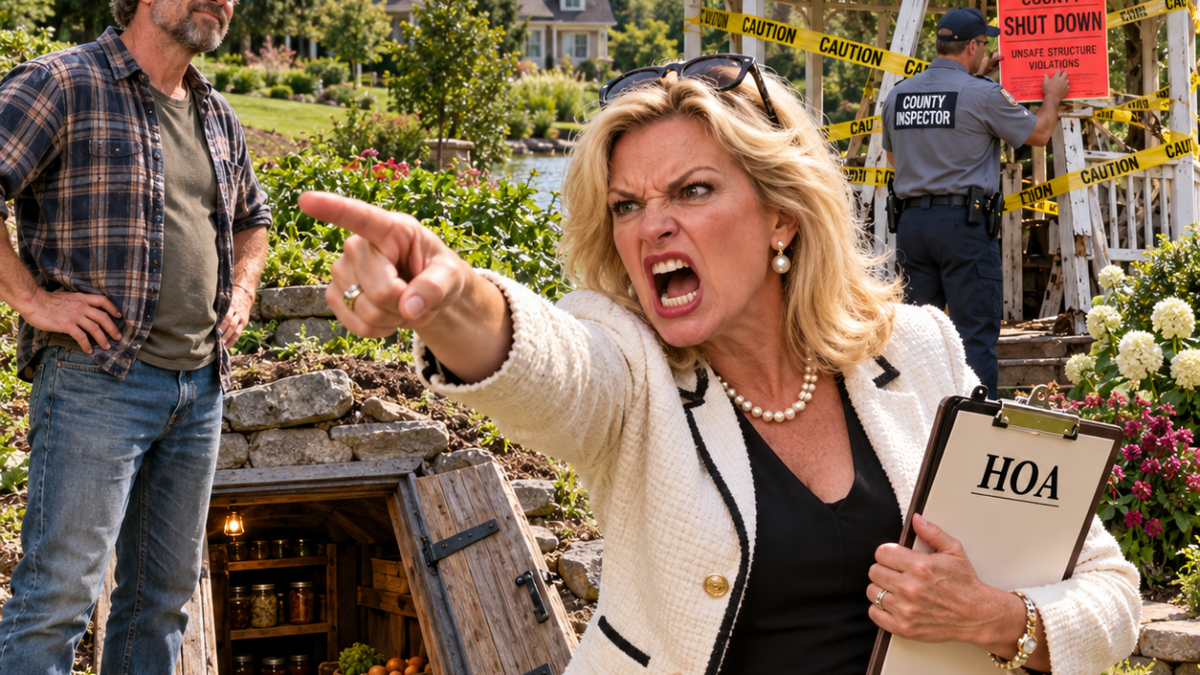
PART 2
The root cellar had begun as an act of love, which made everything Karen did afterward feel more invasive than a normal HOA dispute ever should have.
Laura could grow almost anything.
Tomatoes that climbed higher than my shoulders. Green beans so productive we started leaving grocery bags of them on neighbors’ porches. Carrots, onions, potatoes, cucumbers, peppers, strawberries and raspberries. By August our kitchen looked like a small commercial cannery. Mason jars cooled on towels across every available counter while our pantry shelves bowed beneath preserves, pickles, sauces and vegetables.
I used to tease her.
“Most people retire and take cruises.”
“Most people don’t know what supermarket tomatoes taste like compared to mine.”
“That sounds threatening.”
“It is.”
Our children were grown and living in other states, so gardening became one of the things that organized our seasons. Spring meant planting. Summer meant tending. Late summer meant preserving. Winter meant opening jars that smelled faintly of August.
The storage problem kept getting worse.
One evening Laura was trying to wedge six jars of peaches onto an already overloaded garage shelf when she muttered, “My grandmother had a proper root cellar. None of this nonsense.”
I was standing behind her.
“What kind?”
She turned.
“Don’t get that look.”
“What look?”
“The engineer look.”
“I don’t have an engineer look.”
“You absolutely do.”
She described her grandmother’s cellar in Vermont.
Cool.
Dark.
Shelves.
Bins.
Natural humidity.
That unlocked the memory of my grandfather.
Within forty-eight hours I had sketches.
Within a week I had actual calculations.
Laura stood over my shoulder.
“You understand I wanted somewhere to store potatoes.”
“Yes.”
“This looks like a bunker for preserving potatoes through nuclear war.”
“Safety factor.”
She laughed.
I took the design seriously because underground structures deserve respect.
Soil pressure is real.
Water intrusion is real.
Poor ventilation is real.
A badly supported roof can kill you.
I checked frost depth. Drainage. Earth loads. Lateral loads. Moisture control. Air exchange.
The walls were reinforced concrete masonry.
Exterior waterproofing.
Drain tile.
Gravel.
Precast slab.
Earth cover.
Two separate ventilation lines arranged for passive airflow.
The entire entrance faced away from our major storm direction.
Then county permit.
I didn’t trust assumptions.
The planning clerk, Dave, examined the drawings.
“You sure this is for carrots?”
“And apples.”
He flipped another page.
“I’ve seen commercial shelters with less documentation.”
“I like sleeping at night.”
“You an engineer?”
“Retired Army Corps.”
“That explains everything.”
Three weeks later, permit approved.
The HOA bylaws were next.
I read them.
Every page.
Sheds required review.
Gazebos required review.
Fences.
Decks.
Above-ground accessory structures.
Nothing governing subterranean food-storage structures.
Even Bylaw 14.7, which Karen eventually cited, specifically described “above-ground structures and exterior alterations.”
I built.
My son Michael came home from college for summer break and became involuntary labor.
He complained for approximately twelve minutes.
Then became as invested as I was.
We poured footers together.
Set block.
Installed rebar.
Mixed mortar.
He learned why straight lines matter.
I learned that twenty-two-year-olds can carry concrete blocks considerably faster than fifty-eight-year-old retired engineers.
One afternoon, while we worked inside, Michael said:
“Grandpa would have liked this.”
“My grandfather?”
“Your dad.”
I paused.
My father had died three years earlier.
“He would’ve criticized everything.”
“Exactly.”
We both laughed.
By the time the waterproof membrane went on, Michael had to return to school.
Before leaving he scratched his initials into a hidden section of fresh mortar near the entry wall.
I pretended not to notice.
I noticed.
Laura cried the first time I opened the finished door.
Not because it was beautiful in any conventional sense.
Because it worked.
Cool air.
Cedar shelves.
Potato bins.
Wine rack that she claimed had somehow “appeared.”
A line of jars glowing beneath warm LED lights.
“My vegetable vault,” she said.
I kissed her forehead.
“Fortress of freshness.”
“Never call it that in public.”
Then Karen’s letter arrived.
**UNAPPROVED SUBTERRANEAN BUNKER.**
I laughed at “bunker.”
Laura did not.
She worried about conflict.
I worried about precedent.
The first fine was $100.
I replied with the bylaw.
County permit.
Photos.
Certified mail.
Then $250.
Karen added “soil stability hazard.”
That crossed into technical territory.
I was almost offended professionally.
I replied with structural calculations and site information.
I included:
**If the association possesses contrary analysis prepared by a licensed geotechnical or structural professional, please provide it.**
Nothing.
Instead, Karen started talking.
That was how she operated.
If paper failed, narrative.
Brenda next door knocked.
“Karen said there’s a chance your underground room could collapse toward our property.”
“Come see it.”
Her face changed the moment she stepped inside.
“Oh.”
That single syllable became important.
Not fear.
Understanding.
Clean walls.
Neat shelves.
Concrete.
Ventilation.
No cave.
No pit.
No improvised shelter.
“It’s… nice.”
“Thank you.”
“Karen made it sound like a hole covered with plywood.”
“I know.”
Brenda walked out with a jar of strawberry jam.
The next neighbor got pickles.
Soon we hosted a barbecue.
Not a political event.
At least not officially.
People ate.
Then I showed them the cellar.
Tom, a real-estate agent, whistled.
“This would actually sell a house.”
Maria ran a hand over the block wall.
“You did this yourself?”
“Mostly.”
“Why is Karen calling it dangerous?”
“Ask Karen.”
Then I showed them the permit.
Bylaw.
Fines.
Quietly.
No speech.
No rant.
One neighbor at a time, the story changed.
Karen noticed.
Her messages became harsher.
George Gable arrived next.
Retired accountant.
Folder under his arm.
His wife had died several years earlier. His roses were famous throughout Oak Ridge.
His violation?
Four-inch decorative stone edging around the rose garden.
Karen called it an unapproved fence.
He fought for months.
Eventually she backed down after George threatened individual board liability.
“She doesn’t enforce rules,” he told me. “She tests whether you’ll surrender.”
That sentence clarified everything.
His file showed welcome-mat disputes.
Basketball hoop warnings.
Trash-can fines.
Garden edging.
Holiday lights.
Selective enforcement.
A pattern.
Then Sarah Mitchell entered the story.
Not my wife—our neighbor Sarah.
Attorney.
Contract and property litigation.
She had attended our barbecue and asked unusually specific questions about the permit.
When I finally called her, I had barely finished explaining before she said:
“Mark, stop communicating with Karen directly.”
“That bad?”
“That useful.”
She reviewed George’s file.
My file.
Karen’s letters.
County records.
“First step: cease and desist.”
“Against the HOA?”
“Against every board member.”
That made me pause.
“Why every member?”
“Because they may believe Karen is handling routine enforcement.”
“And?”
“Once counsel tells them the action appears unsupported and potentially exposes them individually if they knowingly continue bad-faith enforcement, they start reading before signing.”
I smiled.
“You enjoy this.”
“I hate bullies.”
Then came her second idea.
Gazebo.
Karen’s pride.
It sat beside the community pond, white-painted timber beneath a dark roof, string lights around the rafters, electrical outlets installed for events.
She had pushed it through the previous spring.
Newsletter after newsletter.
**KAREN’S COMMUNITY RENEWAL INITIATIVE**
She never called it that officially.
Everyone else did.
Sarah asked:
“Was it permitted?”
“I assume.”
“Never assume.”
I went to county records.
Requested everything.
Permit.
Plans.
Inspections.
Invoices.
Bid documents.
The package arrived in a banker’s box.
I spent three nights reading.
At first:
Nothing.
Permits were there.
Contractor licensed.
Foundation inspection apparently passed.
Framing passed.
Then numbers began bothering me.
Four concrete piers.
Plans required four feet below grade.
Concrete invoice quantity seemed low.
I calculated volume.
Again.
Still low.
Maybe they had extra material.
Maybe invoice incomplete.
Not proof.
Then electrical.
Plans required underground conduit.
Invoice showed fixtures.
Breaker.
Switches.
Outlets.
Romex.
Interior-type cable.
No underground conduit line item.
I searched.
Maybe second receipt.
No.
Then final electrical inspection.
Request submitted.
No result.
No certificate.
No signed final.
I called Sarah.
“You awake?”
“It’s eleven.”
“That’s not an answer.”
“What did you find?”
“Potentially unsafe buried wiring.”
Silence.
“How potentially?”
“If they installed what the invoices suggest, very.”
“Can you prove it?”
“Not without inspection.”
“Then don’t accuse publicly.”
“I know.”
“Document.”
“Already doing it.”
“Of course.”
The cease-and-desist letters landed meanwhile.
Board panic followed.
Official fines paused.
Personal harassment did not.
Garbage dumped in Laura’s roses.
No proof who.
Anonymous animal-control complaint about Buddy, our golden retriever.
Officer found an extremely spoiled dog asleep beneath a shaded porch fan with two bowls of water.
He looked around.
“This the neglected animal?”
Buddy rolled over for belly rubs.
The officer scratched him.
“I’ve seen abuse cases.”
“I imagine.”
“This isn’t one.”
“No.”
He lowered his voice.
“Neighborhood dispute?”
“HOA.”
He sighed.
“That explains a surprising amount.”
Laura started losing sleep.
That made me question myself.
Not the legality.
The cost.
One evening she sat at the kitchen table.
“What if she doesn’t stop?”
“She will.”
“You can’t know.”
“No.”
“What if this turns into years?”
I had no answer.
She looked toward the window.
“I wanted a cellar for peaches.”
“I know.”
“I didn’t want a war.”
“I know.”
“Sometimes I wonder if filling it in would be easier.”
That hurt.
Not because I was angry with her.
Because Karen had succeeded in making our own property feel unsafe emotionally.
I took Laura’s hands.
“If you ask me to stop because you truly want it gone, I’ll stop.”
She stared at me.
“But I don’t want it gone.”
“Then we don’t surrender something we love just to make someone who hates losing feel powerful.”
Tears filled her eyes.
“I hate this.”
“So do I.”
That night I decided the conflict needed an ending.
Then Karen announced the meeting.
County inspector attending.
Public inspection.
Vote on “remediation action.”
She thought she had built a stage.
Sarah called it a gift.
I called Inspector Evans’s office only to confirm he was actually a county employee invited through proper channels.
He was.
I did not tell him my findings.
No private lobbying.
I wanted everything in the open.
Thursday.
Seven o’clock.
Clubhouse packed.
Karen wore purple.
Laura held my hand.
My leather portfolio rested across my knees.
Karen opened.
“Serious threat to neighborhood safety.”
“Unpermitted bunker.”
“Potential collapse.”
“Increased liability.”
Every phrase more dramatic.
Then Inspector David Evans stood.
Late fifties.
Gray mustache.
County polo.
He looked tired.
Good inspectors often look tired.
They spend careers seeing problems people insist are fine.
Karen smiled.
“Mr. Evans will confirm what this board has been saying.”
He didn’t respond to that.
Then she suggested going directly to my property.
I stood.
“Before we do, may I provide the permit documentation?”
Karen snapped:
“This is my meeting.”
Inspector Evans looked toward me.
“You have permit documents?”
“Yes.”
He held out a hand.
Karen’s face changed.
I gave him the portfolio.
My permit.
Stamped drawings.
Calculations.
Site plan.
He read.
The room waited.
Then:
“These are unusually complete.”
Karen shifted.
“But the construction may not match.”
“Correct,” Evans said. “That’s what inspection determines.”
I smiled.
“Please inspect.”
We walked.
Fifty neighbors down Oak Drive.
Strangest parade of my life.
Inside the cellar, Evans checked everything.
Walls.
Roof.
Ventilation.
Entry.
Drainage.
Dimensions.
He used flashlight.
Level.
Moisture meter.
Ten minutes.
Fifteen.
Karen waited outside smiling.
Finally he emerged.
“This structure is sound.”
Murmur.
He continued.
“Permit valid. Construction generally conforms to submitted documents. Masonry work is excellent. Ventilation appropriate. Waterproofing appears properly installed.”
Karen’s smile vanished.
“Are you saying it’s legal?”
“As far as county building compliance, yes.”
“What about collapse?”
“I see no evidence of imminent structural instability.”
“But—”
“Ma’am.”
Evans looked at her.
“I inspect structures. I don’t adjudicate HOA covenants.”
Then he looked at me.
“Very good work.”
That felt better than I expected.
Laura squeezed my hand.
I could have stopped there.
Victory.
But safety issue remained.
So:
“Mr. Evans, since you’re here…”
Karen’s head snapped toward me.
“I reviewed public construction records for another structure.”
I pointed toward the pond.
Gazebo.
Evans listened.
I handed him second packet.
Plans.
Invoices.
Missing final.
Concrete discrepancy.
Wiring discrepancy.
He became serious.
Karen protested.
“Baseless retaliation!”
Evans ignored the word.
“What concerns you most?”
“Electrical.”
“Show me.”
I pointed to Romex invoice.
Then planned conduit.
Then missing inspection.
He walked toward the gazebo.
Parents followed.
Karen’s confidence disappeared completely.
At one support post, Evans moved mulch.
Examined pier.
Not conclusive without excavation, but concerning.
Then electrical feed.
He knelt.
Dug.
Orange jacket.
His expression changed.
“Power live?”
Karen said:
“Yes.”
He stood immediately.
“Everybody step back.”
The crowd moved.
That tone requires no explanation.
He opened electrical box.
Inspected.
Then called county dispatch.
Requested immediate utility isolation.
Karen’s voice rose.
“You cannot shut this down based on one wire!”
“I can shut down a public-use structure when I observe an electrical condition creating potential shock hazard.”
“People use this every day!”
“That is why I’m shutting it down.”
He pulled a red tag.
Attached it.
**UNSAFE—DO NOT OCCUPY**
Karen stared.
The gazebo lights still glowed above the tag until power was cut minutes later.
Then darkness.
The visual was brutal.
Her legacy project.
Dark.
Red warning notice.
Inspector standing beside it.
My root cellar thirty yards away.
Approved.
Safe.
Karen said:
“This is his fault.”
Nobody answered.
Evans turned.
“Mr. Henderson did not install this wiring.”
Silence.
“He brought a concern to my attention. The condition exists independently of who reported it.”
He handed Karen paperwork.
“Access prohibited pending electrical correction, structural review and required inspections.”
Her hand shook.
Someone asked:
“Could someone have been electrocuted?”
Evans chose words carefully.
“There is a credible shock hazard. I would not permit public use until corrected.”
A mother pulled her child closer.
That ended Karen’s authority more effectively than any speech could.
People can tolerate petty rules.
They can tolerate unpleasant leaders longer than they should.
They do not forgive being told a safe cellar is dangerous while their children play inside a structure that actually has unsafe electricity.
George walked beside me.
“Recall petition.”
“Yes.”
By next afternoon, table near mailboxes.
No door-to-door needed.
People lined up.
Welcome-mat woman.
Basketball family.
Young parents.
Retirees.
Even people who had previously avoided eye contact.
Signatures exceeded threshold within forty-eight hours.
Gazebo costs followed.
Power correction.
Demolition of unsafe components.
Foundation investigation.
Potential rebuild.
Reserve fund impact.
Special assessment possibility.
Gary the treasurer looked physically ill at the emergency meeting.
“How much?”
He gave preliminary estimate.
Groans.
One homeowner:
“Why should we pay for Karen’s shortcut?”
Karen tried blaming contractor.
Sarah stood as resident counsel.
“Contractor responsibility may be pursued. But board oversight and records also matter.”
Karen glared.
“You have been conspiring with Henderson.”
“No.”
Sarah smiled.
“I’ve been reading.”
Recall vote.
Landslide.
Karen removed.
Other board members resigned.
George Gable became interim president reluctantly.
Tom vice president.
Sarah legal adviser, non-voting.
First action:
My fines rescinded.
Formal apology.
Second:
Gazebo remediation.
Third:
Bylaw review.
Fourth:
Independent review of Karen-era enforcement.
Karen stayed through the meeting.
Barely.
At the end she approached me.
“This is what you wanted.”
“No.”
“You humiliated me.”
“You invited the inspector.”
Her face tightened.
“You went looking for something.”
“Yes.”
“Why?”
“Because you were threatening to destroy my safe structure while claiming your concern was safety.”
I gestured toward the dark gazebo.
“If you want to use safety as a weapon, make sure your own projects are safe.”
“You ruined me.”
“No.”
I shook my head.
“I read the paperwork.”
She walked away.
Weeks followed.
Gazebo partially dismantled.
Investigation found improper electrical installation.
Foundation work required correction.
Contractor faced consequences under county and civil processes.
HOA recovered some costs through insurance and contractor claims, but not all.
Owners still paid something.
That anger lingered.
Karen’s house went up for sale.
One morning, while I was retrieving mail, I saw her loading boxes.
She looked at me.
I almost kept walking.
Then she said:
“Happy?”
I stopped.
“No.”
“You won.”
“I kept my cellar.”
“You took my position.”
“I never wanted your position.”
“You turned everyone against me.”
“No.”
Her eyes hardened.
“You think you’re better than me.”
I considered.
“No.”
Then:
“But I think I was right about the cellar.”
She laughed bitterly.
“That’s all this ever was to you.”
“No.”
I looked toward her house.
“This became about people being afraid to disagree with you.”
For a moment, anger left her.
Something tired replaced it.
“Do you know how hard that board was to manage?”
“I believe it.”
“No one wanted to volunteer. Everyone complained. Nobody helped.”
“That also sounds believable.”
“So I made decisions.”
“Yes.”
“And then everyone blamed me.”
“Leadership means getting blamed sometimes.”
She stared.
“You sound like a colonel.”
“Engineer.”
“Same thing.”
She put another box into her car.
Then:
“I still think that cellar is ridiculous.”
I smiled.
“That’s okay.”
She looked surprised.
“What?”
“You were always allowed to dislike it.”
That was the tragedy.
Karen could have hated my root cellar forever.
Nothing wrong with that.
She crossed the line when she decided dislike created authority.
She moved three days later.
New family bought the house.
No drama.
Two kids.
Dog.
Bright red bicycle left occasionally beside garage.
New board did not implode.
Oak Ridge gradually returned to normal.
But first came rebuilding.
Gazebo was demolished.
The sound carried across our yard.
Saw blades.
Hammers.
Wood cracking.
Laura stood inside the root cellar arranging peaches.
I sat near doorway.
She listened.
“Does that sound satisfying?”
“Yes.”
“Too satisfying?”
“Probably.”
She smiled.
The cellar smelled like earth, cedar and fruit.
Exactly what we intended.
Not bunker.
Not sinkhole.
Not violation.
Home.
George and the interim board reviewed covenants line by line.
Above-ground meant above-ground.
They left it that way.
They added process requirements before fines.
Notice.
Specific rule.
Reasonable cure period.
Appeal.
Recorded vote for major enforcement.
No more invented phrases.
Architectural standards simplified.
Welcome mats disappeared from regulation entirely.
Basketball hoops treated like basketball hoops.
Not threats to civilization.
George hated being president.
Excellent sign.
“I have roses.”
“I know.”
“I retired from accounting to avoid committees.”
“I know.”
“Why did you nominate me?”
“Trust.”
“That’s manipulative.”
“Yes.”
He served one year.
Then election.
Maria became president.
Calm.
Organized.
Boring.
Perfect.
The new gazebo took almost a year.
This time:
Competitive bids.
Proper electrical contractor.
Conduit.
Inspections.
Certificate of occupancy.
Foundation per plan.
When it opened, nobody named it after anyone.
Just:
**Oak Ridge Pond Pavilion**
Ribbon cutting.
Children.
Picnic.
No Karen plaque.
Inspector Evans attended unofficially.
He found me.
“Root cellar still standing?”
“So far.”
“Neighborhood still above it?”
“Mostly.”
He smiled.
“New pavilion passed.”
“I saw.”
“Twice.”
“What?”
“I inspected electrical twice because your board is traumatized.”
“That seems healthy.”
He laughed.
Laura brought him a jar of peaches.
“For services rendered.”
“I can’t accept gifts for inspections.”
“It’s been a year.”
He hesitated.
Then took peaches.
“I was never here.”
Years passed.
Root cellar became neighborhood curiosity.
Laura hosted canning workshops.
At first six people.
Then fifteen.
Young families wanted to learn preservation.
I taught one class about ventilation and moisture.
Almost nobody attended.
Laura’s jam class was full.
Humbling.
Michael visited with his fiancée.
I showed her his initials in the mortar.
He groaned.
“You saw that?”
“Immediately.”
“Why didn’t you say anything?”
“Because someday you’d come back and think I didn’t.”
Laura cried.
Michael rolled eyes.
Then cried a little too.
That cellar became family memory.
Exactly as I had hoped.
One winter, ice storm knocked power out for thirty hours.
Refrigerators warmed.
Neighbors moved some produce and medication into cooler locations.
Our cellar stayed stable.
Not refrigeration.
But cold enough for vegetables.
Laura stored jars.
We helped three neighbors keep potatoes, apples and some non-critical foods protected.
Tom came down carrying a crate.
“Doomsday bunker finally paying off.”
“Get out.”
He laughed.
Nobody called it dangerous anymore.
That mattered.
Karen became story.
Not daily reality.
New residents heard fragments.
“Former HOA president tried to condemn Mark’s cellar and got her own gazebo condemned.”
True enough.
They embellished.
Some said inspector ripped the gazebo down during the meeting.
False.
Some said Karen was arrested.
False.
Some said I secretly worked for county.
False.
Some said root cellar could survive nuclear blast.
Definitely false.
Laura encouraged that rumor.
“Stop.”
“It makes the peaches more exciting.”
No.
George eventually moved closer to his daughter.
Before leaving, he gave me his old folder.
“Historical archive.”
“Burn it.”
“Can’t.”
“Why?”
“You’re the paperwork lunatic.”
Fair.
His rose border remained.
New owners loved it.
Four inches high.
Still not a fence.
One afternoon, several years after conflict, an envelope arrived.
No return address.
Handwriting unfamiliar at first.
Karen.
Mark,
I don’t expect a reply.
I recently saw a photograph online of the rebuilt pavilion.
It looks good.
Better than the one I pushed through.
I have had time to admit that.
I believed people would judge my effectiveness by visible accomplishments. The gazebo became proof to me that I was improving Oak Ridge, and I pushed the contractor to finish quickly and under budget because I wanted it completed before the annual meeting.
That does not excuse what happened.
I did not know the wiring was unsafe, but I also did not ask enough questions.
The root cellar became personal because you challenged my interpretation in writing, and I felt you were undermining me.
I now understand that disagreement was not insubordination.
I was not your commander.
I am sorry for what Laura and you went through.
Karen
I read it twice.
Laura read it.
“What do you think?”
“Better than nothing.”
“Do you forgive her?”
“That’s not a yes-or-no switch.”
“No.”
We sat.
Then Laura smiled.
“She admitted the new gazebo is better.”
“You really know how to focus on important things.”
“I married an engineer.”
I filed the letter.
Not because I needed evidence anymore.
Because endings deserve documents too.
Eventually Oak Ridge created an annual community harvest dinner.
Laura supplied pickles.
Tom supplied barbecue.
Maria organized tables.
Pavilion filled.
One year, George returned from his daughter’s house for the event.
He walked slowly now.
Cane.
Still sharp.
He entered our root cellar.
Looked around.
“All this trouble for potatoes.”
“And peaches.”
“Worth it?”
I looked at him.
“Yes.”
He nodded.
“Good.”
Then he pointed toward his old file cabinet in my office.
“You still have that folder?”
“Yes.”
“Why?”
“Because you told me not to burn it.”
“I’ve changed my mind.”
We laughed.
George died two years later.
His daughter asked if we wanted anything from his estate.
Laura chose a small rose cutting.
We planted it beside cellar entrance.
That seemed right.
People leave pieces.
Grandfather left idea.
Michael left initials.
George left rose.
Karen, strangely, left lesson.
Not every legacy is intentional.
My grandfather’s root cellar from childhood eventually collapsed after property changed hands.
I learned through a cousin.
New owners planned removing remnants.
For a while I felt sad.
Then I went outside.
Opened ours.
Cool air.
Shelves.
Apples.
Potatoes.
Laura’s jars.
Grandchildren running above it.
The idea survived.
Maybe preservation does not mean keeping exact structure forever.
Maybe it means carrying useful things forward.
That became more meaningful as I aged.
I had spent career building infrastructure meant to last.
Bridges.
Drainage.
Facilities.
But every engineer knows nothing lasts indefinitely.
Maintenance.
Adaptation.
Replacement.
People sometimes confuse permanence with success.
A structure succeeds when it serves its purpose safely for the time required.
The cellar did.
It stored food.
Brought family together.
Connected us to grandparents.
And unexpectedly forced our neighborhood to confront abusive governance.
Not bad for hole in hill.
Years after Karen left, county updated building-code database.
Inspector Evans called.
“You’re famous.”
“What did I do?”
“Your cellar plans are being used as example in training.”
I laughed.
“For what?”
“Complete residential permit documentation.”
“Please tell me you’re joking.”
“Not joking.”
“Do they know history?”
“I may have told it.”
“You’re worse than Laura.”
He emailed PDF.
There it was.
Redacted address.
Example.
Proper drainage.
Ventilation.
Retaining-wall detailing.
Laura printed it.
Framed it.
Hung it inside cellar.
I objected.
She ignored me.
“This is embarrassing.”
“You built a famous bunker.”
“Root cellar.”
“Famous vegetable vault.”
“Worse.”
Our grandchildren loved it.
One asked:
“Grandpa, did bad lady really try to fill this with concrete?”
Children are direct.
“Yes.”
“Why?”
“She thought it broke rules.”
“Did it?”
“No.”
“Then why didn’t she read rules?”
I laughed.
Excellent question.
“Sometimes people decide what they want the rules to mean before they read them.”
“That’s dumb.”
“Yes.”
“Did she get grounded?”
“Sort of.”
Satisfied.
Years after, another HOA dispute emerged.
Different president.
Fence height.
Two neighbors arguing.
People came to me.
“Handle it.”
“No.”
“You beat Karen.”
“No.”
“I defended my property.”
“Same thing.”
“Not same.”
I refused to become neighborhood oracle.
That mattered.
Winning conflict can tempt people into new power.
I understood Karen better by then.
Authority often begins with usefulness.
Someone solves problem.
People rely on them.
They gain confidence.
Then certainty.
Then resentment toward challenge.
Then control.
I wanted none.
I attended meetings occasionally.
Asked questions.
Voted.
Then went home.
Healthy community doesn’t need hero forever.
It needs process.
One evening Maria asked me to speak to new board members.
I agreed reluctantly.
No war stories.
Three principles.
“First, if a rule is vague, don’t pretend it isn’t.”
“Second, if safety is reason, use qualified expert before enforcement.”
“Third, never spend other people’s money defending your pride.”
Silence.
Then Maria:
“That last one should be on wall.”
Maybe.
I went home.
Laura had canned pears.
Life.
The rebuilt pavilion weathered beautifully.
Children used it.
Weddings.
Graduation pictures.
Birthday parties.
One autumn Michael got married there.
That surprised me.
He and his fiancée wanted outdoor ceremony.
When he told us, I stared.
“The gazebo?”
“Pavilion.”
“Semantics.”
“It’s nice.”
“It is.”
Laura loved idea.
Wedding day clear.
Leaves beginning turn.
Michael stood beneath roof that existed because Karen’s first structure failed.
I sat beside Laura.
She whispered:
“You thinking what I’m thinking?”
“Probably.”
“Don’t say it.”
“What?”
“If Karen hadn’t—”
“I was not going to say that.”
“You were.”
I smiled.
Ceremony began.
Our son married under safe, properly permitted structure rebuilt after one of ugliest disputes in neighborhood history.
There’s metaphor somewhere.
I refused to say it.
After reception, Michael pulled me aside.
“Dad.”
“What?”
“Come here.”
He led me toward pond edge.
Pavilion lights reflected on water.
Properly wired lights.
He smiled.
“You checked them, didn’t you?”
“No.”
“Dad.”
“I looked.”
He laughed.
Then hugged me.
“Thanks.”
“For?”
“Building things right.”
That hit harder than expected.
I spent life thinking engineering was calculations.
But children notice values hidden inside habits.
Do it right.
Ask questions.
Don’t cover mistakes.
Fix unsafe work.
Stand behind what you build.
That was the lesson I hoped he carried.
Not conflict.
Years continued.
Laura’s garden grew smaller as knees complained.
Root cellar never filled as completely.
We gave shelves to grandchildren for juice boxes during visits.
Then one year Laura became ill.
Nothing dramatic at first.
Fatigue.
Appointments.
Tests.
Cancer.
The word changed everything.
Suddenly cellar dispute felt microscopic.
Gazebo absurd.
Karen distant.
Treatments.
Hospital trips.
Michael came home often.
Our daughter Rebecca flew in from Colorado.
Neighbors brought meals.
Maria organized rides despite me insisting unnecessary.
Tom mowed lawn.
People we had once barely known became infrastructure.
That is community.
Not bylaws.
People.
During treatment, Laura couldn’t garden much.
One afternoon I found her inside root cellar sitting on small stool.
“What are you doing?”
“Visiting.”
“It’s a room.”
“It’s my room.”
“Fair.”
She touched shelves.
“Remember when Karen wanted to fill this?”
“Yes.”
“Imagine if we had let her.”
I sat beside her.
“We wouldn’t have these shelves.”
“No.”
“Or George’s rose.”
“No.”
“Or your framed permit.”
She smiled.
“Especially tragedy.”
Then serious.
“I’m glad you fought.”
I took her hand.
“So am I.”
Laura responded well to treatment.
Not easy.
But successful enough to give us more years.
Afterward, she never returned garden to old scale.
She didn’t need to.
One raised bed.
Tomatoes.
Herbs.
Enough.
Root cellar became less storage and more museum of ordinary life.
That was okay.
Purpose changes.
One shelf held grandfather’s old hand tools.
One Michael’s wedding wine.
One jars of peach preserves.
One county training certificate.
One photograph of original unsafe gazebo with red tag.
Laura put that photograph there.
I objected.
“Historical artifact.”
“You’re impossible.”
“So I’ve heard.”
When Inspector Evans retired, Oak Ridge invited him to harvest dinner.
We gave him plaque.
**FOR EXEMPLARY COMMITMENT TO PUBLIC SAFETY**
He looked embarrassed.
“People usually hate inspectors.”
“Depends what you inspect.”
He looked toward me.
“Still blaming me for gazebo?”
“Crediting.”
He laughed.
Then told story publicly.
“When Karen invited me that night, I expected normal HOA disagreement.”
Crowd listened.
“I had no idea I was entering suburban civil war.”
Laughter.
Then he got serious.
“Mark did something important.”
I shook head.
“He had evidence.”
He continued.
“He didn’t ask me to punish anyone. He showed records and asked me to inspect. That distinction matters.”
I appreciated that.
Because revenge wasn’t what made outcome legitimate.
Inspection was.
Facts.
If gazebo had been safe, I would have accepted it.
Would have looked foolish maybe.
But safety matters more than winning.
That’s what Karen failed to understand.
She needed conclusion before evidence.
I tried, not always perfectly, to reverse order.
Years later, I learned this is hardest discipline in conflict.
You want opponent wrong.
You want confirmation.
You notice facts that support anger.
Ignore ones that don’t.
That is how reasonable people become unfair.
My engineering training helped.
Structures don’t care about ego.
Wall either carries load or doesn’t.
Wire either rated for environment or isn’t.
Permit either exists or doesn’t.
Concrete either reaches required depth or doesn’t.
Truth can be uncomfortable.
Still truth.
Karen’s defining mistake was believing official language could change physical reality.
Call cellar sinkhole.
Still sound.
Call gazebo safe.
Still hazardous.
Eventually somebody inspects.
That principle reaches beyond construction.
One winter, a heavy rain saturated ground.
I checked cellar.
Dry.
Laura stood in doorway.
“Still over-engineered?”
“Yes.”
“Good.”
I checked drainage.
No issues.
The hillside above remained stable.
Twenty years after construction, county records still valid.
No collapse.
No sinkhole.
No vermin empire.
Peaches survived.
Karen’s warning letter remained in binder.
I occasionally read opening sentence:
**IMMEDIATE REMOVAL OF UNAPPROVED SUBTERRANEAN BUNKER REQUIRED**
I smile.
Then close it.
The funniest thing happened much later.
Oak Ridge newsletter ran article:
**RESILIENT FOOD STORAGE DURING POWER OUTAGES**
Recommended root cellars among options.
Laura brought newsletter to breakfast.
Said nothing.
Placed it beside coffee.
I read.
Looked at her.
She raised eyebrow.
“No.”
“Oh yes.”
“We are not framing this.”
“We absolutely are.”
It joined county document on wall.
I had lost control of my cellar décor.
Justice has limits.
By then new residents had no idea why funny.
They saw legitimate preparedness information.
That was good.
History didn’t need stay angry forever.
Karen’s old house changed hands twice.
Third owners became friends.
They once invited us to dinner.
Standing in backyard, new owner pointed toward pavilion.
“Previous owner mentioned there used to be scandal.”
I nearly laughed.
“Which previous owner?”
“Woman before family we bought from.”
Karen.
Apparently she visited during sale.
“What did she say?”
“That HOA politics drove her out.”
Laura looked at me.
I answered carefully.
“There was disagreement.”
After dinner, Laura accused:
“You’re becoming diplomatic.”
“I’m old.”
“Same thing.”
Maybe.
Age changes desire for last word.
When young, winning argument feels urgent.
Later, peace feels more valuable.
But peace without boundaries is surrender.
I still believe that.
The trick is knowing difference.
If Karen had complained about cellar aesthetics, I could live with disagreement.
If she had requested review, fine.
If independent engineer found hazard, I would fix it.
But she threatened destruction without basis.
That required resistance.
Not because every fight deserves war.
Because property, safety and due process matter.
George once said:
“Bullies thrive on cost imbalance.”
“What?”
“It costs her five minutes to send fine. Costs you hours to fight.”
Exactly.
That was why system needed reform.
New HOA adopted a rule: before major fine, board had to identify exact provision, evidence and enforcement history.
Major physical remediation required independent expert review.
No unilateral demolition authority.
Sounds obvious.
Hadn’t been.
Institutions often write new rule after someone abuses old ambiguity.
Our pain became safeguard.
That made it easier to accept.
Eventually George’s daughter sent me his old calculator.
He had written my name on tape.
I placed it on shelf beside Operation Overreach binder.
Laura said:
“Your root cellar is becoming archive.”
“History needs climate control.”
She rolled eyes.
The lilac bushes around entrance grew tall.
Every spring purple flowers nearly hid door.
Visitors had to duck around branches.
One year Maria joked that entrance violated visibility requirements.
I stared.
She laughed.
“Too soon?”
“Fifteen years.”
“Still too soon?”
“Always.”
Our grandchildren painted small sign.
**HENDERSON VEGETABLE VAULT**
Laura won.
I mounted it.
No HOA approval.
Nobody cared.
That is what healthy normal looks like.
One autumn evening, long after Karen’s departure, I sat inside cellar alone.
No particular reason.
Cool air.
Earth smell.
One light.
My grandfather returned in memory.
Not literally.
His voice.
“Keep potatoes dry.”
“Don’t bruise apples.”
“Good cellar saves work.”
Simple.
He could never have imagined HOA covenants.
County inspection databases.
Romex.
Recall votes.
Yet principle same.
Build carefully.
Respect land.
Preserve what feeds family.
I realized cellar had survived because knowledge moved across generations.
Grandfather taught me why.
Engineering taught me how.
Laura gave reason.
Michael helped build.
Community eventually protected right to keep it.
Structures are rarely individual.
Even when one person lays blocks.
The roots go outward.
That realization softened old anger.
Karen had treated neighborhood as collection of properties to control.
But it was network of lives.
Brenda.
Tom.
George.
Sarah.
Maria.
Inspector Evans.
Michael.
Laura.
Even Karen.
Every action affected others.
Her failure was not caring enough about that web.
Our success came from rebuilding it.
When Laura and I reached fortieth anniversary, children organized surprise dinner at pavilion.
They decorated with jars of flowers.
Michael brought slideshow.
Unfortunately included photo of Karen’s condemned gazebo.
I groaned.
Crowd laughed.
Rebecca said:
“Dad, it’s family lore now.”
“That was not family.”
“It shaped family.”
Maybe.
Then slide of us building cellar.
Michael shirtless, filthy, carrying blocks.
Laura painting shelves.
Me kneeling beside plans.
Then recent photo.
Lilacs mature.
Door weathered.
Still standing.
Michael raised glass.
“To over-engineering.”
Everyone toasted.
I surrendered.
Years later, if I had to choose one moment representing victory, it would not be red condemned tag.
Not recall vote.
Not Karen leaving.
Not apology letter.
It would be Laura placing first jar of peaches back on shelf after conflict ended.
She held jar toward light.
Amber fruit inside.
Then set it in row.
No speech.
No cheering.
Normal action restored.
That is what bullies steal first.
Normalcy.
Home becomes theater.
Mailbox becomes threat.
Doorbell becomes fear.
Yard becomes battlefield.
Victory means ordinary things feel ordinary again.
Peaches.
Dog asleep.
Grass.
Neighbors.
A cellar door.
The gazebo eventually became ordinary too.
Children played beneath it.
Couples took pictures.
Electrical system safe.
Foundation stable.
I stopped thinking of Karen when I passed.
That was another victory.
Healthy replacement had erased emotional charge.
After Inspector Evans died—several years after retirement—his family sent Oak Ridge a note thanking community for plaque and memories.
Maria proposed adding small safety award in his name for community improvement projects.
Approved.
First Evans Safety Award went to high-school students who designed reflective crossing signs near entrance.
I liked that.
Legacy better than red tag.
That is how good communities metabolize conflict.
Take lesson.
Discard poison.
Keep useful parts.
If Karen ever heard about award, I don’t know.
Her letter was last contact.
I hope she found peace.
I mean that.
Not because I excuse what she did.
Because perpetual misery is not justice.
Accountability occurred.
She lost position.
Reputation suffered.
House sold.
That was enough.
The rest belonged to her life.
One summer, I found original pink violation notice while cleaning office.
Laura read over shoulder.
“Keep?”
I hesitated.
For years I kept everything.
Evidence.
Now no case.
No risk.
No purpose.
I fed it into shredder.
Laura looked shocked.
“Mark Henderson voluntarily destroyed paperwork?”
“Historic day.”
“What about binder?”
“Keeping permit.”
“Obviously.”
“Plans.”
“Obviously.”
“Karen letters?”
I looked.
Then shredded most.
Not apology.
Kept that.
Not revenge.
Completion.
Paper war ended.
No need ammunition.
Operation Overreach binder became thinner.
I relabeled:
**ROOT CELLAR—PERMITS & HISTORY**
Much better.
Years earlier Karen’s name dominated file.
Now structure did.
That felt right.
Eventually Laura and I updated estate plan.
Michael wanted house someday.
Rebecca wanted certain furniture.
We included cellar maintenance notes.
He laughed.
“You put inspection schedule in will?”
“Yes.”
“Dad.”
“Drainage matters.”
He hugged me.
“I’ll take care of it.”
Those words reached something deep.
Same feeling grandfather gave me.
Things pass.
Responsibility too.
One day Mark Jr.—my grandson named after me—asked why roof covered in grass.
“Insulation.”
“Why not normal roof?”
“Earth keeps temperature steady.”
“Could I live in here?”
“No.”
“Why?”
“Because grandmother would fill your bed with potatoes.”
Laura from doorway:
“Correct.”
He ran away laughing.
That is cellar now.
Not conflict.
Childhood.
Family.
Storage.
Story.
I sometimes wonder what would have happened if Karen had simply walked through door before issuing first fine.
If she had seen walls.
Permit.
Shelves.
Laura’s jam.
Maybe still disliked.
Maybe rule dispute remained.
But fear narrative would have been harder.
She chose judgment before observation.
That decision defined entire conflict.
Inspector Evans did opposite.
Observed first.
Then judged.
That contrast may be central lesson.
You can hold title and be wrong.
You can be accused and still be right.
Only evidence closes distance.
In Karen’s meeting, she wanted Evans as prop.
Professional refused role.
He inspected.
That is what expertise should do.
Not validate whoever invited you.
Determine reality.
When he said my cellar was over-engineered, I admit I enjoyed it.
A lot.
When he red-tagged gazebo, I enjoyed that too.
Human.
But years later, best part is no one was hurt.
That wiring could have injured child.
That matters more than irony.
If Karen’s attack hadn’t pushed me to inspect records, hazard might have remained.
Eventually somebody could have touched wet metal under wrong fault condition.
Maybe nothing.
Maybe tragedy.
We will never know.
I prefer not knowing.
Because it was corrected.
Sometimes conflict uncovers danger by accident.
That doesn’t make conflict good.
It makes vigilance useful.
The community never built another major structure without independent final inspection.
Contractors complained about paperwork.
Good.
Paperwork cheaper than funerals.
I said that at one meeting.
Maria wrote it down.
Ended up newsletter quote.
Laura framed that too.
My cellar walls became embarrassing museum of my own sentences.
I banned new frames.
Ignored.
One rainy evening, power flickered.
Laura and I sat on porch.
Water ran across lawn.
Cellar invisible beneath wet grass except door.
She said:
“Think it’ll collapse?”
I looked at her.
“After twenty years?”
“Karen said imminent.”
“Give it another week.”
She laughed.
The laugh echoed under porch.
I looked toward pond.
Pavilion lights reflected.
Safe wiring.
Solid structure.
Community quiet.
Everything that had once symbolized conflict now simply existed.
That is probably the best possible ending to any feud.
Not eternal celebration.
Irrelevance.
Karen wanted my cellar erased.
Instead, years later, nobody cared that it was there.
Exactly what I wanted.
She wanted gazebo to prove her leadership.
Years later, nobody connected pavilion to her.
Exactly what community needed.
Buildings should serve people, not egos.
Rules should protect people, not power.
And homes should be places where ordinary life can happen without fear that one person’s preference will arrive on pink paper and pretend to be law.
When people ask me now about “the night the inspector condemned Karen’s gazebo,” they expect triumphant revenge.
I tell them truth.
“Yes, it was satisfying.”
Then I add:
“But the important part was that somebody found that wire before a child did.”
That usually quiets them.
Because underneath comedy was danger.
Underneath HOA drama was responsibility.
And underneath our hill was simply a root cellar.
Cool.
Dry.
Permitted.
Over-engineered.
Full of peaches.
Exactly as it should be.
A few summers ago, Michael brought his own son to help repair cellar door.
Cedar had finally weathered.
Three generations working again.
We removed hinges.
Sanded.
Sealed.
Grandson asked:
“Did great-great-grandpa build one too?”
“Yes.”
“Was his this nice?”
“No electricity.”
“No lights?”
“No.”
“That sounds terrible.”
I laughed.
“He thought it was excellent.”
We hung new door.
Michael checked level.
Off by fraction.
I noticed.
He noticed me noticing.
“Don’t.”
“What?”
“It’s within tolerance.”
I smiled.
“Good.”
He stared.
“You were about to get the level.”
“Absolutely.”
Grandson shook head.
“Mom says you’re crazy.”
“Engineering is hereditary.”
“No thanks.”
Laura brought lemonade.
We sat outside.
Lilacs.
Door.
Sun.
No HOA letters.
No inspectors.
No audience.
That was final image I wanted to keep.
Not red tag.
Family fixing door.
Because revenge gets clicks.
Repair builds life.
Karen’s downfall was dramatic.
But our recovery was more important.
She threatened to fill the cellar with concrete.
Instead, her own project was demolished and rebuilt.
She tried to isolate us.
Instead, neighbors became friends.
She tried to use rules as weapons.
Instead, rules became clearer.
She tried to humiliate me publicly.
Instead, the inspection exposed a safety problem everyone needed to know about.
She lost presidency.
But community gained governance.
We kept cellar.
But more importantly, we kept home.
And if there was any justice more satisfying than watching that red condemned tag swing from her gazebo in the evening wind, it was opening my cellar years later and realizing I could no longer remember the exact amount of Karen’s final fine.
I remembered Laura’s peaches.
I remembered Michael’s initials.
I remembered George’s roses.
I remembered Inspector Evans saying it was built better than most houses.
I remembered my grandfather.
Karen’s number?
Gone.
That is what time eventually does to bullies.
It reduces them.
Not necessarily through punishment.
Through perspective.
Things that once occupied your whole mind become one chapter.
Then one paragraph.
Then one anecdote.
Then a name grandchildren barely recognize.
But things built with love continue gathering meaning.
The root cellar began with my grandfather.
Then Laura.
Then Michael.
Then conflict.
Then community.
Then grandchildren.
Its story outgrew Karen completely.
I think that would have pleased my grandfather.
He never liked waste.
Especially wasted energy.
If he had watched me spend months angry about HOA politics, he probably would have said:
“Cellar still cold?”
“Yes.”
“Potatoes still good?”
“Yes.”
“Then quit complaining and get to work.”
He would have been right.
So that is where I leave the story.
Oak Ridge is quiet.
The pavilion is safe.
The bylaws are shorter.
The HOA meetings are boring.
Laura still grows more tomatoes than two people can reasonably eat.
Michael still claims my mortar lines are unnecessarily precise.
The grandchildren still call the cellar Grandpa’s bunker despite repeated corrections.
And every autumn, we carry crates down those steps together.
Apples.
Potatoes.
Carrots.
Jars of peaches.
The door closes.
Cool air settles.
Earth holds its steady temperature.
No drama.
No fines.
No threat.
Just a structure doing the job it was built to do.
Karen once called it an illegal sinkhole and promised the county would condemn it.
She brought the inspector herself.
He looked at my cellar.
Then he looked at her gazebo.
And for once, the rules were enforced exactly where the danger actually was.
My cellar stayed.
Her gazebo didn’t.
But the thing that mattered most wasn’t who lost a structure.
It was who finally learned that authority cannot turn fiction into fact.
Concrete doesn’t care who holds the gavel.
Electrical current doesn’t care who writes the newsletter.
And truth doesn’t care how confidently someone says the word “violation.”
Eventually, somebody qualified shows up and looks.
When Inspector Evans looked, everything changed.
Karen built her power on appearances.
I built my cellar on a foundation.
Only one of those was designed to carry weight.