PART 2: HOA Karen Towed My Whole Life Off My Own Land—Then the U.S. Army Showed Up at Her Front Door
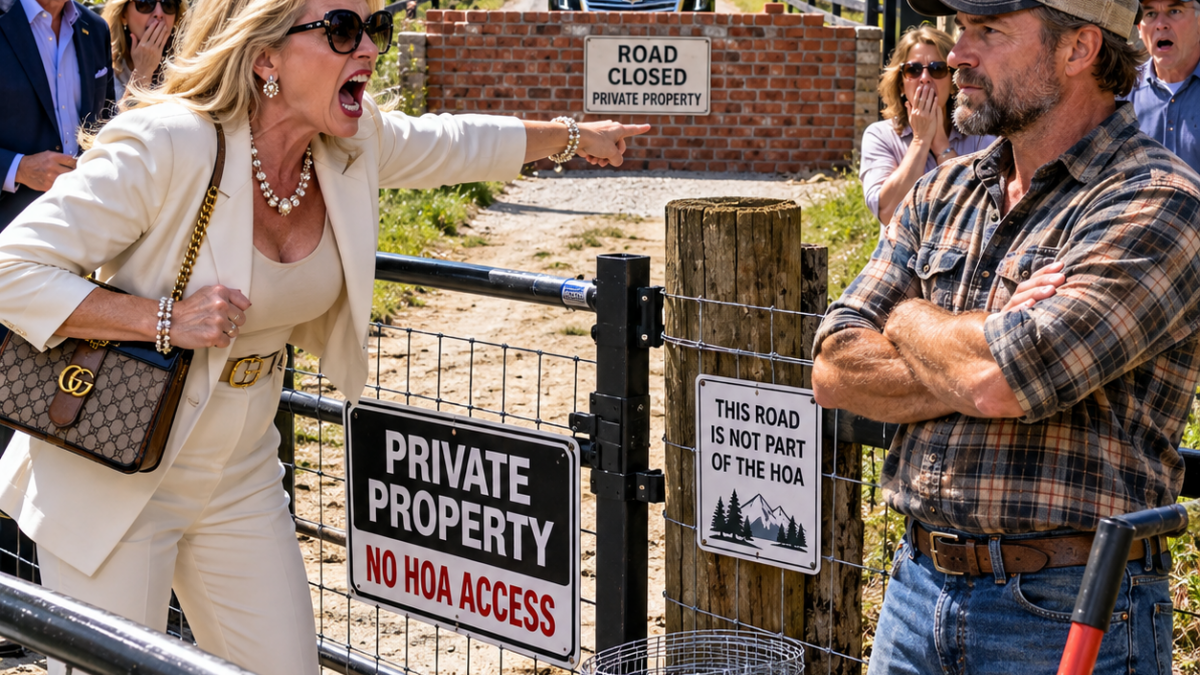
PART 2
### Chapter One: The Land I Bought to Disappear
I did not buy those forty acres because I wanted to fight another war.
I bought them because I was tired.
That is not something men like me say easily. In uniform, tired is not a feeling you indulge. It is a condition you manage. You drink terrible coffee from a paper cup, lace your boots tighter, double-check the manifest, and keep moving because convoys do not load themselves and missions do not wait for anyone to feel ready.
For twenty-five years, I served in Army logistics.
Most people hear logistics and think of spreadsheets, supply closets, forklifts, and clipboards.
They picture men like me counting boxes while everyone else does the hard part.
They are wrong.
Logistics is the bloodstream of a mission. Ammunition, fuel, water, food, medical supplies, generators, radios, replacement parts, tires, armor plates, batteries, tents, field stoves, maps, oil, chain, bolts, straps, forms, signatures, serial numbers—everything has to be accounted for, moved, secured, and delivered before anyone gets to talk about victory.
You learn to respect details.
You learn that a missing serial number can ruin a day.
You learn that an unsecured asset is not an inconvenience.
It is a vulnerability.
That mindset does not leave you when you retire. It follows you home. It stands behind your shoulder when you buy land. It whispers in your ear when someone waves a fake rule in your face and expects you to panic.
When I left the Army, I wanted land more than I wanted anything else.
Not a mansion.
Not a golf course.
Not a retirement community where people wore polo shirts and compared sprinkler systems.
Land.
A place where the horizon did not feel negotiated.
A place where I could wake up and hear wind before engines.
A place where nobody on a committee could tell me what color my mailbox needed to be.
I spent nearly a year looking before I found it.
Forty acres outside the city limits, bordered by county road on one side and old ranchland on another. It had rough grass, cedar, live oak, a seasonal creek bed, and a slight rise where I planned to build a small house with a west-facing porch.
The realtor called it “undeveloped.”
I called it clean.
The property sat near Whispering Pines, a subdivision so manicured it looked airbrushed. Every house had matching rooflines, approved exterior colors, identical mailboxes, and lawns shaved so evenly they looked nervous. Their entrance sign had stone pillars, decorative lanterns, and the kind of landscaping that requires committees, irrigation, and quiet resentment.
But my land was outside that.
That was the point.
I asked the title company the same question three different ways.
“Is this property part of any HOA?”
No.
“Are there covenants attached?”
No.
“Any aesthetic restrictions, private enforcement rights, boundary overlays, or easements benefiting the subdivision?”
No.
The survey confirmed it.
The county records confirmed it.
The title report confirmed it.
The attorney I paid to review everything confirmed it.
The land was unencumbered county property.
Raw.
Private.
Mine.
I signed the papers on a hot Thursday afternoon. Afterward, I drove out to the land alone, parked near the rise, and stood there until the sun went down.
No neighbors calling across a fence.
No orders.
No noise except insects and wind through scrub oak.
For the first time in years, I felt my nervous system begin to unclench.
I had a plan.
Temporary trailer first.
Shipping container for storage.
Then well work, septic, foundation, framing, workshop, porch, and eventually a garden that would probably fail twice before I learned enough to make it useful.
The container arrived two weeks after closing.
Twenty feet long.
Weatherproof.
Steel.
Practical.
A man like me appreciates practical things.
Inside went my life.
Not all of it, because no object contains a life completely, but enough that the container felt almost sacred.
My father’s tools were in there, wrapped carefully in canvas. He had been a machinist, and those tools still carried the smell of oil and discipline. My mother’s photographs were sealed in plastic bins because Texas humidity has no mercy. My dress uniforms were boxed in garment bags. My medals were packed in a small case I rarely opened. Furniture from the last house. Books. Records. Deployment journals. Kitchen things. Winter coats I did not need but could not throw out. A footlocker I had dragged through more places than some people visit in a lifetime.
And, in the back, hidden behind a removable panel, one locked Pelican case holding a serialized Army radio unit.
That part needs explaining.
A few weeks before the move, my old unit had asked a favor. They were preparing for a field training exercise near a National Guard site not far from my new place. One piece of communications equipment, a SINCGARS radio transceiver, needed temporary secure custody during a logistics shuffle. It was not classified in the way people imagine from movies. There was no crypto key inside it. I was not careless. But it was still Army property, serialized and accountable.
I had spent my career caring about accountable property.
I agreed to hold it temporarily.
Simple favor.
Clean paperwork.
No drama.
That was before Karen Whitmore decided my container offended her view.
### Chapter Two: Queen of Beige
The first time I saw Karen, she was standing on the other side of the fence in a beige pantsuit that looked like it had been chosen to match the subdivision.
She had the posture of a person who believed the world owed her attention before she had earned it. One hand held a clipboard. The other rested on her hip. Her sunglasses were perched on her head, though the sun was behind her. She looked less like a neighbor and more like a building inspector who had appointed herself pope.
“You there,” she called.
I was unloading lumber from my truck.
I looked around, mostly because I hoped she was talking to someone else.
She was not.
I walked over but stopped on my side of the fence.
“Can I help you?”
“I’m Karen Whitmore, president of the Whispering Pines Homeowners Association.”
The way she said president made it sound like a federal office.
“Mark Peterson,” I said.
“Yes, I know who you are.”
That was the first thing about her I disliked.
Not that she knew my name.
That she enjoyed telling me she knew.
She glanced past me toward the container.
“That will need to be removed.”
I followed her gaze.
“The container?”
“Obviously.”
“Why?”
“It is an industrial structure visible from the community.”
“It’s temporary storage.”
“It is an eyesore.”
“It’s on my land.”
“It affects our property values.”
“Your property values stop at your property line.”
Her mouth tightened slightly.
I had offended her, but not in a way she could immediately categorize.
“Whispering Pines has standards.”
“I’m sure it does.”
“And adjacent properties are expected to maintain visual harmony.”
“No, they aren’t.”
She blinked.
“Excuse me?”
“My property is not in your HOA. I did not sign your covenants. I don’t pay your dues. I don’t attend your meetings. You have no authority over anything on this side of the fence.”
For a second, she looked less angry than confused.
It was a strange expression, the confusion of someone encountering a locked door where she had always imagined a hallway.
Then her face hardened.
“You should have reviewed the neighborhood documents before purchasing.”
“I reviewed county documents. Those matter more.”
Her lips pressed together.
“We’ll see about that.”
I should have recognized the sentence for what it was.
A threat.
Over the next month, the letters started.
The first one arrived in a cream-colored envelope with a gold pinecone logo and a font so pretentious it looked expensive.
Formal Notice of Visual Noncompliance.
I laughed when I read it.
It claimed my shipping container constituted an industrial storage unit within the “visual influence zone” of Whispering Pines. It cited Covenant 7.4B, which prohibited sheds, trailers, and nonapproved structures visible from community roads.
I read the covenant online.
It applied to HOA lots.
Not adjacent properties.
Not county parcels.
Not retired warrant officers trying to build a house in peace.
I wrote back politely.
Dear Ms. Whitmore,
My property at 1412 County Road 3 is not part of Whispering Pines HOA and is not subject to its covenants, conditions, restrictions, architectural guidelines, or enforcement mechanisms. Attached please find the county plat, survey, and title report confirming the same.
Please direct no further enforcement correspondence to me.
Respectfully,
Mark Peterson.
The next letter came six days later.
Notice of Continuing Violation.
This one added language about an “aesthetic easement.”
That caught my attention.
I checked the title report again.
Nothing.
I called the title company.
Nothing.
I pulled county records myself.
Nothing.
I drove to the county clerk’s office and asked an older woman behind the counter whether she had ever heard of an aesthetic easement extending fifty feet from Whispering Pines into neighboring land.
She looked at me over her glasses.
“Karen Whitmore bothering you?”
That told me more than her answer.
“There is no easement,” she said. “She tried that nonsense with a county road project two years ago.”
“Nonsense?”
“That’s the technical term.”
I left with certified copies of everything.
Then came another letter.
Then another.
Unauthorized rural storage.
Potential vermin harbor.
Negative impact on neighborhood enjoyment.
Failure to comply.
Administrative assessment pending.
I saved each one.
I scanned them.
I built a binder.
At first, I labeled it Whispering Pines HOA.
After the fourth letter, I crossed that out and wrote Karen File.
That was not anger.
That was classification.
### Chapter Three: When Courtesy Stops Working
I have learned that there are people who misunderstand courtesy as fear.
Karen was one of them.
Because I answered calmly, she assumed I was intimidated.
Because I used documents, she assumed I was hiding behind paper.
Because I did not scream, she assumed I would eventually surrender.
She did not understand that discipline is not weakness.
It is stored force.
Two weeks before the tow truck came, Karen appeared again at the fence. This time she brought two other board members with her. One was a nervous man with thinning hair who kept checking his phone. The other was a woman in pearls who looked at my land as if it might stain her shoes from across the property line.
Karen held up a folder.
“Mr. Peterson, the board has reviewed your lack of cooperation.”
I was repairing a section of temporary fencing near the trailer.
I stood, wiped my hands, and walked close enough to speak without shouting.
“Your board has no authority to review my land.”
The nervous man said quietly, “Karen, maybe we should—”
She raised one hand and he stopped.
That told me a lot.
“We are prepared to escalate,” she said.
“You’ve been escalating since hello.”
“This is not a joke.”
“No, it’s harassment.”
Pearls gasped like I had said something obscene.
Karen’s eyes narrowed.
“If you force our hand, the removal cost will be added to your account.”
“I don’t have an account.”
“You will.”
“Karen, listen carefully. If you step onto my land or touch my property, I will treat it as trespass and theft.”
She smiled.
“Threats are unnecessary.”
“That wasn’t a threat. It was a forecast.”
She turned and walked away.
The nervous man looked back once before following.
I remember thinking he looked afraid.
At the time, I assumed he was afraid of conflict.
Later, I realized he was afraid of Karen.
That evening, I called my sister Emily.
She lived in Arizona and had been the only family member who understood why I needed the land. After our parents died, she went toward people; I went toward space. She never judged me for that.
“You sound tense,” she said.
“The HOA next door is inventing authority over my property.”
“Can they do that?”
“No.”
“Will that stop them?”
I looked at the latest letter on my table.
“Probably not.”
Emily sighed.
“Mark.”
“I’m handling it.”
“That phrase has scared me since we were kids.”
“I mean legally.”
“You always mean legally until someone makes you mad enough.”
I smiled despite myself.
“I’m not twenty anymore.”
“No. You’re worse now. You have printers, scanners, and military patience.”
She was right.
I promised her I would not do anything reckless.
I meant it.
But reckless is not the same as ruthless.
And Karen was pushing me toward ruthless.
### Chapter Four: The Day She Took Everything
The tow truck arrived on a Tuesday.
I had been out near the future house site, marking where the contractor would trench for utilities. I heard diesel first, then the metallic rattle of chains. When I looked up, Dale’s Discount Towing was turning off the county road and onto my dirt drive.
Behind it came Karen’s white SUV.
For a few seconds, I stood perfectly still.
Sometimes the body understands danger before the mind bothers forming sentences.
The tow truck stopped near the container. Dale climbed out, looked around, and started preparing his gear like a man who had done this kind of thing too many times.
Karen stepped out of her SUV, wearing that beige pantsuit like battle armor.
I walked toward them.
“Stop.”
Karen turned with a bright, poisonous smile.
“Good morning, Mr. Peterson.”
“What are you doing?”
“What you refused to do voluntarily.”
Dale pulled chains from the truck bed.
I looked at him.
“If you attach those chains, you are participating in theft.”
He glanced at Karen.
She said, “Proceed.”
He proceeded.
I took out my phone and started recording.
“Karen Whitmore, you are on private land without permission. Dale, you are on private land without permission. I am ordering both of you to leave immediately.”
Karen looked at the camera.
“This property falls under Whispering Pines aesthetic authority.”
“No, it does not.”
“The board has determined otherwise.”
“The board cannot vote itself ownership over land it doesn’t govern.”
Dale paused again.
I saw doubt in his face. It was small, but it was there.
Karen saw it too.
“Dale,” she snapped. “You are being paid for removal, not legal commentary.”
He looked away and wrapped the chain.
That made my anger settle into something dangerous.
Not loud.
Clear.
I called the sheriff’s department.
I said trespass.
I said theft in progress.
I gave the address.
I gave Karen’s name.
I gave Dale’s company name.
Karen rolled her eyes while I spoke, as if law enforcement were just another inconvenience she expected to manage.
When Deputy Collins arrived, I felt relief.
Then I watched Karen walk toward him.
She did not shout.
She did not rant.
She performed.
Her shoulders lowered. Her voice softened. She became reasonable, civic-minded, concerned. She showed him her highlighted page. She used phrases like community standards, enforcement action, ongoing violation, and aesthetic easement.
He nodded too much.
That was the first bad sign.
I gave him the survey.
I gave him the property line documentation.
I showed him the title report.
He looked overwhelmed.
Karen kept talking.
Finally, he came back to me and said, “Sir, this looks like a civil matter.”
There are sentences that change your opinion of a person forever.
That was one of them.
“She is stealing my container,” I said.
“I understand your frustration.”
“No, Deputy. You don’t. My property is being removed from my land against my will.”
“She has paperwork claiming HOA authority.”
“Her paperwork is fake.”
“That may be, but I can’t adjudicate that here.”
“You don’t need to adjudicate anything. You need to stop an active trespass.”
He shifted his weight.
“I can file a report.”
Karen stood behind him smiling.
The tow truck winch began to pull.
The container lurched.
Metal screamed against earth.
My father’s tools, my mother’s photographs, my uniforms, my records, my memories—all of it moved because a deputy lacked the courage to read a survey and tell an HOA president no.
I kept filming.
That was the hardest part.
Everything in me wanted to step between the truck and the container.
But Karen wanted that. She wanted a scene. She wanted me angry on camera. She wanted a retired soldier losing control so she could become the victim in her next newsletter.
So I stood there and documented my own violation.
The container scraped across the grass, leaving deep gouges like wounds.
Dale loaded it.
Karen gave him a satisfied nod.
Then she turned to me.
“You’ll receive the invoice.”
I lowered the phone.
“You should have taken the off-ramp.”
She frowned.
“What?”
“I warned you. You kept going.”
Her smile returned.
“I think you’ll find, Mr. Peterson, that people who fight the HOA rarely enjoy the experience.”
I looked past her at the departing truck.
“You’re not fighting people anymore.”
She laughed.
Then she drove away.
Deputy Collins handed me a card with the report number.
I asked for his full name and badge number.
He looked ashamed giving it.
Good.
Shame meant some part of him knew.
### Chapter Five: The Junkyard Ransom
I slept badly that night.
Not because I doubted what I would do next.
Because anger kept walking around my chest looking for an exit.
At dawn, I made coffee and watched the sun come up over the land where the container had stood. The ground was torn. The blocking was scattered. One of my moving blankets had fallen during the tow and lay in the dirt like a discarded flag.
I picked it up, shook dust from it, and folded it carefully.
That made me angrier than the ruts.
Small damage often hurts more than large damage because it proves the person who caused it did not care where their harm landed.
Dale’s Discount Towing sat behind a rusted chain-link fence fifteen miles away.
I drove there with a copy of my documents, my phone recording in my shirt pocket, and no expectation that reason would work.
The office smelled like cigarettes, old coffee, and hot plastic. Dale sat behind a counter, flipping through paperwork with one hand and eating something wrapped in foil with the other.
He recognized me immediately.
“Here for the big box.”
“I’m here for my property.”
He licked sauce from his thumb and pulled a clipboard closer.
“Non-consensual tow, five hundred. Admin fee, three hundred. Storage, two hundred a day. You’re at one thousand cash.”
“No.”
He looked up.
“No?”
“The tow was illegal. I’m not paying ransom.”
He smiled.
“Then storage keeps running.”
“You entered private property.”
“HOA order.”
“The HOA has no authority.”
“Not my problem.”
“Dale, I am giving you one chance to release my container voluntarily.”
He leaned back.
“Buddy, I don’t know who you think you are, but that box stays until somebody pays. You got a problem, sue somebody.”
I looked through the grimy window. My container sat in the back lot behind a row of wrecked pickups. Seeing it there produced a kind of quiet pain I had not expected. Objects taken from you become prisoners in your mind.
“You haven’t opened it?”
Dale smirked.
“Wouldn’t you like to know?”
My eyes went cold.
He noticed.
For the first time, his smirk weakened.
“You are making a serious mistake,” I said.
He recovered quickly.
“Everybody says that when they don’t want to pay.”
I left.
In the truck, I sat for a moment with both hands on the steering wheel.
The Pelican case.
The Army radio.
The serial number.
The temporary custody paperwork.
The training exercise.
I had been so focused on the personal violation that the federal angle had sat in the back of my mind like a sealed compartment.
Now it opened.
Karen and Dale were not simply holding my property.
They were holding U.S. Army property.
And if they refused to return it after formal notice, the question would stop being whether they meant to steal a radio.
The question would become whether they knowingly refused to return federal property after being told they had unlawfully seized the container that held it.
I did not call the provost marshal immediately.
A younger version of me might have.
The older version had learned patience from logistics and war rooms.
First, I needed the record.
Demand.
Notice.
Receipt.
Refusal.
Extortionate fee.
Board approval.
Then the hammer.
### Chapter Six: Reconnaissance
A good operation begins with intelligence.
Karen had already revealed a lot about herself. She liked paper authority. She liked public humiliation. She liked forcing people to pay rather than fight. She hid behind process when process favored her and ignored it when it did not.
But I needed more than instinct.
I needed pattern.
My first stop was Hank Tillman’s ranch to the west.
Hank looked like Texas had carved him out of fence posts and old leather. He wore a sweat-stained hat, boots that had outlived several presidents, and the relaxed suspicion of a man who did not believe in strangers until they proved useful.
He was repairing a gate when I pulled up.
“You Peterson?”
“Yes, sir.”
“I heard about the tow truck.”
“That traveled fast.”
“Karen’s stupidity makes good wind.”
I told him everything.
He listened, leaning on the gate.
When I finished, he spat into the dust.
“That woman once tried to file a county complaint because my cattle smelled like cattle.”
“What did the county do?”
“Laughed after I left.”
“She’s gone after other ranchers?”
“Every rural property touching that subdivision. Dust from tractors. Barns visible from walking paths. Roosters. Equipment noise. Once called the game warden on a family for a deer feeder because she said it attracted undesirable wildlife.”
“Did any of it work?”
“Not legally. But it wore people down.”
That was familiar.
“Hank, would you write a statement?”
He looked at me.
“You going after her?”
“Yes.”
“Properly or stupidly?”
“Properly.”
He grinned.
“Then I’ll write whatever you need.”
Next, I went into Whispering Pines.
Not angry.
Not accusing.
Not as the victim whose container had been stolen.
I went as a man gathering ground truth.
Clean polo. Tucked shirt. Calm voice.
At the first few homes, people gave me the official version. Nice community. Strong standards. Good amenities. Karen keeps things orderly.
But fear has tells.
People looked toward the street before answering.
They lowered their voices.
They used phrases like “if you follow the rules” and “some people don’t like structure.”
Then I reached Laura Bennett’s house.
She was in her late thirties, with tired eyes and a boy’s basketball visible in the hall behind her. When I mentioned I was considering land nearby and wanted to know how the HOA treated adjacent owners, she looked past me, then stepped onto the porch and lowered her voice.
“Don’t buy near here if Karen is still president.”
That was the opening.
I asked why.
Her answer came like water through a cracked dam.
Basketball hoop fines.
Paint approvals delayed for months.
Grass measured with a ruler.
A warning letter because her son’s bicycle was visible from the road.
A dispute over porch furniture.
A threat over chalk drawings on the driveway.
Then I asked, carefully, “Have you ever heard of an aesthetic easement?”
Her eyes widened.
“Oh God. She’s using that again?”
Again.
That word mattered.
“She claimed something like that with the county road expansion,” Laura said. “Said Whispering Pines had a visual protection zone. The county attorney told her there was no such thing.”
“Do residents know that?”
“Some do. Most don’t want to get involved.”
“Would you be willing to say that in writing?”
She hesitated.
Behind her, her son called, “Mom?”
Fear moved across her face.
Then something else replaced it.
Anger.
“Yes,” she said. “I would.”
By sundown, I had five resident contacts. By the next morning, nine. By afternoon, twelve.
People had been waiting for someone else to say the first dangerous thing out loud.
Karen had fined one family because a child’s playhouse was too colorful.
She threatened an elderly widower over a flag bracket.
She forced a woman to remove a memorial bench for her dead husband because it had not been approved by the architectural review committee.
She sent violation letters for trash cans, porch lights, garden ornaments, basketball hoops, planters, hoses, and one “excessively visible” birdbath.
Each story alone sounded petty.
Together, they formed a system.
A system designed not to preserve beauty, but to preserve fear.
The most important ally was Arthur Vance.
Arthur lived near the clubhouse in a home so quiet and orderly that I knew immediately a lawyer lived there or a librarian had retired with money.
He opened the door wearing reading glasses and a suspicious expression.
I introduced myself.
He said, “You’re the man with the container.”
“I was.”
That got the smallest smile.
I told him the story.
When I finished, he said, “Come in.”
Arthur was a retired corporate attorney. He had spent decades dealing with contracts, boards, fiduciary duties, insurance, and executives who thought titles made them smarter than documents.
He reviewed my binder at his dining room table.
Within ten minutes, his expression changed from curiosity to professional interest.
Within twenty, he was angry.
“This is conversion,” he said.
“Plain English?”
“She took property that was not hers and exercised control over it inconsistent with your rights.”
“That sounds right.”
“Trespass to chattel, trespass to land, fraud if the easement is knowingly fabricated, civil conspiracy if the tow company knew or should have known, and potentially racketeering if there is a pattern of using sham authority and towing to extract fees.”
I leaned back.
“Arthur, I just wanted my land left alone.”
“Yes,” he said. “Bullies often underestimate people who want simple things.”
We drafted the demand letter together.
It was not emotional.
It was colder than that.
It identified Karen and the board. It identified the property. It described the unlawful entry, removal, storage, and fee demand. It denied HOA authority. It demanded immediate return of the container within seventy-two hours, restoration of my land, and compensation for damage and costs.
We addressed it to Karen personally and every board member individually.
Arthur was clear about why.
“If this goes only to Karen, she controls the story. If it goes to every board member, they become informed. From that moment forward, they cannot honestly claim they did not know.”
We did not mention the Army radio.
That was my reserve force.
Arthur approved of that.
“Give them rope,” he said.
“How much?”
“Seventy-two hours.”
### Chapter Seven: The Written Confession
The certified mail receipts came in one by one.
Karen signed first.
Then Jerry, the secretary.
Then Linda Meyers, the treasurer.
Then two directors whose names I barely knew but would soon remember.
Every signature mattered.
The clock started.
For seventy-two hours, nothing happened.
My container remained at Dale’s yard.
No apology came.
No phone call.
No return schedule.
No check.
On the morning of the third day, I found a white envelope in my mailbox with the Whispering Pines logo embossed in the corner.
I knew before opening it that Karen had chosen the hard road.
The letter was glorious in the worst possible way.
It accused me of harassment.
It claimed I had attempted to intimidate a volunteer community board.
It said the board had reviewed the matter and voted unanimously to uphold the enforcement action.
It repeated the fake aesthetic easement.
It added the phrase shared visual corridor, which I could almost see Karen inventing at her kitchen table while feeling very legal.
Then came the demand.
Removal fee.
Storage fee.
Administrative penalty.
Continuing noncompliance.
Total: $2,500 and rising.
Failure to pay could result in legal action, a lien, and forced sale of my property.
I read it once as a victim.
Then I read it again as a logistics officer.
The second reading was satisfying.
She had put her misconduct in writing.
She had confirmed refusal after formal notice.
She had tied the board to her decision.
She had demanded money.
She had threatened a lien on property outside HOA authority.
She had transformed ignorance into intent.
I slid the letter into a plastic sleeve.
Evidence does not belong loose on a table.
Then I called Top Gutierrez.
Top had been my first sergeant years earlier, a man whose voice could make privates stand straighter through a telephone. He knew property accountability inside and out.
When I explained the radio, he unleashed a string of profanity so creative I almost wrote it down.
“Tell me the crypto key isn’t in there.”
“It is not.”
“Mark.”
“Top, I’m retired, not incompetent.”
“You know I have to ask.”
“The hardware is there. Serialized. No fill. No key.”
“Still government property.”
“Yes.”
“And they refused to return the container after written demand?”
“Yes.”
“And demanded money?”
“Yes.”
There was a pause.
Then his voice changed.
“Send me the serial, custody paperwork, and your documents. I’ll make sure the right people understand the seriousness.”
I sent everything.
Then I called the provost marshal’s office.
The sergeant who answered sounded routine until I said, “I need to report the unlawful seizure of U.S. Army property.”
There is a specific kind of silence that happens when a military desk realizes a call just stopped being ordinary.
He asked for details.
I gave them.
Name.
Rank retired.
Equipment type.
Serial number.
Unit.
Location.
Tow company.
HOA president.
Demand letter.
Refusal.
Fee demand.
Training exercise timeline.
I emailed the evidence while we spoke.
He put me on hold.
When he returned, his tone was no longer merely professional.
It was procedural.
“Mr. Peterson, do not contact the HOA or the tow company again. Remain available. This is now an official military police matter.”
I hung up.
Then I made coffee.
People think revenge feels hot.
The best kind does not.
The best kind feels like machinery starting in the distance.
### Chapter Eight: Major Evans
My phone rang less than two hours later.
“Mr. Peterson, this is Major Evans.”
I recognized the name immediately.
When Evans had been a young lieutenant, I had helped him survive a property book inspection that could have ended his career before it started. He was smart then, intense, a little too eager, but teachable. Now his voice carried authority.
“Major Evans,” I said. “Good to hear from you.”
“I’d say the same, Chief, but I just read your packet.”
“Not my finest retirement moment.”
“What in the hell happened out there?”
“Civilian logistics, sir.”
He gave a short laugh despite himself.
Then he turned serious.
“We are taking this seriously. Theft or unlawful possession of serialized communications equipment, even without crypto, creates a federal property issue and a readiness issue. I’m coming with two MP units. Meet us at the gas station east of your property. Bring the binder.”
“Yes, sir.”
The old muscle memory returned.
I dressed carefully. Not in uniform. This was not my operation to command. I wore jeans, boots, and a clean shirt. I put the binder in a document case, along with digital copies on a thumb drive.
At the gas station, two white military police SUVs were parked near the diesel pumps.
Major Evans stood beside them in uniform. Four MPs waited nearby, all composed, all alert, all projecting the unmistakable energy of people who were not there for neighborhood drama.
Evans shook my hand.
“Chief.”
“Major.”
“Show me.”
I handed him the binder.
He read silently.
No wasted comments.
No theatrical outrage.
He moved through the documents quickly but carefully: survey, title report, fake HOA letter, video stills, certified demand, receipts, Karen’s refusal, Dale’s fee demand, equipment records.
When he reached the lien threat, he looked up.
“She threatened forced sale of land outside her HOA?”
“Yes.”
“And the board signed off?”
“Yes.”
He looked back down.
“That is an impressive level of stupidity.”
“She’s had practice.”
Evans handed the binder to an MP.
“Copy the key exhibits.”
Then he turned to me.
“We are going to Ms. Whitmore’s residence first. She initiated the seizure. You will follow in your vehicle. You will not engage unless I call you forward.”
“I understand.”
“I mean it.”
“Major, I spent twenty-five years telling lieutenants not to touch things.”
His mouth twitched.
“Fair point.”
The convoy rolled out.
Two MP SUVs leading.
My pickup behind.
The drive into Whispering Pines was one of the strangest moments of my life.
I had been in convoys under threat overseas. I had moved equipment through hostile territory. I had coordinated routes where the wrong turn could become a casualty report.
But nothing prepared me for the surreal sight of military police vehicles passing identical mailboxes and lawn crews inside a subdivision where the greatest prior emergency was probably an unapproved pergola.
People stopped.
A woman walking a poodle froze mid-step.
A landscaper killed his leaf blower.
Garage doors opened.
Phones appeared.
Karen’s house was impossible to miss.
Largest decorative wreath.
Perfect hedges.
Seasonal flags.
And beside the front door, a small tasteful sign that read HOA PRESIDENT.
I almost admired the commitment.
Evans and the MPs walked to the door.
I parked across the street, window down, phone recording.
Karen opened the door in a pink tracksuit.
I watched her expression move through irritation, confusion, annoyance, and then something approaching fear.
“Can I help you?”
Evans said, “Are you Karen Whitmore, president of the Whispering Pines Homeowners Association?”
“Yes. What is this about?”
“I’m Major Evans, United States Army. These are military police officers. We have reason to believe you are involved in the unlawful seizure and possession of United States government property.”
Karen stared.
Then she looked toward my truck.
“That man put you up to this.”
Evans did not turn around.
“No, ma’am. Army property records put us up to this.”
“I don’t have any Army property.”
“On Tuesday, you directed Dale’s Discount Towing to remove a shipping container from 1412 County Road 3.”
“That was an HOA enforcement action.”
“Your HOA enforcement action removed a container holding serialized U.S. Army communications equipment.”
Her face drained.
“I didn’t know that.”
“You knew the container did not belong to you.”
“It was a violation.”
“Not of your covenants. Not on land you govern.”
Karen opened her mouth, then shut it.
For the first time since I had met her, words failed.
Evans continued.
“You refused a formal demand for return and attempted to demand payment for release. That matter will be documented.”
“I need to call the HOA attorney.”
“You may call counsel after you tell us where the container is.”
She swallowed.
“Dale’s Discount Towing.”
“Get your keys.”
“What?”
“You are taking us there.”
Neighbors were outside now. Pretending to check mail. Pretending to walk dogs. Pretending not to record every second.
Karen looked at them and seemed to shrink.
Authority is strange. When everyone believes in it, it can make a small person look large. When belief disappears, the same person looks almost hollow.
She grabbed her purse and keys.
As she walked to her Lexus, she looked across the street at me.
Our eyes met.
I did not smile.
I gave her one slow nod.
She understood.
Not all of it.
But enough.
### Chapter Nine: Dale Meets Real Authority
The convoy to Dale’s Discount Towing looked like a parade designed by karma.
Karen’s Lexus first.
Two military police SUVs behind her.
My dusty pickup last.
When we pulled into the yard, Dale was standing outside smoking. At first, he smiled, probably thinking Karen had brought him more business.
Then he saw the MPs.
The cigarette slipped from his fingers.
Major Evans got out and walked toward him with the kind of directness that makes guilty men wish they had chosen other careers.
“Are you Dale Pearson?”
Dale swallowed.
“Yeah.”
“You are in possession of a shipping container removed from 1412 County Road 3.”
Dale looked at Karen.
She avoided his eyes.
“Uh, yeah, but there’s fees—”
Evans stepped closer.
“No.”
Dale blinked.
“No?”
“The container holds United States Army property. You are currently in possession of stolen federal property. You can cooperate, provide immediate access, and explain your role as a witness. Or you can obstruct recovery and be treated accordingly.”
Dale’s face went pale.
“I was just doing what she told me.”
Karen snapped, “Dale!”
That was a mistake.
Evans turned his head slowly toward her.
“Ms. Whitmore, I strongly recommend silence.”
She went silent.
Dale led us to the back of the lot so quickly he almost tripped.
There was my container.
Same dents.
Same lock replaced by Dale’s lock.
Same faded marking I had painted near the bottom corner.
The sight of it produced relief and anger at the same time.
An MP stepped forward with bolt cutters.
Dale fumbled with keys.
The MP looked at him.
“We don’t need your key.”
The lock snapped.
The doors opened.
Inside, my belongings were shifted but present.
My chest tightened seeing the boxes.
My father’s tool chest had slid slightly but remained closed. My mother’s photo bins looked intact. A chair had fallen sideways. A wardrobe box leaned against the wall.
Evans turned to me.
“Mr. Peterson, show us the item.”
I entered carefully, moving past boxes and furniture to the rear panel. I removed the fasteners, pulled the false panel loose, and revealed the Pelican case.
An MP took it, opened it, checked the equipment, checked the serial number, and nodded.
“Asset confirmed.”
Evans looked at Dale.
“The entire container goes back to Mr. Peterson’s property immediately.”
Dale looked like he might faint.
“I don’t have a truck ready.”
“Then get one ready.”
“I mean, that costs—”
Evans’s voice dropped.
“Mr. Pearson, there is no version of this conversation where you receive payment.”
Dale absorbed that.
Then he began making phone calls with shaking hands.
Karen stood near her Lexus, arms folded tightly, eyes on the gravel. She looked smaller than she had on my land. Smaller than she had at her front door. In that junkyard, surrounded by wrecked cars and military police, the illusion was gone.
Evans approached her one final time.
“This incident will be referred for review. The U.S. Attorney’s Office will determine whether federal charges are appropriate. I strongly advise you to preserve all records and obtain counsel.”
Karen’s voice was weak.
“I was protecting my community.”
“No,” Evans said. “You were abusing authority you did not have.”
That sentence hit harder than any insult could have.
Because it was accurate.
Dale eventually got a truck ready.
Under MP supervision, my container was loaded and transported back to my land. The same company that dragged it away illegally now returned it under federal pressure.
It was a beautiful symmetry.
The driver backed the container into place using the scars Dale’s earlier tow had cut into the ground. He said nothing. I said nothing. There was nothing useful to say.
When it was done, I walked around the container, checking damage.
Doors functional.
Lock destroyed but replaceable.
Exterior scraped.
Interior shifted.
Land damaged.
But the container was home.
Before leaving, Major Evans shook my hand.
“Chief, I hope retirement gets quieter.”
“I thought it would.”
“You always did attract complicated paperwork.”
“Only because people keep making bad decisions in triplicate.”
He smiled.
“We’ll be in touch for a formal statement. Be thorough.”
“I always am.”
The MPs drove away.
I stood alone beside the returned container.
The immediate battle was over.
But the war had just entered a new phase.
### Chapter Ten: Insurance Panic
The next morning, Arthur called before I finished my coffee.
“I saw the videos.”
“What videos?”
“Mark, half of Whispering Pines recorded Karen being escorted to her Lexus by military police.”
“Escorted is a strong word.”
“Accurate enough for homeowners who are terrified.”
I rubbed my eyes.
“How bad is it inside?”
“For Karen? Catastrophic. For the board? Worse.”
Arthur explained what I already suspected. The HOA’s Directors and Officers insurance might cover ordinary board mistakes, but intentional misconduct, fraud, theft, or knowingly acting outside authority created dangerous exposure. The board members had signed Karen’s refusal letter. They had been put on notice. Now a federal property incident existed.
Even if no one was charged, insurers hated risk wrapped in arrogance.
Arthur helped me draft a notice to the HOA’s insurance carrier.
It was factual.
No threats beyond the truth.
It stated that the HOA president and board authorized the unlawful removal of property from non-HOA land, refused formal demand for return, demanded payment, and created a federal property issue involving U.S. Army equipment.
It stated that I was preserving all civil claims.
It stated that neighboring landowners had experienced repeated harassment under fabricated authority.
It included copies of the key documents.
Arthur insisted on sending a copy to every board member.
Again, informed people lose the luxury of pretending.
Two days later, Arthur called back laughing under his breath.
“The insurer issued notice of non-renewal.”
“That fast?”
“Mark, you sent them a packet showing their insured HOA may have endorsed theft of federal property while acting outside jurisdiction. They probably sprinted to the printer.”
“What happens now?”
“The policy ends in thirty days unless they find replacement coverage, which will be expensive if available at all. More importantly, the board members are panicking.”
Good.
Panic, directed correctly, can become accountability.
Arthur had also begun organizing residents. Under the bylaws, a certain percentage of homeowners could demand a special meeting. Before the MP incident, gathering signatures might have taken weeks. After the videos spread, it took less than two days.
Residents who had once whispered now called Arthur directly.
They were angry about the insurance.
Angry about potential dues increases.
Angry about Karen risking the entire association over land that was not even theirs.
But beneath the financial fear was something older.
Resentment.
Karen had ruled Whispering Pines through constant pressure. People paid fines to avoid liens. They complied to avoid becoming targets. They laughed weakly at her rules in private and obeyed them in public.
Now they saw her vulnerability.
That changed everything.
Arthur and I prepared for the special meeting.
He told me, “You need to speak.”
“I’m not a member.”
“You are the reason they are meeting.”
“That’s not comforting.”
“You don’t need comfort. You need slides.”
He was right.
I built a presentation the way I used to build mission briefs.
Simple.
Chronological.
Evidence-based.
Slide one: aerial map showing my land outside Whispering Pines.
Slide two: county property records.
Slide three: title report language.
Slide four: no recorded aesthetic easement.
Slide five: image of Karen and Dale on my property.
Slide six: container being dragged away.
Slide seven: damage to the land.
Slide eight: demand letter.
Slide nine: Karen’s refusal signed by the board.
Slide ten: Dale’s fee demand.
Slide eleven: military police vehicles outside Karen’s home.
Slide twelve: proposed settlement and reform terms.
No jokes.
No embellishment.
No insults.
Facts are sharper when you do not decorate them.
The settlement offer was firm but restrained.
Payment for actual land repair: $3,800.
Payment toward immediate legal and professional costs: $5,000.
Written public apology to me and neighboring rural landowners.
Permanent acknowledgment that Whispering Pines had no authority over adjacent nonmember properties.
Karen’s resignation.
The current board’s resignation for gross negligence.
Dissolution of the architectural review committee.
Full audit of HOA finances for five years.
New elections within sixty days.
It was not everything I could have pursued.
That was deliberate.
If I tried to crush the residents, Karen could frame me as an enemy.
If I offered them a path out, Karen became the obstacle.
That was logistics too.
Always know where pressure will move once applied.
### Chapter Eleven: Uniform
On the night of the special meeting, I wore my old service dress uniform.
I hesitated before putting it on.
The uniform still fit, though not as cleanly as it once had. Age, civilian food, and fewer mandatory runs had made their arguments. But it fit well enough.
I stood in front of the mirror longer than I expected.
The ribbons looked like another man’s life.
Or maybe the same life before it narrowed into one man, one property line, one HOA president who thought a binder made her untouchable.
I wore the uniform for a reason.
Karen’s authority was performative. Title. Logo. Gavel. Committee. Covenant.
I wanted to remind the room that real authority is accountable to something larger than ego.
Hank met me in the clubhouse parking lot wearing a pearl-snap shirt, boots, and a belt buckle the size of a dinner plate.
He looked me up and down.
“Well, hell. You clean up scary.”
“That the goal?”
“Hope so.”
Arthur arrived carrying a briefcase and wearing the expression of a man about to enjoy a professional obligation.
“You ready?” he asked.
“No.”
“Good. Overconfidence ruins good testimony.”
We walked in together.
The clubhouse was packed.
Every chair taken.
Residents along the walls.
People standing near the back doors.
The room buzzed with anger, fear, and anticipation.
At the front sat the board.
Four members looked like they had aged ten years in a week.
Karen sat in the center.
She looked diminished but still dangerous. Her hair was perfect. Her blouse was pressed. Her mouth was tight. When she saw my uniform, hatred flashed across her face so clearly that even Arthur noticed.
The board secretary, Jerry, tried to call the meeting to order.
Nobody listened at first.
Residents shouted.
“Is our insurance canceled?”
“Did you know about the Army equipment?”
“Why were the MPs at your house?”
“Did you lie about the easement?”
Karen grabbed the microphone.
“As president, I want to assure everyone this matter has been distorted by an outside agitator attempting to undermine our community standards.”
That was her first mistake of the night.
A woman near the front yelled, “The outside agitator didn’t bring military police to your porch. You did.”
The room erupted.
Karen banged the gavel.
“Order!”
The gavel sounded small.
Arthur rose.
“Madam President, as a resident and as an attorney, I move that Mr. Peterson be allowed to present the facts concerning the incident that has placed this association in legal and financial jeopardy.”
Karen snapped, “He is not a member.”
Arthur said, “No, and yet this board removed his property, demanded money from him, and caused the association’s insurance carrier to issue notice of non-renewal. The membership is entitled to hear from him.”
A chorus of agreement filled the room.
Karen looked at the board.
No one defended her.
That was when I knew she was losing.
Not lost.
Losing.
Arthur nodded to me.
I walked to the podium.
For a second, the room blurred—not visually, exactly, but emotionally. I had briefed officers, soldiers, contractors, inspectors, and commanders. I had spoken in rooms where people were armed and exhausted and afraid.
This room was different.
These were civilians who had bought homes expecting peace.
Karen had turned that peace into surveillance.
I placed both hands on the podium.
“My name is Mark Peterson,” I began. “For twenty-five years, I served in the United States Army. When I retired, I bought forty acres beside this subdivision because I wanted quiet. My land is not part of Whispering Pines. It never has been.”
Arthur clicked the first slide.
The map appeared behind me.
Red boundary line.
My property outside.
Whispering Pines inside.
I walked them through it.
County records.
Title report.
No easement.
No covenant authority.
Then came the photo of Karen and Dale on my land.
Murmurs.
Then the video still of the container being dragged.
Louder murmurs.
Then the ruts.
A woman whispered, “That’s awful.”
Karen’s face hardened.
I continued.
“Your board was notified in writing. Every member signed for the letter. The demand was simple: return my property and repair the damage.”
Slide: demand letter.
“Instead, this board refused.”
Slide: Karen’s response.
The room went quiet as people read.
The signatures were visible.
The threat of lien and forced sale was visible.
I let them sit with it.
Then I said, “This letter is important because it proves the board was not acting in confusion after that point. It had notice. It refused return. It demanded money.”
Then I clicked to the final slide.
The military police SUVs outside Karen’s house.
Silence fell so hard it felt physical.
“What the board did not know,” I said, “was that inside my container was serialized United States Army communications equipment temporarily in my custody. Once the HOA refused to return the container and demanded payment, this stopped being only a civil dispute. Military Police recovered the asset. The matter has been referred for review.”
Karen looked down.
The four other board members stared at her.
I continued.
“As a result of this conduct, your association’s insurance carrier has issued notice of non-renewal. If civil litigation proceeds, the cost may fall on the association and possibly on individuals involved.”
Fear moved through the room.
I did not enjoy it.
But I used it.
“However,” I said, “I did not come here to punish residents who did not create this situation. I came with a settlement offer that resolves my civil claims and gives this community a path out.”
Arthur handed copies to the board.
I read the terms.
Payment for damage.
Payment for costs.
Written apology.
Recognition of jurisdiction limits.
Karen’s resignation.
Board resignation.
Dissolution of architectural review.
Audit.
New election.
The room was quiet until I finished.
Then someone began clapping.
Not loudly.
One person.
Then another.
Then many.
Karen shot to her feet.
“This is extortion!”
Arthur stepped forward.
“No, Karen. What happened to Mr. Peterson was extortion. This is a settlement offer.”
“You can’t remove me. I was elected.”
The treasurer, Linda, spoke first.
Her voice shook, but she spoke.
“I agree to the terms.”
Karen turned as if slapped.
“What?”
Linda looked at her.
“You told us the easement was valid.”
“It is.”
“No,” Linda said, stronger now. “It isn’t.”
Jerry, the secretary, put his head in his hands.
“I agree too.”
Another board member said, “So do I.”
Karen’s face twisted.
“You cowards.”
A man from the audience shouted, “You got our insurance canceled!”
Another yelled, “You risked our homes over a metal box!”
Hank’s voice cut through from the back.
“Wasn’t your box to take.”
That simple sentence did more damage than all the legal language in the room.
Karen stared at me.
“You planned this.”
I met her eyes.
“I gave you seventy-two hours to fix it.”
Arthur placed a resignation form on the table.
“Karen, sign. Or tomorrow morning, Mr. Peterson files suit naming you personally. I will assist residents in seeking removal and recovery. And given what is already documented, I expect discovery will be unpleasant.”
For a moment, I thought she might refuse.
People like Karen rarely surrender cleanly. They need one last performance, one final attempt to turn defeat into martyrdom.
She grabbed the pen.
Her hand shook.
She signed so hard the paper tore.
Then she shoved it across the table.
“You can have this miserable little club.”
She stormed out.
The door slammed.
Nobody followed.
For several seconds, the room stayed silent.
Then Laura Bennett began to cry.
Not loudly.
Just a hand over her mouth and tears running down her face.
Her son’s basketball hoop, her months of fear, the letters, the fines, the constant feeling of being watched—it all left her at once.
Others followed.
Not everyone cried, but nearly everyone exhaled.
That was the sound of a neighborhood realizing the monster was not coming back into the room.
### Chapter Twelve: After the Throne
The remaining board resigned the next day.
Their resignation letters were polite on the surface and furious underneath, each one carefully blaming Karen without fully admitting they had followed her. That was expected. Cowardice often files paperwork after the fight ends.
Arthur helped form a temporary transition committee.
Laura joined.
So did a retired accountant named Ben, a school principal named Maria, and a quiet engineer named Ellis who had apparently kept his own records for years but never found the courage to use them until now.
The architectural review committee was suspended immediately.
That alone changed the neighborhood within days.
A basketball hoop remained visible overnight.
No letter came.
A woman placed a blue planter on her porch.
No warning.
A man put up a flag bracket.
No fine.
Someone hung wind chimes.
Nothing happened.
Freedom, at first, can feel suspiciously like an administrative error.
The audit began two weeks later.
It did not uncover a movie-style criminal empire. There were no secret offshore accounts, no bags of cash, no dramatic embezzlement ledger.
What it found was uglier because it was ordinary.
Karen had used HOA money as a weapon.
Survey fees for imaginary boundary disputes.
Legal consultation for petty enforcement.
Administrative expenses tied to vendettas.
Compliance letters sent to people she disliked.
Excessive payments to favored vendors.
Unapproved expenses justified afterward.
A hundred small abuses hiding behind the language of community standards.
Death by paperwork.
The settlement check arrived three weeks after the meeting.
$8,800.
Arthur delivered it himself to my trailer.
“On behalf of the temporary committee,” he said.
I took the envelope.
“Feels strange.”
“What does?”
“Being paid by people she hurt too.”
Arthur nodded.
“They know that. But they also know if they don’t repair what was done in their name, nothing changes.”
I used the money to repair the land.
A contractor came with equipment, graded the gouges, replaced soil, seeded grass, and restored the area where the container had been dragged.
Watching those ruts disappear affected me more than I expected.
I had been angry about the theft.
Angry about the deputy.
Angry about Dale.
Angry about Karen.
But the ruts had carried something else.
Violation.
Every morning, they reminded me that someone had come onto my land and moved my life because she believed her preference mattered more than my ownership.
When the ground was leveled and seeded, it felt like a wound closing.
Not forgotten.
Closed.
The U.S. Attorney’s Office eventually declined to press charges after the equipment was recovered and the facts were documented. Karen had cooperated once the MPs arrived, though “cooperated” was generous. The letter they sent was severe, formal, and unmistakable. Any future interference involving federal property would be treated differently.
Arthur made sure a copy went into the HOA’s official records.
A permanent stain.
Karen listed her house less than a month later.
The sign appeared on a Friday.
By Saturday morning, Hank had set a folding chair near his fence with a thermos of coffee.
“You watching?”
“Observing.”
“That’s watching.”
“History deserves witnesses.”
“You brought binoculars.”
“Small print on moving boxes.”
I laughed for the first time in days without feeling guilty.
Karen left without ceremony.
No farewell.
No apology to the residents.
No apology to me beyond the written one the temporary committee required and probably drafted for her.
Just movers, a truck, and a woman who had once ruled a neighborhood leaving it like a thief avoiding eye contact.
I did not go watch.
I had work to do.
The foundation contractor was coming Monday.
### Chapter Thirteen: Building Home
The day they poured the foundation, I stood there longer than necessary.
Wet concrete does not look emotional to most people.
To me, it looked like proof.
Proof that Karen had not stopped the house.
Proof that the land remained mine.
Proof that the future had not been dragged away on Dale’s flatbed.
I walked the outline while the crew worked.
Kitchen.
Living room.
Bedroom.
Office.
Mudroom.
Porch.
Workshop site beyond the drive.
For months, everything had been temporary. Trailer. Container. Files. Conflict. Waiting.
Now something permanent was taking shape.
Emily called that evening.
“So,” she said, “did the evil HOA queen flee the realm?”
“She moved.”
“Good. Did you wave?”
“No.”
“You’re more mature than me.”
“That has never been true.”
She laughed.
Then she grew serious.
“Are you okay now?”
I looked toward the foundation.
“I think I’m getting there.”
“Not the same thing.”
“No.”
“Mark, you spent your whole life making sure things got where they were supposed to go. Then someone came and took everything from the place it belonged. That had to hit hard.”
My sister had an annoying habit of saying true things plainly.
“It did.”
“And now?”
“Now I’m putting things back.”
“That sounds like healing.”
Maybe it was.
Over the next months, framing went up.
Walls.
Roof.
Windows.
Porch.
The container stayed near the workshop. I cleaned it, repaired the scrapes, replaced the lock, and reorganized everything inside.
My father’s tools went onto pegboard in the workshop.
My mother’s photographs went into the house.
The uniforms went into a closet.
The medals stayed boxed a while longer.
Some things take time.
Whispering Pines changed too.
Not into paradise.
No neighborhood does.
People still argued about dues. Someone complained about pool hours. A landscaping debate nearly became a religious war. But the fear was gone.
The new board rewrote enforcement procedures.
No single person could issue fines alone.
Appeals went to a neutral panel.
Financial reports became accessible.
Conflict-of-interest disclosures became mandatory.
The HOA formally acknowledged it had no authority over adjacent nonmember properties.
That clause mattered to Hank.
He insisted on reading it twice.
“Beautiful,” he said.
“It’s just legal language.”
“So is a deed. Doesn’t make it less beautiful.”
He was right.
### Chapter Fourteen: The Apology Meeting
Three months after Karen left, the new HOA held a community meeting and invited me and neighboring landowners.
I almost did not go.
Arthur said I should.
Hank said he would go if there was food.
There was food.
So we went.
The clubhouse felt different without Karen at the front table. Chairs were arranged in a circle instead of rows facing a throne. Coffee sat near the back. Someone had brought cookies. Not store-bought either. Real cookies.
Laura chaired the meeting.
She looked nervous but determined.
“We invited Mr. Peterson and our rural neighbors tonight because this association harmed them under the prior administration. That harm was done in the name of Whispering Pines. It must be addressed in the name of Whispering Pines too.”
She turned to me.
“Mr. Peterson, we are sorry.”
The room was quiet.
Not dramatic.
Not performative.
Real.
She continued.
“We accepted claims about authority that were not true. Some of us were afraid to challenge them. Some of us trusted leadership we should have questioned. Your property was trespassed upon, your belongings were taken, and your land was damaged. That should not have happened.”
Then she turned toward Hank.
“And our surrounding ranch neighbors were treated as nuisances instead of neighbors. That ends tonight.”
Hank shifted uncomfortably.
He was not built for ceremonies.
Arthur handed me a framed copy of the formal acknowledgment that Whispering Pines had no jurisdiction over my land or neighboring rural parcels.
I accepted it.
For a moment, I did not know what to say.
I had planned to be concise. Controlled. Maybe even distant.
But looking around the room, I saw people who had been afraid too. Karen had harmed me directly, but she had held them captive longer.
So I said the truth.
“I came here angry.”
A few people looked down.
“I’m still angry about some of it. I won’t pretend otherwise. But I know most of you didn’t ask Karen to do what she did. And I know many of you were living under the same pressure in different ways.”
Laura wiped her eyes.
“I accept the apology. And I hope this place becomes what people thought they were buying when they moved here.”
That got a quiet round of applause.
Then Hank stood.
Everyone looked at him.
He cleared his throat.
“My cows still smell like cows,” he said.
The room froze.
Then he added, “That won’t be changing.”
People laughed.
The tension broke.
Someone invited Hank to the refreshment table, and he immediately forgave the entire subdivision because the cookies were excellent.
That night, as we left, Laura walked me to the door.
“Do you hate us?” she asked.
The question surprised me.
“No.”
“You’d have reason to.”
“I hated what happened.”
“And Karen?”
I looked toward the dark street where her house now had new owners.
“I’m done giving her space in my head.”
Laura nodded.
“I hope we can be better neighbors.”
“So do I.”
### Chapter Fifteen: The Housewarming
When my house was finally finished, I held a housewarming.
That was Emily’s idea.
I resisted at first.
“I don’t need a party.”
“You need witnesses,” she said.
“To what?”
“To the fact that you actually built the life you kept threatening to build.”
She flew in from Arizona and took over immediately, which is what younger sisters are designed by nature to do. She arranged food, invited Hank, Arthur, Laura, Major Evans, Top Gutierrez, and several neighbors from Whispering Pines who had become actual neighbors instead of silent witnesses.
Major Evans came in civilian clothes.
Top came wearing a shirt that said I HAVE A SPREADSHEET FOR THAT, which may have been the most frightening garment I had ever seen.
Dale was not invited.
Karen, obviously, was not invited.
The container sat near the workshop, doors open, now filled with organized shelves, tools, spare fencing materials, and labeled bins. Top inspected it like a unit arms room and declared it “acceptable for a retired guy.”
High praise.
Hank grilled.
Emily told embarrassing stories about me as a child.
Arthur and Major Evans discussed legal liability with the cheerful darkness of men who had seen too much paperwork.
Laura brought her son, who asked if this was “the Army container.”
I said, “It used to be.”
“What is it now?”
I looked at it.
“Storage.”
He seemed disappointed.
Children prefer legends.
Later, when the sun began to set, I stood on the porch with a paper plate in my hand, watching people talk in the yard.
For years, I had imagined this porch as a place of solitude.
One chair.
Coffee.
Quiet.
But that evening, it held voices.
Laughter.
Boots on wood.
Glasses clinking.
Hank arguing about brisket.
Emily scolding someone for not taking dessert.
Laura’s son chasing a moth near the steps.
The peace I wanted had not turned out to be isolation.
It had turned out to be choice.
The choice to welcome people.
The choice to close the gate.
The choice to be left alone when I wanted and surrounded when I did not.
Karen had tried to take that choice.
She failed.
Major Evans stepped beside me.
“Looks good, Chief.”
“Thanks.”
“Quieter than the last time I was out here.”
“That was the goal.”
He looked toward the container.
“You know this story is going to follow you.”
“I suspected.”
“MPs showing up at an HOA president’s house? That’s legend material.”
“I’d prefer boring.”
“You should’ve picked another life.”
I laughed.
Maybe he was right.
### Chapter Sixteen: What Karen Never Understood
Karen never understood land.
That was the heart of it.
She understood property values. She understood curb appeal. She understood architectural control, committee authority, violation letters, and the intoxicating thrill of making someone else correct something because she said so.
But she did not understand land.
Land is not a brochure.
It is not an aesthetic backdrop for real estate listings.
It is not empty space waiting for a committee to approve its usefulness.
Land holds work.
Memory.
Risk.
Plans.
Families.
History.
A container on raw land may look ugly to someone driving past in an SUV, but to me it held the bridge between who I had been and who I was trying to become.
Karen saw steel.
I saw my father’s hands in the worn handles of his tools.
I saw my mother’s handwriting on photo envelopes.
I saw twenty-five years of movement finally stopped in one place.
I saw a house not yet built, a workshop not yet raised, a future not yet unpacked.
She never asked what it was.
She only decided she did not like seeing it.
That was her entire failure in miniature.
She believed dislike justified control.
Too many tyrants start there.
Small ones.
Big ones.
Neighborhood ones.
They begin by saying, “I don’t like that.”
Then they discover a rule.
Or invent one.
Then they find people too tired to resist.
Then they mistake silence for agreement.
Karen got away with it for years because she rarely targeted someone all at once. She worked in letters. Fees. Threats. Delays. Committees. People paid because fighting cost more than surrender.
But then she picked up the wrong piece from the board.
My container was not a birdbath.
It was not a basketball hoop.
It was not a porch planter.
It was not a mailbox color.
It was a line.
And when she crossed it, the response did not come from anger alone.
It came from records.
That is what I want people to understand.
I did not win because I yelled.
I did not win because I wore a uniform.
I did not win because I had old Army connections.
Those things helped, but they were not the foundation.
I won because I documented everything.
Every letter.
Every lie.
Every signature.
Every threat.
Every refusal.
Karen brought arrogance.
I brought a binder.
Arrogance feels stronger at first.
The binder lasts longer.
### Chapter Seventeen: The Last Drive Past Whispering Pines
About a year after the tow, I drove past Whispering Pines on my way back from the feed store.
The entrance looked the same.
Stone pillars.
Trimmed shrubs.
Decorative lanterns.
But the neighborhood felt different.
A basketball hoop stood in a driveway.
A blue front door faced the street.
A flag flew from a proper bracket.
A child’s chalk drawing covered part of a sidewalk—rainbow, dog, sun, something that might have been a dinosaur.
Nobody had fined it into silence.
Laura was outside pulling weeds. She waved when she saw my truck.
I waved back.
A man I did not know nodded from his porch.
Normal things.
Small things.
Victories rarely look like monuments once enough time passes. They look like children leaving toys out overnight without fear. They look like a widow hanging wind chimes. They look like a resident painting a door blue because she likes blue.
Karen’s old house had new owners. A younger couple, I had heard. No HOA sign by the door. No aggressive seasonal decorations. No sense that the porch was a throne.
Good.
As I drove by, I remembered Karen’s face the day she left.
Not clearly.
That surprised me.
For a while, her expressions had lived in my head: the smirk during the tow, the panic in front of Major Evans, the rage at the meeting.
Now they had blurred.
That felt healthy.
I did not need to keep her vivid forever.
The lesson could stay without the poison.
When I got home, Hank was waiting by the gate with two beers.
“You always appear when I have chores.”
“Good timing is a ranching skill.”
“You never ranched a day in your life before sixty.”
“Don’t confuse experience with wisdom.”
We sat on the tailgate near the workshop.
The sun lowered over the land.
My house stood behind us, solid and finished.
The container, clean and level, sat where it belonged.
Hank nodded toward it.
“Still think you should paint a flag on that thing.”
“No.”
“Or a mural of Karen being chased by MPs.”
“Definitely no.”
“People would pay to see it.”
“I’m not building a tourist attraction.”
He sighed.
“You lack entrepreneurial vision.”
I took a drink.
“Thank God.”
We watched the light move across the grass where the ruts had been.
No scars remained.
Only green.
Hank grew quiet.
“You know, when Whispering Pines went up, I thought it’d swallow everything eventually.”
“It still might grow.”
“Maybe. But not the same way.”
I looked toward the subdivision lights.
“No. Not the same way.”
“You made them learn the fence line.”
“I made Karen learn it.”
“She was the lesson. They were the class.”
That was good enough that I looked at him.
“You been saving that?”
“All week.”
We laughed.
### Epilogue: The Peace I Had to Defend
People still ask me about Karen.
They want to know if she was charged.
They want to know if the Army really came.
They want to know if Dale paid anything.
They want to know if I sued, if I got rich, if I ruined everyone who wronged me.
The truth is less cinematic and more satisfying.
The Army recovered its property.
The U.S. Attorney’s Office issued a warning but declined charges after cooperation and recovery.
Dale’s towing company lost more than money. Word spread. Complaints surfaced. County scrutiny followed. Predators do not like sunlight.
The HOA paid my settlement.
Karen resigned.
The board resigned.
The architectural review committee was dissolved.
The finances were audited.
The bylaws were rewritten.
New people took over.
Karen moved away.
And I built my house.
That is the ending I care about.
Not Karen’s humiliation, though I will admit the memory of her face when Major Evans said “federal property” still warms a small, petty corner of my soul.
Not the insurance panic, though that was effective.
Not the meeting, though watching a room full of frightened people become brave in real time is something I will never forget.
The real ending is quieter.
It is morning coffee on my porch.
It is my father’s tools hanging in my workshop.
It is my mother’s photographs on my shelf.
It is the container sitting exactly where I choose to keep it.
It is Hank complaining about rain we both know we need.
It is Laura’s son riding his bike without worrying whether a president with a clipboard will fine his mother.
It is Whispering Pines existing as a neighborhood instead of a petty kingdom.
It is the grass growing over the scars Dale’s truck left behind.
Karen tried to tow my life off my land because she thought power was the ability to make other people obey her preferences.
She was wrong.
Power is knowing where the line is.
Power is keeping records.
Power is standing still long enough for the truth to gather weight.
Power is giving a bully a chance to stop, then letting her own written refusal become the key that unlocks every consequence she thought she could avoid.
I came to that land looking for peace.
For a while, I thought Karen had stolen it.
But peace is not always something you are handed.
Sometimes it is something you have to defend.
Not with rage.
Not with recklessness.
With discipline.
With patience.
With evidence.
With allies.
With the law.
And, occasionally, with two military police SUVs rolling through a neighborhood of matching mailboxes.
Now, when the sun goes down over my forty acres, I sit on the porch and listen to the evening settle.
The wind moves through the grass.
The workshop lights glow.
The container throws a long shadow across the ground.
And beyond the fence line, Whispering Pines is just a cluster of houses in the distance.
No longer a threat.
No longer a kingdom.
Just a neighborhood.
My land is still mine.
My life is still mine.
My peace is still mine.
And this time, nobody is hooking chains to it.
**THE END**