PART 2: HOA Karen Threatened to Seize My “Worthless” Woodpile—Then Discovered Her $22,000 Mistake Could Cost Her Everything!
PART 2
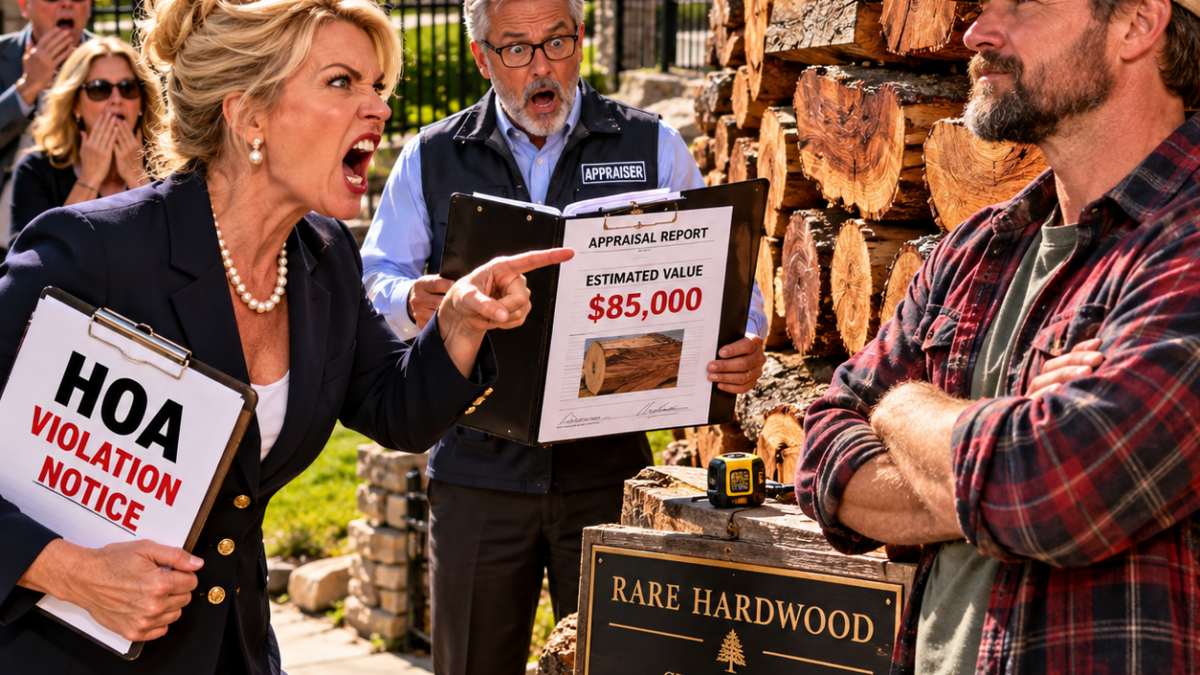
The envelope was white, expensive-looking, and decorated with the Oak Ridge Estates logo in dark green ink. I found it while collecting our mail on Monday morning, less than forty-eight hours after Karen had marched into my driveway and demanded that I remove the woodpile. There was something almost comical about how official it looked, considering the dispute involved nothing more scandalous than a neatly organized supply of firewood behind my house.
I opened it at the kitchen counter while Sarah prepared breakfast.
At the top, in bold capital letters, were the words FORMAL NOTICE OF VIOLATION.
Below them, Karen had listed our offense as “Unapproved Storage of Refuse and Debris.” The description identified the four-cord oak woodpile on the rear portion of our property, with a poorly taken photograph attached as evidence. Whoever had taken the picture had stood at an angle that made the logs appear to be scattered across the yard. The photograph didn’t show the clean space surrounding the stack, the carefully aligned rows, or the fact that the entire arrangement stood well away from neighboring homes.
Then I read the penalties.
An initial fine of $100.
An additional $100 for every day the alleged violation remained uncorrected.
I checked the date on the notice.
Saturday.
The same day Karen had given me until Monday to remove the wood.
She hadn’t even waited for her own deadline.
“You’re kidding,” Sarah said when I handed her the letter.
“I wish I were.”
She read the document twice, her expression growing more incredulous with every line. “She told you Monday. It’s Monday morning. How can we already be fined?”
“That’s an excellent question.”
Sarah looked toward the backyard. “Jack, we’re not going to pay this, are we?”
“Not unless somebody can show me a valid reason.”
I took the notice into my office and placed it beside the HOA rulebook. During my late-night reading, I’d discovered that the association’s governing documents contained a broad provision prohibiting the outdoor storage of unsightly materials. The wording was vague enough that someone determined to cause trouble could interpret almost anything as a violation. But nowhere had I found a specific prohibition against properly stacked household firewood.
That distinction mattered.
Our house had a working fireplace. Preparing fuel for winter was an ordinary use of residential property, not some commercial storage operation. The oak had come from two trees removed by a licensed professional after an arborist determined they posed a serious safety risk. We had followed the required removal procedures and kept the documentation.
I drafted a response that afternoon.
I identified the relevant section of the HOA rules, described the purpose of the woodpile, and explained that the material was neither garbage nor abandoned debris. I noted that the wood had been cut into uniform sixteen-inch lengths and stacked near the rear boundary of our property. I attached a copy of the tree-removal documentation and requested that the board identify any provision specifically prohibiting domestic firewood storage.
I also disputed the fine because it had been assessed before Karen’s stated deadline had expired.
Sarah read the letter over my shoulder.
“That’s very polite,” she said.
“I can make it less polite.”
“Don’t you dare.”
I smiled.
She rested her chin on my shoulder. “I just don’t want us spending our retirement fighting somebody who has nothing better to do.”
“Neither do I.”
“Then why do I get the feeling you’re preparing for a battle?”
I turned toward her. “Because I don’t think she wants an explanation. I think she wants obedience.”
Sarah sighed.
She knew me well enough not to argue with that distinction.
I made copies of the letter, signed the original, and walked across the street. Karen’s house was easily the most elaborately landscaped property in our cul-de-sac, with decorative stone borders, ornamental shrubs, and a collection of weathered garden figures arranged across the front lawn. A concrete birdbath stood near the walkway, its rim cracked and its bowl stained dark green.
I noticed the irony immediately.
The woman threatening me over appearances had several faded decorations that, by her own interpretation of the nuisance rules, could easily have been considered unsightly.
I didn’t knock. I placed my letter in a sealed envelope and secured it to her front door where she would find it, then returned home.
As I crossed the street, I noticed an elderly man watching from the house beside Karen’s.
He was standing behind his front window.
When our eyes met, he gave me a small nod.
At the time, I didn’t think much of it.
Later, I’d come to understand that the gesture meant far more than I realized.
Karen’s response arrived by certified mail two days later.
I knew something was wrong before I finished opening it.
She had returned my original letter, but nearly every paragraph was covered in red ink. Words were underlined. Sentences were circled. Entire sections had been dismissed with angry handwritten comments.
Next to my explanation that the logs were firewood, she’d written:
TRASH IS TRASH.
Beside my request for a specific prohibition, she’d scribbled:
ARTICLE IV, SECTION 2. BOARD DISCRETION.
Under the paragraph describing our right to reasonable use of our property, she’d written:
NOT YOUR DECISION.
I stood at the kitchen counter and stared at those three words.
Not your decision.
The house belonged to Sarah and me. We paid the mortgage, property taxes, and insurance. We maintained the yard, repaired the fences, and had paid thousands of dollars to remove trees that might otherwise have fallen on the roof during a storm.
Yet Karen appeared to believe that becoming HOA president gave her the final word over every ordinary decision we made.
The accompanying letter stated that our appeal had been denied by the architectural review committee.
Our accumulated fines were now listed at $300.
And then came the sentence that changed the entire nature of the dispute.
If the woodpile was not removed within seven days, the association would hire a contractor to remove the material at our expense and pursue a lien against our property for the removal charges, fines, and related costs.
A lien.
On our home.
I read that paragraph slowly.
Then I sat down.
Over the course of my military career, Sarah and I had lived in more temporary housing than I cared to remember. We had rented small apartments near bases, squeezed our belongings into government quarters, and endured moves that seemed to come just when we’d finally gotten comfortable.
There had been birthdays I missed.
Anniversaries celebrated over grainy video calls.
Christmas mornings when Sarah opened presents alone because I was thousands of miles away.
Every time she complained about another move, I’d made the same promise.
“One day, we’ll have a house nobody can make us leave.”
Oak Ridge was supposed to be that house.
We had searched for months before finding it.
Sarah loved the big kitchen window overlooking the backyard. I loved the fireplace, the workshop, and the trees. We talked about having friends over for Thanksgiving, growing vegetables, and finally unpacking the boxes we’d kept sealed through half a dozen moves.
The day we received the keys, Sarah stood in the empty living room and cried.
Not loudly.
She simply turned toward me, smiled through her tears, and whispered, “We’re home.”
Now a woman across the street was threatening to place a legal claim against that home because she disliked our firewood.
I folded the letter carefully.
Sarah entered the kitchen.
“What’s wrong?”
I handed it to her.
She read the first page.
Then the second.
When she reached the lien threat, her face went pale.
“Can she actually do that?”
“Not simply because she says so. There are legal requirements.”
“But could this affect our house?”
“If she tries to enforce an invalid fine or record a lien, we’ll have to challenge it.”
Sarah looked toward the backyard.
“I can’t believe this is happening.”
Neither could I.
She placed the letter on the counter and looked at me with an expression I hadn’t seen since my last deployment.
Fear.
Not fear of Karen herself.
Fear of losing the ordinary, peaceful life we’d worked so hard to build.
That was when my frustration hardened into something more determined.
I took Sarah’s hands.
“Listen to me. We’re not losing this house over a stack of oak.”
She nodded, but her eyes remained worried.
“And we’re not going to let her take the wood either.”
“Jack, is it really worth all this?”
I looked through the window.
The oak stood in its carefully arranged rows, catching the afternoon sunlight.
For weeks, splitting and stacking those logs had given me a sense of peace I hadn’t felt in years.
Some mornings I would go outside before Sarah woke up, make a cup of coffee, and work quietly for an hour. There was no schedule except the one I set myself. No sudden orders. No deployment briefing. No pressure to be ready to leave home at a moment’s notice.
Just the repetitive, satisfying work of turning fallen trees into something that would serve our family.
I turned back to Sarah.
“It’s not just about the wood anymore.”
She held my gaze.
“I know.”
The following morning, I began documenting everything.
I photographed the woodpile from the street, the sidewalk, the driveway, and every reasonable angle around our property. I measured the length, height, and depth of the stack and recorded its distance from the house and the nearest boundary. I took close-up photographs of the cut ends, the stacking pattern, and the clean ground surrounding it.
I even photographed the arborist’s report and removal permits beside the logs.
Then I created a digital folder containing every notice Karen had sent.
Each photograph was dated.
Every letter was scanned.
Every conversation I could accurately remember was written down.
I had learned years earlier that when a dispute becomes serious, the person with the best evidence usually has a significant advantage over the person with the loudest voice.
Karen had plenty of volume.
I intended to have the evidence.
While reviewing the photographs, another question occurred to me.
How much was the wood actually worth?
I knew seasoned oak could be expensive. I’d spent enough time comparing firewood prices to understand that four cords represented a substantial amount of winter fuel. But I hadn’t seriously considered the market value of the entire stack.
I called three local firewood suppliers.
Each provided a price range for properly seasoned hardwood.
The amounts were higher than I expected but not extraordinary.
Then I contacted a specialty lumber dealer who supplied material to furniture makers and woodworking shops.
His name was Robert.
I explained that the wood came from large, mature red and white oak trees, that the logs had been carefully selected and processed, and that I wanted to establish a defensible value for the material.
He asked several questions about the condition, size, and quality of the pieces.
Then he asked me to send photographs.
I emailed a selection.
About an hour later, my phone rang.
“Mr. Turner?”
“Speaking.”
“This is Robert from the mill.”
“Did you get the pictures?”
“I did. And I have to ask you something.”
“Go ahead.”
“Why are you planning to sell all that oak?”
“I’m not.”
He laughed. “Good. Because some of those pieces deserve a better future than a fireplace.”
I frowned.
“What do you mean?”
“You have some very nice material there. The white oak in particular looks promising. If the pieces are sound and suitable, certain specialty buyers would pay significantly more for selected stock than an ordinary firewood dealer would.”
I leaned back in my chair.
“How much more?”
“That depends on a physical inspection and what can actually be recovered or used. A stack like yours isn’t automatically worth furniture-grade prices, but I wouldn’t call it trash.”
I looked at Karen’s letter lying beside the computer.
“Neither would I.”
Robert offered to inspect the material and prepare a written valuation distinguishing ordinary fuel value from the potential specialty value of selected oak.
I accepted.
He arrived the following afternoon with a moisture meter, measuring tools, and a notebook.
For nearly two hours, he examined the wood.
He checked representative pieces, studied the grain, and separated the logs that appeared suitable for specialty uses from those better suited for firewood.
He asked about the original trees.
I showed him photographs taken before they were removed.
“Beautiful trees,” he said quietly.
“They were.”
“Always a shame when they have to come down.”
“Believe me, we didn’t want to lose them.”
Robert stood beside the stack and looked toward the house.
“At least you’ve done something useful with them.”
That meant more to me than he knew.
Before leaving, he explained that his appraisal would reflect the unusually favorable qualities of the selected material, the potential market for specialty hardwood pieces, and the remaining firewood value, rather than assuming every log could be sold as premium woodworking stock.
I appreciated the distinction.
I didn’t need an inflated number.
I needed a credible professional assessment.
Two days later, his signed report arrived.
I opened the attachment.
Read the description.
Reviewed the calculations.
And stopped at the final estimate.
$22,000.
Just over twenty-two thousand dollars in total appraised potential value.
I sat motionless.
Then I called Robert.
“Are you certain about this?”
“I’m comfortable with the valuation under the conditions described in the report. Remember, that’s an appraisal based on appropriate specialty buyers and the usable condition of the material, not a promise that a firewood yard will hand you that amount tomorrow.”
“I understand.”
“But if you’re asking whether it should be treated as worthless debris, the answer is absolutely not.”
I thanked him and ended the call.
Then I stared at the number again.
Twenty-two thousand dollars.
Karen wanted to send a crew onto our property and haul away an asset that, according to a specialist, had a potential value comparable to a substantial home improvement project.
I knew she’d recently renovated her kitchen.
The neighborhood newsletter had included a photograph from a charity gathering at her house. She’d proudly displayed her new granite countertops, stainless steel appliances, and custom cabinets.
I had no idea what she’d actually paid for the renovation, but the irony was impossible to ignore.
The wood she considered worthless could be worth more than the impressive kitchen she loved showing off.
Sarah came into the office.
“Why are you smiling?”
I turned the screen toward her.
She leaned closer.
Then her mouth fell open.
“Jack.”
“I know.”
“Twenty-two thousand dollars?”
“That’s what the appraisal says.”
She looked toward the window.
“That pile of logs?”
“That pile of logs.”
She sat down beside me.
For a moment, neither of us spoke.
Then Sarah began laughing.
It started softly.
Within seconds, she was laughing so hard she had to cover her mouth.
I started laughing too.
After days of anxiety, it felt good.
But the laughter didn’t last.
Sarah looked at the report again.
“What if she’d actually had it removed?”
I thought about that.
A contractor might have hauled the material away without understanding its value.
The wood might have been sold, burned, dumped, or damaged.
And Karen had threatened to bill us for the privilege.
My smile disappeared.
“That’s why we’re not waiting for her next move.”
The elderly man who had watched me deliver the first letter was named George Henderson.
He lived directly beside Karen.
I found that out when I was checking the association’s online property directory.
George was a retired history professor who had lived in Oak Ridge for more than thirty years.
His name appeared in old neighborhood newsletters, usually beside photographs of community cleanups, historical presentations, and charity drives.
He seemed like a man who knew the neighborhood well.
And his knowing nod from the window had stayed in my mind.
Sarah baked a loaf of sourdough bread the next afternoon.
I wrapped it, walked down the street, and rang George’s doorbell.
He opened the door almost immediately.
Before I could introduce myself, he smiled.
“You’re the woodpile fellow.”
I laughed.
“Apparently, that’s my reputation now.”
“Come inside. I’ve been wondering when you’d stop by.”
His house felt lived in.
Bookshelves covered two walls of the living room.
Old photographs stood on a side table.
A wooden clock ticked above the fireplace, and the air carried the faint smell of coffee and old books.
George accepted the bread with genuine pleasure.
“Your wife made this?”
“She did.”
“Then I already like her.”
He poured us coffee.
After a few minutes of ordinary conversation, I explained what had happened with Karen.
George listened without interrupting.
When I reached the lien threat, he shook his head.
“There it is.”
“What?”
“Her favorite weapon.”
He set down his cup.
“Karen doesn’t usually start with anything dramatic. She begins with a warning. Then a fine. Then another letter. Eventually she convinces people the only way to have peace is to give her what she wants.”
“How long has she been doing that?”
“About ten years.”
I looked at him.
“Ten?”
“Long enough that people have forgotten what this place felt like before she took over.”
George leaned back.
“I’ve watched her chase good families out of arguments they never wanted. I’ve seen neighbors stop speaking to one another because they were afraid somebody would report them for a harmless violation.”
He told me about a military family whose children had a brightly colored swing set.
Karen disliked the colors.
She claimed the equipment violated the neighborhood’s exterior appearance standards.
The family received notices, attended meetings, and spent months arguing.
Eventually, exhausted by the dispute, they removed it.
“Those children cried,” George said.
His voice changed.
“I watched their father dismantle that swing set piece by piece. The poor man looked as though somebody had made him tear down their Christmas tree in July.”
I thought about Sarah and our house.
George continued.
Then there was an elderly widow who planted vegetables in her front yard.
She had a small patch of tomatoes, peppers, and herbs.
Her husband had loved gardening before he died.
After his death, tending the plants gave her a reason to get outside each morning.
Karen decided the garden wasn’t aesthetically acceptable.
“She fined that woman until she removed almost everything,” George said.
I felt my jaw tighten.
“Over vegetables?”
“Over control.”
He looked toward his front window.
“That’s what you’ve got to understand about Karen. The rules aren’t the point. Being able to make other people obey is the point.”
I thought about the faded decorations in Karen’s yard.
“Does anyone ever challenge her?”
“A few have tried.”
“What happened?”
“Most gave up. Some moved. Others decided it was easier to pay the fines.”
George sighed.
“Fear can make reasonable people accept unreasonable things.”
He was quiet for a moment.
Then he looked at me.
“You’re not planning to give in, are you?”
“No.”
“Good.”
I showed him the letters, photographs, and appraisal.
He studied the report carefully.
When he reached the final figure, his eyebrows rose.
“Twenty-two thousand dollars?”
“According to the specialist.”
George whistled.
“Well, Karen certainly picked the wrong pile of wood.”
I smiled.
“That’s what I’m starting to think.”
He returned the report.
“There’s a family you should speak to. Tim and Jessica Miller. Three doors down.”
“What happened to them?”
George looked sad.
“Their two little girls drew pictures on the driveway with sidewalk chalk last summer. Rainbows, flowers, animals. Ordinary children’s drawings.”
I waited.
“Karen called it graffiti.”
I stared at him.
“You’re joking.”
“I wish I were.”
“She fined them?”
“Two hundred dollars.”
I slowly shook my head.
George leaned forward.
“Jack, if you challenge her, do it properly. Don’t just fight for your own woodpile. Make sure everybody understands what she’s been doing.”
I thought about the frightened expression on Sarah’s face when she read the lien threat.
Then I imagined how Tim and Jessica must have felt receiving a $200 fine because their daughters had drawn rainbows on the driveway.
George reached across the table and placed his hand over mine.
“People here are tired of being afraid. They just need someone to show them they’re not alone.”
I left his house carrying far more than information.
I carried the uncomfortable realization that our argument was part of something much larger.
Karen hadn’t suddenly become unreasonable when we moved into Oak Ridge.
She’d been unreasonable for years.
She’d just finally chosen someone who refused to be frightened into silence.
The Millers lived in a pale-blue house near the end of the street.
There were children’s bicycles beside the garage and a small basketball hoop near the driveway.
When I rang the bell, a woman in her late thirties opened the door.
“Can I help you?”
“Are you Jessica Miller?”
“Yes.”
“I’m Jack Turner. I live across the street from Karen.”
Her expression changed immediately.
“Oh.”
That single word told me almost everything I needed to know.
I explained that George had suggested I speak with her about an HOA dispute.
Jessica glanced behind her.
“My husband’s home, but we’re not really looking to get involved in anything.”
“I understand,” I said. “I’m not asking you to fight anybody. I just wanted to hear what happened if you’re comfortable telling me.”
She hesitated.
Then Tim appeared behind her.
“What’s going on?”
Jessica explained.
He studied me for a moment.
“You’re the guy with the firewood.”
I smiled.
“Apparently everyone knows.”
Tim didn’t smile back.
“Karen’s been talking about you.”
“I’m sure she has.”
He looked toward the street.
“Listen, we paid our fine. We don’t want more trouble.”
I nodded.
“Then I won’t put you in that position.”
I handed him a card with my phone number.
“If you ever want to talk, give me a call. That’s all.”
I left without pressing further.
Three days later, Tim sent me a message.
Can we meet somewhere outside the neighborhood?
We met at a small public park.
Tim and Jessica arrived together.
Their daughters were staying with Jessica’s mother.
Tim looked tired.
Jessica seemed nervous.
We sat at a picnic table beneath a large maple tree.
For a few minutes, nobody spoke.
Then Jessica reached into her bag and removed a folded notice.
“Last summer, our oldest daughter turned seven,” she began.
Her voice was quiet.
“She wanted to have a little art party with her sister. We bought sidewalk chalk, and they spent the afternoon drawing on our driveway.”
She handed me a photograph.
Two little girls smiled beside an enormous chalk rainbow.
There were butterflies, hearts, flowers, and a crooked drawing of a dog.
The picture was so ordinary, so unmistakably innocent, that I struggled to imagine anyone being offended by it.
Jessica continued.
“Karen came by that evening. She said the drawings made the neighborhood look messy.”
Tim looked down.
“I told her they were washable. It was supposed to rain the next day.”
“She said that wasn’t the point,” Jessica whispered.
I almost laughed at how familiar the words sounded.
Karen seemed to have one answer for everything.
That isn’t the point.
Jessica opened the violation notice.
Two hundred dollars.
The stated offense was unauthorized markings on exterior residential surfaces.
“Did you appeal?” I asked.
Tim nodded.
“She told us the board had already decided.”
“Did you attend a hearing?”
“No. We were told there was nothing to discuss.”
“Did you pay?”
Jessica’s eyes filled.
“We couldn’t afford to keep fighting. We just paid it.”
She wiped her cheek.
“Our youngest asked why the lady across the street hated her pictures.”
I felt something tighten in my chest.
“What did you tell her?”
Jessica looked at the photograph.
“I told her some people don’t like colors.”
For several seconds, none of us spoke.
Then Tim looked at me.
“We bought this house because we thought it would be a good place to raise our daughters.”
“So did we,” I said quietly. “Not the daughters part. But the good place to live.”
Jessica gave a small, sad laugh.
“We’ve talked about moving.”
“Because of Karen?”
“Because it never ends,” Tim said. “You never know what she’s going to complain about next. You start checking everything before you do it. You wonder whether your trash can is visible, whether the kids’ toys are in the wrong place, whether somebody will report you because the grass grew an extra inch.”
He looked at his wife.
“It’s exhausting.”
I understood that feeling more than he knew.
For twenty years, my work had involved rules, inspections, schedules, and consequences.
But those rules existed for a purpose.
They were supposed to protect lives and make difficult operations safer.
Karen seemed to have turned the idea of rules into a permanent excuse to control people.
“I can’t promise this will be easy,” I told them. “But I can promise that I’m not going to surrender just because she’s loud.”
Tim looked at me.
“What are you planning?”
“First, I’m going to challenge the fines and the lien threat through an attorney. Then I’m going to make sure the rest of the board sees the evidence.”
Jessica frowned.
“Will that actually work?”
“I don’t know yet.”
I didn’t want to give them false confidence.
“But I do know something. Karen has spent years making people feel as though they’re alone. If everyone she’s mistreated starts speaking honestly, she won’t be able to pretend this is just one unreasonable homeowner complaining.”
Tim looked at the photograph of his daughters.
Then he folded it carefully.
“If there’s a meeting, we’ll be there.”
Jessica nodded.
“And we’ll tell them what happened.”
I shook Tim’s hand.
“That’s all I’m asking.”
Driving home, I realized the case file on my desk no longer represented only our property dispute.
It contained the beginning of a record of what Karen had done to an entire neighborhood.
And the more people I spoke with, the more convinced I became that she had grown comfortable exercising power precisely because nobody had ever forced her to justify it.
That was about to change.
I called Dave Rosser the following Monday.
Dave and I had known each other since my time at Camp Lejeune. He’d served as a captain in the Marine Corps Judge Advocate Division, and during those years he’d earned a reputation for being the kind of attorney who could read a fifty-page regulation, identify the one paragraph everybody had overlooked, and use it to dismantle an argument that had seemed impossible to defeat.
After leaving the service, he’d begun working with a veterans advocacy organization that provided affordable legal assistance to former service members and their families.
I hadn’t spoken to him in months.
He answered with the same booming voice I remembered.
“Gunny Turner! I thought retirement had finally swallowed you whole.”
“Not quite.”
“How’s civilian life treating you?”
I glanced at the stack of certified letters on my desk.
“I’ve had better experiences with people shooting at me.”
Dave laughed.
“That bad?”
“I’ve got an HOA president threatening to put a lien on my house over a woodpile.”
There was a pause.
“Say that again.”
“Exactly what you heard.”
“How much wood?”
“Four cords of oak.”
“Is it stacked safely?”
“Neater than my barracks ever were.”
“Is it prohibited by the governing documents?”
“That’s what I’d like you to tell me.”
“All right,” he said. “Start from the beginning.”
For the next half hour, I explained everything.
The diseased trees.
The removal permits.
The work I’d put into preparing the logs.
Karen’s Saturday morning ultimatum.
The violation notice dated before her deadline.
The red-ink response.
The escalating fines.
The threatened lien.
And finally, the professional appraisal.
When I mentioned the $22,000 valuation, Dave stopped me.
“Hold on. Twenty-two thousand?”
“That’s the appraised potential value.”
“Not two thousand two hundred?”
“No.”
“Jack, what the hell kind of firewood are you stacking?”
“The kind Karen apparently wants to throw away.”
Dave burst out laughing.
Then his tone changed.
“All right. Humor aside, that’s a significant asset. We need to examine the valuation carefully, but threatening to seize or destroy valuable private property without proper authority can create serious exposure.”
“That’s what I thought.”
“Send me the governing documents, every notice, every photograph, and the appraisal. I also want the relevant enforcement and hearing procedures.”
I emailed him the files.
He promised to review them.
The following afternoon, he called back.
“Jack, I’ve gone through everything.”
“And?”
“You’re right to challenge this.”
I leaned forward.
“How strong is the case?”
“There’s no simple rule that says every HOA nuisance provision is invalid. These documents can be enforceable. But enforcement has to comply with the governing documents and applicable law, and the association’s authority isn’t unlimited.”
“Which means?”
“Which means Karen’s blanket claim that her own opinion settles the matter is a serious problem. You’ve documented questions about notice, timing, selective enforcement, the basis for the fines, and whether the board properly authorized any threatened removal.”
I looked toward the window.
“Can she put a lien on our house?”
“Whether an assessment or fine can support a lien depends on the law and the association’s documents. She can’t simply create that right because she’s angry with you. We’re going to demand the legal basis for every threat she’s made.”
He paused.
“And I want the rest of the board involved.”
“Why?”
“Because right now, Karen may be controlling what they know.”
I thought about George’s stories.
The widow.
The swing set.
The Millers’ chalk drawings.
“She’s good at that.”
“Then let’s make sure every director receives the complete record.”
Over the next two days, Dave and I prepared a formal notice of dispute.
It was addressed to Karen, the other board members, and the association’s property management company.
The letter challenged the fines and explained why the woodpile did not fit the characterization of abandoned refuse.
It included photographs, measurements, supporting documentation concerning the trees, and the professional appraisal.
It also demanded that the association cease threatening unauthorized entry or removal while the dispute remained unresolved.
Dave made the warning unmistakable.
Any attempt to seize or damage the logs without lawful authority would expose the responsible parties to potential civil liability and could warrant a police investigation.
He also explained that board members owed duties to the association and should not expose homeowners to unnecessary legal costs by acting recklessly or ignoring material facts.
I read that section twice.
“That’s going to get their attention.”
“It’s supposed to.”
“What about Karen?”
Dave chuckled.
“She’s already demonstrated that she doesn’t respond well to being questioned. Our goal isn’t to impress her. It’s to make sure everybody else understands the risk.”
The final demand included cancellation of the fines, confirmation that no contractor would enter our property, and an acknowledgment that the woodpile dispute had been improperly handled.
We also requested a written apology and review of Karen’s role on the architectural committee.
Dave sent the packet by certified mail to every director individually.
That detail mattered.
Nobody could later say Karen had simply forgotten to mention the issue.
The board would have the photographs.
The regulations.
The timeline.
And the $22,000 appraisal.
All of it.
For the next week, the neighborhood was unusually quiet.
Karen stopped approaching me in the driveway.
No new violation notice arrived.
Her curtains remained closed when I worked outside.
Once, while carrying groceries into the house, I saw her watching me from her porch.
I gave a polite nod.
She turned away without acknowledging it.
Sarah noticed the change too.
“Do you think she’s finally backing off?”
“I hope so.”
“But you don’t believe it.”
I looked toward Karen’s house.
“Not yet.”
Dave had warned me that people who built their authority on intimidation sometimes reacted unpredictably when they realized intimidation no longer worked.
And Karen had made it painfully clear that she viewed any challenge to her decisions as a personal insult.
Still, I hoped the involvement of an attorney and the other board members would convince her to reconsider.
I had no desire to spend the next year fighting over firewood.
I wanted to prepare for winter.
I wanted to enjoy the fireplace.
I wanted my wife to feel comfortable walking to the mailbox without wondering what threatening letter might be waiting inside.
For several days, I allowed myself to imagine that the dispute might simply end.
Then the email arrived.
URGENT SPECIAL MEETING OF THE OAK RIDGE ESTATES HOMEOWNERS ASSOCIATION.
The subject was community standards and member compliance.
The agenda contained one principal item.
REVIEW OF ONGOING VIOLATION—LOT 42.
Lot 42 was our house.
I read the notice.
Then forwarded it to Dave.
He called within minutes.
“Well,” he said, “she’s certainly making this interesting.”
“She’s calling a public meeting about my woodpile.”
“Yes, she is.”
“Can she do that?”
“Associations can hold meetings and address compliance matters, subject to their procedures and applicable requirements. But if she’s turning this into a public accusation, we’ll make sure you have an opportunity to respond appropriately.”
I looked at the email again.
“She wants the neighborhood to see me as the problem.”
“That’s my guess.”
“She thinks people will pressure me to give in.”
“Probably.”
I considered the photographs, witness statements, and appraisal already in my possession.
“Then maybe it’s time they see the other side.”
Dave sounded pleased.
“Now you’re thinking.”
Sarah was less enthusiastic.
The evening before the meeting, she stood in the kitchen drying the same plate for so long that I finally took it from her hands.
“You’re going to wear a hole through that thing.”
She gave a nervous laugh.
“I’m worried.”
“I know.”
“What if everybody takes her side?”
“They might not.”
“But what if they do?”
I set the plate on the counter.
She looked at me.
“Jack, Karen knows everyone in this neighborhood. She’s been president for years. We’ve only been here six months. Some of these people probably think we’re troublemakers already.”
I couldn’t dismiss her concerns.
Karen had spent years cultivating the image of a decisive leader who protected the neighborhood from irresponsible homeowners.
She had positioned herself as the guardian of property values.
And I was the new resident supposedly refusing to follow the rules.
Sarah continued.
“I don’t want people whispering about us. I don’t want to feel uncomfortable in our own driveway.”
I took her hands.
“Neither do I.”
“Then why are we going?”
“Because if we don’t answer her accusations, she gets to tell the story however she wants.”
Sarah looked away.
“Maybe we could just move the wood somewhere she can’t see it.”
I didn’t respond immediately.
That possibility had crossed my mind.
In purely practical terms, I might have been able to relocate the logs.
It would have been inconvenient, but not impossible.
But I’d already watched Karen turn a harmless woodpile into a threatened lien.
And George’s stories showed that compliance didn’t necessarily end her demands.
Once a homeowner demonstrated that threats worked, another complaint might follow.
Then another.
Then another.
I pulled out the photograph of the Miller girls standing beside their rainbow.
“Look at this.”
Sarah studied it.
I explained what had happened.
Her expression changed.
“She fined them for that?”
“Two hundred dollars.”
Sarah stared at the little girls.
“Those poor children.”
“George told me about another family who had to remove their swing set. And a widow who lost her vegetable garden.”
Sarah looked up.
“Why didn’t anyone stop her?”
“Because everyone thought they were fighting alone.”
She placed the photograph on the table.
For a long moment, she was quiet.
Then she straightened.
“What time is the meeting?”
“Seven.”
She nodded.
“I’ll be ready at six-thirty.”
I smiled.
“Are you sure?”
“Yes.”
She looked toward the backyard.
“And Jack?”
“Yeah?”
“Don’t let her make you lose your temper.”
I kissed her forehead.
“I won’t.”
The community clubhouse was packed when we arrived.
Every folding chair appeared to be occupied.
People stood along the back wall.
The low sound of conversation filled the room, but it faded noticeably when Sarah and I walked through the door.
Several people looked directly at me.
Others pretended not to notice.
Karen sat behind the board table wearing a dark navy pantsuit. Her hair was rigidly styled, and a neat stack of papers sat in front of her beside the little wooden gavel she liked so much.
When she saw us, her mouth tightened.
I could almost hear her thinking.
Good. The troublemaker showed up.
Sarah squeezed my hand.
I squeezed back.
George was seated near the front.
He waved us over.
“I saved you two seats,” he whispered.
We sat directly in front of him.
A few rows behind us, I saw Tim and Jessica.
Tim gave me a small nod.
Jessica looked pale but determined.
I returned the gesture.
At seven sharp, Karen struck her gavel.
“Order. This special meeting of the Oak Ridge Estates Homeowners Association is now called to order.”
The room settled.
She began with a long statement about neighborhood pride, property values, and the responsibility of every homeowner to preserve the community’s character.
She spoke about standards.
Respect.
Cooperation.
The dangers of allowing one person’s selfishness to undermine the investment of an entire neighborhood.
I listened without reacting.
Then she finally got to the point.
“Unfortunately,” she announced, “we are dealing with a resident who has repeatedly refused to comply with our reasonable community rules.”
Several heads turned toward me.
Karen let the silence linger.
“Mr. Jack Turner, the owner of Lot 42, has maintained an unsightly accumulation of rotting timber on his property despite multiple opportunities to correct the problem.”
I heard Sarah inhale sharply.
Karen continued.
“This pile of debris creates an aesthetic nuisance and raises concerns about the general appearance of our neighborhood. Mr. Turner was politely asked to remove it. Rather than cooperate, he responded with hostility and threatened legal action against this association.”
My jaw tightened.
Hostility?
I had written a respectful request for clarification.
Then hired an attorney only after she threatened to place a lien on our home.
Karen lifted a page.
“This is the letter he sent.”
She held Dave’s formal notice in the air.
“It contains threats against our board members personally. Threats of lawsuits, damages, and even criminal complaints.”
A few residents murmured.
Karen lowered the paper.
“I ask you, is this how a responsible homeowner behaves?”
She looked around the room.
Several people avoided her eyes.
One of her friends nodded emphatically.
Karen continued.
“The board cannot permit individual residents to intimidate us out of enforcing the rules. We must act decisively, or our community standards will become meaningless.”
Then she looked directly at me.
“Mr. Turner, the board is prepared to offer you one final opportunity. You will agree tonight to remove the refuse within forty-eight hours, or the association will proceed with the necessary enforcement measures, including removal and collection of associated costs.”
She folded her hands.
A small smile appeared.
“Do you understand?”
For a moment, I simply looked at her.
She had spent nearly fifteen minutes describing me as a selfish troublemaker.
She had omitted the tree-removal report.
The photographs.
The questionable timing of the initial fine.
The appraisal.
The threatened lien.
Everything that might complicate her narrative.
And now she was presenting her ultimatum in front of an audience she expected to intimidate me.
I rose slowly.
“Yes, Karen. I understand.”
Her smile widened.
“Good.”
“But I think there’s some information everyone here deserves to see before making a decision.”
Her smile disappeared.
“This isn’t a courtroom, Mr. Turner.”
“No, ma’am. It’s a homeowners association meeting. And I’m one of the homeowners.”
A few people shifted in their chairs.
I continued.
“You’ve accused me publicly. I’d like a reasonable opportunity to respond.”
Karen reached for her gavel.
“This board is not obligated to entertain a lengthy argument.”
Before she could strike it, a man seated to her left leaned forward.
His name was Arthur Bennett.
He was another board member, a quiet accountant who had rarely spoken at previous meetings.
“Karen,” he said, “I think we should hear him.”
Her head snapped toward him.
“Arthur, we’ve already reviewed the violation.”
“Have we reviewed his evidence?”
“We’ve reviewed everything necessary.”
Arthur looked at me.
Then back at Karen.
“He’s a member of this association. If we’re discussing enforcement against his home in front of everyone, fairness requires that he be allowed to respond.”
Someone near the back said, “I agree.”
A second voice followed.
“Let him talk.”
Karen’s expression hardened.
For several seconds, I thought she might simply end the meeting.
Instead, she waved her hand.
“Fine. Five minutes.”
“Thank you.”
I walked toward the front of the room carrying a small USB drive.
The clubhouse had a projector connected to a laptop for community presentations.
I’d arranged my evidence into a concise sequence of slides.
“May I use the screen?”
Karen opened her mouth.
Arthur nodded.
“Go ahead.”
I connected the drive.
The projector flickered.
Then the first photograph appeared.
A clear, full-color image of my woodpile.
The entire room could see it.
Neatly stacked oak.
Uniform logs.
Clean ground.
No garbage.
No scattered branches.
No rotting debris.
I turned toward the residents.
“Ladies and gentlemen, this is the pile of trash you’ve been hearing about.”
A few people leaned forward.
Someone near the back said, “That’s it?”
I nodded.
“That’s it.”
The photograph remained on the screen.
“This wood came from two mature oak trees that were removed from our property after a licensed arborist found them dangerously diseased. Instead of paying to discard the timber, I spent weeks processing and preparing it for household use.”
I clicked to the next slide.
The arborist’s report appeared beside the removal documentation.
“We didn’t cut down healthy trees because we wanted an outdoor storage yard. We removed trees that threatened our home.”
I paused.
“Those trees had stood here for generations. My wife and I were heartbroken to lose them. Using their wood to heat our home seemed like a practical way to preserve something valuable from them.”
Several residents nodded.
I looked toward Sarah.
She gave me a small smile.
Then I continued.
“The wood is stacked toward the rear of our property, where it creates no obstruction to public areas. I’ve documented its dimensions, placement, and condition.”
The next slide showed the actual view from the street.
A few people laughed in disbelief.
From that angle, most of the woodpile was barely visible behind the landscaping.
One woman called out, “I drive past your house every day. I didn’t even know you had that much wood!”
I nodded.
“That was precisely my point when I first responded to Karen.”
Karen struck her gavel.
“Mr. Turner, your time is nearly up.”
Arthur looked at her.
“He’s only been speaking for a few minutes.”
“He’s making a presentation, Arthur.”
“Yes,” Arthur replied. “And I think we need to see it.”
The room murmured in agreement.
I clicked to the next slide.
Two photographs appeared side by side.
On the left was my woodpile.
On the right was Karen’s front yard.
Her faded garden gnomes stood beside the cracked concrete birdbath.
I didn’t smile.
I didn’t insult her.
I simply pointed at the images.
“The rule cited in my violation notice concerns unsightly exterior materials. Yet the association has never explained what objective standard makes my neatly stacked firewood unacceptable while other visible exterior items are allowed.”
A small ripple of laughter moved through the room.
Karen’s face reddened.
“Those are decorative lawn ornaments!”
“Yes, ma’am.”
“They’re perfectly acceptable!”
“Then we agree that the appearance of an object is partly a matter of opinion.”
More laughter.
I clicked again.
This time, the screen showed examples of other exterior conditions I’d documented.
A weathered basketball hoop.
A boat stored on a trailer.
Peeling paint on a home belonging to a board member.
A temporary shed that appeared to have remained in place long after its intended use.
I identified no homeowners by name.
Instead, I explained that I had been unable to find evidence of consistent enforcement against comparable exterior conditions.
“I’m not presenting these photographs because I want my neighbors fined,” I said. “I don’t. I’m presenting them because standards should be applied fairly, not used selectively against whoever happens to disagree with the president.”
The room grew quiet.
“Rules are supposed to protect a community. They shouldn’t become weapons against individual families.”
I clicked to the correspondence timeline.
The first document appeared.
Karen’s original notice.
Dated Saturday.
I explained the Monday deadline she’d given me verbally.
Then I displayed my written response.
The wording was courteous and direct.
I read a short section requesting the specific rule that prohibited firewood.
The next slide showed her red-ink annotations.
People began whispering.
One man leaned toward his wife and pointed at the screen.
I could hear him say, “She actually wrote that?”
Karen’s jaw tightened.
I continued.
“The board was told that I refused to cooperate. But this is my written attempt to resolve the situation.”
I displayed the certified letter she’d sent afterward.
The $300 in accumulated fines.
The seven-day removal ultimatum.
And finally, the paragraph threatening a lien against our home.
The laughter stopped.
I looked around the room.
“Some of you may be familiar with property liens. Others may not. But whatever the applicable legal requirements, this is not something homeowners should be threatened with casually.”
I turned toward Sarah.
“My wife and I spent twenty years moving from one military assignment to another. This is the first house we’ve purchased with the intention of staying for the rest of our lives.”
My voice grew quieter.
“She was terrified when she read this letter.”
Sarah looked down.
I continued.
“Not because we’re afraid of following reasonable rules. We want to follow them. But because the association’s president was threatening our home over something she still hadn’t demonstrated was prohibited.”
There was absolute silence.
I let the words settle.
Then I said, “And now I’d like to discuss what Karen has repeatedly described as worthless refuse.”
I pressed the next key.
The screen went dark for a moment.
Then a single number appeared in enormous white letters.
$22,000
Nobody spoke.
I waited.
Then I turned toward the room.
“That is the appraised potential value of the oak Karen wants removed from my property.”
The reaction was immediate.
A woman gasped.
Someone whispered, “Twenty-two thousand dollars?”
A man in the second row actually turned around to see whether anyone else had heard correctly.
I held up Robert’s signed report.
“This is a professional valuation based on the quality of the selected red and white oak, its condition, and its potential uses by specialty buyers. It’s not a guaranteed cash offer, and I’ve never claimed that it is. But it establishes that the material is a valuable asset, not abandoned garbage.”
I turned toward Karen.
“You threatened to send a contractor onto my property to remove this asset at my expense.”
Her expression had changed.
The redness in her cheeks faded.
I continued.
“You also threatened to pursue a lien against our home if we tried to stop you.”
Arthur was staring at the appraisal.
Another board member, Carol, leaned forward.
“Karen, did you know about this valuation?”
Karen opened her mouth.
No words came out.
Carol looked at me.
“Was this information provided to the board?”
“Yes. My attorney sent it to every director.”
Arthur reached into his folder and withdrew a copy.
“I received it.”
Carol nodded slowly.
“So did I.”
I looked toward the audience.
“Imagine someone approaching your property, deciding that something you own is worthless because they don’t like how it looks, and threatening to have it taken away without properly establishing their authority.”
I paused.
“Imagine that property has substantial value.”
Then I looked at Sarah.
“And imagine being told that if you object, your family home could be placed at risk.”
A woman near the back shook her head.
“That’s not right.”
Another resident spoke.
“Why wasn’t the board discussing this before?”
I let the silence continue.
Then I said, “I’m not asking for special treatment. I’m asking for the same thing every homeowner here deserves: fair rules, proper procedures, and respect for our property.”
I could see Karen gripping the edge of the table.
She hadn’t expected this.
She had invited the neighborhood to watch her discipline a troublesome resident.
Instead, she was watching her own conduct appear on the screen, document by document, in front of everyone whose respect she depended on.
And I still had one final point to make.
I looked toward the Millers.
“Tim? Jessica? Would you be willing to tell everyone what happened with your daughters?”
For a moment, neither moved.
Then Jessica reached for her husband’s hand.
Tim stood.
And Karen’s carefully constructed version of Oak Ridge began to collapse.
Tim wasn’t accustomed to public speaking.
His hands trembled as he walked toward the front.
Jessica followed a few steps behind him.
I stepped aside and offered them the microphone.
Tim looked at the room, swallowed, and began.
“Last summer, our daughters were drawing pictures on our driveway with sidewalk chalk.”
There were a few confused expressions.
He continued.
“They were seven and five. They drew rainbows and flowers and a dog. The chalk washed off when it rained.”
He unfolded the notice Jessica had brought.
“Karen fined us two hundred dollars.”
A ripple of shock passed through the room.
Someone asked, “For chalk?”
Tim nodded.
“She called it graffiti.”
Jessica stepped forward.
“Our youngest daughter cried when we told her to stop drawing outside.”
Her voice broke slightly.
“She thought she’d done something wrong.”
I watched several residents look toward Karen.
She sat rigidly behind the table.
Jessica continued.
“We tried to explain that the chalk wasn’t permanent. We tried to resolve it. Eventually, we paid the fine because we were afraid the penalties would keep increasing.”
She looked around the room.
“We’ve talked about selling our house because of things like this. We don’t feel comfortable letting our children play in their own driveway.”
There was silence.
Then George stood.
“I’d like to say something.”
Karen snapped, “Mr. Henderson, this is not an open grievance session.”
George looked at her calmly.
“I’ve lived here thirty years, Karen. I think I’ve earned the right to speak for two minutes.”
Several people nodded.
Arthur gestured toward the microphone.
“Please continue, George.”
George didn’t approach the front.
He stood where he was, leaning lightly on the back of his chair.
“I remember what Oak Ridge was like before people became afraid of receiving violation notices for harmless things.”
His voice was steady.
He described the family who had removed their children’s swing set after months of complaints.
Then he told the room about the widow pressured to dismantle her vegetable garden.
“That woman grew tomatoes because it reminded her of her husband,” George said. “He’d been dead less than a year when the complaints started.”
A woman near the aisle wiped her eyes.
George looked at Karen.
“We used to take care of one another here.”
He paused.
“Somewhere along the way, we started treating our neighbors like problems that needed correcting.”
Karen’s expression twisted.
“This is completely inappropriate.”
But another woman had already raised her hand.
Arthur recognized her.
“Mrs. Patterson?”
She stood slowly.
Her hair was silver, and she leaned on a cane.
“My husband planted a rosebush beside our front walkway the year we bought our house.”
Her voice was soft.
“He died six years ago.”
The room went still.
“I kept the rosebush because it was one of the last things he planted for me.”
She looked down at her hands.
“Karen told me it extended too far beyond the approved landscaping boundary. She said it had to be removed.”
I heard Sarah inhale sharply.
Mrs. Patterson continued.
“I asked if I could trim it. I offered to have it professionally pruned. But the notices kept coming.”
A tear slipped down her cheek.
“Eventually, I had it dug out.”
For several seconds, she couldn’t speak.
Then she whispered, “It never grew back after I moved it.”
I looked toward Karen.
Even now, she seemed more angry about being contradicted than concerned about the woman standing in front of her.
Another resident raised his hand.
Then another.
Stories began emerging from across the room.
A man had been fined because his son’s bicycle remained beside the garage overnight.
A woman had received repeated notices about a decorative bench Karen considered unsuitable.
Another homeowner described being threatened over the color of a replacement mailbox.
Not every complaint was necessarily improper, and I knew a community needed enforceable rules. But the repeated stories painted a disturbing picture of inconsistent decisions, unnecessary hostility, and residents who had felt pressured to accept fines without a meaningful opportunity to be heard.
For nearly fifteen minutes, people spoke.
Some were angry.
Some embarrassed.
Some visibly relieved.
A few apologized for having remained silent when they saw others being targeted.
Sarah reached for my hand.
I sat beside her and listened.
I hadn’t come to the meeting intending to lead a neighborhood revolt.
I’d come to defend a woodpile.
But as I watched people who had barely acknowledged one another begin sharing their experiences, I understood what George had meant.
Fear had kept them isolated.
Now they were discovering they weren’t alone.
Karen’s gavel remained on the table.
Untouched.
For the first time in years, nobody seemed particularly interested in whether she approved of what they were saying.
Arthur finally stood.
He looked exhausted.
He looked angry.
And he looked directly at Karen.
“Did you authorize these penalties without giving the affected homeowners a fair opportunity to challenge them?”
Karen stiffened.
“I enforced the rules.”
“That wasn’t my question.”
Her eyes narrowed.
“Arthur, you’re undermining the board.”
“No,” he said quietly. “I’m trying to understand what the board has been doing.”
Carol leaned forward.
“Karen, did you inform us that Mr. Turner’s wood had been professionally appraised at over twenty thousand dollars before you announced that the association would have it removed?”
Karen looked from Carol to Arthur.
“It’s firewood.”
Carol frowned.
“That isn’t an answer.”
“It’s an ugly pile of logs!”
Arthur placed his hands on the table.
“Karen, we need to stop talking about whether you personally like the wood. We need to know whether the association has valid grounds to threaten a homeowner’s property.”
Karen’s face flushed.
“He threatened us with a lawsuit!”
Arthur held up Dave’s letter.
“He disputed fines and warned us not to seize his property without lawful authority. Given the documentation, that doesn’t appear unreasonable.”
For a moment, Karen seemed genuinely stunned.
She’d spent years surrounded by board members who rarely challenged her decisions.
Now two of them were questioning her in front of the entire neighborhood.
“You’re taking his side?” she demanded.
Arthur shook his head.
“I’m taking the side of doing this properly.”
The four other board members gathered at one end of the table.
They spoke in low voices.
Karen remained seated at the center, furious and increasingly isolated.
Sarah leaned toward me.
“What happens now?”
“I don’t know.”
But I had a feeling things had changed permanently.
After several minutes, Arthur stood.
“The board will suspend all fines against Mr. Turner pending immediate review. No removal action will proceed during that review.”
A murmur of approval spread through the room.
He continued.
“We will also examine the enforcement procedures raised tonight and determine what corrective actions are appropriate.”
Karen slammed her palm against the table.
“You can’t make that decision without me!”
Arthur looked at her.
“You’re one member of this board, Karen. Not the entire board.”
The words hung in the air.
Then Arthur announced the meeting was adjourned.
People began standing.
Several homeowners approached us.
One man shook my hand.
A woman thanked Sarah.
George embraced me with surprising strength.
“You did it, son,” he whispered.
I shook my head.
“We haven’t done anything yet.”
George smiled.
“Oh, yes, you have.”
He gestured toward the room.
“Look around.”
Neighbors were talking.
Not whispering.
Not glancing nervously toward Karen.
Talking openly.
Some were exchanging phone numbers.
Others were asking about the board review.
For years, people had accepted the idea that challenging Karen was dangerous.
That belief had just been shattered.
As Sarah and I walked toward the exit, I glanced back.
Karen was still sitting at the front table.
Alone.
Her hands were clenched.
Her eyes were fixed on me.
And the expression on her face was unlike anything I’d seen before.
It wasn’t ordinary anger.
It was humiliation mixed with hatred.
The look of someone who had lost control in front of the people she most wanted to impress.
I felt an uneasy chill.
Dave had warned me that a bully who lost her audience might become reckless.
Looking at Karen that night, I wondered whether she was already planning something.
I didn’t have to wonder for long.
The next morning, Sarah found me installing a security camera beneath the rear eaves.
She stood in the yard holding a mug of coffee.
“Jack, what are you doing?”
“Improving our security.”
She looked at the camera.
“Because of Karen?”
“Partly.”
“Do you really think she’d come onto our property?”
I tightened the mounting bracket.
“I don’t know what she’ll do. That’s why I want a record if something happens.”
I’d ordered two high-definition cameras after speaking with Dave.
One covered the driveway and front approach.
The other faced the woodpile.
Both had motion recording and night vision.
I tested the cameras carefully, checked the coverage, and made sure the recordings were stored securely.
When I finished, I went inside and called Dave.
“Everything’s installed.”
“Good.”
“Do you think I’m overreacting?”
“After what happened at that meeting? No. But remember, our goal is documentation, not confrontation.”
“I know.”
“Don’t argue with her if she comes around. If she threatens to enter the property, call the authorities. And keep Sarah out of any dispute.”
I glanced toward the kitchen.
She was standing beside the sink, looking through the window at the woodpile.
Her shoulders were tense.
I didn’t like seeing her that way.
She’d spent years carrying the burden of my military career.
When I was deployed, she handled everything alone.
Broken appliances.
Car repairs.
Medical appointments.
Bills.
Unexpected problems that always seemed to happen at the worst possible time.
I used to tell her that one day I would make up for all the years she spent worrying.
And here we were.
Finally retired.
Finally home.
Yet she was still looking out the window as though something bad might happen.
That bothered me more than Karen’s threats ever had.
Two days passed without incident.
The board confirmed in writing that the fines were suspended and no removal was authorized during the review.
I placed the letter in my evidence binder.
Then I went outside and resumed ordinary work around the property.
I repaired a loose section of fencing.
Cleaned the gutters.
Checked the fireplace.
For a few hours, I almost felt normal.
On Thursday evening, Sarah made dinner, and we watched an old movie together.
She fell asleep with her head against my shoulder.
I looked at her and thought about how badly I wanted the conflict to end.
It wasn’t the fines anymore.
It wasn’t even the wood.
It was the way Karen had managed to reach into our home and steal something less visible.
Our peace of mind.
We’d worked too hard to build a quiet life to surrender that peace to someone else’s need for control.
I carefully adjusted the blanket around Sarah.
Then I turned off the television.
Before going to bed, I checked the camera feeds.
The driveway was empty.
The woodpile stood undisturbed.
Across the street, Karen’s house was dark.
I went to sleep hoping the board’s intervention had finally put an end to the matter.
At 5:30 the next morning, my phone rang.
The sound pulled me out of a deep sleep.
I looked at the screen.
George Henderson.
My stomach tightened.
I answered.
“George?”
His voice was low.
“Jack, don’t panic, but there’s a truck outside your house.”
I sat up.
“What kind of truck?”
“A large flatbed. It has a crane on the back.”
I was already getting out of bed.
“Where exactly?”
“Parked near your driveway. Two men are unloading equipment.”
I crossed the room and switched on the security monitor.
The image showed our street in pale gray predawn light.
A heavy flatbed truck stood near the curb.
Its headlights were on.
Two men wearing work clothes were preparing a hydraulic grapple attachment.
Then another vehicle entered the frame.
A Lexus.
Karen’s Lexus.
I stared.
She parked behind the truck and stepped out wearing a dark trench coat.
Even through the camera, I recognized her stiff, furious posture.
She walked directly toward the workers and pointed toward the back of our property.
The woodpile.
My heart began beating harder.
Not from fear.
From disbelief.
“George,” I said quietly, “it’s Karen.”
“I know. I can see her.”
“Call the police. Tell them a contractor appears to be preparing to remove disputed private property despite the board’s written suspension of enforcement.”
“Already calling.”
“Stay inside, George.”
“Jack—”
“I mean it. Don’t confront them.”
I ended the call.
Sarah was awake now.
She sat on the edge of the bed, staring at the monitor.
“What is happening?”
I pulled on jeans and boots.
“Karen brought a removal truck.”
Sarah’s face went white.
“No.”
I checked the camera feed again.
One worker was moving toward the side access to our backyard.
Karen was gesturing impatiently.
“She’s trying to take the wood.”
Sarah stood.
“Jack, please don’t go out there angry.”
I turned toward her.
“I’m not going out angry.”
She looked at me.
I could see she wasn’t convinced.
I crossed the room and took her hands.
“Listen. The cameras are recording. George has called the police. I’m going to tell the workers there’s an active dispute and that I don’t consent to removal. That’s it.”
“What if she starts shouting?”
“Then she can shout.”
“What if they won’t stop?”
“I’ll step away and let the officers handle it.”
Sarah swallowed.
“Promise me.”
“I promise.”
I kissed her forehead.
Then I walked downstairs.
At the front door, I paused.
Through the glass, I could see the bright headlights of the truck.
The street was otherwise quiet.
Most of our neighbors were still asleep.
The air outside was cold and damp.
For a brief moment, I thought about staying inside until the police arrived.
It would have been a reasonable choice.
But one of the workers had already opened the side gate.
They appeared ready to begin setting up equipment.
I didn’t want them unknowingly damaging valuable material in the middle of an unresolved legal dispute.
So I opened the door.
And stepped onto the driveway.
“Good morning, gentlemen.”
My voice carried clearly in the cold air.
Both workers stopped.
One was tall and broad-shouldered, with a heavy beard.
The other had a tattoo visible above his collar.
Neither looked especially pleased to be working before sunrise.
Karen spun around.
Her face changed the instant she saw me.
“What are you doing out here?”
I kept walking until I was standing well clear of the equipment.
“Good morning, Karen.”
She marched toward me.
“You were told to remove that debris!”
I glanced at the truck.
“Are these gentlemen here for the wood?”
She lifted her chin.
“Yes. Since you refused to comply, I made the necessary arrangements.”
“The board suspended enforcement.”
“That board doesn’t understand what’s best for this community.”
I stared at her.
“You’ve ignored the board’s own decision?”
She waved a hand dismissively.
“I am still the HOA president.”
“That’s not what I asked.”
Karen turned toward the workers.
“Don’t listen to him. Continue.”
Neither moved.
I looked at them.
“Gentlemen, I’m Jack Turner. This is my property.”
The bearded man nodded cautiously.
“Okay.”
“The material you’re here to collect belongs to me. It’s the subject of an ongoing legal dispute, and the HOA board has suspended enforcement. I do not consent to its removal.”
Karen made a sharp sound of disgust.
“He’s trying to intimidate you.”
I ignored her.
“Did someone tell you this was an authorized junk-removal job?”
The bearded worker glanced at Karen.
“That’s what we were told.”
“Did anyone mention the legal dispute?”
“No.”
“Or that the wood has a professional appraisal exceeding twenty thousand dollars?”
Both men looked at me.
The tattooed worker frowned.
“Twenty thousand?”
“Twenty-two thousand, approximately, under a specialty valuation.”
He looked toward the woodpile.
Then back at Karen.
“Lady, you told us this was trash.”
“It is trash!” Karen snapped.
I took a copy of the appraisal and the board’s suspension notice from the folder I’d brought outside.
I handed them to the bearded worker.
“You’re welcome to review these before you do anything.”
He glanced at the papers.
Then toward the truck.
“Hold up,” he said to his coworker.
The other man stopped moving the equipment.
Karen stepped forward.
“What’s the problem?”
The bearded worker looked at her.
“Ma’am, we’re not getting involved in some lawsuit.”
“There is no lawsuit!”
I spoke calmly.
“There is a formal legal dispute. And you’ve now been told the owner does not consent to removal.”
Karen’s face flushed.
“Just take the wood!”
Neither worker moved.
She looked from one to the other.
Then she said something that made the entire morning feel unreal.
“I’ll pay you double.”
The bearded worker blinked.
“What?”
“Double your quoted price. Cash if necessary. Load it and get out of here.”
I stared at her.
She was standing on a public street before sunrise, offering additional money to persuade two workers to remove property after its owner had objected and shown them documentation.
It was no longer possible to pretend she simply misunderstood the situation.
The bearded man stepped away from her.
“Ma’am, I need to call my boss.”
Karen nearly shouted.
“You don’t need to call anybody! I’m the president of the homeowners association!”
I looked at the man.
“Please call whoever you need to call. Nobody here wants you caught in the middle of a dispute you weren’t told about.”
He nodded.
Then he took out his phone.
Karen turned on me.
“This is your fault.”
I didn’t answer.
“You’ve made this neighborhood impossible.”
I remained quiet.
“You humiliated me in front of everyone!”
There it was.
For weeks, she’d claimed this was about appearances, rules, and property values.
But standing in the driveway at five-thirty in the morning, she’d finally said what mattered most to her.
Humiliation.
Not safety.
Not compliance.
Not the condition of the wood.
She wanted to punish me because people had questioned her authority.
I looked toward the camera mounted under the eaves.
Its indicator light was on.
Everything was being recorded.
Karen followed my gaze.
For the first time, she noticed it.
Her face changed.
“Are you recording me?”
“Those are security cameras.”
“You have no right!”
“They’re installed on my house.”
She took a step toward me.
“You think you’re so clever.”
I stayed where I was.
“I think you should tell these men to leave.”
“I’ll have your house covered in liens!”
I didn’t respond.
“I’ll make sure every violation is enforced! Every single one!”
“Karen—”
“No! You don’t get to tell me what to do!”
Her voice echoed through the cul-de-sac.
A light came on in the house beside ours.
Then another.
I could see movement behind several windows.
Karen kept shouting.
“I have spent ten years protecting this neighborhood from people like you!”
I looked at her.
“People who keep firewood?”
“People who don’t respect authority!”
A distant siren became audible.
Karen stopped.
For a second, she looked confused.
Then red and blue lights appeared at the entrance to the cul-de-sac.
Two police cruisers turned onto our street.
The first stopped near the flatbed truck.
The second pulled in behind it.
The workers stepped back from their equipment.
Karen looked toward the officers.
Then toward me.
I could almost see her calculating what story she would tell them.
She smoothed her coat.
Straightened her shoulders.
And walked toward the first officer with a bright, artificial smile.
“Officer, thank goodness you’re here.”
The officer who approached us was a tall man with a serious expression.
He looked at the truck.
Then at the crane.
Then at Karen.
“Who’s in charge of this job?”
Karen raised her hand immediately.
“I am. I’m the president of the Oak Ridge Estates HOA.”
The officer nodded.
“And what work is being performed?”
“We’re removing an unauthorized accumulation of debris from a homeowner’s property.”
I remained silent.
Karen pointed toward me.
“This man has been refusing to comply with our community standards. He’s aggressive, uncooperative, and he’s preventing these workers from carrying out an official association action.”
The officer turned toward me.
“Sir, are you the homeowner?”
“Yes. Jack Turner.”
“Did you authorize the removal?”
“No.”
He looked back at Karen.
“Ma’am, is there a court order or other legal authorization permitting you to remove the property over the owner’s objection?”
Karen blinked.
“I’m the HOA president.”
“Do you have documentation authorizing this particular removal?”
She gestured impatiently.
“The association has rules.”
The officer remained calm.
“I’m asking whether you have documentation for this action.”
Karen reached into her purse and pulled out a folded paper.
It was an old violation notice.
She handed it to him triumphantly.
“Right there.”
He read it.
Then looked at me.
“Mr. Turner, do you have anything showing the current status of this matter?”
“Yes, officer.”
I handed him the binder.
Inside were copies of the property documents, correspondence, appraisal, attorney’s letter, delivery receipts, and the board’s written suspension of enforcement.
He reviewed them carefully.
Then he looked toward the second officer.
“Can you speak with the workers and establish what they were told?”
The second officer nodded.
Meanwhile, the first officer examined the suspension notice.
“This says the association suspended enforcement pending review.”
“Yes,” I replied.
“And you informed these workers you don’t consent to the removal?”
“Yes.”
He looked toward Karen.
“Ma’am, can you explain why the truck is here if the association suspended enforcement?”
Karen folded her arms.
“Because the board has become weak.”
The officer blinked.
“I’m sorry?”
“Those people don’t understand the importance of maintaining standards. Mr. Turner manipulated them at a meeting.”
I saw the officer’s expression change slightly.
Not dramatically.
Just the look of someone realizing this situation was less straightforward than he’d expected.
The second officer returned with the two workers.
The bearded man looked uncomfortable.
“We were hired for a junk-removal job,” he explained. “She told us the material was abandoned debris and the association had already approved everything.”
“Did you enter the property?”
“We opened the side gate and started preparing equipment. We hadn’t loaded anything yet.”
The tattooed worker added, “We didn’t know the owner was objecting until he came outside.”
Karen interrupted.
“Because he shouldn’t be objecting!”
The officer raised his hand.
“Ma’am, please let him finish.”
The bearded man continued.
“When he told us there was a dispute and showed us the appraisal, we stopped.”
The officer nodded.
“That’s appropriate.”
Karen’s face reddened.
“Appropriate? These men have a contract!”
“Any contract dispute can be addressed separately,” the officer replied. “But you’re not going to remove disputed property from this residence right now.”
For several seconds, Karen looked as though she hadn’t understood him.
Then she said, “Excuse me?”
“The removal is not proceeding today.”
Karen’s expression twisted.
“You cannot tell me how to run this community!”
“Ma’am, I’m telling you this work needs to stop until the legal authority is clarified.”
She stepped toward him.
“Do you know who I am?”
The officer looked directly at her.
“Yes. You’ve told me.”
A few neighbors had begun emerging from their houses.
George stood on his porch wearing a heavy cardigan.
Tim and Jessica were near their driveway.
Several other residents watched from behind the safety of their front doors.
Karen noticed them.
And something inside her seemed to snap.
She pointed at me.
“This man is destroying the neighborhood!”
I said nothing.
“He has turned everybody against me! He has threatened the board! He’s been going around collecting photographs of people’s houses!”
The officer held up a hand.
“Ma’am—”
“I will not be treated like this!”
Her voice climbed higher.
“I run this association! I’ve kept these people in line for ten years!”
George slowly shook his head.
Karen saw him.
“And you!” she shouted. “You’ve been encouraging him!”
George didn’t respond.
“You’ve always resented my leadership!”
The officer stepped closer.
“Ma’am, you need to lower your voice.”
“Don’t you tell me to lower my voice!”
The street fell silent.
Even the workers stopped whispering.
Karen was standing inches from a police officer, shouting at him while several neighbors watched.
The officer’s tone became firmer.
“You need to step back.”
She hesitated.
Then took a small step away.
He continued.
“You’re not being arrested at this moment, but this situation is becoming disorderly. The removal has been stopped. You need to leave the property area and avoid further confrontation.”
Karen stared at him.
Her mouth opened.
Closed.
Opened again.
For a moment, I thought she might continue arguing.
Then she looked around.
At the officers.
At the workers.
At the neighbors.
At me.
And finally, at the security camera overlooking the driveway.
Her shoulders sagged slightly.
The bearded worker had already begun securing the truck’s equipment.
His coworker was closing the side gate.
Karen looked toward them.
“You’re leaving?”
“Yes, ma’am,” the bearded man replied.
“But I hired you!”
“We’re not taking disputed property. You’ll have to talk to the office.”
He walked away.
Karen stood frozen.
The crane folded back toward the flatbed.
The workers climbed into the cab.
The engine started.
The truck slowly pulled away without a single log.
I watched it disappear around the corner.
Then Karen turned toward me one last time.
There was a look in her eyes that I will never forget.
Not because it frightened me.
Because it revealed how completely she’d misunderstood the situation.
She seemed genuinely unable to comprehend that someone could refuse her instructions and suffer no immediate consequence.
Her lips trembled.
“You’ve ruined me.”
I looked at her.
“No, Karen.”
She waited.
“You made your own decisions.”
Her expression crumpled.
Then she turned away.
She climbed into her Lexus.
The officers made sure the street was clear.
And she drove off.
The sun had barely risen.
The entire confrontation had lasted less than an hour.
But the woman who arrived expecting to haul away my property left with nothing.
No wood.
No victory.
And no audience willing to pretend she was right.
The officer took my statement.
He reviewed the relevant documents and provided an incident number.
He also noted the possible security-camera evidence and advised us to preserve the original recordings.
Before leaving, he looked toward the woodpile.
“That’s what this was all about?”
“Yes, sir.”
He shook his head.
“That’s quite a morning.”
“You can say that again.”
After the police left, George walked across the street.
He looked at the departing cruisers.
Then at me.
“You all right?”
“I’m fine.”
“Sarah?”
“Shaken up.”
George nodded.
“I saw Karen arrive. I knew the truck meant trouble.”
“Thanks for calling.”
He waved the gratitude away.
“Anybody would’ve done it.”
I looked at him.
“Would they?”
George glanced toward the neighboring houses.
For several seconds, he didn’t answer.
Then he smiled faintly.
“Maybe not a month ago.”
I followed his gaze.
Tim was standing beside Jessica.
Another neighbor was talking to the couple across the street.
People were no longer hiding behind their curtains.
They were outside.
Talking openly about what had happened.
George placed a hand on my shoulder.
“Things are changing around here, Jack.”
I looked toward Karen’s empty driveway.
“I hope so.”
Sarah stepped onto the porch.
She wore a sweater over her pajamas.
Her face was pale, but she smiled when she saw George.
“Thank you for calling the police.”
He tipped his head.
“Of course, dear.”
She came down the steps and wrapped her arms around me.
I held her tightly.
For several seconds, we didn’t speak.
Then she whispered, “I thought she was going to take it.”
I looked toward the oak.
“She didn’t.”
Sarah’s grip tightened.
“What if nobody had stopped her?”
I didn’t have a comforting answer.
Instead, I held her until she was ready to let go.
Then we went inside.
I made coffee.
Sarah sat at the kitchen table.
And for the first time in weeks, I noticed how tired she looked.
That realization hurt.
I’d become so focused on building my case that I’d nearly forgotten how frightening the uncertainty had been for her.
I sat across from her.
“I’m sorry.”
She frowned.
“For what?”
“For bringing all this into our lives.”
Sarah reached across the table.
“Jack, you didn’t bring it here.”
I looked at her.
“She did.”
Her voice was soft but firm.
“You defended our home. That’s different.”
I nodded.
She squeezed my hand.
“But I want it to end.”
“So do I.”
“Really end.”
I understood.
She didn’t want another month of certified letters.
Another meeting.
Another confrontation in the driveway.
She wanted the future we’d imagined when we bought the house.
Warm evenings.
Quiet mornings.
Neighbors we could trust.
And a fireplace burning with oak from the trees we’d once loved.
I promised her I would do everything reasonable to bring the dispute to a final resolution.
Then I called Dave.
“She did what?”
Dave’s voice came through the phone so loudly that Sarah heard him from across the room.
“She hired a flatbed truck with a grapple crane.”
“After receiving the board’s suspension?”
“Yes.”
“And she personally directed the workers?”
“Yes.”
“Did they remove anything?”
“No.”
“Was there property damage?”
“Not that I’ve found.”
“Any physical confrontation?”
“No.”
“Police report?”
“Incident number. The report will follow.”
“Video?”
“Every minute.”
There was a long silence.
Then Dave exhaled.
“Jack, preserve those recordings immediately.”
“Already backing them up.”
“Good. Keep the originals. Don’t edit them or post them publicly.”
I looked toward Sarah.
“Understood.”
“And send me copies of the written suspension, your attorney notice, and anything the workers gave you.”
“I will.”
Dave paused.
Then his voice softened.
“How’s Sarah?”
“Not great.”
“I can imagine.”
“She just wants this over.”
“Then we’re going to work toward that. But don’t confuse a dramatic morning with the end of the legal process.”
“I know.”
“We need the board to act. And we need Karen to understand that she can’t keep escalating without consequences.”
I glanced toward the driveway.
“Something tells me the board won’t be happy when they see what happened.”
Dave gave a dry laugh.
“That’s probably an understatement.”
He was right.
By lunchtime, the neighborhood was talking about little else.
George had seen the confrontation from his porch.
Tim and Jessica had witnessed part of it.
Several residents had recorded Karen’s shouting on their phones.
My security cameras had captured the attempted removal and her statements with far greater clarity.
I provided the relevant footage to Dave and the association’s management company so the evidence could be reviewed properly.
Before dinner, Arthur called.
His voice sounded strained.
“Jack, this is Arthur Bennett.”
“Hello, Arthur.”
“I’ve just finished reviewing the materials concerning this morning.”
I waited.
“I don’t know what to say.”
“That’s all right.”
“No, it isn’t.”
He took a breath.
“As a board member, I’m embarrassed. As your neighbor, I’m ashamed this happened.”
I leaned against the kitchen counter.
“You weren’t the one who hired the truck.”
“But we allowed this situation to continue long enough for it to happen.”
He paused.
“Mr. Turner, the board had formally suspended enforcement. Ms. Prescott had no authorization to proceed with that removal.”
“I know.”
“She acted contrary to the board’s decision.”
“Yes.”
Arthur was silent for a moment.
Then he said, “We’re holding an emergency meeting this afternoon.”
I looked at the clock.
“What are you planning?”
“To address the leadership problem we’ve been avoiding for far too long.”
I said nothing.
Arthur continued.
“Whatever action we take, I want you to know that the association will not be pursuing the removal of your firewood.”
I closed my eyes.
For a moment, I thought of Sarah.
Of the fear on her face.
Of the moving boxes we’d unpacked six months earlier.
“Thank you,” I said.
Arthur’s voice grew quieter.
“We should have said that weeks ago.”
He ended the call.
I stood in the kitchen looking at the phone.
Then I walked toward the living room.
Sarah was sitting on the couch.
She looked up.
“Who was that?”
“Arthur.”
“What did he say?”
I sat beside her.
“He says the board’s handling it.”
She studied my face.
“Do you believe him?”
I thought about the meeting.
About the way Arthur had challenged Karen.
About the other directors finally asking questions.
“Yes,” I said.
“For the first time, I do.”
The courier arrived shortly after five the following afternoon.
I had been expecting an email.
Maybe a phone call.
Possibly another formal letter explaining that the board needed more time to investigate.
Instead, a man in a dark jacket walked up our driveway carrying a thick envelope.
“Jack Turner?”
“That’s me.”
“Delivery requiring a signature.”
I signed.
Then I carried the envelope inside.
Sarah stood beside me as I opened it.
The first document was a formal letter from the Oak Ridge Estates Board of Directors.
I read the opening paragraph.
Then I stopped.
Sarah leaned closer.
“What does it say?”
I looked at her.
“They removed Karen.”
She blinked.
“What?”
“Effective immediately. She’s no longer HOA president.”
Sarah covered her mouth.
I continued reading.
Following its emergency review, the board had voted unanimously to remove Karen from the presidency and her committee positions under the association’s governing procedures. The letter explained that her decision to arrange unauthorized removal work after enforcement had been suspended constituted serious misconduct and exposed the association to unnecessary legal risk.
The board also confirmed that every fine and violation notice related to my woodpile had been rescinded.
Permanently.
There would be no removal.
No additional penalties.
No attempt to pursue a lien over the disputed firewood.
And no future enforcement action arising from the notices Karen had issued.
The second document was a written apology.
Not one of those carefully worded statements that says everyone regrets the inconvenience while admitting nothing.
This one acknowledged that our concerns had not been handled properly.
It recognized that the threats of removal and escalating penalties had caused unnecessary distress.
And it confirmed that the association intended to review its enforcement procedures to prevent similar incidents.
Sarah read the letter slowly.
Then she sat down.
For a moment, I thought she was going to cry.
Instead, she started laughing.
I looked at her.
“What’s funny?”
She shook her head.
“She threatened to take our house over a woodpile.”
I sat beside her.
“Technically, she threatened a lien.”
Sarah looked at me.
“Jack.”
“Sorry.”
She laughed harder.
Then tears began rolling down her cheeks.
I wrapped my arms around her.
She leaned against me and whispered, “It’s over.”
I wanted to believe that.
I truly did.
But Karen still lived across the street.
And the events of that Friday morning had left unanswered questions about her conduct.
The board’s decision protected our property from further association enforcement.
It didn’t necessarily resolve what Karen had personally done.
Dave agreed.
When I called him, he congratulated us on the board’s decision.
Then he said, “Now we need to decide what you want to do about Karen herself.”
I sat quietly.
“What are my options?”
“We can review civil claims arising from her conduct and the documented damages. The evidence from the attempted removal is particularly important.”
“Will it mean another long fight?”
“Possibly. But it may also give us a path to a binding settlement.”
I looked toward the living room.
Sarah had fallen asleep on the couch, the board’s apology resting beside her.
For months, I’d been telling myself this dispute was about principle.
And it was.
But now I had another priority.
My wife deserved to feel safe in her own home.
“I don’t want to destroy anybody,” I told Dave.
“I understand.”
“But I don’t want Karen showing up here again, either.”
“Then that’s what we’ll focus on. Finality. Clear boundaries. Appropriate compensation. And enforceable terms where available.”
I thought for a moment.
“All right.”
Dave’s tone became serious.
“Jack, I want to be clear. We don’t pursue unsupported claims merely because we’re angry. We use the evidence and the available legal remedies.”
“Agreed.”
“And if there’s a settlement, it has to be something the parties lawfully agree to.”
“Understood.”
I ended the call.
Then I looked outside at the woodpile.
Four cords of oak.
The same wood Karen had dismissed as garbage.
It was still standing exactly where I’d stacked it.
Not a single log had been taken.
But something about our neighborhood had changed.
The woman who once controlled every board meeting with a wooden gavel no longer held that office.
And the neighbors who had been afraid to challenge her were finally speaking for themselves.
Dave filed the civil action against Karen personally the following week.
The case concerned her individual conduct, including the alleged harassment, the threats directed toward our property, and her attempt to arrange removal of the disputed wood after receiving notice of our objections.
He supported the complaint with the correspondence, witness statements, police documentation, and the security footage.
George provided a statement describing the truck’s arrival and his call to the police.
Tim and Jessica documented what they had observed and their previous experiences with Karen’s enforcement tactics.
Sarah prepared a statement explaining the emotional and financial anxiety the dispute had caused our household.
I hated asking her to relive it.
She sat at the kitchen table one evening with her laptop open, trying to put the experience into words.
After a while, she stopped typing.
“Jack?”
I looked up.
“Yeah?”
“Do you know what the worst part was?”
I pulled out the chair beside her.
“What?”
“It wasn’t the fine.”
I waited.
“It wasn’t even the lien threat.”
Her eyes filled.
“It was realizing that after everything we went through to get here, somebody could still make me afraid to open my own front door.”
I reached for her hand.
She continued.
“When you were overseas, I used to imagine what retirement would be like. I pictured us drinking coffee together every morning. I pictured you working in the backyard. I pictured inviting friends over without worrying about when you’d have to leave again.”
A tear slipped down her cheek.
“I thought the hard years were finally behind us.”
I didn’t know what to say.
For most of my career, I’d thought about the things my deployments had cost me.
The birthdays.
The holidays.
The years away from home.
But Sarah had paid a price too.
She’d spent those years waiting.
Worrying.
Building a life around uncertainty.
And when we finally had the opportunity to live without that uncertainty, Karen had brought a new version of it straight to our door.
“I’m sorry,” I whispered.
Sarah shook her head.
“No. I don’t want you apologizing for protecting us.”
She squeezed my hand.
“I just want our home to feel like ours again.”
I pulled her close.
“It will.”
And this time, I meant to make sure it stayed that way.
Karen’s attorney contacted Dave soon after receiving the complaint.
He wanted to discuss settlement.
Karen initially disputed much of our account.
She insisted she had acted in her official capacity.
She claimed the early-morning removal had been a misunderstanding.
And she argued that the entire dispute had been exaggerated.
The security footage made those arguments difficult to sustain.
It showed her arriving with the truck.
Directing the workers.
Offering to pay them more after they learned the property was disputed.
And threatening further penalties while officers and neighbors were present.
The correspondence established that she’d received our formal objections and the board’s suspension before the attempted removal.
The case had become substantially more difficult for her to defend.
Dave called me after speaking with her attorney.
“They’re interested in settling.”
“Good.”
“But Karen is objecting to some of the proposed conditions.”
“Which ones?”
“The restrictions on future contact and association leadership. And the proposed agreement concerning her residence.”
I understood.
I had no desire to control where another person lived simply because I disliked her.
But I also understood why Sarah felt uncomfortable sharing a street with someone who had repeatedly threatened our property and arrived before dawn with a removal crew.
Dave explained that a negotiated agreement could include mutually accepted terms about contact, neighborhood governance, and relocation, provided the parties voluntarily agreed to them and the arrangement complied with applicable law.
It wasn’t something we could simply impose because Karen had behaved badly.
I considered that carefully.
Then I asked Dave to pursue the strongest reasonable protections for Sarah and me, without turning the case into a personal vendetta.
The settlement discussions continued.
Karen resisted.
Then, as the evidence was exchanged and the prospect of further litigation became more concrete, her position changed.
Eventually, her attorney advised her to accept a negotiated resolution.
The final agreement addressed our documented legal costs and a modest damages payment.
It required Karen to avoid further harassment or unauthorized interference with our property.
She agreed not to seek another leadership position within the Oak Ridge association.
And, as part of the negotiated resolution, she committed to selling her house and relocating within six months.
I signed only after Dave had reviewed every provision.
Then I took the agreement home to Sarah.
She read it carefully.
When she reached the section about Karen moving, she looked up.
“She’s really leaving?”
“That’s what she agreed to.”
Sarah set the pages down.
For a moment, she simply sat there.
Then she whispered, “Maybe we can finally start living here.”
I smiled.
“That’s the plan.”
Three months later, a FOR SALE sign appeared in Karen’s front yard.
I noticed it one morning while carrying the recycling bin to the curb.
The sign stood beside the cracked birdbath she’d once defended so fiercely.
I stared at it for a moment.
Then I continued with my chores.
There was no celebration that day.
No gathering in the street.
No shouting from neighbors.
But over the following weeks, I noticed something interesting.
People seemed lighter.
Residents began spending more time outside.
Conversations lasted longer.
Children played without their parents constantly glancing toward Karen’s house.
George started sitting on his porch again.
Tim and Jessica planted flowers along their walkway.
Mrs. Patterson began planning a new rose garden.
It was as though the neighborhood had been holding its breath for years and was finally beginning to exhale.
The day Karen’s moving truck arrived, I was working in the backyard.
I heard the engine and looked toward the street.
Men carried boxes from her house.
Furniture followed.
Then lamps.
Decorations.
Large framed mirrors.
At one point, I saw Karen standing near the truck.
She looked smaller somehow.
Not physically.
Just less imposing.
Without her title, without the board’s authority, and without a room full of people afraid to contradict her, she was simply another person moving out of a house.
She noticed me watching from my driveway.
For a moment, our eyes met.
I didn’t smile.
I didn’t wave.
I didn’t make some grand gesture of victory.
I just looked at her.
Then I turned and went back to work.
There was nothing left to say.
She had once stood on our property and threatened to take something that belonged to us.
Now she was leaving the neighborhood where she’d spent ten years telling others how they were allowed to live.
I didn’t need to humiliate her.
Her own decisions had already cost her more than any argument I could have won.
By evening, the moving truck was gone.
The house across the street was empty.
And when Sarah came outside to sit beside me on the porch, we watched the sunset without once mentioning Karen’s name.
Arthur was elected the new HOA president shortly afterward.
His first community meeting was nothing like Karen’s.
There was no threatening speech.
No public accusation against a homeowner.
No dramatic use of the gavel.
Instead, Arthur began by acknowledging that the association needed to rebuild trust.
He explained that the board was reviewing its enforcement procedures and financial practices.
Residents would receive clearer explanations of alleged violations.
Disputes would be considered through a transparent process.
Standards that depended too heavily on personal opinions would be clarified.
And homeowners would have meaningful opportunities to raise concerns without fear of retaliation.
The architectural review committee was reorganized into a more cooperative group focused on practical improvements rather than punishment.
When Arthur finished speaking, several residents applauded.
I looked at Sarah.
She was smiling.
For the first time since we’d moved to Oak Ridge, attending an HOA meeting didn’t feel like preparing for an argument.
It felt like participating in a community.
Afterward, Arthur approached me.
“Jack, I wanted to thank you.”
I shook my head.
“You don’t need to.”
“I do.”
He glanced toward the room.
“We’d gotten comfortable letting one person make decisions for everybody. Some of us knew things weren’t right, but we didn’t want conflict.”
“Nobody enjoys conflict.”
Arthur nodded.
“That’s true. But avoiding conflict isn’t always the same thing as doing the right thing.”
I looked toward George, who was talking with Tim and Jessica.
“Sometimes it takes a while for people to realize that.”
Arthur smiled.
“Well, we’re learning.”
I shook his hand.
“That’s all anybody can ask.”
The next summer, something happened that made me happier than any settlement check ever could.
I was cleaning my truck when I noticed bright colors spreading across the Millers’ driveway.
At first, I couldn’t tell what was happening.
Then I saw their daughters.
They were sitting on the concrete with enormous boxes of sidewalk chalk.
Pink.
Blue.
Yellow.
Purple.
Green.
Every color imaginable.
They’d drawn a huge rainbow stretching across the driveway.
Flowers covered the edges.
A sun with a smiling face shone above a crooked little house.
One girl was working on a butterfly.
The other was drawing what appeared to be a dog with six legs.
I stood beside my truck and smiled.
Jessica noticed me.
“Morning, Jack!”
“Morning!”
She gestured toward the driveway.
“What do you think?”
I walked over.
“It’s beautiful.”
The youngest girl looked up.
“That’s our dog.”
I studied the drawing.
“Very impressive.”
“He has extra legs because he’s super fast.”
“That makes sense.”
Her sister held up a piece of blue chalk.
“Want to draw something?”
I hesitated.
Then I sat on the driveway beside them.
I hadn’t drawn with sidewalk chalk in decades.
The little girl handed me a piece of yellow chalk.
“What are you going to make?”
I thought for a moment.
Then I drew a small campfire.
It wasn’t particularly good.
The flames looked like crooked triangles.
The logs resembled brown rectangles.
But the girls seemed delighted.
“That’s your wood!” the younger one exclaimed.
I laughed.
“Yes, ma’am. That’s my wood.”
Tim came outside carrying lemonade.
He looked down at the drawings.
Then at me.
“I think the neighborhood’s getting more colorful.”
“Looks that way.”
Jessica joined us.
For a moment, she stood looking at her daughters.
Then she said something quietly enough that only I could hear.
“They don’t ask whether they’re allowed to draw anymore.”
I looked at her.
Her eyes were wet.
“Thank you, Jack.”
I shook my head.
“You and Tim helped make that happen.”
She looked toward the girls.
“Maybe.”
Then she smiled.
“But you were the first one who stood up.”
I looked back at the chalk drawings.
A few months earlier, those same children had been afraid of getting their parents fined for making pictures.
Now they were laughing in the sunshine, covering the driveway with color.
That was worth more to me than watching Karen lose her position.
Because it meant something had genuinely changed.
At the next neighborhood barbecue, Arthur even displayed a photograph of the chalk mural on the community bulletin board.
No fine.
No warning.
Just a picture of two smiling little girls and the words:
OAK RIDGE SUMMER ART DAY.
Sarah framed a copy for our kitchen.
Every time I saw it, I smiled.
About a year after Karen first threatened my woodpile, I received a call from a local furniture maker.
His name was Daniel Mercer.
He specialized in custom rustic furniture and had heard about the unusual oak collection through someone at the specialty lumber mill.
“Mr. Turner, I’m told you have some very nice seasoned white oak.”
“I have a fair amount.”
“Would you mind if I took a look?”
I remembered Robert’s appraisal.
“Not at all.”
Daniel arrived the following Saturday.
He was a tall, soft-spoken man who seemed more comfortable talking about wood grain than people.
He spent nearly an hour examining selected logs, checking their condition and discussing what could realistically be made from them.
Then he straightened.
“You’ve got some beautiful pieces here.”
“That’s what Robert told me.”
“He was right.”
Daniel explained that he was developing a line of custom rustic furniture and wanted distinctive oak for several projects.
He wasn’t interested in the entire stack.
Only selected pieces that met his requirements.
He asked whether I would consider selling approximately one-third of the wood.
I hesitated.
I’d spent so much time defending those logs that selling them felt strangely personal.
Daniel seemed to understand.
“There’s no pressure,” he said. “I know this material came from trees that meant something to you.”
I nodded.
“They were the first thing we loved about the property.”
He looked toward the backyard.
“Then maybe some of them should become something that lasts.”
That sentence stayed with me.
I thought about the trees as they’d once stood.
Their branches stretching over the grass.
The shade they’d provided.
The way Sarah had stood beneath them on the day we viewed the house and said, “Can you imagine living here?”
I looked back at Daniel.
“What kind of furniture?”
“Tables. Benches. Cabinets. Custom pieces.”
I smiled faintly.
“Something people might pass down?”
“Exactly.”
I walked over to the woodpile and rested my hand against one of the logs.
For a moment, I imagined it becoming a table in somebody’s dining room.
A place where families gathered for birthdays.
Where children did homework.
Where grandparents shared stories.
The trees couldn’t stand in our backyard anymore.
But perhaps pieces of them could become part of someone else’s home.
“All right,” I said. “Let’s talk.”
We negotiated a fair price for the selected material.
Daniel inspected the pieces before finalizing the purchase, and the payment reflected the specific wood he could use rather than simply treating the entire stack as ordinary firewood.
When the sale was complete, I stared at the amount.
It covered the original cost of removing the dangerous trees.
It also reimbursed what we’d spent on the remaining legal expenses after the settlement contributions.
And there was enough left over for a vacation.
A real vacation.
Not a military move.
Not a rushed trip between obligations.
Just Sarah and me going somewhere because we wanted to.
When I told her, she sat down laughing.
“You’re telling me Karen tried to make us pay to throw away something that just paid for a vacation?”
“Pretty much.”
She shook her head.
“I almost feel bad for her.”
I raised an eyebrow.
“Almost?”
Sarah smiled.
“Very almost.”
Then she looked toward the backyard.
“You know what the best part is?”
“What?”
“Those trees are still taking care of us.”
I looked at her.
And suddenly, the money felt like the least important part.
Because she was right.
The trees had sheltered our home for generations before we arrived.
When disease forced us to remove them, their wood became a source of warmth.
And now selected pieces would become furniture that could last for years.
The same material Karen wanted treated as garbage had found another purpose.
I couldn’t have imagined a more satisfying answer to her claim that it was worthless.
That winter, we held our first big neighborhood bonfire.
It was Sarah’s idea.
We used a portion of the ordinary firewood remaining from the oak stack, carefully choosing logs intended for burning rather than the specialty material Daniel had purchased.
The evening was cold.
The sky was clear.
Stars shone above the dark trees beyond our backyard.
I prepared the firepit before our guests arrived.
Sarah made hot cider, chili, and cornbread.
George brought a bottle of good bourbon.
Arthur arrived carrying folding chairs.
Tim and Jessica came with their daughters, who immediately asked whether they could roast marshmallows.
Mrs. Patterson brought homemade cookies.
A few other neighbors joined us.
Soon the backyard was filled with conversation and laughter.
I lit the fire.
The oak caught slowly.
Then the flames rose, orange and gold, sending warmth into the cold night air.
For a while, I simply watched.
The logs settled.
Sparks lifted toward the stars.
And the familiar scent of burning oak drifted across the yard.
I thought about the day Karen first stood in my driveway.
The way she pointed at the woodpile.
The contempt in her voice.
The confidence with which she’d threatened our home.
I remembered Sarah’s fear.
The certified letters.
The $22,000 appraisal.
The tense board meeting.
The frightened families who finally found the courage to speak.
The flatbed truck arriving before sunrise.
And the flashing police lights illuminating our quiet street.
It was difficult to believe all of it had begun with firewood.
George lowered himself into a chair beside me.
“Beautiful fire,” he said.
“Thank you.”
He held his hands toward the warmth.
“Your oak?”
“Some of it.”
He smiled.
“Karen would’ve hated this.”
I laughed.
“Probably.”
George looked around the yard.
The Miller girls were giggling as they tried to keep their marshmallows from catching fire.
Arthur was telling Sarah a story.
Mrs. Patterson was describing the new roses she’d planted near her walkway.
For a long moment, George said nothing.
Then he looked at me.
“You know what I miss most about being young?”
I smiled.
“What?”
“Not the energy. Not the hair.”
He chuckled.
“I miss how easy it used to be to make friends.”
I glanced toward the others.
George continued.
“When my wife was alive, this neighborhood used to have gatherings like this all the time. Backyard dinners. Holiday parties. People helping each other when storms came through.”
His voice softened.
“After she died, I stopped hosting things. Then Karen took over, and everybody seemed to retreat behind their front doors.”
I looked at him.
“I didn’t know.”
He nodded.
“Most people didn’t.”
For a moment, he watched the flames.
Then he said, “This is the first time in years I’ve felt like I live in a neighborhood instead of a collection of houses.”
I didn’t trust myself to answer immediately.
Instead, I reached for the bourbon bottle.
Poured two small glasses.
And handed one to him.
“To better neighbors,” I said.
George raised his glass.
“To better days.”
We drank.
Across the fire, Sarah looked at me and smiled.
It was the kind of smile I’d imagined during my final years in the Marines.
Relaxed.
Unworried.
Home.
Later that evening, after the children had gone inside to warm up, Sarah joined me beside the fire.
She slipped her hand into mine.
“Remember when we first saw this house?”
I nodded.
“Of course.”
“You told me we’d spend winter evenings out here.”
“That’s right.”
She looked around the yard.
“I don’t think either of us imagined this many people.”
I smiled.
“No.”
Sarah leaned against my shoulder.
“But I like it.”
“So do I.”
We sat in silence for a while.
Then she said, “Do you ever wish you’d just moved the wood when Karen first complained?”
I considered the question.
There had been moments during the dispute when I’d wondered whether the fight was worth the stress.
Moments when the paperwork seemed endless.
When legal bills arrived.
When Sarah looked frightened.
When I woke up wondering what Karen would do next.
But looking around our backyard that night, I knew the answer.
“No,” I said quietly.
Sarah looked at me.
“Why not?”
“Because moving the wood wouldn’t have fixed what was wrong.”
She nodded slowly.
I continued.
“Karen would’ve found something else. And the Millers would’ve kept worrying about their daughters drawing outside. George would’ve kept watching everything from his window. Mrs. Patterson might never have felt comfortable planting roses again.”
Sarah looked toward the fire.
“And now?”
I watched the Miller girls return with fresh marshmallows.
Arthur was laughing at something George had said.
Mrs. Patterson was showing Jessica photographs of her flowers.
“Now people aren’t afraid to be neighbors.”
Sarah rested her head against my shoulder.
“Then I suppose it was worth it.”
I kissed her hair.
“Yeah.”
We stayed outside long after most of our guests had gone home.
The fire gradually settled into glowing coals.
The air grew colder.
Sarah brought out one last cup of coffee for each of us.
At the far edge of the yard, the remaining oak stood neatly stacked.
Still orderly.
Still useful.
Still exactly where it belonged.
I thought about everything that wood had become.
A symbol of the life Sarah and I were trying to build.
An object of Karen’s obsession.
A twenty-two-thousand-dollar revelation.
Evidence in a dispute that exposed years of intimidation.
A source of beautiful material for a local craftsman.
And finally, the warmth that brought our neighbors together on a winter evening.
Karen had looked at those logs and seen worthless debris.
She believed that because she disliked something, she had the authority to order its destruction.
She believed that threatening fines and legal consequences would frighten us into surrendering something we had every reason to preserve.
And she believed nobody would challenge her.
She was wrong about all three.
I never celebrated the idea of another person losing her home or position.
Those were serious consequences, even when someone brought them upon herself.
But I didn’t regret defending my family.
I didn’t regret asking for evidence.
I didn’t regret insisting that rules be applied fairly.
And I certainly didn’t regret refusing to let Karen turn our retirement into another exercise in fear.
Because in the end, the outcome was bigger than any appraisal.
The wood remained ours.
The unreasonable fines disappeared.
Our home was protected.
The neighborhood changed.
And Sarah finally had the peaceful life I’d promised her.
I looked at the last glowing embers.
Then at our house, its windows shining warmly against the winter darkness.
After twenty years of deployments, temporary addresses, and promises made across thousands of miles, I was exactly where I wanted to be.
Home.
Beside the woman who had waited for me through every difficult year.
Surrounded by people who had become genuine friends.
Warming ourselves with oak from the trees we’d once loved.
Karen thought she could teach me a lesson about obedience by threatening to take my woodpile.
Instead, she taught the entire neighborhood something far more important.
A person’s home should never become somebody else’s kingdom, and no amount of authority gives a bully the right to take what isn’t theirs.
As the last flames settled, Sarah squeezed my hand and whispered, “I’m glad you didn’t let her take it.”
I looked at the woodpile, then at the friends still laughing beside the fire.
“So am I,” I said.
Because Karen had threatened to haul away what she called a worthless pile of dead trees—but in the end, that wood helped us reclaim something no amount of money could ever buy.
Our peace. Our dignity. And the feeling of finally being home.
THE END.