PART 2: HOA Karen Stole My Gate Remote—She Didn’t Know I Could Trace Every Move She Made
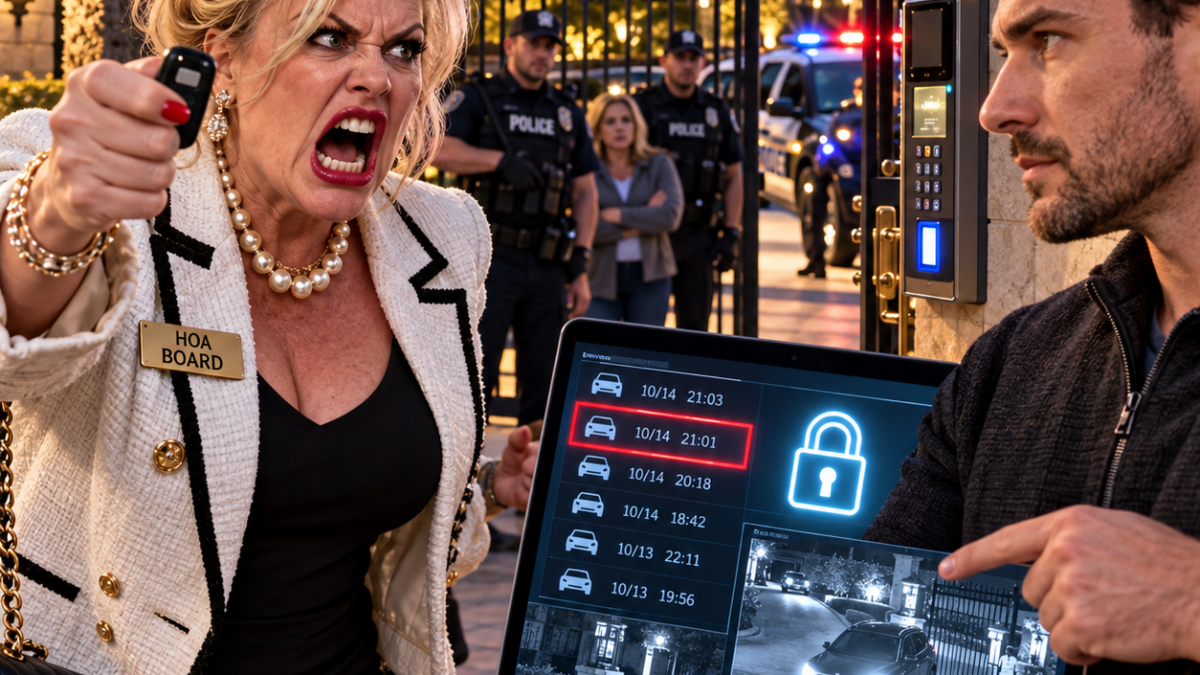
—
PART 2
—
I sat inside the truck for another minute after saving the note.
Not because I was unsure what to do.
Because I knew exactly what not to do.
Anger makes people generous with mistakes.
It gives the other side screenshots, witnesses, recordings, and sentences they can quote without context.
Karen had spent years provoking people and then pointing at their reaction as proof that she had been right to target them.
I wasn’t going to give her that gift.
I took three photographs from inside my truck.
The closed entrance gate.
The gate display showing normal operation.
My dashboard clock.
Then I sent Sarah a message.
**Locked out by HOA. I’m okay. Walking in. Explain when I get home.**
There was a pedestrian access path around the far edge of the development, inconvenient but legal, so I left the truck on the public road and walked.
Twenty minutes later, I opened our front door.
Sarah was standing in the hallway wearing sweatpants and one of my old Army shirts.
“Where is the truck?”
“Outside the gate.”
“What?”
She had been worried when she first saw me.
Now she looked angry.
I told her everything.
The trash-can violation.
The changed access.
Karen waiting beside the gate.
The remote.
Sarah stared at me.
“She reached into the truck?”
“Yeah.”
“And took it?”
“Yeah.”
“Call the police.”
“I will.”
“Will?”
“I want to document the access denial first. And I want the HOA formally notified before Karen has time to rewrite what happened.”
Sarah knew me well enough to recognize the tone.
“Oh, no.”
“What?”
“You have that face.”
“What face?”
“The face you used when our bank website charged us twice and you discovered their payment processor had been configured wrong.”
“That was different.”
“You wrote them a fourteen-page report.”
“It was thirteen.”
She closed her eyes.
“Jack.”
I smiled.
“I’m not doing anything stupid.”
“Define stupid.”
“Anything illegal.”
“Good start.”
I put my hands on her shoulders.
“This matters.”
Her anger faded slightly.
“I know.”
“No, I mean beyond the remote. An HOA president shouldn’t be able to decide someone can’t reach their house because she’s angry over garbage cans.”
Sarah glanced toward the front door.
“We moved here for peace.”
“I remember.”
Our first two years in Oak Creek had been mostly peaceful.
Karen had always been irritating, but irritation was manageable.
When we bought the house, Oak Creek looked like exactly what we wanted after fifteen years of military life and six moves.
Quiet streets.
Tall trees.
A preserved woodland behind our backyard.
A pool we rarely used.
Lawns trimmed enough to make the place look cared for but not sterile.
Sarah opened a flower shop downtown.
I moved into cybersecurity consulting and infrastructure security.
For the first time in our marriage, we had started putting things in closets without wondering whether we’d be packing them again eighteen months later.
Then Karen began tightening her grip.
Our burgundy front door became “unapproved pigmentation.”
The portable basketball hoop our nephew used became “temporary athletic equipment visible from common areas.”
Sarah’s azaleas became “nonconforming vegetation.”
Each issue was small enough that fighting seemed ridiculous.
That was the trick.
Two hundred dollars wasn’t worth hiring a lawyer.
Repainting a door wasn’t worth spending three evenings at HOA meetings.
Moving a basketball hoop wasn’t worth a war.
So people complied.
And every time they complied, Karen learned the same lesson.
Pressure worked.
The next morning, I sent a factual email to the entire board.
Not Karen alone.
Every director.
I stated that at approximately 11:47 p.m., my gate credentials had ceased functioning and Karen Miller had personally informed me that she had suspended my access due to an HOA violation.
I stated that she had then reached inside my vehicle and taken the physical remote assigned to my household.
I requested immediate restoration of access, return of the device, preservation of all gate-access records, and written identification of the bylaw allegedly authorizing denial of ingress to an owner-occupied residence.
No insults.
No threats.
Just facts.
Then I filed a non-emergency police report about the remote.
The officer was careful.
“This may end up being considered a civil property dispute.”
“That’s fine.”
“You understand we’re not going to arrest an HOA president over a gate opener.”
“I’m not asking you to.”
“What are you asking for?”
“A report number showing I documented what happened the morning after it happened.”
He studied me.
“You work in law?”
“Cybersecurity.”
He nodded as if that explained everything.
“Yeah. That makes sense.”
The police report became evidence number two.
Evidence number three came from the HOA itself.
At 2:14 that afternoon, Karen responded to my email.
Her message was almost a gift.
**Mr. Reed, your gate privileges will remain suspended until all outstanding fines are paid and you attend a community standards remediation meeting. The Board has broad authority to restrict amenity access in response to continuing violations. Your remote remains HOA property and will not be returned until compliance is achieved.**
I read it twice.
Then forwarded it to my personal evidence archive.
Sarah came into my office carrying coffee.
“Good or bad?”
“Very good.”
“She’s still locking us out.”
“Yes.”
“Then how is it good?”
“Because yesterday she could have claimed the remote malfunctioned and I misunderstood her.”
“And now?”
“Now she put everything in writing.”
Sarah handed me the coffee.
“She really doesn’t know what you do for a living, does she?”
“No.”
Oak Creek’s entrance system wasn’t mysterious technology.
It was an access-control platform.
Like most access systems, it generated administrative records.
The important question wasn’t how I could get into it.
The important question was how I could legally force the HOA to preserve and produce its records.
So I read.
The covenants.
The bylaws.
The published architectural rules.
The fine schedule.
The annual budgets.
The state statutes governing common-interest communities.
By Saturday, I had learned two things.
First, the HOA had explicit authority to suspend recreational amenities after proper notice.
Pool access.
Clubhouse reservations.
Tennis courts.
Nothing I found gave Karen clear authority to physically deny a homeowner vehicle access to the private road leading to his residence.
Second, homeowners had broad inspection rights over association records, including operational contracts and certain system records connected to HOA expenditures and governance.
That interested me.
The following Monday, I submitted a formal preservation and inspection request.
I requested:
Board minutes authorizing my access suspension.
The rule granting the board power to revoke residential gate access.
Communications relating to the decision.
Vendor records associated with the gate system.
Administrative access logs covering the week of the incident.
Invoices.
Contracts.
Financial statements.
And three years of vendor-payment records.
Sarah read the last section.
“Three years?”
“Yes.”
“For the gate?”
“For everything.”
She leaned against the desk.
“You’re widening this.”
“Karen controls the HOA because nobody knows what it does.”
“You’re going to find out.”
“I’m going to ask.”
“And if they refuse?”
I smiled.
“Then I document that too.”
The refusal arrived forty-eight hours later.
Karen called the request “harassing, overbroad, and unrelated to the underlying compliance matter.”
I responded by quoting the HOA’s own transparency provision.
No argument.
Just the section number.
That evening, my neighbor Dave knocked on the door.
Dave was sixty-four, retired from running an auto repair shop, and had the build of someone who had spent forty years lifting objects the manufacturer specifically recommended using equipment for.
“Heard Karen locked you out.”
“News travels.”
“She told Linda at book club you verbally threatened her.”
I stared at him.
“What?”
“Apparently you ‘used military intimidation tactics.'”
“I told her good night.”
Dave grinned.
“Terrifying.”
I invited him inside.
When I explained what actually happened, the humor left his face.
“That woman tried to fine me five hundred dollars over an oil spot.”
“I remember.”
“Then she told me which pressure-washing company I should use.”
“Which company?”
“Evergreen Property Services.”
Something in the name caught my attention.
“Is that the company that does the common-area landscaping?”
“Think so.”
“Who owns it?”
“No clue.”
I wrote the name down.
Dave raised an eyebrow.
“You collecting enemies?”
“Data.”
“Worse.”
Two days later, Sarah called me into the kitchen.
She had searched the state’s public corporate registry.
Evergreen Property Services was registered to David Miller.
Karen’s brother-in-law.
That did not prove corruption.
Relatives could legally do business with an HOA.
But conflicts had to be disclosed.
Competitive bidding rules had to be followed if the governing documents required them.
Board members generally could not treat association money like a family checking account.
So we looked for disclosures.
There were none.
Dave started talking to neighbors.
Not campaigning.
Talking.
That was enough.
Mrs. Gable, an elderly widow, had received a $300 penalty for a ceramic garden gnome.
The Chungs had been fined because their daughter drew chalk flowers on the driveway.
A couple with a newborn had received a noise-warning notice after someone complained about nighttime crying.
A retired teacher had been threatened over a bird feeder.
And in case after case, when landscaping corrections were demanded, Evergreen appeared somewhere in the paperwork as a recommended vendor.
I built a spreadsheet.
Resident.
Violation.
Date.
Fine.
Appeal result.
Recommended contractor.
Board vote.
Karen involvement.
Pattern recognition is one of the least glamorous parts of cybersecurity.
Movies make the job look like people typing furiously in dark rooms while impossible graphics move across six monitors.
Most real investigations involve spreadsheets.
Logs.
Timestamps.
Boring records that become terrifying when arranged correctly.
Karen had spent years treating every victim as an isolated event.
Once I put everyone on the same timeline, the isolation disappeared.
Then the HOA finally produced records.
Not willingly.
Their attorney sent a carefully worded message explaining that certain responsive materials would be made available to avoid unnecessary dispute.
Sarah and I went to the clubhouse.
Karen was waiting.
So were two other board members.
Dr. Lewis, a dentist who looked as though he’d rather perform six root canals without anesthesia than sit through the meeting.
And Harold Banks, a retired insurance salesman who never disagreed with Karen in public.
Banker’s boxes covered a table.
Karen looked at my laptop bag.
“No electronic copying of confidential materials.”
I placed a printed copy of the inspection provision on the table.
“It allows reproduction.”
Her jaw tightened.
“You have two hours.”
“That’s enough.”
Sarah handled finances.
I handled governance and system documentation.
We worked quietly.
The Evergreen contract was worse than I expected.
No competing bids.
Automatic annual renewal.
Large increases.
Broad descriptions such as “specialized grounds enhancement” and “seasonal aesthetic services.”
Then Sarah touched my arm.
“Jack.”
She pointed to an invoice.
Administrative consulting.
$4,750.
Vendor: KMS Community Solutions LLC.
Another invoice.
$3,200.
Another.
$5,100.
“What’s KMS?”
“Don’t know.”
She wrote it down.
Twenty minutes later, she found a tax document with an address.
Karen’s home address.
Sarah slowly looked at me.
“KMS.”
I understood.
Karen Miller’s maiden name, according to a public record we had already seen during corporate research, began with S.
KMS.
A company receiving “consulting fees” from the HOA she controlled.
Still not proof of criminal conduct.
But enough to demand answers.
Then I found the gate vendor invoice.
I requested the associated administrative report.
Karen objected.
“That contains sensitive security information.”
“I requested the audit log, not passwords or configuration credentials.”
“We don’t provide that.”
Dr. Lewis shifted uncomfortably.
I looked at him.
“The association’s own preservation policy says system records connected with a homeowner dispute must be retained.”
He stared at Karen.
“You told me there wasn’t a log.”
The room changed.
Karen snapped, “I said there was no relevant log.”
Dr. Lewis swallowed.
“That’s not what you said.”
I said nothing.
I didn’t need to.
Sarah looked down so Karen wouldn’t see her smile.
The gate vendor ultimately provided a sanitized audit export after the HOA attorney became involved.
And there it was.
A timeline.
My remote functioning normally for years.
Then an administrative credential associated with the president’s authorized account initiating a system-wide credential update shortly before I arrived.
My failed entry attempts.
Karen’s credential successfully opening the gate later that night.
No interpretation required.
Just time.
Action.
Account.
Result.
The most powerful evidence is often the evidence that doesn’t need adjectives.
I printed the log.
Placed it inside a clear sleeve.
Then sat in my office looking at it.
Sarah stood behind me.
“So that’s it?”
“For the gate.”
“She deliberately changed it.”
“Yes.”
“Can she deny it?”
“She can deny anything.”
“But?”
“But denying this means explaining why the system says her administrative account made the change.”
Sarah sat on the corner of my desk.
“You look disappointed.”
“I am.”
“Why?”
“I wanted there to be some explanation where she was just incompetent.”
“Why?”
“Because incompetence can be fixed.”
“And this?”
I tapped the page.
“This was intentional.”
The recall provision required signatures from twenty-five percent of homeowners.
Oak Creek had 120 homes.
Thirty signatures.
At first, thirty felt impossible.
Karen had conditioned people well.
Privately, they complained.
Publicly, they lowered their heads.
Then we hosted a neighborhood meeting at our house.
We expected fifteen people.
Forty arrived.
Sarah made coffee.
Dave brought folding chairs.
People stood in the hallway.
I began with one rule.
“No rumors.”
Everyone looked at me.
“If we can’t prove it, we don’t say it.”
Dave raised his beer.
“Cybersecurity church is in session.”
People laughed.
The tension broke.
Then I showed them the records.
Not every allegation.
Only documented facts.
Payments to Evergreen.
Relationship to Karen.
Lack of visible competitive bidding documentation.
Payments to KMS Community Solutions.
The address connected to Karen.
The patterns of selective enforcement.
And finally, my gate.
I projected the audit timeline.
“This is the part that brought me here.”
Mrs. Gable stared at the screen.
“She really locked you out?”
“Yes.”
“Over garbage cans?”
“Yes.”
A younger homeowner shook his head.
“That’s insane.”
“No.”
I looked around the room.
“That’s the point. It’s not insane if nobody stops you.”
Silence.
“Karen didn’t wake up one morning believing she could block a homeowner from reaching his house. She learned she could push further every time somebody decided fighting wasn’t worth it.”
I pointed toward Mrs. Gable.
“Three hundred dollars for a garden ornament.”
Toward the Chungs.
“Driveway chalk.”
Toward Dave.
“An oil stain.”
Then at myself.
“A trash can, followed by losing access to my own street.”
I lowered my hand.
“Individually, every fight feels too small.”
I changed the slide.
The financial totals appeared.
“Together, they’re a system.”
Nobody spoke for several seconds.
Then Mrs. Gable walked to the table.
“Where do I sign?”
We got thirty-eight signatures that night.
The special recall meeting had to be held within fifteen days.
Karen responded exactly as people like Karen always respond when fear stops working.
She used more fear.
Violation notices appeared everywhere.
Dave’s American flag was supposedly the wrong size.
Mrs. Gable received a warning for “vegetation accumulation.”
The Chungs were cited for a basketball hoop visible through a garage window.
One resident received a complaint about a decorative wreath.
The retaliation was so obvious it became funny.
Dave called me.
“Congratulations.”
“For what?”
“Karen just got us four more signatures.”
But she saved her worst move for me.
Three days before the recall meeting, Sarah called while I was at work.
“Jack.”
I stood immediately.
Something in her voice was wrong.
“What happened?”
“The truck is gone.”
“What?”
“Your truck. It’s not in the driveway.”
For half a second, my brain refused to understand.
“Was it stolen?”
“I called the police.”
“And?”
“Towed.”
I closed my eyes.
“By who?”
“Karen complained.”
The towing notice identified my personal Ford F-150 as an impermissible commercial vehicle.
The theory rested on a small consulting-company decal on the rear window.
It was absurd.
I retrieved the truck.
Four hundred twenty-five dollars.
Then went directly to town hall and obtained the ordinance Karen had cited.
My vehicle didn’t meet the defined commercial classification.
Not close.
I obtained the incident report.
Complainant:
Karen Miller.
HOA President.
Sarah stared at the paperwork that evening.
“She knew the recall meeting was coming.”
“Yes.”
“So this was punishment.”
“Probably.”
“You sound calm.”
“I am calm.”
“No, you’re doing that thing where calm gets scary.”
I laughed once.
Then looked at the towing receipt.
“You know what the problem with abusing systems is?”
“What?”
“Systems generate records.”
The night of the recall meeting, the clubhouse was packed.
I had never seen that many Oak Creek residents in one place.
People stood along the back wall.
Others crowded near the doors.
Karen sat at the head table wearing a navy pantsuit and an expression that tried very hard to look contemptuous instead of afraid.
She struck the gavel.
“This meeting has been called in response to a defamatory petition organized by a resident who has demonstrated open hostility toward community rules.”
Dave leaned toward me.
“Strong opening. Very Nixon.”
Sarah elbowed him.
Karen continued.
“Mr. Reed will be given a limited opportunity to make his allegations. I remind everyone that unsupported personal attacks will not be tolerated.”
I stood.
Connected my laptop to the projector.
Walked to the front.
For fifteen years, I had briefed people who outranked me about communications systems they didn’t understand.
I learned early that volume does not equal authority.
So I spoke quietly.
“Tonight isn’t about whether anyone likes Karen Miller.”
The room settled.
“It’s not about whether you like me.”
I changed the slide.
“It’s about records.”
The first section covered enforcement.
Names.
Dates.
Fines.
Contradictory approvals.
Photos.
Board correspondence.
Mrs. Gable’s gnome got the first laugh.
The baby’s noise warning got none.
The second section covered my gate.
I showed Karen’s email confirming she suspended access.
Then the police report confirming I reported the remote taken.
Then the vendor-supplied audit timeline.
I highlighted four entries.
Normal access.
Administrative change.
My repeated failures.
Karen’s successful access.
“This system records events automatically,” I said.
“The relevant vendor report shows an administrative action associated with the president’s account shortly before I arrived home. Minutes later, my credential stopped working.”
Karen shifted.
I continued.
“The following day, the president confirmed in writing that my access had been intentionally suspended.”
Next slide.
Her email filled the screen.
A murmur moved through the room.
I looked toward the homeowners.
“The issue isn’t technology. The technology only preserved what happened.”
Then the towing report.
My truck.
The ordinance.
The definition Karen had relied upon.
The actual legal definition.
The receipt.
“$425.”
I paused.
“That is what retaliation cost my family that afternoon.”
Karen shouted, “You violated the commercial vehicle rule!”
I turned toward her.
“The municipal ordinance says otherwise.”
“Your truck advertises a business.”
“The ordinance doesn’t classify vehicles based on decals.”
She opened her mouth.
I raised the police report.
“And this records who made the complaint.”
Someone behind me said, “Jesus.”
I changed slides.
Now money.
The clubhouse became completely still.
Evergreen Property Services.
Invoices.
Payments.
Vendor ownership.
Family relationship.
Then KMS Community Solutions.
Consulting payments.
Corporate address.
Karen’s address.
Three years of questionable spending.
The number on the screen exceeded $150,000.
I was careful.
“Let me be precise. I am not standing here declaring every dollar criminal.”
Karen laughed sharply.
“Because you know this is slander.”
I looked at her.
“I’m saying these transactions require an independent audit.”
The laughter stopped.
“Any innocent board should want that.”
Silence.
“Any honest board should insist on it.”
Then Dave called from the audience.
“Let’s audit it.”
Several voices answered.
“Yes.”
“Audit it.”
Karen slammed the gavel.
“Order!”
I looked directly at her.
“For years, every homeowner here had to prove themselves innocent to you.”
I pointed toward the financial records.
“Tonight we’re asking the board to prove it handled our money honestly.”
The room erupted.
Karen stood.
“This is a coordinated campaign by a disgruntled hacker!”
There it was.
“Hacker.”
She pointed at me.
“He claims he has system logs that he never should have seen! This man works in cybersecurity. How do we know he didn’t manufacture everything?”
Mr. Henderson, a retired attorney who had begun helping the recall group, stood.
“Madam President.”
“What?”
“The gate report displayed tonight bears the vendor’s certification information.”
Karen froze.
He continued.
“And the correspondence produced with it came through association counsel.”
The room quieted.
Karen looked toward Dr. Lewis.
He wouldn’t look back.
She had assumed my technical background made the evidence suspicious.
What she didn’t understand was that my technical background was why I insisted the evidence come through lawful channels.
Chain of custody.
Independent source.
Verifiable timestamps.
Not because I wanted to look clever.
Because I knew exactly what she would accuse me of.
I smiled slightly.
“Cybersecurity isn’t about breaking systems, Karen.”
She glared at me.
“It’s about proving what happened when somebody misuses one.”
That line ended the argument.
Mr. Henderson invoked the recall procedure.
Karen was entitled to respond before the vote.
She straightened.
For one strange moment, I almost felt sorry for her.
Then she began talking.
She blamed residents.
She blamed increasing maintenance costs.
She blamed “entitled newcomers.”
She called the Evergreen arrangement efficient.
She claimed KMS compensated her for administrative labor the board would otherwise have paid an outside company to perform.
Then she said something that destroyed whatever support remained.
“Do you people have any idea how much work I’ve done for you?”
The room went silent.
She continued.
“I have spent ten years keeping property values up while half of you complain about basic standards.”
Mrs. Gable’s face hardened.
Karen pointed at the audience.
“You think neighborhoods like this maintain themselves? You think you deserve everything I created while constantly fighting me?”
Created.
That word mattered.
Oak Creek wasn’t hers.
She had forgotten that.
Dave said quietly, “There it is.”
Karen heard him.
“What?”
“You think you own us.”
Her face flushed.
“I have sacrificed more for this community than you ever—”
“No,” Dave said.
“You managed it.”
He looked around the room.
“We own it.”
Applause started.
Then spread.
Karen shouted over it.
“This is a mob!”
Mr. Henderson stepped forward.
“No. It’s a vote.”
The recall began.
One hundred residents were represented in person or by valid proxy.
Karen needed only enough uncertainty to survive.
She didn’t get it.
The first ten votes were for removal.
Then twenty.
Thirty.
Forty.
By the time the tally passed sixty, Karen stopped watching.
Dr. Lewis sat with his head down.
Harold Banks looked like a man who had just discovered loyalty was not covered by his insurance policy.
The final result was overwhelming.
Karen Miller was removed from the Oak Creek Reserve Board.
For several seconds, she simply sat there.
The gavel remained in front of her.
No one spoke.
Then she whispered, “You can’t do this.”
Mr. Henderson answered.
“They just did.”
The new interim board immediately passed three motions.
Restore my access.
Cancel the retaliatory sanctions pending legal review.
Commission an independent forensic audit.
The first passed unanimously.
The second passed unanimously.
The third passed with every homeowner applauding before the vote was even finished.
Karen left through the side door.
She didn’t take the gavel.
The audit began the following week.
I stayed out of it.
That surprised Sarah.
“You’re not going through the records?”
“No.”
“Why?”
“Independent means independent.”
The accountants found more than we had.
A lot more.
Evergreen invoices repeatedly exceeded market pricing.
Work had been billed that could not be substantiated.
Related-party transactions had not been properly disclosed.
KMS Community Solutions had received significant payments with inadequate documentation of services.
Restaurant expenses had been charged as board meetings.
Personal purchases appeared under association categories.
The preliminary questioned amount approached a quarter million dollars.
That was when Oak Creek stopped being an HOA drama and became something prosecutors might care about.
The board referred the audit.
Investigators interviewed residents.
They interviewed vendors.
They subpoenaed records.
Karen hired an attorney.
Dr. Lewis and Harold resigned from all association involvement.
Each claimed Karen controlled most operational decisions.
That didn’t make them heroes.
But it made them witnesses.
Months later, charges were announced.
The legal process was slower and less cinematic than people imagine.
There was no dramatic police raid during an HOA meeting.
No handcuffs while neighbors cheered.
Paperwork.
Court dates.
Lawyers.
Financial records.
Negotiations.
But consequences arrived.
Karen faced serious fraud and theft-related allegations connected to association funds.
David Miller’s company became part of the investigation.
Some money was recovered through insurance and restitution.
Contracts were terminated.
Controls were rewritten.
And Karen eventually put her house on the market.
I saw the FOR SALE sign one Saturday while washing the truck she had once had towed.
Dave walked over carrying two beers.
He looked across the street.
“Think she’ll cite the sign for being too large?”
I laughed.
“Tempting.”
He handed me a bottle.
“To the revolution.”
“No.”
I raised mine.
“To boring HOA meetings.”
He thought about that.
“That’s the saddest toast I’ve ever heard.”
“It’s the best possible outcome.”
He clinked his bottle against mine.
“To boring HOA meetings.”
The new board eliminated the labyrinth of vague discretionary rules.
Vendor contracts above a reasonable threshold required multiple bids.
Related-party transactions required disclosure and independent approval.
Financial summaries were posted quarterly.
Fine appeals went before a panel instead of one person.
And gate-access suspension could never again be used as punishment for ordinary HOA violations.
That rule passed unanimously.
The board replaced the gate system’s administrative credentials and issued every household new remotes.
When Dave handed mine to me, he held it like a ceremonial medal.
“For valor in combat against suburban bureaucracy.”
“You’re enjoying this too much.”
“I waited eight years.”
Sarah was standing beside me.
She took the new remote.
“Give me that.”
“Why?”
“Because both of you are twelve.”
The first time we drove through the gate after everything was resolved, Sarah was driving.
She pressed the button.
The iron gate opened.
Simple.
Routine.
Exactly how it always should have been.
But she didn’t drive forward immediately.
She looked at me.
“You okay?”
“Yeah.”
“You got quiet.”
I stared through the windshield.
I remembered sitting outside that gate exhausted after seventy-two hours of work.
I remembered Karen holding the remote.
I remembered the helplessness beneath the anger.
That was the emotion I had never admitted.
Not rage.
Helplessness.
Fifteen years in the military had taught me how to function when people were shooting at me.
But being told I couldn’t enter the neighborhood where I paid a mortgage because somebody disliked the position of a trash can?
That had felt strangely more humiliating.
Because it was absurd.
And absurdity does something dangerous.
It makes you question whether anyone else will take you seriously.
Sarah touched my arm.
“You won.”
I shook my head.
“No.”
She frowned.
“We definitely didn’t lose.”
“I mean this wasn’t winning.”
“Then what was it?”
I watched the gate finish opening.
“Correction.”
She smiled.
“That is the most cybersecurity answer you’ve ever given me.”
We drove home.
Karen moved out three weeks later.
I happened to be outside when the moving truck arrived.
I didn’t approach her.
Didn’t wave.
Didn’t smile.
She saw me.
For a second, we looked at each other across the street.
The old version of me had imagined that moment differently.
I thought I would feel vindicated.
Maybe triumphant.
Maybe I’d say something devastating and clever.
Instead, I felt tired.
Karen had destroyed her own position long before the recall vote.
The vote simply made it official.
She had spent years accumulating tiny amounts of power.
Permission to approve paint.
Permission to issue fines.
Permission to sign contracts.
Permission to chair meetings.
None of those powers were inherently dangerous.
The danger came when she began believing the powers belonged to her instead of the position.
When she forgot positions are temporary.
When she forgot records survive personalities.
And when she forgot that people who feel isolated can eventually discover one another.
Her moving truck pulled away.
Dave appeared at my fence.
“She’s gone.”
“Yep.”
“Feel good?”
I considered it.
“Peaceful.”
He nodded.
“Better.”
Oak Creek became a different place afterward.
Mrs. Gable put her garden gnome back.
Then added a flamingo.
Then, because apparently liberation had gone to her head, added a small Bigfoot statue behind the azaleas.
Dave complained that it lowered property values.
Mrs. Gable told him to mind his own driveway.
They became friends.
The Chungs’ daughter covered half their driveway in chalk flowers one summer afternoon.
Nobody sent a letter.
The couple with the baby eventually had a second child.
Also loud.
Still no citation.
Sarah repainted our front door.
Not burgundy.
The original color had become impossible to match.
She chose a deep red.
I stood in the driveway while she finished.
“You filed the application, right?”
She turned slowly.
Paintbrush in hand.
I backed away.
“Bad joke.”
“Very.”
When the new board reviewed the door rules, they discovered the six-shades-of-beige restriction had never even been properly incorporated into the recorded architectural standards.
The “desert sand” door that had irritated me for years had been another product of Karen’s preference dressed up as law.
Sarah painted over it with almost religious satisfaction.
I kept one thing from the entire ordeal.
Not Karen’s stolen remote.
That was eventually recovered with other HOA property and discarded when the system changed.
I kept the printed audit timeline.
The gate events.
A handful of boring timestamps.
I framed it.
Sarah thought I was insane.
“You’re hanging computer logs in your office?”
“They’re historically significant.”
“They look like a receipt.”
“Exactly.”
She shook her head.
“What is that supposed to mean?”
“The most important evidence usually does.”
Years later, new neighbors occasionally heard the story.
It evolved, as neighborhood stories do.
In one version, I hacked the entire gate from my basement.
False.
In another, I remotely locked Karen outside for twelve hours.
Also false.
Dave encouraged that version because he found it funny.
Someone claimed I redirected her remote to open the community dumpster.
I wish I were creative enough to invent that.
The truth was less flashy.
And more important.
I didn’t defeat Karen by hacking her system.
I defeated her by understanding systems better than she did.
She understood authority as a button.
Press it and the gate closes.
Press it and the fine appears.
Press it and a truck gets towed.
Press it and people obey.
I understood authority as a chain.
A decision creates a record.
A record has a timestamp.
A payment creates an invoice.
An invoice connects to a vendor.
A vendor connects to an owner.
A board action requires minutes.
A rule requires authority.
An accusation creates a report.
A report identifies the person who made it.
Systems are chains.
And Karen spent years pulling on those chains without realizing they all led back to her.
That was her biggest mistake.
Not stealing my remote.
Not towing my truck.
Not overpaying her brother-in-law.
Not even underestimating a cybersecurity engineer.
Her biggest mistake was believing control meant invisibility.
It doesn’t.
The more power you exercise, the larger the trail you leave.
One evening several years later, Sarah and I were sitting on the back patio.
Her flower shop had expanded.
I had started consulting independently.
Oak Creek was quiet.
Dave was arguing with a sprinkler.
Mrs. Gable’s Bigfoot statue remained undefeated.
The entrance gate opened in the distance.
A car drove through.
Then the gate closed.
Sarah smiled.
“Remember when that sound ruined your entire week?”
“Month.”
“Fine. Month.”
I looked toward the entrance.
“I remember.”
“Would you do anything differently?”
That took me a while.
“I’d fight the front door color.”
She laughed.
“Seriously?”
“Seriously.”
“You would’ve started a war over burgundy paint?”
“No.”
I looked at her.
“I would’ve asked them to prove the rule.”
She understood.
That was the real lesson.
Not every disagreement deserves a war.
Most don’t.
But small abuses matter because large abuses rarely arrive fully grown.
Karen didn’t begin by locking people out of their homes.
She began with paint.
Then basketball hoops.
Then flowers.
Then garbage cans.
Each small surrender taught her that nobody would demand evidence.
Nobody would read the bylaws.
Nobody would look at the money.
Nobody would compare stories.
By the time she reached through my truck window and took that remote, she wasn’t making a new mistake.
She was repeating the same mistake at a scale finally large enough for everyone to see.
She mistook silence for consent.
She mistook fatigue for weakness.
She mistook a title for ownership.
And she mistook my profession for something involving flashy computer tricks.
Cybersecurity is mostly about trust.
Who has access?
What are they allowed to do?
What happens when they exceed that authority?
How do you prove it?
How do you prevent it from happening again?
Oak Creek had a security problem.
It just wasn’t the gate.
Karen was the privileged account nobody had audited.
Once we finally did, everything changed.
Today, the gate still stands at Oak Creek Reserve.
Black iron.
Stone pillars.
Keypad.
Remote receiver.
Nothing dramatic.
Most residents barely notice it.
That’s exactly how infrastructure should work.
Sarah’s red door is still red.
Mrs. Gable’s gnome now wears tiny seasonal hats.
Dave became HOA president for two years and complained constantly that the job was mostly arguing about irrigation invoices.
I told him that meant he was doing it correctly.
He stepped down voluntarily at the end of his term.
That might have been the healthiest thing anyone had ever done in Oak Creek governance.
At his final meeting, he handed the gavel to the next president and said, “If I ever ask for this thing back, hit me with it.”
Everyone laughed.
I looked around the room.
No fear.
No whispers.
No one waiting to see whether speaking would make them the next target.
Just neighbors disagreeing about ordinary things.
That was what victory looked like.
Not Karen leaving.
Not the criminal case.
Not my access being restored.
Normality.
Boring, frustrating, democratic normality.
After the meeting, I walked home.
When I reached my driveway, Sarah was watering flowers beside the red door.
She looked at me.
“How bad?”
“Thirty-seven minutes arguing about mulch.”
“Ouch.”
“Dave nearly resigned again.”
“He’s already resigned.”
“He almost re-resigned.”
She laughed.
I went inside.
My old framed gate log hung above the desk.
Four lines were highlighted.
Administrative change.
Credential failure.
Credential failure.
Successful presidential access.
If you didn’t know the story, they meant nothing.
To me, they meant everything.
They reminded me that bullies depend on people accepting the version of reality they announce most loudly.
Karen said the rules gave her authority.
The documents said otherwise.
Karen said the gate issue was routine enforcement.
The timestamps said otherwise.
Karen said homeowners were simply chronic complainers.
The pattern said otherwise.
Karen said the finances were normal.
The audit said otherwise.
For years, her voice had been louder than everyone else’s evidence.
Then one night, she stole a gate remote from the wrong person’s truck.
Not because I was smarter than everyone she had bullied before me.
Not because I was tougher.
And certainly not because I could perform some magical act with a computer.
She picked the wrong person because my entire career had taught me never to confuse confidence with proof.
When something doesn’t make sense, follow the record.
When someone claims authority, verify the permission.
When a system behaves differently, find what changed.
When a person tells you no evidence exists, ask who controls the evidence.
And above all, never destroy your credibility trying to win an argument faster than the facts can win it for you.
Karen wanted me angry.
I became organized.
She wanted me isolated.
I started listening to my neighbors.
She wanted obedience.
I asked for documentation.
She wanted control.
I gave everyone transparency.
That cheap plastic remote never opened another gate.
But in a strange way, it opened something bigger.
It forced the people of Oak Creek to finally look at the system they had spent years pretending wasn’t their responsibility.
And once they looked closely enough, Karen’s entire kingdom disappeared.
Not because somebody attacked it.
Because everyone finally realized it had never truly belonged to her in the first place.
The neighborhood belonged to us.
The money belonged to us.
The board answered to us.
And my home was my home.
Karen had stood at that gate believing she could decide whether I was allowed back inside.
Years later, whenever Sarah and I drove through those same iron doors, I sometimes remembered her standing there with my remote held like a trophy.
I remembered that smile.
I remembered how certain she had been.
And I always thought the same thing.
She believed she had taken my access.
What she actually handed me was evidence.
And once I followed where that evidence led, she lost access to the one thing she valued more than anything else.
Control.
For good.