PART 2: HOA Karen Reported My Rain Garden as a Mosquito Hazard—Then the County Inspector Found Thousands of Larvae in Her Birdbath
PART 2
A year earlier, I hadn’t even known what a rain garden was.
My name is Mark Davies.
I retired from the Army Corps of Engineers after twenty years of service, and when Sarah and I bought our house in Northgate Meadows, I wanted one thing more than anything else.
Quiet.
Not silence.
Those are different things.
Silence can be lonely.
Quiet is children playing two houses down, lawn mowers in the distance, Sarah talking to Buster while she waters flowers, somebody grilling on a Saturday evening.
Quiet is ordinary life.
After two decades of military schedules, temporary quarters, deployments, briefings, construction sites, airports, sand, mud, concrete, steel and people calling me at impossible hours because some essential system had failed, ordinary life felt almost exotic.
Northgate Meadows seemed perfect.
Tree-lined streets.
Reasonable houses.
Good schools, though our own children were already grown.
A decent yard.
Enough space for Buster, our golden retriever, to believe he owned half the county.
The only problem was drainage.
Our front lawn had a low section near the curb.
Whenever a serious storm came through, runoff from the roof and driveway collected there.
For two or three days, the grass sat beneath muddy water.
Then summer heat arrived.
The patch became cracked.
Then rain returned.
Mud again.
Sarah hated it.
Buster loved it.
That alone was reason enough to fix it.
One Saturday after a storm, I stood ankle-deep in mud while Buster attempted to become the color of wet soil.
Sarah watched from the porch.
“You’re smiling.”
“I am not.”
“You are.”
“I’m evaluating.”
“That’s your happy face.”
I looked at the flooded patch.
“A French drain would work.”
“Sounds ugly.”
“It goes underground.”
“Then why are you looking excited?”
I was.
Engineering problems are dangerous things to give retired engineers.
They become hobbies.
I spent that evening reading.
Runoff.
Infiltration.
Native planting.
Stormwater best practices.
Eventually I found residential rain gardens.
The concept was beautifully simple.
Instead of immediately piping water into a storm drain, you shape a shallow basin where runoff can temporarily collect, filter through engineered soil and infiltrate naturally.
Done correctly, the feature does not remain wet.
It fills.
Then drains.
That distinction would eventually become very important.
I designed mine like I was submitting a small municipal project.
Sarah walked into the dining room one evening and found me surrounded by drawings.
“You realize we own a house, not a watershed district.”
“Every property is a watershed.”
“I regret asking.”
I calculated roof area.
Driveway runoff.
Soil infiltration.
Basin depth.
Overflow route.
Then I dug test holes and filled them with water to estimate percolation.
The existing clay-heavy soil wasn’t good enough.
So the design included excavation and replacement with layers of gravel, sand and amended topsoil.
The goal was simple.
Water gone within forty-eight hours.
Preferably sooner.
Why forty-eight?
Mosquitoes need standing water long enough for eggs and larvae to develop.
A properly functioning rain garden dries too quickly to become a productive breeding site.
I knew that before Karen ever used the word mosquito.
Then came plants.
Native species capable of tolerating alternating wet and dry conditions.
Blue flag iris.
Cardinal flower.
Swamp milkweed.
Joe-Pye weed farther toward the back.
Sedges.
Native grasses.
Sarah became more interested once flowers entered the conversation.
“You design the plumbing.”
“It isn’t plumbing.”
“You design whatever engineer thing it is.”
“Hydrologic—”
“I’ll choose what doesn’t look like a highway drainage ditch.”
That was our division of labor.
For two months, I worked most weekends.
Excavation.
Stone.
Soil.
Mulch.
Plants.
It was physical work.
Good work.
After retirement, I had discovered that one of the hardest adjustments was losing visible progress.
In the military, projects had milestones.
Concrete poured.
Bridges opened.
Utilities connected.
Missions completed.
Civilian retirement can become strangely formless if you don’t create structure.
The garden gave me some.
Sarah called it my decompression basin.
“Very funny.”
“It absorbs excess water and excess colonel.”
“I was never a colonel.”
“Still absorbs ego.”
When we finished, the feature looked nothing like the muddy hole that had been there before.
Curving stones defined the edge.
Plants softened the basin.
Mulch covered exposed soil.
From the sidewalk, it looked like an intentional native flower bed set slightly lower than the rest of the lawn.
Then the first major thunderstorm arrived.
I stood beneath the garage overhang watching runoff flow through the inlet channel.
Water spread across the basin.
Several inches.
Sarah came beside me.
“It’s filling.”
“That’s the idea.”
“It looks like a pond.”
“Temporarily.”
She narrowed her eyes.
“You have approximately twenty-four hours before I remind you of this conversation.”
The next morning, water level had dropped more than half.
By afternoon, almost everything had infiltrated.
Sarah came outside.
“Fine.”
“What?”
“It works.”
“Say it properly.”
She sighed dramatically.
“My husband was right.”
I put my hand behind my ear.
“What?”
“Don’t push it.”
For two weeks, everything was peaceful.
Neighbors stopped.
Asked questions.
Mrs. Gable from next door loved the flowers.
The Patels brought their daughter over because she wanted to see the monarch caterpillars on the milkweed.
Dave Miller, a retired accountant across the street, told me he wished somebody had installed one near the common area where runoff collected.
Then Karen emailed.
**COMMUNITY STANDARDS REMINDER**
No name.
No lot number.
Just vague language about unauthorized landscape modifications.
I read the HOA covenants.
All one hundred and fifty badly scanned pages.
There were restrictions about fences, sheds, exterior paint, vehicles, mailboxes, satellite dishes and decorations.
Landscaping rules were vague.
Neat maintenance.
No invasive species.
No conditions constituting nuisance or blight.
Nothing forbade rain gardens.
Then I found a section on water management.
It encouraged residents to consider landscaping practices that reduced runoff and erosion.
I laughed.
Sarah looked over.
“What?”
“Karen’s own rules recommend what I built.”
“Email her.”
“I will.”
“Be nice.”
“I’m always nice.”
She stared at me.
“Use civilian nice.”
Fair.
I wrote a concise response.
Quoted the stormwater section.
Attached my design.
Included the plant list.
Explained drainage performance.
Sent.
Three days later, Dave saw me helping him with his lawn mower.
“You emailed Karen.”
“How do you know?”
“Because I’ve lived here eleven years.”
He pulled the starter cord.
Nothing.
I adjusted the carburetor.
“What am I missing?”
“Karen doesn’t like being corrected.”
“I didn’t correct her.”
“You cited the bylaws.”
“That’s correction.”
He told me the history.
Northgate Meadows once had a nearly invisible HOA.
Collect dues.
Maintain entrance signs.
Arrange block party.
Replace broken common-area lights.
Then the old president moved.
Attendance at the next meeting was terrible.
Karen arrived with proxy votes.
Became interim president.
Then permanent president.
Reorganized committees.
Placed herself in charge of architectural review.
Added friends Linda and Barb.
Soon enforcement intensified.
Garage doors.
Holiday lights.
Basketball hoops.
Welcome mats.
Children’s toys.
“Why does everyone allow it?”
Dave laughed without humor.
“People are busy.”
“That’s it?”
“That’s enough.”
He got serious.
“She wears people down.”
The lawn mower started.
Dave shut it off again.
“One notice isn’t worth hiring a lawyer.”
“Right.”
“Then another.”
“Right.”
“Then fifty bucks.”
“Then one hundred.”
“And eventually people decide peace is cheaper than principle.”
I looked toward my house.
The rain garden glowed red and blue in afternoon sunlight.
“She’s going after that?”
Dave nodded.
“If you back down quickly, she’ll probably move on.”
“And if I don’t?”
He looked almost apologetic.
“She’ll make it personal.”
The first official violation arrived four days later.
Pink cardstock.
Three violations.
Unauthorized grading.
Nonstandard flora.
Unkempt appearance.
Three hundred dollars.
Fourteen days to cure.
I read it slowly.
Then again.
The grading provision existed to prevent homeowners from redirecting water onto neighboring lots.
My garden did the opposite.
The flora provision Karen referenced contained no approved species list.
Every plant I had used was native.
The appearance standard was subjective.
I appealed.
Not emotionally.
Thirty pages.
Survey information.
Drainage diagrams.
Native-plant references from the state university extension service.
Photos.
Mrs. Gable even wrote a statement.
The review committee rejected everything.
No hearing.
No questions.
Just:
**OUT OF CHARACTER WITH COMMUNITY AESTHETIC.**
Fines began.
Fifty dollars per day.
That was when I bought the file cabinet.
Sarah stood in the dining room as I unloaded folders and a label maker.
“Going to war?”
“Building records.”
“Same thing with you.”
I created categories.
Correspondence.
Fines.
Bylaws.
Design documentation.
Photographs.
Witness statements.
County information.
Every morning I photographed the garden.
Every evening after rain, I photographed water levels.
Dates.
Times.
Same angles.
I created a drainage log.
Rainfall.
Approximate depth.
Time to complete infiltration.
Twenty-two hours.
Thirty-one.
Twenty-seven.
Never seventy-two.
Never close.
Karen kept billing.
$500.
$850.
$1,200.
$1,500.
$2,000.
I attended HOA meetings.
Sat in back.
Took notes.
Requested minutes.
Rarely spoke.
That drove Karen insane.
People like Karen understand two forms of interaction.
Submission.
Conflict.
Documentation is a third language.
She hated it.
Then the whisper campaign began.
Mosquitoes.
Rats.
Swamp.
Health risk.
Residents told me what she was saying.
Sarah worried.
Not because she thought Karen was right.
Because lies repeated often enough begin influencing people who never check.
Then came the county notice.
Westmoreland County Mosquito Control District.
Inspection in three days.
Potential violation if artificial water features held stagnant water longer than seventy-two hours.
Five-hundred-dollar fine.
Abatement authority.
Sarah stood at the window reading the notice.
“Can they actually make us tear it out?”
“If we violate the code.”
“Do we?”
“No.”
“Mark.”
I looked at her.
She knew me too well.
“How sure?”
“Very.”
“That’s not one hundred percent.”
“Nothing is.”
She looked toward the garden.
“I love that thing.”
I put an arm around her.
“So do I.”
“I don’t want some guy with a county truck deciding it’s a mosquito pit because Karen complained.”
“Then we make sure he understands it.”
My first call was to mosquito control.
Frank Henderson answered.
Senior inspector.
Professional.
Calm.
He didn’t care about the HOA dispute.
Good.
I explained the feature.
He asked drainage time.
I told him.
Asked about soil layers.
I told him.
Asked whether the basin ever remained wet more than seventy-two hours.
Never.
“Bring your records.”
“I have plenty.”
He laughed.
“Engineer?”
“Army Corps.”
“That explains it.”
“Is that bad?”
“I normally get homeowners yelling before I finish saying mosquito.”
“What should I prepare?”
“Show me how it works.”
That sentence immediately calmed me.
He cared about function.
Not Karen.
The night before inspection, I organized everything on the dining table.
Sarah walked past.
Stopped.
“Is that laminated?”
“Yes.”
“You laminated the rain-garden schematic.”
“Yes.”
“You need help.”
“So I’ve heard.”
At nine thirty the next morning, Karen positioned herself across the street.
Wicker chair.
Iced tea.
Linda.
Barb.
It looked like a public execution with patio furniture.
Sarah watched through our front window.
“You were right.”
“About?”
“She actually brought spectators.”
At 9:58, the county truck arrived.
Frank Henderson stepped out.
Tall.
Lean.
Weathered.
Wide-brim hat.
Rubber boots.
Dipper clipped to his belt.
He noticed Karen instantly.
“Fan club?”
“Complainant.”
“Of course.”
He followed me to the garden.
A storm the previous night had left roughly three inches of clear water in the lowest section.
Perfect.
Exactly what Karen thought would destroy me.
Frank studied the basin.
“Walk me through it.”
I gave him the schematic.
Explained runoff area.
Inlet.
Soil media.
Overflow.
Plants.
Expected infiltration.
He listened.
Asked technical questions.
Good ones.
Then he knelt.
Looked into the water.
Dragonflies moved overhead.
He dipped.
White basin came up.
Tiny organisms.
No mosquito larvae.
Another dip.
Nothing.
Third.
Fourth.
No larvae.
He stood.
“Mr. Davies.”
“Yes?”
“You built this?”
“Yes.”
“This is textbook.”
I felt something release in my chest.
He deliberately raised his voice.
“Water is clear. No mosquito larvae. Drainage characteristics are appropriate. Predator activity is excellent.”
Across the street, Karen stopped smiling.
Frank continued.
“Honestly, these systems reduce runoff and can improve habitat without creating mosquito problems when they’re designed correctly.”
I resisted looking toward Karen.
Frank did not.
Then he said:
“Protocol requires an immediate-area sweep.”
I knew enough county procedures to understand.
“How far?”
“Thirty meters around the complaint site.”
Karen understood too.
Her chair scraped backward.
“What does that mean?”
Frank crossed the road.
“Means I look for other standing-water sources nearby.”
“There aren’t any.”
He stepped onto the public sidewalk in front of her home.
Then looked toward her roses.
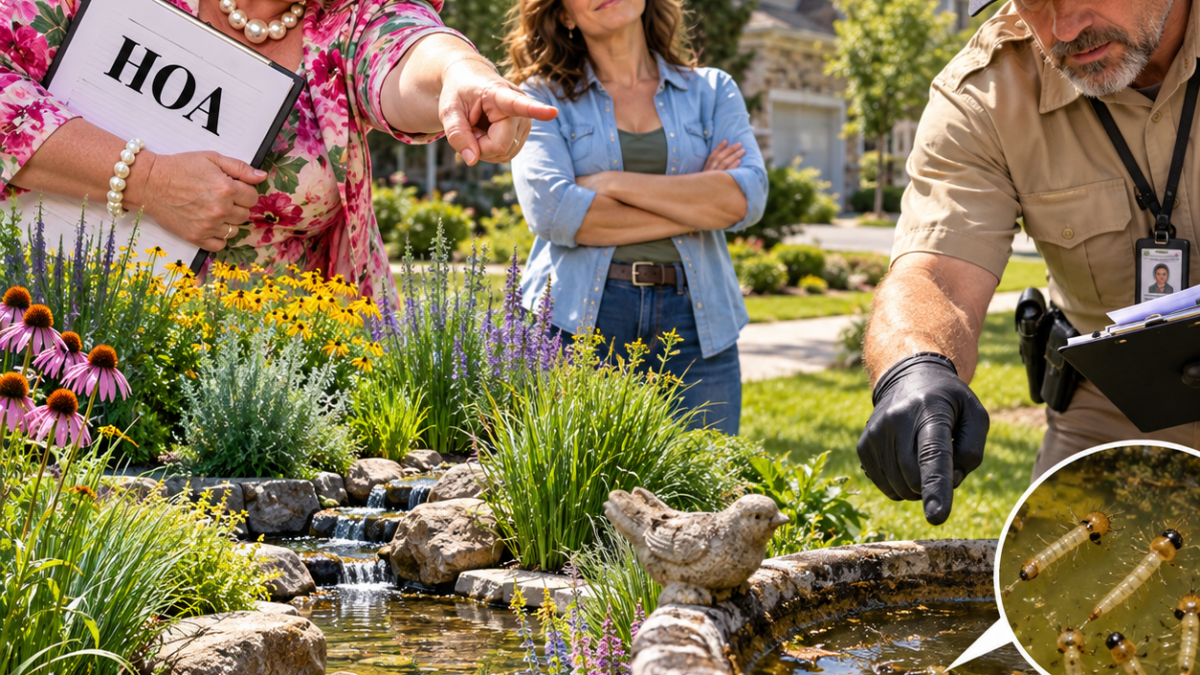
Faux-stone birdbath.
Green water.
Still.
A film on top.
Frank stopped.
“Well.”
Karen stood.
“That’s decorative.”
He walked closer.
“It’s full of water.”
“Birds use it.”
“When did you last clean it?”
“I don’t know.”
He lowered the dipper.
Karen stepped forward.
“You don’t have permission—”
“I can inspect visible public-health conditions associated with the complaint investigation. If you prefer, I can request formal access through the district.”
That stopped her.
He dipped.
Lifted.
The white bowl moved.
Not because his hand shook.
Because the water was alive.
Hundreds of larvae.
Wriggling.
Karen’s face changed.
Linda stared.
Barb whispered:
“Oh my God.”
Frank looked into the basin.
Then at Karen.
“Ma’am, this is active breeding.”
“That can’t be from my house.”
He held up the dipper.
“It is currently in your birdbath.”
“But the mosquitoes came from over there.”
He looked toward my garden.
“Mosquitoes can fly.”
Karen seemed briefly triumphant.
Then Frank continued.
“But larvae don’t teleport.”
Dave, who had wandered outside by then, coughed suspiciously.
Frank became all business.
“This water is stagnant, organic-rich and undisturbed. Perfect breeding conditions.”
Karen stared at the larvae.
“This is one birdbath.”
“One productive container can produce hundreds or thousands of adults over repeated cycles.”
“You’re exaggerating.”
“No.”
He pulled out his citation book.
Karen’s face went white.
“What are you doing?”
“I’m documenting an active breeding site.”
“I’m the one who filed the complaint.”
“Yes, ma’am.”
“Against him.”
“Yes.”
“Then why are you writing me a ticket?”
“Because mosquitoes don’t care who filed the complaint.”
That sentence spread through Northgate Meadows before lunch.
Frank issued a $250 citation.
Forty-eight-hour abatement.
Then made Karen empty the birdbath.
Green water and larvae poured into the soil beneath her roses.
She looked as though somebody had forced her to pour champagne into a sewer.
Frank photographed the empty basin.
Linda suddenly remembered an appointment.
Barb had something in the oven.
Both disappeared.
Karen stood alone.
The performance she staged for my humiliation ended with a county inspector citing her.
I did not laugh.
Not while she could see.
I waited until the front door closed.
Sarah met me inside.
We lasted three seconds.
Then both of us lost it.
She leaned against the kitchen counter laughing.
“Larvae don’t teleport!”
“I heard.”
“You have to put that on a shirt.”
“No.”
“I’m making shirts.”
“No.”
The county report arrived several days later.
My rain garden:
No violation.
No larvae.
Proper infiltration.
No abatement required.
Karen’s birdbath:
Confirmed active breeding site.
Cited.
Remediated.
I made three copies.
Naturally.
The story changed the neighborhood.
People who had barely nodded before stopped me.
Mrs. Gable arrived with cookies.
“She fined me seventy-five dollars because my garden hose wasn’t coiled properly.”
“Properly how?”
“Perfect circle.”
“You’re kidding.”
“I measured after the second notice.”
The Patels came by with their stroller.
Karen had classified their daughter’s sidewalk chalk as graffiti.
Dave had years of stories.
Trash cans ten minutes late.
Welcome mat wrong color.
Holiday decorations.
Commercial work van.
Tree branch.
Window screen.
Toy storage.
It wasn’t discipline.
It was exhaustion as governance.
Each resident believed they were uniquely targeted.
Then the birdbath exposed something more dangerous to Karen than hypocrisy.
Shared experience.
People talked.
That evening Sarah and I sat behind the house.
Fireflies moved above the grass.
Buster slept beneath my chair.
“You’re becoming a folk hero.”
“I passed an inspection.”
“You broke the spell.”
“What spell?”
“Everyone thought she was untouchable.”
Sarah took my hand.
“Now they’ve seen her get a ticket.”
That sounded ridiculous.
It was also true.
Karen’s power had never come entirely from bylaws.
It came from inevitability.
People thought fighting her would make things worse.
The inspector had publicly proven that authority existed above her.
More importantly, it could turn toward her too.
I created a new folder.
**KAREN DOSSIER**
Sarah looked at the label.
“You enjoyed that.”
“Professional terminology.”
“Absolutely.”
We began collecting stories.
Then hosted a barbecue.
Not a rebellion meeting.
That word never appeared.
Burgers.
Hot dogs.
Neighbors.
Sixty people came.
More than we had ever hosted.
At first, people talked about normal things.
Schools.
Weather.
Cars.
Then gradually the HOA stories emerged.
A single mother fined over a torn screen.
Retirees threatened over an oak limb extending three inches toward the sidewalk.
A night-shift worker cited because his company van sat on the street during daylight hours despite an explicit employment-vehicle exception.
Sarah moved through the crowd taking mental notes.
I flipped burgers.
Dave eventually took the tongs.
“You need to hear what’s happening inside.”
Fifteen people were in the living room.
Patels.
Mrs. Gable.
Young parents.
Retirees.
People who had lived in Northgate since construction.
I connected my laptop to the television.
No speech.
Just evidence.
“My dispute started here.”
Karen’s first email.
Violation.
Appeal.
Fines.
County complaint.
Inspection.
Then I explained selective enforcement.
“You don’t prove abuse by saying something feels unfair.”
I pulled up examples.
“You prove that one person is penalized under a rule while identical conduct is knowingly ignored elsewhere.”
Mr. Patel leaned forward.
“Database.”
“What?”
“I can build one.”
He was a software developer.
“Residents upload violation notices, date, rule cited, photographs. Then we map comparable properties.”
Sarah smiled.
“There goes your weekend.”
He looked excited.
Mrs. Gable spoke from the couch.
“My Harold was a lawyer.”
Everyone turned.
“He always said follow the money.”
Silence.
“Has anybody seen a real audit?”
Nobody had.
HOA budget summaries, yes.
Audited financial statements, no.
Receipts, no.
Detailed vendor contracts, rarely.
The rebellion became organization.
Northgate Accountability Project.
Secure database.
Physical records at my house.
Legal consultation fund.
Mrs. Gable managed cash collection.
Nobody argued with Mrs. Gable.
Within a month, the data was enormous.
Selective enforcement patterns.
Repeated use of vague clauses.
Three families who claimed HOA harassment contributed to selling their houses.
Dozens of questionable fines.
Then financial discrepancies.
Fine revenue reported by homeowners exceeded the amounts shown in HOA summaries.
Not proof of theft.
But a question.
Then expenses.
Aesthetic Management Solutions LLC.
Recurring consulting fees.
Large payments.
Mr. Patel searched corporate records.
The sole officer matched Karen’s maiden name.
The room went silent when he showed us.
Sarah whispered:
“No.”
Dave looked at the screen.
“She’s paying herself?”
“We need documentation,” I said.
Mr. Patel clicked.
Formation documents.
Registered address.
Officer name.
Then HOA expense statements.
$18,000.
Consulting.
More payments elsewhere.
Could have been legitimate if properly disclosed, approved and actually performed.
But board minutes contained almost nothing.
Mrs. Gable spoke quietly.
“Follow the money.”
That was when I called Mike Stratton.
Former Army friend.
Now an attorney specializing in corporate governance and contracts.
Dave had already called him.
Of course he had.
Mike arrived carrying no six-pack.
I had bought one for him.
He ignored it for two hours while reading.
When he finished:
“Mark.”
“Yes?”
“This is no longer an HOA landscaping dispute.”
“I know.”
“If your financial evidence is correct, we may have self-dealing, breach of fiduciary duty and potentially fraud.”
Sarah folded her arms.
“What do we do?”
Mike looked toward the files.
“First, we stop talking like prosecutors until prosecutors tell us what this is.”
Good answer.
“Second, formal records demand.”
“Third, board removal process.”
“Fourth, if financial evidence supports it, we refer it.”
“Civil?”
“Possibly.”
“Criminal?”
“Possibly.”
I asked:
“Both?”
Mike smiled.
“I missed working with you.”
The demand letter went out.
Karen.
Linda.
Barb.
Official HOA address.
Turn over records.
Suspend disputed fines.
Independent audit.
Resign or face removal litigation.
Ten days.
Personal liability warnings where intentional misconduct or fraud were established.
Karen responded in forty-eight hours.
Emergency community meeting.
Agenda:
**SLANDEROUS ALLEGATIONS AND MALICIOUS MISINFORMATION CAMPAIGN.**
Sarah read it aloud.
“Subtle.”
“She wants a public fight.”
Mike called.
“Perfect.”
“Why perfect?”
“She thinks the meeting is her stage.”
“It is.”
“Not once the members arrive.”
He gave one rule.
“Let her talk.”
The clubhouse was packed.
People stood along walls.
Karen sat at the front in black.
Linda and Barb beside her.
For twenty minutes, she spoke.
Sacrifice.
Volunteer service.
Ungrateful residents.
Troublemakers.
Me.
Apparently I had built an “illegal swamp” because I could not tolerate community rules.
She called financial allegations lies.
Called the Accountability Project a mob.
Called Mike’s letter intimidation.
We said nothing.
Her voice grew louder because nobody interrupted.
That is the danger of giving a person unlimited rope.
Eventually she tried to adjourn.
Mike stood from the back.
“Point of order.”
Karen stared.
“Who are you?”
“Michael Stratton, counsel for homeowners represented through the Northgate Accountability Project.”
The room changed.
Legal counsel has a way of changing rooms.
He cited the bylaws.
Members had the right to address the special-meeting subject.
Karen allowed five minutes.
Mike smiled.
“Mr. Davies will need more.”
I walked forward.
Mr. Patel activated projector.
Slide one:
**FACTS VS. ALLEGATIONS**
“I’m not here to tell you whether Karen is a good person.”
The room quieted.
“I’m not here to tell you whether you should like me.”
Karen glared.
“I’m here to show records.”
Map.
Red dots.
Fines.
Green dots.
Comparable conditions unenforced.
Violation notices.
Dates.
Rules.
Patterns.
Then financial summaries.
Fine revenue.
Reported totals.
Gap.
Then Aesthetic Management Solutions.
Corporate filing.
Karen’s maiden name.
$18,000 payment.
The room exploded.
People shouted.
Karen went white.
Linda leaned toward Karen.
“What is that?”
Karen answered too quietly.
Barb stared at the screen.
I continued.
“This document does not by itself prove a crime.”
Important.
“It proves a conflict requiring explanation.”
Then more payments.
“What service was performed?”
Silence.
“Who approved the contract?”
Silence.
“Where is disclosure?”
Silence.
Karen stood.
“This is fabricated.”
Mr. Patel immediately displayed the state corporate database page.
“Public record.”
She looked at Linda.
Linda looked horrified.
“I didn’t know.”
Barb followed.
“She told us it was an outside consultant.”
Karen snapped:
“Stop talking.”
Wrong command.
Linda stood.
“No.”
That may have been the moment Karen truly lost.
“I want this on the record. I was never told you owned that company.”
Barb nodded frantically.
“Neither was I.”
Karen’s face changed from white to red.
“You approved the budgets.”
“Based on what you gave us!”
Members shouted.
Mike stepped forward.
“Everyone.”
The room eventually settled.
“Today, documentation relating to these financial questions was delivered to the appropriate district attorney’s economic-crimes intake personnel for review.”
Gasps.
“We are not declaring anyone guilty.”
Another important distinction.
“The government will determine whether criminal investigation is warranted.”
Karen gripped the table.
“This is blackmail.”
“No.”
Mike looked directly at her.
“It is reporting records.”
Then governance.
Article 12.
Removal.
Quorum.
Required vote.
Dave moved.
Dozens seconded.
Karen banged the gavel.
“Meeting adjourned!”
Nobody left.
“You cannot do this!”
Mike raised his voice.
“The membership can.”
Vote.
Aye.
The sound shook the room.
Opposed?
Silence.
Not one audible vote.
Karen sat frozen.
Linda cried.
Barb gathered papers.
Karen looked at me.
Pure hate.
“You planned all this.”
I shook my head.
“You filed the mosquito complaint.”
That sentence hurt her more than anything else.
Because everybody remembered the birdbath.
She stormed out.
The new interim board formed that night.
Dave president.
Mr. Patel treasurer.
Maria secretary.
I declined nomination.
“I didn’t fight one president to become another.”
Laughter.
The board immediately froze disputed fines.
Ordered independent audit.
Opened records.
The neighborhood breathed.
Then reality began.
Audits are not dramatic.
They are spreadsheets.
Receipts.
Bank statements.
Invoices.
Checks.
Emails.
Vendor registrations.
Weeks.
The forensic accountant found more than we expected.
Unsupported consulting charges.
Self-dealing through Aesthetic Management Solutions.
Doctored invoices.
Unexplained transfers.
Over three years, more than forty thousand dollars appeared improperly diverted.
The report went to the district attorney.
This time, investigators decided there was enough.
Karen was arrested.
That moment felt less satisfying than people expected.
Neighbors gathered outside.
Some filmed.
I stayed inside.
Sarah stood beside me at the window.
“You’re not going out?”
“No.”
“She tried to destroy our garden.”
“I know.”
“She stole from everyone.”
“Apparently.”
“You don’t want to see?”
I thought about it.
“No.”
Why?
Because accountability had stopped being our job.
Once professionals took over, I wanted distance.
Linda and Barb cooperated.
They received probationary outcomes after acknowledging their failures and assisting investigators.
Karen fought longer.
Trial followed.
Conviction on multiple financial counts.
Sentence:
Two years incarceration.
Restitution.
Her house went up for sale.
Neighbors celebrated quietly.
I didn’t.
Not because she deserved no consequence.
She did.
But by then, what mattered was what we built next.
The new board held town halls.
Every major rule reviewed.
Garden hose coil?
Gone.
Sidewalk chalk restriction?
Gone.
Subjective toy-color rules?
Gone.
Vague “neighborhood harmony” clauses narrowed.
Fines became last resort.
Warnings first.
Appeal rights.
Documentation.
Transparency.
HOA budget shrank.
Dues dropped.
The block party returned.
Using recovered restitution money felt inappropriate at first.
Then Dave proposed using a small portion of recovered funds for a community event while returning the majority to reserves and residents.
People agreed.
Bouncy house.
Band.
Food.
Kids drawing sidewalk chalk everywhere.
Mrs. Gable deliberately left her garden hose in an imperfect spiral.
“Rebellion,” she told me.
My rain garden became famous.
Not county-famous.
Neighborhood-famous.
People asked questions.
I held a workshop.
Twelve homeowners.
Then another.
Soon Northgate had rain gardens.
Small ones.
Large ones.
Cardinal flower.
Iris.
Milkweed.
Every time a new one appeared, Sarah smiled.
“Karen started an environmental movement.”
“Don’t tell her.”
Then one afternoon, Frank Henderson returned.
Not officially.
He had heard about the workshop.
Walked through the garden.
“Still draining?”
“Twenty-six hours after the last storm.”
“Good.”
He looked across the street.
Karen’s old house had sold.
Young family.
Three children.
Bright plastic playset.
A small birdbath.
Clean water.
Frank pointed.
“That one better be changed weekly.”
“I’ll inform them.”
He laughed.
“No citations unless necessary.”
“What happened to the original birdbath?”
“Karen took it when she moved.”
We both stared.
“Hope she cleans it.”
“Not my district anymore.”
Sarah and I spent more evenings outside.
That had been the original dream.
Quiet.
Buster sleeping at our feet.
Dragonflies above the garden.
Hummingbirds at cardinal flowers.
Kids riding bikes.
No pink notices.
One evening she brought two glasses of wine.
“Do you realize this all happened because of mosquitoes?”
“No.”
“Because of Karen.”
“Closer.”
She sat beside me.
“What was her biggest mistake?”
“Financial fraud?”
“No.”
“Selective enforcement?”
“No.”
“Filing a false health complaint?”
She smiled.
“The birdbath.”
I laughed.
“You’re never letting that go.”
“Never.”
Across the street, a child’s yellow tricycle lay on the lawn of Karen’s old house.
It had probably been there all afternoon.
No violation.
No warning.
Just life.
That was the difference.
Messy did not mean dangerous.
Different did not mean disorderly.
A neighborhood was not improved by removing every sign that human beings lived there.
The first autumn after Karen left, Northgate Meadows looked almost physically different.
Not because houses changed.
People did.
Garage doors stayed open while neighbors talked.
Children left toys outside until dinner.
Gardens expanded.
Bob grew tomatoes near his driveway.
One woman painted her front door dark blue.
The board approved it in three days.
Mrs. Gable added a ceramic frog near her mailbox.
Dave hated it.
As president, he said nothing.
Growth.
Then came the anniversary of the mosquito inspection.
Mr. Patel texted our group.
**Birdbath Day?**
I refused.
Sarah accepted.
That Saturday, twenty neighbors appeared carrying mosquito dunks, scrub brushes and clean-water guides.
They walked door to door offering free birdbath cleaning.
Somebody printed shirts.
**LARVAE DON’T TELEPORT**
I blamed Sarah.
Correctly.
Frank Henderson heard about it and mailed me a mosquito-control brochure with a handwritten note.
**Finally, public health education with accurate science.**
Life became funny again.
That mattered.
Conflict consumes humor first.
When people can laugh about something without fear, it has lost control over them.
Years later, if someone asks me what Northgate Meadows was like under Karen, I rarely mention prison.
I mention silence.
Neighbors didn’t talk.
That was her real power.
Each person thought their violation was embarrassing.
Their problem.
Their failure.
Karen controlled information.
Then the birdbath changed that.
Suddenly people laughed together.
Then talked.
Then compared documents.
Then followed money.
Community was the thing she could never survive.
Sarah once asked whether I regretted not simply asking for approval before building the garden.
I thought about it.
“No.”
“Even knowing what happened?”
“Yes.”
“Why?”
“Because approval wasn’t actually the issue.”
She nodded.
Karen would probably have rejected it anyway.
The garden represented something she had not authorized.
That was enough.
Years after the legal mess ended, one of the families who had sold during Karen’s presidency visited.
They were driving through town.
Stopped.
The wife looked at the rain garden.
“We should’ve fought.”
I shook my head.
“You had kids.”
“We were exhausted.”
“That’s not failure.”
“She drove us out.”
“Yes.”
The husband stared at the neighborhood.
“It looks different.”
“It feels different.”
Their youngest child, now a teenager, asked:
“Is that the mosquito swamp?”
His parents laughed.
I pointed across the road.
“Wrong house.”
The adults understood.
The teenager didn’t.
That was okay.
Maybe someday nobody would remember.
That would mean the system had changed enough that the story became unnecessary.
The HOA eventually created a formal stormwater guideline.
Rain gardens encouraged.
Native plants encouraged.
Projects above certain size required basic drainage review.
Reasonable.
I helped write the engineering portion.
Not the politics.
I made that clear.
Maria asked:
“Would you serve on the board?”
“No.”
“Committee?”
“No.”
“Advisory panel?”
“No.”
“Can we call you when drainage questions come up?”
“Unfortunately yes.”
That became my civic role.
Occasional engineer.
Full-time retired person.
Sarah joked that I had failed retirement.
Buster aged.
He slowed.
Stopped chasing squirrels.
Spent more time beside the rain garden.
One spring morning, I found him lying near the milkweed watching a dragonfly.
Sarah came outside.
“He likes your swamp.”
“Engineered ecological basin.”
“Swamp.”
Buster died that winter.
That loss hit harder than I expected.
The house became too quiet.
Again.
We buried his ashes beneath a young serviceberry near the back edge of the rain garden.
Sarah chose the tree.
In spring, white flowers appeared.
The garden had started as a drainage solution.
Then became battlefield.
Evidence.
Symbol.
Community classroom.
And finally, memory.
That is the strange thing about places.
Meaning accumulates.
Karen had looked at the basin and seen ugliness because she never waited long enough to understand what it did.
Years later, I stood beside the same garden watching Buster’s tree bloom.
Sarah held my arm.
“Still think it was worth it?”
“Yes.”
“Even Karen?”
I looked across the street.
Different family.
Clean birdbath.
Toy truck on the lawn.
Then back at the flowers.
“Yes.”
Because without the fight, maybe we would have kept to ourselves.
Maybe Mrs. Gable would still think fear was normal.
Maybe the Patels would have paid another sidewalk-chalk fine.
Maybe Karen’s financial scheme would have continued.
Maybe three more families would have sold.
I did not believe everything happens for a reason.
That phrase annoys engineers.
Sometimes terrible things happen because somebody makes a terrible choice.
Meaning is what we build afterward.
That was what Northgate did.
Karen created damage.
We created accountability.
One afternoon, nearly five years after everything ended, I received a letter.
No return address.
Handwritten.
Mark,
I don’t expect forgiveness.
I have had a great deal of time to think about Northgate.
I believed I was protecting the neighborhood.
I now understand that I confused control with leadership.
The garden angered me because you did not ask for my approval.
I told myself it was about rules.
It was not.
The mosquito complaint was meant to force you to surrender.
I knew I did not have evidence that your property was causing the problem.
I did it anyway.
The irony of what the inspector found is not lost on me.
I am sorry.
Karen
I read it twice.
Then handed it to Sarah.
She read it.
“Well.”
“What?”
“She admitted the birdbath.”
“That is your takeaway?”
“Yes.”
I smiled.
“Do I answer?”
Sarah looked toward the garden.
“Do you want to?”
“No.”
“Then don’t.”
I filed the letter.
Not in the Karen Dossier.
In the original HOA dispute file.
Final document.
Closed.
People love stories where revenge is dramatic.
Bully attacks hero.
Hero destroys bully.
Crowd cheers.
Real life is rarely satisfying in exactly that way.
Karen went to prison.
That was serious.
But prison wasn’t the part that gave me peace.
Neither was watching her lose the board.
Neither was the inspector’s citation.
Peace came years later when the garden stopped feeling like a battlefield.
When I could weed milkweed without remembering pink notices.
When a mosquito landed on my arm and I didn’t automatically look across the street.
When children came to workshops and knew nothing about Karen.
When somebody asked how to size a rain garden and the answer was simply engineering.
Not politics.
The best revenge wasn’t Karen losing her power.
It was her power becoming irrelevant.
Northgate no longer organized itself around fear of one woman.
People forgot to be afraid.
That is a deeper defeat than humiliation.
One summer, the county invited me to speak at a stormwater workshop.
Frank Henderson was there.
Older.
Still wearing the same wide-brim hat.
Before my talk, he introduced me.
“This is Mark Davies.”
Pause.
“His rain garden does not breed mosquitoes.”
Laughter.
Then:
“But I have inspected some birdbaths in his neighborhood.”
Bigger laughter.
I shook my head.
Afterward, a homeowner approached.
“My HOA says rain gardens attract mosquitoes.”
I handed her the county guidance.
“Not if they’re designed correctly.”
“How do I convince them?”
“Documentation.”
Of course.
Plans.
Drainage times.
Native species.
Public-health guidance.
She smiled.
“You sound like you’ve done this before.”
“A little.”
That night, I told Sarah.
She laughed.
“Full circle.”
Almost.
The last full circle came a year later.
Northgate Meadows applied for a county sustainability recognition program.
Community projects included:
Rain gardens.
Native pollinator beds.
Improved stormwater practices.
Reduced chemical lawn use.
One requirement was an on-site inspection.
Frank had retired.
A younger inspector came.
She walked the neighborhood.
Stopped at mine.
“This is the original one?”
“Original what?”
“Rain garden.”
Apparently people had told her.
“Yes.”
She studied it.
“Beautiful.”
Across the street, the young family living in Karen’s old house had built a smaller rain garden near their driveway.
Their little girl was kneeling beside it planting cardinal flower.
The inspector pointed.
“That one too?”
“Workshop graduate.”
She smiled.
The neighborhood received the recognition.
At the next block party, Dave hung a banner near the entrance.
**NORTHGATE MEADOWS — COUNTY SUSTAINABILITY COMMUNITY**
Underneath, somebody taped a smaller handwritten sign.
**THANKS, KAREN.**
I removed it.
Sarah objected.
“Why?”
“Too mean.”
“She started all this.”
“She did.”
“Then it’s accurate.”
“Still mean.”
She took the sign home.
Probably kept it.
That evening, children ran through sprinklers.
Someone grilled.
Mrs. Gable argued with Dave about mulch.
Mr. Patel showed me a new irrigation controller.
Maria complained about meeting minutes.
Ordinary.
Beautifully ordinary.
I looked at the rain garden.
Dragonflies darted through evening light.
Water from an afternoon storm had already disappeared.
No mosquito larvae.
No standing swamp.
No danger.
Just flowers.
I thought back to Karen standing on the sidewalk with that pink notice.
Two thousand dollars.
County condemnation.
Public-health threat.
She believed authority meant she could define reality.
If she called a garden a swamp, it became one.
If she called native plants weeds, they became weeds.
If she called neighbors violators, they became violators.
The inspector destroyed that illusion in one morning.
Not by fighting Karen.
By looking into the water.
That was all.
Facts are often less dramatic than accusations.
Clear water.
No larvae.
Green birdbath.
Hundreds of larvae.
One dipper.
Truth.
Everything afterward grew from that.
Neighbors started asking:
If she was wrong about Mark, what else is she wrong about?
Then:
Why are we being fined?
Then:
Where does the money go?
Then:
Who authorized these payments?
Then:
Why are we afraid of our own HOA?
Good questions are dangerous to bad systems.
Karen tried to destroy one rain garden.
Instead, she created a neighborhood full of people willing to ask questions.
That was the part she never saw coming.
My children eventually moved farther away.
Sarah and I got older.
Northgate changed.
New families.
New dogs.
New arguments.
Somebody eventually installed a mailbox so ugly even I sympathized with the architectural committee.
Reasonable governance remained necessary.
The new HOA sometimes issued notices.
Real ones.
Unsafe dead tree.
Broken fence obstructing sidewalk.
Abandoned vehicle leaking oil.
Noise at two in the morning.
But enforcement became predictable.
Transparent.
Appealable.
Nobody enjoyed being cited.
Nobody feared being targeted.
That difference is everything.
Dave eventually retired from the board.
At his final meeting, residents presented him with a gift.
A perfectly coiled garden hose mounted inside a glass display case.
Plaque:
**BREAK ONLY IN CASE OF TYRANNY**
Mrs. Gable nearly fell over laughing.
Mr. Patel took over for one term.
Then Maria.
Leadership rotated.
That may have been Northgate’s most important reform.
No monarchs.
No permanent presidents.
Temporary service.
Because power should have an expiration date.
One evening, Sarah and I sat beside Buster’s serviceberry.
She poured wine.
“Do you miss the fight?”
“No.”
“Not even a little?”
“No.”
She looked skeptical.
“Maybe the documentation.”
She laughed.
“I knew it.”
The sunset turned clouds pink.
Unfortunately, the exact shade reminded me of Karen’s violation notices.
I told Sarah.
She laughed harder.
We sat quietly afterward.
A mosquito buzzed near my ear.
I slapped my arm.
Missed.
Sarah said:
“Should we report the garden?”
“Get out.”
She laughed again.
That sound was worth every hour I had spent digging.
Years earlier, the garden had been my way to decompress after military service.
I thought its purpose was drainage.
Then pollinators.
Then stormwater.
Eventually I understood it had given me something else.
A way to belong.
I had arrived in Northgate thinking retirement meant withdrawing from conflict.
Keep lawn trimmed.
Walk dog.
Build projects.
Avoid drama.
Karen taught me unwillingly that peace is not the absence of responsibility.
Sometimes protecting peace requires participation.
Not domination.
Not revenge.
Participation.
Attend the meeting.
Read the budget.
Check the rule.
Ask the question.
Know your neighbor.
Document the answer.
Power thrives in empty rooms.
Our HOA had become Karen’s kingdom because everyone else was too busy to attend.
When the rooms filled again, the kingdom disappeared.
That lesson stayed with me longer than the mosquito citation.
So when new homeowners moved in, I told them:
“Go to one HOA meeting a year.”
They usually laughed.
“I’m serious.”
“Why?”
“So you remember it belongs to you.”
Sometimes they listened.
Sometimes not.
But enough did.
Northgate stayed healthy.
The final irony arrived on a humid July morning almost a decade after my first violation.
A county mosquito-control truck stopped outside.
I was watering plants.
Young inspector approached.
“Mr. Davies?”
“Yes?”
“We received a mosquito complaint.”
I stared.
She smiled.
“Not against you.”
“Oh.”
“Common area retention pond.”
“Need directions?”
“Yes.”
I pointed.
Then she looked at the rain garden.
“Frank Henderson trained me.”
That name brought a smile.
“He told me about this place.”
“Did he?”
“He calls it the birdbath case.”
“Of course he does.”
She walked toward her truck.
Then stopped.
“For what it’s worth, the garden still looks good.”
“Thank you.”
“Any mosquitoes?”
“Only the ones flying in from somewhere else.”
She laughed.
“Larvae don’t teleport.”
I put down the hose.
“You people need new material.”
She drove away.
I stood there smiling.
That afternoon, I found an old photograph.
Taken on inspection day.
Someone—probably Dave—had captured Frank standing beside Karen’s birdbath holding the dipper full of larvae.
Karen’s expression was extraordinary.
Shock.
Anger.
Disbelief.
Humiliation.
Years ago, I would have looked at that photograph and felt victory.
Now I felt something else.
Distance.
She seemed like a character from an old story.
The anger was gone.
I put the photograph back.
Then went outside.
The cardinal flowers were blooming.
A monarch moved across milkweed.
Water from morning rain was nearly gone.
Sarah sat on the porch.
“Everything working?”
“Exactly as designed.”
She smiled.
“You’ve been waiting ten years to say that.”
“Longer.”
I sat beside her.
Across the street, the family living in Karen’s old house had a birdbath near their front steps.
Clean.
Fresh water.
The little girl emptied it with a watering can, scrubbed the basin and refilled it.
Apparently somebody had taught her mosquito prevention.
I watched her.
Then looked at Sarah.
“Think Karen would appreciate the irony?”
“No.”
“Probably not.”
The child finished.
Bird landed.
Ordinary life continued.
That is how the story really ended.
Not with prison bars.
Not with a gavel.
Not with cheering homeowners.
With a child changing water in a birdbath.
A neighborhood that had learned the difference between appearance and danger.
A board that understood rules should solve problems instead of creating obedience.
And a rain garden still doing exactly what I designed it to do.
Hold water briefly.
Filter it.
Release it.
Then make room for the next storm.
Justice turned out to work much the same way.
Karen dumped years of frustration, fear and control into Northgate Meadows.
For a while, all of us held it.
Then people started filtering truth from accusation.
Fact from intimidation.
Law from personality.
What remained could finally drain away.
The garden survived.
The neighborhood survived.
We survived.
And whenever someone asks me whether Karen’s birdbath really turned out to be the mosquito problem after she reported my rain garden, I tell them the truth.
Yes.
Hundreds of larvae.
Maybe thousands.
I never counted.
Frank Henderson did not need to.
One look was enough.
Then they usually laugh and say:
“That must have been the most satisfying moment of your life.”
It wasn’t.
It was satisfying.
Very.
I am only human.
But the most satisfying moment came years later.
A young couple stopped beside my yard.
They had recently moved into Northgate.
The husband pointed toward the garden.
“We’re thinking about building one.”
“Good.”
“HOA okay with it?”
I looked toward the flowers.
Then toward the street where Karen used to sit in her wicker chair.
“Now they are.”
His wife smiled.
“Can you show us how?”
I went inside.
Pulled out my old design drawings.
Not the Karen Dossier.
Not violation notices.
Not county complaint.
Just plans.
Runoff calculations.
Plant lists.
Soil profile.
The useful documents.
We stood beside the basin for nearly an hour.
I explained everything.
At the end, the husband said:
“You must really love this stuff.”
I looked at the garden.
At Buster’s tree.
At Sarah watching from the porch.
At dragonflies moving above flowers.
“Yes.”
I did.
That was the victory.
Karen once called it a mosquito-infested swamp.
The county inspector called it a model.
The HOA eventually called it an approved stormwater feature.
Neighbors called it beautiful.
I just called it mine.
And after everything we had been through, that was more than enough.