PART 2: HOA Karen Reported My Rain Barrels as a Mosquito Hazard—She Never Expected One Inspection to Bring Down Her Entire Reign
PART 2
The first thing I did was document everything.
That instinct had been drilled into me long before I ever owned a house.
Memory gets fuzzy.
People change stories.
Paper doesn’t.
I photographed the barrels from every angle. I photographed the screens, the spigots, the overflow pipes, the dry gravel underneath them, and the French drain I had dug to prevent pooling.
Then I printed the specifications for the barrels.
Food-grade polyethylene.
Previously used for food storage.
Thoroughly cleaned.
I printed the county guidance on rainwater collection.
I printed local water-conservation recommendations.
And finally, I placed Karen’s HOA letter on the workbench and read it again.
The notice accused me of maintaining an “unapproved exterior modification” and a “potential sanitation hazard.”
Potential.
That was an interesting word.
It allowed her to accuse me without proving anything.
Sarah walked into the garage while I was photographing the inlet screen.
She leaned against the doorway and watched me for a moment.
“You’re doing the thing,” she said.
I glanced over.
“What thing?”
“The thing where you stop looking like my husband and start looking like somebody just handed you an operations map.”
I almost smiled.
“I’m documenting.”
“I can see that.”
She came closer.
“Mark, these are rain barrels.”
“I know.”
“She’s ridiculous.”
“I also know.”
“So why do I feel like you’re preparing for a siege?”
I set the camera down.
“Because she isn’t arguing about barrels anymore.”
Sarah gave me a tired look.
“She’s an HOA president, not an invading army.”
“No, but the mechanism is the same.”
She folded her arms.
I continued.
“She sends a notice. Most people don’t want trouble, so they comply. Then she learns that a letter is enough. Next time she pushes harder.”
Sarah looked toward the driveway.
“What happens if we just take them down?”
“Then she wins.”
“That sounds like pride talking.”
I thought about that before answering.
Maybe part of it was pride.
I wasn’t going to pretend otherwise.
But it wasn’t only pride.
“If she had shown me an actual rule saying rain barrels were prohibited, I would deal with it,” I said. “If the county tells me this system is unsafe, I’ll redesign it tonight. But she didn’t do either of those things. She decided she didn’t like something and then went hunting for authority to justify that feeling.”
Sarah exhaled slowly.
“I don’t want our lives consumed by this.”
“Neither do I.”
“Then promise me you won’t turn it into some personal war.”
I looked at the growing stack of documents on my bench.
“I won’t start one.”
Sarah raised an eyebrow.
“That was very carefully worded.”
“It was.”
She shook her head, but I saw the beginning of a smile.
“Fine, General.”
I laughed.
“Don’t call me that.”
“What’s the plan, General?”
I picked up Karen’s letter.
“We give her every possible opportunity to be reasonable.”
“And when she isn’t?”
I slid the letter into the folder.
“Then we make sure she has to explain herself.”
My response to the HOA was almost painfully polite.
No insults.
No accusations.
No emotion.
I explained why I installed the barrels, how they worked, how mosquito access was prevented, how overflow was controlled, and why the system qualified as water conservation.
I attached photographs.
I attached regulations.
I attached manufacturer specifications.
Then I sent the entire package by certified mail.
Sarah watched me place the receipt inside PROJECT HOA.
“You really are keeping everything.”
“Everything.”
That turned out to be one of the smartest decisions I made.
Karen never replied to the substance of my letter.
Instead, she came to my house and announced that county mosquito control was coming.
Two days later, they did.
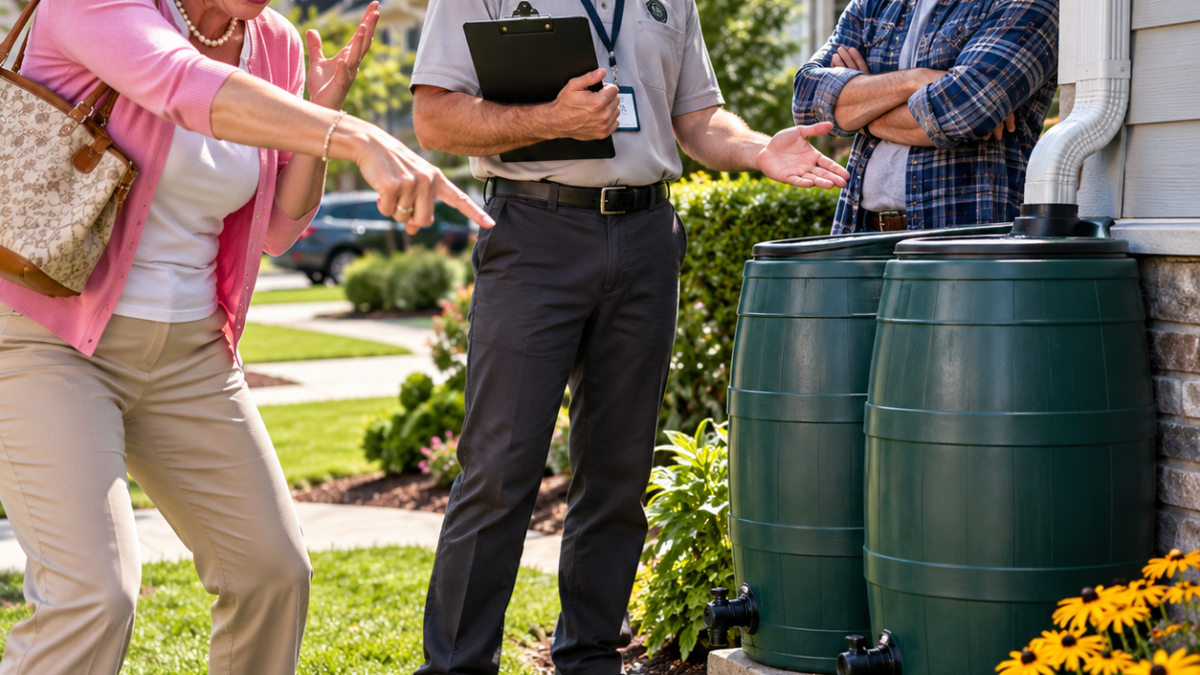
The county truck was impossible to miss.
It rolled slowly down Oakmont Creek shortly after four in the afternoon, white paint, official seal on the door, amber light mounted on top.
We lived on the kind of suburban street where even a plumber’s van parked too long could generate discussion.
A county vehicle?
That was entertainment.
Curtains moved.
Garage doors opened.
George Henderson, two houses down, walked to his mailbox despite the fact that I had watched him collect his mail twenty minutes earlier.
Karen was already outside.
Of course she was.
She stood near my driveway like someone waiting for photographers.
When the truck stopped, her face almost lit up.
The driver stepped out carrying a clipboard and a small inspection bag.
He was younger than I expected, probably late thirties, lean, serious, wearing a khaki county uniform.
His name tag read MILLER.
Karen reached him before he had taken five steps.
“Officer Miller?”
He nodded.
“I’m Dave Miller.”
“I’m Karen Smith, president of the Oakmont Creek Homeowners Association. Thank you for coming so quickly. We take public health extremely seriously here.”
Dave glanced toward my property.
“Okay.”
Karen lowered her voice into the solemn tone people use when delivering terrible news.
“The resident has installed large open containers of stagnant water beside his home.”
I almost interrupted.
I didn’t.
Let her talk.
“They pose an obvious breeding risk for mosquitoes,” she continued. “We have children here. Elderly residents. With diseases like West Nile, I simply felt I had a responsibility.”
Dave wrote something on his clipboard.
Then he looked at me.
“You’re the homeowner?”
“Yes. Mark Davies.”
I walked over and shook his hand.
“Thanks for coming. I can show you the system.”
Karen gave a tiny smile.
It was the expression of someone who believed the executioner had finally arrived.
Dave followed me around the side of the house.
I explained the setup.
“Two fifty-five-gallon food-grade barrels. Rainwater comes directly from the downspout. Every opening is screened.”
He crouched beside the first barrel.
“What mesh?”
“Approximately one-sixteenth-inch stainless.”
He leaned closer.
“Sealed how?”
“Marine-grade sealant beneath the ring, then mechanically clamped.”
He ran a finger around the edge.
“Overflow?”
I pointed.
“Screened port on the rear. Runs into that drain line. French drain underneath.”
He stood and looked down.
The gravel beneath the barrels was dry.
“No pooling?”
“None.”
He opened his inspection bag and pulled out a flashlight.
Karen hovered several feet behind him.
She had gone strangely quiet.
Dave shined the light through the mesh and looked inside.
Then he inspected the second barrel.
He checked the fittings.
He tested the spigot.
He examined the overflow.
The entire time, Karen stood with her arms folded.
Finally, she couldn’t stand the silence.
“Well?” she demanded.
Dave continued writing.
Karen stepped closer.
“Isn’t that stagnant water?”
He stopped.
“No.”
One word.
Flat.
Simple.
Karen blinked.
“What?”
“This isn’t what we classify as an accessible stagnant-water breeding source.”
She frowned.
“There’s water sitting inside those barrels.”
“Yes.”
“Then it’s stagnant.”
Dave looked at her.
I could almost see him deciding how much patience he had left.
“Ma’am, the issue isn’t whether water remains in a container. The issue is whether mosquitoes can access it, lay eggs, and complete their breeding cycle.”
She pointed dramatically.
“Exactly.”
“They can’t.”
The street seemed to go quiet.
I knew George was listening.
I knew Mrs. Gable across the street was standing behind her curtains.
I could practically feel the neighborhood leaning toward us.
Karen stared at Dave.
“That cannot be right.”
He pointed at the inlet.
“The screen is more than adequate.”
Then the overflow.
“Screened.”
Then the ground.
“No pooling.”
He tapped the sealed lid.
“Closed system.”
Karen’s face tightened.
“But I reported a hazard.”
“And I inspected the report.”
Her voice sharpened.
“And?”
“And there is no mosquito violation here.”
For the first time since I had known Karen, she seemed unable to immediately produce words.
Dave looked back at the barrels.
“Actually, this is a very good home setup.”
Karen’s head snapped toward him.
“What?”
He nodded toward me.
“The overflow management is better than what I see in most residential installations. If everyone screened rain barrels like this, it would make my job easier.”
I didn’t smile.
I desperately wanted to.
But I didn’t.
Karen was turning red.
“There has to be some regulation against storing this much stagnant water.”
Dave sighed.
“Again, you’re using that term incorrectly.”
Her mouth opened.
He continued before she could speak.
“The water is contained. Mosquitoes cannot access it. There’s no public health violation.”
Then he looked directly at her birdbath across the street.
“Frankly, open birdbaths, clogged gutters, plant saucers, uncovered buckets, and lawn drainage problems are much more common mosquito sources.”
I followed his gaze.
So did Karen.
Her birdbath sat in the middle of her flower bed.
The irony was so perfect that I almost believed somebody had staged it.
Dave made one final note.
“I’m closing the complaint as unfounded.”
Karen’s expression froze.
Not anger.
Not yet.
Something more primitive.
Disbelief.
The kind a person feels when reality refuses to perform according to the script in their head.
Dave shook my hand.
“Good system, Mr. Davies.”
“Thank you.”
Then he walked to his truck.
Karen followed him two steps.
“But Officer Miller—”
He opened the door.
“I’ve completed the inspection, ma’am.”
And then he left.
The truck pulled away.
For several seconds, nobody moved.
George stood beside his mailbox with an envelope in one hand.
He looked at me.
Then he looked at Karen.
Then the old man gave me the smallest thumbs-up I had ever seen.
I nearly lost it.
Karen saw him.
That made everything worse.
She turned back toward me.
The expression on her face had changed completely.
Before the inspection, this had been administrative.
Now it was personal.
“You think this is funny?” she asked.
“I didn’t say anything.”
“You embarrassed me.”
That caught me by surprise.
“I didn’t call the inspector.”
Her jaw tightened.
“You know exactly what you did.”
“No, Karen. You filed a complaint. He inspected it. He disagreed with you.”
Her eyes narrowed.
“This isn’t over.”
I believed her.
“I assumed as much.”
Then I walked inside.
Sarah was standing in the living room with one hand over her mouth.
When I closed the door, she burst out laughing.
“Oh my God.”
“Keep it down.”
“He looked at her birdbath.”
“I noticed.”
“He actually looked at her birdbath.”
“Yes.”
Sarah laughed harder.
I allowed myself one grin.
Then I looked through the blinds.
Karen was still standing outside.
She wasn’t embarrassed anymore.
She was furious.
Sarah saw my expression.
“What?”
“This bought us about forty-eight hours.”
She stopped laughing.
“You think she’ll try something else?”
“I know she will.”
I was wrong about one thing.
It took less than forty-eight hours.
The envelope arrived the following afternoon.
Same expensive cream stationery.
Same HOA logo.
Different accusation.
I opened it at the kitchen table.
Sarah sat across from me while the kids were doing homework upstairs.
“What now?”
I read the first paragraph.
“She changed the violation.”
Sarah closed her eyes.
“Of course she did.”
The mosquito issue had disappeared.
Now my rain barrels were allegedly an “unapproved exterior structure” under Section 7.14 of the architectural rules.
The notice imposed a $100 fine.
Then came the important part.
Twenty-five dollars per day until removal.
Sarah leaned over my shoulder.
“They can do that?”
“They can impose daily fines in some situations.”
“Can they put a lien on the house?”
I didn’t answer immediately.
That was enough.
Her face changed.
“Mark.”
“If fines become valid debt and remain unpaid long enough, yes, it can get ugly.”
Her voice dropped.
“So we could actually have a lien over two plastic barrels?”
“If Karen gets her way.”
Sarah pushed her chair back and stood.
“Then take them down.”
I looked at her.
“I’m serious.”
“I know.”
“Take them down tonight. Put them in the garage. We’ll use a hose like everybody else.”
I could hear fear beneath the frustration.
This wasn’t a game to her.
It wasn’t a puzzle.
It was our house.
The place where our children slept.
The place we had saved years to buy.
I reached for her hand.
“Sarah.”
“No. I supported you when this was ridiculous. I laughed when the inspector embarrassed her. But liens and lawyers? That’s different.”
“You’re right.”
That answer surprised her.
I continued.
“It is different. Which is why I need to know whether this fine is legitimate before I do anything.”
“And if it is?”
“I’ll remove them.”
She searched my face.
“Promise?”
“If the rules actually prohibit them, yes.”
She sat down again.
“And if they don’t?”
“Then she doesn’t get to threaten our home because she’s angry an inspector disagreed with her.”
That night, I read the HOA documents from beginning to end.
Nobody reads HOA covenants for pleasure.
They are written in a style seemingly designed to make the human mind surrender.
Page after page of setbacks, paint colors, easements, roof materials, parking limitations, landscape requirements, voting procedures, enforcement powers, notice periods, architectural approvals.
By midnight, my coffee was cold.
By one in the morning, I had highlighted half the document.
By two, I found the sentence that changed everything.
Section 9.02.
Water Conservation and Xeriscaping.
I sat up straighter.
The section specifically encouraged water-saving devices.
Drip irrigation.
Drought-resistant landscaping.
Rainwater collection systems.
I read it twice.
Then a third time.
That alone was useful.
But the next sentence made me whisper, “You’ve got to be kidding me.”
Installations primarily intended for water conservation were explicitly exempt from formal Architectural Review Committee approval provided they did not alter the primary structure of the dwelling.
I stared at those words.
Then I looked toward the dark kitchen where Sarah had left Karen’s violation letter.
Section 7 said certain structures required approval.
Section 9 specifically exempted water-conservation installations from that process.
Karen had fined me under the general rule while ignoring the specific exemption.
I printed the page.
Then I printed it again.
At 2:17 in the morning, Sarah appeared in the doorway wearing a robe.
“Please tell me you’re coming to bed.”
I held up the paper.
“I found it.”
She squinted.
“Found what?”
“The exemption.”
She walked over.
I showed her.
She read the paragraph silently.
Then she looked at me.
“So she can’t fine us?”
“I’m not a lawyer. But if these words mean what words usually mean, she has a problem.”
A slow smile appeared.
“You look way too happy for two in the morning.”
“I’m not happy.”
“You’re absolutely happy.”
I looked again at the section.
Maybe I was.
Not because I wanted the fight.
Because for the first time, I had proof that the fight wasn’t just about interpretation.
Karen was contradicting the HOA’s own written rules.
I drafted another response.
Still polite.
But not soft.
I quoted Section 9.02 exactly.
I included the county inspection findings.
I demanded immediate cancellation of the fine.
And because I now understood Karen’s personality better, I added something I knew she would hate.
I asked for a written apology.
Sarah read that sentence and looked at me.
“You had to poke the bear.”
“The bear filed a mosquito complaint.”
“You enjoy this more than you admit.”
“I enjoy documentation.”
“Sure.”
The letter went out certified.
The receipt went into PROJECT HOA.
Then I waited.
While I waited, I started asking questions.
Not about Karen.
About the HOA.
George Henderson was my first stop.
George was in his late seventies, widowed, and had lived in Oakmont Creek since half the neighborhood was still construction dirt.
His yard was beautiful.
Roses.
Hydrangeas.
Petunias.
And garden gnomes.
Lots of garden gnomes.
Some people would have called them tacky.
George called them “the infantry.”
One afternoon, I found him watering flowers.
“George.”
He looked up.
“Colonel Rain Barrel.”
“Very funny.”
He grinned.
“What can I do for you?”
I leaned against the low brick border between our lawns.
“Can I ask you something about Karen?”
His smile vanished.
“That sentence has never ended well.”
“Have you ever had problems with her and the HOA?”
George turned off the hose.
“How much time do you have?”
That was the beginning.
He pointed toward a gnome sitting near a rose bush.
It held a tiny fishing pole.
“My wife gave me that one twenty years ago.”
I nodded.
“Karen fined me for it.”
I thought I had misheard.
“The gnome?”
“Unapproved exterior ornament.”
“How much?”
“Started at fifty.”
“Started?”
“By the time I paid, three hundred.”
I stared at him.
“You paid three hundred dollars over a garden gnome?”
George’s eyes lowered.
“My daughter begged me. Said the stress wasn’t good for me. Karen kept sending letters about further penalties and collection action.”
His voice had changed.
The humor was gone.
“I went to a board meeting,” he said. “I brought a picture showing the gnome had been in my yard years before Karen moved here. She talked to me like I was a child.”
“What did the other board members do?”
“Nothing.”
“Nothing?”
“Frank stared at his papers. Mary looked uncomfortable. Karen did all the talking.”
“And they upheld the fine?”
George nodded.
“So I paid.”
He looked toward the little figure.
“My wife loved that stupid thing.”
That sentence landed harder than I expected.
Suddenly the issue wasn’t ornamental rules.
It was an old man being forced to defend a cheap ceramic gift because it carried memories of someone he had lost.
“What happened afterward?”
A hint of mischief returned.
“I bought ten more.”
I laughed.
George grinned.
“You should have seen her face.”
That conversation changed my understanding of what was happening.
Karen hadn’t become aggressive because of my rain barrels.
She had been operating this way for years.
I told George what she was doing to me.
The mosquito complaint.
The inspection.
The new architectural fine.
The Section 9 exemption.
When I finished, George shook his head.
“That woman will interpret the Bible as a parking ordinance if it gives her authority.”
I laughed.
Then I became serious.
“How many other people has she done this to?”
He looked down our street.
“A lot.”
“Would they talk?”
“To you?”
“To each other.”
He studied me.
“What are you planning?”
“Nothing dramatic.”
“That means something dramatic.”
“I want information.”
George rubbed his chin.
“You military boys and your information.”
“Documentation wins arguments.”
“You think this can change anything?”
I looked toward my house.
“I think one person complaining is easy to dismiss. Twenty people with letters, fines, dates, and photographs are harder.”
George slowly nodded.
“I know people.”
“I know you do.”
He smiled.
“You want me to recruit?”
“I want you to talk.”
“Same thing at my age.”
Over the next week, a picture emerged that was worse than I expected.
I created a private online group for Oakmont Creek residents.
I kept the first post deliberately neutral.
Had anyone experienced confusing or inconsistent HOA enforcement?
Within hours, comments appeared.
A father had received repeated warnings because his children’s basketball hoop could be seen from the street.
A woman had been ordered to repaint a blue front door because it supposedly wasn’t an approved shade, even though nobody could show her the official approved palette.
Another family had been fined because their garbage cans remained visible a few hours after collection.
One homeowner had been cited for holiday decorations left up two days too long.
Another had received violation photographs taken over his backyard fence.
Then people started sending documents.
That changed everything.
Complaints are emotional.
Documents are evidence.
I told everyone the same thing.
“Don’t exaggerate. Don’t speculate. Give me dates. Give me letters. Give me photographs. If you paid a fine, show the receipt.”
PROJECT HOA grew from a folder into a box.
George came over one evening carrying a grocery bag full of paperwork.
Sarah stared at it.
“What is that?”
George set it on the table.
“The revolution.”
Sarah laughed despite herself.
Inside were copies of old notices from neighbors.
As we organized them, patterns emerged.
Karen often cited broad phrases such as “community appearance” or “aesthetic consistency.”
Violations against people she disliked escalated quickly.
Violations involving people close to her often disappeared.
One resident pointed out that Karen’s cousin lived two streets over with a fence that clearly violated height restrictions.
No notices.
No fine.
No issue.
Sarah sat beside me while I entered dates into a spreadsheet.
“This is bigger than barrels now, isn’t it?”
“Yes.”
She studied one letter.
“Do you think she knows how angry everyone is?”
“No.”
“Why?”
“Because angry people who think they’re alone stay quiet.”
I looked at the stack of letters.
“They’re starting to realize they’re not alone.”
Karen’s response to my Section 9 letter arrived a week later.
She rejected everything.
According to her, the water-conservation exemption applied only to “minor and unobtrusive devices.”
My fifty-five-gallon barrels, she claimed, were too large.
There was one obvious problem.
The bylaw never said that.
She had invented the limitation.
The fines now totaled $275.
The letter ended with a threat.
Remove the barrels and pay the balance within ten business days, or the matter would be referred to the HOA’s attorney for lien proceedings.
Sarah read the final paragraph twice.
Her face went pale.
“This is what I was afraid of.”
I nodded.
“Me too.”
“What do we do?”
“Now I call Ben.”
Ben Carter and I had served together years earlier.
He had been a JAG officer then.
Smart.
Aggressive when necessary.
Annoyingly calm when everyone else was panicking.
After leaving the military, he entered private practice and built a reputation handling civil litigation.
I hadn’t planned on involving a lawyer.
Karen changed that.
I scanned everything.
Every notice.
Every photograph.
The county inspection.
The bylaws.
George’s statements.
The other residents’ documentation.
Then I sent the entire file.
Ben called that evening.
“Mark.”
“Ben.”
“I just read your suburban war novel.”
“What do you think?”
“I think retirement has made you boring.”
“Helpful.”
He laughed.
Then his voice changed.
“You actually have something here.”
“How strong?”
“On your barrels? Very strong.”
I leaned back.
“And the rest?”
“Potentially stronger.”
I waited.
“The HOA has discretion,” he said. “But discretion isn’t a blank check. Selective enforcement, inconsistent penalties, harassment, ignoring governing documents—those things create exposure.”
“I don’t want a lawsuit.”
“Good.”
“That surprises you?”
“You sent me a binder that probably has its own gravitational field.”
“I want them to stop.”
“Then we give them an opportunity to stop.”
He explained his strategy.
He would send a letter.
Not only to Karen.
To every board member.
That mattered.
Karen could ignore me.
Frank and Mary would have a harder time ignoring a lawyer telling them that Karen’s decisions could expose the association—and potentially the board—to liability.
Ben’s letter attacked three points.
First, Section 9.02 specifically covered rainwater collection and exempted it from formal ARC review.
Second, Karen’s continuing fines after being shown that provision could be interpreted as bad-faith enforcement.
Third, and most importantly, the bylaws contained an attorney-fee provision stating that if the HOA pursued legal action and failed, it could become responsible for the homeowner’s legal costs.
Ben laughed when he found that one.
“This is my favorite paragraph.”
“Why?”
“Because accountants hate open-ended legal expenses.”
“Frank is an accountant.”
“I know.”
“You read everything.”
“Mark, you sent me enough material to prosecute a small country.”
The final section of the letter offered a way out.
Cancel every fine.
Confirm the rain barrels were compliant.
Stop the lien threat.
And conduct a board review of recent ARC enforcement.
If they refused and pursued action, Ben made clear we were prepared to respond.
The letter went out.
Two days later, Frank called me.
He sounded like a man who had just discovered the volunteer position he accepted for free might cost him thousands of dollars.
“Mr. Davies?”
“Mark is fine.”
“This is Frank Miller. HOA board.”
“I know.”
“I received the letter from your attorney.”
“Yes.”
“It was… concerning.”
I almost said, “That was the idea.”
Instead I said, “The lien threat was concerning too.”
A pause.
“Well, I’m not certain the entire board fully understood the history.”
That was an interesting choice of words.
“Did you vote on my fines?”
“Karen handles most architectural enforcement.”
“Did you vote on threatening my house with a lien?”
Another pause.
“Not formally.”
I wrote that down.
“Frank, you’re the treasurer, correct?”
“Yes.”
“Then you probably noticed the attorney-fee clause Ben referenced.”
Silence.
I continued.
“If Karen wants to test this in court, that’s her decision. But my lawyer believes Section 9 is clear.”
“Court would be expensive.”
“That’s exactly what he said.”
Frank exhaled.
“We have a board meeting Tuesday.”
“I know.”
“I’ve added your matter to the agenda.”
“Thank you.”
“It might be useful if you attended.”
“I’ll be there.”
He sounded relieved.
Then I added, “I won’t be alone.”
Silence again.
“What does that mean?”
“It means this doesn’t only concern me.”
Tuesday night, the Oakmont Creek clubhouse was packed.
Normally, HOA meetings attracted five people.
Maybe seven if somebody was upset about landscaping.
That night more than fifty homeowners filled the chairs, lined the rear wall, and stood near the doors.
George sat in the front row wearing a collared shirt.
Beside him was a cardboard folder marked GNOME EVIDENCE.
I stared at it.
He whispered, “Presentation matters.”
“You’re enjoying this.”
“Immensely.”
The woman with the blue door sat nearby holding paint samples.
The basketball-hoop family came together.
Parents who had never attended an HOA meeting in their lives were there carrying envelopes.
Copies.
Photographs.
Receipts.
Paper was everywhere.
Sarah sat beside me.
“You did this.”
“No.”
I looked around.
“Karen did.”
At seven sharp, the board entered.
Frank saw the room first.
His face changed.
Mary followed him and stopped.
Then Karen walked in.
For half a second, her confidence broke.
She had expected me.
Maybe Sarah.
Maybe George.
She had not expected fifty homeowners.
Then the mask returned.
She sat at the center table, placed her binder in front of her, and called the meeting to order.
Routine matters came first.
Budget.
Landscaping.
Streetlight repair.
Nobody cared.
The tension was suffocating.
Finally, Karen looked toward me.
“Next item. Compliance action regarding 412 Oak Street.”
Every head turned.
Karen’s voice became formal.
“Mr. Davies has installed unapproved water-storage structures without architectural approval. Current fines total six hundred seventy-five dollars. The board will consider further enforcement, including potential lien action.”
She looked directly at me.
“Mr. Davies, you may speak.”
I stood.
My legs felt heavier than I expected.
Not fear exactly.
Responsibility.
I had spent years briefing rooms full of officers and engineers.
But this was different.
These were my neighbors.
And behind me sat people who had trusted me with stories they had been too embarrassed or frightened to tell publicly.
I carried PROJECT HOA to the podium.
The binder landed with a heavy thud.
“Good evening.”
Karen watched me like she wanted the floor to open beneath my feet.
“My name is Mark Davies. This started with two rain barrels.”
I opened the binder.
“But it stopped being about rain barrels a long time ago.”
Karen immediately interrupted.
“Please restrict your remarks to your own violation.”
I looked at Frank.
Then Mary.
Then back at Karen.
“My violation is part of the pattern. So the pattern is relevant.”
A murmur moved through the room.
Karen tapped her pen.
“Proceed.”
I began with the facts.
Installation date.
Original HOA notice.
My written response.
Karen’s mosquito complaint.
County inspection.
I held up the report.
“The county found no public health violation.”
Someone in the back whispered, “We know.”
A few people laughed.
Karen glared toward the sound.
I continued.
“After the mosquito complaint failed, the alleged violation changed.”
I displayed her architectural notice.
“Section 7 was cited.”
Then I displayed Section 9.
“The problem is that our governing documents specifically identify rainwater collection as an encouraged water-conservation practice and specifically exempt qualifying water-conservation installations from formal ARC review.”
Karen interrupted.
“As I already explained, that exemption applies to minor devices.”
“Where does it say minor?”
She stared at me.
“In the intent of the rule.”
“Where?”
“The board has interpretive authority.”
“Then show me the written standard used to determine when a water-conservation installation becomes too large for the exemption.”
She said nothing.
I waited.
The room was silent.
“Is there a gallon limit?”
No answer.
“A size limit?”
Nothing.
“A visibility standard?”
Karen’s face reddened.
“This is not a courtroom.”
“No. But you threatened my home with a lien, so I think asking what rule I violated is reasonable.”
Someone clapped.
Karen slammed her pen down.
“No interruptions from the audience.”
I turned back toward the room.
“My attorney has formally advised the board that we consider these fines invalid and imposed in bad faith.”
I placed Ben’s letter on the podium.
“He has also advised that pursuing legal action despite the explicit language in Section 9 could expose the association to my legal fees and additional claims.”
Frank shifted in his chair.
Mary looked at Karen.
I took a breath.
“Now we get to the part Karen doesn’t want discussed.”
Karen leaned forward.
“Mr. Davies—”
I looked behind me.
“George?”
George stood.
He walked slowly toward the microphone carrying GNOME EVIDENCE.
“My name is George Henderson. I’ve lived in Oakmont Creek for thirty years.”
His voice trembled at first.
Then steadied.
“My wife and I bought our house when some of you were children.”
A few people smiled.
He removed a photograph.
“This garden gnome was a gift from my wife.”
He paused.
“She died six years ago.”
The room changed.
Even Karen looked briefly uncomfortable.
“Three years ago, I was fined because that gnome was considered an unapproved lawn ornament.”
He held up an HOA letter.
“Fifty dollars became three hundred dollars because I refused to remove it.”
George looked directly at Karen.
“I eventually paid because my daughter was worried about what the stress was doing to me.”
His hand shook slightly.
“It wasn’t about ceramic.”
His voice cracked.
“It was something my wife gave me.”
Nobody laughed now.
Nobody moved.
“I have lived here longer than every current board member. I paid my dues. I maintained my house. I helped shovel neighbors’ driveways. I watched their children grow up.”
He looked around the room.
“And I was made to feel like a criminal over a garden decoration my dead wife bought me.”
Sarah squeezed my hand.
George swallowed.
“That’s when I realized the rules were no longer being used to protect the neighborhood.”
He looked at Karen.
“They were being used to control people.”
Then he sat down.
The woman with the blue door stood next.
“My name is Sarah Beth Connelly.”
She held up paint chips.
“I paid almost four hundred dollars to repaint a brand-new door because I was told my blue wasn’t an approved shade.”
She turned toward the board.
“I asked for the approved color list.”
Her voice rose slightly.
“I was never given one.”
A man in the back stood.
“Tom Riley.”
He didn’t go to the podium.
He simply held up a folded notice.
“My kids stopped playing basketball in our driveway because every time they left the hoop near the curb, we got threatened with fines.”
Another woman stood.
“My toddler’s slide.”
Another.
“Holiday wreath.”
Another.
“Trash cans.”
Another.
“Flower pots.”
One by one.
The room became a testimony.
Karen attempted to interrupt.
“That issue was resolved.”
“That is not relevant.”
“You were given notice.”
“You were noncompliant.”
But the stories kept coming.
What made them powerful was that nobody screamed.
Nobody called her names.
People simply read her own letters aloud.
Dates.
Amounts.
Threats.
Rules.
The weapon was documentation.
The very weapon Karen had used to intimidate people.
Now it was being turned around.
I watched Frank’s face change with every speaker.
At first, he had looked nervous.
Then confused.
Then horrified.
Mary covered her mouth when one young mother described crying after receiving a fine during the week her husband was in the hospital.
Karen finally snapped.
“This is absurd!”
The room went silent.
She stood.
“This is supposed to be a compliance hearing regarding Mr. Davies. Instead, he has organized a mob.”
“A mob?” somebody repeated.
“Yes!”
She pointed toward me.
“He has manipulated all of you because he refuses to follow basic community standards.”
I stepped away from the podium.
“You don’t have to talk about me, Karen.”
Her eyes flashed.
“Excuse me?”
“Talk about them.”
I gestured toward the residents.
“Tell George why his wife’s gnome hurt property values.”
Her mouth tightened.
“Tell Sarah Beth what shade of blue was acceptable.”
Nothing.
“Tell Tom why his kids’ basketball hoop required hundreds of dollars in threats.”
She pointed at me.
“You think you’re some kind of hero?”
“No.”
My answer came immediately.
“I think I’m a homeowner who asked you to show me the rule.”
That seemed to hit harder than anything else.
Her voice dropped.
“You have no idea what it takes to run this community.”
“Then show us.”
She frowned.
I turned toward the board.
“Show us how decisions are made. Show us the records. Show us the enforcement criteria.”
Frank looked at me.
“What exactly are you asking for?”
This was the moment.
I had discussed it with Ben.
With George.
With Sarah.
And I had decided that if we got this far, we would not stop at canceling my fine.
“We’re asking for three things.”
Karen began shaking her head.
I ignored her.
“First, immediate suspension of any lien action against my property.”
Murmurs of agreement.
“Second, a moratorium on disputed ARC fines until procedures are reviewed.”
More agreement.
“And third…”
I let the room become quiet.
“A full independent audit of ARC enforcement and HOA finances during Karen’s presidency.”
Karen’s chair scraped violently against the floor.
“No.”
One word.
Loud.
Absolute.
Frank turned toward her.
“Karen—”
“No.”
She stared at me.
“You have no basis for demanding access to confidential association finances.”
George stood.
“It’s our money.”
Several voices agreed.
Karen shouted over them.
“Sit down!”
Nobody did.
Frank raised both hands.
“Everyone, please.”
Karen turned on him.
“You are not entertaining this.”
Frank blinked.
“We received a formal legal notice.”
“So?”
“So an independent review may be appropriate.”
Her face transformed.
For the first time, her anger was not directed at me.
It was directed at him.
“You coward.”
The room gasped.
Frank’s face went white.
Mary spoke quietly.
“Karen.”
Karen pointed at Frank.
“I have carried this board for years while you hide behind spreadsheets.”
Frank stared at her.
Something hardened in his expression.
Maybe humiliation finally gave him courage.
“Then the records should prove you handled everything properly.”
Karen froze.
The sentence was devastating because there was no argument against it.
If everything was clean, why fear an audit?
George raised his hand.
“I move that lien action against Mark Davies be suspended and that the association commission an independent review of ARC enforcement and financial activity.”
Someone shouted, “Second.”
Frank looked around helplessly.
The room erupted.
“Yes.”
“Do it.”
“Vote.”
Karen slammed both palms on the table.
“You people have no idea what you’re doing!”
Frank swallowed.
Then he turned toward Mary.
“All in favor?”
Mary raised her hand.
Her voice was barely audible.
“Aye.”
Every eye moved toward Frank.
Karen stared at him.
Frank looked at the crowd.
Then at Ben’s letter.
Then at the stacks of violation notices covering residents’ laps.
Finally, he raised his hand.
“Aye.”
Karen’s face emptied.
Frank cleared his throat.
“Motion passes. Two to one.”
For half a second, nobody reacted.
Then the room exploded.
Applause.
Cheers.
George grabbed my shoulder.
Sarah covered her face and laughed.
Someone behind us yelled, “About time!”
Karen stood perfectly still.
The president of Oakmont Creek, the woman who had spent years using letters to make people afraid of their own mailboxes, now looked smaller than I had ever seen her.
She gathered her purse.
“This meeting is adjourned.”
Frank looked surprised.
“We still have—”
“I said it’s adjourned.”
She stormed toward the side door.
Nobody moved to stop her.
Nobody argued.
The crowd simply watched.
She reached the door, turned back once, and looked directly at me.
There was hatred in that look.
But underneath it was something new.
Fear.
Then she disappeared.
The applause started again.
George leaned toward me.
“You know she’s going to blame you for every second of this.”
“I know.”
“You worried?”
“Yes.”
He smiled.
“Good.”
“Why is that good?”
“Means you aren’t stupid.”
The formal cancellation of my fines arrived three days later.
Frank signed it.
All penalties rescinded.
Rainwater system compliant.
No architectural approval required under Section 9.02.
I stood in my garage holding the letter.
Sarah walked in.
“What’s that?”
I handed it to her.
She read it.
Then she looked at me.
“It’s over.”
“My part is.”
She understood immediately.
“The audit.”
“The audit.”
She leaned against the workbench.
“Do you ever wonder what would have happened if Karen had just left the barrels alone?”
“Every day.”
Sarah smiled faintly.
“She picked a very expensive fight with two plastic drums.”
We didn’t yet know how expensive.
The independent accounting firm started work the following week.
Frank cooperated completely.
Whether from principle, fear, or self-preservation, I didn’t know.
Probably all three.
The auditors requested invoices.
Contracts.
Bank statements.
Expense reports.
Credit-card records.
Meeting minutes.
Vendor agreements.
For the first few days, nothing happened publicly.
Karen stopped walking the neighborhood.
Her blinds stayed closed.
She no longer appeared at people’s houses holding violation notices.
It was the quietest Oakmont Creek had been in years.
Then Frank called me.
“Mark.”
His voice sounded wrong.
“What happened?”
“I can’t discuss everything yet.”
“Okay.”
“But you need to know this isn’t just about enforcement anymore.”
I sat down.
“What did they find?”
A long pause.
“Money.”
That was all he said.
The preliminary audit report came two weeks later.
There were small things first.
Undocumented administrative reimbursements.
Meals charged to the HOA credit card without clear business purposes.
Fees paid directly into accounts without proper approvals.
Any one of those things might have been explainable.
Together they looked bad.
Then the auditors reached the landscaping contract.
Three years earlier, Oakmont Creek had changed vendors.
The old landscaping company had been replaced by Prestige Lawn and Garden.
Costs jumped nearly thirty percent.
Service quality went down.
Residents had complained about it for years.
Karen always defended the contract.
“Inflation.”
“Labor shortages.”
“Premium service.”
The auditors asked for competitive bids.
There weren’t any.
They asked for the board vote approving the change.
The paperwork was vague.
Then somebody checked the business registration.
Prestige Lawn and Garden belonged to Gary Wilson.
That name meant nothing to me.
It meant something to George.
He called immediately.
“Mark.”
“What?”
“Gary Wilson.”
“Yes?”
“That’s Karen’s cousin.”
I thought he was joking.
He wasn’t.
Frank confirmed it later.
Karen had steered a substantially more expensive landscaping contract toward a family member without disclosing the relationship in the records reviewed by the auditors.
That changed the legal atmosphere completely.
This was no longer about aggressive HOA management.
This was potential self-dealing.
Possible breach of fiduciary duty.
The association’s attorney became involved.
An emergency board meeting was scheduled.
This one was closed for part of the session because lawyers were present.
I wasn’t inside for the discussion.
Neither were most homeowners.
But I saw Karen arrive.
She parked hard enough that her tires clipped the curb.
She walked into the clubhouse holding a thick binder.
For a strange moment, I felt no satisfaction.
I remembered what Sarah had asked weeks earlier.
Don’t turn it into a personal war.
It had become one anyway.
Not because I wanted revenge.
Because every time Karen was given a chance to step backward, she stepped forward.
She could have accepted the mosquito inspector’s decision.
She didn’t.
She could have rescinded the fine when Section 9 was shown to her.
She didn’t.
She could have backed away after Ben’s letter.
She didn’t.
She could have treated the board meeting as a warning that neighbors felt unheard.
Instead, she called them a mob.
And now people were looking at records she probably never imagined anyone would examine.
The closed session lasted almost two hours.
Finally, the doors opened.
Karen came out first.
Her face was pale.
Not angry red.
Pale.
Frank followed several minutes later.
George approached him.
“What happened?”
Frank looked exhausted.
“The board voted.”
“On what?”
Frank swallowed.
“Karen has been removed as president and from the board effective immediately.”
George stared at him.
“You removed her?”
“Unanimously.”
“What about the money?”
“Our attorney will communicate with her regarding repayment and further action.”
The news spread before midnight.
People texted.
Called.
Knocked on doors.
For years, Karen had seemed untouchable.
Now she was gone.
The landscaping contract with her cousin was terminated.
The association returned to a less expensive vendor.
Records were made available to homeowners.
Enforcement procedures were temporarily suspended while the board reviewed them.
I expected to feel triumphant.
Instead, I felt tired.
Sarah found me sitting alone on the patio that night.
“You okay?”
“Yeah.”
“You don’t look like somebody who just won.”
“I didn’t want this.”
She sat beside me.
“I know.”
“I wanted to water tomatoes.”
That made her laugh softly.
I looked across the yard.
“Do you think we went too far?”
Sarah considered the question seriously.
Then she shook her head.
“No.”
“Why?”
“Because you didn’t fake anything.”
I looked at her.
“You didn’t invent the letters. You didn’t make George pay those fines. You didn’t force her to hire her cousin. You just made people look.”
That stayed with me.
You just made people look.
Maybe that was the entire story.
Karen’s power had depended on nobody looking too closely.
Nobody reading every page.
Nobody comparing one violation with another.
Nobody asking where the money went.
Nobody talking to their neighbors.
Her system survived because everyone experienced it privately.
George thought he was alone with his gnome.
Sarah Beth thought she was alone with her blue door.
Tom thought he was alone with the basketball hoop.
We thought we were alone with two rain barrels.
Once those stories were put in the same room, the pattern became impossible to ignore.
Less than a month after Karen was removed, a FOR SALE sign appeared in front of her house.
George called me.
“You see it?”
“I see it.”
“Think we should buy it?”
“Why?”
“Community gnome museum.”
I laughed harder than I had in weeks.
Her moving day arrived on a warm afternoon.
A truck sat in her driveway.
Boxes moved in and out.
I was in my garden.
The tomatoes had exploded with growth.
Ironically, the summer had been dry, so the rainwater system had proven even more useful than I expected.
I was checking a pepper plant when I heard a car door.
Karen stepped from her garage carrying a cardboard box.
She saw me.
We stood maybe forty yards apart.
For weeks I had imagined that moment.
I imagined she might march over.
Accuse me of destroying her reputation.
Threaten a lawsuit.
Tell me I had turned the community against her.
Part of me had rehearsed responses.
Calm ones.
Sharp ones.
Maybe even one or two cruel ones.
But when the moment actually came, neither of us spoke.
She looked tired.
Older somehow.
The aggressive certainty that had once filled every conversation was gone.
Her eyes moved toward the side of my house.
Toward the barrels.
Both still there.
For one second, the absurdity of everything hit me.
Those barrels had survived the mosquito complaint.
The fines.
The lien threat.
The board hearing.
The audit.
The fall of a president.
All because Karen had looked at them one afternoon and decided they offended her authority.
She looked back at me.
I could have smiled.
I didn’t.
I could have waved.
I didn’t.
I simply nodded.
Not triumphantly.
Not sarcastically.
Just acknowledgment.
Her face tightened.
Then she put the box in her car.
She drove away without looking back.
That was our final confrontation.
No screaming.
No dramatic confession.
No police cars.
No cinematic revenge speech.
Just a woman leaving a neighborhood she once believed she controlled, while the rain barrels she tried to remove remained exactly where they had always been.
In some ways, that silence was more satisfying than any argument could have been.
The special board election happened shortly afterward.
George was nominated.
When he first heard, he refused.
“I’m almost eighty.”
“That’s not a rule.”
“I don’t want meetings.”
“You attend all of them anyway.”
“To complain.”
“Now you can complain from the front table.”
He stared at me.
“You’re a terrible friend.”
He won easily.
The first meeting he attended as a board member, he placed the fishing gnome on the table beside his nameplate.
Nobody objected.
A younger attorney from another street also joined the board.
Frank stayed on as treasurer.
To his credit, he changed.
He stopped pretending that silence was neutrality.
He apologized publicly for failing to question Karen’s decisions earlier.
That mattered to people.
The board rewrote the enforcement procedure.
No more one-person Architectural Review Committee.
The ARC expanded to five rotating residents.
No fine could be issued solely because one board member disliked something.
Written standards had to exist.
Homeowners received an opportunity to discuss problems before penalties.
Multiple board members had to approve serious enforcement.
Financial contracts above a certain amount required competitive bids and conflict-of-interest disclosures.
Meeting records became easier to obtain.
It wasn’t glamorous.
No television crews came.
Nobody wrote newspaper stories.
But Oakmont Creek changed.
You could feel it.
The Riley kids put their basketball hoop back out.
At first they carried it away after playing.
Then one day they left it overnight.
Nothing happened.
The next week, they left it again.
Still nothing.
Soon the sound of basketballs bouncing on driveways returned to the street.
Sarah Beth repainted her door.
Blue.
A deeper blue than before.
George nearly cried when he saw it.
“Beautiful.”
She laughed.
“You hate blue.”
“I love defiance.”
The young mother brought her toddler’s slide back onto the lawn.
Holiday decorations stayed up a little longer.
Nobody cared.
Trash cans occasionally sat outside until afternoon.
Civilization somehow survived.
And George’s gnome collection grew completely out of control.
One morning, I counted twenty-three.
I walked over.
“This is becoming a problem.”
He looked offended.
“They’re constituents.”
“There are twenty-three.”
“Twenty-four.”
He pointed behind a rose bush.
A tiny gnome wearing sunglasses stared back at me.
“Good Lord.”
George smiled.
“Freedom isn’t always tasteful.”
Months passed.
PROJECT HOA remained in my workshop.
I could have thrown it away.
I didn’t.
Not because I expected another battle.
Because it reminded me how easily small abuses become normal when everyone assumes resistance will cost more than compliance.
That realization bothered me.
Karen had never needed absolute authority.
She only needed the appearance of it.
One official-looking envelope.
One mention of fines.
One threat involving a lien.
Most people immediately imagined lawyers, courtrooms, ruined credit, lost homes.
So they paid.
Not because Karen was right.
Because fighting felt dangerous.
That was her true power.
Fear filled the gap between what she could actually do and what homeowners imagined she could do.
Once that gap disappeared, so did most of her authority.
One evening late that summer, rain began falling.
Not a storm.
Just a gentle, steady rain.
Sarah and I sat beneath the covered portion of our patio.
The kids were inside.
The yard smelled like wet soil and basil.
Water moved through the gutters.
I could hear it entering the barrels.
A soft hollow rush.
Sarah rested her head against my shoulder.
“You hear that?”
“What?”
“Your victory monument filling up.”
I smiled.
“They’re barrels.”
“No.”
She looked toward the side of the house.
“They stopped being barrels months ago.”
Rain tapped against the patio roof.
I thought about the day Karen first stood on the sidewalk.
Those barrels have to go.
I remembered Sarah asking me whether any of it was worth the fight.
George standing at a microphone talking about his wife.
Frank raising his hand.
Mary whispering “aye.”
Karen’s face when the vote became two to one.
The audit.
The moving truck.
The kids playing basketball again.
“You know what’s strange?” I said.
“What?”
“I probably would have compromised.”
Sarah lifted her head.
“With Karen?”
“Before all this.”
She looked skeptical.
“If she had come over and said the barrels looked bad and asked whether I could screen them with something nicer, I probably would have built another trellis.”
“You already built a trellis.”
“Then a nicer trellis.”
She laughed.
“If she had shown me a legitimate concern, I would have fixed it.”
“So what changed?”
“She didn’t want a solution.”
I watched rainwater disappear into the gutter.
“She wanted obedience.”
Sarah was quiet.
Then she said, “Maybe that was the thing she never understood about you.”
“What?”
“You’ll compromise when somebody respects you.”
She smiled.
“But ordering you around might be the fastest possible way to guarantee you become unbearable.”
I laughed.
“That’s fair.”
The rain became heavier.
One barrel reached capacity.
Water moved through the screened overflow and disappeared neatly into the French drain.
Exactly as designed.
No puddle.
No mosquitoes.
No hazard.
Just rainwater waiting for my garden.
I thought about Officer Miller.
His inspection had lasted maybe fifteen minutes.
At the time, it felt like the victory.
The county expert had stood on my lawn and told Karen she was wrong.
That moment was satisfying.
But it wasn’t the real victory.
The real victory happened later, when George stood up.
When neighbors stopped whispering separately and started speaking together.
When Frank chose his responsibility over his fear of Karen.
When Mary raised her hand.
When residents demanded to see the records.
Karen’s biggest mistake wasn’t reporting my barrels.
It wasn’t even fining me.
Her biggest mistake was believing every homeowner would remain isolated.
She had spent years treating people one at a time.
One letter.
One fine.
One threat.
One frightened household.
She never imagined those households comparing notes.
That was why everything collapsed so quickly once we did.
I sometimes wonder what Karen told herself afterward.
Maybe she still believed she was the victim.
Maybe she believed Oakmont Creek had been ungrateful.
Maybe she convinced herself the landscaping arrangement had been perfectly innocent and that everyone else misunderstood.
People rarely become villains in their own version of events.
But I eventually stopped caring what story she told herself.
The records told ours.
My garden produced more tomatoes that year than we could possibly eat.
We gave bags to neighbors.
George got so many that he started leaving them on porches without asking.
Tom Riley traded us cucumbers from his garden.
Sarah Beth brought homemade salsa.
Even Frank came by one afternoon.
That surprised me.
He stood near the driveway looking uncomfortable.
“Mark.”
“Frank.”
He held out an envelope.
I stared at it.
“Please tell me this isn’t another violation.”
He laughed nervously.
“No.”
Inside was a refund check.
The new board had reviewed several past fines connected to questionable enforcement decisions.
George got money back.
So did Sarah Beth.
Several other homeowners received partial or complete refunds.
The amounts were not enormous.
But the symbolism mattered.
Frank shoved his hands into his pockets.
“I should have paid more attention.”
I looked at him.
“Yes.”
He nodded.
“I know.”
For a second, I worried the honesty had been too sharp.
Then he said, “I kept telling myself I was only treasurer.”
“That was convenient.”
“It was.”
He looked toward the houses around us.
“I thought if I focused on the numbers and let Karen handle enforcement, I wasn’t responsible for that side of things.”
He shook his head.
“I was wrong.”
I respected him for saying it.
“You’re fixing it.”
“I’m trying.”
“That counts.”
He looked at the rain barrels.
“All this because of those things.”
“Apparently.”
He laughed.
“You know, my wife wants one now.”
“Rain barrel?”
“Two.”
“I’ll send you the plans.”
“Screen them properly. I hear mosquito control is strict.”
He stared at me.
Then started laughing.
So did I.
That moment told me the neighborhood had healed more than any rule change could.
For years, the HOA had been something residents feared.
By fall, it was slowly becoming what it should have been from the beginning.
A group of neighbors handling shared responsibilities.
Nothing more.
Nothing less.
No kingdoms.
No rulers.
No petty wars over personal taste.
Just people.
The final page I placed into PROJECT HOA wasn’t a violation notice.
It was a photograph.
Sarah took it on an October afternoon.
George stood beside me in my garden holding a basket of tomatoes.
Behind us, the rain barrels were visible beneath the jasmine.
The Riley kids were playing basketball in the background.
Across the street, Sarah Beth’s blue door practically glowed in the sunlight.
If you didn’t know the history, it looked completely ordinary.
Maybe that was what made it perfect.
Peace usually looks ordinary.
You don’t appreciate that until somebody turns ordinary life into a battlefield.
I placed the photograph inside the binder.
Then I closed it.
For good.
The following spring, I expanded the garden.
Sarah accused me of deliberately planting too many tomatoes so I could justify the rain barrels.
She was probably right.
Lily helped me plant basil.
Sam wanted pumpkins.
George supervised from a lawn chair even though nobody asked him to.
At one point, he looked toward the barrels.
“Remember when Karen said those things were going to kill us all with mosquitoes?”
I laughed.
“She didn’t exactly say they’d kill us all.”
“Close enough.”
He leaned back.
“You know, I hated her for a while.”
The statement surprised me.
“Past tense?”
George shrugged.
“Too much work.”
I waited.
“My wife used to say resentment was like carrying around a bag of manure because you’re mad somebody else owns a garden.”
I laughed.
“That sounds like her?”
“No.”
He grinned.
“I made that up.”
I threw a gardening glove at him.
He dodged it.
Then his expression softened.
“But she did tell me not to waste whatever years I had left being angry.”
He looked toward the fishing gnome.
“I forgot that for a while.”
I knew what he meant.
Revenge can become its own prison.
I had felt flashes of it myself.
When Karen was removed, part of me wanted to celebrate her humiliation.
When her house went up for sale, part of me wanted her to know I had won.
But over time, victory became less about her losing.
It became about everyone else getting something back.
George got his garden.
Tom’s children got their driveway.
Sarah Beth got her blue door.
Parents stopped fearing plastic toys on lawns.
Frank got a chance to become a better board member.
Mary found her voice.
And I got to water tomatoes using rain that fell on my own roof.
That was enough.
Years in uniform had taught me that there are fights you win by taking ground.
This one taught me something different.
Sometimes you win by refusing to surrender ground that was already yours.
Not recklessly.
Not violently.
Not by becoming as cruel as the person fighting you.
You win by knowing the rules better than the person abusing them.
By documenting facts.
By remaining calm when someone desperately wants you to lose your temper.
By making sure frightened people know they aren’t alone.
And sometimes, if you are very lucky, the person trying to use the system against you becomes so convinced of their own power that they force everyone to finally examine the system itself.
Karen believed the county inspector would humiliate me.
Instead, he exposed how little she understood.
She believed fines would scare me into submission.
Instead, they made me read the bylaws.
She believed a lien threat would make me remove the barrels.
Instead, it brought Ben into the fight.
She believed calling an HOA meeting would put me on trial.
Instead, fifty homeowners put her leadership on trial.
She believed the audit would be another temporary inconvenience.
Instead, it uncovered the financial decisions that ended her presidency.
Every escalation was hers.
Every consequence followed.
That may be the most satisfying part of the entire story.
I didn’t destroy Karen.
Her own arrogance did.
I simply stopped moving out of its way.
And years later, when summer rain begins tapping against the roof of that house, I still hear the water travel through the gutters and into those barrels.
They’re faded now.
The jasmine has grown thick enough to almost completely hide them.
One brass spigot had to be replaced.
The mesh screens have been cleaned more times than I can count.
They’re ordinary pieces of plastic.
Nothing impressive.
Nothing dramatic.
But sometimes I stand there filling a watering can and remember a county truck turning into the cul-de-sac.
I remember Karen standing on the sidewalk waiting for an expert to condemn me.
I remember Officer Miller inspecting the mesh.
The overflow.
The dry ground.
Then looking at her and explaining, in the calmest possible voice, that she was wrong.
At the time, I thought that was the ending.
It wasn’t.
It was the beginning.
Because Karen had wanted the entire neighborhood to watch me lose.
Instead, she accidentally gave them permission to watch her authority fail.
Once people saw that she could be wrong, they started asking what else she had been wrong about.
Once they asked that question, everything changed.
And that is how two rain barrels meant to keep tomato plants alive during a dry summer ended up doing something I never designed them to do.
They collected more than rain.
They collected evidence.
They collected neighbors.
They collected years of quiet frustration that had never had anywhere to go.
And eventually, drop by drop, all of it became too much for one person’s power to contain.
The barrels are still beside my house.
George’s gnomes are still standing guard.
The blue door is still blue.
Children still leave their basketball hoop near the driveway.
Sometimes garbage cans stay outside past noon.
Somehow our property values survived.
More importantly, so did our sense of community.
That was what Karen never understood.
A neighborhood isn’t protected by making everyone afraid of violating a rule.
It’s protected when the people living there actually feel like neighbors.
When they can disagree without threatening each other.
When authority exists to solve problems rather than manufacture them.
When rules are clear enough that everyone knows where they stand.
When somebody can knock on a door and have a conversation before sending an official-looking envelope designed to scare a family.
The new board wasn’t perfect.
No board ever will be.
People disagreed.
Meetings occasionally ran too long.
George once spent twenty minutes arguing that seasonal gnome displays deserved explicit protection in the landscaping guidelines.
I wish I were joking.
But nobody feared the meetings anymore.
Nobody felt powerless.
And when disagreements happened, they happened in daylight.
That was enough.
On the anniversary of the night Karen lost the board vote, George appeared at my front door holding a small gift bag.
“What is this?”
“Open it.”
Inside was a miniature ceramic rain barrel.
A tiny gnome stood beside it holding an umbrella.
I stared at him.
“You had this made.”
“Custom.”
“Why?”
He looked genuinely offended.
“History deserves monuments.”
Sarah came up behind me and burst out laughing.
I placed it in the garden.
Right beside the tomatoes.
It remains there today.
Every time I see it, I remember something George said after the first crowded HOA meeting.
We had been standing outside the clubhouse while neighbors talked around us.
He looked exhausted and happier than I had ever seen him.
“We really did it,” he told me.
At the time, I thought he meant we had defeated Karen.
Now I know he meant something better.
We had stopped being afraid of one another’s silence.
That was the victory.
Not revenge.
Not humiliation.
Not even the audit.
The victory was the moment people realized that power only feels absolute when everyone faces it alone.
Karen learned that lesson too late.
I learned it just in time.
And my tomatoes?
Best crop I ever grew.