PART 2: HOA Karen Poisoned My Pasture With Pool Waste—Then Her Own Cover-Up Cost Her $180,000
PART 2
My name is John Davis.
Before retirement, I spent twenty-five years with the Army Corps of Engineers.
That career teaches you something about problems.
People usually want to solve them too early.
A crack appears in concrete and someone wants to patch it.
Water appears where it shouldn’t and somebody wants a pump.
A wall shifts and someone wants braces.
But the first question is not how do we fix it.
The first question is why is it happening.
Define the failure.
Find the source.
Document the conditions.
Control the variables.
Then act.
That training probably saved my pasture.
It also destroyed Karen Miller’s little kingdom.
I bought the ten acres three years after leaving the Army.
The place was nothing fancy.
Old barn.
Fencing that needed work.
A well that produced good water but required a new pressure tank.
Mesquite along the southern boundary.
A small seasonal drainage channel on the east.
And enough open pasture for several horses.
Whispering Pines Estates bordered my northern fence.
Unlike my property, Whispering Pines was new.
Upscale.
Gated at one end.
Stone entrance sign.
Curving streets.
Swimming pools.
Perfect shrubs.
Lawns green enough in August to make you wonder whether the residents had negotiated directly with God.
My parcel predated the development.
No HOA covenant.
No architectural restrictions.
No dues.
That mattered to me.
I had spent most of my adult life inside systems where people above me had legitimate authority.
I respected legitimate authority.
I had no patience for invented authority.
During my first month, I repainted the barn.
Rust red.
Traditional.
Simple.
Two days later, I found a cream-colored envelope taped to my front gate.
WHISPERING PINES ESTATES
ARCHITECTURAL CONTROL COMMITTEE
I read it beside the mailbox.
The letter expressed “community concern” regarding my barn color.
Apparently rust red conflicted with the approved earth-tone palette visible from neighboring homes.
They suggested taupe.
I laughed so loudly Gus looked up from the paddock.
Then I threw the letter into my burn barrel.
A week later, I met Karen.
I was repairing fence posts when she walked toward the boundary.
She did not introduce herself as Karen Miller.
She introduced herself as President of the Whispering Pines Estates Homeowners Association.
That told me plenty.
She was in her late fifties.
Blonde hair sculpted into place.
Floral clothes.
Confident posture.
The kind of woman who could turn a casual greeting into an administrative interview.
“So you’re Mr. Davis.”
“John.”
She ignored that.
“I understand you intend to keep livestock.”
“Horses.”
Her nose wrinkled.
“We have some very sensitive residents.”
“To horses?”
“To odors.”
“I clean stalls.”
“And flies.”
“I manage manure.”
“And noise.”
I stared at her.
“Horses aren’t known for holding concerts.”
Her mouth tightened.
“My point is simply that your decisions affect people around you.”
“So do theirs.”
“We maintain a very high community standard.”
“I’m happy for you.”
She looked toward my red barn.
“You received our letter?”
“Yes.”
“And?”
“I enjoyed it.”
Her smile froze.
“Are you going to repaint?”
“No.”
“You understand that barn is clearly visible from multiple Whispering Pines properties.”
“Yes.”
“That matters.”
“Not legally.”
That was the first time she realized I would not pretend her HOA had authority over me.
She didn’t like it.
For over a year, however, nothing serious happened.
I adopted Gus.
Then Daisy.
Gus came from a neglected ranch where an elderly owner could no longer care for him.
Daisy had bounced through two homes because she was “difficult.”
She wasn’t difficult.
She was afraid.
There is a difference.
For the first few weeks, Daisy wouldn’t let me touch her face.
I learned to approach slowly.
Let her choose.
Six months later, she followed me around like a dog.
Retirement became everything I hoped.
Wake early.
Coffee on the porch.
Feed horses.
Fence work.
Barn repair.
No deadlines except weather.
No phone calls at two in the morning.
No colonel asking whether I could make impossible timelines possible.
Peace.
Then one summer, the grass began dying.
At first, the patch was small.
Maybe four feet by six.
Right against the northern fence behind Karen’s lot.
I assumed heat stress.
The soil there had always been slightly lower.
Maybe runoff.
Maybe animal activity.
I reseeded.
Nothing.
The next week, the patch expanded.
Ten feet.
Then fifteen.
Grass turned yellow at the perimeter.
Brown inside.
Black toward the center.
I watered a nearby control area.
Healthy grass responded.
The dead patch didn’t.
Then I noticed the soil.
Wet.
Always wet.
Even when the rest of the pasture cracked beneath the heat.
I checked my irrigation lines.
No leak.
Checked the well line.
No leak.
Checked the barn supply.
No leak.
I dug shallow inspection holes.
The moisture increased toward the fence.
That was when my engineer brain stopped treating it like a lawn problem.
I started measuring.
Week one.
Week four.
Week eight.
The shape told the story.
A plume.
One origin.
Widening outward.
Contaminants often draw geometry on the landscape.
Water follows grade.
Chemical damage follows concentration.
The narrow tip of the triangle sat beneath Karen’s fence.
Behind that fence?
Pool equipment.
I began observing service patterns.
Every Tuesday morning around nine, a pool truck arrived.
Friday too.
White pickup.
Blue company logo.
Same young technician most days.
He worked near the filters.
Thirty minutes after he left, soil darkened along the fence.
Not always dramatically.
But enough.
I marked the times.
Tuesday: 10:21.
Friday: 10:14.
Tuesday: 10:32.
The ground became wet after each service.
I searched pool-maintenance procedures.
Backwashing.
Filter cleaning.
Wastewater.
I was not a pool expert.
That mattered.
I didn’t want assumptions becoming evidence.
So I wrote questions rather than conclusions.
Possible source: backwash discharge.
Need water/soil testing.
Need direct observation.
I also moved Gus and Daisy away from the northern paddock.
Until I knew what was in that soil, I wasn’t letting them graze anywhere near it.
That decision cost me.
I had to feed more hay.
Use the southern pasture harder.
Rotate less efficiently.
Daisy hated the change.
She would stand by the closed gate looking offended.
“Complain to Karen,” I told her.
Daisy sneezed at me.
Reasonable response.
Before escalating, I followed what I considered basic neighbor protocol.
Give people an opportunity to correct a problem.
I drafted a letter.
No accusations.
No threats.
Just facts.
Property description.
Dates.
Photographs.
Measurements.
Persistent soil saturation.
Point of apparent runoff.
I requested that the Whispering Pines HOA investigate possible drainage from Lot 112.
I sent copies to Karen and the full board.
Certified.
Return receipt.
Karen signed for hers.
Then nothing happened.
Two weeks.
Pool truck Tuesday.
Wet soil.
Friday.
Wet soil.
Dead zone expanding.
On day fifteen, an envelope arrived.
Whispering Pines logo.
I assumed it might finally acknowledge the complaint.
Instead:
NOTICE OF VIOLATION
I read the first sentence.
Then read it again because my brain rejected it.
The HOA had inspected the boundary area and determined that my property contained improperly maintained landscaping visible from Whispering Pines.
The dead grass.
They were citing me for the dead grass.
My land was outside their HOA.
They had no enforcement authority.
And the damage appeared to originate from their president’s property.
I kept reading.
Thirty days to remediate.
Failure could result in a fifty-dollar-per-day fine.
I sat at my kitchen table for a full minute.
Then laughed.
Not because it was funny.
Because the alternative was throwing something.
A second page responded to my complaint.
The board had determined the condition likely resulted from “seasonal dormancy and natural overland drainage.”
No action warranted.
Natural drainage.
During a drought.
From a pool-equipment area.
Twice a week.
I read the sentence again.
Then called Bill Turner.
Bill was a Vietnam-era veteran I knew from a monthly breakfast group.
He lived inside Whispering Pines.
Three houses from Karen.
“John.”
“Bill.”
“You sound mad.”
“I got a letter from your HOA.”
“That’ll do it.”
I explained.
He sighed.
“Karen?”
“Yes.”
“Of course.”
“She’s trying to fine me for grass.”
“You’re not in the HOA.”
“I’m aware.”
“So is she.”
That interested me.
“What do you mean?”
“She knows exactly where the boundary is. She complained about you before.”
“When?”
“Barn color.”
“Seriously?”
“Board meeting.”
“What did they tell her?”
“That you’re outside association jurisdiction.”
I sat straighter.
“So she knows.”
“Oh, she knows.”
“Bill?”
“Yeah?”
“How bad is she?”
He was quiet.
Then he said, “Depends whether she likes you.”
That was answer enough.
He told me stories.
Trash cans.
Flower colors.
Vegetable gardens.
Parking.
Holiday decorations.
Some legitimate rules.
Others stretched.
Enforcement inconsistent.
Friends received warnings.
Enemies received fines.
People learned not to challenge Karen publicly.
“She’s got a file on everyone,” Bill said.
“Why do people keep electing her?”
“Most don’t show up.”
That sentence stayed with me.
Power rarely needs everyone’s support.
Sometimes it only needs everyone else’s exhaustion.
I filed the violation notice.
Started a new evidence binder.
Then ordered laboratory testing.
The kit came from an environmental lab in Austin.
Sample containers.
Gloves.
Chain-of-custody forms.
Instructions.
I followed them exactly.
Sample A: center of dead zone.
Sample B: margin where vegetation was actively dying.
Sample C: healthy control area a hundred yards away.
I photographed each collection point.
Recorded GPS coordinates.
Noted temperature.
Soil condition.
Time.
Sealed containers.
Signed custody form.
Overnight courier.
Then I bought a trail camera.
High definition.
Timestamp.
Motion activation.
Remote alerts.
I mounted it on an oak entirely inside my property.
The angle captured the section of Karen’s backyard containing the pool equipment and the fence gap.
I was careful not to aim into windows or private interior spaces.
I wanted the drainage area.
Nothing more.
Tuesday morning, my phone buzzed.
Motion detected.
I opened the feed from the barn.
Pool technician.
He connected a blue hose to the filter system.
Uncoiled it.
Walked toward the hedge.
The hose disappeared behind foliage.
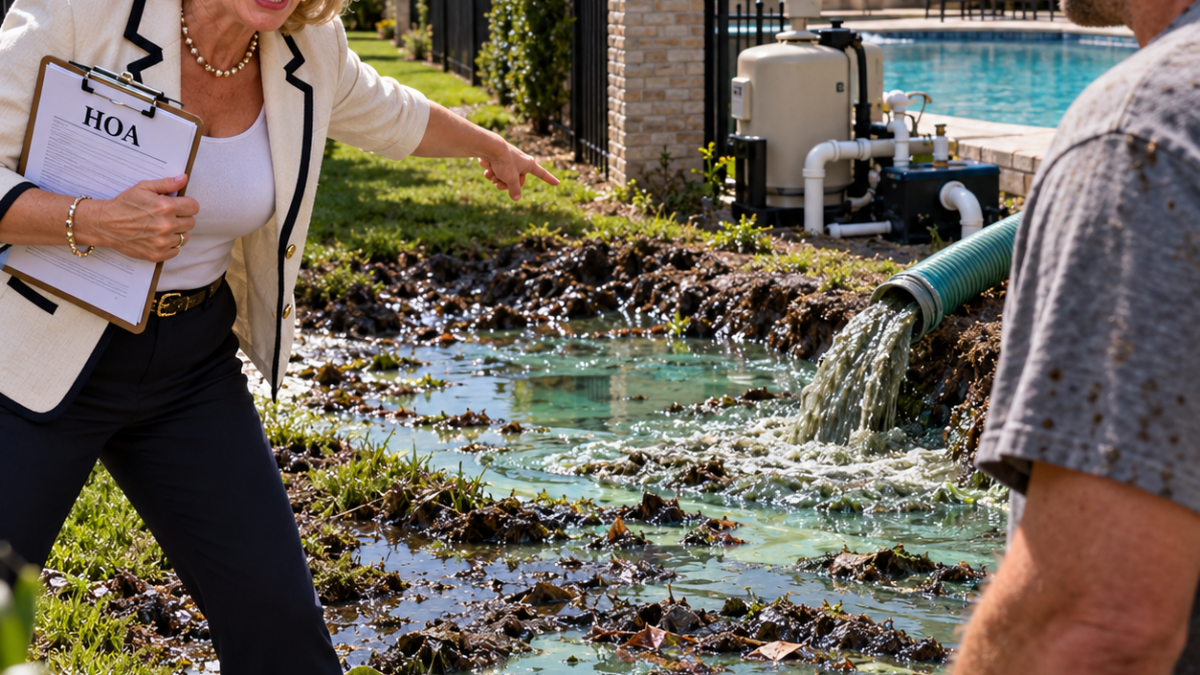
Minutes later, water began flowing toward the fence.
Not trickling.
Flowing.
It reached the hidden opening.
Then poured directly onto my land.
I walked outside but stayed far enough away to avoid altering the scene.
Water spread across the black soil.
The same geometry.
The same plume.
Twenty minutes.
Hundreds of gallons.
When the technician finished, he disconnected the hose and left.
I thought I had what I needed.
Then Karen stepped outside.
I almost closed the app.
She carried iced tea.
Walked toward the hedge.
Looked down.
Then leaned slightly to inspect the drainage gap.
Afterward, she looked toward my pasture.
And smiled.
Not a broad cartoon villain smile.
A small satisfied expression.
Maybe she was pleased with her landscaping.
Maybe pleased the water had drained.
Maybe something else.
I didn’t know what was in her head.
But I knew one thing.
She saw where the water went.
She knew.
That mattered.
I saved the footage.
Original file.
Backup drive.
Cloud copy.
Friday produced another discharge.
Then Tuesday.
Three recorded events.
I stopped speculating.
The mechanism was proven.
The lab results arrived the following Thursday.
I opened the report.
Control sample normal.
The affected samples showed chemical conditions consistent with repeated exposure to treated swimming-pool discharge, with elevated disinfectant-related residues and stabilizer compounds concentrated most heavily at the center of the dead zone.
The lab’s language was clinical.
The conclusion was not.
The soil was badly contaminated.
Vegetative growth would remain impaired without remediation.
I stared at the last page.
Then looked through my kitchen window toward Gus and Daisy.
The anger returned.
Different now.
Until that moment, I had considered the possibility that Karen was merely selfish.
Maybe the pool company created an improper discharge arrangement.
Maybe she didn’t understand the damage.
Maybe she thought it was harmless water.
But she had received my letter.
Photographs.
Map.
Description of the dead zone.
She responded by blaming summer heat.
Then sent me a violation notice.
Meanwhile the dumping continued.
That changed everything.
I called Marcus Thorne.
Marcus was a retired Marine JAG officer I had met through a veterans network.
He handled property and land-use litigation.
The first time someone introduced us, Marcus described part of his practice as “correcting HOA personality disorders through civil procedure.”
I thought he was joking.
I called his office.
“Thorne.”
“Marcus. John Davis.”
“Army engineer.”
“That’s me.”
“What broke?”
“Neighbor’s pool.”
“Call a pool company.”
“She’s dumping the waste on my pasture.”
Pause.
“Call my office.”
“I just did.”
“Bring everything.”
The next morning, I walked into his conference room with three binders, a laboratory report, photographs, maps, and a USB drive.
Marcus stared.
“How long were you in engineering?”
“Twenty-five years.”
“I can tell.”
I laid everything out chronologically.
Daily photographs.
Measurements.
Certified letter.
Receipt.
HOA response.
Violation notice.
Lab report.
Video.
He watched the first discharge.
No comment.
Second.
Still nothing.
Then Karen appeared after the discharge.
He paused.
Replayed.
Paused again.
“Is that her?”
“Yes.”
“She received your letter before this?”
“Yes.”
“Certified?”
I handed him the signed receipt.
He looked at Karen’s signature.
Then the HOA violation.
Then back at the video.
“John.”
“Yes?”
“I love organized clients.”
“I’m married to the evidence.”
“Unfortunately you’re exactly my type.”
We spent two hours going through possible claims.
Property damage.
Trespass-related issues depending on drainage configuration.
Nuisance.
Potential environmental violations.
Remediation costs.
Loss of use.
Testing.
Professional fees.
Possibly punitive damages if deliberate conduct could be proven.
Marcus refused to promise amounts.
That increased my trust.
“Your title says one-eighty?” people later asked me.
The final settlement reached that.
But on day one, Marcus said something much more important.
“We don’t chase a number. We prove the damage.”
He hired an environmental consultant.
The consultant inspected.
Took additional samples.
Mapped the plume.
Estimated depth.
The contamination was worse than the visible grass suggested.
Water had infiltrated below the root zone.
The remediation plan was not “throw down seed.”
It involved removing affected soil.
Licensed hauling.
Replacement fill.
Topsoil.
Regrading.
Vegetative restoration.
Monitoring.
Preliminary estimate:
More than ninety thousand dollars.
My stomach dropped.
“Ninety?”
Marcus nodded.
“And it could go higher.”
“For dirt?”
“For contaminated dirt, hauling, disposal, imported clean material, grading, restoration, professional oversight.”
I stared at the estimate.
Karen had created a six-figure problem to avoid paying for proper pool drainage.
“That can’t be real.”
“It is.”
“What if I do some work myself?”
“No.”
“I own equipment contacts.”
“No.”
“Marcus—”
“You hired me because you wanted legal accountability. We document professional remediation. We do not hand the defense an argument that you inflated damage or performed unnecessary work.”
He was right.
I hated that.
Lawyers enjoy being right at irritating moments.
Marcus drafted a demand.
Every board member received it.
Not just Karen.
He wanted them aware.
The letter described the contamination.
Included independent lab results.
Referenced the video.
Demanded immediate cessation.
Demanded professional remediation.
Required withdrawal of the bogus landscaping violation.
Requested reimbursement of expenses and legal fees.
Reserved claims for punitive damages.
The total demand, after estimated remediation and other damages, was $180,000.
I read the number.
“That’s going to make them insane.”
“Good.”
“I don’t want extortion.”
“It isn’t.”
He pointed to the remediation quote.
“We are not inventing damage.”
Then to testing.
“Real.”
Legal fees.
“Real.”
Loss of use.
“Real.”
Punitive component.
“Negotiable, but supported by the conduct we’re alleging.”
I nodded.
“What about regulators?”
Marcus tapped another envelope.
“Already prepared.”
A complaint went to the Texas Commission on Environmental Quality.
Full evidence package.
No dramatic language.
Dates.
Photos.
Test results.
Video descriptions.
Site map.
The state investigator called several days later.
Mr. Henderson.
Professional.
Direct.
“Mr. Davis, I’m reviewing your complaint.”
“Yes, sir.”
“You commissioned private testing?”
“Yes.”
“Chain-of-custody documents included?”
“Yes.”
“And you have recordings of the discharge?”
“Multiple.”
“Do they show the disposal pathway?”
“Clearly.”
“Who controls the source?”
“Pool contractor servicing Karen Miller’s property.”
“Has discharge stopped?”
“I haven’t seen it since the legal letter.”
“Good.”
He scheduled a site visit.
The fourteen-day demand period started.
For the first time in months, Tuesday passed without a pool truck.
Friday too.
The soil began drying.
Nothing grew.
But at least the poisoning stopped.
Karen disappeared behind her fence.
No iced-tea commentary.
No smug smiles.
Cars arrived at her house in the evenings.
Two belonged to board members.
One to a law office.
Bill called.
“People are panicking.”
“Good.”
“Karen says you’re bluffing.”
“Less good.”
“She says the tests are fake.”
I stared at my phone.
“Did she say that at a meeting?”
“Private board meeting.”
“How do you know?”
“Board member told his wife. Wife told mine.”
The oldest intelligence network in human civilization.
Marriage.
Day fourteen arrived.
No acceptance.
No counteroffer.
Nothing.
Marcus called at 8:05 the next morning.
“Filing.”
“Do it.”
The lawsuit entered public record.
That was when Karen tried to control the narrative.
Emergency HOA meeting.
Bill attended.
I didn’t.
He called afterward.
“You’re going to enjoy this.”
“I doubt it.”
“She says you’re extorting the neighborhood.”
“Of course.”
“Says you ruined your own pasture.”
“Of course.”
“She says your photos are manipulated.”
“Of course.”
“She says HOA insurance will cover everything but premiums may rise because of your frivolous claim.”
“That one’s clever.”
“Then David stood up.”
David Kaplan.
Retired accountant.
Former board treasurer.
“What did he ask?”
“TCEQ.”
I smiled.
Karen apparently turned white.
She had never told homeowners about the state investigation.
The room changed immediately.
A lawsuit can be framed as two angry neighbors.
A state environmental investigation is harder to dismiss as personality conflict.
Afterward, residents began calling me.
David first.
“Mr. Davis?”
“John.”
“I apologize for contacting you directly.”
“No problem.”
“I was once treasurer.”
“So Bill said.”
“May I ask whether the TCEQ complaint concerns Karen’s pool?”
“Yes.”
Silence.
“She told us it was unrelated.”
“It’s directly related.”
“Do you actually have video?”
“Yes.”
“Would your attorney allow me to see evidence?”
“I’ll ask.”
Marcus allowed selected residents to review public or nonprivileged material.
David saw lab results.
Photographs.
The HOA violation notice.
Not all litigation strategy.
Enough.
Then Maria called.
Karen had fined her over a vegetable garden.
Repeatedly.
Maria cried while telling me.
Not because of tomatoes.
Because Karen had made her feel like a criminal inside her own home.
A young couple called.
Playset.
Wrong manufacturer.
Months of threats.
Another homeowner described a mailbox fight.
Another a flag.
Another a shed color.
Some complaints were petty.
Some were legitimate HOA disputes.
I did not pretend every resident had been wronged.
But a pattern emerged.
Selective enforcement.
Personal hostility.
Karen escalated hardest against people who challenged her.
David produced old meeting minutes.
Emails.
Records.
Marcus reviewed them.
“This helps context.”
“For my case?”
“Potentially. But don’t let the neighborhood rebellion distract you.”
“Meaning?”
“You are suing over contamination. Stay disciplined.”
That became my rule.
I would not turn my lawsuit into revenge for every HOA grievance in Texas.
Karen had enough rope from my case alone.
Mr. Henderson arrived in a state vehicle on a hot Wednesday.
Whispering Pines noticed immediately.
Government logos are remarkably effective neighborhood communication devices.
He met me at my gate.
Tall.
Gray mustache.
Clipboard.
Sampling kit.
He stood at the edge of the dead zone.
“Wow.”
“Pretty.”
“Not the word I’d use.”
He photographed.
Measured.
Sampled center.
Edge.
Control.
Then inspected the fence gap.
“So discharge entered here?”
“Yes.”
“You’ve altered anything?”
“No.”
“Good.”
He looked toward my field notebook.
“May I see your logs?”
I handed them over.
He flipped through.
“You engineers are exhausting.”
“I’ve heard.”
“You photographed this daily?”
“Almost.”
He nodded.
“Makes chronology easier.”
After my property, he walked to Karen’s house.
I stayed on my side of the fence.
She answered quickly.
Bright floral dress.
Perfect hair.
Smile.
From thirty yards away, I watched her perform.
Hand gestures.
Pointing at my pasture.
Pointing at sky.
Pointing toward the drainage.
Henderson stood still.
Took notes.
Then pointed toward the pool equipment.
Her body language changed.
Arms crossed.
Head shaking.
He took photographs.
Water sample.
Drainage-path photographs.
The pool technician’s connection point.
Neighbors slowed during dog walks.
Curtains moved.
Whispering Pines’ rumor economy reached full production.
Three days later, a small newspaper article appeared.
STATE INVESTIGATES WASTEWATER DISCHARGE NEAR WHISPERING PINES
Karen was not named in the headline.
She didn’t need to be.
Within the HOA, everyone knew.
Bill called.
“Clubhouse is on fire.”
“Literally?”
“No.”
“Important distinction.”
“Karen is blaming you for the newspaper.”
“I didn’t call them.”
“Marcus?”
“I’m not asking.”
That afternoon, Karen’s attorney sent a settlement offer.
Five hundred dollars.
Grass seed.
Mutual release.
Withdrawal of regulatory complaint if legally possible.
Marcus read it aloud.
Then looked at me.
“Do you own a printer?”
“Yes.”
“Good. Print this.”
“Why?”
“So you can frame the worst offer I’ve ever seen.”
He rejected it.
Depositions began.
The pool technician went first.
His name was Kyle Benton.
Twenty-six.
Nervous.
He had worked for Blue Horizon Pool Services for four years.
Marcus showed him the video.
“Is that you?”
“Yes.”
“The hose?”
“Yes.”
“What is it connected to?”
“Filter backwash outlet.”
“Where does it discharge?”
He hesitated.
“Through the hedge.”
“Onto Mr. Davis’s property?”
“Yes.”
“Who instructed you to route it there?”
“Mrs. Miller.”
Karen’s lawyer objected.
Marcus waited.
Then continued.
“How long?”
“About two years.”
I felt cold despite the air conditioning.
Two years.
The grass hadn’t visibly died until concentration built.
But the dumping had started much earlier.
“Why that location?”
“She said not to dump toward her lawn.”
Of course.
“Did you discuss alternative drainage?”
Kyle nodded.
“We recommended extending to an approved disposal point when she renovated the pool equipment.”
“Cost?”
“I don’t remember exactly.”
“Why wasn’t it done?”
“She said it was unnecessary because there was empty land behind the fence.”
Empty land.
My pasture.
My horses’ pasture.
Marcus placed an invoice before him.
“Recognize this?”
“Yes.”
Service record.
Handwritten note:
BACKWASH EAST FIELD
“Whose description?”
“Ours.”
“Based on?”
“Customer instructions.”
Kyle looked miserable.
I didn’t hate him.
He should have known better.
Maybe did.
But Karen owned the property.
Karen chose the route.
Karen watched the results.
Kyle’s testimony destroyed ignorance.
Then Karen sat for deposition.
Navy suit.
Rigid posture.
Her attorney beside her.
Marcus began gently.
Name.
Address.
Role in HOA.
Pool ownership.
Maintenance company.
Then:
“Did you instruct Blue Horizon Pool Services to discharge filter backwash through the eastern hedge?”
“No.”
Kyle’s testimony already said otherwise.
Marcus did not react.
“Did you know the hose discharged through the fence?”
“No.”
Video.
“Is that you?”
Karen stared.
“It appears to be.”
“What are you doing?”
“Walking in my backyard.”
“You approach the discharge point.”
“I have landscaping there.”
“You look through the fence.”
“I don’t recall.”
“Do you deny looking through the fence?”
“I deny your characterization.”
Marcus nodded.
Next.
“Did Mr. Davis send you a certified letter describing the expanding dead vegetation adjacent to your property?”
“I receive many letters.”
He showed the receipt.
“Your signature?”
“Yes.”
“Did you read his letter?”
“I skimmed it.”
“You then signed a response attributing the condition to seasonal dormancy and natural surface flow?”
“The board responded.”
“Did you author the draft?”
“I contributed.”
“And days later, the HOA issued him a landscaping violation?”
“His property was unsightly.”
“He isn’t a member.”
“Our community still has standards.”
“That was not my question.”
Karen’s attorney shifted.
Marcus repeated.
“Is Mr. Davis’s parcel subject to Whispering Pines covenants?”
Karen resisted.
Eventually:
“No.”
“Then what authority did you have to fine him?”
“We were notifying him.”
“The document says ‘fine.’”
“It was intended to encourage compliance.”
“With rules that don’t apply?”
Her lawyer objected.
Marcus moved on.
Then came the lab tests.
Karen said they could be wrong.
The video.
Manipulated.
Kyle.
Disgruntled employee.
Service invoices.
Misunderstood.
Drainage.
Natural spring.
Marcus let her talk.
That was his method.
People expect aggressive lawyers to interrupt.
Marcus loved silence.
Silence makes liars fill space.
Three hours later, Karen had constructed so many explanations that some contradicted others.
The worst moment came when Marcus asked:
“Do you contend this video is fake?”
“I’m saying videos can be altered.”
“Was this one altered?”
“I don’t know.”
“Is that you?”
“It looks like me.”
“Did you stand by your fence that day?”
“I don’t recall.”
“Did your pool receive service that morning?”
“I don’t know.”
Marcus produced the company record.
Date.
Time.
Technician.
Filter service.
Backwash.
Then a forensic authentication report on the original camera files.
No evidence of editing.
Metadata consistent.
Marcus leaned back.
“Do you still believe the footage may have been fabricated?”
Karen’s attorney said, “You can answer if you know.”
Karen looked at the screen.
Then whispered:
“I don’t know.”
For the first time, she sounded small.
The insurance carrier had lawyers present by then.
They were less interested in neighborhood politics than risk.
They saw:
Verified contamination.
Repeated discharge.
Certified notice.
Continued activity.
Video.
Technician testimony.
Invoices.
Questionable HOA fine.
Regulatory investigation.
A defendant who refused to concede obvious facts.
Insurance companies dislike uncertainty.
They dislike bad witnesses even more.
Their counsel requested settlement discussions.
Marcus called.
“They want to talk.”
“Good.”
“Do not get excited.”
“I’m not.”
“You are.”
“A little.”
“Settlement is where people ruin good cases because they need emotional victory.”
“What do you recommend?”
“We ask for what fixes the harm.”
The final remediation quote had increased.
$110,000.
Deeper excavation.
More hauling.
Clean topsoil.
Regrading.
Monitoring.
Add testing.
Legal fees.
Loss of pasture use.
Additional hay costs.
Punitive component.
Final demand remained:
$180,000.
Settlement conference.
Same sterile conference-room atmosphere every legal show pretends is dramatic.
It wasn’t.
Coffee.
Bottled water.
Legal pads.
Exhausted people.
Karen sat across from me.
No floral dress.
Dark suit.
No iced tea.
Two carrier attorneys beside her.
Her own lawyer looked as though he had aged ten years.
Marcus spoke.
“One hundred eighty thousand.”
Carrier counsel said, “Breakdown?”
Marcus did.
Remediation.
Expenses.
Fees.
Damages.
Karen finally spoke.
“This is insane.”
I looked at her.
First direct eye contact all day.
“Was dumping it cheaper?”
Her lawyer touched her arm.
She jerked away.
“You’re trying to ruin me.”
“No.”
“You’ve turned everyone against me.”
“No.”
“You called the state.”
“Yes.”
“You went to the newspaper.”
“No.”
“Your lawyer did.”
Marcus smiled.
“Prove that.”
The insurance attorney closed his eyes briefly.
Karen continued.
“This was grass.”
I stared at her.
“That field was supposed to hold horses.”
She waved dismissively.
“They’re animals.”
That was the moment whatever sympathy I still had disappeared.
Not because she insulted me.
Because she still didn’t understand.
Gus and Daisy weren’t decorations.
They were living creatures I had taken responsibility for.
If I had ignored the contamination because Karen told me to water the grass, I might have let them graze there.
I leaned forward.
“You poisoned soil on land where animals feed.”
“I did not poison anything.”
“Kyle testified.”
“He did what he was paid to do.”
“You paid him.”
Silence.
“You received my letter.”
No answer.
“You saw the damage.”
No answer.
“You fined me for it.”
Her eyes dropped.
That was the part that mattered emotionally.
The dumping was selfish.
The denial was dishonest.
The violation notice was cruelty.
She had seen harm caused from her property and decided not merely to deny it but to punish me for displaying the result.
Marcus continued the negotiation.
Insurance coverage became complicated.
Some conduct potentially covered.
Some disputed.
Possible exclusions.
HOA exposure.
Individual exposure.
I stayed out of that fight.
I wanted the land fixed.
Eventually carrier counsel said:
“We can reach the total number subject to allocation and full release.”
Karen whispered, “No.”
Her attorney leaned toward her.
“Karen.”
“No.”
Carrier counsel spoke calmly.
“If this proceeds to trial, exposure may be significantly greater.”
“They’re bluffing.”
Nobody answered.
He slid the deposition transcript toward her.
“No, Mrs. Miller.”
That hurt her more than anything I could have said.
They accepted.
$180,000.
Professional remediation funded.
My documented expenses.
Legal resolution.
HOA’s bogus violation withdrawn.
No more discharge.
Full access for cleanup.
Settlement signed.
When I put the pen down, I expected triumph.
Instead, I felt tired.
Marcus noticed.
“Not what you expected?”
“What?”
“Winning.”
“I thought it would feel bigger.”
“It will when grass grows.”
He was right.
The check arrived one week later.
The cleanup began Monday.
If Karen’s pool had quietly damaged my property, remediation was the opposite.
Nothing about it was quiet.
Excavator.
Dump trucks.
Backup alarms.
Diesel.
Workers in protective gear appropriate for the site plan.
Survey stakes.
Consultant vehicles.
Soil hauled away load by load.
I stood near the barn watching the first bucket rise.
Black earth.
Dead roots.
Months of contamination.
Maybe years.
The excavator rotated.
Dropped it into a truck.
Boom.
Another bucket.
Karen could see everything from her backyard.
Her pool sat twenty yards beyond the fence.
For two weeks, the consequences of her choice occupied her view.
Frankly, that was satisfying.
Not because I wanted to humiliate her.
Because for months, she had acted as if damage on the other side of her fence didn’t exist.
Now she couldn’t ignore it.
Excavation widened.
Deepened.
Clean boundaries established through follow-up sampling.
Contaminated material removed.
Then clean fill.
Topsoil.
Grading.
Drainage corrected so nothing could be routed through that fence again.
I chose pasture grass suited for horses rather than decorative sod across the whole area.
Marcus joked that choosing function over suburban aesthetics was my final insult.
Maybe.
The environmental consultant required time before horses returned.
I waited.
No shortcuts.
While the land healed, Whispering Pines exploded.
The settlement allocation hit HOA finances.
Insurance disputes left the association responsible for a substantial portion.
The board announced a special assessment.
$2,500 per household.
People went insane.
Bill called.
“I think Karen may actually be murdered.”
“Don’t joke about that.”
“I’m not joking.”
“Bill.”
“Fine. Socially murdered.”
Better.
The association letter described the charge as arising from “resolution of pending legal and environmental matters.”
David obtained more detail.
Homeowners demanded records.
The story spread.
Emergency meeting.
I did not attend.
Not my HOA.
Bill later described it.
Standing room only.
Karen tried to call order.
People shouted questions.
Why were residents paying?
Why had the board dismissed my complaint?
Why was a non-member fined?
Who authorized the legal strategy?
Why had Karen’s private pool created association liability?
Why weren’t homeowners told about TCEQ?
Maria stood.
She brought two years of her violation letters.
Another homeowner brought theirs.
Then another.
The meeting stopped being about $2,500.
It became about fear.
People talked about living under constant scrutiny.
About selective fines.
About being embarrassed in front of neighbors.
About avoiding meetings because challenging Karen only made enforcement worse.
David moved for a no-confidence vote.
Karen reportedly shouted:
“You have no idea what I’ve done for this community!”
Someone answered:
“We know exactly what you’ve done. That’s why we’re voting.”
Bill laughed telling me that part.
The vote removed Karen.
Most of the board went with her.
Bill became interim president.
He called the next morning.
“Congratulations.”
“For what?”
“You destroyed an HOA president.”
“No.”
“She did that.”
“True.”
“What do you want?”
“First official act.”
“I’m afraid to ask.”
“We rescinded your landscaping violation.”
“Very generous considering I never belonged to your HOA.”
“Second act.”
“What?”
“Written apology.”
“That’s unnecessary.”
“Not to us.”
The letter arrived three days later.
It acknowledged that my property was outside HOA jurisdiction.
Acknowledged the violation notice had been improper.
Apologized for the association’s handling of my runoff complaint.
Short.
Direct.
No excuses.
I framed it beside the original violation.
Not out of spite.
As a reminder.
On the left:
FAILURE TO MAINTAIN LANDSCAPING.
On the right:
WE APOLOGIZE.
Sometimes bureaucracy does have poetry.
The pasture took months.
At first, clean soil looked sterile.
Brown.
Freshly graded.
Then sprouts appeared.
Tiny green lines.
Rain helped.
Irrigation helped.
Life returned slowly.
I kept Gus and Daisy out until final testing cleared the area.
The day the consultant said it was safe, I opened the northern gate.
Daisy entered first.
Of course.
She walked onto the restored section.
Lowered her head.
Began grazing.
I stood at the fence and watched.
No cheering.
No reporters.
No lawyers.
Just a horse eating grass.
That was the victory Marcus had promised.
He called later.
“Well?”
“They’re grazing.”
“Congratulations.”
“You were right.”
“I need that in writing.”
“No.”
“Email acceptable.”
“Never.”
Gus wandered onto the new grass.
Older now.
Slower.
I leaned on the fence.
For months, that ground had represented conflict.
Now it was pasture again.
There is something deeply satisfying about restoration.
Punishment is abstract.
Someone writes a check.
Someone resigns.
Someone loses authority.
Restoration is physical.
Clean soil.
Roots.
Rain.
Green.
The settlement left me with money after remediation and expenses.
I could have bought something stupid.
Frank suggested a bass boat.
I don’t fish enough.
Instead, I took in another rescue horse.
A young filly named Willow.
Neglected.
Underweight.
Suspicious of people.
Daisy hated her for three days.
Then adopted her.
Karen’s house went on the market around the same time.
The sign appeared on a Tuesday.
I noticed while repairing fence.
No satisfaction at first.
Just observation.
Two weeks later, movers came.
Bill called.
“She’s leaving.”
“I see.”
“That’s it?”
“What do you want me to do?”
“I thought you’d celebrate.”
“I have horses to feed.”
Truthfully, I did feel something.
Relief.
Karen had dominated my attention longer than I wanted to admit.
Every Tuesday I had watched for pool trucks.
Every wet patch became suspicious.
Every HOA envelope raised my blood pressure.
Her leaving meant I could stop orienting my life around the threat next door.
That is freedom too.
The house sold to a family with two children.
The new owner knocked on my gate before moving in.
“Mr. Davis?”
“John.”
“I’m Daniel Parker.”
We shook hands.
“I bought the Miller place.”
“I figured.”
He looked uncomfortable.
“I know some history.”
“I’m sure.”
“The pool drainage has been replumbed.”
“Good.”
“We had it inspected.”
“Smart.”
“I wanted you to know.”
“Thank you.”
He hesitated.
“My wife wants to plant trees along the fence. More privacy for both sides.”
“Sounds good.”
“No issue with roots or anything?”
I smiled.
“You’re asking.”
“Of course.”
“No issue.”
That ten-second conversation was healthier than every interaction I had with Karen combined.
Ask.
Discuss.
Agree.
Neighbors.
Simple.
The new HOA changed too.
Bill did not become emperor.
That was his best qualification.
Board meetings published detailed minutes.
Enforcement required written findings.
Appeals heard by people without personal involvement.
Financial records became easier to inspect.
Subjective language was reduced.
The vegetable-garden restriction disappeared.
Maria expanded hers immediately.
She grew tomatoes.
Then too many zucchini.
Every gardener eventually commits the zucchini mistake.
She brought me bags.
“You helped save the garden.”
“I did nothing.”
“You fought Karen.”
“She fought herself.”
Maria smiled.
“Take the zucchini.”
Punishment enough.
The playset stayed.
Trash-can enforcement became reasonable.
Property values did not collapse.
No civilization ended because somebody planted rosemary near a driveway.
A year after the settlement, Whispering Pines invited me to a community barbecue.
I almost said no.
Then Bill called.
“You should come.”
“I’m not a member.”
“That’s the point.”
“What point?”
“We’re neighbors.”
Hard to argue.
I went.
No speeches.
Thank God.
Maria introduced me to people I only knew through phone calls.
David brought beer.
Children ran across common grass Karen once treated like museum carpet.
Daniel, the new owner next door, handled burgers.
At one point, a woman asked:
“Are you the pasture guy?”
I laughed.
“I suppose.”
“My husband says you got a hundred and eighty thousand dollars because grass died.”
I looked at him.
He suddenly became fascinated by his plate.
“No.”
She waited.
“I received a settlement after repeated chemical discharge contaminated my land, required six-figure remediation, and continued after notice.”
Her eyes widened.
“That makes more sense.”
Her husband muttered, “I told it shorter.”
“Too short.”
We laughed.
That became part of the story’s evolution.
People loved the number.
$180,000.
It sounded like jackpot revenge.
It wasn’t.
Most of it represented real damage.
Cleanup.
Lawyers.
Testing.
Loss.
Risk.
Time.
Stress.
The expensive part of environmental damage is that restoring land can cost vastly more than not damaging it in the first place.
Karen could have fixed her drainage early.
A proper system would have cost a fraction.
Instead, she chose the cheap route.
Then denial.
Then intimidation.
Then legal defense.
Arrogance compounds like interest.
Years later, Gus died.
The horse.
Not a dramatic death.
Age.
Twenty-nine.
One morning he couldn’t rise comfortably.
Veterinarian came.
We made the decision every animal owner hates.
I sat beside him.
Hand on his neck.
Daisy called from the other paddock.
Willow paced.
When it was over, I cried harder than I expected.
I buried Gus beneath a live oak on the western side.
Far from the old contamination zone.
Bill helped.
So did Daniel.
Afterward, Daniel looked toward the green northern pasture.
“He got some good years here.”
“He did.”
“You almost lost that grazing area.”
“Yes.”
“Hard to believe.”
I looked at the grass.
The repaired section was now nearly indistinguishable.
Only I could see the line.
Because I knew where to look.
Scars often work that way.
Other people stop seeing them before you do.
Daisy died three years later.
Willow remained.
I took in two more rescues.
The pasture continued doing what land does when people stop poisoning it.
Growing.
Seasons changed.
Rain.
Drought.
Green.
Brown.
Green again.
The scar disappeared.
My anger did too.
That surprised me.
For years, I assumed forgiveness required some noble emotional effort.
It didn’t.
Time simply made Karen less important.
She became a chapter.
Not the book.
One morning, Marcus visited.
No lawsuit.
No emergency.
Just passing through.
He stood on the porch.
“That it?”
“What?”
“The contamination area.”
I pointed.
“From fence to that post.”
He stared.
“I can’t tell.”
“Exactly.”
We walked out.
Willow followed.
Marcus kept a cautious distance.
“You trust that animal?”
“More than most attorneys.”
“Unfair.”
“Accurate.”
He crouched.
Touched grass.
“You know what I remember?”
“What?”
“That violation letter.”
I laughed.
“Still framed.”
“Good.”
“You enjoyed this case too much.”
“It had everything.”
“Environmental damage?”
“Video.”
“HOA overreach?”
“Certified mail.”
“Vindictive fine?”
“Perfect narrative structure.”
“You sound diseased.”
“Litigator.”
Same thing.
He became serious.
“You handled something well.”
“Documentation?”
“No.”
“What?”
“You stopped.”
I looked at him.
“After settlement.”
“What else would I do?”
“You’d be surprised.”
He stood.
“Some clients win and then make revenge their identity. They keep looking for new ways to punish the other person. They sue again. Talk to media for years. Chase side claims worth nothing. They can’t let the enemy stop being central.”
I considered that.
“Karen moved.”
“Even if she hadn’t.”
He was right.
Winning is not peace if you keep fighting after the threat is gone.
The land taught me that.
You remove contamination.
You don’t keep excavating clean soil because you’re angry at what used to be there.
That sentence stayed with me.
Years later, when a younger veteran asked about conflict with his own neighbors, I told him:
“Dig until you reach clean soil. Then stop digging.”
He looked confused.
I explained.
Prove the problem.
Fix the harm.
Establish the boundary.
Then live.
Revenge stories online often end when the bad person loses.
Real life should continue beyond that.
Mine did.
I expanded the barn.
Built a shaded rehabilitation pen.
Started working with a local equine rescue.
Not full time.
Enough.
Some horses came for months before adoption.
Others stayed.
One mare named Belle arrived terrified of hoses.
The first time I washed a bucket near her, she nearly climbed the fence.
We learned slowly.
Trust takes repetition.
So does fear.
Funny how animals and neighborhoods share that.
Whispering Pines had lived under Karen’s enforcement style so long that even after she left, residents still behaved as if she might return.
People asked permission for things no longer regulated.
Apologized before disagreeing.
Expected retaliation.
Bill told me changing documents was easier than changing reflexes.
“People are still scared of letters.”
“They’ll learn.”
“How?”
“Time.”
He sighed.
“I hate answers that require patience.”
“You’re president of an HOA. Patience is the job.”
“Worst promotion of my life.”
He served two years.
Then stepped down voluntarily.
That alone proved progress.
David became treasurer.
Maria refused every nomination.
“I have tomatoes.”
Strong platform.
Five years after the settlement, Whispering Pines held a neighborhood cleanup day.
Not HOA-mandated.
Volunteer.
Daniel asked if they could help repair the outer section of my fence where storm debris had damaged posts.
I said no at first.
Private property reflex.
Then reconsidered.
Saturday morning, twelve people arrived.
Tools.
Gloves.
Coffee.
Children too young to be useful.
We replaced posts.
Reset wire.
Cleared brush.
No one sent an architectural form.
No one demanded uniformity.
At lunch, Maria brought sandwiches.
I looked around.
“You know Karen would hate this.”
Bill shook his head.
“Stop giving her credit.”
“For what?”
“For bringing us together.”
“She didn’t.”
He pointed at everyone.
“We did that afterward.”
Good distinction.
Bullies don’t deserve credit for the communities formed in resistance to them.
The people who choose solidarity deserve it.
That night, I found the original field notebook.
Page one.
Measurements.
Chemical odor.
Lot 112.
I flipped through.
Every expansion.
Every service day.
Every photograph reference.
Toward the back, one final note after remediation:
Area cleared for grazing. Vegetation stable. No further discharge observed.
I closed it.
Mission complete.
That should have been the end.
But another ending came years later.
A letter.
Forwarded through Marcus.
Karen.
I almost threw it away.
Then opened it.
John,
I know you have no reason to read this.
I have spent a long time angry about what happened. For years I told myself you humiliated me and turned the neighborhood against me.
That is not the truth.
I made decisions because I believed being president meant I had to win every disagreement. I treated your refusal to obey me as disrespect instead of recognizing that I had no authority over you.
The pool discharge should never have happened. When you wrote the first letter, I should have stopped it immediately.
The violation notice was wrong.
I knew it was wrong when I signed it.
I wanted to intimidate you.
I am sorry.
Karen
I stopped reading after that sentence.
Then started again.
I knew it was wrong when I signed it.
There it was.
Not the settlement.
Not the deposition.
Not the lawyers.
The truth.
Simple.
Late.
But true.
I set the letter beside my coffee.
Willow grazed outside.
The northern pasture was green.
What should I do with an apology that arrived years after it could change anything?
I asked Marcus.
“Why are you asking a lawyer?”
“You handled her for months.”
“I charged you for conflict, not forgiveness.”
“Helpful.”
“What do you want?”
“I don’t know.”
“Then don’t respond until you do.”
I waited.
Two weeks.
Then wrote:
Karen,
I received your letter.
Thank you for acknowledging what happened.
The land recovered, and I moved forward a long time ago.
I hope you have too.
John
Nothing else.
No lecture.
No victory lap.
No invoice.
She never wrote again.
That was fine.
Closure is often overrated.
Peace is better.
By then, the $180,000 had become trivia.
The thing everyone remembered.
The thing strangers wanted to hear.
But when I thought about the case, I remembered different moments.
The first green shoots after remediation.
Gus grazing safely.
Daisy rolling in the restored grass.
Willow arriving skinny and frightened, then running across the pasture months later.
Mrs. Alvarez from Whispering Pines handing me tomatoes at a barbecue.
Daniel knocking before planting trees.
Karen finally writing:
The violation notice was wrong.
Those were the real markers.
Money measures damage imperfectly.
Restoration measures what you do afterward.
One summer, my granddaughter Emily visited.
She was eleven.
City kid.
Loved horses from a safe distance.
Willow tolerated her.
Emily noticed the framed HOA violation in my office.
“What’s this?”
“Old argument.”
She read.
“Failure to maintain landscaping?”
“Yes.”
“Why is that funny?”
I pointed through the window.
“See the green pasture along that fence?”
“Yes.”
“That used to be completely dead.”
“Why?”
“Neighbor dumped something she shouldn’t have.”
“And then she fined you?”
“Correct.”
Emily stared.
“That’s stupid.”
Children excel at simplifying legal disputes.
“Yes.”
“What did you do?”
“Collected evidence.”
“Did you yell at her?”
“No.”
“Why not?”
“Wouldn’t make the grass grow.”
She considered that.
Then asked the question I wish more adults asked.
“What made the grass grow?”
“Fixing the source and replacing the damaged soil.”
She nodded.
“So that’s what mattered.”
Exactly.
Later that afternoon, she helped feed Willow.
I thought about how easily the story could have become only about revenge.
Karen got destroyed.
HOA lost.
$180K payout.
Those are clickable words.
But if that is all you understand, you miss the point.
I didn’t buy ten acres because I wanted enemies.
I didn’t rescue horses because I wanted lawsuits.
I didn’t collect soil samples because I enjoyed proving people wrong.
I wanted quiet land.
Karen interfered with that.
The legal fight existed to restore the quiet.
Not replace it.
That distinction saved me from becoming the kind of person who needs conflict to feel alive.
I had met those people in the Army.
Sometimes leaders became so accustomed to operating under pressure that peace made them uncomfortable.
They created crises.
Not consciously.
But chaos became familiar.
Karen reminded me of that.
Without violations, she had no purpose.
Without people to correct, no identity.
That was tragic in its own way.
Not an excuse.
An explanation.
The best HOA board afterward understood that rules should solve actual shared problems.
Drainage.
Common roads.
Insurance.
Maintenance.
Not provide emotional purpose for whoever holds the gavel.
David once said:
“Good governance is boring.”
I agreed.
Whispering Pines became wonderfully boring.
Their meetings focused on budgets.
Pool repairs.
Entrance landscaping.
Storm drainage.
No dramatic confrontations.
No surveillance of vegetable gardens.
One year they argued twenty minutes over mulch.
Bill called afterward.
“We’re becoming normal.”
“Congratulations.”
“It was the most boring meeting of my life.”
“Success.”
The pool next door remained.
Daniel’s family used it constantly.
Children screaming.
Splashing.
Music sometimes.
Normal neighbor noise.
Backwash went through proper disposal.
The fence stayed dry.
One day, Daniel apologized because his kids were loud.
“John, sorry about yesterday.”
“What happened yesterday?”
“Pool party.”
“I heard it.”
“Too loud?”
“Kids were laughing.”
“Yes.”
“That’s not a problem.”
He smiled.
“Karen would’ve filed a noise complaint.”
“She did once.”
“What?”
“Against her own neighbor’s wind chimes.”
We both laughed.
Sometimes the healthiest revenge is discovering that the world becomes pleasant once one person stops controlling it.
I grew older.
Retirement became less about projects and more about mornings.
Coffee.
Horses.
Weather.
My knees complained during fence repairs.
I hired help more often.
The pasture required constant work.
Land never truly becomes low-maintenance.
That is part of why I loved it.
One autumn morning, I walked the northern boundary.
The hedge on Daniel’s side had grown thick.
The original fence gap had been repaired years earlier.
No sign remained.
I stopped where the dead zone once began.
Bent down.
Pulled a handful of grass.
Roots thick.
Soil dark but healthy.
Earthworms.
I smiled.
Years earlier, that handful would have smelled chemical and wrong.
Now it smelled like dirt.
Ordinary dirt.
Most people never appreciate ordinary soil.
I do.
Because I have seen what dead soil looks like.
Restoration gave ordinary things value.
Rain that absorbed naturally.
Grass roots.
Horse manure.
Even weeds.
Especially weeds.
Weeds mean soil can support life.
There were days during remediation when I would have celebrated dandelions.
That perspective remains.
A year later, Whispering Pines replaced part of its pool-management policy.
Not because they had jurisdiction over private pools in every way, but because shared environmental risks mattered.
Clear drainage requirements.
Vendor documentation.
No discharge toward adjoining properties.
Annual reminders.
It was one of the few HOA rules I fully endorsed.
Bill sent me a copy.
“Look what you created.”
“I created nothing.”
“Your lawsuit did.”
“Karen’s discharge did.”
“Fine.”
He added:
“We named it the Davis Rule.”
“No.”
“We did.”
“Change it.”
“Kidding.”
He had learned from Tom Gable, apparently.
HOA presidents become comedians once they no longer fear being overthrown.
I visited Marcus’s office almost ten years after the case.
Different reason.
Estate planning.
He had more gray hair.
Still sharp.
He opened a file cabinet.
“You know I still use your case?”
“For what?”
“Training.”
“That seems unethical.”
“Anonymized.”
“What lesson?”
“Documentation.”
He pointed at me.
“Clients come in saying, ‘My neighbor is poisoning my yard.’”
“Sounds familiar.”
“They bring nothing.”
“No photos?”
“Maybe one blurry phone picture.”
“No samples?”
“No.”
“No timeline?”
“No.”
“No certified notice?”
“No.”
I shook my head.
“Amateurs.”
“That is exactly what I tell them.”
“You do not.”
“No.”
He smiled.
“But your case is perfect for showing why evidence matters.”
I thought about that.
Karen lost partly because she underestimated paper.
She thought power was the title on her HOA letterhead.
My power came from information.
Daily photographs.
Measurements.
Chain of custody.
Videos.
Signed receipts.
Invoices.
Her own letters.
Kyle’s records.
Evidence outlasts confidence.
That lesson applied beyond HOAs.
Whenever someone tries to pressure you into arguing emotionally, facts slow the room down.
“What happened?”
“When?”
“Where?”
“How often?”
“Who saw it?”
“What document?”
“What measurement?”
Anger says something is wrong.
Evidence shows why.
You need both sometimes.
But only one survives deposition.
Marcus completed my estate documents.
Before I left, he said:
“One-eighty.”
“What?”
“Still my favorite settlement number.”
“You need hobbies.”
“I golf.”
“That explains everything.”
Back home, Willow stood near the gate.
Older.
Gray showing.
I gave her an apple slice.
Looked toward Whispering Pines.
Different board.
Different families.
Different atmosphere.
Karen’s old house had changed color twice.
Her pool remained bright blue.
My grass remained green.
That symmetry made me laugh.
The thing Karen protected most aggressively was her image.
Perfect pool.
Perfect lawn.
Perfect community.
In the end, the perfect surface hid the ugliest behavior.
My pasture looked damaged.
Embarrassing.
Black.
But beneath the ugliness, truth was accumulating.
That reversal is why the story still resonates with me.
Appearances are dangerous evidence.
Karen’s yard looked healthy.
Mine looked neglected.
She controlled the story until testing revealed the source.
People believed the wrong side because one side looked prettier.
That happens everywhere.
Companies.
Families.
Governments.
Neighborhoods.
The cleanest facade can hide the worst drainage.
Engineers learn to look downstream.
Eventually, I sold five of my ten acres to a conservation-minded couple who wanted to keep horses.
I retained the house, barn, and northern pasture.
People asked why I didn’t move entirely.
Too many memories.
Gus beneath the oak.
Daisy near the barn.
Willow’s first run.
The contamination scar.
The restoration.
This land had become the record of my retirement.
Leaving would feel like closing a book before I was finished.
The couple asked about Whispering Pines.
“Any trouble?”
“Not anymore.”
“HOA jurisdiction?”
“None.”
“Drainage?”
“Documented.”
I gave them everything.
Survey.
Environmental closure reports.
Testing.
Boundary records.
They laughed at the size of the binder.
“Do we need all this?”
“Probably not.”
“Then why?”
“Because probably is how stories begin.”
They kept it.
Good.
One Christmas, Bill mailed me a card.
Inside was a photograph of the Whispering Pines board.
Six people.
Ugly sweaters.
Maria holding a basket of vegetables.
On the back:
TEN YEARS WITHOUT AN ENVIRONMENTAL LAWSUIT. NEW RECORD.
I laughed for five minutes.
Framed that too.
The old evidence wall slowly became comedy.
That is how you know a wound healed.
When proof of pain becomes a story you can laugh about.
Karen’s violation letter stayed.
Not as hatred.
As absurdity.
Imagine poisoning someone’s pasture and then fining them because the poisoned pasture looks bad.
You couldn’t invent better satire.
Except it happened.
Sometimes visitors see it.
They ask:
“Is this real?”
“Yes.”
“Did they really try to fine you?”
“Yes.”
“How much?”
“Fifty dollars a day.”
“What did you say?”
“Nothing.”
“Nothing?”
“I filed it.”
“That’s all?”
“Then I tested the soil.”
That answer usually disappoints people.
They want confrontation.
I understand.
But screaming would have given Karen a story.
Evidence gave me the truth.
That distinction made $180,000 possible.
More importantly, it made restoration possible.
Years later, I learned Kyle left pool service.
Started his own landscaping company.
He came by once.
Unexpected.
Pickup at the gate.
Older.
Married, judging by the ring.
“Mr. Davis?”
“John.”
“I don’t know if you remember me.”
“I do.”
He looked embarrassed.
“I wanted to apologize.”
“You testified truthfully.”
“After.”
I waited.
“I should’ve refused.”
“The discharge?”
“Yes.”
“I knew it wasn’t right.”
That mattered.
“I was young. She was the customer. Boss told me customers choose drain location unless prohibited. I didn’t ask.”
“You know now.”
“Yes.”
He looked toward the pasture.
“It recovered.”
“It did.”
“Good.”
I could tell he had carried guilt.
So I gave him something I once struggled to give myself.
Permission to stop carrying it.
“Kyle.”
“Yes?”
“You told the truth when it mattered.”
“Still.”
“You didn’t design the drainage.”
“No.”
“You should have questioned it.”
“Yes.”
“So question it next time.”
He nodded.
“That’s all?”
“That’s all.”
He smiled weakly.
“Thank you.”
We shook hands.
That conversation taught me something about accountability.
Not everyone involved deserves the same weight of blame.
Kyle participated.
Karen directed.
The board dismissed warnings.
The HOA overreached.
Different decisions.
Different responsibility.
Anger flattens people.
Justice should not.
That is another reason I became uncomfortable when strangers celebrated the case as “destroying Karen.”
I didn’t want destruction.
I wanted consequence proportionate to conduct.
She lost money.
Status.
Community trust.
Eventually moved.
Those were consequences.
But she remained a human being capable, years later, of admitting the violation letter was knowingly wrong.
That mattered too.
Not enough to erase.
Enough to complete.
One morning, long after the case disappeared from local memory, I stood at the northern fence.
Rain had fallen overnight.
The ground was wet everywhere.
Normal wet.
No chemical smell.
No strange triangle.
Water gathered briefly near the fence, then drained through the pasture naturally.
I watched it move.
There is something satisfying about water behaving properly.
Marcus would call that engineer sickness.
Probably.
The horses grazed.
Clouds broke.
Sunlight reached the grass.
I remembered Karen’s first words:
Maybe if you learned how to water it properly.
For years, I thought of that sentence with anger.
That morning, I laughed.
Because in the end, water had been exactly the problem.
Just not mine.
She had mistaken contamination for incompetence.
My patience for weakness.
A formal letter for surrender.
Silence for fear.
Documentation for passivity.
She believed power meant getting the last word.
I learned long ago that the last word rarely matters.
The last measurement does.
The last test.
The last signed agreement.
The last truck carrying contaminated soil away.
The last regulatory sample coming back clean.
The first horse grazing safely again.
Those are outcomes.
Outcomes beat speeches.
If I had to reduce everything to one lesson, it would not be “fight your HOA.”
It would be this:
When someone harms you and insists nothing happened, do not let their certainty replace your observation.
Look closely.
Measure.
Document.
Ask once.
Give them the chance to correct it.
Then, if they choose arrogance over responsibility, stop arguing about reality and prove it.
Karen told me summer killed my grass.
The photographs showed a spreading plume.
She called it natural runoff.
The camera showed a hose.
She implied neglect.
The laboratory showed contamination.
She claimed ignorance.
The certified letter showed notice.
She tried to blame me.
Her own contractor testified.
Each lie made the eventual truth heavier.
By settlement day, Marcus barely needed rhetoric.
The evidence sat there.
Folders.
Videos.
Reports.
Records.
Truth does not always arrive dramatically.
Sometimes it arrives tabbed and indexed.
The $180,000 number made headlines.
The grass made me happy.
That is the ending strangers find hardest to understand.
If I had received the check and the soil remained dead, I would have lost.
If Karen had been humiliated and Gus couldn’t graze safely, I would have lost.
If Whispering Pines revolted but my pasture stayed contaminated, I would have lost.
Justice required restoration.
Everything else was secondary.
Today, when I stand on my porch, I do not see a battlefield.
I see horses.
Fence posts.
Grass.
The barn still rust red.
Whispering Pines beyond the trees.
Children sometimes laughing in the pool where the entire mess started.
Nobody over there tells me what color to paint.
I don’t care what color they paint either.
That is what a boundary should do.
Not create enemies.
Define responsibility.
Karen crossed mine physically with wastewater and politically with HOA authority that did not belong to her.
I defended it.
Then, once it was respected, I stopped defending and started living again.
The final irony?
My pasture eventually looked better than Karen’s old lawn.
Not manicured.
Not perfect.
Real.
Native grass mixed with improved pasture species.
Healthy soil.
Horse tracks.
Occasional weeds.
Life.
A landscape Karen probably would have called messy.
To me, it was beautiful.
Because every green blade represented something black soil once made impossible.
Years after the settlement, I brought a soil core up from the restored area.
No legal reason.
Curiosity.
Dark topsoil.
Healthy root structure.
Earthworms.
I placed the sample back.
Patted the ground.
Willow watched.
“You approve?”
She kept eating.
Good enough.
I walked back toward the barn as sunset settled across the property.
The white fence at Whispering Pines caught orange light.
For an instant, I remembered Karen standing on the other side with iced tea.
Condescending smile.
Telling me to learn how to water grass.
If I could speak to the version of myself standing in that blackened pasture, I would tell him something.
Do not let the ugliness of this moment convince you it is permanent.
Take the picture.
Write the date.
Collect the sample.
Protect the horses.
Then keep going.
Because poisoned ground can be excavated.
Clean soil can be brought in.
Roots can return.
A frightened community can learn to speak.
A bully can lose power.
And even after months of black earth, green eventually becomes possible again.
Karen dumped pool waste onto my land.
The claim eventually cost $180,000.
But the check was never the part that stayed with me.
What stayed was the first morning after the remediation when I saw tiny green shoots pushing through clean soil.
They were barely an inch tall.
Fragile.
Easy to miss.
I crouched beside them.
Touched one with my fingertip.
For months, every sign from that patch had meant damage.
That morning, it meant life.
That was the moment I knew the fight was truly over.
Not when Karen signed.
Not when the board removed her.
Not when the settlement money cleared.
When the ground decided to grow again.
Years later, I still think justice works the same way.
It is not always the punishment.
Sometimes justice is simply the return of what should have been there all along.
Safety.
Boundaries.
Accountability.
Peace.
And on my side of that old white fence, after everything Karen tried to deny, justice finally took root.