PART 2: HOA Karen Ordered My Lean-To Demolished—Then the Power Company Revealed It Protected the Transformer Feeding Her Entire Street
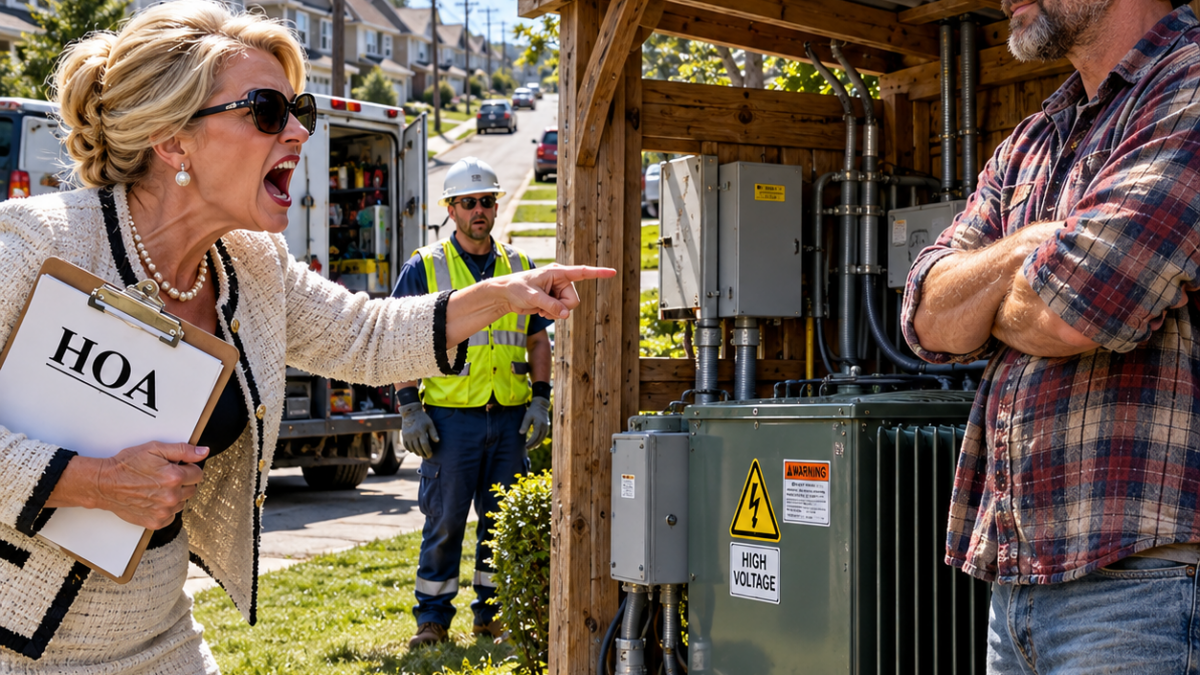
Karen gave me until Friday to tear down the little lean-to at the back of my property, and she promised the HOA would demolish it themselves if I refused.
She was so certain it was nothing more than an ugly, unapproved shed that she doubled my fines, threatened a lien on my house, and eventually hired two men with sledgehammers to remove it while the neighborhood watched.
What she didn’t bother to learn was why that structure existed in the first place—or what would happen when the people who actually owned what sat beneath it arrived.
“That illegal monstrosity comes down by Friday, Mr. Davies.”
Karen Johnson stood just beyond the edge of my flower bed, clutching a clipboard against a bright pink tracksuit and staring toward the far corner of my property as though she were personally inspecting an enemy position.
“Otherwise,” she continued, “the association will remove it for you, bill you for the demolition, and assess a thousand-dollar fine for every day you remain noncompliant. Is that clear?”
I set down the pruning shears I had been using on my roses.
Twenty-five years in the Army Corps of Engineers had taught me that when someone begins a confrontation by trying to overwhelm you, the worst thing you can do is match their volume.
So I looked at Karen.
Then I looked at the structure she hated.
It wasn’t beautiful.
I’ll admit that.
Four heavy treated-pine posts supported a sloped roof covered in shingles chosen to match my house. Three partial walls shielded the equipment beneath it from the worst of the weather while leaving the rear completely open for utility access and ventilation.
Under that lean-to sat a large green electrical transformer.
Not mine.
Not Karen’s.
Not the HOA’s.
Northridge Power and Light owned it.
The transformer had been sitting on that utility easement since long before Sterling Meadows existed, feeding power to my cul-de-sac and several streets beyond.
An ice storm had damaged it the previous winter after a heavy limb fell across the casing. The repair crew told me the impact had come dangerously close to knocking out service during one of the coldest nights of the year.
So the following summer, after checking the recorded easement and maintaining the required access clearances, I built the shelter.
My money.
My labor.
Protection for equipment that kept dozens of homes running.
Karen saw a shed.
“Did you read Appendix C?” I asked.
Her eyebrows lifted.
“Excuse me?”
“The original Sterling Meadows development documents.”
“I am intimately familiar with our covenants.”
“Then you remember the preexisting utility easements.”
Her expression tightened.
“The Architectural Review Committee governs exterior structures.”
“Not that easement.”
“It is on your lot.”
“The land is part of my parcel. The utility right-of-way predates the subdivision.”
“That doesn’t give you permission to build whatever you want.”
“It isn’t whatever I want.”
I pointed toward the transformer.
“It protects electrical infrastructure.”
Karen laughed.
Not because anything was funny.
Because people like Karen often laugh when they need an audience to believe they are not losing.
“You built a shed without approval.”
“It isn’t a shed.”
“It has a roof.”
“So does a bus stop.”
Her face darkened.
I probably could have skipped that sentence.
I didn’t regret it.
“The fine stands,” she said. “The demolition order stands. You’ll receive the certified notice tomorrow.”
“Good.”
That stopped her.
“Good?”
“Put everything in writing.”
Karen stared at me.
“I intend to.”
“Excellent.”
Her voice sharpened.
“You think this is some sort of game?”
“No.”
I removed my work gloves one finger at a time.
“I think written records are useful.”
For the first time, a small uncertainty appeared behind her anger.
It lasted less than a second.
Then she recovered.
“We’ve put liens on homes for less.”
There it was.
Not community standards.
Not aesthetics.
Leverage.
“Karen,” I said, “before you threaten my home again, go back to your office, pull the recorded plat for Lot 114, and read the section covering that transformer.”
“I don’t need homework from you.”
“You probably do.”
She stepped closer.
“I’m president of the HOA.”
“And Northridge Power and Light owns the transformer.”
“This is a community matter.”
“Electricity is going to become a community matter very quickly if you convince someone to start swinging a hammer around seven thousand volts.”
Her eyes flickered toward the green box.
Then back to me.
“You’re trying to frighten me.”
“No.”
I picked up my shears.
“I’m trying to prevent you from doing something stupid.”
Her mouth opened.
Closed.
Then she turned sharply and marched toward the sidewalk.
At the driveway she looked back.
“Friday, Mr. Davies.”
I nodded.
“Make sure your demolition crew has good insurance.”
She left without answering.
I stood alone beside the roses for another minute before looking toward the lean-to.
The transformer hummed quietly beneath the roof.
Steady.
Unremarkable.
Doing exactly what it had been doing long before Karen became president of anything.
Then I went inside, pulled my closing documents from the filing cabinet, and found the survey.
Ten minutes later, I was smiling.
Karen believed she had given me four days to surrender.
What she had actually given me was four days to make sure every person whose authority mattered knew exactly what she was planning.
PART 2
I bought my house in Sterling Meadows because I had reached a point in my life where quiet had become valuable in a way I never understood when I was younger. For most of my career, silence meant something was wrong. Silence on a job site could mean equipment had stopped. Silence during an operation could mean communications were down. Silence overseas could make every experienced person in the room look up at the same time. After twenty-five years with the Army Corps of Engineers, I wanted ordinary noise instead: lawn mowers, dogs, garage doors, a basketball bouncing against pavement, sprinklers clicking across somebody’s lawn. I wanted a garage large enough for my old Ford pickup, a small garden, and a porch where I could drink coffee without anyone handing me a schedule, a set of plans, or an emergency change order.
Sterling Meadows was slightly too polished for my taste, but it was peaceful. The houses were variations of the same suburban idea, the lawns were edged with unnecessary precision, and the entrance sign had more decorative stonework than some government facilities I had worked on, but the house itself was solid and the back of my lot opened toward county woodland. That buffer mattered to me. I could stand at the rear fence and see trees instead of somebody else’s breakfast room.
Before I closed, I did what I had spent a career doing whenever I was about to accept responsibility for a site: I read everything. Mortgage documents. Survey. Easements. Covenants. Plat maps. Restrictions. Most buyers skim HOA paperwork until their eyes blur and then initial wherever the title agent points. I brought colored tabs.
My real-estate agent watched me mark pages.
“You actually read those?”
“That’s generally why people print words on paper.”
“You’re going to be popular with the HOA.”
“I’m not planning to marry them.”
That was when I first noticed the public utility easement at the rear corner of the lot.
Ten feet by ten feet on the recorded plat.
Granted in 1974.
Twenty-four years before Sterling Meadows was developed.
The easement gave Northridge Power and Light access rights for installation, service, maintenance and protection of electrical distribution equipment. A large pad-mounted transformer sat there, surrounded by a narrow gravel apron and enough clear space for utility crews to work.
I asked about it before buying.
The seller shrugged.
“Big green box.”
“Any problems?”
“Never.”
Northridge confirmed it supplied more than my house. The transformer was a major local distribution node serving my cul-de-sac and additional streets downstream.
That included Karen’s street.
I didn’t know that would become funny later.
For almost two years, the transformer was just part of the landscape.
Then the ice storm hit.
It started as freezing rain late on a Thursday and turned uglier overnight. By midnight, every tree looked dipped in glass. Branches sagged. I went outside twice with a flashlight to check limbs near the house.
Around two in the morning, there was a sharp crack from the back of the property.
Then the lights flickered.
Off.
On.
Off again.
Five seconds.
Then stable.
I pulled on boots.
A large oak branch from outside my property had snapped under ice load, fallen across the easement and struck the side of the transformer.
It hadn’t ruptured anything.
But the casing was dented.
A utility crew arrived before dawn.
One lineman looked at the branch.
“Lucky hit.”
“How lucky?”
“Another foot toward the primary connections and your neighborhood could’ve been cold until tomorrow.”
It was nineteen degrees outside.
That stayed with me.
The crew removed the branch and replaced damaged hardware.
I asked one of them whether some form of overhead protection would help.
“Depends how you do it.”
“Open access. Noncombustible separation. Ventilation maintained.”
He looked at me.
“You an electrician?”
“Engineer.”
“That explains the questions.”
He walked around the site.
“If you build anything, don’t attach it to our equipment, don’t block access, don’t trap heat and don’t put posts where they interfere with underground lines.”
Reasonable.
The following spring I called Northridge’s engineering office and asked for utility-marking information. I didn’t request them to design anything. I simply made sure I understood clearances and buried-service locations.
Then I built.
Treated lumber.
Heavy posts.
Roof slope enough to shed snow.
Corrugated metal originally, later shingles.
Three windbreak sides ending well clear of the transformer.
Rear entirely open.
Clearances larger than required.
Nothing attached to the pad.
Nothing buried within prohibited distances.
It took one weekend and part of another.
My neighbor Tom stopped by while I was working.
“What’s that?”
“Transformer shelter.”
“Why?”
“I like electricity.”
“You planning for the apocalypse?”
“I’m planning for February.”
He laughed.
The lean-to immediately became almost invisible to me.
That was the point.
It sat quietly at the back of the property, protecting something everyone relied on.
Then Karen noticed.
Karen Johnson had lived in Sterling Meadows longer than I had but became HOA president only a few months after I moved in. The previous president, a mild-mannered dentist named Paul, had approached HOA leadership the way I think most reasonable people should: reluctantly. Meetings were short. Fines were rare. Committees handled genuinely necessary things.
Paul moved to Florida.
Karen filled the vacuum.
Some people have hobbies.
Karen had compliance.
At first, I found her almost entertaining.
She carried a clipboard on morning walks.
Not metaphorically.
Actually carried one.
She stopped residents to ask about mulch color.
One morning I saw her measuring the distance between a driveway and a garbage can with a tape measure.
My first violation came over my trash container.
Six inches too close to the curb on a noncollection day.
Fifty dollars.
I could have appealed.
Instead I paid it.
My wife had died several years before I moved to Sterling Meadows, and by then I had learned to choose my emotional expenditures carefully.
Fifty dollars was irritating.
Not strategic terrain.
The lean-to was different.
Karen’s first notice called it an “unapproved accessory structure.”
I responded verbally the afternoon she confronted me.
The next morning, certified mail arrived.
Violation 2023-47B.
$1,000.
Additional $100 per day.
Demolition threat.
Potential lien.
Potential foreclosure.
I read the letter at my kitchen table.
Then I opened my closing file.
The recorded plat was exactly where I remembered.
Public Utility Easement.
1974.
I pulled the HOA covenants.
Appendix C.
Section Four.
Language acknowledging prior utility rights.
Then I checked county records online and confirmed the easement remained active.
My response was three pages.
No insults.
No threats.
Just facts.
**The structure is a protective covering associated with existing utility infrastructure located within a recorded public utility easement.**
I attached plat.
Recorded easement reference.
Photographs.
Then I copied Northridge Power and Light.
That was the move Karen considered unforgivable.
Not because it was improper.
Because it took the dispute outside her kingdom.
Brenda Wallace from Northridge corporate relations called four days later.
“Mr. Davies?”
“Yes.”
“I have your letter and the HOA notice.”
“I’m sorry you got dragged into this.”
She laughed.
“We get dragged into HOA disputes more than you would believe.”
“I can imagine.”
“This one is unusual.”
“Why?”
“Because your shelter is actually useful.”
That was gratifying.
Brenda explained the transformer fed my cul-de-sac and three additional streets.
“Peak service impact if that unit fails is substantial.”
“How substantial?”
“Enough that our operations people know its number.”
“What number?”
“G788B.”
I wrote it down.
Then she said:
“Our field department reviewed the photographs. Assuming the clearances shown are accurate, we have no objection.”
“Would you put that in writing?”
“Already drafted.”
I almost laughed.
“For me?”
“For the HOA.”
Her voice changed slightly.
More serious.
“We are also making clear that no HOA contractor is authorized to alter, obstruct, damage or remove protective structures around our equipment without utility coordination where that activity could affect access or safety.”
“Thank you.”
“One more thing.”
“Yes?”
“If anyone is seriously planning demolition around an energized transformer, call us before it happens.”
“I will.”
“Not after.”
“Understood.”
Her letter reached Karen before the architectural hearing.
I knew because my second violation notice arrived immediately afterward.
My fine doubled.
The letter accused me of “attempted circumvention of lawful HOA authority through improper third-party interference.”
Third-party interference.
The utility company that owned the transformer.
I sat back.
That was when I understood Karen wasn’t confused.
She was committed.
There’s an important difference.
Confused people can change their minds when new evidence arrives.
Committed people reinterpret evidence as an attack.
I started walking the neighborhood.
Not because I needed allies yet.
Because I needed context.
What I found was a pattern.
Lot 98.
New fence.
Original fence replaced because Karen’s committee said it exceeded height by two inches.
Lot 72.
Dead patch of lawn.
Owner was an elderly widow named Mrs. Gable who couldn’t immediately afford a sprinkler repair. Karen fined her for “visible turf deterioration.”
Another home had replaced perfectly good exterior lights because they were too contemporary.
A family had moved their basketball hoop three times.
The stories were everywhere once I learned to look.
Then I met Arthur.
He was kneeling in a flower bed pulling weeds, white hair sticking from beneath a faded baseball cap.
“Arthur?”
He looked up.
“John Davies.”
“You remember me?”
“Engineer at the end of Hawthorne.”
“That sounds ominous.”
“Heard you’re fighting Karen.”
“Word travels.”
He smiled.
“Only thing faster than electricity in Sterling Meadows.”
I asked him about the easement.
Arthur stopped smiling.
“You read the old plat.”
“Yes.”
“Good.”
“You remember how the HOA handled utilities when it formed?”
“Son, I helped write half those minutes.”
That got my attention.
He invited me onto his porch.
His wife Clara had served as Sterling Meadows’ first HOA secretary.
Unlike current leadership, she kept everything.
Arthur disappeared inside and returned carrying a banker’s box.
Twenty-five-year-old minutes.
Typed pages.
Original formation votes.
Then April 12, 1999.
Item Four.
A motion recognizing that all preexisting utility easements were exempt from architectural-review authority and remained subject to superior utility-provider jurisdiction.
Unanimous approval.
Arthur had made the motion.
Clara seconded it.
“Can I copy this?”
“You can take the whole box for a week.”
“Are you sure?”
“Karen once fined Clara because our porch wreath was still up on January seventh.”
I looked at him.
“Christmas wreath?”
“Winter greenery.”
He frowned.
“Forty dollars.”
That apparently settled the matter.
The architectural-review hearing took place inside Karen’s house.
That alone told me what sort of proceeding she wanted.
A neutral board uses the clubhouse.
Karen used her dining room.
Mahogany table.
Potpourri.
Family photographs.
She sat at the head.
Gary, treasurer, to one side.
Sheila to the other.
Three-person committee.
Karen controlled two votes before anyone spoke.
Several residents were invited as observers.
Tom and his wife Sarah were there.
Mrs. Gable too.
I brought one black binder.
Karen opened.
“Mr. Davies, this hearing concerns your continued refusal to remove an unauthorized outbuilding.”
“Before we begin, I’d like to submit documents for the record.”
Her lips tightened.
“You may present mitigating information.”
“I’m presenting controlling information.”
Not diplomatic.
True.
Plat survey.
Easement.
Original minutes.
Then Northridge letter.
Gary picked it up.
Read.
His face changed.
“She says they appreciate the structure.”
Karen glared.
Gary kept reading.
“They’re warning us not to touch it.”
Sheila looked.
Karen finally took the letter.
Her eyes moved quickly.
Then slower.
Exclusive utility access.
Critical equipment.
Legal liability.
Possible interruption of service.
She placed it down.
“This is collusion.”
Nobody spoke.
She continued:
“You contacted the utility company behind the board’s back.”
“I contacted the owner of the transformer.”
“After the HOA issued enforcement.”
“Yes.”
“To undermine us.”
“To verify jurisdiction.”
“You are deliberately refusing community standards.”
“Karen, the transformer powers your house.”
“That is irrelevant.”
That was the sentence people remembered.
I asked for formal rescission.
She refused.
I cited founding minutes.
She called them ancient history.
I cited the plat.
She called it a loophole.
I cited Northridge.
She dismissed them as corporate bureaucracy.
Then she called vote.
Sheila:
“Yes.”
Gary hesitated.
His hand eventually rose.
Karen:
“Yes.”
Two to one? No.
Three to zero.
My fines stood.
Demolition authorized.
The hearing ended.
I walked outside.
Tom followed.
“That was insane.”
Sarah joined him.
“She made us replace our fence.”
“I saw.”
“Two inches.”
Mrs. Gable approached.
Her hands trembled.
“She fined me two hundred dollars over my grandson’s Big Wheel.”
I looked at her.
“What?”
“He left it near the garage after visiting.”
“How long?”
“Two hours.”
She lowered her voice.
“I used grocery money.”
That was when the lean-to stopped being only mine.
We stood on Karen’s sidewalk after her sham hearing, and people began telling the truth because for the first time they had watched someone refuse to pretend her authority was legitimate.
I created a private email group.
**Sterling Meadows Freedom Initiative.**
Yes, dramatic.
I had spent too long around military naming conventions.
Thirty households joined within a week.
Then more.
Screenshots.
Violation letters.
Fines.
Threats.
Lien notices.
The stories formed a pattern of disproportionate enforcement and intimidation.
I hired David Chen.
David specialized in HOA disputes.
Small office.
Big personality.
He read my binder.
Then the transcript from my recorder.
“You recorded the hearing?”
“Single-party recording is lawful here under the circumstances we checked.”
“Good.”
He listened.
Karen:
*I don’t care what some moldy old piece of paper says.*
David paused playback.
“She said that about founding HOA minutes?”
“Yes.”
He leaned back.
“John, I need you to understand how beautiful this is.”
“I’m trying.”
He advised patience.
No immediate lawsuit unless necessary.
Formal cease-and-desist to all board members.
Individual notice of potential liability.
Sheriff awareness if demolition attempted.
Utility notified.
Cameras.
“Then?”
“We wait.”
“For what?”
“Ego.”
He smiled.
“Never interrupt an opponent while they’re proving your case.”
Security cameras went up.
For days:
Squirrels.
Cats.
Delivery drivers.
Then white van.
Slow.
No logo.
Paused near my house.
Two days later Karen emailed the entire community.
**COMMUNITY BEAUTIFICATION UPDATE**
An “unsightly unapproved structure” would be removed Friday morning.
She did not name me.
No need.
I forwarded the email to David.
He called laughing.
“She announced premeditated demolition to two hundred homeowners.”
“Apparently.”
“Do not respond publicly.”
“Why?”
“Because she thinks she just won.”
The email transformed the resistance.
Tom took Friday off.
Mrs. Gable promised to stand on her porch.
Others joined.
I told everyone:
“No confrontation.”
No signs.
No blocking.
No screaming.
Witnesses.
Phones.
That was all.
Thursday afternoon I called Brenda Wallace.
“They’re coming tomorrow.”
Pause.
“Who?”
“HOA demolition crew.”
“You’re serious.”
“Yes.”
“Time?”
“Nine.”
“What exactly are they planning to remove?”
“The shelter over G788B.”
Another pause.
This one colder.
“Thank you.”
I called sheriff’s nonemergency number.
Explained.
Potential trespass.
High-voltage equipment.
Credible written threat.
They logged it.
Then David called investigative reporter Maria Flores.
I resisted.
“Do we need television?”
“No.”
“Then why?”
“Because transparency is Karen’s natural predator.”
I reluctantly agreed.
Friday morning arrived clear.
I drank coffee.
At 8:45 white van appeared.
Two men.
Sledgehammers.
Crowbars.
At 8:50 Karen arrived in a navy blazer.
Phone in hand.
At 8:55 neighbors emerged.
Fifteen at first.
Then more.
No shouting.
Just people.
The workers approached.
I stepped forward.
“Gentlemen.”
They stopped.
“You’re entering private property.”
One man said:
“Lady hired us to remove a shed.”
“That structure protects a 7,200-volt distribution transformer.”
He looked toward back yard.
Then at Karen.
She shouted from street:
“He’s lying.”
I continued calmly.
“The utility owns that equipment. They have formally warned the HOA not to interfere. If you damage it, you could cause an outage, fire, equipment failure or serious injury.”
The worker looked uneasy.
“How close is transformer?”
“Under the roof you’re being paid to hit.”
He lowered sledgehammer.
Karen marched over.
“Do your job.”
The worker turned.
“You said shed.”
“It is a shed.”
“Is there high voltage?”
“It’s protected.”
“That’s not what I asked.”
Karen’s face flushed.
“You are being paid to remove an illegal structure.”
“For how much?”
“Excuse me?”
“How much are we getting?”
“One hundred dollars.”
The man laughed.
“We’re not getting electrocuted for a hundred bucks.”
“Nothing is going to happen.”
Then the utility truck arrived.
Heavy-duty Northridge vehicle.
Amber lights.
Field supervisor climbed out.
Hard hat.
Vest.
Not smiling.
“What in the hell is going on?”
He walked straight past Karen.
Checked transformer.
Checked shelter.
Then turned.
“Who hired these guys?”
Karen stepped forward.
“I’m HOA president.”
He stared.
“So?”
She blinked.
“This structure violates our covenants.”
“That is transformer G788B.”
“I know.”
“You were going to let somebody attack a structure surrounding energized equipment with sledgehammers?”
“It’s a roof.”
“It is protecting our equipment.”
“You don’t have jurisdiction over HOA aesthetics.”
He actually laughed.
“Ma’am, I have jurisdiction over our transformer.”
Then sheriff’s cruiser arrived.
Deputy stepped out.
Then Maria Flores.
Camera.
Microphone.
Karen looked around.
That was the moment she understood the audience had changed.
The deputy asked for documentation.
Karen showed phone.
HOA email.
Covenants.
No utility authorization.
No easement authority.
Utility supervisor showed his service tablet.
Property rights.
Transformer information.
Brenda’s corporate notice.
The deputy listened.
Then said:
“Ma’am, do not proceed with demolition.”
Karen protested.
“I have board authority.”
“Not to damage utility infrastructure.”
“He built it!”
“That does not give you permission to destroy it.”
Karen pointed toward me.
“He’s manipulating everyone.”
The camera was rolling.
Tom stood nearby.
Mrs. Gable.
Sarah.
Other residents.
No one moved to help Karen.
The utility supervisor looked at the demolition crew.
“Take your tools away from my transformer.”
They complied instantly.
Then to Karen:
“Our legal department will contact your association.”
She went pale.
“We’ll also bill for this emergency response and inspection.”
The deputy:
“And we’re documenting the attempted entry and demolition order.”
The word **report** changed her posture.
For years, Karen had created reports about everyone else.
Now someone was creating one about her.
She got in SUV.
Left.
No final speech.
No victory.
Just silence.
Neighbors cheered only after she turned corner.
I didn’t.
Not because I wasn’t satisfied.
I was.
Very.
But I knew confrontation was only beginning.
That evening Maria’s story aired.
**HOA SHOWDOWN OVER STRUCTURE PROTECTING NEIGHBORHOOD POWER**
The footage was devastating because nobody needed commentary.
Karen ordering workers forward.
Utility truck arriving.
Supervisor explaining danger.
Deputy stopping demolition.
Residents speaking.
Mrs. Gable told reporter about grocery money.
Tom talked about fence.
Sarah about forced stain.
I said only:
“I built the shelter after storm damage. I checked the recorded utility easement. The power company has no objection. I never wanted a confrontation.”
Reporter asked:
“What do you want now?”
“Better governance.”
That answer surprised me.
But it was true.
Not Karen ruined.
Not revenge.
Rules that made sense.
The private email group exploded that night.
People who had never spoken posted.
One man uploaded three years of fines.
Another showed a lien notice over landscaping.
A mother wrote about holiday decorations.
Another resident disclosed legal threats over a satellite dish.
The recall petition was drafted by David.
Twenty-five percent required.
We reached sixty percent in forty-eight hours.
The meeting moved to elementary-school auditorium because clubhouse too small.
Karen attempted to delay.
David cited bylaws.
She attempted to invalidate signatures.
We verified them.
She accused petitioners of harassment.
That convinced more people to attend.
Two weeks later, auditorium was full.
Karen sat on stage between Gary and Sheila.
No clipboard this time.
Stacks of documents.
She opened.
“Before we begin—”
Someone called:
“Recall first!”
Applause.
She banged gavel.
The sound disappeared under voices.
Tom stepped to microphone.
“This meeting was called under Article Eleven. We are here to consider recall.”
David, sitting front row, nodded.
Karen could not legally rewrite agenda.
Signatures verified.
Then homeowner statements.
Mrs. Gable.
She stood gripping podium.
Voice small at first.
“I was fined two hundred dollars because my grandson left his Big Wheel in my driveway.”
Room quiet.
“I paid because I was afraid.”
She looked toward Karen.
“I skipped groceries that week.”
Nobody moved.
Karen looked downward.
Tom spoke about fence.
Sarah.
Another couple.
Another widow.
A young father.
An older veteran.
Then me.
I brought one page.
“Sterling Meadows was supposed to be a community.”
I looked around.
“It became a place where people were afraid to open their mailbox.”
Karen glared.
“I don’t believe rules are bad.”
That surprised some people.
“I believe rules should be clear, proportional and applied consistently. A board should protect shared interests, not manufacture fear.”
Then lean-to.
Easement.
Power company.
Attempted demolition.
“The board had written notice that it lacked authority. It proceeded anyway.”
Karen finally interrupted.
“You have been trying to destroy this board from the beginning!”
I looked at her.
“No.”
Pause.
“I wanted you to leave a transformer shelter alone.”
Laughter rippled.
Karen flushed.
Recall vote.
Nearly unanimous.
Gary resigned before his name called.
Sheila followed.
Karen remained.
She demanded individual roll call.
Fine.
Name after name:
Recall.
Recall.
Recall.
She heard each vote.
I almost felt sorry for her.
Almost.
Tom became interim president.
I refused nomination.
Karen laughed bitterly.
“Of course. Coward.”
I looked at her.
“I didn’t fight you because I wanted your chair.”
That shut her up.
New board’s first motion:
Void my fines.
Passed unanimously.
Second:
Suspend contested penalties issued under previous board pending review.
Passed.
Third:
Independent forensic audit.
Passed.
Fourth:
Open board meetings and monthly financial posting.
Passed.
For first time in years, people applauded governance instead of fearing it.
The forensic audit took months.
It found plenty.
Not every rumor.
That distinction mattered.
There was no secret mansion purchased with dues.
No offshore account.
No Hollywood corruption.
Reality was smaller.
And uglier precisely because it was ordinary.
Greenview Landscaping.
Exclusive contract.
High price.
Owner:
Karen’s brother-in-law.
No competitive bidding record.
Substantial legal fees for enforcement letters.
Poor segregation of financial responsibilities.
Gary signed checks without asking enough questions.
Selective waiver of fines.
Karen allies received forgiveness.
Other residents didn’t.
Some charges lacked documentation.
State authorities reviewed.
Civil claims followed.
Several improper liens challenged.
Karen faced personal litigation from homeowners.
Attorney general requested records.
She resigned from any remaining committee roles, though recall already stripped her board authority.
Her husband stayed mostly invisible.
Six months later:
FOR SALE.
One afternoon, moving truck.
I was pruning roses again.
Same place as beginning.
Karen walked from house toward SUV carrying a small box.
She saw me.
Stopped.
For several seconds, neither spoke.
Then:
“You happy?”
“No.”
“That’s a lie.”
“I’m relieved.”
“You turned everyone against me.”
“No.”
“You called utility company, sheriff, television station, lawyer.”
“Yes.”
“You organized them.”
“I introduced people.”
Her jaw tightened.
“You ruined this neighborhood.”
I looked around.
Two children riding bikes.
Mrs. Gable talking to Sarah.
Tom helping someone carry patio chairs.
“Seems okay.”
Karen’s eyes filled with anger.
“I kept standards.”
“You also threatened foreclosure over a toy.”
“There were rules.”
“You treated every rule like emergency law.”
She stepped closer.
“You never respected authority.”
I almost laughed.
“I spent twenty-five years in the Army.”
“So?”
“I respect authority enough to know it has boundaries.”
She had no answer.
Then she looked toward lean-to.
“That thing is still ugly.”
Finally, something we could agree on.
“Yes.”
She seemed surprised.
“I never said it was pretty.”
For half a second, almost human expression.
Then gone.
She got into SUV.
Moving truck pulled away later.
I did not wave.
New family bought house.
Nice people.
Two children.
No interest in HOA politics.
Exactly right.
The power company returned a month later.
Not demolition.
Upgrade.
Field engineers inspected lean-to.
They suggested modifications.
Roofing replaced with shingles matching house.
Additional clearance on one side.
Small solar-powered ventilation fan.
Reinforcement around wind-facing edge.
Then plaque.
Metal.
Official Northridge logo.
**ASSET PROTECTION STRUCTURE
NORTHRIDGE POWER AND LIGHT
IN COOPERATION WITH PROPERTY OWNER**
I stared.
Utility foreman smiled.
“Now your shed has credentials.”
“Lean-to.”
“Whatever helps you sleep.”
Tom came over.
Read plaque.
Then laughed for almost a minute.
“Karen would explode.”
“Let it go.”
“I am letting it go while enjoying it.”
Fair.
Lean-to became neighborhood landmark.
Children called it “the power shed.”
One boy told friend:
“That building beat the HOA.”
I corrected him.
“Buildings don’t beat people.”
Kid looked at plaque.
“This one did.”
Hard to argue.
The new board changed rules.
Not abolished.
That was important.
There were still standards.
Lawns maintained reasonably.
Trash stored properly.
Unsafe structures corrected.
But fines required notice.
Opportunity to cure.
Specific covenant citation.
Hearing before neutral committee.
Repeat violations documented.
Liens required board supermajority and counsel review.
Foreclosure could never begin over minor aesthetic fines without extensive safeguards.
Financial records online.
Contracts over threshold required bids.
Conflict-of-interest disclosures mandatory.
Board members served term limits.
The phrase **architectural-review authority is absolute** disappeared.
Thank God.
Mrs. Gable received reimbursement for several improper fines after review.
She cried.
Not because amount huge.
Because someone admitted she had been treated unfairly.
Tom’s fence remained.
Sarah stained it whatever color she wanted within reasonable palette.
Then they planted roses.
Arthur became honorary advisor for historical documents.
He refused formal board seat.
Smart man.
I went back to quiet.
Garage.
Garden.
Old truck.
That was what I wanted.
But quiet felt different.
Before Karen fell, quiet had often been fear.
People avoided talking.
Avoided eye contact.
Avoided meetings.
New quiet was confidence.
People knew they could speak.
That distinction is subtle until you live it.
The neighborhood began block parties again.
Not mandatory HOA “community engagement events.”
Real parties.
Someone brought grills.
Kids played in street.
People stayed late.
At first block party after recall, Tom handed me beer.
“To the shed.”
“Lean-to.”
“To the lean-to.”
We toasted.
Power stayed on.
Good.
That winter, another ice storm came.
Worse than previous.
Branches down.
Road slick.
Transformer stayed protected.
Around midnight, lights flickered once.
Then stable.
I put on coat.
Walked back.
Heavy branch lay across roof.
Shingles dented.
Structure held.
Transformer untouched.
Next morning, utility crew arrived.
Foreman looked.
“Saved us one.”
“How much?”
“Hard to say.”
“Enough.”
Karen’s old street had power throughout.
Irony no longer mattered.
Safety did.
That morning Mrs. Gable knocked.
Holding thermos.
“Coffee.”
“Thank you.”
She looked toward shelter.
“Still think it’s ugly.”
“Everybody does.”
She smiled.
“But useful.”
“Exactly.”
That became my favorite review.
Years passed.
Tom eventually became tired of being president.
Another excellent sign.
He served two terms.
Then stepped down.
Maria became president.
Then Arthur’s niece served.
Leadership rotated.
No throne.
Meetings sometimes dull.
Budgets.
Pool filters.
Snow removal.
Insurance.
Boring governance.
Beautiful.
The forensic audit ultimately led to restitution agreements regarding some related-party expenditures.
Gary cooperated fully.
He admitted he had signed whatever Karen put in front of him because he disliked conflict.
That lesson mattered.
Bad leadership rarely operates alone.
Sometimes it requires villains.
More often it requires decent people who refuse to say no.
Gary apologized at meeting.
“I thought keeping peace meant agreeing.”
Mrs. Gable answered from audience:
“That wasn’t peace.”
He nodded.
“No.”
Sheila moved away before Karen.
Never apologized.
People move differently through consequences.
Not my job.
Karen’s civil issues continued.
I heard rumors.
I avoided details.
Our personal dispute had been resolved.
Fines gone.
Lean-to recognized.
No reason to build life around her downfall.
Then one afternoon, almost two years later, an envelope arrived.
No return address.
Handwritten.
Karen.
John,
You probably don’t expect to hear from me.
I’ve had time to think about Sterling Meadows.
I still believe homeowners associations need standards. I still believe some residents expected the board to solve every problem and then resented being told what to do.
But I was wrong about your structure.
I knew about the utility letter before the demolition vote. I convinced myself the HOA’s authority was more important because backing down would make me look weak.
When the board meeting happened in my house, I had already decided you were my enemy. Every document you produced felt like an attack instead of information.
Hiring those men was wrong.
The transformer issue could have caused real harm.
I did not think that through.
I am sorry.
I don’t expect forgiveness.
Karen
I read it twice.
Then placed it on table.
My daughter Emily happened to be visiting.
She read my face.
“What?”
“Letter.”
“From?”
I handed it.
She read.
“Are you going to answer?”
“No.”
“Why?”
“I don’t know what to say.”
“Thank you?”
“Maybe.”
“Go to hell?”
“No.”
“Good.”
I smiled.
Emily continued:
“Then maybe nothing.”
I kept letter.
Not as trophy.
As closure.
People can be wrong and later know it.
That doesn’t erase damage.
But acknowledgment matters.
I never answered.
Sometimes forgiveness is private.
Sometimes it is simply no longer needing opponent to suffer.
The lean-to remained.
Northridge inspected transformer periodically.
Every technician noticed plaque.
Some knew story.
New guy once asked:
“Why does homeowner-built shelter have company plaque?”
Senior lineman laughed.
“Long story.”
I stayed silent.
The story became folklore.
Exaggerated.
According to teenagers, Karen had personally tried to smash transformer with hammer.
False.
According to one version, electricity arced over her SUV.
Definitely false.
Another version claimed sheriff arrested her on lawn.
Also false.
Truth was dramatic enough.
I corrected people when necessary.
Because if your victory requires exaggeration, maybe facts weren’t strong enough.
Ours were.
One spring, Northridge announced transformer replacement.
G788B had reached end of service cycle.
I felt strangely sentimental.
Ridiculous.
Green metal box.
But symbol.
Crew disconnected.
Lifted it.
Installed new larger unit.
Lean-to needed modification.
I helped.
Technician asked:
“You want to keep shelter?”
“Of course.”
“It’ll need wider rear opening.”
“Tell me dimensions.”
We rebuilt one side.
Added stronger roof.
New plaque.
Same wording.
That evening I stood outside listening to new transformer hum.
Different frequency slightly.
Emily called.
“What are you doing?”
“Listening to electricity.”
“You need hobbies.”
“I have hobbies.”
“No, normal ones.”
Maybe.
Sterling Meadows evolved.
New families.
Some never heard Karen story.
That pleased me.
A healthy community shouldn’t require permanent enemy.
New HOA president once sent me notice.
I opened envelope and felt old adrenaline.
Violation:
Tree branch over sidewalk.
Legitimate.
I checked.
Yes.
Trimmed it.
Sent confirmation.
Done.
That was when I knew system worked.
Not because no one got notices.
Because notices were reasonable.
Rules applied.
No humiliation.
No threats of foreclosure.
No drama.
I later told Maria.
“I got cited.”
She looked worried.
“For?”
“Branch.”
“Valid?”
“Yes.”
“And?”
“I fixed it.”
She laughed.
“Look at us being functional adults.”
Exactly.
Mrs. Gable died years later.
Before funeral, her grandson—the Big Wheel criminal—came to my house.
He was twenty-something now.
“Mr. Davies?”
“Yes.”
“Grandma talked about you.”
“That worries me.”
He smiled.
“She said you taught her not to be scared of mail.”
That broke something inside me.
Not big heroic line.
Not “saved neighborhood.”
Not transformer.
Not television.
She stopped fearing mail.
That mattered.
He handed me a small toy.
Old red Big Wheel.
Miniature keychain version.
“She kept this as joke after recall.”
I laughed.
He said:
“She wanted you to have it.”
It hangs in my garage.
Sometimes the best medals are ridiculous.
Arthur passed too.
His daughter gave original HOA minutes to new board archives.
Digitized.
Public.
No more history living in attic boxes.
That was important.
Institutional memory prevents convenient reinvention.
The clause about utility easements remains.
Highlighted now.
New board training includes it.
Northridge even added note to their service map referencing homeowner shelter and access agreement.
Formalization happened slowly.
What began as unofficial good idea became documented infrastructure.
That felt satisfying in engineer’s way.
One afternoon, a new homeowner named Kevin approached while I was working on truck.
“I’m building cover over heat pump.”
“Okay.”
“Do I need HOA approval?”
“Yes.”
“Why? You didn’t.”
I wiped hands.
“My situation involved preexisting utility easement and utility-owned equipment.”
“But still structure.”
“Different facts.”
He looked disappointed.
“So you’re siding with HOA?”
“I’m siding with reading rules.”
He laughed.
“I thought you hated HOAs.”
“No.”
That answer surprised him.
I explained.
“I hate lazy authority.”
That became one of those sentences people repeated.
Maybe because simple.
Good HOA can coordinate shared property.
Bad HOA can turn ordinary neighbors into subjects.
Difference isn’t existence.
It’s governance.
Karen personalized authority.
New boards proceduralized it.
That is healthier.
Years after retirement, I visited an old Army friend.
He heard story.
“You ran counterinsurgency on homeowners association.”
“No.”
“Cameras, alliance building, legal pressure, outside stakeholders, media.”
“That sounds worse when you list it.”
He laughed.
“What was decisive point?”
I thought.
Not utility truck.
Not sheriff.
Not recall.
“Founding minutes.”
“Paper?”
“Yes.”
He nodded.
“Always logistics.”
Always.
Rights without records are vulnerable.
Memory fades.
People lie.
Documents survive.
Karen called 1999 minutes moldy paper.
They were more powerful than her title.
That was lesson.
Another was infrastructure invisibility.
Most people never think about transformer.
Flip switch.
Light.
No thought about equipment, maintenance, easements, crews.
Karen certainly didn’t.
She saw lean-to as aesthetic violation because she didn’t see system underneath.
Engineers live beneath appearances.
Every ordinary thing depends on hidden systems.
Water pressure.
Drainage.
Electricity.
Load paths.
Road foundations.
Networks.
You ignore them until failure.
Then suddenly everyone becomes interested.
That is why I built shelter.
Not to challenge anyone.
Prevent failure.
The irony was almost perfect.
Karen, obsessed with visible beauty, tried to destroy ugly structure protecting invisible function.
If she had succeeded, street might have lost power someday.
She nearly traded resilience for aesthetics.
That happens everywhere.
Not only HOAs.
Organizations reward visible projects and neglect maintenance.
Ribbon cuttings photograph better than transformer shelters.
But maintenance is civilization.
I gave talk at local veteran engineers’ group later.
Used story as example.
Not HOA revenge.
Infrastructure stewardship.
Someone asked:
“Would you build it again knowing trouble?”
“Yes.”
“Even without utility approval beforehand?”
I paused.
Important.
“If doing again, I’d get written utility acknowledgment before construction.”
That was honest.
My shelter was allowed under easement and utility welcomed it, but written coordination in advance would have made dispute easier.
Good lessons include own improvements.
I wasn’t perfect.
Just more prepared than Karen.
Years later, Northridge changed policy requiring prior approval for homeowner-built protective structures around equipment.
Probably partly because of my case.
I supported it.
Standardization prevents unsafe copycats.
Someone might see my lean-to and build airtight box around transformer causing heat issue.
Good intention isn’t enough.
Expert review matters.
Karen would have enjoyed irony:
The man who fought HOA approval eventually supported utility approval rules.
Different authority.
Different purpose.
Different competence.
But yes.
I could admit nuance.
That is what certainty addicts cannot.
One summer, transformer fan failed.
Solar vent fan on shelter kept air moving enough that temperature stayed acceptable until repair.
Technician told me:
“Your little roof still earning keep.”
I texted Tom.
He replied:
**KAREN WOULD HAVE FINED THE FAN FOR NOISE.**
I laughed.
Maybe.
At Sterling Meadows twentieth anniversary, board hosted picnic.
They displayed history.
Old development photos.
Original plat.
Pool opening.
Storm cleanup.
One photo showed Friday standoff.
Utility truck.
Sheriff car.
Neighbors.
Lean-to in background.
Caption:
**2019—UTILITY EASEMENT DISPUTE LEADS TO GOVERNANCE REFORM**
Very boring wording.
Perfect.
No Karen photo close-up.
No humiliation.
History without cruelty.
I liked that.
Kids asked:
“What happened?”
Tom told sanitized version.
“Board tried to remove something it didn’t own.”
“Why?”
“Because adults sometimes don’t read instructions.”
Children accepted.
Maybe that is summary.
My grandson eventually moved nearby.
He laughed first time saw lean-to.
“This is famous thing?”
“Unfortunately.”
“It’s small.”
“Yes.”
“I expected bunker.”
“Wrong HOA story.”
He looked at transformer.
“So this powers houses?”
“Yes.”
“How many?”
“Several streets.”
“Karen’s too?”
“At the time.”
He smiled.
“That’s hilarious.”
“It became funny later.”
At first it wasn’t.
That is another truth storytelling hides.
We turn fear into punchline after safe.
Friday morning sounds triumphant now.
At time, I did not know whether demolition workers would listen.
I didn’t know if Karen would force confrontation.
I didn’t know how sheriff would interpret.
I didn’t know if utility truck would arrive before someone swung hammer.
I was calm because calm was useful.
Not because I wasn’t afraid.
High-voltage equipment scares me.
It should.
I imagined someone cracking shelter beam, falling onto transformer, arc flash, fire, outage.
That was why I warned men clearly.
They made right choice.
I never learned names.
Years later one apparently saw news rerun online and contacted Tom.
Said:
“Tell your engineer friend thanks. That woman told us power box was abandoned.”
That angered me all over again.
Abandoned.
If true, Karen not only ignored danger—she misrepresented it.
But case long closed.
No point.
I told Tom:
“Tell him I’m glad he walked away.”
He did.
The reporter Maria Flores won local journalism award partly for HOA segment series.
She later covered three other communities.
Apparently our story opened floodgates.
People contacted station.
Not all claims valid.
Some homeowners simply disliked rules they agreed to.
Maria was careful.
She distinguished abuse from inconvenience.
I respected that.
One segment interviewed me about difference.
I said:
“Being told to move your trash can isn’t tyranny.”
Then paused.
“Being threatened with foreclosure when rule doesn’t apply is different.”
That quote spread.
People online argued anyway.
Internet does that.
I stopped reading comments.
Life improved immediately.
My old truck eventually died.
Not dramatically.
Transmission.
I considered restoration.
Emily said:
“You have enough projects.”
I replaced with used pickup.
New truck barely fit garage.
HOA said nothing.
Correct.
I kept old truck for six months.
Eventually donated.
No identity crisis.
People change.
The lean-to roof needed replacement again after hail.
Northridge offered.
This time company paid.
Crew installed metal standing-seam roof rated for impact.
It looked almost attractive.
Tom came over.
“Careful.”
“What?”
“Karen might approve.”
I threw work glove at him.
Missed.
Sterling Meadows kept humming.
That is how story ends for most days.
Not dramatic.
Transformer hum.
Sprinklers.
Dogs.
Children.
Email about pool hours.
Occasional board meeting.
Peace.
But there was one final moment I carry.
Several years after Karen moved, a summer thunderstorm rolled through in afternoon.
Lightning hit somewhere nearby.
Power blinked.
Stayed on.
Rain hammered.
Wind bent trees.
I stood at kitchen window.
Saw branch fall from woodland.
It struck lean-to roof.
Roof flexed.
Held.
Transformer untouched.
Thirty seconds later phone buzzed.
Neighborhood group.
**Anyone lose power?**
Responses:
No.
No.
All good.
Still on.
I smiled.
Not because I had been right years earlier.
Because structure had done job.
Utility maintenance isn’t glamorous.
Success means nothing happens.
That afternoon nothing happened.
No outage.
No freezer thaw.
No elderly resident without air conditioning.
No utility emergency.
No headline.
Perfect.
I walked out after storm.
Removed branch.
Checked damage.
Minor.
Then I noticed plaque.
Rainwater running over words:
**ASSET PROTECTION STRUCTURE**
Official language.
Karen had called it illegal monstrosity.
Reality eventually gave it different name.
That is enough.
People often ask whether I consider what happened revenge.
No.
Revenge would have been cutting power to Karen’s house.
Obviously I never did.
Revenge would have been using new board to fine her.
We didn’t.
Revenge would have meant making her fear mailbox the way Mrs. Gable did.
Nobody did.
Consequences came from her choices.
Public embarrassment because she scheduled public demolition.
Recall because homeowners voted.
Audit because records warranted.
Lawsuits because liens and fines harmed people.
Move because she chose to leave.
That is accountability, not revenge.
Still, I am human.
Was it satisfying when utility truck arrived at exact moment she ordered men forward?
Absolutely.
When supervisor asked who she was and responded “So?” to title?
Very.
When sheriff requested document and she had none?
Yes.
When television camera captured her expression?
I won’t pretend I hated it.
But those moments fade.
What lasts is what replaced them.
Rules.
Transparency.
Neighbors.
Confidence.
The lean-to.
That is why final victory was not Karen leaving.
It was community functioning after she was gone.
Bad systems sometimes collapse only to produce new bully.
We avoided that.
Tom stepped down.
Boards rotated.
People disagreed normally.
No one worshiped me.
Thank God.
I had no interest becoming opposite Karen.
One year board proposed naming community service award after me.
I refused.
Tom said:
“Why?”
“Because that is exactly how people start getting weird.”
He laughed.
Award became Sterling Meadows Neighbor Award.
Better.
First recipient:
Mrs. Gable.
For organizing food deliveries to residents during winter storm.
She cried.
I did too, though I blamed allergies.
Her grandson’s Big Wheel story got mentioned.
Whole room laughed.
Fear transformed into joke.
That is healing.
At my seventy-fifth birthday, Emily gave me framed copy of original plat.
Utility easement highlighted.
Underneath engraved:
**READ THE FINE PRINT.**
I hung it in office.
Better than medal.
Beside it I keep Brenda Wallace’s utility letter.
Not Karen’s violation.
That went into storage.
You choose which documents become legacy.
Years later, while cleaning, I found first $50 trash-can fine.
I laughed.
Paid receipt stapled.
Maybe I should have fought it.
Maybe not.
Strategic retreat gave me perspective.
Not every hill.
Only ones matter.
The lean-to mattered because authority crossed jurisdiction, threatened home, risked infrastructure, and created pattern others suffered too.
That was hill.
Knowing difference is part of maturity.
People online sometimes encourage fighting every HOA letter.
Bad advice.
Read rule first.
If valid, comply.
If unclear, ask.
If wrong, document.
If abusive, organize.
Escalation should be proportional.
The goal isn’t permanent war.
The goal is fair normalcy.
I learned that in Army too.
Mission isn’t combat.
Mission is objective.
My objective:
Keep infrastructure safe.
Protect property rights.
Stop harassment.
Restore governance.
Achieved.
No need keep fighting.
Karen became anecdote.
I hope she found happiness outside HOA.
Strange thing:
I heard through old neighbor she did move to non-HOA community.
When Tom told me, I laughed so hard had to sit down.
“What?”
“She escaped HOAs.”
“Apparently.”
“Good for her.”
He stared.
“You mean that?”
“Yes.”
Maybe she learned something.
Maybe not.
Not my concern.
One final letter arrived from Northridge years later.
Routine easement update.
They were formalizing several longstanding protective installations.
Asked me to sign maintenance-access acknowledgment.
I read every line.
Of course.
Emily watched.
“You trust them by now.”
“Trust doesn’t replace reading.”
“Dad.”
I signed.
The lean-to became formally referenced in utility asset records.
No ambiguity.
No future Karen.
That gave me more satisfaction than I expected.
My small structure had moved from unofficial, tolerated, useful—
to documented.
Recognized.
Permanent until no longer needed.
That is engineer’s version of happy ending.
Eventually, new grid upgrades may eliminate transformer.
Maybe underground system changes.
Maybe lean-to becomes unnecessary.
When that day comes, I will remove it.
No drama.
Because structure exists to serve purpose.
If purpose ends, structure can end.
Karen thought my refusal was emotional attachment to shed.
It never was.
It was attachment to reason.
She demanded destruction without cause.
I resisted.
If utility someday says:
“We no longer need it.”
I’ll take it down myself.
That difference is everything.
Authority based on expertise and actual ownership deserves hearing.
Authority based on title alone does not.
When my grandson asked:
“So who won?”
I thought.
“Electricity.”
He laughed.
“No, seriously.”
“The neighborhood.”
“That’s cheesy.”
“Correct.”
“Did you beat Karen?”
“No.”
“She lost.”
“Yes.”
“Because of you.”
“Partly.”
He frowned.
I explained:
“People already knew something was wrong. They just weren’t talking.”
That is truest part.
Heroes are convenient.
Communities change when enough ordinary people stop assuming they’re alone.
Tom.
Sarah.
Mrs. Gable.
Arthur.
Utility supervisor.
Deputy.
Reporter.
David Chen.
Gary eventually.
Even workers who refused sledgehammers.
Each mattered.
If men had listened to Karen, danger.
If utility ignored call, danger.
If deputy dismissed as civil dispute, harder.
If neighbors stayed inside, recall slower.
Systems work through networks.
Same as grid.
One transformer doesn’t power everything alone.
Lines.
Switches.
Substations.
Crews.
Protection.
Resilience comes from connection.
Sterling Meadows learned same lesson.
Karen isolated people.
We connected.
Her system failed.
Our community strengthened.
Maybe that is why transformer shelter remains best symbol.
Not because it took down HOA president.
Because it protects a node that serves everyone.
Even people I disagree with.
Even Karen when she lived there.
The electricity never asked whether she deserved it.
Infrastructure serves community.
Leadership should too.
That sentence eventually became motto in new homeowner handbook.
Not attributed.
Good.
Ideas better when not owned.
Today, if I stand on porch at dusk, I can see lean-to roof through trees.
Nothing dramatic.
Green transformer mostly hidden.
Small solar fan catches last light.
Plaque barely visible.
Streetlights click on one by one.
Karen’s old house lights up.
Then Tom’s.
Mrs. Gable’s former home.
Mine.
Power flows.
No one thinks about it.
That is exactly how reliable systems should feel.
Invisible until needed.
I still edge lawn.
Still prune roses.
Still occasionally receive HOA email.
Most boring.
Pool repairs.
Budget meeting.
Tree trimming.
When envelope says Sterling Meadows, pulse no longer jumps.
That might be ultimate proof war ended.
Mailbox became mailbox again.
Home became home.
Lean-to became lean-to.
And transformer keeps humming.
People often expect final line to be about Karen getting what she deserved.
I think better ending is simpler.
She wanted lean-to gone.
It stayed.
She wanted control.
Control disappeared.
She wanted community afraid.
People started talking.
The power company didn’t merely defend the shelter.
They improved it.
They attached their name.
Officially.
Every time I see plaque, I remember afternoon Karen stood in pink tracksuit and told me structure was illegal monstrosity.
I could have shouted.
Threatened.
Insulted.
Instead I told her to read Appendix C.
She didn’t.
That was her real mistake.
Not misunderstanding shed.
Not underestimating me.
Refusing to read anything that might prove her wrong.
You cannot govern well if truth feels like insubordination.
Eventually, every closed system meets outside authority.
Recorded plat.
Utility rights.
Law.
Public scrutiny.
Other people.
Karen built her empire on belief nobody would check.
I checked.
Then others checked.
And once everyone began reading same documents, empire became paperwork.
That is how Sterling Meadows got quiet back.
Not frightened quiet.
Not people hiding behind curtains while Karen’s golf cart passed.
Real quiet.
The peaceful hum of homes where residents understand board works for community, not other way around.
That is the quiet I bought house for.
It took a ridiculous detour to get there.
A trash-can fine.
A transformer.
A lean-to.
Two sledgehammers.
Utility truck.
Sheriff.
News camera.
Recall.
Audit.
Years of jokes.
But we got there.
And every stormy night when wind shakes trees behind property, I look toward that roof and know exactly why I refused to tear it down.
It never existed to make a statement.
It existed to protect something everyone depended on.
Karen saw ugly little structure.
I saw function.
Power company saw asset.
Neighborhood eventually saw lesson.
Sometimes the thing that looks least important is holding up more than anyone realizes.
And sometimes, before you order something demolished because it offends your sense of control, you should probably find out what’s underneath it.
Especially when what’s underneath it is the transformer keeping your own lights on.