PART 2: HOA Karen Ordered My 40-Foot Ham Radio Tower Down—Then the FCC Knocked on Her Door Instead
PART 2
Karen didn’t mail it.
She taped it directly to my front door.
Cream-colored paper.
Thick stock.
Oak Hollow logo at the top.
ARTICLE VII, SECTION 3 — UNAPPROVED STRUCTURE.
The notice quoted language requiring prior architectural approval before any permanent or temporary exterior structure could be erected.
Below that, in bold:
FINE: $100 PER DAY UNTIL REMOVAL.
I peeled the paper from the door carefully because I didn’t want to tear it.
That may sound ridiculous.
Most people would crumple a notice like that.
I treated it like evidence from a scene.
I photographed it where Karen had placed it.
Photographed the adhesive.
Photographed the date on my phone.
Then I brought it inside.
The dining-room table became headquarters.
The first thing I did was pull out the Oak Hollow covenants.
I had read them before closing on the house.
Twice.
People sign enormous stacks of documents at real-estate closings without reading most of them.
I don’t.
Years in intelligence cured me of that habit.
Details that seem unimportant are often the only details that matter later.
Article VII was there.
Karen had quoted it accurately.
Structures did require architectural approval.
But she had not mentioned other provisions in the documents, including a severability section stating that provisions conflicting with superior law could become unenforceable to the extent of that conflict.
I also printed the federal materials I had relied upon concerning amateur-radio regulation and reasonable accommodation.
Then I pulled my FCC license.
Active.
Valid.
Framed copy hung inside the radio room, but I printed the official record as well.
Next came the tower specifications.
Forty feet.
Engineered base.
Guying not required under the design I had chosen.
Grounding system installed.
Three-element Yagi.
No excessive lighting.
No commercial operation.
Everything organized.
Then I wrote my response.
No emotion.
No accusation.
No “Karen is insane.”
Nothing she could quote to make me look unstable.
I acknowledged the notice.
Explained that I was a federally licensed amateur operator.
Explained that I had reviewed the relevant regulatory framework.
Cited the provisions I believed required reasonable accommodation for amateur-radio communications.
Quoted the HOA’s own severability clause.
Then made an offer.
I was willing to discuss reasonable aesthetic measures.
Neutral paint.
Cable routing.
Landscaping near the tower base.
Anything practical that did not destroy the functionality of the station.
My request was simple:
Rescind the violation.
Suspend fines.
Meet in good faith.
I printed two complete packets.
One stayed with me.
The other went certified mail.
Return receipt.
People sometimes think certified mail is an aggressive act.
It isn’t.
It is a memory.
When conflict becomes serious, memory becomes strangely flexible.
“I never received that.”
“You never told us.”
“That wasn’t included.”
“That wasn’t what I said.”
Certified mail does not argue.
It simply remembers.
A week passed.
Nothing.
I began to think perhaps someone on the board had finally spoken to a lawyer.
Then Monday arrived.
Another envelope.
Inside:
INVOICE — $700.
Seven days.
One hundred dollars per day.
Stapled behind it was a short response.
The architectural-control committee had “reviewed” my submission.
Position unchanged.
Tower must be removed.
Fines continued.
Signed:
Karen Miller
President, Oak Hollow HOA.
Not secretary.
Not committee chair.
Not entire board.
Karen.
I called the management office.
A woman named Denise answered.
“I received a response regarding my tower appeal. Can you tell me when the architectural committee met?”
Silence.
“I’d have to check.”
“Please.”
Keyboard.
“I don’t see a meeting.”
“Was there an email vote?”
“I wouldn’t know.”
“Who sits on the committee?”
Another pause.
“I probably shouldn’t discuss that.”
“Those names are in the annual report.”
Silence.
“Mr. Stevens, you should direct your questions to the board president.”
“I did.”
“And?”
“She says the committee reviewed it.”
“Well…”
Denise hesitated.
“That’s what I have too.”
I wrote down the conversation.
Date.
Time.
Name.
Exact wording as best I could remember.
That evening I created a spreadsheet.
Columns:
Date.
Time.
Event.
People.
Evidence.
Amount demanded.
Response.
The first few rows looked harmless.
Then they began multiplying.
Week two:
Tower fine — $1,400 accumulated.
Week three:
$2,100.
Then the side attacks started.
Improper lawn maintenance.
Twenty-five dollars.
Attached was a photograph of a patch of grass near my mailbox.
A red digital circle highlighted several blades.
The notice said the lawn exceeded the maximum permitted height.
I walked outside with a ruler.
The supposed violation was roughly a quarter inch.
Maybe.
Depending on exactly where you measured.
I laughed once.
Then photographed it.
Next:
Trash receptacle timing.
Fifty dollars.
Claim:
Bins placed curbside at 7:45 p.m.
Permitted after:
8:00 p.m.
Problem:
I had rolled them out after 8:30.
I knew because I had been on a scheduled radio net until 8:17.
Station log confirmed it.
Security camera timestamp confirmed it.
Karen’s notice was false.
I still did not respond.
Then:
Vehicle visible from street.
Then:
Exterior hose improperly stored.
Then:
Mailbox post “weathering.”
Every notice arrived on official letterhead.
Every notice got scanned.
Every envelope preserved.
Every photograph dated.
I paid normal assessments exactly on schedule.
Not a day late.
I wanted the record to show something simple.
I was not refusing the HOA.
I was disputing abuse.
Karen could not credibly say:
Mark Stevens doesn’t pay his obligations.
I paid every legitimate one.
The phantom fines remained untouched.
That distinction infuriated her.
She began working socially.
The first hint came at the community mailbox.
A woman named Nancy stopped me.
We had spoken perhaps twice.
“Mark?”
“Yes?”
“I hope you don’t mind me asking.”
“That depends.”
She laughed nervously.
“Does that antenna put out dangerous radiation?”
There it was.
“Radio-frequency energy?”
“Yes.”
“I operate within the limits required for amateur stations.”
“My father has a pacemaker.”
“I understand.”
“Karen said high-powered transmissions can interfere.”
I kept my voice calm.
“My system is designed and operated to avoid that. There are established RF-exposure rules and interference procedures.”
Nancy looked toward my house.
“I just worry.”
“That’s reasonable.”
“Would you turn it off if someone had a medical issue?”
“If there were evidence my station created a specific problem, I would investigate immediately.”
That answer seemed to surprise her.
Karen apparently described me as someone willing to irradiate children for fun.
At a neighborhood block party, the change became obvious.
People who once chatted now nodded and turned away.
A man named Bill pointed toward my house while whispering to his wife.
Someone asked whether property values would fall.
Another asked whether my signals could “scramble Wi-Fi.”
I answered politely.
Never defensively.
Still, the isolation got to me.
Military retirement already creates a strange gap.
For decades, identity comes built in.
Unit.
Mission.
Schedule.
Rank.
Purpose.
Then one day people thank you for your service and send you home.
You build a new routine.
Mine was radio.
Coffee before sunrise.
Check propagation.
Listen.
Call CQ.
Log a contact.
Sometimes I spoke with Japan.
Sometimes Brazil.
Sometimes a man forty miles away with a homemade antenna.
Ham radio does something people who have never tried it may not understand.
It makes distance feel temporary.
You speak into a microphone in a quiet room, and somewhere beyond the horizon a stranger answers.
No algorithm.
No social feed.
No carefully curated identity.
Just call signs, signal reports, voices, weather, equipment, and human curiosity moving through the atmosphere.
Karen was turning the one thing that helped me feel connected into the reason my neighbors avoided me.
That hurt more than the money.
One evening, after a particularly uncomfortable homeowners’ event, I went into the shack and shut the door.
The room smelled faintly of electronics and coffee.
Transceiver glowing.
Meters steady.
I spun through twenty meters.
Static.
Noise.
Then:
“CQ, CQ, CQ…”
Local call sign.
I answered.
We exchanged reports.
His name was Dave Reynolds.
Conversation shifted naturally.
Equipment.
Weather.
Antennas.
Then he said:
“You’re the new forty-foot Yagi over on Willow?”
“Yes.”
He laughed.
“So you’re the guy driving Karen Miller crazy.”
I sat up.
“You know her?”
“Unfortunately.”
“You’re in Oak Hollow?”
“Chestnut section.”
I glanced toward the neighborhood map.
Same association.
Different street.
Dave continued.
“I used to sit on the architectural committee.”
“Used to?”
“Resigned last week.”
“Why?”
“Guess.”
I already knew.
“Karen?”
“She’s completely out of control.”
My hand tightened around the microphone.
“Did my tower application ever reach your committee?”
Pause.
“No.”
That was the first major break.
“You’re sure?”
“Absolutely.”
“She says the committee reviewed it.”
“She denied it herself.”
I stayed silent.
Dave continued.
“I raised the federal issue. Told her the board needed actual counsel before issuing escalating fines.”
“What did she say?”
“She said her authority was absolute.”
I leaned back.
“Absolute.”
“Her word.”
Static fluttered.
Then Dave said:
“I was Army JAG before I retired.”
That got my full attention.
“You’re an attorney?”
“Former military lawyer. Still licensed.”
I smiled for the first time that week.
“Dave.”
“Yeah?”
“I think we should meet.”
Saturday morning I walked to Chestnut Lane carrying my binder.
Dave’s house looked like most of Oak Hollow.
Brick.
Two-car garage.
Trim lawn.
But a twenty-foot flagpole stood out front.
American flag above Army flag.
He was in the garage rebuilding a lawn-mower carburetor.
“Mark?”
“Yes.”
He wiped his hands.
“Come inside.”
His wife brought iced tea.
We spread my records over the kitchen table.
Initial violation.
Certified response.
Receipt.
Invoices.
Grass.
Trash bins.
Photos.
Security footage.
Spreadsheet.
Dave read in silence.
When he reached the accumulated tower invoice, the total was above $3,000.
“She put this on HOA letterhead?”
“Yes.”
“She is billing you personally under authority she exercised without committee vote?”
“As far as I can tell.”
He leaned back.
“This is worse than I thought.”
“Legally?”
“Governance-wise.”
He pointed toward the window.
“You see that flagpole?”
“Yes.”
“She tried the same thing.”
“Tower clause?”
“Exactly.”
“What happened?”
“I sent her the federal flag law.”
“And?”
“She backed down.”
“Just like that?”
“Not happily.”
He smiled.
“She has hated me ever since.”
I looked at him.
“So she understands federal limits when losing is obvious.”
“Yes.”
“But she decided this one was different.”
“Because your tower is bigger and because she already made it personal.”
He tapped my spreadsheet.
“This documentation is excellent.”
“Habit.”
“Keep doing it.”
“What exactly do you think I have?”
Dave folded his hands.
“One disagreement over architecture is normal HOA business.”
“Okay.”
“Repeated retaliatory enforcement after you asserted your rights can become something else.”
“Such as?”
“Breach of fiduciary obligations. Selective enforcement. Abuse of board authority. Maybe other claims depending on state law and facts.”
He paused.
“More important politically, she’s exposing the association.”
“How?”
“If the board knowingly pursues conduct outside its lawful authority and causes damages, homeowners may ultimately bear the cost.”
I thought about the people avoiding me at the block party.
“They don’t know that.”
“No.”
“Karen is telling them I’m the liability.”
“Exactly.”
That changed my strategy.
Until then, the conflict had been:
Karen versus Mark.
She wanted it that way.
An isolated homeowner is easy to label.
So Dave gave me two names.
Tom and Sarah Patterson.
Young couple.
Blue-door fight.
Mrs. Gable.
Widow.
Garden gnomes.
I called Tom first.
He sounded suspicious until I explained who I was.
Then tired.
Very tired.
“We painted that door three times.”
“Why?”
“First blue was too saturated.”
“Second?”
“Too cool.”
“Third?”
“Still disrupted palette harmony.”
“What color now?”
“Desert Sand.”
He said it like a curse.
“How much did you spend?”
“Paint, supplies, time? Maybe seven hundred bucks.”
“And fines?”
“Two hundred.”
“Why didn’t you appeal?”
“We did.”
“What happened?”
“Karen chaired the hearing.”
Of course.
Sarah got on the phone.
“You mean there’s actually a way to challenge her?”
“Yes.”
A long silence.
Then she said something that bothered me:
“I thought she was the HOA.”
That was Karen’s real achievement.
She had merged herself with the institution so completely that residents forgot one was temporary and the other belonged to all of them.
Mrs. Gable was harder.
Eighty-three.
Lived alone.
Soft voice.
Karen had fined her over ceramic garden gnomes.
Five hundred dollars before Mrs. Gable’s son finally boxed them away.
“They were my husband’s,” she told me.
“He thought they were funny.”
“Do you still have them?”
“My son put them in the garage.”
“Why?”
“I don’t want trouble.”
That sentence was everywhere in Oak Hollow.
I don’t want trouble.
Karen built power from those words.
We met Tuesday night at my house.
Me.
Dave.
Tom.
Sarah.
Mrs. Gable.
The tower was visible through the window.
At first, nobody discussed strategy.
We told stories.
Tom and Sarah described repainting.
Mrs. Gable described watching her son carry away the gnomes her husband had collected.
Dave told us about the flagpole.
I showed my fines.
By the end, nobody believed they were isolated anymore.
That matters.
Abuse feels personal until patterns become visible.
Once patterns become visible, shame changes direction.
Sarah Patterson said it first.
“She’s a bully.”
Dave nodded.
“Then the answer isn’t five separate fights.”
“What is it?” Tom asked.
“One community insisting the rules belong to everyone.”
We created a private group.
Nothing dramatic.
No defamatory posts.
No memes about Karen.
Just:
Share notices.
Share dates.
Share experiences.
Document.
Mrs. Gable turned out to be more useful than all of us.
She had lived there for thirty years.
She knew everybody.
Who had been fined.
Who had resigned from committees.
Who had moved after disputes.
Which board members quietly disagreed with Karen.
Within two weeks, the group had forty-eight members.
Then seventy.
People uploaded notices.
Wrong driveway basketball hoop.
Wrong mulch color.
Trash can visible too long.
Holiday lights early.
Holiday lights late.
Pickup truck parked overnight.
Children’s toys.
Flag.
Door.
Fence.
Garden.
The more evidence accumulated, the clearer the pattern became.
Karen did not enforce every violation consistently.
She enforced what offended her.
Or who offended her.
My tower remained the biggest fight.
Which meant I remained the best test case.
We debated suing.
Dave discouraged immediate litigation.
“Could we win something?”
“Possibly.”
“Then why not?”
“Because lawsuits are slow, expensive, divisive, and the association pays to defend itself.”
Tom frowned.
“So we’d be suing ourselves.”
“Partly.”
Dave looked at me.
“We need something that separates Karen’s conduct from the homeowners.”
“A cleaner event.”
“Yes.”
We didn’t know what that would be.
Karen provided it.
One afternoon I was kneeling in the flower bed pulling weeds when her voice came from the sidewalk.
“Your radio is doing it again.”
I looked up.
She stayed off my lawn now.
Security camera probably helped.
“Doing what?”
“My television.”
I waited.
“It flickers.”
“When?”
“When you transmit.”
“How do you know?”
“I can hear you.”
“You can hear me on your TV?”
“No. I know when you’re using that thing.”
“How?”
She ignored the question.
“My garage door opened by itself three times this morning.”
That caught me.
Not because I believed my radio caused it.
Because she had changed tactics.
Interference.
Specific technical claim.
Something measurable.
“That’s serious,” I said.
Her expression brightened.
“You admit it.”
“No.”
“You just said—”
“I said interference is serious.”
“It’s your tower.”
“Tower doesn’t transmit.”
“Don’t play word games.”
“I’m not.”
I stood.
“My station is filtered and grounded. But if you believe it’s causing harmful interference, there’s a proper process.”
“What process?”
“The FCC handles interference complaints.”
Her chin lifted.
“I know.”
“Good.”
I walked toward the sidewalk but stayed on my lawn.
“File one.”
She blinked.
“What?”
“Formal complaint.”
“You want me to report you?”
“If you believe my station is causing interference, yes.”
She studied me.
Suspicion.
“Why?”
“Because an investigation can determine the source.”
“I already know the source.”
“Then you should want confirmation.”
“What happens?”
“An agent can inspect the station, check emissions, compare frequencies, inspect affected equipment, and determine likely cause.”
I paused.
“If it’s me, I fix it.”
Karen’s eyes narrowed.
“And if it’s not?”
“Then we stop blaming my station.”
There it was.
A fork in the road.
A cautious person would investigate privately.
Check the garage opener.
Ask an electrician.
Document the TV issue.
Karen saw something else.
A chance to bring federal enforcement down on me.
Her smile returned.
“Oh, I’ll file.”
“Good.”
“You’re going to regret inviting the government into this.”
“I don’t think so.”
“I’ll have them shut you down.”
“If that’s what the evidence supports.”
She turned away.
Then stopped.
“You think you’re clever.”
“No.”
“You’re arrogant.”
“I’m asking for a technical investigation.”
“We’ll see how calm you are when they confiscate all that equipment.”
She walked away.
I waited until she was gone.
Then went inside.
Called Dave.
“She did it.”
“What?”
“Interference allegation.”
Pause.
“You told her to file?”
“Yes.”
Longer pause.
Then Dave laughed.
Not a polite laugh.
A full one.
“Oh, Mark.”
“What?”
“You really are Air Force.”
“I’m not sure that was a compliment.”
“She walked into it?”
“She sprinted.”
We needed to be careful.
I did not assume filing a complaint automatically meant criminal wrongdoing.
People can be mistaken.
Technical issues can be confusing.
The important thing was that Karen had made very specific claims after months of documented hostility.
If investigators found my station compliant and found no connection, her credibility would suffer.
If there was a real technical issue?
I would fix it.
That was the advantage of truth.
It did not require the outcome I preferred.
I spent the next week inspecting everything.
Grounding.
Bonding.
Feedline.
Connectors.
Filters.
Transmitter.
Amplifier.
Power supply.
SWR.
Spectrum.
I ran diagnostics.
Checked harmonics.
Printed screenshots.
Reviewed logs.
Updated equipment serial numbers.
My station was already clean.
I made it cleaner.
Then I sent Karen one final certified letter.
I acknowledged her verbal interference complaint.
I stated that I was confident my station complied.
I included information for the FCC complaint process.
I encouraged formal investigation.
Not sarcastically.
Not threateningly.
The letter said essentially:
Let the evidence decide.
Return receipt came back.
Then silence.
The daily tower invoices stopped.
Other violation notices stopped.
For the first time in two months, nothing appeared on my door.
Oak Hollow became unnaturally quiet.
Meanwhile, residents heard Karen bragging.
At the pool.
At mailbox gatherings.
At a board coffee session.
“She finally got the FCC involved.”
“They’re going to shut him down.”
“The tower will be gone.”
She was pre-celebrating.
That was a mistake.
If you publicly promise an outcome you do not control, the outcome eventually controls you.
A week passed.
Then two.
Then three.
Every morning I glanced toward the street.
Nothing.
Then on a Thursday at 9:16 a.m., a dark blue government sedan stopped in front of my house.
I saw it on the security camera.
Government plate.
Man in polo shirt.
Small FCC emblem.
Briefcase.
I stood.
Took one breath.
Then opened the door before he knocked.
“Mr. Stevens?”
“Yes.”
He displayed identification.
“Daniel Peterson. FCC Enforcement Bureau. I’m here regarding an interference complaint.”
“Come in.”
No panic.
No argument.
Exactly what I had asked for.
I led him straight to the shack.
Agent Peterson stopped in the doorway.
Looked at the rack.
Cable routing.
Grounding.
Power distribution.
Logs.
License.
“Clean station.”
It was the sort of compliment only another technical person understands.
“Thank you.”
He sat.
“Complaint identifies television disruption and garage-door activation.”
“I’m aware.”
“Mrs. Miller?”
“Yes.”
“She says the interference corresponds with your transmissions.”
“I’ve prepared records.”
For thirty minutes, I showed him everything.
License.
Station diagram.
Grounding.
Filters.
Equipment.
Logs.
Dates Karen cited.
Operating frequencies.
Output levels.
He inspected connections.
Looked at the tower.
We ran controlled transmissions.
Spectrum stayed clean.
He nodded.
“Your signal is where it should be.”
I didn’t celebrate.
“That’s my goal.”
Then I gave him the binder.
Not theatrically.
Context.
Initial tower notice.
My response.
Certified receipt.
Fines.
Retaliatory notices.
Interference accusation.
Letter encouraging formal investigation.
He read quietly.
Stopped at the certified complaint invitation.
“You gave her the complaint information?”
“Yes.”
“Why?”
“Because I wanted a neutral determination.”
“You weren’t concerned?”
“If my station was causing interference, I needed to know.”
He looked at me for a moment.
Then continued reading.
When he closed the binder, his expression had changed.
Not friendly.
Not hostile.
Professional concern.
“Mr. Stevens, I don’t see evidence here that your station is causing the reported issues.”
“Understood.”
“I still need to inspect the complainant’s equipment.”
“Of course.”
I hesitated.
“May I accompany you if she agrees or if you consider it appropriate?”
He considered.
“Why?”
“She has repeatedly attributed technical problems to my station publicly. I’d like the process to be transparent.”
Agent Peterson thought for another moment.
“Stay out of the way.”
“Absolutely.”
We walked two houses down.
I saw Karen behind the window before we reached the porch.
She had been waiting.
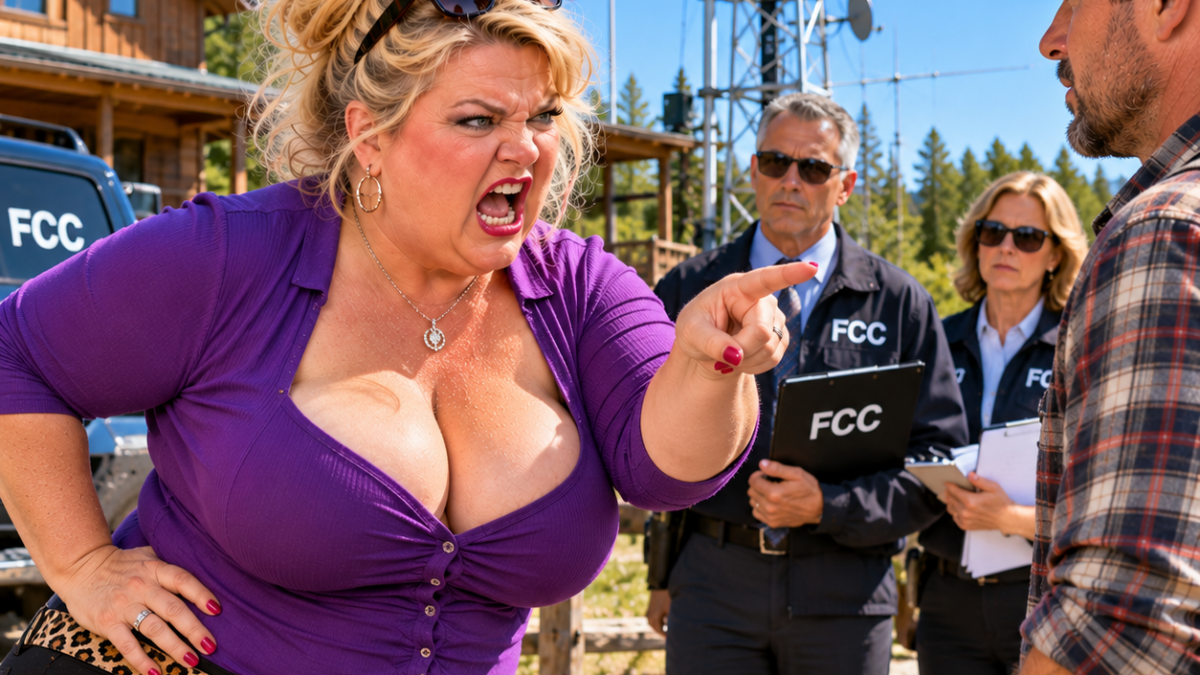
The expression on her face when she saw Agent Peterson was triumphant.
Then she saw me walking beside him.
Triumph vanished.
She opened the door before we knocked.
“Agent Peterson.”
Bright voice.
Too bright.
“Thank goodness. I see you found him.”
Agent Peterson gave no reaction.
“I inspected Mr. Stevens’ station.”
“And?”
“I need to inspect the devices associated with your complaint.”
Karen glanced at me.
“He can wait outside.”
Peterson’s tone remained neutral.
“I’ve asked him to remain available for controlled transmission testing.”
She tightened.
“I would prefer—”
“This will be more efficient.”
She stepped aside.
Her home looked exactly like I expected.
Perfect.
Nothing misplaced.
Decor coordinated.
No clutter.
No evidence human beings had ever dropped socks.
We entered the family room.
Large flat-screen TV.
Cable box.
Soundbar.
Router.
Several chargers.
Cheap power strip overloaded behind the cabinet.
Karen turned on the television.
Perfect picture.
“It’s not happening now.”
Peterson asked:
“When did it last occur?”
“This morning.”
“What time?”
“Around eight.”
I knew immediately.
I had not transmitted at eight.
My station log showed my first transmission after nine.
Peterson asked me nothing yet.
He inspected cables.
Power supplies.
Then asked:
“Mr. Stevens, can you transmit from your station remotely?”
“Yes.”
“Do so.”
I opened the control app.
Selected a clear frequency.
Reduced to appropriate test power.
“Ready.”
“Transmit.”
I transmitted.
The television remained perfect.
Again.
Nothing.
Karen crossed her arms.
“It’s intermittent.”
“Understood.”
Agent Peterson moved behind the television.
Examined the power strip.
“This is inexpensive unshielded equipment.”
Karen frowned.
“So?”
“Poorly designed electronics can both generate and receive interference.”
“I’ve never had problems before his tower.”
Peterson did not argue.
He noticed a baby monitor.
Picked it up.
Read label.
Older unit.
Consumer device.
Then checked the garage.
The opener looked like it had survived three presidents and two recessions.
Fixed-code model.
Peterson examined it.
“When was the security code last changed?”
Karen stared.
“I didn’t know it had a code.”
“It uses switch settings.”
“Meaning?”
“Another remote using the same code can activate it.”
“That’s impossible.”
“No.”
“It started after his tower.”
Peterson looked at me.
“What amateur bands were you using on the mornings she identifies?”
I pulled the log.
He compared.
Then asked Karen:
“Do you have exact times?”
She produced notes.
That surprised me.
Until I read them.
Several alleged events occurred when my station log showed no transmissions.
One occurred while I had been at the grocery store.
Security camera confirmed my car absent.
Another supposedly occurred during a time I was receiving only.
Peterson asked:
“Are these times accurate?”
“Yes.”
“You’re certain?”
“I wrote them down when it happened.”
He looked again.
Then toward me.
“Were you transmitting at 8:12 Tuesday?”
“No.”
“Can you corroborate?”
“Station log. Security footage. I was driving to the VA clinic.”
Karen interrupted.
“He could have automated it.”
Peterson looked at her.
“Did you observe him transmitting?”
“I know his equipment.”
“That is not my question.”
Her face flushed.
“No.”
He continued through each claim.
The room became colder without the temperature changing.
Eventually Agent Peterson set the papers on the kitchen counter.
“Mrs. Miller, I have not found technical evidence linking Mr. Stevens’ amateur-radio station to the issues you’ve described.”
Her mouth opened.
He continued.
“His station appears technically compliant based on my inspection and testing.”
“But—”
“Your television system contains several consumer devices that may be susceptible to interference.”
“My television is fine.”
“You reported it wasn’t.”
She stopped.
“The garage opener is an older fixed-code design and can be activated by other compatible remotes.”
“That doesn’t explain everything.”
“No.”
Peterson remained calm.
“But nothing I’ve observed points to Mr. Stevens’ station.”
Karen looked at me.
Hatred.
Then back at him.
“So that’s it? You just believe him?”
“I believe measurements.”
That was the most devastating sentence of the day.
Measurements.
Not Karen.
Not me.
Evidence.
She tried another angle.
“What about the tower itself?”
“What about it?”
“It’s illegal.”
Peterson’s expression barely changed.
“That is not the subject of this interference investigation.”
“I was told federal regulations protect neighborhoods.”
“The Commission regulates communications matters. Private land-use disputes may involve separate legal questions.”
Karen pointed toward me.
“He told me the FCC would shut him down if he was interfering.”
“If harmful interference attributable to his operation were established, appropriate technical or enforcement steps could be taken.”
“There. Exactly.”
“We have not established that.”
Karen’s confidence was breaking in visible pieces.
Then Agent Peterson pulled her written complaint from his file.
“Mrs. Miller, this complaint contains statements identifying Mr. Stevens as the source of interference.”
“Yes.”
“Some of the times listed do not correspond with transmissions according to the records I reviewed.”
“He could fake records.”
Peterson’s voice cooled.
“Do you have evidence of that?”
“No.”
“Do you have independent measurements linking his station to these problems?”
“I’m not an engineer.”
“Understood.”
He looked down at the complaint.
“Did you personally observe all events described here?”
Karen hesitated.
That hesitation mattered.
“I experienced them.”
“All of them?”
“Yes.”
He pointed to one entry.
“This indicates disruption at 8:12 a.m.”
“Yes.”
“And you were present?”
“Yes.”
I said nothing.
Peterson looked at me.
“Mr. Stevens, you said you were away?”
“Yes.”
“Proof?”
“Time-stamped parking receipt at the VA clinic, GPS history, security camera departure.”
Karen stared at me.
Peterson looked back at her.
“Mrs. Miller, I need you to understand that complaints submitted to federal agencies are expected to be accurate and made in good faith. Knowingly making materially false statements in matters within federal jurisdiction can carry serious consequences.”
He did not shout.
Did not accuse her of a crime.
Did not say handcuffs.
He did not need to.
Karen froze.
Her entire body went still.
For months, she had used official language as a weapon.
Now official language was being addressed to her.
“Are you saying I committed a crime?”
“I am advising you of the seriousness of the complaint process.”
“I told the truth.”
“Then the record will reflect what we found.”
“What does that mean?”
“It means I will document the inspection, the technical findings, and the lack of evidence linking Mr. Stevens’ station to the reported problems.”
“And?”
“Any further review is handled by the bureau.”
Her face lost color.
I had never seen a personality collapse so quietly.
No screaming.
No dramatic confession.
Just fear.
Real fear.
The kind that appears when someone discovers the institution they tried to weaponize has procedures that apply in both directions.
Peterson packed his equipment.
“My technical investigation concerning Mr. Stevens is complete.”
Karen swallowed.
“So his tower stays?”
“That is not a determination I am making.”
“But his radio?”
“I found no basis today to take enforcement action against his station.”
He turned toward me.
“Mr. Stevens.”
I nodded.
We walked outside.
Halfway back to my house, he said:
“Your records helped.”
“Glad.”
“You handled this professionally.”
“I wanted the measurements.”
“That’s usually better than arguing.”
He smiled slightly.
Then got into his sedan.
I watched him drive away.
I didn’t feel triumphant.
Not then.
Mostly I felt exhausted.
Months of defending myself.
Letters.
Fines.
Rumors.
Neighbors staring.
A federal inspection I never should have needed.
The tower stood where it always had.
Nothing physically changed.
But the neighborhood had.
Three curtains moved as I walked back inside.
By lunchtime, everyone knew a federal vehicle had visited.
By afternoon, they knew the agent had gone to Karen’s after me.
By evening, Tom and Sarah’s private group had exploded.
DID ANYONE SEE THE FCC CAR?
HE WENT TO MARK’S FIRST.
THEN KAREN’S.
MARK WALKED OVER WITH HIM.
KAREN HASN’T COME OUT ALL DAY.
Rumors grew.
I shut them down where I could.
No, Karen had not been arrested.
No, she had not been threatened with immediate prison.
No, the FCC had not seized anything.
Facts were strong enough.
We didn’t need fiction.
Dave called that evening.
“So?”
“My station is clean.”
“I knew that.”
“He found no evidence linking me to her complaints.”
“Good.”
“He advised her that knowingly false statements to a federal agency are serious.”
Dave was silent.
Then:
“How did she take that?”
“She stopped talking.”
He laughed once.
“Mark, do you understand what just happened?”
“Yes.”
“No. Politically.”
I sat.
“Her entire campaign depended on credibility.”
“I know.”
“She told everyone the government was coming to shut you down.”
“Yes.”
“The government came.”
“Yes.”
“And left you operating.”
“Yes.”
He paused.
“Now.”
“Now what?”
“Special meeting.”
The petition requirement was ten percent.
We got twice that the first evening.
People signed because the FCC visit crystallized something.
Karen had not simply been strict.
She had used the office of HOA president to escalate personal grudges.
Residents began asking:
If she would do this to Mark, what happens when she decides my fence is next?
The old stories resurfaced.
Blue door.
Gnomes.
Flagpole.
Basketball hoop.
Mailbox.
Flower pots.
Noise complaint.
RV parking.
Each family had once believed their fight was uniquely embarrassing.
Now they saw pattern.
The rest of the board could no longer hide behind Karen.
A special meeting was scheduled for Thursday.
Purpose:
Review conduct of HOA president.
Consider removal.
Karen sent an email before the meeting.
She described the effort as a “mob campaign.”
Claimed misinformation.
Claimed disgruntled homeowners were undermining neighborhood stability.
Interestingly, she said almost nothing about the FCC.
That absence was louder than any defense.
The clubhouse filled thirty minutes early.
I had never seen so many people at an HOA meeting.
Chairs ran out.
People lined the walls.
Couples stood in the hallway.
The private Facebook group had nearly two hundred residents by then.
Karen sat at the board table.
She looked older.
Same hair.
Same posture trying to look rigid.
But the certainty was gone.
Dave had been asked to present the petitioners’ case.
He walked to the podium.
No drama.
No insults.
“For years,” he began, “we have allowed one individual’s preferences to become indistinguishable from our association’s rules.”
Karen stiffened.
Dave continued.
“This meeting is not about whether we like Karen Miller.”
“It is about governance.”
Good opening.
He displayed board records.
Committee procedures.
My application.
Evidence that the architectural committee had never formally voted.
Karen interrupted.
“That is a technicality.”
Dave looked at her.
“No.”
His former JAG voice filled the room.
“That is procedure.”
Applause.
He continued.
Tower notice.
My certified response.
Federal materials.
Daily fines.
Then retaliatory notices.
Grass.
Trash.
Other homeowners murmured.
Dave showed the timeline.
Tower dispute begins.
Petty violations multiply.
Interference allegation.
Federal complaint.
Technical inspection.
No fault found against my station.
Then Tom and Sarah stood.
Tom held a paint chip.
“This is Desert Sand.”
People laughed.
He did not.
“My wife and I painted our front door three times because President Miller kept deciding our blue was wrong.”
Sarah spoke next.
“We spent hundreds of dollars and eventually stopped appealing because every appeal went back to the same person.”
Mrs. Gable’s son walked forward carrying a cardboard box.
He placed it on the table.
Opened it.
Ceramic gnomes.
The room laughed softly.
Then he spoke.
“My father bought these for my mother.”
Silence.
“After he died, they were something that still made her smile.”
He looked toward Karen.
“You fined an eighty-three-year-old widow five hundred dollars until she became afraid to put them in her own garden.”
Nobody laughed anymore.
More residents spoke.
Basketball hoop.
Wrong stain.
Trailer.
Holiday wreath.
Fence.
One man described receiving a violation the week his wife was in the hospital.
A woman described Karen photographing her backyard from the sidewalk.
Another described being threatened over a child’s chalk drawings.
None of these stories alone would have ended a presidency.
Together?
They described a culture.
Karen tried to respond.
“Standards exist for a reason.”
Someone shouted:
“So does common sense.”
Applause.
Finally Dave called me.
I carried the binder.
Set it on the podium.
No speech written.
I looked at Karen.
Then the room.
“This binder covers approximately two months.”
I opened it.
“Every letter.”
“Every invoice.”
“Every notice.”
“Every photograph.”
“My first response offered compromise.”
I held it up.
“I asked for a lawful, reasonable resolution.”
Next document.
“The fines continued.”
Next.
“Then grass.”
Next.
“Trash cans.”
Next.
“Other violations.”
I closed the binder.
“I did not ask the FCC to punish Karen.”
I wanted that clear.
“I asked for a neutral technical determination after she accused my radio station of interfering with her electronics.”
I held up the closure correspondence we had received concerning the technical complaint.
“The inspection found no evidence that my station was causing the problems described.”
Karen interrupted.
“That does not prove I lied.”
I looked at her.
“I didn’t say it did.”
That stopped her.
I continued.
“What it proves is that you told this neighborhood federal regulators would validate your claims.”
Pause.
“They didn’t.”
Another pause.
“And while trying to prove I was reckless, you exposed something else.”
“What?” Karen snapped.
I looked around the room.
“How recklessly this association was being run.”
Silence.
Then applause.
Not wild.
Steady.
I waited.
“I’m not asking you to vote against Karen because she dislikes my tower.”
“I’m asking you to decide whether any president should have the power to turn personal dislike into official enforcement without checks.”
I looked at the board members.
“Today it was my antenna.”
“Yesterday it was Mrs. Gable’s gnomes.”
“Tom and Sarah’s door.”
“Dave’s flagpole.”
“Tomorrow it will be somebody else.”
I stepped away.
“That decision belongs to you.”
I sat.
Karen demanded time.
She deserved it.
She stood.
Walked to the podium.
For a moment I wondered whether we had underestimated her.
She could have apologized.
Admitted mistakes.
Blamed process failures.
Promised reform.
Maybe saved herself.
Instead:
“This community has no idea how hard I have worked for you.”
Bad start.
She pointed toward residents.
“Every day I deal with people who believe rules apply to everyone except them.”
Murmurs.
“I maintained property values.”
“I protected standards.”
“I kept this neighborhood from becoming chaotic.”
Her voice rose.
“And now a small group of malcontents wants to destroy everything because they don’t like accountability.”
Mrs. Gable spoke from the second row.
“You fined my gnomes.”
People laughed.
Karen snapped:
“They were prohibited decorative objects.”
Wrong answer.
The laughter grew.
Karen’s face reddened.
She pointed at me.
“This man erected a forty-foot industrial structure without approval.”
“Amateur tower,” someone said.
“He brought federal investigators into our neighborhood!”
That made the room quiet.
I almost couldn’t believe she said it.
Dave stood.
“No.”
Karen turned.
“He filed the complaint?”
Dave asked.
Silence.
“You did.”
She looked trapped.
“I had legitimate concerns.”
“And he cooperated.”
“I—”
“You called the federal government.”
Dave’s voice remained calm.
“Mark opened his station.”
“He provided records.”
“He submitted to testing.”
“No violation was found.”
Karen’s attempt to make me responsible for her complaint collapsed in real time.
She changed direction.
“I will not apologize for keeping Oak Hollow safe.”
That was her closing argument.
Safety.
Control.
Standards.
People had heard it for ten years.
This time they had also heard each other.
A motion came from the floor.
Removal of Karen Miller from the board.
Second.
Bylaws required two-thirds of homeowners present.
Ballots were distributed.
Karen sat at the table.
I watched her.
Not with pleasure.
Curiosity.
What does a person think when the authority they confused with identity is suddenly placed in other people’s hands?
Ballots came back.
Counting took eight minutes.
Longest eight minutes of the whole fight.
Acting secretary stood.
Voice trembling slightly.
“For removal…”
She read the number.
Far beyond two-thirds.
“Against…”
Very few.
“Motion carries.”
The room exhaled.
Then applause.
Karen didn’t move.
For maybe five seconds she simply stared forward.
Then:
“You people will regret this.”
She pushed her chair backward.
Grabbed her purse.
Walked out.
Door slammed.
Nobody followed.
That sound ended ten years of her presidency.
The remaining board members sat awkwardly.
One resigned on the spot.
Another apologized.
Dave was appointed interim president until elections could be held.
His first motion:
Suspend and review all discretionary fines issued during the previous twelve months, excluding legitimate assessments and dues.
Unanimous.
Second:
Immediately rescind tower-related fines against me pending formal legal review.
Unanimous.
Third:
Establish an independent review committee with outside counsel.
Unanimous.
Then Dave smiled toward Mrs. Gable.
“One more.”
He proposed reimbursement of fines that had been imposed without proper authority or inconsistent enforcement, subject to review.
Mrs. Gable’s son raised his hand.
“And the gnomes?”
Dave tried to stay serious.
“The chair recognizes the gnomes.”
The room erupted.
Two weeks later, Mrs. Gable put them back.
All of them.
Her garden looked ridiculous.
Wonderful.
Tom and Sarah repainted their front door.
Blue.
Deep cobalt.
When I saw it, Tom was standing outside.
“Too vibrant?”
“Terrible.”
“Good.”
He grinned.
The board’s independent attorney reviewed my tower dispute.
We met in the clubhouse.
No Karen.
No shouting.
Documents on table.
She asked reasonable questions.
Height.
Placement.
Safety.
Insurance.
Operation.
Visual mitigation.
We discussed landscaping around the base.
I agreed to darken part of the lower support structure to reduce visual contrast.
They formally approved the installation.
The fines disappeared.
No settlement drama.
No giant check.
Just correction.
That was enough.
The covenant review took months.
Vague language was rewritten.
Appeal procedures separated from initial enforcement.
One person could no longer act as complainant, decision-maker, and appeal authority.
Committee votes had to be recorded.
Fine schedules capped.
Notice periods clarified.
Legal review required for disputes involving federal or state law.
Residents received meeting minutes.
Nothing revolutionary.
Good governance is boring.
That was the point.
The private Facebook group remained.
But it changed.
At first:
Karen did this.
Karen did that.
Look at this notice.
Afterward:
Who wants a community garden?
Anyone interested in a garage sale?
Playground shade project?
Lost dog.
Potluck Saturday.
The emotional temperature dropped.
That may have been the biggest sign we had actually won.
A healthy community does not spend all its time discussing its leadership.
Dave served as interim president for six months.
Then refused nomination.
“I’ve had enough law for one lifetime.”
Residents elected a woman named Maria Sanchez.
Civil engineer.
Calm.
Extremely organized.
At her first meeting she said:
“If the board ever starts referring to itself as ‘the authority,’ please remind us that we are volunteers responsible for mowing contracts and pool filters.”
I liked her immediately.
Karen remained in Oak Hollow for two months.
I saw her only twice.
The first time at the grocery store.
We entered the same aisle from opposite ends.
She saw me.
Stopped.
For a moment, I expected confrontation.
Nothing.
She turned her cart around.
That should have felt satisfying.
Instead it felt sad.
Not sympathy exactly.
Just the strange emptiness after a conflict that occupied too much space.
The second time was moving day.
A truck parked outside her house.
Boxes.
Furniture.
Workers.
I was in the radio shack.
Twenty meters was open.
I had a strong contact with an operator on an island in the South Pacific.
We talked about antennas.
Weather.
Propagation.
He gave me a 5-by-7 report.
I gave him 5-by-8.
While he spoke, I looked through the window.
Karen’s Escalade pulled away behind the moving truck.
She did not look toward my house.
I keyed the microphone.
“Good signal into Texas.”
The operator laughed.
“Same there, Mark.”
Invisible waves crossed thousands of miles while Karen disappeared around the corner.
That was the right ending for her role in my life.
No speech.
No gloating.
Distance.
A young family bought the house.
First week, they painted the front door yellow.
Bright yellow.
I happened to be walking past when the husband stepped back to look at it.
He saw me.
“Too much?”
I pretended to consider.
“Needs more yellow.”
He laughed.
Nobody fined them.
Mrs. Gable added two new gnomes.
Tom started joking that his front door could be seen from orbit.
Dave flew his flag.
Bill—the neighbor who had muttered about my property values—knocked on my door one afternoon.
“Got a minute?”
“Sure.”
He shifted uncomfortably.
“I owe you an apology.”
“For?”
“I believed things.”
“About the tower.”
“Yes.”
He looked toward it.
“Karen said your transmissions were dangerous.”
“I know.”
“I repeated it.”
“I know.”
“You heard?”
“Neighborhoods have propagation too.”
He laughed nervously.
“I should’ve asked you.”
“Yes.”
Not cruel.
Just true.
He nodded.
“I’m sorry.”
“Accepted.”
He started to leave.
Then looked back.
“Can that thing really talk to Japan?”
“Want to see?”
That evening Bill made his first supervised amateur contact.
A station in British Columbia.
Not Japan.
Still.
When the operator answered, Bill’s entire face changed.
“That’s coming through your antenna?”
“Yes.”
He stared at the equipment.
“That’s pretty cool.”
“Careful. Property values.”
He laughed.
Eventually several neighbors became curious about amateur radio.
I hosted an open shack one Saturday.
Showed people equipment.
Explained propagation.
Licensing.
Emergency communications.
RF safety.
A teenager named Lucas became obsessed.
Studied.
Passed his technician exam.
His parents asked me whether he needed a tower.
“Absolutely not.”
They looked relieved.
“Yet.”
They stopped looking relieved.
Lucas started with a simple vertical antenna.
Perfect.
Ham radio stopped being the mysterious threat Karen had described.
It became another neighborhood hobby.
One day Maria approached me after a meeting.
“We’re updating the emergency plan.”
“All right.”
“Would you be willing to serve as volunteer communications coordinator?”
I laughed.
“No.”
She smiled.
“I was told you would.”
“Then why ask?”
“Because the county emergency manager wants licensed amateur operators identified.”
That changed things.
“What would it involve?”
“Backup communications during severe weather or extended outages.”
I looked toward the tower.
Funny.
The structure Karen called a hazard might become part of the community’s emergency plan.
“Send me details.”
A year later, a line of severe thunderstorms rolled across Texas.
Wind.
Hail.
Power outage.
Cell service became intermittent.
Oak Hollow lost electricity for almost nine hours.
The clubhouse generator ran.
I went on amateur frequencies.
County emergency net activated.
We relayed storm reports.
Downed lines.
Road flooding.
Medical information where appropriate.
Nothing dramatic.
No movie rescue.
Just backup communication functioning when ordinary systems were strained.
At one point Maria came into the shack.
Emergency radio in hand.
She watched me pass a road closure to net control.
When I signed off, she looked through the window.
“Metal monstrosity.”
I smiled.
“Terrible.”
“Absolute blight.”
“Destroying the community.”
She nodded.
“Thank God it’s here.”
That sentence meant more than any vote.
Later, Oak Hollow installed a small plaque in the clubhouse listing emergency volunteers.
My call sign was there.
I almost asked them to remove it.
Then left it.
Karen had wanted the tower erased because she could not control it.
Now the neighborhood understood what it actually was.
A tool.
That was all.
Tools become dangerous or useful depending on how people use them.
The same was true of HOA rules.
Rules had not been Oak Hollow’s problem.
Karen’s relationship with rules had been the problem.
She treated them as extensions of preference.
Aesthetic harmony meant whatever Karen liked.
Safety meant whatever Karen feared.
Enforcement meant whatever Karen wanted.
Once procedure returned, the same association became almost boring.
I mean that as praise.
Meetings were shorter.
Notices were clearer.
Neighbors appealed disagreements without expecting retaliation.
Sometimes homeowners lost appeals.
That is important.
Reform did not mean everyone got what they wanted.
It meant people got a fair process.
One resident wanted to park a forty-foot RV permanently in front of his house.
Board denied it.
He appealed.
Lost.
No tyranny.
No federal agents.
Just rules applied through transparent procedure.
That was the community we should have had from the beginning.
Years passed.
My tower needed maintenance.
I lowered the antenna assembly.
Replaced coax.
Inspected hardware.
Lucas, now licensed and headed to engineering school, helped.
He stood at the base.
“Mr. Stevens?”
“Yeah?”
“Is it true the FCC came here because Karen said your radio opened her garage door?”
“That is a simplified version.”
“Did it?”
“No.”
“What did?”
“Old opener was a likely suspect.”
He laughed.
“My dad says she almost went to prison.”
“Your dad likes stories.”
“So she didn’t?”
“No.”
“The agent explained legal consequences of false federal statements. Anything beyond that was for the government to decide.”
“So the story got exaggerated.”
“Neighborhoods do that.”
He tightened a bolt.
“Still pretty cool.”
“Nothing about legal exposure is cool.”
“The part where the government guy tells her your signal is clean?”
I smiled.
“That part was satisfying.”
Accuracy matters.
Over the years, the Karen story mutated.
According to version five, three FCC vans surrounded her house.
Wrong.
One sedan.
According to another, agents seized her computer.
Never happened.
Another claimed she was arrested during the HOA meeting.
Absolutely false.
The truth was better because it was ordinary.
She summoned an authority she assumed would validate her.
The authority measured.
Investigated.
Did not validate her.
Then the community did what communities are supposed to do when leaders lose trust.
They voted.
No need to invent handcuffs.
Accountability was enough.
Mrs. Gable died four years after the conflict.
Her son asked if I wanted one of the gnomes.
I said yes.
He gave me the ugliest one.
Red hat.
Green pants.
Ridiculous grin.
I put it beneath the tower.
Dave saw it.
“What in God’s name is that?”
“Memorial.”
“To what?”
“Federalism.”
He stared.
“I hate you.”
Mrs. Gable would have laughed.
I kept it there.
Sun faded the colors.
Rain chipped the paint.
Nobody cited me.
Tom and Sarah eventually moved because of work.
Before leaving, they painted their door Desert Sand.
I thought they had lost their minds.
Then I saw the moving truck.
Tom walked over.
“Buyer requested neutral.”
“Coward.”
“Property values.”
We shook hands.
Sarah hugged me.
“You know, we almost didn’t join that first meeting.”
“Why?”
“Fear.”
“Of Karen?”
“Of becoming the kind of people who fight neighbors.”
That stuck with me.
“You weren’t fighting neighbors.”
“We didn’t know that yet.”
She was right.
Resistance can feel antisocial at first, especially in communities obsessed with harmony.
Sometimes people tolerate abusive leadership because conflict feels worse than unfairness.
But peace and silence are not the same.
Oak Hollow had been quiet under Karen.
Very quiet.
People whispered.
Complied.
Paid.
Avoided.
Afterward, meetings sometimes became louder.
People disagreed.
Asked questions.
Demanded records.
Ironically, that made the neighborhood healthier.
Healthy systems can survive dissent.
Karen’s could not.
Dave and I remained friends.
We got on the radio occasionally even though he preferred voice and I liked digital modes.
One evening he came over with bourbon.
We sat beneath the tower.
“You know what your problem was?”
“What?”
“You overdocumented.”
“That is not a problem.”
“You had three photographs of the first notice.”
“Angles.”
“You photographed tape residue.”
“For context.”
“You are deeply damaged.”
“Air Force.”
“Exactly.”
I poured another drink.
“What was Karen’s biggest mistake?”
Dave didn’t hesitate.
“Thinking institutions are weapons instead of constraints.”
I looked at him.
“Former JAG answer.”
“Yes.”
He continued.
“She thought HOA authority meant she could do whatever the HOA wanted.”
“Then she thought FCC authority meant it could do whatever she wanted.”
“Exactly.”
“But institutions have procedure.”
“And scope.”
“And evidence.”
“And appeal.”
We clinked glasses.
That may be the entire story.
Karen loved the appearance of authority.
Binder.
Title.
Letterhead.
Fine schedule.
Federal complaint.
She never respected the mechanisms underneath.
That was why the mechanisms eventually defeated her.
My Air Force career taught me the opposite.
Procedure can be irritating.
Slow.
Rigid.
But in serious systems, procedure protects everybody.
The person accused.
The person complaining.
The organization.
The public.
When I invited the FCC process, I was accepting a risk.
What if my station had a technical fault I missed?
Then I would fix it.
That was the deal.
Evidence before ego.
Karen could never make that deal.
Being wrong felt like losing status.
So she had to keep doubling down.
Tower.
Fines.
Lawn.
Trash.
Health rumors.
Property values.
Interference.
Federal complaint.
Each escalation designed to avoid saying one sentence:
Maybe I was wrong.
Those five words would have saved her presidency.
Probably saved her house sale.
Saved months of neighborhood division.
Saved everyone time.
Pride is expensive.
Much more expensive than amateur radio, and amateur radio is already an irresponsible way to spend money.
Ask anyone.
My original transceiver led to an amplifier.
Then filters.
Then antenna analyzer.
Then tower.
Then backup radio.
Then emergency battery.
Then another antenna because technically it served a different purpose.
Sarah—my sister, not Tom’s wife—visited once and stood in the shack.
“How much is all this?”
“Unknown.”
“You know.”
“I choose not to.”
“That much?”
“National-security information.”
She rolled her eyes.
Everyone needs hobbies.
Mine just happened to change an HOA.
The tower remained forty feet.
I never made it taller out of spite.
People expected me to.
“Put up eighty feet now.”
Why?
Forty did what I needed.
Revenge that damages your own technical plan is bad engineering.
The best outcome was not that I could now do anything I wanted.
It was that I could do what was reasonable without being harassed.
That distinction mattered.
A few years later, new homeowners bought Karen’s former house.
Jason and Emily.
Two children.
Nice people.
They had no idea about the history.
One afternoon Jason knocked.
“Mark?”
“Yes?”
“I have a weird question.”
“Go ahead.”
“Garage door keeps opening.”
I stared at him.
Then started laughing.
Hard.
He looked alarmed.
“Did I say something?”
“Come in.”
I eventually explained.
He laughed too.
“Seriously?”
“Very.”
“So is it your radio?”
“No.”
“What should I do?”
“Replace the opener.”
He did.
Problem vanished.
For weeks Dave called it divine comedy.
I sent him the old opener frequency specs.
He framed them.
That incident gave me closure I did not know I needed.
The same house.
Same kind of problem.
Different response.
Jason asked.
We investigated.
Found likely cause.
Fixed it.
No accusations.
No fines.
No federal complaint.
Normal adults solving a technical issue.
That was what should have happened years earlier.
Sometimes healed systems reveal themselves not through big ceremonies but by handling the next small problem correctly.
Oak Hollow did.
One summer, Maria’s term ended.
Residents tried to convince her to stay.
She refused.
“Boards need rotation.”
Amen.
A younger man named Anthony became president.
His first email:
Please remember the HOA is run by volunteers. Be kind to each other.
No threats.
No words like absolute.
Beautiful.
He asked me to review a proposed antenna clause because more homeowners were installing various wireless equipment.
I told him:
“I’m not the HOA’s lawyer.”
“We know.”
“I’m not writing rules.”
“We know.”
“What do you want?”
“Technical sanity check.”
That I could do.
The final clause was short.
Safety.
Placement where practicable.
Compliance with applicable law.
Reasonable review.
No absolute bans.
No aesthetic language vague enough to become personal taste.
I approved of the philosophy.
Not because it favored ham operators.
Because it favored clarity.
The neighborhood evolved.
Wi-Fi mesh antennas.
Satellite dishes.
Solar panels.
EV chargers.
Security cameras.
Technology changes faster than covenants.
Karen’s approach would have required every new object to match a frozen image of suburbia.
That is impossible.
Communities survive by adapting.
The tower that once seemed radical eventually looked almost old-fashioned beside solar roofs and fiber boxes.
Time has a sense of humor.
I became one of the older residents.
People asked for advice.
I tried not to become what I had fought.
That is harder than it sounds.
Experience creates confidence.
Confidence easily becomes certainty.
So whenever I felt myself saying:
Obviously…
I stopped.
Karen had been certain too.
The discipline I learned from the conflict was simple.
Check.
Measure.
Document.
Listen.
Then decide.
Not glamorous.
Works.
At seventy, I reduced my radio hours.
Hearing not what it used to be.
Hands slower.
Still licensed.
Still active.
The tower remained.
Some evenings I sat on the porch while the Yagi rotated slowly.
Motor humming.
Antenna turning toward Europe.
Or South America.
Or wherever propagation looked good.
Neighbors barely noticed it anymore.
Children who grew up in Oak Hollow thought it had always been there.
Maybe that was the strangest victory.
Not becoming a monument.
Becoming normal.
Karen had called it an insult to the community.
The community eventually stopped thinking about it.
That is what happens when fear loses narrative control.
The object remains.
Panic disappears.
One evening Lucas came home from college.
Electrical engineering.
Of course.
He brought a friend.
They wanted to see the station.
I powered everything up.
Conditions were good.
We heard a weak call from New Zealand.
Lucas took the microphone.
Made contact.
His friend stared.
“That came from here?”
“Yes.”
“On that tower?”
“Yes.”
“Across the planet?”
“Pretty much.”
He walked to the window.
“That’s insane.”
I smiled.
“Some people thought so.”
After they left, I stayed in the shack.
The room was quieter than years earlier.
Different equipment now.
Some digital displays.
New radio.
Same principle.
Listen.
Transmit.
Wait.
Somewhere far away, somebody answers.
I thought about Karen.
Not angrily.
Almost academically.
What made a person become that way?
Maybe she always needed control.
Maybe years without consequences trained her.
Maybe homeowners rewarded her because strict enforcement initially seemed efficient.
Maybe every unchallenged petty victory taught her another wrong lesson.
Power rarely arrives fully formed.
It accumulates through permission.
One person pays an unfair fine.
Another repaints.
Another says:
Not worth fighting.
Another board member says:
Let Karen handle it.
Eventually Karen no longer hears:
We let you do this.
She hears:
I am entitled to do this.
That is how institutions drift.
Not always through conspiracy.
Often through fatigue.
The solution is not permanent warfare.
It is participation.
Read minutes.
Attend occasionally.
Ask where money goes.
Know appeal rights.
Rotate leadership.
Do not let one volunteer become synonymous with the organization.
Oak Hollow learned.
So did I.
My first instinct after the tower dispute was to avoid HOA involvement forever.
Then I realized withdrawal creates vacancies.
Vacancies get filled by people who enjoy control.
So I attended enough meetings to know what happened.
Not every meeting.
I have limits.
No human being should voluntarily hear twenty minutes of debate about mulch more than twice annually.
But enough.
When budgets came out, I read them.
When board elections happened, I voted.
When people disagreed, I did not assume disagreement meant abuse.
That last part mattered.
After Karen, some residents started calling any enforcement “Karen behavior.”
That was dangerous too.
Rules still existed.
A neighbor stored a derelict boat in his front yard for months.
Board acted.
He screamed tyranny.
It wasn’t.
Transparent notice.
Clear rule.
Opportunity to comply.
Appeal.
Decision.
Accountability goes both directions.
Freedom is not the absence of every restriction.
It is restriction bounded by legitimate authority, applied fairly, with process.
That principle survived longer than the drama.
Eventually Dave died.
Unexpected stroke.
His wife called.
I sat in the shack for an hour afterward without turning anything on.
At his memorial, his Army flag was folded.
His wife gave me his old handheld radio.
“He wanted you to have this.”
I couldn’t speak for a second.
Dave had been the first person inside Oak Hollow to tell me I wasn’t imagining the pattern.
He had transformed isolation into strategy.
I kept the handheld beside my main station.
Battery rarely charged.
Didn’t matter.
Some equipment carries more memory than function.
Mrs. Gable’s gnome under tower.
Dave’s radio on desk.
The tower itself.
Not monuments to victory.
Reminders of people.
The conflict mattered because relationships came out of it.
Without Karen, would I have known Dave?
Maybe through radio eventually.
Would I have known Mrs. Gable?
Probably not.
Tom and Sarah?
Maybe as faces.
Strange how bad events rearrange lives.
I would never call the harassment a gift.
That romanticizes harm.
But humans are good at building meaning from what happens.
We did.
Years later, Oak Hollow held a community emergency-preparedness day.
Fire department.
EMS.
Weather service.
Amateur-radio demonstration.
I sat beneath a tent with Lucas.
A little girl pointed at my tower visible above rooftops.
“What does that do?”
Lucas looked at me.
“Want to answer?”
I smiled.
“It lets us talk to people far away.”
“How far?”
“Sometimes the other side of the world.”
Her eyes widened.
“Why?”
Best question.
Why?
Emergency communications.
Technical experimentation.
Friendship.
Skill.
Curiosity.
All true.
I said:
“Because sometimes it’s good to know somebody can still hear you.”
She nodded like that made perfect sense.
Maybe it did.
That had been the emotional center of the whole story without me understanding it.
Karen’s strategy depended on making people feel alone.
I was dangerous to her system not because of forty feet of aluminum.
Because I refused isolation.
First through documentation.
Then Dave.
Then Tom and Sarah.
Mrs. Gable.
Private group.
Homeowners.
Eventually a room full of people realizing they had all been hearing the same thing.
Someone can still hear you.
Radio and community had more in common than I thought.
A signal alone is just energy.
Communication happens when somebody answers.
Oak Hollow finally answered.
One winter evening, a storm knocked out local cell service for several hours.
I was on emergency net.
A resident needed information about a pharmacy open near the highway.
We relayed.
Another had a tree across the road.
Reported.
No heroics.
Later Maria texted:
Still an eyesore?
I replied:
Absolutely.
She sent a laughing emoji.
That was the kind of ending I preferred.
Not Karen ruined.
Not government revenge.
A joke between neighbors because danger had turned into memory.
The for-sale sign disappeared from Karen’s old yard years ago.
Yellow door faded.
Jason repainted it green.
Nobody cared.
Mrs. Gable’s house sold after her death.
New owners removed most of the garden.
Kept one gnome.
I saw it near the porch.
Red hat.
Not the same one.
Still.
Made me smile.
Oak Hollow changed.
People moved.
Children grew.
Cars became electric.
Solar panels appeared.
The clubhouse roof got replaced.
Pool cracked.
Board argued over money.
Normal life.
My tower stood through all of it.
Inspected annually.
Maintained.
Ground system checked.
Bolts replaced.
Antenna upgraded once.
Forty feet of aluminum surviving more peacefully than Karen predicted.
At one point a Realtor asked whether I would consider removing it before selling.
“Selling?”
“Someday.”
“No.”
“Future buyers might see it as unusual.”
“Then future buyers can buy another house.”
She laughed.
I didn’t.
Some things become part of home.
My tower did.
Not because of the fight.
Because of thousands of contacts.
Nights listening to signals cross oceans.
Storm nets.
New operators.
Dave’s voice.
Lucas’s first contact.
That was its real history.
Karen occupied maybe two months.
The tower gave me years.
Perspective puts antagonists in their proper size.
When I finally decided to move into a smaller place, much later, I faced the question.
Tower.
Take it down?
Transfer station?
The buyers were a middle-aged couple.
Husband noticed tower immediately.
“Ham?”
I looked at him.
“You licensed?”
“Extra class.”
I laughed.
Deal improved instantly.
“You want it?”
“Absolutely.”
That felt perfect.
During closing, I handed him the maintenance folder.
Tower engineering.
Grounding layout.
Inspection records.
Equipment specs.
He flipped through.
“This is unbelievably organized.”
“Long story.”
His wife smiled.
“We heard some of it from neighbors.”
“Oh no.”
“She said there was an HOA president.”
“Of course.”
“And the FCC.”
“Of course.”
The husband pointed upward.
“She tried to make you remove this?”
“Yes.”
“And now I get it?”
“Yes.”
He grinned.
“Best house I’ve ever bought.”
I drove away from Oak Hollow without the tower.
That surprised me emotionally.
For years I thought if I ever left, taking it would matter.
It didn’t.
The structure belonged there by then.
History embedded in concrete.
I kept my radios.
Smaller antenna at the new place.
No tower.
Different phase.
Sometimes I drove past Oak Hollow.
The Yagi was still visible above the roof.
Rotated occasionally.
That meant the new owner was operating.
Good.
No violation notices.
No drama.
Just radio.
That was the final transformation.
The tower stopped being mine.
Yet the principle stayed.
You stand up to abuse not so you can own victory forever.
You do it so ordinary life becomes possible for whoever comes next.
Years after Karen, nobody cared about her.
That might have been the harshest consequence.
People fear humiliation.
Legal problems.
Loss of position.
But for someone who built identity around controlling attention, irrelevance was probably worse.
Her name disappeared from newsletters.
Minutes.
Board discussions.
New residents didn’t know it.
The neighborhood moved forward.
I did too.
Occasionally somebody still told the story.
They usually exaggerated.
I corrected them less as I got older.
Except one detail.
Whenever someone said:
“The FCC showed up and arrested Karen.”
I always interrupted.
“No.”
“But—”
“No arrest.”
“What happened?”
“They measured.”
That confused people.
“Measured?”
“Yes.”
“And?”
“The evidence didn’t support her.”
“That’s it?”
“That was enough.”
That was the lesson.
You do not always need spectacle.
Accurate measurement can destroy a lie more thoroughly than shouting.
Karen built months of pressure on claims.
Danger.
Radiation.
Interference.
Illegality.
Then an agent arrived with technical procedures.
No politics.
No neighborhood gossip.
No authority contest.
Measurement.
The signal was clean.
Her timing didn’t match.
Her electronics had alternative explanations.
The story unraveled.
Truth is not always dramatic.
Sometimes it is a spectrum analyzer showing one clean peak.
I liked that.
It fit my life.
Signals intelligence taught me that the world is noisy.
Static.
Interference.
False signals.
Misinterpretation.
People hear what they expect.
Good analysis requires discipline.
Separate source from assumption.
Verify timing.
Correlate data.
Never fall in love with your first explanation.
Karen did the opposite.
She began with:
Mark’s tower is bad.
Every event afterward became proof.
TV flickers?
Tower.
Garage opens?
Tower.
Neighbor complains?
Tower.
Property values?
Tower.
Once she chose the answer, evidence became decoration.
That is how smart people make stupid decisions.
The habit is dangerous far beyond HOAs.
Years later, when people asked what I learned, I gave three answers.
First:
Document early.
Second:
Never confuse confidence with authority.
Third:
When a technical dispute exists, invite measurement.
That last one saved me.
If I had argued endlessly about whether my station caused interference, Karen could have kept the accusation alive forever.
Instead:
Let’s test it.
People who lie hate tests.
People who are mistaken sometimes learn from them.
People who are right benefit too.
The test does not care which category you are in.
I was willing to find out.
Karen wasn’t.
That difference defined everything.
I still remember the exact expression on her face when Agent Peterson said he believed measurements.
Not because I enjoyed fear.
Because it was the first moment she encountered an authority she could not manipulate with confidence.
She had spent years making neighbors feel like evidence was irrelevant.
My paint choice.
My garden.
My interpretation.
My decision.
Then a technical professional entered her house and asked:
What happened?
When?
Show me.
Let’s test it.
That is accountability in its simplest form.
Years after leaving Oak Hollow, I heard Dave’s phrase in my head:
Institutions are constraints, not weapons.
Good institutions constrain everyone.
Including the person invoking them.
Karen never grasped that.
I did.
That is why I welcomed the FCC agent into my shack.
I knew the process could theoretically hurt me too.
If my station violated requirements, I would have had to correct it.
That made the process legitimate.
Karen wanted a process that could only hurt me.
That doesn’t exist for long in a functioning system.
One evening in my smaller home, I turned on the radio.
No forty-foot tower now.
Just a compact antenna.
Conditions mediocre.
Static high.
I called once.
Nothing.
Again.
Weak station answered from Colorado.
We talked ten minutes.
Old man.
Retired teacher.
New to amateur radio.
He asked how long I’d been licensed.
“Long enough.”
He laughed.
“Any advice?”
I looked at my old binder sitting on a shelf.
I had kept it.
Tower dispute.
Fines.
Letters.
FCC correspondence.
Special meeting minutes.
All of it.
“Keep good logs.”
“Radio logs?”
“Everything.”
He laughed.
“Sounds ominous.”
“You have no idea.”
We signed off.
I sat in the quiet.
No Karen.
No HOA conflict.
No anger.
Just a faint carrier disappearing into static.
People sometimes imagine victory feels loud.
Mine didn’t.
It felt like this.
Normal.
Peaceful.
No one threatening my property.
No one demanding I prove my hobby deserved to exist.
No one weaponizing rules.
Freedom often feels boring after you finally get it.
That is why people forget how valuable it is.
I never did.
When I thought back to that first morning, I could still see Karen on the lawn.
Turquoise tracksuit.
Binder.
Face red.
“That metal monstrosity is coming down.”
She had been so certain.
I had been angry.
But beneath anger, one instinct saved me:
Do not fight her emotion with yours.
Create a record.
That record grew.
First notice.
My response.
Her refusal.
Fines.
Petty retaliation.
Interference claim.
Federal complaint.
Inspection.
Community meeting.
Vote.
No single page defeated Karen.
The pattern did.
Bullies survive by making every incident look isolated.
Documenting creates continuity.
Continuity reveals intent.
Community reveals scale.
That is why her power collapsed so quickly once people started comparing experiences.
Tom’s door was not about blue paint.
Mrs. Gable’s gnomes were not about garden decor.
Dave’s flagpole was not about architecture.
My tower was not about aluminum.
Every conflict asked the same question:
Who gets to decide?
Karen’s answer was:
Me.
Oak Hollow’s final answer was:
Not alone.
That was the real victory.
The association remained.
Rules remained.
Boards remained.
Even architectural review remained.
What disappeared was the idea that one person could convert preference into law without challenge.
A tower started that conversation.
A federal investigation exposed the weakness.
A room full of neighbors finished it.
And eventually, even the tower became ordinary.
Exactly as it should.
One final thing happened years later.
Maria emailed me a photograph.
Oak Hollow clubhouse.
Community emergency-preparedness board.
At the bottom was a new line:
AMATEUR RADIO BACKUP COMMUNICATIONS CONTACTS.
Three call signs.
Lucas was one.
The man who bought my house was another.
Third belonged to a woman I didn’t know.
Three operators.
A small local network.
I stared at the photograph.
Then laughed.
Karen had tried to eliminate amateur radio from Oak Hollow.
Years later, the community had three licensed operators formally integrated into emergency planning.
That was satisfying.
Not because it punished her.
Because fear had become capability.
Ignorance had become knowledge.
Conflict had produced something useful.
Maria’s email contained one sentence:
LOOK WHAT YOUR EYESORE STARTED.
I replied:
TELL THEM TO KEEP THEIR LOGS.
She wrote back:
ALWAYS.
That is where I prefer to end the story.
Not with Karen’s moving truck.
Not with her frightened face.
Not even with the vote.
With three call signs on a community board.
People connected.
Prepared.
Nobody afraid of a tower.
Nobody treating a binder like a crown.
Because that was what Karen never understood.
A community isn’t protected by making everything look identical.
It is protected by trust.
By process.
By neighbors who can disagree without trying to destroy each other.
By leaders who know the limits of their authority.
And by ordinary people willing to stand up when those limits are crossed.
Karen thought she was fighting a forty-foot aluminum tower.
She wasn’t.
She was fighting the idea that her opinion could be challenged.
That was a fight she was always going to lose.
The morning she first threatened me, she had the title.
The binder.
The fines.
The board.
The rumors.
The confidence.
I had a radio station, a license, a file folder, and the patience to let evidence accumulate.
Months later, she had none of the power she believed was permanent.
And my signal?
My signal was still on the air.
Clear.
Measured.
Legal.
Answered by people thousands of miles away.
That was enough.
More than enough.
Because after all the threats, the fines, the neighborhood whispers, the federal complaint, and the meeting where Karen finally lost her grip on Oak Hollow, I learned something I should probably have understood from twenty-four years of listening to signals buried in noise:
You don’t defeat interference by screaming into it.
You clean up your own signal.
You document the source.
You let the instruments tell the truth.
And then you keep transmitting.