PART 2: HOA Karen Ordered Me to Destroy My Family’s 1849 Hitching Posts—Then the County Historian Made Her Famous for the Wrong Reason
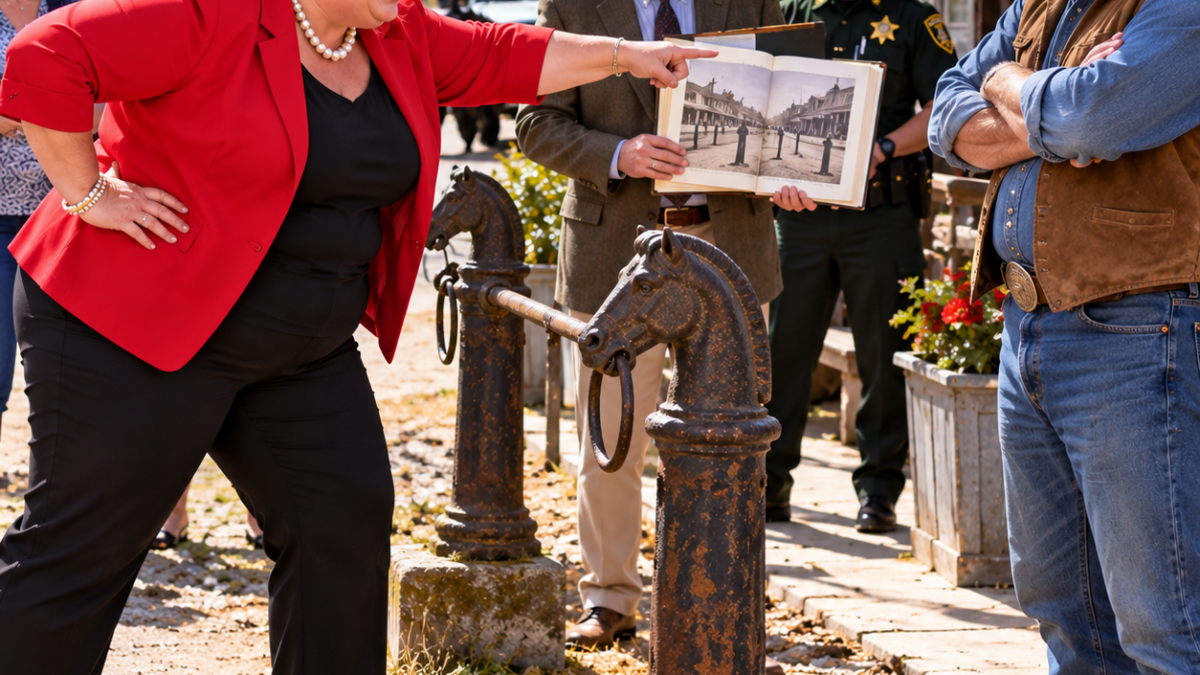
PART 2
The woman on the phone introduced herself as Dr. Alister Finch, director of the County Historical Society.
Her voice had changed the moment she saw my photos. Before that, I had been just another citizen calling about an old object. After the photos, I could hear paper moving, a chair scraping, and the unmistakable sound of someone sitting up straighter.
“Mr. Callahan,” she said, “how certain are you that those rings came from Black Creek Foundry?”
I looked through the kitchen window at the hitching posts.
They stood at the foot of the driveway like two old soldiers who had forgotten how to surrender.
“My grandfather told me that story my whole life,” I said. “He said Cormac Callahan traded two wagonloads of applewood and three days of labor for the ironwork. Said the blacksmith who forged them was named O’Rourke.”
There was silence.
Then Dr. Finch said, “Patrick O’Rourke?”
A chill moved up my back.
“I think so.”
Her voice went quiet, almost reverent.
“Mr. Callahan, Patrick O’Rourke was the master smith at Black Creek. We have written references to his work, but no confirmed surviving pieces. The foundry fire in 1853 destroyed nearly everything, and what survived was either melted down during later scrap drives or lost to private collections.”
I sat down at the kitchen table.
“So what are you saying?”
“I am saying your HOA president may have threatened to destroy the last known surviving pre-1850 Black Creek ironwork in the county.”
For a moment, I did not speak.
The anger I had been carrying since Karen stood on my lawn shifted into something heavier. Bigger. This was not just about my family anymore. Those rings were not just Callahan history. They might be county history. State history. A physical piece of a world that had almost vanished.
“Can you come see them?” I asked.
“I can be there tomorrow morning,” Dr. Finch said. “And Mr. Callahan?”
“Yes?”
“Do not let anyone touch those posts.”
I almost laughed.
“Ma’am, they’ll have to go through me first.”
After we hung up, I stayed at the table with my hand resting on my grandfather’s old deed.
I thought about him then.
Patrick Callahan, my grandfather, had been the kind of man who could fix a tractor with wire, silence a room with one glance, and make a child feel like the whole universe had paused to listen. He was not educated in the formal sense, but he understood land, contracts, weather, and people. Especially people.
When he sold the pastureland to the developers, the family called him stubborn. They told him to take the money and let the old farmhouse go. But he said the same thing every time.
“We are not selling the root.”
At the time, I thought he meant the house.
Now I understood he meant everything.
The house.
The barn.
The oak.
The posts.
The stories tied to them.
The strange little line between remembering and forgetting.
Karen wanted everything smooth, matching, and obedient. My grandfather had built protections because he knew someday uniformity would come disguised as progress.
The next morning, Dr. Finch arrived in a dusty Subaru with a leather satchel in one hand and the focused expression of a woman approaching a sacred site.
She was in her late sixties, maybe older, with silver hair cut short, thick glasses, hiking boots, and a no-nonsense way of moving that made me like her immediately. She did not waste time on small talk. She walked straight to the hitching posts and stopped three feet away.
“Oh,” she said softly.
Just one word.
But I knew what it meant.
She knelt in the grass, pulled on cotton gloves, and touched the granite first. Her fingers moved slowly across the chisel marks, the worn corners, the weather-pitted sides.
“This stone was shaped by hand,” she murmured. “Not decorative. Functional. Local granite, likely pulled from the north ridge quarry.”
Then she turned to the iron rings.
For twenty minutes, she disappeared into her work.
She measured the thickness of the rings with calipers. She photographed every angle. She examined the weld seam with a magnifying lens. She scraped the smallest possible fleck of oxidation into a vial. She ran one gloved thumb along the uneven surface where a hammer had left faint marks more than 170 years earlier.
Across the street, Karen Miller’s golf cart rolled slowly into view.
Of course it did.
She parked beside the curb and pretended to inspect Mrs. Wilcox’s hydrangeas while staring directly at us.
Dr. Finch did not even glance at her.
Finally, the historian stood.
Her face had changed.
It was not excitement anymore.
It was certainty.
“Mr. Callahan,” she said, “these are Black Creek rings.”
My throat tightened.
“You’re sure?”
“I would stake my reputation on it.”
She looked back at the iron.
“The weld pattern, the hammering, the carbon inclusion, the way the ring was closed by hand rather than cast—this is exactly consistent with early Black Creek work. And these granite posts appear to be original to the site. Do you understand what you have here?”
I looked at the posts, suddenly unable to answer.
Dr. Finch did it for me.
“These are not lawn ornaments. These are irreplaceable artifacts.”
That was when Karen crossed the street.
Her pink tracksuit was bright enough to hurt the eyes, and her clipboard was tucked under one arm like a weapon. She marched onto my lawn with the same stiff authority she used at HOA meetings, stopping only when Dr. Finch turned to face her.
“Can I help you?” Karen asked sweetly.
Dr. Finch removed her gloves one finger at a time.
“I am Dr. Alister Finch, director of the County Historical Society. And you must be Mrs. Miller.”
Karen’s smile twitched.
“I am the president of Creekside Meadows HOA.”
“Yes,” Dr. Finch said. “The woman attempting to destroy priceless historical ironwork.”
Karen blinked.
“These are unapproved structures.”
“They are pre-1850 artifacts.”
“They are in violation of community standards.”
“They are possibly the only surviving examples of Black Creek Foundry work known to exist.”
Karen’s eyes flickered toward me, then back to Dr. Finch.
“That has not been verified by the board.”
Dr. Finch gave her a look so cold it could have frosted the grass.
“History is not verified by HOA boards.”
I had to turn my face slightly so Karen would not see the smile trying to break through.
Dr. Finch reached into her satchel, pulled out a business card, and handed it to Karen.
“My official report will be sent to your board, the county commissioner’s office, the state historic preservation office, and the local newspaper. Until then, I strongly advise you not to touch these posts, threaten these posts, or hire anyone else to threaten them for you.”
Karen took the card like it might bite.
“I don’t appreciate your tone.”
“And I don’t appreciate cultural vandalism dressed as neighborhood beautification.”
For the first time since I had known Karen Miller, she had no answer.
She retreated to her golf cart and drove away with none of her usual victory posture.
Dr. Finch watched her go.
“She is going to do something foolish,” she said.
“She already has.”
“No,” Dr. Finch replied. “More foolish.”
She was right.
The official report arrived two days later.
Ten pages.
Dense.
Precise.
Devastating.
Dr. Finch identified the hitching posts as historically significant artifacts connected to the original Callahan Homestead and likely forged by Black Creek Foundry before 1850. She recommended immediate preservation and fast-tracked designation for state historic protection.
She sent the report to everyone she promised.
The HOA board.
The county commission.
The state historic preservation office.
And the editor of the local paper.
For about forty-eight hours, Karen disappeared.
No golf cart patrol.
No email.
No bright notices on doors.
The silence felt unnatural.
Then the HOA newsletter landed in every inbox.
The headline was pure Karen.
Preserving Our Community’s Aesthetic Harmony.
She did not use my name, but she did not need to. Everyone knew. She wrote about certain homeowners trying to use “obscure personal history” to avoid rules. She warned that if old stones and rusted rings were allowed to stay, the neighborhood could slide into visual disorder. She talked about property values. She talked about fairness. She talked about how every resident had to sacrifice personal preference for the good of the community.
She called the hitching posts “eccentric yard decorations.”
Sarah, my lawyer later, would call that line a gift.
But at the time, reading it in my kitchen, it felt like a slap.
By then, I had been home from the Army for eight months. I had come back tired in ways sleep did not fix. Twenty years of service teaches a person how to keep moving, but it does not teach him how to be still when the battles are supposed to be over.
The Callahan house had been my place to be still.
Mornings under the old oak.
Coffee on the porch.
Hands on stone.
The knowledge that something in this world had stood before me and would stand after me.
Karen had taken that peace and turned it into a public argument over lawn clutter.
That evening, I walked the neighborhood.
Not to campaign.
Not exactly.
I just needed to be seen as a person, not as the villain Karen had created in her newsletter.
The first person I stopped to talk to was Mr. Henderson, one of the original residents. He was trimming roses in front of a tidy blue house when I passed.
“Evening,” I said.
He looked up and studied me for a moment.
“You’re Jack Callahan.”
“Yes, sir.”
He clipped one dead bloom and dropped it into a bucket.
“I knew your grandfather.”
That stopped me.
“You did?”
“Everyone did. Patrick Callahan was the only man I ever saw make a developer nervous without raising his voice.”
For the first time that week, I laughed.
Mr. Henderson smiled faintly.
“I saw the newsletter,” he said.
“Then you know what she thinks of my yard.”
“I know what she wants people to think.”
His scissors paused.
“That is not the same thing.”
We talked for half an hour. He told me about the early meetings when Creekside Meadows was still just survey flags and open pasture. He remembered my grandfather standing before the developer with a folder under one arm, refusing to sign anything until the homestead was protected. He even remembered the brochures.
“What brochures?”
“The marketing materials. They used a photo of your house. Those posts were in the picture. They called the homestead a charming link to the county’s pastoral roots.”
I stared at him.
“You still have them?”
Mr. Henderson smiled.
“I have everything.”
The next morning, he brought me a folder.
Inside were copies of the original Creekside Meadows brochures. There was my house under the old oak, the two hitching posts visible beside the driveway. Beneath the photo, the caption read:
A community built around history, charm, and local heritage.
Karen’s entire argument collapsed in one glossy sentence printed by the original developer.
But Mr. Henderson had more than brochures.
He had stories.
A young couple, the Patels, had been fined because their toddler’s plastic slide was “too bright.”
A widow named Mrs. Alvarez had been forced to remove her vegetable garden even though her late husband had planted it every spring for twenty years.
A veteran named Dave Harlan had nearly been fined for flying a flag that Karen deemed “disproportionate.”
The more I listened, the clearer it became.
Karen’s fight with me was not unusual.
It was just bigger.
She had spent years taking small pieces of people’s lives and calling it enforcement. A slide. A garden. A flag. A bench. A paint shade. A memory.
The hitching posts were just the first pieces that could fight back.
I met with the Patels three days later.
They were cautious at first. People in neighborhoods like ours learned not to speak too openly. Karen had ears everywhere, and she held grudges like family heirlooms.
But when I showed them Dr. Finch’s report and the developer brochure, their caution shifted into something else.
Hope.
Mrs. Patel brought out the citation for the slide. Her daughter’s little blue-and-yellow playset had been visible from the sidewalk, which Karen claimed disrupted the visual harmony of the street.
“She cried when we put it in the garage,” Mrs. Patel said. “Can you imagine explaining to a three-year-old that her slide is against the rules?”
Mr. Patel looked at me.
“What do you need from us?”
“For now,” I said, “keep every notice. Every email. Every fine. Every conversation. Truth matters, but organized truth matters more.”
The resistance began quietly.
A forwarded email.
A scanned violation letter.
A whispered story at the mailbox.
Mr. Henderson connected me with older residents. The Patels connected me with younger families. Dave Harlan connected me with veterans and retirees who had hated Karen long before I moved back.
Within two weeks, I had a second binder.
PATTERN.
It contained more than thirty examples of selective enforcement, excessive fines, retaliatory notices, and contractor work awarded to companies connected to Karen’s relatives.
That last part came from Dave.
“She keeps using Miller and Sons,” he said one evening in my kitchen. “Ever wonder why?”
“Because they’re cheap?”
He gave me a look.
“Because her brother-in-law owns it.”
I wrote that down.
When I finally met Sarah Jenkins, the lawyer, she read everything without interruption.
Her office was spare, almost military in its order. One framed copy of the Constitution hung behind her desk. No clutter. No softness. Just clean lines, sharp pens, and a woman who looked like she had never been intimidated by anyone’s title in her life.
Her website said she had been a Marine Corps JAG officer.
That was enough for me.
I laid out the deed, Karen’s letters, Dr. Finch’s report, the newsletter, the developer brochure, and the pattern binder.
Sarah Jenkins read the deed exemption first.
Then Dr. Finch’s report.
Then the newsletter.
When she reached the phrase “eccentric yard decorations,” her eyebrow lifted.
“Did she write this herself?”
“Yes.”
“Excellent.”
I blinked.
“Excellent?”
“She is publicly dismissing artifacts after receiving notice of historical significance. That helps establish willful disregard.”
She picked up the deed.
“This exemption is strong. It protects the parcel, not just the dwelling. Her interpretation is nonsense.”
Then she tapped Dr. Finch’s report.
“This is stronger.”
She leaned back.
“Mr. Callahan, Karen Miller thinks this is an HOA dispute. It is not. It is property rights, historical preservation, selective enforcement, breach of fiduciary duty, and possibly public corruption if the contractor issue is what it looks like.”
For the first time, I felt the ground shift under Karen instead of under me.
Sarah explained the plan.
We would fast-track the historical designation. With Dr. Finch’s support and the state office already notified, the hitching posts could receive temporary protection while final landmark review proceeded. Under state heritage law, once temporary protection was issued, willful alteration or destruction could carry severe civil penalties and even criminal exposure.
I sat still.
“So if Karen tries to remove them after that…”
“She walks into a buzz saw.”
“Do we warn her?”
Sarah’s smile was small.
“We have warned her repeatedly that she is wrong. She ignored you. She ignored the deed. She ignored the historical society. At this point, we preserve every communication, continue acting lawfully, and let her choose her own consequences.”
The temporary protective order came through faster than any of us expected.
Dr. Finch called me personally.
“They are protected,” she said.
I closed my eyes.
“Thank you.”
“Don’t thank me yet,” she replied. “People like Mrs. Miller often become most dangerous when they are almost beaten.”
Again, she was right.
The letter arrived from the HOA’s attorney three days later.
It stated that because I had refused to comply, the association would exercise its right to cure the violation. A contractor had been scheduled to remove the hitching posts on the second Tuesday of the month. The cost, plus fines and legal fees, would be added as a lien against my property.
I read the date twice.
Then a cold laugh came out of me.
The second Tuesday was my standing VA appointment. I had mentioned it casually to a neighbor during a conversation about scheduling. Somehow Karen knew.
She planned to demolish the posts while I was gone.
She wanted me to return home and find 175 years of family history reduced to broken stone.
I called Sarah Jenkins.
“She took the bait.”
“Good,” Sarah said. “Cancel the appointment.”
“I already did.”
“Then we host a welcoming committee.”
The next two weeks were strange.
Karen strutted through the neighborhood like a victorious general. She sent an email blast praising the board’s decisive action to protect property values. Her supporters posted approving comments. A few people avoided looking at me when I passed them on the sidewalk, not because they disliked me, but because fear had trained them to stay neutral.
Neutrality is comfortable until someone jackhammers your history.
Behind the scenes, we prepared.
Sarah Jenkins contacted the state historic preservation office and confirmed they would send an official observer.
Dr. Finch prepared a press statement.
Mr. Henderson found more documents from the original development process.
Dave watched Karen’s contractor activity and confirmed that Miller and Sons had been hired without competitive bidding.
The Patels’ private email chain grew from six families to twenty-seven.
By the night before the scheduled demolition, Creekside Meadows looked calm.
It was not.
Under all those trimmed lawns, something was moving.
The morning came bright and cold.
At 8:10, I stood in my bedroom and put on my Army service uniform for the first time in years. The jacket felt heavier than I remembered. Ribbons. Medals. Nameplate. Every piece of it carried weight. I was not wearing it for Karen.
I was wearing it for Cormac Callahan.
For my grandfather.
For every version of this land that had existed before beige vinyl siding and HOA newsletters.
At 8:30, the truck arrived.
Miller and Sons Contracting rumbled down the street in a flatbed loaded with jackhammers, crowbars, and two men who looked like they expected an easy job at an empty house.
They parked by the driveway.
The driver climbed down first, work order in hand.
Then I stepped onto the porch.
He froze.
Beside me stood Sarah Jenkins in a dark suit, holding a leather briefcase.
On my other side stood Dr. Finch, looking ready to fight a bulldozer with her bare hands.
At the edge of the lawn stood Mark Cole from the State Historic Preservation Office.
Across the street, a Channel 8 News van sat with its side door open.
The contractor looked at his work order, then at us.
“Can I help you gentlemen?” I asked.
The driver cleared his throat.
“We have an order from the HOA to remove these posts.”
Sarah stepped forward.
“I’m Jack Callahan’s attorney. You have been given an illegal work order. These hitching posts are under temporary state protection pending historical landmark designation. Any attempt to damage, alter, remove, or disturb them may expose you and your company to criminal and civil liability.”
The man’s face went pale.
Mark Cole handed him a copy of the order.
“I am here to enforce the protection notice,” he said. “Put the jackhammers back on the truck.”
The second worker did so immediately.
The driver pulled out his phone.
“Karen,” he said when she answered, “we got a problem.”
Two minutes later, Karen’s golf cart came flying around the corner.
She was wearing the pink tracksuit again.
I remember thinking that history has a strange sense of humor.
Her smile vanished the moment she saw the scene.
Uniform.
Lawyer.
Historian.
State official.
News camera.
Contractors standing idle.
“What is the meaning of this?” she demanded.
Sarah turned.
“Mrs. Miller. Your attempted demolition is unlawful.”
“My work order is lawful,” Karen snapped. “This association has authority to remove noncompliant structures.”
Mark Cole stepped forward.
“Not these.”
Karen looked him up and down.
“And you are?”
“State Historic Preservation Office.”
Her expression flickered.
“These are rocks.”
Dr. Finch moved into the camera’s line.
“They are the last known surviving examples of pre-1850 Black Creek Foundry ironwork. Your repeated insistence on calling them rocks does not improve your position.”
That was when the reporter crossed the street.
“Mrs. Miller?” she asked, microphone raised. “Jennifer Croft, Channel 8 News. Can you explain why your HOA is attempting to demolish protected historical artifacts after receiving a report from the county historical society?”
Karen’s mouth opened.
No sound came out.
Then, because Karen was Karen, she chose the worst possible answer.
“This is a private community,” she said. “We have rules. He cannot just keep ugly objects on his property because of some ridiculous family story.”
Dr. Finch’s eyes flashed.
“Madam, that ridiculous family story is better documented than your authority.”
The cameraman kept filming.
Jennifer Croft pressed on.
“We also understand the contractor hired for this enforcement action is owned by your brother-in-law. Did the HOA take competitive bids?”
Karen’s face drained.
“That is association business.”
“So there were no bids?”
“I did not say that.”
“Can you provide the bid documents?”
Karen pointed at me.
“This man has manipulated you all. He is using his military service and some old rocks to make himself untouchable.”
The words hung there.
Even the contractor winced.
I stepped off the porch and walked to the edge of the lawn.
“My service has nothing to do with your choices, Karen. My family history has nothing to do with your brother-in-law’s contract. And those posts have stood here longer than every rule you keep pretending gives you a crown.”
Her eyes went wild.
“This is my community!”
That was the line that ruined her.
The reporter repeated it that evening on the six o’clock news.
HOA President Claims “This Is My Community” While Trying to Demolish Protected Landmark.
The story exploded.
The footage showed Karen shouting in the street while Dr. Finch calmly explained the history of the posts. It showed the state official ordering the contractors away. It showed the Channel 8 reporter asking about Miller and Sons. It showed me standing quietly in uniform beside the hitching posts while Karen unraveled.
By morning, Creekside Meadows was no longer a private little subdivision fight.
It was county news.
Then state news.
Then a viral story online.
The comments were brutal.
Not toward me.
Toward Karen.
People posted their own HOA horror stories by the thousands. Veterans groups shared the segment. Historical preservation pages shared Dr. Finch’s interview. Local residents began calling the HOA office demanding explanations.
Karen resigned as president the next day, citing “personal reasons.”
Nobody believed that.
The board tried to survive without her.
They did not.
One week later, the homeowners called an emergency meeting.
This time, Karen did not sit at the front table.
Mr. Henderson did.
He stood at the podium with the original developer brochures, the steering committee minutes, and copies of the deed exemption. He laid out the truth calmly. The Callahan Homestead had always been protected. The developers had advertised it as an asset. The HOA had no authority to force the removal of those posts.
Then the Patels spoke.
Then Mrs. Alvarez.
Then Dave.
Then a resident named Laura Bell, who happened to be a forensic accountant, presented what she had found in the HOA spending records.
In two years, more than eighty percent of enforcement and maintenance contracts had gone to Miller and Sons or related businesses.
No competitive bids.
Inflated prices.
Repeated emergency fees.
Compliance work that residents said had never been completed.
The room erupted.
The recall vote was unanimous.
Every remaining board member was removed.
Mr. Henderson was elected interim president on the spot. His first act was to formally apologize to me and my family. His second was to void every fine Karen had issued against my property. His third was to hire an independent law firm and forensic accounting team to investigate Karen, Miller and Sons, and every contract tied to her time in office.
I stood at the back of the room, arms folded, watching my neighbors take back their own community.
That was when Mrs. Patel came over and hugged me.
“You showed us we didn’t have to be afraid,” she said.
I did not know what to say.
Because the truth was, I had been afraid too.
Not of Karen exactly.
Of losing something I could never replace.
Of being the last Callahan who failed to protect what every Callahan before me had kept standing.
But sometimes courage is not the absence of fear.
Sometimes it is just the decision that the thing behind you matters more than the thing in front of you.
Over the next few months, Creekside Meadows changed.
The new board suspended the most absurd rules. Children’s toys began appearing in yards again. Dave flew his flag without apology. Mrs. Alvarez replanted her vegetable garden, and half the neighborhood showed up with seedlings.
The Patels put the blue slide back in their yard.
Their daughter used it for three straight hours.
Dr. Finch secured full state landmark designation for the hitching posts. The preservation office helped install a small bronze plaque beside them. Not big. Not flashy. Just dignified.
It read:
THE CALLAHAN HITCHING POSTS, CIRCA 1849
Last known surviving examples of Black Creek Foundry ironwork, preserved as part of the agricultural and industrial heritage of this county.
The first time I read it, I had to look away.
I wished my grandfather could have seen it.
Maybe, in some way, he did.
Sarah Jenkins negotiated a settlement with the new HOA. They paid my legal fees, issued a public apology, and made a donation to the County Historical Society in the Callahan family name. More importantly, they rewrote the covenant enforcement process so no single president could ever again use the HOA like a personal weapon.
The investigation into Karen went further than anyone expected.
The forensic accountants found inflated invoices, missing documentation, and payments routed through companies connected to her relatives. Karen and her brother-in-law eventually pleaded guilty to financial misconduct charges tied to the HOA contracts. She received probation, restitution, and a permanent ban from serving on any HOA board or committee again.
Her house went up for sale before winter.
She moved out quietly.
No golf cart parade.
No clipboard.
No final speech.
Just a moving truck, a locked front door, and the end of her little empire.
I saw her once that day.
She was standing beside the truck, watching two movers carry out a box marked OFFICE. She glanced toward my driveway, toward the posts she had tried to destroy.
Our eyes met.
For a second, I thought she might say something.
But people like Karen rarely apologize when they lose.
They only resent the world for keeping score.
She looked away first.
After she left, I walked down to the hitching posts and rested one hand on the nearest iron ring. It was cold, rough, and pitted beneath my palm.
I thought of Cormac Callahan standing there in 1849, tying a horse under an open sky, never imagining subdivisions, HOAs, newsletters, lawyers, news cameras, or a woman in a pink tracksuit declaring war on his ironwork.
I thought of my grandfather in the developer’s office, refusing to sell the root.
I thought of every neighbor who had swallowed one more fine, one more threat, one more humiliation because fighting alone felt impossible.
And I understood something I wish I had learned sooner.
History is not only what happened long ago.
History is what ordinary people choose not to let disappear.
A few weeks later, Mr. Henderson stopped by near sunset.
We stood together by the posts while the neighborhood settled into evening around us. A child laughed somewhere down the street. Someone mowed a lawn. Dave’s flag snapped softly in the wind. Mrs. Alvarez’s garden had new tomato cages lined neatly in the soil.
Mr. Henderson looked at the plaque.
“My wife and I almost moved last year,” he said quietly. “Karen made this place feel cold.”
“I’m sorry.”
He shook his head.
“You warmed it back up.”
I did not know how to answer that.
He put one hand on the granite post.
“You saved more than these.”
After he left, I stayed there until the sun dipped behind the roofs.
The iron rings caught the last light.
For 175 years, those posts had stood through wars, storms, depressions, land sales, family deaths, births, arguments, weddings, funerals, and finally one HOA president who mistook uniformity for beauty.
Karen saw clutter.
Dr. Finch saw history.
My grandfather saw legacy.
Now the neighborhood saw it too.
That was the ending Karen never expected.
She tried to erase the thing that made my property different.
Instead, she made it famous.
She tried to shame me into tearing out my roots.
Instead, she exposed her own corruption.
She tried to turn neighbors against me.
Instead, she reminded them they were neighbors.
And those two old hitching posts still stand at the foot of my driveway, silent and stubborn beneath the oak, with hand-forged iron rings that have held through nearly two centuries of weather and human foolishness.
They are not yard debris.
They are not violations.
They are proof.
Proof that some things deserve to remain.
Proof that petty power always panics when real history stands up.
And proof that a family legacy, once defended by the right people at the right moment, can outlast every Karen who ever tries to tear it down.
HOA Karen Ordered Me to Destroy My Family’s 1849 Hitching Posts—Then the County Historian Made Her Famous for the Wrong Reason
[FACEBOOK CAPTION — 700–800 WORDS]
Karen Miller looked at the last piece of my great-great-grandfather’s legacy and called it yard debris. She stood on my lawn with a clipboard, threatening to have two pre-Civil War hitching posts jackhammered out of the ground like they were cracked sidewalk blocks. What she did not know was that those two stones were about to drag her perfect beige kingdom into the one kind of spotlight she could not control.
“They are not charming,” she said, tapping one manicured nail against her clipboard. “They are unsightly, noncompliant, and in clear violation of Creekside Meadows standards.”
I stood at the foot of my driveway, staring at the two granite posts that had been there since 1849. Their tops were fitted with hand-forged iron rings, blackened by more than a century and a half of rain, frost, summer heat, and passing generations. My grandfather used to tell me those rings were made at the old Black Creek Foundry before it burned to the ground in the 1850s.
To Karen, they were an eyesore.
To me, they were blood.
“My grandfather’s grandfather set those posts here,” I said. “They were here before your HOA, before this subdivision, before the paved road, before half this county had street names.”
Karen gave me a patient little smile, the kind people use when they have already decided you are beneath the paperwork.
“That may be emotionally meaningful to you, Mr. Callahan, but Creekside Meadows has covenants. Sentiment does not override uniformity.”
Uniformity.
That was Karen’s favorite word.
Everything in Creekside Meadows had to match. Beige mailboxes. Approved shrubs. Identical porch lights. Lawn ornaments limited by number and size. Children’s toys hidden from street view. Even flags seemed to irritate her if they dared to move too freely in the wind.
I was the mistake in her perfect little map.
My family’s old homestead sat on two acres in the middle of the development, a stubborn island of history surrounded by cul-de-sacs and fresh vinyl siding. The original farmhouse had been repaired, expanded, and modernized, but the foundation stones were still the same ones Cormac Callahan laid when he broke this ground with oxen and his own hands.
When developers came in the late 1990s, my grandfather refused to sell the main place. He sold pastureland around it only after forcing them to sign an agreement protecting the house, barn, old oak, and historical features from the new HOA’s architectural control. He kept the original documents in a steel lockbox, wrapped in oilcloth, as if he knew someday a person like Karen would come along.
After my last tour overseas, I inherited the house and came home hoping for peace.
Karen inherited a clipboard and decided she owned the street.
“If these are not removed by the end of the month,” she continued, “the association will hire a contractor to remove them and bill you. We will also assess a one-thousand-dollar noncompliance penalty.”
My jaw tightened.
“You are threatening to destroy 175-year-old ironwork.”
“I am enforcing standards.”
“No,” I said. “You are standing on private property threatening my family’s history.”
Her smile disappeared.
“This community is not your personal museum, Mr. Callahan.”
That sentence landed harder than she intended.
Because for a second, I saw my grandfather standing where she stood, his hands scarred from farm tools, his voice low as he told me, “Land remembers, Jackie. People forget, but land remembers.”
I watched Karen climb back into her golf cart and drive away like a general leaving a battlefield she had already won.
She had not won.
She had chosen the wrong battlefield.
I went inside, pulled the steel lockbox from the hall closet, and laid my grandfather’s documents across the kitchen table. The deed exemption was there, clear as daylight. Article 9, Section 3. The Callahan Homestead was exempt from HOA architectural and landscaping covenants as long as it was maintained and did not create a public nuisance.
I sent Karen and the board a certified letter with the clause circled in red.
One week later, a neon orange notice was taped to my front door for every neighbor to see. Karen had rejected my appeal, doubled my fine to two thousand dollars, and called the hitching posts “ancillary yard debris.”
Then she copied the entire neighborhood.
My phone started buzzing with messages from people telling me to give up, to stop making trouble, to think about property values.
I looked out the window at those two granite posts standing quiet in the morning sun.
Then I made a call.
Not to a lawyer.
Not yet.
I called the county historical society.
The woman who answered put me on hold after seeing the photos.
Three minutes later, a new voice came on the line.
“Mr. Callahan,” she said, suddenly very serious, “tell me everything you know about that iron.”
[END OF FACEBOOK CAPTION]
[FIRST COMMENT / FULL STORY CONTINUATION]
The woman on the phone introduced herself as Dr. Alister Finch, director of the County Historical Society.
Her voice had changed the moment she saw my photos. Before that, I had been just another citizen calling about an old object. After the photos, I could hear paper moving, a chair scraping, and the unmistakable sound of someone sitting up straighter.
“Mr. Callahan,” she said, “how certain are you that those rings came from Black Creek Foundry?”
I looked through the kitchen window at the hitching posts.
They stood at the foot of the driveway like two old soldiers who had forgotten how to surrender.
“My grandfather told me that story my whole life,” I said. “He said Cormac Callahan traded two wagonloads of applewood and three days of labor for the ironwork. Said the blacksmith who forged them was named O’Rourke.”
There was silence.
Then Dr. Finch said, “Patrick O’Rourke?”
A chill moved up my back.
“I think so.”
Her voice went quiet, almost reverent.
“Mr. Callahan, Patrick O’Rourke was the master smith at Black Creek. We have written references to his work, but no confirmed surviving pieces. The foundry fire in 1853 destroyed nearly everything, and what survived was either melted down during later scrap drives or lost to private collections.”
I sat down at the kitchen table.
“So what are you saying?”
“I am saying your HOA president may have threatened to destroy the last known surviving pre-1850 Black Creek ironwork in the county.”
For a moment, I did not speak.
The anger I had been carrying since Karen stood on my lawn shifted into something heavier. Bigger. This was not just about my family anymore. Those rings were not just Callahan history. They might be county history. State history. A physical piece of a world that had almost vanished.
“Can you come see them?” I asked.
“I can be there tomorrow morning,” Dr. Finch said. “And Mr. Callahan?”
“Yes?”
“Do not let anyone touch those posts.”
I almost laughed.
“Ma’am, they’ll have to go through me first.”
After we hung up, I stayed at the table with my hand resting on my grandfather’s old deed.
I thought about him then.
Patrick Callahan had been the kind of man who could fix a tractor with wire, silence a room with one glance, and make a child feel like the whole universe had paused to listen. He was not educated in the formal sense, but he understood land, contracts, weather, and people. Especially people.
When he sold the pastureland to the developers, the family called him stubborn. They told him to take the money and let the old farmhouse go. But he said the same thing every time.
“We are not selling the root.”
At the time, I thought he meant the house.
Now I understood he meant everything.
The house.
The barn.
The oak.
The posts.
The stories tied to them.
The strange little line between remembering and forgetting.
Karen wanted everything smooth, matching, and obedient. My grandfather had built protections because he knew someday uniformity would come disguised as progress.
The next morning, Dr. Finch arrived in a dusty Subaru with a leather satchel in one hand and the focused expression of a woman approaching a sacred site.
She was in her late sixties, maybe older, with silver hair cut short, thick glasses, hiking boots, and a no-nonsense way of moving that made me like her immediately. She did not waste time on small talk. She walked straight to the hitching posts and stopped three feet away.
“Oh,” she said softly.
Just one word.
But I knew what it meant.
She knelt in the grass, pulled on cotton gloves, and touched the granite first. Her fingers moved slowly across the chisel marks, the worn corners, the weather-pitted sides.
“This stone was shaped by hand,” she murmured. “Not decorative. Functional. Local granite, likely pulled from the north ridge quarry.”
Then she turned to the iron rings.
For twenty minutes, she disappeared into her work.
She measured the thickness of the rings with calipers. She photographed every angle. She examined the weld seam with a magnifying lens. She scraped the smallest possible fleck of oxidation into a vial. She ran one gloved thumb along the uneven surface where a hammer had left faint marks more than 170 years earlier.
Across the street, Karen Miller’s golf cart rolled slowly into view.
Of course it did.
She parked beside the curb and pretended to inspect Mrs. Wilcox’s hydrangeas while staring directly at us.
Dr. Finch did not even glance at her.
Finally, the historian stood.
Her face had changed.
It was not excitement anymore.
It was certainty.
“Mr. Callahan,” she said, “these are Black Creek rings.”
My throat tightened.
“You’re sure?”
“I would stake my reputation on it.”
She looked back at the iron.
“The weld pattern, the hammering, the carbon inclusion, the way the ring was closed by hand rather than cast—this is exactly consistent with early Black Creek work. And these granite posts appear to be original to the site. Do you understand what you have here?”
I looked at the posts, suddenly unable to answer.
Dr. Finch did it for me.
“These are not lawn ornaments. These are irreplaceable artifacts.”
That was when Karen crossed the street.
Her pink tracksuit was bright enough to hurt the eyes, and her clipboard was tucked under one arm like a weapon. She marched onto my lawn with the same stiff authority she used at HOA meetings, stopping only when Dr. Finch turned to face her.
“Can I help you?” Karen asked sweetly.
Dr. Finch removed her gloves one finger at a time.
“I am Dr. Alister Finch, director of the County Historical Society. And you must be Mrs. Miller.”
Karen’s smile twitched.
“I am the president of Creekside Meadows HOA.”
“Yes,” Dr. Finch said. “The woman attempting to destroy priceless historical ironwork.”
Karen blinked.
“These are unapproved structures.”
“They are pre-1850 artifacts.”
“They are in violation of community standards.”
“They are possibly the only surviving examples of Black Creek Foundry work known to exist.”
Karen’s eyes flickered toward me, then back to Dr. Finch.
“That has not been verified by the board.”
Dr. Finch gave her a look so cold it could have frosted the grass.
“History is not verified by HOA boards.”
I had to turn my face slightly so Karen would not see the smile trying to break through.
Dr. Finch reached into her satchel, pulled out a business card, and handed it to Karen.
“My official report will be sent to your board, the county commissioner’s office, the state historic preservation office, and the local newspaper. Until then, I strongly advise you not to touch these posts, threaten these posts, or hire anyone else to threaten them for you.”
Karen took the card like it might bite.
“I don’t appreciate your tone.”
“And I don’t appreciate cultural vandalism dressed as neighborhood beautification.”
For the first time since I had known Karen Miller, she had no answer.
She retreated to her golf cart and drove away with none of her usual victory posture.
Dr. Finch watched her go.
“She is going to do something foolish,” she said.
“She already has.”
“No,” Dr. Finch replied. “More foolish.”
She was right.
The official report arrived two days later.
Ten pages.
Dense.
Precise.
Devastating.
Dr. Finch identified the hitching posts as historically significant artifacts connected to the original Callahan Homestead and likely forged by Black Creek Foundry before 1850. She recommended immediate preservation and fast-tracked designation for state historic protection.
She sent the report to everyone she promised.
The HOA board.
The county commission.
The state historic preservation office.
And the editor of the local paper.
For about forty-eight hours, Karen disappeared.
No golf cart patrol.
No email.
No bright notices on doors.
The silence felt unnatural.
Then the HOA newsletter landed in every inbox.
The headline was pure Karen.
Preserving Our Community’s Aesthetic Harmony.
She did not use my name, but she did not need to. Everyone knew. She wrote about certain homeowners trying to use “obscure personal history” to avoid rules. She warned that if old stones and rusted rings were allowed to stay, the neighborhood could slide into visual disorder. She talked about property values. She talked about fairness. She talked about how every resident had to sacrifice personal preference for the good of the community.
She called the hitching posts “eccentric yard decorations.”
Sarah Jenkins, my lawyer later, would call that line a gift.
But at the time, reading it in my kitchen, it felt like a slap.
By then, I had been home from the Army for eight months. I had come back tired in ways sleep did not fix. Twenty years of service teaches a person how to keep moving, but it does not teach him how to be still when the battles are supposed to be over.
The Callahan house had been my place to be still.
Mornings under the old oak.
Coffee on the porch.
Hands on stone.
The knowledge that something in this world had stood before me and would stand after me.
Karen had taken that peace and turned it into a public argument over lawn clutter.
That evening, I walked the neighborhood.
Not to campaign.
Not exactly.
I just needed to be seen as a person, not as the villain Karen had created in her newsletter.
The first person I stopped to talk to was Mr. Henderson, one of the original residents. He was trimming roses in front of a tidy blue house when I passed.
“Evening,” I said.
He looked up and studied me for a moment.
“You’re Jack Callahan.”
“Yes, sir.”
He clipped one dead bloom and dropped it into a bucket.
“I knew your grandfather.”
That stopped me.
“You did?”
“Everyone did. Patrick Callahan was the only man I ever saw make a developer nervous without raising his voice.”
For the first time that week, I laughed.
Mr. Henderson smiled faintly.
“I saw the newsletter,” he said.
“Then you know what she thinks of my yard.”
“I know what she wants people to think.”
His scissors paused.
“That is not the same thing.”
We talked for half an hour. He told me about the early meetings when Creekside Meadows was still just survey flags and open pasture. He remembered my grandfather standing before the developer with a folder under one arm, refusing to sign anything until the homestead was protected. He even remembered the brochures.
“What brochures?”
“The marketing materials. They used a photo of your house. Those posts were in the picture. They called the homestead a charming link to the county’s pastoral roots.”
I stared at him.
“You still have them?”
Mr. Henderson smiled.
“I have everything.”
The next morning, he brought me a folder.
Inside were copies of the original Creekside Meadows brochures. There was my house under the old oak, the two hitching posts visible beside the driveway. Beneath the photo, the caption read:
A community built around history, charm, and local heritage.
Karen’s entire argument collapsed in one glossy sentence printed by the original developer.
But Mr. Henderson had more than brochures.
He had stories.
A young couple, the Patels, had been fined because their toddler’s plastic slide was “too bright.”
A widow named Mrs. Alvarez had been forced to remove her vegetable garden even though her late husband had planted it every spring for twenty years.
A veteran named Dave Harlan had nearly been fined for flying a flag that Karen deemed “disproportionate.”
The more I listened, the clearer it became.
Karen’s fight with me was not unusual.
It was just bigger.
She had spent years taking small pieces of people’s lives and calling it enforcement. A slide. A garden. A flag. A bench. A paint shade. A memory.
The hitching posts were just the first pieces that could fight back.
I met with the Patels three days later.
They were cautious at first. People in neighborhoods like ours learned not to speak too openly. Karen had ears everywhere, and she held grudges like family heirlooms.
But when I showed them Dr. Finch’s report and the developer brochure, their caution shifted into something else.
Hope.
Mrs. Patel brought out the citation for the slide. Her daughter’s little blue-and-yellow playset had been visible from the sidewalk, which Karen claimed disrupted the visual harmony of the street.
“She cried when we put it in the garage,” Mrs. Patel said. “Can you imagine explaining to a three-year-old that her slide is against the rules?”
Mr. Patel looked at me.
“What do you need from us?”
“For now,” I said, “keep every notice. Every email. Every fine. Every conversation. Truth matters, but organized truth matters more.”
The resistance began quietly.
A forwarded email.
A scanned violation letter.
A whispered story at the mailbox.
Mr. Henderson connected me with older residents. The Patels connected me with younger families. Dave Harlan connected me with veterans and retirees who had hated Karen long before I moved back.
Within two weeks, I had a second binder.
PATTERN.
It contained more than thirty examples of selective enforcement, excessive fines, retaliatory notices, and contractor work awarded to companies connected to Karen’s relatives.
That last part came from Dave.
“She keeps using Miller and Sons,” he said one evening in my kitchen. “Ever wonder why?”
“Because they’re cheap?”
He gave me a look.
“Because her brother-in-law owns it.”
I wrote that down.
When I finally met Sarah Jenkins, the lawyer, she read everything without interruption.
Her office was spare, almost military in its order. One framed copy of the Constitution hung behind her desk. No clutter. No softness. Just clean lines, sharp pens, and a woman who looked like she had never been intimidated by anyone’s title in her life.
Her website said she had been a Marine Corps JAG officer.
That was enough for me.
I laid out the deed, Karen’s letters, Dr. Finch’s report, the newsletter, the developer brochure, and the pattern binder.
Sarah Jenkins read the deed exemption first.
Then Dr. Finch’s report.
Then the newsletter.
When she reached the phrase “eccentric yard decorations,” her eyebrow lifted.
“Did she write this herself?”
“Yes.”
“Excellent.”
I blinked.
“Excellent?”
“She is publicly dismissing artifacts after receiving notice of historical significance. That helps establish willful disregard.”
She picked up the deed.
“This exemption is strong. It protects the parcel, not just the dwelling. Her interpretation is nonsense.”
Then she tapped Dr. Finch’s report.
“This is stronger.”
She leaned back.
“Mr. Callahan, Karen Miller thinks this is an HOA dispute. It is not. It is property rights, historical preservation, selective enforcement, breach of fiduciary duty, and possibly public corruption if the contractor issue is what it looks like.”
For the first time, I felt the ground shift under Karen instead of under me.
Sarah explained the plan.
We would fast-track the historical designation. With Dr. Finch’s support and the state office already notified, the hitching posts could receive temporary protection while final landmark review proceeded. Under state heritage law, once temporary protection was issued, willful alteration or destruction could carry severe civil penalties and even criminal exposure.
I sat still.
“So if Karen tries to remove them after that…”
“She walks into a buzz saw.”
“Do we warn her?”
Sarah’s smile was small.
“We have warned her repeatedly that she is wrong. She ignored you. She ignored the deed. She ignored the historical society. At this point, we preserve every communication, continue acting lawfully, and let her choose her own consequences.”
The temporary protective order came through faster than any of us expected.
Dr. Finch called me personally.
“They are protected,” she said.
I closed my eyes.
“Thank you.”
“Don’t thank me yet,” she replied. “People like Mrs. Miller often become most dangerous when they are almost beaten.”
Again, she was right.
The letter arrived from the HOA’s attorney three days later.
It stated that because I had refused to comply, the association would exercise its right to cure the violation. A contractor had been scheduled to remove the hitching posts on the second Tuesday of the month. The cost, plus fines and legal fees, would be added as a lien against my property.
I read the date twice.
Then a cold laugh came out of me.
The second Tuesday was my standing VA appointment. I had mentioned it casually to a neighbor during a conversation about scheduling. Somehow Karen knew.
She planned to demolish the posts while I was gone.
She wanted me to return home and find 175 years of family history reduced to broken stone.
I called Sarah Jenkins.
“She took the bait.”
“Good,” Sarah said. “Cancel the appointment.”
“I already did.”
“Then we host a welcoming committee.”
The next two weeks were strange.
Karen strutted through the neighborhood like a victorious general. She sent an email blast praising the board’s decisive action to protect property values. Her supporters posted approving comments. A few people avoided looking at me when I passed them on the sidewalk, not because they disliked me, but because fear had trained them to stay neutral.
Neutrality is comfortable until someone jackhammers your history.
Behind the scenes, we prepared.
Sarah Jenkins contacted the state historic preservation office and confirmed they would send an official observer.
Dr. Finch prepared a press statement.
Mr. Henderson found more documents from the original development process.
Dave watched Karen’s contractor activity and confirmed that Miller and Sons had been hired without competitive bidding.
The Patels’ private email chain grew from six families to twenty-seven.
By the night before the scheduled demolition, Creekside Meadows looked calm.
It was not.
Under all those trimmed lawns, something was moving.
The morning came bright and cold.
At 8:10, I stood in my bedroom and put on my Army service uniform for the first time in years. The jacket felt heavier than I remembered. Ribbons. Medals. Nameplate. Every piece of it carried weight. I was not wearing it for Karen.
I was wearing it for Cormac Callahan.
For my grandfather.
For every version of this land that had existed before beige vinyl siding and HOA newsletters.
At 8:30, the truck arrived.
Miller and Sons Contracting rumbled down the street in a flatbed loaded with jackhammers, crowbars, and two men who looked like they expected an easy job at an empty house.
They parked by the driveway.
The driver climbed down first, work order in hand.
Then I stepped onto the porch.
He froze.
Beside me stood Sarah Jenkins in a dark suit, holding a leather briefcase.
On my other side stood Dr. Finch, looking ready to fight a bulldozer with her bare hands.
At the edge of the lawn stood Mark Cole from the State Historic Preservation Office.
Across the street, a Channel 8 News van sat with its side door open.
The contractor looked at his work order, then at us.
“Can I help you gentlemen?” I asked.
The driver cleared his throat.
“We have an order from the HOA to remove these posts.”
Sarah stepped forward.
“I’m Jack Callahan’s attorney. You have been given an illegal work order. These hitching posts are under temporary state protection pending historical landmark designation. Any attempt to damage, alter, remove, or disturb them may expose you and your company to criminal and civil liability.”
The man’s face went pale.
Mark Cole handed him a copy of the order.
“I am here to enforce the protection notice,” he said. “Put the jackhammers back on the truck.”
The second worker did so immediately.
The driver pulled out his phone.
“Karen,” he said when she answered, “we got a problem.”
Two minutes later, Karen’s golf cart came flying around the corner.
She was wearing the pink tracksuit again.
I remember thinking that history has a strange sense of humor.
Her smile vanished the moment she saw the scene.
Uniform.
Lawyer.
Historian.
State official.
News camera.
Contractors standing idle.
“What is the meaning of this?” she demanded.
Sarah turned.
“Mrs. Miller. Your attempted demolition is unlawful.”
“My work order is lawful,” Karen snapped. “This association has authority to remove noncompliant structures.”
Mark Cole stepped forward.
“Not these.”
Karen looked him up and down.
“And you are?”
“State Historic Preservation Office.”
Her expression flickered.
“These are rocks.”
Dr. Finch moved into the camera’s line.
“They are the last known surviving examples of pre-1850 Black Creek Foundry ironwork. Your repeated insistence on calling them rocks does not improve your position.”
That was when the reporter crossed the street.
“Mrs. Miller?” she asked, microphone raised. “Jennifer Croft, Channel 8 News. Can you explain why your HOA is attempting to demolish protected historical artifacts after receiving a report from the county historical society?”
Karen’s mouth opened.
No sound came out.
Then, because Karen was Karen, she chose the worst possible answer.
“This is a private community,” she said. “We have rules. He cannot just keep ugly objects on his property because of some ridiculous family story.”
Dr. Finch’s eyes flashed.
“Madam, that ridiculous family story is better documented than your authority.”
The cameraman kept filming.
Jennifer Croft pressed on.
“We also understand the contractor hired for this enforcement action is owned by your brother-in-law. Did the HOA take competitive bids?”
Karen’s face drained.
“That is association business.”
“So there were no bids?”
“I did not say that.”
“Can you provide the bid documents?”
Karen pointed at me.
“This man has manipulated you all. He is using his military service and some old rocks to make himself untouchable.”
The words hung there.
Even the contractor winced.
I stepped off the porch and walked to the edge of the lawn.
“My service has nothing to do with your choices, Karen. My family history has nothing to do with your brother-in-law’s contract. And those posts have stood here longer than every rule you keep pretending gives you a crown.”
Her eyes went wild.
“This is my community!”
That was the line that ruined her.
The reporter repeated it that evening on the six o’clock news.
HOA President Claims “This Is My Community” While Trying to Demolish Protected Landmark.
The story exploded.
The footage showed Karen shouting in the street while Dr. Finch calmly explained the history of the posts. It showed the state official ordering the contractors away. It showed the Channel 8 reporter asking about Miller and Sons. It showed me standing quietly in uniform beside the hitching posts while Karen unraveled.
By morning, Creekside Meadows was no longer a private little subdivision fight.
It was county news.
Then state news.
Then a viral story online.
The comments were brutal.
Not toward me.
Toward Karen.
People posted their own HOA horror stories by the thousands. Veterans groups shared the segment. Historical preservation pages shared Dr. Finch’s interview. Local residents began calling the HOA office demanding explanations.
Karen resigned as president the next day, citing “personal reasons.”
Nobody believed that.
The board tried to survive without her.
They did not.
One week later, the homeowners called an emergency meeting.
This time, Karen did not sit at the front table.
Mr. Henderson did.
He stood at the podium with the original developer brochures, the steering committee minutes, and copies of the deed exemption. He laid out the truth calmly. The Callahan Homestead had always been protected. The developers had advertised it as an asset. The HOA had no authority to force the removal of those posts.
Then the Patels spoke.
Then Mrs. Alvarez.
Then Dave.
Then a resident named Laura Bell, who happened to be a forensic accountant, presented what she had found in the HOA spending records.
In two years, more than eighty percent of enforcement and maintenance contracts had gone to Miller and Sons or related businesses.
No competitive bids.
Inflated prices.
Repeated emergency fees.
Compliance work that residents said had never been completed.
The room erupted.
The recall vote was unanimous.
Every remaining board member was removed.
Mr. Henderson was elected interim president on the spot. His first act was to formally apologize to me and my family. His second was to void every fine Karen had issued against my property. His third was to hire an independent law firm and forensic accounting team to investigate Karen, Miller and Sons, and every contract tied to her time in office.
I stood at the back of the room, arms folded, watching my neighbors take back their own community.
That was when Mrs. Patel came over and hugged me.
“You showed us we didn’t have to be afraid,” she said.
I did not know what to say.
Because the truth was, I had been afraid too.
Not of Karen exactly.
Of losing something I could never replace.
Of being the last Callahan who failed to protect what every Callahan before me had kept standing.
But sometimes courage is not the absence of fear.
Sometimes it is just the decision that the thing behind you matters more than the thing in front of you.
Over the next few months, Creekside Meadows changed.
The new board suspended the most absurd rules. Children’s toys began appearing in yards again. Dave flew his flag without apology. Mrs. Alvarez replanted her vegetable garden, and half the neighborhood showed up with seedlings.
The Patels put the blue slide back in their yard.
Their daughter used it for three straight hours.
Dr. Finch secured full state landmark designation for the hitching posts. The preservation office helped install a small bronze plaque beside them. Not big. Not flashy. Just dignified.
It read:
THE CALLAHAN HITCHING POSTS, CIRCA 1849
Last known surviving examples of Black Creek Foundry ironwork, preserved as part of the agricultural and industrial heritage of this county.
The first time I read it, I had to look away.
I wished my grandfather could have seen it.
Maybe, in some way, he did.
Sarah Jenkins negotiated a settlement with the new HOA. They paid my legal fees, issued a public apology, and made a donation to the County Historical Society in the Callahan family name. More importantly, they rewrote the covenant enforcement process so no single president could ever again use the HOA like a personal weapon.
The investigation into Karen went further than anyone expected.
The forensic accountants found inflated invoices, missing documentation, and payments routed through companies connected to her relatives. Karen and her brother-in-law eventually pleaded guilty to financial misconduct charges tied to the HOA contracts. She received probation, restitution, and a permanent ban from serving on any HOA board or committee again.
Her house went up for sale before winter.
She moved out quietly.
No golf cart parade.
No clipboard.
No final speech.
Just a moving truck, a locked front door, and the end of her little empire.
I saw her once that day.
She was standing beside the truck, watching two movers carry out a box marked OFFICE. She glanced toward my driveway, toward the posts she had tried to destroy.
Our eyes met.
For a second, I thought she might say something.
Maybe apologize.
Maybe curse.
Maybe try one last time to pretend she was the victim.
She did none of those things.
She got into the car and drove away.
I never saw her again.
After Karen left, something unexpected happened.
The posts became a place people stopped to see.
Not crowds, not tourists exactly, but neighbors. People who had driven by them for years without really looking suddenly slowed down. Parents pointed them out to children. Mr. Henderson brought his grandson one Saturday morning and told him how horses used to tie there before the road was paved. Mrs. Alvarez brought a small bouquet of marigolds and set it near the plaque because, she said, history deserved flowers too.
At first, I felt strange about it.
Those posts had always belonged to my family.
Now they belonged to the neighborhood in a way I had not expected.
One afternoon, Mrs. Patel’s daughter, the same little girl whose blue slide had once offended Karen, walked up with a crayon drawing in her hand. It showed two gray posts, a brown horse, and a bright yellow sun.
“Mommy says these are important,” she told me.
“They are.”
“Because they’re old?”
“That’s part of it.”
She studied them seriously, as if trying to understand how stones could matter.
“Because somebody loved them?”
That question hit me harder than anything Karen had ever said.
I crouched beside her.
“Yes,” I said. “That’s exactly why.”
She handed me the drawing.
“You can put it in your house.”
So I did.
It still hangs on my refrigerator.
Not because it is accurate. The horse has five legs, and the posts are twice as tall as the house. But because a child understood in ten seconds what Karen never understood at all.
Things matter because people love them.
A few months later, Creekside Meadows held its first real neighborhood picnic in years.
Not one of Karen’s stiff “community appreciation socials,” where the napkins matched the tablecloths and everyone was quietly afraid of stepping on the wrong patch of grass. This was different. Kids ran everywhere. Someone brought a grill. Dave showed up with an American flag apron so loud it could have caused a violation under the old regime. Mrs. Alvarez brought tomatoes from her new garden and dared anyone to complain.
Nobody did.
Mr. Henderson stood up after dinner and tapped a plastic cup with a spoon.
“I would like to say something,” he said.
The conversations softened.
He looked older that evening, but lighter too.
“When Creekside Meadows was built,” he began, “we were promised a neighborhood with character. Not just houses. A community. Somewhere people could know one another, help one another, and respect what came before us.”
His eyes moved toward me.
“Somewhere along the way, we forgot that rules are supposed to protect people, not replace kindness.”
A quiet murmur of agreement moved through the picnic tables.
“For too long, many of us stayed silent because the fight felt too small, or too tiring, or too personal. A fine here. A notice there. A garden removed. A toy hidden. A flag questioned. We told ourselves it was easier to comply.”
He paused.
“Then Karen tried to destroy something that could not be replaced. And Jack Callahan reminded us that some fights are not about winning. They are about refusing to lose what matters.”
I looked down.
Public praise has always made me uncomfortable. In the Army, you accept the medal, shake the hand, and move on. But this was different. These people were not saluting me. They were seeing me.
That felt more dangerous somehow.
Mr. Henderson raised his cup.
“To the Callahan posts,” he said.
Everyone lifted theirs.
“To the posts.”
I looked toward the end of my driveway, where the iron rings caught the last orange of sunset.
And for the first time since the whole mess began, I felt peace without bracing for the next attack.
Later that night, after everyone had gone home, I walked down to the posts alone.
The grass was damp. The neighborhood was quiet. Porch lights glowed along the street. Somewhere, a dog barked once and settled down.
I put one hand on the nearer post.
The granite was cool beneath my palm.
I thought about Cormac Callahan arriving here with more stubbornness than money. I thought about the horses tied to those rings, the wagons, the winters, the births and funerals, the generations who had walked past them without knowing they were touching history every time they came home.
Then I thought about Karen.
Not with hatred.
That surprised me.
For months, hatred had been easy. Clean, even. She had threatened my family’s legacy. She had humiliated me, lied about me, tried to use her office to erase something priceless, and exposed her own neighbors to financial exploitation.
But standing there in the quiet, I felt something colder and sadder.
Karen had lived in a neighborhood full of stories and saw only violations.
She had looked at a child’s slide and seen disorder.
At a widow’s garden and seen noncompliance.
At a veteran’s flag and seen improper proportions.
At my family’s hitching posts and seen debris.
Imagine being that poor inside.
Imagine moving through the world unable to recognize meaning unless it came stamped, approved, and painted beige.
That did not excuse her.
Nothing excused her.
But it made her smaller in my mind.
Less like a monster.
More like a warning.
The next spring, the county historical society held a small dedication ceremony at the posts.
Dr. Finch insisted on it.
She arrived wearing the same hiking boots, though this time she had added a dark blazer and a scarf printed with old maps. A few county officials came. Channel 8 returned, though thankfully without any shouting this time. Mr. Henderson spoke briefly. Sarah Jenkins stood in the back with her arms crossed, smiling like a person who enjoyed seeing good paperwork become good history.
Dr. Finch gave the main remarks.
“These posts,” she said, standing beside the plaque, “are not important simply because they are old. Age alone does not create meaning. They are important because they survived with their context intact. They still stand where they were placed. They still mark the entrance to a homestead that shaped the development around it. They tell us that history is not always locked in museums. Sometimes it is beside a driveway, quietly waiting for people to notice.”
Her voice softened.
“And sometimes, preservation depends on one person refusing to let convenience destroy memory.”
I looked away again.
I did that a lot during the ceremony.
Afterward, Dr. Finch walked over and handed me a folder.
“What’s this?”
“Copies of the final designation documents. And something else.”
Inside was a scanned page from an 1851 county ledger.
Black Creek Foundry, O’Rourke, Patrick.
Two hitch rings.
Callahan farm road.
I stared at the entry until the words blurred.
Dr. Finch touched my arm.
“I thought you should have it.”
For the first time in years, I wished I could call my grandfather.
Not to tell him I won.
He would not have cared about that part.
I wanted to tell him he had been right.
The land remembered.
The paper remembered.
The iron remembered.
And because of that, so did we.
Years from now, someone else will own this house.
That thought used to bother me. The idea of being the last Callahan here felt like failure somehow, as if blood alone were responsible for memory. But I do not believe that anymore.
History survives when people agree to carry it.
The people of Creekside Meadows carry it now.
The new HOA board added a simple rule after everything settled. No historic feature inside the community could be altered, removed, or destroyed without review by an independent preservation expert. It passed unanimously.
Dave joked that it was the first HOA rule in history written with common sense.
He might be right.
The board also created a heritage walk for the neighborhood. It was not fancy. Just a small printed map showing the old oak, the Callahan posts, the creek crossing, and the remains of the stone wall that once divided the original pasture. Kids at the elementary school used it for a local history project. Mrs. Patel’s daughter stood in front of my driveway with a paper and read aloud, very seriously, that “the hitching posts were saved from a bad lady who did not understand old things.”
Nobody corrected her.
One afternoon, I found Leo Henderson, Mr. Henderson’s grandson, studying the iron rings.
“Do they still work?” he asked.
“What do you mean?”
“Could you still tie a horse here?”
I looked at the rings, then at the quiet suburban street.
“Yes,” I said. “I suppose you could.”
He grinned.
“Cool.”
And that was enough.
Because every generation finds its own way to care.
For my grandfather, it was locking the deed in a steel box.
For me, it was calling Dr. Finch.
For a little boy, maybe it began with wondering whether a horse could still be tied to a ring forged before the Civil War.
Karen never understood any of that.
She thought power meant forcing the world to match her preference.
But true power is not control.
True power is continuity.
It is a stone that stays.
An iron ring that rusts but does not break.
A community that finally remembers it belongs to the people who live in it, not the person holding the clipboard.
The last time I saw Karen’s old house, the new owners had planted sunflowers along the front walk.
Bright, wild, uneven sunflowers.
Under Karen, they would have been cited by noon.
Now they leaned toward the street like they owned the sun.
The little girl with the blue slide lived two houses down. Mrs. Alvarez’s vegetable garden had grown so well she started leaving bags of tomatoes on porches. Dave’s flag was still too big, and nobody with sense dared suggest otherwise. Mr. Henderson’s roses bloomed red and white beside his driveway.
Creekside Meadows was not perfect.
No neighborhood is.
People still argued at meetings. Someone still complained about parking. A dog named Winston developed a habit of stealing garden gloves and burying them under shrubs.
But the fear was gone.
That mattered more than harmony.
Harmony without freedom is just silence.
Karen had given us silence.
The posts gave us our voice back.
One evening, not long after the first summer storm, I stood on the porch and watched rain bead on the granite. Water ran down the pitted sides, darkening the stone, making the iron rings shine black under the porch light. For a moment, the whole street seemed to disappear, and I could almost imagine the old farm road, the muddy ruts, the horses, the lanterns in the farmhouse windows.
Then headlights swept across the pavement.
A minivan rolled by.
A child waved from the back seat.
The past and present met in the same place, as they always had.
I walked down the driveway and stood between the two posts.
For most of my life, I thought legacy was something heavy. Something inherited like a debt. Something you had to protect perfectly or fail completely.
Now I know legacy is more alive than that.
It can be threatened.
It can be misunderstood.
It can be insulted by a woman with a clipboard and a golf cart.
But if enough people stand around it and say, “No, this stays,” then it does.
Karen Miller tried to erase the last visible piece of my family’s beginning.
Instead, she exposed the end of her own little reign.
She tried to make my neighbors see my history as clutter.
Instead, she made them see their own lives inside it.
She tried to tear out two old posts.
Instead, she pulled up the roots of every lie she had planted in Creekside Meadows.
And those posts still stand.
Silent.
Weathered.
Unbothered by newsletters, threats, fines, committees, or the temporary arrogance of people who mistake authority for ownership.
Sometimes I rest my hand on the iron ring and feel the roughness beneath my palm.
I think about fire at the foundry, war overseas, my grandfather’s lockbox, Dr. Finch’s voice on the phone, Karen’s face when the camera turned on, and the little girl who asked if old things matter because somebody loved them.
Yes.
That is exactly why they matter.
The posts remain because somebody loved them.
The neighborhood changed because enough people remembered they loved something too.
And Karen?
She became what all petty tyrants eventually become when the truth outlives them.
A story people tell as a warning.
The hitching posts are still here.
And that is the ending she never saw coming.