PART 2: HOA Karen Gave Me 24 Hours to Shut Down My 150-Year-Old Sugar Shack—Then the Governor’s Letter Destroyed Everything She Thought She Controlled!
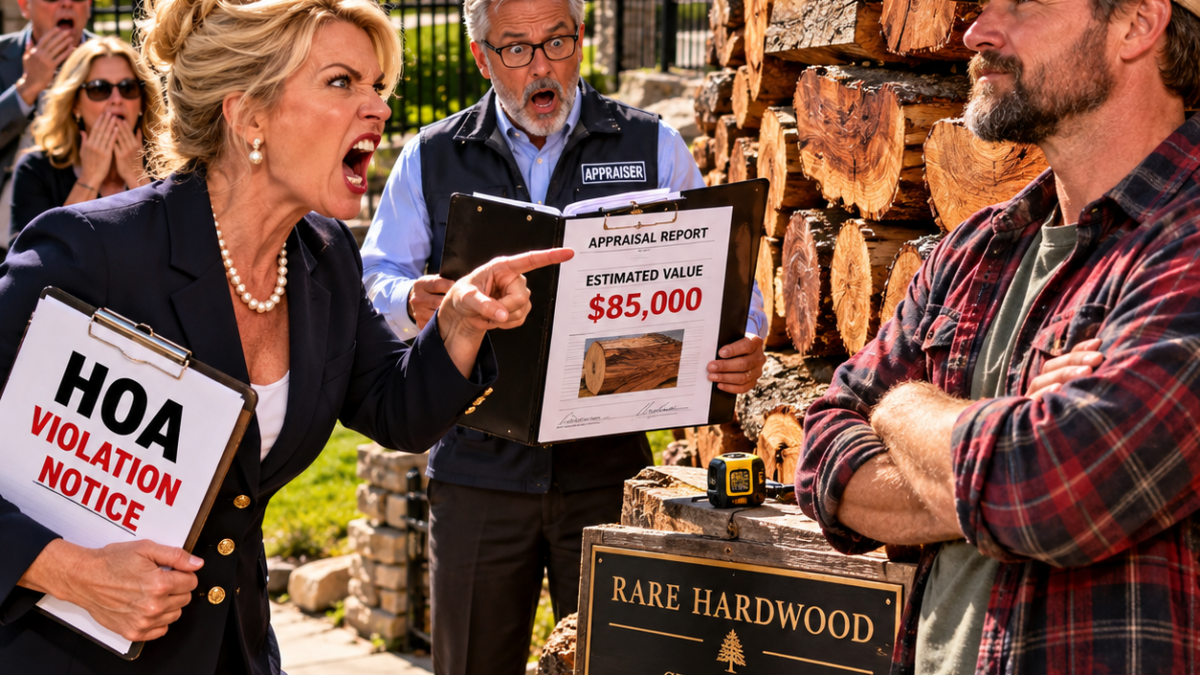
PART 2
The Land My Family Refused to Abandon
The sugar shack had been standing on that hillside since 1873.
My great-great-grandfather, Elias Thorne, had returned from the Civil War with very little money and a determination to build something his children could inherit. Through a nineteenth-century land grant, he acquired two hundred acres of forest and farmland in the northern part of the state.
The property wasn’t particularly valuable back then. Much of it was covered in thick woodland, the winters were brutal, and the rocky terrain made conventional farming difficult.
But the land had one extraordinary advantage.
Sugar maples.
Hundreds of them.
Every spring, when the days began warming and the nights still dipped below freezing, the trees produced sap that could be collected and boiled into maple syrup.
Elias recognized the opportunity.
He built the original farmhouse using timber harvested from his own land. Then, with help from neighboring farmers, he constructed a small post-and-beam sugar shack near the eastern edge of the property.
The structure was simple.
Rough hemlock beams, a sturdy stone foundation, a wood-fired evaporator, and a cupola that allowed steam to escape through the roof.
There was nothing elegant about it.
But it worked.
For more than 150 years, that little building had helped support our family.
Through the Great Depression, when cash was scarce and nearly everything had to be repaired instead of replaced, the syrup provided income.
During difficult harvest years, it helped pay taxes and buy necessities.
When family members went off to war, those who stayed home kept the operation running.
And through every generation, the same lesson was passed down.
The land didn’t belong to us simply because our names appeared on a deed.
We were responsible for taking care of it so the next generation would have something worth inheriting.
My grandfather used to tell me that whenever I complained about carrying sap buckets through deep snow.
“Your ancestors cleared this place by hand, Jack. You can manage one more bucket.”
I hated hearing that as a child.
Now, decades later, I would have given anything to spend another morning following him through the woods.
My father, Thomas Thorne, had devoted most of his life to the farm.
He wasn’t a sentimental man in the ordinary sense. He rarely gave speeches about family traditions or talked about the sacrifices our ancestors had made.
Instead, he showed what he believed through work.
He repaired the stone foundation when frost shifted it.
Replaced rotting boards without changing the old structure’s character.
Maintained the evaporator.
Protected the maple trees.
And kept a handwritten record of every sugaring season.
His notebooks went back decades.
Each one contained dates, weather conditions, sap quantities, syrup yields, and small observations about the trees.
Some years were excellent.
Others were disastrous.
In one notebook, he’d written:
Late thaw. Poor run. Still worth getting out of bed.
That was Dad.
Even a bad season was an opportunity to keep a promise.
When I left home for the Army, I never expected to spend twenty years away.
But one assignment became another.
Promotions followed.
Deployments came and went.
Eventually, I retired as a lieutenant colonel after a career in the Army Corps of Engineers.
During those years, my father kept the farm running.
He never complained when I missed sugaring season.
He simply called and told me how many gallons they’d produced.
Sometimes he’d mail a small bottle of syrup to wherever I was stationed.
Inside the package, there was usually a note.
Still tastes like home.
I kept every one of those notes.
When retirement finally came, I returned with my wife, Sarah, and our two children.
Sarah had grown up in the city. The first time she visited the farm, she was startled by how dark the countryside became after sunset.
But she fell in love with it.
She loved the silence.
The changing seasons.
The view of the hills.
And the fact that our children could explore land that had belonged to their family for generations.
Our daughter, Emma, loved helping collect sap.
Our younger son, Noah, preferred the sugar shack itself, especially the moment when the thin, watery liquid began turning golden.
My father was delighted to have them around.
By then, his hands had begun to tremble, and his knees were no longer strong enough for long days in the woods.
He spent more time sitting beside the evaporator, directing the rest of us.
He still insisted on checking the final syrup himself.
“Not ready,” he’d say.
I’d look at the thermometer.
“Dad, it’s almost there.”
He’d shake his head.
“Almost isn’t ready.”
Then, several minutes later, he’d nod.
“Now.”
And somehow, he was usually right.
The farm wasn’t merely a business to us.
It was where three generations gathered every spring.
It was where my children learned patience.
Where Sarah discovered that hard work could be peaceful.
And where my father could still feel useful long after age had taken away much of his strength.
That was what Karen had threatened to destroy.
Not some abandoned shed.
Not an illegal backyard workshop.
A living piece of our family’s history.
And she had given me twenty-four hours to extinguish its fire.
The dispute hadn’t begun with smoke.
It had begun with a line on a map.
In the late 1990s, a developer purchased roughly five hundred acres adjoining our farm and began constructing Oakwood Bluffs, an expensive residential subdivision filled with large houses, landscaped entrances, and winding roads.
Our family had no objection to the development itself.
People needed homes.
The developer owned the land.
We expected to coexist.
My father met with the developer before construction began.
The old stone wall separating the properties had been standing there longer than anyone could remember.
It ran along the eastern edge of our farm, passing just beyond the sugar shack.
Dad insisted that the wall and the legal boundary be respected.
The developer agreed.
They shook hands.
For nearly twenty years, that understanding caused no problems.
The homeowners association maintained the subdivision.
We maintained our farm.
Residents occasionally purchased syrup from us.
Some even brought their children to watch the boiling process.
Everyone seemed perfectly capable of living beside a working agricultural operation without declaring an emergency every time smoke rose from a chimney.
Then the developer went bankrupt.
The company dissolved.
Several officers retired or moved away.
And the original verbal agreement became little more than a memory.
A few years later, Karen Whitmore became HOA president.
She approached neighborhood management with the enthusiasm of someone who had finally found a position that allowed her to give orders without being questioned.
At first, her complaints were minor.
She disliked the appearance of our farm equipment.
She complained that our gravel driveway didn’t match the subdivision’s paved roads.
She said our split-rail fence looked rustic in the wrong way.
I reminded her that our farm wasn’t part of Oakwood Bluffs.
She didn’t like hearing that.
Eventually, her association commissioned a boundary survey.
It relied on a questionable county GPS reference point and placed the property line approximately seventy-five feet inside the area we’d historically maintained.
That disputed strip included a corner of the sugar shack and part of the old split-rail fence my father had installed.
I hired an independent surveyor.
His findings supported our deed and the historical boundary markers.
Karen refused to accept them.
“Our professional survey is valid,” she told me.
“So is ours.”
“Then we’ll have to agree to disagree.”
I remember looking at her and thinking that property boundaries weren’t matters of personal preference.
Either a parcel belonged to the association or it didn’t.
For a while, the disagreement remained dormant.
Neither side changed the physical boundary.
Nobody interfered with the sugar shack.
I had other responsibilities and didn’t want to spend thousands of dollars litigating a strip of land that had been peacefully occupied and maintained by my family for generations.
That decision might have been understandable.
But it gave Karen time to become comfortable pretending the dispute had already been settled in her favor.
And when the next sugaring season arrived, she decided to act on that assumption.
Two years before the confrontation, our farm had received an extraordinary honor.
I’d applied for the Governor’s Heritage Farming Grant, a state-supported program intended to preserve historic agricultural operations and encourage public education about traditional farming methods.
The application was extensive.
I submitted historical records, photographs, property documents, educational plans, and a maintenance proposal for the sugar shack.
State reviewers visited the farm.
They inspected the structure.
Examined our production methods.
Reviewed our historical documentation.
And evaluated the educational visits we’d been hosting for local schoolchildren.
After months of waiting, I received a letter confirming that we’d been selected.
I remember opening it at the kitchen table.
Sarah stood behind me.
Dad sat near the window.
When I read the award announcement aloud, he simply lowered his head.
For a moment, I thought he was disappointed.
Then I saw his shoulders shaking.
He was crying.
I’d seen my father endure terrible winters, serious injuries, failed harvests, and family losses without shedding a tear.
But the knowledge that someone outside our family recognized the importance of preserving the sugar shack brought him to tears.
He looked at me and whispered, “Your grandfather would’ve liked this.”
Several months later, the governor visited.
There were local reporters.
Agricultural officials.
Representatives from the heritage program.
The governor stood in front of the sugar shack, shook my hand, and spoke about the importance of preserving working farms that connected modern communities with their agricultural past.
We received a bronze commemorative plaque.
The grant helped us repair aging structural components, improve safety, and expand our school field-trip program.
It didn’t magically exempt the farm from every regulation.
It didn’t give us permission to ignore genuine safety concerns.
But it was powerful evidence that the sugar shack was a recognized, supported agricultural heritage project rather than the unauthorized commercial nuisance Karen claimed it was.
I kept the original award letter in a fireproof cabinet in my office.
Copies were included in our state program records.
The bronze plaque remained mounted on the main beam of the sugar shack.
Karen had apparently never bothered to read it.
That omission would eventually become one of the most expensive mistakes of her time as HOA president.
But before I could use the grant records to defend our operation, I needed to deal with the immediate threat.
Because the next morning, Karen’s promised fines arrived.
The $3,000 Threat
The certified envelope arrived before breakfast.
The postal carrier handed it to me with an apologetic expression.
“Looks official,” he said.
“It usually does.”
Inside was a formal notice bearing the Oakwood Bluffs HOA logo.
Karen had divided her complaints into three categories.
Violation One: Unapproved Outbuilding — $1,000.
According to the notice, our sugar shack violated Article 7.4 of the HOA covenants because its materials, color, and roofing did not conform to the architectural requirements imposed on detached structures within the development.
I read that paragraph twice.
The sugar shack had been built in 1873.
The subdivision had been developed more than a century later.
Karen was attempting to apply architectural rules written for suburban garden sheds to a historic agricultural building that predated the association by approximately 125 years.
Violation Two: Unauthorized Commercial Activity — $1,000.
The association claimed our seasonal maple syrup production and sales constituted prohibited business activity affecting the residential character of Oakwood Bluffs.
Apparently, allowing a few school buses to visit during sugaring season was now considered evidence of a commercial threat to neighborhood stability.
Violation Three: Smoke, Odor, and Noise Nuisance — $1,000.
Karen described the sugar shack as producing noxious smoke, disruptive noise, and industrial odors.
The notice made no meaningful distinction between the white water vapor rising through the cupola and the controlled wood-combustion exhaust leaving the chimney.
It simply treated every visible plume as evidence of a violation.
The total was exactly what Karen had threatened.
Three thousand dollars.
And beneath the listed charges was another warning.
The fines would continue to accrue if we refused to comply.
If the matter remained unresolved after thirty days, the association intended to pursue collection measures, including a lien where permitted.
I set the papers on my father’s old desk.
Sarah entered the room carrying coffee.
“More trouble?”
I handed her the notice.
She read it silently.
Then she looked up.
“They’re fining us for the sugar shack?”
“That’s what it says.”
“But this isn’t even their property.”
“I know.”
“And the state helped us restore it.”
“I know.”
She looked toward the window.
Outside, Dad was walking slowly toward the sugar shack with Noah beside him.
They were carrying two small buckets together.
The sight made Sarah’s expression tighten.
“Please don’t let this ruin the season.”
I reached for her hand.
“It won’t.”
But privately, I was worried.
The farm was financially stable, yet operating a small agricultural business wasn’t the same thing as having unlimited resources.
Our equipment required maintenance.
Heating fuel cost money.
Insurance premiums had increased.
The educational program demanded time and preparation.
And the grant came with responsibilities to maintain and use the structure for its intended heritage purpose.
If Karen forced us into prolonged litigation, the expense alone could become painful.
That was probably what she was counting on.
She didn’t need to be right if she could make the cost of proving her wrong unbearable.
I decided not to give her that advantage.
I sat at my desk, opened a legal pad, and began assembling a response to each allegation.
No shouting.
No insults.
Just the documents.
For the outbuilding claim, I obtained certified copies of the early property records and the historical society’s letter documenting the sugar shack’s significance.
I included our independent survey and photographs of the original stone wall.
Then I attached a copy of the Governor’s Heritage Farming Grant award and the program documentation confirming that the sugar shack was an approved preservation project.
For the commercial activity allegation, I visited the county zoning office.
The staff provided documentation of our agricultural classification and the permitted uses associated with our parcel.
I also gathered information concerning the state’s right-to-farm protections.
Those protections weren’t unconditional, and their application could depend on facts such as whether a farm was lawfully established and operated responsibly.
But our maple operation had existed long before the adjoining subdivision.
The association would have difficulty arguing that its later residential development automatically extinguished our right to farm.
For the nuisance allegation, I documented our equipment maintenance, smoke-control procedures, operating schedule, and seasonal production.
The evaporator’s cupola released mostly water vapor from boiling sap.
The separate wood-fired exhaust chimney produced smoke, but we operated and maintained it as part of a longstanding agricultural process.
No one had provided evidence that we were violating an applicable emissions standard.
I was willing to address any legitimate safety or environmental concern.
I wasn’t willing to accept a $1,000 penalty because Karen personally disliked the smell of maple syrup.
Then I remembered something.
A week earlier, Karen had hosted an enormous backyard cookout.
Two large outdoor smokers had operated for hours.
Dark smoke drifted over the neighboring yards.
Music played loudly.
Cars lined the street.
I had taken photographs because the gathering was unusually large.
Now those photographs became relevant.
I wasn’t interested in punishing Karen for hosting friends.
But if she wanted to argue that visible smoke and outdoor activity were automatically unacceptable, her own gathering provided an obvious example of why nuisance standards required context and consistent application.
I attached the photographs with an explanation.
Then I prepared three separate responses.
One for each alleged violation.
Each contained the supporting documents relevant to that charge.
I sent them by certified mail.
Karen received copies.
So did Gerald.
Brenda.
And every other director.
I wanted the entire board to understand that these weren’t casual complaints.
They were formal allegations affecting a historically significant agricultural operation.
And their president was asking them to support those allegations without establishing that the association had authority over the property.
For one week, nothing happened.
No new fines.
No angry visits.
No golf cart outside the sugar shack.
Dad noticed the quiet.
“Your neighbor finally run out of complaints?”
“Not likely.”
He smiled.
“Your grandfather used to say people who love the sound of their own voice rarely stay quiet for long.”
I laughed.
“Sounds about right.”
Dad patted my shoulder.
“Don’t let her make you forget why you’re doing this.”
I looked toward the evaporator.
“Making syrup?”
He shook his head.
“Keeping this place alive.”
I nodded.
“I won’t.”
Three days later, a process server arrived at the farmhouse.
Karen had filed a lawsuit.
And she wanted a judge to shut down the sugar shack.
The Lawsuit That Changed Everything
The legal papers requested an injunction preventing us from operating the sugar shack until the alleged violations were corrected.
Karen’s association claimed the building and business activities created an ongoing nuisance affecting neighboring residents.
The complaint relied heavily on the disputed boundary survey.
It also accused me of deliberately refusing to cooperate with reasonable neighborhood standards.
I read the papers twice.
Then I called Sarah into the room.
She scanned the first page.
Her face went pale.
“Jack, they’re taking us to court?”
“Yes.”
“Over maple syrup?”
“Over the right to operate our farm.”
She sat down.
For a moment, neither of us spoke.
Then she asked the question that bothered me most.
“What happens if the judge orders us to stop?”
I looked toward the sugar shack.
The sugaring season was short.
Missing even a few weeks could destroy much of our annual production.
It would also disrupt the school visits we’d already scheduled.
Our reputation depended on fulfilling commitments.
Our family income depended on the harvest.
And the grant required us to maintain the historical operation and educational activities responsibly.
Karen wasn’t merely creating inconvenience.
She was threatening the very continuity the heritage program existed to preserve.
“We’re going to defend it,” I said.
Sarah nodded.
But the worry remained in her eyes.
That afternoon, I called Ben Carter.
Ben was a former military attorney I’d known during my service. After leaving the Army, he’d built a civilian practice handling property disputes, land-use cases, and civil litigation.
I explained everything.
The old stone wall.
The competing surveys.
The governor’s grant.
The three violation notices.
And the new lawsuit.
Ben listened carefully.
When I finished, he asked one question.
“Jack, has the HOA ever produced a deed showing ownership of that seventy-five-foot strip?”
“No.”
“An easement?”
“No.”
“A court judgment establishing its boundary?”
“No.”
“Then on what basis are they claiming jurisdiction?”
“Their survey.”
Ben was quiet for a moment.
“Send me the entire file.”
I forwarded the documents.
The next morning, he called.
“Jack, I think we have a substantial defense.”
I closed my office door.
“I’m listening.”
“First, the boundary dispute hasn’t been resolved. Their survey doesn’t automatically establish ownership. Second, agricultural zoning and the right-to-farm framework may provide strong protections for your established operation. Third, the heritage grant and historical documentation undermine their characterization of the sugar shack as some unauthorized new structure.”
“What about the injunction?”
“We’ll oppose it. We’ll also assess what counterclaims and declaratory relief are appropriate.”
“Can we win?”
“I never promise outcomes before seeing all the evidence.”
I appreciated that answer.
“But I can tell you this,” Ben continued. “Their case isn’t nearly as straightforward as Karen seems to believe.”
I leaned back.
“She’s threatened to fine us into bankruptcy.”
“Then we document every threat.”
“She says our operation is a public nuisance.”
“Then we ask for evidence.”
“She claims our building violates her architectural rules.”
“Then we make her establish that those rules apply to your parcel.”
I looked through the window at the sugar shack.
“And the governor’s grant?”
“That could become very important. I want the original award documents, the preservation agreement, and the current program requirements. Also, contact the administering state agency and request written clarification of the grant’s status and purpose.”
“Why?”
“Because the court needs to understand what this building actually is—not merely what Karen chooses to call it.”
I looked at the bronze plaque hanging beside the sugar shack door.
For two years, I’d regarded it as a family honor.
Now I was beginning to understand that the records behind it might help protect the building itself.
Ben continued.
“One more thing. Do not let this become a personal shouting match. If she approaches you, record the facts, disengage, and call me.”
“I can do that.”
“Good. Because the best way to defeat an unsupported claim is to make the other side prove it.”
After the call, I walked outside.
Dad was sitting on a bench beside the sugar shack.
He looked up.
“Bad news?”
“Karen filed suit.”
He stared at me.
“To stop the syrup?”
“Yes.”
His hands tightened around his walking stick.
For a moment, he looked much older than he had that morning.
Then he whispered, “Your grandfather kept this place running through the Depression.”
I sat beside him.
“I know.”
“My father ran it after coming home from the war.”
“I know, Dad.”
He looked at the old building.
“All those years. All those winters.”
I waited.
Then he turned toward me.
“Don’t let them make you ashamed of what we built.”
I felt my throat tighten.
“I won’t.”
He nodded.
“Then we’ll keep boiling.”
And we did.
But while the sap ran through the maple trees, another kind of work was beginning.
I needed to understand the people behind Karen’s power.
Because the more I examined her conduct, the less this looked like a simple dispute over smoke.
It looked like a pattern.
And I was about to discover how expensive that pattern had become for her own neighbors.
The Neighbors Karen Had Silenced
Mrs. Gable answered the telephone on the second ring.
“Thorne residence?” she asked before I could introduce myself.
I smiled.
“How’d you know?”
“Jack, there are only about three people in this neighborhood who call an eighty-four-year-old woman before lunch, and two of them are doctors.”
I’d known Mrs. Gable since my father first introduced us years earlier.
Her family had purchased their house when Oakwood Bluffs was relatively new. She remembered the original developer, the early community meetings, and the years when the subdivision and neighboring farms had coexisted peacefully.
Her husband, Harold, had died several years earlier.
Since then, she’d lived alone with a stubborn little terrier and an impressive collection of ceramic garden gnomes that Harold had bought during their travels.
I explained the lawsuit.
Her cheerful tone vanished.
“That woman did what?”
“She’s asking the court to shut down the sugar shack.”
“Your father’s sugar shack?”
“Yes.”
“The one that’s been there since before my grandmother was born?”
“That’s the one.”
There was a long silence.
Then Mrs. Gable said, “Jack, I think you need to come over. There’s something I want to show you.”
I drove to her house that afternoon.
She met me at the door holding a thick folder.
Inside were HOA notices dating back several years.
Photographs.
Letters.
Appeals.
Fine schedules.
One document concerned her garden gnomes.
Karen had claimed they violated the subdivision’s exterior decoration standards because they were not sufficiently uniform.
I stared at the notice.
“She actually wrote that?”
Mrs. Gable nodded.
“Apparently Harold should have checked with Karen before buying souvenirs from Vermont.”
I shook my head.
She pointed toward the window.
A little ceramic fisherman stood beneath a flowering shrub.
“Harold bought that one during our twenty-fifth anniversary trip.”
Her voice softened.
“He thought it looked like him.”
I looked at the figure.
It wore a tiny hat and carried a fishing pole.
Mrs. Gable smiled sadly.
“After he died, I couldn’t bear to move it.”
I turned back to the notice.
“Did you pay the fine?”
“Eventually. I didn’t have the energy to argue.”
She looked at me.
“But I kept the paperwork.”
“Why?”
“Because when someone tells you you’re wrong long enough, you start wondering whether you really are. I wanted to remember what actually happened.”
That answer stayed with me.
I had thought of Karen’s behavior primarily as an abuse of rules.
But listening to Mrs. Gable, I began to understand the emotional cost.
Years of petty enforcement had trained people to doubt themselves.
To apologize for harmless choices.
To believe that the safest way to live was to attract as little attention as possible.
I copied the relevant documents with her permission.
Then she took my hand.
“Your father was good to Harold when he got sick.”
I nodded.
I remembered Dad bringing firewood to their house one winter after Harold’s surgery.
Mrs. Gable continued.
“Harold couldn’t shovel the driveway. Your father came over every time it snowed.”
“That’s just how Dad is.”
“Exactly.”
Her eyes filled.
“So you tell him I haven’t forgotten.”
I promised I would.
Before I left, she gave me a list of other residents who might be willing to speak.
At the bottom, she’d written one sentence.
People aren’t difficult to bring together when they’re finally given a reason to trust one another.
The Garcia family lived near the entrance to the subdivision.
Marco and Elena had two young children and a newly installed wooden playset in their backyard.
I found Marco standing beside it with a can of wood stain.
He looked furious.
“Don’t tell me,” I said. “Karen?”
He turned.
“How’d you guess?”
I pointed toward the expensive playset.
“Looks like something a normal kid might enjoy.”
He laughed bitterly.
“Apparently, that’s the problem.”
He explained that the playset had been stained in a color called Sierra Redwood.
The association’s approved list specified Natural Cedar.
The colors were similar enough that I struggled to distinguish them in photographs.
Karen had issued a $500 fine.
“She wants us to sand the entire thing and restain it,” Marco said.
“Over that difference?”
He nodded.
“Five hundred dollars, plus the cost of doing it again.”
Elena appeared at the back door carrying their youngest child.
“She also fined us last year because our welcome mat had too many colors.”
I looked at her.
“A welcome mat?”
She nodded.
“It had flowers on it.”
I stared.
Then I laughed once in disbelief.
Elena didn’t laugh.
“Jack, we saved for years to buy this house. Our children finally have a backyard. And now every improvement feels like something we have to defend.”
I showed them the court documents.
Marco’s expression changed as he read.
“She’s really trying to close your farm?”
“Yes.”
He looked toward the distant hills.
“My grandfather made maple syrup when I was a kid. We’d visit him every spring.”
He smiled briefly at the memory.
“That smell takes me right back.”
Elena read the injunction request.
Then she looked at me.
“This isn’t about smoke.”
“No.”
“She just doesn’t like being told no.”
I nodded.
Marco set the paintbrush down.
“Then we’re in.”
I raised an eyebrow.
“In what?”
“Whatever you’re doing to make the board answer for this.”
Elena nodded.
“We’ll speak at the annual meeting. We’ll provide the fine notices. Whatever you need.”
I thanked them.
As I walked back to my truck, Marco called after me.
“Jack!”
I turned.
He pointed at the playset.
“My kids are going to use this thing, whether Karen likes the color or not.”
For the first time that week, I smiled all the way home.
The next person I contacted was Mark Jessup.
Mark was a retired Marine gunnery sergeant who had moved to Oakwood Bluffs several years earlier.
We’d met at a Fourth of July neighborhood barbecue and quickly discovered that we had similar opinions about unnecessary bureaucracy.
Mark believed rules were essential.
He also believed that anyone enforcing a rule ought to understand it.
When I arrived at his house, he was working in his garage.
He wiped his hands on a rag.
“Jack Thorne. What’s going on?”
“I need another set of eyes on some documents.”
He studied my expression.
“That sounds serious.”
“It is.”
We sat at his kitchen table.
I spread out the boundary surveys, violation notices, court papers, and grant documentation.
Mark worked through them slowly.
He didn’t interrupt.
When he finished, he tapped the disputed boundary map.
“She’s relying entirely on this?”
“Pretty much.”
“And you’ve got an independent survey showing the historical wall matches the recorded boundary?”
“Yes.”
He frowned.
“Then why is she acting like ownership has already been decided?”
“That’s what I’d like to know.”
He moved to the financial documents I’d collected from public HOA reports.
“What about the association’s legal expenses?”
“They’ve hired outside counsel.”
“With whose money?”
“The homeowners’, presumably.”
Mark leaned back.
“Does the board know how much this fight is costing them?”
“I don’t think most residents even know the full story.”
He looked at the summons again.
“Then we’re not just defending your farm. We need to establish what the board authorized and how its money has been spent.”
That question led us to something I hadn’t initially considered.
HOA financial records.
Contracts.
Meeting minutes.
Approval procedures.
Every document showing how Karen’s administration made decisions.
We began with a formal records request through the association’s procedures.
Mark helped organize the requested categories.
Three years of financial summaries.
Detailed expenditures.
Contract awards.
Board meeting minutes.
Correspondence concerning significant maintenance projects.
And records related to the legal action against our farm.
At first, the association refused to provide much of anything.
We received a short letter claiming our request was excessive.
Then another claiming the documents were confidential.
Ben reviewed the response.
He explained that access rights depended on the applicable law, our standing, and the particular records requested, so we needed to use the proper legal process rather than assume the association had to disclose everything merely because we asked.
He helped the appropriate homeowners submit formal demands for records they were entitled to inspect.
A few days later, Arthur Bennett, one of the board members, contacted Mark.
Arthur had been uncomfortable with several of Karen’s decisions.
He agreed that the financial records needed review.
With his assistance and Ben’s involvement, the association finally produced a substantial set of documents.
What we found changed the dispute completely.
The first suspicious item was a landscaping contract.
Oakwood Bluffs had been paying Green Pastures Landscaping LLC more than $100,000 per year.
That amount alone didn’t prove anything improper.
The subdivision was large, and maintaining common areas could legitimately be expensive.
But when Mark and I examined the paperwork, we couldn’t find evidence of a competitive bidding process.
The contract appeared to have been renewed repeatedly without meaningful price comparisons or documented review.
I searched the state business registry.
Green Pastures Landscaping LLC belonged to Karen’s brother-in-law.
I printed the registration.
Then called Mark.
“You’re going to want to see this.”
He arrived within twenty minutes.
We compared the business registration with the contract approval records.
The relationship had not been clearly disclosed in the board minutes we’d received.
Then we examined the invoices.
Routine landscaping charges.
Seasonal maintenance.
Emergency services.
And several unusually expensive tree-removal jobs.
One invoice concerned the removal of three storm-damaged trees from common property.
The price was nearly triple the range Mark and I obtained from independent contractors for comparable work, although we understood that site conditions and urgency could affect pricing.
Another invoice included equipment rental charges without sufficient supporting detail.
A third billed for debris disposal on a date when neighborhood photographs showed no obvious cleanup activity.
None of this established criminal wrongdoing by itself.
But taken together, the records raised substantial questions.
And the more we looked, the more questions appeared.
I called Ben.
“We found a contractor relationship the board may not have disclosed.”
“Tell me.”
I explained the landscaping company, the invoices, and the corporate registration.
Ben listened.
Then he said, “Preserve the records exactly as received. We’ll need independent review before drawing conclusions.”
“Do you think Karen’s getting money from this?”
“We don’t know.”
“But her brother-in-law is.”
“His company is receiving association payments. Whether the contract was properly awarded and whether anyone breached a duty requires further examination.”
I respected his caution.
The last thing I wanted was to make exaggerated allegations while criticizing Karen for doing exactly that.
Still, the evidence was troubling.
Mark was less restrained when he saw the total amount.
“Over a hundred thousand dollars a year,” he muttered.
He flipped through the records.
“And she wants to fine an eighty-year-old woman for garden gnomes.”
I didn’t answer.
We kept reading.
The next set of documents concerned enforcement.
Mrs. Gable’s gnomes appeared in the minutes.
The Garcias’ playset appeared.
Several small violations involving homeowners who had complained about Karen’s decisions were carefully recorded.
But other incidents were missing.
One resident had complained that Karen’s adult son parked a large lifted truck on a lawn for nearly a week.
No enforcement action appeared in the records.
Another homeowner had raised concerns about unauthorized decorations belonging to a board member.
Again, no corresponding action.
The pattern suggested that complaints against Karen’s allies were handled differently from those involving residents who challenged her.
It was not proof that every fine was invalid.
But it was enough to justify closer scrutiny.
And it made the association’s decision to sue my farm look increasingly suspicious.
Karen had treated us like a serious threat over a seasonal agricultural operation that predated the subdivision.
Yet she had apparently tolerated far more obvious neighborhood violations when the people involved were close to her.
Mark closed one binder.
“This is bigger than your sugar shack.”
I nodded.
“Much bigger.”
He looked toward the window.
“What are you going to do?”
I thought about Dad.
Mrs. Gable.
The Garcia children.
And the people who had lived for years under a system that seemed to punish disagreement.
“I’m going to make sure the board sees all of it.”
The Fence My Father Built
The next violation notice arrived on a rainy Thursday.
At first, I thought it was another complaint about smoke.
Instead, Karen had found a new target.
Our old split-rail fence.
Twenty feet of weathered cedar running along the disputed boundary near the sugar shack.
Dad had installed it years earlier.
He’d built it by hand, carefully following the line of the old stone wall.
It wasn’t fancy.
It wasn’t painted.
And it didn’t resemble the decorative fencing used in Oakwood Bluffs.
But it belonged on a working farm.
Karen’s notice claimed that all visible fences along the subdivision boundary had to comply with current HOA appearance standards.
According to the letter, our fence needed to be painted an approved color.
The notice even claimed that previously existing fences were no longer exempt.
I stared at the page.
The fence had been standing there long before Karen became president.
It was on land we maintained and claimed under our recorded property documents.
And she wanted to regulate its color while our separate boundary dispute remained unresolved.
The demanded color?
Oakwood Cream.
I read the words twice.
Then I laughed.
Not because the situation was funny.
Because the absurdity had become almost unbelievable.
My father walked into the office while I was still holding the notice.
“What’s that?”
“Karen wants the fence painted.”
He frowned.
“Which fence?”
“The one near the sugar shack.”
He stared at me.
“Why?”
“Because it doesn’t match her subdivision.”
Dad took the paper.
His hands trembled slightly as he read.
Then he sat down.
For a long moment, he looked at the notice without speaking.
Finally, he said, “Your mother helped me put that fence up.”
I looked at him.
“I remember.”
“She held the posts steady while I set them.”
His eyes softened.
“She was eight months pregnant with your sister, and she still insisted on helping.”
I smiled at the memory.
Mom had died several years earlier.
There were still mornings when Dad seemed to forget she was gone.
He’d reach for a second coffee cup before remembering.
Or begin telling a story and turn toward the chair where she used to sit.
The fence was one of those ordinary things that carried her memory.
Not a monument.
Not a photograph.
Just twenty feet of weathered wood she’d helped install.
Dad lowered the notice.
“She wants us to paint it?”
“Yes.”
“That wood’s never needed paint.”
“I know.”
He shook his head.
“Your mother would’ve had something to say about that.”
I laughed.
“Probably something I couldn’t repeat in front of the kids.”
Dad smiled.
Then the smile faded.
“Jack, how much more of this are we going to have to take?”
The question caught me off guard.
He wasn’t angry.
He was tired.
I could see it in his face.
The farm had been the center of his life for decades.
Now, in his eighties, he was watching a stranger threaten the place he’d spent his entire adulthood protecting.
I sat beside him.
“Not forever.”
He looked at me.
“Promise?”
I held his gaze.
“I promise I’m going to see this through.”
He nodded.
Then he handed the notice back.
“Good.”
I scanned it and sent it to Ben.
He called almost immediately.
“A fence?”
“Twenty feet.”
“On the disputed boundary?”
“Yes.”
“What color?”
“Oakwood Cream.”
There was a pause.
Then Ben laughed so hard I had to move the phone away from my ear.
“I’m sorry,” he said finally. “I know this isn’t amusing for your family, but she’s making it exceptionally difficult to argue that the enforcement is focused on genuine safety concerns.”
“I was thinking the same thing.”
He grew serious.
“Do not paint it. Do not alter it. And do not let anyone else alter it while the ownership dispute remains unresolved.”
“Understood.”
“I want a current photograph of the fence, its condition, and its location relative to the survey markers. Also, preserve that notice.”
“What are you planning?”
“We’re going to use it to show the court how broadly she’s trying to assert the association’s authority.”
I looked through the window toward the weathered rails.
The fence wasn’t valuable in a financial sense.
But it mattered.
And I was beginning to understand something important.
Karen wasn’t satisfied with stopping the sugar shack.
She wanted to control every visible reminder that our farm existed independently of her subdivision.
The fence.
The smoke.
The building.
The equipment.
The seasonal visitors.
If she could force us to treat our farm as an extension of Oakwood Bluffs, she could begin regulating it into something unrecognizable.
That was the larger danger.
The sugar shack was only the beginning.
The following weekend, I walked the boundary with our surveyor, Henry Wallace.
Henry had worked in the county for more than thirty years.
He knew the terrain.
He knew the old stone wall.
And he knew how often modern development maps failed to reflect historical markers accurately.
We began at the northern corner.
He checked the monuments and reference points.
Then we followed the wall toward the sugar shack.
The ground was muddy.
Snow lingered beneath the trees.
The air smelled of thawing earth and damp leaves.
Henry stopped near the split-rail fence.
“Here’s where their survey goes wrong.”
He showed me the data.
Their boundary line relied on a reference point that appeared inconsistent with the older recorded descriptions and physical monuments.
When that point was used, the line shifted westward.
Far enough to place part of the sugar shack inside the subdivision’s claimed area.
Our survey relied on the recorded deed descriptions and multiple established monuments.
Those measurements supported the stone wall as the boundary.
Henry shook his head.
“These disputes happen, but a line drawn on somebody’s modern subdivision map doesn’t automatically erase older property rights.”
“Could a judge still rule against us?”
“That’s ultimately a legal question. But from a surveying standpoint, I can explain and defend my findings.”
I nodded.
“That’s what I need.”
He drove fresh stakes into the ground.
Bright orange ribbons fluttered along the boundary.
I photographed everything.
Then Henry measured the distance from the sugar shack to the line established by his survey.
The building was on our side.
So was the fence.
The evidence was growing stronger.
But I wanted more than a surveyor’s opinion.
I wanted the underlying records that showed what the developer had actually intended when Oakwood Bluffs was first approved.
And that search would lead me to a document Karen never expected me to find.
The Agreement Buried in the County Archives
The county records office occupied the lower floor of an old government building.
It smelled of paper, dust, and furniture polish.
I arrived shortly after opening with a notebook and a list of documents I needed.
The clerk directed me toward the archived subdivision files.
I spent hours reviewing old plats, correspondence, planning conditions, and recorded instruments.
Most were exactly what you’d expect.
Road layouts.
Drainage plans.
Utility easements.
Engineering calculations.
Then I found a folder labeled with the original development company’s name.
Inside were correspondence and meeting records from the period before Oakwood Bluffs was built.
One letter caught my attention.
It was addressed to the developer’s project manager.
The subject concerned the boundary adjoining the Thorne farm.
I read it slowly.
The correspondence acknowledged the preexisting agricultural operation and described the stone wall as the practical division between the proposed subdivision and the neighboring farm, subject to the formal property records.
It also referred to the need to avoid encroachment upon the Thorne property’s agricultural improvements.
I felt my pulse quicken.
Then I found an older site map.
Unlike Karen’s newer survey, it showed the sugar shack on the farm side of the boundary.
The map wasn’t a substitute for a complete title determination.
But it was relevant evidence that the original development plan had contemplated the farm as separate from the HOA-controlled area.
I photographed the records.
Then requested certified copies of the relevant documents.
As I waited, another familiar name caught my eye.
My father.
He had written to the developer decades earlier, documenting his concerns about preserving access to the sugar shack and respecting the historical boundary.
The letter was simple.
No legal jargon.
No threats.
Just a farmer asking that the land his family had worked for generations be left undisturbed.
At the bottom, he’d written:
Our farm was here before the proposed homes, and we welcome good neighbors. We ask only that the same respect be shown to our property.
I stared at his handwriting.
For a moment, I was no longer standing in the county records office.
I was a child following Dad through the maple woods.
Listening to him explain where the boundary ran.
Watching him greet neighbors who stopped to buy syrup.
Seeing him treat every person with the same courtesy, whether they owned a thousand acres or rented a small house.
He’d never wanted conflict with Oakwood Bluffs.
He’d wanted coexistence.
I looked at the old letter again.
Then I made another copy.
When I returned home, I found Dad sitting near the kitchen window.
I placed the document in front of him.
“Remember writing this?”
He adjusted his glasses.
Read the first paragraph.
Then smiled.
“That was a long time ago.”
“You told them exactly where the boundary was.”
He nodded.
“They were decent people back then.”
I pulled out the old development map.
He studied it.
“That’s right,” he said, pointing toward the line. “That’s where we agreed the wall would stay.”
“Do you remember who was at the meeting?”
“Some of them.”
He began naming people.
An engineer.
A surveyor.
Two county officials.
The development manager.
I wrote down everything he remembered.
Then he looked at me.
“Why?”
“Because the original records support our boundary.”
He leaned back.
For a moment, his eyes closed.
Then he whispered, “Your grandfather always said to keep the paperwork.”
I smiled.
“He was right.”
Dad nodded.
“He usually was.”
I carried the documents into my office and called Ben.
When I explained what I’d found, he became quiet.
Then he said, “Jack, bring those records to me tomorrow.”
“Are they that important?”
“They may help establish how the original development was designed and what the parties understood. Combined with the deeds and surveys, they could be significant.”
I glanced at Dad through the office doorway.
He was still studying the copy of his old letter.
For the first time since Karen began threatening the farm, he looked peaceful.
I hoped I could keep him feeling that way.
But I knew we were approaching a confrontation neither side could avoid.
The annual HOA meeting was coming.
The injunction hearing was approaching.
And somewhere in Karen’s financial records, an unexplained pattern of spending was waiting to be examined.
The next few weeks would decide whether she could continue pretending her title gave her authority over everyone around her.
Or whether the people she’d spent years intimidating would finally demand answers.
The Letter Karen Never Expected to See
The confirmation from the state heritage office arrived on a Tuesday afternoon.
I’d contacted the program administrator at Ben’s suggestion, explaining that our historic maple operation was facing a land-use dispute and that the adjoining homeowners association had described the sugar shack as an unauthorized structure.
I hadn’t asked the state to fight my legal battle.
I simply requested written confirmation of the farm’s participation in the Governor’s Heritage Farming Grant program, the purpose of the award, and the preservation obligations connected to the project.
The response was more helpful than I’d expected.
It came on official state letterhead, accompanied by a copy of the original grant award signed by the governor.
The package confirmed that the Thorne Family Sugar Shack had been selected for the heritage program after review of its historical significance, agricultural operations, and educational mission.
It described the building as a documented nineteenth-century sugarhouse associated with one of the area’s longstanding maple-producing farms.
It also confirmed that state funds had supported preservation and safety improvements designed to maintain the building’s historical character while allowing continued agricultural demonstrations.
The letter made an important distinction.
The grant did not automatically settle the boundary dispute or exempt the farm from every applicable law.
But it did establish that the state recognized and supported the very operation Karen was trying to characterize as an unauthorized nuisance.
Any proposed demolition, major alteration, or forced interruption of the grant-funded preservation project would raise questions requiring careful review under the program’s terms.
I read the letter several times.
Then I called Ben.
“It’s here.”
“The heritage confirmation?”
“Yes. And they included the governor’s original award letter.”
“Excellent.”
I leaned against my desk.
“Does this end the case?”
“No. But it strengthens the evidence concerning the building’s purpose, history, and public value. We still need to establish the boundary and address the actual legal claims.”
I appreciated that Ben wasn’t promising a miracle.
He wasn’t treating the governor’s signature as a magical shield that made every disagreement disappear.
Instead, he understood how it fit into the larger picture.
The deed established ownership claims.
The surveys addressed the boundary.
The county records explained the historical development.
The agricultural permits and zoning records supported our lawful operations.
The heritage documentation established that the sugar shack was a recognized preservation project serving educational and agricultural purposes.
Together, those documents told a consistent story.
Our family hadn’t constructed a nuisance beside a residential neighborhood.
A residential neighborhood had been built beside an existing farm.
And its current HOA president was trying to rewrite that history.
Ben asked me to bring the documents to his office.
Before leaving, I took the original award letter into the kitchen.
Dad was sitting at the table with Noah.
They were examining the labels for the next batch of syrup bottles.
“Look what came today,” I said.
Dad adjusted his glasses.
I placed the governor’s letter in front of him.
He recognized it immediately.
His expression softened.
“I remember that day.”
“Me too.”
He touched the paper lightly.
“Your mother would’ve been proud.”
I sat beside him.
“She would’ve loved the ceremony.”
Dad smiled.
“She would’ve told you to stand up straight for the cameras.”
I laughed.
Then he looked at the governor’s signature.
For a moment, his face grew serious.
“Jack, I never thought anybody outside this county would care about our little sugar shack.”
I looked toward the window.
“I think more people care than we realized.”
He nodded.
Then he folded his hands.
“Just make sure you don’t spend your whole life fighting about it.”
The words surprised me.
“Dad?”
He looked at me.
“Your grandfather didn’t build this place so his children could spend all their time in courtrooms.”
I swallowed.
“I know.”
“He built it to make syrup.”
Dad smiled.
“And to raise a family.”
I looked toward Noah, who was carefully arranging labels in a crooked stack.
The boy grinned.
“Grandpa says I’m in charge of quality control.”
Dad chuckled.
“He takes the job very seriously.”
I watched them together.
And I realized how much Karen had already taken from us, even without shutting down a single day of production.
Hours spent with lawyers.
Evenings spent reading legal documents.
Worry that followed us to bed.
Conversations that should have been about harvest plans but instead revolved around fines and court dates.
I didn’t want this dispute to become the defining story of our farm.
I wanted it to become something we survived.
Then I wanted to get back to making maple syrup.
The first independent inspection came two days later.
At my request, the appropriate local fire and agricultural officials reviewed the sugar shack’s operation.
I wanted any legitimate concerns addressed before the injunction hearing.
The inspection began in the morning.
Two officials examined the evaporator installation, ventilation arrangements, fuel storage, and general operating conditions.
They reviewed our maintenance records and asked questions about production schedules.
I answered everything.
Sarah helped retrieve documents.
Dad watched from a bench outside.
Karen’s house wasn’t visible from the sugar shack, but I felt certain she’d hear about the inspection.
I welcomed that.
If there was a genuine problem, I wanted to know.
If there wasn’t, I wanted the record to reflect that too.
After several hours, the officials completed their review.
They identified a few ordinary maintenance recommendations, including additional labeling in one storage area and continued attention to chimney upkeep.
Nothing they observed justified an immediate shutdown.
The written follow-up documented their findings within the scope of the inspection.
I thanked them.
One official looked toward the old beams.
“Beautiful building.”
“Thank you.”
“Hard to believe it’s been here that long.”
I smiled.
“My family says the same thing every spring.”
He examined the bronze heritage plaque.
“Governor’s program?”
“Yes.”
He nodded.
“Keep up with the maintenance. Places like this aren’t easy to replace.”
I watched the inspectors leave.
Then I returned to the sugar shack.
Dad was waiting by the evaporator.
“Well?”
“We passed the important parts.”
He grinned.
“Then let’s get back to work.”
And we did.
For the rest of the afternoon, we boiled sap.
No lawyers.
No fines.
No angry letters.
Just the steady hiss of evaporation and the smell of maple filling the building.
For a few precious hours, life felt ordinary again.
But outside the farm, Karen was preparing for the annual HOA meeting.
And the documents Mark had been reviewing were about to make that meeting considerably more uncomfortable than she expected.
The Money Trail
Mark arrived at my house on Saturday carrying a second binder.
The first contained the association’s contracts.
The new one contained comparisons, calculations, and notes from an independent accounting review.
He placed it on the kitchen table.
“Jack, we’ve got a problem.”
I smiled grimly.
“Another one?”
“This one’s going to matter to every homeowner in Oakwood Bluffs.”
I sat down.
Mark opened the binder.
The landscaping contract with Green Pastures Landscaping LLC had been approved through a process that raised serious conflict-of-interest concerns.
The company belonged to Karen’s brother-in-law.
The annual payments exceeded $100,000.
And the available records contained no clear competitive bidding process or documented disclosure of the family relationship before the contract was awarded.
The independent review also identified duplicate-looking charges, inadequately supported emergency services, and invoices that warranted further verification.
Again, none of that automatically proved fraud.
But the association’s internal controls appeared remarkably weak.
More importantly, Arthur had begun asking questions directly.
He had obtained confirmation that some directors were unaware of the contractor’s family connection when they approved renewals.
Mark showed me copies of the relevant minutes.
“Look here.”
I leaned forward.
The landscaping contract had been renewed through a routine board vote.
Karen had presented the renewal as a standard administrative matter.
There was no recorded discussion of alternatives.
No explanation of pricing.
No disclosure that the contractor was her brother-in-law.
Then Mark showed me an email.
It came from a former board member who had questioned the contract several years earlier.
He had asked whether the association should obtain competing bids.
Karen’s response dismissed the suggestion as unnecessary and accused him of undermining community stability.
I read it slowly.
The wording sounded painfully familiar.
It was the same technique she’d used against me.
Treat every question as disloyalty.
Treat every objection as an attack.
Make people uncomfortable enough that they stopped asking.
Mark tapped the table.
“She’s been doing this for years.”
I nodded.
“And now she’s using the association’s legal budget to fight our farm.”
“Exactly.”
He opened another document.
The HOA’s legal expenses had increased sharply since Karen began pursuing the sugar shack dispute.
Residents weren’t being given a clear explanation of the potential financial exposure.
The board’s legal counsel was billing the association.
And if the case continued, those costs could affect the neighborhood’s budget.
I looked at Mark.
“Do the homeowners know?”
“Not enough of them.”
“What about Arthur?”
“He’s asking for an emergency financial review.”
I thought about the annual meeting.
“When is it?”
“Next Thursday.”
I closed the binder.
“Then they need to see the numbers.”
Mark nodded.
“But we do this carefully. No unsupported accusations. We show the documents, explain the unanswered questions, and ask for an independent audit.”
“Agreed.”
“And Jack?”
“Yeah?”
“Don’t make this just about Karen.”
I raised an eyebrow.
“How could it not be?”
“Because if the association has been poorly managed, those homeowners are the ones paying for it. They need to understand what has happened so they can fix it.”
I looked at the documents.
He was right.
Winning my personal dispute wouldn’t automatically repair the damage Karen had done to the community.
People needed a functioning association.
They needed reasonable rules.
They needed transparent finances.
And they needed board members who understood that holding office meant being accountable to the residents, not ruling over them.
I pulled out the governor’s grant letter.
Mark examined it.
Then he smiled.
“Well, that’s going to be interesting.”
“What?”
“Karen’s spent weeks telling people that your sugar shack is some illegal backyard operation.”
He pointed at the letter.
“And now you’ve got the governor’s signature on a document recognizing it as a heritage farming project.”
I looked at the page.
“That doesn’t settle the boundary.”
“No,” Mark agreed. “But it makes her version of the story much harder to sell.”
Then he glanced toward the landscaping binder.
“And once the residents see what their money’s been paying for, I doubt the sugar shack will be their biggest concern.”
Karen sent another neighborhood-wide email two days before the meeting.
The subject line read:
PROTECTING OAKWOOD BLUFFS FROM EXTERNAL COMMERCIAL ENCROACHMENT
I nearly spilled my coffee.
Sarah read it over my shoulder.
“She’s still doing this?”
“Apparently.”
The email described our farm as an increasingly aggressive commercial operation threatening the peaceful character of the subdivision.
It alleged that our legal challenge was designed to weaken the HOA’s authority.
It accused me of gathering personal information about residents.
And it urged homeowners to attend the annual meeting to defend their neighborhood’s future.
There was no mention of the independent survey.
No mention of the agricultural zoning.
No mention of the heritage grant.
No mention of the original development records.
And certainly no mention of the landscaping contract involving her brother-in-law.
Sarah finished reading.
Then she shook her head.
“She’s trying to scare them.”
“Yes.”
“Do you think it will work?”
“On some people.”
Sarah looked toward the sugar shack.
“And on the others?”
I closed the email.
“That depends on whether they’re willing to look at the evidence.”
I forwarded the message to Ben.
He called that afternoon.
“I’ve read it.”
“And?”
“Don’t respond emotionally. We’ll address the material claims in the appropriate forum. The meeting is primarily for the homeowners to hold their board accountable.”
“Mark and Arthur are prepared.”
“Good. Keep the financial evidence separate from the property litigation. We don’t want anyone claiming we’re using allegations about the contracts as leverage to avoid legitimate legal scrutiny of the farm.”
I understood.
The truth had to stand on its own.
If Karen’s enforcement claims were unsupported, we would demonstrate that through the relevant property and agricultural records.
If her administration had mishandled HOA funds, the homeowners would investigate that through proper governance and accounting procedures.
One problem didn’t automatically prove the other.
But both could reveal how she had exercised power.
Ben paused.
“Jack, I also want you to know something. The state heritage office has confirmed it will provide the appropriate records for the upcoming court proceedings.”
I looked toward the old sugar shack.
“Good.”
“And the grant administrator may be available to explain the program if necessary.”
For the first time, I felt the pieces coming together.
The historical records.
The surveys.
The inspections.
The governor’s letter.
The accounting questions.
The residents willing to speak.
Karen had spent weeks trying to isolate me as a troublesome outsider.
Instead, her own actions had brought people together.
And the annual HOA meeting was about to show just how far that change had gone.
The Meeting Where Karen Lost Control
The Oakwood Bluffs clubhouse was packed.
Cars lined the street outside.
Residents stood in the hallway.
Every chair was occupied.
I hadn’t seen such a turnout in years.
Karen sat at the front table beneath a framed photograph of the subdivision entrance.
Gerald was beside her.
Brenda sat on the other side, clutching a stack of papers.
Arthur and two other board members occupied the remaining seats.
When Sarah and I entered, Karen’s eyes fixed on me.
Then she smiled.
It was the kind of smile people use when they think the outcome of a confrontation has already been decided.
We found seats near the front.
Mark sat beside us.
Mrs. Gable was directly behind Sarah.
Marco and Elena Garcia sat several rows farther back.
I recognized other residents who had shared their experiences with us.
Some nodded.
Others offered small smiles.
George, a longtime neighbor who had purchased syrup from my father for years, leaned across the aisle and whispered, “Looks like everybody came.”
I nodded.
“Looks that way.”
Karen struck her gavel.
The room quieted.
She began with ordinary reports.
Landscaping.
Road maintenance.
Budget summaries.
Upcoming community projects.
Then she launched into a long speech about protecting property values from irresponsible outside activity.
I listened.
She described the sugar shack as an unauthorized commercial structure.
She claimed its smoke endangered residents.
She accused us of refusing reasonable cooperation.
She suggested that my legal objections were an attempt to undermine the HOA’s authority.
Then she said something that made several people turn toward me.
“Some individuals believe that because their families have owned land for a long time, they should be exempt from the rules that make our community respectable.”
I felt Sarah stiffen.
Karen continued.
“History does not justify threatening the health, safety, and property values of hundreds of families.”
She placed a hand dramatically over her chest.
“As your president, I have a responsibility to protect Oakwood Bluffs, regardless of how much pressure certain outsiders try to apply.”
Her friends applauded.
Not loudly.
But enough to encourage her.
Karen raised her chin.
“Tonight, I intend to request the board’s continued support for our legal action against the Thorne operation.”
Arthur leaned toward his microphone.
“Before we vote, I believe the membership needs to hear some additional information.”
Karen’s smile faded.
“What information?”
“The pending financial review and the full documentation regarding the farm dispute.”
Her eyes narrowed.
“Arthur, the legal action is confidential.”
“We can discuss the public filings and properly disclosable association expenditures.”
Karen turned toward Gerald.
“Do something.”
Gerald looked uncomfortable.
Arthur continued.
“I’ve received questions from residents about the association’s legal costs, the boundary dispute, and the factual basis for the alleged violations.”
Karen struck her gavel.
“This meeting is not a public trial!”
A man in the back called out, “Then why did you spend ten minutes accusing the farmer?”
Several residents murmured in agreement.
Karen’s face reddened.
Arthur looked toward me.
“Mr. Thorne, would you be willing to explain the documents concerning your property and operation?”
I stood.
“Yes.”
Karen leaned toward the microphone.
“Absolutely not!”
Carol, another board member, spoke.
“I think we should hear him.”
Karen stared at her.
“Carol?”
“We’ve received legal correspondence, Karen. It would be irresponsible not to understand what the association is relying on.”
The room grew quiet.
Karen looked from one director to another.
For the first time, her board wasn’t automatically following her lead.
Arthur gestured toward the projector.
“Jack, go ahead.”
I walked to the front carrying a slim folder and a flash drive.
I didn’t bring a dramatic speech.
I brought documents.
The first slide showed an old photograph of the sugar shack.
It was taken before Oakwood Bluffs existed.
My grandfather stood in the doorway.
My father, then a young man, stood beside him.
The old stone wall was visible in the background.
I looked around the room.
“This photograph was taken decades before most of the houses in Oakwood Bluffs were built.”
A few residents leaned forward.
I clicked to the next slide.
A historical image of the property.
Then the original deed.
Then the county development documents.
I explained how the farm had been established, how the subdivision had developed beside it, and why the boundary was disputed.
I showed the old stone wall.
The competing surveys.
And the archived development correspondence acknowledging the separate agricultural property.
Then I paused.
“I’m not asking anyone here to accept my word as a substitute for a legal boundary determination. That’s what the courts and qualified surveyors are for.”
I looked toward Karen.
“But I’m asking you to understand that your association’s president has been describing a genuinely disputed boundary as though ownership had already been conclusively decided in the HOA’s favor.”
Several homeowners nodded.
I continued.
“The sugar shack was built in 1873. It isn’t a new structure. It isn’t a commercial workshop we erected last year. It’s part of a longstanding agricultural operation.”
The next slide showed our county agricultural documentation.
Then the inspection findings.
I explained that we operated seasonally, maintained our equipment, and had cooperated with the appropriate officials.
“We’re prepared to address legitimate safety concerns. What we’re challenging is the claim that a neighboring HOA can impose its architectural rules on agricultural property without first establishing jurisdiction.”
A man raised his hand.
“Is it true the sugar shack produces dangerous smoke?”
I answered directly.
“The evaporator boils maple sap, producing substantial white water vapor. We also operate a wood-fired heating system with a separate exhaust chimney. Like any such operation, it must be properly maintained. The recent inspection found no condition requiring immediate shutdown.”
The man nodded.
“Thank you.”
Karen leaned forward.
“You’re leaving out the noise and traffic!”
I looked at her.
“We’ve hosted limited school visits as part of our educational program, and seasonal customers have purchased syrup from us for generations.”
“Exactly!” she exclaimed. “Commercial activity!”
I turned back toward the residents.
“Which brings me to something Karen has never acknowledged.”
I took a document from my folder.
The paper felt heavier than it should have.
Perhaps because of what it represented.
A hundred and fifty years of work.
My father’s pride.
The day the governor stood in front of the sugar shack.
The knowledge that people beyond our family believed the building deserved to survive.
I looked at Karen.
“Before you continued issuing fines, did you review the Governor’s Heritage Farming Grant records I sent to the board?”
She scoffed.
“Some meaningless farming certificate?”
The room grew quiet.
I unfolded the letter.
“No, Karen.”
I held it up.
“This is the original award letter from the governor’s office.”
Her expression changed.
I continued.
“Two years ago, after a formal state review, the Thorne Family Sugar Shack was selected for a heritage preservation grant supporting its historic agricultural operation and educational activities.”
I handed a copy to Arthur.
Then I displayed the letter on the screen.
The official letterhead appeared.
The program description.
The state award.
And the governor’s signature.
Nobody spoke.
I read the central finding aloud.
The state had recognized the sugar shack as a historically significant agricultural resource and approved preservation assistance to support its continued use and educational mission.
Then I displayed photographs from the governor’s visit.
There I was, standing beside him.
Sarah nearby.
Dad holding Emma’s hand.
The bronze plaque shining against the old wooden beam.
A woman near the back whispered, “That’s the governor?”
“Yes,” I answered.
I clicked again.
The next image showed the grant administrator’s more recent confirmation, explaining that the sugar shack remained part of the supported heritage project.
I turned toward the board.
“Your president has repeatedly characterized this building as an unauthorized nuisance. But the state recognized and funded its preservation after reviewing its history and operation.”
I paused.
“The grant does not settle our property boundary. It does not exempt us from legitimate regulations. But it directly contradicts the story that this is some unapproved, newly established operation threatening the neighborhood.”
Then I looked at Karen.
“The building you’ve been threatening to shut down is the same building the governor stood in front of and publicly supported preserving.”
Karen stared at the screen.
Her face had gone pale.
For several seconds, she didn’t speak.
The woman who’d shouted at me from a golf cart now seemed unable to find a single sentence.
Then she whispered, “That doesn’t mean anything.”
Arthur looked down at the letter.
“Karen, this is an official state grant award.”
She shook her head.
“It’s just a political publicity stunt.”
Carol frowned.
“Did you know this was a funded heritage project?”
Karen looked at her.
“I knew he had some kind of plaque.”
“Did you review the grant documents before pursuing the lawsuit?”
Karen’s eyes moved toward Gerald.
He looked down.
Brenda began sorting papers that didn’t need sorting.
Arthur leaned forward.
“Karen, did you provide this information to the association’s attorney?”
The room went silent.
Karen didn’t answer.
Arthur repeated the question.
“Did our legal counsel know the state had formally supported preservation of the sugar shack?”
Karen swallowed.
“I don’t recall.”
Carol stared at her.
“How could you not recall?”
I stood beside the projector.
For weeks, I’d imagined what it would feel like to show Karen the documents she’d refused to acknowledge.
I thought I’d feel triumphant.
Instead, I felt something sadder.
All this conflict.
All the threats.
The money.
The fear.
The possibility of losing a season of syrup production.
And it might have been avoided if she’d taken the time to read a letter.
I looked toward the residents.
“I’m not here to embarrass anyone. I’m here because my family has worked that land for five generations, and I refuse to let an unsupported allegation end that history.”
The room remained quiet.
Then Mrs. Gable stood.
Her small voice carried surprisingly well.
“Karen, Thomas Thorne brought syrup to my husband every spring until the year Harold died. That farm was part of this community before most of us arrived.”
Several people nodded.
Mrs. Gable continued.
“You keep saying you’re protecting our neighborhood. But when did protecting a neighborhood start meaning destroying the things that make it special?”
No one answered.
She sat down.
A long silence followed.
Then Arthur reached for the microphone.
“I believe the membership also needs to hear the preliminary findings concerning our landscaping expenditures.”
Karen’s head snapped toward him.
“Absolutely not.”
Arthur looked at her.
“Karen, this is association business.”
“Those records are confidential!”
“Certain details may be confidential. The contract totals and governance questions are not matters we can simply ignore.”
He looked toward Mark.
“Would you summarize the records you’ve reviewed?”
Mark stood.
And the expression on Karen’s face changed from embarrassment to something much closer to panic.
The $100,000 Question
Mark walked toward the front of the room carrying the financial binder.
Unlike Karen, he didn’t try to command the audience.
He simply placed the records on the table, adjusted the microphone, and began.
“My name is Mark Jessup. I’ve been a homeowner here for several years. Along with other residents, I’ve been reviewing certain association expenditures because we have concerns about how contracts have been awarded and approved.”
Karen crossed her arms.
“This is completely inappropriate.”
Arthur looked at her.
“Let him finish.”
Mark displayed the first document.
The annual landscaping contract.
The total exceeded $100,000.
He then displayed the state business registration identifying Karen’s brother-in-law as the owner of Green Pastures Landscaping LLC.
A low murmur spread through the room.
One homeowner raised his hand.
“Wait. Our landscaping contractor is related to Karen?”
Mark nodded.
“According to the corporate records, yes.”
Another resident spoke.
“Was that disclosed when we approved the budget?”
“That’s one of the questions requiring an answer,” Mark replied.
He explained that the records we’d received did not clearly document a competitive bidding process or adequate conflict-of-interest disclosure.
Then he showed several invoices for unusually expensive emergency tree work.
“We obtained comparative estimates,” he said. “These suggest some charges may have been substantially higher than ordinary market rates. There can be legitimate reasons for higher costs, but the available documentation doesn’t explain them.”
A man near the back stood.
“Are you saying our dues have been going to Karen’s family?”
Mark shook his head.
“I’m saying the association has paid a company owned by Karen’s brother-in-law, and the process surrounding those payments needs independent examination.”
Arthur nodded.
“That’s precisely why we need an audit.”
Karen suddenly stood.
“This is a smear campaign!”
Everyone turned toward her.
“Mr. Thorne has spent weeks gathering people who hate me. He’s trying to destroy my reputation because I dared to enforce our rules!”
I remained seated.
She pointed at me.
“You orchestrated this!”
Arthur spoke firmly.
“Karen, sit down.”
She stared at him.
“Excuse me?”
“Please sit down so we can finish.”
Her face darkened.
“I am the president!”
“And this is a board meeting, not your personal property.”
The words drew a ripple of applause.
Karen looked around, clearly shocked.
For years, she’d used her title to silence disagreements.
Now the title no longer frightened people.
Mark continued.
He displayed correspondence showing that questions about the landscaping contract had been raised previously.
Then he showed the association’s increasing legal expenses.
“Residents should also understand that the lawsuit against the Thorne farm is being funded by association resources.”
A woman frowned.
“How much have we spent?”
Arthur answered.
“The full amount is being reconciled, but the current legal bills are significant.”
A man near the aisle raised his voice.
“Why are we paying lawyers to shut down a farm that’s been there for 150 years?”
Someone else called out, “And why weren’t we told about the governor’s grant?”
Another voice followed.
“Who approved this lawsuit?”
Arthur looked toward Karen.
“That’s a question the board is reviewing.”
Karen’s mouth tightened.
“You’re all being manipulated.”
Mrs. Gable stood again.
“No, Karen. We’re finally being informed.”
Applause broke out.
Karen struck her gavel.
Nobody stopped clapping.
She struck it again.
The applause grew louder.
For a moment, she looked as though she might break the little wooden instrument in her hand.
Then Gerald, who had remained almost completely silent throughout the meeting, leaned toward his microphone.
“Karen,” he said, “I think we need to tell them.”
She turned sharply.
“Tell them what?”
Gerald swallowed.
“About the legal advice.”
The room quieted.
Arthur looked at him.
“What legal advice?”
Gerald’s hands shook as he lifted a document.
“Before the lawsuit was filed, I asked whether we had enough evidence to establish that the sugar shack actually fell under our jurisdiction.”
Karen stared at him.
“Gerald, don’t.”
He continued.
“I was concerned about the boundary dispute and the possibility that the farm had rights predating the subdivision.”
Arthur leaned forward.
“And what were you told?”
Gerald looked at Karen.
“That I should stop asking questions.”
The room went silent.
Karen stood again.
“That’s a lie!”
Gerald looked exhausted.
“No, Karen. It isn’t.”
He held up an email.
“You told me the residents wouldn’t challenge the legal bills if we presented this as a public safety issue.”
I felt Sarah’s hand tighten around mine.
Gerald continued.
“You said the farmer would probably give in once he understood how expensive litigation could become.”
The words struck me harder than I expected.
Karen hadn’t simply been overconfident.
She’d been counting on the financial burden to force my family to abandon the fight.
I looked toward the projector.
The governor’s letter remained visible.
Behind me, more than a century of family history was summarized on a screen.
And in front of me stood the woman who’d apparently believed she could erase it by making the cost of resistance unbearable.
Arthur turned toward Karen.
“Did you say that?”
She didn’t answer.
“Karen?”
Her face flushed.
“I was trying to protect this community.”
Gerald shook his head.
“No. You were trying to win.”
For several seconds, nobody moved.
Then Carol spoke.
“I move that we immediately suspend the association’s pursuit of discretionary enforcement against the Thorne farm, direct counsel to review the litigation in light of all the evidence, and authorize an independent examination of the disputed expenditures.”
Another director seconded the motion.
The vote followed the board’s procedures.
Four directors supported the motion.
Karen opposed it.
The motion passed.
A wave of applause filled the clubhouse.
Karen sat motionless.
Arthur then announced that a separate special meeting would be scheduled to address board leadership and any removal or recall proceedings required under the association’s governing documents.
Karen’s mouth opened.
“You can’t remove me just because people don’t like me.”
Arthur looked directly at her.
“You’re right. Any removal has to follow the rules.”
He paused.
“The same rules you keep insisting everyone else must respect.”
This time, the applause was louder.
Karen stood so abruptly that her chair scraped across the floor.
She grabbed her purse.
Glared at me.
Then stormed toward the exit.
At the door, she turned.
“This isn’t over, Mr. Thorne!”
I stood.
For a moment, the entire room was silent.
I looked directly at her.
“You’re right, Karen.”
She blinked.
I continued.
“The property dispute still needs to be resolved. The financial questions still need answers. And my family still deserves to know whether we can continue operating our farm without being threatened.”
Her face hardened.
“But from now on,” I said, “we’re going to deal with facts.”
She left without another word.
I watched the door close.
Then I looked toward Sarah.
Her eyes were wet.
I sat beside her.
“Are you okay?”
She nodded.
“I keep thinking about your dad.”
I looked at her.
“Why?”
“Because he was so proud when the governor came.”
Her voice trembled.
“And now he has to watch somebody try to destroy the thing he’s spent his life protecting.”
I looked toward the empty doorway.
The anger I’d been holding for weeks returned.
Not the explosive kind.
Something quieter.
More determined.
Karen had nearly turned our family’s proudest achievement into a legal liability.
And she’d done it while convincing herself she was the victim.
The next phase would not be decided by applause.
It would be decided in court.
The Morning Karen’s Case Collapsed
The injunction hearing took place several weeks later.
The courthouse stood in the center of the county seat, a stone building with tall windows and a wide staircase.
I arrived early with Ben.
Sarah came with me.
Dad wanted to attend, but the long drive and extended sitting were difficult for him, so he stayed home with Emma and Noah.
Before I left, he handed me something.
An old brass sap spile.
It had belonged to his grandfather.
The metal was worn smooth from decades of use.
“Keep this in your pocket,” he said.
I looked at it.
“Dad, I don’t need a good-luck charm.”
He smiled.
“Then keep it because it reminds you why you’re there.”
I closed my hand around it.
“All right.”
He gripped my arm.
“Don’t let them make you ashamed of the farm.”
“I won’t.”
At the courthouse, Karen arrived with the HOA’s attorney.
She wore a dark suit and carried a leather folder.
Her expression was rigid.
She didn’t look at me.
Gerald and Brenda followed behind her.
Arthur was also present, representing the board’s interest in reviewing and resolving the dispute.
The hearing began with the association’s request for an injunction.
Its attorney argued that the sugar shack created an ongoing nuisance and that the disputed strip of land fell within the association’s authority.
Ben responded with the actual property records.
He presented the original deed descriptions, our survey, the historical boundary evidence, and the archived development correspondence.
The judge reviewed the competing materials.
Then she asked the HOA’s attorney a direct question.
“Has ownership of the disputed strip been judicially determined?”
“No, Your Honor.”
“Does your client possess a recorded deed to that specific area?”
The attorney hesitated.
“The association relies on its survey and development records.”
“That wasn’t my question.”
He looked down.
“Not a separate deed to the disputed strip, Your Honor.”
The judge turned toward Ben.
“Mr. Carter, your client contends the boundary follows the historical monuments and recorded descriptions?”
“Yes, Your Honor. Our surveyor can explain the measurements and the inconsistencies in the association’s survey.”
Ben presented the supporting materials.
Then he introduced the agricultural zoning records and evidence of the farm’s long-established operation.
The judge asked whether there had been any official finding requiring shutdown.
Ben presented the recent inspection results.
“No, Your Honor. The relevant inspection did not identify a condition requiring immediate cessation of operations.”
The association’s attorney attempted to argue that residents had reported smoke and noise.
The judge looked at him.
“Complaints may be relevant, but a preliminary injunction requires more than generalized dissatisfaction. What evidence establishes the specific legal basis for the relief you’re requesting?”
The attorney referred to the nuisance provisions.
The judge returned to the unresolved boundary.
“Those are association covenants. Their applicability to this property is precisely what remains in dispute.”
Karen shifted in her seat.
I watched her carefully.
For weeks, she’d talked as though the existence of an HOA rule automatically gave her authority to enforce it wherever she pleased.
Now a judge was asking the same question I’d asked from the beginning.
By what legal right?
Ben then addressed the historical status of the building.
He presented the records documenting its construction and continued use.
Finally, he introduced the Governor’s Heritage Farming Grant letter.
The judge examined the documents.
“The structure is part of a state-supported historical agricultural preservation program?”
“Yes, Your Honor.”
“And the program has provided financial assistance for its maintenance and educational use?”
“Correct.”
The judge looked at the original award.
Then the more recent confirmation.
She studied the documents for several seconds.
“Does the grant itself determine the property boundary?”
“No,” Ben replied immediately.
“Does it independently exempt the operator from applicable health and safety regulations?”
“No. We make no such claim.”
“Then explain its relevance.”
Ben stood straight.
“It establishes that this is a recognized historical agricultural operation with an existing preservation and educational mission. That directly bears on the association’s characterization of the building as an unauthorized new commercial nuisance, and on the potential harm of shutting it down without sufficient evidence.”
The judge nodded.
“Understood.”
Then she looked toward the HOA’s attorney.
“Was this information disclosed and considered when the association prepared its request?”
The attorney shifted.
“Your Honor, I understand the grant documents were provided in subsequent correspondence.”
“Did you review them before continuing to pursue the injunction?”
He glanced at Karen.
For the first time all morning, she looked visibly uncomfortable.
“We have reviewed them now,” he answered.
The judge’s expression remained neutral.
But her next question was sharp.
“Then what evidence establishes that immediate shutdown is warranted despite the unresolved jurisdictional question, the longstanding agricultural use, and the inspection findings?”
The attorney had no convincing answer.
The hearing continued.
Both sides addressed the legal standards, alleged harm, and competing evidence.
At the conclusion, the judge denied the requested preliminary injunction.
The association had not demonstrated sufficient grounds for an immediate order shutting down the sugar shack.
The underlying boundary and property issues would still require proper resolution.
But Karen had failed to obtain the emergency relief she’d sought.
The sugar shack would continue operating while the dispute moved through the appropriate legal process.
I sat motionless.
Sarah gripped my hand.
Then she leaned toward me.
“You can keep boiling.”
I looked at her.
For a second, I couldn’t speak.
Then I whispered, “Yes.”
She closed her eyes.
A tear ran down her cheek.
Across the room, Karen stared at the table.
Her lawyer was quietly gathering his papers.
The confident expression she’d worn when she first arrived was gone.
The judge had not accepted the assumption that an HOA’s dissatisfaction automatically justified shutting down a historic farm.
And the governor’s letter had helped expose just how incomplete Karen’s version of the story had been.
When we left the courtroom, Ben shook my hand.
“That’s an important result.”
I nodded.
“But we’re not finished.”
“No.”
I looked toward Sarah.
“Can we call Dad?”
Ben smiled.
“I think he’d like that.”
I stepped into the courthouse hallway and dialed home.
Dad answered after several rings.
“Jack?”
“Hey, Dad.”
“How’d it go?”
I looked toward Sarah.
Then I said the words I’d been waiting weeks to say.
“We can keep the sugar shack open.”
There was silence.
Then I heard Dad exhale.
A long, shaky breath.
“Good,” he whispered.
I swallowed.
“Yeah.”
“Good.”
For a moment, neither of us spoke.
Then he asked, “Did you tell them about the governor?”
I laughed through the tightness in my throat.
“Yes, Dad.”
“And the old property maps?”
“Those too.”
He chuckled softly.
“Well, your grandfather would’ve approved.”
I closed my eyes.
Standing in that courthouse hallway, holding my father’s old brass sap spile in my pocket, I felt as though the weight of five generations had finally lifted a little from my shoulders.
We still had work to do.
The boundary still needed a final resolution.
The lawsuit still needed to end.
And Karen’s administration still faced difficult questions.
But one thing was certain.
The evaporator could keep running.
The maple trees could keep producing.
And the little sugar shack my great-great-grandfather built in 1873 would not be extinguished by Karen’s twenty-four-hour ultimatum.
The Final Fall of Karen Whitmore
The judge’s decision changed the entire direction of the dispute.
Until then, Karen had been able to portray herself as the defender of a respectable neighborhood under threat from an irresponsible farming operation.
She controlled the HOA newsletter.
She dominated board meetings.
She framed every objection as personal hostility.
And she’d convinced herself that if she kept increasing the pressure, eventually I’d surrender.
But the court had examined the evidence and refused to shut us down.
That decision didn’t automatically decide every issue.
It didn’t make Karen personally liable for every dollar the association had spent.
And it didn’t prove that every complaint she’d ever received was dishonest.
What it did was remove the immediate weapon she’d been using against my family.
The threat of losing the sugaring season.
The possibility that a judge would order the evaporator extinguished.
The fear that we might be forced to close the building before the boundary dispute could be properly resolved.
For the first time in weeks, I could concentrate on making syrup without wondering whether each batch might be our last.
The court ruling also changed the political situation inside Oakwood Bluffs.
Residents began demanding explanations for the association’s legal spending.
They wanted to know why the board had pursued emergency litigation despite the unresolved boundary and the farm’s longstanding history.
They asked why the heritage grant documents hadn’t been fully considered.
And they wanted an independent accounting of the landscaping contracts.
Arthur responded by organizing the review Karen had resisted.
An outside accounting firm examined the records.
The association’s legal counsel reviewed its governance procedures.
The board also retained an independent land surveyor to evaluate the disputed boundary alongside the existing surveys and recorded property documents.
Karen objected to nearly every step.
She accused Arthur of disloyalty.
Claimed the accountants were biased.
Insisted the surveyors had been influenced by me.
And threatened to sue the association she had once controlled.
But this time, nobody withdrew the review simply because she objected.
The homeowners had learned the difference between respecting a leader and surrendering their judgment.
And they weren’t willing to surrender it again.
The financial review took several weeks.
When the preliminary results were presented, the numbers were impossible to ignore.
The association had paid substantial sums through contracts involving companies connected to Karen’s relatives.
Some charges appeared reasonable.
Others lacked adequate supporting documentation.
Several emergency-service invoices were significantly higher than comparable estimates, and the board had failed to maintain sufficient records explaining the differences.
The auditors identified tens of thousands of dollars in disputed or unsupported expenditures requiring correction, reimbursement, or further investigation.
The report did not claim that every questionable payment was fraudulent.
But it established serious failures of oversight.
That was enough to provoke outrage among homeowners.
At a special meeting, Arthur explained the findings.
People who had paid annual dues for years sat quietly as he described how poorly certain contracts had been reviewed.
Then the questions began.
“Why weren’t we getting competing bids?”
“Who approved those invoices?”
“Did the board know the contractor was related to Karen?”
“Why were small homeowners’ violations handled so aggressively while major financial decisions received so little scrutiny?”
Arthur answered what he could.
Where the records were incomplete, he said so.
That honesty impressed me more than any polished speech could have.
Karen had always behaved as though admitting uncertainty was weakness.
Arthur understood that trust depended on acknowledging what you didn’t know.
The association pursued recovery of the disputed amounts and began restructuring its contractor approval process.
Green Pastures Landscaping LLC’s agreement was not renewed.
The resulting claims were resolved through a combination of negotiated repayment, credits, and corrective measures, including a substantial reimbursement from the contractor.
The association also referred the relevant records to the appropriate authorities for independent review of any potential wrongdoing.
I never pretended to know everything those investigators would conclude.
That wasn’t my responsibility.
My responsibility had been to protect my farm.
The homeowners’ responsibility was to hold their association accountable.
Both processes were finally moving forward.
Then came the special leadership vote.
By that point, Karen had lost the support of almost everyone who once defended her.
Some residents remained loyal.
Others argued that she’d done some good things during her years in office.
I didn’t dispute that she might have made decisions that benefited the neighborhood.
But whatever she’d accomplished did not excuse the conduct now documented in the records.
The membership followed the procedures required by its governing documents.
After notice, the appropriate opportunity to respond, and a formal vote, Karen was removed from her remaining board position.
Arthur became the new president.
The result was announced in the clubhouse.
I wasn’t seated at the front.
I wasn’t holding a microphone.
I was standing beside Sarah near the back.
When Arthur announced the decision, the room filled with applause.
Karen sat motionless.
Then she stood.
For a moment, I thought she might begin another angry speech.
Instead, she looked around the room.
At the neighbors who had once avoided contradicting her.
At the board members who had finally demanded transparency.
At the people who had shared stories of fines, threats, and unnecessary humiliation.
Then her eyes found mine.
I didn’t smile.
I didn’t wave.
I simply looked back.
Karen picked up her purse.
And left.
There was no gavel.
No order for everyone to be silent.
No final ultimatum.
The woman who had once arrived at my sugar shack announcing that she could fine me into submission had lost the very position she’d used to threaten us.
And it had happened because the people she claimed to represent had finally decided to hold her accountable.
The property dispute reached its resolution soon afterward.
With the new board committed to ending the conflict, the association agreed to cooperate in a full boundary review using the recorded deeds, historical monuments, and independent survey evidence.
The final documentation supported the Thorne farm’s claim to the disputed area.
The parties executed and recorded the necessary boundary agreement, resolving the uncertainty that Karen had used to justify her enforcement campaign.
The old stone wall remained the practical dividing line.
The sugar shack stood on our property.
The split-rail fence stayed where my father had built it.
And the seventy-five-foot strip Karen had claimed as part of Oakwood Bluffs was no longer subject to the association’s disputed assertion of control.
The settlement also resolved the outstanding civil claims between the farm and the HOA.
The association withdrew its remaining attempt to stop our operation.
All fines related to Karen’s sugar shack enforcement campaign were canceled.
The association agreed to contribute to the legal and professional expenses we’d incurred because of the dispute.
And both sides committed to respecting the recorded boundary.
Ben reviewed the final agreement at his office.
When he’d finished, he pushed the document toward me.
“Jack, this is what we wanted.”
I studied the pages.
“No future enforcement over the sugar shack?”
“Not under the association’s old claim of jurisdiction. The agreement establishes the boundary and resolves those disputed notices. Your farm still has to follow whatever laws actually apply, of course.”
“That’s all I’ve ever asked.”
Ben smiled.
“Then sign.”
I picked up the pen.
For a moment, my hand hovered over the paper.
I thought about my grandfather.
My father.
The old shack.
The governor’s visit.
The children who came every spring to learn how maple syrup was made.
And all the nights Sarah had spent worrying about what might happen.
Then I signed.
Ben signed the necessary documents.
The agreement was completed.
And the dispute that had threatened our family’s livelihood finally had a legal ending.
When I stepped outside his office, the sky was clear.
I stood beside my truck for a moment, breathing the cold air.
Then I called Sarah.
“It’s finished.”
She didn’t answer immediately.
“What do you mean?”
“The agreement’s signed. The boundary is being recorded. The HOA is withdrawing the remaining claims.”
A long silence followed.
Then she whispered, “We won?”
I looked toward the hills in the distance.
“We protected the farm.”
She began crying.
Not loudly.
Just the quiet tears of someone who’d been holding herself together for too long.
I closed my eyes.
And for the first time since Karen appeared at the sugar shack, I allowed myself to feel relieved.
There was one final conversation I hadn’t expected.
It happened several weeks after the settlement.
I was checking the equipment near the sugar shack when a car stopped beside the gravel driveway.
Karen stepped out.
She wasn’t wearing her usual expensive-looking suit.
No clipboard.
No HOA badge.
No golf cart.
Just a plain winter coat.
I watched her approach.
“Mr. Thorne.”
“Karen.”
She stopped several feet away.
For a moment, neither of us spoke.
Then she looked toward the sugar shack.
“I suppose you’re satisfied.”
I set down the wrench I’d been holding.
“With what?”
She gave a bitter laugh.
“Don’t pretend you don’t know. I’m no longer president. My family’s business relationships have been dragged through an audit. Everyone in the neighborhood talks about me like I’m some kind of criminal.”
I looked at her.
“Your decisions brought those questions into the open.”
Her jaw tightened.
“I spent years working for that community.”
“I know.”
“I organized events. Managed contractors. Handled complaints. Did things nobody else wanted to do.”
“I’m sure you did.”
She seemed surprised that I wasn’t arguing.
Then she pointed toward the sugar shack.
“And all of it came apart because of this building.”
I felt something cold settle inside me.
“No, Karen.”
She looked at me.
“It didn’t come apart because of the building.”
I took a step closer.
“It came apart because you refused to accept that your authority had limits.”
She opened her mouth.
I continued.
“My family owned this land long before Oakwood Bluffs existed. We followed our agricultural obligations. We maintained the building. We cooperated with inspections. And when you raised complaints, I asked you to establish the legal basis for them.”
Karen looked away.
“You didn’t have to turn everyone against me.”
“I didn’t.”
She laughed bitterly.
“You expect me to believe that?”
“I expect you to remember what happened.”
My voice remained quiet.
“You fined us three thousand dollars in one day. You threatened to double those fines. You said you’d have our building condemned. You tried to force us to shut down a historic farm before the boundary was even resolved.”
Karen stared at the ground.
“You called our family business a nuisance. You treated the governor’s heritage grant like a joke. And you kept escalating when every document raised questions about your position.”
I paused.
“At any point, you could have stopped.”
Her eyes filled with tears.
For a moment, I thought she might apologize.
Instead, she whispered, “You don’t know what it’s like to have everyone turn against you.”
I felt a strange sadness.
Not pity exactly.
But recognition.
Karen seemed to believe that losing authority was the same thing as losing her identity.
She’d invested so much of herself in controlling the neighborhood that she couldn’t imagine who she was without that power.
I looked toward the sugar shack.
“Karen, my father is in his eighties.”
She glanced up.
“He’s worked this farm almost his entire life. His father worked it before him. And his father before that.”
I swallowed.
“When you threatened to shut it down, you weren’t just threatening a business. You were threatening the last thing my father still felt strong enough to teach his grandchildren.”
Her expression changed.
I continued.
“Do you know what it did to him when he read those notices?”
She didn’t answer.
“He started worrying that everything he’d spent his life protecting would disappear because somebody didn’t like seeing steam rise above the trees.”
For the first time, Karen looked genuinely uncomfortable.
I stepped back.
“I don’t hate you.”
She stared at me.
“But I won’t apologize for defending my family.”
The wind moved through the bare branches.
Karen glanced toward the old stone wall.
Then toward the bronze plaque mounted beside the sugar shack door.
She stood there for several seconds.
Finally, she said, “I didn’t understand what this place meant to you.”
I looked at her.
“You never asked.”
The words hung between us.
Karen lowered her head.
Then she turned toward her car.
Before getting in, she looked back.
“I suppose there’s nothing left to say.”
I thought about everything we’d been through.
The fines.
The lawsuit.
The financial records.
The meetings.
The court hearing.
The strain on my family.
“No,” I replied.
“There’s nothing left to argue about.”
She drove away.
I watched until her car disappeared beyond the trees.
Then I went back inside the sugar shack.
The evaporator needed attention.
The sap wasn’t going to boil itself.
And for the first time in months, I could work without wondering when the next threatening notice would arrive.
The Day My Father Walked Through the Door Again
The following sugaring season began with one of the coldest March mornings I could remember.
Snow still covered the shaded portions of the forest.
The maple trees stood dark against the pale sky.
And the first sap buckets hung from their trunks like little metal bells.
I woke before sunrise.
Sarah was already in the kitchen.
She poured coffee into a travel mug and handed it to me.
“Big day?”
“Big day.”
She smiled.
“You’re nervous.”
I laughed.
“A little.”
The farm was hosting its first major school visit since the legal dispute.
More than sixty children were expected over the course of the day.
Teachers had coordinated with our educational program.
The heritage office had sent updated materials.
And the local historical society planned to present a small exhibit about the farm’s history.
It wasn’t an enormous public event.
But it mattered.
Because for a while, we’d genuinely feared that schoolchildren would never again be allowed to walk through that building.
I went outside and began preparing the evaporator.
By seven, steam was rising through the cupola.
The wood fire crackled.
The sap began warming.
And the familiar maple aroma filled the shack.
I stood beside the evaporator for a moment, listening.
That sound had followed my family through five generations.
The hiss of boiling sap.
The pop of the wood fire.
The gentle vibration of the old building.
I closed my eyes.
For a moment, I could almost hear my grandfather telling me to pay attention.
Watch the boil, Jack.
Don’t rush it.
You’ll know when it’s ready.
I opened my eyes and smiled.
Then the door creaked.
Dad stood in the entrance.
He wore his old wool coat and a faded cap.
One hand rested on his walking stick.
His face was pale from the cold, but his eyes were bright.
“Dad?”
He grinned.
“You planning to run this whole operation without me?”
I laughed.
“Wouldn’t dream of it.”
He stepped inside slowly.
I moved toward him, but he waved me away.
“I’m old, Jack. I’m not made of glass.”
I smiled.
“Yes, sir.”
He walked toward the evaporator.
Placed one hand against the old wooden beam.
Then looked upward.
Steam drifted through the cupola.
Sunlight filtered through the windows.
He stood silently for a long time.
Finally, he whispered, “Still here.”
I looked at him.
“Still here.”
His eyes filled.
I moved closer.
“Dad?”
He shook his head.
“I’m fine.”
But he wasn’t.
Not entirely.
I could see how much the past year had affected him.
The fear.
The uncertainty.
The thought that the building his ancestors constructed might be lost during his lifetime.
He looked at the old beam again.
Then at me.
“You kept your promise.”
My throat tightened.
“I told you I would.”
He nodded.
Then he placed his hand on my shoulder.
“Your grandfather would be proud of you.”
I looked away.
For a moment, I couldn’t speak.
Dad squeezed my shoulder.
“But you know what would make him even prouder?”
I turned back.
“What?”
He smiled.
“Seeing you stop worrying long enough to make some good syrup.”
I laughed through the tears gathering in my eyes.
“Yes, sir.”
Then he rolled up his sleeves.
And asked where we were keeping the hydrometer.
The first school bus arrived shortly after nine.
Children climbed down wearing colorful jackets and winter hats.
Their teachers organized them into groups.
Emma and Noah helped welcome them.
Sarah managed the demonstration tables.
Dad sat on a sturdy chair near the evaporator, where he could answer questions without standing for long periods.
I explained how the sugar maple produced sap.
How temperature changes influenced the flow.
How we collected it.
And how the evaporator removed water until the sap became syrup.
The children watched with wide eyes.
One little boy raised his hand.
“How old is this building?”
“A little over 150 years.”
His mouth fell open.
“Older than my grandma?”
I smiled.
“Probably.”
Another child asked, “Did dinosaurs make maple syrup?”
The teachers laughed.
Dad leaned forward.
“Not that I know of, young man. But if they did, I’d like to see the size of their buckets.”
The children erupted into laughter.
For the rest of the morning, Dad was in his element.
He told stories about collecting sap before modern tubing systems became common.
Explained why the weather mattered.
And described how his grandfather had worked the evaporator.
I watched him from across the room.
His hands still trembled.
His back was still bent.
But his voice was strong.
He was no longer the frightened old man sitting at the kitchen table reading violation notices.
He was Thomas Thorne.
Fourth-generation maple farmer.
Teacher.
Storyteller.
And guardian of a tradition older than anyone in that room.
At lunchtime, the children gathered outside for a tasting.
Each received a small sample of syrup.
They compared its flavor with the supermarket products they knew.
One little girl raised her hand.
“Mr. Thorne?”
“Yes?”
“Why do you do all this work when you could just buy syrup at the store?”
I smiled.
It was a reasonable question.
A question I’d probably asked my own father when I was a child.
I looked toward Dad.
He was sitting beside Sarah, watching.
Then I turned back to the girl.
“Because some things are worth doing even when there’s an easier way.”
She frowned.
“Like what?”
I thought for a moment.
“Like growing your own food. Building something with your hands. Learning from your grandparents.”
I gestured toward the sugar shack.
“And keeping something alive so the people who come after you can experience it too.”
The little girl considered that.
Then she nodded seriously.
“My grandma makes cookies.”
I smiled.
“Then you understand.”
She grinned.
“Her cookies are way better than store cookies.”
“Exactly.”
The group laughed.
And in that ordinary, wonderful moment, I knew we’d finally reclaimed the thing Karen had almost taken from us.
Not merely the right to operate.
The joy of operating.
A Different Kind of Community
Over the following months, the relationship between the farm and Oakwood Bluffs changed dramatically.
Arthur approached us with an idea.
Rather than treating the agricultural property as a nuisance, why not create a voluntary educational partnership between the neighborhood and the farm?
Families with children could participate in scheduled visits.
Residents interested in local history could attend presentations.
And the association could help publicize events without attempting to control the agricultural operation.
I liked the idea.
Sarah loved it.
Dad thought it was the most obvious suggestion anyone had made in years.
“That’s what neighbors are supposed to do,” he said.
And he was right.
The first joint event drew a surprisingly large crowd.
Mrs. Gable arrived with two grandchildren.
Marco and Elena brought their children.
Gerald attended quietly, looking embarrassed but genuinely interested.
Carol helped organize refreshments.
Arthur introduced himself to Dad and apologized personally for the distress the association had caused.
Dad shook his hand.
“Well,” he said, “we all make mistakes.”
Arthur nodded.
“Some bigger than others.”
Dad smiled.
“Then we’d better make sure we learn from them.”
The new board revised its enforcement procedures.
It clarified the association’s boundaries and jurisdiction.
It established more transparent financial reporting and contract review requirements.
And it made clear that any future disputes involving neighboring agricultural land would be handled through proper legal channels rather than unilateral threats.
Residents also began questioning petty fines that had once gone unchallenged.
The association reviewed several previous penalties and corrected those it determined had been improperly imposed.
Mrs. Gable’s garden gnomes remained exactly where Harold had placed them.
The Garcias kept their playset in Sierra Redwood.
And nobody tried to tell my father what color to paint his split-rail fence.
That last detail delighted him.
One afternoon, Arthur visited the farm.
He stood beside the fence, studying its weathered rails.
“Jack, I have to admit something.”
“What’s that?”
“I think this fence looks better unpainted.”
I laughed.
“Don’t let Dad hear you say that. He’ll never let you forget it.”
Arthur smiled.
Then he looked toward the sugar shack.
“You know, I lived beside this farm for years and never really understood what happened inside that building.”
“Most people don’t until they visit.”
“I wish we’d started talking to one another before everything got so ugly.”
I looked toward the old stone wall.
“Me too.”
He held out his hand.
“Fresh start?”
I shook it.
“Fresh start.”
And this time, it felt genuine.
A year after Karen’s lawsuit, a small ceremony was held at the farm.
The local historical society had completed an updated exhibit documenting the sugar shack’s history.
The heritage program sent a representative to recognize the continued preservation work and our educational outreach.
No governor attended this time.
There were no television cameras.
No grand political speeches.
Just neighbors, family members, teachers, and people who cared about preserving local history.
The ceremony took place beside the sugar shack.
A new wooden sign had been installed near the entrance.
THORNE FAMILY SUGAR SHACK
Established 1873
Five Generations of Maple Farming
Preserved for Future Generations
Dad stood beside me while the sign was unveiled.
He wore his best jacket.
Sarah had insisted.
Emma and Noah stood on the other side.
The children looked proud.
The heritage representative spoke briefly about the importance of working farms that connected local history with modern education.
Then Arthur said a few words on behalf of Oakwood Bluffs.
He acknowledged the difficult dispute.
Expressed the association’s commitment to respecting the farm’s property rights and operations.
And thanked our family for allowing neighborhood children to experience a tradition that had survived for more than a century.
When he finished, people applauded.
Dad looked toward me.
“You should say something.”
I shook my head.
“I’m not much for speeches.”
He smiled.
“You’ve been talking to lawyers for a year. You can manage two minutes.”
I laughed.
Then I stepped forward.
I looked at the faces gathered around the old building.
People who had once been strangers.
Neighbors who had been afraid to question their HOA president.
Children who now understood where maple syrup came from.
Friends who had helped us through one of the most difficult years our family had faced.
I cleared my throat.
“When my great-great-grandfather built this sugar shack, he probably wasn’t thinking about what it would look like 150 years later.”
A few people smiled.
“He was thinking about getting through the next winter. Feeding his family. Building something that might last.”
I looked toward Dad.
“Every generation after him faced different challenges. Some were financial. Some were personal. Some came from weather or war or changing times.”
I paused.
“Our challenge was different.”
The crowd became quiet.
“We had to prove that something old could still have value in a world that sometimes mistakes newness for improvement.”
I looked at the sugar shack.
“This building isn’t perfect. The roof needs maintenance. The equipment requires constant attention. And every March, somebody in our family complains that it’s too cold to get out of bed.”
Laughter spread through the group.
“But it matters.”
My voice softened.
“It matters because children learn here. Because our family remembers the people who came before us. Because the syrup we make connects generations who never had the chance to meet.”
I swallowed.
“And because a place doesn’t become worthless just because somebody else doesn’t understand it.”
I looked toward the Oakwood Bluffs residents.
“Over the past year, we learned something else.”
I paused.
“Good neighbors don’t have to agree about everything. But they do have to respect one another’s rights, listen honestly, and recognize that their own preferences are not the only things that matter.”
Arthur nodded.
Mrs. Gable wiped her eyes.
Sarah smiled.
I looked at Dad again.
He was standing very straight, despite the walking stick in his hand.
His eyes were shining.
I finished with the only words that seemed appropriate.
“My family protected this place for five generations. With your help, we’re making sure there’s a sixth.”
The applause began quietly.
Then grew.
Dad reached for my hand.
I stepped back beside him.
He squeezed it firmly.
For a moment, I thought he might say something profound.
Instead, he leaned toward me and whispered, “Not bad for a fellow who talks too much.”
I laughed.
Then he pulled me into a hug.
And there, beside the sugar shack he’d spent his life maintaining, my father cried openly.
So did I.
Because we both understood what the past year had nearly cost us.
And we understood what we’d managed to save.
The Last Time I Looked at Karen’s Letter
Several months later, I cleaned out the old filing cabinet in my office.
The dispute had produced an astonishing amount of paperwork.
Violation notices.
Surveys.
Legal letters.
Inspection reports.
Invoices.
Financial documents.
Photographs.
Court filings.
Settlement agreements.
I organized everything into labeled folders.
Most of the documents would remain archived in case anyone ever needed to verify the boundary or the resolution of the case.
Then I found the first letter Karen had sent.
Three thousand dollars in fines.
The threat of daily increases.
The accusation that our sugar shack was an unauthorized nuisance.
I unfolded it.
For a moment, I could hear her voice again.
You have twenty-four hours to extinguish that fire.
I remembered standing in the doorway.
The evaporator running behind me.
The cold March air.
Karen’s golf cart.
The two uncomfortable board members.
And the absolute certainty with which she’d informed me that my family’s history was nothing more than a violation of her rules.
I turned the page.
Then I looked at the other document lying on my desk.
The governor’s original grant letter.
Its edges were slightly worn from handling.
The signature remained clear.
The paper had become more meaningful to me than any award displayed on a wall.
Not because a governor’s signature made our family more important than anyone else’s.
But because it represented something Karen had refused to see.
The sugar shack had value beyond its financial worth.
Beyond the income it produced.
Beyond the land beneath it.
Its value lay in the history it preserved, the people it connected, and the knowledge it passed forward.
Karen had tried to reduce all of that to three thousand dollars in fines.
Then she’d spent association money trying to convince a judge to shut it down.
In the end, the evidence she’d ignored contributed to her defeat.
Her administration lost control.
Her disputed enforcement campaign was canceled.
The association had to correct its financial oversight failures.
The boundary was resolved.
And our farm continued producing syrup.
I placed the first violation notice into a folder marked RESOLVED.
Then I put the governor’s letter back into its protective sleeve.
As I closed the cabinet, I heard footsteps behind me.
Emma stood in the doorway.
“Dad?”
“Yeah, sweetheart?”
“Grandpa wants you at the sugar shack.”
I smiled.
“What’s he doing?”
“Showing Noah something about the evaporator.”
I looked at the clock.
It was getting late.
“All right. Tell him I’m coming.”
Emma hesitated.
Then she asked, “Dad, are we going to keep making syrup when Grandpa isn’t able to help anymore?”
The question caught me off guard.
I looked at my daughter.
Her cheeks were pink from the cold.
Her hair was tied back.
She wore the same old work jacket Sarah had bought her for her first sugaring season.
I thought about the generations before us.
The people whose names were written in Dad’s notebooks.
The great-great-grandfather who built the sugar shack.
The grandfather who taught my father.
The father who taught me.
And now the children who were learning from all of us.
I smiled.
“Yes.”
Emma looked relieved.
“Good.”
“Why?”
She grinned.
“Because Noah says he’s going to be in charge someday.”
I laughed.
“Oh, does he?”
She nodded.
“And I told him he’s wrong.”
I raised an eyebrow.
“Why’s that?”
“Because I’m older.”
I laughed harder.
Then I stood.
“Well, I think the two of you have plenty of time to work that out.”
She took my hand.
We walked outside together.
The afternoon sun was beginning to disappear behind the hills.
The old maple trees stood in long rows across the property.
The stone wall marked the boundary where it always had.
And ahead of us, white steam rose gently through the cupola of the sugar shack.
A few years earlier, I’d taken that sight for granted.
Now I never would again.
I could see Dad through the window.
He was standing beside Noah, pointing toward the evaporator.
The boy listened intently.
Sarah stood nearby, smiling.
I stopped for a moment.
Emma looked up.
“Dad?”
I swallowed.
“Just looking.”
“At what?”
I watched my father place his hand on Noah’s shoulder.
“Everything.”
She squeezed my hand.
Then we walked toward the building.
That evening, after the last batch was finished, Dad insisted on tasting the syrup.
I brought him a small sample.
He studied the color.
Lifted the cup.
Smelled it.
Then took a careful sip.
For several seconds, he said nothing.
I smiled.
“Well?”
He narrowed his eyes.
“Almost.”
I laughed.
“Dad, you say that every year.”
He took another sip.
Then smiled.
“Now it’s ready.”
Sarah laughed from the doorway.
Emma and Noah cheered.
And for a moment, the little building seemed to hold every generation of our family at once.
I looked toward the bronze plaque hanging on the beam.
Then toward the governor’s letter, which I’d framed in a modest display inside the sugar shack.
I remembered the expression on Karen’s face when she saw it projected onto the clubhouse screen.
The way her confident smile disappeared.
The silence that followed when Arthur asked whether she’d reviewed the grant before trying to shut us down.
She had believed that power meant making other people afraid.
But she never understood that real authority requires responsibility.
And she never understood that the strongest defense of our farm wasn’t anger.
It was the truth.
Our deed.
Our history.
Our records.
Our lawful agricultural operation.
And a community willing to recognize when someone had gone too far.
Karen had arrived in a golf cart believing she could end 150 years of tradition with a handful of violation notices.
She’d left the dispute without her presidency, without the support she’d once commanded, and without the power to interfere with our farm.
The sugar shack was still standing.
The maple trees were still producing.
My father was still teaching his grandchildren.
And the fire Karen ordered me to extinguish was still burning.
I looked at Dad.
Then at Sarah.
Then at Emma and Noah.
Outside, the evening air was cold.
Inside, the evaporator cast a warm glow across the old wooden beams.
The sweet scent of maple filled the room.
And I knew something with absolute certainty.
My great-great-grandfather hadn’t built this place so that one day a stranger with a clipboard could decide it no longer mattered.
He’d built it for the people who would come after him.
For the family he’d never meet.
For the generations who would stand where he stood and continue the work he began.
Karen thought she could put a price on all of that.
Three thousand dollars in fines.
Then more.
Then a lawsuit.
Then the threat of losing the land itself.
But she made one terrible mistake: she believed that because she couldn’t see the value of something, that value didn’t exist.
The governor’s letter forced her to confront what five generations of my family had always known.
The sugar shack wasn’t a nuisance waiting to be removed.
It was a legacy worth protecting.
And when I stepped outside that night and watched the last curls of maple steam rise above the roof, I no longer saw a building under threat.
I saw a promise fulfilled.
A family reunited around the work it loved.
A neighborhood that had learned to respect its oldest neighbor.
And a tradition that would continue long after Karen Whitmore’s name had been forgotten.
She gave me twenty-four hours to shut down my family’s sugar shack.
Instead, her fight ended her presidency—and helped ensure our 150-year-old tradition would survive for generations to come.
THE END.