PART 2: HOA Karen Destroyed My Wildflower Meadow—She Had No Idea She’d Just Mowed Down a Protected Monarch Habitat
—
PART 2
—
For several seconds, I couldn’t move.
People talk about anger like it arrives as heat, like your blood suddenly boils and you start shouting before you even understand what happened.
Mine didn’t.
Mine arrived as cold.
I stood beside my truck with one hand still wrapped around the door handle and stared across the meadow.
Yesterday, the milkweed had reached my waist in places.
Coneflowers had been opening along the eastern edge.
Bee balm clustered near the old stone wall.
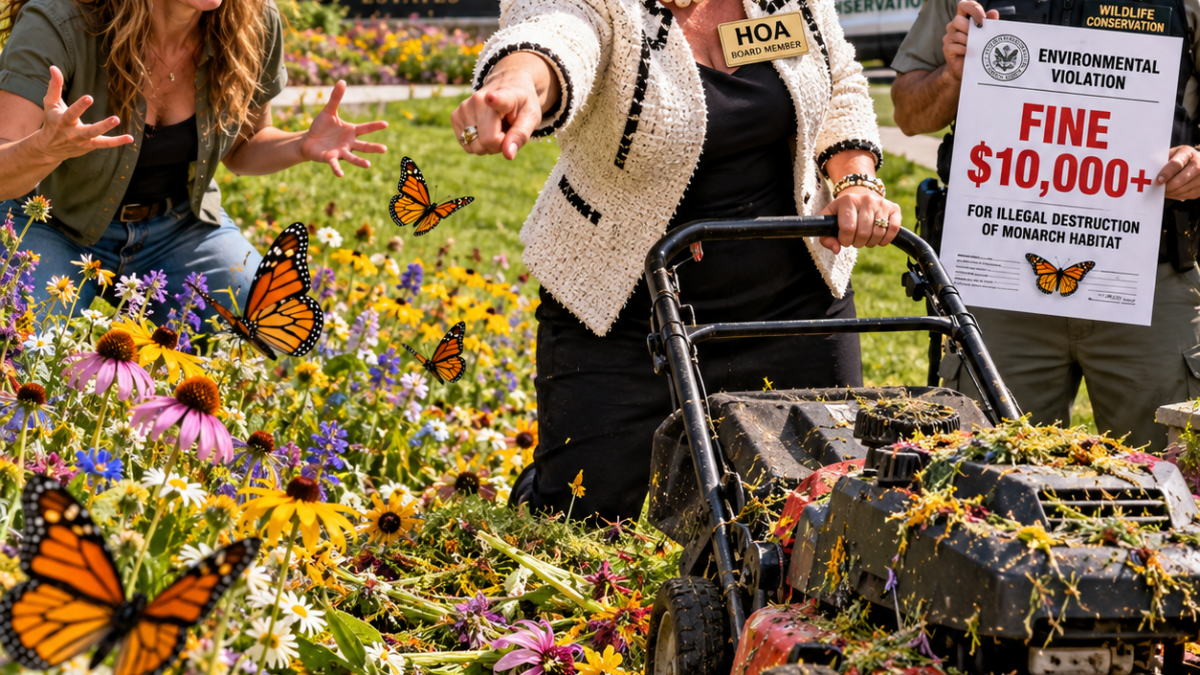
That morning, it looked as though someone had dragged a giant razor across the earth.
Almost everything had been cut down to three inches.
Tracks from commercial mowers ran through the soil.
Plants had been chopped, scattered, and crushed beneath heavy tires.
Near the far fence, a pile of shredded stalks had collected in a shallow ditch.
A monarch butterfly drifted across the field.
It circled twice.
Then it disappeared toward the trees.
That nearly broke me.
I began walking.
Patty stepped forward.
“There,” she said. “Much better.”
I looked at her.
Behind her stood two landscaping trucks marked GREENLINE PROPERTY SERVICES.
Three workers were loading equipment onto trailers.
One of them glanced at me, then quickly looked away.
“Who authorized this?”
Patty adjusted her sunglasses.
“The association handled it.”
“That’s not what I asked.”
“We gave you multiple notices.”
“Who authorized you to enter my property?”
Her confident expression flickered.
Only for a second.
Then it returned.
“You refused to maintain the property after being formally notified. Briarwood’s nuisance provisions allow the association to correct conditions that affect neighborhood property values.”
“My property isn’t in Briarwood.”
“It borders Briarwood.”
“That doesn’t make it yours.”
She shrugged.
“Take it up with the board.”
I walked toward the landscaping crew.
“Who’s the supervisor?”
A man in a neon-green shirt slowly raised his hand.
“Me.”
“What’s your name?”
“Carlos.”
“Carlos, did you know this was private property?”
He looked at Patty.
She interrupted.
“They were acting under HOA authorization.”
I kept my eyes on him.
“Did you verify who owned the land?”
He swallowed.
“We were told the HOA had authority.”
“By her?”
He hesitated.
Then nodded.
Patty snapped, “You don’t need to interrogate my contractor.”
That word almost made me laugh.
Her contractor.
On my land.
Destroying my meadow.
I took out my phone.
Patty folded her arms.
“Oh, please. Photograph whatever you want. Maybe now you’ll understand that people around here expect properties to be maintained.”
I photographed everything.
The mower tracks.
The cut milkweed.
The flattened flowers.
The trucks.
The license plates.
The workers.
The property markers.
Then I started recording video.
I slowly turned in a full circle while stating the date, time, location, and what I was seeing.
Patty gave an exaggerated sigh.
“You’re being dramatic.”
Maybe I was.
But my mother had taught me something useful during the final year of her life.
When you’re overwhelmed, document first and react later.
Cancer had forced our family to live inside paperwork—medical records, insurance forms, authorizations, appeals, treatment notes.
My mother used to say, “If somebody has power over you, keep receipts.”
So I kept receipts.
When I reached the western edge of the meadow, I stopped.
There was a small wooden stake beside a patch of crushed milkweed.
The stake had been painted orange at the top.
A metal tag was attached beneath it.
MONARCH MONITORING PLOT B-4.
The mower had passed directly over it.
The tag was bent nearly flat.
I crouched.
Beneath the shredded leaves, I found what I had been afraid I would find.
A monarch caterpillar.
Dead.
It was tiny.
No longer than my little finger.
I stared at it for several seconds.
Then I heard Patty behind me.
“For heaven’s sake, Daniel. It’s a bug.”
That was the moment my grief became something harder.
I stood.
“What did you just say?”
She gestured toward the field.
“You’re acting like we bulldozed a cemetery.”
I walked toward her slowly.
She stopped smiling.
“My mother planted this meadow.”
Patty rolled her eyes.
“I know. You’ve told everyone the sentimental story.”
“No, Patty. You don’t know anything about it.”
“I know it was overgrown.”
“It was registered habitat.”
That finally changed her expression.
Not much.
But enough.
“Registered with whom?”
I didn’t answer immediately.
Because I wasn’t completely sure yet how much legal protection the program created.
I knew the county had documentation.
I knew our conservation group had records.
I knew the property contained monitored monarch habitat.
But I wasn’t going to bluff.
So I said the only thing I knew with absolute certainty.
“You entered private property after I explicitly told you the HOA had no authority here. You hired contractors to destroy vegetation you didn’t own. Whatever happens next, that part is already true.”
Carlos stepped closer.
“Sir, I’m really sorry. We were given paperwork.”
“I want a copy.”
Patty cut in.
“No.”
Carlos looked uncomfortable.
I held out my hand.
“Carlos, you were brought onto private property under somebody else’s claimed authority. Right now, you should be thinking about protecting yourself.”
He looked from me to Patty.
Then he walked to his truck.
“Carlos!” Patty shouted.
He returned carrying a clipboard.
There was a work order clipped to the top.
He handed it to me.
Patty reached for it.
I stepped back.
The document listed the job as:
BRIARWOOD HOA NUISANCE ABATEMENT.
Property location: 417 Meadow Ridge Road.
My address.
Authorized by: Patricia Hargrove, Board President.
Under special instructions, somebody had typed:
OWNER NONCOMPLIANT. FULL CUT. REMOVE ALL WEEDS, INCLUDING MILKWEED. NO NEED TO CONTACT RESIDENT.
I read that sentence twice.
Then a third time.
“Remove all weeds, including milkweed.”
Patty must have noticed where I was looking.
She said quickly, “That’s standard terminology.”
“No, it isn’t.”
“You’re not a landscaper.”
“Neither are you.”
Carlos quietly said, “Actually, ma’am, we usually don’t get species-specific instructions unless the customer asks for them.”
Patty spun toward him.
“Whose side are you on?”
His face changed.
Not angrily.
Professionally.
“The side that doesn’t want to get sued.”
For the first time that morning, Patty looked worried.
I photographed every page of the work order.
Then I called the sheriff’s non-emergency line.
Patty laughed.
“You’re calling the police over grass?”
“No.”
I looked directly at her.
“I’m calling them because you trespassed onto my land and destroyed property after I told you not to.”
Her laugh disappeared.
The deputy arrived twenty-five minutes later.
His name was Mark Ellison, and he looked like a man who had hoped his morning would involve nothing more complicated than somebody’s loose dog.
He listened to Patty first.
I let him.
She spoke for nearly ten minutes about “community standards,” “nuisance conditions,” “property values,” and “board enforcement authority.”
Then Deputy Ellison asked one question.
“Is his parcel actually in your association?”
Patty hesitated.
“It affects our association.”
“That wasn’t my question.”
“Our attorney has discussed—”
“Ma’am, is this property legally part of your HOA?”
“No.”
The deputy looked at me.
“Did you give permission for the mowing?”
“No.”
“Did you tell her before today that the HOA had no authority on your property?”
“Yes.”
“I have the letters and emails.”
Patty immediately said, “This is a civil dispute.”
Deputy Ellison nodded.
“Most likely. But that doesn’t mean I’m not making an incident report.”
Her face tightened.
He photographed the property.
I showed him the work order.
When he reached the instruction about milkweed, his eyebrows rose.
“That specific plant important?”
“Yes.”
“How important?”
“I’m about to find out.”
After he left, Patty walked toward her SUV.
She had almost reached the door when I called her name.
She turned.
“I want you to remember something.”
She stared at me.
“You could have knocked on my door.”
Her lips parted, but I kept going.
“You could have called. You could have asked one question. You could have listened when I told you this wasn’t HOA property. Instead, you decided that because you didn’t like how my land looked, you had the right to destroy it.”
“It’ll grow back.”
I felt something twist inside my chest.
Some of it would.
Some of it wouldn’t.
And even if every flower returned tomorrow, that still wouldn’t make what she had done acceptable.
“You’d better hope that’s all this costs you,” I said.
Then I walked away.
I didn’t threaten her.
I didn’t yell.
I didn’t touch her car.
I didn’t post her name online.
I went inside, sat at my kitchen table, and started making phone calls.
The first call was to Dr. Elise Warren.
Elise was an ecologist who worked with the county pollinator initiative and had visited my property at least a dozen times.
She answered on the fourth ring.
“Daniel?”
“Elise, I need you to come out here.”
Something in my voice must have scared her.
“What happened?”
“They mowed the meadow.”
Silence.
Then, very quietly, “How much?”
“Almost all of it.”
“Who?”
“The HOA.”
Another silence.
“What?”
“They hired landscapers.”
“Daniel, don’t touch anything.”
“I wasn’t planning to.”
“No clearing. No reseeding. No moving debris unless we document it first. I’m coming.”
She arrived forty minutes later with another biologist named Aaron Kim and enough equipment to make the front of my property look like a small research station.
Elise walked into the meadow.
She didn’t speak for several minutes.
That worried me more than anger would have.
She crouched beside the destroyed monitoring plot.
Aaron began taking GPS points.
Finally she turned.
“Did they mow the southern strip too?”
“Yes.”
“All of it?”
“I think so.”
She closed her eyes.
“What?”
“There were nine confirmed monarch larvae in that section three days ago.”
My stomach dropped.
“Nine?”
“Maybe more by now.”
I looked toward the flattened milkweed.
“Are they protected?”
Elise chose her words carefully.
“The monarch’s regulatory status has changed over time, and the rules can depend on the program, the property agreement, and what funding or habitat protections are attached. I’m not going to give you legal advice standing in a field.”
“Okay.”
“But your meadow is enrolled in a county conservation incentive program, part of it is under a habitat-restoration agreement, and we have documented monitoring plots here. Deliberately destroying enrolled habitat after entering private property without permission is not something an HOA gets to wave away as lawn maintenance.”
That was the first time all day I felt my breathing slow.
Not because I wanted money.
At that point, money was almost irrelevant.
I wanted somebody with authority to say the obvious thing.
They had no right.
Elise spent four hours documenting the damage.
She counted destroyed milkweed stands.
Photographed crushed monitoring markers.
Collected fragments.
Mapped the mower paths.
Recorded native species that had been cut before seed production.
She found three dead monarch caterpillars.
We found two more later.
Each one felt like another insult.
Around three that afternoon, she called a county conservation officer.
By five, the officer had been joined by someone from the state environmental field office.
That was when Patty came back.
I saw her white SUV stop along the road.
She got out and stared at the government vehicles parked in my driveway.
Then she walked toward us.
“What is going on?”
The state officer turned.
He was a compact man in his fifties named Raymond Cole.
“Can I help you?”
“I’m Patricia Hargrove. President of Briarwood Estates.”
His eyes flicked toward me.
Then back to her.
“Were you involved in the vegetation removal here?”
Patty immediately became cautious.
“The association addressed a nuisance condition.”
“Did you authorize the contractor?”
“I’d need to review the paperwork.”
I almost admired the speed of that transformation.
At eight that morning, she had been proud of what she had done.
By five, she couldn’t remember authorizing it.
Carlos’s work order was sitting inside a clear evidence sleeve on the folding table behind us.
Officer Cole picked it up.
“This paperwork has your name.”
She stared at it.
“That may have been generated by our management company.”
“Did you sign the service approval?”
“I sign many documents.”
“Is that your signature?”
Patty looked at the bottom of the page.
Nobody said anything.
“Yes.”
“Did you instruct them to remove milkweed?”
“I’m not a botanist.”
“That wasn’t my question.”
Her cheeks turned pink.
“I told them to mow the property.”
“Did you know you didn’t own it?”
“It borders our community.”
Again, that sentence.
As if proximity created ownership.
Officer Cole’s expression did not change.
“I’m going to need your contact information.”
Patty looked at me.
And for the first time since I had met her, there was no superiority in her face.
There was fear.
Small.
Controlled.
But unmistakable.
“This is ridiculous,” she said.
Nobody answered.
She left ten minutes later.
By the next morning, my phone was ringing constantly.
Some calls came from neighbors.
Some came from county employees.
One came from GreenLine Property Services’ insurance carrier.
Then, at eleven seventeen, an attorney named Melissa Grant called.
“I represent the Briarwood Estates Homeowners Association,” she said.
I leaned against the kitchen counter.
“All right.”
“I understand there was an unfortunate landscaping incident yesterday.”
I almost laughed.
“Is that what we’re calling it?”
“I’m not minimizing your concerns, Mr. Mercer.”
“You just called unauthorized entry onto my property and destruction of three acres an unfortunate landscaping incident.”
She paused.
“Fair point.”
That surprised me.
She continued.
“I’m trying to establish facts before this becomes more adversarial than necessary.”
“It became adversarial when your president ordered contractors onto my property.”
“I understand your position.”
“No. You understand the sentence. I’m not sure you understand the position yet.”
Another pause.
Then she asked, “Do you have legal representation?”
“Not yet.”
“I would recommend that you obtain it before further discussions.”
That surprised me even more.
Lawyers normally didn’t tell the other side to get a lawyer unless they understood the situation was serious.
“Thank you,” I said.
“I also need to ask that you preserve all correspondence with the association.”
“I already have.”
“And any photographs or habitat documentation.”
“I have years of it.”
This time her pause lasted longer.
“How many years?”
“Four years of formal monitoring. More informal records before that.”
“I see.”
I could practically hear the legal problem getting larger on her end of the phone.
She ended the call politely.
Twenty minutes later, I called the attorney who had handled my mother’s estate.
His name was Samuel Pike.
Sam was seventy-one years old, wore bow ties without irony, and had a reputation for speaking softly right before somebody received very bad news.
I explained everything.
He listened without interrupting.
When I finished, he asked, “Do you still have the first HOA notice?”
“Yes.”
“The one you responded to in writing?”
“Yes.”
“And in that response, you told them explicitly that your parcel was not subject to their covenants?”
“Yes.”
“Did they acknowledge receiving it?”
“I got an email from the management company saying the matter had been forwarded to the board.”
“Excellent.”
“Why excellent?”
“Because stupidity is harder to prove when people can claim ignorance.”
I sat down.
“What are we looking at?”
“Potentially trespass. Property damage. Restoration costs. Possibly conversion depending on what was removed. Maybe statutory issues connected to the habitat program. The contractors have their own exposure, though their reliance on the HOA’s representation may matter. We’ll also examine whether Mrs. Hargrove acted within her authority.”
“And if she didn’t?”
Sam made a quiet sound that was almost a chuckle.
“Then she may discover why corporate protections are not magical force fields.”
That evening, he sent a preservation letter to the HOA.
No records were to be deleted.
No emails destroyed.
No texts erased.
No board minutes modified.
No invoices discarded.
No landscaping instructions changed.
He sent one to GreenLine too.
Then we waited.
For exactly thirty-six hours.
On Friday morning, Sam called.
“You should sit down.”
“I am sitting down.”
“The HOA’s insurer contacted me.”
“That fast?”
“They’re nervous.”
“How nervous?”
“Enough that they’ve appointed outside counsel.”
I looked through my kitchen window toward the ruined meadow.
“What happens now?”
“Now we find out what they knew.”
What they knew turned out to be worse than I expected.
Much worse.
The first discovery came from an HOA board member named Robert Mills.
Robert lived three streets inside Briarwood and had served as treasurer for two years.
I barely knew him.
The Sunday after the mowing, he knocked on my door.
He looked exhausted.
“Can we talk?”
I invited him inside.
He refused coffee.
Refused water.
He just sat at my table with both hands folded.
“I need to tell you something before Patty changes the story.”
I started recording only after asking his permission.
He nodded.
Then he said, “The board never voted to mow your property.”
I stared at him.
“What?”
“She told the landscaping company we approved nuisance abatement.”
“Did you?”
“No.”
“Was it discussed?”
“Yes.”
“When?”
“April seventeenth.”
That was five days after Patty visited my driveway.
“What happened?”
Robert rubbed both hands over his face.
“She brought up your meadow. Said residents had complained. She wanted the association attorney to send an enforcement letter.”
“And?”
“I told her your parcel wasn’t in the HOA.”
That landed hard.
“You told her?”
“So did Janet.”
“Janet?”
“Janet Lawson. Board secretary. She pulled the parcel map during the meeting and put it on the screen. Your property is outside our boundary.”
My anger came back.
Cold again.
“Then how did GreenLine get authorization?”
Robert looked miserable.
“Patty contacted them herself.”
“Using HOA money?”
“Yes.”
“How much?”
“Eight hundred and forty dollars.”
For some reason, that number almost made the whole thing more insulting.
Three acres of habitat.
Years of work.
My mother’s meadow.
Destroyed for $840.
“Why are you telling me this?”
Robert looked toward the window.
“Because she’s now telling residents the entire board approved it.”
“Did she put that in writing?”
“She sent an email Friday.”
“Do you have it?”
He took out his phone.
“I printed it too.”
The email said:
As many of you are aware, the Board previously authorized corrective landscaping at the Mercer parcel due to long-standing vegetation complaints. Unfortunately, Mr. Mercer has chosen to escalate what should have been a routine maintenance matter.
I read it twice.
Then handed the phone back.
“Robert, I need you to send this to my attorney.”
“I already did.”
That made me look up.
He swallowed.
“I’m resigning from the board tomorrow.”
“Because of this?”
“Because this isn’t the first time she’s done something without a vote. It’s just the first time I realized how far she’d go.”
The story spread through Briarwood faster than any official notice could contain it.
By Monday, residents were arguing in the neighborhood Facebook group.
Some defended Patty.
They called my meadow “an overgrown field.”
They said I should have mowed it myself.
They asked why butterflies mattered more than property values.
Others posted photographs from previous summers showing monarchs, swallowtails, bees, and goldfinches in the flowers.
One mother posted a picture of her daughter standing beside my mother’s old milkweed patch during the school science visit.
Her caption read:
THIS IS THE “WEED FIELD” THEY DESTROYED.
I didn’t comment.
Sam told me not to.
“Your strongest position,” he said, “is being the person who documents while everyone else talks.”
So I documented.
Two weeks after the mowing, the first official findings arrived.
The county determined that approximately 2.7 acres of enrolled pollinator habitat had been significantly damaged.
The state identified destruction within active monitoring plots and initiated an enforcement review connected to restoration obligations.
The habitat program itself carried financial consequences because grant-supported plantings and conservation commitments had been damaged before the end of the required maintenance period.
But the biggest number didn’t come from a fine.
It came from restoration.
Elise and two other ecologists prepared an assessment.
Reestablishing the meadow was not as simple as scattering a bag of flower seeds.
The soil had been compacted in several areas.
Some invasive plants were likely to take advantage of the disturbance.
Milkweed colonies would need to be restored.
Native seed would need to be sourced regionally.
The site would require monitoring for multiple growing seasons.
Temporary fencing would be necessary in sensitive plots.
Professional labor would be required.
Estimated restoration and monitoring cost:
$38,600.
I stared at the number.
Sam looked at me.
“Surprised?”
“I thought maybe ten.”
“Ecological restoration is expensive.”
“Will it actually cost that much?”
“If you want it restored correctly.”
“I do.”
“Then that’s the number.”
A week later, state and county penalties connected to the unauthorized destruction and violations of the conservation-program terms added several thousand dollars more.
The exact allocation became complicated because the landowner—that was me—had not caused the damage.
The agencies weren’t trying to punish me.
They were identifying the responsible parties.
GreenLine’s insurer quickly changed strategy.
They offered full cooperation.
Carlos gave a written statement.
So did two crew members.
They produced text messages from Patty.
And those text messages were devastating.
One read:
MAKE SURE YOU CUT THE MILKWEED PATCHES. HE CLAIMS THEY’RE FOR BUTTERFLIES AND USES THAT AS AN EXCUSE NOT TO MAINTAIN IT.
Another said:
DO IT EARLY THURSDAY BEFORE HE CAN INTERFERE.
I read that message three times in Sam’s office.
“Before I could interfere.”
Sam nodded.
“She knew you would object.”
“She knew.”
“Yes.”
“She knew it was my property.”
“That appears increasingly difficult for her to deny.”
Something inside me finally settled.
For weeks, part of me had wondered if maybe this was just arrogance spiraling into incompetence.
Maybe Patty genuinely believed some old easement gave her authority.
Maybe she misunderstood.
Maybe she had simply made a catastrophic mistake.
Those messages ended that possibility.
She knew I didn’t consent.
She knew I considered the milkweed intentional.
And she specifically arranged the mowing early enough to reduce the chance that I would stop it.
That wasn’t confusion.
That was a decision.
Sam leaned back.
“I’m going to ask you something important.”
“Okay.”
“Do you want revenge, or do you want a remedy?”
I looked at him.
“Aren’t they the same thing right now?”
“No.”
He removed his glasses.
“Revenge makes people careless. Remedy makes them patient.”
I thought about my mother.
About the little bent monitoring stake.
About Patty calling a monarch caterpillar “a bug.”
“I want the meadow back.”
“You can’t get the exact meadow back immediately.”
“I know.”
“What else?”
“I want her to never do this to somebody again.”
“That,” Sam said, “we may be able to work with.”
The HOA called an emergency meeting.
I wasn’t invited.
But nearly every homeowner in Briarwood was.
Three people sent me recordings afterward.
Patty stood at the front of the clubhouse and insisted she had acted “in good faith.”
According to her, my meadow had created “a legitimate community concern.”
She claimed she believed the HOA had “nuisance-remediation authority” over bordering parcels.
Then Janet Lawson, the board secretary, stood up.
“Patty, that isn’t true.”
The room went silent.
Patty stared at her.
Janet continued.
“We showed you the boundary map.”
“I don’t recall that.”
“I have the minutes.”
“The minutes may not reflect the full discussion.”
“I wrote the minutes.”
Several people laughed.
Patty’s face flushed.
Then Robert, who had already resigned, spoke from the back of the room.
“You were told not to proceed without legal review.”
Patty pointed toward him.
“You resigned. You no longer speak for this board.”
“I’m speaking as a homeowner whose dues paid for your mistake.”
Applause broke out.
That was when Melissa Grant, the HOA attorney, stood.
According to the recordings, her statement lasted less than a minute.
“For legal reasons, I strongly advise everyone present, including board members, not to make further factual representations about pending litigation.”
Patty snapped, “There is no litigation yet.”
Melissa looked directly at her.
“There will be.”
The room went dead quiet.
I listened to that recording alone in my kitchen.
For the first time since the meadow was destroyed, I smiled.
Not because Patty was frightened.
Because somebody had finally told her, publicly and without ambiguity, that her title did not place her above consequences.
The lawsuit was filed three weeks later.
We named the HOA.
We named GreenLine, though their insurer was already negotiating.
And based on the evidence of independent conduct, Sam named Patricia Hargrove individually.
That last part sent Briarwood into chaos.
Patty had apparently been telling everyone the HOA insurance policy would handle everything.
Then she learned that an insurer can reserve rights or deny coverage for certain intentional conduct.
Her lawyer called Sam almost immediately.
They wanted her removed individually from the case.
Sam declined.
They offered an apology.
Not publicly.
Not directly from Patty.
A written statement drafted by counsel.
Sam showed it to me.
I read the first sentence:
Ms. Hargrove regrets that the landscaping activity resulted in unintended distress to Mr. Mercer.
I handed it back.
“No.”
Sam smiled faintly.
“I assumed.”
“Unintended distress?”
“Lawyers enjoy passive constructions.”
“She intentionally had it mowed.”
“Yes.”
“Then she can intentionally apologize.”
The next offer included money.
Twenty thousand dollars, with confidentiality.
“No.”
Thirty-five thousand.
“No.”
Forty-five.
“No.”
Sam finally asked, “Daniel, what number are you looking for?”
“It’s not just a number.”
“I know.”
“I want complete restoration funded.”
“Reasonable.”
“I want monitoring funded for five years.”
“Potentially reasonable.”
“I want reimbursement for my legal fees.”
“We’ll pursue it.”
“I want the HOA to formally acknowledge in writing that my property is not subject to its covenants.”
“That should be easy.”
“And I want Patty to admit she authorized the mowing without board approval.”
Sam studied me.
“That may be the hardest term.”
“Then it matters most.”
The case moved toward depositions.
That was when things became ugly.
Patty’s attorney began challenging the meadow’s value.
They questioned whether every native plant had been intentionally cultivated.
They asked whether I could prove individual monarch caterpillars had been present before mowing.
They wanted records of every dollar I had spent on habitat work.
They implied I had allowed the meadow to become unsightly and was now using conservation as leverage.
I expected legal strategy.
I didn’t expect how personal it would feel.
One afternoon, after six hours of reviewing photographs and documents, I drove home and parked beside the meadow.
New growth had begun.
Tiny green shoots pushed through the cut stems.
Some black-eyed Susans were trying to bloom again.
But the field looked wrong.
Too short.
Too open.
Too wounded.
I walked to the place where my mother and I used to sit.
There had once been a wooden bench there.
It had rotted years earlier, but two stones still marked the spot where its legs had rested.
I sat in the grass.
For the first time since the mowing, I cried.
Not dramatically.
Not loudly.
I just sat there with my hands over my face and let six years of grief come back.
Losing the meadow had reopened losing her.
That was the part no damage estimate could calculate.
My mother had been fifty-nine when she died.
During her final summer, she had become too weak to walk across the field.
I would push her halfway down the path, and she would complain that I was going too fast even when I was barely moving.
One afternoon, a monarch landed on her shoulder.
She froze.
I remember laughing because she whispered, “Don’t breathe.”
“You have to breathe, Mom.”
“Not until it leaves.”
The butterfly stayed for maybe ten seconds.
She talked about those ten seconds for a week.
Three days before she entered hospice, she asked me whether the milkweed would survive without her.
I told her yes.
At the time, I thought she was asking about plants.
Years later, I understood she was asking a different question.
Would the things she loved continue after she was gone?
I had promised they would.
And Patty had reduced that promise to shredded stalks because she preferred short grass.
I don’t know how long I sat there.
Eventually, I heard footsteps.
It was Elise.
She was carrying a clipboard.
She stopped when she saw me.
“Bad time?”
“No.”
She sat a few feet away.
For a while, neither of us spoke.
Then she pointed toward a small patch near my boot.
“See that?”
I looked.
A milkweed shoot was pushing upward.
Maybe four inches tall.
“I see it.”
“Common milkweed spreads underground.”
“I know.”
“No, I mean really think about that.”
I looked at her.
“You can cut everything you see above the surface and still not kill the whole colony.”
I stared at the little green shoot.
Elise smiled.
“Plants are stubborn.”
That became my anchor.
The meadow wasn’t gone.
It was hurt.
There was a difference.
Restoration began before the lawsuit ended.
GreenLine’s insurer agreed to advance part of the cost without admitting final liability.
Carlos came personally on the first day.
He stood beside his truck looking embarrassed.
“I almost didn’t come.”
“Why did you?”
“Because my crew did the damage.”
“You were lied to.”
“I still drove the mower.”
I appreciated that.
He looked across the field.
“I’ve done landscaping twenty-two years. Never thought I’d be learning how to put weeds back.”
“They’re not weeds.”
He smiled.
“Yeah. I know that now.”
Under Elise’s direction, we loosened compacted areas and installed temporary markers around surviving milkweed.
Volunteers from the conservation group came on weekends.
Then something happened I hadn’t expected.
Briarwood residents started coming too.
At first, it was three people.
Then eight.
Then twenty.
Janet came with her husband.
Robert brought his teenage son.
The mother whose daughter had visited during the school science trip arrived carrying gloves, water, and enough sandwiches for everyone.
People who had never spoken to me spent their Saturday planting native plugs in the meadow their HOA president had ordered destroyed.
One elderly man named Frank knelt beside me while planting asters.
“I voted for Patty.”
I glanced at him.
“Okay.”
“I thought she’d keep dues under control.”
“That go well?”
He laughed.
“Apparently I funded a butterfly lawsuit.”
I laughed too.
It was the first time the situation had genuinely felt funny.
By late afternoon, nearly fifty residents had signed a letter demanding Patty resign.
She refused.
Instead, she sent a neighborhood email accusing “a vocal minority” of exploiting the incident to undermine elected leadership.
That email might have been the single worst political decision she made.
Because homeowners who had been neutral became furious.
The petition for recall reached the required threshold in forty-eight hours.
Patty tried to stop the vote.
She argued the signatures were invalid.
She accused Robert of organizing a personal vendetta.
She claimed my lawsuit had “contaminated community opinion.”
Then somebody leaked the GreenLine text messages.
Not me.
Not Sam.
To this day, I don’t know who did it.
But once Briarwood residents saw:
DO IT EARLY THURSDAY BEFORE HE CAN INTERFERE
the debate ended.
The recall meeting took place on a rainy Tuesday evening.
I didn’t attend.
It wasn’t my HOA.
I stayed home.
At 8:43 p.m., my phone buzzed.
It was Robert.
She’s out.
The vote wasn’t close.
Seventy-eight percent voted to remove her.
Two other board members resigned the same night.
Janet was elected interim president.
Her first official action was to suspend all “external nuisance enforcement” until legal counsel reviewed the association’s authority.
Her second was to send me a letter.
Not an email.
A paper letter.
It said:
Mr. Mercer,
On behalf of the Briarwood Estates Homeowners Association, the current Board acknowledges that your property at 417 Meadow Ridge Road is not and has never been subject to the Briarwood declaration or architectural rules.
The Board further acknowledges that landscaping work authorized on your parcel was undertaken without lawful authority from the Association.
We sincerely regret the damage caused to your property and the distress caused to you and your family’s legacy.
I read the last line three times.
Your family’s legacy.
They understood.
Or at least someone did.
I put the letter in the same drawer where I kept my mother’s old photographs.
The legal case still wasn’t over.
In fact, the most dramatic part was about to begin.
Patty’s deposition was scheduled for September.
By then, five months had passed since the mowing.
The meadow was recovering.
Not completely.
But enough that late-blooming asters had returned.
Monarchs appeared again during migration.
The first one I saw that fall landed on a milkweed leaf beside monitoring plot B-4.
I photographed it and sent the picture to Elise.
Her reply was one sentence.
Told you they were stubborn.
Patty’s deposition lasted nearly seven hours.
I wasn’t required to sit in for all of it, but I attended.
She wore a navy suit and pearls.
Her attorney sat beside her.
Sam sat across the table.
A court reporter occupied the end.
At first, Patty was composed.
She answered cautiously.
She didn’t remember specific conversations.
She didn’t recall exact dates.
She couldn’t remember whether she had seen the parcel map.
She wasn’t sure who had used the phrase “nuisance abatement.”
She couldn’t remember why the work order specifically mentioned milkweed.
Sam let her do that for almost an hour.
Then he began laying documents in front of her.
“Mrs. Hargrove, I’m showing you Exhibit 14. Do you recognize this email?”
“Yes.”
“You sent it?”
“Yes.”
“Please read the highlighted sentence.”
Her jaw tightened.
She read:
“Daniel Mercer has again refused to address his weed field despite repeated warnings.”
Sam nodded.
“This was sent after Mr. Mercer informed you in writing that his parcel was outside the HOA?”
“I don’t recall the timing.”
Sam placed another document down.
“Exhibit 15 is Mr. Mercer’s email dated April tenth. Exhibit 14 is yours dated April eleventh. Would you like to revise your answer?”
She stared at the dates.
“No.”
“No, you don’t want to revise?”
“I received his message.”
“So you knew his position before writing this?”
“I knew his position.”
“Did you believe his position was wrong?”
“Yes.”
“Based on what legal document?”
Her attorney objected.
Sam waited.
The objection went on the record.
Patty eventually answered.
“I believed the board had authority over nuisance conditions affecting Briarwood.”
“Who told you that?”
“I don’t recall.”
“Was it your attorney?”
“I don’t recall.”
“Was it another board member?”
“I don’t recall.”
“Did you read it in the covenants?”
“I don’t recall the exact provision.”
Sam opened a thick binder.
“I have the covenants here. Please identify the provision.”
Her attorney objected again.
Patty didn’t touch the binder.
Sam moved on.
“Did Mr. Mills tell you the Mercer parcel was outside the association?”
“I don’t remember.”
“Did Ms. Lawson display the county parcel map during the April seventeenth meeting?”
“I don’t remember.”
“Did you request a board vote to authorize mowing?”
“I believed one wasn’t necessary.”
“That wasn’t my question.”
Patty looked at him.
“No.”
“Did the board vote?”
“No.”
“Did you tell GreenLine the board had authorized the work?”
Silence.
Her attorney leaned close and whispered something.
Patty answered.
“I may have used general language regarding association authorization.”
Sam slid the work order toward her.
“The work order says ‘HOA-authorized nuisance abatement.’ Is that the general language you mean?”
She didn’t answer immediately.
“Yes.”
“Who authorized it?”
“I did.”
“Personally?”
“As president.”
“Without a board vote?”
“I believed I had authority.”
“Mrs. Hargrove, did you send this text to GreenLine?”
He placed the printout in front of her.
She looked down.
DO IT EARLY THURSDAY BEFORE HE CAN INTERFERE.
Her shoulders stiffened.
“Yes.”
“Why did you want the work performed before Mr. Mercer could interfere?”
“I meant before he could create a scene.”
“On his property?”
She looked up.
Sam continued.
“You knew he would object?”
“Yes.”
“You knew he had expressly refused permission?”
“He had refused to mow.”
“That wasn’t my question.”
Her attorney interrupted.
Sam waited.
Then repeated it.
“You knew he had not given permission for your contractor to enter his property?”
Patty’s face had turned red.
“Yes.”
The room felt different after that.
Her lawyer knew it.
I knew it.
Sam knew it.
The court reporter kept typing.
Sam asked one final series of questions.
“You understood that Mr. Mercer intentionally maintained milkweed?”
“Yes.”
“You understood he associated that milkweed with monarch butterflies?”
“Yes.”
“You nevertheless instructed GreenLine to cut the milkweed?”
“I instructed them to mow the field.”
“The text says, ‘Make sure you cut the milkweed patches.’ Did you write that?”
“Yes.”
“Why?”
Patty exhaled sharply.
“Because he was using butterflies as an excuse.”
“An excuse for what?”
“For refusing to maintain the property.”
Sam leaned forward slightly.
“Mrs. Hargrove, do you believe land you do not own must be maintained according to your personal preferences?”
Her attorney objected.
Patty answered anyway.
“If it affects everyone else, yes.”
Sam sat back.
“That’s all I have for now.”
Outside the conference room, I stood beside the elevator with Sam.
Neither of us spoke until the doors opened.
Then I asked, “Was that as bad for her as it felt?”
Sam stepped inside.
“Worse.”
Settlement negotiations became serious the following week.
GreenLine settled first.
Their insurer funded a substantial portion of restoration and monitoring costs. In exchange, the company received a release from further civil claims after completing agreed remediation support.
Carlos later told me the company changed its policies.
No crew would enter disputed property based solely on an HOA work order anymore.
They required ownership verification or written owner consent when boundaries were questionable.
That mattered to me.
A mistake that changes future behavior has at least produced something useful.
The HOA settlement took longer.
Briarwood’s insurer agreed to cover much of the property damage and legal expense, but disputed certain costs tied to Patty’s unauthorized actions.
The new board wanted the case finished.
So did I.
But Patty continued resisting the personal-liability portion.
Her attorney called our demands punitive.
Sam responded that knowingly ordering work on somebody else’s land after being told not to was exactly the kind of conduct that created personal exposure.
Eventually, mediation was scheduled.
It took place in November.
By then, the meadow had entered dormancy.
Brown stems stood where flowers had bloomed.
Milkweed pods had opened along the southern slope, sending white seeds into the cold air.
I carried one pod with me to mediation.
Not intentionally.
I had picked it up that morning and left it in my coat pocket.
The mediator was a retired judge named Helen Burke.
She spent the morning moving between conference rooms.
Offers went back and forth.
Money.
Language.
Liability.
Confidentiality.
Restoration.
At noon, Patty’s side offered a settlement that would have paid everything I had spent, funded restoration, and put a modest additional amount in my pocket.
But it required confidentiality.
And Patty would make no admission.
I said no.
Judge Burke studied me.
“Mr. Mercer, you understand this is financially favorable?”
“Yes.”
“What are you trying to achieve that this doesn’t give you?”
I reached into my coat pocket.
My fingers touched the dry milkweed pod.
“I want the record to say what happened.”
“Why?”
“Because she spent months telling people this was a misunderstanding.”
Judge Burke waited.
“It wasn’t.”
I continued.
“She knew it wasn’t her property. She knew I objected. She did it early so I couldn’t stop her. Then she lied and said the board approved it.”
The judge nodded.
“I understand why you’re angry.”
“This isn’t about being angry.”
That surprised even me.
But once I said it, I realized it was true.
“I was angry. I’m still angry. But the meadow is coming back. What I care about now is that when this ends, she doesn’t get to rewrite what happened.”
Judge Burke left.
Two hours later, she returned with a new proposal.
The settlement would not be confidential as to basic terms.
The HOA would fund the remaining restoration and five years of ecological monitoring.
My legal fees would be reimbursed according to the negotiated amount.
The association would permanently record that my parcel was outside its jurisdiction.
It would adopt new procedures requiring board votes and legal review before any nuisance action involving non-HOA property.
Patty would personally contribute toward the settlement.
The regulatory fines and program-related penalties assessed to the responsible parties totaled several thousand dollars, separate from the much larger restoration and civil costs.
And Patty would sign a factual acknowledgment.
Not an apology drafted entirely in soft language.
An acknowledgment.
The proposed statement said:
I, Patricia Hargrove, acknowledge that I authorized landscaping work at 417 Meadow Ridge Road despite knowing that the parcel was not owned by the Briarwood Estates Homeowners Association and despite knowing that Daniel Mercer had not consented to the work. The Briarwood Board did not vote to authorize the mowing. I further acknowledge that I specifically instructed the contractor to cut milkweed present on the property.
I read it.
Then read it again.
Sam watched me.
“What do you think?”
“One change.”
He raised an eyebrow.
I pointed to the page.
“Add that the meadow was established monarch and pollinator habitat.”
The mediator carried the request back.
Patty refused.
We waited another forty minutes.
Then she agreed.
At 6:17 p.m., we signed.
I thought I would feel victorious.
I didn’t.
Mostly, I felt tired.
Patty left through another exit.
I never saw her.
Sam shook my hand in the parking lot.
“Congratulations.”
“Doesn’t feel like winning.”
“The good settlements usually don’t.”
“What are they supposed to feel like?”
“An ending.”
But it wasn’t quite the ending.
Not yet.
Winter passed.
The first restoration season began in March.
By April, milkweed shoots were appearing everywhere.
More than we expected.
Elise laughed when she saw them.
“You couldn’t kill this colony if you tried.”
“Somebody did try.”
“Fair point.”
Coneflowers returned more slowly.
We reseeded sections with native mixes.
The county installed updated educational signs near the monitoring plots.
One sign explained monarch migration.
Another identified milkweed as the host plant monarch caterpillars depend on.
I requested one additional sign.
It was small.
Nothing dramatic.
It read:
MARGARET MERCER MEMORIAL MEADOW
RESTORED 2027
NATIVE HABITAT FOR MONARCHS, POLLINATORS, AND PEOPLE WHO STILL BELIEVE WILD THINGS DESERVE ROOM TO GROW
The conservation group paid for it before I could.
In June, Briarwood’s new board asked if residents could help with a restoration day.
I said yes.
More than sixty people came.
Children planted flowers.
Teenagers hauled mulch.
Adults removed invasive plants.
Carlos and two employees from GreenLine volunteered too.
Even Deputy Ellison stopped by for twenty minutes while off duty.
He stood beside the memorial sign.
“So this is the famous grass.”
I laughed.
“Careful.”
“Sorry. Famous legally significant vegetation.”
“Better.”
The meadow looked beautiful by late July.
Not the same.
That distinction mattered.
People kept saying, “It’s like nothing ever happened.”
I always corrected them.
Something did happen.
The meadow had changed.
So had I.
So had Briarwood.
Pretending damage never occurred isn’t healing.
Healing is when the damage remains part of the story without remaining the end of the story.
That August, I was walking the southern path when I saw a woman standing near the edge of my property.
For one second, I thought it was Patty.
My body tightened automatically.
But it was Janet.
She waved.
“Can I come in?”
“Sure.”
She walked toward me carrying an envelope.
“What’s this?”
“Final reimbursement from the association.”
“You could have mailed it.”
“I wanted to see the meadow.”
We walked together.
She stopped beside a cluster of blooming milkweed.
“There are butterflies everywhere.”
“Good year.”
She watched one monarch move between flowers.
Then she said, “I owe you an apology too.”
“You didn’t mow it.”
“No. But I was on the board. I knew Patty was getting out of control before this happened, and I kept telling myself somebody else would deal with it.”
I didn’t know what to say.
She continued.
“People like Patty don’t become powerful just because they’re aggressive. They become powerful because everyone else gets tired of arguing.”
That stayed with me.
Before leaving, Janet told me Patty had sold her house.
“Where’d she move?”
“No idea.”
I realized I didn’t care.
That surprised me.
For months, the thought of Patty facing consequences had occupied more space in my mind than I wanted to admit.
Now she was simply gone.
The meadow remained.
That felt appropriate.
The following September brought the moment I had secretly been waiting for.
I was inspecting milkweed near monitoring plot B-4 when I saw a monarch caterpillar.
Fat.
Striped.
Very much alive.
I crouched beside it.
Then I called Elise.
“You busy?”
“Always.”
“I found one.”
“One what?”
“You know what.”
She went quiet.
“B-4?”
“B-4.”
“I’m coming.”
While I waited, I sat in the grass.
The caterpillar kept eating.
Completely unaware of property lines.
HOA boards.
Attorneys.
Depositions.
Settlement agreements.
It just ate.
A monarch passed overhead.
Then another.
I looked toward my mother’s memorial sign.
For some reason, I thought about the last question she asked me before hospice.
Will the milkweed survive without me?
Back then I had promised yes because I wanted to comfort her.
Now I finally understood the answer.
It survives because somebody chooses to protect it.
Not once.
Over and over.
That’s what preservation is.
It isn’t putting a fence around something and assuming nobody will ever challenge it.
It’s being willing to stand between what matters and the people who think their preferences give them ownership over everything they can see.
Patty thought she was mowing weeds.
That was the arrogance at the center of the whole disaster.
She looked at something she didn’t understand and assumed it had no value.
She looked at private land and assumed proximity gave her authority.
She looked at my silence and assumed it meant weakness.
She was wrong three times.
And each mistake became expensive.
The government penalties alone cost the responsible parties thousands.
The restoration cost tens of thousands more.
Add legal expenses, insurance consequences, Patty’s personal contribution, the recall, and the sale of her home, and that one morning with a mower cost far more than she could have imagined when she stood beside the road smiling at me.
But that still isn’t the part I remember most.
I remember the first restoration day.
I remember neighbors kneeling in the soil.
I remember Carlos planting milkweed where his crew had cut it.
I remember children chasing butterflies between flowers their parents had helped restore.
I remember watching Briarwood residents turn against a culture where one person’s idea of “tidy” mattered more than someone else’s rights.
Most of all, I remember that tiny green milkweed shoot pushing through the soil while I sat grieving beside my mother’s meadow.
You can cut down everything visible.
You can leave tracks across the earth.
You can convince yourself that because something looks destroyed, you’ve won.
But sometimes the roots are deeper than you know.
Two years after the mowing, the meadow produced more monarch caterpillars than we had recorded in any previous season.
Elise blamed improved monitoring.
I preferred another explanation.
“Spite,” I told her.
She laughed.
“You think the butterflies are spiteful?”
“No.”
I looked over the meadow.
“I think the meadow is.”
Every summer since then, I leave one section beside the road especially tall.
Goldenrod.
Asters.
Milkweed.
Coneflowers.
Black-eyed Susans.
Anybody driving into Briarwood has to pass it.
The HOA has never sent another letter.
In fact, the association eventually installed a small pollinator garden beside its entrance sign.
The first time I saw it, I pulled over.
There were six milkweed plants arranged behind a wooden plaque.
CERTIFIED POLLINATOR GARDEN.
I laughed so hard I had to sit in my truck for a minute.
Later, Janet admitted the board had debated whether I would think it was hypocritical.
“I do,” I told her.
Her face fell.
Then I added, “But hypocritical improvement is still improvement.”
She laughed.
The pollinator garden stayed.
So did mine.
Sometimes people ask whether I’m glad everything happened because the meadow eventually received more protection and community support.
The answer is no.
I would rather Patty had respected my property in the first place.
I would rather those caterpillars had lived.
I would rather my mother’s meadow had never been flattened.
Pain doesn’t become good simply because something meaningful grows afterward.
But meaningful things can grow afterward.
That difference matters.
On the anniversary of the mowing, I usually walk down to monitoring plot B-4 around eight in the morning.
I don’t do anything ceremonial.
No speeches.
No anger.
I just stand there.
One year, a monarch landed on my sleeve.
I didn’t move.
I immediately remembered my mother freezing in her wheelchair all those years earlier.
“Don’t breathe,” she had whispered.
Standing in that meadow, older than I had been when she died and surrounded by milkweed taller than my waist, I heard myself laugh.
“You have to breathe, Mom.”
The butterfly stayed for a few seconds.
Then it opened its wings and disappeared over the flowers.
I watched until I couldn’t see it anymore.
After everything—the destroyed plants, the fines, the lawyers, the HOA meetings, the depositions, the settlement, the months of restoration—I finally understood that my best revenge had never been making Patricia Hargrove pay.
The money mattered because restoration cost money.
The penalties mattered because rules without consequences are only suggestions.
Her removal mattered because power without accountability eventually becomes abuse.
But none of those things were the victory.
The victory was standing in the place she had tried to reduce to a manicured patch of grass and watching it become wild again.
The victory was knowing the milkweed had returned.
The monarchs had returned.
The neighbors had changed.
And the woman who once stood beside the road smiling because she believed she had finally forced me to obey her rules was no longer there to tell any of us how tall the flowers were allowed to grow.
My mother’s meadow survived her.
It survived Patty.
And long after the fines were paid and the legal files were closed, it kept doing exactly what wild things do when people finally give them room.
It grew.