PART 2: HOA Karen Cut My Water Line—Then Her Own Basement Became the Evidence That Destroyed Her
PART 2
For one long second, I did not move.
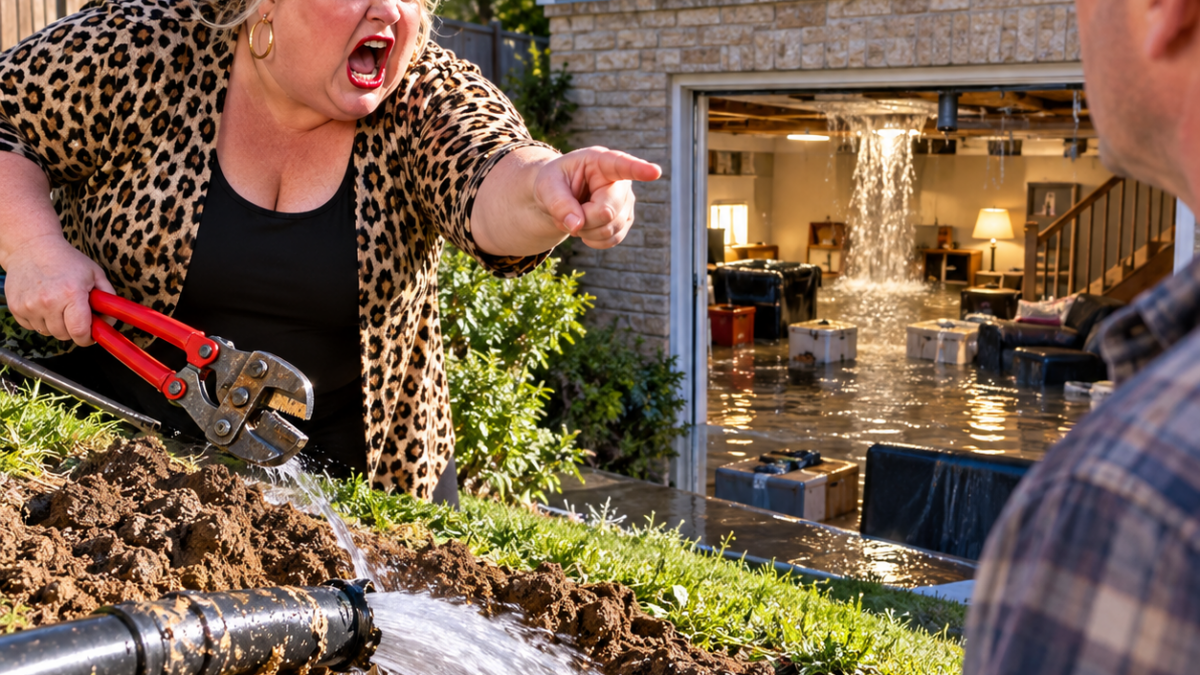
I just stood in the roar of the water, mud spraying across my boots, my jeans, my shirt, my face. It was absurd. It was terrifying. It was almost cinematic. The geyser climbed above the young maple tree beside my driveway, broke apart in the sunlight, and came down in a dirty brown arc against Karen Jensen’s house.
Her perfect beige stucco was being beaten by the very water she had released.
Her window well filled first.
Then overflowed.
Then the water found every seam, every gap, every vulnerable place around the basement window and began pouring into her home.
Karen lay in the mud where the blast had knocked her back, her pink tracksuit turning brown by the second. She kicked her legs, scrambled, slipped, and tried to stand while shrieking words I could barely hear over the geyser.
“My basement! My basement! Stop it!”
I had spent twenty years in the Army Corps of Engineers. I had seen pipes fail, berms collapse, culverts clog, roads wash out, and entire temporary systems surrender under the weight of bad planning. The first rule in any infrastructure emergency is simple.
Stop the source.
Panic later.
I moved toward the water meter box near the curb, boots sinking into the lawn that had already become a swamp. The cast-iron lid was slick, but I hooked my fingers under it and pulled. The meter below was half-submerged, the dial spinning so fast it looked like a toy propeller. Beside it sat the gate valve for my property.
I reached down into the cold, muddy water and started turning.
It fought me. Years of disuse will do that. Metal threads grind. Old valves resent being asked to save anyone. I set my jaw and kept turning.
Behind me, Karen screamed, “You did this, John! You did this!”
I did not answer.
I turned the valve until my wrist burned.
The geyser dropped from fifty feet to thirty.
Then twenty.
Then ten.
Then it collapsed into a bubbling, churning hole in the middle of my torn-up yard.
Finally, silence fell.
Not real silence.
Water still dripped from tree branches, splashed from Karen’s stucco, and gurgled in the trench. Somewhere inside her house, an alarm had started beeping, probably a water sensor or sump pump. Sarah was shouting my name from the porch. A dog barked three houses down. Neighbors were beginning to appear in doorways and behind curtains.
But compared to the roar of the geyser, it felt silent.
Karen got to her feet, mud dripping from her elbows.
“You are paying for this,” she hissed.
I looked at her.
Her face was streaked with dirt, her hair plastered to her cheek, her eyes wide with rage and disbelief. She was not hurt badly enough to stop being Karen. That was the first bad sign.
“Are you injured?” I asked.
She blinked.
“What?”
“Are you injured?”
“My basement is destroyed.”
“That wasn’t the question.”
For a moment, she looked almost confused that I was not shouting back.
Then she pointed a trembling finger at me.
“You installed an illegal pipe. You caused this.”
I pulled out my phone and started recording.
That changed her expression instantly.
“Do not record me.”
“I’m documenting the scene.”
“You need my permission.”
“No. I need evidence.”
Her mouth opened.
I held the camera steady.
“State your name, please.”
She stared at me like I had slapped her.
“What?”
“You came onto my property with a spade and struck the ground beside a marked utility line. State your name.”
“I am Karen Jensen, president of the Pleasant View Estates Homeowners Association, and you are in serious trouble.”
“Thank you.”
I panned the phone down to the muddy gouge in the earth. The rusty spade lay a few feet away, its blade still caked in wet soil. I zoomed in on the faint blue utility mark painted in the grass by 811, then on the break point where Karen had struck, then on the orange survey flag marking my property line.
The flag was not subtle.
It stood ten feet inside the boundary Karen claimed was “common ground.”
I walked the camera slowly across the yard, narrating everything.
“City-marked utility line visible. Survey marker visible. Trench located within my private lot. Karen Jensen entered the property after being told not to interfere and struck the ground with a spade.”
Karen made a strangled noise.
“That is not what happened.”
I pointed the camera back at her.
“That is exactly what happened.”
Sarah reached us then, wearing a sweater over pajamas and rubber garden shoes she had thrown on in panic. Her face was pale.
“John, are you okay?”
“I’m fine.”
She looked at Karen, the mud, the water, the broken earth, the flooding window well across the lawn.
“What happened?”
“Karen happened.”
Sarah’s mouth tightened.
She had tolerated Karen’s notices better than I had. Improper placement of trash bins. Flag size. Flowerpot color. Unauthorized edging. All the little stings Karen used to teach newcomers obedience. Sarah had tried diplomacy. She had smiled through Karen’s welcome visit, thanked her for the gelatin mold she brought, and read the entire HOA binder twice.
But standing there in the mud, looking at our torn-up lawn and Karen’s flooded basement, even Sarah’s patience died.
“Karen,” she said quietly, “did you hit the line?”
Karen turned on her.
“Your husband created an unsafe condition!”
Sarah did not flinch.
“Did you hit the line?”
Karen’s jaw worked.
“I was removing an unauthorized trench from common ground.”
Sarah looked at the survey flag.
“That’s our yard.”
“The board has always considered—”
“Did you hit the line?”
Karen stopped.
For one second, there it was.
The truth, visible beneath her anger like a rock under shallow water.
Then she covered it with outrage.
“I will not be interrogated by you people on land that belongs to the community.”
I kept recording.
“Good,” I said. “Please keep talking.”
She stopped immediately.
That was when I knew she understood, at least on some level, that she had stepped into something larger than a neighborhood argument.
I made three calls.
The first was to the city water department. I reported a residential service line rupture past the meter, already shut off. The dispatcher asked whether there was still active flooding. I said no. I also told him I needed a technician to document the break and confirm the location.
He said someone would be dispatched.
The second call was to my insurance company.
The agent’s name was Brenda, and at first she had the careful tone of someone recording a strange but ordinary homeowner claim. Then I explained that the damage had been caused by the HOA president entering my property with a spade and striking the line.
Her tone changed.
“So, just to confirm,” Brenda said, “a third party intentionally interfered with a permitted project on your property, caused a water service rupture, and the resulting discharge damaged her own home?”
“That is correct.”
“Do you have documentation?”
“Video, photos, survey flags, utility markings, permits, and witnesses.”
A pause.
Then: “Excellent. Document everything. Do not accept blame. Do not agree to pay anything. Do not communicate with her except in writing if necessary. Get a plumber’s report, a city report, and preserve the original video.”
I almost smiled.
“Already doing that.”
“I thought you might be.”
The third call was to an emergency plumber.
Sal arrived fifty minutes later in a dented white van with a ladder on top and a bumper sticker that said YOUR LEAK IS MY LIVELIHOOD. He climbed out, took in the mud, the trench, Karen’s soaked house, my half-finished French drain, and the spade lying like a murder weapon in the grass.
“Well,” he said, “somebody had themselves a Saturday.”
I walked him through what happened.
He listened, scratched his beard, looked at the blue utility mark, looked at the break, looked at the survey flag, then looked across at Karen’s house.
“The lady in the brown tracksuit did this?”
“It used to be pink.”
Sal nodded.
“Life comes at you fast.”
I liked him immediately.
He excavated carefully around the break. The service line had been punctured cleanly where the spade edge drove down into the soil. He showed me the damaged section, the cut, the impact mark, the direction of force. Then he wrote a report.
I stood beside him while he filled out the probable cause section.
Pipe rupture appears to be the direct result of forceful impact from a sharp-edged tool consistent with a shovel or spade. Damage is not consistent with age-related failure, pressure failure, root intrusion, or normal wear.
“Can you add that the impact point is on my property?” I asked.
“If the survey says so.”
I handed him a copy.
He studied it.
“Then yes.”
He signed and dated the report.
That document became the first real brick in what Sarah started calling “the Karen Wall.”
Not a physical wall.
A wall of evidence.
By noon, my lawn was a disaster, my house had no water, Karen’s basement was in crisis, and half the neighborhood had some version of the story. I could see people pretending to check mail, sweep porches, water plants, and walk dogs that had clearly already been walked. Pleasant View Estates had been quiet for sixty-seven days since we moved in, but now the air itself seemed to be leaning toward our yard.
Karen disappeared into her house for a while, then came back out with her phone pressed to her ear.
Her voice carried.
“He ruptured a community line. No, I’m telling you, it’s common ground. My basement is ruined. I want him cited, fined, sued, everything.”
She saw me watching and turned away.
Sarah stood beside me.
“She’s going to blame you for all of it.”
“Yes.”
“Even with the video.”
“Yes.”
“How can someone lie when everyone can see the truth?”
I watched Karen pace on her driveway, one muddy hand waving as she spoke.
“Because she’s been doing it for years and getting away with it.”
That was not a guess.
Even then, before I knew the full history, I could feel it. People do not become that confident in their lies after one successful attempt. Karen’s arrogance had roots.
The city water technician arrived after Sal had already started the repair. He was a tired man named Victor who looked at the hole, the shutoff, the flags, and the spade mark.
“Past the meter,” he said.
“I know.”
“Your responsibility to repair.”
“I know that too.”
He glanced toward Karen’s house.
“Did it really flood her basement?”
“She really hit the line.”
He looked at me for a second.
Then at the pink-brown tracksuit woman pacing across the lawn.
Then back at me.
“I’ll note the location and visible cause.”
“Thank you.”
Victor took photos, logged the meter reading, documented that the break was on my side of the meter, and confirmed the visible damage looked consistent with a tool strike. He did not accuse Karen in his report—that was not his job—but he wrote enough facts that anyone reading it could draw the line with a ruler.
By evening, the broken section of pipe had been replaced, water service restored, and the first fan of paperwork spread across our dining room table.
City permit.
811 ticket.
Original plat survey.
HOA plan submission.
Karen’s emails.
Her “Do not test me” message.
Photos.
Video.
Sal’s report.
Victor’s city documentation.
Repair invoice.
Insurance claim number.
Sarah looked at the table.
“This is insane.”
“Yes.”
“It looks like a court case.”
“It probably is.”
She sat down heavily.
“I wanted peace, John.”
I looked at my wife then, really looked.
Her hair was pulled back messily. There was mud on the cuff of her jeans. She had spent the afternoon helping me photograph, scan, label, and save everything while also trying not to cry from sheer frustration. This house was supposed to be our landing place. The end of moving trucks, base housing, deployments, temporary routines, and the kind of uncertainty that wears a marriage thin at the edges.
“I know,” I said.
Her eyes filled, but she blinked it back.
“We did everything right.”
“I know.”
“We asked for permits. We submitted plans. We waited. We tried to be good neighbors.”
I reached across the table and took her hand.
“Then we keep doing things right.”
“And if she doesn’t?”
“Then we make sure wrong becomes expensive.”
Sarah stared at me for a moment.
Then she laughed once, not happily, but enough to break the pressure.
“That sounds like you.”
The certified letter arrived the next morning.
Not from Karen.
From a law firm.
Dewey, Cheatham & Howe.
I stared at the letterhead and genuinely wondered if I was being pranked.
The content was less funny.
The letter accused me of negligence, unauthorized modification of shared community infrastructure, reckless excavation, destruction of HOA common property, and direct responsibility for the catastrophic flooding of Karen Jensen’s basement. It demanded that I cease all work immediately, pay a $10,000 HOA fine, reimburse Karen for all basement losses, and submit to binding arbitration under the HOA’s authority.
Sarah read it over my shoulder.
“They can’t be serious.”
“They’re serious.”
“But she hit the line.”
“They know what Karen told them.”
“We have video.”
“They haven’t seen it.”
She looked at the three-page threat letter, then at me.
“You’re too calm.”
“I’m not calm. I’m organized.”
That afternoon, I called David Ramirez.
David and I had served together in Iraq. He had been a JAG officer, sharp as barbed wire, with the rare ability to explain complex law to sleep-deprived soldiers without making them feel stupid. After leaving the service, he opened a property and contract law practice in the city. He was one of those men who sounded amused by conflict only because he knew exactly how to handle it.
When I told him the story, he laughed for almost fifteen seconds.
“Let me get this straight,” he said. “The HOA president trespassed on your property, hit your marked water line with a spade, flooded her own basement, then hired a lawyer to accuse you of damaging community infrastructure?”
“That’s the short version.”
“Johnny, this is not a case. This is a buffet.”
“I need help.”
“You need a folder. Several folders. Maybe a cart.”
“I have documents.”
“Good. Send me everything. Survey. Plat. HOA covenants. City permits. 811 ticket. Emails. Video. Plumber report. City technician notes. Photos of her basement if you have them. Every violation she’s issued since you moved in.”
“We’ve only been here sixty-seven days.”
“With Karen types, that’s plenty.”
He was right.
By evening, David had reviewed enough to call me back with the tone I remembered from mission briefings.
“First, you’re fine legally. She’s not.”
“That’s good to hear.”
“Second, the HOA’s position depends entirely on something called common ground. If your lawn is not common ground, their whole argument collapses.”
“It’s not.”
“Then we prove it so hard they regret learning how maps work.”
Sarah and I spent the next two nights building the file.
The official county plat showed our lot clearly. Lot 47 included the front lawn. The only easement was the utility strip near the sidewalk. The trench sat fully inside our property. There was no “community aesthetics easement.” No “shared visual corridor.” No “customary common strip.” Those were Karen phrases, not legal terms.
The HOA covenants made things worse for her.
Section 7 said homeowners were responsible for utility lines and infrastructure on their individual lots. Section 14 required HOA approval for visible exterior modifications, but buried drainage work with city permits was not prohibited, and permitted work on private property was presumed acceptable unless it violated a specific written rule.
Karen had no specific written rule.
She had vibes.
Very loud vibes.
David told me to hire a certified land surveyor anyway.
“Why pay for another survey?” Sarah asked.
“Because one survey says we’re right. Two surveys make them look reckless. A fresh notarized survey after the incident makes them look worse.”
The surveyor came out the next morning. He was a precise, humorless man named Allen who moved through the yard with professional detachment, setting bright pink flags at the corners and along the disputed edge. When Karen stepped onto her porch and saw him, she froze.
I gave a friendly wave.
She did not wave back.
Allen finished, printed the preliminary diagram from his truck, and said, “Your trench is well within your lot.”
“How far?”
“Nine feet eleven inches from the nearest boundary point.”
“Can you put that in writing?”
“That’s what surveys are.”
I liked him too.
The new notarized survey became another brick.
But David wanted more.
“Karen didn’t become Karen yesterday,” he said. “Find the pattern.”
I knew what he meant.
A single event could be framed as a misunderstanding.
A pattern could not.
Our first ally was George Peterson, a retired history teacher who lived two doors down. He had always seemed pleasant but cautious, the kind of neighbor who waved warmly yet never lingered too long. I caught him watering roses the morning after the survey.
“George,” I said, “can I ask you something about the HOA?”
His smile vanished.
“Karen?”
That one word told me enough.
We sat on his back patio while he poured iced tea and told me the history of Pleasant View Estates under Karen Jensen.
She had been elected eight years earlier on a promise to “restore standards.” Within a year, she had rewritten committee procedures, consolidated architectural review under the president’s office, and turned the HOA from a neighborhood maintenance body into a one-woman inspection regime.
“She fined me two hundred dollars because my garden hose was coiled wrong,” George said.
I thought he was joking.
He was not.
“She called it visible disorder.”
“What did you do?”
“I paid it. Then I bought a hose reel she approved. Then she cited me because the reel was too close to the front walk.”
He said it lightly, but there was bitterness under the humor.
George gave me names.
The Millers—not related to any other Millers in our previous disasters, just a tired couple who had been forced to repaint their house because Karen declared their beige “too warm.”
The Lees, whose professionally built backyard treehouse was torn down because Karen claimed it disrupted the skyline.
Mrs. Alvarez, who removed a vegetable garden after Karen threatened fines for nonconforming food production.
A young family who received notices over sidewalk chalk.
A widower who stopped flying his late wife’s wind chimes because Karen called them “tonal clutter.”
Each story sounded small to outsiders.
That was Karen’s genius.
She made every cruelty just small enough that fighting looked unreasonable.
But small things accumulate.
A fine here. A threat there. A repainting bill. A removed treehouse. A silenced wind chime. A family garden pulled from the dirt. People began living around Karen’s preferences, trimming themselves down until nothing stuck out enough for her to cut.
Sarah took the family side of the investigation.
People opened up to her faster. She sat at kitchen tables, drank coffee, listened to stories, and came home with folders of scanned letters and handwritten statements. I talked to the homeowners who had tried to fight back and failed. Together, we built a second file.
David called it pattern evidence.
Sarah called it the Karen Museum.
By the end of the week, our dining room table had disappeared beneath three binders.
BINDER ONE: WATER LINE INCIDENT.
BINDER TWO: PROPERTY AUTHORITY.
BINDER THREE: PATTERN OF ABUSE.
I drove them to David’s office in a storage crate.
He lifted the first binder, then looked at me.
“You always this thorough?”
“Only when someone digs up my yard and blames me.”
“Remind me never to annoy you.”
We spent four hours planning the response.
David would not simply answer the law firm’s accusations. He would dismantle them. The letter would go to Karen’s lawyer, the HOA board, the HOA’s insurance carrier, and Karen’s personal homeowner’s insurer.
“We hit every pressure point at once,” he said, sketching circles on a legal pad. “Her lawyer needs to know the facts. The HOA board needs to know she lied. The HOA insurer needs to know their president may have committed intentional misconduct. Karen’s personal insurer needs to know her basement claim resulted from her own intentional act. Nobody likes being surprised by a client who lied to them.”
The demand letter was devastating.
It rejected the claim that my lawn was common ground and attached the county plat map, original survey, and new notarized survey. It attached the city permit and 811 ticket. It attached Sal’s report and Victor’s city documentation. It described Karen’s conduct as trespass, intentional property damage, and reckless interference with a marked utility line. It demanded reimbursement for the plumbing repair, the surveyor, lawn restoration, legal fees, and rescission of every HOA notice issued against us.
Then David added the part that made Sarah raise her eyebrows.
A demand for a public written apology.
“Will she do that?” Sarah asked.
“No,” David said. “But refusing makes her look worse.”
Finally, he included a warning: if they did not comply within ten business days, we would file civil action and refer the evidence to the district attorney for potential criminal review.
“Can this really be criminal?” Sarah asked.
David leaned back.
“She entered private property after being told the project was permitted, intentionally struck the ground with a tool, and caused significant damage. Whether prosecutors take it is their call. But yes, it is absolutely worth referring.”
The certified letters went out that afternoon.
The first crack in Karen’s wall came from George.
He called me two days later, whispering like he was reporting from behind enemy lines.
“The other board members came to my house.”
“What did they want?”
“They wanted to know if your lawyer’s letter was real. They had no idea Karen hit the line.”
I sat up straighter.
“What did she tell them?”
“That you ruptured a shared water line while digging illegally in common ground.”
“Of course.”
“They looked sick, John. I showed them the county plat I had from my closing papers. Same as yours. There is no common ground there.”
“What did they say?”
“They said they needed their own attorney.”
The second crack came from Karen’s law firm.
David called me after speaking with them.
“They are backing away fast.”
“That quick?”
“They only knew Karen’s version. Now they’ve seen the video stills and the maps. They used the phrase ‘significant misunderstanding.’”
“What did you say?”
“That their client created the misunderstanding with a shovel.”
The third crack came from Karen herself.
She called an emergency HOA meeting.
Of course she did.
The notice went out in giant bold letters.
MANDATORY EMERGENCY COMMUNITY MEETING
Topic: Malicious Legal Threats, Unsafe Homeowner Conduct, and Protection of Pleasant View Estates
“She’s setting a stage,” Sarah said.
“Yes.”
“What do we do?”
I looked at David’s latest email.
“We let her perform.”
The clubhouse was full that Friday night.
Karen stood at the front wearing a navy blazer and a face full of righteous injury. The other two board members sat beside her, stiff and pale. They would not look at me. That told me they had seen the evidence and understood exactly how bad this could become.
I sat in the second row with Sarah on one side and David Ramirez on the other. George sat behind us. The Millers were near the aisle. Mr. Lee stood against the back wall, arms crossed. Mrs. Alvarez sat two rows over with a folder on her lap.
Karen thought she had called a meeting.
She had walked into a coordinated operation.
“Thank you all for coming,” she began. “I know many of you have heard rumors. Tonight, I intend to set the record straight.”
Then she lied for twelve minutes.
In her version, I was a reckless new homeowner who ignored HOA procedures, dug into a sensitive community easement, ruptured shared infrastructure, flooded her basement, then hired a lawyer to intimidate the association. She described her destroyed craft room in heartbreaking detail. Scrapbooking supplies. Collectible plates. Framed prints. Seasonal decorations. She almost cried when mentioning a box of handmade ornaments.
I watched the room.
Some people believed her.
Some wanted to believe her because believing Karen was easier than admitting they had lived under a bully. Others looked uncertain. A few looked at me with suspicion. That was Karen’s strength: she spoke with the confidence of someone used to filling silence.
Then she pointed at me.
“This man is trying to make all of you pay for his negligence.”
David stood.
The room shifted.
“David Ramirez, counsel for John Carter,” he said. “I have a few questions.”
Karen’s eyes narrowed.
“This is a homeowners meeting, not a courtroom.”
“Then answering should be easier.”
A few people murmured.
David moved to the projector we had arranged through George, who still had access to the clubhouse equipment from his days helping with trivia night. Karen noticed the remote in his hand too late.
“You stated that Mr. Carter’s project was located on common ground,” David said.
“That is correct.”
He clicked the remote.
The county plat map appeared on the screen behind her.
Gasps and whispers moved through the room as people recognized their subdivision map.
“This is the official plat map filed with the county recorder,” David said. “Can you identify the common ground on Mr. Carter’s front lawn?”
Karen stared at the map.
“The board has long considered that area—”
“Not my question. Can you identify any recorded common ground on Lot 47?”
She swallowed.
“The map does not reflect community practice.”
David nodded.
“So the answer is no.”
“That is not what I said.”
“It is what the map says.”
He clicked again.
The city permit appeared.
“You also stated that the work was unauthorized. This is the city permit. This is the 811 utility locate confirmation. This is the HOA submission sent to you weeks before the incident.”
Another click.
Her 11:59 p.m. email appeared.
Do not test me.
The room went very quiet.
David turned back to her.
“That was your message to Mr. Carter the night before you entered his property with a spade. Correct?”
Karen’s lips pressed into a thin line.
“I was warning him not to proceed with illegal work.”
David clicked again.
The video still appeared: Karen mid-swing, spade raised, face twisted with anger.
A low sound moved through the room.
Not a gasp exactly.
Recognition.
“Let’s watch what happened next,” David said.
The video played.
Karen’s own voice filled the clubhouse.
“That’s common ground, mister. And this unapproved landscaping project of yours is over.”
Then the swing.
The thunk.
The hiss.
The geyser.
The roar.
The water arcing into her own house.
Karen’s scream.
“My basement! My craft room! You did this!”
When the video stopped, nobody spoke.
Karen’s face had gone the color of wet paper.
David let the silence do the work.
Then I stood.
“She did not just lie about me,” I said. “She has been using that same authority against this entire neighborhood for years.”
I opened the first pattern binder.
“George Peterson. Fined for how he coiled his garden hose.”
George stood.
“The Miller family. Forced to repaint a house at their own expense because Karen did not personally like the shade.”
Mrs. Miller stood, holding a folder.
“The Lee family. Forced to remove a safe, professionally built treehouse.”
Mr. Lee stood.
“Mrs. Alvarez. Pressured to remove a vegetable garden.”
She stood too.
One by one, the people Karen had isolated became visible.
That was the moment her power broke.
A bully can manage one angry homeowner.
Karen could not manage a room full of receipts.
The crowd erupted.
“You lied to us!”
“She hit the line herself!”
“What about my fines?”
“Where did the money go?”
Karen grabbed the podium.
“This is an illegal ambush!”
One of the board members, a young man named Daniel who had spent most of the meeting staring at the table, finally leaned toward his microphone.
“I think,” he said, voice shaking, “we need to vote on whether Ms. Jensen should remain president pending legal review.”
Karen turned toward him.
“Daniel.”
Just his name.
A command.
But commands only work while people still believe in the commander.
Daniel did not sit back.
“I move to suspend Karen Jensen as HOA president immediately.”
The other board member, a woman named Elaine, closed her eyes like she was jumping from a ledge.
“I second.”
Karen looked out at the room and realized nobody was coming to save her.
The vote passed in a roar.
Her presidency ended in the very room where she planned to destroy me.
The fallout came fast.
The HOA’s insurance carrier sent a reservation of rights letter within days, warning that intentional misconduct by the board president might not be covered. Karen’s personal homeowner’s insurance investigated her basement claim and denied it after receiving the video and reports. Their reasoning was brutal: the damage resulted from her own intentional act on neighboring property.
In plain English, she flooded herself.
The city issued citations for unauthorized interference with permitted work and unsafe conditions created by the rupture. The HOA, desperate to show good faith, ordered professional remediation of my yard at association expense.
Karen went from queen of Pleasant View Estates to radioactive liability in less than two weeks.
The final board meeting was held at a downtown law office because the new lawyer did not trust the clubhouse to stay civil. Karen sat alone on one side of a long conference table, wearing a gray cardigan and no makeup. Without the podium, blazer, binder, and audience, she looked smaller. Not humble. Just reduced.
The new HOA attorney laid it out plainly.
Karen’s actions were outside the scope of her authority. The association faced significant liability. The board had grounds to remove her permanently and seek recovery from her personally for damages caused by her misconduct.
Daniel and Elaine voted to remove her from the board.
Karen did not speak.
I watched her hands.
They were clenched in her lap.
The same hands that had held the spade.
The settlement came a month later.
The HOA paid for the waterline repair, the certified survey, the legal fees, and full professional restoration of our lawn. They covered completion of the French drain and sprinkler system. Every fine and violation against us was expunged. A written apology was mailed to every homeowner admitting the former president had acted without authority and that our project had been properly permitted.
But David did not stop with us.
The settlement created a reimbursement fund for homeowners harmed by Karen’s arbitrary enforcement. The Millers recovered the cost of repainting. The Lees received compensation toward a new, city-approved treehouse. Mrs. Alvarez replanted her vegetable garden with half the neighborhood bringing seedlings. George refused his reimbursement and donated it back into the fund, saying, “Watching Karen answer for herself was payment enough.”
Pleasant View Estates changed after that.
The architectural committee was restored as an elected three-person body. No single president could issue notices, hear appeals, and decide fines alone. The bylaws were rewritten to require written standards, due process, and recorded votes. Fines had to be tied to actual rules, not Karen’s mood.
Meetings became boring.
Beautifully boring.
Karen’s personal consequences were quieter but devastating.
Her basement remediation cost tens of thousands out of pocket. Mold removal, drywall replacement, flooring, damaged contents, electrical inspection, dehumidification, reconstruction. The craft room she had cried about became the most expensive monument in town to her own arrogance.
Six months later, a For Sale sign appeared on her lawn.
By then, nobody in the neighborhood feared her.
Some pitied her.
Most ignored her.
On the day the moving truck came, I was outside inspecting the newly restored lawn. The grass had grown in thick and green. The French drain worked perfectly. The sprinkler heads rose and turned with a soft mechanical hiss, watering the exact area Karen had once declared forbidden.
She came out carrying a cardboard box.
For a moment, we saw each other across the street.
I expected a glare.
A curse.
One last accusation.
But Karen looked hollow. Her eyes moved from me to the lawn, then to the young maple Sarah and I had planted near the place where the geyser had erupted.
She said nothing.
Neither did I.
She loaded the box into her car and drove away.
I felt no triumph watching her leave.
Only relief.
There is a difference.
Triumph is loud.
Relief is quiet enough to hear your own sprinklers.
A few weeks later, Sarah and I stood in the front yard with a shovel and a young maple tree. We had chosen it together because it would turn red in the fall, and Sarah said the yard needed something beautiful where all that mud had been.
I dug the hole slowly, enjoying the simple honesty of work that did not require legal strategy. The soil was rich now, properly graded, draining the way it should. No pooling near the foundation. No trench war. No Karen standing over me with a spade.
Sarah held the tree steady while I backfilled around the roots.
“You know,” she said, “we came here looking for peace.”
“I remember.”
“We found a flood.”
“We found a Karen.”
She smiled faintly.
“But now?”
I looked down the street.
George was talking to Mr. Lee near the mailbox. Mrs. Alvarez was watering tomato plants. The Millers had repainted their house a warm beige Karen would have hated and everyone else seemed to like. Somewhere behind the Lees’ house, a hammer echoed from the construction of a new treehouse.
“Now,” I said, “I think we found the neighborhood.”
Sarah leaned against my shoulder.
The maple leaves moved in a light breeze.
Later that evening, after we cleaned the tools and washed the mud from our boots, I stood on the porch and watched the sprinklers run. Thin arcs of water moved gently across the lawn, controlled, quiet, doing exactly what water should do when handled with respect.
I thought about the geyser.
About Karen’s scream.
About the video playing in the clubhouse.
About the faces of people who had been afraid for years and finally stood up.
It would be easy to say Karen got what she deserved because her own basement flooded. That would be simple. Satisfying, maybe. But not complete.
The real justice was not the water.
The real justice was the truth.
The water only forced everyone to look.
Karen had built her power from confusion. She claimed common ground where there was private property. She claimed authority where there was none. She claimed community while terrorizing neighbors one notice at a time. She claimed victimhood after swinging the spade.
But truth is stubborn.
It waits in county records.
It waits in city permits.
It waits in survey flags.
It waits in plumber reports and insurance files and phone videos someone remembered to take while covered in mud.
And when truth finally rises, it can be just as unstoppable as a broken water line under pressure.
Karen cut my water line because she thought she owned every inch of the neighborhood.
The geyser flooded her basement because physics does not care who is HOA president.
And everything that happened afterward—the meeting, the vote, the settlement, the apology, the tree—happened because for once, the consequences flowed in the right direction.
Now the maple tree is growing.
The lawn is green.
The foundation stays dry.
The sprinklers whisper in the morning sun.
And Pleasant View Estates, finally free from the woman who confused control with leadership, feels like the peaceful place Sarah and I thought we were buying.
Sometimes people ask me if I regret testing Karen.
I tell them the truth.
I did not test Karen.
Karen tested the line.
And the line held.
[FACEBOOK CAPTION — 700–800 WORDS]
Karen raised that rusty spade like she was about to strike down a kingdom, not a ten-inch trench in my front yard. She called my permitted drainage project “common-ground vandalism” while standing ten feet inside my property line with city utility marks at her feet. Then she drove the blade into the ground, and the water that exploded out of my lawn did what months of paperwork never could—it told the whole neighborhood exactly who she was.
“That’s common ground, mister,” Karen Jensen said, her voice sharp enough to scrape paint. “And this unapproved landscaping project of yours is over.”
I looked up from the trench I was leveling and saw the president of the Pleasant View Estates HOA standing on my lawn in a bright pink tracksuit, gripping a spade like it gave her legal authority over gravity, property law, and underground plumbing. Behind her, the morning was calm. Birds moved through the maple trees. Sprinklers clicked somewhere down the block. It should have been the kind of Saturday where a man could work on his own land without a neighborhood dictator marching across the grass to start a war.
But Karen had needed only sixty-seven days to make herself the center of our lives.
My wife, Sarah, and I had moved here for peace. After twenty years in the Army Corps of Engineers, I wanted a quiet house, a clean lawn, and a project that did not involve blast walls, emergency culverts, washed-out access roads, or men shouting over radios in the dark. This house seemed perfect except for one problem: after heavy rain, water pooled near the foundation.
To me, that was not a crisis.
It was a project.
A French drain, a sprinkler system, a little grading, all permitted by the city and marked by 811. I had the utility lines painted. I had the survey flags placed. I had the plat map showing my front lawn belonged to me, not Karen, not the HOA, and not whatever imaginary “community aesthetics easement” she kept inventing in her emails.
I had submitted the plans weeks earlier because Sarah said, “Just humor the HOA.”
So I humored them.
Karen replied with delays, demands, and nonsense. Materials list. More detailed diagram. Environmental impact statement for a ten-inch trench. Architectural committee review, even though I later learned the architectural committee was mostly Karen talking to herself in her garage office.
Finally, with rain season coming, I sent one last polite email stating I was beginning work under my city permit.
Her answer came at 11:59 p.m.
Do not test me.
The next morning, there she was.
“Karen,” I said, keeping my voice level, “we’ve been over this. This is my property. The survey markers are right there.”
I pointed to the orange flag planted clearly on my side of the line.
She scoffed.
“The official survey is wrong. The board has always considered this strip an easement for community aesthetics.”
“There is no such easement.”
“The board disagrees.”
“The county record does not.”
Her face tightened.
That was what Karen hated most: records she did not control.
Before I could step between her and the trench, she lifted the spade and brought it down hard beside the PVC line I had been setting.
I opened my mouth to warn her.
Too late.
There was a dull, sickening thunk.
For half a second, nothing happened.
Karen smiled.
Then the ground hissed.
The soil swelled around the shovel blade, darkening as if something alive were pushing up from underneath. A low vibration came through my boots. Karen’s smile faded.
Then my lawn exploded.
A geyser of muddy, pressurized water shot fifty feet into the air with a roar that drowned out her first scream. The force threw her backward into the mud, the spade flying from her hands. But the worst part—the beautiful, awful, perfectly ironic part—was the angle.
The water did not shoot straight up.
It arced across my lawn and slammed directly into Karen’s beige stucco house.
A heavy brown waterfall hammered the wall, poured into her basement window well, and vanished inside like justice had found a drain.
“My basement!” Karen shrieked from the mud. “My craft room! You did this!”
I stood there, soaked to the knees, watching the consequences of her own swing flood through her own window.
Then I pulled out my phone and started recording.
Because Karen had just turned herself into evidence.
[END OF FACEBOOK CAPTION]
[FIRST COMMENT / FULL STORY CONTINUATION]
For one long second, I did not move.
I just stood in the roar of the water, mud spraying across my boots, my jeans, my shirt, and my face. It was absurd. It was terrifying. It was almost cinematic. The geyser climbed above the young maple tree beside my driveway, broke apart in the sunlight, and came down in a dirty brown arc against Karen Jensen’s house.
Her perfect beige stucco was being beaten by the very water she had released.
The window well filled first.
Then overflowed.
Then the water found every seam, every gap, every weak place around the basement window and poured into her home.
Karen scrambled in the mud, kicking like a furious child who had fallen into a puddle she created. Her pink tracksuit turned brown by the second. She tried to stand, slipped, caught herself with both hands, and screamed words I could barely hear over the geyser.
“My basement! My basement! Stop it!”
I had spent twenty years in the Army Corps of Engineers. I had seen pipes fail, berms collapse, culverts clog, roads wash out, and temporary systems surrender under pressure because somebody ignored a warning mark, skipped a checklist, or believed confidence could replace competence.
The first rule in any infrastructure emergency is simple.
Stop the source.
Panic later.
I moved toward the water meter box near the curb, boots sinking into the lawn that had already become a swamp. The cast-iron lid was slick, but I hooked my fingers under it and pulled. The meter below was half-submerged, the dial spinning so fast it looked like a toy propeller. Beside it sat the gate valve for my property.
I reached down into the cold, muddy water and started turning.
It fought me. Years of disuse will do that. Metal threads grind. Old valves resent being asked to save anyone. I set my jaw and kept turning until my wrist burned.
Behind me, Karen screamed, “You did this, John! You did this!”
I did not answer.
I turned the valve until the geyser dropped from fifty feet to thirty.
Then twenty.
Then ten.
Then it collapsed into a bubbling, churning hole in the middle of my torn-up yard.
Finally, silence fell.
Not real silence.
Water still dripped from tree branches, splashed from Karen’s stucco, and gurgled in the trench. Somewhere inside her house, an alarm had started beeping, probably a water sensor or sump pump. Sarah was shouting my name from the porch. A dog barked three houses down. Neighbors were beginning to appear in doorways and behind curtains.
But compared to the roar of the geyser, it felt silent.
Karen got to her feet, mud dripping from her elbows.
“You are paying for this,” she hissed.
I looked at her.
Her face was streaked with dirt, her hair plastered to one cheek, her eyes wide with rage and disbelief. She was not hurt badly enough to stop being Karen. That was the first bad sign.
“Are you injured?” I asked.
She blinked.
“What?”
“Are you injured?”
“My basement is destroyed.”
“That wasn’t the question.”
For a moment, she looked almost confused that I was not shouting back.
Then she pointed a trembling finger at me.
“You installed an illegal pipe. You caused this.”
I pulled out my phone and started recording.
That changed her expression instantly.
“Do not record me.”
“I’m documenting the scene.”
“You need my permission.”
“No. I need evidence.”
Her mouth opened.
I held the camera steady.
“State your name, please.”
She stared at me like I had slapped her.
“What?”
“You came onto my property with a spade and struck the ground beside a marked utility line. State your name.”
“I am Karen Jensen, president of the Pleasant View Estates Homeowners Association, and you are in serious trouble.”
“Thank you.”
I panned the phone down to the muddy gouge in the earth. The rusty spade lay a few feet away, its blade still caked in wet soil. I zoomed in on the faint blue utility mark painted in the grass by 811, then on the break point where Karen had struck, then on the orange survey flag marking my property line.
The flag was not subtle.
It stood ten feet inside the boundary Karen claimed was “common ground.”
I walked the camera slowly across the yard, narrating everything.
“City-marked utility line visible. Survey marker visible. Trench located within my private lot. Karen Jensen entered the property after being told not to interfere and struck the ground with a spade.”
Karen made a strangled noise.
“That is not what happened.”
I pointed the camera back at her.
“That is exactly what happened.”
Sarah reached us then, wearing a sweater over pajamas and rubber garden shoes she had thrown on in panic. Her face was pale.
“John, are you okay?”
“I’m fine.”
She looked at Karen, the mud, the water, the broken earth, the flooding window well across the lawn.
“What happened?”
“Karen happened.”
Sarah’s mouth tightened.
She had tolerated Karen’s notices better than I had. Improper placement of trash bins. Flag size. Flowerpot color. Unauthorized edging. All the little stings Karen used to teach newcomers obedience. Sarah had tried diplomacy. She had smiled through Karen’s welcome visit, thanked her for the gelatin mold she brought, and read the entire HOA binder twice.
But standing there in the mud, looking at our torn-up lawn and Karen’s flooded basement, even Sarah’s patience died.
“Karen,” she said quietly, “did you hit the line?”
Karen turned on her.
“Your husband created an unsafe condition!”
Sarah did not flinch.
“Did you hit the line?”
Karen’s jaw worked.
“I was removing an unauthorized trench from common ground.”
Sarah looked at the survey flag.
“That’s our yard.”
“The board has always considered—”
“Did you hit the line?”
Karen stopped.
For one second, there it was.
The truth, visible beneath her anger like a rock under shallow water.
Then she covered it with outrage.
“I will not be interrogated by you people on land that belongs to the community.”
I kept recording.
“Good,” I said. “Please keep talking.”
She stopped immediately.
That was when I knew she understood, at least on some level, that she had stepped into something larger than a neighborhood argument.
I made three calls.
The first was to the city water department. I reported a residential service line rupture past the meter, already shut off. The dispatcher asked whether there was still active flooding. I said no. I also told him I needed a technician to document the break and confirm the location.
He said someone would be dispatched.
The second call was to my insurance company.
The agent’s name was Brenda, and at first she had the careful tone of someone recording a strange but ordinary homeowner claim. Then I explained that the damage had been caused by the HOA president entering my property with a spade and striking the line.
Her tone changed.
“So, just to confirm,” Brenda said, “a third party intentionally interfered with a permitted project on your property, caused a water service rupture, and the resulting discharge damaged her own home?”
“That is correct.”
“Do you have documentation?”
“Video, photos, survey flags, utility markings, permits, and witnesses.”
A pause.
Then: “Excellent. Document everything. Do not accept blame. Do not agree to pay anything. Do not communicate with her except in writing if necessary. Get a plumber’s report, a city report, and preserve the original video.”
I almost smiled.
“Already doing that.”
The third call was to an emergency plumber.
Sal arrived fifty minutes later in a dented white van with a ladder on top and a bumper sticker that said YOUR LEAK IS MY LIVELIHOOD. He climbed out, took in the mud, the trench, Karen’s soaked house, my half-finished French drain, and the spade lying like a murder weapon in the grass.
“Well,” he said, “somebody had themselves a Saturday.”
I walked him through what happened.
He listened, scratched his beard, looked at the blue utility mark, looked at the break, looked at the survey flag, then looked across at Karen’s house.
“The lady in the brown tracksuit did this?”
“It used to be pink.”
Sal nodded.
“Life comes at you fast.”
I liked him immediately.
He excavated carefully around the break. The service line had been punctured cleanly where the spade edge drove down into the soil. He showed me the damaged section, the cut, the impact mark, the direction of force. Then he wrote a report.
I stood beside him while he filled out the probable cause section.
Pipe rupture appears to be the direct result of forceful impact from a sharp-edged tool consistent with a shovel or spade. Damage is not consistent with age-related failure, pressure failure, root intrusion, or normal wear.
“Can you add that the impact point is on my property?” I asked.
“If the survey says so.”
I handed him a copy.
He studied it.
“Then yes.”
He signed and dated the report.
That document became the first real brick in what Sarah started calling “the Karen Wall.”
Not a physical wall.
A wall of evidence.
By noon, my lawn was a disaster, my house had no water, Karen’s basement was in crisis, and half the neighborhood had some version of the story. I could see people pretending to check mail, sweep porches, water plants, and walk dogs that had clearly already been walked. Pleasant View Estates had been quiet for sixty-seven days since we moved in, but now the air itself seemed to be leaning toward our yard.
Karen disappeared into her house for a while, then came back out with her phone pressed to her ear.
Her voice carried.
“He ruptured a community line. No, I’m telling you, it’s common ground. My basement is ruined. I want him cited, fined, sued, everything.”
She saw me watching and turned away.
Sarah stood beside me.
“She’s going to blame you for all of it.”
“Yes.”
“Even with the video.”
“Yes.”
“How can someone lie when everyone can see the truth?”
I watched Karen pace on her driveway, one muddy hand waving as she spoke.
“Because she’s been doing it for years and getting away with it.”
That was not a guess.
Even then, before I knew the full history, I could feel it. People do not become that confident in their lies after one successful attempt. Karen’s arrogance had roots.
The city water technician arrived after Sal had already started the repair. He was a tired man named Victor who looked at the hole, the shutoff, the flags, and the spade mark.
“Past the meter,” he said.
“I know.”
“Your responsibility to repair.”
“I know that too.”
He glanced toward Karen’s house.
“Did it really flood her basement?”
“She really hit the line.”
He looked at me for a second.
Then at the pink-brown tracksuit woman pacing across the lawn.
Then back at me.
“I’ll note the location and visible cause.”
“Thank you.”
Victor took photos, logged the meter reading, documented that the break was on my side of the meter, and confirmed the visible damage looked consistent with a tool strike. He did not accuse Karen in his report—that was not his job—but he wrote enough facts that anyone reading it could draw the line with a ruler.
By evening, the broken section of pipe had been replaced, water service restored, and the first fan of paperwork spread across our dining room table.
City permit.
811 ticket.
Original plat survey.
HOA plan submission.
Karen’s emails.
Her “Do not test me” message.
Photos.
Video.
Sal’s report.
Victor’s city documentation.
Repair invoice.
Insurance claim number.
Sarah looked at the table.
“This is insane.”
“Yes.”
“It looks like a court case.”
“It probably is.”
She sat down heavily.
“I wanted peace, John.”
I looked at my wife then, really looked.
Her hair was pulled back messily. There was mud on the cuff of her jeans. She had spent the afternoon helping me photograph, scan, label, and save everything while also trying not to cry from sheer frustration. This house was supposed to be our landing place. The end of moving trucks, base housing, deployments, temporary routines, and the kind of uncertainty that wears a marriage thin at the edges.
“I know,” I said.
Her eyes filled, but she blinked it back.
“We did everything right.”
“I know.”
“We asked for permits. We submitted plans. We waited. We tried to be good neighbors.”
I reached across the table and took her hand.
“Then we keep doing things right.”
“And if she doesn’t?”
“Then we make sure wrong becomes expensive.”
Sarah stared at me for a moment.
Then she laughed once, not happily, but enough to break the pressure.
“That sounds like you.”
The certified letter arrived the next morning.
Not from Karen.
From a law firm.
The content was less funny than the name on the letterhead.
It accused me of negligence, unauthorized modification of shared community infrastructure, reckless excavation, destruction of HOA common property, and direct responsibility for the catastrophic flooding of Karen Jensen’s basement. It demanded that I cease all work immediately, pay a $10,000 HOA fine, reimburse Karen for all basement losses, and submit to binding arbitration under the HOA’s authority.
Sarah read it over my shoulder.
“They can’t be serious.”
“They’re serious.”
“But she hit the line.”
“They know what Karen told them.”
“We have video.”
“They haven’t seen it.”
She looked at the three-page threat letter, then at me.
“You’re too calm.”
“I’m not calm. I’m organized.”
That afternoon, I called David Ramirez.
David and I had served together in Iraq. He had been a JAG officer, sharp as barbed wire, with the rare ability to explain complex law to exhausted soldiers without making them feel stupid. After leaving the service, he opened a property and contract law practice in the city. He was one of those men who sounded amused by conflict only because he knew exactly how to handle it.
When I told him the story, he laughed for almost fifteen seconds.
“Let me get this straight,” he said. “The HOA president trespassed on your property, hit your marked water line with a spade, flooded her own basement, then hired a lawyer to accuse you of damaging community infrastructure?”
“That’s the short version.”
“Johnny, this is not a case. This is a buffet.”
“I need help.”
“You need folders. Several folders. Maybe a cart.”
“I have documents.”
“Good. Send me everything. Survey. Plat. HOA covenants. City permits. 811 ticket. Emails. Video. Plumber report. City technician notes. Photos of her basement if you have them. Every violation she’s issued since you moved in.”
“We’ve only been here sixty-seven days.”
“With Karen types, that’s plenty.”
He was right.
By evening, David had reviewed enough to call me back with the tone I remembered from mission briefings.
“First, you’re fine legally. She’s not.”
“That’s good to hear.”
“Second, the HOA’s position depends entirely on something called common ground. If your lawn is not common ground, their whole argument collapses.”
“It’s not.”
“Then we prove it so hard they regret learning how maps work.”
Sarah and I spent the next two nights building the file.
The official county plat showed our lot clearly. Lot 47 included the front lawn. The only easement was the utility strip near the sidewalk. The trench sat fully inside our property. There was no “community aesthetics easement.” No “shared visual corridor.” No “customary common strip.” Those were Karen phrases, not legal terms.
The HOA covenants made things worse for her.
Section 7 said homeowners were responsible for utility lines and infrastructure on their individual lots. Section 14 required HOA approval for visible exterior modifications, but buried drainage work with city permits was not prohibited, and permitted work on private property was presumed acceptable unless it violated a specific written rule.
Karen had no specific written rule.
She had vibes.
Very loud vibes.
David told me to hire a certified land surveyor anyway.
“Why pay for another survey?” Sarah asked.
“Because one survey says we’re right. Two surveys make them look reckless. A fresh notarized survey after the incident makes them look worse.”
The surveyor came out the next morning. He was a precise, humorless man named Allen who moved through the yard with professional detachment, setting bright pink flags at the corners and along the disputed edge. When Karen stepped onto her porch and saw him, she froze.
I gave a friendly wave.
She did not wave back.
Allen finished, printed the preliminary diagram from his truck, and said, “Your trench is well within your lot.”
“How far?”
“Nine feet eleven inches from the nearest boundary point.”
“Can you put that in writing?”
“That’s what surveys are.”
I liked him too.
The new notarized survey became another brick.
But David wanted more.
“Karen didn’t become Karen yesterday,” he said. “Find the pattern.”
Our first ally was George Peterson, a retired history teacher who lived two doors down. He had always seemed pleasant but cautious, the kind of neighbor who waved warmly yet never lingered too long. I caught him watering roses the morning after the survey.
“George,” I said, “can I ask you something about the HOA?”
His smile vanished.
“Karen?”
That one word told me enough.
We sat on his back patio while he poured iced tea and told me the history of Pleasant View Estates under Karen Jensen.
She had been elected eight years earlier on a promise to “restore standards.” Within a year, she had rewritten committee procedures, consolidated architectural review under the president’s office, and turned the HOA from a neighborhood maintenance body into a one-woman inspection regime.
“She fined me two hundred dollars because my garden hose was coiled wrong,” George said.
I thought he was joking.
He was not.
“She called it visible disorder.”
“What did you do?”
“I paid it. Then I bought a hose reel she approved. Then she cited me because the reel was too close to the front walk.”
He said it lightly, but there was bitterness under the humor.
George gave me names.
The Millers, a tired couple forced to repaint their house because Karen declared their beige “too warm.”
The Lees, whose professionally built backyard treehouse was torn down because Karen claimed it disrupted the skyline.
Mrs. Alvarez, who removed a vegetable garden after Karen threatened fines for nonconforming food production.
A young family who received notices over sidewalk chalk.
A widower who stopped hanging his late wife’s wind chimes because Karen called them “tonal clutter.”
Each story sounded small to outsiders.
That was Karen’s genius.
She made every cruelty just small enough that fighting looked unreasonable.
But small things accumulate.
A fine here. A threat there. A repainting bill. A removed treehouse. A silenced wind chime. A family garden pulled from the dirt. People began living around Karen’s preferences, trimming themselves down until nothing stuck out enough for her to cut.
Sarah took the family side of the investigation.
People opened up to her faster. She sat at kitchen tables, drank coffee, listened to stories, and came home with folders of scanned letters and handwritten statements. I talked to the homeowners who had tried to fight back and failed. Together, we built a second file.
David called it pattern evidence.
Sarah called it the Karen Museum.
By the end of the week, our dining room table had disappeared beneath three binders.
BINDER ONE: WATER LINE INCIDENT.
BINDER TWO: PROPERTY AUTHORITY.
BINDER THREE: PATTERN OF ABUSE.
I drove them to David’s office in a storage crate.
He lifted the first binder, then looked at me.
“You always this thorough?”
“Only when someone digs up my yard and blames me.”
“Remind me never to annoy you.”
We spent four hours planning the response.
David would not simply answer the law firm’s accusations. He would dismantle them. The letter would go to Karen’s lawyer, the HOA board, the HOA’s insurance carrier, and Karen’s personal homeowner’s insurer.
“We hit every pressure point at once,” he said. “Her lawyer needs to know the facts. The HOA board needs to know she lied. The HOA insurer needs to know their president may have committed intentional misconduct. Karen’s personal insurer needs to know her basement claim resulted from her own intentional act. Nobody likes being surprised by a client who lied to them.”
The demand letter was devastating.
It rejected the claim that my lawn was common ground and attached the county plat map, original survey, and new notarized survey. It attached the city permit and 811 ticket. It attached Sal’s report and Victor’s city documentation. It described Karen’s conduct as trespass, intentional property damage, and reckless interference with a marked utility line. It demanded reimbursement for the plumbing repair, the surveyor, lawn restoration, legal fees, and rescission of every HOA notice issued against us.
Then David added the part that made Sarah raise her eyebrows.
A demand for a public written apology.
“Will she do that?” Sarah asked.
“No,” David said. “But refusing makes her look worse.”
Finally, he included a warning: if they did not comply within ten business days, we would file civil action and refer the evidence to the district attorney for potential criminal review.
The certified letters went out that afternoon.
The first crack in Karen’s wall came from George.
He called me two days later, whispering like he was reporting from behind enemy lines.
“The other board members came to my house.”
“What did they want?”
“They wanted to know if your lawyer’s letter was real. They had no idea Karen hit the line.”
I sat up straighter.
“What did she tell them?”
“That you ruptured a shared water line while digging illegally in common ground.”
“Of course.”
“They looked sick, John. I showed them the county plat I had from my closing papers. Same as yours. There is no common ground there.”
“What did they say?”
“They said they needed their own attorney.”
The second crack came from Karen’s law firm.
David called me after speaking with them.
“They are backing away fast.”
“That quick?”
“They only knew Karen’s version. Now they’ve seen the video stills and the maps. They used the phrase ‘significant misunderstanding.’”
“What did you say?”
“That their client created the misunderstanding with a shovel.”
The third crack came from Karen herself.
She called an emergency HOA meeting.
Of course she did.
The notice went out in giant bold letters.
MANDATORY EMERGENCY COMMUNITY MEETING
Topic: Malicious Legal Threats, Unsafe Homeowner Conduct, and Protection of Pleasant View Estates
“She’s setting a stage,” Sarah said.
“Yes.”
“What do we do?”
I looked at David’s latest email.
“We let her perform.”
The clubhouse was full that Friday night.
Karen stood at the front wearing a navy blazer and a face full of righteous injury. The other two board members sat beside her, stiff and pale. They would not look at me. That told me they had seen the evidence and understood exactly how bad this could become.
I sat in the second row with Sarah on one side and David Ramirez on the other. George sat behind us. The Millers were near the aisle. Mr. Lee stood against the back wall, arms crossed. Mrs. Alvarez sat two rows over with a folder on her lap.
Karen thought she had called a meeting.
She had walked into a coordinated operation.
“Thank you all for coming,” she began. “I know many of you have heard rumors. Tonight, I intend to set the record straight.”
Then she lied for twelve minutes.
In her version, I was a reckless new homeowner who ignored HOA procedures, dug into a sensitive community easement, ruptured shared infrastructure, flooded her basement, then hired a lawyer to intimidate the association. She described her destroyed craft room in heartbreaking detail. Scrapbooking supplies. Collectible plates. Framed prints. Seasonal decorations. She almost cried when mentioning a box of handmade ornaments.
I watched the room.
Some people believed her.
Some wanted to believe her because believing Karen was easier than admitting they had lived under a bully. Others looked uncertain. A few looked at me with suspicion. That was Karen’s strength: she spoke with the confidence of someone used to filling silence.
Then she pointed at me.
“This man is trying to make all of you pay for his negligence.”
David stood.
The room shifted.
“David Ramirez, counsel for John Carter,” he said. “I have a few questions.”
Karen’s eyes narrowed.
“This is a homeowners meeting, not a courtroom.”
“Then answering should be easier.”
A few people murmured.
David moved to the projector we had arranged through George, who still had access to the clubhouse equipment from his days helping with trivia night. Karen noticed the remote in his hand too late.
“You stated that Mr. Carter’s project was located on common ground,” David said.
“That is correct.”
He clicked the remote.
The county plat map appeared on the screen behind her.
Gasps and whispers moved through the room as people recognized their subdivision map.
“This is the official plat map filed with the county recorder,” David said. “Can you identify the common ground on Mr. Carter’s front lawn?”
Karen stared at the map.
“The board has long considered that area—”
“Not my question. Can you identify any recorded common ground on Lot 47?”
She swallowed.
“The map does not reflect community practice.”
David nodded.
“So the answer is no.”
“That is not what I said.”
“It is what the map says.”
He clicked again.
The city permit appeared.
“You also stated that the work was unauthorized. This is the city permit. This is the 811 utility locate confirmation. This is the HOA submission sent to you weeks before the incident.”
Another click.
Her 11:59 p.m. email appeared.
Do not test me.
The room went very quiet.
David turned back to her.
“That was your message to Mr. Carter the night before you entered his property with a spade. Correct?”
Karen’s lips pressed into a thin line.
“I was warning him not to proceed with illegal work.”
David clicked again.
The video still appeared: Karen mid-swing, spade raised, face twisted with anger.
A low sound moved through the room.
Not a gasp exactly.
Recognition.
“Let’s watch what happened next,” David said.
The video played.
Karen’s own voice filled the clubhouse.
“That’s common ground, mister. And this unapproved landscaping project of yours is over.”
Then the swing.
The thunk.
The hiss.
The geyser.
The roar.
The water arcing into her own house.
Karen’s scream.
“My basement! My craft room! You did this!”
When the video stopped, nobody spoke.
Karen’s face had gone the color of wet paper.
David let the silence do the work.
Then I stood.
“She did not just lie about me,” I said. “She has been using that same authority against this entire neighborhood for years.”
I opened the first pattern binder.
“George Peterson. Fined for how he coiled his garden hose.”
George stood.
“The Miller family. Forced to repaint a house at their own expense because Karen did not personally like the shade.”
Mrs. Miller stood, holding a folder.
“The Lee family. Forced to remove a safe, professionally built treehouse.”
Mr. Lee stood.
“Mrs. Alvarez. Pressured to remove a vegetable garden.”
She stood too.
One by one, the people Karen had isolated became visible.
That was the moment her power broke.
A bully can manage one angry homeowner.
Karen could not manage a room full of receipts.
The crowd erupted.
“You lied to us!”
“She hit the line herself!”
“What about my fines?”
“Where did the money go?”
Karen grabbed the podium.
“This is an illegal ambush!”
One of the board members, a young man named Daniel who had spent most of the meeting staring at the table, finally leaned toward his microphone.
“I think,” he said, voice shaking, “we need to vote on whether Ms. Jensen should remain president pending legal review.”
Karen turned toward him.
“Daniel.”
Just his name.
A command.
But commands only work while people still believe in the commander.
Daniel did not sit back.
“I move to suspend Karen Jensen as HOA president immediately.”
The other board member, a woman named Elaine, closed her eyes like she was jumping from a ledge.
“I second.”
Karen looked out at the room and realized nobody was coming to save her.
The vote passed in a roar.
Her presidency ended in the very room where she planned to destroy me.
The fallout came fast.
The HOA’s insurance carrier sent a reservation of rights letter within days, warning that intentional misconduct by the board president might not be covered. Karen’s personal homeowner’s insurance investigated her basement claim and denied it after receiving the video and reports. Their reasoning was brutal: the damage resulted from her own intentional act on neighboring property.
In plain English, she flooded herself.
The city issued citations for unauthorized interference with permitted work and unsafe conditions created by the rupture. The HOA, desperate to show good faith, ordered professional remediation of my yard at association expense.
Karen went from queen of Pleasant View Estates to radioactive liability in less than two weeks.
The final board meeting was held at a downtown law office because the new lawyer did not trust the clubhouse to stay civil. Karen sat alone on one side of a long conference table, wearing a gray cardigan and no makeup. Without the podium, blazer, binder, and audience, she looked smaller. Not humble. Just reduced.
The new HOA attorney laid it out plainly.
Karen’s actions were outside the scope of her authority. The association faced significant liability. The board had grounds to remove her permanently and seek recovery from her personally for damages caused by her misconduct.
Daniel and Elaine voted to remove her from the board.
Karen did not speak.
I watched her hands.
They were clenched in her lap.
The same hands that had held the spade.
The settlement came a month later.
The HOA paid for the waterline repair, the certified survey, the legal fees, and full professional restoration of our lawn. They covered completion of the French drain and sprinkler system. Every fine and violation against us was expunged. A written apology was mailed to every homeowner admitting the former president had acted without authority and that our project had been properly permitted.
But David did not stop with us.
The settlement created a reimbursement fund for homeowners harmed by Karen’s arbitrary enforcement. The Millers recovered the cost of repainting. The Lees received compensation toward a new, city-approved treehouse. Mrs. Alvarez replanted her vegetable garden with half the neighborhood bringing seedlings. George refused his reimbursement and donated it back into the fund, saying, “Watching Karen answer for herself was payment enough.”
Pleasant View Estates changed after that.
The architectural committee was restored as an elected three-person body. No single president could issue notices, hear appeals, and decide fines alone. The bylaws were rewritten to require written standards, due process, and recorded votes. Fines had to be tied to actual rules, not Karen’s mood.
Meetings became boring.
Beautifully boring.
Karen’s personal consequences were quieter but devastating.
Her basement remediation cost tens of thousands out of pocket. Mold removal, drywall replacement, flooring, damaged contents, electrical inspection, dehumidification, reconstruction. The craft room she had cried about became the most expensive monument in town to her own arrogance.
Six months later, a For Sale sign appeared on her lawn.
By then, nobody in the neighborhood feared her.
Some pitied her.
Most ignored her.
On the day the moving truck came, I was outside inspecting the newly restored lawn. The grass had grown in thick and green. The French drain worked perfectly. The sprinkler heads rose and turned with a soft mechanical hiss, watering the exact area Karen had once declared forbidden.
She came out carrying a cardboard box.
For a moment, we saw each other across the street.
I expected a glare.
A curse.
One last accusation.
But Karen looked hollow. Her eyes moved from me to the lawn, then to the young maple Sarah and I had planted near the place where the geyser had erupted.
She said nothing.
Neither did I.
She loaded the box into her car and drove away.
I felt no triumph watching her leave.
Only relief.
There is a difference.
Triumph is loud.
Relief is quiet enough to hear your own sprinklers.
A few weeks later, Sarah and I stood in the front yard with a shovel and a young maple tree. We had chosen it together because it would turn red in the fall, and Sarah said the yard needed something beautiful where all that mud had been.
I dug the hole slowly, enjoying the simple honesty of work that did not require legal strategy. The soil was rich now, properly graded, draining the way it should. No pooling near the foundation. No trench war. No Karen standing over me with a spade.
Sarah held the tree steady while I backfilled around the roots.
“You know,” she said, “we came here looking for peace.”
“I remember.”
“We found a flood.”
“We found a Karen.”
She smiled faintly.
“But now?”
I looked down the street.
George was talking to Mr. Lee near the mailbox. Mrs. Alvarez was watering tomato plants. The Millers had repainted their house a warm beige Karen would have hated and everyone else seemed to like. Somewhere behind the Lees’ house, a hammer echoed from the construction of a new treehouse.
“Now,” I said, “I think we found the neighborhood.”
Sarah leaned against my shoulder.
The maple leaves moved in a light breeze.
Later that evening, after we cleaned the tools and washed the mud from our boots, I stood on the porch and watched the sprinklers run. Thin arcs of water moved gently across the lawn, controlled, quiet, doing exactly what water should do when handled with respect.
I thought about the geyser.
About Karen’s scream.
About the video playing in the clubhouse.
About the faces of people who had been afraid for years and finally stood up.
It would be easy to say Karen got what she deserved because her own basement flooded. That would be simple. Satisfying, maybe. But not complete.
The real justice was not the water.
The real justice was the truth.
The water only forced everyone to look.
Karen had built her power from confusion. She claimed common ground where there was private property. She claimed authority where there was none. She claimed community while terrorizing neighbors one notice at a time. She claimed victimhood after swinging the spade.
But truth is stubborn.
It waits in county records.
It waits in city permits.
It waits in survey flags.
It waits in plumber reports and insurance files and phone videos someone remembered to take while covered in mud.
And when truth finally rises, it can be just as unstoppable as a broken water line under pressure.
Karen cut my water line because she thought she owned every inch of the neighborhood.
The geyser flooded her basement because physics does not care who is HOA president.
And everything that happened afterward—the meeting, the vote, the settlement, the apology, the tree—happened because for once, the consequences flowed in the right direction.
Now the maple tree is growing.
The lawn is green.
The foundation stays dry.
The sprinklers whisper in the morning sun.
And Pleasant View Estates, finally free from the woman who confused control with leadership, feels like the peaceful place Sarah and I thought we were buying.
Sometimes people ask me if I regret testing Karen.
I tell them the truth.
I did not test Karen.
Karen tested the line.
And the line held.