PART 2: HOA Karen Cut My Fence for Her Shortcut—So I Built a Steel Gate That Finally Ended Her Reign
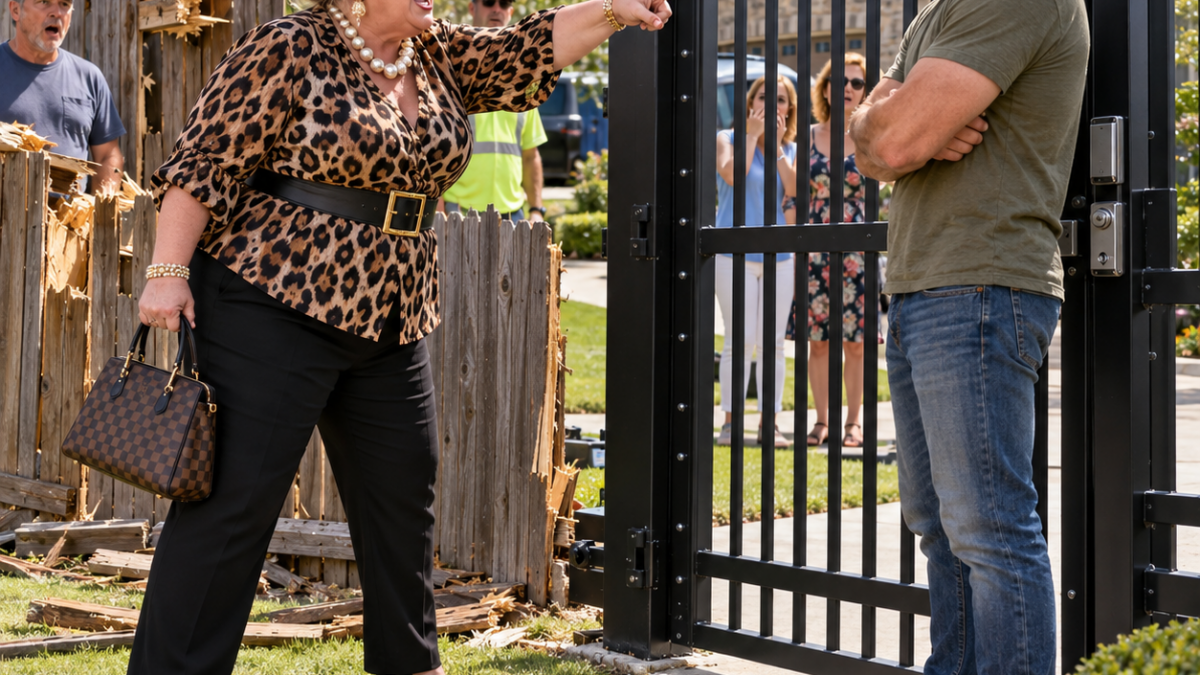
PART 2
The violation notice sat on my dining room table like a dare.
Sarah read it twice, then lowered it slowly and looked at me with the kind of quiet anger I had learned to respect during our twenty-two years of marriage.
“She is fining you for the fence she damaged?”
“Yes.”
“For being dilapidated?”
“Yes.”
“After she cut it?”
“Four times.”
Sarah set the paper down flat, smoothing it with both hands as though she wanted to keep herself from tearing it in half.
“That woman is insane.”
“No,” I said. “She is strategic.”
Sarah looked up.
There was a difference, and it mattered. Crazy people are unpredictable. Karen Miller was not unpredictable. She was arrogant, entitled, and accustomed to winning because most people were too tired to fight a hundred-dollar fine, a committee hearing, or a neighborhood rumor campaign. She knew exactly what she was doing. She created a problem, reframed it as a violation, and then used the machinery of the HOA to punish whoever objected.
That made her dangerous.
The notice claimed my perimeter fence violated Oak Creek Estates aesthetic standards. It demanded that I remove the “rusted agricultural barrier” and replace the entire quarter-mile stretch with an approved six-foot privacy fence matching the development’s approved designs. At my own expense. If I failed to comply within thirty days, the HOA would assess a fine of one hundred dollars per day.
I was not a member of Oak Creek Estates.
My land predated the development.
My deed had no HOA restrictions.
Karen’s authority ended at the property line she kept cutting through.
But that did not stop her from writing the notice, stamping it with the association logo, and signing it with a flourish so dramatic it looked like she was signing a royal decree.
Sarah sat across from me, arms folded.
“What are you going to do?”
I looked at the stack in front of me.
The certified survey. The photos. The return receipt with Karen’s signature proving she had received my warning. The HOA notice. The log of repair dates. The trail camera invoices. Every piece of paper was a board in the bridge I was about to build.
“I’m going to make the line impossible to ignore.”
The truth was, I had tried to be neighborly for too long.
When Sarah and I bought the ranch, we knew we were moving beside a subdivision. Oak Creek Estates had been built right up against the eastern side of the property, separated from my pasture by an old fence line that had existed longer than any of their cul-de-sacs. The developer had put their streets, clubhouse, pool, and walking trails on their side. My land had remained my land. That was clear on every map, survey, plat, deed, and county record.
For the first few years, nobody had a problem with that.
The people in Oak Creek waved when I drove by on the tractor. Their kids sometimes leaned on the split-rail section near the road and asked about the cattle. During calving season, I would catch families standing at the edge of their lots, watching new life wobble into the world under the big Texas sky. They treated my ranch like part of the view, and I did not mind that. I liked being the quiet neighbor with cows.
Then Karen Miller became HOA president.
The first time I saw her, she was riding in a white golf cart decorated with a small Oak Creek Estates flag on the front. She wore a pink visor, oversized sunglasses, and the expression of a person conducting an inspection of troops. She drove slowly along the inner road, stopping every few houses to write something on a clipboard. I remember thinking she looked harmless in the irritating way some people are harmless only because no one has told them no yet.
I did not know then how expensive that word would become.
Karen’s presidency began with notices. A pickup truck parked overnight in a driveway. A basketball hoop left visible from the street. A mailbox flag that was faded from the sun. A porch swing painted dark green instead of the approved muted sage. People grumbled, but most complied. That was how Karen built power. She never started with the thing that would make people revolt. She started with small inconveniences and trained the neighborhood to obey.
Then she noticed the fence.
From her side, I suppose it did look rough. It was an old five-strand barbed wire barrier held by cedar posts and steel T-posts, patched over decades by ranch hands and previous owners who cared more about function than beauty. Some sections had rust. Some posts leaned slightly. But it held cattle. It marked the line. It did exactly what a ranch fence was supposed to do.
Karen did not see function.
Karen saw a violation.
The first time I caught her pushing through it, she was halfway across my pasture in her golf cart, her wheels bumping over the flattened wire like she was on a safari tour. I drove my ATV out and stopped twenty yards ahead of her.
She braked, annoyed that the obstacle could speak.
“Ma’am,” I said, keeping my voice polite, “you’re on private property.”
She looked around, then back at me.
“I’m just using the old access path.”
“There is no access path.”
“The previous owner allowed it.”
That was a lie so bold it almost made me admire her confidence. The previous owner had been a hard old rancher named Bud Miller, no relation to Karen, and he had once threatened to tow a delivery van for turning around in his driveway. The idea of Bud letting HOA golf carts roll through his pasture was absurd.
“No, ma’am,” I said. “He didn’t.”
Her smile became thin.
“Well, the community has always treated this as a connection to the clubhouse.”
“The community road is half a mile that way.”
“I know where the road is, Sergeant.”
The way she said Sergeant bothered me. Not because the word offended me. I was proud of my service. It bothered me because she said it like she was filing me under a category: difficult veteran, rural type, obstacle.
“I’m asking you not to come through here again,” I said. “My cattle are in rotation, and if the fence gets compromised, they could get out onto the county road.”
She glanced at the cattle in the distance, unimpressed.
“Then perhaps you should invest in modern fencing.”
I took a breath.
“Or perhaps people should not drive through private pasture.”
She smiled then, that same cold little smile she would later wear while holding bolt cutters.
“We’ll see.”
A week later, I found the first clean cut.
One strand, sliced near a post.
I told myself maybe it had been a coincidence. Maybe a worker. Maybe a teenager. Maybe some drunk kid with pliers and too much time.
I repaired it.
The second time, two strands were cut.
The third time, a post had been loosened and the wire pulled down low enough for a golf cart to roll over. That was when I put two and two together with the ugly certainty of a man who had spent his life reading ground signs and threat patterns.
The fourth time, I found Karen holding the cutters.
That was the day I stopped hoping she would behave like a reasonable adult.
The next morning, I called Tom Sharp.
Tom was a property lawyer in the county seat and a former Marine, which meant he had two professional settings: direct and more direct. I had met him years earlier through a veterans’ group when he helped another rancher fight an illegal easement claim. He had a voice like gravel and the patience of a man who saved all his politeness for judges.
I explained everything from the beginning.
The shortcut.
The first sagging wire.
The first clean cut.
The warning conversation.
The certified letter.
The new violation notice.
Tom listened without interrupting.
When I finished, he gave a short laugh.
“Classic overreach.”
“That good or bad?”
“For you? Good. For her? Bad.”
He asked me to email the documents. Ten minutes after I sent them, he called back.
“Jack, the HOA has no jurisdiction over your ranch. None. Their covenants apply to Oak Creek Estates lots, not your hundred acres. They can dislike your fence, pray against your fence, write poems about your fence, or hold a candlelight vigil for their hurt feelings. Legally, they cannot tell you what to build on your land if you follow county code.”
“So if I replace the fence…”
“Pull the permit, build inside your line, document everything.”
“How substantial can I make it?”
“How substantial do you want it?”
I looked out the window at the repaired stretch of wire and the perfect lawns beyond it.
“Substantial enough that a golf cart never crosses again.”
Tom chuckled.
“Then build it right.”
My next call was to Dave Riley, though everybody who knew him called him Sledge.
Sledge had been a welder in my old unit. He could make steel behave like clay and had once repaired a bridge support in a dust storm with incoming fire close enough that the younger guys started praying out loud. Now he ran a fabrication shop outside town and built custom gates, cattle guards, equipment frames, and anything else that needed to outlive the person paying for it.
I told him what had happened.
There was a long silence.
Then he said, “She cut your fence?”
“Four times.”
“For a golf cart shortcut?”
“Yes.”
“Against cattle pasture?”
“Yes.”
“Jack, I say this with respect. You have been too nice.”
“I’m done being nice.”
“Good. What are we building?”
We sketched the idea over the phone, then again in person that afternoon at his shop.
Eight-foot heavy-gauge steel panels. Four-inch steel pipe posts sunk six feet into concrete. A slanted three-foot overhang angled toward my property, not theirs, legal under agricultural fencing rules and impossible to climb without looking ridiculous and risking a hospital bill. One sixteen-foot double gate for my equipment, reinforced cross-braced steel, welded hinges, and a lockbox recessed behind a protective plate. A hardened boron-alloy padlock. Security camera mounts along the top rail.
Sledge stood over the drawing with a grease pencil in his hand and a grin under his beard.
“This is not a fence,” he said.
“What is it?”
“A polite steel sermon.”
I smiled for the first time in days.
“That’s exactly what I need.”
The county planning office approved the permit within forty-eight hours. The clerk looked over the drawings, raised one eyebrow, and said, “That is one serious agricultural barrier, Mr. Callahan.”
“I like clear boundaries.”
She glanced at the survey, then at me.
“Neighbor trouble?”
“Golf cart trouble.”
That got me a laugh and a county stamp.
For all my calm planning, I need to be honest about something.
The project cost more than I wanted it to.
Steel was not cheap. Sledge gave me the best price he could, but good materials and skilled labor cost money, and this was not a weekend repair with a roll of wire and a pair of gloves. Sarah and I sat at the kitchen table that night with the estimate between us. She traced one number with her finger and said nothing.
“That’s a lot,” she finally said.
“I know.”
“We can do it.”
“I know that too.”
“That isn’t what I’m worried about.”
I looked at her.
She leaned back in the chair and studied my face in the way only a spouse can, reading things I thought I had hidden.
“I’m worried about what this is doing to you.”
That landed harder than the estimate.
I looked toward the window, where the pasture had gone dark and the lights of Oak Creek glowed in perfect rows beyond the fence line.
“I’m fine.”
“No, Jack. You’re controlled. There’s a difference.”
I did not answer.
Sarah knew the Army had left certain habits in me. Some were useful. Planning. Discipline. Patience. The ability to stay calm when another person expected anger. But other habits were heavier. Hypervigilance. Sleeping lightly. Thinking in terms of threats and perimeters when other people saw neighbors and mailboxes.
“I don’t want Karen Miller living in your head,” Sarah said softly.
“She already crossed onto my land.”
“That isn’t what I mean.”
I knew.
I reached across the table and took her hand.
“I’m not doing this because I want a war.”
“Then why?”
“Because if I let her keep cutting the fence, she learns the line isn’t real. If she learns that, other people learn it too. And eventually, something worse happens. A cow gets hit on the road. One of their kids comes through the gap and gets hurt. A trespasser gets kicked by a steer. Then everyone asks why I didn’t secure the boundary.”
Sarah’s expression softened, but only slightly.
“And the other reason?”
I sighed.
“Because I’m tired of fixing damage caused by someone who thinks rules are only for other people.”
She squeezed my hand.
“That one I understand.”
The day the materials arrived, Oak Creek Estates noticed.
A flatbed truck loaded with steel panels and pipe rolled onto my property at 7:30 in the morning, kicking up a cloud of dust that drifted lazily toward the manicured lawns on the other side. Curtains moved in half the houses along the boundary. I saw a man in a robe step onto his patio with a coffee cup and forget to drink from it.
The steel looked massive in the morning sun.
Dark gray. Heavy. Final.
Sledge arrived with two men from his crew, both veterans, both quiet and efficient. They set survey stakes six inches inside my property line and checked them twice. They unloaded the auger, the welding rig, the concrete forms, and the first run of posts.
By 9:15, the auger was chewing into Texas soil.
By 9:27, Karen appeared.
Her golf cart came whipping around the curve from the clubhouse path and braked just short of the line. She wore a lavender polo, white visor, and an expression that would have soured milk.
“What is the meaning of this?” she shouted over the auger.
Sledge cut the engine.
The sudden silence made her voice seem even sharper.
I walked over with the county permit on a clipboard.
“Good morning, Karen. I’m replacing my fence.”
“You cannot do this.”
“I can.”
“This is not an approved design.”
“It is county-approved agricultural fencing.”
“The HOA has standards.”
“Your standards stop at that survey stake.”
She looked down at the wooden stake near her front tire as if it had insulted her.
“That is not how community living works.”
“I do not live in your community.”
Her face turned blotchy.
“You border our community.”
“And now I will border it more securely.”
Sledge coughed into one fist. It sounded suspiciously like a laugh.
Karen snapped her head toward him.
“You think this is funny?”
Sledge leaned one arm on the auger controls.
“Ma’am, I’ve seen people respect minefields faster than you respect survey stakes.”
I closed my eyes for half a second.
Karen pointed at him.
“You are performing unapproved construction visible from HOA property.”
Sledge looked at me.
“Does she always talk like a malfunctioning printer?”
That was when Karen called the sheriff.
I did not stop her.
In fact, I encouraged her.
“Please do,” I said. “It will save me the trouble.”
Twenty minutes later, Deputy Miller arrived.
He looked young, tired, and deeply disappointed to have been summoned into a fence argument before lunch. Karen rushed him before he had both boots out of the cruiser.
“Officer, this man is building an illegal industrial wall that violates our covenants, threatens our property values, and creates a hostile environment for residents.”
Deputy Miller looked from Karen to me, then to the permit in my hand.
“Sir?”
I handed him the clipboard.
“County permit, certified survey, property line marked. All work is on my land.”
He read the permit, walked the line, checked the stakes, and looked at the auger holes. Then he turned to Karen.
“Ma’am, he is on his property and has a valid county permit.”
Karen blinked.
“But the covenants—”
“Do not apply here.”
Her jaw tightened.
“He is creating a nuisance.”
“Ma’am, I am going to say this carefully. Mr. Callahan has documented repeated damage to this fence line and has informed you not to enter his property. If you cross this line again, you may be cited for trespassing. If you damage anything, you may be charged.”
The silence after that sentence was one of the finest sounds I had ever heard.
Karen looked around.
The construction crew was watching. Several neighbors were watching from patios. Colonel Peterson, a retired Air Force officer who lived two houses down on the HOA side, stood in his driveway with a mug in his hand, smiling openly.
Karen had expected a sheriff’s deputy to validate her authority.
Instead, he had defined its limit.
She climbed into her golf cart and drove away without another word.
Sledge waited until she was gone before starting the auger again.
“Now,” he said, “let’s build the sermon.”
The wall rose fast.
By the end of the first day, the steel posts stood in concrete like a row of dark spears. By the second day, the panels went up. Sledge and his crew welded each section with the precision of men who took pride in overbuilding things. Sparks showered onto the dirt. The smell of hot metal drifted through the morning air. Every few hours, I caught another neighbor watching from behind blinds, over fences, or from golf carts parked at what they thought was a casual distance.
By the fourth day, the old barbed wire was gone and Fortress Callahan stood in its place.
Eight feet of steel.
Three feet of angled overhang.
A sixteen-foot gate that looked like it belonged on a military motor pool.
No gaps.
No sagging wire.
No shortcut.
It did not look cruel. It did not look angry.
It simply looked final.
Sarah walked the line with me that evening, her hand in mine.
“It’s a lot,” she said.
“It had to be.”
She looked through the steel toward Oak Creek Estates. Sprinklers hissed on the other side. Somewhere, a golf cart beeped in reverse.
“She’s going to hate it.”
“Yes.”
Sarah sighed.
“Jack.”
“I know.”
“No, listen to me. I know you. You think in campaigns. You think in objectives. But she’s not just going to stop because the fence is bigger now.”
I looked down the long gray line.
“I’m counting on that too.”
My wife turned and stared at me.
“You’re waiting for her to make a bigger mistake.”
“No,” I said. “I’m making sure I’m ready when she does.”
Because that was the truth.
I did not want Karen to escalate. I wanted peace. I wanted cattle, quiet mornings, fence checks, and evenings on the porch with Sarah while the Hill Country cooled under a purple sky.
But wanting peace does not mean ignoring the person cutting holes in it.
The first week after the wall went up, Karen attacked with paper.
Violation notices arrived every few days, each more absurd than the last.
Unapproved agricultural equipment visible from community property.
My tractor, parked in my barn.
Excessive animal noise.
My cattle, being cattle.
Improper lawn maintenance.
My native pasture, which was neither lawn nor hers.
Visual hostility.
That one was my favorite. Apparently the steel fence’s “aggressive profile” created psychological discomfort among residents using common areas.
Tom Sharp told me not to respond.
“File everything,” he said. “Every notice shows harassment and lack of jurisdiction. Let her stack the evidence for us.”
So I did.
The folder got thick.
Karen also used the HOA newsletter. Her “President’s Corner” became a weekly sermon about neighborliness, aesthetic harmony, and the threat posed by “bordering landowners who reject the spirit of community cooperation.” She never used my name. She did not have to.
But then something changed.
People inside Oak Creek Estates started asking questions.
Colonel Peterson called me one afternoon.
“I hope you don’t mind,” he said, “but I stood up at the HOA meeting and asked whether Karen’s obsession with your fence had anything to do with the fact that she lost her golf cart shortcut.”
“How did she take that?”
“Like a raccoon in a trash can.”
I laughed.
Peterson lowered his voice.
“She’s losing people, Jack. A lot of residents don’t like that wall, sure, but they like less the idea that the HOA can fight a rancher who isn’t even in the association. Makes them wonder where her authority ends.”
“Good question.”
“Exactly.”
According to Peterson, Karen sputtered through a denial, then claimed the fence represented a broader security concern. She suggested it could hide illegal activity, encourage anti-community behavior, and damage the emotional openness of the neighborhood.
Peterson asked if she planned to inspect every privacy fence in Oak Creek for emotional openness.
The room laughed.
Karen did not.
The notices slowed after that.
Then they stopped.
For sixty-three days, life returned to normal.
The cattle stayed where they belonged. The gate stayed locked. The cameras I had installed along the top rail recorded deer, coyotes, wind, dust, and once, a raccoon so fat it triggered three motion alerts and stared into the lens like it owned the place.
I checked the footage every morning with coffee.
Part habit.
Part discipline.
Part knowledge that Karen Miller was not finished.
People like her do not mistake defeat for a lesson. They mistake it for humiliation. And humiliation, in the wrong person, ferments into revenge.
During those quiet weeks, I learned more about Karen than I ever wanted to know.
Peterson told me she had risen to power after the previous HOA president moved to be closer to his grandchildren. The old board had been lazy, maybe too informal, but mostly harmless. They approved pool repairs, argued about landscaping budgets, and sent friendly reminders instead of threats.
Karen ran for president promising “professional standards.”
That sounded reasonable enough to people who did not yet know her.
Within six months, she had rewritten the fine schedule, created a compliance committee, and appointed herself chair. She bought a laminator for official notices. She had a custom sign made for her golf cart that read HOA PRESIDENT. She started using phrases like community discipline and aesthetic accountability.
The more Peterson talked, the clearer the pattern became.
Karen did not want a pleasant neighborhood.
She wanted a small country.
With herself as lawmaker, inspector, judge, and executioner.
One family got fined because their teenager left a bicycle on the porch overnight.
Another because their garage door was open for more than forty-five minutes.
A widow got cited because her wind chimes created “unapproved tonal disruption.”
A disabled man was threatened over a wooden wheelchair ramp because he had installed it before Karen approved the stain color.
When Peterson told me that last one, I felt my old anger sharpen.
“That man still live there?”
“Mr. Walsh. Yes.”
“Did she back off?”
“Eventually. His nephew is a lawyer.”
“Of course.”
That was Karen’s method. Push until someone pushed back with a letterhead she feared. Then retreat, deny, and find a softer target.
I knew then that if Karen had not cut my fence, somebody else would have had to face her eventually. Maybe Mr. Walsh. Maybe the widow with the wind chimes. Maybe a young family who could not afford a lawyer. Bullies like Karen do not stop at the first boundary. They keep testing until one boundary finally holds.
On the morning of the sixty-fourth day, the camera system flagged motion at 2:17 a.m.
I clicked the alert.
The video opened in black and white infrared. For a second, all I saw was the gate, pale under moonlight, and the long shadow of the oak tree moving in the wind.
Then a figure stepped into frame.
Large hooded sweatshirt.
Gloves.
Bolt cutters.
My pulse slowed rather than quickened. That old operational calm settled over me.
The figure walked to the lockbox and tried to clamp the cutters around the padlock.
Even under the hood, I knew her.
Karen.
She leaned her full weight into the bolt cutters.
Nothing.
She repositioned them and tried again.
Nothing.
A third time.
The hardened lock did not even flinch.
The camera microphone caught a muffled curse.
Karen threw the bolt cutters into the dirt.
For a moment, I thought she might leave.
Instead, she disappeared from frame and came back with a spray-paint can.
She shook it hard. The rattle sounded clear through the speakers.
Then she painted my gate.
Big orange letters dripped across the gray steel. Obscenities. Accusations. “TYRANT.” “PSYCHO.” A few words I would not repeat in front of Sarah.
When she finished, she kicked the gate, hurt her foot badly enough to stumble, grabbed her tools, and vanished back toward Oak Creek Estates.
I watched the video three times.
Then I saved it to a hard drive, uploaded it to cloud storage, and poured another cup of coffee.
Sarah came into the kitchen a few minutes later.
She saw my face.
“What happened?”
I turned the laptop toward her.
She watched silently.
When the video ended, she looked at me.
“Is that enough?”
I smiled without humor.
“That is everything.”
I did not clean the gate.
I did not call Karen.
I did not stand on the property line shouting.
At 9:00 a.m., I drove to the sheriff’s department with the thumb drive in my pocket and the evidence folder on the passenger seat.
Detective Miller was older than the deputy who had come out during construction. He had tired eyes, a desk full of files, and the posture of a man who had listened to every possible kind of nonsense and still showed up for work.
I laid out the story in order.
Not emotionally.
Operationally.
Trespass history.
Fence damage.
Certified warning.
HOA retaliation.
County permit.
Sheriff’s prior response.
Steel gate.
Harassment notices.
Camera footage.
He listened, occasionally making notes.
When I handed him the thumb drive, he plugged it into his computer.
The video played.
He watched Karen fail to cut the lock.
He watched her spray-paint the gate.
He watched her hood slip back enough for her face to show clearly under the infrared camera.
Then he replayed the part where she kicked the gate and stumbled.
One corner of his mouth moved.
“Well,” he said, “that is one of the cleaner criminal mischief videos I’ve seen this month.”
“Enough to charge?”
He looked at me over the monitor.
“More than enough.”
He explained that because of the cost of the custom gate, repair work, and prior warning, the district attorney would likely treat it seriously. Criminal mischief. Attempted property damage. Trespass history. Possible harassment. It would not be brushed off as a neighbor dispute this time.
“She’ll be processed?” I asked.
“Yes.”
“Warrant?”
“Likely.”
He leaned back.
“Mr. Callahan, people like this usually count on two things. Victims not documenting and officers not wanting paperwork. You documented everything.”
“I learned from professionals.”
He smiled faintly.
“Clearly.”
Tom Sharp was happier than a lawyer should be when I called him.
“She did what on camera?”
“Tried to cut the lock. Failed. Spray-painted the gate.”
“Face visible?”
“Yes.”
“Audio?”
“Yes.”
“Jack, that is not evidence. That is a Christmas present.”
Two days later, a sheriff’s patrol car drove through Oak Creek Estates and stopped in front of Karen Miller’s house.
I did not see it happen.
Colonel Peterson did.
He called me afterward with the enthusiasm of a man narrating a ballgame.
“She answered the door in a bathrobe,” he said. “Deputy showed her the warrant. She pointed toward your ranch and started talking fast. Then they turned her around.”
“Handcuffs?”
“Oh, yes.”
I closed my eyes.
Not in joy exactly.
Relief.
The difference matters.
Karen had spent months acting like the law was a tool she could threaten other people with. Now it had arrived at her own porch.
News spread through Oak Creek before noon.
By evening, the HOA board had issued a statement distancing itself from her actions. They suspended her as president pending legal proceedings. The statement claimed Karen’s conduct was “personal and not authorized by the association.”
That was cowardly.
It was also useful.
The board had finally admitted the obvious: this was Karen’s vendetta, not governance.
Tom Sharp filed the civil suit the same week.
It named Karen personally, not the HOA. The complaint included the first cut fence photos, the certified warning, the invalid HOA notices, the county permit, the deputy’s confirmation, the security footage, the repair estimate, legal fees, and punitive damages for a targeted harassment campaign.
Tom sent me the draft before filing.
“Too harsh?” he asked.
“No.”
“Good. Because I wasn’t changing it.”
The lawsuit landed on Karen’s doorstep the day after she made bail.
That was when Oak Creek cracked open.
For years, Karen had ruled through isolation. She made every homeowner believe their problem was individual. Their fine. Their notice. Their unapproved ramp. Their wind chimes. Their garden. Their child’s swing set.
Once she was arrested, people started talking.
Colonel Peterson hosted a meeting at his house, technically a barbecue, though almost nobody ate. Sarah and I went. I expected ten people. Nearly forty showed up.
A disabled man named Mr. Walsh brought copies of letters Karen had sent him threatening legal action over the wheelchair ramp he built for his front porch.
A young couple named Maria and Ben explained how they had been forced to tear out a vegetable garden because Karen wanted “continuous turf presentation.”
An elderly widow cried while telling us she had been fined for wind chimes her late husband bought in Santa Fe.
A father of three showed photos of a backyard playhouse Karen called “visually disruptive.”
Peterson stood at the grill, jaw tight, as story after story filled the yard.
At one point, Sarah whispered, “She hurt everyone.”
Not everyone.
But enough.
That was the night my fight became theirs.
A recall petition started on Peterson’s patio. By the following week, more than eighty percent of Oak Creek residents had signed. They wanted Karen permanently removed, the bylaws reviewed, and a full audit of HOA finances during her presidency.
The county newspaper called me two days later.
I almost refused the interview.
Tom told me not to.
“Facts are clean,” he said. “Let them breathe.”
So I told the reporter the story, but I kept it focused on principles. Property rights. Boundaries. Abuse of HOA authority. Documentation. Lawful response. I did not call Karen names. I did not need to. Her mugshot and the orange graffiti did all the work.
The article ran front page.
HOA President Charged After Vandalizing Veteran Rancher’s Steel Gate.
Beside the headline was a photo of Karen’s spray-painted words across my gate.
Below it was her mugshot.
Oak Creek Estates went quiet after that.
Not peaceful.
Quiet like a courtroom before the verdict.
The recall meeting was held in the clubhouse—the same clubhouse Karen had been so determined to reach through my pasture.
There was poetry in that.
The room was packed. Karen sat in the back with her attorney, wearing a gray blazer and a face carved from resentment. Without her golf cart, clipboard, and title, she looked smaller. Still angry. Still convinced she had been wronged. But smaller.
The acting president tried to maintain order. He was a nervous accountant named Gerald who had spent years nodding along with Karen and was now discovering how expensive cowardice could become.
Residents stood one after another.
Mr. Walsh spoke about his ramp.
Maria spoke about the vegetable garden.
The widow spoke about her wind chimes.
The father spoke about the playhouse.
Then Colonel Peterson stood.
He did not shout. He did not dramatize. He simply held up the newspaper photo of my vandalized gate.
“This is not leadership,” he said. “This is what happens when a community gives power to someone who loves control more than neighbors.”
Karen’s attorney rose and objected that the meeting was not a trial.
Peterson looked at him.
“No, counselor. It’s a neighborhood. That’s worse for her.”
The room erupted.
The vote was nearly unanimous.
Karen Miller was removed from the board permanently.
Someone in the back started clapping, then stopped, as if they were not sure whether celebration was appropriate. Then the whole room rose into applause anyway. Not wild. Not cruel. Just the sound of people taking a breath they had been holding for years.
Karen walked out before the meeting ended.
Nobody followed her.
But the consequences followed.
The criminal case resolved first.
Karen’s attorney negotiated a plea. She pleaded guilty to misdemeanor criminal mischief. The reduced charge kept her out of jail, but it did not protect her pride. In court, she stood before the judge in a plain gray suit and said “guilty” so quietly the judge made her repeat it.
I sat behind the prosecutor with Sarah on one side and Tom Sharp on the other.
Karen never looked back at me.
The judge was a woman with sharp eyes and a voice that made excuses die before they reached the air.
“Mrs. Miller,” she said, “this court has reviewed the video evidence, the property records, and the prior notice given to you. This was not a misunderstanding. This was not confusion over an easement. You entered another person’s property after being warned, attempted to damage a secured gate, and then vandalized it when your first effort failed.”
Karen’s attorney tried to soften it.
“She was under emotional distress, Your Honor. This was a neighborhood conflict that escalated—”
The judge raised one hand.
“No. This was a defendant who believed her frustration entitled her to damage property.”
Karen’s face tightened.
The sentence included a fine, community service, restitution, and a permanent restraining order barring her from coming within five hundred feet of my property or contacting me, Sarah, or anyone acting on our behalf.
That mattered most.
My steel wall now had a legal wall standing behind it.
The civil case settled the next day.
Karen’s insurance covered part of the damages after a fight. She personally paid the rest. The settlement included the cost to repair and repaint the gate, the security system, attorney’s fees, and additional compensation for the repeated fence damage.
Tom Sharp demanded a written apology.
Karen’s lawyer sent one sentence.
“I apologize for my actions affecting Mr. Callahan’s property.”
It was not sincere.
It was not even well written.
I framed a copy and hung it in the workshop bathroom.
Sarah said that was petty.
I said I was comfortable with that.
Oak Creek changed after Karen fell.
A new board was elected, led by Colonel Peterson. The first thing they did was suspend fines for non-safety violations until the covenants could be reviewed. The second thing they did was create an appeal process that did not require homeowners to plead before the same person accusing them. The third thing they did was formally apologize to residents targeted under Karen’s leadership.
People planted gardens again.
Wind chimes returned.
Mr. Walsh’s ramp got a fresh coat of stain, and three neighbors helped him do it.
The playhouse stayed.
The vegetable garden expanded.
As for my ranch, peace returned in the way peace returns after a storm: slowly, with a few broken branches left to clear.
Sledge came back and sandblasted the orange paint off the gate. Then he repainted the steel a dark, even gray. When he finished, he stood back and admired it.
“Looks better with a battle scar removed,” he said.
“It held.”
“Of course it held. I built it.”
That was Sledge.
Weeks later, I drove the ATV along the fence line at sunset. The cattle grazed in the lower pasture. Dust rose behind the tires. The steel wall caught the last light and threw a long shadow across the boundary.
On the other side, Oak Creek Estates looked less like an enemy camp and more like what it always should have been: a neighborhood full of ordinary people trying to live ordinary lives.
Colonel Peterson stood near the clubhouse path and lifted one hand.
I lifted mine back.
No one crossed the line.
No one needed to.
But healing a community is slower than removing a bad president.
The new board held its first open meeting a month after Karen’s sentencing. Peterson invited Sarah and me, even though we were not residents of Oak Creek Estates. I almost refused. I had no desire to sit in the clubhouse where Karen had once turned my ranch into a talking point. But Sarah told me to go.
“They need to see you as a person, Jack. Not a lawsuit. Not a fence. A person.”
So we went.
The clubhouse looked different without Karen at the front. Maybe it was only my imagination, but even the fluorescent lights seemed less hostile. People sat in folding chairs with coffee, cookies, legal pads, and cautious expressions. There was no gavel. Peterson said he never liked gavels. He opened the meeting by standing with his hands in his pockets.
“We are not here to punish people for living in homes,” he said. “We are here to make sure our neighborhood does not become one person’s weapon ever again.”
That line got quiet applause.
Then he asked for comments.
At first, nobody moved.
Fear has muscle memory. Even when the person causing it is gone, people hesitate, waiting for punishment that no longer comes.
Then Mr. Walsh raised his hand.
His ramp had become a symbol inside the neighborhood, though he seemed embarrassed by that. He stood with a cane and cleared his throat.
“I would like the new rules to make clear that accessibility improvements are not subject to aesthetic harassment.”
Nobody argued.
Maria, the woman with the vegetable garden, stood next.
“I want rules that distinguish between dangerous neglect and someone growing tomatoes.”
That got a laugh.
The widow with the wind chimes asked that complaints require actual evidence and not just one person’s irritation.
A father asked whether playhouses could be allowed if safe and kept in good repair.
One by one, the neighborhood began rewriting not just bylaws, but culture.
Sarah leaned toward me.
“This is what she was afraid of.”
“What?”
“People realizing they can speak.”
She was right.
Karen had not ruled because she was stronger than everyone. She had ruled because she convinced everyone they were alone.
That night broke the last of that illusion.
At the end of the meeting, Peterson looked toward me.
“Mr. Callahan, would you like to say anything?”
Every head turned.
I stood slowly.
“I’m not part of your HOA,” I said, “and after this, I promise you I am very grateful for that.”
A few people laughed.
“But I am your neighbor. My cattle don’t know where your covenants end. Your kids don’t know which side of a legal boundary they’re on if a fence gets cut. We live beside one another, whether we’re inside the same association or not.”
I paused, looking at faces that had once been strangers behind windows.
“I didn’t build that gate because I hate Oak Creek. I built it because a boundary was ignored so many times that it had to become impossible to ignore. I hope your new rules do the same thing inside this neighborhood. Not to keep people apart, but to keep power where it belongs.”
Peterson nodded.
“And where is that?”
“With everyone,” I said. “Not one person with a clipboard.”
The applause that followed was not loud.
But it was sincere.
After the meeting, Mr. Walsh shook my hand.
“I used to think that gate was ugly,” he said.
“You still can.”
He smiled.
“No. Now I think it’s educational.”
I laughed.
The final chapter with Karen came six weeks later.
Her house went on the market.
No sign of financial ruin, no dramatic foreclosure notice, nothing that satisfying or cinematic. Just a clean real estate listing with carefully staged photos, white curtains, polished counters, and no mention that the former owner had been arrested in a bathrobe for vandalizing a ranch gate.
The listing called Oak Creek Estates “a peaceful, highly desirable community.”
That made Sarah snort coffee through her nose.
I did not see Karen move out. The restraining order meant she could not come near my property, and I was grateful for that. Peterson told me she left on a Tuesday morning with one moving truck and no goodbyes. A few neighbors watched from windows, but nobody came out.
I thought that would feel satisfying.
It did not.
It felt like the end of a bad illness.
Relief without celebration.
People like Karen take up space even when you try not to think about them. They force decisions. They rearrange routines. They teach you to check cameras before coffee and read envelopes like they might contain threats. When they leave, the quiet is welcome, but it takes time to trust it.
The family who bought her house moved in two months later.
A teacher, a paramedic, and two boys who immediately rode bicycles in the driveway in clear violation of at least three old Karen-era standards.
Peterson told them the history in broad terms.
Not all of it.
Enough.
The first time I saw one of the boys ride his bike near the clubhouse path, he stopped at the steel gate and stared through it at the cattle.
I was on the ATV nearby, checking a water trough.
He waved.
I waved back.
“Are those your cows?” he shouted.
“Yes.”
“Can they bite?”
“Not usually.”
“Can I pet one?”
“Not through that gate.”
He nodded seriously.
“Good gate.”
“Yes,” I said. “Very good gate.”
That made me smile the rest of the afternoon.
The gate became part of the landscape faster than I expected. At first, residents called it “the wall” in a tone that suggested both criticism and awe. Then it became “Callahan’s gate.” Then just “the ranch gate.” Delivery drivers used it as a landmark. Kids drew it in sidewalk chalk during a neighborhood art day, turning it into something between a castle door and a superhero shield.
I pretended not to like that.
Sarah knew better.
One Saturday, Sledge came by for coffee and saw a chalk drawing of the gate on the Oak Creek sidewalk with a stick figure labeled MR. JACK standing beside it.
He laughed so hard he had to sit down.
“You became folklore,” he said.
“I became a cautionary tale.”
“Same thing in Texas.”
Maybe he was right.
The legal files eventually moved from the dining table to a storage box in my office.
Photos. Receipts. Certified letters. Violation notices. Permit copies. Camera stills. Court documents. Settlement agreement. The apology letter. It was all there, every step of a fight I had never wanted and refused to lose.
For a long time, I kept the box close.
Then one evening, Sarah found me looking through it again.
“Why?” she asked.
I did not pretend not to understand.
“I don’t know.”
“Yes, you do.”
I closed the folder in my hands. It was the first violation notice, the one accusing me of having an ugly fence after Karen cut it.
“I think I’m making sure it really happened.”
Sarah sat beside me.
“It happened.”
“It feels ridiculous when you say it out loud. A woman cut a cattle fence for a golf cart shortcut, and it turned into court orders and recall votes.”
“Small violations become big ones when nobody stops them.”
I looked at her.
“That sounds like something Tom would say.”
“It sounds like something your wife would say after living through it.”
She took the folder from me and placed it back in the box.
“Jack, you won.”
“I know.”
“Then stop letting her attend meetings in your head.”
That was fair.
So the next morning, I carried the box to the workshop and put it on the high shelf where I kept old tax records, Army papers, and manuals for equipment I no longer owned but might someday need to fix.
Not thrown away.
Not forgotten.
Just no longer on the table.
That was its own kind of victory.
Months passed.
The ranch returned fully to itself.
Spring came in with bluebonnets along the fence line and calves testing their legs under wide morning skies. The steel posts, once stark and new, gathered dust and weather. Birds perched on the top rail. Vines tried to climb one section near the creek until I cut them back. The gate opened and closed for feed deliveries, veterinary visits, hay trailers, and Sledge when he came by pretending he needed to inspect his work but really wanted coffee.
Oak Creek changed too.
The new board held fewer meetings and sent fewer emails. Peterson’s newsletters were short, practical, and almost aggressively boring. Pool hours. Road maintenance. Volunteer cleanup day. No moral lectures about aesthetic harmony. No thinly veiled attacks on bordering landowners. No threats disguised as courtesy reminders.
The volunteer cleanup day surprised me most.
Peterson invited me and Sarah. Again, I almost refused. Again, Sarah made the better call.
We showed up with gloves, trash bags, and a cooler of water.
People from Oak Creek picked litter along the road, trimmed overgrown brush near the clubhouse, and repainted benches at the playground. Mr. Walsh sat in a folding chair handing out cold drinks, his ramp visible in the background of every conversation because he had become something of a celebrity. Maria brought tomatoes from her garden. The widow with the wind chimes brought cookies shaped like tiny bells.
Nobody mentioned Karen.
Not once.
That was how I knew she was truly gone.
A tyrant is not defeated when people curse her name.
She is defeated when they no longer need to speak it.
That afternoon, Peterson and I stood near the clubhouse path, looking toward the long gray line of my fence.
“You know,” he said, “I hated that thing when you first built it.”
“I assumed.”
“I thought it made the neighborhood look like we bordered a prison.”
“And now?”
He crossed his arms.
“Now I think maybe we did.”
I looked at him.
He smiled faintly.
“But she was on our side of the bars.”
We stood in silence for a while.
Then Peterson said, “I’m sorry.”
“For what?”
“For not challenging her sooner.”
I watched a group of kids chase each other across the clubhouse lawn, screaming with the wild joy of people too young to care about bylaws.
“You weren’t the only one.”
“No. But I had rank once. I should have recognized a petty dictator sooner.”
That was the thing about veterans. We carried strange guilt. Not always because we had done wrong, but because we thought we should have prevented more.
“You recognized her eventually,” I said.
“After she crossed your line.”
“Sometimes people have to see a line crossed before they admit there is one.”
Peterson nodded slowly.
“That sounds like something worth putting in the next newsletter.”
“Please don’t quote me.”
“I’ll attribute it to anonymous ranch wisdom.”
“Even worse.”
He laughed.
By late summer, Oak Creek’s new bylaws passed.
They were not perfect, because no document written by a committee ever is. But they were better. Clearer. Less punitive. They required due process before fines. They prohibited retaliatory enforcement. They protected accessibility improvements. They created conflict-of-interest rules for vendor contracts. They made it impossible for one board member to issue violations, hear appeals, and assign contractors alone.
Peterson mailed me a copy with a sticky note on the front.
You are still not a member. Lucky you.
I showed it to Sarah.
She laughed.
Then she surprised me by saying, “I’m proud of them.”
“Me too.”
“And you.”
I looked at her.
“You built more than a gate, Jack.”
I wanted to shrug that off, but she would not have allowed it.
So I accepted it.
Some victories are not about humiliating the person who started the fight.
Some victories are about what gets rebuilt afterward.
That was the part Karen never understood.
Her world had been subtraction. Remove the toy. Remove the garden. Remove the flag. Remove the ramp. Remove the fence. Remove whatever did not fit her idea of order.
But real community is addition.
Add trust.
Add process.
Add kindness.
Add room for people to be different without turning every difference into a violation.
On the one-year anniversary of Karen cutting the fence for the last time, I woke before sunrise and walked out to the gate.
I did not plan it. I just woke early, put on boots, and followed the old ranch habit of checking the line before the day got too hot.
The sky was still dark blue. The horizon held a thin band of orange. Cattle shifted in the pasture like shadows. The gate stood quiet, its steel cool under my hand.
No graffiti.
No damage.
No boot prints.
No golf cart tracks.
Just a boundary doing its job.
I thought about that morning a year earlier when Karen stood with bolt cutters and told me my private land was a community pathway. I thought about my own anger, sharp and dangerous. I thought about Sarah at the table, worried not just about the fence but about me. I thought about Sledge laughing over steel plans, Tom Sharp calling the evidence a Christmas present, Detective Miller watching the video, Peterson holding up the newspaper at the recall meeting.
All those moments had become part of the gate.
Not physically, maybe.
But in meaning.
A structure is never just its materials. I learned that in the Engineers. A bridge is not just steel and concrete. It is trust under load. A road is not just asphalt. It is movement made possible. A fence is not just posts and panels. It is a line made visible so peace does not have to be negotiated every morning.
That gate was not built because I hated my neighbors.
It was built because I wanted to be able to remain neighbors.
Without resentment.
Without trespass.
Without someone deciding my peace was less important than her shortcut.
Sarah came down the driveway carrying two cups of coffee.
“You disappeared,” she said.
“Just checking the gate.”
She handed me a cup.
“It still there?”
“So far.”
She stood beside me, shoulder against my arm.
The sun edged higher.
From the Oak Creek side, a jogger passed on the community road and lifted a hand. I recognized him vaguely as one of the residents who had signed the recall petition. I lifted my cup in return.
Sarah smiled.
“Remember when they all thought we were the weird ranch people?”
“We are the weird ranch people.”
“Yes,” she said. “But now they like us.”
“That is unfortunate.”
She laughed softly.
For a while, we drank coffee in silence.
Then she said, “Do you ever regret building it so big?”
I looked at the eight-foot panels, the angled overhang, the huge double gate, the lockbox, the cameras.
“No.”
“Not even a little?”
I thought about it.
“No. But I’m glad I don’t feel angry every time I see it anymore.”
That was true.
At first, the gate had been a monument to conflict. A physical expression of enough. A line in steel. But over time, the meaning changed. Now it felt less like defiance and more like stability. Something that allowed everything else to soften.
Sarah slipped her hand into mine.
“Good.”
Later that morning, I saddled one of the horses and rode the north fence line, mostly because I had not done it in too long. The world looked different from a horse. Slower. Older. The steel gate in the distance looked modern and severe, but beyond it Oak Creek’s rooftops shone in the sun, ordinary and peaceful.
At the far pasture, I stopped under a live oak and let the horse graze.
Boundaries.
That had been the whole story from the start.
Karen did not understand them.
Not property boundaries.
Not legal boundaries.
Not personal boundaries.
Not the boundary between leadership and control.
She saw every limit as an insult. Every refusal as rebellion. Every independent person as a challenge.
And maybe that was why she had lost so completely. She spent all her energy trying to cross lines and never considered what would happen when someone finally built one she could not breach.
A week later, I received one final piece of mail connected to the case.
No return address I recognized. Inside was a short handwritten note.
Mr. Callahan,
You probably do not know me. My name is David Walsh. My father is the man with the wheelchair ramp. I wanted to thank you. He never told me how bad it had gotten with the HOA. After Karen was removed, he told me everything. For months, he was afraid they would put a lien on his house over that ramp. He built it after his stroke because he wanted to stay independent. Karen made him feel like a burden.
You stood up to her when nobody else could. I know you did it for your own fence, but it helped my father too.
Thank you.
I read it twice.
Then I took it to Sarah.
She cried.
I almost did.
That letter meant more to me than the settlement money, more than the apology, more than Karen’s guilty plea. Because it reminded me that the fight had never really been about steel.
The fence was only the place where the larger sickness became visible.
Karen had made people feel small.
That was her real crime.
The law punished the vandalism because that was what it could measure. Dollars, paint, damage, trespass, repairs. But the deeper damage was harder to write into a complaint. The elderly man afraid of losing his home over a ramp. The widow silencing her wind chimes. The young couple ripping out vegetables. The children learning their playhouse was a violation. The slow training of a community to ask permission before living.
My gate stopped a shortcut.
But the fight that followed reopened something else.
Courage.
That winter, Oak Creek invited us to their holiday gathering.
This time, I accepted without Sarah having to persuade me.
The clubhouse was decorated with lights that absolutely would have violated Karen’s old “warm white only” standard. Someone had hung colorful paper snowflakes made by the neighborhood kids. Dave Walsh sat beside his father near the coffee urn. Maria brought jars of homemade salsa from her garden. The widow’s wind chimes had inspired an ornament exchange theme, which felt like a quiet act of rebellion.
Peterson wore a sweater with a reindeer on it and looked like he would rather be court-martialed.
When we walked in, people greeted us warmly.
Not like heroes.
Like neighbors.
That was better.
Near the end of the night, Peterson tapped a spoon against a mug.
“I have one announcement,” he said. “The board has voted to rename the maintenance access lane near the ranch boundary.”
I stiffened.
He looked at me, and I knew I was in trouble.
“It will now be officially marked as Callahan Lane.”
The room applauded.
I shook my head.
“No.”
Peterson grinned.
“Yes.”
“I am not part of your HOA.”
“Exactly why we trust you.”
The sign went up in January.
CALLAHAN LANE
AUTHORIZED MAINTENANCE ACCESS ONLY
NO TRESPASSING BEYOND MARKED BOUNDARY
Underneath, someone had added a small line in smaller letters:
Boundaries make good neighbors.
Sarah loved it.
I pretended not to.
The sign did what signs are supposed to do. It clarified. It informed. It prevented stupidity before it required a lawyer. Delivery drivers stopped trying to use the old path. Kids knew where to turn around. New residents understood that the ranch was private property without needing a confrontation.
Simple.
Clear.
Peaceful.
All the things Karen had made impossible.
Years later, when I think about that whole ordeal, I do not remember the court date first. I do not remember the graffiti first, or the sheriff’s cruiser, or even Karen’s face when the deputy told her my permit was valid.
I remember the wire hanging loose in the morning light.
I remember how quiet it was.
A cut fence makes a particular kind of silence. It is the silence of something that should be doing a job but has been made useless. It bothered me more than I could explain at the time. Not because wire is sacred. Wire can be replaced. But because somebody had taken it upon herself to decide my line did not matter.
That is how most serious fights begin.
Not with explosions.
With someone deciding a line does not matter.
A small trespass.
A small lie.
A small act of damage explained away as convenience.
Then another.
Then another.
Until the person being crossed either accepts the new reality or stands up and redraws the line in a way nobody can miss.
Karen forced me to build a steel gate.
But she also forced Oak Creek to look at itself.
And maybe that is why, in the end, I do not regret any of it.
Not the cost.
Not the time.
Not the stress.
Not even the public mess.
Because after all of it, the ranch was safer. The cattle were secure. Sarah slept better. Oak Creek became freer. Mr. Walsh kept his ramp. Maria kept her garden. The widow kept her wind chimes. Kids kept their playhouses and bikes and toys. Peterson kept the board boring, which was the highest compliment I could give him.
And Karen?
Karen became a story people tell when a new board member gets a little too excited about enforcement.
Somebody will lean back in a folding chair and say, “Careful. That’s how Karen started.”
Then everyone remembers.
That is how communities protect themselves.
Not only with rules.
With memory.
The last time I saw Karen’s name was not in a court document. It was in a forwarded email from Peterson. Apparently she had tried to join a neighborhood landscaping committee in the town where she moved. Someone had Googled her.
She did not get the position.
I showed Sarah.
She read it and smiled.
“Boundaries follow people.”
“Apparently so.”
I deleted the email.
I did not need another file.
The ranch gate still stands.
The paint has faded a little under the Texas sun. Dust gathers in the corners. Birds perch on it sometimes, disrespectful and fearless. The lock still works. The cameras still record. The posts have not shifted a fraction of an inch because Sledge built them like he expected them to survive weather, cattle, and human foolishness.
Sometimes visitors ask why I built such a serious gate facing a suburban neighborhood.
I usually say, “Long story.”
If they ask again, I tell them.
Not because I enjoy reliving it, but because people need to know that boundaries are only as strong as your willingness to defend them.
And because somebody listening might be dealing with their own Karen.
Maybe not a fence. Maybe a driveway. A tree. A ramp. A garden. A mailbox. A roof color. A child’s toy. Some small piece of life that a petty person with borrowed authority has decided to control.
If they ask me what I learned, I tell them this:
Do not start with rage.
Start with records.
Take pictures.
Get surveys.
Send letters.
Keep receipts.
Pull permits.
Know where your authority begins and where theirs ends.
Build carefully.
Wait patiently.
And when the person who keeps crossing your line finally crosses it in front of a camera, let the truth do what anger never could.
At the gate, I stopped the ATV and killed the engine.
For a while, I just sat there.
A fence can mean many things.
To a rancher, it means livestock stay safe.
To a soldier, it means perimeter security.
To a lawyer, it means property rights.
To a bully, it feels like an insult.
But to me, by the end of it all, that gate meant something simpler.
Enough.
Enough trespassing.
Enough excuses.
Enough paper threats.
Enough pretending that someone’s convenience mattered more than another person’s home.
Karen had cut my fence because she believed boundaries were only real when she approved them.
She was wrong.
Some lines are drawn in ink on county records.
Some are sunk six feet into concrete.
Some are written into restraining orders.
And some are drawn inside a man the moment he decides he will not be bullied one more inch.
I never saw Karen again.
I heard she sold her house and moved two counties over. Maybe she found another neighborhood. Maybe she found another board. Maybe she learned something, though I doubt it. People like Karen rarely change because consequences arrive. They simply call themselves victims and look for a new audience.
But Oak Creek learned.
I learned too.
For years after leaving the service, I thought peace meant avoiding conflict. Letting small things go. Swallowing irritation. Fixing the wire again and again because fighting felt like inviting the war back into my life.
But peace is not the absence of conflict.
Peace is knowing the line is secure.
It is waking up, drinking coffee with your wife, checking the cameras, and finding nothing but deer.
It is cattle grazing behind a fence no one dares cut.
It is neighbors who finally understand that rules without respect are just weapons.
It is a gate that stands closed, not out of hatred, but out of principle.
Sometimes I still stop there in the evenings, one hand resting on the cool steel, looking across the divide between pasture and pavement. The gate is quiet now. No graffiti. No bolt-cutter marks. No drama.
Just steel, concrete, law, and a lesson Karen Miller paid dearly to learn.
You can cut wire.
You can lie in newsletters.
You can wave a binder and call yourself the HOA.
But when a man finally builds his boundary with truth, permits, cameras, and patience, there are some gates you will never pass again.