PART 2: HOA Karen Called My Classic Cars “Junk” and Reported Me to the County—Then She Walked Into Court and Saw My Name on the Bench
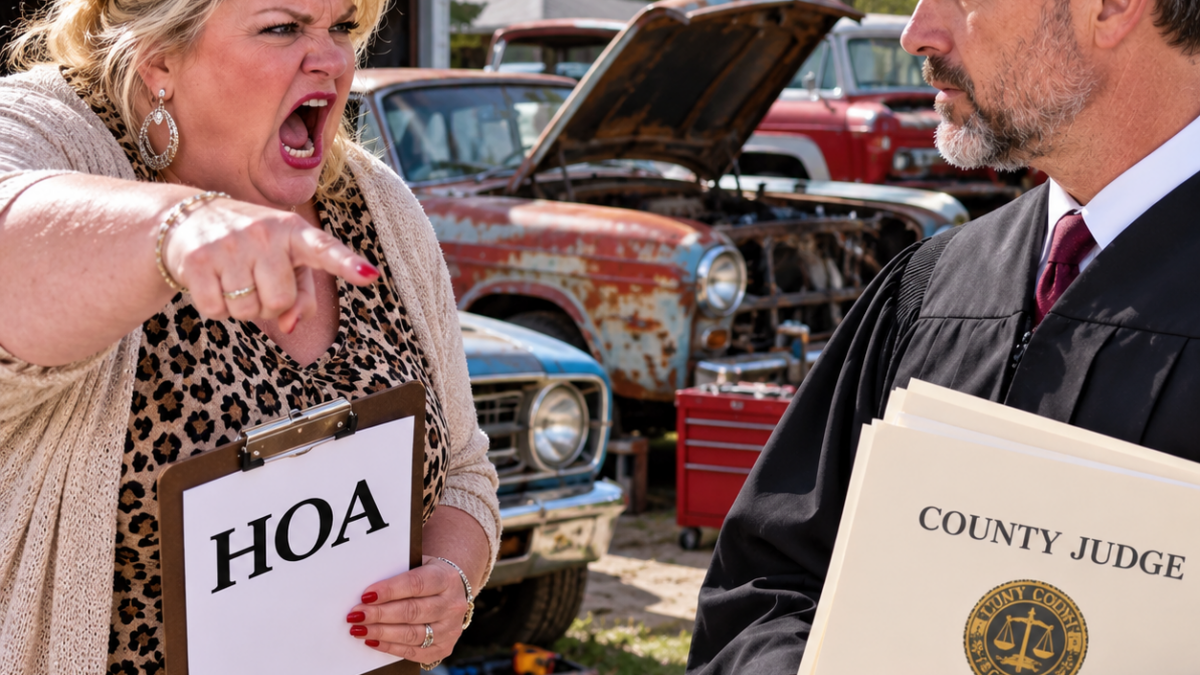
PART 2
My full name is Michael Thomas Rener.
Most people called me Mike.
Karen called me Colonel when she wanted to sound respectful and Mr. Rener when she wanted me to remember that she considered herself in charge.
I retired after thirty years in the United States Army.
The final part of my career was in the Judge Advocate General’s Corps, and the last several years were spent as a military judge.
Before that, I had been a line officer, a staff officer, an attorney, an adviser, an instructor, and probably a dozen other titles nobody outside the military would care about.
What mattered was what the Army taught me.
Rules matter.
Procedure matters.
Documentation matters.
But none of those things matter if the people enforcing them forget why they exist.
Sarah understood that instinctively.
We met when I was twenty-seven.
I was home between assignments and attended a friend’s wedding because avoiding it would have required more effort than going.
Sarah sat beside me during dinner.
She asked what I did.
“Army.”
“For fun?”
“For work.”
“That sounds exhausting.”
“It is.”
Then she told me she managed an elementary-school library.
“For fun?”
“For work.”
“That sounds terrifying.”
“It is.”
We were married sixteen months later.
Military life gave her every reason to leave.
Moves.
Deployments.
Cancelled anniversaries.
Missed birthdays.
Phone calls from bad connections in places she couldn’t pronounce.
But Sarah had a gift for building home wherever we landed.
A tiny apartment near Fort Hood.
A rental house in Virginia.
Government quarters overseas.
It did not matter.
Within a week, she had books on shelves, photographs on walls and something cooking that made the place smell permanent.
She loved old things.
Old houses.
Old furniture.
Old songs.
And especially old cars.
Her father had owned the ’67 Mustang when she was a child.
He sold it when medical bills piled up.
Sarah never blamed him.
But whenever she saw a Fastback at a car show, she stopped.
Every time.
“Look at those lines.”
“It’s a car.”
“It’s art.”
“It leaks oil.”
“That’s part of the art.”
The Bel Air came later.
She saw one at a Fourth of July show, turquoise and white, chrome polished until sunlight bounced off it.
“That one too.”
“How many retirement projects are we planning?”
“As many as it takes to keep you from organizing the garage alphabetically.”
“I would never.”
“You already label extension cords by length.”
“That’s efficiency.”
“That’s a cry for help.”
That was Sarah.
When doctors found the cancer, retirement was less than two years away.
At first we behaved as if the diagnosis were an administrative inconvenience.
Appointments went on the calendar.
Treatment schedules went into folders.
I researched everything.
Survival rates.
Trials.
Specialists.
I approached cancer the way I approached a military problem.
Identify the threat.
Build the plan.
Execute.
Sarah let me.
For a while.
Then one night she put her hand over the laptop.
“Mike.”
“I found another study.”
“Mike.”
“The sample size isn’t huge, but—”
“Stop.”
I looked at her.
She smiled.
“You can’t out-plan this.”
That sentence broke something in me.
Not because I didn’t know it.
Because I did.
She died the following spring.
My daughters, Emily and Rachel, stayed with me through the funeral.
Friends from three decades of service called.
Old soldiers flew across the country.
Flowers filled the house.
Then people left.
That’s the part nobody explains about grief.
The world rallies around you at the beginning.
Then Tuesday happens.
Then Wednesday.
Then another Saturday afternoon when there is no emergency, no funeral and no reason for anyone to be there.
The silence returns.
My retirement ceremony occurred eleven months later.
People congratulated me.
Thirty years.
Colonel.
Decorations.
Speeches.
Someone said, “Now you can finally relax.”
I smiled because that was what they expected.
Inside, I felt like somebody had removed the mission and the person I planned to share the reward with at exactly the same time.
My daughters had families.
They loved me.
They worried about me.
But they had lives.
I refused to become the widowed father who called every evening because he couldn’t tolerate an empty house.
So I bought a place in Oak Haven Estates.
Half an acre.
Three-bedroom house.
Large garage.
Enough distance between neighbors that I could breathe.
The development looked calm.
The HOA documents looked strict but manageable.
I read every page before closing.
That habit alone should tell you something about me.
I didn’t hate homeowners associations.
A well-run association could protect common property, organize maintenance and prevent the one neighbor who believed six broken washing machines constituted lawn art.
What I hated was vague authority.
Section 7.14 would eventually become Karen’s favorite weapon.
It required properties to be maintained in a manner consistent with the “aesthetic character and quality expectations of Oak Haven Estates.”
Broad language.
Too broad.
But not automatically abusive.
Everything depends on how people use discretion.
Karen used discretion the way a child uses a hammer after discovering windows.
Two weeks after I moved in, she arrived carrying a welcome basket.
One dry muffin.
Coffee mug with the Oak Haven logo.
And a three-inch binder.
“We pride ourselves on standards,” she said.
“I read the covenants before closing.”
She looked disappointed.
“Then you understand.”
“I understand what they say.”
Her smile tightened slightly.
“You’ll fit in beautifully.”
That turned out to be optimistic.
My first notice came over a garden hose.
Visible from the street.
I had left it coiled beside the garage for the afternoon.
Apparently HOA guidance allowed temporary exterior equipment to remain visible for no more than four hours.
I moved it.
Photographed the empty wall.
Emailed confirmation.
Karen responded:
*Thank you for your prompt compliance.*
A week later:
Trash cans placed curbside too early.
I corrected it.
Documented it.
Then:
Flag dimensions.
That one angered me.
The flag had flown outside my porch for years.
It had also covered the casket of Sergeant First Class Daniel Mercer, one of the finest men I ever served with.
His widow gave it to me after the funeral because Daniel had once joked that I was the only officer stubborn enough to keep a flag straight in a sandstorm.
Karen’s notice said it exceeded approved decorative-banner width by two inches.
I stood on my porch holding the letter.
For ten minutes I considered making the conflict personal.
Then I read the governing documents again.
The flag provision was more complicated than Karen’s summary suggested.
Federal protections also existed.
I wrote a formal response.
Her notice disappeared.
No apology.
Just silence.
I created a binder.
On the spine I wrote:
**THE QUEEN’S DECREES**
Sarah would have approved the title.
Every notice went inside.
Every reply.
Every photograph.
Every certified-mail receipt.
Karen wanted confrontation.
I gave her records.
Nothing irritated her more.
Then the Mustang arrived.
I found it six months after Sarah died.
A farmer named Hank had listed it online.
The photographs were terrible.
Rust.
Missing interior pieces.
Engine removed.
But the VIN checked out.
The frame was better than expected.
When the flatbed dropped it in my driveway, I stood there longer than I want to admit.
I put my hand on the roof.
“Found it.”
The words came out before I could stop them.
I wasn’t talking to Hank.
For the next year, restoration gave structure to my days.
I woke early.
Coffee.
Walk.
Then a few hours in the garage.
Rust removal.
Parts catalogues.
Metalwork.
Research.
Original specifications.
The work demanded attention without demanding conversation.
It was perfect for grief.
The Bel Air appeared later.
I hadn’t planned to buy it.
But a widower in the next county was selling the unfinished project after moving into assisted living.
He watched me inspect it.
“My wife hated this car.”
“Mine would have loved it.”
“Then take it.”
I did.
Neither car was pretty.
But both were protected.
Registered.
Covered when I wasn’t working.
The Mustang remained in the driveway because the garage was too small to accommodate the work area and both vehicles comfortably.
The Bel Air sat beside the garage under a custom cover.
Karen noticed immediately.
Her first letter called them “derelict vehicles.”
I responded with registrations and the county definition.
Under county ordinance, a derelict vehicle had specific characteristics including expired registration and visible abandonment.
Mine didn’t qualify.
I expected the issue to die.
Instead, Karen escalated.
First notice.
Second notice.
Aesthetics committee determination.
Then the lawn confrontation.
Fourteen days.
Five hundred dollars per day.
Lien.
Foreclosure.
The first fine arrived exactly when she promised.
Five hundred dollars.
I read it twice.
Then placed it in the binder.
A week later, the amount increased.
I submitted a formal appeal and requested a hearing.
The HOA had to grant one.
The community clubhouse looked like every low-budget conference room ever designed.
Beige walls.
Gray folding chairs.
Artificial plant.
Table at the front.
Karen sat in the center.
Arthur Wells, retired accountant, sat to her left.
He looked nervous even before I spoke.
Brenda Cole sat to Karen’s right.
Brenda’s primary role on the board appeared to be nodding.
I set my binder on the table.
Karen looked at it.
“Planning a presentation?”
“I’m planning to document the appeal.”
“Three copies?”
“One for each board member.”
Arthur looked mildly impressed.
Brenda looked offended by paper.
I began.
Registration records.
County code.
Photographs showing covers.
HOA vehicle provisions.
There was no specific prohibition on a registered classic vehicle being actively restored.
The commercial-vehicle restrictions didn’t apply.
Boat provisions didn’t apply.
Recreational-vehicle provisions didn’t apply.
Section 7.14 was vague and, in my view, being interpreted arbitrarily.
I finished in ten minutes.
Karen did not consult Arthur.
Did not consult Brenda.
Did not open the packet.
“Thank you.”
I waited.
“The fine stands.”
Arthur looked at her.
She didn’t look back.
“On what basis?” I asked.
“The aesthetics committee has determined that the vehicles constitute a visual nuisance.”
“The committee being you.”
“I chair it.”
“Was there a vote?”
“Yes.”
“When?”
“That is internal committee business.”
“The rules require minutes.”
Her eyes hardened.
“Mr. Rener, this is not a courtroom.”
Not yet, I thought.
But I only said, “Then please provide the minutes.”
“The board’s decision is final.”
“Not under your bylaws.”
She leaned forward.
“The total outstanding balance is now three thousand dollars.”
“I won’t be paying it.”
Arthur finally looked up.
Brenda stopped nodding.
Karen smiled.
“You will.”
“No.”
“We’ll place a lien.”
“You’re entitled to attempt whatever process the governing documents and law actually permit.”
Her smile disappeared.
I closed my binder.
“This ruling is arbitrary, unsupported by the written covenants and procedurally defective.”
“You think because you were a colonel you can intimidate people.”
“I haven’t mentioned my rank.”
“You use that tone.”
“What tone?”
“That superior tone.”
I almost laughed.
“This is just my voice.”
I stood.
“Send every future communication in writing.”
As I reached the door, Karen called after me.
“You’ll regret this.”
I stopped.
“I’ll have you know I have friends in county government.”
I turned.
She sat behind the folding table like a queen threatening exile.
That sentence did not scare me.
It interested me.
Because Karen didn’t know nearly as much about county government as she thought.
The notice of intent to lien came next.
Balance:
$10,500.
The number was absurd enough that I took a photograph and sent it to my attorney friend Dave Morrison.
He called immediately.
“What did you do?”
“Owned a Mustang.”
“No, seriously.”
“I’m serious.”
He laughed for almost thirty seconds.
Then I told him the rest.
His laughter stopped.
“Mike, you need counsel.”
“I may.”
“You absolutely do.”
“Not yet.”
“Why?”
“I want to see where she takes it.”
“That sentence is why nobody trusts retired colonels.”
“She threatened county action.”
“So?”
I looked at the letter.
“So I suspect she’s going to create something useful.”
Dave sighed.
“You judges are all insane.”
“Former military judge.”
“Same disease.”
Karen did exactly what I expected.
The county code-enforcement letter arrived one week later.
The envelope alone made the issue more serious.
Not an HOA logo.
County seal.
Official complaint.
Inspection scheduled.
Then I read the allegations.
Unlicensed auto-repair business.
Hazardous fluids.
Potential soil contamination.
Gasoline leakage.
Antifreeze.
Vermin.
Vagrants.
Public-health risk.
Property-value degradation.
The complaint described my home as though I were running an illegal scrapyard beside a school.
And Karen had signed it.
Not anonymously.
**Karen Miller, President, Oak Haven Estates HOA.**
I sat at the kitchen table and read every word.
Then I smiled.
Not because the accusations were funny.
Because she had crossed from vague association rhetoric into specific, verifiable factual allegations made to a government agency.
That was different.
Words on HOA paper could be obnoxious.
Words submitted to county enforcement created a public record.
Karen wanted a bigger arena.
She had one.
I prepared.
Not by hiding anything.
By exposing everything.
Receipts.
Vehicle titles.
Registrations.
Restoration logs.
Photographs.
I documented the garage.
Tools.
Parts.
No customer vehicles.
No business signage.
No advertisements.
No payments.
No employees.
No evidence of commerce.
I placed professional drip trays beneath both cars even though neither leaked.
Photographed them.
Morning.
Evening.
Three consecutive days.
I ordered a soil analysis from a local lab.
Clean.
Motion camera for the side yard.
It captured a raccoon.
Three squirrels.
One neighborhood cat.
No vagrants.
The morning of the inspection, I washed nothing.
Moved nothing.
Hid nothing.
At 9:02, a county truck pulled into my driveway.
The inspector stepped out.
David Ortiz.
I knew David professionally.
Not closely.
He had appeared in administrative matters before, but we had never socialized.
He looked at me.
Then paused.
“Judge?”
“David.”
He glanced at the clipboard.
“You’re Michael Rener?”
“Last I checked.”
He actually closed his eyes for half a second.
“You have got to be kidding me.”
“Apparently not.”
He lowered his voice.
“I wasn’t told this was your property.”
“You shouldn’t have been. Treat it exactly like anyone else’s.”
He nodded.
Professional immediately.
“Understood.”
I gestured toward the driveway.
“You have full access to inspect anything authorized by the complaint. I’ve also prepared documents responding to each allegation.”
He looked at the binder.
“Of course you did.”
“Occupational defect.”
From across the street, Karen’s curtain moved.
I noticed.
David noticed me noticing.
He didn’t comment.
We started with the alleged business.
“Any customers?”
“No.”
“Money exchanged?”
“No.”
“Advertising?”
“No.”
“Business license?”
“No business.”
“Vehicle repair for third parties?”
“Never.”
I showed pension documentation and my county appointment information only to establish employment and income sources if needed.
Then the Mustang.
I removed the cover.
David walked around it.
“Fastback?”
“Sixty-seven.”
“Nice.”
“Eventually.”
He looked under the engine bay.
Dry.
Drip pan clean.
Bel Air next.
Same.
Soil report.
Clean.
Then the vermin allegation.
I showed him the wildlife-camera footage.
He watched the raccoon cross the screen.
“That looks dangerous.”
“He has a criminal record.”
David laughed.
Then became serious again.
“Nothing here supports the complaint.”
“I know.”
“I still need to complete the inspection.”
“Take your time.”
He checked drainage.
Storage.
Hazardous materials.
Fuel cans properly stored.
No oil dump.
No fluid discharge.
No business waste.
At the end, he stood beside the truck.
“I can’t promise the wording until review.”
“I wouldn’t ask you to.”
“But I’m not seeing violations.”
“Understood.”
He hesitated.
Then said, “Who filed this?”
“You have the form.”
“I know who filed it.”
He glanced toward Karen’s house.
“I meant why?”
“Control.”
David shook his head.
“I have actual illegal repair operations waiting for inspection.”
“Sorry you lost an hour.”
“You didn’t file it.”
“No.”
He drove away.
Karen’s curtain closed.
The report arrived one week later.
One page.
Four allegations.
Four findings.
**UNFOUNDED.**
Case closed.
I sat at the table reading it.
Sarah would have loved the word.
Unfounded.
Cold.
Bureaucratic.
Brutal.
Karen had tried to summon government force.
Government had inspected.
Government had found nothing.
But the report gave me something else.
An official timeline.
Her HOA notices.
My responses.
Her escalating fines.
Her threat to involve county officials.
Then a county complaint containing allegations that did not survive inspection.
Pattern mattered.
Especially where I worked.
After retiring from the Army, I lasted six months without a formal job.
Then a friend on the county commission called.
“You’re miserable.”
“I’m retired.”
“You’re miserable and retired.”
“What do you want?”
“We need magistrates.”
“No.”
“Part-time.”
“No.”
“Administrative docket.”
“No.”
“Land-use matters.”
I paused.
He heard it.
“I knew it.”
That was how I became a county magistrate judge.
Most of my docket was profoundly unglamorous.
Traffic matters.
Small claims.
Administrative reviews.
Permit applications.
Zoning variances.
Construction matters.
Some hearings were contentious.
Most were paperwork with people attached.
I liked it.
The job demanded precision without swallowing my life.
People in Oak Haven knew I worked part-time.
Most assumed something administrative.
I never advertised the title.
The name on the court calendar was:
**Hon. Michael T. Rener**
Neighbors called me Mike.
Karen apparently never connected the two.
After receiving the county report, I logged into the public docket.
I searched Oak Haven Estates HOA.
One active major application appeared.
**Project 774-B**
New community clubhouse.
Approximately five thousand square feet.
Olympic-size pool complex.
Parking expansion.
Land-use variance.
Estimated cost:
$2.5 million.
Hearing date:
October 26.
Assigned magistrate:
Michael T. Rener.
I stared at the screen.
Then leaned back.
There are moments in life when coincidence becomes almost theatrical.
I did not celebrate.
Because the first thought that entered my mind was not revenge.
It was ethics.
I immediately disclosed the neighborhood dispute to the chief magistrate and county counsel.
I documented that I was an HOA member, that the association was an applicant in a matter assigned to my docket, and that I had an ongoing private dispute involving assessments.
The question was reviewed.
I had no direct financial interest in whether the permit was granted beyond the same generalized interest held by any resident.
My personal fines were not part of the application.
The county complaint against me had been closed.
Still, appearance mattered.
So the parties would be informed before substantive proceedings, and any formal recusal issue could be raised according to procedure.
That mattered to me.
Karen could break every rule she wanted.
I wouldn’t.
Two days later, Dave came over.
I showed him Project 774-B.
He stared at the screen.
Then at me.
“No.”
“Yes.”
“She doesn’t know?”
“Apparently not.”
“You’re assigned?”
“Yes.”
“Mike.”
“I disclosed it.”
“Of course you did.”
“County counsel reviewed it.”
Dave rubbed both hands over his face.
“This is absurd.”
“It’s administrative law.”
“It’s Shakespeare.”
“I need something from you.”
“Anything.”
“I don’t want this hearing becoming about me.”
Dave’s expression changed.
“What are you thinking?”
“The application involves more than zoning dimensions. The HOA is proposing a multimillion-dollar project funded through community money and special assessments.”
“Correct.”
“If residents have legitimate concerns about management capacity, finances or statutory compliance, those concerns need to come from them.”
“Not you.”
“Exactly.”
Dave sat back.
“You want independent residents represented.”
“I want anyone speaking to have counsel if they choose. No ex parte contact with me. No private strategy about the merits once you’re retained.”
“You’re drawing the line now.”
“I’m drawing it permanently.”
He nodded.
“Good.”
“What I can tell you is public.”
“Understood.”
“After this conversation, if you represent residents in the matter, we don’t discuss the case privately.”
Dave smiled.
“Your wife was right.”
“About what?”
“You are exhausting.”
I almost heard Sarah saying it.
That hurt in a way I didn’t expect.
Dave noticed.
He softened.
“She would’ve liked this Mustang.”
“I know.”
He looked toward the garage.
“You going to finish it?”
“That’s the plan.”
“Then let’s make sure Karen doesn’t own your house first.”
We began talking to neighbors.
Not secretly conspiring.
Not building fabricated testimony.
Listening.
Bob Patterson lived two streets over.
Retired firefighter.
Vegetable garden behind his house.
Not a messy garden.
Rows so straight they looked surveyed.
Tomatoes.
Peppers.
Beans.
Herbs.
Bob distributed produce to older neighbors every summer.
Karen fined him because the garden had “agricultural character inconsistent with ornamental residential landscaping.”
He showed me the letter.
I read it twice.
“She actually wrote agricultural character?”
“Yep.”
“You’re growing tomatoes.”
“Apparently that’s how civilization falls.”
The Lees had a four-year-old daughter.
Small plastic slide in the backyard.
Bright yellow.
Maybe four feet tall.
Karen classified it as an “unapproved permanent recreational structure.”
Fine.
Then Mrs. Gable.
Seventy-eight.
Widowed.
Small terrier named Charlie.
Charlie barked at squirrels.
Not constantly.
Not at night.
Karen’s board levied escalating nuisance fines after three complaints.
All from the same neighboring property.
Mrs. Gable opened a folder.
“I paid this instead of filling one of my prescriptions on time.”
I looked up.
“What?”
“It was only delayed.”
“That isn’t the point.”
She shrugged.
“What was I supposed to do?”
That sentence made me angrier than Karen’s threat against my house.
Not because Mrs. Gable was helpless.
Because she had been made to feel helpless.
When people believe procedure is rigged, they stop using procedure.
That is how petty power becomes durable.
Dave formed the Oak Haven Residents for Responsible Governance.
Not my group.
Residents’ group.
He represented Bob, the Lees, Mrs. Gable and several others.
I did not attend strategy meetings once he became counsel in the permit matter.
That separation mattered.
Meanwhile, residents obtained public financial records.
Then association records they were entitled to inspect.
Concerns emerged.
Large landscaping contract.
No meaningful competitive bidding in the file.
Vendor ownership tied to Karen’s brother-in-law.
Administrative fees.
Legal consulting charges.
Reserve fund lower than residents expected.
Nothing automatically proved criminal conduct.
That distinction mattered.
Questions were not convictions.
But for a $2.5 million capital project, unanswered questions mattered.
The hearing approached.
Karen, meanwhile, believed she had won our personal fight.
She circulated another HOA letter claiming that although the county had declined enforcement, the association retained independent authority.
My fines continued.
I responded once.
Formal dispute.
Then stopped.
Two nights before the hearing, I worked on the Mustang until almost eleven.
The engine block sat on a stand.
I had cleaned and painted it.
Sarah’s photograph rested on the workbench.
Not a formal portrait.
She was laughing.
Wind blowing her hair across her face.
Taken at a car show.
A green ’67 Mustang behind her.
I picked up the photograph.
“You picked a hell of a project.”
Silence.
I smiled.
“You also picked me, so judgment clearly wasn’t your strength.”
For years after she died, speaking to Sarah out loud felt embarrassing.
Then I realized grief does not care whether you look ridiculous alone in a garage.
I placed the photograph back.
The next morning, I drove past Karen’s house on my walk.
She was supervising installation of a large decorative fountain.
She saw me.
Her expression hardened.
“Still have those cars?”
“Last I checked.”
“The lien process is moving.”
“Then follow the law.”
“You think you’re untouchable.”
“No.”
“You will after tomorrow.”
That interested me.
“What happens tomorrow?”
She smiled.
“Our clubhouse permit.”
“Ah.”
“The county knows Oak Haven is one of the premier communities in the district. We have strong relationships.”
“I’m sure.”
“Once construction begins, property values are going to rise dramatically.”
“Congratulations.”
Her eyes narrowed.
“I won’t let one bitter resident hold this neighborhood back.”
“Then don’t.”
I kept walking.
She had no idea.
The morning of the hearing, I arrived early.
Black robe.
Files reviewed.
Clerk briefed.
Disclosure statement ready.
The hearing room was small.
Wood-paneled walls.
County seal.
Two counsel tables.
Gallery seating perhaps forty.
By nine fifteen, most seats were full.
Residents.
HOA board.
Attorneys.
County staff.
Dave sat at one table.
Bob.
The Lees.
Mrs. Gable.
A financial expert retained by their group.
On the other side:
Karen.
Brenda.
Arthur.
HOA counsel, Thomas Peterson.
Karen wore a bright pink suit.
From chambers, I could hear her laughing.
Confident.
Then the clerk called the room.
“All rise.”
Chairs moved.
Conversations died.
“The County Magistrate Court is now in session, the Honorable Michael T. Rener presiding.”
I entered.
Sat.
Looked up.
Karen’s face changed.
I will remember that expression until I die.
At first, confusion.
Then recognition.
Then disbelief so complete it almost looked like fear.
Her smile disappeared.
Color drained from her face.
She looked toward the nameplate.
**MICHAEL T. RENER**
Then back at me.
I was not wearing jeans.
No grease.
No Mustang behind me.
No driveway.
No clipboard.
For the first time, Karen understood that the quiet widower she had spent months threatening had an existence beyond Oak Haven.
Peterson noticed her reaction.
He followed her gaze.
Then looked down at his case file.
His eyes widened.
He leaned toward Karen.
Whispered.
She whispered back violently.
I waited.
Silence eventually spread.
“Good morning.”
My voice carried easily.
“We are here on Project 774-B, application by Oak Haven Estates Homeowners Association for zoning variance and related preliminary construction approval.”
Peterson rose.
“Your Honor, before proceeding…”
“Yes?”
“There appears to be a potential conflict of interest.”
Karen stared at me.
I nodded.
“The court anticipated that issue.”
I placed the written disclosure on the record.
“I reside within Oak Haven Estates and have an ongoing private dispute concerning association assessments unrelated to the merits of this application. That matter is not before this court. The assignment and disclosure were reviewed administratively before today’s hearing.”
Peterson shifted.
“My client was not aware.”
“That is why disclosure is being made now before evidence.”
He looked toward Karen.
Then back.
“We would request reassignment.”
I considered the request.
County counsel’s written review was already in the file.
The applicant could articulate specific grounds.
Peterson attempted.
My residence.
The dispute.
Karen’s county complaint.
I listened.
Then ruled according to the process established for administrative hearings.
The mere fact of membership and a separate dispute did not automatically establish legal disqualification under the framework governing the proceeding, but the record would preserve the objection for review.
I also made something explicit.
“My personal HOA dispute will play no role in this decision unless evidence independently admissible and relevant to the application is introduced through proper channels. No party should assume otherwise.”
Peterson sat.
Karen looked furious.
But fear was still there.
“Applicant may proceed.”
For twenty minutes, Peterson presented Oak Haven’s proposal.
Modern clubhouse.
Pool.
Fitness room.
Community event space.
Landscaping.
Parking.
Projected value increase.
Architect renderings.
It was polished.
And frankly, parts of it were attractive.
Being angry at Karen did not make a swimming pool a bad idea.
That was the discipline the hearing demanded.
When Peterson finished, I asked technical questions.
Drainage.
Traffic.
Noise buffers.
Financing structure.
Reserve contribution.
Special assessment.
Operational costs.
Peterson answered some.
Karen attempted others.
Then opposition began.
Dave stood.
“Your Honor, Oak Haven Residents for Responsible Governance does not oppose community improvement as a concept.”
He paused.
“We oppose entrusting a project of this scale to the current administration without adequate safeguards.”
Karen’s face hardened.
Dave continued.
“The concerns are not personal. They are documentary.”
Exactly right.
Bob testified first.
He described the vegetable garden.
Letters entered as exhibits.
Photographs.
Dates.
Appeal.
Fine.
Peterson objected.
“Relevance.”
Dave responded.
“This testimony concerns governance practices and the reliability of the applicant’s internal enforcement representations.”
I allowed limited testimony.
Not because tomatoes determined zoning.
Because applicant-management credibility could bear on compliance plans, financial administration and statements made in support of the application.
The Lees followed.
Their daughter’s slide.
Then Mrs. Gable.
She looked tiny behind the witness microphone.
Dave spoke gently.
“Mrs. Gable, tell the court about Charlie.”
She smiled despite herself.
“He’s a terrier.”
“How old?”
“Nine.”
“Dangerous?”
“To squirrels.”
A few people laughed.
Even I had to fight a smile.
Then she described the fines.
$50.
$100.
$250.
Escalating.
She brought bank statements.
Prescription receipts.
The month she delayed medication.
Karen stared downward.
That testimony changed the room.
Not legally by itself.
Emotionally.
Yes.
Then finances.
The expert accountant laid out what records were available.
Landscaping contract.
Price comparison.
Related-party ownership.
Administrative expenses.
Reserve status.
The expert was careful.
He never called anything theft.
He said:
“Undisclosed conflict concern.”
“Insufficient documentation.”
“Pricing materially above available comparables.”
“Reserve weakness.”
“Potential assessment pressure.”
That precision made the testimony more damaging than accusation.
Karen could dismiss angry homeowners.
It was harder to dismiss numbers.
Then came Arthur.
Nobody expected Arthur.
Not Karen.
Not Brenda.
Perhaps not even Dave until shortly before the hearing.
Arthur took the oath.
Sat.
Looked toward Karen.
Then looked away.
Dave approached.
“Mr. Wells, you serve as treasurer?”
“Technically.”
“Why technically?”
Arthur swallowed.
“Because Karen handles most decisions.”
Karen whispered something to Peterson.
He shook his head.
Dave continued.
“Does the board vote?”
“Yes.”
“Meaningful votes?”
Arthur hesitated.
Karen’s stare could have cut steel.
“No.”
The gallery shifted.
“What do you mean?”
“Karen usually tells us how the board is going to vote before the meeting.”
“Do you review contracts?”
“Not always.”
“Did you review the landscaping bids?”
Arthur looked down.
“There weren’t three complete bids.”
Silence.
Karen turned purple.
Peterson stood.
“Objection, foundation.”
Dave established foundation.
Arthur was treasurer.
Had access to records.
Was present.
Question continued.
Arthur admitted he had expressed concern.
Karen allegedly warned him that failure to support board decisions could expose him to legal claims.
“Did you believe that?”
“Yes.”
“Were you afraid?”
Arthur’s voice became very quiet.
“Yes.”
Karen suddenly stood.
“That is a lie!”
The room froze.
I looked at her.
“Ms. Miller.”
“He’s lying!”
“Sit down.”
“You don’t understand—”
“Sit down.”
For the first time since I had known her, Karen obeyed me immediately.
Not because I was louder.
Because the room had structure.
Authority here came from law.
Not personality.
Arthur continued.
By the time his testimony ended, the issue was larger than a pool.
The HOA’s application depended on representations regarding finances, governance, ability to administer a large construction project and compliance commitments.
The evidence raised serious questions.
Peterson requested a recess.
Granted.
During recess, I remained in chambers.
No hallway conversations.
No Dave.
No residents.
No Karen.
That separation mattered.
Judges do not get to be warriors in their own courtroom.
Whatever satisfaction I felt had to stay outside the decision.
When proceedings resumed, Peterson offered rebuttal.
Then Karen asked to speak.
Her lawyer looked like he wished she wouldn’t.
She approached the podium.
Pink suit.
Hands trembling.
“This entire hearing is a vendetta.”
“Ms. Miller.”
“You have hated me since I enforced the rules against those disgusting cars.”
I let the sentence hang.
Then said:
“You will address the court, not attack individuals.”
She stared.
“Your Honor.”
The words tasted painful to her.
“This proceeding is compromised because you personally resent me.”
“My private dispute is not evidence before the court.”
“You’re letting all these people attack me.”
“They are presenting testimony subject to objection.”
“They’re disgruntled.”
“Then rebut the facts.”
She blinked.
“What?”
“Evidence.”
I leaned slightly forward.
“If financial records are wrong, identify the correct numbers.”
Silence.
“If Arthur’s description of board procedure is wrong, produce minutes demonstrating independent votes.”
Silence.
“If related-party contracts were competitively reviewed, produce the bidding record.”
Silence.
“If reserve concerns are inaccurate, provide audited figures.”
Karen looked at Peterson.
He had documents.
But not enough.
Her greatest weapon had always been certainty.
In that room, certainty required support.
She didn’t have it.
Then she made another mistake.
“You want evidence?”
“Yes.”
She pointed toward me.
“I filed a county complaint because your property was dangerous.”
Peterson closed his eyes.
I said nothing.
Karen continued.
“Your junk cars leaked chemicals. You were running a business. You were destroying property values.”
Dave stood.
“Your Honor, may I respond?”
I considered.
Karen had opened the issue herself.
“Limited response.”
Dave introduced the county report.
The complaint.
Signed by Karen.
Then the inspection findings.
**Unlicensed business: unfounded.**
**Hazardous fluid discharge: unfounded.**
**Vermin/public-health allegation: unfounded.**
**Nuisance-code violation: unfounded.**
Karen stared at the document.
She knew it existed.
But seeing it marked as an exhibit was different.
Dave said:
“This is not offered to litigate Judge Rener’s private HOA dispute. It is offered because Ms. Miller herself raised the complaint as evidence of her administrative judgment.”
Peterson objected.
I sustained part.
Limited scope.
But the report remained relevant to the statement Karen had just made under oath-like formal representation.
The irony was brutal.
She had dragged the issue in.
Not me.
Closing arguments were short.
Then I recessed to review.
The easy ending would have been rage.
Gavel.
Speech.
Humiliation.
Real judging is slower.
I reviewed statutory criteria.
Variance requirements.
Financial assurances.
Management obligations.
Public safety.
Application completeness.
Evidence.
The permit could not be denied because Karen annoyed me.
It could be denied if the applicant failed required criteria.
And several criteria were not met.
The financial structure was inadequate.
Reserve information was incomplete.
Required governance authorizations were questionable.
Compliance representations were unreliable.
Related-party contracting raised unresolved review concerns.
Several project impacts required further documentation.
I returned.
Everyone stood.
Then sat.
Karen looked as if she hadn’t breathed in ten minutes.
I read the ruling.
Not theatrically.
Carefully.
“The court finds that the current application fails to establish sufficient financial, governance and administrative safeguards required for approval of a project of this magnitude.”
Peterson wrote notes.
Karen stared.
“The application is denied in its present form.”
Her mouth opened.
I continued.
“The denial does not determine that Oak Haven Estates may never pursue a community facility. It determines that this applicant record does not presently satisfy approval requirements.”
That differed slightly from the dramatic destruction Karen expected.
But then came the part she feared.
“Separate from the permit ruling, testimony and documentation presented concerning possible financial irregularities exceed the scope of this hearing.”
The room went silent.
“Accordingly, the clerk will transmit relevant portions of the public record to the appropriate county authorities for independent review.”
Karen’s face went white.
No accusation.
No conviction.
Referral.
That was enough.
I brought the gavel down.
“Court is adjourned.”
The room erupted outside, not inside.
I remained on the bench until the clerk completed formalities.
Then left through chambers.
I did not walk into the hallway and celebrate.
Did not shake Dave’s hand.
Did not smile for cameras.
Because something strange had happened.
The moment I feared would feel triumphant mostly felt heavy.
Sarah should have been there.
Not because she cared about HOA politics.
Because she would have stood beside me afterward, touched my arm and said:
“You look tired.”
Then we would have gone home.
Instead, I returned to an empty house.
I took off my tie.
Changed into work clothes.
Walked to the garage.
And spent two hours installing pistons in the Mustang engine.
That was where I finally smiled.
The news spread through Oak Haven within hours.
Not because I told anyone.
Residents were at the hearing.
Public record did the rest.
**HOA CLUBHOUSE PERMIT DENIED AFTER QUESTIONS OVER GOVERNANCE AND FINANCES**
Karen sent an emergency email that evening.
She blamed:
“Activists.”
“Disgruntled residents.”
“Misleading testimony.”
“A biased proceeding.”
What she didn’t mention was Arthur.
What she didn’t mention was the county complaint she herself raised.
What she didn’t mention was the financial record.
The email backfired.
Residents began comparing stories.
More violations surfaced.
A retired teacher fined for a Little Free Library.
A family warned over children’s bicycles.
A veteran cited because his pickup was visible while his garage floor cured.
A widow ordered to remove a memorial bench.
One story alone could be dismissed.
Twenty could not.
A petition for an emergency HOA meeting reached more than seventy percent homeowner support within forty-eight hours.
Karen attempted to postpone it.
The bylaws prevented her.
The normal clubhouse was too small.
The meeting moved to the high school auditorium.
I attended as Mike.
Not Judge Rener.
No robe.
No bench.
Jeans.
Clean shirt.
Back row.
Bob saw me.
“Come sit up front.”
“No.”
“Why?”
“This isn’t my meeting.”
“You started it.”
“No.”
Karen started it.
The residents finished it.”
He smiled.
“Sarah would’ve liked that.”
My chest tightened.
“You never met her.”
“No.”
“But I’ve seen that car.”
Fair enough.
Karen sat at the front.
Gray suit this time.
Peterson beside her.
Brenda had resigned that morning.
Arthur had resigned the previous evening.
That left Karen almost alone.
The interim secretary read the petition.
Then homeowner comments began.
Bob spoke first.
Vegetable garden.
He held up photographs.
“My crime was growing food.”
Laughter.
Then the Lees.
Then Mrs. Gable.
She brought Charlie.
Technically dogs weren’t allowed in the auditorium.
Nobody objected.
Charlie sat quietly beneath her chair throughout the meeting.
When Mrs. Gable spoke, her voice shook.
“I paid hundreds of dollars because this dog barked at squirrels.”
Karen stared at the table.
“I was afraid that if I didn’t pay, they would put a lien on my home.”
The auditorium became silent.
“I’m seventy-eight years old.”
Her voice broke.
“My husband is dead.”
“Charlie is what I come home to.”
Then she looked at Karen.
“You knew that.”
Karen’s face tightened.
Mrs. Gable continued.
“You knew exactly what those fines did to me.”
That moment mattered more to the room than anything that happened in court.
Numbers establish wrongdoing.
Stories establish cost.
Resident after resident spoke.
Years of frustration.
Years of swallowed anger.
Then financial questions.
Then the vote.
Karen stood before it began.
“This board has protected property values for years.”
A man shouted:
“From tomatoes?”
Laughter.
The moderator restored order.
Karen continued.
“You will regret destroying the standards that made Oak Haven desirable.”
Someone else called:
“We’re destroying you, not standards.”
I hated that.
Not because it was false.
Because mobs can become ugly even when they begin with legitimate grievances.
I stood from the back.
People noticed.
I didn’t go to the microphone.
I simply said:
“Let her finish.”
The room quieted.
Karen looked toward me.
For a second, neither of us was judge or president.
Just neighbors.
She finished.
Then ballots.
The count was overwhelming.
No confidence.
Removal as president.
Removal from the board.
Karen sat perfectly still when the result was announced.
Some residents cheered.
Some booed her as she stood.
I didn’t.
Bob didn’t either.
Mrs. Gable just hugged Charlie.
Karen walked down the aisle.
When she passed my row, she stopped.
“You wanted this.”
I looked at her.
“No.”
“Liar.”
“I wanted you to leave my cars alone.”
She laughed bitterly.
“This is revenge.”
“No.”
I shook my head.
“This is what happens when people finally compare notes.”
Her eyes became wet.
Anger.
Humiliation.
Maybe fear.
“I hope you’re happy.”
Then she walked out.
I wasn’t happy.
Not yet.
The new board elected Bob interim president.
His first proposal was simple.
Freeze all disputed fines issued under Karen’s administration pending review.
Passed.
Second:
Independent financial audit.
Passed unanimously.
Third:
Review HOA enforcement rules for clarity and proportionality.
Passed.
I attended one meeting.
Then stopped.
I had enough governance in my life.
The district attorney’s office reviewed the referral.
That took months.
Longer than neighborhood rumors suggested.
People love instant justice because stories are easier when consequences arrive before the commercial break.
Reality requires subpoenas.
Records.
Interviews.
Accounting.
Lawyers.
Eventually investigators identified enough irregularities to pursue charges related to certain contracting and financial practices.
Karen and her brother-in-law faced criminal exposure.
Not every allegation residents repeated proved true.
That mattered.
I corrected people when they exaggerated.
“She stole millions.”
“No evidence of that.”
“She bribed county officials.”
“No evidence.”
“She paid herself HOA money.”
“Not established.”
“Why are you defending her?”
“I’m defending facts.”
Sarah would have appreciated that distinction.
The eventual resolution was less spectacular than rumor.
Karen entered a plea to reduced charges.
Probation.
Community service.
Restitution exceeding one hundred thousand dollars tied to financial losses and improper transactions.
Her brother-in-law entered his own resolution.
No prison.
No dramatic handcuffs outside the courthouse.
Consequences nonetheless.
A FOR SALE sign appeared in Karen’s yard shortly afterward.
I saw movers two weeks later.
I did not walk over.
Did not say goodbye.
Some chapters end quietly.
The new board also dealt with my cars.
Bob called.
“We reviewed your fines.”
“Congratulations.”
“You owe zero.”
“I know.”
“We’re formally rescinding them.”
“Good.”
“And releasing the lien notice.”
“Better.”
“Also…”
I waited.
“We rewrote the vehicle guideline.”
“That sounds dangerous.”
He laughed.
“Registered restoration projects are permitted if maintained responsibly and not used commercially.”
“Reasonable.”
“Don’t sound so surprised.”
“I’m adjusting.”
Then he asked:
“You going to finish Sarah’s Mustang?”
“Yes.”
“When?”
“That depends on how often you call me about HOA business.”
He stopped calling.
By autumn, the engine was ready.
That morning was perfect.
Cool air.
Clear sky.
Leaves beginning to turn.
I opened the garage early.
The Mustang sat in the driveway.
Front end waiting.
Engine hoist positioned.
Tools arranged.
Torque wrench.
Chains.
Leveler.
Bob arrived carrying two beers.
“At nine in the morning?”
“For later.”
“Good recovery.”
He set them in the refrigerator.
Then looked at the engine.
“That’s beautiful.”
“Sarah would disagree.”
“What?”
“She’d ask why I painted the block before installing it.”
“Why?”
“Because she enjoyed criticizing process she knew nothing about.”
Bob laughed.
We worked slowly.
Raise.
Roll forward.
Angle.
Lower.
Adjust.
Stop.
Check clearance.
Again.
Hours passed.
At one point I caught myself looking toward the garage door expecting Sarah to appear with coffee.
Grief does that.
Years later, some part of you still expects the impossible out of habit.
By afternoon, the engine sat in place.
I stood there staring.
Bob handed me a beer.
“Mike.”
“Yes?”
“You okay?”
I nodded.
Then shook my head.
Then laughed.
“Ask again in a minute.”
He didn’t.
We sat on the tailgate.
Children played somewhere down the street.
Lawn mower.
Dog barking.
Ordinary neighborhood sounds.
Not fearful silence.
Bob took a drink.
“We resubmitted the clubhouse project.”
“I saw.”
“Smaller.”
“Much.”
“No Olympic pool.”
“Good.”
“Normal community pool.”
“Reasonable.”
“Lower assessment.”
“Very reasonable.”
“Competitive bids.”
I looked at him.
“Now you’re just showing off.”
He smiled.
“It was approved.”
“I know.”
He glanced at me.
“You didn’t review it.”
“No.”
“Why?”
“Different magistrate.”
“Because of me?”
“Because I requested reassignment once the private HOA dispute became active litigation.”
Bob nodded.
“That was probably smart.”
“It was necessary.”
He looked at the Mustang.
“Funny.”
“What?”
“Karen kept saying you were using your position against her.”
“I know.”
“But you’re the one who stepped away.”
I took a drink.
“That’s what authority is supposed to look like.”
Bob was quiet.
Then:
“You ever miss the Army?”
“Every day.”
“Would you go back?”
“Not for one second.”
He laughed.
I understood the contradiction.
Service becomes part of you.
So does the relief of leaving.
Later that evening, after Bob left, I remained in the garage.
I connected battery leads.
Checked fluids.
Verified wiring.
The car wasn’t ready to drive.
But the engine could potentially start.
I placed Sarah’s photograph on the cowl.
“Okay.”
My voice sounded too loud.
“This was supposed to be your job.”
Silence.
I turned the key.
Starter.
Nothing.
I laughed.
“Of course.”
Checked connection.
Second attempt.
Starter turned.
Engine coughed.
Stopped.
My heart hammered harder than it had before hearings involving men with actual criminal charges.
Third attempt.
The engine caught.
For a second, rough.
Then stronger.
A deep mechanical rumble filled the driveway.
I froze.
The sound hit my chest.
Exhaust.
Fuel.
Steel.
Vibration.
And memory.
I started crying before I knew it.
Not dramatic sobbing.
Tears.
Uncontrolled.
I put one hand on the roof.
“Got it running, Sarah.”
The engine idled.
Neighbors came outside.
Of course they did.
Bob crossed the street.
The Lees appeared with their daughter.
Mrs. Gable walked down carrying Charlie.
Nobody complained about the noise.
Bob shouted:
“THAT THING LEGAL?”
I wiped my eyes.
“ASK THE COUNTY!”
Everyone laughed.
I shut the engine down.
Silence returned.
But this time the silence did not feel empty.
That was the difference.
For years after Sarah died, I thought healing meant getting back to the person I was before.
It doesn’t.
That man had a wife.
A future arranged around two people.
You don’t return.
You build forward with whatever remains.
The Mustang did that for me.
Bolt by bolt.
Panel by panel.
Month by month.
Karen nearly turned it into a symbol of war.
I refused to let her keep that meaning.
It was Sarah’s car.
Always had been.
A month later, Emily and Rachel visited.
They hadn’t seen the Mustang since the engine went in.
Emily walked around it.
“Mom would hate the color.”
“It isn’t painted yet.”
“She’d hate whatever you choose.”
“Probably.”
Rachel touched the roof.
“Dad.”
“Yeah?”
“You really did it.”
“Not finished.”
“You know what I mean.”
I did.
We found Sarah’s original list that night.
I had kept it in a drawer.
Retirement projects.
Travel.
Restore Mustang.
See Yellowstone again.
Plant tomatoes.
Learn to dance.
I pointed to the last one.
“Absolutely not.”
Emily laughed.
“Mom would’ve forced you.”
“She tried.”
“Did you?”
“Once.”
“How bad?”
“International incident.”
For the first time since Sarah died, we spent an evening talking about her without the conversation collapsing under grief.
We laughed.
That was another kind of restoration.
Oak Haven changed gradually.
Not magically.
There were still arguments.
Grass height.
Parking.
Pool hours.
Fence materials.
One man tried to install a twelve-foot inflatable skeleton permanently in his front yard.
The board told him no.
He complained about authoritarianism.
Bob called me.
“What do you think?”
“I think twelve-foot skeletons are outside my jurisdiction.”
“Coward.”
Reasonable rules remained.
That was important.
The lesson wasn’t that all HOA standards were tyranny.
The lesson was that power without accountability becomes personal.
The new board published minutes.
Contracts above established thresholds required competitive bids.
Financial statements became understandable.
Fine schedules became proportional.
Formal hearings required actual votes.
Board members disclosed conflicts.
Residents could appeal.
The world did not end.
Property values did not collapse.
Mrs. Gable’s dog still barked at squirrels.
Oak Haven survived.
Bob replanted his vegetable garden.
Larger this time.
Karen would have hated it.
One afternoon he left tomatoes on my porch with a note.
**ILLEGAL AGRICULTURAL CONTRABAND.**
I laughed for five minutes.
The Lees’ daughter grew out of her plastic slide.
They donated it instead of destroying it.
Mrs. Gable stopped paying fines and started attending meetings.
Nobody could stop her from talking once she began.
Bob later told me the board once spent forty minutes debating whether to adjourn because Mrs. Gable was still discussing dog-noise enforcement.
I told him justice has a price.
A year after the hearing, Oak Haven held the opening for the new clubhouse.
Smaller.
Simple.
Well built.
Pool beside it.
No marble entrance.
No giant fountain.
No monument to a president.
Just a useful building.
Bob invited me.
I declined.
Then Mrs. Gable called.
“You are attending.”
“Am I?”
“Yes.”
“Why?”
“Because there’s cake.”
I went.
A small bronze plaque near the entrance listed:
**Oak Haven Community Center
Funded and Built Through the Contributions of Oak Haven Homeowners**
No president’s name.
That made me smile.
Bob walked over.
“Different from Karen’s plan.”
“Better.”
“Less impressive.”
“More affordable.”
“That too.”
Children jumped into the pool.
Parents sat beneath umbrellas.
Neighbors talked.
Nobody cared who was in charge.
That might have been the healthiest sign of all.
I wandered toward the parking lot.
A man I barely knew approached.
“You’re Judge Rener.”
“Sometimes.”
“You’re the reason Karen got removed.”
“No.”
He looked surprised.
“You denied the permit.”
“I denied an application that didn’t satisfy the record.”
“You exposed her.”
“Residents testified.”
“You sent the records to prosecutors.”
“The court transmitted evidence for review.”
He frowned.
“You don’t take credit for anything, do you?”
I thought about that.
“Credit is dangerous.”
“How?”
“You start believing outcomes belong to you.”
I looked back at the clubhouse.
“That building belongs to them.”
I pointed toward the residents.
“The old board forgot that.”
He nodded slowly.
Then walked away.
I understood Karen better after she was gone.
That may sound strange.
Distance makes people easier to see.
I don’t think she woke one morning and decided to become a neighborhood tyrant.
Probably nobody does.
She likely joined the board believing she could improve things.
Then people deferred to her.
She learned that speaking confidently made others surrender.
Small victories reinforced the behavior.
One rule.
Another.
One fine.
Another.
Each time someone complied, it proved to her that she had been right.
Eventually disagreement itself became evidence of wrongdoing.
That is how power distorts judgment.
Not always dramatically.
Incrementally.
She once criticized my flag.
Then my garden hose.
Then my trash cans.
Then my cars.
Then my home.
Each step made the next feel normal to her.
Until she signed a government complaint accusing a widower restoring his wife’s dream car of poisoning the water table and attracting vagrants.
At some point, nobody around her said:
“Karen, this is insane.”
Arthur was afraid.
Brenda agreed.
Residents paid.
Silence looked like consent.
I knew that phenomenon from the military too.
Good command climates depend on subordinates who can say:
“Sir, that is a bad idea.”
A leader surrounded by people who only nod eventually mistakes obedience for competence.
Years later, I received a letter forwarded through the HOA management office.
No return address I recognized.
Inside was one page.
Mike,
I don’t expect a response.
I have had a lot of time to think about what happened at Oak Haven.
I still believe communities need standards.
I still believe some of the residents who complained about me ignored how difficult board service can be.
But I also know I crossed lines.
I made disagreements personal.
I used enforcement when I should have used conversation.
Your cars became a symbol to me because you refused to be intimidated, and I mistook that refusal for disrespect.
The county complaint was wrong.
I knew some of the allegations were exaggerated when I signed it.
I told myself I was forcing officials to investigate.
The truth is I wanted them to scare you.
For that, I am sorry.
Karen
I read the letter three times.
The sentence that mattered was not “I am sorry.”
It was:
**I wanted them to scare you.**
That was honesty.
Late.
Costly.
But honesty.
I placed the letter inside the Queen’s Decrees binder.
Final page.
Then I changed the label.
Emily saw it months later.
“ACCOUNTABILITY?”
“More accurate.”
“You’re getting sentimental.”
“Absolutely not.”
“You kept Karen’s apology.”
“Evidence.”
“Dad.”
“Documentation.”
She laughed.
The Mustang eventually received paint.
Deep Highland Green.
Sarah’s favorite.
Chrome restored.
Interior black.
Original-style wheels.
Nothing flashy.
When I finally drove it for the first time, I waited until early Sunday morning.
No crowd.
No neighbors.
No camera.
Just me.
I placed Sarah’s photograph on the passenger seat.
Ridiculous.
I didn’t care.
Engine started.
Gear engaged.
The car rolled down the driveway.
Past Bob’s garden.
Past the Lees’ house.
Past Mrs. Gable walking Charlie.
She waved both arms.
I turned onto the main road.
For the first mile, I heard every possible mechanical sound.
Engineer’s curse.
Then I relaxed.
Window down.
Cool air.
V8 rumble.
Sunlight through trees.
At a red light, I looked toward the passenger seat.
“You were right.”
The photograph did not answer.
“Okay, you were right about the car.”
Still nothing.
“Don’t get used to it.”
I laughed alone at the light.
A driver beside me stared.
Let him.
I drove thirty miles.
No destination.
Sarah had always complained that I needed a reason to go somewhere.
That morning, I didn’t.
When I returned, Bob waited near my driveway.
“Well?”
I shut the engine down.
“Needs timing adjustment.”
He stared.
“That’s all you have to say?”
“What do you want?”
“Was it amazing?”
I looked at the Mustang.
Then toward the empty passenger seat.
“Yes.”
Bob nodded.
“Good.”
Then he held up an envelope.
“What’s that?”
“HOA notice.”
I stared at him.
He kept a straight face.
“Noise violation.”
I grabbed for it.
He jumped back laughing.
The envelope contained a gift certificate to a local diner.
Across the front he had written:
**FOR EXCESSIVE LEVELS OF HAPPINESS.**
I hated how much I liked it.
Years passed.
I reduced my court schedule.
Then retired fully.
Again.
This time retirement felt different.
I had work when I wanted it.
Cars.
Garden.
Neighbors.
Daughters visiting.
Grandchildren climbing into the Mustang and asking why cars used to need keys.
The Bel Air became the next project.
Slower.
I was older.
Hands stiffer.
No urgency.
One Saturday, my oldest granddaughter sat on a stool in the garage.
“What was Grandma Sarah like?”
That question stopped me.
She had never met her.
I looked toward the Mustang.
“Funny.”
“Mom says she was bossy.”
“Extremely.”
“She liked cars?”
“Loved them.”
“Did she fix them?”
“No.”
“Then why did she like them?”
“Because you don’t have to know how something works to know it makes you happy.”
My granddaughter considered that.
Then pointed at the Bel Air.
“Is that junk?”
I laughed.
“Careful.”
“Mom said the HOA lady called them junk.”
“Your mother talks too much.”
“So is it?”
“No.”
“What is it?”
I looked around the garage.
Parts.
Tools.
Photographs.
Sarah’s old list framed on the wall.
“A promise.”
She frowned.
“Cars can’t be promises.”
“Anything can.”
That answer satisfied neither of us.
But someday it might.
Oak Haven became an ordinary neighborhood.
Which was the greatest success possible.
The clubhouse needed roof repairs.
Residents argued about budget.
The pool closed once because somebody’s kid put bubble bath in the filtration system.
Bob resigned from the board after four years.
Mrs. Gable threatened to run.
Everyone panicked.
She ultimately declined because Charlie “needed experienced full-time supervision.”
People laughed about the Karen years eventually.
That took time.
Humor is another sign that fear has lost authority.
Someone referred to an unusually strict parking email as “Karen energy.”
Another resident proposed naming a garden plot “The Unauthorized Agricultural Zone.”
Bob’s vegetable patch won a county beautification recognition.
I mailed him a copy of Karen’s old violation notice in a frame.
He hung it in his garage.
The Mustang started winning small car-show awards.
Nothing major.
Best Restored.
People’s Choice.
Veterans’ Favorite.
Every time somebody asked how long restoration took, I said:
“Longer than planned.”
They assumed I meant mechanical work.
I didn’t correct them.
The most meaningful show happened five years after Karen left.
Local charity event.
Cancer-support fundraiser.
I entered the Mustang because Sarah would have demanded it.
I displayed one small card beside the windshield.
**1967 Ford Mustang Fastback
Restored in memory of Sarah Rener
Librarian, wife, mother, professional critic of her husband’s organizational habits.**
Emily added the final phrase without telling me.
People stopped.
Read.
Smiled.
One older woman touched my arm.
“My husband and I were going to restore a Corvette.”
“Were?”
“He passed last year.”
I understood the tense.
She looked at the Mustang.
“I sold it.”
“No shame in that.”
“I know.”
She nodded.
“I just wondered.”
“About?”
“Whether I should have kept it.”
I looked at her.
There are moments when people want advice.
And moments when they want permission not to regret themselves.
“You kept what mattered.”
She began crying.
“So did you.”
Then she walked away.
I sat behind the Mustang for a long time afterward.
The car won no trophy that day.
Didn’t matter.
At sunset, I drove home.
Pulled into Oak Haven.
Children on bicycles.
Someone grilling.
Bob watering tomatoes.
A dog barking.
No one afraid.
I parked the Mustang in my driveway.
Exactly where Karen once stood threatening foreclosure.
For a while, I remained behind the wheel.
I thought about that morning.
Fourteen days, Mr. Rener.
The confidence in her voice.
The certainty that authority would bend reality.
If she had simply disliked the cars and left me alone, none of what followed would have happened.
If she had issued one notice and accepted the appeal, nothing.
If she had read the county ordinance, nothing.
If she had listened to Arthur, nothing.
If she had refrained from false allegations, nothing.
At every stage, she had an exit.
Pride closed each one.
People sometimes call what happened revenge.
I understand why.
She threatened my home.
Then walked into my courtroom.
Her project failed.
Her finances were investigated.
Her board collapsed.
She lost her position.
She eventually faced criminal consequences.
It sounds like revenge.
But revenge would have required me to use power the way she did.
To decide the outcome first.
To make the rules fit my anger.
I didn’t.
That distinction matters more to me than any victory.
When her county complaint arrived, I opened my property.
When her permit reached my docket, I disclosed the conflict.
When residents testified, they brought documents.
When financial questions arose, experts reviewed records.
When potential crimes appeared, investigators—not neighbors—decided what they meant.
The system Karen tried to weaponize against me worked because people eventually stopped treating it like a weapon.
They treated it like a process.
That is slower.
Less satisfying in the moment.
But far more powerful.
Sarah used to tell me:
“You don’t always have to win, Mike.”
I hated that sentence.
Still do.
Sometimes she followed it with:
“You only have to make sure you don’t become the thing you’re fighting.”
I understand that one now.
Karen lost her title.
I kept my house.
Oak Haven got better governance.
The county got a clubhouse application that eventually made sense.
Residents got their voices back.
And I finished Sarah’s Mustang.
That last part is the one I care about most.
Because before Karen turned it into evidence, before lawyers referred to it as a vehicle, before code enforcement photographed it, before neighbors called it a symbol of resistance, it was just a car my wife wanted us to build together.
The world tried to make it mean something else.
I gave it back its original meaning.
Memory.
Love.
Purpose.
A promise kept too late for the person who made me promise it.
Sometimes, on Sunday mornings, I still drive with Sarah’s photograph on the passenger seat.
Not every time.
I’m not completely insane.
Just often enough.
There is a road outside town that runs through open farmland.
Little traffic.
Long curves.
In autumn the trees turn gold.
Sarah loved that road.
I drive there.
Roll the window down.
Let the engine settle around two thousand RPM.
And for a few miles, the years between us seem smaller.
Not gone.
Never gone.
Just smaller.
Then I return to Oak Haven.
Past the clubhouse Karen wanted to build as a monument to herself.
The simpler version stands there now.
Families use it.
That’s enough.
Past Bob’s garden.
Still agricultural.
Still illegal according to one framed letter hanging in his garage.
Past Mrs. Gable’s house.
Charlie died eventually.
She planted a small tree for him.
The board approved it.
Actually, they didn’t need to.
Nobody asked.
Past the Lees’ house.
Their daughter is nearly grown.
No slide.
Bicycle in the driveway sometimes.
Civilization survives.
Then home.
The Mustang goes in the garage now.
Not because an HOA forced me.
Because I finished it.
That difference is everything.
One evening my granddaughter asked me why I kept the Queen’s Decrees binder.
I pulled it down.
Thick.
Old notices.
Photographs.
County report.
Financial hearing papers.
Karen’s apology.
“History,” I said.
She rolled her eyes.
“That’s boring.”
“You asked.”
“Tell me the short version.”
I thought for a second.
Then said:
“A woman thought rules made her powerful.”
“What happened?”
“She forgot rules apply to the people enforcing them too.”
My granddaughter nodded.
“And then you beat her?”
“No.”
“Mom says you did.”
“Your mother exaggerates.”
“What happened?”
I looked toward the Mustang.
“She reported my junk cars to the county.”
“And?”
“They inspected.”
“And?”
“They weren’t junk.”
She waited.
“That’s it?”
“Pretty much.”
She narrowed her eyes.
“Mom says she walked into court and you were the judge.”
I sighed.
“Your mother really does talk too much.”
Her face lit up.
“So it’s true?”
“Yes.”
“What did she do?”
I remembered Karen’s face when the clerk said my name.
Despite myself, I smiled.
“She finally read the nameplate.”
My granddaughter laughed so hard she nearly fell off the stool.
That story will probably outlive the truth.
Family stories always do.
Someday they’ll say Karen fainted.
She didn’t.
Someday they’ll say I slammed a gavel and sent her directly to jail.
I didn’t.
Someday they’ll say I owned ten classic cars.
Please God, no.
But the truth is better than the legend.
A bully threatened the wrong thing.
Not because the owner was secretly powerful.
Not because I was a judge.
Because she created documents.
Records.
Witnesses.
Complaints.
Financial trails.
She made herself accountable.
I just refused to destroy the evidence for her.
And that is what I remember whenever I see somebody confuse a title with immunity.
HOA president.
Colonel.
Judge.
Board member.
Those titles are tools.
Nothing more.
Karen treated hers like a crown.
The Army taught me mine was borrowed.
The court reinforced it.
Sarah made sure I never forgot it.
She once attended one of my military promotion ceremonies.
Afterward, everybody called me “sir.”
Sarah waited until we reached the parking lot.
Then handed me her purse.
“Hold this.”
I looked at the new rank on my uniform.
“You understand I just got promoted.”
“Yes.”
She handed me two grocery bags too.
“Congratulations.”
That woman could destroy ego faster than any judicial ethics lecture.
I wish she had been around when Karen arrived.
Maybe Sarah would have ended the whole thing in thirty seconds.
Karen:
“Those cars lower property values.”
Sarah:
“Then don’t buy them.”
Problem solved.
Instead, I needed binders, inspectors, attorneys, accountants, a courtroom and half a neighborhood uprising.
Somewhere, I am certain Sarah finds that hilarious.
The last major restoration step on the Mustang was the badge.
Small chrome horse.
Front grille.
I saved it for last intentionally.
The afternoon I installed it, the driveway was quiet.
No Bob.
No neighbors.
No ceremony.
I tightened the final fastener.
Stepped back.
There it was.
Complete.
Not perfect.
No restoration ever is.
But complete.
I sat on the garage floor.
For a long time.
Then took out my phone.
Opened Sarah’s contact.
I had never deleted it.
Her number belonged to someone else now.
I knew that.
I didn’t call.
I opened the notes app instead.
Typed:
**Finished the Mustang.**
Then beneath it:
**You were right. It has stories.**
I saved the note.
That was enough.
People think a satisfying ending means the villain is punished.
Maybe sometimes.
But punishment fades.
Karen moved away.
Another family lives in her house.
Her fountain is gone.
Most new residents don’t know her name.
The criminal case is old news.
Even her apology sits closed in a binder.
What remains?
Mrs. Gable can live without fearing a dog fine.
Bob grows tomatoes.
The Lees let children be children.
HOA finances are transparent.
The clubhouse serves residents rather than one president’s ego.
And Sarah’s Mustang runs.
That is the ending I wanted.
Not destruction.
Restoration.
Because that was what I had been doing from the beginning.
Restoring a car.
Restoring purpose.
Restoring my ability to live in a house that had felt empty.
Then, unexpectedly, helping restore a neighborhood where people had forgotten that rules were supposed to serve them.
Karen once looked at the rusted Mustang and saw junk.
She never understood that broken things are not always worthless.
Sometimes they’re waiting for someone patient enough to rebuild them.
The same turned out to be true of Oak Haven.
And, if I’m honest, of me.
So whenever somebody asks whether Karen really reported my “junk cars” to the county before discovering I was the magistrate assigned to her precious permit hearing, I tell them yes.
That part is true.
Then they usually grin and ask the obvious question.
“What did her face look like when she saw you on the bench?”
I could describe it.
The shock.
The color draining away.
The moment recognition hit.
But I don’t anymore.
I just smile.
Then I look toward the Highland Green Mustang sitting beneath the garage lights.
And I say:
“Not nearly as good as Sarah would’ve looked driving that car.”
Because in the end, Karen was never the most important person in this story.
Sarah was.
She was the reason those cars were there.
The reason I refused to let someone call them garbage.
The reason I kept working when grief told me there was nothing left to build.
Karen thought she was threatening a pile of metal.
She was threatening the last promise I had made to my wife about the life we were supposed to share.
And that was something no fine, no lien, no fake complaint and no self-appointed neighborhood queen was ever going to take away from me.
The Mustang is still here.
So am I.
And Oak Haven finally learned the lesson Karen never did.
Authority can tell people where the lines are.
It does not give you the right to move those lines whenever someone refuses to bow.
Sometimes the quiet man in the greasy T-shirt really is just a widower working on an old car.
And sometimes, before you report him to the county and threaten his home, you might want to learn his full name.
Especially if your next permit application is sitting on his docket.