PART 2: HOA Karen Called My 150-Acre Farm an Eyesore—So I Put a Wind-Energy Project on the Ridge She Couldn’t Control
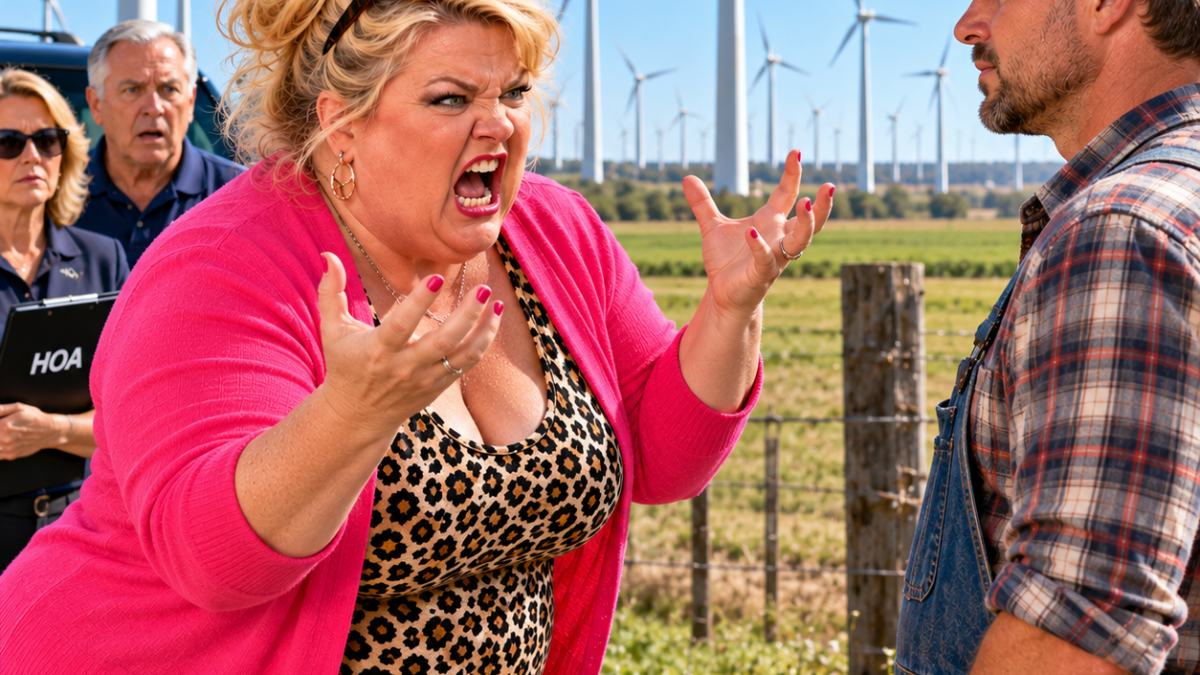
The first time Karen called my family farm an eyesore, I let it go; the third time, she handed me a $5,000 fine and threatened the land my grandfather had worked before her subdivision even existed.
She believed a title on an HOA board gave her the power to decide what I could park beside my barn, how tall my hay could grow, and eventually whether I was allowed to keep the property my family had held for generations.
What she never understood was that the same ridge she hated looking at gave me an option so enormous, so completely outside her authority, that once I signed the first papers, the entire neighborhood began asking a very different question about who the real problem was.
Karen Cross was standing on the sidewalk across from my north pasture when she announced that my grandfather’s barn was “a blight on the prestige of Summit Creek Estates.”
She made sure people heard her.
That was important to Karen.
Being angry privately was never enough.
She needed an audience.
Her finger was aimed past the weathered barn toward my 1952 Farmall tractor.
The tractor was red once.
Most of it still was.
But decades of use, restoration, sun, rain, oil, and honest age had created patches of darkened metal and surface rust that no amount of cosmetic polishing could completely erase without destroying the character I had spent two years preserving.
To Karen, it was junk.
To me, it was one of the few things I owned that could make me hear my father’s voice without closing my eyes.
He taught me to change the oil on that Farmall when I was twelve.
He taught me to double-clutch it.
He taught me not to fight old machinery when it resisted.
“Listen to what it’s telling you, Jack,” he used to say.
“Machines usually warn you before they break.”
People do too, I eventually learned.
Karen had been warning me for months.
I just hadn’t listened closely enough.
“This notice,” she said, pushing an envelope toward me, “requires the immediate removal of that vehicle.”
“It’s a tractor.”
“It is visible from Summit Creek.”
“So?”
“It violates our aesthetic standards.”
“My farm isn’t in Summit Creek.”
Her expression barely moved.
“Your property affects Summit Creek.”
“That isn’t the same thing.”
“It is when property values are involved.”
I opened the envelope.
Formal violation notice.
Summit Creek Estates Homeowners Association.
Unauthorized exterior condition.
Unapproved machinery.
Aesthetic blight.
Fine:
$5,000.
Daily escalation after the compliance deadline:
$500.
For several seconds I simply stared at the number.
Then I looked at Karen.
“You’re fining me five thousand dollars for rust.”
“I’m fining you for noncompliance.”
“With rules that do not apply to me.”
Her smile tightened.
“Mr. Marcus, we have been more than patient.”
“You don’t have jurisdiction over these 150 acres.”
“The board’s legal counsel disagrees.”
I glanced at the subdivision behind her.
Rows of large beige houses.
Matching mailboxes.
Matching stone entrances.
Lawns trimmed so precisely they looked vacuumed rather than mowed.
My family’s land sat in the middle of it all like something forgotten by a developer.
Because that was basically what had happened.
When the surrounding farms were sold in the late 1990s, the developer tried to buy ours too.
My father refused.
Later, I bought the property from him with nearly everything I had saved during thirty years in the Army Corps of Engineers.
It was not a financial investment.
It was a promise.
Keep the land.
Keep the barn.
Keep something real.
Now Karen stood thirty feet from my property line threatening it because she disliked the color of old steel.
“You should read my deed,” I said.
“I have lawyers for that.”
“Then ask them to read it.”
She took a step closer.
“Comply, Jack.”
First-name basis now.
Bad sign.
“This doesn’t need to become ugly.”
I folded the notice.
“Karen, you’re standing outside my farm threatening me with fines you have no authority to issue.”
“I am protecting seven hundred families from declining property values.”
“From a tractor?”
“From disorder.”
There it was.
Not rust.
Not the barn.
Not property values.
Disorder.
My land did not match her vision.
And therefore, in Karen’s mind, it needed to be controlled.
She turned toward her SUV.
Then looked back.
“I hope you make the intelligent choice.”
I watched her leave.
That evening I placed the $5,000 notice on the same oak table where my father used to sort seed invoices.
My wife, Sarah, read it twice.
Then she looked at me.
“What are you going to do?”
I looked through the window toward the ridge above the pasture.
At the time it was empty except for grass, oak trees, and wind.
A lot of wind.
I had no idea then just how useful that wind was about to become.
PART 2
My name is Jack Marcus.
I spent thirty years in the Army Corps of Engineers.
Colonel when I retired.
I built bridges, repaired infrastructure, coordinated emergency construction, dealt with contractors who believed schedules were philosophical suggestions, and learned that most impossible problems become less impossible once you stop arguing with them emotionally and start identifying the systems underneath them.
When I left active service, I had no desire to run anything.
No consulting firm.
No municipal job.
No federal contract.
People offered.
I declined.
I wanted to go home.
Home was 150 acres my grandfather had farmed, my father had worked, and I had spent my childhood trying desperately to escape.
Funny how that happens.
At eighteen, I couldn’t leave fast enough.
At fifty-eight, I would have defended every fence post.
The property rolled across pasture and wooded hills on the edge of the county.
There was the main farmhouse.
The old cypress barn.
A smaller equipment shed.
Stone walls my great-grandfather had built by hand.
A creek at the southern boundary.
And the long northern ridge.
The ridge had always been the windiest place on the farm.
My father hated baling hay up there.
I loved it as a kid because it made cheap kites fly like fighter jets.
In the late 1990s, a developer began buying neighboring acreage.
Farm after farm disappeared.
Roads went in.
Utility lines.
Storm drains.
Then houses.
Hundreds.
Summit Creek Estates.
The developer offered my father money for our land.
Good money.
Then more.
My father told him no twice.
The third time he stopped answering the phone.
Eventually the developer built around us.
Our farm became an island.
For years, that caused no problem.
Residents liked us.
Children came for pumpkins in October.
People walked near the fence and waved.
Our hay fields provided open space.
The barn became something of a landmark.
Somebody once painted it for a high school art project.
People called us “the farm.”
Not with hostility.
Just geography.
“Turn left after the farm.”
“The trail begins across from the farm.”
“Meet me near the farm.”
Fine by me.
Then Karen Cross became HOA president.
I met her two weeks after her election.
She arrived in a black Escalade and parked along the county shoulder.
I was repairing fence.
She stood watching for a moment.
Then said:
“Are you Mr. Marcus?”
“Yes.”
“I’m Karen Cross.”
I waited.
“President of Summit Creek Estates.”
“Congratulations.”
She didn’t seem to appreciate that.
“I wanted to introduce myself because the board is beginning a comprehensive neighborhood appearance initiative.”
“Sounds busy.”
Her eyes went toward the barn.
Then tractor.
Then equipment shed.
“I expect we may need to discuss some visual concerns.”
“About my farm?”
“Yes.”
“Why?”
“Because your property is surrounded by our development.”
“That doesn’t answer the question.”
Karen smiled patiently.
“We all share a visual environment.”
I looked across the fence.
“Karen, is there something specific you need?”
“Not today.”
She handed me a business card.
“But I think cooperation would benefit everyone.”
I put the card in my pocket.
“Have a good afternoon.”
Within one month I understood what “cooperation” meant.
Approved house colors reduced.
Mailbox standard changed.
Decorations regulated.
New landscaping rules.
Architectural committee expanded.
Karen chaired it.
Then came letters directed at me.
First one polite.
Concern about farm equipment visible from common roadways.
I ignored it.
Second more formal.
Request for “voluntary aesthetic mitigation.”
I answered with a simple letter:
My property is not subject to Summit Creek Estates HOA covenants. Please direct future questions regarding land-use compliance to county planning.
That should have ended it.
Then came the $5,000 tractor fine.
I responded carefully.
Certified mail.
Copy of deed.
Original county plat.
Updated subdivision plat.
Tax parcel description.
No HOA covenant attachment.
No agreement.
No easement granting aesthetic-control rights.
My letter was three paragraphs.
Professional.
Boring.
Conclusive.
I assumed their attorney would read it, call Karen, and say:
Stop.
Instead, one week later, a courier brought a package.
Twenty pages from a law firm.
Aesthetic easement theory.
Implied reciprocal restrictions.
Community cohesion.
Visual impact.
Property-value preservation.
Geographic integration.
Words designed to sound expensive enough that a normal homeowner would stop asking questions.
At the end:
Fine balance increased to $8,500.
New violations followed.
North pasture grass exceeding residential lawn standard.
That one actually made me laugh.
I showed Sarah.
“They fined the hay.”
She read it.
“They think the pasture is a lawn?”
“Apparently.”
Commercial vehicle violation.
My Ford F-150.
“Commercial vehicle?” Sarah asked.
“It has a toolbox.”
“That’s commercial?”
“According to Karen, maybe.”
Structural-security concern.
Great-grandfather’s stone wall.
Fine total:
$15,000 additional.
Then Karen’s handwritten note.
Mr. Marcus,
We can do this the easy way or the hard way. It is your choice.
Comply, and we can be friends.
Defy us, and you will discover that Summit Creek has very deep pockets.
Karen Cross
President
Sarah read it silently.
“She actually wrote that?”
“With a pen.”
“What kind of idiot writes threats by hand?”
“Confident ones.”
That night I didn’t sleep much.
Not because I thought Karen could legally take my farm.
I didn’t.
But legal nonsense still costs money to defeat.
She had HOA dues.
Seven hundred homes.
Lawyer on retainer.
Time.
I had land.
Retirement income.
Savings.
Pride.
The phrase deep pockets kept irritating me.
It was intended to communicate one thing:
You may be right.
We can afford to punish you anyway.
That was when it stopped being amusing.
I got out of bed around two.
Went downstairs.
Made coffee.
Sat in my study.
On the wall was an old photograph from an engineering operation overseas.
I was younger.
Dust everywhere.
Temporary bridge behind us.
We had been told the crossing would take six weeks.
We built it in twelve days because the mission demanded it.
Not by working harder.
By changing the design.
Changing the terrain.
Changing the assumptions.
I looked at Karen’s note again.
Easy way.
Hard way.
Fine.
If she wanted the hard way, the first thing I needed was not anger.
It was intelligence.
The next morning I drove to county records.
Martha Bell worked behind the counter.
She had processed my tax questions for years.
When I asked for every filing connected with Summit Creek Estates, she looked over her glasses.
“That’s a lot.”
“I have time.”
“Trouble with Karen?”
I smiled.
“Why would you ask?”
She laughed.
“Because you’re not the first.”
I spent eight hours there.
Formation documents.
Subdivision plats.
Covenants.
Amendments.
County agreements.
Utility easements.
Road records.
State filings.
Meeting notices where publicly accessible.
Some things I already knew.
Most importantly:
My land was outside the association.
Completely.
Karen’s lawyer could invent as many creative theories as he wanted.
The recorded documents were clear.
But then I noticed something else.
Annual financial figures.
Legal and enforcement expenses high.
Community improvement expenses strangely low relative to dues.
Fine revenue significant.
Numbers didn’t align neatly.
Could be accounting categories.
Could be timing.
Could be nothing.
I copied it.
Engineers learn not to ignore anomalies just because they are small.
Back home, I covered the dining table.
Sarah entered.
Stopped.
“Oh no.”
“What?”
“You’ve made a war table.”
“It’s research.”
“You’re using four highlighters.”
“That’s organizational.”
“Jack.”
I looked at her.
“What?”
“That is a war table.”
Fair.
For three nights I read.
Karen had authority inside Summit Creek.
Real authority.
Residents had signed covenants.
HOA could enforce them, within limits.
Fine them, within limits.
Sue, under proper circumstances.
But none of that crossed my boundary.
Then I read county zoning.
My land:
AG-2 agricultural/rural.
Permitted uses included farming.
Agricultural storage.
Certain accessory commercial uses.
And alternative-energy facilities subject to county permits.
That last section caught my attention.
Not because I planned anything yet.
Just because I knew something about the ridge.
Years earlier, a renewable-energy developer had contacted me.
Vortex Wind Solutions.
They were mapping potential small wind projects.
My ridge had favorable wind.
At the time I refused.
I didn’t want towers.
I liked the horizon the way it was.
I put that memory aside.
First, I needed to know whether Karen was targeting only me.
So I began walking.
Summit Creek had public streets.
I stayed on them.
Evening walks.
No agenda announced.
Just talking.
I met Thomas Henderson first.
Gray hair.
Retired bank manager.
Beautiful roses.
I complimented them.
He frowned.
“They aren’t ours.”
“What?”
“Variety.”
He pointed.
“Karen’s committee approved Crimson Glory. My wife wanted yellow.”
“Why not plant yellow?”
He looked around before answering.
“Because we got a warning last time.”
That was the first crack.
Then Garcias.
Miguel and Elena.
Two kids.
Their son’s blue plastic playhouse had generated notices.
“Color violation?” I asked.
Miguel handed me the letter.
Bright primary colors inconsistent with Summit Creek aesthetic character.
Required replacement:
Approved cedar structure from designated recreation guide.
Cost:
Nearly $2,000.
“Did you buy it?”
“No.”
“So fines?”
He nodded.
“Three hundred so far.”
Then Mrs. Gable.
Eleanor Gable.
Widow.
Small house.
Garden that must once have been magnificent.
She was sitting on a stool deadheading petunias when I met her.
“My husband planted these,” she told me.
“He died four years ago.”
“Beautiful flowers.”
“They were.”
Several had wilted.
She looked embarrassed.
“I can’t keep them like he did.”
“Why should you?”
“Karen says inconsistent spacing and visible decline violate front landscaping standards.”
I thought I misheard.
“She fined you because flowers wilted?”
“One hundred dollars a week.”
“How long?”
She looked down.
“Three months.”
My anger became difficult to hide.
“Why are you paying?”
“What else can I do? My pension isn’t much. I can’t hire a lawyer.”
I sat beside her.
“Eleanor, keep every letter.”
She looked at me.
“Why?”
“Because I think you’re not the only one.”
Over the next week I heard story after story.
Basketball hoop height.
Patio grout color.
Garbage cans.
Shrubs.
Porch furniture.
Satellite dish.
Fence stain.
Christmas decorations.
Nothing individually catastrophic.
That was the genius of Karen’s system.
Each problem was too small to justify a major war.
So people paid.
Complied.
Apologized.
Then resented themselves for it.
I invited the Hendersons, Garcias, and Mrs. Gable to our farmhouse.
Back entrance.
Not because we were doing anything illegal.
Because they were genuinely afraid Karen would see.
That alone told me how unhealthy things had become.
We sat around my dining table.
I showed them the financial statements.
The documents.
The jurisdiction boundaries.
Then their letters.
Three families.
Different violations.
Same language.
Same escalation pattern.
Mrs. Gable whispered:
“She does this on purpose.”
“Yes.”
Miguel said:
“But what can we do? She has lawyers.”
I looked at the county map pinned on the wall.
“You don’t fight someone where they control the ground.”
Thomas frowned.
“What does that mean?”
“It means we stop reacting.”
I explained.
Document everything.
Talk quietly to neighbors.
Collect fines.
Collect board notices.
Ask for records where legally allowed.
Build a pattern.
No social-media screaming.
No threats.
No vandalism.
No confrontation.
Evidence.
Thomas smiled.
“You really were military.”
“Unfortunately.”
Our little group grew.
Then Karen noticed.
Her response came by certified mail.
Emergency HOA board action.
Purported lien notice.
Balance:
$27,000.
My hands went cold reading it.
Legally ridiculous or not, Karen was trying to create a cloud over my land.
Same week:
Mrs. Gable received a foreclosure threat related to unpaid assessments and fines.
The Garcias received a legal-demand letter.
Thomas got notice that his fence and satellite installation would be reinspected.
Our group panicked.
They came to the farmhouse after dark.
Miguel paced.
“We have children, Jack.”
“I know.”
“I can’t risk the house.”
“I know.”
Eleanor was crying.
“I’ll pull the flowers.”
I let everyone speak.
Fear has to leave the body before people can think.
When they quieted, I walked toward the topographical map.
“You’re right.”
Thomas stared.
“What?”
“We cannot beat Karen on her preferred battlefield.”
Miguel looked exhausted.
“So we stop?”
“No.”
I pointed toward my ridge.
“We change the battlefield.”
They looked at the map.
Elena frowned.
“That’s your property.”
“Exactly.”
I took out the county zoning section.
Alternative energy.
Agricultural zoning.
Conditional permits.
Commercial lease allowances.
Then I placed an old business card on the table.
VORTEX WIND SOLUTIONS.
Thomas read it.
Then looked at me.
“No.”
I smiled.
“Years ago they wanted the ridge.”
Miguel’s mouth opened.
“Wind turbines?”
“Maybe.”
Eleanor suddenly stopped crying.
Then she smiled.
A genuinely mischievous smile.
“Oh, Jack.”
I laughed.
“First step is only a MET tower.”
“What’s that?”
“Meteorological evaluation tower.”
“How tall?”
“One hundred ninety feet.”
Thomas leaned back.
“Oh my God.”
Karen hated a seventy-year-old tractor.
Now imagine a 190-foot steel tower standing on the ridge she considered part of Summit Creek’s visual environment.
But this wasn’t just revenge.
That mattered.
A wind lease could create serious income.
Property-tax relief.
Energy production.
Potential local tax revenue.
The county encouraged renewables.
And unlike Karen’s fines, the project would pass through actual public permitting.
Engineering.
Environmental review.
Setbacks.
Safety.
Noise.
Wildlife assessment.
Grid study.
Real rules.
Not her aesthetic preferences.
I called Vortex the next morning.
Their development director remembered the property.
“Colonel Marcus?”
“Still interested in my ridge?”
Pause.
“Very.”
“How quickly can you install a measurement tower?”
He laughed.
“You changed your mind?”
“Circumstances evolved.”
“What kind of circumstances?”
“Neighborhood aesthetics.”
He didn’t understand.
Yet.
Vortex began permit work.
Meanwhile our homeowner group collected signatures for an audit request and no-confidence process.
I did not mention turbines while asking residents to sign.
That would have been manipulative.
I talked about Karen.
Fine practices.
Financial transparency.
Board accountability.
People signed.
Thirty percent.
Forty.
Fifty.
Eventually more than sixty percent of homeowners supported a special financial audit and leadership review.
Karen’s power looked impressive from outside.
Inside, it was hollow.
Then the Vortex truck arrived.
Tuesday morning.
Flatbed.
Tower sections.
Guy-wire hardware.
Small crane.
Crew.
I met them with coffee.
First tower section went up before lunch.
Summit Creek noticed within minutes.
Cars stopped.
Phones came out.
One woman actually used binoculars.
At 12:17, Karen’s Escalade appeared.
Fast.
She stopped near the ditch.
Got out.
Ignored the gate.
Started across.
I walked to meet her at the property boundary.
“Good afternoon.”
“What are you doing?”
“Installing equipment.”
“That is not equipment.”
“It is.”
“That is an industrial tower.”
“Meteorological tower.”
“You cannot erect that.”
“I already am.”
Karen held up her phone.
“I am calling our attorney.”
“Good.”
“You are violating at least six covenants.”
“Karen.”
“What?”
“My land is not in your association.”
“We have been through this.”
“Yes.”
“I’m fining you one hundred thousand dollars.”
The Vortex crew stopped working.
One guy looked at another.
I almost felt bad for them.
“You cannot fine me.”
“I can and I will.”
“Before you do…”
I took out two folded documents.
County permit.
Zoning confirmation.
I handed them over.
Karen read.
Her expression moved through three stages.
Anger.
Confusion.
Fear.
“What is this?”
“Permit.”
“For what?”
“The tower.”
“This cannot be legal.”
“It is.”
Her eyes went toward the steel structure.
“What are you planning?”
“Wind analysis.”
“For what?”
I waited.
She already knew.
“No.”
I said nothing.
“No.”
Her voice was lower.
“You are not putting turbines there.”
“That depends on the data.”
“You’re doing this to punish me.”
“I’m leasing my property for a county-approved energy study.”
“You vindictive bastard.”
The Vortex crew suddenly became fascinated by bolts.
I kept my voice neutral.
“Karen, step off my land.”
“This affects our homes.”
“Take that concern to county planning.”
“We will sue.”
“Your attorney is free to challenge the permit.”
“I will stop this.”
“That could create a different problem.”
“What?”
“Interference with a commercial energy-development contract.”
She stared.
I continued.
“Vortex’s attorneys are larger than mine.”
That was not entirely a legal argument.
But she understood the language.
Deep pockets.
I gave it back to her without saying the phrase.
“You wouldn’t.”
“I’m not asking you to do anything except respect the property line.”
Her hands tightened around the papers.
Then she crumpled them.
Turned.
Walked away.
No dramatic defeat.
No screaming collapse.
Just a person discovering that one hundred ninety feet of steel did not care about her title.
The tower stood for three months.
Every sunrise.
Every sunset.
Visible from much of Summit Creek.
Karen despised it.
Residents were divided.
Some disliked it.
Fair.
I never pretended turbines are invisible.
But something strange happened.
People began calling the MET tower “the Liberty Pole.”
I hated that name.
Thomas loved it.
Karen called an emergency community meeting.
Topic:
Industrialization of the Summit Creek skyline.
The clubhouse packed.
I attended because residents requested it and because Karen had made my farm the subject.
She began with a speech.
Prestige.
Character.
Beauty.
Investment.
She showed photographs of wind turbines from other projects, choosing the least flattering angles possible.
Then she pointed at me.
“This man is willing to destroy your views for greed and spite.”
Murmurs.
Not many agreeing.
More uncomfortable.
She continued.
“Imagine the noise.”
“Imagine the shadows.”
“Imagine property values collapsing.”
“Imagine looking out your bedroom window and seeing industrial machinery.”
I let her finish.
Community manager invited me to respond.
I went to the podium.
No prepared speech.
“My name is Jack Marcus.”
Everybody knew.
“My farm has been beside Summit Creek longer than Summit Creek has existed.”
I paused.
“Some of you hate that tower.”
A few nodded.
“That is your right.”
Karen smiled briefly.
“Beauty is subjective.”
Her smile widened.
“But since tonight is about eyesores, I’d like to talk about a few others.”
Her smile vanished.
I looked toward Eleanor.
“Is a widow being threatened because her late husband’s flowers wilted beautiful?”
Silence.
“Is a child’s playhouse dangerous because it is blue?”
People shifted.
“Is a $5,000 fine over rust attractive?”
Small laugh.
“Is threatening land you do not govern a good look for a community?”
Karen grabbed the microphone.
“That is not relevant.”
“It is exactly relevant.”
I looked at residents.
“For years, many of you have dealt with the same pattern privately.”
“Tonight, maybe you should deal with it publicly.”
I turned toward Miguel.
“Would you tell them about your son’s playhouse?”
He froze.
Elena touched his arm.
Miguel stood.
At first quiet.
Then stronger.
He told the story.
Costs.
Threats.
His son asking why his playhouse was “bad.”
Then Eleanor.
She stood slowly.
Talked about her husband.
Their garden.
Her pension.
Weekly fines.
By the time she finished, several people were crying.
Then a man stood without being asked.
Basketball hoop.
Woman.
Patio grout.
Another.
Mailbox.
Another.
Fence.
Another.
The meeting changed.
No longer:
Jack versus Karen.
Residents versus fear.
Karen attempted to interrupt.
Failed.
Stories came too fast.
Then I moved to finances.
This part required care.
Our group had engaged an accountant to analyze records legally available to members and public corporate filings.
We had identified payments.
Large ones.
Repeated transfers from HOA accounts to an entity called Aesthetic Compliance Solutions LLC.
Karen’s lawyer, Bartholomew Slade, controlled that company.
That relationship itself might have had explanations.
So I didn’t accuse yet.
I projected public filings.
“This company receives substantial enforcement-related payments.”
Karen stood.
“Legal services cost money.”
“Yes.”
I clicked.
“Here is the corporate filing showing Mr. Slade’s ownership.”
She crossed her arms.
“So?”
“Residents asked for detailed invoices.”
No answer.
“They were refused.”
Karen said:
“Attorney-client privilege.”
“Some legal communications may be privileged.”
I looked around.
“But money leaving your HOA isn’t invisible simply because a lawyer receives it.”
Then came the harder records.
Transfers linked from the enforcement company toward payments associated with Karen’s personal credit accounts.
The accountant had reconstructed the pattern from documents residents had obtained.
I put them on screen carefully.
Karen shot up.
“Forged!”
I didn’t respond emotionally.
“These records should be independently audited.”
“Lies!”
“Then an audit will clear you.”
That sentence landed harder than an accusation.
If I was wrong?
Audit cleared her.
If I was right?
Different problem.
Residents began shouting for an audit.
Karen called Slade on speakerphone.
He threatened defamation.
I said:
“Then preserve every record.”
The line went quiet.
The room exploded.
Community manager called police, not because guilt had been legally established on the spot, but because the confrontation had become chaotic and residents were alleging serious financial misconduct.
Officers arrived.
They separated people.
Took statements.
Karen left under scrutiny, not some theatrical conviction.
The real investigation came later.
That distinction mattered.
Audit first.
Evidence.
Authorities.
Due process.
Not mob justice.
Within days, remaining board members suspended Karen pending review.
Special election procedures began.
Independent auditors entered.
The numbers got uglier.
Personal expenses.
Undisclosed arrangements.
Enforcement spending tied to people close to decision-makers.
Payments whose business purpose could not be adequately supported.
Over three years, investigators and auditors identified more than $400,000 in funds that required explanation, recovery, or referral.
Slade’s professional conduct came under scrutiny.
Karen’s position collapsed.
Criminal charges eventually followed from what investigators concluded was intentional misappropriation.
Slade faced disciplinary proceedings and serious legal exposure.
I stopped following every development.
By then I had what I needed.
Property protected.
Fines gone.
Purported lien removed.
Residents taking control.
Mrs. Garcia—Elena—somehow ended up HOA president.
She protested.
Residents elected her anyway.
Her first major initiative:
Cut the rulebook.
Half the aesthetic restrictions disappeared.
Yellow roses allowed.
Children’s play equipment could contain actual colors.
Minor landscaping imperfections received warnings, not escalating financial punishment.
Hardship process for elderly residents.
Financial transparency.
Vendor disclosures.
Real appeal hearings.
Eleanor’s garden became a neighborhood project.
One Saturday, twenty residents arrived.
Mulch.
Flowers.
Tools.
Petunias.
Roses.
Native plants.
Every color imaginable.
Eleanor stood on her porch crying.
Miguel’s son got a new play structure.
Bright blue.
With red climbing grips.
Green roof.
Yellow slide.
Elena sent me a photograph.
Caption:
TOTALLY NONCOMPLIANT.
I printed it.
Put it on my refrigerator.
Meanwhile, the MET tower completed its work.
Vortex analyzed the data.
The ridge was better than their original models predicted.
Not forty turbines.
That would have been absurd for my site and inconsistent with the actual project.
Three utility-scale machines.
Three.
Still enormous.
Still visible.
Still unquestionably turbines.
The project moved through county review.
Setbacks.
Sound modeling.
Environmental evaluation.
Wildlife studies.
Grid connection.
Road improvements.
Public comment.
Some Summit Creek residents opposed.
I respected that.
One man named Richard came to my farm.
“I helped vote Karen out.”
“I remember.”
“I still hate the turbines.”
“Fair.”
“You’re not going to call me a Karen?”
“No.”
He smiled.
“I’m serious.”
“So am I.”
“They change the view.”
“Yes.”
“Shadow flicker?”
“Modeled.”
“Noise?”
“Modeled.”
“Birds?”
“Studies ongoing.”
He seemed surprised.
“You’re actually answering.”
“What did you expect?”
“A lecture.”
“No.”
I pointed toward the ridge.
“Richard, you are allowed to dislike something on my land.”
“Then why are you doing it?”
Good question.
At first?
Karen.
I won’t lie.
Her threats pushed me back toward Vortex.
But after the first meeting, reasons changed.
Lease income was substantial.
Enough to preserve the farm for my children.
County gained tax revenue.
Project generated renewable electricity.
Access improvements benefited fire response.
And the site worked technically.
“If Karen had never bothered you?” Richard asked.
I thought.
“I might have said no forever.”
“So this is revenge.”
“It started close to that.”
“And now?”
“Now it’s a business decision.”
He looked up at the ridge.
“Still ugly.”
I smiled.
“Beauty is subjective.”
He groaned.
“I walked into that.”
“Yes.”
Construction took months.
Foundation excavations were enormous.
Rebar cages.
Concrete.
Delivery convoys.
Tower sections.
Nacelles.
Blades.
The first blade looked impossible on the trailer.
Long white arc moving down the county road.
People lined up to watch.
Children loved it.
Adults took videos.
Eleanor came with a folding chair and sandwiches.
Thomas brought binoculars.
Miguel’s son asked whether he could climb one.
“No.”
“Why?”
“Because I enjoy not being arrested.”
When the first turbine went vertical, even I felt something.
Not revenge.
Awe.
Engineering has a way of doing that.
Individual pieces seem manageable.
Then assembled scale becomes almost unreal.
Tower.
Nacelle.
Hub.
Blades.
Three white machines stood along the ridge by the end of construction.
From Summit Creek, they were visible.
No question.
But the sound?
Less than people expected.
At the nearest residences, under ordinary conditions, wind through trees often masked them.
Modern turbines are not silent.
Nothing mechanical is.
But they were not the screaming industrial nightmare Karen had described.
Bird studies led to operational and deterrent measures.
Vortex used modern monitoring.
Again, not zero impact.
Real projects have tradeoffs.
That honesty mattered.
Richard came back after operations began.
“Well?”
I asked.
“I still don’t love them.”
“Fair.”
“They’re quieter than I expected.”
“Thank you.”
“That wasn’t a compliment.”
“I’m taking it.”
He laughed.
Then looked toward the closest turbine.
“My grandson thinks they’re awesome.”
“Kids have good taste.”
“Don’t push it.”
Over time, turbines became part of the skyline.
Some people never liked them.
Others loved them.
Most stopped thinking about them every day.
That happens with infrastructure.
At first, object.
Then landmark.
Then background.
The lease payments changed our farm.
Not luxury.
Security.
I repaired the barn roof properly.
Restored drainage in the lower pasture.
Put acreage into conservation management.
Helped my children with college accounts.
Paid property taxes without wincing.
Sarah finally convinced me to replace the twenty-year-old pickup Karen had called a commercial violation.
I kept it anyway.
Parked it in the equipment shed.
“You have a problem,” she said.
“It runs.”
“It leaks.”
“Character.”
“It smells.”
“History.”
“You sound like your father.”
Best compliment she could give me.
Karen’s house went on the market months after the investigation began.
I heard she sold under financial pressure.
I heard she moved to stay with a sister.
I heard a dozen other things.
Most were gossip.
I did not chase them.
That part of the story belonged to investigators and courts.
What mattered to me happened closer.
Summit Creek healed.
Not perfectly.
No community does.
People still fought over dues.
Pool repairs.
Snow removal.
Tree trimming.
Dogs.
Parking.
Ordinary disputes.
Beautiful.
One evening Elena called.
“You coming to the meeting?”
“No.”
“We need someone to explain wind-project taxes.”
“Send an accountant.”
“You started this.”
“I absolutely did not.”
“Jack.”
“No.”
“Mrs. Gable says you’re coming.”
I sighed.
“What time?”
At the meeting, no gavel drama.
No shouting.
Residents asked where tax revenues went.
How turbine assessments worked.
Whether emergency agreements existed.
I answered what I knew.
Vortex representative answered technical questions.
County official handled taxes.
Richard asked tough questions.
Nobody punished him.
That was progress.
Afterward Eleanor approached.
Her garden had become magnificent again.
“How are the flowers?”
She smiled.
“Noncompliant.”
“Good.”
Then she grew serious.
“I used to wake up afraid of the mailbox.”
That hit me.
“What do you mean?”
“Mail carrier.”
She looked embarrassed.
“Every HOA envelope felt like a bill I couldn’t pay.”
I nodded.
“Now?”
“I get annoyed about grocery advertisements.”
“Normal life.”
She laughed.
“Normal is wonderful.”
I remembered that.
Normal is wonderful.
Karen had turned governance into a source of dread.
When that dread disappeared, nobody celebrated every day.
They simply lived differently.
That was victory.
Years passed.
The turbines kept turning.
Slow.
Steady.
White blades crossing blue sky.
Some mornings fog swallowed the lower tower and the blades seemed to float.
Sarah loved those mornings.
I’d sit on the porch with coffee.
She’d join me.
“You know,” she said once, “they’re actually beautiful.”
“You hated the idea.”
“I hated why you started it.”
“That’s fair.”
“You were angry.”
“Yes.”
“Very.”
“Yes.”
“Petty.”
“Potentially.”
She smiled.
“But you did your homework.”
“Always.”
We watched them turn.
The lease had another fifteen years.
Extension options.
Our children would eventually decide what happened after us.
That mattered too.
The farm had survived development.
Then Karen.
Wind revenue made it more likely to survive rising taxes and future pressure.
The same ridge developers once wanted for houses now helped keep the rest of the acreage agricultural.
Irony again.
Thomas Henderson died several years later.
Heart.
Quick.
He had become a close friend.
At his memorial, his wife told me something.
“He loved those turbines.”
“I know.”
“No.”
She smiled through tears.
“He didn’t love wind power.”
I waited.
“He loved what they meant.”
That I understood.
To Thomas, the turbines meant Karen had discovered a boundary.
To me, they came to mean something larger.
Adaptation.
My grandfather farmed with horses before tractors.
My father thought the Farmall was modern.
I grew up on diesel machinery.
Now electrons left my ridge.
Land survives by changing too.
Preservation isn’t freezing something.
It’s keeping its core while finding ways to sustain it.
The old barn remained.
Stone wall remained.
Farmall remained.
Hay fields remained.
Three turbines turned behind them.
Old and new in one landscape.
Karen would have hated that.
Too complicated.
Not uniform.
I loved it.
Eventually, the legal cases concluded.
Public records showed Karen and Slade had faced serious consequences tied to the financial misconduct uncovered after the audit.
I won’t pretend I celebrated someone’s life collapsing.
I didn’t.
By then anger had cooled.
Karen made choices.
Then consequences arrived.
That was enough.
One afternoon, years after she left, an unfamiliar sedan stopped near the farm entrance.
Woman stepped out.
Mid-forties.
“Colonel Marcus?”
“Retired.”
“Jack?”
“Yes.”
She introduced herself.
“I’m Karen’s niece.”
That caught me.
“What can I do for you?”
She looked uncomfortable.
“I almost didn’t stop.”
I waited.
“My aunt lives near my mother now.”
I said nothing.
“She talks about this place.”
“I imagine so.”
“She says you destroyed her.”
There are moments when you can choose the satisfying answer or the truthful one.
I chose truthful.
“I didn’t.”
The niece looked surprised.
“The residents removed her.”
“The auditors found the money.”
“The authorities handled the rest.”
“She says the turbines were revenge.”
“They began partly because she forced me to reconsider an old lease opportunity.”
“That sounds like yes.”
“Maybe.”
I looked toward the ridge.
“But revenge doesn’t pass county permitting, environmental review, financing, grid studies, and construction.”
She almost smiled.
“Fair.”
“Why are you here?”
She took a breath.
“My aunt isn’t well.”
I felt something soften.
Not forgiveness exactly.
Distance.
“She wants to know whether you’d ever speak to her.”
I looked at the barn.
The tractor.
Then the turbines.
“No.”
The niece nodded as though expecting it.
“Can I tell her why?”
“Yes.”
I thought.
“Tell her I don’t hate her.”
She waited.
“But I’m not reopening a finished chapter.”
The niece looked toward Summit Creek.
“She really lost everything.”
“No.”
“What?”
“She lost a position.”
“A house.”
“Money.”
“Reputation.”
“Those aren’t everything.”
The niece frowned.
“What would you call everything?”
“Whether she learns from it.”
I never heard back.
I hope Karen found peace somewhere.
That may surprise people.
It surprised me.
But hatred is another lien.
One you put on your own mind.
I had worked too hard removing hers from my land to keep one on myself.
The farm became something new over the years.
Still agriculture.
Still family.
But schools occasionally asked to visit the turbines.
Vortex created an educational display near a safe viewing area.
Energy production.
Wind speed.
Grid.
Engineering.
I gave tours sometimes.
Children asked wonderful questions.
“Why do they turn so slowly?”
“How big is the blade?”
“What happens when there’s too much wind?”
“What if lightning hits?”
One boy stared at the Farmall.
“What’s that?”
I nearly threw him off the property.
Kidding.
Mostly.
I explained tractors before computers.
Mechanical simplicity.
Family history.
He listened for maybe thirty seconds before asking if turbine blades could break.
Progress.
One October, Summit Creek held a fall festival partly on community grounds and partly by agreement on our farm.
Pumpkins.
Food trucks.
Hayrides.
Local band.
Eleanor’s garden club ran a flower booth.
Miguel’s son, now in high school, volunteered parking.
He pointed toward the turbines.
“Mr. Marcus?”
“Yeah?”
“Did you really build those because my playhouse was blue?”
I laughed.
“That story has gotten worse.”
“My dad says yes.”
“Your dad lies.”
“He says Karen fined you and you went nuclear.”
“No nuclear.”
“Wind.”
“Correct.”
“So why?”
I thought.
“Because sometimes when somebody blocks one path, you discover another path is better.”
He stared.
“That sounds like old-person wisdom.”
“It is.”
He laughed and ran off.
That evening I asked Miguel what he had told his son.
“The truth.”
“No.”
“Mostly.”
“He thinks the turbines are revenge for the playhouse.”
Miguel grinned.
“Good story.”
“Bad history.”
“History is boring.”
“That is how civilizations collapse.”
“Colonel.”
“Farmer.”
We laughed.
The Farmall still sat beside the barn.
I never removed the rust.
I protected it.
Stabilized the metal.
Maintained the engine.
Used it occasionally in parades and hay rides.
One year the Summit Creek HOA invited me to display it at their community heritage day.
I thought it was a prank.
Elena called.
“Seriously.”
“The eyesore?”
“We’re reclaiming the term.”
They made a placard.
1952 FARMALL
MARCUS FAMILY FARM
No mention of Karen.
Good.
Kids climbed onto it for pictures.
I stood nearby answering questions.
An older resident said:
“I remember when she fined you five thousand dollars for this.”
“So do I.”
“It looks beautiful.”
I ran my hand across the worn hood.
“It always did.”
That was another lesson.
People with enough authority can make you question things you know.
Karen called the barn dilapidated.
Tractor junk.
Pasture unkempt.
Stone wall dangerous.
For a while, even I began seeing my farm through her eyes.
Defensive.
Explaining.
Justifying.
Then the turbines arrived and somehow freed me from that.
Land doesn’t need to look like a subdivision to have value.
A farm is supposed to look worked.
Barns weather.
Tractors age.
Hay grows.
Walls lean.
Mud happens.
Life leaves marks.
Karen confused pristine with valuable.
Those are not the same.
The turbines weren’t pristine either.
Maintenance crews arrived.
Service trucks.
Access roads.
Oil checks.
Inspections.
Real infrastructure.
Real work.
But they produced something.
Energy.
Income.
Tax revenue.
Like the farm.
Useful things often have visual consequences.
That didn’t make every development automatically good.
Again, tradeoffs.
But demanding a landscape exist only as decoration for people looking out expensive windows?
That was never reasonable.
One winter, ice coated the turbine blades.
They shut down automatically.
Sunrise hit them.
Glittering.
Sarah took a photograph.
Printed it.
Hung it in the hallway.
Beside an old black-and-white photograph of my grandfather with horses.
Two technologies.
Same ridge.
Nearly a century apart.
I stood staring one day.
Our daughter came home from college.
“Why are you emotional?”
“I’m not.”
“You are.”
“Allergies.”
“In December?”
“Dust.”
She hugged me anyway.
“Are you selling when you get older?”
“The farm?”
“Yes.”
“No.”
“Good.”
“Why?”
She looked at the photographs.
“Because this is home.”
That was the victory Karen never knew she helped create.
Wind income made keeping the farm easier for the next generation.
The thing she feared most—change in her skyline—became part of the reason our land wouldn’t become another subdivision.
If she had successfully forced me to beautify the property into financial uselessness, maybe someday taxes would have won.
Maybe my kids would sell.
Maybe developers would build another hundred beige houses.
Instead:
Open pasture.
Barn.
Trees.
Three turbines.
Funny definition of preserving property values.
Years later, county updated its renewable rules.
More detailed.
Height.
Setbacks.
Decommissioning bonds.
Wildlife.
Sound.
Public hearings.
The loophole, as I once jokingly called it, became a mature policy framework.
I supported that.
Real rules protect everybody.
One resident accused me:
“You got yours before restrictions.”
“Some.”
“So now you support more rules.”
“I support good engineering.”
“That’s hypocritical.”
“No.”
I explained.
“When our project was permitted, it met the rules and technical reviews then required.”
“Growth teaches regulators things.”
“New standards can improve future projects without invalidating old lawful ones.”
He didn’t agree fully.
That was okay.
Healthy communities include disagreement.
Karen’s system could not tolerate disagreement.
That was its weakness.
One evening a new Summit Creek president visited.
Third since Elena.
His name was David.
He walked up the gravel drive.
No clipboard.
Good start.
“I wanted to introduce myself.”
“Welcome.”
He looked toward turbines.
“I’m supposed to hate those, right?”
“Depends who you ask.”
“My daughter loves them.”
“Smart.”
He laughed.
Then looked serious.
“I read old records.”
“Bad hobby.”
“About Karen.”
“Worse hobby.”
“She claimed your land was subject to implied aesthetic authority.”
“Yes.”
“That was insane.”
“Yes.”
He hesitated.
“I wanted you to know we amended policy.”
“How?”
“Any formal HOA enforcement action involving property boundaries must have title verification before legal expense is approved.”
I smiled.
“That is a very boring rule.”
“Thank you.”
“Highest compliment.”
He nodded toward barn.
“Can I buy pumpkins here in October?”
“If they grow.”
“Excellent.”
Then he left.
That interaction would have been impossible under Karen.
HOA president and outside farmer.
No war.
No hierarchy.
Just neighbors.
That was maturity.
I eventually stopped calling the turbines Karen’s turbines.
For the first few years I joked that way.
“Karen’s retirement plan.”
“Karen’s skyline.”
“Karen’s monuments.”
Then one day Sarah said:
“You realize she doesn’t own them.”
“I know.”
“Then stop attaching her name.”
She was right.
Words preserve connections.
The turbines belonged to the farm’s future.
Not Karen’s past.
So I stopped.
One was eventually nicknamed Grandpa by my son because it stood closest to the old family cemetery.
Another Sarah called Tallulah for reasons she never explained.
The third remained Turbine Three because engineers need balance.
Every year Vortex sent production statements.
Numbers.
Megawatt-hours.
Availability.
Maintenance.
Lease calculation.
I understood maybe too much.
The property-tax bill arrived.
I paid it from wind income.
Then I took a photo.
Sent it to Sarah.
Caption:
EYESORE PAID TAXES.
She replied:
GO FIX THE FENCE.
Marriage keeps triumph in perspective.
Eleanor lived long enough to see the garden mature again.
She died peacefully at ninety.
At her memorial, the family asked guests not to send flowers.
Instead:
Donate to the Summit Creek community garden.
Perfect.
The garden eventually included a plaque.
ELEANOR GABLE GARDEN
LET EVERYTHING BLOOM.
No approved varieties.
No mandated spacing.
Children planted sunflowers crookedly.
Nobody fined them.
I visited sometimes.
Not because of HOA history.
Because Eleanor had become my friend.
That mattered.
What began as conflict connected me to people I might otherwise never have known.
Thomas.
Miguel.
Elena.
Eleanor.
Richard.
Even Gerald, who once sat on Karen’s board, eventually apologized.
He had signed some early enforcement actions.
After the audit, he came to my barn.
“Jack.”
“Gerald.”
“I was a coward.”
Direct.
I respected that.
“You were scared.”
“That’s nicer than I deserve.”
“What do you want?”
“To apologize.”
I waited.
“I knew some of Karen’s actions were wrong.”
“Why didn’t you stop her?”
“I thought keeping my seat meant I could moderate her.”
“Did you?”
“No.”
He looked down.
“Mostly I legitimized her.”
That was an insightful sentence.
“You learned.”
“Late.”
“Still counts.”
He looked toward the turbines.
“I hated that tower.”
“So did Karen.”
“That’s why I ended up liking it.”
I laughed.
Gerald later served on a county advisory committee.
Not HOA.
Public infrastructure.
He became annoyingly obsessed with transparent minutes.
Good.
People can fail and then improve.
Systems should allow that too.
Not every story needs permanent villains.
Karen remained responsible for what she did.
But the people around her were more complicated.
That made the outcome more human.
One summer Vortex scheduled major maintenance.
Crane returned.
Residents gathered like old times.
Richard brought his grandson.
The boy stared up.
“Mr. Marcus, how tall?”
I told him.
“Can you see the whole county?”
“No.”
“Can I go up?”
“No.”
“Can Grandpa?”
Richard said:
“Absolutely not.”
The boy groaned.
I smiled.
The turbine blades stood still while technicians worked.
Without rotation, they looked stranger.
Like giant white clocks frozen.
By evening maintenance finished.
Rotor began moving.
One blade.
Then another.
Slow acceleration.
I watched.
Still found it beautiful.
Not because Karen hated it.
Because I understood what went into it.
Foundations beneath ground.
Electrical systems.
Gearbox—or direct-drive architecture depending on model.
Controls.
Sensors.
Pitch systems.
Grid synchronization.
People see three blades.
Engineers see thousands of decisions.
That’s how I saw the conflict eventually too.
People tell the story:
Karen insulted farm.
Jack built turbines.
Karen defeated.
Reality contained thousands of decisions.
I could have yelled.
Could have paid.
Could have sued immediately.
Could have sold.
Could have withdrawn.
Residents could have stayed silent.
Accountant could have ignored anomalies.
County could have rejected permits.
Vortex could have found poor wind.
Any branch changes the ending.
That’s why I don’t romanticize strategy.
Planning matters.
So does circumstance.
Luck.
Other people’s courage.
The wind itself.
Especially the wind.
Without it, my brilliant plan would have been a very tall weather pole and an awkward conversation.
One anniversary of the old conflict, Thomas’s widow brought me Karen’s first HOA newsletter as president.
She had found it in Thomas’s papers.
Headline:
PRESERVING THE SUMMIT CREEK VISION.
I read it.
Karen wrote:
Uniformity protects harmony.
I stared at that sentence.
Uniformity protects harmony.
No.
Uniformity can protect predictability.
Sometimes aesthetics.
Maybe market expectations.
Harmony is different.
Harmony requires different notes.
I showed Sarah.
She said:
“That’s annoyingly poetic for you.”
“Retirement.”
“You’re getting soft.”
“Wind erosion.”
She laughed.
I put the newsletter in the archive.
Not on the wall.
The walls belong to family.
That principle became more important with age.
Conflict can consume identity if you display it too proudly.
I refused to become the man whose best story was defeating an HOA president.
I had thirty years of service.
Family.
Farm.
Friends.
Children.
Projects.
Losses.
Harvests.
Karen was a chapter.
Loud chapter.
Not the book.
Our son eventually took over more farm operations.
He understood modern equipment better than I did.
He also understood renewable-energy contracts because I made him read every page.
He complained.
“Why do I need to know curtailment clauses?”
“Because someday I’ll be dead.”
“Dad.”
“Facts.”
“You could say retired.”
“I am retired.”
“You’re standing in a tractor shed working.”
“That’s different.”
He shook his head.
Our daughter became an environmental planner.
I blamed the turbines.
She blamed me.
Probably both.
At Thanksgiving one year, the family argued about whether wind-development setbacks should be increased.
A normal family might discuss football.
Ours debated land use.
I loved it.
My granddaughter eventually climbed onto the Farmall.
I showed her the oil cap.
She asked:
“Is this the rusty thing the mean lady hated?”
Sarah burst out laughing.
I stared at my son.
“You told her?”
“Family history.”
“She’s six.”
“She asked.”
Granddaughter patted the hood.
“I like rust.”
I smiled.
“Excellent judgment.”
Then she pointed up.
“I like windmills too.”
“Turbines.”
“What?”
“Wind turbines.”
She rolled her eyes.
Six years old.
Already family.
One afternoon, standing on the ridge, I looked down at Summit Creek.
From that height, houses didn’t look oppressive.
No beige army.
Just roofs among trees.
Tiny streets.
Backyards.
Pools.
Families.
Perspective changes things.
Karen had seen my farm from her sidewalk and thought:
Ugly.
I had seen Summit Creek from my fence and thought:
Conformity.
Both views were incomplete.
The real community contained people like Eleanor and Miguel.
Children.
Workers.
Widows.
Retirees.
People who simply wanted to live.
That helped me release the last resentment.
An HOA is not its worst president.
A farm is not its rustiest tractor.
A person is not their loudest mistake.
Karen’s crimes and abuses were real.
So were the years before them.
Maybe she had once helped neighbors.
Maybe power changed her.
Maybe it revealed her.
I don’t know.
Not my job to diagnose.
My job was the boundary.
Defend it.
Then move on.
Late in life, I reduced my work.
Hired more help.
Sat on porch more.
Coffee.
Sarah beside me.
Turbines turning.
Farmall near barn.
Sometimes county fog rolled in.
Sometimes storms.
Lightning in distance.
The turbines automatically adjusted and shut down when necessary.
Engineering.
Procedure.
Limits.
Everything Karen’s leadership lacked.
One morning Sarah said:
“Do you remember the exact words?”
“What words?”
“Her note.”
I knew immediately.
“Easy way or hard way.”
She smiled.
“And?”
“Deep pockets.”
“What would you tell her now?”
I thought.
Nothing angry came.
Finally:
“I’d tell her the easy way was leaving people alone.”
Sarah nodded.
“That’s good.”
“What would you tell her?”
“Your husband’s tractor was always cute.”
“Cute?”
She laughed.
I shook my head.
The note had once kept me awake.
Years later, it barely stirred anything.
Time is the most effective de-escalation tool ever invented.
The lease got renewed.
County extended project approvals.
Farm stayed.
Summit Creek matured.
Karen became local folklore.
New residents heard fragments.
Some exaggerated.
I corrected them when necessary.
“No, forty turbines never happened.”
“Three.”
“No, I didn’t build them overnight.”
“Years of development.”
“No, Karen wasn’t arrested at the tower site.”
“Police came later during financial turmoil.”
“No, I did not personally seize HOA records.”
“Residents had lawful access.”
Why correct a better story?
Because truth mattered.
Especially after fighting someone who treated rules and facts as tools.
If I turned Karen into a cartoon for entertainment, I would repeat part of her mistake.
Reality was dramatic enough.
A retired engineer farmer.
A power-hungry HOA president.
A 1952 tractor.
A $5,000 rust fine.
An attempted lien.
A wind-energy developer.
A 190-foot MET tower.
Residents comparing stories.
Financial records.
Three turbines.
A corrupt system collapsing.
We didn’t need forty.
Three did the job.
One spring, a documentary student from the local university asked to interview me for a project about land-use conflicts.
I agreed.
She asked:
“When did you decide to get revenge?”
I corrected her.
“I decided to defend the farm.”
“But calling Vortex?”
“That was angry.”
“So revenge?”
“Partly.”
She smiled, pleased.
Then I added:
“But anger can introduce you to an option without being the reason you keep it.”
She frowned.
“Explain.”
“I called Vortex because Karen made me angry.”
“I signed the final long-term project agreements because they made economic and engineering sense.”
“Those are different decisions.”
She wrote that down.
Then:
“Do you regret it?”
“No.”
“Would you have done it without Karen?”
“Probably not.”
“So are you grateful?”
“Absolutely not.”
She laughed.
That distinction amused her.
But it matters.
Bad people sometimes cause good outcomes indirectly.
That does not retroactively make their conduct good.
Karen’s harassment helped trigger a project that preserved my farm financially.
It also harmed people.
Cost money.
Created fear.
Exposed corruption.
Both can be true.
Life doesn’t always provide pure moral equations.
The documentary student asked:
“What is the biggest lesson?”
I looked toward ridge.
“Authority has boundaries.”
“Second?”
“Read your documents.”
“Third?”
I smiled.
“Never threaten an engineer standing beside a windy ridge.”
She laughed.
That quote apparently made the film.
Years later, after Sarah and I had both slowed considerably, our children organized a family gathering.
Three generations.
We took a photograph near the barn.
Farmall in front.
Turbines behind.
Our granddaughter insisted on sitting in the tractor seat.
Sarah stood beside me.
I looked at the camera.
For a second I saw layers.
Grandfather.
Father.
Me.
Children.
Grandchildren.
Old barn.
Old tractor.
New turbines.
The whole farm telling time.
Karen had once called this place a blight.
She was wrong.
Not because everything on it was objectively beautiful.
Some of it wasn’t.
Mud.
Rust.
Dead patches.
Machines.
Bent fencing.
Work.
Beauty wasn’t the point.
Meaning was.
Use was.
Continuity.
A place can be valuable because of what happened there.
Because of who worked there.
Because of what it supports.
That cannot always be measured by curb appeal.
After the photograph, my son said:
“Dad, you know when you’re gone, people are going to tell the turbine story forever.”
“Tell it correctly.”
“Three turbines.”
“Correct.”
“Not forty.”
“Especially not forty.”
He laughed.
“Karen called farm ugly.”
“Yes.”
“You weaponized zoning.”
“I utilized lawful land-use options.”
“That’s not how anyone is going to tell it.”
“I know.”
I sighed.
“Just don’t make me sound insane.”
He looked at the turbines.
“No promises.”
That evening I sat alone for a while.
Sunset.
Blades turning.
Warm light across the barn.
I remembered Karen’s first finger pointing at the Farmall.
Rust.
Blight.
Fine.
Then years of consequences.
I thought about the word revenge.
People love it because it gives stories symmetry.
You hurt me.
I hurt you harder.
Satisfying.
Simple.
What happened wasn’t that simple.
If I had destroyed Summit Creek, residents would have paid for Karen’s behavior.
If the turbines had been installed only to cause misery, I would have become another version of her.
Instead, the project had to work.
Legally.
Economically.
Technically.
Community had to reform itself.
Money had to be audited.
Evidence had to be verified.
Authorities had to decide what conduct crossed criminal lines.
That’s what made the ending satisfying to me.
Not suffering.
Correction.
Karen’s real punishment was not seeing turbines.
It was discovering her authority was conditional.
Residents’ obedience was conditional.
Board support was conditional.
Lawyer loyalty was conditional.
Money had records.
Property had boundaries.
Documents had consequences.
And when all those conditions failed at once, the kingdom she imagined vanished.
No cannon.
No dramatic army.
Just paperwork.
Votes.
Permits.
Audit trails.
And wind.
Lots of wind.
One of the last times I drove the Farmall, Sarah sat beside the field watching.
Engine coughed.
Smoked.
Then settled into rhythm.
I moved slowly toward ridge.
Three turbines turned above me.
I stopped.
Put tractor in neutral.
Listened.
Old engine.
Distant turbine whoosh.
Past and future.
Same land.
Sarah walked over.
“You’re smiling.”
“Am I?”
“Yes.”
“Must be gas fumes.”
She leaned against the tractor.
“Worth it?”
“What?”
“All of it.”
That was harder.
The sleepless nights?
No.
Eleanor crying?
No.
Families scared?
No.
Legal threats?
No.
But standing there, knowing the system had changed?
Knowing farm would survive?
Knowing residents had reclaimed their voices?
“Yes.”
Not because conflict was worth seeking.
Because surrender would have been worse.
Sarah nodded.
Then looked toward the ridge.
“Do you think Karen ever sees pictures of these?”
“Probably.”
“What do you think she feels?”
“I don’t care.”
Sarah smiled.
“That’s the right answer.”
She was right.
Indifference was the final freedom.
Years before, Karen occupied my thoughts.
Where would she attack?
What letter next?
Which fine?
Which lawyer?
Later she became a story.
Eventually she became nothing relevant to daily life.
That is when the fight truly ended.
Not when the board dissolved.
Not when charges were filed.
Not when turbines went up.
When I stopped checking the rearview mirror.
The sun went lower.
Turbine blades crossed orange sky.
Farmall idled beneath them.
Sarah touched the hood.
“Still rusty.”
“Authentic patina.”
“Rust.”
“Historical oxidation.”
“Rust.”
I laughed.
“All right.”
She smiled.
“Beautiful rust.”
That one got me.
Beautiful rust.
Maybe that should have been the answer from the beginning.
But some people aren’t asking because they want an answer.
They’re asking because they expect obedience.
Karen expected obedience.
Instead, she gave me a reason to study every legal use available on my own property.
She gave Summit Creek residents a reason to compare notes.
She gave auditors a reason to follow money.
She gave the county a reason to enforce boundaries.
And she gave three turbines a story they never asked for.
Every morning after that, when I sat on my porch with coffee, I could see them turning.
Not forty.
Three.
That was enough.
They produced power.
Paid taxes.
Helped secure the farm.
Changed the skyline.
Reminded Summit Creek that nobody owns the view beyond their property line.
But eventually, even that symbolism faded.
They became what good infrastructure usually becomes.
Normal.
The same thing happened to the farm.
It stopped being “the eyesore.”
It became the farm again.
Kids came for pumpkins.
Neighbors walked by.
People waved.
The Farmall sat beside the barn.
Rust and all.
No fines.
No threats.
No certified letters.
No one telling me what color history was allowed to be.
Just land.
Family.
Work.
Wind.
Home.
Karen once told me we could do this the easy way or the hard way.
For years I thought the satisfying part was that she chose the hard way.
I was wrong.
The satisfying part was realizing she never got to choose for me at all.
That decision had always been mine.
It was my land.
My farm.
My boundary.
My future.
And when the evening wind came down off the ridge and those three white blades began turning against the darkening sky, I finally understood why they never looked like an eyesore to me.
They looked like proof.
Proof that intimidation works only until someone checks the map.
Proof that power ends where lawful authority ends.
Proof that people who feel alone can change everything once they start comparing stories.
Proof that you do not always defeat a bully by shouting louder.
Sometimes you keep your voice calm.
You read every page.
You protect the property line.
You let the truth spread.
And when the terrain gives you an opening—
you change the weather.