PART 2: HOA Karen Buried My Private Gate in Concrete—Then My Lawyer Hit Her With a $600,000 Bill
PART 2
The deputy arrived after the concrete had already started to set.
His name was Miller, a young man with tired eyes and the careful posture of someone who had been called into too many neighborhood disputes that turned out to be adults behaving worse than children. He parked his cruiser at the edge of my driveway, stepped out slowly, and looked from the gray slab to my face.
Then he looked toward the road where Karen’s golf cart had disappeared.
“Sir,” he said, “tell me exactly what happened.”
I did.
I did not yell. I did not exaggerate. I did not call Karen the names she had earned. I gave him facts the way I had given reports in the service: direct, chronological, clear.
I showed him my property survey.
I showed him the county plat map.
I showed him the deed.
I pointed to the access road and explained that the dirt track running past my gate was a utility easement across my land, not HOA common property. A utility easement meant the county water authority could access infrastructure if needed. It did not mean Karen Covington could bring a concrete truck onto my property and entomb my gate because she wanted a private bridle path to look more exclusive.
Deputy Miller studied the documents.
His face tightened.
Then he sighed.
“Mr. Morgan, I see what you’re showing me.”
“But?”
“But she’s claiming this is an HOA common-area dispute.”
“It is not.”
“I understand that’s your position.”
“It is not my position. It is the county’s recorded map.”
“I hear you. But without a court order clarifying the property line, I can’t arrest anyone over this today. I can take a report. I can document the damage. But this is going to be civil.”
Civil.
That word has become the hiding place of every bully who knows exactly how far to push before the law has to stop and ask for paperwork.
I looked at the deputy and nodded toward the slab.
“So if I drive to Karen’s house and pour concrete over her front door, then claim an imaginary covenant gave me the right to reclaim her porch, you would call that civil?”
His jaw shifted.
“Sir, I’m not saying what happened is right.”
“No. You’re saying I need a judge.”
“Yes.”
“Then write the report carefully.”
He did.
And while that report did not put Karen in cuffs, it gave me something nearly as valuable.
A case number.
A timestamp.
A neutral officer’s acknowledgment that there had been damage and a dispute.
Paper trails matter.
People like Karen think power is volume. They think the loudest person in the room owns the truth. They are wrong. Power is documentation. Power is being able to lay one page after another in front of a judge until the lie has nowhere left to stand.
As soon as the cruiser pulled away, I called David Chen.
David and I had served together years earlier. Back then, he was a JAG officer with a calm voice and a talent for making arrogant captains regret speaking too soon. After leaving the military, he became a real estate attorney, the kind developers hated and judges respected because he never walked into a room without knowing exactly where the load-bearing legal beam was.
“Jack Morgan,” he said when he answered. “Please tell me you are calling to invite me fishing.”
“Not unless you want to fish concrete out of my gate.”
There was a pause.
“Start from the beginning.”
I did.
Mailbox flag.
Garden hose.
Truck decal.
Weekly violation letters.
Karen’s obsession with the access road.
Her claim that my gate sat on community land.
My certified letter with the survey and plat map.
The concrete truck.
The video.
The police report.
When I finished, David was quiet for three seconds.
That was not normal.
David usually had a comment ready before a person finished breathing.
“She did what?” he asked.
“She poured concrete over my gate.”
“On your deeded property?”
“Yes.”
“After receiving a certified letter explaining the easement?”
“Yes.”
“And she identified herself on camera as HOA president while authorizing it?”
“Yes.”
Another pause.
Then his voice changed.
Not louder.
Sharper.
“Email me everything. Deed. Survey. Plat map. Covenants. Violation letters. Certified mail receipts. Video. Police report number. Photographs. Every communication from Karen. Every invoice. Everything.”
“What are we doing?”
“We are giving her one chance to act sane.”
“And when she doesn’t?”
“Then we dismantle her little kingdom brick by brick.”
By that evening, my dining room table was a war room.
Sarah brought me coffee first, then sandwiches when she realized I had forgotten to eat. She had been married to me long enough to know when I had gone operational. I had folders stacked by category: property records, HOA communications, photographs, police report, easement documents, certified mail receipts.
Sarah stood beside the table, arms folded, staring at the photo of my buried gate.
“She really did this,” she said softly.
“Yes.”
“That gate took you a month.”
“I can build another gate.”
She looked at me then, and her eyes were not angry in the loud way Karen was angry. They were hurt.
“That road goes to the creek.”
“I know.”
“That is our place.”
“I know.”
Her voice lowered. “Then don’t just fix the gate, Jack.”
I looked up.
“Make sure she never does this to anyone again.”
That was the moment the fight stopped being about steel and concrete.
It became about the whole neighborhood.
Because Karen Covington had not started with my gate. She had practiced on smaller targets first.
She had practiced on old Mrs. Gable, who lived alone and loved the garden gnomes her late husband had collected. Karen fined her until the woman packed them away crying.
She had practiced on the Rodriguez family, whose ten-year-old son Leo loved basketball. Karen called the portable hoop a temporary structure that disrupted neighborhood harmony and fined them two hundred dollars. When Leo’s father appealed, she doubled the fine for “insubordination.”
She had practiced on the Wilsons for a welcome sign, on the Parkers for a work van, on the Mayfields for letting their grass grow a half-inch too tall while their mother was in the hospital.
My gate was not her first abuse.
It was just the first one big enough to wake everybody up.
Two days later, David’s demand letter went out by courier.
It was beautiful in the way a precision tool is beautiful.
No insults.
No emotion.
No wasted language.
It cited the county deed, the recorded plat, the utility easement language, and the HOA’s own jurisdiction clause. It stated that the land where the gate stood was my private property. It stated that the easement was for utility access only and created no recreational rights for residents and no enforcement rights for the association.
Then it described Karen’s actions: entering private property, directing a vendor to destroy a permanent fixture, obstructing access to forty acres of deeded land, and doing so after being placed on written notice.
The demands were simple.
Remove the concrete.
Restore the land.
Replace the gate.
Pay for a new survey.
Pay preliminary legal fees.
Cease and desist all harassment.
Total: just over ten thousand dollars.
David sent copies to every HOA board member.
He gave them ten business days.
“A rational board will settle immediately,” he told me.
“You think Karen is rational?”
“No,” he said. “But the letter proves we gave them an off-ramp before they drove off the cliff.”
Karen answered on HOA letterhead.
Not through a lawyer.
Herself.
That alone told David everything he needed to know.
The letter began: Mr. Morgan, the board has received your interesting letter.
Interesting.
That was Karen. She could look at a legal warning the way a cat looks at furniture: something inconvenient placed in her path by lesser beings.
She rejected every demand.
She declared the dirt road “a long-recognized community bridle path.” She claimed my gate had been an unauthorized structure. She insisted the board acted within its authority to reclaim common property. She called the concrete pour “restoration.”
Then she attached an invoice.
To me.
Unauthorized structure removal fee: $2,500.
Common area restoration fee: $1,500.
Willful disregard of board directive: $1,000.
Total due: $5,000.
At the bottom, in bold letters, she threatened to place a lien on my property and pursue foreclosure if I did not pay within thirty days.
When I read it to David over the phone, he made a sound halfway between a laugh and a prayer.
“Jack,” he said, “this is magnificent.”
“She billed me for vandalizing my gate.”
“She admitted the board authorized the action.”
“She threatened foreclosure over a fake debt.”
“She created a paper trail of malicious intent.”
“She’s insane.”
“No,” David said. “She’s arrogant. Insane can be unpredictable. Arrogance walks in a straight line, and we are about to let her walk all the way into liability.”
“So we respond?”
“No.”
“No?”
“We go quiet. Let the deadline pass. If she files the lien, she escalates our damages and exposes herself personally.”
“She’ll do it.”
“I’m counting on it.”
While David prepared the legal strategy, I prepared the battlefield.
I began with the HOA covenants.
Ninety pages of vague language, circular definitions, and enough phrases like harmonious community character to choke a mule. Karen loved that kind of language because vagueness lets a bully pretend preference is law.
But buried inside that binder were several things she had ignored.
The board had fiduciary duties.
The board had to act in the financial interest of the association.
The board had to follow recall procedures if members lost confidence.
Most importantly, the HOA’s authority extended only to common areas as defined by the recorded county plat.
The recorded plat did not show my access road as common area.
It showed my land.
The easement was marked as utility access.
No bridle path.
No community trail.
No HOA jurisdiction.
Karen’s whole argument rested on a fiction.
The next step was people.
Every evening, I walked Duke, my golden retriever, through Maple Creek Estates. Duke was the best intelligence officer I had. People who would avoid a retired major with a legal dispute would stop to pet a dog.
I started with small talk.
Weather.
Grass.
Roofing contractors.
Then people began asking about the concrete.
“What really happened back there?”
So I told them, calmly, and asked a question.
“Has Karen ever done anything like this to you?”
At first, people looked around before answering.
Then the stories came.
Mrs. Gable invited me inside and showed me a shoebox full of violation notices. Her husband had collected garden gnomes from every road trip they ever took together. After he died, she arranged them around the front flower bed because, she said, “It made the house feel less empty.”
Karen called them tacky.
Then noncompliant.
Then a nuisance.
The fines grew until the HOA placed a lien on Mrs. Gable’s house.
“I’m eighty-three years old,” she told me, hands trembling around a cup of tea. “I was married in this house. My babies came home from the hospital to this house. And that woman made me think I could lose it over little painted men my husband loved.”
I asked if I could copy her notices.
She said yes.
Then she cried.
The Rodriguez family lived two streets over. Leo, their son, showed me the basketball hoop folded in the garage like something shameful. His father, Miguel, explained that the hoop was never left out overnight. Leo used it after homework. Other children came over. For a while, their driveway had been the happiest spot on the block.
Karen fined them anyway.
Miguel appealed at a board meeting.
Karen cut off his microphone.
Then she doubled the fine.
“She said I was setting a bad example for my children,” Miguel said. “For questioning authority.”
Leo stood behind him, silent.
I looked at the boy and said, “Do you still like basketball?”
He shrugged the way children shrug when adults have made joy complicated.
That made me angrier than the concrete.
The stories kept coming.
A family fined for a work van parked fifteen minutes while tools were unloaded.
A nurse cited for leaving trash bins out because she had been stuck at the hospital on a double shift.
A young widow warned that her porch wreath was emotionally inappropriate because it stayed up too long after her husband’s funeral.
Each story was small enough to be dismissed alone.
Together, they formed a pattern.
Karen did not enforce standards.
She harvested fear.
My biggest discovery came from George Whitaker, a retired surveyor who had lived in Maple Creek since the first houses were built.
I found him pruning roses with the precision of a surgeon.
“You’re the concrete gate fellow,” he said without looking up.
“That’s me.”
He snipped a dead bloom. “Been waiting for her to overplay it.”
“You know about the access road?”
“Know it better than she does. I helped review the original plat.”
That got my full attention.
George invited me into his garage, where he kept old rolled maps in cardboard tubes. He found one marked Maple Creek Original Development and spread it across a workbench.
“There,” he said, tapping the line near my property. “Utility easement. County water authority. Not HOA. Not recreational. Not common land.”
“I know.”
“She knows too.”
I looked at him.
George nodded. “Five years ago she tried to claim that track as a community bridle path. I stood at a board meeting and corrected her. Showed her the plat. Explained the easement. Told her she had no jurisdiction.”
“Was it in minutes?”
“Not the way I said it. Karen controlled the minutes. But I wrote myself a memo afterward because I knew she’d try again.”
He opened a metal cabinet and pulled out a file.
The memo was dated, signed, and detailed.
George had documented the entire exchange.
I nearly smiled.
“You have any problem signing an affidavit?”
George looked at me over his glasses.
“Son, I’ve been retired twelve years. I’ve been waiting for something useful to do.”
On day thirty-one, Karen filed the lien.
I knew because the certified notice arrived in my mailbox with all the smugness of a loaded weapon.
Maple Creek Homeowners Association had placed a $5,000 lien against my property for unpaid fines and restoration charges.
I called David.
“She did it.”
“Oh, Karen,” he said softly. “Thank you.”
“She filed the lien.”
“Then we add fraudulent lien and slander of title.”
“She just made it worse?”
“She just made it personal.”
David explained that filing a lien is not just sending a nasty letter. A lien clouds title. It affects ownership, financing, saleability, and credit. Filing one over a knowingly false debt, on land outside HOA jurisdiction, after being warned by counsel, opened the door to statutory damages, punitive damages, and personal liability.
Karen thought she had trapped me.
She had stepped into the one trap David wanted most.
The annual HOA meeting was six weeks away.
Usually, fifteen people attended, most of them board loyalists or residents who wanted to complain about pool hours. Karen expected to propose a special assessment for legal defense and pass it without trouble.
That was where we chose to make the truth public.
For weeks, I worked quietly with Miguel Rodriguez, Mrs. Gable’s nephew, George Whitaker, and a handful of residents who were tired of whispering. We made a one-page fact sheet.
At the top was a clear copy of the county plat map.
Below that, simple facts:
The access road was on Jack Morgan’s deeded property.
The easement was for utility access only.
The HOA’s own covenants limited jurisdiction to common areas shown on the plat.
The gate was destroyed after written notice.
A lien had been filed despite contrary public records.
Then came anonymized examples of other abuses: garden gnome fines, basketball hoop fines, work van citations, grief wreath notice, trash bin penalties.
No insults.
No drama.
Just facts.
We went door to door.
Not campaigning.
Informing.
People opened their doors cautiously. Some were afraid to take the paper. Some whispered that Karen would retaliate. Some read the plat map twice and then asked if they could have extra copies for neighbors.
By the week of the meeting, Maple Creek had changed.
People were talking.
Not through Karen.
To each other.
That was what she feared most.
The night of the annual meeting, the community center was packed.
Over a hundred residents filled every chair, lined the walls, and stood in the back. Karen sat at the front table in a purple pantsuit, gripping her gavel like a queen holding a scepter. Brenda sat beside her, stiff and pale. Gerald, the treasurer, shuffled papers with shaking fingers.
Karen mistook the crowd for support.
She smiled like she had summoned loyal subjects.
The meeting began with minutes, budgets, landscaping costs, and pool chemicals. Nobody cared. The room was waiting.
Then Karen cleared her throat.
“As many of you know,” she said, “the board has been forced to take decisive action to protect community assets from a particularly stubborn resident who refuses to respect our covenants.”
Every eye moved to me.
I sat in the front row.
Sarah sat beside me, her hand over mine.
Karen continued. “Due to legal expenses created by this resident’s hostility, the board proposes a one-time special assessment of two hundred dollars per household to fund our legal defense and preserve neighborhood standards.”
That was the moment.
I stood.
“Before anyone votes to give this board more money,” I said, “I believe the community deserves to see what it is paying for.”
Karen’s smile vanished.
“You are out of order.”
“No,” Miguel called from the back. “Let him speak.”
Murmurs rose.
Karen banged the gavel. “This is not a forum for personal grievances.”
“You made it one when you asked everyone to fund your mistake,” I said.
I walked to the front and handed packets to Karen, Brenda, Gerald, and several residents in the first row.
“This is my deed. This is the official county plat. This is the utility easement. The gate Karen buried in concrete was on my private property. The HOA has no jurisdiction over it.”
Karen stood. “That is your interpretation.”
George rose from the third row.
“No, it isn’t.”
The room turned.
George walked forward slowly, leaning on a cane he did not really need but used to make people underestimate him.
“My name is George Whitaker,” he said. “I am a retired licensed surveyor. I reviewed the original Maple Creek plat. Mr. Morgan is correct. That land is not common area. It never was.”
Karen’s face tightened. “George has been confused about this for years.”
George looked at her calmly.
“Five years ago, I told you the same thing at a board meeting. You shouted me down. I wrote a memo afterward. I signed an affidavit yesterday.”
The room erupted.
Karen banged the gavel harder.
“Order!”
Mrs. Gable stood next.
She was small, white-haired, and trembling, but her voice carried.
“What about the lien on my house?” she asked. “Was that community protection too? My husband’s gnomes were not hurting anyone.”
Someone gasped.
Miguel stood. “And my son’s basketball hoop? You doubled our fine because I appealed.”
More people rose.
The nurse.
The contractor.
The widow with the wreath.
One by one, Maple Creek spoke.
Karen shouted for order until her voice cracked, but no one obeyed anymore.
They were not listening to her.
They were listening to one another.
Finally, I raised my voice.
“I move to recall the entire board for gross negligence, breach of fiduciary duty, and willful misconduct.”
For one heartbeat, the room went still.
Then Miguel said, “I second.”
The vote was overwhelming.
Ninety-seven to three.
Karen sat frozen behind the table, her gavel useless in front of her.
Power left her face slowly, like air leaking from a tire.
But public humiliation was only the social consequence.
The legal consequence arrived at the Maple Creek bake sale.
David chose the timing.
Karen had always treated the annual bake sale like a coronation. She arranged cookies, directed volunteers, corrected tablecloth angles, and accepted compliments for an event half the neighborhood had actually organized.
That Saturday, Sarah and I stood near the back of the clubhouse while Karen adjusted a platter of lemon squares with stiff, angry movements. She had been recalled, but she had not yet accepted defeat. People like Karen do not lose power gracefully. They look for a new room to dominate.
Then the process server walked in.
He was a large man in a dark jacket with shoulders broad enough to block the doorway. He crossed the room with calm purpose and stopped at Karen’s table.
“Karen Covington?”
She looked up, annoyed. “Yes?”
He placed a thick stack of papers beside the lemon squares.
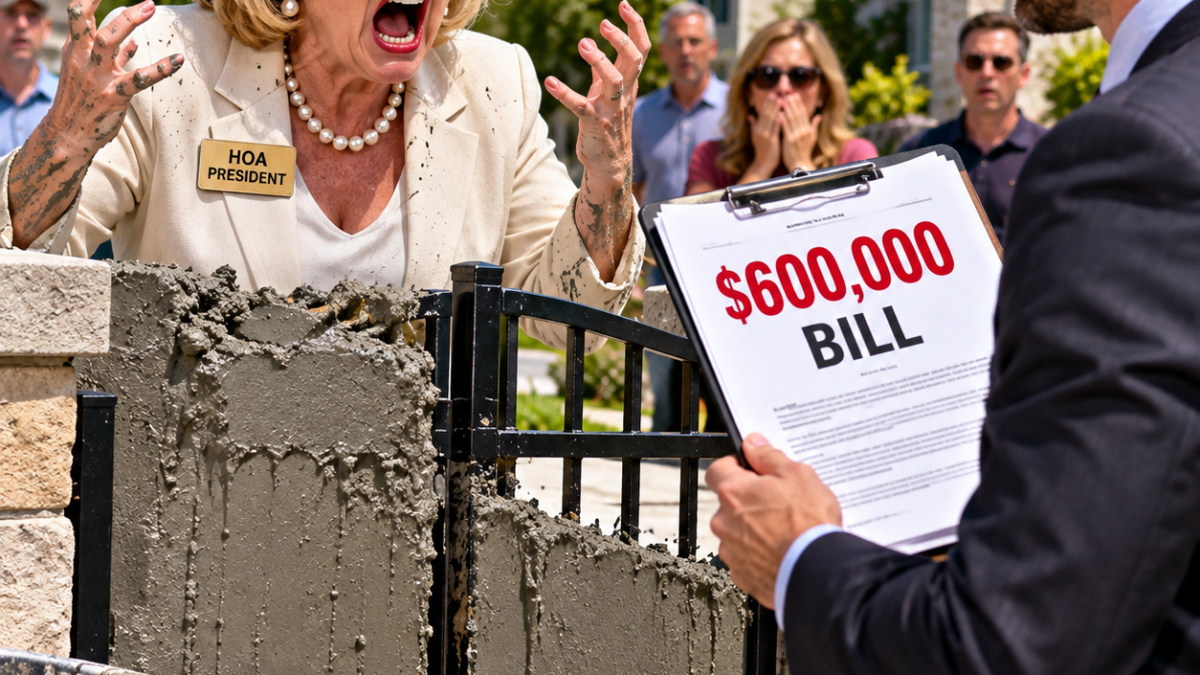
“You’ve been served.”
The room went silent.
He turned.
“Brenda Miller?”
Brenda froze near the coffee urn.
“You’ve been served.”
“Gerald Finney?”
Gerald looked like he might faint.
“You’ve been served.”
Karen stared down at the caption.
Jack Morgan v. Maple Creek Homeowners Association, Karen Covington, Brenda Miller, and Gerald Finney.
Her eyes moved lower.
Then lower.
Then stopped on the damages demand.
Six hundred thousand dollars.
Her hand began to tremble.
The metal cookie tongs slipped from her fingers and clattered onto the table.
That sound, small as it was, felt louder than the concrete truck.
Because that was the sound of Karen realizing this was no longer a game of letters, fines, and meetings.
This was a courtroom.
This was discovery.
This was personal liability.
This was the bill for every cruel little thing she thought nobody could make her pay for.
Her face drained of color.
“Six hundred thousand,” she whispered.
David stepped beside me.
“Now,” he said quietly, “she understands math.”
The lawsuit hit Maple Creek like thunder.
It named the HOA, Karen, Brenda, and Gerald. It alleged trespass, destruction of property, fraudulent lien, slander of title, breach of fiduciary duty, harassment, and willful misconduct. It demanded actual damages for concrete removal, gate replacement, legal fees, quiet title action, survey costs, and punitive damages.
But David’s strongest move was not the dollar amount.
It was the pattern.
He included sworn statements from Mrs. Gable, Miguel Rodriguez, George Whitaker, and others to show that Karen’s conduct was not an innocent mistake. It was part of a long campaign of abusing HOA power.
The new interim board panicked, then did the smartest thing possible.
They turned on Karen.
Their new lawyer filed a cross-complaint arguing that the former board members had acted outside their authority, ignored public records, failed to conduct due diligence, and exposed the association to massive liability. The HOA’s insurance carrier sent a reservation-of-rights letter, warning that intentional misconduct and fraudulent liens might not be covered.
Brenda folded first.
She hired a real lawyer, cried through mediation, and admitted she had signed whatever Karen put in front of her without reading it.
Gerald folded next.
He confessed that he had approved payment for the concrete vendor because Karen told him the land was common area. He had never checked the plat. He had never asked counsel. He had never verified the invoice.
They both wrote public apology letters.
They both agreed to pay smaller personal settlements.
They both agreed to testify truthfully.
Karen refused.
Karen countersued me for harassment and emotional distress.
When David read the countersuit, he laughed so hard Sarah came into the room to ask what happened.
“She claims you caused emotional distress by refusing to accept lawful HOA authority,” he said.
“Did she mention the concrete?”
“Oh, she mentions it as necessary restoration.”
“Of course she does.”
“She is going to be very unhappy in deposition.”
He was right.
Karen’s deposition lasted seven hours.
David walked her through everything.
Slowly.
Kindly.
Cruelly.
He placed the county plat map in front of her.
“Mrs. Covington, do you recognize this document?”
“I suppose.”
“Is this the official recorded plat for Maple Creek Estates?”
“I believe so.”
“Please identify the area where Mr. Morgan’s gate was located.”
She hesitated.
David waited.
Silence is a tool if you know how to use it.
Finally, she pointed.
“Does that area appear within Mr. Morgan’s deeded parcel?”
Her attorney objected.
David rephrased.
“Is that area labeled as HOA common area?”
“No.”
“Is it labeled as a community bridle path?”
“No.”
“Is it labeled as a utility easement?”
“Yes.”
“Does the existence of a utility easement transfer ownership of the land to the HOA?”
“I’m not a lawyer.”
“No. You were HOA president. Did you ever confirm that legal theory with counsel before bringing a concrete truck onto Mr. Morgan’s land?”
She shifted.
“We believed—”
“That was not my question.”
Her lawyer told her to answer.
“No.”
Then David produced George’s affidavit.
“Mrs. Covington, do you recall a board meeting five years ago where retired surveyor George Whitaker informed you that this exact strip was a utility easement on private land and not HOA common property?”
“I don’t recall.”
David placed George’s memo in front of her.
“Do you deny this meeting occurred?”
“I said I don’t recall.”
“Conveniently?”
Her attorney objected.
David smiled.
The deposition continued.
By the end, Karen had admitted she never ordered an independent survey, never obtained a legal opinion, never verified common-area status, authorized the concrete pour, approved the invoice to me, and directed the filing of the lien.
Her own lawyer looked exhausted.
The quiet title action finished what was left.
A judge reviewed the deed, plat map, easement language, and HOA covenants. The ruling took less than fifteen minutes.
The land was mine.
The easement was for utilities only.
The HOA had no authority over the access road or gate.
The lien was invalid.
The court ordered it released.
With that judgment recorded, Karen’s defense collapsed.
Settlement came fast after that.
The HOA agreed to pay for concrete removal, full restoration of the land, replacement of the gate, survey costs, legal fees, and policy reforms. The new board agreed to rescind Karen-era fines that had been improperly assessed, remove Mrs. Gable’s lien, refund the Rodriguez family’s basketball hoop fine, and revise the vague sections of the bylaws that had allowed Karen to turn personal preference into punishment.
Karen’s personal portion was the part everyone talked about.
Because insurance would not cover willful misconduct tied to the fraudulent lien and punitive claims, Karen became personally liable for more than one hundred fifty thousand dollars.
Not the full six hundred thousand.
But enough.
Enough to hurt.
Enough to follow her.
Enough to make sure she understood that power used carelessly can become a debt.
The day the construction crew came to remove the concrete, half the neighborhood found reasons to walk outside.
The excavator rolled in after breakfast, fitted with a hydraulic breaker. The operator lowered the steel point onto the slab Karen had poured over my gate.
The first strike cracked the surface.
The sound boomed across Maple Creek.
People stopped on sidewalks.
The second strike split the concrete near the buried hinge.
The third sent a chunk loose.
Sarah stood beside me with Duke at our feet.
“Sounds better coming out than going in,” she said.
I smiled for the first time that morning.
The crew worked all day, breaking the slab into pieces and hauling them away. Underneath, the original gate was twisted, ruined, and stained gray. I kept one small broken piece of concrete and set it on a shelf in my workshop. Not as a trophy. As a reminder.
After the land was restored, I built the new gate myself.
Heavier steel.
Better hinges.
A cleaner arch.
At the center, I added a small design Sarah suggested: two oak leaves crossed beneath a simple star. Strength and service, she called it.
While I was welding the final section, a moving truck pulled up in front of Karen’s house.
She had sold.
Not because anyone forced her at gunpoint. Not because the law was cruel. Because consequences have weight, and hers had finally become too heavy to carry.
I watched movers load boxes into the truck.
Karen stood near the curb in sunglasses, arms folded, jaw tight. There was no clipboard. No gavel. No circle of nervous neighbors waiting for her instructions.
Just a woman leaving a neighborhood she had tried to rule and failed to understand.
She looked toward my property once.
I thought she might shout something.
She did not.
Maybe she had finally learned the value of silence.
Or maybe she was just out of words.
When the truck pulled away, Mrs. Gable came out of her house and placed three garden gnomes by her front flower bed.
One of them held a tiny shovel.
One held a lantern.
One held a sign that said Welcome.
Nobody fined her.
That weekend, Sarah and I hosted a barbecue.
It started small and then became something bigger. Mrs. Gable came with potato salad. The Rodriguezes brought ribs. Leo brought a basketball and spent half the afternoon shooting hoops in my driveway with Duke chasing every rebound as if the ball owed him money.
George Whitaker sat under the shade with iced tea, holding court about property records like they were war stories.
David Chen came too, wearing jeans for the first time I had ever seen, and accepted a paper plate with the satisfaction of a man who had eaten opposing counsel for breakfast.
At sunset, Miguel walked over and stood beside me near the new gate.
“You gave us our neighborhood back,” he said.
I shook my head.
“No. You all took it back.”
He watched Leo laughing with two other kids near the driveway.
“I should have spoken up sooner.”
“A lot of people should have.”
“Do you blame us?”
I looked across Maple Creek.
At Mrs. Gable’s gnomes.
At the neighbors talking openly.
At the children playing where silence used to live.
“No,” I said. “But I hope everyone remembers what silence costs.”
A few weeks later, I received a card in the mail.
It was from Mrs. Gable.
Her handwriting was shaky but clear.
Thank you for giving us our neighborhood back. And for the gnomes.
I stood in the kitchen reading it while Sarah poured coffee.
“That one means more than the settlement, doesn’t it?” she asked.
I nodded.
Because money fixes damage.
It does not always restore what was taken.
That card did.
Karen had tried to bury my gate in concrete.
But in the end, she buried her authority, her reputation, and the fear she had used to keep an entire neighborhood quiet.
The gate stands now at the back of my property, black iron shining in the afternoon sun, opening onto the dirt road that leads to the woods, the creek, and the bench where Sarah and I still sit on Sunday evenings.
Every time I swing it open, I hear the hinges move clean and free.
No concrete.
No clipboard.
No voice telling me my land belongs to someone else.
Just the sound of a gate doing what it was built to do.
Opening.
The morning the construction crew arrived to break apart Karen Covington’s concrete slab, half the neighborhood suddenly remembered they had lawns to water, mailboxes to check, dogs to walk, and trash bins to adjust.
Nobody admitted they had come out to watch.
But everybody watched.
I stood at the edge of my driveway with Sarah beside me and Duke sitting between us, his golden tail sweeping the dirt like he understood this was not a normal workday. The sun was barely over the rooftops, throwing pale light across Maple Creek Estates, and for once the neighborhood was quiet in a way that felt honest. No leaf blowers. No angry golf cart. No HOA president barking orders at retirees over shrub height.
Just a heavy excavator rolling slowly toward the back of my property, its steel tracks chewing gently into the gravel road Karen had tried to steal.
Behind it came a dump truck, two workers in reflective vests, and a foreman named Ellis who had looked at the slab the day before and whistled through his teeth.
“Whoever did this wasn’t trying to fix anything,” he had said. “They were trying to make a point.”
I had looked at the ugly gray mound swallowing what was left of my old gate.
“They made one.”
Now Ellis climbed down from his truck, adjusted his hard hat, and walked over with a clipboard.
“Morning, Major.”
“Retired,” I said.
He smiled. “Still counts.”
Sarah handed him a thermos of coffee because Sarah believed every job began better when somebody offered coffee. Ellis accepted it with both hands, thanked her, and glanced toward the houses where curtains were moving all down the street.
“You’ve got an audience.”
“They’ve earned the right to watch,” I said.
He looked at me for a second, then nodded like he understood more than I had explained.
The hydraulic breaker on the excavator lowered over the slab.
For a moment, everything seemed to hold still.
I remembered the day Karen poured it.
Her floral muumuu shifting in the morning breeze. Her clipboard pressed to her chest like a shield. The concrete sliding down the truck chute, wet and heavy, swallowing the hinges I had welded myself. Her voice, smug and certain, telling me, “This is HOA common property now, Major.”
She had thought concrete was final.
People like Karen love hard things. Concrete. Fines. Letters. Liens. Rules. They think if something looks solid enough, nobody will question what is underneath.
But everything has a fault line.
Ellis lifted one hand.
The operator brought the hammer down.
The first strike cracked across the slab with a sound like thunder breaking under the earth.
Duke barked once.
A few neighbors flinched.
Sarah’s hand found mine.
The second strike drove deeper, and a jagged line opened from the buried hinge post toward the center of the concrete. The third strike split off a chunk the size of a suitcase. Gray dust rose into the morning air, drifting across the grass Karen had once claimed belonged morally to the community.
By the tenth strike, the slab that had looked so permanent began to fail.
I did not cheer.
I wanted to.
Part of me wanted to shout loud enough for Karen to hear from her house three streets over. Part of me wanted to laugh the way she had smiled when the concrete truck pulled away. Part of me wanted to turn this moment into the public spectacle she deserved.
But revenge, I had learned, is not always loud.
Sometimes revenge is standing still while the thing someone used to humiliate you is broken apart legally, professionally, and at their expense.
Beside me, Sarah wiped at one eye.
“You okay?” I asked.
She nodded, but her voice was soft. “I hated looking at it.”
I knew what she meant.
That gate had not just been steel. It had been my work, my patience, my hands. It opened to the back forty acres where Sarah and I walked when the world became too noisy. Beyond that gate was the dirt road to the creek, the old oak with the low branch, the bench I had built after my first year of retirement because Sarah said I needed a place where I was not fixing something.
Karen had blocked more than access.
She had tried to wall off peace itself.
By midmorning, concrete chunks filled the dump truck.
Ellis and his crew worked carefully around the twisted remains of the old wrought-iron gate. When they finally pulled it free, it came out bent, gray-stained, and ruined beyond repair.
The lock housing was crushed.
One hinge had been snapped sideways.
The bottom rail was bowed like a broken rib.
The worker set it gently on the grass, almost respectfully.
Sarah stepped closer and ran her fingers over the iron.
“You made this in the old workshop,” she said.
“I did.”
“You burned your thumb welding that corner.”
“I remember.”
“You said some ugly words.”
“I remember that too.”
She smiled, but it faded quickly. “It deserved better.”
“Yes,” I said. “It did.”
I had already decided to keep a piece of it. Not the whole gate. I did not need a shrine to damage. But I cut a small section from the twisted bottom rail later that day and placed it on the shelf above my workbench beside an old Army Corps coin and a photograph of Sarah standing by the creek in a blue jacket.
Some men keep trophies.
I keep reminders.
By late afternoon, the last concrete chunk was hauled away. The ground underneath looked bruised. The soil was compacted, torn, stained with dust and gravel. The old gateposts had been removed, leaving two raw holes in the earth. But the slab was gone.
For the first time in months, the access road was open again.
Not usable yet.
Not restored.
But open.
Sarah stood beside me as the dump truck pulled away.
Across the street, Mrs. Gable raised one hand from her porch. She had three garden gnomes lined proudly along her flower bed again, each one freshly cleaned. The tallest wore a red hat. The smallest held a lantern. The middle one looked, somehow, defiant.
I raised my hand back.
That small wave meant more than I expected.
The neighborhood had changed after the lawsuit.
Not instantly. People like to imagine justice lands like lightning, striking once and clearing the sky. In real life, justice is usually paperwork, meetings, bills, apologies, and the slow awkward rebuilding of trust between people who should have spoken sooner.
The $600,000 lawsuit had terrified everyone at first.
It was supposed to.
David Chen, my attorney, had chosen the number carefully. High enough to force attention. High enough to make insurance companies, board members, and homeowners understand that Karen’s concrete stunt was not a neighborhood squabble. But also defensible. Every dollar attached to actual damages, legal fees, slander of title, fraudulent lien, punitive exposure, and the pattern of HOA abuse Karen had created over years.
When Karen was served at the bake sale, the old Maple Creek died.
People still talked about that moment.
The process server placing the lawsuit beside the lemon squares.
Brenda Miller bursting into tears.
Gerald Finney turning the color of spoiled milk.
Karen staring at the demand figure, her finger trembling over the line that said damages in excess of $600,000.
The entire clubhouse had gone silent.
For years, Karen had built her authority by embarrassing other people in public. She had read violation letters aloud at meetings. She had mocked people’s appeals. She had made Mrs. Gable explain her dead husband’s gnomes in front of neighbors. She had made Miguel Rodriguez defend his son’s basketball hoop like it was a criminal enterprise.
Then, in one brutal minute, the shame she had handed out came back to her.
But I did not mistake that moment for the ending.
It was only the beginning of consequences.
Brenda folded first.
She came to our house two weeks after being served, standing on the porch with red eyes and both hands wrapped around a manila envelope. Sarah answered the door. I was in the workshop, but Duke’s bark brought me inside.
Brenda looked smaller without Karen beside her.
“I know you probably don’t want to see me,” she said.
“That depends on why you’re here,” I told her.
She looked down at the envelope. “My attorney told me not to come.”
“Smart attorney.”
“I came anyway.”
Sarah glanced at me, then stepped back from the doorway. “Come in.”
Brenda sat at our kitchen table and cried before she got three sentences out.
Not dramatic tears. Not performative tears. Quiet, humiliated tears from a woman who had finally realized that nodding along with a bully does not make you innocent.
“I should have questioned her,” Brenda said. “I knew she was cruel sometimes. I told myself she was just strict. I told myself neighborhoods need rules.”
“They do,” I said. “But rules are not supposed to be weapons.”
She nodded, wiping her face. “I signed things without reading them. Gerald did too. Karen would put papers in front of us and say the board had already discussed it. Half the time, we hadn’t. She made it sound like disagreeing meant we were betraying the community.”
Sarah poured her water.
Brenda opened the envelope and slid out copies of emails.
“I gave these to my lawyer,” she said. “He’ll give them to Mr. Chen through the proper process. But I wanted you to know before you read them.”
The emails were from Karen.
Some were about me.
That stubborn military relic thinks his deed matters more than the community.
Once the gate is gone, he’ll have no choice but to accept board authority.
File the lien fast. Men like Morgan only understand pressure.
I read those lines without speaking.
Sarah read them over my shoulder.
Her mouth tightened.
Brenda’s voice shook. “I’m sorry, Jack. I’m sorry to both of you.”
I believed her.
That did not erase what she had done.
But it mattered.
Gerald came next, though he did not have the courage to come alone. His adult daughter brought him. She was a sharp woman named Elaine who worked in banking and looked at her father with the restrained fury of someone who had spent the last month explaining consequences to him.
Gerald sat stiffly at the table, hands folded, eyes fixed on the wood grain.
“I failed in my duty as treasurer,” he said, clearly repeating words his lawyer had helped him prepare.
Elaine sighed. “Dad.”
His shoulders sagged.
Then the prepared speech fell away.
“I was afraid of her,” he admitted.
That was the first honest thing he said.
“She yelled,” he continued. “She embarrassed people. She made everything sound urgent. If I asked questions, she’d say I was obstructing necessary enforcement. After my wife died, I didn’t want conflict. Karen gave me tasks. Simple tasks. Sign this. Approve that. Read this number at the meeting. I liked feeling useful.”
He looked at me then.
“I let feeling useful make me careless.”
I had no answer that would comfort him.
So I gave him the truth.
“Careless people can do as much damage as cruel ones.”
He nodded.
Elaine put one hand over his.
“He knows.”
Gerald agreed to cooperate fully. Like Brenda, he settled his personal exposure early. He paid a smaller sum, painful but not ruinous, and signed a sworn statement about Karen’s control over the board.
Karen refused.
Of course she did.
Karen hired a lawyer who sent aggressive letters full of underlined phrases and weak threats. She countersued me for harassment, emotional distress, and “targeted reputational destruction.” David read the countersuit in his office, leaned back in his chair, and smiled like a man watching someone step onto thin ice.
“She thinks this is Facebook,” he said.
“What does that mean?”
“She thinks outrage is evidence.”
The deposition proved him right.
Karen arrived wearing a navy suit, too much perfume, and the same expression she wore at HOA meetings when she was about to announce a fine. She sat across from David with her attorney beside her, chin lifted, eyes cold.
For the first hour, she performed.
She talked about community standards, safety, neighborhood harmony, and her duty to protect common assets. She described me as hostile, uncooperative, intimidating. She said the gate “felt exclusionary.” She said the access road had “always been understood” as common. She said the lien was “standard enforcement procedure.”
David let her talk.
That was one of his gifts.
He gave arrogant people room to build their own traps.
Then he placed the county plat map on the table.
“Mrs. Covington, please identify the area where Mr. Morgan’s gate was located.”
She hesitated.
Her attorney shifted.
David waited.
Eventually, she pointed.
“Is that area labeled as HOA common area?”
“I don’t read maps professionally.”
“That was not my question.”
Her jaw tightened. “No.”
“Is it labeled as a bridle path?”
“No.”
“Is it labeled as a utility easement?”
“Yes.”
“Does this plat show ownership transferring to the HOA?”
“I’m not an attorney.”
“You were president of the HOA, correct?”
“Yes.”
“You authorized spending association money to pour concrete over a gate on land you had not verified was association property, correct?”
“I relied on my understanding.”
“Your understanding based on what document?”
She did not answer.
David opened another folder.
George Whitaker’s affidavit.
He slid it forward.
“Do you recall a board meeting five years ago where Mr. Whitaker, a retired licensed surveyor, informed you that this easement was not common property?”
“I don’t recall that.”
David turned to an exhibit tab.
“Here is an email you sent the next morning to Brenda Miller. Please read the highlighted sentence.”
Karen’s face changed.
Only slightly.
But I saw it.
Her attorney leaned over quickly.
David said, “You may read it silently first.”
Karen read.
Then David said, “Now aloud, please.”
Her voice lowered.
“George is making noise about the easement again. We need to stop entertaining technical objections or we’ll never get control of that back access.”
David let the words sit in the room.
Then he asked, “When you wrote ‘get control,’ what did you mean?”
Karen stared at the page.
For once, she had no speech prepared.
By the end of the deposition, her case was bleeding from every major artery. She had admitted she did not order a survey, did not obtain a legal opinion, did not verify the land status, did approve the vendor, did send the invoice, did direct the lien, and did know at least one qualified person had challenged her claim years earlier.
The quiet title action finished the matter.
A judge reviewed the deed, plat, easement language, and HOA covenants. David argued for summary judgment, and Karen’s lawyer tried to make noise about historic community use.
The judge was not amused.
“Historic tolerance is not ownership,” he said.
I wrote that down because it was the kind of sentence a man remembers.
The order was clear.
The access road was on my property.
The easement was for utility purposes only.
The HOA had no authority over the gate.
The lien was invalid and had to be released.
With that judgment recorded, Karen’s defense collapsed.
The settlement conference happened two weeks later.
Karen sat at the far end of the table, pale and rigid. Brenda and Gerald were not there; their portions had already been resolved. The new HOA board attended with its new counsel, a tired-looking attorney who had inherited a disaster and clearly wanted it buried before it bankrupted everyone.
David laid out the numbers.
Concrete removal.
Gate replacement.
Land restoration.
Survey costs.
Legal fees.
Quiet title costs.
Damages tied to the fraudulent lien and slander of title.
Punitive exposure.
Emotional distress was not our main argument, but Sarah’s statement changed the room.
She had written about the back gate not as an object, but as access to our life. She wrote about the creek bench, our Sunday walks, the way retirement had been hard for me at first, and how that land gave me peace when civilian life felt too quiet and too loud at the same time. She wrote that Karen had not merely damaged a gate. She had violated the one place where we felt free from being managed.
David read a portion aloud.
Karen looked away.
The settlement was not the full six hundred thousand.
It did not need to be.
The HOA paid substantial damages through a painful combination of reserves and negotiated insurance coverage for certain claims. Karen’s personal liability, excluded from coverage because of willful misconduct tied to the lien and punitive portion, came to more than one hundred fifty thousand dollars.
Enough to change her life.
Enough to make her sell.
Enough to make every future HOA president in Maple Creek read a plat map before touching private land.
The new board also agreed to reforms.
All Karen-era fines would be reviewed.
Improper fines would be refunded.
Mrs. Gable’s lien would be released.
The Rodriguez family would get their basketball hoop fine back.
No lien could be filed in the future without independent legal review.
No board member could authorize physical action against property without a survey, legal opinion, and open meeting approval.
Vague aesthetic language would be rewritten into objective standards.
Meetings would be recorded.
Minutes would include dissent.
It was not glamorous.
But it was real change.
After the concrete was removed and the settlement papers were signed, I began building the new gate.
I could have hired someone. The settlement covered it.
But I needed to do it myself.
The workshop became my church for three weeks.
I measured steel, cut sections, ground edges, welded joints, and sanded until the frame was smooth under my hands. Duke slept near the door, occasionally lifting his head when sparks flew too brightly. Sarah came in every evening with coffee or iced tea and pretended she was only checking whether I had remembered to eat.
The new gate was stronger than the old one.
Heavier posts.
Deeper footings.
Reinforced hinges.
A cleaner arch.
At Sarah’s suggestion, I added two oak leaves beneath a single star in the center panel.
“Strength and service,” she said.
“Sounds like a unit motto.”
“Maybe it’s ours.”
On the day we installed it, neighbors came to help without being asked.
Miguel brought tools.
George brought a level older than half the neighborhood and dared anyone to question its accuracy.
David Chen arrived in jeans and work gloves, which I documented with a photograph because I had never seen the man dressed like he knew which end of a shovel went into the ground.
Mrs. Gable brought lemonade.
Leo Rodriguez brought a basketball and somehow turned every break into a driveway shooting contest.
By sunset, the gate stood upright.
Black iron against the trees.
Solid.
Clean.
Free.
I swung it open for the first time.
The hinges moved smoothly, with a low, steady sound that reached something deep in my chest.
Sarah slipped her arm through mine.
“It opens beautifully,” she said.
“It should.”
“No,” she said. “I mean it feels like it opens beautifully.”
I understood.
Behind us, the neighbors had gone quiet.
Not awkward quiet.
Respectful quiet.
Everyone knew this was more than a gate.
It was proof that the thing Karen tried to bury had survived her.
A week later, Karen’s moving truck came.
No one organized a farewell.
No one brought a casserole.
No one pretended.
She stood on her curb in sunglasses, arms folded, while movers carried out boxes, lamps, framed prints, and the furniture from the house she had used like a throne. The curtains were already down. Without them, the windows looked strangely bare, as if the house itself had been relieved of watching everyone.
I was at the new gate when she looked over.
For a moment, I thought she might walk toward me.
Sarah came outside and stood beside me, just in case.
Karen did not cross the street.
She only stared.
Then she called out, “I hope you’re proud.”
I considered all the things I could have said.
I could have told her she had done this to herself.
I could have reminded her of the concrete, the lien, the gnomes, the basketball hoop, the widow’s wreath, the years of petty cruelty.
But in that moment, she looked less like a villain than a warning.
A person hollowed out by the need to control things that were never hers.
So I said, “I hope you learn.”
Her mouth tightened.
She got into her car.
The moving truck pulled away first.
Then Karen followed it out of Maple Creek Estates and disappeared around the bend.
Nobody clapped.
Nobody cheered.
The quiet was better.
That weekend, Sarah and I hosted a barbecue.
At first, I thought maybe ten people would come. By noon, there were folding chairs across half the yard, kids running near the fence, adults gathered under the shade, and Duke moving from guest to guest with the shameless confidence of a dog who believed all gatherings existed to celebrate him.
Mrs. Gable’s gnomes had returned to her garden that morning, and she brought photographs like a proud grandmother. Leo Rodriguez played basketball in my driveway with a new permanent hoop his father had installed, fully approved under the rewritten rules. Every shot he made seemed to loosen something in Miguel’s face.
Brenda came too.
She stood near the food table for a while, uncertain, holding a container of cookies like an apology. Some people avoided her. Some spoke politely. Healing is not the same as forgetting. But Mrs. Gable eventually walked over, took one cookie, and said, “These are good.”
Brenda cried.
Gerald came with Elaine and helped George argue about whether the new gate posts were perfectly plumb.
“They are,” George snapped.
Gerald checked the level. “They are.”
“Damn right they are.”
For the first time, I saw Gerald laugh without looking around for permission.
David stood beside the grill eating ribs with dangerous enthusiasm.
“You know,” he said, “for a man who claimed he wanted peace and quiet, you caused an extraordinary amount of trouble.”
“I didn’t pour the concrete.”
“No,” he said. “You did something worse.”
“What’s that?”
“You proved everyone else didn’t have to live under it.”
As the sun dropped lower, Miguel came to stand beside me near the gate.
“I keep thinking about how long we all let it happen,” he said.
I looked across the yard.
At Mrs. Gable laughing with Sarah.
At Leo teaching a smaller child how to dribble.
At neighbors who used to wave from a distance now sharing food under my trees.
“Fear makes people practical,” I said. “Practical people tell themselves the fight is not worth the cost.”
“And was it?”
I looked at the gate.
“Yes,” I said. “But it should not have taken my land being buried for everyone to believe it.”
Miguel nodded.
A few days after the barbecue, a small envelope arrived in the mail.
No return address.
Inside was a handwritten card from Mrs. Gable.
The handwriting was shaky, but every word was clear.
Dear Jack and Sarah,
Thank you for giving us our neighborhood back.
And thank you for the gnomes.
My Harold would have liked you.
I read it twice at the kitchen table.
Then I handed it to Sarah.
She read it and pressed the card to her chest.
“That,” she said softly, “is better than the settlement check.”
She was right.
Money repaired the damage.
That card repaired something else.
In the months that followed, Maple Creek Estates changed in small, steady ways.
The HOA meetings became boring again, which is what HOA meetings should be. Budgets. Pool repairs. Landscaping bids. Clear rules. Recorded votes. Nobody shouted. Nobody banged a gavel like a weapon. Nobody read violation letters aloud to shame people.
The new board created a simple appeal process.
They removed vague language from the rules.
They required legal review before liens.
They published financial reports homeowners could actually understand.
The neighborhood did not become perfect. No neighborhood does. People still argued about dogs, fences, noise, and parking. But disagreement no longer felt like standing before a firing squad.
Mrs. Gable’s gnomes stayed in her garden.
Leo’s basketball hoop stayed in the driveway.
The nurse who had been fined for late trash bins became chair of the community support committee, which mostly meant organizing volunteers when someone was sick, grieving, or overwhelmed.
George taught a Saturday workshop called “How to Read Your Survey Before You Fight About Your Fence,” which was far better attended than anyone expected.
And me?
I became the man people came to before they believed a letter from the HOA.
Not because I wanted authority.
I had seen what wanting authority did to Karen.
People came because they trusted me to tell them where the lines actually were.
One Sunday evening, months after Karen left, Sarah and I walked through the new gate toward the creek.
The sun was low, turning the dirt road gold. Duke trotted ahead, nose down, convinced every leaf concealed breaking news. The gate swung closed behind us with a soft click.
No concrete.
No clipboard.
No threat.
Just iron, hinges, and open land.
We reached the bench by the creek, the one I had built years earlier when retirement still felt like a uniform I did not know how to wear. Sarah sat beside me and leaned her head on my shoulder.
“Do you ever miss the quiet before the neighborhood changed?” she asked.
I thought about it.
The truth was, yes.
I missed the early days when Maple Creek was just houses in the distance and nobody cared about my mailbox flag. I missed walking the back road without thinking about lawyers, liens, or court orders. I missed believing that if I left people alone, they would leave me alone.
But I also thought about Mrs. Gable’s card.
Leo’s basketball hoop.
The neighbors at the barbecue.
The gate standing clean and strong behind us.
“No,” I said finally. “I don’t miss that quiet.”
Sarah looked up. “Why?”
“Because it wasn’t peace. It was just silence.”
She smiled a little.
The creek moved slowly over the stones. Duke splashed near the bank, then shook water everywhere with no respect for human dignity.
I laughed.
For the first time in a long time, it came easily.
Karen Covington had tried to bury my rights under concrete.
In the end, she buried her own power.
She buried the fear that kept Maple Creek obedient.
She buried the lie that a board title could turn private land into community property.
And she gave all of us, without meaning to, the one thing bullies never intend to create.
A reason to stand together.
The gate still stands today.
Black iron.
Oak leaves.
A single star.
Sometimes neighbors walking past stop to look at it. New residents ask why the back gate looks so much stronger than it needs to be. Usually, I just smile and say, “Long story.”
But every now and then, when someone really needs to hear it, I tell them.
I tell them about the concrete truck.
The fraudulent lien.
The bake sale.
The $600,000 lawsuit.
The gnomes.
The basketball hoop.
The moving truck.
And the card.
Because the lesson was never only about my gate.
It was about what happens when ordinary people stop letting petty tyrants convince them they are alone.
It was about the simple, stubborn truth that home means nothing if you have to ask permission to live peacefully inside your own boundaries.
And every time I open that gate and hear the hinges move clean and free, I remember the sound of concrete cracking.
Not because it was the sound of revenge.
Because it was the sound of a neighborhood waking up.