PART 2: HOA Karen Bulldozed My Family Chapel—Then Learned It Was a Protected 1800s Cemetery
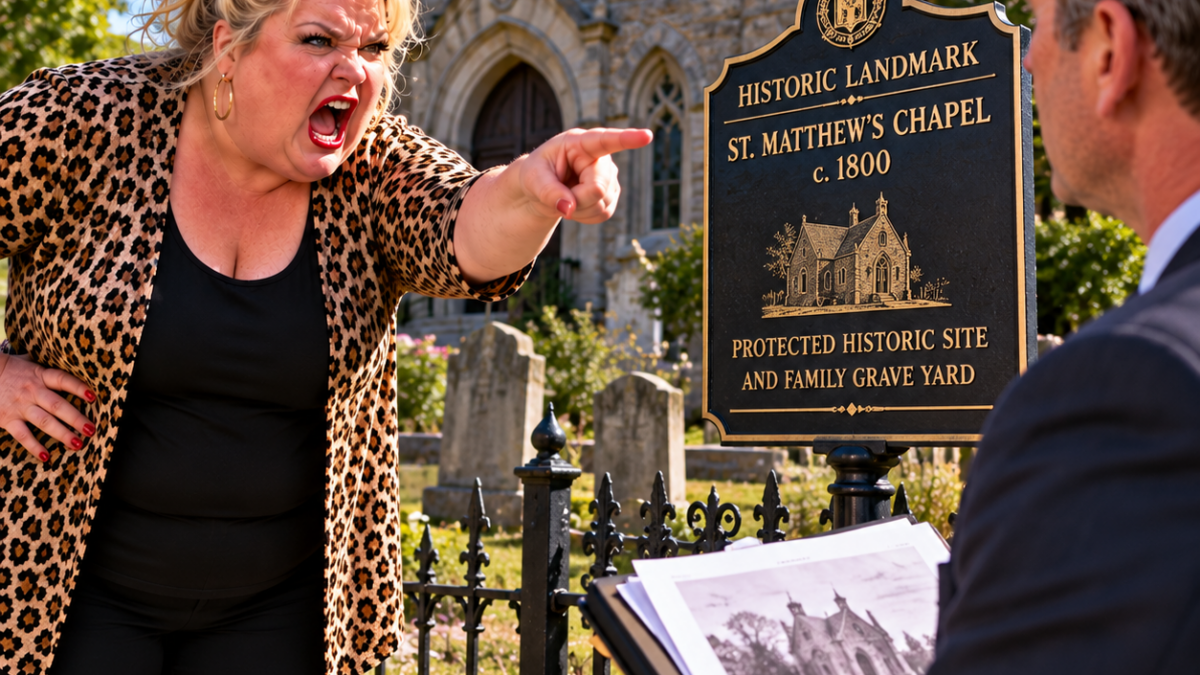
PART 2
I had learned a long time ago that grief is not useful until you give it a job.
Left alone, grief becomes fog. It fills every room. It softens the edges of your thinking. It makes you sit on the floor holding a broken piece of glass while the world keeps moving around you as if nothing holy has been destroyed.
But disciplined grief is different.
Disciplined grief can become a map.
A file.
A timeline.
A case.
So I stood in the ruins of Saint Agnes Chapel, with dust on my boots and broken headstones around me, and forced myself to stop shaking.
I filmed everything.
Slowly.
Methodically.
The collapsed north wall.
The gouged foundation.
The crushed bell.
The snapped marble headstone of Agnes Thorne, my ancestor’s wife and the woman the chapel had been named for.
The tire tracks across the burial ground.
The heavy equipment still idling nearby.
The demolition crew gathering tools as if they had just finished clearing a shed instead of erasing 173 years of memory.
I walked to the largest man on the crew. He had a thick neck, a bulldog tattoo on his forearm, and the tired irritation of someone who had expected an easy cash job and found himself facing a homeowner with a camera.
“State your name and your company,” I said.
He looked at the phone.
“Man, I’m not doing an interview.”
“You demolished a structure on my property.”
“We had a work order.”
“From whom?”
“The HOA.”
“Name.”
He shrugged.
“Lady named Karen. Said she was president. Said she had all the permits.”
“Did you verify them?”
His jaw tightened.
“That’s not my job.”
“It is when you tear down a historic structure.”
He laughed once, ugly and nervous.
“Historic? Lady told us it was an abandoned outbuilding.”
I panned the camera toward the cemetery.
“You see the graves?”
He looked past me for the first time.
Really looked.
His face changed.
Just a little.
“We didn’t touch graves.”
I walked the camera toward the crushed headstone.
“This was Agnes Thorne. She died in 1887.”
He said nothing.
That silence mattered.
I filmed it too.
Then I called 911.
The first deputy who arrived was young, maybe twenty-five, with a face that still believed most situations could be solved if everyone calmed down. I understood his hesitation. He saw a demolished structure, an HOA president with paperwork, a furious property owner, and a crew claiming they had been hired. It looked complicated. It looked civil.
Karen had counted on that.
She arrived in her golf cart with perfect timing, her two board loyalists behind her, both looking less confident now that a deputy was present. She carried a folder full of papers and wore the expression of a woman who had rehearsed authority in the mirror.
“Officer,” she said, “thank you for coming. This is simply an HOA abatement action.”
I laughed once.
Not because anything was funny.
Because the words were obscene.
“This is private property,” I said. “That chapel and cemetery are protected by a historical preservation easement and county deed restrictions. She had no authority.”
Karen opened her folder.
“We issued repeated notices.”
“You fabricated jurisdiction.”
“The structure was unsafe.”
“You hired bulldozers on a Sunday morning to destroy graves.”
The deputy looked alarmed at the word graves.
Karen quickly handed him the abatement order.
It looked official if you did not know what official looked like. Seals. Letterhead. Legal phrases. Safety language. Karen understood the power of paperwork as theater. She had made a prop convincing enough to confuse someone who did not have time to research a deed on the side of the road.
The deputy scanned it, then looked at me.
“Sir, this may be a civil matter.”
“No,” I said. “This is destruction of private property and desecration of a registered burial site.”
“I understand you’re upset.”
That sentence nearly broke something in me.
Upset.
As if I had spilled coffee.
As if my ancestors’ graves were a landscaping disagreement.
“I am not upset, Deputy. I am reporting a crime.”
He shifted uncomfortably.
Karen stepped in.
“The HOA has already determined the site was abandoned and hazardous. We’re improving the area for the community.”
“Improving?” I said.
She smiled at me.
“We’re considering a zen garden. Or pickleball. Residents love pickleball.”
The deputy raised a hand between us.
“Everyone, please. I can’t adjudicate property records here. If there is a dispute over authority, you’ll need to seek a court order.”
Then he warned Karen to make sure her paperwork was correct.
It was not enough.
But it was what he did.
He left.
And Karen, emboldened by the absence of immediate consequences, gave the crew one final instruction.
“Clear the remaining debris.”
That was when the excavator claw grabbed the last standing section of the vestibule and tore it down.
I recorded until my phone battery warning flashed.
I recorded the bell being dragged aside.
I recorded the blade pushing stone into a pile.
I recorded Karen watching.
Not horrified.
Not uncertain.
Watching like a queen inspecting a conquered city.
When the machines finally stopped, she drove over to me, tires crunching over fragments of glass.
“All better now,” she said.
Then, after a small pause, she added, “The invoice goes to your account tomorrow.”
She drove away.
I stood alone in the wreckage until the sun shifted and shadows stretched across the torn earth.
Then I picked up the bent brass plaque from the dirt.
ERECTED 1849 — S. THORNE.
My hands were covered in dust.
For a moment, I was seven years old again, standing beside my grandmother while she polished that plaque with a soft cloth and told me the story of Silas and Agnes.
Silas had been a stonemason. He came to Virginia with little more than tools, faith, and the stubborn belief that a man could build something strong enough to carry his name beyond his lifetime. He quarried the limestone himself. He laid the walls by hand. He named the chapel for Agnes because she had taught him, according to my grandmother, that land without love was just dirt.
They married in that chapel.
They buried children from that chapel.
They rang its bell when soldiers came home from wars and when neighbors did not.
My grandfather was the last person buried in the churchyard. He had asked for no speech, no monument, only to be laid beside his father under the oak tree. My grandmother honored that. Then, for the rest of her life, she cared for the chapel as if it were another living member of the family.
And I had failed to protect it.
That thought hit harder than anger.
I had seen Karen coming. I had received the notices. I had sent the cease and desist letter. I had known she wanted the chapel gone. But I had believed the law would be obvious enough to stop her.
That was my mistake.
The law is only obvious to people who respect it.
Karen did not.
I went into the house and did not take my boots off. Dust from the chapel marked the floors as I walked to my office.
I opened the drawer labeled OAK RIDGE.
Inside was the Karen file.
Two years of harassment.
Mailbox paint.
Grass height.
The flag.
Rake against the porch.
Letters calling Saint Agnes an outbuilding.
Suggestions that I deed the land to the HOA for a community park.
Demands that I submit demolition plans.
My lawyer’s cease and desist letter.
The final fraudulent abatement order.
I laid everything out on the desk.
Then I downloaded the footage from my phone and made three copies.
Hard drive.
Cloud.
USB.
Evidence first.
Grief later.
The next forty-eight hours became a blur of work.
I slept only in fragments, usually at the desk with my hand still on a folder. I drank coffee until it tasted like metal. I built a timeline from Karen’s first mention of the chapel to the morning of demolition. Every letter. Every notice. Every photo. Every invoice. Every witness.
First, I researched the demolition company.
Bulldog Demolition.
Its name was visible on the truck in my video.
The state contractor licensing board showed its license had been suspended three months earlier for safety violations and lack of proper insurance. That alone would have made the job illegal.
Then I searched the owner.
Frank Gallo.
I recognized the name.
He had appeared in Oak Ridge newsletters as chair of Karen’s “Community Beautification Committee,” a committee that seemed to exist mostly to recommend projects Karen already wanted.
Frank was one of the men standing beside her during the demolition.
So the contractor was not random.
He was connected.
Next came the money.
Karen said the work would be billed to my HOA account, but demolition crews do not show up on Sunday mornings without payment or a serious promise of one. I opened the homeowner portal and downloaded three years of HOA budgets, bank summaries, vendor lists, and expense reports.
The payment was not listed under Bulldog Demolition.
That was too easy.
Instead, I found a $25,000 payment two weeks earlier to Oak Ridge Environmental Services.
The company had been created one month before.
Registered agent: Robert Whitcomb.
Karen’s husband.
Business address: Karen’s house.
Purpose: landscaping and grounds management.
Payment description: emergency hazard abatement and beautification project.
No invoice attached.
No full board vote.
Only Karen’s signature.
I leaned back and stared at the screen.
There it was.
The line from HOA funds to Karen’s husband’s shell company to an unlicensed contractor connected to her board.
This was not just trespass.
Not just vandalism.
Not just desecration.
This was conspiracy.
Fraud.
Embezzlement.
And Karen had documented half of it herself because she believed paperwork became legal if she placed enough official-looking words on it.
By the second evening, neighbors started coming.
First Marcus, a fellow veteran from two streets over. He had been ordered to remove a disabled veteran decal from his truck because Karen claimed it was an unauthorized exterior display. He had refused, and she had been fining him for months.
Then Mrs. Gable, a widow whose heirloom roses had been torn out by an HOA-approved landscaper because they were not on the approved planting list.
Then the Millers, whose children’s swing set had been declared too colorful and visible from the road.
They stood on my porch with flowers, food, apologies, and fury.
Marcus spoke first.
“We saw what she did, Jack.”
Mrs. Gable’s eyes filled when she saw the dust still on my boots.
“She had no right.”
I almost said nobody could help.
Then I looked at their faces and realized that was exactly what Karen had trained everyone to believe.
So I opened the door wider.
“Come in.”
We sat around my dining table, the surface covered in records and photographs. I showed them the deed, the preservation easement, the cemetery registration, the contractor suspension, the payment to Karen’s husband’s shell company.
As I spoke, I watched fear change into something else.
Recognition.
Resolve.
Mrs. Gable reached into her purse and pulled out a small notebook.
“I kept records too,” she said softly. “Every fine. Every letter. Every time her landscaper damaged my beds.”
The Millers had photos, notices, receipts.
Marcus had a recording from an HOA meeting where Karen mocked his request for accessible parking near the pool.
Karen had thought she was bullying isolated homeowners.
She had accidentally created witnesses.
Our first move was not the police.
It was the State Historical Commission.
I already knew Saint Agnes had never made it onto the National Register, though my grandmother had started the process years ago. But it was listed in the state inventory of historic properties, and the family cemetery was registered with the county. Those records mattered. More importantly, state law did not treat cemetery desecration as an HOA dispute.
Marcus came with me to the capital.
He wore a dark suit with his service pin on the lapel. I carried one binder.
Deed.
Easement.
Cemetery registration.
Photos before destruction.
Photos after.
Video of the demolition.
Video of the bulldozer breaking Agnes Thorne’s headstone.
The senior investigator, Mr. Abernathy, watched the footage in silence. He had the tired eyes of a man who had spent decades seeing irreplaceable things ruined by arrogance, negligence, and money.
When the headstone cracked on screen, he stopped the video.
He removed his glasses.
“How many graves?”
“At least fourteen marked. Family records suggest more unmarked.”
He closed his eyes briefly.
Then he looked at me.
“Mr. Thorne, this is one of the most brazen violations I’ve seen in thirty years.”
His voice was controlled.
His anger was not.
“We will open an investigation immediately. I’m contacting the Attorney General’s office today.”
That was the first time since the demolition that I felt the ground under me again.
Not relief.
Not yet.
But direction.
While the state investigation began, we moved to public exposure.
Karen was already spinning the story. According to Marcus, she had held a closed board session claiming the demolition was a “misunderstanding” caused by unclear county records and an overzealous contractor. She portrayed herself as a responsible leader protecting property values from a derelict structure.
So we built a press kit.
Not a rant.
A case.
A one-page summary. Before-and-after photos. Family history. Copies of the preservation easement and cemetery registration. The fraudulent abatement order. The payment to Oak Ridge Environmental Services. Contractor license records. Short statements from Mrs. Gable, the Millers, and Marcus.
Then we sent it to Susan Keller, an investigative reporter known for finding blood in city budgets and bone in zoning scandals.
She was at my door within hours.
I walked her through the ruins.
I did not perform grief for the camera. I did not need to. The place spoke louder than I could.
Susan filmed the broken bell.
The stained glass.
The headstones.
The crushed plaque.
The oak tree standing above the cemetery like the only witness older than the crime itself.
Then she asked, “What do you want people to understand?”
I looked at the rubble.
“That this was not an abandoned building. It was a family chapel. It was a cemetery. It was protected. And it was destroyed by people who believed HOA power mattered more than history, law, and human decency.”
The story aired that night.
It opened with my phone footage of the bulldozer tearing into the chapel wall.
Then old photographs of Saint Agnes.
Then me standing in the ruins.
Then Mrs. Gable talking about her roses.
Then Marcus explaining how Karen had mocked his disability request.
Then the money trail.
Oak Ridge Environmental Services.
Karen’s husband.
$25,000.
Emergency hazard abatement and beautification.
Then Susan caught Karen outside the clubhouse.
“Karen Whitcomb, did you authorize HOA funds to demolish a registered cemetery?”
Karen’s face went from surprise to irritation to rage in three seconds.
“This is a private HOA matter.”
“Did you use a company owned by your husband to process the payment?”
“No comment.”
“Were you aware the demolition contractor was unlicensed?”
Karen shoved the microphone away.
“That man is a troublemaker. The structure was an eyesore.”
That word did more damage than any denial.
Eyesore.
By midnight, the clip had spread statewide.
By morning, national outlets had picked it up.
HOA President Bulldozes Veteran’s 1800s Family Chapel and Cemetery.
The phones at Oak Ridge Estates did not stop ringing.
The HOA website crashed.
The community page exploded.
People who had been silent for years began posting their stories. Fines over gardens. Threats over flags. Retaliation for appeals. Vendor favoritism. Missing meeting minutes. Questionable payments.
Public outrage did what private fear never could.
It made Karen’s defenders disappear.
Then the bank froze the HOA’s operating account pending review.
The contractor licensing board opened its own investigation.
The Attorney General’s office issued subpoenas.
Frank Gallo’s company folded almost immediately under pressure. Then, according to my lawyer, Frank started talking.
That was when Karen’s world truly began to collapse.
He said Karen had ordered the demolition personally.
He said she insisted it be done Sunday morning before I could get a court order.
He said she told him the chapel site would be converted into “a community amenity” once I was “put in my place.”
He said the payment came through her husband’s shell company because she wanted to avoid a full board vote.
My lawyer called me after that deposition summary came through.
“Jack,” he said, “she is finished.”
I wanted that to feel like victory.
But I was standing in front of a pile of stones that used to hold my family’s prayers.
Finished did not rebuild the chapel.
The emergency HOA meeting was called by petition.
More than eighty percent of homeowners signed.
It was held in the clubhouse Karen had ruled from like a throne room. This time, she sat at the front with an expensive lawyer and the two remaining board members who had not resigned. She looked smaller under the fluorescent lights. Not humble. Just cornered.
The meeting was chaired by Judge Henderson, a retired judge who lived in the neighborhood and had agreed to serve as neutral moderator.
He gave Karen the floor first.
She read from a statement.
Selfless service.
Property values.
Unfortunate misunderstanding.
Bad information.
Contractor error.
Difficult homeowner.
Not once did she say chapel.
Not once did she say cemetery.
Not once did she say sorry.
When she finished, the room stayed silent.
Judge Henderson turned to me.
“Mr. Thorne, you may respond.”
I stood.
I had planned a speech, but when I looked at my neighbors, I did not need the paper.
“A misunderstanding,” I said, “is forgetting to bring cookies to a bake sale.”
A few people shifted.
“A misunderstanding is not hiring an unlicensed contractor with a bulldozer to destroy a chapel and desecrate graves.”
Karen’s lawyer started to stand.
Judge Henderson raised a hand.
“Let him finish.”
I looked at Karen.
“For two years, we were told this was about standards. Grass height. Flags. Flowers. Mailboxes. Playsets. Decals. We were told the rules existed to protect community harmony. But harmony built on fear is not harmony. It is obedience.”
Mrs. Gable was crying quietly.
Marcus stood at the back with his arms crossed.
The Millers held hands.
I continued.
“She believed we were weak because we were polite. She believed we were alone because she attacked us one at a time. She believed history could be erased because it did not fit her view. She believed graves could be treated as landscaping. And she believed the law was just another tool she could bend with the right letterhead.”
My voice hardened.
“She was wrong.”
The motion to recall Karen and the remaining board members came from the floor.
The vote was unanimous.
The room shook with aye.
Karen stood abruptly.
“You can’t do this!” she screamed. “I built this community!”
That was when the clubhouse doors opened.
Two state troopers entered with a plainclothes detective from the Attorney General’s office.
No one spoke.
The detective walked to the front.
“Karen Whitcomb?”
Her lawyer put a hand on her arm.
She looked around as if expecting someone to save her.
No one moved.
The detective held up a warrant.
“You are under arrest for felony destruction of a burial site, conspiracy, embezzlement, and related financial crimes.”
For the first time since I had known her, Karen had no words.
The handcuffs clicked shut in a room full of people she had once controlled.
She cried then.
Threatened.
Said she knew important people.
Said it was a mistake.
Said I had ruined her.
The troopers led her out anyway.
When her eyes met mine, I felt less than I expected.
Not joy.
Not pity.
Only the closing of a door.
The legal proceedings lasted more than a year.
Frank Gallo testified for the state. Karen’s husband was charged for his role in the shell company and money movement. The forensic audit found years of misused HOA funds: vacations disguised as conference expenses, luxury dinners labeled community outreach, inflated vendor payments, and petty “beautification” projects routed through friends.
The chapel demolition was the crime that exposed everything.
Karen was convicted.
The judge emphasized the desecration of graves, the abuse of authority, the financial fraud, and her lack of remorse. She received prison time, restitution orders, and civil liability that stripped away the last illusion of her power.
But none of that restored Saint Agnes.
That part came slower.
The state placed Oak Ridge Estates in temporary receivership. The old rulebook was gutted. The HOA charter was rewritten with plain language, strict financial controls, open meetings, conflict disclosures, and explicit protection for historic and family burial sites. No board member could issue emergency abatements without independent legal review, proper permits, and documented safety findings.
Mrs. Gable joined the new community garden committee.
Marcus led the accessibility committee.
The Millers rebuilt their children’s swing set.
And I created the Saint Agnes Restoration Trust.
The settlement money, state preservation grant, and donations from people who saw the story went into it. We hired archaeologists, preservationists, and cemetery restoration specialists. They treated the site with a care that made me ache.
They sifted soil by hand.
Recovered glass.
Cataloged stones.
Mapped graves.
Repaired headstones where they could.
The chapel could not be rebuilt as it was. Too much was gone. Too much original material had been crushed. I had to accept that restoration is not resurrection.
So we built a memorial.
Low stone walls now trace the original footprint of Saint Agnes Chapel. The old bell, cracked but intact, sits beneath a protective arch made from salvaged limestone. The restored headstones stand behind it under the oak tree. The brass plaque my grandmother used to polish was repaired and mounted at the entrance.
Beside it is a new bronze marker.
SAINT AGNES CHAPEL
Built in 1849 by Silas Thorne in memory of his wife, Agnes.
Destroyed in 2026 through unlawful abuse of authority.
Restored as a memorial to family, history, and the rule of law.
At the bottom, at my request, are the words my grandmother used to say:
Land without memory is only dirt.
The dedication ceremony was held on a cool autumn evening.
Neighbors came.
Reporters came.
State officials came.
But what I remember most is Mrs. Gable placing the first rose beside Agnes Thorne’s restored headstone.
Marcus stood beside me.
“You okay?” he asked.
“No.”
He nodded.
“That’s fair.”
Then, after a moment, I said, “But I’m standing.”
“That counts.”
The sun lowered behind the oak tree, and the memorial stones glowed warm in the light. For a moment, if I let my eyes blur, I could almost see the old chapel standing again.
Almost.
Now I visit Saint Agnes often.
Sometimes in the morning, when mist lies low over the grass.
Sometimes at sunset, when the sky turns the same colors that used to pass through the stained glass windows.
I sit on the stone bench and think about Silas and Agnes. About my grandmother. About my parents. About the strange burden of being the one left to defend a place after everyone else in the ground can no longer speak.
People sometimes ask if Karen got what she deserved.
I tell them prison was the court’s answer.
The memorial is mine.
Because revenge alone would have left a hole in the earth.
Justice had to build something around it.
Karen wanted pickleball courts where my family prayed and mourned.
Instead, there is a protected memorial now, visited by school groups, historians, veterans, neighbors, and children who learn that old places matter because people mattered there.
Oak Ridge Estates changed too.
No more whispered fear over mailbox violations.
No more surprise abatement orders.
No more shell companies.
No more one-woman kingdom.
The community became what Karen always claimed she was protecting but never understood: people caring for a place together.
But healing is never as clean as a headline.
The week after Karen’s arrest, I still woke up before dawn with the sound of bulldozers in my ears.
There were no machines outside.
No diesel fumes.
No steel blade chewing through stone.
Only birds in the oak tree and the low wind moving across the grass.
But my body did not know that at first.
Every morning, I walked down to the chapel site before coffee. I would stand at the rope barrier the state investigators had installed and look at the place where the doorway had been. Sometimes I could still see it in memory—the narrow stone threshold, the worn step, the brass plaque, the small iron latch my grandfather had repaired twice because it stuck in wet weather.
Now there was only churned earth and numbered evidence flags.
Blue flags for glass.
Yellow flags for bone fragments or possible burial disturbance.
Red flags for headstone pieces.
The first time I saw the yellow flags, I had to sit down.
Not because I was weak.
Because there are some sights a person should not have to stand through.
An archaeologist named Dr. Helen Ward led the recovery team. She was a small woman with gray hair cut short and the steady voice of someone who knew that reverence could be a professional skill. The first day she arrived, she asked permission before stepping onto the site.
That moved me more than I expected.
Karen had not asked permission to destroy it.
Dr. Ward asked permission to help clean it.
“Mr. Thorne,” she said, “we will treat this as both a historic site and an active family cemetery. That means slow work. Careful work. I need you to understand we may not be able to identify or restore everything.”
“I know.”
“I also need you to understand that what happened here was not your fault.”
That hit me harder than any legal statement.
I looked away.
She did not press.
People who work around grief for a living know silence is sometimes a hand held out.
“I should have filed sooner,” I said after a while. “I had the notices. I knew she was escalating. I should have gotten an injunction before the weekend.”
“You responded reasonably to unreasonable behavior,” Dr. Ward said. “That is not failure. That is being human.”
I wanted to believe her.
It took longer than that.
The investigation turned the site into a strange blend of sacred ground and crime scene. State agents came and went. Preservation specialists photographed every stone. Surveyors mapped the original foundation. Dr. Ward’s team sifted soil through screens and cataloged every fragment.
I watched them recover pieces of stained glass so small they looked like candy.
Blue from the river window.
Green from the hills.
Amber from the sunrise panel above the altar.
My great-grandfather had commissioned those windows in 1912 for his bride, Eleanor. According to family letters, he wanted the chapel to reflect “the land God gave us.” There were no saints in those windows, no imported scenes from distant cathedrals. There was the creek, the oak, the ridge, the wild dogwoods blooming in spring, and the family fields as they once were before developers carved them into lots.
One afternoon, Dr. Ward handed me a small piece of red glass.
“This may be from the dogwood window,” she said.
I held it in my palm.
It was no bigger than a thumbnail.
Still beautiful.
Still catching light.
“That window was behind the pulpit,” I said.
“You remember it?”
“My grandmother used to say the red was for sacrifice.”
Dr. Ward nodded.
“She sounds like she understood symbolism.”
“She understood everything.”
I closed my fingers around the glass and felt the sharp edge press into my skin.
Not enough to cut.
Enough to remind me it was real.
While the state worked the physical site, the legal investigation widened.
The Attorney General’s office subpoenaed HOA records. The receiver appointed to oversee Oak Ridge Estates froze discretionary spending and took control of the bank accounts. Karen’s allies began resigning from committees faster than emails could announce the vacancies.
For years, people had wanted her favor.
Now they wanted distance.
Frank Gallo, the demolition contractor, became the weak link everyone expected him to be. His company had no active license, no valid insurance, and no permit for the demolition. Once investigators explained the possible charges, his loyalty to Karen dissolved immediately.
He gave them texts.
Do it Sunday. He won’t get a judge in time.
Bill through Oak Ridge Environmental. Bob will handle payment.
Make sure nothing is standing when you leave.
Those words appeared later in court filings, cold and ugly on white paper.
Make sure nothing is standing.
I read that line until it stopped being words and became a scar.
Karen’s husband, Bob, tried to claim he had no idea what Oak Ridge Environmental Services was being used for. That lasted until investigators found emails from him asking whether the “old chapel job” could be categorized as grounds management to avoid homeowner questions.
The conspiracy was not sophisticated.
It was arrogant.
That is usually enough for people like Karen. They do not hide things well because they have spent years confusing intimidation with invisibility.
The forensic accountant found more.
Payments for “community hospitality” that lined up with Karen’s anniversary trip.
Decorative landscaping charges routed through Frank Gallo’s company at triple market rate.
Consulting fees paid to a “compliance advisory group” registered to the daughter of another board member.
Credit card charges at restaurants two counties away.
None of them, by themselves, had been enough to bring the kingdom down. People had noticed, whispered, shrugged, and moved on.
But the chapel gave every small suspicion a center.
Karen had not fallen because she made one mistake.
She fell because one mistake gave everyone permission to examine the whole machine.
That examination changed Oak Ridge.
At first, the neighborhood felt haunted.
News vans parked near the entrance for days. Residents avoided cameras. Children asked why strangers were filming the old chapel. Some homeowners were angry at Karen. Some were angry at the embarrassment. A few were angry at me, because truth has a way of lowering property values before it raises moral standards.
One man stopped me at the mailbox and said, “Did you have to go national with it?”
I looked at him for a long second.
“My family cemetery was bulldozed.”
He looked down.
“I just mean, we all have to live here.”
“So do my dead.”
He did not speak to me again for three months.
That was fine.
Not everyone finds courage at the same speed.
Mrs. Gable did.
She came to the chapel site almost every afternoon, carrying tea in a thermos and pruning shears she did not use. She would stand near the rope line, hands folded, watching the recovery team work.
One day I asked her, “Why do you keep coming?”
She looked at the broken headstones.
“Because when they tore out my roses, I stayed behind the curtains and cried. I told myself I was too old to fight. I told myself it was only a garden.”
She swallowed.
“It was not only a garden.”
“No.”
“And this is not only a chapel.”
After that, she became one of the strongest voices in the community meetings.
Not loud.
Not dramatic.
But unwavering.
The first meeting under state receivership was held in the clubhouse with a state official at the front table instead of Karen. The difference in atmosphere was almost physical. No floral muumuu. No clipboard throne. No smug smile. Just a tired civil servant named Mr. Pike explaining budgets, liabilities, legal exposure, and the process for rebuilding governance.
People were angry.
Afraid.
Embarrassed.
Confused.
Mr. Pike let them be all those things.
Then he said, “This community has a choice. You can treat this as one person’s crime and try to move on quickly, or you can treat it as a governance failure and repair the structure that allowed it.”
Marcus stood.
“Repair the structure.”
Mrs. Gable stood beside him.
“The whole structure.”
The Millers stood next.
Then others.
Not everyone.
Enough.
The reform committee formed that night.
I refused to chair it.
I had no desire to become Karen in reverse. That is a danger people do not talk about enough. After a tyrant falls, there is always a temptation to replace her with the person who defeated her. The crowd feels safe handing power to the avenger.
But power had already done enough damage here.
So I agreed to serve as historical and property advisor, nothing more.
Marcus led the accessibility committee. Mrs. Gable led beautification. A retired accountant named Leona Park took finance. A young father named Daniel Miller, whose children had lost their swing set, handled communications because he said nobody should have to find meeting notices behind fake plants ever again.
The old bylaws were a swamp of vague authority.
Visual harmony.
Community standards.
Undesirable structures.
Board discretion.
Emergency beautification.
Every phrase Karen had used as a crowbar against someone’s life.
We cut them out.
Or defined them so tightly no future Karen could hide inside them.
No emergency property action without independent legal review.
No contractor hired without license and insurance verification.
No payments over $5,000 without open vote and published invoice.
No conflict-of-interest transactions without full disclosure and homeowner approval.
No entry onto private property without consent, court order, or immediate life-safety emergency.
No regulation of protected historical, religious, cemetery, or family memorial sites.
Mrs. Gable added a clause protecting established gardens from arbitrary removal.
Marcus added accessible parking procedures.
The Millers added a family play structure clause that made half the room laugh and the other half applaud.
Then someone proposed naming the historic protection clause after me.
I said no.
They named it the Saint Agnes Clause instead.
That I could accept.
The criminal case moved slowly.
People think justice happens in thunderclaps. Sometimes it does. Karen’s arrest had felt like that. But prosecution is mostly paper, hearings, motions, continuances, evidence reviews, plea discussions, expert reports, and waiting.
Waiting was the hardest part.
Every time Karen’s lawyer filed a motion calling the demolition an “administrative misunderstanding,” I felt the old anger return. Every time he referred to the graveyard as “alleged burial grounds,” I had to walk outside before I said something I would regret.
My lawyer, Tom Avery, had served with me years earlier. He knew when to talk and when to let me pace.
One afternoon, after reading another filing, I slammed the paper on his conference table.
“Alleged?” I said. “There are death certificates. Maps. Headstones. Family records. State registration. What more do they want, the dead to stand up and testify?”
Tom leaned back.
“They don’t need to win that argument. They need to muddy it.”
“It’s obscene.”
“Yes.”
“How do you stay calm?”
“I don’t confuse calm with forgiveness.”
That sentence helped.
A little.
The preliminary hearing drew more people than the courtroom could hold.
Karen entered through a side door in a gray suit, thinner than before, her face pale but still proud in that brittle way of people who believe humility is something that happens to others. Bob sat behind her with his own attorney. Frank Gallo avoided looking at both of them.
I sat with Tom and Marcus. Mrs. Gable insisted on coming. So did the Millers. Dr. Ward sat behind us as an expert witness.
The prosecution played part of my video.
Not all of it.
Enough.
The bulldozer blade hitting the chapel wall.
The demolition crew saying Karen had the permits.
Karen arriving and telling them to proceed.
The headstone breaking.
In court, sounds become different. The crack of marble against steel echoed from the speakers and seemed to remove all air from the room.
Karen looked down.
Not in remorse.
In calculation.
When Mr. Abernathy from the Historical Commission testified, he was measured but devastating. He explained the state inventory, the preservation easement, the cemetery registration, and the legal responsibilities attached to such sites.
Then Dr. Ward testified about the damage to the burial ground.
The prosecutor showed photographs.
The judge’s face changed when he saw them.
That mattered.
Judges are trained to remain neutral, but they are still human. There is something universally understood about graves. Even people who care nothing for old buildings understand that the dead should be left in peace.
The judge found probable cause.
The case moved forward.
Karen’s lawyer stopped using the phrase “alleged burial grounds” after that.
Public attention faded over the months, as it always does. National outrage moved on to other villains, other scandals, other fires. But inside Oak Ridge Estates, the work continued.
The chapel site remained fenced.
The recovery trust grew.
Donations came from strangers with handwritten notes.
My grandmother had a chapel like this.
My family cemetery was lost to development.
For Silas and Agnes.
For every small history someone tried to erase.
I read every note.
Some made me angry. Some made me grateful. Some made me feel less alone.
One envelope contained a check for seven dollars and thirteen cents from a child in Ohio who had seen the story with her grandmother.
The note said:
I am sorry about your church. I hope this helps fix it.
I kept that note in my desk.
Not the trust files.
My desk.
Because in the middle of all the fraud reports, court filings, and expert assessments, that little note understood the heart of it better than most adults.
I hope this helps fix it.
That was what we were all trying to do.
Fix what could be fixed.
Honor what could not.
The archaeological recovery took nearly five months.
Some headstones were repaired. Others were too damaged and had to be stabilized as fragments. The bell was cracked but intact enough to preserve. The brass plaque was bent, scraped, and stained, but a metals conservator cleaned and mounted it so the original inscription could still be read.
The hardest day was the reinterment ceremony for disturbed remains.
It was private.
Family only, though my family by then had grown in strange ways. Marcus came. Mrs. Gable came. The Millers came with their children, who stood quiet and wide-eyed. Dr. Ward came with her team, not as officials but as witnesses.
A local pastor read a short prayer.
I am not sure what I believe in the formal sense anymore. Twenty years in uniform and too much loss can complicate a man’s theology. But standing there under the oak tree while the recovered remains were returned to consecrated ground, I felt something close to faith.
Not certainty.
Presence.
The sense that the dead were not demanding revenge.
Only remembrance.
After the prayer, I placed the restored brass plaque near the temporary marker.
Then Mrs. Gable stepped forward with a rose.
She placed it gently on the earth.
“For Agnes,” she said.
No one moved for a long time.
The plea offers began after Frank Gallo’s testimony was secured.
Karen rejected the first one.
Then the second.
Her lawyer wanted a deal. Everyone knew it. But Karen could not accept any deal that required the word guilty to pass her lips. Pride had carried her this far; pride would drag her farther.
Bob took a plea first.
That shocked her more than the arrest.
He admitted Oak Ridge Environmental Services had been used to move HOA money without proper approval. He claimed Karen directed the scheme. He agreed to testify if necessary.
When I heard, I sat in silence for several minutes.
Tom watched me.
“You expected loyalty?”
“No.”
“But?”
“I expected them to destroy each other eventually. I just thought it would feel different.”
“How does it feel?”
“Small.”
That was true.
The mighty Karen Whitcomb, queen of Oak Ridge Estates, reduced to a defendant whose husband was bargaining against her. Not tragic. Not satisfying. Just small.
By the time trial approached, her defenses had narrowed.
She claimed she believed she had authority.
The documents said otherwise.
She claimed the chapel was unsafe.
No independent inspection existed.
She claimed the cemetery was abandoned.
County registration, headstones, family records, and maintenance photographs disproved it.
She claimed the payment through her husband’s company was an administrative shortcut.
The texts showed intent to avoid scrutiny.
She claimed she never meant to damage graves.
My video showed the bulldozer crossing the cemetery while she watched.
The trial lasted eight days.
I testified on the second.
The prosecutor walked me through the history of Saint Agnes. I spoke about Silas and Agnes. My grandmother. The chapel. The preservation easement. The notices. The cease and desist letter. The demolition.
Then they played the video again.
I had seen it dozens of times by then.
It still felt like being struck.
Karen’s attorney cross-examined me gently at first, then tried to suggest I had exaggerated the chapel’s condition.
“Isn’t it true, Mr. Thorne, that the structure had weathering?”
“It was 173 years old.”
“Isn’t it true there were cracks in some stones?”
“Yes.”
“Isn’t it true you were not using it as an active church?”
“It was a family chapel and cemetery.”
“But not active services.”
I looked at him.
“My grandparents are still buried there. That is active enough.”
A few people in the gallery shifted.
He changed direction.
He suggested I had a long-standing grudge against Karen.
“I had a long-standing desire for her to leave my property alone.”
He suggested I used the media to inflame public sentiment.
“I used the media after the deputy told me to seek civil remedies while bulldozers were still moving through my family cemetery.”
He suggested I wanted revenge.
I paused.
Then I said, “At first, yes.”
The room went very still.
Tom closed his eyes.
The defense attorney looked almost pleased.
“At first?”
“Yes.”
“And now?”
“Now I want the record to say clearly what happened. Revenge is personal. This is bigger than me.”
He did not ask many more questions.
Mrs. Gable testified too.
Not about the chapel, but about pattern.
The judge allowed limited testimony on Karen’s prior conduct to establish motive, intent, and absence of mistake. Mrs. Gable sat straight in the witness chair and described her roses, the fines, the threats, and Karen’s habit of using official language to frighten homeowners into surrender.
The defense tried to make her look bitter.
It failed.
No one looking at Mrs. Gable could believe she was motivated by anything except exhausted truth.
Marcus testified about the accessibility issue and Karen’s mockery. The Millers testified about the swing set. The forensic accountant testified about the money. Dr. Ward testified about the graves. Mr. Abernathy testified about the historical protections.
Frank Gallo testified last.
He looked smaller in court than he had beside the bulldozer.
He admitted everything.
The Sunday timing.
The double payment.
The shell company.
Karen’s instruction to finish before noon.
The text: Make sure nothing is standing when you leave.
Karen stared at him with pure hatred.
He did not look at her.
The jury deliberated for six hours.
Guilty on felony destruction of a burial site.
Guilty on conspiracy.
Guilty on embezzlement.
Guilty on falsification of HOA records.
Guilty on related financial charges.
When the verdict was read, Karen made a sound I had never heard from her before.
Not a scream.
Not a sob.
A small, stunned exhale.
Like the world had finally refused to obey.
Sentencing came a month later.
The courtroom was packed again.
Victim impact statements were allowed.
I wrote mine by hand.
Not because I needed to. Because typing felt too clean.
When the judge called my name, I walked to the podium with the paper folded in my pocket.
Then I did not use it.
I looked at Karen.
“For a long time,” I said, “I thought this case was about what you destroyed. The chapel. The glass. The headstones. The oak beams. The bell.”
My voice held.
Barely.
“But those were things. Sacred things, yes. Irreplaceable things. But still things.”
Karen looked down.
“What you truly attacked was memory. You tried to decide that because something was old, because it was quiet, because it did not serve your idea of beauty or control, it no longer mattered. You treated my ancestors as obstacles. You treated my grandmother’s care as clutter. You treated my grief as noncompliance.”
I heard Mrs. Gable crying behind me.
“You did not only harm me. You harmed every person in that neighborhood who learned from you that power did not need compassion. You taught people to be afraid of letters in their mailboxes. Afraid of meetings. Afraid of gardens, flags, playsets, decals, and the colors of their own doors.”
I took a breath.
“But the thing you forgot is that fear is not loyalty. It is only silence. And silence breaks.”
I turned to the judge.
“I am not asking the court for revenge. I am asking for a sentence that says the dead are not defenseless, history is not disposable, and no title—HOA president or otherwise—places a person above the law.”
The judge listened without expression.
Then Karen spoke.
Her statement was everything I expected.
She was sorry people were hurt.
She was sorry the situation escalated.
She had only wanted to protect the community.
She had relied on bad advice.
She had been overwhelmed.
She had made mistakes.
Mistakes.
That word again.
The judge did not accept it.
He cited the planning, the warnings, the financial concealment, the Sunday demolition, the desecration, and the lack of genuine remorse. He sentenced her to prison, restitution, fines, and a permanent prohibition from serving on any HOA board or similar community association in the state.
When the sentence was read, Karen finally cried.
I felt nothing dramatic.
No surge of triumph.
No cinematic satisfaction.
Only a deep, exhausted sense that a long march had reached a marker.
Not the end.
A marker.
The true ending took years.
That is another thing stories often simplify.
They end at the verdict because verdicts are clean. Rebuilding is not.
The memorial took planning, fundraising, arguments, permits, archaeological reports, preservation reviews, contractor bids, and weather delays. There were days I wanted to abandon the whole thing and fence off the site forever. There were nights I dreamed the chapel was whole again and woke up angry at daylight.
But the community kept showing up.
Mrs. Gable organized volunteers to plant heirloom roses along the memorial path, varieties that would have existed in my grandmother’s lifetime.
Marcus built benches with another veteran from the neighborhood.
The Millers’ children helped paint small wooden markers for a temporary educational trail.
Leona Park managed the trust account with a ferocity that terrified contractors into honest invoicing.
Even the man who had once complained that I went national eventually came to help lay gravel.
He did not apologize directly.
He showed up with a shovel.
Sometimes that is an apology.
We held the dedication ceremony two years after the demolition.
By then, the site had changed.
Not restored.
Changed.
Low limestone walls traced the chapel footprint, using salvaged stones where possible. The bell sat beneath a simple protective arch. The brass plaque was mounted at the entrance. The headstones stood cleaned and repaired, with small markers for those too damaged to restore. The old oak tree had survived, though an arborist had to cable one heavy limb damaged during demolition.
At sunset, the memorial caught light in a way that hurt.
Beautiful things can hurt.
People gathered quietly. Neighbors, historians, veterans, state officials, reporters, children who had only heard pieces of the story from adults. No one brought balloons. No one tried to make it festive. It was not that kind of day.
Mrs. Gable placed the first rose.
Marcus rang the cracked bell once with a padded mallet.
It did not sound the way it used to.
The note was lower.
Rougher.
Broken.
But it rang.
That sound moved through the crowd and across the grass.
I had to close my eyes.
For a moment, I heard my grandmother’s voice.
Land without memory is only dirt.
When I opened my eyes, the sun was behind the oak tree, and the new bronze marker glowed.
SAINT AGNES CHAPEL
Built in 1849 by Silas Thorne in memory of his wife, Agnes.
Destroyed through unlawful abuse of authority.
Restored as a memorial to family, history, and the rule of law.
Land without memory is only dirt.
After the ceremony, people stayed.
No one seemed eager to leave.
Children walked the stone outline of the chapel. Adults read names on headstones. Mrs. Gable sat on a bench with her hands folded over her cane, smiling faintly through tears.
Marcus stood beside me.
“She would have hated this,” he said.
“Karen?”
He nodded.
“Yes.”
I looked around.
The roses.
The plaque.
The protected graves.
The neighbors speaking softly to one another.
The children learning names older than the neighborhood itself.
“No,” I said. “She wouldn’t have understood it.”
“That too.”
The HOA changed after Saint Agnes.
Not perfectly. No community becomes pure because one villain leaves. There were still arguments about budgets, landscaping, noise, parking, and holiday decorations. People still got annoyed. Meetings still ran long. Someone once spent twenty minutes arguing about mailbox numbers, and I considered walking into the lake.
But the cruelty was gone.
That mattered.
Rules became rules again.
Not weapons.
The community garden thrived under Mrs. Gable’s leadership. Marcus got accessible parking properly marked at the pool. The Millers’ swing set became a gathering place for children whose parents had once been too nervous to leave toys outside. The old clubhouse, once Karen’s throne room, became a place where people held potlucks, not ambush meetings.
The Saint Agnes Clause became part of the rewritten HOA charter.
No protected historic structure, cemetery, memorial, religious site, or family burial ground could be altered, regulated, entered, or disturbed by the association except as required by law and with written consent of the owner, independent legal review, and applicable government approval.
Overkill?
Maybe.
But after you watch a bulldozer cross graves, overkill feels like common sense.
The chapel story became a warning in Oak Ridge.
Not just about Karen.
About convenience.
Because Karen had succeeded for years not only because she was cruel, but because people were tired. They were busy. They did not want conflict. They paid fines to save time. They ignored meetings because life was already full. They assumed someone else would stop her if she ever went too far.
Then she went too far.
And everyone learned that unchecked power does not become satisfied.
It becomes hungry.
I still live on the Thorne property.
The farmhouse is restored now. My grandmother’s garden grows again. The flag flies. My mailbox post is still weathered, though I painted it once just because I wanted to, not because Karen told me to. I keep the Karen file in a cabinet in my office. It is thick, organized, and complete.
I do not look at it often.
I do not need to.
The memorial is the real record.
Sometimes school groups visit. The Historical Commission added Saint Agnes Memorial Park to a regional heritage trail. Children arrive with worksheets and soft voices, then slowly grow curious. They ask good questions.
Why did she do it?
Why didn’t anyone stop her sooner?
Can old buildings be fixed?
Are the people still buried there?
Did you know them?
That last one always makes me pause.
No, I tell them.
Not in life.
But I know their stories.
And then I tell them about Silas, the stonemason. Agnes, who taught children to read. Eleanor, who loved stained glass. My grandfather, who requested no monument but ended up part of one anyway. My grandmother, who polished the brass plaque until her hands became too stiff.
I tell them history is not only presidents and wars and famous buildings.
Sometimes history is a one-room chapel behind a farmhouse.
Sometimes it is a family cemetery under an oak tree.
Sometimes it is a place everyone drives past until someone tries to erase it.
People still ask if I hate Karen.
The honest answer is no.
Hate requires maintenance.
I have stones to tend.
Roses to water.
Names to remember.
Karen took enough from me. I will not give her that too.
But I do remember what she did.
That is different.
Remembering is not bitterness. Remembering is stewardship.
On the anniversary of the demolition, I go to Saint Agnes before sunrise. I bring a cloth and polish the original brass plaque the way my grandmother did. The first time I did it, my hands shook. Now they are steady.
The plaque is still scarred.
So am I.
Both remain.
One morning, years after the trial, I found a small envelope tucked beneath a stone near the entrance. Inside was no name, only a note written in careful handwriting.
Mr. Thorne,
I lived here when Karen was president. I saw the notices. I heard people complain. I knew something was wrong, but I stayed quiet because I didn’t want trouble. I am sorry. I bring my children here now so they learn not to be silent when something sacred is threatened.
There was a pressed flower inside.
A rose petal.
I sat with that note for a long time.
In the end, maybe that is the clearest measure of justice.
Not punishment.
Not headlines.
Not even memorials.
But children being taught to speak where adults once stayed silent.
Karen called my family chapel an eyesore.
She thought age was ugliness.
She thought memory was clutter.
She thought graves were obstacles.
She thought the law was a costume she could wear when it suited her and discard when it did not.
But old stones have witnesses.
Paper has memory.
People have limits.
And the dead, though silent, are not powerless when the living finally decide to speak.
The chapel is gone.
I will never pretend otherwise.
There are mornings when that truth still rises sharp enough to take my breath.
But Saint Agnes is not erased.
Its outline is in stone.
Its bell still rings.
Its names are readable again.
Its story is told.
And where Karen wanted pickleball courts over my ancestors’ graves, children now walk quietly past roses and learn that power without humility destroys itself, that history must be defended, and that no community can survive when one person’s ego becomes more important than everyone else’s humanity.
Sometimes the stones they break become the foundation of something stronger.
Sometimes a graveyard becomes the place where a neighborhood comes back to life.
And sometimes, when a tyrant tries to erase the dead, the living finally stand up.