PART 2: HOA Karen Bricked Up My Lake Path—Then Learned I Owned the Only Road to Her Mansion
PART 2
I did not touch the wall that morning.
That was important.
A younger version of me might have grabbed a sledgehammer and started knocking blocks loose before Karen had time to waddle back to her SUV. A grieving version of me, the man I had been right after my wife died, might have let rage make the first move. But thirty years in the Army Corps of Engineers teaches you one thing above all else: the person who documents first usually wins.
So I stepped back.
I pulled out my phone.
And I recorded everything.
“This is John Caldwell,” I said, keeping my voice flat and controlled. “Date and time: Saturday, 8:17 a.m. Location: east boundary of my property at Harmony Creek. Newly constructed cinder block wall blocking established gravel access path to the lake trail.”
Karen’s eyes narrowed.
“You do not have permission to record me.”
“I’m recording my property.”
“You are harassing an HOA official.”
“I’m documenting unpermitted construction.”
That wiped the smile off her face for half a second.
Only half.
Then she remembered who she thought she was.
“This structure was approved by the architectural review committee.”
“You mean you.”
“The committee acts under my supervision.”
“So yes. You.”
Her face flushed.
I panned the camera slowly over the wall. The rough cinder block. The uneven mortar. The decorative stones shoved into the top like someone had been paid by the mistake. The wooden stake with the notice. The trampled native grass. The discarded cement bags lying partly on my side of the property line.
Then I crouched and filmed the base.
No proper footing visible.
No drainage gap.
No permit tag.
No survey marker.
A wall built by arrogance, not competence.
Karen folded her arms.
“You can film all you want. The covenants are very clear.”
“So is the county recorder.”
She scoffed.
“You people always run to the county when you don’t get your way.”
You people.
I let that phrase pass without reaction, but I saved it in memory. Karen had a habit of saying more than she intended when she felt powerful.
I filmed the path beyond the wall, or what was left of it. The gravel still disappeared under the new cinder block, proof that the path had not been imaginary. It had been buried.
That path was the reason I bought this property.
Twenty years earlier, when my wife Ellen and I first walked the land, the house had been modest, the pasture overgrown, and the woods thick enough to block most of what later became Harmony Creek. But the path had charmed her instantly. It curved through cedar and oak, then opened toward the lake where the water caught sunset like polished copper.
Ellen stood there that first day and said, “This place has a quiet heart.”
That was all it took.
We bought it.
The lake path became part of our life. Morning walks. Evening talks. The place we went when decisions were too big to make indoors. After she got sick, the walk became slower. Then shorter. Then one day, I walked it alone with her ashes in a small wooden box and scattered them near the water under the old sycamore she loved.
Karen did not know any of that.
Karen saw gravel and grass and decided both needed correction.
That made the wall more than a wall.
It was a trespass into memory.
But memory would not win this fight.
Documents would.
I went inside and opened the steel file cabinet in my study. The bottom drawer held the old property folder, thick with deeds, survey maps, easement agreements, closing papers, and the kind of records a man keeps because he spent his adult life learning that paper can outlast shouting.
The first document was my deed.
The second was the recorded lake path right-of-way, filed with the county long before Harmony Creek’s HOA existed.
The third was the one Karen would regret most.
EASEMENT AGREEMENT: ESTATES LANE.
Fifteen years earlier, before the final luxury phase of Harmony Creek was built, the developer had come to my kitchen table with topographical maps and a respectful tone. His name was Henry Henderson, and while he was still a developer, he had at least understood that landowners were not obstacles to be bulldozed.
He wanted access across my property to reach the bluff where he planned to build twelve high-end homes.
I refused to sell him land.
I had already watched fields disappear under beige siding, and I was not about to carve a permanent county road through the middle of my ten acres.
So we compromised.
A private access easement.
Revocable.
One dollar a year.
Ninety days’ written notice.
The language was clean because my lawyer had drafted it.
The use of Estates Lane was permissive, not adverse. The easement could be terminated by me, my heirs, or assigns for any reason upon written notice to the grantees.
At the time, everyone thought that was reasonable.
The developer got his road.
The residents got their mansions.
I kept ownership.
And for fifteen years, I never considered revoking it.
Why would I?
The Estates residents kept to themselves. Their landscapers drove too fast sometimes, and a few delivery trucks missed the curve, but nothing serious. The road was a neighborly accommodation. A handshake wrapped in legal language.
Then Karen built a wall across my lake path and fined my grass.
I scanned the easement agreement, the deed, the right-of-way, the plat maps, and every piece of paper connected to both roads. I labeled each file carefully. Then I photographed the wall again from the county markers and overlaid the survey lines on the image.
By lunch, I had a digital folder.
By dinner, I had a physical binder.
On the spine, I wrote:
HARMONY CREEK — ACCESS DISPUTE.
It was not dramatic.
It was worse.
It was organized.
The next morning, I began knocking on doors.
Not in the Estates.
Not yet.
I started with the old part of Harmony Creek, the original homes built around me before the McMansions arrived. Those people knew Karen’s rule from the receiving end.
Sam and Ruth Goldstein lived two streets over. They had been here almost as long as I had. Sam was in his garden when I arrived, trimming rosebushes with the care of a surgeon.
“Morning, Sam.”
He looked up and smiled, then saw my face.
“Oh no. What did she do now?”
I pointed through the trees toward the new wall.
“She blocked the lake path.”
His jaw tightened.
“I saw trucks yesterday. Thought they were fixing drainage.”
“No. Boundary enhancement.”
Sam snorted.
“That woman enhances everything except decency.”
Ruth came outside when she heard voices. The moment Karen’s name came up, her eyes filled with tired anger. She told me about the birdbath.
It had been a gift from her daughter. Stone. Simple. Beautiful. It had stood in their front garden for thirty years. Karen declared it noncompliant yard ornamentation and fined them two hundred dollars, then fifty dollars a week until they removed it.
Ruth tried to appeal.
Karen told her, “Sentimentality is not an exemption.”
Sam took the birdbath down himself.
Ruth had not planted flowers in that spot since.
That story went into my binder.
Next was Maria Alvarez, a single mother and emergency room nurse. I found her between shifts, dark circles under her eyes, hair clipped back, still wearing scrubs. She invited me in without hesitation when I mentioned Karen.
“She made me repaint my house,” Maria said before I even sat down.
“The beige issue?”
“You heard?”
“I’m hearing a lot.”
Maria laughed without humor.
The previous owner had painted her house a color already approved by the HOA. Karen decided it looked one shade too dark after sunset and began issuing notices. Maria fought at first, then lost overtime hours dealing with hearings, letters, and threats of liens. Eventually, she paid five thousand dollars to repaint the entire exterior a shade so similar only Karen could tell the difference.
“I cried writing that check,” she said quietly. “That was money I saved for my kids.”
She gave me copies of everything.
Warnings.
Fines.
Emails.
Receipts.
Then I visited Dave Roark.
Dave was a retired Marine gunnery sergeant who lived two doors down from me. We respected each other in the quiet way veterans sometimes do, without needing many words. His lawn was immaculate. His garage was cleaner than most operating rooms. A twenty-foot flagpole stood in his front yard, the American flag lit properly at night.
Karen hated it.
Of course she did.
“Colonel,” Dave said when he saw me.
“Gunner.”
He leaned against his garage workbench.
“Come about the Berlin Wall?”
“I am.”
“Good. I’ve been waiting.”
Dave had his own binder.
Three inches thick.
Karen had spent six months trying to force him to remove the flagpole, claiming it required architectural approval. Dave had responded with federal law protecting the right to display the American flag. Karen replied that he had an “insubordinate attitude.”
He smiled when he told me that part.
“I’ve been called worse by professionals.”
That was the day the resistance formed.
Not officially.
No dramatic speech.
Just two old soldiers standing in a garage full of tools, recognizing that the fight had moved beyond one wall.
Dave would gather resident statements.
I would handle property records.
We would feed everything to a lawyer.
Karen thought she had isolated me.
She had accidentally connected everyone she had bullied.
The county records office became my second home for the next two days. The place smelled like dust, toner, and patience. I pulled the master plat for Harmony Creek. I pulled incorporation documents. I pulled amendments to the covenants. I found Article Seven, Section B, Subsection Four, the so-called “boundary enhancement” clause Karen had used to justify the wall.
It had been passed at a sparsely attended winter meeting with notice posted on a corkboard in the back hallway of the clubhouse.
Behind a fake plant.
Technically legal.
Morally rotten.
Then I confirmed the road.
Estates Lane was not public.
Never had been.
The county had not accepted dedication. It had no maintenance obligation. The underlying land still belonged to me. The HOA had use only through the revocable easement.
Karen’s mansion, her neighbors’ mansions, their landscapers, delivery trucks, guests, caterers, pool cleaners, and luxury SUVs all reached their cul-de-sac by crossing my land.
Permissively.
Temporarily.
Revocably.
I ordered certified copies.
While waiting, a clerk named Brenda lowered her voice and said, “You might want to look at HOA vendor filings.”
“Why?”
“Sometimes the money explains the behavior.”
She was right.
The wall had been built by Prestige Outdoor Solutions LLC.
Harmony Creek’s preferred vendor for landscaping, masonry, fencing, and “exterior compliance remediation.”
Their invoices were high.
Not just high.
Insulting.
A quick search of state business records revealed the owner: Gerald Paplowski.
Karen’s brother-in-law.
I found the connection in five minutes on social media. Christmas photos. Family vacations. Karen smiling beside Gerald and his wife under matching holiday sweaters.
The wall was not only a power play.
It was a payday.
Paid for with HOA dues.
My binder became a weapon.
The lawyer I chose was Evelyn Reed. Former JAG. Property litigation specialist. The kind of woman who listened without blinking and made silence feel expensive.
I sat in her office and presented everything like a briefing.
Situation.
Background.
Legal documents.
HOA abuse pattern.
Vendor conflict.
Desired outcome.
When I finished, she leaned back and smiled in a way that reminded me of a shark noticing blood in warm water.
“Colonel Caldwell,” she said, “this is the cleanest HOA overreach case I’ve seen in years.”
“Good.”
“It gets better. The easement is your leverage. The vendor issue is their nightmare. Karen thinks she’s enforcing covenants. What she’s actually done is interfere with recorded property rights while steering paid work to a family member.”
“What do we do first?”
“We give them a chance to surrender.”
She drafted the first letter.
Cease and desist.
Remove the illegal wall.
Restore the lake path.
Refund the grass fine.
Produce permits, approvals, contractor invoices, and conflict disclosures related to Prestige Outdoor Solutions.
Preserve all records.
Thirty days.
The letter went not only to Karen, but to every HOA board member at their home address.
Evelyn explained why.
“Karen can lie later and claim they didn’t know. This removes that option.”
Karen responded a week later by email.
It was beautiful in the way disasters are beautiful from a safe distance.
She called our claims baseless, defamatory, and harassing. She said the wall would remain. She assessed an additional one-thousand-dollar fine against me for “intimidation of the board through hostile legal correspondence.” Then she copied every board member.
I forwarded it to Evelyn.
Her reply came ten minutes later.
Perfect. Now we escalate.
The second letter was short.
Formal Notice of Termination of Easement.
Pursuant to the recorded easement agreement governing Estates Lane, I hereby provide ninety days’ written notice of termination of permissive access across my property.
After the termination date, Estates Lane would revert to private use only. Unauthorized passage would constitute trespass.
Twelve certified letters went out.
One to each Estates homeowner.
One to the HOA.
One to the registered agent.
One to Karen personally, because Evelyn had a sense of humor sharp enough to draw blood.
For a week, nothing happened.
Then the panic started.
Luxury cars slowed in front of my house.
Residents I had never met stared at the road signs as if they had appeared in another language.
Someone in a black Mercedes stopped, got out, photographed the survey stake, and got back in without speaking.
Then came the emergency HOA meeting.
Dave and I attended and sat in the back row.
Karen stood at the podium wearing a navy blazer and the strained confidence of a person whose lies had not yet been tested by reality.
She called me disgruntled.
She called the termination notice extortion.
She called my road “critical community infrastructure,” which was funny because two weeks earlier she had argued my property rights were irrelevant when her wall blocked my path.
A man from the Estates stood.
His name was Peterson, a corporate attorney who lived three houses down from Karen.
“Karen,” he said, “have our lawyers reviewed the recorded easement?”
“They are looking into it.”
“That isn’t what I asked.”
She stiffened.
“They are confident our rights are protected.”
“On what basis?”
“Prescriptive use.”
Peterson’s expression changed.
He knew enough law to know the problem.
“Prescriptive use does not apply when use was granted by written permission.”
The room shifted.
Karen’s grip tightened on the podium.
“This is not the time for legal nitpicking.”
Peterson sat down slowly, and the look on his face said he had started doing math Karen could not control.
Dave leaned toward me.
“She’s bleeding.”
“Not yet,” I said. “But she knows where the wound is.”
Karen filed for an injunction.
Of course she did.
The hearing was set two weeks later.
Evelyn sounded almost cheerful on the phone.
“They have voluntarily asked a judge to read your easement. That is generous of them.”
The courtroom was cool, quiet, and merciless.
Karen arrived with two lawyers and a face full of theatrical injury. She sat at the plaintiff table like she expected the judge to scold me into submission.
Their lawyer argued first.
Emergency access.
School buses.
Deliveries.
Community harmony.
Irreparable harm.
He spoke well.
That is what lawyers are paid to do when facts are poor.
Then Evelyn stood.
She walked to the bench and handed the judge the certified easement agreement.
“This is the controlling document, Your Honor.”
The judge put on his glasses.
The room went silent while he read.
Not skimmed.
Read.
Page one.
Page two.
Signature page.
Recording stamp.
Then he looked up.
“Counsel,” he said to Karen’s attorney, “this is a revocable easement.”
The attorney cleared his throat.
“Yes, Your Honor, but—”
“The language is unambiguous.”
“Yes, but the road has been used continuously for fifteen years, and the residents—”
“By permission,” the judge said. “The document establishes permissive use. That defeats prescription.”
Karen shifted in her chair.
The judge continued.
“The court is not in the business of rewriting private agreements because one party dislikes the consequences. If the Estates residents relied on revocable access, that was a risk created by the original development arrangement.”
He looked at Karen.
“And according to the materials before me, this dispute began because the HOA constructed a wall blocking Mr. Caldwell’s recorded path?”
Evelyn handed up the plat and photographs.
The judge reviewed them.
Then he removed his glasses.
“You cannot ignore his property rights when you want a wall and then ask this court to protect your access rights when he responds under a contract you agreed to inherit.”
Karen’s face went pale.
“Request for injunction is denied.”
The gavel fell.
That sound was the first real crack in Karen’s kingdom.
But she was not done.
Cornered people with pride rarely choose wisdom.
Two days after the hearing, a Prestige Outdoor Solutions truck arrived at Estates Lane. Gerald Paplowski climbed out with three workers, bags of asphalt patch, and the swagger of a man sent by family power to intimidate an old soldier.
I met him at the edge of the road with my phone recording.
“This is private property,” I said. “You are not authorized to perform work here.”
Gerald smirked.
“We have a work order from the HOA.”
“The HOA does not own this road.”
“It’s a community road.”
“It is my road. The court confirmed the easement is revocable. Permission expires in fifty-eight days. Leave.”
He stepped closer.
“Or what?”
I held up the phone.
“Or this video goes to the sheriff, my lawyer, and the reporter who has been asking questions about your company’s contract with your sister-in-law.”
That did it.
His face changed.
Not fear exactly.
Calculation.
He spat near my driveway before leaving.
I filmed that too.
The reporter’s name was Sarah Mitchell. She worked for a local station and had a reputation for loving corruption stories with good visuals. Dave had first contacted her about his flagpole dispute, but once she saw the wall, the easement, the vendor contracts, and Karen calling me a neighborhood terrorist in meeting minutes, she was in.
Her first segment aired that night.
Decorated Army Engineer Battles HOA Over Blocked Access Path.
It showed the wall.
It showed the lake path.
It showed Dave beside his flag.
It showed Maria holding repainting invoices.
It showed Sam and Ruth standing in the empty spot where their birdbath used to be.
Then it showed a graphic of Estates Lane crossing my property, with a countdown: 58 DAYS UNTIL ACCESS EXPIRES.
Karen refused an on-camera interview, which made her look worse.
By the next week, Harmony Creek was no longer a quiet HOA dispute.
It was a public spectacle.
Residents who had feared Karen started emailing Evelyn. Some sent documents. Some sent photos. Some sent apology notes. The board members began distancing themselves. One resigned. Another claimed he had trusted Karen’s legal interpretation. Nobody wanted to be standing beside her when the road closed.
The forensic audit demand, once a footnote, became a full investigation request from residents.
Prestige Outdoor Solutions stopped answering calls.
Gerald deleted his social media.
Karen doubled down.
At another meeting, she accused me of trying to “hold a community hostage.” She said the Estates residents had “rights that superseded technicalities.” She claimed I was motivated by spite.
Peterson stood again.
“Karen, why was Prestige Outdoor Solutions hired to build the wall?”
“They are an approved vendor.”
“Who approved them?”
“The board.”
“Did you disclose your family relationship with the owner?”
Her face froze.
The room went silent.
Peterson repeated, slowly, “Did you disclose that the owner of Prestige Outdoor Solutions is your brother-in-law?”
That question did more damage than my easement letter.
People can ignore property disputes if they do not affect them.
They do not ignore money.
Especially their money.
Karen tried to call the question defamatory. Peterson asked to enter it into the minutes. Dave seconded. The acting secretary, visibly trembling, wrote it down.
The kingdom was burning from the inside.
Day ninety arrived clear and cold.
At 7:00 a.m., two flatbed trucks turned onto my property carrying the gates.
Industrial steel.
Black.
Eight feet tall.
Set on heavy posts with concrete footings.
One at each end of Estates Lane where it crossed my land.
Dave stood beside me with a thermos of coffee.
“Subtle,” he said.
“I considered a moat.”
“Next time.”
By 8:15, both gates were locked.
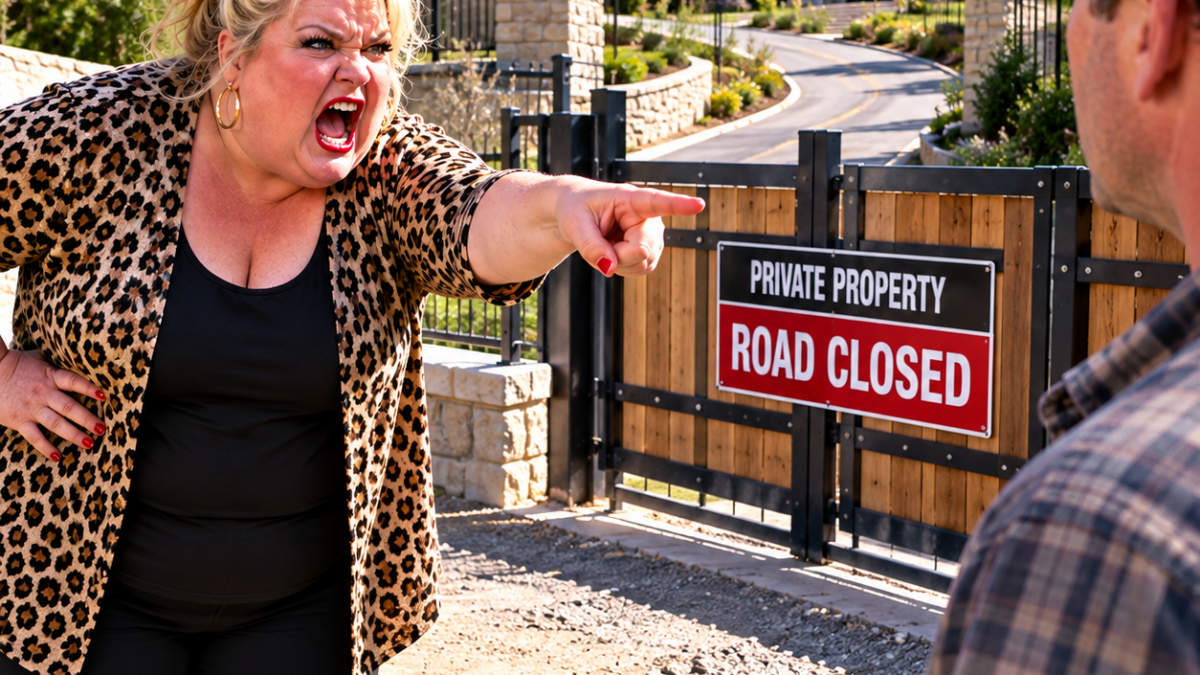
I hung the signs myself.
PRIVATE PROPERTY.
ROAD CLOSED.
NO TRESPASSING.
AUTHORIZED EMERGENCY ACCESS ONLY.
I had already coordinated with the fire department and sheriff. Emergency services had a Knox-style access key. I was not trying to endanger anyone. I was making a legal point, not creating a hazard.
That mattered.
Karen would have preferred I be reckless.
I refused to give her that gift.
At 8:31, the first BMW rolled down Estates Lane and stopped at the gate.
Peterson got out.
He stared at the lock.
Then at me on the porch.
I lifted my coffee.
He did not wave back, but he did not shout either. He pulled out his phone and started making calls.
Within twenty minutes, cars backed up behind him.
Luxury SUVs.
A Mercedes.
A Tesla.
A contractor van.
A housekeeper’s compact car.
People got out, angry and confused, all dressed for ordinary mornings that had just been canceled by a contract their HOA president told them not to worry about.
Then Karen arrived.
Her white SUV came down the road too fast and stopped inches from the gate.
She laid on the horn.
Long.
Furious.
Pointless.
Then she stormed out.
“Caldwell!” she screamed.
I took another sip of coffee.
“Good morning, Karen.”
“Open this gate right now!”
“You are on private property.”
“This is illegal!”
“The judge disagreed.”
“You are trapping us!”
“No. I revoked permissive access after you blocked my recorded path and ignored formal notice. There is a difference.”
She grabbed the gate and shook it.
It did not move.
Good contractors had installed it.
Not Prestige.
The sheriff’s deputy arrived ten minutes later.
Karen ran to him, waving her arms, demanding my arrest. The deputy listened patiently. Then he walked to me.
“Mr. Caldwell, can I see your documents?”
I handed him the folder.
Easement termination.
Court order.
Property map.
Emergency access confirmation.
The deputy read carefully.
Then he turned to Karen.
“Ma’am, this is private property. The road is legally closed to non-authorized traffic. You need to leave.”
Her mouth opened.
Closed.
Opened again.
“You can’t be serious.”
“I am. Everyone needs to turn around. If vehicles remain here, citations may be issued.”
The humiliation was complete.
Her neighbors were watching.
The reporter’s van arrived just in time to film Karen’s face when the deputy told her she was trespassing.
That evening, Karen was removed as HOA president in an emergency board vote.
The Estates residents led the charge.
Not because they suddenly loved me.
Because their million-dollar homes had become functionally landlocked, and Karen had caused it.
The next morning, Peterson came to the gate with two other Estates homeowners.
No yelling.
No threats.
Just pale faces and expensive shoes on gravel.
“Mr. Caldwell,” Peterson said, “we owe you an apology.”
I said nothing.
“Karen has been removed. The board is prepared to negotiate.”
“You can speak to Evelyn Reed.”
“We will meet reasonable terms.”
“My terms are reasonable. They are not small.”
He swallowed.
“I understand.”
Evelyn sent them the list.
Remove the wall.
Restore the path.
Refund abusive fines to affected residents with interest.
Issue public apologies.
Audit the HOA finances.
Terminate all contracts with Prestige pending review.
Rewrite the covenants with resident oversight.
Pay all legal fees, survey costs, and filing expenses.
Dedicate Estates Lane to the county as a public road, with compensation for the land.
My compensation demand was fifty thousand dollars.
Every penny to be donated to a veterans’ charity in Ellen’s name.
Sarah Mitchell’s station covered the negotiation like a hostage drama, which in a way it was. Karen had taken a community hostage with ego. The residents now had to pay the ransom in accountability.
The HOA surrendered in forty-eight hours.
A demolition crew arrived.
Not Prestige.
I sat on my porch and watched the cinder block wall come down piece by piece. The sound was ugly and beautiful at once. Jackhammers. Falling block. Scraping shovels. Dust in the air. Underneath the rubble, the old gravel path reappeared like something pulled from a shallow grave.
When the last debris truck left, I walked the path alone.
For the first time in months, nothing blocked the way to the lake.
I stopped under the sycamore where Ellen’s ashes rested in the soil and water and memory. The lake was still. The evening light turned the surface gold.
“I handled it,” I said quietly.
The wind moved through the leaves.
That was answer enough.
The audit came out six weeks later.
It was worse than even Brenda at the county office had hinted.
Prestige Outdoor Solutions had been overpaid for years. Inflated landscaping contracts. Unbid wall work. Decorative projects routed through Karen’s relatives. Maintenance fees that never matched actual labor. The total was high enough to trigger state interest and enough public anger to end every remaining defense Karen had.
She and her husband put the mansion up for sale.
The first offer fell through because the road dedication had not yet been finalized.
That irony was so perfect even Evelyn laughed.
Karen, who had blocked my path, had to wait for me to reopen hers before she could escape.
The day the county recorded the new public easement, I walked to the gate with the key. Residents gathered. Dave stood beside his flag. Maria came with her kids. Sam and Ruth brought a small stone birdbath they had bought to replace the old one. Sarah Mitchell’s camera crew filmed from the roadside.
I unlocked the padlock.
Pulled the chain free.
Swung the gate open.
People applauded.
I did not smile for the camera.
This had never been about applause.
A week later, Karen moved out.
No dramatic final confrontation.
No apology.
No lesson spoken aloud.
She sat in the passenger seat of her SUV while movers loaded furniture into a truck. When the vehicle passed my house, she stared straight ahead.
That was fine.
I had no need to hear her voice again.
Harmony Creek changed after that.
The Goldsteins put their birdbath back in the garden.
Maria’s house stayed its allegedly dark beige.
Dave’s flag flew higher than ever.
The new board rewrote the covenants in plain language. No more hidden meeting notices behind fake plants. No more single-person architectural authority. No more family vendor contracts without disclosure and competitive bids. No more fines without a clear rule, evidence, notice, and appeal.
The HOA meetings became longer for a while because democracy is messier than dictatorship.
But they became honest.
The path to the lake stayed open.
The road to the Estates became public.
And the neighborhood finally became something Karen had only pretended to protect: a community.
One evening, months after it ended, Dave met me at the lake. We stood by the water as the sun went down, listening to frogs start up in the reeds.
“You know, Colonel,” he said, “it was never about the wall.”
“No,” I said. “It never is.”
“It was about power.”
“And access.”
“And respect.”
I nodded.
The gravel path behind us curved back through the trees toward my house. Estates Lane lay beyond that, no longer a weapon, no longer leverage, just a road.
That felt right.
A road should connect people.
Not empower bullies.
I thought about Karen calling her wall a boundary enhancement feature. In a strange way, she had been right. Not about the wall. That thing had been illegal, ugly, and doomed from the beginning.
But the fight did enhance boundaries.
It showed everyone where property ended and arrogance began.
It showed the board where authority stopped.
It showed the residents what silence cost.
It showed Karen that rules are not magic words you say over someone else’s life.
And it reminded me of something I had almost forgotten after Ellen died: peace is not something you keep by avoiding every fight. Sometimes peace is on the other side of one fight you finally refuse to lose.
I still walk that path.
The gravel crunches under my boots the same way it did twenty years ago. The sycamore is older now. So am I. The lake still catches sunset like copper when the sky is clear.
Sometimes I pass neighbors there.
Sam and Ruth holding hands.
Maria’s kids with fishing poles.
Dave walking like he is still on patrol.
Even Peterson from the Estates, who nods respectfully every time, perhaps still embarrassed, perhaps simply grateful.
Nobody mentions Karen much anymore.
That is how I know we won.
Not because she left.
Not because the fines were refunded.
Not because the wall came down.
We won because her name no longer controls the temperature of the room.
The last reminder of her reign is a line in the new HOA handbook under the ethics policy:
No board member may use association authority to interfere with recorded property rights, retaliate against residents, or financially benefit undisclosed family vendors.
Dave calls it the Karen Clause.
I call it the reason I sleep well.
People think revenge has to be loud.
They imagine shouting, humiliation, dramatic speeches, and doors slammed in rage.
But the best kind of justice I have ever seen is quiet and documented.
A certified letter.
A recorded deed.
A judge reading the fine print.
A locked gate at sunrise.
A bully learning that the road she takes for granted belongs to the person she tried to crush.
Karen built a wall to take away my path.
So I closed a road to give the whole neighborhood its backbone back.
And when the dust settled, the wall was gone, the path was open, the road was public, and Harmony Creek finally earned the first word in its name.
The first few days after the gate opened were not peaceful in the way people imagine peace.
They were awkward.
Cars began moving through Estates Lane again, but every driver slowed near my house as if the road itself had become a courtroom exhibit. Some nodded. Some stared straight ahead. Some looked embarrassed, which was reasonable, because only a month earlier several of them had called me everything short of a criminal in emergency meetings Karen staged for her own survival.
I did not wave at everyone.
I waved at the ones who looked human.
Peterson was the first Estate resident to stop.
Three days after the county recorded the public easement, his black BMW pulled to the side of the newly dedicated road. He stepped out in a suit that probably cost more than the mower I used on the front pasture, but he did not carry himself like a rich man coming to negotiate. He looked like a tired lawyer who had spent too many nights reading documents he wished he had read earlier.
“Colonel Caldwell,” he called.
I was repairing a rail near the restored lake path. I set the hammer down.
“Peterson.”
He walked to the fence but did not cross it. I respected that.
“I wanted to apologize properly.”
“You already did at the gate.”
“No,” he said. “I apologized because I needed something. That isn’t the same thing.”
That was honest enough to earn my attention.
He looked down the road toward the Estates, where Karen’s mansion sat behind trimmed hedges and expensive denial.
“We all knew she was difficult,” he said. “That’s the word we used. Difficult. Demanding. Particular. We made her smaller in language so we didn’t have to deal with what she actually was.”
“A bully?”
He nodded.
“A bully with access to our checkbook.”
That was the part that had finally broken the Estates residents. Karen mistreating me had been uncomfortable. Karen blocking the road had been inconvenient. Karen’s family contracts had been unforgivable. The wealthy can tolerate arrogance longer than most people, but they have a special hatred for being made fools with their own money.
Peterson sighed.
“I’m a contracts attorney, Colonel. I read agreements for a living. And I never read the one controlling access to my own home. I trusted the developer. I trusted the HOA. I trusted Karen when she said you were bluffing.”
“That seems like a professional mistake.”
He almost smiled.
“It was.”
For a moment, the only sound was the wind moving through the native grasses Karen had fined as weeds. Late afternoon light caught the seed heads and turned them silver.
“She told us you were unstable,” he said. “That you were angry, antisocial, obsessed with the past. She said the lake path was abandoned and the wall was approved.”
I looked at the restored gravel path curving through the trees.
“My wife loved that path.”
He glanced at me, and something in his face changed.
“I didn’t know that.”
“No. Karen didn’t either. Wouldn’t have mattered if she did.”
“I’m sorry.”
This time, I believed him.
He reached into his jacket and pulled out an envelope.
“What’s this?”
“A personal contribution. Not HOA money. Mine. To your veterans’ charity donation.”
I did not take it.
“Peterson—”
“Please,” he said. “I know the road payment is already going there. This is separate. My father served in Vietnam. He would have been ashamed of me for standing behind Karen as long as I did.”
That hit differently.
I took the envelope.
“Thank you.”
He nodded once, turned, and walked back to his car. Before he got in, he looked over his shoulder.
“For what it’s worth, the Estates are forming our own road committee.”
“The road is public now.”
“Yes. Exactly. Which means our committee will have no authority whatsoever.”
I almost smiled.
“That sounds useful.”
“It’s mostly an excuse to make sure we never let one person speak for all of us again.”
That was the first sign Harmony Creek might actually heal.
The second came from Maria.
She showed up on my porch the following Saturday with her two kids and a folder of papers under one arm. Her son held a plate of cookies wrapped in foil. Her daughter carried a small potted plant with purple flowers.
“We came to say thank you,” Maria said.
“You didn’t need to.”
“Yes, we did.”
The children looked up at me with the solemn unease of kids who had been coached to behave around an old man with a reputation.
I crouched slightly.
“What kind of cookies?”
“Chocolate chip,” the boy said.
“Then your mother raised you right.”
That earned the smallest smile.
Maria handed me the folder.
“What’s this?”
“Copies of the refund checks and the notice clearing all violations from my file. I wanted you to see it.”
I opened the folder.
There it was.
A formal letter from the new Harmony Creek board acknowledging that the prior enforcement action against Maria Alvarez had been arbitrary, improperly documented, and financially burdensome. The HOA refunded the fines and late fees with interest. They could not refund the stress, the missed shifts, the humiliation of standing in front of Karen’s board while being told her house was the wrong beige, but the letter mattered.
“It’s not everything,” Maria said. “But it’s something.”
“It is.”
Her voice softened.
“I used part of it to start a college fund for the kids. It isn’t much.”
“It’s a start.”
She smiled then, and for the first time since I met her, the tiredness in her face did not seem to be winning.
Her daughter held out the plant.
“For your path,” she said.
I looked at Maria.
“She insisted,” Maria said. “She said if the mean wall broke your plants, we should bring one back.”
The plant was small, fragile, and probably not native to anything within two hundred miles, but I accepted it like it was an award.
“We’ll find it a good place.”
The little girl nodded seriously.
“Not near bad walls.”
“No,” I said. “Not near bad walls.”
After they left, I carried the plant down to the beginning of the lake path and set it near a flat stone by the edge. Ellen would have liked that. She had always said children understand ceremony better than adults because they don’t pretend not to feel things.
By the second week, the Goldsteins had reinstalled a birdbath.
Not the old one. That had been hauled away years earlier after Karen’s fines became too much. The new one was larger, carved from pale stone, and placed right in the center of their front garden where anyone driving by could see it. Ruth planted lavender around the base. Sam added a small plaque.
FOR THE BIRDS.
That was all it said.
It was perfect.
I walked by one morning and found Ruth standing with a watering can, staring at the birdbath as if it were an old friend finally returned from exile.
“Looks good,” I said.
She turned and smiled.
“She would hate it.”
“Yes, ma’am.”
“I thought that would make me feel petty.”
“Does it?”
“No,” she said. “It makes me feel alive.”
I understood that more than I expected.
People underestimate what small freedoms mean after someone has spent years stealing them. A birdbath. A flagpole. A shade of paint. A walking path. None of those things matter much from a distance. But when a bully uses power to take them, getting them back becomes about more than decoration or convenience.
It becomes proof that your life belongs to you again.
Dave’s proof flew twenty feet above his lawn.
His flagpole had survived Karen, of course. Dave had never taken it down. But after the settlement, he replaced the halyard, polished the base, and installed a brighter light. At sunset, the flag glowed above his yard, clean and steady.
Karen’s old violation notice had been framed inside Dave’s garage next to a printed copy of the Freedom to Display the American Flag Act.
Underneath, he had written in black marker:
SUGGESTION DENIED.
That was Dave’s idea of interior decorating.
The forensic audit took longer.
The new board hired an outside accounting firm with no connection to Harmony Creek, no local political entanglements, and, as Evelyn put it, “no patience for creative bookkeeping.” They reviewed five years of invoices, bids, checks, reimbursement requests, board minutes, and vendor approvals.
People expected overbilling.
They did not expect the scale.
Prestige Outdoor Solutions had received almost forty percent of all discretionary maintenance spending over three years. Landscaping contracts had been renewed without competitive bids. Emergency repair fees had been approved for projects that were not emergencies. Decorative stonework had been billed at luxury hardscape rates and completed with materials that looked suspiciously like contractor leftovers. The cinder block wall across my lake path had been charged as a “community safety improvement” despite blocking a recorded right-of-way.
The audit also found that Karen had approved payments in meetings where no quorum existed, then recorded the approvals afterward as unanimous consent.
That was not simply arrogance.
That was fraud wearing HOA letterhead.
The state investigation began quietly, which made it more serious. People imagine investigations arriving with sirens and dramatic raids, but most real trouble starts with letters, subpoenas, and professionals asking boring questions that guilty people cannot answer.
Gerald Paplowski, Karen’s brother-in-law, folded first.
Men like Gerald are brave when holding a work order in someone else’s driveway. They are less brave when investigators ask why their company charged triple market rate for unpermitted work authorized by a family member who failed to disclose the relationship.
He claimed Karen handled all board approvals.
Karen claimed the board approved everything.
The old board claimed they trusted Karen’s summaries.
It was a circle of blame so perfect it might have been funny if the residents had not paid for it.
Evelyn kept me informed because some of the disputed work involved my path and the illegal wall. I did not need to attend every meeting, but I read every document she sent.
One line in the audit stayed with me.
The prior board environment appears to have discouraged scrutiny.
That was the clean accounting way of saying Karen scared people into silence.
At the first community meeting after the audit summary was released, the clubhouse was packed.
Not like Karen’s emergency meeting, where people came to watch a fight.
This time they came to understand the damage.
The new acting president was a quiet man named Alan Meyers, a software engineer with the personality of a locked filing cabinet and the moral clarity of someone who hated waste more than conflict. Nobody loved his speeches, because he didn’t give speeches. He gave bullet points. That was exactly what Harmony Creek needed.
He stood at the front with the audit report projected behind him.
“Here are the facts,” he said.
No drama.
No performance.
No floral muumuu.
Just facts.
He explained the improper vendor relationship. The overpayments. The missing competitive bids. The need to rebuild the reserve fund. The legal settlement. The cost of rewriting the covenants. The pending recovery actions against Karen and Prestige.
People were angry.
But this anger was different.
Karen’s anger had always punched downward. This anger wanted repair.
Peterson stood and asked whether the Estates residents would contribute more toward the legal fees since the road issue had triggered the crisis.
A few people stiffened.
Then Maria stood.
“That road issue helped all of us,” she said. “If Colonel Caldwell hadn’t used the road, Karen would still be here fining us over paint and birdbaths.”
Sam Goldstein nodded.
“She used our money against us. We all need to clean it up.”
Dave added from the back, “And this time we clean it up in daylight.”
That line got applause.
The board approved a recovery plan, a temporary freeze on nonessential beautification spending, and a new financial transparency policy. Every contract above a small threshold would require multiple bids. Every board member had to disclose conflicts of interest. Every payment would be posted in a monthly ledger accessible to residents.
No hidden invoices.
No cousin contracts.
No family slush funds.
After the meeting, Alan approached me near the coffee urn.
“I need to ask you something,” he said.
“All right.”
“Would you serve on the covenant review committee?”
“No.”
He blinked.
At least he was direct.
“You didn’t think about it.”
“I did. Quickly.”
“May I ask why?”
“I’m not interested in governing my neighbors.”
“That might be why you’d be useful.”
I looked across the room. Maria was talking to Ruth. Dave was cornering Peterson about emergency access procedures. Sam was explaining to someone that the new birdbath was not open for committee review. People were talking, disagreeing, laughing carefully, testing freedom like a new joint after a cast comes off.
“You already have good people,” I said.
“We have people who are angry.”
“Good. Angry people read fine print.”
Alan considered that.
“Would you at least review the section on property rights?”
“That I’ll do.”
“Thank you.”
“I’ll mark it up in red.”
“I assumed.”
The covenant rewrite became one of the strangest civic exercises I had ever seen.
People who once ignored HOA emails began reading definitions of “structure,” “ornamentation,” “common area,” and “architectural modification” like constitutional scholars. The old document had been a swamp of vague phrases Karen could bend however she wanted: visual harmony, neighborhood character, aesthetic consistency, unacceptable deviation, disruptive feature.
Every vague phrase became suspect.
The new rule was simple: if an ordinary homeowner could not understand what a rule prohibited, the rule either had to be rewritten or removed.
Dave fought hard for veteran and flag protections.
Maria fought for financial hardship review before fines escalated.
Ruth demanded a harmless decorative item clause, which everyone immediately called the Birdbath Amendment.
Peterson handled the road language, making sure no future board could confuse private property with community entitlement.
I reviewed the property rights section and removed three sentences that tried to preserve “visual influence” over adjacent non-HOA land.
No.
Absolutely not.
Harmony Creek could regulate Harmony Creek. It could not pretend its preferences floated over fence lines like pollen.
Alan accepted my red marks without complaint.
“You are thorough,” he said.
“I am retired, not dead.”
He almost smiled.
While Harmony Creek rebuilt itself, Karen became a ghost people pretended not to watch.
Her house lingered on the market. At first, the listing photographs were laughably perfect. Marble counters. Grand staircase. Pool. Outdoor kitchen. “Exclusive Estates living with serene community access.” Nothing about the legal dispute. Nothing about the road. Nothing about the audit. Nothing about the fact that every neighbor on the cul-de-sac now viewed her like a contagious rash.
The first buyer walked after inspection.
The second walked after learning about the public easement situation.
The third offered so far below asking that even people who disliked Karen winced.
A mansion can lose value quickly when attached to a scandal, a hostile HOA history, and a seller with pending legal exposure.
Karen blamed me, of course.
Evelyn received a letter from her attorney accusing me of damaging Karen’s reputation through “ongoing public hostility.” Evelyn replied with copies of the news segments, audit findings, court order, and settlement terms. Her cover letter was two sentences.
Truth is an absolute defense.
Please govern yourself accordingly.
I framed that one in my workshop.
Not everything about the ending was satisfying, though.
That is important to say.
Some families never recovered what Karen took from them. The Millers who had sold years earlier because of fines and legal pressure did receive a settlement payment from the recovery fund after Evelyn tracked them down. But money did not put them back in the house where their son had grown up. It did not restore the basketball hoop his friends built. It did not erase the year they spent feeling hunted by a woman with a title.
When I called Mr. Miller to tell him the fund had approved their claim, there was a long silence.
“I appreciate it,” he said finally. “But I wish someone had stopped her sooner.”
There was nothing I could say to that.
He was right.
After the call, I sat in my study and looked out toward the path. For most of Karen’s reign, I had stayed out of HOA matters because I could. My property was grandfathered. My life was separate. Her letters annoyed me but rarely controlled me. I had the luxury of distance.
Others did not.
I thought about that for a long time.
Then I called Dave.
“We should do something for the Millers’ son.”
Dave did not ask why.
“What are you thinking?”
“A scholarship. Small. Community-funded. For kids in Harmony Creek who beat something hard.”
There was a pause.
Then Dave said, “Ellen would like that.”
He knew where to aim.
The idea grew faster than I expected.
Maria helped organize it. Peterson handled the paperwork. Alan made sure HOA funds did not mingle with private donations. Dave insisted veterans and first responders be allowed to contribute. Sam and Ruth hosted the first fundraiser in their backyard, with the birdbath sitting proudly in the garden like a stone mascot.
We called it the Open Path Fund.
Not the Caldwell Fund.
Not the Anti-Karen Fund, though Dave argued for that one longer than necessary.
The Open Path Fund.
The first recipient was the Millers’ son, now a college freshman studying physical therapy because, as his mother told us, “After everything his body went through, he wanted to help other people come back.”
The award was not enormous.
But when we mailed the check and the letter, Mrs. Miller called Sarah—Maria had given her number by mistake, and somehow the conversation found me—and cried so hard she could barely speak.
I hung up and walked down to the lake.
The gravel path was quiet under my boots.
Ellen had always believed a place remembers what people do there. I had never been sure about that. But standing under the sycamore, listening to the lake breathe against the shore, I hoped she was right. I hoped that path remembered more than a wall. I hoped it remembered all the people who found their way back to one another after it came down.
Karen finally moved out in late November.
It was cold that morning, the kind of dry cold that makes sound carry. Her moving truck arrived just after sunrise. I saw it from my porch while drinking coffee. For a moment, I considered going inside. I had no interest in one last confrontation.
But then I stayed.
Not to gloat.
To witness the end.
Karen came out wearing a cream coat and oversized sunglasses, though the sky was cloudy. Her husband moved around the driveway with the stiff discomfort of a man who had discovered that money cannot buy his way out of every humiliation. Movers carried furniture, boxes, wrapped mirrors, and framed art into the truck.
No neighbors came to say goodbye.
That was perhaps the most brutal part.
Karen had spent years forcing people to notice her. On the morning she left, nobody wanted to be seen noticing.
Her SUV turned toward Estates Lane just before noon. She had no choice but to drive the road she had once taken for granted, the road now public because I had forced the issue she created. As she approached my house, the vehicle slowed.
For one second, I thought she might stop.
She did not.
But she did turn her head.
Through the windshield and behind the sunglasses, I could not see her eyes. I only saw the outline of her face, the tight jaw, the rigid posture, the remains of a woman who had mistaken fear for respect and learned too late that fear evaporates the moment people stop believing they are alone.
Then she drove away.
No final insult.
No apology.
No wave.
Just departure.
Dave, who had materialized beside my porch like Marines apparently do even in retirement, watched the SUV disappear around the bend.
“You okay, Colonel?”
I took a sip of coffee.
“I expected to feel more.”
“Disappointed?”
“No. Just finished.”
Dave nodded.
“That’s better than angry.”
He was right.
Anger keeps the other person in the room.
Finished closes the door.
Winter settled over Harmony Creek gently that year.
The lake path stayed open. People used it more than they had in years. At first, I wondered if the increased foot traffic would bother me, but it did not. Most stayed respectful. They kept to the gravel, nodded when they saw me, and treated the path less like a shortcut and more like something returned from captivity.
One afternoon, I found a small wooden bench near the lake under Ellen’s sycamore.
I did not put it there.
For a second, that old protective anger flared. Who had installed something without asking?
Then I saw the brass plate.
In memory of Ellen Caldwell, who loved this path.
May every neighbor walk it in peace.
I stood there for a long time.
The bench was simple, well-made, properly placed, and set just far enough from the water not to disturb the bank. Whoever installed it had done the work carefully. There was no HOA logo. No donor names. No performance.
Just Ellen’s name.
I later learned Maria, Ruth, Dave, and Peterson had organized it quietly. They had asked Evelyn to check whether it would violate any property issue, which made me laugh through the tightness in my throat. They had even filed a small written permission request with me by mail, but the letter arrived two days late because the post office sent it to Caldwell Lane instead of Caldwell Road.
I kept the bench.
Of course I did.
The first time I sat there, I felt grief differently.
Not gone.
Never gone.
But less like a locked room and more like an open window.
Ellen would have teased me for becoming a neighborhood cause. She would have said, “John, you spent thirty years building roads and somehow retired into a war over one.” Then she would have squeezed my hand and told me I did the right thing.
At least, I hope she would.
In January, the new HOA handbook was finalized.
Alan delivered me a printed copy even though I had told him I did not need one.
“It includes your edits,” he said.
“I’m sorry to hear that.”
“It also includes the ethics policy.”
“The Karen Clause?”
He sighed.
“We are not calling it that officially.”
“But unofficially?”
“Everyone is calling it that.”
The rule was clear: no board member could use HOA authority for personal retaliation, undisclosed financial benefit, interference with recorded property rights, or selective enforcement. Any conflict of interest had to be disclosed in writing before discussion or vote. Any resident could request records related to fines, contracts, or enforcement actions.
Transparency had become policy.
Not a personality trait.
That mattered.
The first election under the new rules drew more candidates than Harmony Creek had seen in a decade. People who once avoided HOA meetings now ran for committees. Maria joined the budget oversight group. Dave joined architectural review just to make sure it never became Karen’s throne again. Ruth joined the community garden committee and immediately proposed native grasses along the path.
I waited for someone to object.
No one did.
The same native grasses Karen fined me for became part of a neighborhood beautification plan.
The irony was almost too rich.
Spring brought the first Open Path Day.
Maria hated the name at first. She said it sounded like a yoga retreat. Dave said any event with potato salad and folding chairs automatically disqualified itself from spiritual seriousness. Alan said the name was already on the flyer, which ended the discussion because nobody wanted to redesign anything.
It was held near the lake, with my permission, though I insisted the HOA carry insurance for the event and provide trash cleanup. Trust, but notarize.
People walked the restored path in small groups. Kids fished from the bank. Sam and Ruth set up lemonade. Dave grilled burgers with military seriousness. Peterson gave a short talk about why recorded property rights matter, which somehow managed to be both useful and boring. Maria presented the first Open Path Fund update and announced that donations had exceeded expectations.
Then she asked me to speak.
I had refused three times.
She asked a fourth in front of everyone.
That was ambush tactics, and I told her so later.
But I stood near Ellen’s bench, looking at neighbors who no longer looked away from one another, and realized I could not avoid the moment.
“I don’t like speeches,” I began.
Dave shouted, “We know.”
That got a laugh.
I waited until it faded.
“This path was private to me for a long time. Not legally private, but personally. My wife loved it. After she passed, I walked it because it helped me remember who I was before grief made the house too quiet.”
The crowd grew still.
“When Karen built that wall, I was angry because she blocked access. But I was also angry because she touched something sacred to me without understanding it. And that is what bad power does. It touches things without understanding them.”
I looked toward the children near the water, then back at the adults.
“Some of you lost money. Some lost sleep. Some lost parts of your homes, gardens, routines, or confidence because one person learned she could push people around. I used the road because that was the leverage I had. But this community changed because people finally stood together.”
I paused.
“The path is open now. Keep it that way. Not just this gravel path. The path to records. The path to questions. The path to saying no when someone with a title forgets they serve the community, not own it.”
No one clapped right away.
For a terrible second, I thought I had said too much.
Then Ruth started.
Then Sam.
Then Maria.
Then everyone.
I sat down quickly because public emotion still made me uncomfortable, and Dave handed me a bottle of water like I had survived combat.
“Decent speech,” he said.
“High praise from you.”
“I’ve heard worse from generals.”
The day ended with kids placing painted stones along the edge of the path. Not blocking it. Decorating it. Each stone had one word.
Respect.
Truth.
Home.
Peace.
One little boy painted a black gate with a red X through it.
That one became Dave’s favorite.
By summer, Harmony Creek had become something I never expected to see: lively. Not perfect. No neighborhood is. People still complained. Dogs still barked. Someone still parked a boat too long in a driveway and triggered a debate that lasted twenty-seven emails. But the tone had changed.
Rules were no longer weapons stored in Karen’s binder.
They were tools people argued over openly.
That is democracy at its least glamorous and most necessary.
One evening, Peterson invited me to the Estates for dinner.
I almost said no.
Then I remembered him standing at my fence with that envelope for the veterans’ charity. He had tried, in his lawyerly way, to become better after being wrong. That deserved something.
His house was large, but less ridiculous inside than I expected. His wife, Claire, was warm, sharp, and immediately told me she had been furious with him for siding with Karen.
“I told him,” she said as we sat down, “that any woman who uses the phrase ‘visual corridor’ more than once in a meeting cannot be trusted.”
Peterson sighed.
“I have been hearing that for months.”
“You earned it.”
“I know.”
Dinner was good.
Conversation was better.
Claire told me the Estates residents had begun hosting monthly potlucks rotating from house to house. Before the road closure, they barely knew one another except by car model and landscaping contractor. Karen had liked it that way. Isolated people are easier to impress and easier to mislead.
Now they compared repair notes, shared contractor recommendations, and watched board meetings together online like sporting events.
“Nothing builds community like almost losing access to your own driveway,” Peterson said.
“Put that on a brochure,” I said.
Claire laughed.
After dinner, Peterson walked me outside.
From his driveway, Estates Lane curved through the trees toward my land. The road looked ordinary under the streetlights.
“I hated that gate,” he said.
“I noticed.”
“I also needed it.”
Most people never say that part.
I respected him for it.
“Sometimes a locked gate tells people a truth an open road lets them ignore,” I said.
He looked at me.
“You should write these things down.”
“No. Then people would ask me to speak more.”
“Fair.”
By the first anniversary of the wall coming down, the neighborhood had mostly stopped mentioning Karen. That was healthy. Her name survived in policy jokes and cautionary references, but she no longer dominated conversations. Her mansion had new owners, a family who installed a swing set in the backyard and painted the front door blue.
A bright blue door.
Under Karen, that door would have triggered three notices, a hearing, and possibly a constitutional crisis.
Under the new board, it triggered one comment from Ruth: “Lovely color.”
The lake path became busier that fall. Leaves collected along the gravel. I cleared them when they got thick, and one Saturday morning I found three neighbors already there with rakes.
“What is this?” I asked.
Maria grinned.
“Community maintenance.”
“On my path?”
“Our path to your path.”
“That sounds legally suspicious.”
“We brought coffee.”
“Proceed.”
We raked for two hours, filled bags, cleared drainage edges, and argued about whether the painted stones should be left in place or moved higher before winter. They stayed. The kids would have rioted otherwise.
At noon, I walked down to Ellen’s bench and sat alone for a minute.
The lake was calm.
Behind me, neighbors laughed as Dave tried to explain proper rake discipline to a teenager who clearly regretted volunteering.
For years after Ellen died, I had thought peace meant being left alone.
But sitting there, listening to people care for a path that once belonged only to my memories, I understood peace differently.
Peace was not isolation.
Peace was knowing the people nearby would not casually destroy what mattered to you.
Peace was being able to say no and still remain neighbors.
Peace was a road made public after being used as leverage, a path reopened after being walled off, a community learning that access is not just pavement or gravel.
It is trust.
That winter, I received a letter from the veterans’ charity confirming the full donation made in Ellen’s name. The fifty thousand from the road dedication, Peterson’s personal contribution, and several smaller donations from residents had been combined into a fund supporting housing modifications for wounded veterans.
Ramps.
Bathroom renovations.
Door widening.
Driveway grading.
Access.
That word again.
I read the letter twice, then carried it to Ellen’s bench and sat there under a gray sky.
“You would have liked this,” I said.
A cold breeze moved across the lake.
The sycamore branches shifted overhead.
I folded the letter and placed it inside my jacket.
Karen had tried to take access from me.
Somehow, through all the legal pressure, ugly meetings, and locked gates, the ending had become access for people who needed it far more than I ever did.
That felt like justice bigger than revenge.
Revenge would have ended with Karen trapped in her mansion and humiliated at the gate.
Justice ended with ramps built for veterans who wanted to get into their own homes.
That was the ending Ellen would have cared about.
Years from now, people may tell the story wrong.
They will say I fenced the road because Karen blocked my path.
That is true, but incomplete.
They will say I got revenge.
Maybe.
They will say Karen lost her house, her power, and her standing because she picked on the wrong man.
Also true.
But the real story is quieter.
Karen believed rules were tools for domination.
The neighborhood learned rules are supposed to protect trust.
Karen believed access belonged to whoever could seize it.
The law reminded her that permission is not ownership.
Karen believed people would stay afraid if she kept them isolated.
The community discovered fear breaks when neighbors compare notes.
And I learned, late in life, that even after loss, even after years of keeping to yourself, a path can reopen in more ways than one.
The wall is gone now.
The gravel is smooth again.
The birdbath catches morning light in Ruth’s garden.
Maria’s children are taller.
Dave’s flag still flies.
Peterson still drives too slowly past my house, perhaps out of respect, perhaps out of habit.
The blue front door at Karen’s old mansion shines like a little act of rebellion.
And every evening, when the sun lowers over the lake, the path fills with the ordinary sounds of a place finally returned to itself.
Footsteps.
Children laughing.
A dog splashing near the shore.
Neighbors saying good evening without fear of who might report them.
That is what Karen never understood.
A community is not made beautiful by controlling every visible thing.
It becomes beautiful when people can live without being crushed by someone else’s need for power.
She built a wall and called it enhancement.
I built a gate and called it a boundary.
But in the end, the thing that saved Harmony Creek was neither wall nor gate.
It was the moment everyone finally saw the difference between control and care.
Control blocks the path.
Care opens it.
And once Harmony Creek learned that, there was no wall Karen could build high enough to keep the truth out.