PART 2: HOA Hit My Beehives With $12,500 in Fines—Then the State Agriculture Department Put Their Case in Writing
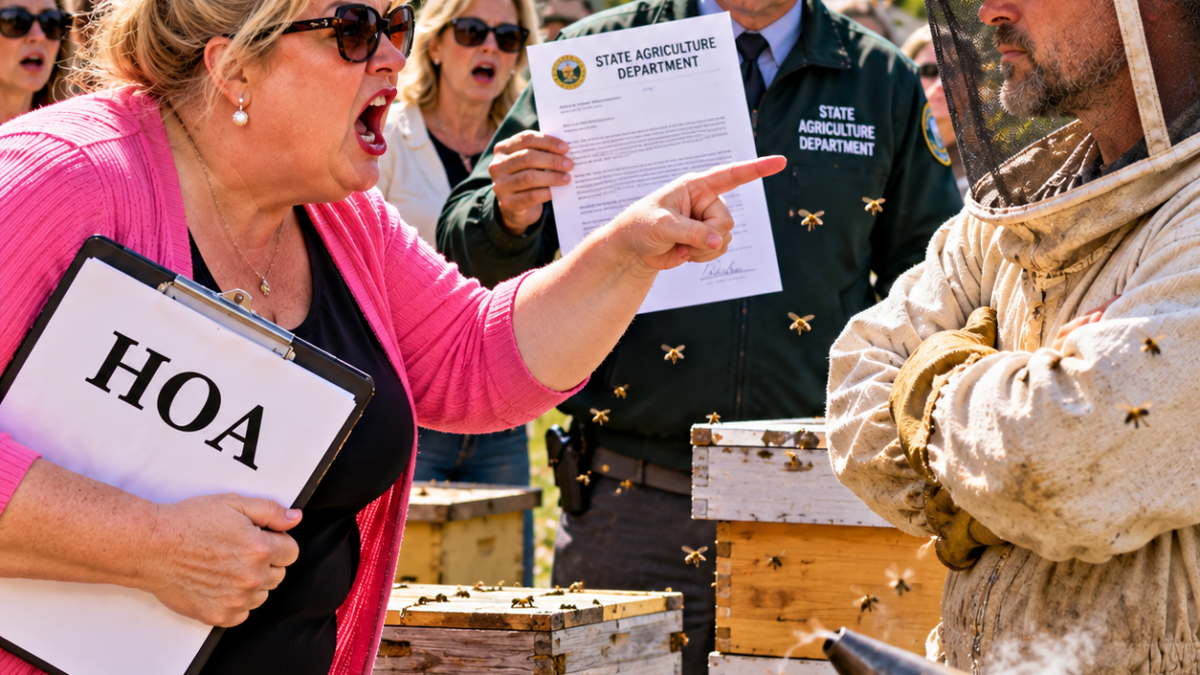
—
PART 2
I closed the hive before doing anything else.
That was important.
Years in EOD had taught me one rule that survived retirement better than almost any other: finish the immediate task before reacting emotionally to the next problem. You do not abandon one hazardous system because somebody starts yelling about another. With bees, the stakes were obviously different, but the discipline was the same. I reseated the frames, checked that the queen had not been disturbed, replaced the inner cover, lowered the telescoping top, and stood there for another minute while the colony returned to its steady rhythm.
Sarah found me in the workshop twenty minutes later with the violation notice laid flat on my bench.
My wife looked at the number.
“Five thousand?”
“That’s what it says.”
“For bees?”
“Commercial enterprise.”
She read the livestock charge.
Then looked at me.
“Livestock?”
“I asked the same thing.”
Sarah had married me while I was still active duty. She knew what it meant when I became quiet instead of angry.
“What are you thinking?”
“That the notice is sloppy.”
“That’s what you’re thinking?”
“Right now.”
She picked up the paper.
“They can’t actually make you remove them, can they?”
“I don’t know yet.”
“You have the state certificate.”
“Yes.”
“And the hives meet the HOA rules?”
“They meet the actual nuisance language. No odor problem, no excessive noise, no commercial traffic, no sales, no customers. The covenant she’s citing is about offensive business activity.”
“So why is she doing this?”
I looked toward the window.
“You know why.”
Sarah sighed.
“Control.”
“Probably.”
She put the violation down.
“Please don’t turn this into one of your operations.”
I opened a drawer and pulled out a folder.
Sarah closed her eyes.
“Jack.”
“What?”
“You already have a folder.”
“Everyone should have folders.”
“What are you naming it?”
I uncapped a marker.
She took it from me.
“No.”
“What?”
“No Operation Queen Bee. No Operation Honey Badger. No Task Force Pollinator.”
“I wasn’t—”
“You were.”
She wrote:
**HOA / APIARY DISPUTE**
and handed the folder back.
“Adult title.”
“Boring.”
“Good.”
Inside went the original notice.
Next I retrieved everything I had assembled before bringing the first nuc onto the property.
The HOA covenants.
State apiary registration.
Site sketch.
Inspection notes.
Photographs.
Dr. Alan Grant’s approval letter.
State pollinator habitat certificate.
My correspondence with the Department of Agriculture.
A statement from my therapist explaining, in appropriately limited clinical terms, why beekeeping formed part of my treatment routine.
I hated including that last document.
Not because I was ashamed.
Because private medical information should not have been necessary to prove that a lawful hobby belonged in my own backyard.
Sarah watched me hesitate.
“You don’t have to send that.”
“I know.”
“Then don’t.”
I thought about it.
“No. It establishes harm if they force removal.”
Her expression softened.
“You shouldn’t have to prove you need something before they respect your right to have it.”
“I agree.”
“But?”
“But Karen doesn’t seem interested in what should be enough.”
The next morning I drafted my response.
No insults.
No accusation of harassment.
No mention of Karen personally beyond identifying the notice she signed.
I wrote like I was documenting a disposal procedure for someone who might later ask exactly why each step had been taken.
First, the hives were not commercial.
I did not sell honey.
I did not advertise.
No customer traffic existed.
No employees.
No deliveries beyond ordinary hobby supplies.
Second, honeybees were not “livestock” under the classification Karen cited.
Third, the apiary had been inspected and approved by the state’s apiculture program.
Fourth, the location exceeded required setbacks and incorporated water, fencing, colony-selection, and management practices intended to minimize conflict.
Fifth, the actual HOA covenant prohibited business activity that was noxious or offensive because of noise, odor, fumes, smoke, or similar nuisance conditions. My hives produced none of those conditions.
Then I requested formal rescission.
I attached the state permit.
Inspection certificate.
Map.
Photographs.
Affidavit that no honey was sold.
And, after another long hesitation, the therapist’s letter.
Sarah read the packet.
“Very reasonable.”
“Thank you.”
“Karen will hate it.”
“Probably.”
I drove it to the management office rather than mailing it.
Young receptionist.
Beige lobby.
Fake ficus.
Quiet music.
“I need a signed acknowledgment of receipt.”
She looked at the packet.
Then at me.
“You want me to sign that I got it?”
“Yes.”
“We don’t usually—”
“I already typed the receipt.”
I slid it forward.
She read it.
Shrugged.
Signed.
Dated.
Stamped.
I put the receipt in the folder before leaving the parking lot.
Four days later, certified mail arrived.
Sarah brought it inside.
“From your friends.”
I opened it at the kitchen counter.
New fine total:
**$12,500.**
Original assessment doubled to $10,000 for failure to comply.
Additional $2,500 for creating an alleged public nuisance and safety hazard.
Below that:
**NUMEROUS RESIDENT COMPLAINTS REGARDING AGGRESSIVE BEE ACTIVITY AND RISK OF ANAPHYLAXIS.**
Attached:
petition.
Fifteen signatures.
I recognized almost every name.
Dave Miller.
The Patels.
Henderson.
Two neighbors from the next street.
And Eleanor Gable.
Mrs. Gable.
The woman next door.
She loved the bees.
Her roses had exploded that spring.
I had given her honey.
She gave us zucchini bread.
I stared at the signature.
Sarah read over my shoulder.
“She signed that?”
“It says she did.”
“Maybe she changed her mind.”
“Maybe.”
But something felt wrong.
EOD instincts are often misunderstood.
People think bomb technicians are fearless.
No.
Good ones are suspicious.
You survive by noticing when something does not fit the expected pattern.
Mrs. Gable’s signature did not fit.
So I started there.
I brought honey.
Not as bribery.
Because I had promised her the next batch.
She was on the porch deadheading petunias.
“Jack!”
Her smile was immediate.
“That better be honey.”
“It is.”
“I’ve got your zucchini bread.”
She stood.
“Come inside.”
“Actually, I need to ask you something first.”
Her expression changed.
“What?”
I removed a folded copy of the petition.
“The HOA says this came from residents concerned about the bees.”
“Okay.”
“Your name is on it.”
Mrs. Gable stared.
“What?”
I handed it over.
She put on her glasses.
Read.
Her face changed slowly from confusion to anger.
“That is my name.”
“Did you sign it?”
“Not this.”
“What did you sign?”
She thought.
Then slapped one hand against her thigh.
“That woman.”
“Karen?”
“She came last week with a clipboard.”
“What did she say?”
“That the HOA was considering benches near the pond.”
Mrs. Gable’s voice rose.
“She said they wanted homeowner support before spending reserve money. She showed me a drawing of two benches and a little walking area. I signed a sheet on the clipboard.”
I felt my jaw tighten.
“Did you read the page?”
“No.”
She looked ashamed.
“Jack, I didn’t. She was standing there talking, and I trusted her.”
“You didn’t do anything wrong.”
“Yes, I did.”
“You signed without reading. That’s not the same thing as agreeing to destroy my hives.”
She pointed at the petition.
“She used my signature.”
“It appears so.”
Mrs. Gable’s eyes sharpened.
“Give me paper.”
“For what?”
“I’m writing exactly what happened.”
That became my first affidavit.
Not legalese.
Simple.
Date.
Approximate time.
Karen’s stated purpose.
Mrs. Gable’s understanding.
Her denial that she knowingly signed an anti-apiary petition.
Signed.
Notarized two days later.
Next:
Dave Miller.
Young father.
Tech worker.
His signature was genuine and knowing.
He admitted it immediately.
“I’m sorry.”
He said it before I even asked.
“Tell me why.”
“Chloe.”
His three-year-old daughter.
“Karen said bees could swarm the play area. Said your hives weren’t permitted.”
I handed him a copy of the state certificate.
He read.
“Seriously?”
“Seriously.”
“She said the state had never inspected them.”
“They did.”
“She said you were selling honey.”
“I’m not.”
“She said there were complaints about aggressive bees.”
“Did you have one?”
“No.”
“Anybody in your house stung?”
“No.”
“Have you ever seen a swarm from my property?”
“No.”
He rubbed his face.
“Man.”
“I’m not here to make you feel bad.”
“I signed it.”
“Because you were scared for your daughter.”
“Yes.”
“That part I understand.”
He looked toward my property.
“You said they’re two hundred yards away?”
“More.”
“Why do I see bees in my flowers?”
“Because bees fly.”
I smiled slightly.
“They could be mine. They could be feral. They could come from miles away.”
Dave stared at the permit.
“She lied.”
“Yes.”
“What can I do?”
“Tell the truth if someone asks.”
He nodded.
“I will.”
Then the Patels.
Karen had told them the hives were unregistered and that homeowner insurance rates could rise.
False.
Henderson had been told the same safety story.
Another signature came from someone who thought she was supporting “pollinator relocation,” not extermination.
By the end of the week, the petition looked less like community consensus and more like a case study in manipulation.
Some signatures were informed but based on false information.
At least two had been obtained under a different stated purpose.
I documented every conversation.
No secret recordings.
Notes.
Signed statements where people were comfortable.
Copies of permits handed out.
Facts.
Sarah watched the binder grow.
“You’re getting scary.”
“This is what paperwork looks like.”
“No. This is what your paperwork looks like.”
She was right.
But the social piece was only one front.
The second was governance.
I read every page of the HOA declaration again.
Article Twelve, Section Two.
Members’ right to inspect association records.
Budgets.
Minutes.
Certain correspondence.
Contracts.
Financial statements.
Subject to reasonable exclusions.
I drafted a formal request.
Two years of board and membership minutes.
Budgets.
Actual expenditures.
Fine collections.
Vendor contracts.
Bid records.
Correspondence concerning my property.
Records of the “numerous complaints” cited against the apiary.
I deliberately did not request every scrap of paper in the association’s history.
I wanted the request broad enough to matter but focused enough that Karen could not honestly call it impossible.
Certified mail.
Email.
Copy to management.
Then I called Dr. Grant.
State apiarist.
He called back within an hour.
“Jack, what happened?”
I told him.
When I reached Karen’s line—
*I don’t care what some bureaucrat says*—
he became quiet.
Not offended personally.
Professionally irritated.
“She told you the state approval is irrelevant?”
“Yes.”
“She fined you anyway?”
“Twelve-five now.”
“Commercial operation?”
“Yes.”
“You’re selling?”
“No.”
“I know you aren’t. I inspected the place.”
He sighed.
“Send me the notices.”
I did.
He called again thirty minutes later.
“This classification is nonsense.”
“I agree.”
“Your colonies were approved as a hobby apiary and pollinator site.”
“Yes.”
“The site is compliant.”
“Yes.”
“I’m going to write the board.”
I sat up.
“Officially?”
“Official letterhead. Copy to management.”
“What will you say?”
“That the state inspected your apiary, that the hives are registered and compliant, that their characterization as unlicensed commercial livestock is inaccurate, and that forced removal may conflict with applicable state agricultural and pollinator policy.”
“Can an HOA still regulate reasonable nuisance issues?”
“Of course.”
Good.
I wanted accuracy.
“If your bees actually created an identifiable nuisance, that can be addressed. But they can’t invent facts and pretend our inspection does not exist.”
“Thank you.”
“I’m copying legal counsel.”
That got my attention.
“Why?”
“Because I don’t want the next call to be after somebody poisons a registered apiary.”
I had not considered that.
The thought made me cold.
“Do you think they’d do that?”
“I think people make bad decisions when they believe they have authority.”
That was becoming a theme.
His letter went out.
Then Karen answered my records request.
Denied.
One paragraph.
Overly broad.
Burdensome.
Confidential.
No proposed narrowing.
No partial production.
No invitation to inspect non-confidential records.
Just no.
I put her letter next to Article Twelve.
Sarah looked over my shoulder.
“She violated it?”
“Looks that way.”
“What now?”
“Lawyer.”
“You finally admit there are professionals for this?”
“Occasionally.”
Through a veterans legal service, I met Sarah Jenkins.
Different Sarah.
Attorney.
Early thirties.
Fast mind.
Zero patience for sloppy authority.
We met at a coffee shop because her nonprofit’s office was being renovated.
I brought two binders.
She stared.
“You brought tabs.”
“Yes.”
“Color-coded?”
“Yes.”
“Are all EOD guys like this?”
“The surviving ones tend to appreciate organization.”
She looked at me for half a second.
Then smiled.
“Fair.”
We went through the file.
Original fine.
Response.
Receipt.
Second fine.
Petition.
Mrs. Gable affidavit.
State certificate.
Dr. Grant letter.
Records request.
Denial.
Sarah stopped at that one.
“Oh.”
“Good oh?”
“Very good oh.”
She read it again.
“Do the bylaws permit inspection?”
I opened the declaration to the tab.
She compared.
“Excellent.”
“Meaning?”
“Meaning Karen has now given us an issue that has nothing to do with bees.”
She leaned forward.
“Your apiary dispute might involve interpretation. Records access is cleaner. The governing document says members have inspection rights. She responded with a blanket denial.”
“What do we do?”
“Demand compliance.”
“That’s it?”
“That’s step one.”
She started notes.
“Rescind fines. Produce records. Preserve all communications related to your apiary. Confirm no enforcement action pending review.”
“And if they refuse?”
“We file to compel.”
She smiled.
“Then they pay lawyers to explain why they refused to follow the rulebook they keep waving at you.”
I liked her.
The demand letter went out.
Ten-day deadline.
Meanwhile, Mrs. Gable invited six of us to her living room.
She called it “tea.”
It was insurgency with cookies.
Dave Miller.
The Patels.
Mr. Henderson, retired CPA.
Sarah and me.
Mrs. Gable placed the fraudulent petition on her coffee table.
“I want everyone to understand exactly what happened.”
She told her story.
Dave told his.
The Patels told theirs.
I passed around Dr. Grant’s letter.
Henderson read it slowly.
“So the board already had this?”
“Yes.”
“And continued fines?”
“Yes.”
“And denied your financial request?”
“Yes.”
Henderson looked at Karen’s denial.
“That bothers me more than the bees.”
“Why?”
“I spent thirty-eight years auditing companies.”
He tapped the paper.
“People with clean books usually complain about producing them.”
He tapped again.
“People with dirty books refuse.”
That sentence changed the mood.
Not proof.
Suspicion.
But informed suspicion.
“What do you think is there?”
Dave asked.
Henderson shrugged.
“Maybe nothing. Maybe Karen is just controlling.”
Mrs. Gable snorted.
“Just?”
“Or maybe there’s a reason she doesn’t want inspection.”
The ten-day deadline almost expired.
Day nine:
HOA counsel called Sarah Jenkins.
Not Karen.
Lawyer.
That alone told us something.
The attorney was apologetic but careful.
Board would rescind my fines pending review.
Records would be produced.
No enforcement while legal questions were examined.
Partial victory.
The bees stayed.
Twelve thousand five hundred dollars vanished from the account ledger.
But Sarah warned me:
“Don’t celebrate.”
“I wasn’t.”
“The boxes matter.”
They arrived at her office two days later.
Five banker’s boxes.
Financials.
Invoices.
Contracts.
Minutes.
Email printouts.
Complaint files.
Fine records.
Management correspondence.
We spread everything across Sarah’s conference room.
Henderson joined.
So did Mrs. Gable for two hours until we convinced her that reviewing two years of landscaping invoices was not the best use of her Saturday.
She returned with sandwiches instead.
At first:
boring.
Pool chemicals.
Insurance.
Lighting.
Mulch.
Tree pruning.
Pest service.
Security cameras.
Then Henderson said:
“Jack.”
I walked over.
He pointed to landscaping.
Budget:
$100,000.
Actual:
closer to $150,000.
“What’s special projects?”
“I don’t know.”
We found invoices.
**Emergency planting.**
**Beautification enhancement.**
**Hardscape restoration.**
Addresses hidden behind lot numbers.
We mapped them.
Karen’s cul-de-sac.
Gerald’s side yard.
Brenda’s street frontage.
Private-adjacent landscaping somehow billed to common-area expense codes.
“Could be legitimate common easements.”
Sarah said.
Good lawyer again.
“Verify before concluding.”
We pulled plats.
Some work sat partly within HOA-maintained strips.
Some did not.
Then the vendor.
Evergreen Vistas.
Three-year contract.
No competitive bid record.
HOA procurement rule required multiple quotes over a threshold.
None in the file.
I searched the state corporate registry.
Registered agent:
Frank Miller.
Dave Miller looked over.
“Not related to me.”
“Good.”
Henderson asked:
“Related to Karen?”
Mrs. Gable, who had returned with coffee, said:
“Her sister married a Miller.”
We verified.
Frank Miller.
Karen’s brother-in-law.
Sarah held up one finger.
“Family relationship alone is not proof of wrongdoing.”
“I know.”
“But undisclosed related-party contracting plus skipped bidding plus inflated spending?”
Henderson said.
“That is a serious governance issue.”
Then emails.
Management asked whether Evergreen’s contract should go to competitive bid.
Karen replied:
**Board sees no need to disrupt a proven vendor relationship. Renew as presented.**
Another email:
Gerald approved.
Brenda approved.
Then fine enforcement.
Sarah created a spreadsheet.
Address.
Violation type.
Fine amount.
Appeal result.
Board relationship.
The pattern emerged slowly.
Karen’s cul-de-sac:
warnings.
Extensions.
No fines.
Other areas:
fast escalation.
Residents who challenged her at meetings:
especially aggressive enforcement.
One email chilled me.
Management company:
**Lot 218 has same basketball hoop configuration as Lot 77. Should we issue consistent notice?**
Karen:
**Lot 218 is resolving privately. Do not send letter. Proceed with 77.**
Another:
A resident requested appeal.
Karen wrote:
**He has been argumentative before. No reason to reward noncompliance. Continue penalties.**
That was not impartial enforcement.
Then my file.
Before the first fine, Gerald had emailed:
**Do we have confirmation he sells honey?**
Karen replied:
**Six hives is obviously commercial. We do not need to wait for him to create traffic before acting.**
No evidence.
Then after I submitted the state permit:
Gerald:
**Should counsel review this before we increase fine?**
Karen:
**No. He is attempting to intimidate us with outside bureaucracy. Double per board policy.**
Gerald’s approval came twelve minutes later:
**Agreed.**
My anger changed.
Before, Karen had felt like the problem.
Now I saw something less satisfying.
She had help.
Not necessarily equal guilt.
But permission.
People who knew enough to ask questions, then stopped asking once she answered.
Sarah leaned back.
“This is why we don’t make this a Karen-only story.”
“What do you mean?”
“Systems fail through enablers.”
Henderson nodded.
“Boards exist so one person doesn’t control everything.”
We kept going.
No smoking gun proving cash went directly into Karen’s pocket.
But enough for serious scrutiny:
Overpriced contracts.
Family connection.
Procurement deviations.
Selective enforcement.
Private-area improvements charged broadly.
Petition manipulation.
Records obstruction.
That was already more than enough for political action.
Mrs. Gable looked at the documents.
“What can homeowners do?”
Sarah opened the bylaws.
“Recall.”
Threshold:
25 percent petition.
Special meeting required.
Henderson smiled.
“You’ll get twenty-five.”
Mrs. Gable stood.
“We’ll get fifty.”
We got sixty.
In one weekend.
But we did it differently than Karen.
Every person saw exactly what they were signing.
One-page summary.
Supporting exhibits available.
No false bench story.
No scare tactics.
No claims of criminal guilt.
Only:
Contracts.
Relationships.
Fine patterns.
Emails.
Records denial.
Apiary timeline.
People were furious.
One man stared at the invoice map.
“They used dues on Karen’s street?”
“Some expenses appear tied to that area.”
Henderson said carefully.
“We’re asking for independent audit.”
Another homeowner pointed to his old fine.
“I paid $1,800 for a shed color.”
Sarah showed him a comparable case from Karen’s circle.
No monetary penalty.
His face hardened.
“I’ll sign.”
A woman who had defended Karen for years read the related-party contract.
“She said she negotiated the best price.”
“Maybe she believed that.”
I said.
“Then why no bids?”
She had no answer.
She signed.
Monday morning:
Recall petition submitted.
Special meeting demanded.
Then another decision.
Attorney General referral.
Sarah resisted dramatic language.
“This is not racketeering.”
she said when Dave used the word.
“Could be fraud.”
“Could.”
“Could be embezzlement.”
“Maybe.”
“Then what do we call it?”
“Evidence requiring investigation.”
That is why lawyers are useful.
We assembled a binder.
Financial anomalies.
Contracts.
Emails.
Sworn statements.
Petition deception.
Selective enforcement.
Records obstruction.
We sent it to the appropriate state office for review.
A copy went to an investigative journalist known for HOA and consumer stories.
Then we waited.
Waiting is harder than fighting.
The hives helped.
I worked frames.
Checked mites.
Fed a weak colony.
Added supers.
Summer moved forward whether Karen survived politically or not.
One afternoon Dave brought Chloe over.
His daughter.
Four years old.
She stayed behind the marked safe line.
Tiny veil.
Her father held her hand.
“Those are the scary bees?”
she asked.
Dave winced.
I smiled.
“No.”
“Do they sting?”
“They can.”
“Will they sting me?”
“If we respect them, probably not.”
“Probably?”
“Anyone who says never is lying.”
She thought.
“Daddy says bees make strawberries.”
“Bees help pollinate strawberries.”
“Same.”
Close enough.
Dave looked at me.
“I really am sorry.”
“You’ve apologized.”
“I signed the petition.”
“You were protecting your kid with the information you had.”
“Bad information.”
“Now you know.”
He looked at Chloe watching bees enter the hive.
“Karen knew what to say.”
“Fear works.”
“That’s the thing.”
He lowered his voice.
“I’m angry at her, but I’m angrier at myself.”
“Don’t be.”
“Why not?”
“Because then fear gets replaced by shame.”
He looked at me.
“What should replace it?”
“Better questions.”
Recall night was held at the high school auditorium because the clubhouse was too small.
That image alone told the story.
Months earlier, twenty people attended HOA meetings.
Now nearly every household showed up.
Karen sat on stage between Gerald and Brenda.
All three looked smaller under theater lights.
Neutral moderator.
Management company attorney.
Ballot procedure explained.
Karen got five minutes.
She used all of them.
“Coordinated smear campaign.”
“Disgruntled homeowner.”
“Personal attack.”
“Accounting misunderstandings.”
“Family vendor selected for quality.”
“Selective enforcement allegations taken out of context.”
Then:
“My record speaks for itself.”
It did.
That was the problem.
Halfway through her statement, side doors opened.
Reporter.
Camera operator.
Karen stopped.
“No.”
The moderator looked up.
“This meeting is open under the association’s governing documents.”
“I object.”
“Noted.”
Camera began recording.
Karen’s composure cracked.
“You cannot film me without permission.”
Reporter:
“We are recording a public association proceeding.”
The moderator raised one hand.
“Please allow the meeting to continue.”
Karen sat.
I was designated representative for petitioners.
I walked to the podium.
For weeks, I had imagined what I would say.
I had imagined mentioning $12,500.
The fraudulent petition.
My therapy.
The state permit.
All the things that made me angry.
But when I looked at three hundred neighbors, most of that suddenly felt too small.
“This started with my bees.”
I said.
Slide one:
Apiary photograph.
“But tonight is not about bees.”
Next.
State approval.
“The board had documentation confirming the apiary was inspected and permitted.”
Next.
Email.
**Double per board policy.**
“Instead of reviewing that information, enforcement escalated.”
Next.
Petition.
Mrs. Gable’s affidavit.
“She believed she was supporting park benches.”
Murmurs.
Next.
Records request.
Karen’s denial.
Next.
Landscaping budget.
Next.
Evergreen Vistas.
Next.
Corporate filing.
Frank Miller.
Karen’s brother-in-law.
I said:
“A family relationship does not automatically mean wrongdoing.”
Important.
“But contracts this large should be transparent, especially when your own procurement rules call for competitive process.”
Next.
Map.
Spending concentration.
Next.
Selective enforcement spreadsheet.
I kept language simple.
No prosecutor theater.
No declarations of crime.
Just questions supported by documents.
“Why did some residents get warnings while others received thousands in fines for the same conditions?”
Next.
Emails.
**Do not send letter.**
**Continue penalties.**
People reacted more strongly to Karen’s own words than anything I said.
That was the point.
At the end:
“This recall is not revenge.”
I looked toward Karen.
“It is an accountability decision.”
Then I stepped away.
Reporter kept camera on Karen.
Moderator asked if she wanted a brief response.
She should have said no.
Instead, Karen grabbed the microphone.
“You people are unbelievable.”
Silence.
“I worked for years to make this neighborhood respectable.”
Gerald whispered something.
Karen ignored him.
“Yes, Evergreen is owned by my brother-in-law.”
The audience erupted.
Karen raised her voice.
“He does good work!”
Moderator:
“Please—”
“And yes, I used discretion on fines.”
Sarah Jenkins beside me closed her eyes.
Karen kept going.
“Because not every homeowner is the same. Some cooperate. Some create problems.”
She pointed at me.
“People like him.”
There it was.
Not a legal confession to every accusation.
But a perfect summary of the governance problem.
Rules for cooperative people.
Rules weaponized against difficult people.
Karen said:
“I am not apologizing for protecting this community.”
The moderator reclaimed the microphone.
Voting began.
Over ninety percent voted to remove all three directors.
Karen.
Gerald.
Brenda.
The applause afterward was enormous.
But it did not feel like victory over three people.
It felt like people discovering they had always possessed the power Karen claimed for herself.
Mrs. Gable became interim president.
She objected.
Everyone ignored her.
Henderson became treasurer.
Dave Miller joined the board later.
First action:
My apiary violation permanently expunged.
Second:
Independent forensic audit.
Third:
Suspend disputed enforcement cases for review.
Fourth:
Competitive procurement requirement reinforced.
Fifth:
Records access policy clarified.
The audit went back five years.
Its findings were ugly.
Nearly $200,000 categorized as misallocated, inadequately supported, conflicted, overpriced, or otherwise requiring remediation.
Not all stolen.
Important.
Some legitimate work had been performed.
Some invoices were simply excessive.
Some contract processes had been improper.
Some private-adjacent beautification should never have been charged the way it was.
Evergreen Vistas lost the contract.
The HOA pursued recovery where counsel believed appropriate.
The state investigation continued separately.
I gave documents.
Answered questions.
Then went back to bees.
Months later, charges were announced involving Karen and her brother-in-law.
Fraud-related counts.
Financial misconduct.
Negotiations followed.
Eventually she accepted a plea resolving lesser charges, paid substantial restitution, and received probation rather than a long prison sentence.
Her brother-in-law’s company suffered its own sanctions and lost access to some contracting opportunities.
Gerald and Brenda were not treated as identical actors.
That mattered.
Enabling bad decisions is serious.
It is not always the same as designing them.
The neighborhood learned to separate anger from evidence.
Karen sold her house.
Quietly.
No public confrontation.
No final driveway scene.
Part of me wanted one.
I wanted her to stop near my apiary and admit:
I was wrong.
That never happened.
At least not then.
The moving truck came on a Tuesday.
She watched men load furniture.
I was checking hive entrances when she looked across the road.
Our eyes met.
For one second.
Then she turned away.
That was all.
Sarah joined me.
“You okay?”
“Yes.”
“Disappointed?”
“A little.”
“What did you want?”
“I don’t know.”
“You wanted an apology.”
“Maybe.”
“You got the bees.”
She pointed.
“You got your name cleared.”
Then toward Meadow Ridge.
“They got their neighborhood back.”
She looked at me.
“Don’t let Karen keep living here after she moved.”
That was wise.
Hard.
Necessary.
The new HOA became boring.
Beautifully boring.
Budgets posted online.
Contracts bid.
Board minutes published.
Fine procedures standardized.
Appeals reviewed by more than one person.
No secret exceptions.
No presidential discretion based on whether somebody was “cooperative.”
Mrs. Gable’s first newsletter opened:
**WE ARE NOT A GOVERNMENT. WE ARE NEIGHBORS WITH A SHARED BUDGET.**
Best HOA sentence I ever read.
She hated meetings.
Which also made her an excellent president.
“Anyone who wants this job too badly should be disqualified.”
she told me.
I agreed.
Dr. Grant returned the following spring.
Annual apiary inspection.
He walked the property.
Checked registration.
Water.
Fence.
Colony placement.
“Everything looks good.”
“Can I get that in writing?”
He laughed.
“You trauma people really love documentation.”
“HOA people taught me.”
He signed.
Then:
“The board still bothering you?”
“New board.”
“Good?”
“Boring.”
“Excellent.”
He looked toward my garden.
“Pollination difference?”
Huge.
Squash.
Cucumbers.
Berries.
Fruit trees.
Neighbors noticed too.
Flowers improved.
Vegetable yields.
Mrs. Gable’s roses.
People began asking questions.
Not:
Are the bees dangerous?
But:
How do they work?
Why do they swarm?
What is a queen?
How far do they fly?
Why is honey different colors?
I started Saturday demonstrations.
Nothing formal.
Maybe four people.
Then twelve.
Always behind barriers.
No casual opening of colonies around unprotected spectators.
Basic safety.
Protective gear.
Allergy awareness.
One day Chloe Miller came wearing a child-sized bee suit.
She was six.
“Mr. Jack.”
“Yeah?”
“I’m not scared anymore.”
“Good.”
“Daddy was.”
Dave looked offended.
“I was concerned.”
Chloe:
“You were scared.”
I laughed.
Dave surrendered.
“Fine.”
I showed her a frame through an observation box.
“See the workers?”
“Yes.”
“See how they’re all moving?”
“Yes.”
“They each have jobs.”
“Like people?”
“Better organized.”
Dave:
“Careful. HOA election next month.”
Mrs. Gable eventually got her benches near the pond.
Real benches.
Bought through bids.
Approved transparently.
No fake petition.
At the dedication, she stood beside one and pointed at me.
“This is what I thought I was signing for.”
Everyone laughed.
Karen’s lie had finally turned into the harmless thing Mrs. Gable originally believed.
That felt strangely healing.
Then came the community garden.
Recovered money funded initial beds.
Raised boxes.
Accessible paths.
Water.
Tool shed.
Residents volunteered.
I added pollinator-friendly plantings.
Native flowers.
Herbs.
No pesticides harmful to bees without careful consideration.
Kids painted signs.
The apiary became part of the garden education program.
Not physically inside it.
Near enough for pollination.
Far enough for safety.
The same hives once called an infestation became something the HOA newsletter bragged about.
I had mixed feelings.
Sarah understood.
“You don’t want them becoming mascots.”
“Exactly.”
“Why?”
“They’re bees.”
“So?”
“They don’t care about HOA redemption arcs.”
She laughed.
“Neither do I.”
The honey harvest that year was exceptional.
Wildflower.
Dark amber.
Complex.
I bottled more than we could use.
Still did not sell it.
We gave jars away.
Neighbors.
Fire station.
VA clinic.
Community events.
Mrs. Gable helped label.
At the workshop table, she held one jar up to the sunlight.
“Look at that.”
Liquid gold.
She smiled.
“You know what I think?”
“Dangerous opening.”
“Karen tried to use these bees to split everybody apart.”
I leaned against the table.
“She nearly did.”
“But they did the opposite.”
“I think documents did most of the work.”
“Don’t ruin this.”
“Sorry.”
Mrs. Gable turned the jar.
“They brought people together.”
I took a blank label.
Wrote:
**COMMUNITY BLEND**
She approved.
Soon every jar from that batch carried the name.
Not for sale.
Just gifts.
People loved it.
Years passed.
Beekeeping became less about recovery and more simply part of who I was.
That was progress.
When I started, every inspection was therapy.
Controlled breathing.
Focus.
Ritual.
A reason to stay present.
Eventually I could work a hive without thinking about why I needed it.
The bees had become ordinary.
There is something beautiful about healing becoming boring.
One evening, my therapist asked:
“Still keeping bees?”
“Yes.”
“Still helping?”
I thought.
“Different now.”
“How?”
“At first, they kept me from thinking about things.”
“And now?”
“Now I think about bees.”
He smiled.
“That’s usually how it works.”
The neighborhood changed too.
New residents heard the story in exaggerated form.
“The bees that took down the HOA.”
No.
“The veteran who exposed a million-dollar corruption ring.”
Also no.
“The state threatened to dissolve the association.”
Absolutely no.
I corrected people until Sarah told me to stop.
“You’re fighting folklore.”
“Folklore should be accurate.”
“That sentence has never been true.”
What happened was dramatic enough.
HOA fined lawful hobby.
President manipulated petition.
Board ignored state documentation.
Homeowner requested records.
President improperly blocked access.
Records revealed serious governance and financial concerns.
Residents organized.
Board recalled.
Authorities investigated.
That was enough.
No need for mythology.
The hardest part to explain was Karen.
People wanted her to be a cartoon villain.
Easy.
Evil.
Greedy.
I understood the appeal.
But I had watched enough people under pressure to know that human failure usually arrives in layers.
Karen liked control.
She liked deference.
She grew accustomed to being obeyed.
At some point, being challenged became equivalent in her mind to being wronged.
Then every tool available to her became justified.
Fine.
Petition.
Exception.
Contract.
Denial.
She did not wake up one morning and decide:
I will destroy a veteran’s therapy and steal from my neighbors.
She made smaller decisions.
Then defended them.
Then made worse decisions to protect the earlier ones.
That does not excuse her.
It makes the warning more useful.
Systems should not depend on people remaining humble forever.
They need checks.
Records.
Votes.
Audits.
Term limits.
Disclosure.
Procedures.
Because everyone is vulnerable to believing their own judgment deserves special treatment.
Including people who mean well.
Including me.
That lesson came home one year when the board proposed banning certain pesticides in Meadow Ridge.
Because bees.
Everyone expected me to support it automatically.
I did not.
I read the proposal.
Too broad.
Poorly defined.
Would have restricted reasonable mosquito control and certain necessary treatments without technical basis.
Mrs. Gable stared.
“Jack, this protects pollinators.”
“It tries to.”
“So?”
“So bad rules with good intentions are still bad rules.”
That room went quiet.
I suggested revisions.
Targeted products.
Application timing.
Notification near registered apiaries.
Education.
Professional exceptions.
Integrated pest management.
The final rule improved.
Afterward Dave said:
“You just argued against your own bees.”
“No.”
“I argued against sloppy regulation.”
He laughed.
“You really learned nothing fun from Karen.”
Wrong.
I learned this:
Never become the thing you defeated simply because your cause feels nobler.
Ten years after the fine, my original queens were long gone.
Colonies change.
Queens replaced.
Hives split.
Some failed.
Some thrived.
The apiary was still there but not the same.
A living system.
That matched the neighborhood.
Mrs. Gable stepped down as president after two terms.
Henderson retired from treasurer duties.
Dave served one term.
New people came.
Processes stayed.
That mattered more than personalities.
At Mrs. Gable’s retirement potluck, we gave her a plaque.
She hated it.
Then she cried.
The plaque read:
**ELEANOR GABLE — PRESIDENT, NEIGHBOR, PROFESSIONAL READER OF CLIPBOARDS**
She hit me with her napkin.
“You wrote that.”
“No evidence.”
“You’re terrible.”
“Read before signing.”
She laughed so hard she had to sit.
A few months later, a letter arrived.
No HOA logo.
Personal.
Karen.
I knew her handwriting from years of violation notices.
I stared at it on the counter.
Sarah came in.
“What?”
I held it up.
“Oh.”
“Want to open it?”
“No.”
“Will you?”
“Yes.”
Inside:
two pages.
Karen wrote that she had spent years angry.
At me.
Residents.
Her lawyers.
Investigators.
Her brother-in-law.
Everyone.
Then somewhere along the way, she realized anger was easier than admitting she had made decisions she could no longer defend.
She did not excuse the financial issues.
She said she had convinced herself that using familiar vendors was efficient, then stopped seeing the conflict.
She admitted she treated cooperative homeowners differently.
She admitted the petition against the bees had been manipulative.
That sentence mattered most.
Then:
**I knew the benches explanation would get signatures more easily. I told myself the safety issue was more important than the method. It was dishonest.**
I stopped reading.
Sarah waited.
I continued.
**I also knew by the second notice that your state permit was real. I did not want to reverse myself publicly. I escalated because I was embarrassed. That choice cost many people far more than it should have.**
Then:
**I am sorry.**
No request for forgiveness.
No defense.
No “but.”
At the end:
**I still don’t like bees.**
I laughed.
Sarah smiled.
“That sounds real.”
I wrote back.
**Karen,**
**Thank you for the letter. I accept the apology. You are not required to like bees.**
**Jack**
That was it.
Forgiveness does not require pretending history did not happen.
It means deciding history no longer needs new casualties.
The following spring, I lost a colony.
Cold snap.
Weak cluster.
Despite feeding and insulation, they did not make it.
When I opened the hive, the silence hit harder than expected.
People think beekeepers see insects.
After enough years, you see a superorganism.
A city.
Work.
Birth.
Failure.
A queen.
Winter strategy.
Collective survival.
Finding a dead colony feels like entering a town after everyone vanished.
Chloe was there that weekend.
Teenager now.
She saw the empty box.
“They died?”
“Yes.”
“All of them?”
“Yes.”
She looked close to tears.
“Why?”
“Sometimes colonies fail.”
“But you did everything right.”
“Probably.”
“That’s unfair.”
“Yes.”
She looked at me.
“Can you start another?”
“Yes.”
“How?”
“We split a strong colony later.”
She stared at the empty frames.
“So it comes back?”
“Not the same colony.”
“But bees come back.”
“Yes.”
That idea stayed with me.
Recovery does not restore the original thing.
It creates the next thing.
Meadow Ridge after Karen was not the neighborhood before Karen.
I after Afghanistan was not the man before Afghanistan.
A split colony is not the old colony.
But life continues.
Different.
Real.
Worth tending.
Chloe eventually studied environmental science.
Dave blamed me.
“Bee propaganda.”
“She made her own choices.”
“She wrote her college essay about the HOA bee war.”
“No.”
“Yes.”
“What did she call it?”
He smiled.
**THE POLITICS OF POLLINATION.**
I groaned.
“Actually pretty good.”
She got in.
Years later, she returned as an intern with the Department of Agriculture.
Dr. Grant had retired.
The new state apiarist brought interns to inspect community apiaries.
Chloe stepped out of the state truck.
I stared.
“You have got to be kidding.”
She grinned.
“Permit inspection.”
“Conflict of interest.”
“I’m observing.”
The new apiarist laughed.
“You know each other?”
“Unfortunately.”
Chloe put on her veil.
“Mr. Thompson taught me bees.”
“Your father lied to you about them first.”
She rolled her eyes.
“I was four.”
Full circle can be obnoxiously sentimental.
This one I allowed.
The inspection passed.
Again.
We kept the certificate.
Again.
Sarah framed it beside the first.
Our workshop wall became ridiculous.
State permits.
Community Garden Appreciation plaque.
Veterans beekeeping certificate.
Mrs. Gable’s joke award.
Sarah called it:
“The Wall of Bureaucratic Survival.”
Accurate.
At the annual harvest festival—because Meadow Ridge eventually had one—I sat near the garden watching kids paint little wooden pollinator houses.
Not honeybee hives.
Native bee nesting structures.
Important distinction.
Henderson grilled.
Dave argued about charcoal.
Mrs. Gable supervised everybody despite being officially retired.
Sarah brought me a jar.
Community Blend.
“Last one from this batch.”
“Keep it.”
“For what?”
“I don’t know.”
She sat beside me.
“Remember the first $5,000 fine?”
“Yes.”
“Were you scared?”
I thought about lying.
“No.”
She stared.
“Jack.”
“Yes.”
“Very?”
“More than I admitted.”
“Why?”
“The money wasn’t the worst part.”
“What was?”
I looked toward the hives.
“I thought they could make me lose this.”
Not the boxes.
The stability.
The ritual.
The thing I had found after years of not knowing how to be still.
Sarah put her hand over mine.
“They couldn’t.”
“I didn’t know that then.”
That is the truth about conflict.
Looking backward, victory feels inevitable because you know the ending.
Living it, you don’t.
When Karen doubled the fine, I did not know whether a court would agree.
When neighbors signed the petition, I did not know which relationships were real.
When I requested records, I did not know whether we would find anything.
When Sarah Jenkins sent her demand, I did not know whether the HOA would bury us in legal fees.
When we launched recall, I did not know if people would choose evidence over familiarity.
Stories compress uncertainty.
Life does not.
That is why courage matters.
Courage is not knowing you win.
It is acting carefully while accepting you might not.
The bees taught that too.
Every season begins with risk.
Weather.
Mites.
Queen failure.
Drought.
Pesticide exposure.
Winter.
You inspect.
Prepare.
Intervene where useful.
Then accept that some variables remain beyond you.
Control is an illusion.
Stewardship is real.
Karen wanted control.
I learned stewardship.
That was the deeper conflict.
One person believed a community worked when everybody obeyed.
The other learned a colony works because thousands of individuals perform roles inside a system none of them personally owns.
People love calling queens rulers.
They are not.
A queen bee does not issue orders.
She lays eggs.
Workers feed.
Clean.
Guard.
Build.
Forage.
Ventilate.
Nurse.
The colony survives through distributed work and chemical communication, not royal decree.
I once explained that at an HOA meeting.
Mrs. Gable smiled at me.
“So you’re saying bees are more democratic than Karen?”
“No.”
Henderson said:
“Close enough.”
The joke made the newsletter.
Years later, after Mrs. Gable passed away, her granddaughter gave me the original blue ceramic planter that had sat beside her porch.
Not a bird bath.
Different house, different story.
She said:
“Grandma wanted you to have something for the bee garden.”
We put it near the workshop.
Filled it with thyme.
Bees loved it.
Every time I saw them foraging there, I remembered the afternoon I confronted Mrs. Gable with that fake petition.
She could have become defensive.
She could have denied carelessly signing.
Instead, she got angry at being deceived and chose to stand up.
One honest person can change the direction of a conflict.
Not because they are powerful.
Because they make lying more expensive.
The HOA eventually created a memorial pollinator bed in her name.
I insisted it not become tacky.
Sarah laughed.
“You have become the aesthetic committee.”
“Never say that again.”
The plaque read:
**ELEANOR GABLE POLLINATOR GARDEN — ASK QUESTIONS. READ BEFORE SIGNING.**
Perfect.
When I turned sixty-five, I reduced from six hives to four.
Back disagreed with supers.
Sarah said retirement from retirement was allowed.
I trained younger volunteers.
No commercialization.
Still hobby scale.
Still registered.
Still inspected.
Still enough honey for gifts.
Community Blend continued.
The label changed.
A small bee over a line drawing of Meadow Ridge’s pond.
Underneath:
**NOT FOR SALE — SHARED BY NEIGHBORS**
That mattered to me.
The entire fight started because Karen insisted quantity meant business.
The honey remained something given.
Not because selling honey is wrong.
Plenty of beekeepers legitimately run businesses.
But because this apiary had always existed for a different reason.
Healing.
Pollination.
Routine.
Community.
Not every useful thing needs to become revenue.
That was another lesson Meadow Ridge slowly learned.
One spring, the board asked if the HOA could pay me for pollination.
I declined.
“You already get it.”
“For free?”
“Bees don’t recognize property lines.”
Henderson, visiting the meeting, said:
“Socialist bees.”
I said:
“Do not politicize my insects.”
Everyone laughed.
Normal.
That word again.
Normal laughter around the same subject that once carried threats of liens and $12,500 penalties.
That transformation meant more than any verdict.
The last time I spoke to Dr. Grant, he had retired to a farm several counties away.
I called to thank him.
“For what?”
“The letter.”
“That was years ago.”
“I know.”
“Jack, I wrote maybe six sentences.”
“They mattered.”
He paused.
“You did the work.”
“So did you.”
Then he said something I never forgot.
“Regulation is only useful when people trust somebody will enforce it consistently.”
The HOA learned that.
So did I.
State permits did not make me morally superior.
HOA rules were not automatically illegitimate.
Both systems could work.
Both could be abused.
The answer was not:
government good, HOA bad.
The answer was:
authority needs evidence, process, transparency, and limits.
Even when you agree with the goal.
Especially then.
One summer afternoon, a swarm appeared on a maple branch near the community garden.
Not from my colonies, as far as I could tell.
Residents panicked less than they would have years earlier.
Someone called me.
I came.
Cluster hanging.
Thousands of bees.
Calm.
I explained:
“Swarm looks terrifying. Usually defensive behavior is lower because they have no brood or stores to protect.”
Still caution.
We set a box.
Collected them.
Registered the new colony.
A little boy watched from behind the safety boundary.
“Can we keep them?”
“Maybe.”
“HOA says yes?”
I laughed.
“The HOA has learned to ask the agriculture department.”
Mrs. Gable would have loved that.
The colony survived.
We named it Eleanor.
I usually hated naming hives.
Made an exception.
Looking back, people sometimes tell me Karen’s biggest mistake was fining the bees.
It wasn’t.
Her biggest mistake was believing that if she controlled the paperwork, she controlled the truth.
The first notice said commercial.
Reality said hobby.
The notice said livestock.
State classification said pollinator.
The petition said residents demanded removal.
Some signers had been deceived.
The board said records were confidential.
The governing documents said members had inspection rights.
The budget said community landscaping.
Invoices showed concentrated benefits and conflicted contracting.
The rulebook said uniform enforcement.
Emails showed discretion based on personal favor.
Karen kept producing paper.
Paper kept contradicting her.
That is why documentation mattered.
Not because paper is inherently powerful.
Because written words freeze decisions.
They make it harder to reinvent yesterday.
People say:
“Never put anything in writing.”
Wrong.
Good governance should put almost everything important in writing.
Just be prepared to defend it later.
Karen wasn’t.
The $12,500 fine is still in my filing cabinet.
I considered framing it.
Sarah threatened divorce.
So filing cabinet.
Sometimes veterans I mentor ask about beekeeping.
Not HOA drama.
Bees.
Does it help?
I answer carefully.
“For me, yes.”
Not cure.
Not magic.
No romantic nonsense.
It gave structure.
Sensory grounding.
Responsibility.
A living system demanding attention outside myself.
Different people need different things.
Some gardens.
Some woodworking.
Fishing.
Dogs.
Running.
Therapy.
Medication.
Community.
Often several.
Bees were one piece.
That is why Karen’s demand felt so invasive.
She thought she was ordering removal of boxes.
I heard:
Remove the tool that helped you rebuild your life.
She did not know that.
At first.
After she received my therapist’s letter, she did.
That is the part I had the hardest time forgiving.
She escalated anyway.
Years later, her apology acknowledged it indirectly.
Embarrassment became more important to her than backing down.
I understand that weakness.
I have felt it.
Everyone has.
You make a decision.
New evidence arrives.
Changing course feels like admitting incompetence.
So you defend harder.
EOD punishes that mindset.
If new information says your first assessment is wrong, you change immediately.
Ego around explosives is lethal.
Ego in governance is slower.
But it still destroys things.
Karen eventually learned.
Meadow Ridge learned sooner.
That was enough.
On a late August evening, many years after the original fine, I stood by the hives as sunlight dropped behind the state woodland.
The bees were returning heavy.
Golden pollen.
Orange pollen.
Some nearly falling onto the landing board.
Sarah came out with two glasses of iced tea.
“You planning to stand there all night?”
“Maybe.”
“Mosquitoes will eat you.”
“Bees protect me.”
“They absolutely do not.”
True.
She handed me a glass.
The garden was full.
Tomatoes.
Squash.
Flowers.
The community garden beyond the fence was busy too.
Chloe, home visiting from her job with an environmental nonprofit, was helping children water beds.
Dave was complaining about rabbits.
Henderson, now well into retirement from retirement, sat on one of the pond benches Karen had once lied about.
New HOA president walked by and waved.
No clipboard.
Good sign.
Sarah leaned into me.
“You found your quiet.”
I listened.
Thousands of bees.
Children.
Lawn mower.
Conversation.
Birds.
“Not exactly quiet.”
“You know what I mean.”
I did.
Peace is not the absence of sound.
It is the absence of threat.
That afternoon years earlier, Karen drove away and I thought conflict had followed me home.
Maybe it had.
But so had everything I needed to face it.
Patience.
Documentation.
People willing to tell the truth.
Institutions that functioned when asked.
Neighbors who were better than the fear used against them.
And bees.
Always bees.
They worked without knowing any of it.
Karen.
Petitions.
Lawyers.
Investigations.
Recall votes.
Their universe was simpler.
Queen.
Brood.
Food.
Weather.
Disease.
Flowers.
Home.
Maybe humans complicate life because we have the luxury.
I watched one worker crawl into the hive carrying bright yellow pollen.
Sarah said:
“You smiling?”
“No.”
“You are.”
“Bee thing.”
“Sure.”
We stayed there until the light faded.
Eventually the flight slowed.
The hive sound changed.
Night approaching.
I thought about that first white envelope.
$5,000.
Then $12,500.
Numbers intended to frighten me into dismantling the apiary before anyone had to justify the accusation.
Karen believed pressure would make me move faster than questions.
Instead, pressure made me document.
Documentation led to neighbors.
Neighbors led to records.
Records led to accountability.
Accountability led to reform.
And reform eventually led to something Karen never managed to create despite years of talking about community standards.
A community.
Not identical.
Not silent.
Not perfectly compliant.
But functional.
People argued.
Voted.
Asked questions.
Read documents.
Helped one another.
And when somebody said, “Trust me,” somebody else learned to reply, “Show me.”
That may have been the best thing the bees ever pollinated.
Not flowers.
Skepticism.
Healthy skepticism.
The kind that protects people without turning everyone into enemies.
I finished my tea.
Sarah went inside.
I stayed another minute.
Then closed the apiary gate.
Not locked against the HOA.
Just raccoons.
Some problems really are simple.
Before going inside, I looked back.
Four hives.
Painted white.
Ordinary.
Legal.
Useful.
Nothing commercial about them.
Nothing threatening.
Just thousands of small creatures doing patient work.
Karen once called them an infestation.
The state called them a protected pollinator habitat.
I called them home.
And after everything that happened, Meadow Ridge finally learned to call them what they had been from the beginning.
Our neighbor’s bees.
That was enough.
The next morning, Mrs. Gable’s old “Community Blend” label was still stuck to a jar on my kitchen shelf, faded at the edges.
I picked it up.
Held it to the light.
The honey inside glowed amber.
For years I thought justice would feel like Karen losing office.
Like the audit.
The restitution.
The recall vote.
Her apology.
Those things mattered.
But justice turned out to feel much quieter.
A jar of honey.
A garden growing.
A child unafraid of bees.
Records anyone could inspect.
A board nobody feared.
A veteran who could stand beside a hive without thinking about war.
Karen tried to use the bees to make me an outsider.
Instead, they gave me neighbors.
She tried to turn fear into authority.
Instead, people learned to ask for evidence.
She tried to make the hives disappear.
Years later, they were still there.
Working.
Pollinating.
Healing.
And every season, when we bottled that dark summer honey and pressed those two words onto the glass—
**Community Blend**—
I remembered the lesson Karen never understood until it was far too late:
A community cannot be controlled into becoming healthy.
Like a hive, it survives because every member matters, because information moves, because work is shared, and because no single individual—not even the one at the center—owns the whole thing.
The bees knew that all along.
It just took the rest of us a little longer to learn it.