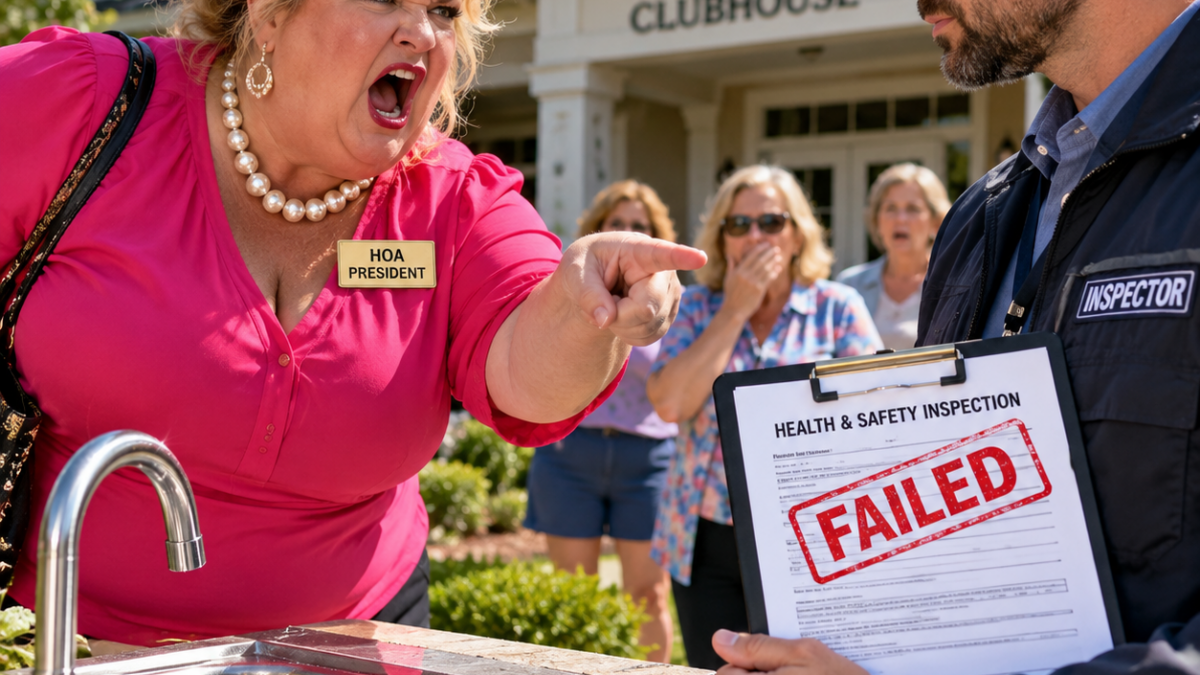
PART 2: HOA Fined My Outdoor Sink—Then Found Out I Was the Inspector Who Shut Down Their $80,000 Clubhouse Project
—
PART 2
I left the sink exactly where it was.
That detail mattered.
Karen expected one of two reactions.
Either I would panic, remove the sink, pay the fine, and become another obedient homeowner who learned that resistance was expensive.
Or I would explode, give her an angry confrontation she could use to portray me as unstable, aggressive, and unwilling to follow community standards.
I gave her neither.
I went inside.
My wife was at the kitchen counter sorting mail when I placed the violation notice beside her.
She read the first line.
Then the second.
Then looked toward the backyard through the window.
“The sink?”
“The sink.”
“The one you can disconnect in ten minutes?”
“That sink.”
She read the amount.
“Five hundred dollars?”
“Apparently it has become a dangerous threat to civilization.”
She kept reading.
“One hundred dollars per day?”
“That’s the exciting part.”
She lowered the paper.
“You’re doing that thing.”
“What thing?”
“The very calm thing.”
“I’m always calm.”
“No.”
She gave me the look spouses develop after enough years together—the one that says they know exactly how much nonsense is contained in the sentence you just spoke.
“You get quiet when you’re angry.”
“I’m not angry.”
She raised an eyebrow.
“Fine. I’m curious.”
“That is worse.”
She was right.
Anger burns fast.
Curiosity can keep me awake for days.
I pulled the closing documents from a cabinet.
The HOA package was thick enough to stop a small-caliber round.
Covenants.
Architectural standards.
Fine schedules.
Meeting procedures.
Enforcement policies.
Amendments.
A stack of neighborhood rules written over twenty years by people who apparently believed human civilization depended on the precise positioning of garbage containers.
My wife poured coffee.
“How long?”
I looked at the binder.
“To read?”
“To turn the dining table into an investigation.”
“Couple hours.”
She laughed.
“You said that during the water-heater incident.”
“That contractor had connected the relief discharge incorrectly.”
“You photographed it from twelve angles.”
“Documentation.”
“You made a diagram.”
“Accuracy.”
“You called the manufacturer.”
“Verification.”
She kissed the top of my head.
“I’ll order dinner.”
For the next three hours, I read.
Not skimmed.
Read.
When you work in code enforcement long enough, you learn that most people read regulations backward.
They decide what outcome they want, then hunt for language that seems to support it.
Inspectors who survive appeals learn to do the opposite.
Start with the text.
Define the scope.
Identify controlling language.
Check exceptions.
Check cross-references.
Check whether enforcement procedure matches the underlying rule.
Karen had cited Covenant 7.14(B).
The provision applied to permanent exterior modifications.
That word appeared twice.
Permanent.
My sink was not anchored to the slab.
The supply could be isolated.
The drain assembly could be disconnected.
The entire unit could be removed without altering the building.
It was temporary workshop equipment.
That alone gave me a strong argument.
Then I found something better.
The covenant contained examples.
Sheds.
Gazebos.
Permanent grilling structures.
Built-in fountains.
Exterior kitchens.
Attached plumbing fixtures.
Nothing resembling a removable utility station.
Interesting.
I kept reading.
Article 12 covered enforcement.
There it was.
Uniform and consistent enforcement.
An HOA could not selectively punish one homeowner while ignoring comparable violations elsewhere without creating serious problems for itself.
I leaned back.
My wife was sitting on the couch reading.
“You found something.”
“Maybe.”
“That smile means definitely.”
“It means Karen gave me homework.”
“And?”
“I did the homework.”
The next morning, before leaving for work, I took a walk.
Not an angry walk.
Not a neighborhood witch hunt.
Reconnaissance.
If Karen wanted to interpret every exterior object as a strict covenant issue, I wanted to understand whether that standard was actually being used uniformly.
It took six minutes to find the answer.
Karen’s house was enormous.
Two streets over.
White columns.
Three-car garage.
Artificially perfect shrubs arranged with geometric precision.
And directly in the front yard stood a decorative fountain.
Not a little birdbath.
A fountain.
Permanent masonry basin.
Buried supply.
Electrical pump.
Fixed drainage.
At the center stood a cherub relieving himself into the water with an expression of biblical confidence.
I stared at it.
Then at the covenant in my hand.
Permanent exterior plumbing fixture.
I took a photograph from the public sidewalk.
Then another.
The satellite dish mounted on Karen’s roof violated a later architectural amendment almost word for word.
Her side fence appeared to be painted the wrong approved color, although I wasn’t enough of a lunatic to pretend that mattered.
Karen apparently was.
I documented everything anyway.
Not because I wanted her fined.
Not yet.
Because selective enforcement cases are built on comparisons.
On my way home that evening, I saw an older woman crouched near a rose bed.
She hurriedly lifted something from the lawn and hid it behind a shrub.
I slowed.
“Everything okay?”
She startled.
Then laughed nervously.
“Oh. Yes.”
I nodded toward the object.
A ceramic garden gnome.
Red hat.
White beard.
Fishing pole.
The little thing looked less dangerous than a loaf of bread.
“Nice gnome.”
Her mouth tightened.
“Not according to Karen.”
I introduced myself.
“Jack Callahan.”
“Eleanor Gable.”
She glanced toward the street as if Karen might materialize from a storm drain.
“She gave me a warning last week.”
“For that?”
“Said it violated the approved yard ornament policy.”
I looked at the gnome.
“What did he do?”
Mrs. Gable laughed.
“That’s what I asked.”
She straightened slowly, one hand pressed to her knee.
“She said whimsical figures make the neighborhood look cheap.”
I thought of Karen’s stone cherub fountain.
I almost choked.
Mrs. Gable noticed.
“You’ve met her.”
“Yesterday.”
“What did you do?”
“Installed a sink.”
Mrs. Gable stared.
Then sighed.
“Oh dear.”
That reaction told me more than anything else could have.
Not surprise.
Recognition.
I asked, “Does she do this often?”
“Depends who you are.”
“What does that mean?”
She hesitated.
Then lowered her voice.
“Some people never get notices.”
“Board members?”
“Friends.”
“And everybody else?”
She glanced at the hidden gnome.
“You learn not to give her reasons.”
That sentence bothered me all night.
You learn not to give her reasons.
That wasn’t governance.
That was conditioning.
The following morning, I drafted my appeal.
No insults.
No accusations.
No emotional language.
I quoted Covenant 7.14(B).
Highlighted permanent.
Explained the sink’s removable configuration.
Requested written clarification of the board’s definition of permanent exterior modification.
Then cited the uniform-enforcement provision.
I asked whether the same approval requirement had been applied to other visible permanent fixtures throughout Oakmont.
I did not mention Karen by name.
I did not mention the fountain.
I didn’t need to.
Finally, I requested that all penalties be stayed pending resolution of the appeal.
Certified mail.
Return receipt.
Copy retained.
Digital scan saved.
My wife watched me label the folder.
“What are you calling it?”
“HOA Dispute.”
“That’s disappointingly normal.”
“What should I call it?”
“Operation Sinkhole.”
I stared at her.
She smiled.
“Come on. That’s good.”
I wrote HOA DISPUTE on the tab.
She shook her head.
“No imagination.”
Karen appeared on my doorstep three days later.
She was holding my letter.
Not neatly.
Crushed in her fist.
“What is this?”
“Good afternoon.”
“Don’t do that.”
“Do what?”
“Act like this is normal.”
I leaned against the doorframe.
“It’s a formal appeal.”
“This is a threat.”
“Which sentence?”
She thrust the pages toward me.
“This business about other properties.”
“The uniform-enforcement clause?”
“You’re trying to intimidate the board.”
“I’m asking whether your rules apply uniformly.”
“They do.”
“Good.”
She blinked.
“Then written clarification should be easy.”
Her face reddened.
“The board has already determined your sink violates the covenants.”
“Has the board met since my appeal?”
“That is none of your concern.”
“It becomes my concern when you say the board made a determination.”
She stared.
I kept my voice even.
“The fine should also be suspended while the appeal is pending.”
“No.”
“No?”
“The fines continue until the violation is corrected.”
“Even while I’m formally disputing whether a violation exists?”
“Yes.”
“Where is that procedure written?”
Her jaw tightened.
“You are now at eight hundred dollars.”
I almost smiled.
She had just admitted, on my porch, that penalties were accumulating during an unresolved appeal.
“Okay.”
That infuriated her more.
“Okay?”
“I look forward to the meeting.”
“Oh, you’ll be there.”
She stepped backward.
“You wanted attention, Mr. Callahan? You’ll have it.”
Then she walked away.
My wife appeared from the hallway.
“How much now?”
“Eight hundred.”
“For the sink?”
“Inflation.”
She folded her arms.
“Are you recording these conversations?”
I looked at her.
She sighed.
“That means no.”
“From now on.”
“Good.”
Then she looked past me toward Karen disappearing down the sidewalk.
“Jack.”
“Yeah?”
“Don’t underestimate someone just because they’re ridiculous.”
I knew exactly what she meant.
Ridiculous people can still file liens.
Ridiculous people can still hire lawyers.
Ridiculous people can still cause enormous damage when systems give them authority.
So I prepared.
Over the next week, I started talking to neighbors.
Not interrogating.
Talking.
Marcus Reed lived six houses away.
Retired Marine.
Twenty years in uniform.
Broad shoulders, gray beard, the kind of posture that retirement never fully erases.
We met while he was washing his truck.
He noticed my county vehicle.
“You with inspections?”
“Plumbing.”
He nodded.
“Then I suppose I shouldn’t show you my garage.”
“Depends what’s in the garage.”
“Nothing you need to know about.”
We laughed.
Then he noticed the folder under my arm.
“Karen?”
I stopped.
“How did you know?”
“That folder face.”
“What’s a folder face?”
“The expression every man gets after she sends him certified mail.”
He had his own story.
Karen had tried to force him to remove a Marine Corps flag displayed beneath the American flag near his porch.
Called it nonconforming decorative signage.
Marcus had fought her for two months.
He eventually won.
But the notices kept coming afterward.
Trash container placement.
Driveway stain.
Portable basketball goal.
“It’s never the first issue,” he said.
“What do you mean?”
“The first issue is where she tests you.”
He sprayed soap from the truck.
“If you push back, she looks for the next one.”
That matched what I was seeing.
Mrs. Gable’s gnome.
Marcus’s flag.
Then the Patels.
Their violation had been over a plastic children’s slide left visible from the street after their daughter’s birthday party.
Two hours.
A fifty-dollar fine.
Mr. Patel had paid it because he worked sixty hours a week and didn’t want to spend his evening reading bylaws.
“That’s the calculation,” I told my wife that night.
“What calculation?”
“Make the fight cost more than surrender.”
She closed her book.
“That’s how bullies work.”
“It’s also how bad bureaucracies work.”
The board meeting was twelve days away.
I knew Karen planned to make an example out of me.
I also knew something she didn’t.
The clubhouse.
Three weeks before the sink appeared in my backyard, I had performed final plumbing inspection on the clubhouse pool expansion.
The HOA had spent heavily on it.
New showers.
Pool equipment.
Outdoor rinse stations.
Utility connections.
The contractor had called for inspection before the system was truly ready.
That happens.
What shouldn’t happen is failing almost every significant safety item.
Backflow prevention protects potable water from contamination.
Cross-connections can create serious public-health risks.
Venting affects drainage performance and sewer-gas protection.
Grounding and bonding around pumps and wet environments matter because water and electricity have never agreed to coexist politely.
The clubhouse installation had problems in all of those areas.
I had called the project contact twice before final failure.
No response.
Then, during the pump-room inspection, a woman had arrived furious.
“We have two hundred guests invited next Saturday.”
I had been photographing a prohibited connection.
“The system isn’t passing today.”
“You can’t do that.”
I remember turning.
“I’m not doing anything to your system. I’m documenting what your contractor did.”
She had demanded my supervisor.
I had given her his number.
She had accused the county of overregulation.
I had explained the specific corrections.
Then I left.
Until Karen walked into my yard, I had never connected that angry woman with my new HOA president.
She remembered the failure.
She simply hadn’t remembered me.
Maybe because inspectors blur together when you spend your life blaming other people for consequences.
At the meeting, I planned to remind her.
My wife helped me choose what to wear.
“Suit?”
“No.”
“Uniform?”
“I don’t have one.”
“You know what I mean.”
“I’m wearing a polo.”
She nodded.
“Good.”
“Why?”
“Because she wants to frame you as someone arriving for battle.”
“I am arriving for battle.”
“Yes.”
She pointed at me.
“But you don’t have to dress like it.”
Fair.
The clubhouse meeting room was nearly full when I arrived.
Not packed.
Maybe thirty-five homeowners.
But more than usual.
Marcus sat near the aisle.
The Patels were three rows back.
Mrs. Gable waved from behind them.
I chose the second row.
Karen entered with four board members.
She wore a navy blazer.
Gold HOA pin.
Gavel.
Stack of papers.
Completely different from the tracksuit version who had visited my backyard.
This was President Karen.
Official Karen.
The one who needed an audience.
She called the meeting to order.
Minutes.
Treasurer’s report.
Landscaping.
Parking.
Then:
“Next item. Violation appeal, 112 Willow Creek Lane. Mr. Jack Callahan.”
Every head turned.
Karen smiled.
“Mr. Callahan was issued a notice for installing an unapproved exterior plumbing fixture. He has submitted a written appeal which contains several assertions regarding the board’s authority and enforcement procedures.”
Several assertions.
That was a clever phrase.
It made facts sound argumentative.
She continued.
“Mr. Callahan, this is your opportunity to explain why you believe you should be exempt from the same rules every other homeowner follows.”
Perfect.
I stood.
“I don’t.”
Her smile faltered.
“Excuse me?”
“I don’t believe I’m exempt.”
I opened my folder.
“I believe the rule cited does not apply.”
I read Covenant 7.14(B).
Permanent exterior modifications.
Then described the sink.
Removable.
Not anchored.
Temporary utility equipment.
I showed photographs.
No theatrics.
Then I addressed the appeals process.
“I requested a definition of permanent.”
Karen interrupted.
“The board defines your fixture as permanent.”
“Based on what criteria?”
“Our interpretation.”
“What physical characteristic makes it permanent?”
She frowned.
“It is plumbing.”
“Garden hoses are plumbing connections.”
“That is ridiculous.”
“Exactly.”
A few people laughed.
Karen banged the gavel lightly.
I continued.
“If any item connected to water becomes permanent by definition, then decorative fountains would require approval.”
Several residents turned toward one another.
Karen knew where I was going.
“We are not discussing other properties.”
“The governing documents require uniform enforcement.”
“Your appeal concerns your property.”
“My appeal concerns whether the rule is being applied consistently.”
I took out the photograph.
I didn’t hold it dramatically.
I simply placed it on the projector tray.
Karen’s fountain appeared on the wall.
The cherub looked even more ridiculous twelve feet tall.
Somebody snorted.
Mrs. Gable covered her mouth.
Karen’s face turned crimson.
“This is inappropriate.”
“Is that fixture approved?”
“We are not discussing my home.”
“That’s a permanent exterior plumbing fixture.”
“This is harassment.”
“I’m asking whether the standard applies uniformly.”
She struck the gavel harder.
“The board has reviewed your appeal.”
I looked at the other board members.
Two avoided my eyes.
One shuffled papers.
Karen announced, “Denied.”
I paused.
“You’re denying it now?”
“Yes.”
“Before discussion?”
“We have discussed it.”
“Then I assume there are minutes.”
Her expression changed.
Just slightly.
“The fine currently stands at twelve hundred dollars.”
There it was.
“Despite the pending appeal.”
“The matter is no longer pending.”
She leaned forward.
“Remove the sink or we proceed toward lien enforcement.”
I heard Marcus shift behind me.
I could feel the room tilting.
Karen thought she had won.
She should have stopped.
Instead, she smiled.
“Is there anything else, Mr. Callahan?”
“Yes.”
She rolled her eyes.
“Briefly.”
I closed the covenant binder.
“Last month, the board canceled the grand opening of the clubhouse pool.”
The other board members looked up.
Karen’s smile vanished.
“What does that have to do with your sink?”
“You stated in the community newsletter that the cancellation resulted from unexpected plumbing complications.”
“Yes.”
“Would you like me to describe them?”
Her eyes narrowed.
“No.”
I did anyway.
“Cross-connections. Missing backflow protection. Improper venting. A noncompliant shower drain configuration. Serious pump installation issues.”
The room went quiet.
Karen stared.
I continued.
“Those problems resulted in a failed county inspection.”
One board member whispered something to another.
I reached into the folder.
Pulled out the report.
Karen’s face changed before I even reached the table.
Recognition.
Not of me yet.
Of the document.
I placed it in front of her.
“This is the inspection report.”
She looked down.
I pointed to the signature line.
“Would you read the inspector’s name?”
Nothing.
“Karen?”
She looked up.
For the first time since I met her, she had no prepared expression.
I tapped the page.
“J. Callahan.”
A murmur passed through the room.
Then I pointed lower.
“County Plumbing Inspector.”
Marcus leaned back and whispered, “Oh, damn.”
Karen stared at me.
“You?”
“Yes.”
“You’re the inspector?”
“Yes.”
“You failed our project?”
“I inspected your project.”
“You cost this association tens of thousands of dollars.”
“No.”
My voice stayed calm.
“The defective work cost you money.”
Her face reddened.
“You knew who I was.”
“Not when I performed the inspection.”
“You’re doing this because of the clubhouse.”
I almost laughed.
“You fined me first.”
The room reacted immediately.
That sequence mattered.
Clubhouse failed.
Karen later discovered I lived in Oakmont.
Then the sink fine.
Or had she known before?
I looked around.
“I didn’t bring this up to threaten anyone.”
Karen scoffed.
“Really?”
“No. I brought it up because I’m being fined over an alleged plumbing violation by a board whose president ignored actual plumbing deficiencies serious enough to fail a public-use facility.”
The silence became heavy.
A homeowner in the third row spoke.
“How much did the repairs cost?”
Karen snapped toward him.
“That is not relevant.”
He stood.
“It’s our money.”
Another woman asked, “Did the inspector warn you before the failure?”
I answered.
“I made two calls to the project contact listed in the file.”
Karen said, “He is twisting this.”
“Were the calls returned?”
She did not answer.
A board member looked at her.
“Karen?”
She picked up the gavel.
“This discussion is closed.”
The homeowner remained standing.
“How much?”
“Sit down.”
“Karen, how much did the repairs cost?”
She slammed the gavel.
“Mr. Callahan’s appeal is denied. We are moving on.”
Nobody moved on.
The meeting continued on paper.
In reality, it ended right there.
Every later agenda item was interrupted by questions.
Clubhouse costs.
Emergency contractor invoices.
Legal fees.
Enforcement standards.
Why some residents received fines immediately while others received warnings.
Why board members appeared exempt from rules.
Karen deflected.
Promised review.
Called questions disruptive.
But something fundamental had changed.
Fear depends on the belief that the person intimidating you cannot be challenged.
That belief had cracked.
After adjournment, Marcus reached me first.
“You sandbagged her.”
“No.”
“You absolutely sandbagged her.”
“I answered her accusation.”
He grinned.
“That was beautiful.”
Mrs. Gable approached.
She held my hand with both of hers.
“Thank you.”
“For what?”
“For making her answer.”
“She didn’t answer much.”
“Exactly.”
The Patels joined us.
Then three homeowners I didn’t know.
Everyone had a story.
Fine for a welcome mat.
Warning over a basketball hoop.
Notice about a planter.
Threat over holiday lights removed one day late.
The details varied.
The pattern did not.
Marcus lowered his voice.
“She’s coming after you harder now.”
“I know.”
“What’s the plan?”
I looked around at the cluster of neighbors.
Two weeks earlier I had been one homeowner with a sink.
Now I had witnesses.
Allies.
A pattern.
“Coffee at my house Saturday.”
Mrs. Gable smiled.
“Near the illegal sink?”
“Especially near the sink.”
Saturday morning, eight households gathered on my back patio.
I set up folding chairs.
Coffee.
Donuts.
The sink gleamed ten feet away.
Mrs. Gable had brought her gnome.
She set it on the counter.
“Security.”
Marcus looked at it.
“That thing armed?”
“With personality,” she said.
I opened the meeting.
“Karen is not going to stop.”
Nobody disagreed.
“She has three advantages. Official communications, HOA money, and most people’s reluctance to get involved.”
Mr. Patel nodded.
“So what do we have?”
“Documents.”
Marcus smiled.
“Spoken like an inspector.”
“And numbers.”
“What numbers?”
“How many homeowners are actually unhappy.”
That became phase one.
Petition.
The bylaws allowed homeowners holding thirty percent of voting interests to compel a special meeting.
Oakmont had 250 homes.
We needed seventy-five signatures.
Phase two.
Information.
Karen controlled official newsletters and board communications.
We created a private homeowner group.
Not an attack page.
No insults.
No rumors.
Every post needed documentation.
Violation notice.
Board minute.
Financial report.
Photograph from public property.
Phase three.
Accountability.
If Karen believed rules mattered, then rules would matter for everyone.
Marcus and I reviewed publicly visible code issues involving board properties.
I want to be clear about something.
We did not trespass.
We did not fabricate complaints.
We did not interfere with anyone’s property.
We identified observable issues and checked public permit records.
Karen’s fountain had no permit.
One board member’s deck extension exceeded the permitted footprint.
Another had installed a standby generator without final electrical approval.
A drainage modification directed water toward the public sidewalk.
Real issues.
Real codes.
We filed legitimate complaints.
No embellishment.
No revenge fantasy.
Just the same principle Karen claimed to worship.
Rules.
The homeowner group exploded.
Fifty members the first day.
Eighty by the end of the week.
Stories poured in.
Photographs of notices.
Emails.
Fine letters.
Appeal denials.
People who had assumed they were alone discovered the same language had been used against dozens of neighbors.
“Failure to maintain aesthetic harmony.”
“Nonconforming recreational equipment.”
“Visual clutter.”
“Architectural inconsistency.”
Karen had turned vague language into a factory.
Then came her retaliation.
A letter from the HOA’s law firm.
Cease and desist.
Allegations that I was harassing Karen.
Warning that statements about clubhouse expenses could be defamatory.
Notification that a lien was being prepared.
Fine total:
$2,000.
My wife read it at breakfast.
“Two thousand?”
“It’s growing faster than my retirement account.”
“This lawyer is being paid from HOA dues?”
“Looks like it.”
She put the letter down.
“So your neighbors are paying a lawyer to threaten you because you questioned how their dues were spent.”
“That is one interpretation.”
“What is the other?”
“There isn’t one.”
I forwarded it to Ben Carter, an attorney recommended by an old friend.
Ben specialized in property and association disputes.
He called within an hour.
“This is useful.”
“Everybody keeps calling terrible letters useful.”
“They’ve turned a covenant disagreement into legal expenditure.”
“So?”
“So discovery.”
There was almost affection in his voice when he said the word.
Lawyers are strange.
“They’re claiming you are conducting harassment while still pursuing fines during a contested appeal.”
“Yes.”
“And the board president’s own permanent fixture appears unapproved?”
“Yes.”
“And she has a documented conflict with you arising from the clubhouse failure?”
“Potentially.”
Ben laughed.
“Do not pay them.”
“I wasn’t planning to.”
“Do not threaten them.”
“Wasn’t planning to.”
“Do not post anything emotional online.”
I glanced at my wife.
She nodded approvingly.
“Anything else?”
“Save everything.”
I looked at the folder already overflowing on my desk.
“That part I understand.”
The first county notice appeared on Karen’s fountain two weeks later.
Bright orange.
STOP WORK / CONTACT ZONING.
Someone photographed it.
The homeowner group went wild.
Mrs. Gable commented:
**Perhaps the cherub needs Architectural Review approval.**
I laughed so hard coffee came out my nose.
Karen did not find it funny.
The next HOA newsletter arrived with a headline:
**A THREAT TO COMMUNITY HARMONY**
The article described anonymous regulatory complaints as cowardly attacks.
It blamed “a small group of disgruntled residents.”
It accused newcomers of disrespecting Oakmont traditions.
It warned that escalating conflict could increase legal expenses.
That last part was almost art.
Karen was spending association money on legal threats while warning residents that opposition to her might increase legal expenses.
We posted the newsletter beside the fountain violation.
Caption:
**Harmony means the rules apply to everyone.**
Nothing else.
No insults.
No commentary.
The documents spoke louder.
Petition signatures surged.
Mrs. Gable became unstoppable.
She went door to door with cookies.
Not even Karen could compete with a seventy-two-year-old grandmother carrying chocolate-chip ammunition.
She would say:
“I’m Eleanor from Rosewood. I’m talking with neighbors about HOA transparency.”
People invited her inside.
They told stories.
She listened.
Then asked for a signature.
Sixty in one week.
Seventy-five by day nine.
We kept going.
Eighty-nine.
Ninety-seven.
One hundred twelve.
Almost half the neighborhood.
That was when Ben drafted the package.
Petition compelling a special recall meeting.
Demand for independent financial audit.
Formal request for enforcement records.
Litigation hold notice requiring preservation of emails, texts, documents, and electronic files relevant to my dispute and the board’s actions.
Marcus read it.
“What does spoliation mean?”
“Destroying evidence.”
“What happens if they do?”
Ben smiled.
“Judges become unhappy.”
“How unhappy?”
“Career-altering unhappy.”
Marcus nodded.
“I like this word.”
We served the package at the June board meeting.
That night the clubhouse was packed.
Standing room.
Karen entered wearing black.
Her allies looked exhausted.
One had a county notice on his deck.
Another was dealing with the generator inspection.
Gerald, the HOA treasurer, looked like he wanted to become invisible.
Karen banged the gavel.
“Order.”
A homeowner immediately stood.
“Point of order. We have a petition.”
“Submissions must be filed in advance.”
I stood.
“This petition is being formally served under Article 5, Section 2.”
Marcus carried it forward.
One hundred twelve signatures.
He placed the bound pages on the table.
Heavy thud.
Karen stared.
“What is this?”
“Recall petition.”
Her face froze.
Marcus stepped back.
I continued.
“It also includes a demand for independent audit and a litigation hold.”
Gerald reached for the packet.
Karen stopped him.
“Don’t.”
He looked at her.
“Karen, I need to read it.”
“This is an ambush.”
Mrs. Gable spoke from the front row.
“No, dear.”
Everyone turned.
“This is the meeting you kept asking us to attend.”
Laughter rippled through the room.
Karen glared.
Mrs. Gable smiled sweetly.
“You’re always telling us homeowners should be involved.”
The petition forced the board to schedule the recall.
But I wasn’t finished.
I had reviewed the published budgets.
Legal expenses had risen nearly three hundred percent since Karen became president.
Community-event spending had fallen.
Emergency clubhouse capital costs had ballooned.
I stood again.
Karen groaned.
“What now?”
“Financial clarification.”
“You’ve served your petition.”
“Yes.”
“And the petition requests an audit.”
“Yes.”
“Then wait for the audit.”
“Homeowners deserve to understand why an audit is necessary.”
I held up the budget comparison.
“Legal expenses are up approximately three hundred percent.”
The room reacted.
“Clubhouse emergency repair costs exceeded eighty thousand dollars.”
Gerald looked down.
Karen snapped.
“Those repairs were necessary.”
“They were necessary because the original work failed inspection.”
“That is your opinion.”
“No.”
I raised the report.
“It is the county’s official finding.”
Then I asked:
“How much HOA money has been spent on legal action related to disputed homeowner fines?”
Karen looked at Gerald.
He swallowed.
“I’d need to calculate.”
“Do that.”
Karen slammed the gavel.
“This board will not be interrogated.”
A homeowner shouted, “It’s our money!”
Another:
“Show us the bills!”
Then another:
“Why are we paying lawyers to defend Karen?”
That was the moment she lost the room.
Not the recall vote.
Not even the clubhouse reveal.
That moment.
Because money makes abstract abuse concrete.
A ridiculous violation letter is annoying.
A lawyer paid with your dues to defend the person sending ridiculous violation letters feels personal.
The board adjourned early.
Outside, neighbors stayed in the parking lot for nearly an hour.
Karen left through a side door.
Her authority was no longer leaking.
It was hemorrhaging.
The audit vote happened ten days later.
Karen opposed it.
Gerald supported it.
That mattered.
Treasurers understand something presidents often forget.
Numbers eventually require signatures.
Gerald was scared.
He had approved reports based on information Karen supplied.
Now homeowners were asking questions.
Attorneys were involved.
A litigation hold existed.
He voted yes.
The audit passed three to two.
Karen’s face during that vote was unforgettable.
She looked at Gerald as if he had betrayed a monarchy.
He looked back like a man who had finally realized there was no monarchy.
Ben simultaneously pushed discovery in the sink dispute.
The HOA had escalated my fine into legal threats.
That gave us a reason to request communications about enforcement.
The document production arrived electronically.
Thousands of pages.
Emails.
Invoices.
Legal bills.
Board communications.
Management-company messages.
For a week, my dining room became a records center.
My wife walked in one evening carrying takeout.
“There are four laptops on my table.”
“Three.”
She pointed.
“That one?”
“Tablet.”
“Jack.”
“Technically different.”
She set down the food.
“Have you slept?”
“Define slept.”
“Closed eyes intentionally for more than four consecutive hours.”
“No.”
She unplugged my mouse.
I stared at her.
“Food.”
“I’m in the middle of—”
“Food.”
I obeyed.
Marriage is a functioning regulatory system.
The documents were worse than I expected.
Karen had emailed the management company after my first appeal.
Her message said:
**He’s a newcomer testing boundaries. Make an example of Mr. Callahan before others decide rules are optional.**
I read it twice.
Then a third time.
My wife sat beside me.
“That’s it.”
“Yes.”
“No ambiguity.”
“No.”
She looked at me.
“How does that feel?”
I thought the answer would be satisfying.
Instead, I felt tired.
“Smaller than I expected.”
“What does?”
“Her.”
Karen had spent months occupying my thoughts like a major threat.
That email exposed something petty.
The sink wasn’t dangerous.
The covenant wasn’t sacred.
She wanted an example.
She wanted submission.
Then we found legal bills.
Thousands for enforcement strategy.
Phone calls with Karen.
Letters to me.
Discussion of the homeowner group.
Review of social-media posts.
Research on lien options.
HOA money funding Karen’s personal campaign.
Then clubhouse invoices.
Repair contractor.
Rush fees.
Reinspection charges.
Lost event deposits.
Temporary equipment.
More than eighty thousand dollars connected to fixing work that should have been correct before inspection.
I looked at the number.
My wife leaned over my shoulder.
“That could have funded community events for years.”
“Exactly.”
Ben’s favorite document arrived from the management company archive.
An email sent after I failed the clubhouse.
Karen wrote:
**The inspector is being unnecessarily rigid. We should explore whether the county can be pressured to send someone more cooperative.**
Below that, two weeks later, after discovering my home address:
**Interesting development: Inspector Callahan apparently purchased in Oakmont. We may finally have leverage to remind him he isn’t the only person who can enforce rules.**
I stopped breathing for a second.
My wife read it.
Her face changed.
“She knew.”
“Yes.”
“She absolutely knew who you were when she fined the sink.”
“Yes.”
That altered everything.
Until then, I had suspected retaliation.
Now we had it written.
The sink fine wasn’t simply selective enforcement.
It was personal revenge for the clubhouse failure.
Ben called it “the kind of exhibit lawyers dream about and clients pay too much money hoping exists.”
The recall meeting was scheduled for the last day legally allowed.
Karen spent the intervening weeks campaigning.
Emails.
Flyers.
Warnings.
She claimed our group wanted to abolish the HOA.
False.
She claimed I intended to use my county position to target residents.
False.
She claimed property values would collapse if enforcement standards weakened.
Unsupported.
She called me vindictive.
That part depended on perspective.
I wasn’t interested in destroying the HOA.
I was interested in preventing the HOA from being used as Karen’s private weapon.
The homeowner group prepared a presentation.
Five slides.
That was Ben’s rule.
“More than five and people stop listening.”
Slide one.
Mrs. Gable’s gnome beside Karen’s fountain.
Gnome fine: $50.
Unapproved fountain: $0 from HOA, county violation pending.
Slide two.
Timeline.
Clubhouse inspection failed.
Karen’s complaint about county inspector.
Karen learns inspector lives in Oakmont.
Sink citation issued.
Slide three.
Legal spending.
Three hundred percent increase.
Slide four.
Karen’s email:
**MAKE AN EXAMPLE OF MR. CALLAHAN.**
Slide five.
Clubhouse emergency cost:
Over $80,000.
No dramatic music.
No insults.
Facts.
The night before the vote, I sat beside the sink.
My wife brought two glasses of iced tea.
“You nervous?”
“Yes.”
“Good.”
“Good?”
“Means you understand it matters.”
I looked at the sink.
“This thing caused a lot of trouble.”
She laughed.
“The sink didn’t do anything.”
“True.”
“You could remove it tomorrow.”
“I’m not removing it.”
“I know.”
We sat quietly.
Then she asked, “What happens if she survives the recall?”
I had avoided that question.
“We continue.”
“The lien?”
“We fight it.”
“Legal bills?”
“We manage.”
She nodded.
“Okay.”
“You’re not worried?”
“I’ve been worried since she came into the yard.”
“That helps.”
She leaned her head against my shoulder.
“I’m not worried about losing.”
“What are you worried about?”
“You.”
I looked at her.
“You get very focused when you think something is wrong.”
“Occupational hazard.”
“You stop eating.”
“I eat.”
“You ate peanuts for dinner Tuesday.”
“Protein.”
She ignored that.
“You don’t have to carry the whole neighborhood.”
“I know.”
“Do you?”
I looked toward the dark clubhouse.
“No.”
That was the most important change in the entire fight.
At the beginning, I was protecting my sink.
Then my property.
Then my professional integrity.
Now none of those were the main reason people were showing up.
Mrs. Gable wanted dignity.
Marcus wanted fairness.
The Patels wanted their kids to grow up in a neighborhood where a birthday toy didn’t trigger punishment.
Gerald wanted financial honesty.
Other families wanted predictable rules.
This was bigger than me.
That made it lighter.
The recall meeting overflowed the clubhouse.
People stood along the walls.
The management company sent an official representative to supervise.
Ballots were prepared.
Homeowner eligibility verified.
Karen sat at the front.
Black blazer.
White blouse.
Papers trembling slightly in her hands.
She avoided looking at me.
The rules gave each side ten minutes.
Karen spoke first.
She framed herself as a volunteer under attack.
Years of service.
Long hours.
Unappreciated sacrifices.
Hostile newcomers.
Internet harassment.
Anonymous code complaints.
Threats to property values.
Then she pointed at me.
“This man has abused his government position to wage a personal vendetta against this association.”
I did not react.
She continued.
“He failed our clubhouse project, costing homeowners thousands, and immediately afterward began a campaign against me personally.”
Interesting chronology.
Wrong.
Everyone in the room had seen the emails.
But Karen kept going.
She described herself as the last barrier between Oakmont and chaos.
Without strong enforcement, she warned, boats would appear in driveways.
Lawns would grow wild.
Fences would become mismatched.
Property values would collapse.
Mrs. Gable whispered loudly:
“Not the mismatched fences.”
Marcus coughed to hide a laugh.
Karen finished to almost no applause.
Then it was my turn.
I stood.
Didn’t approach the podium.
“Good evening.”
I looked around.
“I’m not going to give a speech.”
Marcus activated the projector.
“Five slides.”
Slide one.
Gnome.
Fountain.
The room laughed immediately.
I raised one hand.
“Don’t laugh at the fountain.”
More laughter.
“Seriously.”
They settled.
“This slide isn’t about taste.”
I looked toward Mrs. Gable.
“It’s about equal treatment.”
I pointed.
“Fifty-dollar fine for a removable garden decoration.”
Then Karen’s property.
“No HOA action against a permanent exterior fountain requiring county permitting.”
Next slide.
Timeline.
“April 2: county clubhouse inspection fails.”
“April 3: board president complains about inspector.”
“April 18: board president learns inspector resides in Oakmont.”
“April 20: sink violation issued.”
“April 23: email instructing management company to make an example of Mr. Callahan.”
The room went silent.
Slide three.
Legal expenses.
“This is your money.”
Nothing else.
Slide four.
Karen’s email filled the screen.
MAKE AN EXAMPLE OF MR. CALLAHAN.
I turned toward Karen.
She looked at the table.
I faced the homeowners.
“I could talk for ten minutes about how that made me feel.”
I shook my head.
“Doesn’t matter.”
“What matters is whether you want your dues used to make examples out of neighbors.”
Slide five.
$80,000+.
“Emergency clubhouse corrections after failed inspection.”
I let the number sit.
Then I said:
“I did not fail your clubhouse because I disliked Karen.”
“I failed it because the plumbing failed code.”
“I did not fight the sink fine because I believe I am above HOA rules.”
“I fought it because the rule being used against me did not apply the way she claimed, and because similar rules were not being applied uniformly.”
I looked around.
“This recall is not about whether you like me.”
“Some of you probably don’t.”
A few people smiled.
“It is not about whether you like Karen.”
“It is about whether leadership can use community money, community rules, and community lawyers to settle personal grudges.”
I stepped back.
“That is all.”
The management representative distributed ballots.
The room became strangely quiet.
No cheering.
No shouting.
People voted.
Folded paper.
Sealed box.
Then counting.
Twenty minutes felt like an hour.
Karen remained still.
Hands clasped.
One board ally whispered to her.
She shook her head.
The representative returned to the microphone.
“One hundred forty-two valid ballots were cast.”
Nobody moved.
“Votes in favor of recall: one hundred twenty-eight.”
A sound went through the room.
Not exactly a cheer.
Relief.
“Votes against recall: fourteen.”
Then applause.
Long.
Heavy.
Karen did not cry.
That surprised me.
She simply sat.
For months, I had imagined this moment.
I thought I would feel victorious.
Instead, I watched an illusion disappear.
Karen had always seemed powerful because people reacted to her as though she was.
Now she was a woman sitting behind a folding table while 128 neighbors said no.
That was it.
No magic.
No throne.
No authority beyond what the community had temporarily entrusted to her.
She stood.
Collected her purse.
Left the papers.
Walked toward the door.
Mrs. Gable watched her go.
No insult.
No final jab.
Neither did I.
The door closed.
Marcus exhaled.
“Damn.”
The vice president, required by the bylaws to take temporary control, stared at the gavel like it might explode.
Then he said:
“I move that all disputed fines issued under the former president’s administration be suspended pending review.”
A homeowner seconded.
Passed unanimously.
My sink fine disappeared.
Mrs. Gable’s gnome fine disappeared.
Dozens of other cases were reopened.
The lien threat vanished.
I should have been thrilled.
I was.
But the real shock came later.
The audit.
With Karen removed, records became easier to access.
The independent accountant found personal charges on HOA cards.
Meals.
Office-supply purchases containing clearly personal items.
Vendor contracts awarded without adequate bidding.
Landscaping work routed toward friends.
Legal spending with weak board authorization.
Not every questionable transaction was criminal.
Some were sloppy.
Some were stupid.
Some were defensible.
Others were not.
The new board referred the findings to counsel.
Then, after additional review, to prosecutors.
Karen had spent years accusing other people of violating rules.
Now actual investigators were reading her records.
I did not participate in that investigation beyond providing documents relevant to my own case.
That boundary mattered.
The recall was community accountability.
The criminal process belonged to professionals.
Marcus was elected president.
He fought the nomination.
“I did twenty years in the Marines to avoid becoming an HOA president.”
Mrs. Gable replied, “Life is cruel.”
He won easily.
Mr. Patel became treasurer.
Gerald stayed on temporarily only to assist with financial transition, then resigned voluntarily.
The first new board meeting lasted fifty-three minutes.
No yelling.
No gavel abuse.
No public humiliation.
Marcus opened by saying:
“Our job is not to control your lives.”
Mrs. Gable whispered, “Promising start.”
He continued.
“Our job is to maintain common assets, enforce legitimate standards consistently, manage money responsibly, and then go home.”
Applause.
We formed a bylaw-review committee.
I agreed to help.
That was how a man who hated HOA paperwork ended up spending Wednesday nights rewriting HOA paperwork.
My wife found this hilarious.
“You’ve become what you hate.”
“No.”
“You’re on a committee.”
“Temporary committee.”
“You own three highlighters specifically for HOA documents.”
“They’re different categories.”
“You bought a label maker.”
“That was unrelated.”
She looked toward my shelves.
Every binder now had printed labels.
I avoided eye contact.
The new rules simplified enforcement.
Clear definitions.
Written notice before fines except genuine emergencies.
Reasonable cure periods.
Appeal rights.
At least two board members had to review contested violations.
Financial conflicts disclosed.
Competitive bids.
Detailed monthly expense reports.
No individual president could direct counsel into a homeowner dispute without documented authority.
Rules became boring.
That was the goal.
A good HOA should be boring.
The clubhouse project became another lesson.
The repaired pool finally opened.
This time every inspection passed.
Before the grand reopening, Marcus called me.
“Jack.”
“Yeah?”
“You working Friday?”
“Yes.”
“Can you inspect the clubhouse?”
“No.”
Silence.
“Why?”
“Conflict.”
“You’re not on the board.”
“I’m on the bylaw committee and personally involved in the dispute history.”
“So?”
“So I’m not touching it.”
“Then who?”
“Another county inspector.”
Marcus laughed.
“You really are serious about this rules thing.”
“Unfortunately.”
The new inspector passed the project after one minor correction.
The reopening party went ahead.
Nobody invited me as inspector.
They invited me as a neighbor.
That mattered.
The biggest celebration happened in my backyard three weeks later.
My wife suggested it.
“Barbecue.”
“For what?”
“The workshop.”
“It’s been finished.”
“The sink.”
“It’s a sink.”
“No.”
She smiled.
“It’s the sink.”
Word spread.
Marcus brought burgers.
The Patels brought food.
Gerald arrived with his wife, looking ten years younger now that he wasn’t sitting beside Karen at board meetings.
Mrs. Gable arrived pulling a red wagon.
Inside were garden gnomes.
Not one.
Not two.
At least fifteen.
Fishing gnome.
Sleeping gnome.
Gnome with lantern.
Gnome with wheelbarrow.
Gnome holding a sign that said WELCOME.
I stared.
“How many do you own?”
She smiled proudly.
“Twenty-three.”
“Where are the others?”
“Classified.”
She arranged them around the patio.
Marcus pointed at one.
“Security team?”
“Liberation army.”
People took pictures.
Children moved them into ridiculous formations.
At the center of it all stood the sink.
Fully connected.
Completely functional.
Still removable.
I washed barbecue tools in it.
Mrs. Gable applauded.
“Look at that dangerous criminal fixture.”
I bowed.
Later, when the sun started going down, Marcus handed me a beer.
We stood beside the workshop.
“You realize everyone calls this the Sink Rebellion now.”
“No.”
“Yes.”
“That is embarrassing.”
“It’s too late.”
“I refuse.”
“Neighborhood history doesn’t care.”
I looked across the yard.
My wife was laughing with Mrs. Patel.
Kids chased one another around the lawn.
Mrs. Gable’s gnomes stood like tiny witnesses to the collapse of a regime.
I said, “I moved here because I wanted quiet.”
Marcus nodded.
“Same.”
“Then Karen happened.”
“She did.”
“I thought winning meant getting her out of my yard.”
“And now?”
I considered it.
“Now I think getting everybody into my yard might be the better outcome.”
Marcus smiled.
“That was almost emotional.”
“Don’t spread it around.”
We heard Karen had listed her house within a month.
For sale.
No dramatic confrontation.
No final visit.
She left quietly.
The fountain remained until county compliance required corrections.
Then it disappeared.
So did the satellite dish issue after the new board reviewed whether the rule itself made sense and whether federal law affected enforcement.
That became another lesson.
Some rules were outdated.
Some were vague.
Some were legally questionable.
Others simply existed because nobody had bothered removing them.
The new board asked a question Karen rarely asked.
Why?
Why do we need this rule?
What actual problem does it prevent?
Can residents understand it?
Can it be enforced consistently?
If not, rewrite it or remove it.
Oakmont became calmer.
Not lawless.
Calmer.
That distinction was important.
The grass did not grow six feet tall.
Boats did not flood the streets.
Property values did not collapse.
Mailboxes did not spontaneously turn neon green.
The apocalypse Karen predicted failed to arrive.
Instead, people started attending community events.
The newsletter became boring in the best possible way.
Pool schedule.
Garden club.
Road maintenance.
Budget summary.
Lost dog.
Block-party date.
No warnings from the president about enemies of harmony.
No public shaming.
One afternoon, months after Karen moved away, I came home and saw Mrs. Gable standing near my driveway.
She held the original fishing gnome.
“What happened?”
“Nothing.”
She placed him near my workshop door.
“You’re giving him to me?”
“On loan.”
“Why?”
“He belongs here.”
I looked at the gnome.
“He caused less trouble than the sink.”
“Barely.”
She smiled.
Then her expression softened.
“I was scared of her, you know.”
I didn’t answer immediately.
“I know.”
“No, I mean actually scared.”
She looked toward the street.
“I would hear that golf cart and check my yard.”
That image bothered me.
An elderly woman hiding a garden ornament because another adult might punish her.
“I’m sorry.”
“For what?”
“I wish somebody had pushed back earlier.”
She patted my arm.
“So do I.”
Then she smiled again.
“But earlier didn’t happen.”
“No.”
“You happened when you happened.”
She walked home.
I left the gnome beside the workshop.
My wife found him later.
“We own one now?”
“Temporary placement.”
She laughed.
“Like the sink?”
“Exactly.”
Months became a year.
The prosecutor’s review of Karen’s financial conduct continued.
Some charges were filed.
Some issues remained civil.
The new HOA pursued reimbursement where counsel believed it justified.
I stopped following every detail.
That surprised people.
Marcus once asked:
“Don’t you want to know how bad it gets for her?”
“No.”
“Really?”
“Really.”
He studied me.
“You spent months building the case.”
“I spent months stopping her.”
“That’s different?”
“Yes.”
I had thought about it often.
Revenge has a strange appetite.
When you’re hurt, you imagine one consequence will satisfy you.
The fine canceled.
Not enough.
Recall.
Not enough.
Audit.
Not enough.
Lawsuit.
Not enough.
You can spend years waiting for someone who hurt you to suffer enough that the past finally feels balanced.
But there is no mathematical balance.
Karen could lose every dollar she owned and it would not return the hours my wife spent worried about a lien.
It would not erase Mrs. Gable hiding her gnome.
It would not refund the anxiety of every family threatened over arbitrary enforcement.
Justice mattered.
Consequences mattered.
But eventually, continuing to watch somebody fall becomes its own form of captivity.
I didn’t want Karen owning space in my head after she stopped owning authority in my neighborhood.
So I let professionals handle the rest.
I went back to work.
Real work.
Inspections.
Training junior inspectors.
Reviewing plans.
Explaining to contractors that “we’ve always done it this way” is not a code section.
At home, I worked in my shop.
The sink became genuinely useful.
Paint brushes.
Greasy hands.
Garden tools.
Automotive parts.
It did exactly what I built it to do.
No catastrophe.
No neighborhood decline.
No plumbing apocalypse.
Sometimes new neighbors heard the story and asked to see it.
I would point.
“That’s it.”
They always looked disappointed.
“That?”
“That.”
“All of this happened because of that sink?”
“No.”
That answer became automatic.
“The sink was just where the problem became visible.”
The real problem had existed long before I moved in.
A board culture that stopped asking questions.
A president who learned nobody would challenge her.
Homeowners who decided paying a small fine was easier than participating.
Vague rules.
Weak financial controls.
Fear disguised as harmony.
The sink wasn’t the cause.
It was a pressure test.
And the system failed.
Two years after the recall, Marcus’s term ended.
Under the new rules, he could serve one more term.
He refused.
Mrs. Gable confronted him.
“You are abandoning us.”
“I gave the Marine Corps twenty years and the HOA two. I have suffered enough.”
She pointed at me.
“Jack should run.”
I nearly dropped my coffee.
“No.”
Marcus laughed.
“Absolutely.”
“No.”
Mrs. Gable looked offended.
“Why?”
“Because I don’t want to.”
Marcus nodded.
“That’s your strongest qualification.”
“I’m not doing it.”
I didn’t.
That mattered too.
Reform cannot depend on one hero.
If the system needed Jack Callahan standing guard forever, then we had built another fragile system.
Instead, Elena Brooks ran.
Accountant.
Mother of three.
No interest in power.
Deep interest in spreadsheets.
She won easily.
The transition was uneventful.
No crisis.
No crowd.
No speeches.
Marcus handed over the files.
Elena asked practical questions.
They scheduled the next meeting.
That was one of the proudest moments of the entire fight.
Power changed hands without drama.
That is what healthy organizations do.
At the annual neighborhood barbecue, Elena made an announcement.
“Our reserve fund has fully recovered.”
Applause.
“Legal expenses are down sixty-eight percent from the year before the recall.”
Louder applause.
“And for the first time in several years, we are reducing annual dues.”
People actually cheered.
Marcus leaned toward me.
“Karen said property values would collapse.”
“They went up.”
“She said the HOA would become chaos.”
“It got cheaper.”
“She said you were dangerous.”
“I am.”
He looked at the sink.
“Obviously.”
My wife joined us.
“Are you two talking about the sink again?”
“No.”
“Yes,” Marcus said.
She shook her head.
“You know what bothers me?”
“What?”
“The story always makes Jack sound very clever.”
Marcus thought.
“He did read the bylaws.”
She waved that away.
“He also forgot our anniversary during the discovery phase.”
I stared.
“One time.”
“Exactly one anniversary.”
“I apologized.”
“With a hardware-store gift card.”
Marcus stared at me.
“You gave your wife a hardware-store gift card?”
“It was not the main gift.”
She looked at him.
“It was the only gift.”
“I was under pressure.”
Marcus walked away laughing.
That evening, after everyone left, my wife and I sat on the patio.
The original gnome still stood beside the workshop.
“You really forgot our anniversary?”
“I remembered eventually.”
“How eventually?”
“Within the week.”
She laughed.
I looked toward the quiet street.
“Would you do it again?”
She asked.
“The fight?”
“Yes.”
I thought.
“I’d sleep more.”
“Good.”
“I’d involve other people sooner.”
“Better.”
“I’d listen to you more.”
She raised an eyebrow.
“Careful.”
“But yes.”
“Why?”
I looked toward our house.
When we moved in, I had imagined property ownership as a boundary.
My walls.
My yard.
My workshop.
My peace.
Karen taught me the ugly version of community—other people trying to control what happens behind your boundary.
But Mrs. Gable, Marcus, the Patels, Gerald, Elena and dozens of others taught me something better.
Community can also mean people helping defend those boundaries.
Not because they own your property.
Because they respect that you do.
“I thought buying a home meant finding a place nobody could tell me what to do.”
My wife smiled.
“That sounds very much like you.”
“I know.”
“But?”
“But I think home is also knowing the people around you won’t stand by while somebody abuses you.”
She rested her head against my shoulder.
“That sounds better.”
It was.
Years later, I still occasionally inspect projects connected to homeowners associations.
Whenever I arrive at a clubhouse, somebody usually jokes.
“Careful. Don’t anger the HOA.”
I smile.
Then I inspect the plumbing.
Professionally.
Impartially.
That part never changed.
One contractor recognized my name once.
“Wait.”
He looked at the permit.
“Are you the sink guy?”
I closed my eyes.
“Unfortunately.”
He laughed.
“My sister lives in Oakmont.”
“Of course she does.”
“She told me the story.”
“I’m sure she told it accurately.”
“She said you destroyed an HOA over a faucet.”
“I did not destroy the HOA.”
“That’s not what she said.”
“I helped recall one president.”
“And county violations?”
“Unrelated code enforcement.”
“And the audit?”
“Homeowner action.”
“And the lawyers?”
“Due process.”
He grinned.
“Sink guy.”
I failed one of his vent installations.
Not because he called me Sink Guy.
Mostly.
Eventually, Oakmont installed a small community workshop pavilion near the garden.
Elena asked whether I would review the plans informally before they submitted permits.
I agreed.
At the end of the design meeting, she pointed to one corner.
“We were thinking utility sink.”
The room went silent.
Marcus started laughing.
Mrs. Gable nearly fell out of her chair.
I stared at Elena.
She looked completely serious.
“You’re kidding.”
“No.”
“Permanent?”
“Very.”
“Approved?”
“Unanimously.”
Mrs. Gable raised her hand.
“Can we name it after Jack?”
“No.”
The motion passed anyway.
A small brass plaque appeared six weeks later:
**THE CALLAHAN COMMUNITY UTILITY SINK
APPROVED BY COMMITTEE, PERMITTED BY COUNTY, AND DEFINITELY NOT SUBJECT TO A $500 FINE**
My wife took a picture.
I threatened to remove the plaque.
Nobody believed me.
The thing became a neighborhood joke.
But underneath the joke was something I valued.
We had turned a symbol of intimidation into a symbol of shared memory.
The sink in my backyard remained mine.
The community sink belonged to everyone.
Both stood legally.
Both worked.
Neither threatened civilization.
The final time Karen’s name came up publicly was during a bylaw-review session three years after the recall.
A younger homeowner asked why so many procedural safeguards existed.
Why two board members had to sign off on enforcement.
Why financial conflicts had to be disclosed.
Why homeowners had such detailed appeal rights.
Why litigation required recorded authorization.
Elena looked at me.
I looked at Marcus.
Marcus looked at Mrs. Gable.
Mrs. Gable smiled.
“History.”
The young homeowner laughed.
“No, seriously.”
Mrs. Gable pointed toward the patio where the Callahan Community Utility Sink was visible through the window.
“That sink is why.”
I groaned.
She told the story.
Not the dramatic version.
The real one.
A president fined a homeowner.
The homeowner challenged the interpretation.
The president retaliated.
Other residents discovered similar treatment.
Records showed misuse of legal spending.
A recall followed.
Reforms followed.
The young homeowner listened.
Then asked:
“So the safeguards are there because one person abused the old system?”
Elena shook her head.
“No.”
He looked confused.
“They’re there because any person can abuse a weak system.”
That was the lesson.
Not Karen is evil.
Not Jack is clever.
Not inspectors always win.
Systems matter.
Checks matter.
Transparency matters.
Rules should constrain the people enforcing them as much as the people subject to them.
Especially then.
One autumn afternoon, I stood outside my workshop washing paint from a brush.
The sink water ran clear after a few seconds.
I shut it off.
The steel basin was scratched now.
Used.
Real.
Nothing like the pristine object Karen first saw.
The fishing gnome stood nearby, weathered and faded.
Mrs. Gable had eventually declared the loan permanent.
My wife came outside.
“Dinner.”
“Coming.”
She looked at the sink.
“You know, technically this has been here long enough that calling it temporary is getting questionable.”
I stared at her.
She smiled.
“You heard me.”
“It remains removable.”
“So is the refrigerator.”
“Different category.”
“Maybe Karen was right.”
I pointed the wet paintbrush at her.
“Take that back.”
She laughed and went inside.
I remained there another minute.
The street beyond my fence was quiet.
Not the tense quiet we had when Karen patrolled in her golf cart.
A normal quiet.
Sprinklers.
A basketball bouncing somewhere.
A dog barking.
Someone mowing.
Life.
That was what I had wanted when I bought the house.
Peace.
I just misunderstood what peace required.
I thought peace meant avoiding conflict.
Sometimes peace exists because somebody was willing to confront the right conflict.
I thought freedom meant nobody telling me what to do.
Sometimes freedom survives because people build rules that prevent anyone from gaining too much power.
I thought the sink was mine alone.
In a strange way, it became part of everybody’s story.
Karen fined me five hundred dollars because she thought I was an easy target.
Then one hundred dollars per day because she thought pressure would make me surrender.
She threatened my home.
Used HOA lawyers.
Ignored her own violations.
Tried to turn my profession against me.
And all of it eventually revealed the exact thing she hoped nobody would examine:
Her leadership.
The clubhouse failure mattered because it exposed incompetence.
The emails mattered because they exposed retaliation.
The legal bills mattered because they exposed misuse of community resources.
The fountain mattered because it exposed hypocrisy.
The audit mattered because it exposed financial misconduct.
But none of those things alone removed Karen.
People did.
One hundred twenty-eight homeowners marked a box on a ballot.
That was the real power.
Not my county badge.
Not my inspection report.
Not Ben’s legal notices.
Not Marcus’s discipline.
Not Mrs. Gable’s cookies.
People deciding they had finally had enough.
And that is why, when somebody later asked me what the most satisfying moment was, I never said the moment Karen recognized my name on the clubhouse inspection report.
That was satisfying.
I won’t pretend otherwise.
Watching the color leave her face after weeks of condescension felt pretty damn good.
I also didn’t say the recall result.
Or the canceled fine.
Or seeing the FOR SALE sign on her lawn.
The most satisfying moment came at the barbecue.
Late afternoon.
Kids laughing.
Neighbors talking.
Mrs. Gable’s absurd army of garden gnomes surrounding the patio.
Marcus burning one batch of burgers while insisting Marines could cook.
My wife laughing because I had just dropped barbecue sauce on my shirt.
And me standing at the outdoor sink, turning on the faucet.
Water flowed.
Nothing dramatic happened.
No lien.
No citation.
No angry golf cart.
No one telling me I needed permission to wash grease off my hands on my own property.
I looked across the yard and realized I knew almost every person there.
Three months earlier, they had been strangers behind identical mailboxes.
Now they were friends.
That mattered more than beating Karen.
She had tried to use rules to separate us into obedient little properties.
Instead, her overreach gave us a reason to meet one another.
She tried to make an example out of me.
Instead, we made an example out of the system she abused.
She tried to protect her authority.
Instead, we built safeguards that made authority harder to abuse.
And she tried to make a simple stainless-steel sink disappear.
Years later, it was still there.
Scratched.
Useful.
Perfectly legal.
Every time I washed my hands in it, I remembered the violation notice.
Five hundred dollars.
Then one hundred dollars a day.
I remembered her smile.
And sometimes I smiled too.
Not because Karen lost.
Because Oakmont won.
That distinction took me a long time to understand.
But once I did, the fight finally felt finished.
I turned off the faucet, dried my hands, and went inside.
Behind me, the sink remained exactly where I had installed it.
And nobody in Oakmont Estates ever tried to fine it again.