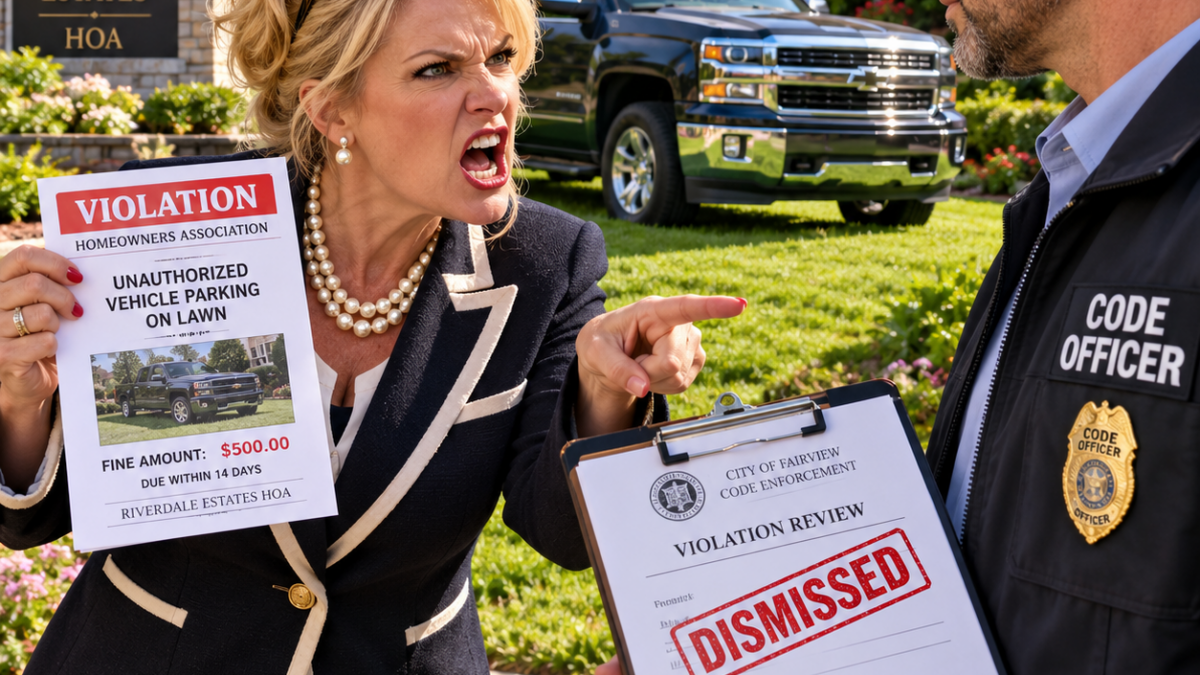
PART 2: HOA Fined Me for Parking Two Tires on My Own Lawn—They Had No Idea I Was the City Code Officer They’d Been Calling for a Year
—
PART 2
The rule itself was real.
That was the frustrating part.
Article 9, Section 4 plainly prohibited residents from parking vehicles on unimproved portions of their lots.
If I had left my truck in the yard overnight, I would have had little argument.
But rules are not just sentences describing what people cannot do.
Enforcement has rules too.
That distinction was something Karen had either never learned or had deliberately forgotten.
Article 12, Section 2 laid out the procedure for a first-time parking violation.
Written warning.
Seventy-two hours to cure.
Then, if the violation continued or repeated, financial penalties could begin.
I read it four times.
There was no ambiguity.
Karen had skipped the warning entirely.
Even more absurdly, the “violation” had cured itself eleven minutes after she issued the notice.
My truck was now sitting legally in my driveway.
I leaned back and rubbed my eyes.
Sarah appeared in the doorway wearing one of my old T-shirts.
“You’re still awake?”
“I found it.”
She sighed.
“Of course you did.”
I turned the binder.
“She had to issue a warning first.”
Sarah shuffled closer.
“So she can’t fine us?”
“She shouldn’t have.”
“Then send them the rule and go to bed.”
That sounded wonderfully simple.
I wish it had remained simple.
I drafted a formal appeal.
No insults.
No accusations.
I wrote the way I wrote professional reports.
Time.
Location.
Conditions.
Relevant provision.
Observed facts.
Required procedure.
Failure to follow procedure.
Requested remedy.
I attached the furniture delivery receipt showing the delivery window.
A photograph from our doorbell camera showing the delivery truck blocking the driveway.
Another photograph showing my truck back on the driveway eleven minutes later.
Then I quoted Article 12 exactly.
Sarah sat across from me watching.
“You’re enjoying this.”
“No.”
“You’re color-coding the attachments.”
“That’s organization.”
“You have tabs.”
“Sarah.”
She smiled.
“I married you. I know what this looks like.”
I printed two copies.
One for the HOA.
One for my records.
Then I wrote a check for the fine.
Sarah frowned.
“I thought you were appealing.”
“I am.”
“Then why pay?”
“Because if they claim nonpayment while the appeal is pending, I don’t want them manufacturing another problem.”
On the memo line I wrote:
**PAID UNDER PROTEST — FORMAL APPEAL PENDING.**
The next morning, I sent the appeal and payment through certified mail.
Everything documented.
Everything traceable.
That should have resolved it.
Instead, it gave Karen another opportunity to prove what kind of organization she had built.
While waiting for the hearing, I started paying attention.
Not hunting.
Paying attention.
When you work in code enforcement, pattern recognition becomes almost involuntary.
You notice abandoned vehicles.
Unpermitted additions.
Blocked drainage.
Unsafe structures.
You also notice when a neighborhood supposedly obsessed with rules applies those rules strangely.
Two streets from Karen’s house, a boat sat behind a fence low enough that most of the hull was visible from the street.
Lakeside Meadows covenants expressly prohibited visible recreational vehicles.
No violation sticker.
No warning.
No apparent concern.
A house owned by someone I had seen laughing with Karen at the community pool had a portable basketball hoop with a cracked base and a rusting pole.
Another covenant required exterior recreational equipment to remain in “good repair.”
Nothing.
The treasurer’s property had a fence built from materials different from the approved community specification.
Nothing.
I started photographing only what was visible from public areas.
Dates.
Times.
Addresses.
I wasn’t looking for ammunition yet.
I wanted to know whether my experience was unusual.
It wasn’t.
A week later, the HOA scheduled my appeal hearing.
Location:
Karen’s house.
That told me almost as much as the violation notice.
A fair hearing should at least look neutral.
Instead, Karen intended to sit at the head of her own dining table and decide whether Karen had acted properly.
Tuesday evening, I put on slacks and a button-down shirt.
Sarah watched me organize my portfolio.
“Promise me something.”
“What?”
“No yelling.”
“I don’t yell.”
She stared at me.
“Army voice counts.”
“I’ll be polite.”
“And don’t stress yourself into a stroke.”
“I’m forty-seven.”
“Then don’t stress yourself into a forty-seven-year-old stroke.”
I kissed her.
“Deal.”
Karen’s house was exactly what I expected.
Perfect lawn.
Perfect shrubs.
Landscape lights spaced with military precision.
An oversized decorative fountain in the front yard.
Too many lights, actually.
Enough to violate the HOA’s own dark-sky section.
I rang the bell.
Karen answered wearing a flowing patterned dress.
“Mr. Reynolds.”
She smiled without warmth.
“Come in.”
Her dining room contained two other board members.
Gary Lambert, secretary.
Thin.
Nervous.
The kind of man who apologized with his posture.
Brenda Shaw, treasurer.
Hard expression.
Arms folded.
Karen took the head seat.
Of course.
A small wooden gavel sat beside her.
That told me everything about the psychological importance of this meeting to her.
She tapped it.
“This hearing is called to order.”
I almost laughed.
Instead, I opened my portfolio.
Karen said, “You may present your appeal.”
I did.
No speeches.
I walked them through the delivery.
Sarah’s medical situation.
Blocked driveway.
Eleven-minute duration.
Immediate cure.
Then the real issue.
“Article 12, Section 2 requires a written warning for first-time violations.”
I slid three copies across the table.
Gary took one.
Brenda did not.
I continued.
“No warning was issued.”
Gary looked at Karen.
She saw him do it.
That irritated her.
Karen said, “The board has authority to waive the warning period for serious violations.”
“Which provision?”
“Article 15.”
I already knew Article 15.
She was bluffing.
“What section?”
Her mouth tightened.
“Section 8.”
I opened the binder.
Article 15, Section 8 concerned unauthorized structural modifications.
Additions.
Exterior construction.
Not parking.
I turned the binder toward her.
“This applies to architectural modifications.”
Karen didn’t even look.
“The board interprets the covenants.”
“Yes.”
“But interpretation doesn’t allow you to move a provision from one category to another.”
Brenda finally spoke.
“You’re being argumentative.”
“I’m appealing a fine.”
“This isn’t a courtroom.”
“I didn’t say it was.”
Karen leaned back.
“Let’s stop wasting time.”
She looked at Gary and Brenda.
“All in favor of upholding the fine?”
Gary raised his hand.
Brenda raised hers.
Karen raised hers.
“Denied.”
I stared.
The hearing had lasted six minutes.
Karen tapped the gavel.
“Anything else?”
I closed the binder.
“No.”
She smiled.
“Good.”
I stood.
Then paused.
“There is one thing.”
Karen frowned.
“What?”
“I want the minutes to reflect that I specifically challenged the board’s reliance on Article 15, Section 8 because it concerns architectural modifications rather than vehicle parking.”
Gary shifted.
Karen said, “The secretary will prepare appropriate minutes.”
“I want my objection recorded verbatim.”
“You don’t control the minutes.”
“No.”
I met Gary’s eyes.
“But if this becomes litigation, I’d rather nobody have to guess what was said.”
Gary’s face went pale.
Karen’s eyes narrowed.
There it was.
The first moment she realized I wasn’t treating this like a neighborhood argument.
I packed my portfolio.
“Thank you for your time.”
As I stepped onto the sidewalk, someone called from next door.
“Tough room.”
An older man stood beside a garage with the door half open.
Oil-stained hands.
Silver hair.
Small smile.
“I’m Henderson.”
“Mark Reynolds.”
“I know.”
He nodded toward Karen’s house.
“They didn’t listen, did they?”
“Not really.”
“They never do.”
I looked at him.
“You’ve dealt with them?”
He laughed.
“I’ve lived here eighteen years.”
That was how I met Frank Henderson.
Retired mechanic.
Widower.
Resident since Lakeside Meadows was first developed.
He told me about the Millers.
Not related to Karen.
Their daughter turned sixteen.
They hung a birthday banner from their porch.
The banner remained up for thirty hours.
Karen fined them for unauthorized signage.
Then the Garcias.
That story changed the entire nature of my fight.
Their seven-year-old son used a wheelchair.
The family installed a small accessibility ramp.
Karen called it an unapproved structural modification.
She demanded removal.
Threatened fines.
The family eventually hired an attorney.
Only after the attorney referenced federal disability protections did the HOA retreat.
“She called the ramp an eyesore,” Henderson said.
I felt my jaw tighten.
“Why didn’t anybody remove her?”
“Because removing a board president requires people to show up.”
He shrugged.
“Most people have jobs. Kids. Problems.”
He looked toward Karen’s dark windows.
“She knows that.”
“People pay because fighting costs more.”
“Exactly.”
He held out his hand.
“You fight differently.”
“What makes you think that?”
“I watched you come out.”
He smiled.
“Men who lose usually look angry.”
“And me?”
“You looked like you learned something.”
I shook his hand.
“I learned the hearing wasn’t real.”
“Good start.”
He released my hand.
“There are more people than you think who’d like a real one.”
The next morning, I walked into the city Code Enforcement Department at 7:15.
That is where my personal dispute collided with something much larger.
My job wasn’t glamorous.
Most municipal code enforcement isn’t.
We dealt with abandoned structures.
Unsafe pools.
Illegally dumped debris.
Overgrown lots harboring rats.
Dangerous retaining walls.
Junk vehicles.
Building work performed without permits when permits were legally required.
Real health and safety issues.
My supervisor, Chief Raymond Miller—no relation to Karen—had one phrase he repeated constantly.
“We enforce public safety, not personal taste.”
That morning, I opened the complaint database.
I had no intention of using city resources to investigate my personal HOA dispute.
That line mattered to me.
But something Mr. Henderson said bothered me.
Karen liked doubling pressure.
HOA fines.
Then threats.
Then sometimes, according to him, city visits.
I searched Lakeside Meadows.
Past twelve months.
The result stopped me.
More than 150 complaints.
For one clean, relatively new residential subdivision.
I stared at the number.
Then opened the files.
Recycling bin left curbside several hours after pickup.
Commercial van parked on a public street.
Basketball hoop near driveway.
Grass allegedly over city height limit.
Temporary contractor trailer.
Decorative yard item near sidewalk.
Minor fence discoloration.
Most cases had been closed as unfounded.
Some resulted in courtesy notices.
But every case consumed time.
Officer dispatched.
Drive time.
Photographs.
Report.
Database entry.
Follow-up.
Taxpayer resources.
I kept reading.
Something else emerged.
Many complaints arrived the day after HOA enforcement action.
I called Henderson on my lunch break.
“Do you have copies of old HOA notices?”
A pause.
“How many?”
“As many as people are willing to share.”
“Why?”
“I’m checking a pattern.”
He laughed.
“Now you really sound like an inspector.”
By that evening, I had dates from twelve HOA cases.
I compared them to city complaint dates.
Basketball hoop.
HOA warning Monday.
City complaint Tuesday.
Trash container.
HOA notice Thursday.
City complaint Friday.
Temporary work van.
HOA warning.
City complaint twenty-four hours later.
The same happened again.
And again.
My anger shifted.
This was no longer simply about Karen abusing HOA procedures.
Someone in Lakeside Meadows appeared to be using municipal enforcement as a second layer of intimidation.
My department.
My colleagues.
Public money.
I opened a separate official file.
No Operation Petty Tyrant jokes.
No personal photos.
Only city data.
Chief Miller walked past my desk.
“You planning to sleep here, Reynolds?”
“Possibly.”
“What?”
“Nothing.”
He looked at my monitor.
“Lakeside Meadows?”
“Yes.”
“That subdivision drives me insane.”
I turned.
“You noticed?”
“Anonymous calls every other day.”
He shook his head.
“I’ve had officers driving out there because somebody thinks a contractor van is ugly.”
“How long has this been happening?”
“Year. Maybe longer.”
He walked away.
That confirmed the institutional pattern.
I still needed a connection.
Until I had one, I wasn’t accusing anyone.
Meanwhile, the neighborhood coalition grew.
Henderson introduced me to Carlos and Elena Garcia.
Their son, Leo, was seven.
Bright kid.
Fast chair.
Faster mouth.
When I visited their house, he challenged me to a race down the driveway.
“I’m not racing a seven-year-old.”
“You scared?”
“Yes.”
“Good.”
His mother laughed.
Then her expression changed when we discussed Karen.
“She called the ramp ugly.”
Elena’s voice shook.
“In front of Leo.”
Carlos stared at the floor.
“We were already dealing with doctors, insurance, physical therapy. The ramp was the one thing that made getting him out of the house easier.”
“And then?”
“She gave us ten days to remove it.”
I looked through their folder.
Karen’s letter described the ramp as inconsistent with architectural standards.
Their attorney’s response cited disability accommodation law.
The HOA backed down.
No apology.
No admission.
Just silence.
Leo rolled into the room.
“Is she in trouble?”
His mother immediately said, “Leo.”
“What?”
He looked at me.
“She’s mean.”
Children reduce complex governance problems efficiently.
I smiled.
“We’re trying to make sure rules are fair.”
He considered that.
“Okay.”
Then rolled away.
Elena watched him.
“I don’t want revenge.”
Neither did I.
Not yet.
“I just don’t want another family getting that letter.”
That became the mission.
Documentation.
Not rage.
David Adler, Sarah’s younger brother, helped turn our evidence into strategy.
David was a corporate attorney.
Expensive suit.
Expensive watch.
Personality specifically engineered to irritate me.
We met for lunch.
He read the fine.
The bylaws.
My appeal.
Board decision.
Photos of comparable violations.
Garcia correspondence.
Henderson statements.
When he finished, he smiled.
I hated that smile.
“What?”
“This is beautiful.”
“People are being harassed.”
“Legally beautiful.”
“Different phrase.”
He tapped Karen’s friend’s boat photo.
“Selective enforcement.”
Then my truck.
“Short-term violation punished immediately.”
Then the boat.
“Long-term violation ignored.”
He leaned back.
“Boards have discretion. They do not have unlimited arbitrary discretion.”
He explained fiduciary duties.
State HOA statutes.
Record inspection rights.
Meeting minutes.
Financial records.
Violation logs.
Architectural decisions.
“We request everything.”
“How much?”
“Five years.”
“That’s excessive.”
“That’s discovery.”
“We’re not suing yet.”
“We’re preparing not to need to.”
That sounded suspiciously lawyer-like.
David told us to build affidavits.
Not social-media stories.
Sworn statements.
Dates.
Copies.
Photographs.
“People remember emotionally,” he said.
“Courts remember exhibits.”
A week later, six of us met in Henderson’s garage.
Me.
Henderson.
Carlos and Elena.
The Miller family.
Another couple named Jamal and Priya Carter.
We mapped the neighborhood.
Red markers:
Homes fined.
Green markers:
Visible violations apparently ignored.
The pattern looked ugly.
Not random.
Board allies clustered in green.
Newer families appeared disproportionately red.
Karen’s property itself had multiple potential HOA violations.
Landscape lighting.
Mailbox.
Small shed near setback.
I didn’t care about her mailbox.
That was the point.
I would never have cared.
But she demanded microscopic compliance from everybody else while ignoring her own house.
David sent a formal records request.
Karen responded by using the maximum legal response period.
Ninety days.
She probably thought delay would weaken us.
It did the opposite.
Every week gave us another statement.
Another photo.
Another neighbor willing to attend the annual meeting.
The city side of the story broke open unexpectedly.
One afternoon, an anonymous complaint arrived about a painter’s truck parked on a public street in Lakeside Meadows.
Officer assigned to the zone called in sick.
I took it.
The truck was legal.
Properly parked.
No obstruction.
No violation.
I photographed it.
Cleared the complaint.
Then noticed a golf cart near the end of the cul-de-sac.
Karen.
She was watching me.
The second our eyes met, she turned the cart around and drove away.
I stood beside the city vehicle.
Something settled into place.
Maybe coincidence.
Maybe not.
But I documented exactly what I observed.
That report allowed me to take the issue to Chief Miller.
I explained the complaint volume.
Pattern.
Cost.
Possible duplication with private HOA enforcement.
He frowned.
“Can you prove who is calling?”
“No.”
“Then we don’t have a person.”
“I know.”
“How many hours?”
“Preliminary estimate is over a hundred staff hours.”
His face hardened.
“Get me a real number.”
That was authorization to continue reviewing the misuse issue.
Through proper city channels, communications data was obtained regarding the anonymous complaint pattern.
One number dominated the records.
Again.
And again.
And again.
Nearly every frivolous Lakeside Meadows complaint.
Karen Miller’s personal number.
When I saw her name attached to it, I didn’t smile.
I felt sick.
Because I understood what it meant.
She wasn’t simply overusing HOA rules.
She had been calling my department on residents she already targeted privately.
She was turning public employees into unpaid extensions of her personal enforcement system.
I printed the report.
Walked into Chief Miller’s office.
Closed the door.
He read.
Slowly.
Then leaned back.
“One person?”
“Yes.”
“How many?”
“Roughly ninety-five percent of the complaints from the subdivision.”
“And most unfounded?”
“Yes.”
“How much staff time?”
“Over 150 hours when dispatch, inspection, report entry, and follow-ups are totaled.”
He took off his glasses.
“Taxpayer cost?”
“Several thousand. Conservative estimate around eight.”
His jaw tightened.
“She’s been using my officers as her private neighborhood patrol.”
“That appears to be what happened.”
He looked at me.
“Personal conflict?”
“Yes.”
I explained my fine.
Everything.
Chief Miller listened.
Then said something important.
“You do not touch the city investigation beyond factual reporting from this point.”
“I understand.”
“I don’t want anyone claiming retaliation.”
“Agreed.”
He pointed at me.
“You’re a complainant personally and a witness professionally.”
“Yes.”
“So separate them.”
“Yes, Chief.”
He picked up the phone.
“Now I call Legal.”
That protected everything.
Karen could say I hated her.
She could say I was angry.
She could say I wanted revenge.
What she could not say was that I personally controlled the city’s response.
I didn’t.
I stepped aside.
The HOA fight continued.
Annual meeting approached.
Normally, Henderson said, maybe twelve people attended.
Karen relied on that.
Apathy is an incredible source of power.
If ten people make all decisions because 240 people stay home, those ten people eventually believe the organization belongs to them.
We went door to door.
Not with accusations.
With invitations.
“Come to the annual meeting.”
“Ask about the budget.”
“Ask about fines.”
“Ask whether enforcement is fair.”
The response shocked even Henderson.
People were angry.
Quietly angry.
One family had been fined because a child’s bicycle remained beside a garage overnight.
Another because their mulch shade allegedly differed from the approved color.
A widow received repeated warnings about weeds that turned out to be flowering native ground cover.
A veteran fought Karen over a service flag.
Almost everyone had assumed their experience was unique.
That was Karen’s greatest protection.
Isolation.
The annual meeting destroyed it.
Sarah insisted on coming.
“You’re supposed to avoid stress.”
“I’m pregnant, Mark, not made of glass.”
“The room may get ugly.”
“I want to see the woman who fined us over the crib delivery explain herself.”
I smiled.
“Okay.”
“And if I go into labor, you are leaving.”
“Immediately.”
“No projector presentation first.”
“I’m not a monster.”
She stared.
“Immediately.”
“Yes, ma’am.”
When we reached the clubhouse, the parking lot was overflowing.
Inside:
More than a hundred residents.
Karen sat at the front table between Gary and Brenda.
Her face when she saw the crowd was priceless.
Then she smiled.
“Wonderful turnout.”
Nobody believed her.
The meeting began.
Minutes.
Treasurer report.
Then questions started.
A resident asked about a $7,000 administrative consulting expense.
Brenda gave a vague answer.
Another asked about enforcement legal fees.
Another about reserve funds.
Karen tried to accelerate the agenda.
Then she reached new business.
I stood.
Her eyes found me immediately.
“Mr. Reynolds.”
“Madam President.”
I had a laptop.
Projector.
Screen.
David stood near the back.
Sarah sat beside Henderson.
I started with stories.
Not mine.
The Garcias.
I did not show Leo’s face.
I explained the ramp dispute.
The room murmured.
Then the birthday banner.
The veteran’s flag.
The bicycle.
The native garden.
I clicked to the neighborhood map.
Red:
Fined.
Green:
Documented but unfined.
The pattern was visible instantly.
Board allies clustered in green.
Newer residents scattered in red.
Karen interrupted.
“This is misleading.”
I pointed to the legend.
“Every point is supported by photographs and violation records.”
Next slide.
My truck.
Two tires touching grass.
$250.
Beside it:
A boat visible for months.
$0.
People began talking.
Karen hammered the gavel.
“Out of order!”
I waited.
When the noise settled, I changed the slide.
Black background.
White letters.
**MISUSE OF CITY CODE ENFORCEMENT SERVICES**
Karen froze.
I saw it.
Tiny.
But real.
Fear.
“As some of you know,” I said, “I work for the city.”
A few residents nodded.
Most did not.
“I’m a code enforcement officer.”
The room shifted.
Karen’s face changed.
Maybe she had known generally.
Maybe not.
But she had never fully understood what my job meant.
“My department has received more than 150 complaints associated with Lakeside Meadows over approximately one year.”
I showed anonymized aggregate data approved for presentation.
“Most were minor.”
“Many were unfounded.”
“And processing them consumed roughly 150 employee hours and thousands of dollars in public resources.”
A homeowner shouted:
“Who kept calling?”
I paused.
Karen stared at me.
This was the moment.
I did not show private information irresponsibly.
I presented only what had been lawfully cleared for disclosure regarding the investigation.
“The city review found that an overwhelming majority of those complaints originated from one repeat source.”
Silence.
I looked at Karen.
“The matter has been referred through appropriate municipal channels.”
Her face went pale.
A woman in the back yelled:
“Was it Karen?”
Another:
“She called the city on my basketball hoop!”
Another:
“She did it to me too!”
Karen shot to her feet.
“This is defamation!”
David moved forward.
He did not shout.
That made him more intimidating.
“My name is David Adler.”
Karen snapped:
“Who are you?”
“Counsel.”
The room became silent.
“I represent Mr. Reynolds and several Lakeside Meadows homeowners regarding claims arising from selective enforcement, harassment, breach of fiduciary duty, and related conduct.”
Karen’s hands gripped the table.
David placed a document in front of her.
“This is formal notice preserving our clients’ claims and requesting immediate retention of all relevant HOA records.”
Karen stared at the pages.
Then at me.
“This is your doing.”
“No.”
I looked around.
“This is what happens when people finally compare notes.”
David turned toward the membership.
“Your bylaws also provide a mechanism for removal of directors through a no-confidence process where sufficient membership participation exists.”
Henderson stood.
“I move for a vote.”
The clubhouse erupted.
Karen screamed:
“This meeting is adjourned!”
She struck the gavel.
Again.
Again.
Nobody moved.
That was the most important moment of the night.
Not the evidence.
Not the lawyer.
Not even the vote.
Karen discovered that authority disappears the second the people granting it stop cooperating with the illusion.
Gary leaned toward her.
“Karen.”
“Don’t.”
“We need to follow procedure.”
“I said adjourned!”
Brenda whispered:
“We can’t just leave.”
People demanded ballots.
Address verification.
Quorum check.
David ensured procedure was followed.
Henderson, practical as always, had anticipated the need for paper.
For once, the process belonged to everyone.
Karen sat rigidly.
Gary looked like he might faint.
Brenda avoided the audience.
The ballots were counted openly.
112 votes to remove the existing leadership.
Three to retain them.
Karen’s face went blank.
No screaming.
No tears.
Just disbelief.
A person who had spent years believing she represented the community had just been told, mathematically, that the community no longer wanted her.
She stood.
Collected her purse.
Left the gavel.
Walked toward the side door.
At the doorway, she turned toward me.
“You think you won?”
Everyone went quiet.
I looked at her.
“No.”
She almost smiled.
Then I continued.
“I think the neighborhood finally showed up.”
Her expression collapsed.
She left.
The door closed.
Sarah squeezed my hand.
Only then did I realize mine was shaking.
Henderson became interim president.
Carlos Garcia accepted a temporary treasurer role.
A retired school principal named Diane became secretary.
The new board’s first act was to suspend all disputed enforcement actions pending review.
My $250 fine was reversed.
A refund check arrived later.
So did an apology.
But Karen’s removal was only the visible layer.
Once the interim board obtained full access to records, the financial investigation became far worse than any of us expected.
The $7,000 administrative consulting expense?
Payments to an entity that could not be properly substantiated.
Several checks had been directly connected to Karen.
Then came credit-card expenses.
Meals.
Personal items.
Spa services coded vaguely.
Travel expenses described as HOA conference costs.
An expensive trip that did not match any recognized conference record the board could verify.
No-bid vendor arrangements.
Poor documentation.
It stopped looking like arrogant mismanagement.
It started looking potentially criminal.
Henderson called me.
“This is beyond us.”
“Yes.”
“What do we do?”
“Counsel.”
David agreed.
The board voted to refer the findings to law enforcement and auditors.
I stayed out of that investigation.
My work was done.
The city separately addressed the code-enforcement misuse.
Chief Miller called me into his office.
“Reynolds.”
“Chief.”
“You’ve turned your neighborhood into a legal seminar.”
“I didn’t start it.”
“I know.”
He slid a report toward me.
The city was pursuing restitution related to wasted resources and implementing safeguards against repetitive bad-faith complaint patterns.
“Good.”
Chief stared at me.
“You know what bothers me?”
“What?”
“She made us distrust complaints.”
That hit me.
Anonymous complaints matter.
Sometimes they reveal genuine dangers.
Child hazards.
Unsafe structures.
Illegal dumping.
Elder neglect situations referred to proper agencies.
A person weaponizing that system weakens it for everybody.
“That’s why this matters,” he said.
Not revenge.
Public trust.
Karen’s situation worsened.
Civil claims.
Restitution.
Financial investigation.
Eventually criminal charges related to HOA funds.
Rumors spread faster than facts.
I avoided them.
Neighbors wanted updates.
I gave none.
Sarah asked me one night:
“Don’t you want to know what happens to her?”
“Yes.”
Then I thought.
“No.”
She smiled.
“That was fast.”
“I want accountability.”
“Not suffering.”
I looked at her.
“Six months ago I probably wouldn’t have known the difference.”
The criminal matter ended in a plea to a lesser embezzlement-related charge.
Probation.
Restitution.
Karen moved away.
Her house went on the market.
The new owners were a young couple with three children and a golden retriever.
The week they moved in, they installed a basketball hoop.
Henderson called me.
“You see that?”
“Yeah.”
“What are we going to do?”
“Absolutely nothing.”
He laughed.
The neighborhood changed.
Not because we removed all rules.
That would have been another mistake.
Rules remained for genuinely important things.
Unsafe structures.
Severe neglect.
Common-area responsibilities.
Parking that blocked emergency access.
Real issues.
But nuisance rules were simplified.
Warnings came before fines.
Appeals went before more than one person.
Board members with conflicts had to recuse themselves.
Financial records went online.
Meetings became open and boring.
Boring was beautiful.
Sarah gave birth four months after the annual meeting.
A boy.
Healthy.
Seven pounds, nine ounces.
The first time I held him, every HOA fight disappeared from my mind.
He was tiny.
Red-faced.
Furious at existence.
Sarah looked exhausted and radiant.
“What do you think?”
I stared at him.
“I think he looks angry.”
“He looks like you.”
“That’s unfortunate.”
She laughed weakly.
We named him Leo.
Not because we were trying to turn a neighborhood dispute into mythology.
Because months earlier, a seven-year-old boy in a wheelchair had looked at me and asked whether rules could be fair.
That question stayed with me.
Carlos cried when we told him.
Elena cried harder.
Their Leo demanded naming rights to our son’s first bicycle.
“That seems premature,” I told him.
“I already picked blue.”
“Of course you did.”
Six months after the vote, Lakeside Meadows held a barbecue beside the new playground.
The playground had been proposed years earlier.
Karen had rejected it.
Liability.
Noise.
Aesthetics.
The new board approved it through proper budgeting and community vote.
Smooth pathways surrounded the equipment.
Accessible ramps.
Wide turning spaces.
Leo Garcia raced from one end to the other in his chair.
Kids followed him.
Henderson wore an apron that said:
**GRILL SERGEANT**
I told him it was embarrassing.
He said I had no authority.
Fair.
A welcome-home banner hung across one house for a soldier returning from deployment.
It remained up all week.
No fine.
No panic.
No collapse of property values.
Sarah sat beside me holding our baby.
I watched neighbors talk.
Laugh.
Share food.
Nothing extraordinary.
That was exactly why it felt extraordinary.
For the first time since we bought the house, Lakeside Meadows felt like a neighborhood instead of a collection of hostages maintaining approved landscaping.
Henderson came over.
“You know you started all this.”
“No.”
“Yes.”
“I parked badly.”
“You parked on your grass for eleven minutes.”
“Historic act of rebellion.”
He laughed.
Then became serious.
“You could have paid it.”
“I did.”
“Could have left it there.”
“I appealed.”
“That’s what I mean.”
He looked around.
“Everybody else got tired.”
I understood.
“People shouldn’t need military training and a city badge to challenge unfair treatment.”
“Exactly.”
That became the next reform.
Plain-language appeal guides.
Free record access.
No procedural traps.
An HOA should not require a law degree to defend yourself from it.
A year later, I found the original violation notice in my office drawer.
The paper had curled slightly.
Two hundred fifty dollars.
My refund check sat beside it.
Uncashed.
Sarah entered.
“You still haven’t deposited that?”
“No.”
“Why?”
“I’m thinking about framing them.”
She stared.
“The ticket and the check?”
“Yes.”
“That is the most Mark thing imaginable.”
“It tells the story.”
She picked up the check.
“We could buy diapers.”
“We have diapers.”
“We always need diapers.”
She was right.
I eventually deposited the refund.
I framed a photocopy.
Marriage teaches compromise.
Years passed.
Karen became a cautionary story older residents occasionally told newcomers.
Most new families never met her.
That felt right.
Reform succeeds when the next generation finds the old abuse difficult to imagine.
One summer evening, I was trimming the yard when Henderson leaned over the fence.
“You know what your problem is?”
“Which one?”
“You still edge your lawn like an Army inspection.”
“Standards.”
He grinned.
“You sound like Karen.”
I stopped the trimmer.
“Take that back.”
He laughed until he coughed.
My son, now old enough to wobble through the yard, ran toward the truck.
I caught him before he reached the driveway.
Henderson watched.
“Hard to believe this started before he was born.”
I looked toward the exact patch of grass where my tires had rested.
No scar remained.
Of course not.
The grass recovered in days.
That made the original fine even more ridiculous.
But the memory mattered.
Karen claimed she was protecting the lawn.
In reality, she was protecting authority.
That difference explains most abusive systems.
The stated issue is rarely the real issue.
Parking.
Mailbox color.
Birthday banner.
Wheelchair ramp.
Trash can.
The actual issue is obedience.
Healthy governance asks:
What harm are we preventing?
Unhealthy governance asks:
Did you obey me?
I learned more about local power from Lakeside Meadows than from twenty years in uniform.
In the Army, authority was explicit.
Ranks.
Responsibilities.
Command structures.
Accountability.
In suburban organizations, power could be far murkier.
A clipboard.
A title nobody wanted badly enough to challenge.
Three residents attending meetings.
Two hundred others staying home.
That was enough to create a tiny kingdom.
Karen never possessed enormous power.
She possessed unattended power.
That was more dangerous than it sounded.
Years later, Chief Miller retired.
At his farewell lunch, he called me over.
“You staying with the city?”
“Probably.”
“You should apply for supervisor.”
“No.”
“Why?”
“I’ve had enough politics.”
He laughed.
“You took down an HOA board.”
“The homeowners did.”
“You investigated systematic misuse of municipal resources.”
“Team effort.”
“You argue bylaws recreationally.”
“That one is unfair.”
He held out his hand.
“You’re good at systems, Reynolds.”
I shook it.
“Systems don’t matter if people stop watching them.”
He nodded.
“That’s the lesson.”
Yes.
That was the lesson.
Not that Karen was uniquely evil.
She wasn’t.
That would make the story too comfortable.
If she were simply a monster, everyone else could relax.
Monsters are rare.
Ordinary people becoming unaccountable are common.
Karen started as a volunteer.
Maybe once she genuinely believed she was helping.
Then nobody challenged her.
A warning became a fine.
A fine became a weapon.
Selective enforcement became normal.
Anonymous city complaints became a second weapon.
HOA money became personal money.
And every successful overreach taught her that the next one would work too.
Until my truck touched the grass.
Two tires.
Eleven minutes.
That was all.
A tiny event hit the system at exactly the right angle and exposed every crack.
Years after the fight, Leo Garcia—now a teenager—came by our house with his parents.
My son was running around the driveway.
The two Leos had become oddly bonded despite the age difference.
Teenage Leo called him “Little Leo.”
My son called him “Big Leo.”
Big Leo looked at the lawn.
“This where it happened?”
“Where what happened?”
“The parking thing.”
His mother groaned.
“You’ve told him?”
Carlos laughed.
“Everybody knows.”
Leo pointed.
“Right there?”
“Pretty much.”
He rolled his chair onto the grass.
“Guess I’m violating the lawn.”
I smiled.
“Your wheels are allowed.”
“Special treatment?”
“Reasonable accommodation.”
He nodded approvingly.
“Good answer.”
Then he grew serious.
“My mom says you fought because of my ramp too.”
I shook my head.
“Your family fought that battle before I arrived.”
“But you told everybody.”
“Yes.”
“Why?”
“Because people needed to understand what unfair rules look like when they stop being funny.”
He looked toward my son.
“Thanks.”
I didn’t know how to answer.
So I said:
“You’re welcome.”
That evening, Sarah and I sat on the porch.
Our son had fallen asleep across my lap.
She looked at him.
“Worth the trouble?”
“What?”
“The whole fight.”
I thought about Karen.
The appeal.
The city investigation.
Late nights.
Lawyers.
Angry meetings.
Her arrest.
Restitution.
The new board.
The playground.
Big Leo racing down the accessible path.
Mrs. Garcia crying when we named our son.
Henderson laughing over the fence.
Neighbors who knew one another now.
“Yes.”
Sarah nodded.
“Even the $250?”
“Especially the $250.”
She smiled.
“You know what’s funny?”
“What?”
“If Karen had given you a warning like the bylaws required, none of this might have happened.”
That stopped me.
She was right.
One warning.
No fine.
No sham appeal.
Maybe I would have parked legally and moved on.
Karen’s downfall wasn’t caused by strength.
It was caused by impatience.
She wanted punishment immediately.
She wanted the satisfaction of forcing compliance.
She skipped the very process designed to protect her authority from accusations of unfairness.
That was the irony.
The rulebook did not destroy her.
Her belief that she was above the rulebook did.
Sometimes people ask which moment felt best.
The vote?
No.
Seeing the 112-to-3 result was powerful, but not the best.
The refund?
No.
Getting $250 back felt almost irrelevant by then.
Her arrest?
Absolutely not.
Watching police take someone away is sobering, even when they brought the consequences on themselves.
The best moment happened much later.
No crowd.
No lawyer.
No projector.
I came home from work one afternoon.
My son was outside with Sarah.
Henderson sat on his porch.
The Garcias were visiting another family.
Kids played basketball in the street.
A boat sat legally inside a driveway waiting for a weekend fishing trip.
Someone’s grass was probably half an inch too tall.
Nobody cared.
Sarah waved.
My son ran toward me.
I parked my truck.
In the driveway.
Then paused.
Looked at the lawn.
Smiled.
Sarah noticed.
“What?”
“Nothing.”
She followed my gaze.
Then she understood.
“Don’t you dare.”
“I wasn’t going to.”
“You were thinking about it.”
“Maybe two tires.”
“Mark.”
I laughed.
Then lifted my son into my arms.
I had spent years believing peace meant the absence of conflict.
The Army teaches you to crave quiet.
No alarms.
No orders.
No incoming problems.
When I bought Lakeside Meadows, that was what I wanted.
Quiet.
Instead, Karen gave me conflict.
But the fight taught me something I didn’t expect.
Peace is not always what exists before the fight.
Sometimes peace is what people build after they finally confront the thing disturbing it.
Karen’s version of Lakeside Meadows looked peaceful.
Perfect lawns.
Matching mailboxes.
Quiet streets.
But underneath it, people were anxious.
Hiding ramps.
Removing banners.
Dragging toys indoors.
Watching for a golf cart.
That wasn’t peace.
That was compliance.
The Lakeside Meadows we built afterward was louder.
Kids.
Barbecues.
Basketballs.
Music.
Birthday decorations.
Neighbors debating budgets at open meetings.
Occasional disagreements.
Real life.
And somehow it felt infinitely more peaceful.
Because nobody was afraid.
The original fine is still framed in my home office.
Not because I enjoy remembering Karen.
I don’t.
It hangs beside my Army retirement photo and my city certification.
My son once pointed at it.
“Daddy, what’s that?”
“A parking ticket.”
“You parked bad?”
I laughed.
“Technically.”
“Then why frame it?”
I looked at the paper.
How do you explain all of that to a five-year-old?
I lifted him onto my knee.
“Because sometimes a small problem helps you notice a bigger one.”
He thought about it.
“Like when the sink leaks?”
“Exactly.”
“And then you fix the pipe?”
“Yes.”
He nodded.
Satisfied.
Children again.
Efficient.
A small problem showed us where the system leaked.
We fixed it.
Not perfectly.
Nothing involving people is ever perfect.
But better.
Fairer.
Stronger.
Karen believed the HOA belonged to the board.
We learned it belonged to the members.
She believed city enforcement existed to reinforce her preferences.
We reminded everyone it existed to protect public welfare.
She believed rules were weapons.
We rebuilt them as safeguards.
She believed one homeowner could be isolated and pressured until he surrendered.
Instead, one homeowner started asking questions.
Then one neighbor answered.
Then another.
Then a family.
Then a room.
Then 112 votes.
That is how her empire ended.
Not with revenge.
Not with shouting.
Not with me proving I was tougher.
It ended when people stopped being afraid one at a time and started standing together all at once.
Karen fined me $250 for putting two tires on my own lawn while a delivery crew carried a crib into the house for my unborn child.
She thought she was teaching me a lesson about rules.
She did.
Just not the lesson she intended.
She taught me that rules without fairness become intimidation.
Authority without accountability becomes abuse.
And communities where good people stay silent can be controlled by surprisingly small personalities.
But she also taught me something better.
One person can read the rulebook.
One neighbor can tell the truth.
One family can share an old letter.
One room can show up.
One vote can change a board.
And one ridiculous parking ticket can become the first crack in a system everybody else assumed was too strong to challenge.
That ticket cost me $250 for a few months.
In the end, I got every dollar back.
Karen lost her office.
The board was replaced.
Misused money was returned.
City resources stopped being weaponized.
Families received reimbursement.
The Garcias kept their ramp.
The kids got their playground.
The neighborhood got its voice back.
And Sarah and I finally got the home we had imagined when we first drove into Lakeside Meadows.
Not a perfect neighborhood.
Something much better.
A fair one.
Some evenings, Henderson still leans over the fence while I’m doing yard work.
One summer night he watched me edge the grass beside the driveway.
“You know, Reynolds,” he said, “you really did save this neighborhood.”
I shut off the trimmer.
“No.”
He rolled his eyes.
“Here we go.”
“We saved it.”
“Fine.”
He pointed at me.
“But you started it.”
I looked down at the lawn.
The exact patch where my tires had rested years earlier was indistinguishable from everything around it.
Green.
Healthy.
Ordinary.
I smiled.
“I just parked the truck.”
Henderson laughed.
And from inside the house, I heard my son calling for me.
I put the trimmer away.
Walked toward the door.
The street behind me was filled with children’s voices, basketballs bouncing, neighbors talking, and all the normal sounds Karen had once tried so hard to regulate into silence.
I never looked back at the patch of grass.
I didn’t need to.
The fight was over.
The lesson wasn’t.
And every time I came home and saw families living freely in a neighborhood that once taught people to keep their heads down, I remembered what that tiny $250 ticket eventually bought us.
Not revenge.
Not victory over one woman.
Something far more valuable.
A community worth coming home to.