PART 2: HOA Fined Me $6,000 for My “Junk Equipment”—Then Learned What Those Machines Had Been Maintaining for 70 Years
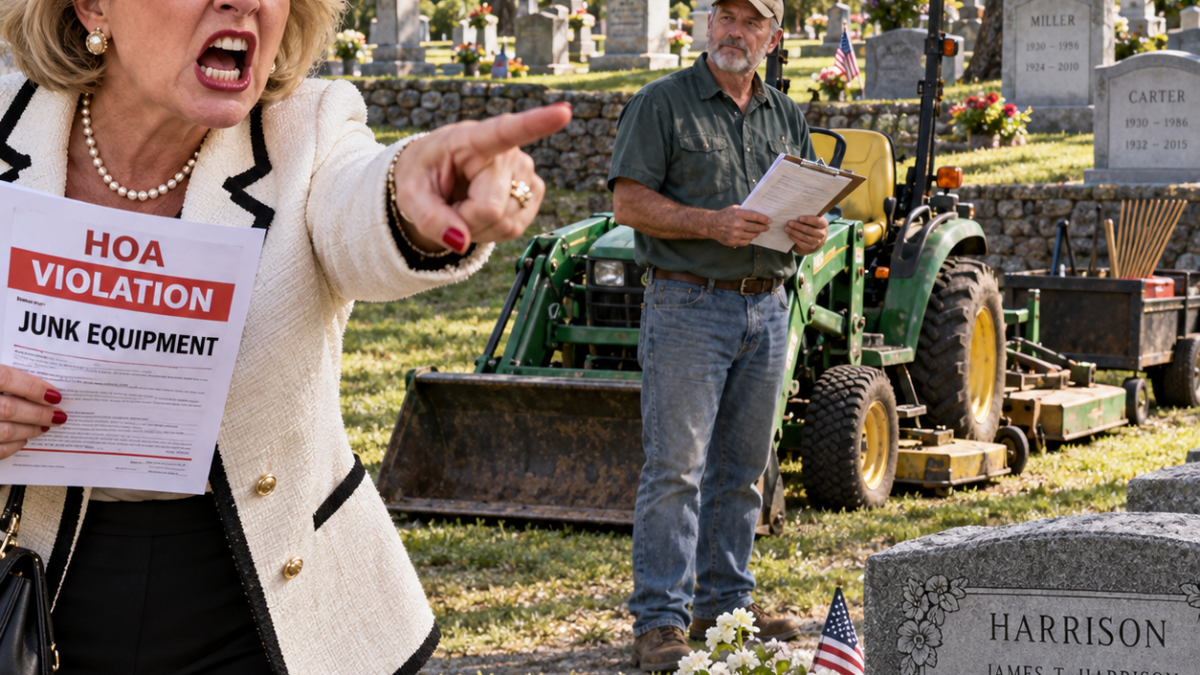
PART 2
Sarah knew something had happened before I spoke.
We had been married sixteen years by then, long enough for her to distinguish between ordinary irritation and the particular silence I brought home when I was already building a plan inside my head.
She was at the kitchen counter cutting tomatoes when I walked in.
“What happened?”
“Why does something have to have happened?”
She put down the knife.
“You closed the door gently.”
“So?”
“You slam it when you’re mildly angry. You close it gently when you’re furious.”
I pulled the violation packet from my shirt pocket.
She read the first page.
Then the second.
Then went back to the first.
“Six thousand dollars?”
“Yes.”
“For what?”
“Apparently we operate a scrapyard.”
Sarah looked through the kitchen window toward the barn.
The Caterpillar sat exactly where it had sat for years.
“You mean the backhoe?”
“And the mower.”
“The new mower?”
“Especially offensive.”
She looked at me.
“And they think part of our land belongs to them?”
“That’s the interesting part.”
I spread Karen’s map across the dining table.
Sarah wiped her hands and came closer.
The digital line cut a neat little bite out of our property.
Lot A-17.
“Where did this come from?”
“Development survey.”
“That doesn’t match Dad’s map.”
“No.”
My father had died four years earlier, but Sarah still called the original property records Dad’s maps.
I went to the old oak filing cabinet in the office.
The cabinet itself had belonged to him.
Top drawer:
tax records.
Second:
insurance.
Bottom:
land.
I pulled out the deed.
1952 survey.
County assessment maps.
A newer survey commissioned when we built the barn.
Then a hand-drawn property sketch my grandfather had made.
Metes and bounds.
Distances.
Stone wall.
Old oak.
Creek.
Iron pin.
Nothing about Lot A-17.
Nothing about boundary adjustment.
Nothing transferring land to Crimson Ridge.
Sarah traced the old line.
“This is forty feet away from their line.”
“Closer to thirty-five at the narrowest point.”
“Still.”
“Yes.”
“What do you do?”
“I call Marcus.”
She leaned against the table.
“You haven’t talked to him in months.”
“That’s because normal people don’t need property lawyers every week.”
“Marcus is not normal.”
“True.”
Marcus Thorne and I met overseas.
He had been a JAG officer attached to our brigade.
I was Army Corps.
We became friends after a contractor dispute over a water-treatment system turned into three days of paperwork, two shouting matches, and one memorable evening when Marcus explained international contract law to a colonel using a box of crackers as visual aids.
After leaving the service, he built a successful property and civil practice.
He answered on the fourth ring.
“Jack Riley.”
“Marcus.”
“Who died?”
“Nobody.”
“Then you owe me money.”
“HOA says they own part of my land.”
Pause.
“Now I’m interested.”
I explained.
Karen.
Fine.
Equipment.
Lot A-17.
Lien threat.
Marcus became quiet.
When lawyers become quiet, it usually means somebody else should become nervous.
“Do not pay them.”
“I wasn’t planning to.”
“Do not write them.”
“Wasn’t planning to.”
“Do not post anything online.”
“I don’t post anything online.”
“That’s why we remain friends.”
I heard paper moving.
“Scan your deed, every survey, tax plats, easements, title policy, everything.”
“Tonight?”
“Now.”
“Sarah made dinner.”
Sarah called from across the room:
“He can wait ten minutes.”
Marcus laughed.
“I heard that.”
“Good.”
After dinner, we scanned everything.
Marcus began pulling county records.
While he worked, I did something that bothered Sarah.
I moved the equipment.
Not off my land.
Just farther from the disputed strip.
She watched from the barn.
“You’re complying?”
“No.”
“Looks like complying.”
“I’m removing their excuse to claim continuing penalties while the boundary gets examined.”
“Tactical retreat.”
“Exactly.”
She smiled.
“Army men love changing the name of things.”
The silence lasted three days.
Then Karen sent the second package.
Annual HOA meeting notice.
Agenda.
Budget.
Pool repairs.
Landscaping contract.
Election.
Then:
**Enforcement Action and Proposed Lien/Foreclosure Authorization — Lot A-17.**
My pulse slowed.
That tends to happen when I’m truly angry.
She wasn’t bluffing.
Behind the meeting notice was a compliance inspection letter.
Forty-eight hours.
Karen and the Architectural Review Committee intended to enter the disputed area and “document ongoing covenant violations.”
I called Marcus.
“They’re coming onto the property.”
“Excellent.”
“Excellent?”
“I found their survey.”
I stopped.
“And?”
“Bad.”
“How bad?”
“The development surveyor had disciplinary history. License was later suspended over deficient work.”
“That doesn’t automatically invalidate this map.”
“No.”
“But?”
“There is no recorded boundary-line adjustment involving your parcel.”
I sat down.
“Nothing?”
“No deed.”
“No easement?”
“No.”
“Lot-line agreement?”
“No.”
“Vacation?”
“No.”
“Transfer?”
“No.”
“What about Lot A-17?”
“Appears to be an internal designation on development documents.”
“So they drew a line.”
“Basically.”
Marcus paused.
“Their internal map cannot transfer title to land they never acquired.”
I looked through the window toward the spot Karen had claimed.
“What do we do when they show up?”
“Record.”
“State law?”
“Assuming you’re on your own property and recording the interaction lawfully, document everything. I’ll send a cease-and-desist notice.”
“And if she crosses?”
“Don’t create a scene. Tell her she is on disputed private land and formally deny permission.”
Marcus’s voice hardened.
“Jack, we are not turning this into a confrontation. We are turning it into evidence.”
I understood.
Evidence outlives anger.
Two days later, Karen arrived at exactly two o’clock.
Golf cart.
Architectural Review Committee woman.
Thin man in polo shirt.
Karen climbed out and immediately pointed toward the work pad.
“The equipment is gone.”
“Moved.”
“That does not cure the violation.”
“There is no violation.”
Clipboard woman started writing.
Karen frowned.
“We are here to inspect.”
“You are on my property.”
“We dispute that.”
“I don’t.”
I held up my phone.
“For the record, I am allowing five minutes of access solely to document the dispute. I am not acknowledging HOA jurisdiction or granting continuing access rights.”
The thin man looked uncomfortable.
Karen scoffed.
“You think saying legal-sounding things changes ownership?”
“No.”
I handed him Marcus’s letter.
“County records do.”
Karen snatched it before he finished the first paragraph.
Her eyes moved.
Faster.
Then slower.
“What is this?”
“Cease and desist.”
“You hired a lawyer?”
“I called a friend.”
“This is intimidation.”
“No.”
I pointed toward Lot A-17.
“Trying to foreclose on land you don’t own is intimidation.”
“We have a survey.”
“You have an unrecorded development map.”
“Same thing.”
“No.”
Karen looked at the committee.
Clipboard woman stared at the paper.
Polo shirt stared at the ground.
I continued.
“Your claimed boundary adjustment was never recorded against my parcel. There is no deed transfer, no approved lot-line agreement, and no recorded instrument granting the HOA title.”
Karen’s face reddened.
“Our lawyers disagree.”
“Then they can contact mine.”
“You can’t win this.”
“I’m not trying to win anything.”
I stepped back.
“I’m trying to keep what already belongs to me.”
Karen shoved the cease-and-desist letter at the committee man.
“This inspection is concluded.”
They left.
The golf cart disappeared toward Crimson Ridge.
Sarah stepped out of the workshop.
“That went better than expected.”
“It went exactly as Marcus expected.”
“And you?”
“I expected more yelling.”
“You sound disappointed.”
“Moderately.”
The next week was quiet.
Too quiet.
Karen was not retreating.
She was recalculating.
I used the time.
Until that point, my case was about a boundary.
Then Arthur Henderson changed everything.
Arthur lived in one of the older homes swallowed by the expansion around Crimson Ridge.
Retired history teacher.
Seventy-eight.
Rose bushes so perfect they looked disciplined.
He was watering them when I stopped.
“Mr. Henderson?”
“Jack Riley.”
“You know me?”
“Everybody knows the cemetery man.”
I smiled.
“My grandfather would hate that title.”
“He’d secretly love it.”
We talked.
Eventually, I mentioned Karen.
Arthur rolled his eyes.
“What did she fine you for?”
“Commercial equipment.”
“How much?”
“Six thousand.”
Arthur nearly dropped the hose.
“For that?”
He pointed toward my distant barn.
“Yes.”
“That woman has finally gone insane.”
“Finally?”
He walked me toward his flower bed.
A ceramic gnome peeked out from behind the roses.
Red hat.
Fishing pole.
Arthur pointed.
“Bartholomew.”
“Nice.”
“He cost me two hundred dollars.”
“The gnome?”
“No. Karen.”
I laughed.
He didn’t.
“She says whimsical lawn ornaments are prohibited.”
“What did you do?”
“I wrote her three pages comparing the HOA to the Lilliputians in Gulliver’s Travels.”
I stared.
Arthur smiled.
“I taught literature too.”
“Did it work?”
“No.”
Then he told me about Margaret Davison.
Her front door.
Wrong shade of white.
Margaret left town to care for her sick sister.
While she was gone, the HOA sent a contractor.
Painted the door.
Sent Margaret a bill.
Nine hundred dollars.
“For paint?”
“And labor.”
“What contractor?”
Arthur’s expression changed.
“Prestige Property Solutions.”
I repeated the name.
“Preferred vendor.”
He shook his head.
“Preferred by Karen.”
“How often?”
“All the time.”
Arthur explained.
Violation.
Short cure deadline.
No compliance.
Prestige appears.
Performs work.
Homeowner billed.
Sod.
Paint.
Shrubs.
Basketball hoop removal.
Pressure washing.
The bills were enormous.
I felt the investigation shift beneath my feet.
“Arthur.”
“Yes?”
“Do you have one of the invoices?”
He disappeared inside.
Returned with a copy from Margaret.
Prestige Property Solutions.
P.O. box.
No detailed labor breakout.
No competitive bid.
Nine hundred dollars.
I folded the copy carefully.
“What else?”
Arthur smiled.
“Now you’re asking the right question.”
I spent the next five days talking to Crimson Ridge homeowners.
Quietly.
No accusations.
One question.
“Have you ever received a bill from Prestige Property Solutions?”
The answer was yes far too often.
A young family paid seven hundred dollars after Prestige removed and stored a basketball hoop.
A widow paid eighteen hundred for sod replacement over a patch of lawn the size of my truck.
Another homeowner paid nearly twelve hundred for shrub trimming and haul-away.
Someone else received a four-figure bill for pressure washing.
The pattern was clean.
HOA declares violation.
Karen controls enforcement.
Homeowner cannot satisfy deadline.
Prestige performs “remediation.”
Homeowner gets inflated invoice.
I created a private email group.
At first:
six members.
Then fourteen.
Thirty.
Thirty-seven.
Fear decreases quickly once people realize they are not alone.
Scans poured in.
Violation letters.
Prestige invoices.
Threats of lien.
Photos.
Appeal denials.
Marcus called me.
“Jack.”
“Yeah?”
“You built me a spreadsheet.”
“I thought lawyers liked exhibits.”
“I love you.”
“Don’t say that again.”
“I’m serious.”
I heard him typing.
“This looks systematic.”
“It is.”
“Do homeowners have a choice of contractor?”
“Apparently not once the HOA declares abatement.”
“That is a problem.”
“How big?”
“Depends where the money goes.”
“Can you find out?”
“I already started.”
While Marcus chased Prestige, I followed another thread.
Karen’s full name appeared on her letters.
Karen Miller-Patterson.
Miller.
The old Miller farm had become Crimson Ridge.
Same name.
Maybe coincidence.
Maybe not.
That Saturday, I drove to Northwood Historic Cemetery.
Our family’s relationship with Northwood went back generations.
My grandfather started the formal maintenance contract after Korea.
Before that, my great-grandfather volunteered there.
Northwood was not fancy.
Old stone wall.
Iron gates.
Huge oaks.
Markers dating back before the Civil War.
One from 1798.
Family sections.
Veterans.
Children.
Farmers.
Teachers.
People whose names were now roads and schools.
My father taught me that cemetery work had one rule above everything else:
You do it right even when nobody is watching.
Trim carefully.
Never damage stones.
Never blow debris against markers.
Never rush around graves.
Treat each plot like somebody’s family will arrive five minutes after you leave.
Sometimes they do.
The backhoe Karen called junk handled drainage work and utility repairs.
The mower cut the open sections.
The trailer carried trimmers.
The chainsaws cleared fallen limbs after storms.
Those machines had worked at Northwood hundreds of times.
I parked beside the caretaker shed.
Walked.
Miller.
The name caught my eye before I consciously looked for it.
Large polished granite.
George Miller.
Eleanor Miller.
I knew those names.
George was a veteran.
The family once owned the land that became Crimson Ridge.
One daughter.
Karen.
My stomach tightened.
I checked cemetery records.
Then old local records.
Relationship confirmed.
Karen’s own family rested here.
Maybe grandparents depending on the branch of the family—close kin, unquestionably.
I walked back outside.
The John Deere sat near the maintenance building.
I looked from the mower to the Miller stone.
Then laughed once.
Not because it was funny.
Because the irony was almost physically painful.
The machine she wanted removed as junk was the machine keeping grass from growing over her family’s grave.
I pulled out my phone.
Photographs.
Wide cemetery view.
Veterans’ row.
Mower.
Trailer.
Maintained paths.
Miller stone.
Close-up of clean edges around it.
Then video.
No drama.
I narrated the maintenance work.
Seventy-year family obligation.
Equipment.
Contract.
What each machine did.
I did not know yet how I would use it.
Then Marcus called.
“We found Prestige.”
I sat on the tailgate.
“Talk.”
“Delaware registration.”
“Okay.”
“Layered entity.”
“Okay.”
“Banking signatory is David Patterson.”
I went silent.
“Karen’s husband?”
“Yes.”
I looked toward the Miller grave.
“You sure?”
“Very.”
“So she fines people.”
“Yes.”
“Then her husband’s company does the work.”
“Yes.”
“Then residents pay his company.”
“Yes.”
Marcus exhaled.
“This is not a normal HOA conflict anymore.”
“What is it?”
“Potential self-dealing. Fraud exposure. Possibly more depending on the records, representations, and local statutes.”
“Can we prove Karen knew?”
“Her signature appears on multiple authorization letters.”
I stared at the cemetery.
“When’s the annual meeting?”
“Ten days.”
Marcus understood from my tone.
“Oh no.”
“What?”
“You have a plan.”
“I have photographs.”
“Legal photographs?”
“Better.”
“There is no better.”
“You’ll see.”
Crimson Ridge Alliance for Fairness.
Arthur named it.
I wanted something shorter.
He won.
Our email group reached almost fifty households.
Twenty people attended a planning session in my workshop.
Karen would have called the workshop ugly.
That made it a perfect headquarters.
Folding chairs between tool cabinets.
Projector aimed at plywood.
Coffee.
Cookies.
Bartholomew the gnome sat on my workbench.
Arthur insisted.
Marcus stood at the front.
“Here is what we know.”
Slide:
Karen enforcement decisions.
Arrow.
Prestige Property Solutions.
Arrow.
David Patterson.
Arrow.
Invoices charged to homeowners.
The room went silent.
Margaret held her $900 door invoice.
“That went to her husband?”
“Evidence indicates the company is controlled by him.”
Marcus answered carefully.
A man near the back said:
“So she creates the violation and her family makes the money.”
“That is the allegation we can support with current records.”
Marcus said.
Anger spread.
Not shouting.
Something colder.
Betrayal.
An HOA spends other people’s trust.
Once that trust is gone, authority collapses quickly.
Marcus outlined objectives.
One:
Defeat lien/foreclosure motion on my property.
Two:
Demand independent audit.
Three:
Move for removal of Karen.
Four:
Preserve records.
Five:
Refer potential financial misconduct to proper authorities.
Then it was my turn.
I put a photograph of the Caterpillar on screen.
“This is the equipment Karen calls junk.”
People knew the image.
Karen had circulated it.
Next slide.
Northwood Cemetery.
Green.
Clean.
Quiet.
“This is one of the places the junk maintains.”
Veterans’ stones.
Historic markers.
Caretaker cottage.
Paths.
Then:
Miller grave.
The room changed.
Arthur took off his glasses.
“Oh.”
Margaret covered her mouth.
I said:
“That is Karen’s family.”
Nobody spoke.
“She wants to fine me six thousand dollars and potentially take the land where I park equipment used to care for the cemetery where her own relatives are buried.”
Arthur whispered:
“Good Lord.”
I clicked back to the backhoe.
“This is not about embarrassing her.”
I meant it.
At that moment, I did.
“This is about showing everybody what happens when someone becomes so obsessed with appearance that they stop asking what something is for.”
The annual meeting was held in a hotel ballroom.
Beige walls.
Beige carpet.
Beige curtains.
Crimson Ridge’s natural habitat.
More than one hundred people came.
Normal attendance:
twelve.
Karen smiled when she saw the crowd.
She thought they had come to watch her discipline me.
That might be the most important mistake she made.
She believed attention automatically meant support.
We distributed evidence packets quietly.
Financial flowchart.
Prestige invoices.
Survey analysis.
County records.
Homeowner statements.
Marcus had us avoid inflammatory language.
No “criminal.”
No “racketeering” in the packet.
Facts first.
Legal conclusions belonged to investigators.
Karen called the meeting to order.
Pool.
Budget.
Landscaping.
Security.
Then:
“Agenda Item Seven.”
My photograph appeared on the screen.
Backhoe.
Mower.
Trailer.
Taken from Karen’s house.
High angle.
Telephoto.
“Lot A-17.”
She began.
I felt Sarah take my hand.
Karen talked about blight.
Industrial storage.
Property values.
Community standards.
She called my equipment “rusting machinery.”
The Caterpillar was not rusting.
That annoyed me disproportionately.
She called the work pad a “commercial scrapyard.”
Then she recommended immediate lien authorization.
Foreclosure if unresolved within seven days.
“All in favor—”
Marcus stood.
“Point of order.”
Karen stopped.
“And you are?”
“Marcus Thorne. Counsel for Mr. Riley.”
The room murmured.
“Under the association’s governing documents, the property owner is entitled to address the membership before enforcement vote.”
Karen looked toward her secretary.
He nodded reluctantly.
“Five minutes.”
She said.
Marcus smiled.
“The bylaws provide reasonable opportunity to be heard. They do not specify five minutes.”
Karen hated him instantly.
I stood.
Walked forward.
“My name is Jack Riley.”
I looked at the equipment photo.
“Karen calls that junk.”
Then changed slides.
Northwood Historic Cemetery filled the screen.
A ripple moved through the room.
“That junk is how my family maintains this.”
Another slide.
Veterans’ graves.
“My grandfather began the formal perpetual-care work more than seventy years ago.”
Another.
Old headstones.
“Some people buried there helped build this town.”
Another.
Mower beside the caretaker shed.
“That mower cuts around stones too fragile to survive careless equipment.”
Utility trailer.
“That trailer carries the tools used to clear limbs and repair pathways.”
Backhoe.
“That machine handles drainage, water lines, and restoration work.”
Karen shifted.
I could see irritation.
She expected property argument.
Not history.
Then I showed the Miller stone.
Silence.
I looked directly at her.
“George and Eleanor Miller.”
Karen’s expression stopped moving.
“Your family.”
Her mouth opened.
Nothing came out.
“The equipment you want declared junk is part of the equipment used to keep their resting place maintained.”
I paused.
“You’re asking this community to authorize a lien against land my family uses to support work that includes preserving the graves of your own relatives.”
Absolute silence.
For all her flaws, Karen was not emotionless.
I watched something genuine hit her.
Maybe memory.
Maybe shame.
Maybe simply exposure.
But I wasn’t done.
Because emotion without evidence becomes theater.
I changed slides.
My original deed.
County record.
Development map.
“No recorded boundary transfer.”
I said.
“No valid instrument creating Lot A-17 from my parcel.”
Karen recovered.
“Our attorneys disagree.”
“Then they can produce the recorded instrument.”
She didn’t.
Arthur stood.
He held Bartholomew.
“My name is Arthur Henderson.”
People laughed softly at the gnome.
He did not.
“My late wife bought this for me twenty years ago.”
He held it higher.
“Karen fined me two hundred dollars because she believed it was too whimsical.”
Laughter disappeared.
Margaret stood.
“My sister was dying.”
Her voice broke.
“I left town to care for her.”
She held up the Prestige invoice.
“The HOA repainted my door while I was gone and billed me nine hundred dollars.”
Another homeowner.
“Seven hundred to remove my son’s basketball hoop.”
Another.
“Eighteen hundred dollars for sod.”
Another.
“Eleven hundred for shrubs.”
One after another.
The room heated.
Karen hammered the gavel.
“These are unrelated grievances.”
Marcus walked forward.
“They are directly related.”
He changed the slide.
Prestige Property Solutions.
Invoices.
Corporate structure.
Bank control.
David Patterson.
Gasps.
Marcus spoke carefully.
“Evidence obtained from lawful public and financial records indicates Prestige Property Solutions is controlled by David Patterson.”
Someone shouted:
“Your husband?”
Karen stood.
“This is defamation!”
Marcus remained calm.
“Mrs. Patterson, we are displaying registration and account-control documentation. You may dispute any factual item.”
She turned toward the audience.
“This company is legitimate!”
“Did you disclose your husband’s ownership?”
someone yelled.
No answer.
“Did the board vote on using Prestige?”
another asked.
Karen grabbed the gavel.
“Order!”
Then a town council member stood.
I had invited him because Crimson Ridge’s survey issue potentially affected municipal records.
He had read the packet.
“This association needs an independent forensic audit.”
Applause erupted.
He continued.
“And the boundary matter surrounding Mr. Riley’s property should be referred to the county survey and title offices immediately.”
Karen looked toward her board.
The secretary avoided her eyes.
Architectural chair looked panicked.
Treasurer stared at the evidence packet.
Arthur climbed halfway onto his chair.
At seventy-eight, this was not medically advisable.
“I move for a vote of no confidence in President Patterson.”
Hands went up.
People shouted:
“Second!”
“Second!”
Karen slammed the gavel.
“This is not on the agenda!”
Marcus held up the bylaws.
“Membership removal provision permits motion under these circumstances given the required support.”
“How convenient.”
she spat.
“No.”
Arthur said.
“How documented.”
The vote proceeded.
Not everyone voted against her.
That mattered.
There were still loyalists.
People afraid of change.
People who disliked public confrontation.
But the result was overwhelming.
Karen removed.
Her face went blank when the count was announced.
For months I had imagined satisfaction.
Something sharp.
Triumphant.
Instead, I felt tired.
Karen looked at the Miller gravestone still frozen on the screen.
Then at me.
No words.
Her husband appeared near the side door.
She picked up her handbag.
Walked out.
The lien vote never happened.
There was no legal foundation left for it.
Arthur became interim president almost by accident.
Somebody nominated him.
Half the room shouted yes.
He pointed at himself.
“I’m seventy-eight!”
Someone yelled:
“Exactly! You don’t have time to become corrupt!”
The room laughed for the first time all night.
Arthur accepted.
His first statement:
“Bartholomew remains.”
Applause.
The serious work began next morning.
Independent audit.
Record preservation.
Vendor files frozen.
Prestige payments suspended.
Attorney review.
Survey review.
The original Crimson Ridge development survey became a problem for reasons beyond my land.
Marcus’s investigation had uncovered disciplinary history involving the original surveyor.
County review found no legally effective boundary adjustment transferring any of my acreage.
Lot A-17 disappeared.
Officially.
It had never been anything more than a line on an internal map.
My land remained mine.
No lien.
No HOA jurisdiction.
The equipment moved back to its normal work pad.
I parked the Caterpillar there first.
Sarah stood beside me.
“You’re enjoying this.”
“Moderately.”
“You parked it straighter than usual.”
“Professional pride.”
The forensic audit was worse.
Prestige had received repeated payments tied to private-property “remediation.”
Vendor selection was poorly documented.
Conflict disclosures were missing.
Some board authorizations were inconsistent.
Financial connection to David Patterson was real.
Authorities received the records.
I will not pretend every allegation automatically became a crime.
That is not how law works.
Investigators determined what could be proven.
Civil restitution came first.
Dozens of homeowners received refunds.
Prestige charges reversed or reimbursed.
Karen and David ultimately entered legal agreements requiring repayment and penalties connected to proven misconduct.
Their financial exposure exceeded one hundred thousand dollars when homeowner reimbursements, association losses, professional costs, and related obligations were counted.
The criminal side ended through negotiated pleas rather than a dramatic jury trial.
Probation.
Restitution.
Fines.
Restrictions.
No cinematic prison gates.
Real accountability is often less theatrical than fiction.
Paperwork started the abuse.
Paperwork ended it too.
Six months later, the Patterson house went up for sale.
Sarah noticed first.
“Sign on the ridge.”
I looked.
FOR SALE.
“Feel anything?”
she asked.
I thought.
“Not much.”
“Disappointed?”
“No.”
I actually meant it.
By then, Karen had stopped being the center of the story.
That was healthier.
Crimson Ridge changed.
Arthur did something I never expected.
He created committees.
I made fun of him.
“You have become what you hated.”
He pointed Bartholomew at me.
“Governance requires committees.”
“Governance requires coffee.”
“We have coffee too.”
The three-hundred-page covenant book was reviewed line by line.
Gnome restrictions:
gone.
Micromanagement of mailbox shades:
simplified.
Holiday decoration rules:
reduced.
Vendor conflicts:
strict disclosure.
Private-property remediation:
notice, hearing, owner choice of contractor wherever legally permissible.
Emergency work:
actual emergency definition.
Board expenditures:
published monthly.
Meeting minutes:
posted.
Appeal process:
clear.
Arthur’s philosophy:
“If a normal adult cannot understand a rule without hiring an attorney, rewrite the rule.”
Marcus wanted that engraved above city hall.
The atmosphere changed.
Kids left basketball hoops outside.
Nobody died.
One homeowner painted her door dark blue.
Property values survived.
Someone put out three flamingo lawn ornaments.
Arthur drove past them twice just to enjoy the rebellion.
Margaret Davison got her nine hundred dollars back.
When the check arrived, she called me.
“I’m taking my sister’s daughter to dinner.”
Her sister had died during the dispute.
That detail hurt.
Money cannot repair timing.
But it can acknowledge wrong.
Arthur received his two hundred dollars.
He framed the refund.
Bartholomew stayed in the roses.
Then one Saturday morning Arthur came up my driveway carrying a box.
I was replacing a hydraulic fitting on the Caterpillar.
“Morning.”
“What did you break?”
“Nothing.”
He handed me the box.
Inside:
garden gnome.
Overalls.
Tiny shovel.
Tiny hard hat.
I stared.
“No.”
“Yes.”
“Sarah will murder you.”
“She approved it.”
I looked toward the house.
Sarah waved from the porch.
Traitor.
Arthur smiled.
“Community gift.”
“What’s his name?”
“Foreman.”
“That’s terrible.”
“Put him near the equipment.”
I did.
He remains there.
Technically not OSHA compliant.
A few weeks later, Arthur stopped by again.
This time he was quiet.
“I saw Karen.”
That surprised me.
“Where?”
“Northwood.”
I stopped working.
“She went to the cemetery?”
“Didn’t get out.”
He leaned against the workbench.
“Car by the gate. Sat there fifteen minutes.”
“You sure?”
“Blonde hair. Same car she had before they moved.”
I looked toward the distant trees hiding the cemetery road.
“What was she doing?”
“Looking.”
“At what?”
Arthur shrugged.
“You know.”
I did.
The Miller stone.
I thought about driving over.
Then didn’t.
Some moments belong to the person having them.
If Karen wanted to sit outside a cemetery and look at the graves her own family left behind, she did not need Jack Riley arriving with a moral lesson.
Maybe she regretted everything.
Maybe nothing.
Maybe she missed them.
Maybe she simply wanted somewhere quiet after losing the life she had built around control.
I never found out.
That uncertainty became important to me.
When somebody hurts you, it is tempting to reduce them to the worst thing they did.
Karen became “the tyrant.”
“The fraud.”
“The HOA queen.”
Those descriptions contained truth.
But George and Eleanor Miller probably didn’t think of her that way when she was a child.
To them, she was Karen.
Somebody they loved.
That does not excuse what she did.
Understanding is not absolution.
But it kept victory from turning into cruelty.
I wanted consequences.
I got them.
I didn’t need humiliation forever.
Northwood kept needing work.
Seasons don’t care about HOA drama.
Leaves fell.
Branches broke.
Grass grew.
Storm drains clogged.
Headstones needed edging.
The Caterpillar went back to the cemetery.
So did the John Deere.
One autumn morning, I was mowing the Miller section.
I slowed near George and Eleanor.
The grass was wet.
I stopped.
Turned off the blades.
Walked over.
Their headstone was clean.
A small bunch of flowers sat beside it.
Fresh.
No card.
No name.
I didn’t touch them.
I trimmed carefully around the granite.
Then continued.
That was the job.
Not deciding who deserved remembrance.
Maintaining the ground for everyone.
My grandfather understood that.
Dad understood it.
It took me longer.
One evening, my son—Ethan, thirteen by then—helped me grease the backhoe.
He pointed at Foreman the gnome.
“Why do we have that?”
“Long story.”
“Mom says it involves an evil HOA lady.”
“Your mother editorializes.”
“She said the HOA tried to steal the land.”
“Closer.”
“And the backhoe saved the cemetery.”
“No.”
“It’s what I heard.”
I closed the grease gun.
“The backhoe didn’t save anything.”
“What did?”
I thought.
“Records.”
“That’s boring.”
“Very.”
“Grandpa’s deed?”
“Yep.”
“Lawyer?”
“Unfortunately.”
“Neighbors?”
“Definitely.”
He looked at the Caterpillar.
“So why is the story about the junk equipment?”
“Because that’s where it started.”
“But it wasn’t really about that.”
I smiled.
“No.”
Kids eventually figure out every adult story.
“It was about money?”
“Partly.”
“Land?”
“Partly.”
“Power?”
I looked at him.
“Mostly.”
Ethan wiped grease on his jeans.
Sarah would object later.
“Why do people want that much power over neighbors?”
“Sometimes because nobody stops them early.”
He frowned.
“That’s dumb.”
“Human history summarized.”
The Northwood contract passed to me from my father, and someday it might pass again.
Not necessarily to Ethan.
I never wanted legacy to become obligation.
There is a difference.
My grandfather chose the work.
My father chose it.
I chose it.
If Ethan chose something else, that would not betray anybody.
But I wanted him to understand why the work mattered.
One Veterans Day, I took him early.
Cold morning.
Frost on the grass.
Flags along the rows.
We stood near a World War II section.
“Your great-grandfather started formal maintenance here after Korea.”
“I know.”
“Why?”
“Money?”
“Not much.”
“Then why?”
I looked across the stones.
“Because somebody has to keep promises after the people who made them are gone.”
He stayed quiet.
That answer landed differently than any lecture could.
We worked until noon.
On the drive home, we passed Crimson Ridge.
Arthur had installed a sign near the community entrance.
**CRIMSON RIDGE — NEIGHBORS FIRST**
I teased him relentlessly.
“Sounds like a grocery-store slogan.”
He refused to remove it.
The HOA under Arthur became almost boring.
That was the highest compliment.
Budgets.
Landscaping.
Pool maintenance.
Stormwater.
Road repair.
Real issues.
No gnome tribunals.
No surprise painting crews.
No forced remediation by family businesses.
No mysterious Lot A-17.
At one annual meeting, attendance dropped to twenty-five.
Arthur was delighted.
“People trust us enough to stay home.”
Marcus disagreed.
“Or they’re becoming apathetic again.”
Both were right.
So the board began publishing short summaries.
Votes.
Contracts.
Expenses.
Conflict disclosures.
Good systems cannot depend on permanent vigilance from heroic individuals.
People get busy.
Children get sick.
Jobs become demanding.
Older residents move away.
The protection has to live in procedure.
That was the most lasting reform.
No president could approve a preferred vendor alone.
Large expenditures required multiple signatures.
Related-party transactions prohibited without disclosure and independent approval.
Homeowners received minimum cure periods.
Private-property entry tightly restricted.
Lien proceedings required full board review and legal verification.
Those rules mattered more than removing Karen.
Because someday Arthur would leave.
And someone else would become president.
Maybe good.
Maybe not.
The system had to survive either way.
Five years after the dispute, Arthur stepped down.
He was eighty-three.
“I’m retiring.”
“You were already retired.”
“I’m retiring harder.”
Crimson Ridge held a barbecue.
Bartholomew got his own chair.
Somebody nominated Margaret Davison for president.
She laughed.
Then accepted.
Her first meeting ran forty-two minutes.
Arthur called it amateur hour.
He attended from the back.
Never interrupted.
Except twice.
At my property, nothing changed much.
Twenty acres.
Barn.
Machines.
Fields.
Forest.
Cemetery contract.
The Caterpillar aged.
Hydraulic hoses replaced.
Pins rebushed.
Starter rebuilt.
Paint faded further.
Still not junk.
One afternoon, a new Crimson Ridge resident stopped by.
Young man.
Expensive running shoes.
Friendly.
“I’m Daniel.”
“Jack.”
“I bought the Patterson house.”
That got my attention.
“The ridge house?”
“Yes.”
He looked embarrassed.
“Apparently the former owner was… famous?”
“Locally.”
He laughed nervously.
“Our disclosure packet included eleven pages of HOA litigation history.”
“Sounds right.”
Daniel looked at my machines.
“Are these the famous junkyard?”
I sighed.
“It’s going to follow me forever, isn’t it?”
“Probably.”
He smiled.
Then grew serious.
“I wanted to tell you something.”
“What?”
“My grandfather is buried at Northwood.”
I looked at him.
“Name?”
“Robert Lane.”
“I know the stone.”
“You maintain that section?”
“Yes.”
Daniel nodded.
“My mother lives in Florida. She worries nobody visits.”
I understood what he meant.
“We visit.”
He looked surprised.
“When we mow.”
I pointed toward the trailer.
“When we trim. When storms come through.”
He smiled.
“Thank you.”
That simple thank-you meant more than Karen’s six-thousand-dollar fine ever did.
People saw machinery.
Noise.
Diesel.
Scratched paint.
Mud.
But purpose is not always pretty.
The shovel that digs a grave is dirty.
The mower that maintains a memorial smells like gasoline.
The backhoe repairing a cemetery drain leaves tracks.
Useful things often look imperfect because they are used.
Karen’s mistake was aesthetic before it was legal.
She believed appearance told her value.
New houses:
valuable.
Old machinery:
junk.
Beige conformity:
order.
Working land:
mess.
Prestige:
respectability.
History:
inconvenience.
That blindness made the financial scheme possible.
If you convince yourself some people and things are beneath you, taking from them becomes easier.
Years later, Sarah asked me what I would have done differently.
We sat on the porch.
Summer rain.
Machines under the pole shed.
Foreman the gnome standing watch.
“I would have read the Crimson Ridge packet when it arrived.”
She laughed.
“Seriously?”
“Yes.”
“The three-hundred-page one?”
“Yes.”
“You threw it into a drawer.”
“I know.”
“You called it suburban fan fiction.”
“That sounds like me.”
“It was absolutely you.”
I smiled.
Then thought.
“I also would have talked to the neighbors earlier.”
“Why?”
“Everyone thought they were alone.”
Sarah nodded.
“That’s how she kept control.”
“Exactly.”
Isolation multiplies fear.
Connection divides it.
Arthur thought his gnome fight was ridiculous.
Margaret thought her door dispute was only her problem.
The basketball family thought paying seven hundred dollars was easier than challenging the board.
I thought my land dispute was separate.
Then we laid the pieces on one table.
Suddenly the system became visible.
That lesson followed me far beyond Crimson Ridge.
When somebody tells you your problem is uniquely your fault, compare notes.
Sometimes it is.
Sometimes everybody in the room has the same letter.
Northwood eventually added a memorial garden.
The town council approved it after years of discussion.
Native plants.
Benches.
Accessible walkway.
My business did much of the site preparation.
The Caterpillar dug drainage.
The mower handled surrounding grounds.
One afternoon during construction, I noticed a woman standing near the Miller stone.
Older.
Blonde.
Different car.
Karen.
I stopped.
She saw me.
For several seconds, neither of us moved.
Five years.
Maybe six.
She looked thinner.
Older.
Human.
I did not approach.
She did.
Slowly.
“Jack.”
“Karen.”
Her voice was quieter than I remembered.
“I wasn’t sure you’d still be doing this.”
“The cemetery?”
“Yes.”
“My family promised.”
She looked toward George and Eleanor.
“My grandparents.”
“I know.”
“I didn’t.”
That surprised me.
“What?”
“I mean, I knew they were buried here.”
She shook her head.
“I didn’t know your family maintained it.”
I waited.
She swallowed.
“I should have.”
There are apologies that arrive as speeches.
And apologies that arrive as broken fragments because the person cannot yet say the whole thing.
I did not help her.
She looked at the equipment.
“That backhoe.”
“Still running.”
She almost smiled.
“I called it junk.”
“Yes.”
“I was wrong.”
“Yes.”
Maybe that was cruel.
But I wasn’t ready to rescue her from the truth.
Karen looked toward the graves.
“I came back because my daughter asked about family history.”
I nodded.
“She wants pictures.”
We stood quietly.
Then Karen said:
“I’m sorry.”
No qualifiers.
Not “if you were hurt.”
Not “mistakes were made.”
“I’m sorry.”
For a second, the old anger flickered.
Six thousand dollars.
Lien.
Prestige.
Fear.
Arthur.
Margaret.
All of it.
Then something else replaced it.
Time.
“I accept that.”
I said.
She looked surprised.
“That’s it?”
“What did you expect?”
“I don’t know.”
“Neither do I.”
She looked at the cemetery.
“I ruined a lot.”
“Yes.”
“You don’t have to agree so quickly.”
“I spent years learning not to argue with accurate statements.”
She actually laughed.
Small.
Embarrassed.
Human.
Then she walked toward her grandparents’ grave.
I went back to work.
We never became friends.
That would make the ending too neat.
Some damage changes relationships permanently.
Forgiveness does not require access.
Understanding does not require forgetting.
Karen visited Northwood a few more times.
Sometimes flowers appeared.
Then months would pass.
I never asked.
The grounds remained maintained whether she came or not.
That was the promise.
Arthur died at eighty-seven.
His family asked whether Bartholomew could sit beside the flowers at his funeral.
Of course.
Crimson Ridge residents filled half the cemetery parking lot.
Margaret gave the eulogy.
She described Arthur as “a man who once fought tyranny with a garden gnome and literary quotations.”
Everybody laughed through tears.
We buried him beneath an oak near his wife.
Afterward, I trimmed the edges myself.
Not because employees couldn’t.
Because some work should be done by the person who remembers why it matters.
Bartholomew returned home with Arthur’s daughter.
Foreman stayed with me.
Ethan, now grown, eventually chose environmental engineering.
Not cemetery maintenance.
I was proud.
On weekends he sometimes helped.
One spring he came home from college and found me replacing a hydraulic cylinder on the Caterpillar.
“This thing still alive?”
“Show respect.”
“It’s older than I am.”
“More useful too.”
He laughed.
“Mom says you should replace it.”
“Your mother lacks vision.”
Sarah called from inside:
“I can hear you!”
Some things never change.
Ethan crouched beside the machine.
“You ever think about selling the business?”
“Sometimes.”
“And the land?”
“No.”
“Ever?”
“No.”
“Because Grandpa bought it?”
“Partly.”
He looked toward Crimson Ridge.
“Because Karen tried to take it?”
I thought.
“No.”
That surprised him.
“Then why?”
“Because I still want it.”
That is an important distinction.
If I kept the land only because Karen once wanted it, she would still control something.
Ownership rooted in spite is another kind of captivity.
I loved the land before Karen.
I loved the business before Karen.
I loved Northwood before Karen.
The ending wasn’t keeping things away from her.
It was continuing to care about them after she became irrelevant.
Years later, the six-thousand-dollar violation notice still exists.
Sarah wanted me to throw it away.
I framed it.
Of course.
Below it, I mounted a photograph.
The Caterpillar beside the cemetery.
Miller gravestone in the background.
Ethan once read the notice.
“Six grand?”
“Yep.”
“For the backhoe?”
“And other equipment.”
“Did you ever actually pay anything?”
“No.”
“So the ticket is worthless.”
“Financially.”
“Then why frame it?”
I looked at the photograph below it.
“Perspective.”
He rolled his eyes.
“You’re becoming Grandpa.”
Best compliment I received all year.
The story people tell around town changed with time.
Early version:
HOA woman tries to steal farmer’s land.
Later:
corrupt president caught funneling money to husband.
Then:
cemetery guy destroys HOA.
I hate that version.
I didn’t destroy Crimson Ridge.
We repaired it.
That matters.
Organizations are not inherently bad because somebody abuses them.
Power is a tool.
Same as a backhoe.
Put a good operator behind it, you dig drainage.
Build foundations.
Restore roads.
Maintain cemeteries.
Put a reckless operator behind it, you destroy things.
The answer is not to blame the machine.
It is to build controls around who gets the keys.
Crimson Ridge became better after Karen because residents participated.
Budgets were read.
Meetings attended.
Conflicts questioned.
Nobody assumed the title “president” meant unquestionable authority.
And years later, when the board considered hiring a new landscaping vendor, Margaret called me.
“We got three bids.”
“Good.”
“We disclosed connections.”
“Good.”
“The lowest one is your company.”
I laughed.
“No.”
“What?”
“I’m not taking it.”
“Why?”
“You’ll accuse me of running the Riley cartel.”
“Jack.”
“I maintain the cemetery. That’s enough.”
“You could use the work.”
“I have work.”
She sighed.
“You are impossible.”
“Document that in the minutes.”
They hired another company.
Fairly.
Competitive bid.
I was genuinely pleased.
Northwood’s old section expanded only rarely.
Most new burials occurred in the newer field.
One autumn afternoon, I was clearing leaves near the Miller marker.
Karen arrived.
By then, seeing her no longer surprised me.
She carried flowers.
We nodded.
She placed them.
Then turned toward the mower.
“You know something strange?”
“What?”
“I used to hate seeing your equipment from the ridge.”
“I remember.”
“I thought it made the area look poor.”
I waited.
She looked across the stones.
“Now whenever I see yellow equipment, I think of this place.”
That was almost poetic.
“I guess people learn.”
she said.
“Sometimes.”
She looked at me.
“I learned late.”
“Late is still a time.”
She nodded.
Then walked away.
That was our last real conversation.
A year later, I heard she had moved again.
Closer to her daughter.
No drama.
No scandal.
Just life continuing.
The cemetery remained.
The land remained.
The machines remained.
Some people see an old backhoe and imagine decay.
I see my father teaching me hydraulic maintenance.
I see my grandfather digging a drainage trench in the cemetery after a hurricane.
I see Ethan at twelve, sitting in the cab pretending to operate the controls.
I see seventy years of work.
Value is contextual.
So is beauty.
A clean granite marker surrounded by trimmed grass is beautiful.
The scratched mower that made it possible may not be.
A restored cemetery path is beautiful.
The muddy backhoe that repaired the drain may not be.
But one cannot exist without the other.
Karen wanted the product without seeing the labor.
That is a common human weakness.
We want clean neighborhoods but not work trucks.
Food but not farms.
Buildings but not construction.
Memorials but not the machines maintaining them.
History without the dirt required to preserve it.
My grandfather never made that mistake.
He believed honest work left marks.
Grease.
Mud.
Calluses.
Worn paint.
He never apologized for them.
Neither do I.
On the seventy-fifth anniversary of our family’s Northwood maintenance contract, the town held a small ceremony.
I tried to decline.
The mayor ignored me.
A plaque was installed near the caretaker cottage:
**IN RECOGNITION OF THE RILEY FAMILY
FOR 75 YEARS OF SERVICE TO NORTHWOOD HISTORIC CEMETERY**
Sarah cried.
I pretended not to.
Ethan gave a speech.
That was unfair.
He told the story of my grandfather.
My father.
Then me.
He did not mention Karen until the end.
“There was once a dispute,” he said, smiling toward me, “over whether some of the Riley equipment qualified as junk.”
People laughed.
I closed my eyes.
Ethan continued.
“But my dad taught me that the question isn’t always what something looks like. Sometimes the better question is what it serves.”
That got me.
Sarah squeezed my hand.
Behind the crowd sat the Caterpillar.
Freshly serviced.
Paint still faded.
No attempt to make it look new.
It had earned every scratch.
After the ceremony, I walked alone toward the older section.
George and Eleanor Miller.
Arthur and his wife.
Veterans.
Children.
Founders.
People whose stories overlapped without knowing it.
I stopped by the Miller stone.
Grass trimmed.
Edges sharp.
Flowers fresh.
Then walked to Arthur.
Bartholomew’s little ceramic twin—his daughter had eventually bought another—sat near the family bench on special occasions.
I smiled.
“You caused trouble.”
I told him.
No answer.
Probably appropriate.
On the drive home, I passed Crimson Ridge.
Different board.
Different residents.
Same entrance.
But the neighborhood looked less sterile now.
Basketball hoop.
Bright front door.
Two garden gnomes.
Somebody had planted sunflowers.
The world had not ended.
I turned onto my driveway.
The Caterpillar followed later on the equipment trailer.
Sarah stood on the porch.
“Good ceremony?”
“Too many speeches.”
“Did you cry?”
“No.”
“Liar.”
I parked.
Foreman the gnome stood beside the work pad.
Twenty acres stretched beyond him.
Still ours.
Always had been.
That mattered.
But not for the reason I once thought.
When Karen threatened that land, I believed my responsibility was to defend ownership.
I was right.
But ownership is only the legal part.
Stewardship is the harder part.
My grandfather owned twenty acres.
Then my father.
Then me.
Eventually somebody else will.
What lasts is not the name on the deed.
It is what the owner does while holding it.
Karen tried to use paper to turn my land into Lot A-17.
County records corrected the lie.
Lot A-17 vanished.
But the deeper thing she tried to erase was purpose.
Those machines were not abandoned objects.
They were tools.
The land was not undeveloped waste.
It was inheritance.
The cemetery was not scenery.
It was memory.
The neighbors were not compliance units.
They were people.
Once we remembered what things were for, her entire system became impossible to justify.
That is why the real revenge was never Karen losing the presidency.
It wasn’t the audit.
It wasn’t the restitution.
It wasn’t the investigation.
It wasn’t the FOR SALE sign.
It wasn’t even the moment her face changed when her grandparents’ grave appeared on the screen.
Those moments were satisfying.
I won’t lie.
But satisfaction passes.
The real victory came later.
Arthur tending roses without fear.
Margaret choosing her own front-door color.
Children playing basketball.
A new board publishing contracts.
My equipment parked where it always belonged.
Northwood’s grass cut.
Veterans’ stones clean.
Miller family flowers placed beside a grave maintained by the machines Karen once called junk.
And my son understanding why his great-grandfather made a promise seventy-five years earlier.
Karen tried to fine me six thousand dollars because she thought ugly and worthless were the same thing.
She threatened five hundred dollars a day.
She threatened a lien.
She threatened foreclosure.
She trusted lawyers, maps, titles, committees, and the fear people feel when official paper arrives in the mail.
What defeated her was not bigger intimidation.
It was context.
The real deed.
The real history.
The real company records.
The real invoices.
The real neighbors.
The real graves.
Truth rarely arrives looking as impressive as a threat letter.
Sometimes it looks like an old deed folded in a filing cabinet.
Sometimes a faded Caterpillar.
Sometimes a widow holding a nine-hundred-dollar paint invoice.
Sometimes an elderly teacher carrying a ceramic gnome.
Sometimes two names carved into granite.
George Miller.
Eleanor Miller.
People Karen once loved.
People my “junk equipment” helped honor.
I shut down the workshop that evening and walked toward the house.
Before going inside, I turned once.
Backhoe.
Mower.
Trailer.
Tools.
Faded.
Used.
Ready for another day.
The next morning, we had work at Northwood.
A storm had dropped a large oak limb near the eastern veterans’ section.
The chainsaws would come out.
The trailer would haul debris.
The backhoe might be needed if the drainage ditch had washed out.
Nobody would photograph the machines.
Nobody would praise them.
Nobody should.
Tools do not need applause.
They need purpose.
My grandfather understood that.
My father understood it.
After everything Karen put us through, I finally understood it too.
I rested one hand on the Caterpillar’s fender.
Old yellow paint.
Cool metal.
Not junk.
Never was.
Then I went inside.
Because morning would come early.
The cemetery would still be there.
The grass would still grow.
The dead would still deserve dignity.
And our equipment still had a lot of work left to do.