PART 2: HOA Fined Me $50 a Day for My “Rusty Junk”—Then They Learned Those Wagon Wheels Crossed America in 1883
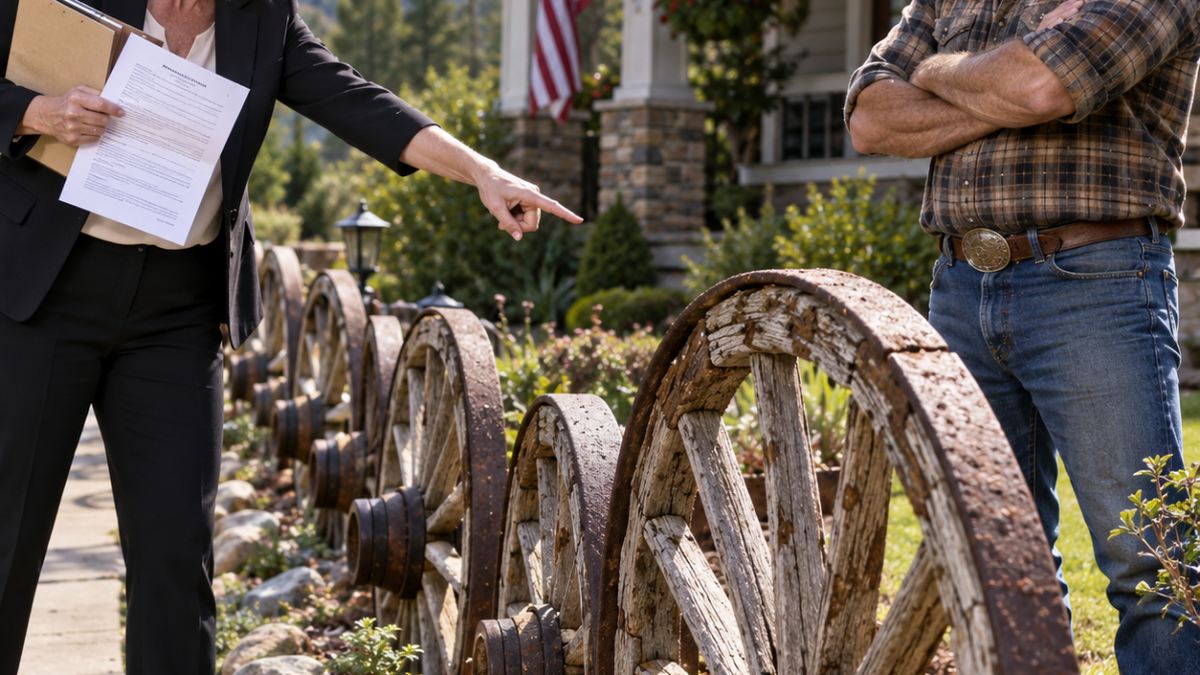
PART 2
That afternoon, I carried the Oak Ridge Meadows HOA binder into my office, cleared everything off my desk, brewed a full pot of coffee, and started reading.
Not skimming.
Reading.
There is a difference.
Most homeowners treat HOA documents the way people treat software agreements. They glance at a few headings, assume the rest is standard language, and sign whatever they need to sign so they can get on with their lives.
I had done essentially the same thing when I bought the property.
That ended that day.
The binder contained the declaration, covenants, conditions and restrictions, architectural standards, enforcement procedures, election procedures, financial policies, committee rules, landscaping guidelines, and several years of amendments.
It was tedious.
Dense.
Repetitive.
Occasionally contradictory.
In other words, it reminded me of Army regulations.
I felt right at home.
For six hours, I highlighted paragraphs, added tabs, made notes, and built a timeline.
Karen had quoted Article Seven, Section Four correctly.
Outdoor decorative structures did require prior approval.
But buried in Article Four was language requiring the association to preserve, “where applicable, the original architectural and historical character of the community.”
I read those words three times.
Historical character.
Interesting.
I turned back to Article Seven.
There was no definition of “decorative structure.”
No definition of “historical artifact.”
No rule specifically prohibiting preserved agricultural or pioneer artifacts.
More importantly, there was an appeals process.
The board could levy a fine, but the homeowner had a right to challenge that fine and request a hearing.
There were notice requirements.
Documentation requirements.
Voting requirements.
Conflict-of-interest provisions.
Rules regarding access to HOA records.
And, most interestingly, a procedure allowing homeowners to recall board members by special vote if enough residents demanded a meeting.
I leaned back in my chair.
My anger had cooled.
That was useful.
Anger can make you fast.
Calm makes you dangerous.
The next morning, the certified letter arrived.
Fifty-dollar fine.
Continued violation.
Photographic documentation attached.
The photograph showed my garden from the street.
Somebody had stood there and taken pictures of my house.
I stared at the image for a moment.
Then I opened a new binder.
A thick one.
On the spine I printed:
PROJECT KAREN.
I admit the name amused me.
The first page was her violation notice.
The second was my written response.
I kept my language dry and professional.
I disputed the characterization of the wheels as decorative junk, explained their provenance, cited Article Four’s historical-character provision, requested dismissal of the fine, and demanded a formal hearing if the board intended to continue enforcement.
I included copies of family records, an 1888 photograph showing the wagon after the McCalls had settled the property, and two pages from Elias McCall’s journal.
Then I sent everything certified mail.
Return receipt requested.
Karen answered three days later.
Not privately.
She sent a community-wide email.
The subject line read:
MAINTAINING THE STANDARDS WE ALL AGREED TO.
She never mentioned my name.
She didn’t need to.
Everyone had seen the wagon wheels.
The email described “a recent resident” who had installed “unapproved exterior materials” and was attempting to avoid established rules by claiming personal sentimental significance.
Personal sentimental significance.
That phrase bothered me more than it should have.
She reduced nearly a century and a half of family history to sentimentality.
Then she reminded everyone that fines would accumulate until violations were corrected.
I printed the email.
Placed it in Project Karen.
And wrote one word on a yellow sticky note.
PUBLIC.
That mattered.
She wasn’t simply enforcing a rule.
She was building a narrative.
She wanted the neighborhood to see me as difficult before anyone heard my side.
That meant this fight was bigger than the wheels.
So I started walking.
Every evening around six, I clipped a leash onto Duke, my golden retriever, and took the long route through Oak Ridge Meadows.
Duke was a better intelligence officer than half the people I had worked with overseas.
Nobody is suspicious of a man walking a golden retriever.
The first person who opened my eyes was Dave Reynolds.
He lived three streets away and had a garage full of woodworking equipment.
I stopped because Duke wanted to sniff his mailbox.
Dave laughed.
“Your dog likes bills?”
“He has expensive taste.”
That started the conversation.
Ten minutes later we were talking about home renovations.
Then paint.
Then HOA rules.
His expression changed.
“You’re the wagon wheel guy.”
“That’s apparently my official title.”
He glanced toward the street before answering.
“Karen’s after you?”
“She seems enthusiastic.”
Dave gave a humorless laugh.
“Yeah. She gets that way.”
He pointed at his front door.
It was beige.
Not normal beige.
The kind of beige that looked as though somebody had mixed oatmeal with regret.
“You like that color?” he asked.
“I’m trying not to insult your home.”
“That means no.”
“No.”
“Good. I hate it too.”
He told me the door had originally been blue.
Then a lighter blue.
Then another blue.
Karen rejected all three shades.
The final letter threatened fines if he didn’t use an approved color.
“So I gave up,” he said. “Painted it that.”
He stared at the beige door.
“You know what bothers me? It wasn’t really the color. It was that she needed me to give in.”
That sentence stayed with me.
Two nights later, Duke and I met Mrs. Gable.
She was seventy-eight and lived alone in one of the oldest houses in the development.
She had a spectacular rose garden and a tiny wooden birdhouse near the front porch.
At least I thought it was a birdhouse until I noticed how new it looked.
I complimented it.
Her face changed.
“My husband built the first one.”
“First one?”
She hesitated.
Then pointed toward her garage.
“Henry made it when our granddaughter was born. Hand-painted it. Little blue roof. Crooked chimney. Wrens nested in it every spring for thirteen years.”
“What happened?”
Mrs. Gable lowered her voice.
“Mrs. Miller said it wasn’t approved.”
I felt my jaw tighten.
“Did she make you remove it?”
“She sent three notices after Henry died.”
Her eyes became shiny.
“I couldn’t look at those letters without hearing his voice. He built that thing in the garage. Cussed every time he cut the roof wrong.”
She smiled briefly.
Then the smile disappeared.
“Karen said rules were rules.”
I looked toward the new birdhouse.
“So your grandson made this one?”
“From the HOA plans.”
“Do the wrens like it?”
She stared at it.
“They don’t seem to.”
I didn’t know why that hit me so hard.
Maybe because grief is stored in strange objects.
A birdhouse.
A wagon wheel.
A flag.
A doorway.
Things that look insignificant until you understand what they mean to the person who owns them.
Before I left, Mrs. Gable touched my sleeve.
“Your wheels are beautiful, Mr. McCall.”
“Jack.”
“Jack.”
She glanced down the street nervously.
“Just be careful.”
“With Karen?”
“She doesn’t like losing.”
Neither did I.
The fines came every day.
Fifty dollars.
One hundred.
One hundred fifty.
Three hundred.
Five hundred.
I paid none of them.
Instead I appealed every single notice.
Every envelope got stamped, copied, logged, and added to Project Karen.
The binder grew.
So did Karen’s irritation.
Her responses became shorter.
Finally, after my fourth appeal, she sent a single sentence:
The Architectural Review Committee has considered your objection and determined that the violation remains valid.
That was it.
No response to Article Four.
No discussion of historical significance.
No explanation.
I smiled when I read it.
Arrogance makes people careless.
Careless people create evidence.
I placed her letter behind a divider marked ARBITRARY ENFORCEMENT.
Then I found Mark Jackson.
Mark was organizing tools in his garage when I introduced myself.
He was maybe forty-eight, broad-shouldered, with the posture of someone who had spent time around uniforms even though he wasn’t wearing one.
He recognized me immediately.
“You’re McCall.”
“That depends who’s asking.”
He laughed.
“The wagon wheel guy.”
“There it is again.”
He wiped his hand and shook mine.
“Mark Jackson.”
I noticed an empty metal bracket mounted beside his driveway.
“You used to have something there?”
His expression turned cold.
“Flagpole.”
I already knew part of the story.
I asked anyway.
Mark stared at the empty bracket for several seconds before answering.
“My son Kyle is a Marine.”
That sentence contained enough pride to fill the garage.
“He was getting ready to deploy. Sarah—my wife—and I put up a proper flagpole. Twenty-two feet. Big flag. Nothing crazy.”
“What happened?”
“Karen happened.”
He leaned against his workbench.
“She showed up with a tape measure.”
I almost laughed.
He didn’t.
“She measured the pole. Said the maximum height was twenty feet.”
“When had that rule been adopted?”
“A week earlier.”
“Notice?”
“Technically.”
That word told me everything.
“A PDF attached to an email nobody read.”
Mark nodded.
“She gave us forty-eight hours. We refused.”
“And?”
“One hundred dollars a day.”
I whistled softly.
“Then their lawyer sent a lien warning.”
His voice changed as he said it.
Not angry anymore.
Ashamed.
“My wife was already falling apart because Kyle was leaving. Then every morning she’d open the mailbox wondering if there was another threat. Finally she said, ‘Mark, I can’t do this anymore.’”
He looked toward the empty bracket.
“So I took it down.”
Neither of us spoke for a moment.
Then he said something quietly.
“Worst part was Kyle noticed.”
I looked at him.
“We were video calling. He asked where the flag went.”
Mark swallowed.
“I told him the HOA made us remove it.”
He laughed once, bitterly.
“My kid was packing equipment to go halfway around the world and I couldn’t keep a flagpole in my own yard.”
I opened the back of my truck.
“Want to see something?”
I carried Project Karen into his garage and dropped it onto the workbench.
The binder landed with a heavy thud.
Mark stared at it.
“What the hell is that?”
“Two weeks of Karen making mistakes.”
I walked him through everything.
The wheels.
The historical clause.
The notices.
The public email.
The appeals.
The one-sentence denials.
The stories from other homeowners.
By the time I finished, something had changed in his face.
“What are you trying to do?” he asked.
“At first?”
I tapped the photo of the wheels.
“Save those.”
“And now?”
“Find out why everybody here is afraid of one woman with a clipboard.”
Mark stared at me.
“You think there’s more?”
“I think power without oversight usually leaves fingerprints.”
He smiled slowly.
“What do you need?”
“Help.”
“With what?”
“Talking to people.”
His smile widened.
“You picked the right guy.”
That afternoon our little rebellion doubled in size.
While Mark talked to homeowners, I exercised another right buried inside the governing documents.
I requested records.
All of them.
Five years of financial statements.
Vendor payments.
Legal expenses.
Architectural decisions.
Board meeting minutes.
Committee minutes.
Contracts.
Karen did exactly what I expected.
She buried me.
Two weeks later, three large cardboard boxes appeared on my porch.
Thousands of pages.
Some scanned crooked.
Some barely readable.
Receipts mixed with minutes.
Vendor invoices filed in random months.
Documents that should have been digital printed and rescanned until the text looked like it had survived a flood.
It was supposed to overwhelm me.
Instead, I carried the boxes into my office.
Made coffee.
And smiled.
I had spent part of my career coordinating engineering projects where one missing signature could delay millions of dollars of equipment.
Paperwork did not scare me.
Bad paperwork interested me.
Three nights later, I found the first serious problem.
Karen’s friends received different treatment than everyone else.
Carol, the HOA secretary, had a backyard shed that exceeded the permitted height.
No violation.
Janice, another board member, had a privacy fence above the approved limit.
No violation.
Karen’s next-door neighbor kept a fishing boat in his driveway for months.
No violation.
Meanwhile, Dave had been threatened over paint.
Mrs. Gable over a birdhouse.
Mark over a flagpole.
Me over wagon wheels.
I made a chart.
Name.
Violation.
Enforcement.
Board connection.
The pattern was ugly.
Then I began studying the money.
That was when I saw Prestige Landscape Solutions.
The name appeared again and again.
$2,400.
$1,750.
$3,900.
$2,100.
The descriptions were vague.
Violation remediation.
Property correction.
Landscape compliance.
No addresses.
No photographs.
No work orders.
No homeowner signatures.
I totaled the invoices.
More than eighty thousand dollars over roughly three years.
I searched the company registration.
Prestige Landscape Solutions existed.
Technically.
The address was a post office box.
The registered agent was Gerald Finney.
The name meant nothing to me.
So I kept looking.
Twenty minutes later, I found a public photograph from a family barbecue.
Karen stood beside a heavyset man holding a beer.
Her caption said:
Great weekend with my favorite brother-in-law Jerry!
Jerry.
Gerald Finney.
I stared at the screen.
Then looked at the invoices spread across my desk.
Then back at the photograph.
“Well,” I whispered.
Duke lifted his head from the floor.
“We may have found something.”
I called Mark.
He arrived twelve minutes later.
I had the invoices arranged across the dining room table.
At the center sat a printout of Gerald Finney’s corporate registration.
Beside it sat the photograph.
Mark looked down.
Then up at me.
“No.”
“Yep.”
“No.”
“Yep.”
He grabbed the corporate record.
“Brother-in-law?”
“According to her own Facebook page.”
He flipped through the invoices.
“How much?”
“Eighty thousand and change.”
His face reddened.
“She made me take down my son’s flag while she was paying her family with our money?”
“Possibly.”
“Possibly?”
“We have evidence of the payments and the relationship. We don’t yet have proof the work wasn’t done.”
Mark paced away from the table.
“She’s stealing.”
“Maybe.”
“Jack.”
“I know what it looks like.”
“Then why are you being so calm?”
“Because accusations are loud. Evidence lasts longer.”
He stopped pacing.
“What now?”
“Now we stop treating this like a fight over my flower garden.”
I pointed at the binder.
“We build a case she can’t explain away.”
The following week, I contacted a veterans’ legal-aid organization.
That was how I met Sarah Jenkins.
Sarah was younger than I expected, maybe mid-thirties, with dark hair tied back, rolled sleeves, and the kind of eyes that made people stop exaggerating.
She spent nearly two hours reviewing Project Karen.
She barely spoke while reading.
Occasionally she made a note.
Once she raised an eyebrow.
When she reached the Prestige invoices, she stopped.
“Who is Gerald Finney?”
“Karen’s brother-in-law.”
Sarah looked at me.
“You can prove that?”
I slid the photograph across the desk.
She stared at it.
Then at Mark.
Then at me.
“This is no longer about wagon wheels.”
“That’s what I told him.”
She continued reading.
When she finished, she closed the binder.
“First, don’t post any of this online.”
Mark looked disappointed.
“Why?”
“Because you want answers before she knows which questions you’re asking. Second, don’t accuse her publicly of criminal conduct yet. We document. We verify. We proceed by the association’s rules.”
I liked her immediately.
Sarah flipped through the bylaws.
“You highlighted the recall provision.”
“Yes.”
“Twenty-five percent of members can force a special meeting.”
“We think we can get forty.”
“Get fifty.”
Mark smiled.
Sarah continued.
“And these wagon wheels. You have provenance?”
I showed her everything.
Family journals.
Old photographs.
Land records.
Preservation invoices.
She studied the 1888 image.
“Do you know what would make Karen’s enforcement position nearly impossible to defend?”
“What?”
“Formal historical designation.”
The county historical society answered my call the following morning.
Dr. Alister Finch arrived at my house two days later.
He was a thin man in a tweed jacket despite the warm weather, and he nearly ran from his car when he saw the wheels.
“Please tell me you haven’t refinished them.”
“No.”
“Excellent.”
He crouched beside the nearest one.
For almost two hours, he examined joinery, tool marks, ironwork, preservation records, family photographs, and Elias’s journal.
At one point he became so quiet that I thought something was wrong.
Then he stood.
“Mr. McCall.”
“Jack.”
“Jack, do you understand what you have?”
“Family wagon wheels.”
He shook his head.
“No. You have documented artifacts tied directly to one of the settlement parties that established this valley.”
He touched the rim carefully.
“The McCall wagon train appears in county histories. We have journals. We have secondhand accounts. We have route records. But almost no surviving material evidence.”
He looked toward my house.
“And you found these on the original homestead?”
“Under the barn.”
“Good Lord.”
He laughed like a child.
“This is extraordinary.”
For the first time since Karen’s violation letter arrived, the wheels no longer felt like something I had to defend.
They felt vindicated.
The historical society moved quickly.
They authenticated the wheels.
Documented their provenance.
Recorded their location.
And recommended formal recognition as protected local historical artifacts.
Dr. Finch also prepared a sworn statement explaining their significance.
When the final paperwork arrived, I carried it into my garden.
I stood beside the wheels alone.
Ran my hand across one worn spoke.
And thought of my grandfather.
“I found it,” I whispered.
The wind moved through the roses.
For one ridiculous second, I imagined he heard me.
Sarah sent the HOA a formal legal notice the next morning.
It explained that the wagon wheels had now been formally recognized for their historical significance and warned against unauthorized removal or damage.
Karen responded by increasing the pressure.
The fines passed two thousand dollars.
Then three.
The notices became more aggressive.
LIEN ACTION MAY BE PURSUED.
LEGAL EXPENSES MAY BE ASSESSED TO OWNER.
I filed every one.
Karen thought she was frightening me.
What she was actually doing was creating exhibits.
Meanwhile, Mark and I began talking to homeowners.
Quietly.
Carefully.
Dave joined first.
When Mark showed him the Prestige invoices and explained the family connection, Dave stared at the papers for a long time.
“She made me buy nine cans of paint.”
“I remember,” Mark said.
“She said my choices hurt everybody’s property values.”
“I remember.”
“And her brother-in-law got eighty grand?”
“That’s what the records show.”
Dave’s expression hardened.
“Where do I sign?”
Mrs. Gable was different.
We visited her on a Sunday afternoon and brought an apple pie.
She made coffee.
We sat at the same kitchen table where she said Henry used to work crossword puzzles.
I didn’t show her the ugly financial records first.
I showed her the historical society letter.
She read slowly.
When she reached the part recognizing the McCall wagon wheels, she touched the page with one finger.
“They’re really that old?”
“1883.”
“My father was born in 1919,” she said softly. “He used to tell me stories about the wagon families.”
Then I told her why we were there.
“We’re forcing a special meeting.”
Her eyes widened.
“You can do that?”
“Yes.”
“And she can’t stop it?”
“Not if enough homeowners sign.”
She looked frightened.
That angered me more than anything Karen had done to me personally.
This woman was afraid to sign a petition in her own neighborhood.
I leaned forward.
“Mrs. Gable, nobody is asking you to fight alone.”
She looked down at her hands.
“Henry hated bullies.”
Mark smiled.
“So do we.”
She looked toward the window.
The replacement birdhouse stood outside.
Perfect.
Approved.
Lifeless.
Then she reached for the pen.
Her signature shook slightly.
Afterward, she stared at it.
“I hope I’m not making trouble.”
“No,” I said.
“You’re helping end it.”
Within one week, we had forty percent of the neighborhood.
Within ten days, fifty-three.
I drafted the demand for a special meeting and delivered it to the board by certified mail.
Karen received it on a Tuesday.
Her first community-wide email arrived Wednesday morning.
She described us as “a small faction attempting to destabilize community governance.”
Mark called me laughing.
“Small faction?”
“Apparently fifty-three percent is the new definition.”
Her second email warned that unnecessary legal expenses related to the meeting might result in increased assessments.
That one made people furious.
Her third accused unnamed residents of spreading false financial rumors.
Interesting.
We had not publicly mentioned the financial records.
That told Sarah something.
“She’s nervous,” Sarah said.
“Can we use that?”
“Not yet.”
A week before the meeting, Mark noticed a gray panel van parked across from my house.
It stayed for two hours.
The next day it returned.
On the third day, I walked toward it.
The driver left.
Mark got the plate number.
Through legitimate public records and a friend familiar with local businesses, we traced the vehicle to a private investigative firm that had previously worked with the HOA’s law firm.
Sarah’s reaction was immediate.
“Document it. Do not confront them.”
I laughed.
“What exactly does she think she’s going to find?”
“People like Karen assume everyone has secrets because they do.”
That line stayed with me.
Then, three days before the special meeting, Karen made the mistake that destroyed whatever remained of her credibility.
I was buying groceries when my phone vibrated.
FRONT YARD MOTION DETECTED.
I opened the security application.
A tow truck was backing onto my lawn.
For a moment my brain refused to process what I was seeing.
Then Karen appeared on-screen.
Purple tracksuit.
White visor.
Clipboard.
She was pointing toward the wagon wheels.
The driver climbed down from the truck.
Through the camera microphone, I heard Karen say,
“Just attach the chain and pull them out.”
The driver stared at the garden.
“All four?”
“Yes.”
“They look pretty old.”
“They’re junk.”
My hands went cold.
I abandoned the grocery cart where it stood.
Called 911.
Then Mark.
“She’s at my house.”
“What?”
“Tow truck.”
Silence.
Then:
“You’re kidding.”
“No.”
“Is she touching the wheels?”
“Not yet.”
“I’m calling everybody.”
“Mark—”
“What?”
“Tell them not to interfere physically.”
There was a pause.
“You know me too well.”
I was halfway home when my phone showed the security feed again.
Neighbors were arriving.
Dave.
Mark.
Sarah Jackson.
Then Mrs. Gable.
Of all people, Mrs. Gable walked straight onto my front lawn.
The tow truck driver was unrolling a chain.
She stepped between him and the wheels.
I nearly drove through a stop sign.
On the camera I heard her say,
“Young man, do you know what those are?”
The driver looked uncomfortable.
“Ma’am, please move.”
“They came here on a wagon train.”
Karen snapped,
“Margaret, go home.”
Mrs. Gable turned toward her.
“Don’t you tell me to go home.”
I actually shouted inside my truck.
“YES!”
By the time I arrived, nearly twenty neighbors had gathered.
The tow truck driver had stopped working.
Karen was red-faced.
Mark stood several feet from her with his phone recording.
“You have no authority to be on this property,” he said.
“I absolutely do.”
“You absolutely don’t.”
“This association has enforcement rights!”
“Not theft rights.”
Karen pointed at him.
“You are interfering with an authorized contractor.”
The driver raised both hands.
“Lady, I’m not authorized for anything anymore. I’m waiting for the cops.”
Karen spun toward him.
“I hired you.”
“You told me we were removing abandoned debris.”
“It is debris!”
“No,” Mrs. Gable said.
Everyone looked at her.
The old woman pointed toward the wheels.
“That is history.”
The street went quiet.
Then two sheriff’s cruisers arrived.
Deputy Miller stepped out of the first car.
He knew Karen.
That became obvious immediately.
He looked at the tow truck.
At the crowd.
At Karen.
Then at me.
“Jack.”
“Deputy.”
He exhaled.
“What happened?”
Karen charged toward him.
“I can explain.”
“I’d like him to first.”
Her face froze.
I handed him a folder.
“Those wheels are mine. They’re on my property. They have recognized historical status. The HOA received written legal notice not to remove or damage them. Karen hired that truck to come onto my property and take them.”
Deputy Miller read the documents.
Slowly.
Karen interrupted twice.
He raised one hand without looking at her.
She stopped.
That may have been the first time in years someone had made Karen Miller stop talking.
Finally he looked at the tow truck driver.
“Did you move anything?”
“No sir.”
“Attach equipment?”
“No.”
“Damage anything?”
“Grass maybe.”
He pointed toward the tire marks.
“I’ll pay for that.”
The deputy nodded.
Then he faced Karen.
“Mrs. Miller, did you receive notice that these items were disputed and historically protected?”
“This association has authority to remedy violations.”
“That wasn’t my question.”
She looked around.
The cameras bothered her.
Mark’s phone.
Dave’s phone.
My security cameras.
And, pulling up at the end of the street, a local news van.
Someone had called Channel Eight.
Karen finally answered.
“I received some letter.”
Deputy Miller folded the paperwork.
“Then you need to leave.”
Her mouth opened.
“Excuse me?”
“You are on private property after receiving notice not to remove these items. You are not touching them. You are not directing anybody else to touch them. Send the truck away.”
“I am the HOA president.”
“Today, you’re a person standing on Mr. McCall’s lawn after he’s told you to leave.”
For the first time since I had met her, Karen looked small.
Not humble.
Not remorseful.
Just shocked that authority existed above her.
She pointed toward me.
“He owes the association thousands of dollars.”
“That’s a civil issue.”
“He is in violation.”
“Also a civil issue.”
“He—”
“Mrs. Miller.”
Deputy Miller’s voice hardened.
“Leave.”
She stared at him.
Then me.
Then the crowd.
Her eyes stopped on Mrs. Gable.
“You should be ashamed of yourself.”
Mrs. Gable straightened.
“No.”
Karen blinked.
Mrs. Gable’s voice trembled, but she continued.
“I’ve spent five years being ashamed because you made me feel foolish for wanting to keep something my husband built.”
Her eyes filled with tears.
“You should be ashamed.”
Nobody moved.
Karen had no answer.
She stormed toward her golf cart, climbed in, and drove away.
The tow truck driver climbed into his cab.
Before leaving, he walked over to me.
“Sorry, man.”
“You didn’t know.”
He looked at the wheels.
“My great-grandfather’s family came through this valley too.”
He shook his head.
“No way I was dragging those things anywhere.”
He drove off.
Then people began applauding.
I hated being applauded.
Always had.
But this didn’t feel like applause for me.
It felt like relief.
Mrs. Gable was crying.
Mark hugged her.
Dave wiped at his eyes and pretended he had dust in them.
The Channel Eight reporter approached me.
“Mr. McCall, can we ask what happened?”
I looked at the camera.
I could have destroyed Karen in that moment.
I could have mentioned the invoices.
The financial records.
The brother-in-law.
The selective enforcement.
Instead I said,
“My family brought those wheels into this valley in 1883. I’m trying to preserve them. I’d like this matter handled lawfully and respectfully.”
That was all.
The reporter looked almost disappointed.
Dr. Finch was less restrained.
When Channel Eight called him, he came racing over from the historical society and gave them ten minutes of passionate commentary about pioneer settlement, cultural artifacts, preservation law, and what he called “an astonishing disregard for local heritage.”
The story aired that night.
I watched from my living room with Mark.
The report opened with Karen standing beside the tow truck.
Then Mrs. Gable.
Then the deputy.
Then me.
Then Dr. Finch.
The final shot showed Karen driving away in her golf cart.
Mark stared at the television.
“Oh, that is brutal.”
“She did it to herself.”
“Tomorrow she’ll resign.”
“No.”
“You don’t think?”
I shook my head.
“People like Karen don’t resign when they lose control.”
“What do they do?”
“They try to regain it.”
The special meeting began forty-eight hours later.
Every chair in the clubhouse was occupied.
People stood along the walls.
More crowded into the foyer.
I had never seen that many residents at an HOA meeting.
Usually thirty people counted as extraordinary.
That night there were more than one hundred fifty.
The Channel Eight camera crew waited near the back.
Karen entered with Carol and Janice.
She wore a dark blazer.
Pearl necklace.
Perfect hair.
No clipboard.
She looked like someone walking into court.
When she saw the cameras, she stopped.
“You cannot film this meeting.”
Mark stood.
“Yes, they can.”
“This is a private association.”
Sarah Jenkins stepped forward.
“The homeowners have authorized documentation of the special meeting.”
Karen’s eyes narrowed when she recognized her.
“And who are you?”
“Counsel.”
That changed Karen’s expression.
Only slightly.
But I saw it.
She took her seat.
At seven o’clock she slammed the gavel.
“The special meeting of the Oak Ridge Meadows Homeowners Association will come to order.”
Nobody spoke.
Karen began with a prepared statement.
She called the meeting unfortunate.
Divisive.
Unnecessary.
She accused “certain homeowners” of manipulating legitimate disagreements in order to create conflict.
Then she dimmed the lights.
A PowerPoint presentation appeared.
The first image was my wagon wheels.
Huge.
Rusty.
Photographed from an angle that made them look terrible.
Karen stood beside the screen.
“This,” she said, “is what started the entire controversy.”
I almost smiled.
She still didn’t understand.
“This resident installed large, deteriorated agricultural equipment in his front yard without architectural approval.”
A murmur moved through the room.
She continued.
“Instead of simply following the same rules everyone else follows, he launched a campaign against your elected board.”
Next slide.
A list of my fines.
$4,150.
The number appeared in red.
Karen pointed at it.
“More than four thousand dollars in unpaid assessments and fines.”
She turned toward me.
“Mr. McCall believes he should receive special treatment.”
I felt Mark shifting beside me.
I touched his arm.
Wait.
Karen spoke for nearly twelve minutes.
Rules.
Standards.
Property values.
Disruptive behavior.
Harassment of board members.
Financial costs.
Finally she concluded.
“We cannot allow intimidation to replace responsible governance.”
She sat down.
The room remained quiet.
Then she said,
“The floor is open.”
I stood.
Project Karen was under my arm.
By then the binder was almost six inches thick.
I walked toward the microphone.
Karen watched me.
Her mouth carried the faintest smile.
She expected a speech about wagon wheels.
I placed the binder on the podium.
The sound echoed through the clubhouse.
“My name is Jack McCall.”
Someone laughed softly.
Most people knew exactly who I was by then.
“And yes, those are my wagon wheels.”
More laughter.
I looked toward the screen.
“Karen is correct about one thing.”
Her smile grew.
“This started with four wagon wheels.”
The smile remained.
“But tonight isn’t about them.”
The smile disappeared.
I opened the binder.
“My first violation notice cited Article Seven, Section Four.”
I projected the rule onto the screen.
“Outdoor ornamentation.”
Then I showed Article Four.
“Here is the rule the board repeatedly refused to address.”
I highlighted the phrase.
HISTORICAL CHARACTER.
“President Miller received four written appeals citing this language.”
Next slide.
Her one-sentence denial.
“I asked the committee to explain why the historical-character provision did not apply.”
I looked toward Karen.
“They never did.”
She reached for her microphone.
“This is procedural nonsense—”
Sarah stood.
“Please allow the homeowner his allotted time.”
Karen glared.
I continued.
“For anyone still wondering whether the wheels have historical significance…”
Next slide.
The county documentation appeared.
“…the county historical society has formally authenticated them as surviving components of the McCall Conestoga wagon that reached this valley in 1883.”
The room shifted.
Not loudly.
But emotionally.
People leaned forward.
“The wagon was dismantled here. The wheels remained on the original homestead. They are part of this valley’s settlement history.”
I paused.
“The so-called junk has been here longer than this neighborhood.”
Laughter erupted.
Karen grabbed the microphone.
“That does not exempt him from architectural—”
“Karen.”
It was Mrs. Gable.
Not loud.
But everybody heard.
“Let him finish.”
Karen stared at her.
Mrs. Gable stared back.
The room applauded.
I waited until it stopped.
“However, as I said, this isn’t about my wheels anymore.”
I changed the slide.
A photograph of Dave’s blue door appeared.
“Dave.”
He stood.
I stepped aside.
He told his story.
No dramatics.
Just facts.
Three rejected shades of blue.
Repeated threats.
Multiple repaintings.
Finally surrender.
Then I displayed photographs of board members’ properties.
Carol’s oversized shed.
Janice’s fence.
A boat in the driveway of Karen’s friend.
“No violations were issued for these.”
Karen’s voice came from the front table.
“You don’t know that.”
I held up records.
“Actually, according to the five years of enforcement records your office provided, I do.”
People murmured.
Next came Mark.
He walked to the microphone.
“My son’s name is Kyle Jackson.”
He swallowed.
“He is a United States Marine.”
Karen looked down.
Mark told the story of the flagpole.
The rule change.
The fines.
The legal threat.
Sarah sitting at the kitchen table crying while Kyle prepared to deploy.
Then Mark said,
“My son asked me why his flag was gone.”
His voice broke.
The entire clubhouse became silent.
“I had to tell him the people running his neighborhood decided it violated standards.”
He stared at Karen.
“You called that enforcement.”
His hands tightened around the microphone.
“I called it shameful.”
When Mark returned to his seat, Sarah Jackson took his hand.
I waited.
Let the silence work.
Then I returned to the microphone.
“Now we need to discuss money.”
Karen’s head snapped up.
There.
That was the moment she understood.
Not everything.
But enough.
I projected the budget.
“Our HOA collects substantial dues every year. Almost thirty percent of recent expenditures have gone toward legal and violation-related costs.”
People began whispering.
“For a community of approximately two hundred homes, that seemed unusually high.”
I displayed several invoices.
“So I reviewed the records.”
Karen stood.
“These documents are being presented without context.”
“They’re your documents.”
“They’re confidential.”
“They were lawfully provided to an association member under the record-inspection provisions of the bylaws.”
Sarah spoke without standing.
“He is correct.”
Karen sat down.
I changed the slide.
PRESTIGE LANDSCAPE SOLUTIONS.
“Over three years, this vendor received more than eighty thousand dollars.”
Another slide.
Invoice after invoice.
“Descriptions include violation remediation, landscape correction, exterior compliance.”
Next slide.
“But many contain no addresses, no work orders, no homeowner authorization, and no supporting photographs.”
Dave called out,
“Who owns it?”
I looked at him.
“Excellent question.”
The corporate registration appeared.
GERALD FINNEY.
I gave the room several seconds.
Then changed the slide.
A photograph filled the screen.
Karen smiling at a family barbecue.
Her arm around Gerald.
The caption beneath it.
MY WONDERFUL BROTHER-IN-LAW JERRY.
For half a second, nothing happened.
Then the clubhouse exploded.
“What?”
“You’ve got to be kidding!”
“Eighty thousand?”
“Is that her brother-in-law?”
“Thief!”
Karen slammed the gavel.
“ORDER!”
Nobody listened.
“ORDER!”
Carol was whispering frantically into her ear.
Janice looked physically ill.
Karen stood.
“This is malicious!”
I remained silent.
“It is a coincidence!”
I finally spoke.
“What part is coincidental?”
She stared at me.
“That my family member owns a legitimate company.”
“I didn’t say the company wasn’t legitimate.”
“You are implying criminal conduct!”
“No.”
I closed the binder halfway.
“I’m presenting financial records.”
Sarah stood.
“And because the records raise substantial conflict-of-interest and fiduciary concerns, they have been forwarded to appropriate legal authorities for review.”
The room went completely silent.
Karen looked at Sarah.
“What authorities?”
Sarah did not smile.
“The district attorney’s office has been notified of the documented transactions.”
Carol whispered,
“Oh my God.”
It carried through her microphone.
That was almost funny.
Karen’s face lost all color.
“You had no right.”
Sarah’s voice remained flat.
“Association funds belong to the association.”
Karen pointed toward me.
“This is revenge!”
I looked at her.
For weeks I had imagined that moment.
Imagined yelling.
Imagined telling her she had picked the wrong person.
Imagined enjoying her panic.
But standing there, I didn’t feel triumphant.
I felt tired.
So I told her the truth.
“No.”
She blinked.
“This was never supposed to be revenge.”
I glanced toward the screen where her family connection remained visible.
“You could have left my wagon wheels alone.”
A few people laughed.
I didn’t.
“You could have listened when I appealed.”
I looked toward Mrs. Gable.
“You could have let a widow keep the birdhouse her husband built.”
Then toward Mark.
“You could have let a father honor his son.”
Then Dave.
“You could have let a man paint his own front door blue.”
Finally I looked at the room.
“But every time somebody asked for a little dignity, you answered with another threat.”
Karen’s mouth opened.
Nothing came out.
“That’s why we’re here.”
Mark rose.
“I move for an immediate vote of no confidence in President Karen Miller and the current board.”
Dave stood.
“Second.”
Chaos erupted again.
Karen pounded the gavel.
“This is not on the agenda!”
Sarah held up the bylaws.
“The special meeting was called specifically to consider removal of the board.”
“You don’t control this meeting!”
“No,” Sarah replied.
“The members do.”
That sentence finished what the evidence had started.
One homeowner after another stood.
A young mother.
A retired teacher.
A contractor.
A nurse.
People who had spent years looking down when Karen’s golf cart passed their houses.
Now they looked straight at her.
The vote began.
Hands rose.
Row after row.
Nearly everyone.
Against the wall.
In the foyer.
Even two homeowners I knew had previously defended Karen raised their hands.
Karen stared.
Carol started crying.
Janice buried her face in both hands.
The result was overwhelming.
The entire board was removed.
Effective immediately.
For several seconds Karen remained seated.
Then she stood so suddenly her chair crashed backward.
She pointed at me.
“You.”
The room became quiet.
“You did this.”
I didn’t answer.
“You moved into this neighborhood and destroyed everything.”
Still nothing.
“All because of rusty junk!”
That finally got a reaction.
Not from me.
From Mrs. Gable.
“They’re wagon wheels, Karen.”
Laughter spread through the room.
Karen’s face twisted.
“I built this community.”
“No,” Dave said.
“You bullied it.”
“You people begged me to keep standards!”
Mark stepped forward.
“We asked for standards.”
He pointed toward the financial slides.
“Not a kingdom.”
Karen looked around.
Nobody defended her.
That was the moment her power disappeared.
Not when we voted.
Not when the district attorney became involved.
Right then.
When she looked into a room full of people who used to fear her and realized they no longer did.
She grabbed her purse.
Carol and Janice followed.
At the door, Karen turned once more.
“I hope property values collapse.”
Dave called after her,
“I’m painting my door blue tomorrow!”
The room erupted.
Even I laughed.
Thirty days later, his door was cobalt blue.
Bright enough to see from the end of the street.
The new temporary board’s first action was to freeze all violation enforcement until a review could be completed.
The second was to cancel every unpaid fine issued under Karen’s contested enforcement campaign, including the four-thousand-dollar mountain of paper attached to my wagon wheels.
The third was to commission a forensic audit.
That audit changed everything.
Prestige Landscape Solutions was only the beginning.
Investigators found questionable credit-card purchases.
Fuel charges with no association business attached.
Grocery bills.
Restaurant expenses.
Personal legal work billed through the HOA attorney.
And, most memorably, a spa bill that had somehow been categorized as a board-development retreat.
Mark called me when he heard that one.
“A spa retreat.”
“I heard.”
“She fined my flagpole and paid for a massage.”
“Apparently tyranny creates shoulder tension.”
He laughed so hard he had to hang up.
The final amount of disputed and misused funds approached one hundred fifty thousand dollars.
The district attorney’s office opened a formal investigation.
Gerald Finney was questioned.
So were Karen, Carol, and Janice.
The criminal process moved more slowly than neighborhood gossip, but eventually charges followed.
Karen’s fall was spectacular precisely because she had spent so long making herself visible.
For years she had signed everything.
Approved everything.
Directed everything.
Her name was on emails, authorizations, minutes, payment records, violation notices, contracts.
Power had made her careless.
She had built the case against herself one signature at a time.
A month after the special meeting, Oak Ridge Meadows held a real election.
Mark ran reluctantly.
He won overwhelmingly.
Dave agreed to serve.
Mrs. Gable refused three times before finally agreeing to take a temporary community liaison position.
“You understand I don’t know anything about HOAs,” she told Mark.
“That makes you overqualified.”
She laughed.
The first open workshop on rule reform drew almost eighty homeowners.
People argued.
Politely.
Some wanted more restrictions.
Some wanted fewer.
A few still worried that relaxing aesthetic rules would create chaos.
That was fine.
Healthy communities disagree.
The difference was that now everyone was allowed to speak.
Article Seven, Section Four—the rule that started everything—was rewritten.
The new language emphasized safety, maintenance, nuisance prevention, and respect for neighborhood history.
Personal landscaping expression was explicitly allowed unless it created a genuine hazard.
Nobody mentioned wagon wheels.
They didn’t need to.
The historical society installed a bronze plaque beside mine.
I stood with Dr. Finch on the morning it went in.
The inscription read:
THE McCALL WHEELS — CIRCA 1883
SURVIVING WHEELS FROM THE CONESTOGA WAGON OF THE McCALL FAMILY, WHO SETTLED THIS VALLEY DURING THE WESTWARD MIGRATION.
A SYMBOL OF ENDURANCE, MEMORY, AND THE LONG JOURNEY HOME.
I read the final line twice.
Long journey home.
My grandfather would have liked that.
A few weeks later, Mrs. Gable came walking toward my house carrying a pie.
Duke saw her first.
He sprinted toward the gate.
“You spoil that dog,” she said.
“He earned it.”
“What did he do?”
“Emotional support during administrative warfare.”
She laughed.
Then handed me the pie.
“Apple.”
“Bribery?”
“Community diplomacy.”
We sat on the porch.
For a while we watched two children stop beside the plaque while their father read it aloud.
Then Mrs. Gable said,
“I put it back.”
“What?”
“Henry’s birdhouse.”
I turned toward her.
“The original?”
She nodded.
“Found it in the garage.”
Her eyes filled slightly.
“My grandson repaired the roof. We didn’t repaint it. Henry never could keep his lines straight.”
“Good.”
“The wrens came back.”
That nearly got me.
Of all the victories, that one hit hardest.
Not the cancelled fines.
Not Karen losing office.
Not the audit.
Not even the historical designation.
The birds came back.
A week later, Mark invited me over.
I knew why before I arrived.
A new flagpole stood beside his driveway.
Twenty feet.
Perfectly installed.
Compliant with current safety requirements.
But more importantly, standing proudly where the old one had been.
Kyle was home on leave.
I met him for the first time.
Young.
Straight-backed.
Quiet.
He shook my hand.
“My dad told me what happened.”
“Your dad did most of the work.”
Mark snorted.
“Liar.”
Kyle looked toward the flag.
“Thanks for helping him put it back.”
I studied the young Marine.
Then the pole.
Then Mark.
“No.”
I said it gently.
“Your dad put it back himself.”
Mark looked away quickly.
Sarah Jackson cried without bothering to hide it.
When the wind caught the flag, it opened above us.
Not oversized.
Not defiant.
Just there.
Where it belonged.
Months passed.
Oak Ridge Meadows changed.
Not dramatically at first.
Little things.
Basketball hoops appeared.
Planters became brighter.
A mailbox turned red.
Somebody painted shutters forest green.
Dave’s cobalt door became a neighborhood joke and then somehow became beloved.
People started sitting outside again.
Neighbors talked.
Children rode bicycles through the cul-de-sac.
The world did not collapse because everyone’s property stopped being identical.
Property values did not plummet.
Nobody’s home burst into flames because of a blue door.
The apocalypse Karen had predicted stubbornly refused to arrive.
Meanwhile, her criminal case worked its way through the system.
She eventually entered a conviction on financial misconduct charges related to the association funds and was ordered to make restitution.
She received probation and was barred from holding fiduciary positions.
Gerald faced consequences as well.
Carol and Janice avoided the worst criminal exposure but faced civil scrutiny for their conduct and left Oak Ridge Meadows not long afterward.
Karen sold her house.
The irony of that was not lost on anyone.
For five years she had justified nearly every act of cruelty with the phrase property values.
Then, in the end, she lost the property she had spent so much time using as an excuse to control everybody else.
I never celebrated that part.
People expected me to.
Mark wanted to throw what he called a “Karen Liberation Barbecue.”
I refused the name.
We held the barbecue anyway.
Mrs. Gable brought pie.
Dave wore a bright blue shirt matching his door.
Kyle helped grill burgers.
Dr. Finch bored half the neighborhood with an hour-long explanation of nineteenth-century wagon construction.
I loved every second of it.
Someone asked if I felt vindicated.
I thought about the question.
“Not really.”
Mark nearly dropped his beer.
“Not really?”
“No.”
“What more do you want? She lost the board. The fines vanished. The wheels became a landmark. She got prosecuted.”
“I didn’t say we lost.”
“Then what do you call it?”
I looked around.
Mrs. Gable was laughing with Sarah.
Children were playing near the clubhouse.
Dave was arguing with somebody about whether cobalt blue counted as a neutral.
“I call this better.”
That evening, after everyone left, I walked home with Duke.
The sun was dropping behind the hills.
When I reached my property, the wagon wheels stood exactly where I had placed them.
Nothing about them had changed.
The same worn spokes.
The same rust.
The same scars.
But they looked different to me.
For weeks I had seen them as something under threat.
Now I saw what they had always been.
Survivors.
They had rolled through mud.
Heat.
Storms.
Rock.
Prairie.
They had carried children who would become parents, grandparents, and eventually names in old family albums.
They had stopped on this soil in 1883.
They survived the dismantling of the wagon.
They survived decades in a barn.
They survived the barn collapsing.
They survived being nearly forgotten.
Then, somehow, they survived Karen Miller.
I sat in the garden with a beer.
Duke settled across my boots.
The bronze plaque caught the final light.
I thought about Elias.
I wondered what he would think of all this.
A homeowners association would probably require a long explanation.
A golf cart dictator even longer.
But the essential part would make sense.
Someone had tried to take something that belonged to the family.
So the family defended it.
Not with violence.
Not with threats.
With patience.
Records.
Neighbors.
And the truth.
My grandfather used to tell me that history disappears in two ways.
Sometimes it is destroyed.
More often, people simply stop caring enough to protect it.
That was why his deathbed request mattered so much.
Find it, Jack.
Don’t let our story turn to dust.
For years I thought he meant the land.
Then I thought he meant the wheels.
I had been wrong both times.
He meant memory.
The land mattered because of the people who had crossed it.
The wheels mattered because of the journey they represented.
Henry’s birdhouse mattered because his hands had built it.
Mark’s flag mattered because his son was serving beneath it.
Dave’s blue door mattered because it was his home.
These things look trivial from the outside.
That was Karen’s mistake.
She looked at objects and saw violations.
She never understood that people attach pieces of themselves to the things they build, preserve, paint, plant, hang, restore, and pass down.
When you attack those things without listening, sometimes you are attacking far more than wood, metal, paint, or cloth.
You are attacking memory.
Dignity.
Identity.
Home.
And eventually people stop surrendering.
A year after the whole thing began, Oak Ridge Meadows held its first annual neighborhood history day.
That wasn’t my idea.
Mrs. Gable proposed it.
Dr. Finch nearly cried from excitement.
Families set tables along the clubhouse lawn displaying old photographs, military medals, immigration papers, quilts, tools, family recipes, letters, and objects that meant something to them.
Not because they were valuable.
Because they carried stories.
Mark displayed a photograph of Kyle beside the restored flagpole.
Dave brought one of the rejected blue paint cans.
Everyone mocked him.
Mrs. Gable brought Henry’s original birdhouse.
A tiny handwritten sign sat beside it.
HENRY GABLE, BUILT 1998.
APPROVED BY THE WRENS.
That sign was the most popular exhibit of the day.
Near sunset, Dr. Finch asked me to say a few words beside the wheels.
I refused twice.
Mrs. Gable ignored me and handed me the microphone anyway.
I stood in front of maybe a hundred neighbors.
For a moment I didn’t know what to say.
Then I looked at the four wagon wheels.
“When these came across the plains in 1883, my great-great-grandfather didn’t know there would someday be houses here.”
People laughed.
“He definitely didn’t know there would be an architectural review committee.”
More laughter.
“But he knew what he wanted.”
I looked toward the neighborhood.
“A place where his family could belong.”
The laughter faded.
“I spent years thinking my promise to my grandfather was about buying this land back.”
I paused.
“Then I thought it was about preserving these wheels.”
Mrs. Gable watched me from the front row.
“But I think I understand it differently now.”
I looked at Mark.
Dave.
Sarah.
Kyle.
The children running near the clubhouse.
“A home isn’t preserved by making everything look the same.”
I rested one hand on the nearest wheel.
“It’s preserved when people care about what came before them while making room for the people who are here now.”
Nobody applauded immediately.
For a few seconds there was only evening wind moving through the trees.
Then Mrs. Gable started.
Others joined.
This time, I didn’t hate the applause.
Later that night, after the tables were folded and the neighbors went home, I remained beside the garden.
The wheels cast long shadows across the grass.
One hundred forty years earlier, Elias McCall had stood somewhere close to that exact spot after a journey most of us can barely imagine.
He had looked across an unknown valley and decided to stop.
This is home.
I finally understood the power of that sentence.
Home is not merely where your deed says you own land.
It is the place where your history is allowed to breathe.
Where neighbors defend one another.
Where an old woman can hang her husband’s crooked birdhouse without asking permission.
Where a father can look at a flag and think of his son.
Where a ridiculous cobalt-blue door can make somebody smile every morning.
Where four battered wagon wheels can sit among roses and remind everyone that the people who came before us endured far greater obstacles than bureaucrats with clipboards.
Karen had once threatened to haul those wheels away and bill me for the privilege.
Instead, they became a county-recognized landmark.
She fined me more than four thousand dollars on paper.
Every dollar disappeared.
She tried to portray me as the neighborhood problem.
Her own records exposed years of abuse.
She tried to frighten my neighbors into silence.
Her pressure finally gave them something to unite against.
She tried to preserve her power through control.
And lost it because people stopped being afraid.
That was the revenge.
Not humiliating her.
Not watching her leave the neighborhood.
Not seeing her name in court records.
The real revenge was watching everything she had tried to suppress come back stronger.
Henry’s birdhouse came back.
Mark’s flag came back.
Dave’s blue door came back.
The neighbors’ voices came back.
And the four old wheels never moved an inch.
Sometimes justice doesn’t look like someone getting destroyed.
Sometimes it looks like everything they tried to destroy surviving them.
I finished my beer and leaned back in the chair.
Duke slept against my boots.
The evening sky faded from orange to purple and finally to deep blue.
A breeze moved through Margaret McCall’s roses.
The flowers brushed softly against the wooden spokes.
For a moment the wheels looked almost ready to turn again.
But their journey was over.
They had crossed the plains.
They had survived generations.
They had carried my family toward a place none of them had ever seen.
And after one hundred forty years, after loss, neglect, weather, greed, fear, and one unbelievably determined HOA president, they were still standing on the same soil where Elias McCall had finally stopped his wagon.
I placed my hand against the old wood.
“Don’t worry,” I whispered.
“You’re staying.”
And this time, there wasn’t anyone left who could tell me otherwise.