PART 2: HOA Demolished the Barn Holding Our Rescue Boats—72 Hours Later, Floodwater Reached Her Front Door
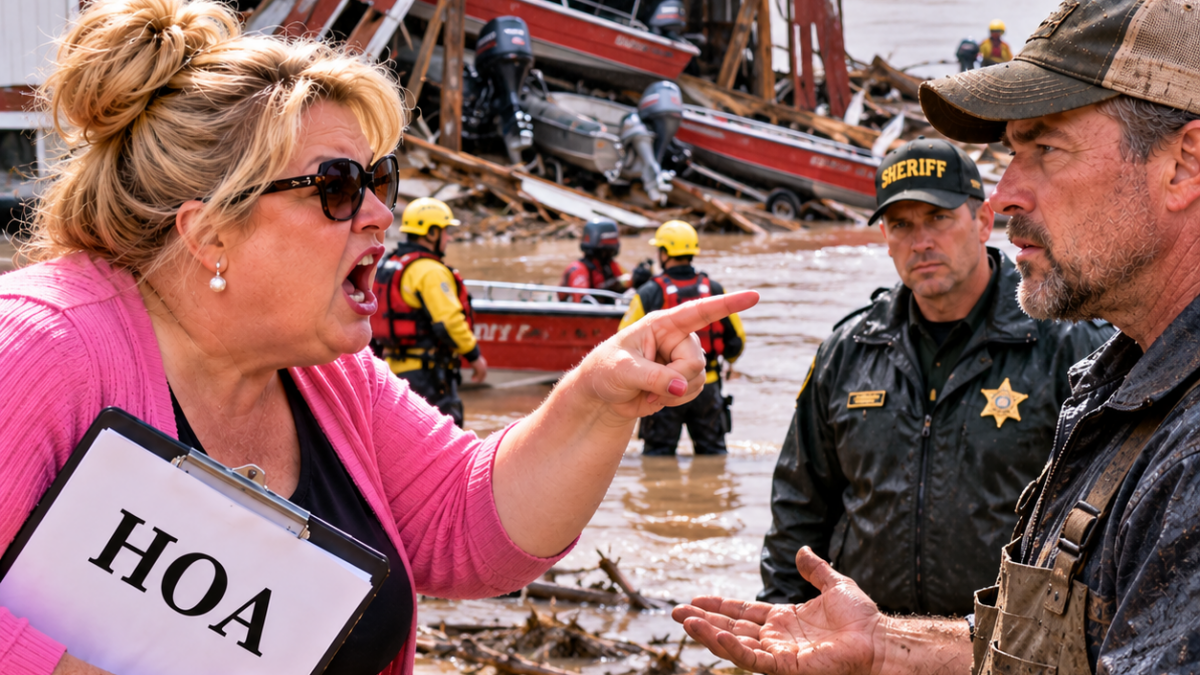
—
PART 2
I called Gus first.
He answered on the second ring.
“You home?”
“Yes.”
“Get to the ramp.”
Pause.
“What happened?”
“Boathouse is gone.”
Another pause.
Longer.
“What do you mean gone?”
“Demolished.”
“Storm?”
“Karen.”
Silence.
Then:
“I’m coming.”
Gus Weller was a retired Navy Seabee built like the kind of man people call when something heavy needs to become somewhere else. He had helped me design the original boathouse ten years earlier and spent three months of Saturdays framing it with volunteers while our wives brought sandwiches and accused us of pretending retirement was another deployment.
He arrived fifteen minutes later in a mud-streaked pickup.
He parked.
Stepped out.
Saw the wreckage.
Stopped.
The expression on his face hurt more than Karen’s smugness had.
Gus walked toward what remained of the building.
He put one boot on a broken wall plate and looked down.
For almost a minute, he said nothing.
Then:
“Well.”
I waited.
“That’s thoroughly screwed.”
I laughed once.
Not because anything was funny.
Because Gus had spent thirty years compressing disaster into short sentences.
He looked at me.
“You see the ninety?”
“Part of it.”
“Boats?”
“Crushed.”
“Radio cabinet?”
“Unknown.”
“Medical?”
“Maybe Pelican cases survived.”
He sighed.
Then slapped my shoulder.
“Okay, skipper. What’s the mission?”
That question saved me.
Not emotionally.
Functionally.
Mission.
Immediate objective.
Storm approaching.
Assets compromised.
Recover capability.
Deal with Karen later.
“Salvage everything.”
I said.
“Call the team.”
Within an hour, twelve volunteers were on site.
Some veterans.
Some firefighters.
One paramedic.
Two ordinary guys who had joined after we rescued their neighbors years before and discovered they were good on boats.
Nobody wasted time cursing Karen.
Not yet.
We pulled debris by hand where safe.
Gus called his company for lifting equipment.
We shut down anything electrical.
Photographed every item before moving it.
Serial numbers.
Damage.
Position.
Ownership.
Funding source.
The rescue nonprofit had been built one donation at a time.
That made every broken object feel personal.
The red Zodiac had been purchased after Hurricane Jasper with money collected at a countywide fundraiser. Schoolchildren had brought jars of coins. A local restaurant donated a weekend’s profits. Two widows mailed checks for twenty-five dollars each with notes saying our volunteers had once helped their husbands.
Now the hull was torn beneath a roof beam.
The second boat had a crushed transom.
Our ninety-horsepower Yamaha looked like someone had dropped a truck on it.
The propeller was destroyed.
Cowling cracked.
Mount bent.
Probably lower-unit damage.
Six smaller motors had been stored on rolling stands.
Three were crushed outright.
One might have survived.
Two were buried.
Our life-jacket rack had collapsed.
Foam flotation crushed beneath framing.
Helmets cracked.
Ropes sliced or contaminated with oil and debris.
Dry suits punctured.
A medical cabinet overturned.
We found trauma supplies scattered beneath insulation.
Some waterproof boxes survived.
Radios too.
GPS units.
Two AED cases appeared intact.
By late afternoon, usable equipment fit into one corner of my garage.
Gus looked at it.
“That’s it?”
“For now.”
Dave Collins, a former Marine in his thirties, kicked a broken board across the grass.
“We should have enough gear for three crews.”
“We did yesterday.”
he said.
Nobody answered.
He looked at me.
“You going after her?”
“Yes.”
“Good.”
“Later.”
His face tightened.
“Jack, she destroyed rescue boats three days before a hurricane.”
“I know.”
“She needs to pay.”
“She will.”
“How?”
“By us being smarter than she is.”
Dave laughed bitterly.
“That’s a low bar.”
“Then we should have no trouble.”
The first night, we worked until floodlights turned the wreckage white against the dark.
My wife, Laura, brought coffee and food.
She had been with me through deployments, flood seasons, military retirement, and the strange transition from solving large logistical problems to arguing with contractors over dock permits.
She knew my silences.
When everyone finally left, she sat beside me on the garage step.
“You look like you want to kill somebody.”
“No.”
“Jack.”
“I want consequences.”
“That sounds more like you.”
I stared at the pile of salvaged equipment.
“She waited until I was gone.”
“I know.”
“She used the old PO box.”
“I know.”
“She knew about the storm.”
Laura rested her hand over mine.
“You don’t have to convince me.”
I looked at her.
“If this storm hits the way they think…”
“Then we prepare.”
“With what?”
“With what you have.”
That was the answer.
I wanted our full fleet.
I wanted all the gear Karen had destroyed.
Instead, I had one damaged boat that might be repairable, several surviving radios, one questionable outboard, some medical kits, and twelve people who knew what they were doing.
Sometimes capability is equipment.
Sometimes capability is people refusing to quit.
The next morning, I drove to the county courthouse.
The Lakeside HOA had existed in one form or another for decades, but its records were scattered between county filings, HOA archives, management-company files, and old meeting minutes.
I wanted the original agreement.
Ten years earlier, after the near-dam failure that convinced me to start Lakeside Volunteer Rescue, we had gone before the board.
Different president.
Different culture.
Tom Reynolds.
Retired pharmacist.
Reasonable man.
The common parcel beside the ramp had been unused.
We proposed a small facility.
We would pay nominal lease.
Maintain site.
Carry insurance.
Operate as a registered nonprofit.
Use the facility solely for emergency response, training, and storage.
In exchange, HOA residents effectively gained a rescue team next door.
Tom called it:
“The easiest decision this board has ever made.”
Unanimous vote.
Ten-year lease at one dollar annually with renewal provisions.
The boathouse itself approved in the same resolution.
I found the minutes.
Then the signed lease.
Then a recorded memorandum referencing the authorization.
I made certified copies.
That felt good.
Not victory.
Ground.
Karen had based everything on a claim that the building was unauthorized.
It wasn’t.
Next:
Sheriff.
Deputy at front desk.
I filed a property-destruction complaint.
The deputy listened.
Then sighed in the way law-enforcement officers sigh when the letters H-O-A appear.
“Mr. Riley, sounds civil.”
“Could be.”
“You probably need an attorney.”
“I probably do.”
“I can take a report.”
“That’s why I’m here.”
He typed.
“Estimated loss?”
“Preliminary equipment value over eighty thousand.”
His hands stopped.
“Eighty?”
“Plus building.”
“What kind of equipment?”
“Rescue boats.”
He looked up.
“Like personal watercraft?”
“Like county-coordinated flood-response assets.”
That changed him.
I handed over a preliminary inventory.
Registered nonprofit documentation.
County grant award.
Sheriff-department training correspondence.
His eyes moved faster.
“These guys work with us?”
“We have.”
“When?”
“Flood fourteen. Jasper. Search operation two years ago.”
He leaned back.
“And HOA demolished the facility?”
“Yes.”
“When?”
“Yesterday.”
“Storm watch already active?”
“Yes.”
He made another note.
“I’m going to send this upstairs.”
“Thank you.”
“I’m not promising criminal.”
“I’m not asking you to.”
“What are you asking?”
“A report number.”
He gave me one.
Evidence begins with existence.
That afternoon, the HOA announced an emergency meeting.
Karen’s notice described:
**Removal of Unauthorized Structure and Related Resident Concerns.**
The wording was almost impressive.
Not:
Destruction of Volunteer Rescue Facility.
Not:
Loss of Emergency Assets Before Hurricane.
Unauthorized structure.
Resident concerns.
Narrative control is often the first refuge of people who realize facts may be dangerous.
I spent the afternoon preparing.
Certified lease.
Original resolution.
Photographs.
Asset inventory.
Nonprofit registration.
County grant documents.
Emergency-response agreements.
Weather bulletins.
Hurricane track.
Projected rainfall.
One binder.
Then another.
Laura watched me spread papers over the dining table.
“Going to yell?”
“No.”
“Good.”
“Going to read.”
“More dangerous.”
The meeting room was packed.
Normally, Lakeside HOA meetings attracted eight people.
Twelve if somebody wanted permission for a fence.
That night:
more than a hundred.
Parents.
Retirees.
Boat owners.
People living near low ground.
People who had heard Karen demolished rescue equipment.
People who just loved spectacle.
Karen sat at the front between Carol Winslow and Bob Mitchell.
Carol had been Karen’s closest ally since election night.
Bob had mostly mastered the art of looking at papers while Karen spoke.
The room hummed.
Karen banged her gavel.
“Meeting will come to order.”
The room quieted.
She launched into her statement.
The structure had violated design standards.
The prior board allegedly exceeded authority.
The lease was under review.
Insurance risk.
Noise complaints.
Environmental concerns.
Debris.
Liability.
She never used the words rescue boat.
Not once.
I wrote a tally mark every time she said “structure.”
Seventeen.
When she finished:
“Questions?”
I stood.
She immediately frowned.
“Mr. Riley.”
“I have a point of order.”
“You’re not a board member.”
“Your bylaws adopt parliamentary procedure for membership meetings.”
Murmurs.
Karen looked toward Bob.
Bob stared at his copy.
I continued.
“A member may raise a point of order when the chair materially misstates an issue before the membership.”
“I have not misstated anything.”
“You called the facility unauthorized.”
“It was.”
I held up a certified copy.
“Then explain this.”
I walked forward.
Handed copies to all three directors.
Karen barely looked.
“What is it?”
“Meeting minutes from ten years ago.”
Silence.
“Unanimous resolution approving the facility.”
I handed another document.
“Lease granting Lakeside Volunteer Rescue use of the parcel.”
Another.
“Recorded memorandum.”
Carol started reading.
Bob did too.
Karen did not.
“The prior board had no authority to override current covenants.”
she said.
Arthur Bell, a retired attorney sitting three rows behind me, muttered loudly enough to hear:
“That isn’t how contracts work.”
Laughter rippled.
Karen struck the gavel.
I continued.
“You also described what you demolished as an old storage structure.”
“It was.”
I held up a photograph.
Projected it.
Crushed rescue boat.
Another.
Broken Yamaha.
Another.
Gear racks.
Another.
Medical equipment.
The mood changed.
I turned toward residents.
“This was the headquarters of Lakeside Volunteer Rescue.”
Everyone knew the name.
Some had been rescued by us.
Some donated.
“Registered nonprofit. County grant recipient. Part of coordinated flood response.”
Karen interrupted.
“Volunteer organization.”
“Yes.”
“As in unofficial.”
“No.”
I showed county documents.
“That equipment was purchased partly with public grant money.”
More murmuring.
I displayed the preliminary asset list.
“Current destroyed or unusable equipment estimate exceeds eighty thousand dollars.”
People gasped.
Karen looked toward Carol.
Carol’s face had changed.
I switched slide.
Hurricane Isabella.
Cone.
Rainfall projection.
Flood warning outlook.
“This demolition occurred after a hurricane watch had been issued.”
Karen:
“Forecasts—”
I turned.
“Twenty to twenty-five inches possible if track holds.”
Room erupted.
One man shouted:
“Are you insane?”
Another:
“My house flooded in fourteen!”
Karen hammered the gavel.
“Order!”
I waited.
When it quieted:
“The county has official resources.”
I said.
“Of course.”
“Lakeside Volunteer Rescue does not replace them.”
Important.
“But during widespread flooding, county assets get stretched. That is why volunteer resources were integrated into planning.”
I looked at Karen.
“You didn’t just remove a building.”
I said.
“You removed local response capacity immediately before a foreseeable emergency.”
No shouting.
No insult.
No revenge line.
Facts were enough.
Arthur Bell stood.
“Madam President.”
Karen’s voice tightened.
“Yes?”
“I’d like to ask whether counsel reviewed the demolition.”
“Legal strategy is privileged.”
“Did counsel review it before or after?”
“I am not answering.”
Arthur nodded.
“Did the board receive a copy of the lease?”
No answer.
He looked at Carol.
“Did you?”
Carol swallowed.
“Karen said the lease expired.”
I turned.
“In eleven months.”
Carol stared at Karen.
Bob looked sick.
Arthur continued.
“Did anyone confirm?”
Karen slammed the gavel.
“This is not a deposition.”
Arthur smiled.
“Not yet.”
That line nearly broke the room.
Then he turned serious.
“There may also be criminal implications if recognized emergency-response assets were knowingly disabled in proximity to a declared emergency.”
Karen went pale.
“You’re threatening me.”
“No.”
Arthur said.
“I’m suggesting you obtain independent counsel.”
The meeting collapsed from there.
Residents demanded answers.
Karen adjourned.
Nobody stopped talking.
Outside, Arthur approached.
“Jack.”
“Arthur.”
“You have representation?”
“Not yet.”
“You do now.”
“You’re retired.”
“I’m bored.”
“I can’t pay city-firm rates.”
“I didn’t ask.”
He looked toward Karen’s car leaving the lot.
“I spent forty years watching arrogant people create expensive problems.”
He smiled.
“I miss it.”
We shook hands.
Then my phone buzzed.
Weather alert.
Isabella had strengthened.
The projected track shifted directly toward us.
I showed Arthur.
His smile disappeared.
“How much equipment can you recover?”
“Not enough.”
“Then forget Karen tonight.”
“I already did.”
“Good.”
The next morning, Karen reminded me.
Certified letter.
HOA counsel.
Cease and desist from “defamatory statements.”
$5,000 charge for demolition cost.
$100 per day for debris.
Lien notice.
I read it twice.
Then handed it to Laura.
She looked stunned.
“They’re charging you for destroying your own building?”
“Apparently.”
“And for not cleaning up the destruction they caused?”
“Yes.”
“Can I swear?”
“Strongly encouraged.”
Arthur received scan.
His response:
**Predictable. Preserve everything. Do not engage directly.**
Then:
**Storm first. Karen later.**
Correct.
Isabella became Category Three offshore.
Expected to weaken.
Rain forecast remained terrifying.
River basin saturated.
Lake already high.
County issued evacuation orders for lowest zones.
Not Lakeside.
People there felt relieved.
I did not.
Higher ground around lake creates false confidence.
Floods do not read subdivision maps.
The rescue team met in my garage.
One patched Zodiac.
Gus had repaired a tear but warned the transom remained questionable.
One 25-horse motor.
Two construction-company jon boats.
Not rated for serious swift water.
Useful only in calmer flooded areas.
Radios.
Medical kits.
PFDs salvaged from personal supplies and donations.
Helmets borrowed from neighboring departments.
We would not enter conditions beyond equipment capability.
That was hard.
Training makes you want to solve.
Discipline makes you know when not to.
I stood before the team.
“We are reduced.”
Nobody argued.
“We are not the county rescue agency.”
Heads nodded.
“We follow incident command. We coordinate. We do not freelance. We do not put ourselves into water we cannot safely operate.”
Dave looked frustrated.
“What if nobody else can reach them?”
“Then we communicate location and wait for proper asset.”
He hated that.
So did I.
“But we do what we can.”
Gus pointed toward jon boats.
“We can move people in low-current neighborhoods.”
“Yes.”
“Deliver medication.”
“Yes.”
“Transport from staging.”
“Yes.”
“Then we have work.”
Exactly.
Rain started the next morning.
Steady.
Then heavy.
Then relentless.
By afternoon, lake rose visibly.
Docks disappeared.
Brown water carried branches.
County radio traffic intensified.
Road closures.
Culverts overwhelmed.
Low bridges submerged.
Emergency crews split across multiple incidents.
At 4:37 p.m., first call came directly to me from an elderly couple on the far side of the lake.
I redirected through dispatch.
Their road flooded.
Woman diabetic.
Limited insulin.
Current near property reportedly low but rising.
Dispatch authorized our assistance under volunteer coordination.
We launched patched Zodiac from what used to be my lawn.
Gus at helm.
Dave forward.
Me center.
Rain stung.
Visibility poor.
Floating debris everywhere.
A cooler.
Chair.
Tree limbs.
Section of dock.
We moved slowly.
No heroic speed.
The couple’s house sat behind water where road had been.
We approached from protected side.
Husband stood on porch with backpack.
Wife pale.
We got them aboard.
Medication dry.
PFDs secured.
Then radio:
family of four signaling from second-floor window two blocks over.
Official unit delayed.
We evaluated.
Current manageable.
Route possible.
We went.
Mother.
Father.
Two children.
Dog.
Six people plus us became too much for one trip.
We split.
Mother and children first.
Father waited.
He insisted.
“Kids go.”
We returned.
Got him and dog.
Every minute burned fuel.
Every trip showed what Karen had destroyed.
With full fleet:
multiple crews.
Separate operations.
Now one boat moved back and forth like a needle sewing a flood together.
Gus’s jon boats launched into calmer sections later.
Useful.
But slow.
Vulnerable to debris.
Not swift-water craft.
We triaged.
Medical first.
Children.
Elderly.
Immediate structural danger.
Then others.
I hated every choice.
Around midnight, dispatch backlog grew.
Some calls waited.
We coordinated with fire.
County rescue arrived where currents strongest.
National Guard activation discussed.
Our volunteers worked shelter transport and shallow-area extraction.
By 2:30 a.m., I could barely feel my hands.
Coffee tasted like mud.
Rain continued.
Then radio broke through.
Female voice.
Panicked.
“Water is coming up the stairs.”
Address.
1212 Crestview Drive.
Every volunteer knew it.
Karen’s house.
Silence.
Dave turned toward me.
Even in darkness, I saw his expression.
“You have got to be kidding.”
Gus said nothing.
Dispatcher repeated.
Basement flooded.
Occupant moved upper level.
Access route compromised.
No immediate medical issue.
Several higher-priority rescues active.
I keyed radio.
“Copy.”
Dave looked at me.
“What’s the call?”
Not because he wanted permission to abandon her.
Because he wanted to know whether anger had entered command.
It had.
I would be lying if I said otherwise.
For one ugly second, I pictured Karen in that expensive house surrounded by water, staring down at the lake after destroying the boats built to protect people like her.
Poetic justice is seductive because it disguises cruelty as balance.
I thought:
Let her wait.
Then I remembered why we existed.
The first flood.
Families on balconies.
No system.
No politics.
No good people and bad people.
Only people in water.
“We follow triage.”
I said.
“Three calls ahead with children and structural risk.”
Gus nodded.
“Then her.”
“Then her.”
Dave exhaled.
“Understood.”
Nobody cheered.
Nobody argued.
That made me proud.
Two hours later, we headed for Crestview.
Floodwater covered street.
Karen’s landscaping gone beneath brown water.
Mailbox barely visible.
The culvert behind her house had backed up and forced water through walkout basement.
We approached from front where current slower.
Spotlight swept porch.
“Karen!”
I shouted.
No answer.
Again.
“Lakeside Volunteer Rescue!”
Door opened.
Flashlight.
Blanket.
Karen stood there.
No perfect hair.
No clipboard.
No HOA pin.
No authority.
Just a frightened woman.
She saw the boat.
Then me.
Something passed across her face.
Shame.
Humiliation.
Relief.
Maybe all three.
“We’re here to evacuate you.”
I said.
She stared.
“Is it safe?”
“We wouldn’t be here if we didn’t believe this route was safe enough.”
Her lower lip trembled.
“My basement…”
“We know.”
“My car…”
“Leave it.”
“My documents—”
“Take identification, medication, essential bag. Two minutes.”
Old command voice.
Not cruel.
Clear.
Karen disappeared inside.
Returned with small bag.
Water over porch steps.
Gus steadied boat.
Dave helped her aboard.
She flinched when his hand touched hers.
Maybe expecting judgment.
He gave none.
We put PFD on her.
She sat in bow.
For the entire ride, she said nothing.
Neither did we.
At shelter, volunteers helped her out.
Before she walked away, she turned to me.
“Jack.”
First time she used my name without accusation.
I waited.
Her mouth opened.
Nothing came.
She looked toward the patched Zodiac.
Then at the faded words:
**LAKESIDE VOLUNTEER RESCUE**
Finally:
“Thank you.”
“You’re safe.”
I said.
That was all.
People later called that revenge.
It wasn’t.
Revenge would have been leaving her.
Rescue was better.
Rescue left no room for her story.
No way to say we were vindictive.
No way to claim personal war.
We did our job.
She had failed hers.
That contrast spoke louder than anything I could have said.
By morning, rain weakened.
Water still rose in places.
We completed more than thirty rescues and assisted dozens more.
No fatalities in our immediate neighborhood.
Countywide damage enormous.
Roads destroyed.
Homes flooded.
Cars submerged.
Power outages.
Mud.
Debris.
Exhaustion.
When water began receding, Lakeside transformed.
Neighbors who barely spoke before shared generators.
People ripped out drywall together.
Cooked food on grills.
Checked elderly residents.
Washed mud from streets.
The clubhouse became relief center.
Karen disappeared after a friend picked her up.
No one knew where.
I did not care.
Two days later, I was helping Gus pull a drowned generator from a garage when sheriff’s vehicles arrived.
Detective Garcia stepped out.
Two deputies.
Arthur stood beside me.
“They’re not here for us.”
he said.
Garcia walked toward Karen’s house.
She had returned that morning.
We watched from a distance.
Door opened.
Conversation.
Document.
Then Karen emerged.
Handcuffs.
Nobody moved at first.
Someone whispered:
“Oh my God.”
Karen looked smaller than I remembered.
No yelling.
No resistance.
She got into cruiser.
A few neighbors clapped.
Then more.
I did not.
Arthur looked at me.
“Nothing?”
“Not like this.”
“Why?”
“I wanted accountability.”
“This is accountability.”
“Maybe.”
I watched car disappear.
“I don’t need to enjoy every part.”
That evening, DA held press conference.
Charges related to intentional destruction of emergency-response assets and associated misconduct.
Investigation also examining financial decisions.
I was careful whenever media called.
No celebration.
No claim she nearly killed people.
No exaggeration.
I said:
“The rescue facility was approved. Assets were destroyed. That reduced local volunteer capacity during a real emergency. Authorities will determine legal responsibility.”
Reporter tried:
“How did it feel rescuing the woman who demolished your fleet?”
“Like rescuing a resident.”
“Nothing more?”
“No.”
“Did she apologize?”
“No.”
“Did you want to leave her?”
I paused.
“Wanting something for one second and doing it are different things.”
That quote ran everywhere.
I hated it.
Laura liked it.
“Sounds heroic.”
“It sounds human.”
“Better.”
HOA imploded.
Carol resigned.
Bob resigned.
Management company distanced itself.
Law firm suddenly became cooperative.
Lien withdrawn.
Fines canceled.
All enforcement against me rescinded.
Arthur chaired emergency membership meeting.
Residents voted interim board.
He became president despite protesting.
“You volunteered.”
I told him.
“I volunteered as lawyer.”
“Promotion.”
“I hate you.”
First resolution:
Formal apology to Lakeside Volunteer Rescue.
Second:
Recognize lease.
Third:
Allocate funds toward rebuilding pending insurance and legal review.
Fourth:
Independent audit of board actions.
Fifth:
No structural removal without verified legal authority and direct notice to affected parties.
Arthur looked at me.
“Anything else?”
“Yes.”
“What?”
“Never use an old PO box.”
People laughed.
Relief needs laughter.
News spread.
Local reporter Ben Carver had covered the demolition before storm.
After flood, story exploded.
**HOA Demolishes Rescue Facility Days Before Flood—Then Volunteers Rescue President**
I hated headline.
Everyone else loved it.
Donations started.
Ben’s station created verified fundraiser with nonprofit board.
First day:
$18,000.
Second:
$47,000.
Then regional coverage.
Businesses called.
Marine supply dealer offered boats at cost.
Engine distributor donated one outboard.
Local lumber company pledged materials.
Gus’s company:
labor free.
Rotary Club:
$25,000.
High school:
fundraiser.
A child mailed nine dollars and seventeen cents.
We kept that letter.
Within a week:
over $200,000 pledged.
I stood in garage looking at donation dashboard.
Laura came behind me.
“You okay?”
“No.”
“Bad no?”
“Overwhelmed no.”
She looked.
“People believe in you.”
“Team.”
“In what you do.”
I sat.
For ten years, Lakeside Rescue had survived on bake sales, raffles, small grants, checks from businesses, volunteers buying things themselves.
One bulldozer destroyed it.
Then flood showed everyone why it mattered.
The community was rebuilding it stronger than before.
That should have felt triumphant.
Instead, I thought about all the families we made wait because we had one patched Zodiac.
The old couple with insulin.
The children in the attic.
Karen.
Every delay.
“Jack.”
Laura said softly.
“What?”
“You didn’t cause the flood.”
“I know.”
“You didn’t destroy the boats.”
“I know.”
“You saved people with what remained.”
“I know.”
“Then stop carrying what wasn’t yours.”
Military families become experts at saying the obvious thing when the person they love refuses to believe it.
Court case took six months.
Less cinematic than people imagine.
Motions.
Hearings.
Evidence.
Insurance disputes.
Plea negotiations.
Valuations.
Statements.
Karen eventually took plea.
Felony count tied to destruction of designated emergency-response assets.
Other charges resolved or dropped under agreement.
Five-year sentence with parole eligibility after two according to court disposition described in source.
Restitution ordered.
House sold amid legal and financial fallout.
I did not attend sentencing for revenge.
I attended because nonprofit was victim.
Judge asked whether I wanted to speak.
I did.
Karen sat at defense table.
Older.
Smaller.
I read from one page.
“Your Honor, the building Karen Stevenson ordered destroyed can be rebuilt.”
I looked at her.
“Boats can be replaced. Motors can be replaced. Radios can be replaced.”
Pause.
“What cannot be replaced is time during an emergency.”
Courtroom silent.
“During Hurricane Isabella, our volunteers operated with a fraction of our normal capability. We completed more than thirty rescues. We also had to prioritize calls that a fully equipped team could have handled in parallel.”
Karen looked down.
“I do not believe this court should punish Ms. Stevenson because I dislike her. I believe consequences should reflect what she chose to do after multiple opportunities to verify the facts.”
I folded paper.
“She treated authority as permission not to ask questions. That decision endangered an entire community.”
I sat.
No speech about losing everything.
No satisfaction.
Judge handled law.
That was his job.
Outside, reporter asked:
“Do you forgive her?”
Too early.
“I don’t know.”
That was honest.
One year after flood, new facility opened.
Not barn.
Facility.
Three bays.
Elevated foundation.
Flood-resistant materials.
Secure equipment storage.
Radio room.
Training space.
Medical cache.
Generator above flood level.
Weather monitoring.
Boat racks.
Three rescue craft.
High-water vehicle purchased through grant and donations.
County emergency management integrated site more formally into planning.
Professional inspection.
Clear ownership.
Clear lease.
Clear renewal.
Every legal document reviewed twice.
Then once more because Arthur enjoyed suffering.
Ribbon cutting.
Governor attended.
County officials.
Sheriff.
Fire.
Residents.
People we rescued.
Children.
Donors.
Gus stood beside me in clean shirt that made him uncomfortable.
Dave wore suit and looked like someone being punished.
Arthur complained about sun.
Mrs. Gable brought cookies.
When red ribbon stretched across bay doors, I remembered crushed wood.
Diesel smell.
Karen’s clipboard.
Storm warning.
I expected satisfaction.
What I felt was grief mixed with gratitude.
Grief for the old building because it had been ours.
Built by hands.
Painted by volunteers.
Marked with dents from years of training.
Gratitude because new one existed only because thousands of people decided we mattered.
Plaque unveiled:
**LAKESIDE VOLUNTEER RESCUE FACILITY**
**Dedicated to the volunteers, donors, first responders, and residents whose courage during Hurricane Isabella proved that preparedness is a shared responsibility.**
No Karen.
Good.
This place did not need her name in any form.
After ceremony, a woman approached with teenage son.
I recognized her slowly.
Family from attic.
“You got my kids out first.”
she said.
“Your husband insisted.”
“He did.”
The boy looked embarrassed.
“He says he wants to join rescue when he’s old enough.”
“How old?”
“Fifteen.”
“Three years.”
I said.
“Then training.”
His eyes lit.
That meant more than the governor.
Years passed.
Facility became ordinary.
Best possible fate for emergency infrastructure.
Monthly drills.
Maintenance.
Fundraising.
Boring readiness.
Flood seasons.
Storm watches.
False alarms.
Occasional rescues.
County expanded resources.
We coordinated better.
Never again sole local boat asset.
That also mattered.
One of lessons Isabella exposed was overreliance.
Volunteer team should never be only line.
Redundancy saves lives.
We pushed county for caches.
Mutual aid.
Staging.
More high-water vehicles.
Karen’s destruction accidentally exposed weak point larger than her own misconduct.
Systems improve when people are honest about failure.
Arthur served one term as HOA president.
Hated every minute.
First thing after election:
Term limits proposal.
“Why?”
I asked.
“Because anyone who enjoys this much power should be removed.”
Passed overwhelmingly.
HOA rewrote procedures.
Direct service required before major enforcement.
Independent legal review for property seizure, liens, demolition, or emergency assets.
Contracts over threshold competitively bid.
Minutes online.
Resident appeal rights.
No president unilateral demolition authority.
People mocked detail.
Arthur said:
“Good governance is boring because exciting governance usually means something went wrong.”
Correct.
Garden gnomes returned.
One appeared on Arthur’s lawn wearing judge wig.
He blamed me.
I denied.
It was Gus.
Mrs. Gable’s roses grew over sidewalk by three inches.
Nobody fined her.
She trimmed because she wanted to.
That is what healthy community looks like:
people doing reasonable things without terror.
Laura and I remained by lake.
We considered moving after flood.
For about ten minutes.
Then realized leaving would let worst week define place.
We stayed.
Rebuilt dock.
Raised utilities.
Improved drainage.
Made home more resilient.
Every hurricane watch still tightened my chest.
Not fear exactly.
Memory.
Rain sounds different after you’ve navigated through someone’s living room.
One evening years later, new neighbor asked about Karen.
Story had become mythology.
“Is it true HOA lady bulldozed rescue boats and then you rescued her in same boat?”
“Basically.”
“Did you make her apologize before she got in?”
“No.”
“Did you tell her ‘rules are rules’?”
“No.”
He looked disappointed.
“That would have been perfect.”
“No.”
“What did you say?”
“That we were there to evacuate her.”
“That’s it?”
“Yes.”
“Why?”
“Because we were rescuers.”
He thought.
“Still would have said rules are rules.”
“That’s why you weren’t driving.”
He laughed.
People want revenge lines.
Reality’s best moment was silence.
Karen sitting in bow.
Mud water around us.
No power.
No title.
No argument.
We saved her anyway.
That was enough.
Years after release, I received letter.
Prison return address initially.
Then later another.
First I did not open for days.
Laura asked why.
“Don’t know.”
“You afraid?”
“No.”
“Angry?”
“Maybe.”
“Curious?”
“Yes.”
“Then open it.”
Karen wrote carefully.
No dramatic apology.
She described night we rescued her.
Said she remembered sound of water hitting boat hull and could not look at any of us.
She said humiliation was strongest emotion then.
Not gratitude.
That honesty surprised me.
Then:
**It took a long time before I understood that you did not humiliate me. I humiliated myself.**
I kept reading.
**You had every reason to hate me, and you still came when my name was called. I have replayed that more times than I can count.**
Another line:
**I thought rules made me important. I thought enforcement made me useful. By the time anyone challenged me, I had confused being obeyed with being right.**
Then:
**I am sorry for the boathouse, but saying that feels too small. I am sorry for the time you lost during the storm because of me.**
I stopped.
That was the apology I had never known I needed.
Not sorry you were upset.
Not sorry things got out of hand.
Sorry for lost time.
I wrote back weeks later.
**Karen,**
**I received your letter. Thank you for taking responsibility. What happened cannot be undone, but it does not need to keep happening inside either of us. I hope you build something better with the life you have left.**
**Jack**
Laura read.
“You forgive her?”
“I think so.”
“Why now?”
“Because she finally understood what she did.”
“And if she hadn’t?”
I thought.
“Maybe I still would have eventually.”
Forgiveness is not acquittal.
Court handled guilt.
Restitution handled money imperfectly.
Community handled governance.
Forgiveness handled what I carried.
Different systems.
Different jobs.
When I turned sixty-eight, I stepped down as Lakeside Rescue director.
Team elected Dave.
Former Marine who once wanted immediate revenge.
He had matured.
Mostly.
At ceremony, he gave speech.
“Jack taught us you never leave anyone behind.”
I whispered:
“Depends on conditions.”
He ignored me.
“He also taught us paperwork is a weapon.”
Laughter.
“Tool.”
I corrected.
More laughter.
Then serious.
“He built this team because years ago he watched people trapped while official systems were overwhelmed. He kept it alive when one person tried to destroy it. And during the worst night this community had seen, he proved why we exist.”
I hated speeches.
Laura cried.
Gus pretended not to.
Afterward, I handed Dave radio.
“Your problem now.”
“Finally.”
“Call me only if building is demolished.”
“Too soon.”
“Never.”
Retirement felt strange.
Again.
But I still trained occasionally.
Taught incident planning.
Boat maintenance.
Volunteer coordination.
Young people joined.
Teen from attic became member.
Then instructor.
Continuity.
One spring, county conducted full-scale flood exercise.
Three rescue boats launched from new facility.
County team.
Fire.
EMS.
National Guard liaison.
Radio traffic clean.
Staging organized.
I stood back.
No one needed me.
That felt better than being indispensable.
Indispensable systems are fragile.
Good leaders build themselves out of necessity.
Karen had wanted opposite.
Every decision flowing through her.
Every exception hers.
Every punishment hers.
Every rule interpretation hers.
She made herself central.
Then when she failed, entire board collapsed.
Lakeside learned not to do that.
Multiple coxswains.
Multiple trainers.
Equipment at separate locations.
Backup radios.
Second fuel storage.
Mutual aid.
No single point of failure.
Infrastructure lesson.
Governance lesson.
Life lesson.
The old demolition site remained part of new complex.
We could have erased it.
Instead, a small section of original concrete slab remained visible beside building.
Not memorial to Karen.
Memorial to old facility.
Embedded in slab was one bent bolt from boat rack.
Gus refused to remove it.
“History.”
he said.
“Trip hazard.”
“History with paint around it.”
We painted yellow.
At open house, kids asked:
“What happened there?”
Volunteers told short version:
“Old building got damaged. Then storm came. Community rebuilt.”
Good.
Not every generation needs inherited enemies.
They need lessons.
One summer afternoon, weather was perfect.
Lake flat.
I sat on dock with grandson.
He knew rescue story.
Family version.
Asked:
“Grandpa, why did that lady knock down your building?”
“Thought rules said she could.”
“But she was wrong.”
“Yes.”
“Why didn’t she check?”
Good question.
“She checked only with people who told her what she wanted.”
He frowned.
“That’s dumb.”
“Yes.”
“Did you hate her?”
Another good question.
“At first.”
“Then?”
“I was angry a long time.”
“Then she said sorry?”
“Eventually.”
“And you’re friends?”
“No.”
He laughed.
Apparently obvious.
“You can forgive someone without being friends.”
He threw pebble.
“Why?”
“Because forgiveness is about what you carry, not where they sit at dinner.”
He considered.
“Can I drive rescue boat?”
“No.”
“Why?”
“Rules.”
He stared.
I laughed.
“Some rules are good.”
Sunset painted lake.
No storm.
No flood.
New facility doors closed.
Boats inside.
Ready.
I thought of night Karen rode in bow.
People tell that as poetic justice.
Maybe.
But the real justice happened afterward.
Not handcuffs.
Not prison.
Not house sale.
Those were consequences.
Justice was the old couple getting insulin.
Kids leaving attic.
Neighbors rebuilding.
Facility returning.
Better systems.
Transparent HOA.
Volunteers training.
A teenage survivor becoming rescuer.
Karen eventually understanding.
Community no longer ruled by fear.
That lasted.
Revenge fades.
Restoration accumulates.
Every new volunteer adds.
Every maintained motor.
Every drill.
Every family who sleeps slightly safer during storm season.
That is the answer to destruction.
Build better.
Hurricane Isabella anniversary came each year.
At first, community held event.
Then memories softened.
Fewer speeches.
Eventually just preparedness weekend.
Good.
Disaster should become knowledge, not identity.
We cleaned culverts.
Updated contact lists.
Checked elderly residents.
Reviewed evacuation zones.
Tested generators.
Inspected boats.
No one said Karen.
Eventually, I realized an entire morning had passed at rescue facility without thinking her name.
That was freedom.
Years earlier, standing beside wreckage, I thought victory would mean destroying her empire.
Instead, victory meant she became irrelevant.
The work outlived the conflict.
One autumn, major storm formed offshore.
New director Dave called.
“Jack.”
“You’re not supposed to call retired people.”
“You checking forecast?”
“Yes.”
“Of course.”
“Models uncertain.”
“Yep.”
“County wants staging tomorrow.”
“Then stage.”
Pause.
“That all?”
“What do you want from me?”
“Wisdom.”
“You have three boats, high-water truck, trained crews, county integration, backup communications, and a building nobody is demolishing.”
He laughed.
“So?”
“So follow plan.”
“Boring.”
“Exactly.”
Storm turned north.
Missed us.
Everyone stood down.
Some residents complained preparedness was unnecessary.
Dave called again.
“You want to explain preparedness to them?”
“No.”
“Why?”
“Because if they complain we prepared for storm that missed, system worked.”
“That makes no sense.”
“It will when you’re old.”
Preparedness looks wasteful until day it isn’t.
Our original boathouse looked like clutter to Karen.
Boats looked like junk.
Training looked like noise.
Insurance looked like paperwork.
Lease looked like old document.
Then water rose.
Everything changed meaning.
That is how emergencies expose value.
Same life jacket that looks bulky becomes survival.
Same volunteer who seems obsessive becomes lifeline.
Same building someone calls eyesore becomes command center.
You should not need disaster to understand worth.
But humans often do.
One day county replaced old commendation plaque destroyed in demolition.
Original had been crushed.
New plaque listed rescues from flood fourteen, Jasper, Isabella.
I stood reading.
Gus beside me.
“We’re old.”
“Yes.”
“We did okay.”
“Yes.”
“You still mad about ninety-horse Yamaha?”
“Every day.”
“That was a good motor.”
“Beautiful.”
“Karen owes us that.”
“She paid restitution.”
“Not emotional restitution.”
“There is no such thing.”
Gus sighed.
“Law is incomplete.”
We laughed.
That was revenge now.
Jokes with friend.
Not anger.
A few years later, Gus died.
Heart attack.
Sudden.
Funeral filled with Seabees, volunteers, contractors, neighbors.
At rescue facility, we mounted small plaque near equipment bay:
**GUS WELLER — IF IT FLOATS, FIX IT. IF IT DOESN’T, BUILD IT BETTER.**
That was him.
During eulogy I remembered first words after demolition.
*That’s thoroughly screwed.*
Then:
*What’s the mission?*
Gus understood something essential.
Disaster invites two questions.
Who did this?
What do we do next?
The first matters for accountability.
The second saves lives.
If you spend too long on first while water rises, people drown.
We handled both.
Mission first.
Justice later.
That became something I taught every volunteer.
No revenge in incident command.
No personal grudges.
Victim is victim.
Need determines priority.
Karen’s rescue became case study without name.
Scenario:
Person responsible for prior harm requests evacuation.
What do you do?
Answer:
Same triage criteria.
Always.
Some young volunteers surprised.
I told them:
“If you want permission to decide who deserves saving, join something else.”
Harsh.
Necessary.
Rescue is covenant.
Not HOA kind.
Better kind.
You go because somebody needs help.
Period.
That is why Karen’s destruction felt like more than property damage.
She attacked physical expression of that promise.
But she could not destroy promise itself.
That night, patched boat still launched.
Volunteers still went.
Community still helped.
Buildings matter.
Equipment matters.
People matter more.
Years later, I visited boathouse early morning.
Dave not there.
Nobody.
I still had key.
Opened bay.
Three boats clean.
Motors serviced.
Gear organized.
Radios charging.
Life jackets inspected.
Smell of rubber, metal, lake water.
I ran hand along one hull.
Brand-new compared to old fleet.
Donation plaque listed thousands of contributors.
I found child’s nine-dollar-seventeen-cent letter framed near office.
Forgotten.
Read:
**Dear rescue people, I am sorry your boats got smashed. I saved this money for a game but you need a boat more. Please save people.**
That was whole story in four lines.
Someone smashed boats.
Other people rebuilt.
Please save people.
Simple.
I sat at table.
Through window, lake calm.
I remembered Karen standing beside excavator.
“The bylaws are the bylaws, storm or no storm.”
I once thought that sentence defined her stupidity.
Now I hear something else.
Warning.
Rules detached from purpose become dangerous.
Why did HOA have structure rules?
Safety.
Appearance.
Liability.
Order.
Fine.
But purpose of governance is not rule enforcement for its own sake.
Purpose is community welfare.
A rule used to destroy emergency resource serving community had inverted itself.
Same with any institution.
When process becomes more important than mission, people get hurt.
Army taught that.
Engineering taught that.
Flood taught that.
Karen merely made lesson personal.
New HOA bylaws included emergency-assets clause.
Any recognized emergency-response facility or equipment subject to separate review before enforcement.
No unilateral action.
Direct notice.
Consultation with county authorities when applicable.
People joked:
“Karen Clause.”
Arthur refused.
“Do not immortalize bad presidents.”
Good rule.
Officially:
**Community Safety Infrastructure Review Provision.**
Boring.
Perfect.
Arthur died years later too.
Older.
Peacefully.
His family gave rescue nonprofit his old leather briefcase.
Inside:
copy of our original lease.
Sticky note in Arthur’s handwriting:
**READ THE DAMN CONTRACT.**
We framed that too.
Facility became museum of sarcastic dead men.
Appropriate.
Mrs. Gable lived longest.
At ninety, still complained HOA newsletter font too small.
We enlarged it.
She won.
One afternoon she asked me:
“Would Karen have been stopped if you hadn’t found lease?”
“Eventually.”
“Would she?”
“Yes.”
“How sure?”
“Not completely.”
She nodded.
“Keep records.”
That was her wisdom.
Institutional memory matters.
Original board knew facility.
Ten years later, one president pretended not to.
Paper remembered.
Minutes remembered.
Lease remembered.
Contracts outlast personalities.
If accurate.
If accessible.
If read.
Karen counted on forgetfulness.
Our paperwork defeated that.
The county later digitized emergency partnerships partly because of case.
No more old boxes.
Current contacts.
Expiration reminders.
Renewal alerts.
Direct owner addresses.
Small reform.
Big value.
Our lease renewal never missed again.
One year, automatic reminder arrived twelve months early.
I forwarded to Arthur’s successor.
Subject:
**LOOK, MODERN CIVILIZATION.**
Response:
**Don’t get excited.**
I did.
When grandson graduated high school, he joined volunteer team.
First day:
“Grandpa, they make me clean boats.”
“Yes.”
“I thought rescue was exciting.”
“Mostly cleaning.”
“Training is ropes and engines.”
“And cleaning.”
“Why?”
“Equipment only saves people if it works.”
He groaned.
A month later appreciated.
He learned maintenance.
Radio protocol.
Safety.
Triage.
No hero fantasies.
Good.
During first minor flood, he helped evacuate one family.
Calm water.
Straightforward.
Came home energized.
“I get it.”
“What?”
“Why you did it.”
“Careful.”
“What?”
“That feeling can become ego.”
He frowned.
“Saving people feels good.”
“It should.”
“So?”
“Mission is them, not feeling.”
He thought.
“You make everything less fun.”
“Family tradition.”
Years later, he became EMT.
Lakeside Rescue became stepping stone.
That might be best outcome of whole saga.
Not building.
People trained into service.
Karen tried to erase facility.
Instead, destruction triggered investment that trained next generation.
Again:
restoration accumulates.
I never saw Karen after court.
Only letters.
Heard she lived quietly after release.
Worked office job.
No boards.
No associations.
I hope true.
Not because I want her punished forever.
Because people deserve chance to become more than worst decision while still carrying responsibility for it.
That balance is hard.
Community often wants monsters because monsters are easy to banish.
Karen was a person who abused limited power catastrophically.
That is scarier.
Means ordinary systems need safeguards.
You cannot rely on never electing another Karen.
You must build rules that keep future Karen from unilateral demolition.
That is why reform mattered more than her sentence.
During fifteenth anniversary of new facility, local reporter asked retrospective.
Not Ben.
Young woman barely older than facility.
She said:
“What do you want people to remember?”
I almost said:
Don’t mess with rescue boats.
Instead:
“Check facts before using authority.”
She waited.
“That’s it?”
“And build redundancy.”
“About boats?”
“About everything.”
She smiled.
“Can you explain?”
“Any system depending on one person, one building, one boat, one board president, one road, one communication channel is waiting for failure.”
She wrote.
“That came from flood?”
“Flood and HOA.”
Interview title:
**Lakeside’s Lesson: Resilience Is Redundancy**
Better than revenge headline.
We had matured.
I had matured.
Maybe.
That evening, Laura and I walked by lake.
She said:
“You know what’s funny?”
“What?”
“You wanted quiet retirement.”
“Still do.”
“You started rescue nonprofit, fought HOA president, survived hurricane, testified in felony case, raised two hundred grand, rebuilt facility, served another decade.”
“When you list it like that, sounds busy.”
“You are terrible at retirement.”
“Agreed.”
She squeezed my hand.
“Worth it?”
I looked across water.
“Yes.”
“Even Karen?”
I thought.
“No.”
She laughed.
“Wrong answer.”
“What’s right answer?”
“Everything that came after.”
Fair.
If Karen had never demolished building, I would prefer it.
Full stop.
I do not believe suffering must happen to create good.
But once it happened, what we built afterward mattered.
That distinction protects against romanticizing harm.
Storm did not happen for reason.
Demolition did not happen for reason.
We made reasons afterward.
That is different.
We chose response.
Years later, I found original boathouse key in drawer.
Bent brass tag:
**LVR BAY 1**
Door no longer existed.
Key useless.
I almost threw away.
Then put in shadow box with photograph of old facility.
Underneath:
**MISSION CONTINUES**
Not because I’m sentimental.
Laura says I am.
I deny.
One final flood came when I was too old to participate.
I watched from home.
Rain.
Lake rising.
County staging.
New team launched.
Three boats.
High-water vehicle.
Multiple crews.
My grandson radioed from team.
Not to me officially.
Text:
**We’re good.**
That was all I needed.
No frantic salvage.
No crushed boats.
No improvising fleet from construction jon boats.
No one person carrying whole plan.
System worked.
Karen’s greatest unintended legacy:
She forced us to remove vulnerabilities.
Emergency passed.
No major losses.
Next day, grandson stopped.
“You watched entire night?”
“No.”
“Grandma says yes.”
“Traitor.”
He laughed.
“Everything worked.”
“I know.”
“Dave says you would’ve complained about staging.”
“He’s correct.”
“What would you change?”
I listed three things.
He regretted asking.
Before leaving, he paused by framed photo.
Old boathouse.
“That was really all you had?”
“Back then?”
“Yes.”
“Two good boats, equipment, volunteers.”
“And she smashed it?”
“Yes.”
“Then you rescued her.”
“Yes.”
He shook his head.
“I still would have said rules are rules.”
“Then you still wouldn’t be driving.”
Same joke.
Tradition.
On quiet days, I sometimes revisit demolition site slab.
Bent bolt still yellow.
New building twice size rises behind.
If you stand just right, you can imagine old roofline.
Volunteers laughing during construction.
Gus yelling measure twice.
Tom signing lease.
First boat arriving.
Children painting nonprofit sign crooked.
Ten years condensed into wood Karen erased in afternoon.
Buildings hold memories.
But memories migrate.
Into people.
Documents.
Habits.
Stories.
New walls.
That is why she could destroy structure but not organization.
She mistook container for thing itself.
Power often makes that mistake.
Destroy object.
Assume mission destroyed.
Fine resident.
Assume dissent gone.
Threaten lien.
Assume obedience.
Demolish barn.
Assume rescue team over.
Then water rose.
And people discovered what remained.
Skill.
Duty.
Relationships.
Courage.
Improvisation.
Those are hard to bulldoze.
The morning after my seventieth birthday, I opened letter from county emergency management.
Certificate recognizing twenty-five years of service.
I showed Laura.
“You framing it?”
“No.”
She framed it.
Placed near boathouse key.
I pretended annoyance.
Then stood staring longer than necessary.
Twenty-five years.
Started because I saw families trapped during first flood.
Nearly ended because one president thought aesthetics outranked purpose.
Survived because team refused.
Expanded because community cared.
That arc is bigger than Karen.
As it should be.
The last thing I want is story where villain remains center forever.
People we saved deserve center.
Volunteers.
Donors.
Neighbors.
Even Karen, in strange way, became one of people saved.
Not symbol.
Person in blanket.
Water rising.
Fear.
When I remember her now, that image comes before handcuffs.
Not because it erases wrongdoing.
Because it reminds me why we existed.
Rescue does not ask whether person deserves storybook ending.
It asks:
Can we reach them safely?
Do they need help?
If yes, go.
That ethic saved me from becoming cruel when I had every emotional excuse.
And in end, that mattered more than beating her.
One stormy autumn evening, no flood, just rain, I sat on porch while lake darkened.
Laura inside.
Grandkids visiting.
Rescue facility lights across water.
I could hear distant motor test.
Low rumble.
Music.
I smiled.
Engine test used to be Karen complaint.
Now sound comforted me.
Preparedness.
Someone doing boring work before emergency.
I thought back to her words:
“The bylaws are the bylaws, storm or no storm.”
I would answer differently now.
Not angry.
Not clever.
Simply:
Then your bylaws are wrong.
Good rules serve people.
Good authority protects purpose.
Good communities know difference between order and obedience.
Karen learned too late.
Lakeside learned in time.
Water eventually receded.
Mud dried.
Homes repaired.
Trees leafed again.
Boats replaced.
Facility rebuilt.
New volunteers arrived.
Old volunteers left.
The lake forgot.
Water does that.
It rises.
Falls.
Reflects sky again as if nothing happened.
People remember.
We should.
Not to stay angry.
To stay ready.
That is why the old key remains framed.
Why lease is digitized.
Why emergency assets are dispersed.
Why HOA procedures changed.
Why every new volunteer hears story.
Not “Karen story.”
Preparedness story.
Authority story.
Mission story.
The final lesson is simple enough that I wish it did not take disaster to teach:
Never destroy something you do not understand merely because you have found a rule that seems to let you.
Ask what it does.
Ask who depends on it.
Ask why it exists.
Ask what happens if it is gone.
Karen asked none of those questions.
She saw a barn.
We saw boats.
County saw capacity.
Families in flood saw a way out.
Seventy-two hours later, when water reached her own front door, she finally saw it too.
And when our damaged Zodiac carried her through the darkness toward the shelter, no one said I told you so.
No one had to.
The rising water had already said everything.
Years afterward, standing at new facility ribbon cutting, people described what happened as revenge.
I corrected them then.
I still do.
Revenge would have ended with Karen losing.
Our story ended with everyone else gaining.
Three new boats.
Better equipment.
Safer procedures.
Stronger county coordination.
Transparent HOA.
Neighbors who knew one another.
Young volunteers trained.
A community that understood preparedness was not clutter.
That is why the ending satisfied me.
Karen’s power disappeared.
The rescue team remained.
The thing she tried to erase became stronger.
And one quiet evening long after headlines vanished, I watched three rescue boats rest behind three clean bay doors while a new generation checked radios before storm season.
No applause.
No cameras.
No courtroom.
Just readiness.
That was victory.
Not watching someone fall.
Knowing the next time the water rose, we would be there.