PART 2: HOA Built a $400,000 Clubhouse on My Land—So I Let Them Finish It Before Serving an Eviction Notice
PART 2
The county records office occupied the first floor of a brick government building that looked like it had been designed by someone who considered fluorescent lighting a personality trait.
I walked in at 2:17 that afternoon.
I remember the exact time because from that moment forward, I documented everything.
The woman behind the records counter looked up from her computer.
She was in her late sixties, with silver hair tied behind her head and glasses hanging from a chain around her neck.
“Help you?”
“I need property records for Parcel 7B.”
Her fingers paused.
“Riley property?”
That surprised me.
“Yes.”
She looked at me again.
“You William Riley’s grandson?”
“I am.”
Her whole expression softened.
“My name’s Marge. Your grandfather used to come in here once a year whether he needed anything or not. Said if he didn’t check on the county, we might give Virginia to Maryland while nobody was watching.”
I laughed for the first time that day.
“That sounds like him.”
“Good man.”
“He was.”
“What do you need?”
“Everything.”
Her eyebrows rose.
“Everything?”
“Deed. Plat. tax maps. transfer history. subdivision records for Whispering Pines. Any boundary adjustment ever filed against Parcel 7B.”
Now she studied me.
“Problem?”
I thought about the clubhouse.
“You could say that.”
Twenty minutes later, the counter between us was covered in paper.
The original deed.
A seventy-five-year chain of title.
Tax records.
Subdivision maps.
Certified plats.
Utility easements.
County development filings.
And there it was.
A thick black line.
Parcel 7B.
Five acres.
Mine.
The Whispering Pines boundary stopped exactly where my grandfather had always told me it stopped.
The clubhouse sat almost one hundred fifty feet beyond that line.
Not three feet.
Not ten.
Not a survey error someone could plausibly make while placing a fence.
One hundred fifty feet.
Nearly a full acre.
I stared at the map.
Marge leaned over.
“What are we looking at?”
I pointed.
“That’s my eastern property boundary.”
“Yes.”
“And Whispering Pines ends here.”
“Yes.”
“They built their clubhouse here.”
My finger moved deep inside Parcel 7B.
Marge blinked.
Then she looked at me.
“They did what?”
“They built a clubhouse.”
“On that?”
“Yes.”
“That’s your land.”
“I know.”
She slowly removed her glasses.
“Does the HOA know?”
“The president told me my property line was a suggestion.”
Marge stared at me for almost three full seconds.
Then she said,
“Oh, honey.”
Not sympathetically.
The way someone says it when another person has just stepped onto a railroad track and cannot hear the train.
I paid for certified copies of everything.
Before I left, Marge handed me the thick envelope and squeezed it once.
“Your grandfather would raise hell.”
“I know.”
“You going to?”
I looked down at the documents.
“No.”
She seemed disappointed.
“Not yet.”
That evening, I spread the maps across the kitchen table in the farmhouse.
The house smelled exactly as I remembered.
Old pine.
Coffee.
Dust.
A little motor oil drifting in from the attached garage.
My grandfather had died eighteen months earlier while I was still overseas.
The property transferred to me while I was deployed, but I had not been able to return until my service obligation ended.
That guilt had been sitting inside me for a long time.
I had missed the funeral.
Missed clearing his clothes.
Missed the lawyers.
Missed the seasons turning over his land without him.
And now, on my first afternoon back, I was looking at plans showing strangers had taken a piece of the one thing he had trusted me to protect.
My wife Sarah came in around seven.
She had been finishing the final week of her nursing contract in Richmond before transferring back closer to home.
She dropped her bag by the door, hurried toward me, and hugged me so hard I almost knocked the maps off the table.
For thirty seconds, the entire world shrank down to her.
Then she noticed my face.
“What happened?”
“You want the short version or the ridiculous version?”
Her eyes narrowed.
“Ridiculous.”
“The HOA built a clubhouse in Grandpa’s hayfield.”
Sarah looked past me toward the window.
“A what?”
“Clubhouse.”
“On our property?”
“According to every document filed with the county.”
“How?”
“That’s tomorrow’s question.”
She picked up the subdivision map.
“Have you called a lawyer?”
“Not yet.”
“Jack.”
“I need a survey first.”
“What if they keep building?”
I looked at her.
“That might be exactly what I want.”
She stared.
I didn’t explain yet.
Because at that point, I wasn’t entirely sure myself.
My second call the next morning was to Dave Jensen.
Dave had spent twenty-three years with the Army Corps of Engineers before losing his lower left leg in Fallujah.
After retirement, he started one of the most respected surveying companies in the county.
We had met through a veterans network several years earlier.
He answered on the second ring.
“Riley.”
“Jensen.”
“You stateside?”
“Yesterday.”
“You miserable jarhead, why am I hearing your voice over the phone instead of over a beer?”
“I need a survey.”
Pause.
“Beer after?”
“Absolutely.”
“What kind of survey?”
“Boundary dispute.”
“How bad?”
“An HOA built a two-story clubhouse about one hundred fifty feet inside my land.”
Silence.
Then:
“They did what?”
“That seems to be everyone’s reaction.”
“Do they claim the property?”
“They claim they have a survey.”
“Who owns the land according to the county?”
“Me.”
“Original monuments?”
“Should still be in place.”
Dave made a sound halfway between a laugh and a growl.
“I’ll be there at dawn.”
“You don’t know where.”
“Riley farm outside Whispering Pines.”
I blinked.
“You remember it?”
“Everybody around here knows that farm. Your grandfather chased a developer off it with a shotgun in the eighties.”
“He told me it was unloaded.”
“He lied.”
That also sounded like Grandpa.
At 5:43 the next morning, Dave’s truck rolled down my gravel driveway.
He climbed out carrying coffee in one hand and a case of survey equipment in the other.
His prosthetic leg gave him a slight mechanical rhythm when he walked, but it did not slow him down.
“Show me the invasion.”
I pointed through the trees.
He stared at the clubhouse.
“Oh.”
“Yep.”
“That is not a fence.”
“No.”
“That is a building.”
“Correct.”
“That is a very expensive building.”
“I’m counting on it.”
Dave looked at me sideways.
“You already planning something?”
“First we prove where the line is.”
His grin widened.
“There’s the Marine I remember.”
We spent six hours retracing the property.
The old iron pins were exactly where they were supposed to be.
We found the western marker first.
Then the southeastern pin under two inches of soil and roots.
The northeastern marker took almost forty-five minutes.
When Dave’s detector finally screamed, he dropped to one knee and dug carefully.
Iron appeared.
Original.
Undisturbed.
Dave checked coordinates.
Then checked again.
Then ran GPS.
Then tied the measurements against the county control points.
By noon, the answer could not have been clearer.
The clubhouse was not slightly encroaching.
It was entirely on my property.
Parking area.
Deck.
Landscaping.
Part of the access lane.
All of it.
Dave stood beside his tripod and stared toward the building.
“I’ve seen stupid encroachments.”
“How stupid?”
“Swimming pools three feet over. Garages six feet over. One guy built half a barn on his cousin’s lot because both of them trusted a fence put up in 1947.”
“And this?”
He removed his cap and scratched his head.
“This is the dumbest thing I’ve ever surveyed.”
I laughed.
“Can you certify it?”
“Jack, I can certify it so hard their attorney will frame it and hang it in the office as a warning.”
Three days later, I had a stamped survey.
I also had an appointment with Marcus Thorne.
Marcus was a retired Marine colonel and former JAG officer who had moved into private practice specializing in real estate litigation.
He was sixty-seven, maybe sixty-eight, with a face that looked carved from old oak and a voice so deep it made ordinary conversation sound like testimony.
His office walls were lined with law books, military photographs, and framed maps.
I handed him the deed first.
Then the county plats.
Then Dave’s survey.
Then I told him exactly what Karen had said.
When I finished, Marcus leaned back.
“Say that sentence again.”
“Which?”
“The property line.”
“She told me, ‘Your property line is more of a suggestion, dear. This is for the community.’”
Marcus looked down.
For a moment I thought he was reading.
Then I realized he was trying not to laugh.
Finally he looked up.
“Did anyone else hear it?”
“Construction workers were nearby.”
“Camera?”
“Not that I know of.”
“Did you write it down?”
“I did that night.”
“Good.”
He closed the folder.
“Now tell me what you want.”
“My land.”
“That’s easy.”
I frowned.
“Easy?”
“Based on this survey, yes. The more interesting question is what you want done with the building.”
I sat back.
“That’s why I’m here.”
Marcus stood and walked toward a whiteboard.
“There are generally several possible remedies in an encroachment dispute. But intent matters. Good faith matters. Knowledge matters.”
He drew a box.
“Suppose your neighbor accidentally builds six inches of fence onto your lot because everybody relied on an old marker. A court does not necessarily order Armageddon.”
Another box.
“Now suppose an organization deliberately occupies nearly an acre, builds a commercial-grade structure, ignores public land records, obtains a questionable survey, and its president openly dismisses the owner’s boundary rights.”
He turned around.
“Different animal.”
“I want to let them finish it.”
Marcus stopped moving.
Then slowly smiled.
“Explain.”
“If I confront them now, construction stops.”
“Likely.”
“They sue. We sue. Everyone spends two years arguing over a half-finished shell.”
“Possibly.”
“But if they finish…”
“The asset becomes much more valuable.”
“And they lose the argument that they were prevented from realizing the project.”
Marcus’s expression changed.
He was no longer merely listening.
He was calculating.
“How complete is the building?”
“Ninety percent.”
“Grand opening?”
“I don’t know.”
“Find out.”
He began pacing.
“Have you spoken to the HOA since the original encounter?”
“No.”
“Good. Do not.”
He pointed toward me.
“From this point forward, you are boring.”
“I’m already married.”
Marcus ignored that.
“No threats. No angry letters. No Facebook posts. No confrontations. No clever signs. No moving equipment. No blocking contractors.”
“What do I do?”
“Document.”
He tapped the certified survey.
“Everything.”
Marcus sat again.
“Install cameras facing the construction area. Date and time stamps. Keep all original files. Maintain logs of deliveries. Photograph progress from your side of the property. If they contact you, forward everything to me.”
“And we let them finish.”
“We let them spend money.”
Sarah was not thrilled.
“You’re telling me,” she said that night, “that these people stole almost an acre from us, and our legal strategy is to help them emotionally by staying out of the way while they finish decorating?”
“I wouldn’t say help.”
“You know what I mean.”
We sat at the kitchen table where my grandfather used to sort bills.
Through the window we could see the upper roofline of the clubhouse above the trees.
Sarah folded her arms.
“What if the court doesn’t give us the building?”
“Then they may have to remove it.”
“And destroy our property again doing that.”
“They’d have to restore the land.”
She stared at me.
“This sounds insane.”
“It feels insane.”
“Then why are we doing it?”
I reached for her hand.
“Because if we stop them today, Karen gets to tell everybody she made an innocent mistake and the angry landowner destroyed the community center before it was finished.”
Sarah’s eyes narrowed.
“And if we wait?”
“She gets to explain why she spent hundreds of thousands of homeowner dollars on land she never owned.”
The corner of Sarah’s mouth moved.
“You’re evil.”
“Strategic.”
“You want them to put furniture inside too, don’t you?”
“I would prefer nice furniture.”
She laughed despite herself.
Then her expression softened.
“Your grandfather would enjoy this.”
“He would have driven a tractor through the foundation.”
“Probably.”
Over the next month, I became exactly what Marcus ordered.
Boring.
Invisible.
Four motion-activated high-resolution cameras went into trees around the eastern field.
A fifth covered my driveway.
Every evening, I downloaded the day’s activity.
Hardwood flooring delivered.
Log entry.
Commercial appliances.
Log entry.
Landscaping crews.
Log entry.
Furniture trucks.
Log entry.
Electricians.
Plumbers.
Painters.
Security system contractors.
Each date went into a spreadsheet.
Each company name.
Each license plate I could safely read.
Each major installation.
And every night, I watched the building become more valuable.
The cheap temporary flooring disappeared.
Expensive engineered hardwood went in.
Granite countertops arrived.
A stainless-steel commercial refrigerator.
Three televisions.
Leather seating.
A conference room.
Fitness equipment.
An automated irrigation system.
Outdoor fire pits.
Decorative lighting.
Someone spent money like the world was ending.
Then Karen decided to remind me she existed.
The letter arrived on a Wednesday.
WHISPERING PINES HOMEOWNERS ASSOCIATION.
NOTICE OF VIOLATION.
I almost threw it away without opening it.
Sarah convinced me otherwise.
Inside was a blurry photograph of my F-150 parked near the barn.
Another photograph showed the unmowed field behind the farmhouse.
According to the letter, I was in violation of community standards for maintaining an “inoperable vehicle” and allowing “excessive vegetation visible from common areas.”
I laughed so hard Sarah came from the kitchen.
“What?”
I handed her the letter.
She read it.
“You aren’t in the HOA.”
“No.”
“The truck runs.”
“Yes.”
“That meadow is intentional.”
“Yes.”
“And they are literally building on the other half.”
“Yes.”
She sat down.
“Oh, she is spectacular.”
The notice demanded compliance within seven days or fifty-dollar daily fines would begin.
Marcus told me not to respond personally.
His office sent a short letter stating that I disputed the HOA’s jurisdiction and that all future contact should go through counsel.
Karen ignored it.
Seven days later, another notice came.
Then another.
Then an invoice.
$350.
Then $700.
Then $1,050.
I filed each one.
The situation became stranger one Tuesday morning.
I was inside the barn replacing a hinge when I heard the unmistakable beep of a large truck reversing.
I stepped outside.
A tow truck was backing toward my Ford.
For a moment I just stood there.
The driver climbed out.
Middle-aged guy.
Greasy ponytail.
Reflective vest.
He unfolded a wheel lift.
“Morning,” I said.
He barely looked over.
“Morning.”
“What are you doing?”
“Tow.”
“I gathered that.”
I pointed at the Ford.
“That truck?”
“Yeah.”
“Why?”
“Abandoned vehicle.”
I looked around theatrically.
At the farmhouse.
Barn.
My tools.
My dog lying on the porch.
Then back to him.
“Does this look abandoned?”
He finally stopped.
“You Riley?”
“Yes.”
He checked his paperwork.
“Whispering Pines HOA called. Said the vehicle’s in violation and authorized removal.”
“Did they tell you this property belongs to Whispering Pines?”
“Yeah.”
“They lied.”
The driver looked toward the clubhouse.
Then toward my house.
I walked closer, keeping my hands visible.
“That Ford is registered to me, insured, operational, and parked on my private property. You attach your equipment to it after I’ve told you that, we’re going to have a very unpleasant morning.”
He frowned.
“I’m just doing the job.”
“I understand.”
I took out my phone.
“I am not angry with you. I am informing you that you do not have permission to tow my vehicle. If you continue, I call the sheriff and report an attempted unauthorized seizure.”
His posture changed.
“Hold up.”
He checked his work order again.
“Karen Miller?”
“That’s her.”
“She said you were refusing HOA rules.”
“I’m not in the HOA.”
“Seriously?”
“County records are available if you want entertainment.”
He looked at my truck.
Then at me.
Then at the cameras he had just noticed in the trees.
“Man, I don’t need this.”
“Neither do I.”
He folded his equipment.
“She told me everything was cleared.”
“She tends to do that.”
“Sorry.”
“Not your fault.”
He climbed back into the cab.
Before leaving, he leaned out.
“Just so you know, she was real specific. Said to get it today even if nobody answered.”
That mattered.
“Thanks.”
When he drove away, I immediately saved all camera footage.
Marcus watched the video that afternoon.
He called me.
“She sent a third party onto your property to remove your vehicle after my office informed her the HOA has no jurisdiction.”
“Correct.”
“You realize how useful that is?”
“Yes.”
“Good.”
A pause.
“Did you really tell the driver you were going to have an unpleasant morning?”
“That seemed polite.”
Marcus laughed.
“She is building my case faster than I can.”
But Karen’s overreach did something I had not planned.
It drew attention from other people who lived outside Whispering Pines.
The first was Arthur Cole.
Arthur lived north of my property in a white ranch house that had been there since the 1960s.
Retired accountant.
Widower.
Quiet man.
The kind of neighbor who waved without forcing you into conversation.
He approached me that afternoon while I repaired fence wire.
“Saw the tow truck.”
“Apparently my vehicle has become a threat to civilization.”
Arthur smiled.
“That woman?”
“Karen?”
He rolled his eyes.
“She has been sending me violation letters for six months.”
I stopped working.
“You’re not in Whispering Pines.”
“I know.”
“For what?”
“Mailbox.”
“What’s wrong with it?”
He pointed toward his property.
A green rural mailbox stood by the road.
“Wrong shade of green.”
I stared.
“She knows your property isn’t in the HOA?”
“I wrote back the first two times.”
“What happened?”
“Third notice included fines.”
“You pay them?”
Arthur looked offended.
“I was an accountant for forty-one years. I do not pay invoices from organizations with which I have no contractual relationship.”
I liked Arthur immediately.
“Anyone else?”
“Oh, sure.”
That answer changed everything.
The Hendersons lived farther south.
They had two acres.
Not HOA property.
Karen had fined them over garden ornaments.
A woman named Evelyn Cross lived along the western access road.
Not HOA.
Violation notices for her chicken coop.
Another older couple had been threatened over an RV parked behind a detached garage.
None belonged to Whispering Pines.
Karen was behaving as if the HOA boundary extended wherever she could see.
The Hendersons showed me a shoebox filled with notices.
Mary Henderson dumped them onto the kitchen table.
“Look at this nonsense.”
Fines.
Threats.
Architectural violations.
Landscaping violations.
One letter claimed their three ceramic garden gnomes created an “inconsistent streetscape.”
Bill Henderson shook his head.
“We built this house in 1984.”
“Whispering Pines wasn’t developed until 2009,” I said.
“Exactly.”
Mary folded her arms.
“I told her that.”
“What did Karen say?”
“She said being adjacent to the community created obligations.”
I laughed.
“She likes inventing law.”
Mary looked toward me.
“Arthur says she built something on your property.”
“A clubhouse.”
Bill almost choked on his coffee.
“You’re kidding.”
I told them everything.
The real survey.
The county deed.
The cameras.
Marcus.
The decision to let construction finish.
When I was done, Bill stared at me.
“You’re letting them build it?”
“Yes.”
“So you can…”
He stopped.
Mary understood first.
“Oh.”
Bill looked at her.
“What?”
She smiled.
“He’s letting them spend their own rope.”
That night, Sarah named our little group the Landowners Liberation Front.
Arthur hated the name.
Mary loved it.
I pretended I had no opinion.
What mattered was that suddenly I had witnesses to a pattern.
Karen did not simply make one property mistake.
She had spent years attempting to impose HOA authority on people who were not members.
That mattered legally.
It also mattered politically.
Arthur brought something else.
Numbers.
“If they’ve spent this much on that building,” he said one evening, “there will be records.”
We were sitting at our kitchen table.
He had brought a calculator even though his phone contained one.
“Construction loans. Special assessments. Vendor invoices. Contracts. Change orders. Board approval.”
“I’m not an HOA member,” I said.
“You can request development records affecting adjoining property.”
“Karen will refuse.”
Arthur smiled.
“Yes.”
I looked at him.
“You want her to refuse.”
“It tells us something.”
I sent the formal request.
Certified.
Professional.
No accusations.
Karen responded four days later.
REQUEST DENIED.
The letter stated that because I was not a dues-paying member, I had no right to inspect internal HOA documents.
Marcus loved it.
“Keep that.”
“Obviously.”
“She is addicted to writing evidence.”
But Arthur had already moved to Plan B.
His friend Carol lived inside Whispering Pines.
Carol Martin.
Fifty-three.
Elementary school administrator.
Recently divorced.
She had complained privately to Arthur for years about Karen’s management style.
Arthur told her about the clubhouse.
Not all our strategy.
Just enough.
Carol made the same records request.
As a homeowner, she could not be brushed aside so easily.
A week later, Carol drove to Arthur’s house after dark carrying a thick envelope.
She looked nervous.
“I don’t want Karen knowing I gave these to you.”
Arthur placed a hand on her shoulder.
“She won’t hear it from us.”
We spread the records across my dining room.
Budget reports.
Construction contracts.
Meeting minutes.
Special assessment notices.
Insurance correspondence.
Vendor lists.
And a survey.
Dave looked at that survey the next morning.
He laughed.
Then stopped laughing.
Then became angry.
“This is garbage.”
He laid it beside his own certified survey.
The differences were obvious.
“What did they do?”
“Best I can tell, they treated an old agricultural fence as the legal boundary.”
“That fence was temporary.”
“I know.”
“My grandfather moved cattle through there.”
“I know.”
“The actual pins are almost a hundred and fifty feet away.”
Dave tapped the HOA survey.
“They ignored them.”
“Could someone make that mistake honestly?”
“A competent licensed surveyor? Not like this.”
He pointed at the signature block.
Then frowned.
“Wait.”
“What?”
He pulled out his phone.
Twenty minutes later, his expression had become very still.
“The surveyor, Gene Haskins.”
“Yes?”
“License suspended.”
“When?”
“Six months before this survey date.”
I leaned forward.
“For what?”
Dave looked at me.
“Professional misconduct.”
I knew what came next before he said it.
“Including falsifying boundary documents.”
That afternoon, Marcus stopped smiling entirely.
He read the survey.
Checked the disciplinary information.
Read the board minutes where Karen recommended Haskins.
Then looked at the construction contract.
“How much have they spent?”
Arthur had already calculated it.
“Original authorization was two hundred fifty thousand.”
“And current?”
“North of four hundred thousand.”
Marcus blinked.
“Four hundred?”
“Change orders.”
“For what?”
“Kitchen upgrades. deck improvements. furnishings. landscaping. AV equipment.”
Marcus slowly put the papers down.
“So Karen took a suspended surveyor’s boundary drawing, used it to claim an acre she did not own, and then persuaded homeowners to fund more than four hundred thousand dollars of construction.”
“That appears to be the sequence.”
Arthur cleared his throat.
“There’s more.”
We all looked at him.
He pushed several invoices across the table.
Payments to Barrington Development Consulting.
Large ones.
No clear deliverables.
Marcus frowned.
“Who owns Barrington?”
Arthur turned over a corporate record.
“Karen’s brother-in-law.”
I exhaled.
Sarah whispered,
“You have got to be kidding me.”
Arthur shook his head.
“I wish.”
The clubhouse was no longer merely an encroachment case.
It was beginning to look like a governance disaster.
Marcus cautioned us.
“Do not call anything fraud until we can prove intent.”
Arthur nodded.
“But?”
“But this is enough for discovery. More than enough.”
The grand-opening invitation arrived through Carol.
Heavy cream card.
Gold lettering.
WHISPERING PINES GRAND CLUBHOUSE GALA.
Saturday, June 21.
Cocktails.
Catered dinner.
Live band.
Champagne toast.
Remarks by President Karen Miller.
Sarah read the invitation aloud at breakfast.
Then looked at me.
“She put her own name bigger than the community name.”
“Leadership.”
“She put ‘visionary community investment.’”
“Modesty.”
Sarah turned the card over.
“Do you want to go?”
“I wasn’t invited.”
“You own the venue.”
I nearly spit out my coffee.
That evening, Marcus called what he referred to as “final operations planning.”
His office conference table was covered in documents.
Property complaint.
Quiet title claim.
Trespass.
Ejectment.
Damages.
Injunctive relief.
Notice of pending litigation.
Service packets for every board member.
Marcus pointed toward the gala date.
“Saturday the twenty-first.”
“Yes.”
“We serve Friday morning.”
Arthur smiled.
“Twenty-four hours.”
“Correct.”
Marcus pointed at me.
“Karen gets served personally at her residence.”
Then at the map.
“Second team posts legal notice on the clubhouse property after service is confirmed.”
Sarah leaned forward.
“What exactly goes on the door?”
“Notice that occupancy and possession are disputed and that my client seeks ejectment.”
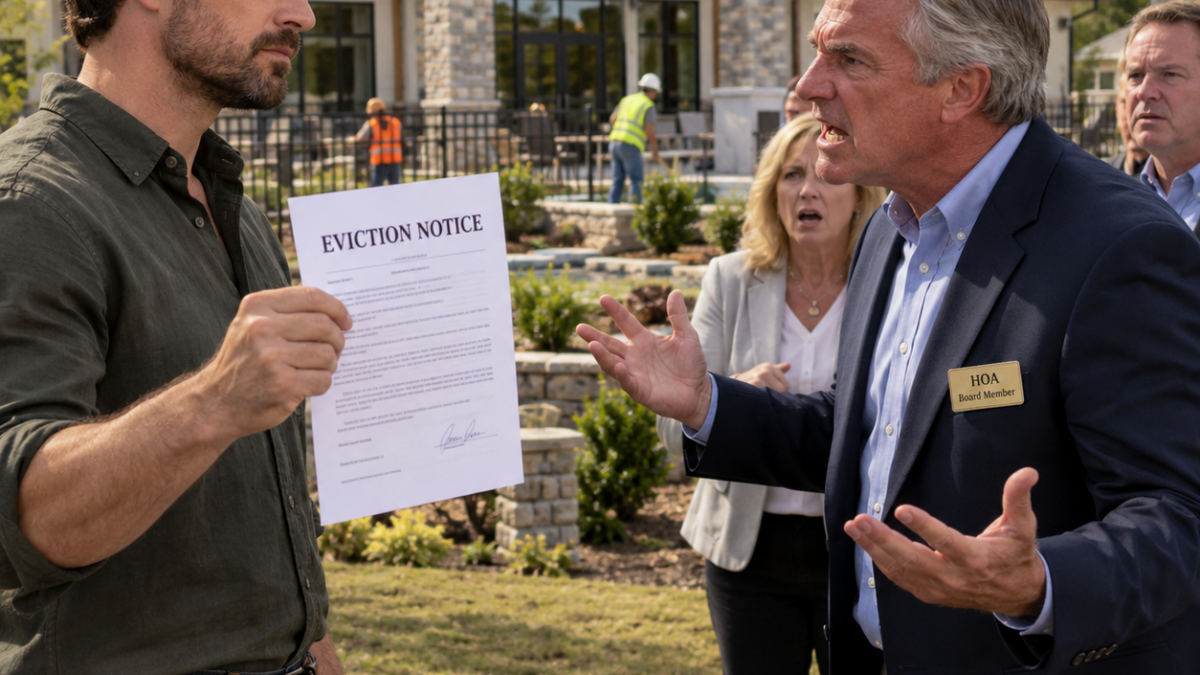
“Eviction notice?”
“In practical terms.”
Marcus looked at me.
“Jack, once we file, this becomes litigation. No improvisation.”
“I understand.”
“If she screams at you?”
“I walk away.”
“If she threatens you?”
“I record it and walk away.”
“If she tries to provoke you in front of cameras?”
“I become boring.”
“Good.”
Arthur looked at the complaint.
“You’re asking for a million dollars in punitive damages.”
Marcus shrugged.
“I’m asking the court to consider the scale of misconduct.”
“You think we’ll get it?”
“Not the point.”
“What’s the point?”
“To make clear that we are not negotiating from weakness.”
I looked through the window toward downtown.
“Do we offer them a chance to buy the land?”
Marcus glanced at me.
“Do you want to sell?”
“No.”
“Then no.”
The two weeks before service crawled.
Karen seemed happier every day.
She spent hours around the clubhouse.
Event planners arrived.
Caterers measured the kitchen.
A florist brought sample centerpieces.
A temporary banner went up:
WELCOME HOME, WHISPERING PINES.
I watched the preparations through the cameras at night.
I wish I could say I enjoyed it.
Sometimes I did.
Other times, it made me sick.
That field had been where my grandfather taught me to drive his old Ford tractor.
It was where we cut hay together.
Where he once stopped in the middle of a July afternoon, handed me water, and said,
“Land remembers who respects it.”
Now sprinkler heads dotted part of that soil.
Parking lights stood where grass had grown for decades.
Concrete covered a section that had never been paved.
Sarah found me staring through the trees one evening.
“You okay?”
“No.”
She stood beside me.
“You can stop this anytime.”
“I know.”
“You don’t have to prove anything.”
“I know.”
“Then why does it look like you’re trying to survive something?”
I looked at the clubhouse.
“Because part of me keeps hearing Grandpa ask why I let them do this.”
Sarah slipped her hand into mine.
“What would he really say?”
I thought about it.
“He’d ask whether I had a plan.”
“And?”
“I do.”
“Then trust it.”
Friday morning arrived clear.
Blue sky.
Warm air.
Birds making far too much noise for what felt to me like the beginning of a courtroom battle.
I parked my truck about a quarter mile from Karen’s house.
Marcus had asked me not to be visible during initial service.
I had him on speakerphone.
“Team one in position,” he said.
My heart was beating harder than I wanted to admit.
I had been under fire before.
I had handled explosives.
I had walked toward devices designed to kill the person who approached them.
Yet sitting in my Ford on a peaceful Virginia street while a process server walked toward an HOA president made my palms sweat.
“Moving.”
Through binoculars, I saw a gray sedan stop near Karen’s driveway.
A man in khakis stepped out carrying an envelope.
Thirty seconds later, Karen emerged.
Pink tracksuit.
Coffee mug.
Hair perfectly arranged.
She paused when she saw him.
They spoke.
Karen shook her head.
The server extended the envelope.
She refused.
He spoke again.
She waved him away.
Then he placed the documents at her feet after identifying her.
Marcus’s phone buzzed.
“Service complete.”
My pulse jumped.
“Board teams?”
“Moving.”
Another thirty seconds.
Marcus said,
“Go.”
The posting team drove toward the clubhouse.
I started my truck.
By the time I reached the access lane, two representatives from Marcus’s office were standing at the front entrance.
One had legal papers.
The other carried a camera.
They affixed the notice squarely beside the clubhouse doors.
Bright.
Impossible to miss.
PROPERTY SUBJECT TO PENDING LITIGATION.
POSSESSION DISPUTED.
NOTICE TO VACATE.
Photographs were taken.
Time stamped.
Documented.
Then I heard tires.
Karen’s white Lexus came around the curve far too fast.
She braked so hard the front dipped.
The driver’s door flew open.
She came out holding the lawsuit.
“What the hell is this?”
The representative remained calm.
“Mrs. Miller, you have been served with legal process concerning this property.”
“You cannot put that on my building!”
“Ma’am, ownership and possession of this structure are disputed.”
“This belongs to Whispering Pines!”
“That is a matter for the court.”
“Take it down!”
“No.”
Karen’s face became crimson.
“I am ordering you off association property!”
The man looked at her.
“You are standing on property owned of record by Mr. Jack Riley.”
That sentence hit her.
Hard.
She turned.
Saw my truck.
Our eyes met across perhaps eighty yards.
For the first time since I came home, Karen did not look amused.
She did not look superior.
She looked frightened.
Then anger rushed in to cover it.
She pointed at me.
“You!”
I stayed beside the truck.
“You planned this!”
I said nothing.
“I will ruin you!”
Still nothing.
“You think you can steal from this community?”
The irony nearly broke my discipline.
But Marcus had given me one instruction.
Boring.
So I looked at her.
Then gave the smallest nod.
The same nod I had given her on the first day.
Back when she thought it meant surrender.
Her expression changed.
This time she understood.
I got back into my truck and left.
The gala was cancelled before noon.
By one, residents were posting photographs of the notice.
By two, local reporters were calling.
At three-fifteen, Channel Seven ran an online headline:
LOCAL VETERAN SUES HOA AFTER CLUBHOUSE ALLEGEDLY BUILT ON HIS PRIVATE LAND.
The story spread faster than any of us anticipated.
I agreed to one interview.
Marcus prepared me.
“Facts.”
“Facts.”
“No name-calling.”
“I know.”
“No satisfaction.”
“That one may be harder.”
The reporter stood with me beside the actual surveyed property line.
The clubhouse rose behind us.
“Mr. Riley, did you know this building was being constructed while you were deployed?”
“No.”
“When did you discover it?”
“The day I returned.”
“What did the HOA tell you?”
“That they believed their survey gave them the land.”
“Do you believe that?”
“I rely on the county deed and a certified survey.”
“Why didn’t you immediately stop construction?”
I paused.
Marcus had told me not to discuss legal strategy.
“I sought professional advice and documented what was happening.”
“What do you want now?”
“My property.”
“Would you sell?”
“No.”
“Why not?”
I looked at the field.
“My grandfather spent his life protecting this land. It isn’t an unused patch on a map. It is something my family has cared for for generations.”
“What happens to the clubhouse?”
“That is for the court.”
My interview aired at six.
Karen held her own press conference at six-thirty.
That was not recommended by her lawyer.
I know this because her later deposition made clear that her attorney had specifically told her not to talk.
Karen talked anyway.
She stood in front of the building with the legal notice visible behind her.
“This is a selfish attempt by one individual to hold an entire community hostage.”
Reporters shouted questions.
“Did you verify ownership before construction?”
“We relied upon professionals.”
“Why does the county map show Mr. Riley owns the site?”
“Those records are old.”
“Was Mr. Riley consulted?”
“The land was effectively unused.”
“Does that mean no?”
Karen became irritated.
“The community has invested hundreds of thousands of dollars in this project. A reasonable person would understand that the greater good matters.”
Then she said the sentence that destroyed whatever public sympathy she might have had.
“A real patriot would have been proud to donate unused land for his neighbors.”
The clip went everywhere.
I was eating dinner when Sarah held up her phone.
“You’re trending locally.”
“I don’t know what that means.”
“It means Karen just insulted thousands of veterans on camera.”
I groaned.
“I didn’t want this to become a military thing.”
“It became one the moment she said patriot.”
Veterans groups began sharing the interview.
Then property-rights pages.
Then local radio.
Karen attempted a second statement the next morning.
It did not help.
Meanwhile, Carol and Arthur decided it was time.
Every homeowner in Whispering Pines received a packet.
Not anonymous gossip.
Documents.
Budget overruns.
Construction cost increases.
The questionable survey.
Payments tied to Karen’s brother-in-law.
Special assessments.
Board minutes.
Arthur wrote a six-page summary using language so simple that nobody could hide behind accounting jargon.
The emergency HOA meeting occurred Sunday evening.
I did not attend.
I was not a member.
But Carol called Sarah immediately afterward.
Sarah put her on speaker.
“You should have seen it.”
“How bad?” I asked.
“Bad.”
“For Karen?”
“Biblical.”
According to Carol, more than a hundred homeowners packed the clubhouse parking area even though the building itself remained under dispute.
People brought the financial packets.
They brought old violation letters.
Fines.
Legal threats.
Architectural denials.
Years of anger.
Karen attempted to call the meeting disorderly.
Someone shouted,
“You spent four hundred thousand dollars on someone else’s land!”
Another homeowner demanded to know why her brother-in-law’s company received money.
The treasurer claimed he did not know the relationship.
A board member accused Karen of withholding information.
Karen accused the board of cowardice.
People began demanding resignation.
Then Mark Delaney, one of the oldest homeowners in Whispering Pines, formally moved for a vote of no confidence.
It passed overwhelmingly.
Karen Miller was removed as president.
Not suspended.
Removed.
The rest of the board barely survived.
Two members resigned the next morning.
By Tuesday, the HOA’s attorney contacted Marcus.
“They want to settle,” he told me.
We were sitting in his office.
“What are they offering?”
“Purchase your land at above-market price. Reimburse legal fees. Formal written apology. Mutual release.”
“How much above market?”
He told me.
It was a serious number.
Sarah looked at me.
Arthur looked at me.
Marcus waited.
I stared at the offer.
There are moments when revenge becomes expensive.
Not financially.
Morally.
I could sell.
Take the money.
Move on.
Nobody would blame me.
But then I remembered Karen’s first sentence.
Your property line is a suggestion.
I remembered my grandfather’s hand resting on a fence post.
They aren’t making any more of it.
I pushed the paper back.
“No.”
Marcus nodded once.
Sarah asked,
“You’re sure?”
“Yes.”
“What do you want?”
I looked at Marcus.
“The building.”
He leaned back.
A slow smile appeared.
“Good.”
The HOA’s new interim leadership did not understand.
Their lawyer certainly did.
They argued that taking the building would be unjust enrichment.
Marcus argued that their predecessor acted in bad faith, constructed after relying on a facially defective survey, ignored long-recorded property evidence, trespassed deeply into my parcel, then continued asserting authority over me.
Discovery began.
That was where Karen’s position collapsed.
Emails surfaced.
One was from the HOA’s original development consultant.
Sent months before construction.
The message warned the board that the chosen clubhouse site appeared to overlap Parcel 7B and recommended confirming title before any site work.
Karen replied:
Our updated survey resolves this. Proceed.
Another email from a contractor asked whether they had a signed land transfer.
Karen responded:
No transfer is necessary. The old Riley parcel will eventually be absorbed into Whispering Pines anyway.
Marcus read that line three times.
Then looked at me.
“She knew.”
Another email was worse.
A board member wrote:
What happens if Riley returns and objects?
Karen replied:
By then the facility will be built and no judge will make us tear down a community asset.
I stared at the screen.
Sarah whispered,
“My God.”
That was it.
The reason they had continued.
The same strategy I was using against them, Karen had tried first.
She believed once the building was complete, the sheer cost would force me to surrender.
Marcus almost admired the audacity.
“She was betting on equitable pressure.”
“What does that mean?”
“She thought a court would say, yes, technically it’s his land, but look at this expensive building. Let’s make him sell.”
“She gambled on stealing enough to make returning it inconvenient.”
“Essentially.”
“And she lost?”
Marcus tapped the email.
“She may have just guaranteed it.”
Karen’s deposition happened six weeks later.
By then, she looked completely different.
Gray suit.
No visor.
No oversized sunglasses.
No clipboard.
She sat beside her attorney with both hands folded tightly.
I sat across the conference room with Marcus.
A court reporter prepared the transcript.
Marcus began gently.
“Mrs. Miller, how long were you president of Whispering Pines?”
“Six years.”
“Were you familiar with the community boundaries?”
“Generally.”
“You oversaw the clubhouse project?”
“Yes.”
“You advocated for the selected location?”
“I supported it.”
“Who selected it?”
“The board.”
“Who first proposed it?”
Pause.
“I did.”
Marcus placed the county plat in front of her.
“Do you recognize this?”
“A map.”
“A recorded county plat.”
“Yes.”
“Please identify Whispering Pines.”
She pointed.
“Now identify Parcel 7B.”
She hesitated.
Then pointed.
“And the clubhouse site?”
Silence.
Her attorney shifted.
Marcus waited.
Karen finally said,
“According to our survey, that area was community property.”
“That was not my question.”
She looked at him.
“Please indicate the clubhouse location on the recorded plat.”
She could not do it without showing the building was on my land.
Marcus introduced the HOA survey.
“You relied on this?”
“Yes.”
“Who hired Gene Haskins?”
“The board.”
“Who contacted him?”
“I don’t remember.”
Marcus produced an email.
“Would this refresh your memory?”
Karen read it.
Her jaw tightened.
“You contacted him personally, correct?”
“Yes.”
“Were you aware his professional license had been suspended?”
“No.”
“You did not verify his license?”
“I assumed his company handled that.”
“Mrs. Miller, you were committing more than two hundred fifty thousand dollars of homeowner funds based on his work, and you did not confirm whether he was legally authorized to perform it?”
Her attorney objected to tone.
Marcus moved on.
Then came the tow-truck notice.
The violation letters.
Arthur’s mailbox.
The Henderson garden gnomes.
Karen became increasingly irritated.
Finally Marcus reached the first conversation.
“Mrs. Miller, do you remember meeting my client on the day he returned home?”
“Yes.”
“Did he tell you the clubhouse was on his property?”
“He claimed it was.”
“Did you tell him his property line was a suggestion?”
“I do not recall those exact words.”
“Did you tell him the project benefited the community?”
“Yes.”
“Did you tell him boundaries change?”
“I may have explained that development evolves.”
Marcus handed her the email discovered earlier.
The one asking what would happen if I objected after returning.
She read it.
Her face changed.
Marcus leaned forward.
“Mrs. Miller, before construction was complete, you were explicitly warned that Mr. Riley might object.”
She said nothing.
“You knew there was a title issue.”
“We believed our survey.”
“Then why did you write, ‘By then the facility will be built and no judge will make us tear down a community asset’?”
Her lawyer touched her arm.
Karen looked trapped.
“We were discussing hypotheticals.”
“You expected construction itself to pressure the owner.”
“No.”
“You expected completion to make the encroachment irreversible.”
“No.”
“You expected a court to force him to accept it.”
“That is not what I said.”
Marcus’s voice dropped.
“Then what did you mean?”
Karen finally snapped.
“I meant the land was sitting there doing nothing!”
The room went silent.
Her lawyer closed his eyes.
Karen continued.
“He wasn’t even living there. Nobody was using it. Whispering Pines needed the space. We improved it.”
Marcus did not interrupt.
That was smart.
Angry people often do your work for you.
“We landscaped it,” Karen said. “We brought utilities. We increased the value. If anything, he benefited.”
Marcus waited.
Then:
“So because you believed my client was not making adequate use of his property, you believed the association had a right to occupy it?”
“I didn’t say that.”
“You just did.”
“I said—”
“No further question on that point.”
Karen looked at me.
Our eyes met.
There was hatred there.
But beneath it was something else.
Recognition.
She finally understood the mistake.
Not building the clubhouse.
Underestimating the owner.
Marcus moved for summary judgment.
The evidence, he argued, left no legitimate dispute over title.
The deed was clear.
The original markers were clear.
Dave’s survey was clear.
The HOA’s survey was defective.
The surveyor’s license was suspended.
Internal correspondence showed Karen knew a dispute existed before completion.
Emails demonstrated a deliberate strategy to finish construction first and use the cost of the structure as leverage against the landowner.
The judge issued his ruling six weeks later.
I sat beside Sarah.
Marcus sat on my other side.
Representatives from the HOA occupied the opposite table.
Karen was behind them with her own counsel because several claims had begun separating her personal conduct from the association itself.
The judge spoke for nearly twenty minutes.
Most of it was technical.
Then he reached the point everyone cared about.
“The recorded title to Parcel 7B is unambiguous.”
I squeezed Sarah’s hand.
“The plaintiff, Mr. Jack Riley, is the lawful owner.”
No surprise.
Still, hearing it mattered.
“The association’s construction constituted an encroachment upon private property.”
The judge discussed good faith.
Equity.
Intent.
The defective survey.
Internal warnings.
Karen’s emails.
Then he said:
“This court cannot reward a party for intentionally completing an encroaching improvement in the hope that the cost of its own conduct will later be used to deprive the lawful owner of meaningful relief.”
Marcus looked straight ahead.
I could see the smallest hint of satisfaction in his jaw.
The judge ruled that the HOA had no possessory right to the land.
They were ordered to vacate.
The structure was legally tied to my real property interest.
Additional claims concerning damages, assessments, and individual misconduct could continue separately.
The disputed clubhouse was mine.
For several seconds, I felt nothing.
Then Sarah whispered,
“Jack.”
I looked at her.
She was crying.
I realized I was too.
Not because I had won a building.
Because somewhere inside me, I had been afraid my grandfather’s warning had been right in the worst possible way.
Hold on to it.
I had.
Outside the courthouse, reporters waited.
Marcus told me I could walk past.
I almost did.
Then one reporter called,
“Mr. Riley, what are you going to do with the clubhouse?”
I stopped.
Looked at Sarah.
Then at the cameras.
“I don’t know yet.”
“Sell it?”
“No.”
“Demolish it?”
“I don’t think so.”
“What does this victory mean to you?”
I thought about it.
“That a property line isn’t a suggestion.”
Then I walked away.
The financial consequences inside Whispering Pines were brutal.
The HOA had spent more than four hundred thousand dollars on an asset it no longer controlled.
Legal fees climbed.
Homeowners were furious.
The board entered court-supervised restructuring.
Claims were brought against people involved in approving the project.
The district attorney began reviewing the suspended surveyor issue and the payments connected to Karen’s brother-in-law.
I stayed out of that as much as possible.
That was no longer my fight.
Karen put her house up for sale.
I saw her once.
She was carrying boxes from the garage into a moving truck.
I was driving past on the county road.
Our eyes met briefly.
No shouting.
No threats.
She looked older.
Tired.
For a moment, I almost felt sorry for her.
Then I remembered the tow truck.
The Hendersons.
Arthur.
The email about forcing me to surrender because the building would already exist.
Pity is not the same as forgiveness.
I kept driving.
The court-appointed HOA representatives approached me about the clubhouse furnishings.
Technically, some equipment had separate ownership questions.
The association needed money.
Creditors needed payment.
Moving commercial kitchen equipment, furniture, televisions, fitness machines, and other fixtures would cost money they did not have.
A liquidation auction was scheduled.
Most buyers had little interest.
The building itself could not be moved economically.
The furniture had to be collected from property now controlled by me.
I attended the auction.
Sarah came.
Arthur came because, according to him, “I spent too many evenings auditing this catastrophe not to see the ending.”
The auctioneer worked quickly.
Tables.
Chairs.
Couches.
Kitchen equipment.
Televisions.
Decor.
Grouped lots.
Very few serious bids.
I raised my paddle.
Ten thousand dollars later, nearly everything remaining in the clubhouse belonged to me.
Arthur shook his head.
“They spent how much?”
“Over four hundred thousand.”
“And you just acquired most of the contents for ten?”
“Apparently.”
Sarah touched my arm.
“Do not become smug.”
“I’m trying.”
“You’re failing.”
The bronze plaque near the entrance was not part of the auction.
It was permanently installed.
WHISPERING PINES COMMUNITY CLUBHOUSE.
A VISION REALIZED THROUGH THE LEADERSHIP OF PRESIDENT KAREN MILLER.
I stood in front of it with a screwdriver.
Sarah filmed.
“Do we need to document this?” I asked.
“No.”
“Then why are you recording?”
“For me.”
I removed the four screws.
The plaque came loose.
Behind it was clean beige siding untouched by sun.
I held the metal plate.
Arthur said,
“You should keep that.”
“Why?”
“History.”
I considered throwing it away.
Then realized he was right.
Not all history deserves celebration.
Some deserves remembering as a warning.
I placed the plaque in a storage box.
Then came the question I had avoided.
What do you do with a two-story clubhouse you never asked for?
The practical options were obvious.
Rent it.
Sell access.
Convert it into event space.
Lease office rooms.
Turn it into a private residence after zoning modifications.
Sarah and I discussed all of them.
None felt right.
One evening, Dave stopped by.
He had brought beer.
We sat on the clubhouse deck looking across the field.
The sunset turned the grass gold.
Dave leaned his prosthetic leg against the railing.
“You know what this reminds me of?”
“What?”
“The old vet center that closed.”
I looked at him.
The county’s veterans support center had lost its lease the previous year.
Programs were scattered across several churches and rented offices.
Counseling in one place.
Benefits assistance in another.
Peer meetings wherever space was available.
Dave took a drink.
“You’ve got meeting rooms.”
“Yes.”
“Kitchen.”
“Yes.”
“Accessible entrances.”
“Yes.”
“Parking.”
“Unfortunately.”
He smiled.
“You know where I’m going.”
I looked through the windows.
The big room.
Conference spaces.
Commercial kitchen.
Deck.
The building Karen had imagined as a symbol of her leadership.
I thought about the veterans network that found Dave.
The legal group that connected me with Marcus.
The men who called after deployments.
The younger Marines who had no idea how difficult silence could become after military life.
I looked at Dave.
“Make some calls.”
His face lit up.
Six months later, the clubhouse had another grand opening.
This time there was no champagne tower.
No gold invitations.
No HOA board table.
No president giving a speech about vision.
We had hamburgers.
Hot dogs.
Coolers.
Coffee.
A volunteer benefits counselor.
Representatives from the VFW.
American Legion.
Mental-health support organizations.
Military families.
Older veterans.
Young veterans.
Men with canes.
Women holding toddlers.
One Vietnam veteran who spent twenty minutes arguing with an Afghanistan veteran about which branch made the worst coffee.
Arthur attended.
So did Bill and Mary Henderson.
Carol came from Whispering Pines.
Even Marge from the county records office appeared with a pie.
“What did I tell you?” she said.
“Grandpa would raise hell.”
“You did better.”
A new sign stood above the entrance.
Hand-carved oak.
THE SENTINEL POST
VETERANS • FAMILIES • NEIGHBORS
ALL ARE WELCOME.
I had not planned to speak.
That was Sarah’s fault.
She tapped a glass with a fork until people quieted.
“My husband hates speeches.”
Everyone laughed.
I glared at her.
“So naturally,” she continued, “he’s giving one.”
Dave shouted,
“Semper Fi!”
Someone else yelled,
“Get on with it!”
I stood on the same deck where Karen had intended to toast the completion of Whispering Pines’ clubhouse.
For a moment, words failed me.
Then I looked beyond the crowd.
At the field.
At the old farmhouse.
At the property line Dave had surveyed.
At the black walnut tree my grandfather loved.
“My grandfather used to tell me they weren’t making any more land.”
A few people smiled.
“He said that meant I should hold on to mine.”
I paused.
“For most of this past year, I thought that lesson was about boundaries.”
I looked toward Arthur.
The Hendersons.
Carol.
Marcus.
Dave.
Sarah.
“I was wrong.”
The crowd became quiet.
“A boundary tells you where your rights end and somebody else’s begin. That matters. It matters a lot.”
I glanced back at the building.
“But land isn’t worth protecting just because you can draw a line around it.”
I swallowed.
“It matters because of what people do with it.”
My voice almost broke.
I let it.
“My grandfather used this field to raise cattle, cut hay, teach a stubborn grandson how to drive a tractor, and give half the county vegetables he claimed he didn’t grow on purpose.”
Laughter.
“When I came home and saw this building here, I thought everything about it was wrong.”
I rested one hand on the railing.
“And it was.”
More laughter.
“The way it was built was wrong. The assumption behind it was wrong. The idea that somebody else could decide my property was unused and therefore available was wrong.”
I looked around.
“But the building itself didn’t have to stay wrong.”
Silence.
“That’s what this place is now.”
I pointed toward the sign.
“Something born out of entitlement became something built around service.”
Dave looked down.
I saw him wipe his eye.
I continued.
“People helped me fight this because they believed property rights mattered. Veterans helped me because they believed I mattered. Neighbors helped because they were tired of being bullied.”
I looked toward the Hendersons.
“Justice isn’t complete when the bully loses.”
Then toward the building.
“It’s complete when something better replaces what they did.”
When I finished, nobody moved for a few seconds.
Then applause came.
Not explosive.
Warm.
Long.
Sarah came beside me.
She rested her head against my shoulder.
“You did okay.”
“High praise.”
“Don’t get used to it.”
Life settled.
The legal cases continued without me at the center.
The suspended surveyor eventually faced professional consequences.
Financial investigators kept examining the payments involving Karen’s relatives.
Whispering Pines reorganized its governance.
New elections were held.
The replacement board adopted strict conflict-of-interest rules.
They also sent letters to every adjacent property owner formally acknowledging that HOA authority did not extend beyond the recorded subdivision boundary.
Arthur framed his letter.
He hung it beside his green mailbox.
Karen’s fines against the Hendersons disappeared.
Bill celebrated by buying two more garden gnomes.
Mary bought five.
They arranged all seven along the road facing Whispering Pines.
I accused them of provocation.
Mary said,
“Community expression.”
I could not argue.
One afternoon, months after the Sentinel Post opened, a young Marine named Ethan stopped by.
Twenty-four years old.
Recently discharged.
He stood near the door for almost ten minutes before coming inside.
I noticed because I had done the same thing once outside a veterans meeting years earlier.
Entering a room full of people who might understand you can be harder than entering one full of strangers.
I walked over.
“Coffee?”
He nodded.
We sat.
At first he talked about nothing.
Traffic.
Weather.
Football.
Then he mentioned sleep.
Then anger.
Then how his girlfriend said he seemed like a different person.
Then how sometimes he drove for hours because going home felt harder than staying in the truck.
I listened.
No clipboard.
No forms.
No dramatic advice.
Just listened.
Eventually Dave arrived.
Then a peer counselor.
Two hours later, Ethan left with three phone numbers and plans to come back Thursday.
I stood by the window and watched him drive away.
Sarah walked up.
“You okay?”
I nodded.
“Yeah.”
“What?”
I looked around the building.
“This.”
She understood.
That evening I walked the old boundary line.
The orange stakes were long gone.
The original iron pins remained underground.
Quiet.
Invisible.
Certain.
I stopped near the black walnut tree.
Grandpa had carved a small R into the trunk decades earlier.
I could still see it.
I put my hand against the bark.
“I held it.”
The words came out before I knew I was going to say them.
For months, I had wanted to tell him that.
I held the line.
I protected the property.
I won.
But standing there, I realized that was not the whole truth.
The land had protected something in me too.
After fifteen years in uniform, I had come home without knowing exactly what home was supposed to feel like.
I thought it would be silence.
Space.
No radios.
No schedules.
No one depending on me.
Then Karen Miller built a clubhouse in the middle of that fantasy.
She forced me into one more battle when I believed I had finished fighting.
I hated her for that.
For a while.
Maybe part of me always would.
But the fight introduced me to neighbors I barely knew.
Arthur.
The Hendersons.
Carol.
It reconnected me with Dave.
Brought Marcus into my life.
Turned Sarah and me from two people returning to an old farmhouse into members of a community we had never expected.
And eventually it gave people like Ethan somewhere to walk through the door.
I would never thank Karen.
That would be ridiculous.
But I learned something because of her.
Property rights are not selfish.
Boundaries are not selfish.
Saying no is not selfish.
You can protect what belongs to you and still use it generously.
Those ideas are not opposites.
The distinction is consent.
Karen never understood that.
She believed “community” was a magic word that erased ownership.
That if enough people wanted something, one person’s rights became inconvenient details.
But a real community does not begin by taking.
It begins by asking.
It respects the word no.
It leaves room for people who choose differently.
It understands that generosity only means something when the giver had the right to refuse.
A year after the court ruling, Whispering Pines held its annual meeting in a rented school auditorium.
Their new president invited me.
I declined.
Then reconsidered.
Sarah and I sat in the back.
The new board chair, a man named Daniel Price, spent most of the meeting discussing reserve funds, drainage, and boring maintenance topics.
Exactly what an HOA meeting should discuss.
Near the end, he addressed the clubhouse disaster.
“We inherited a painful and expensive lesson,” he said.
No euphemisms.
No excuses.
He displayed a boundary map.
“All residents should understand that Whispering Pines ends here.”
He pointed.
A clear line.
My property sat outside it.
Several people laughed.
Daniel smiled.
“Very clearly here.”
More laughter.
Then he became serious.
“Community government exists to manage shared responsibilities. It does not exist to expand its own authority.”
I looked at Sarah.
“That sounds familiar.”
“Maybe they learned.”
Afterward, Carol approached me.
“You know Karen used to say nobody cared enough to challenge her.”
“That was probably true for a while.”
“She mistook exhausted people for supportive people.”
That sentence stayed with me.
Bullies often do that.
Silence looks like consent from the top.
From underneath, it often means somebody is calculating whether fighting back is worth the cost.
Karen kept increasing that cost.
Until one day the cost of staying quiet became higher than the cost of standing up.
Arthur joined us.
He wore a bright green tie.
“Mailbox green,” he explained.
Of course it was.
The Hendersons walked over.
Mary showed me a photograph.
Their seven garden gnomes had become nine.
“Bill has a problem.”
Bill shook his head.
“I’m building a community.”
We laughed.
Those were the moments that mattered.
Not Karen losing the presidency.
Not the deposition.
Not even the judge’s ruling.
Those victories were satisfying.
But satisfaction fades.
Restoration lasts.
Several months later, I received a letter.
No return address I recognized.
Inside was a single sheet.
Jack,
I do not expect forgiveness.
I made decisions I believed were for the benefit of Whispering Pines. I now understand that believing you are acting for others does not give you the right to ignore them.
I was angry with you for a long time.
I blamed you for what happened.
That was easier than accepting that I caused it.
I hope the building is being used well.
Karen.
I read it twice.
Sarah read it.
“What are you going to do?”
“Nothing.”
“You going to answer?”
I thought about it.
Then shook my head.
“No.”
“Why?”
“Because I don’t need anything else from her.”
I folded the letter.
Put it in the same box as the old bronze plaque.
Not as a trophy.
As history.
Some stories need their final page even if nobody replies.
On the second anniversary of the Sentinel Post, Ethan came back.
This time he walked in without hesitating.
He brought another young veteran with him.
“Jack,” he said, “this is Luis.”
Luis looked exactly like Ethan had looked two years earlier.
Guarded.
Tired.
Not ready to admit he needed anything.
I held out my hand.
“Coffee?”
He nodded.
Ethan smiled.
And suddenly I understood what my grandfather meant better than I ever had before.
They aren’t making any more land.
He wasn’t only talking about acreage.
He was talking about places.
The kind people can lose if nobody protects them.
A farm.
A house.
A workshop.
A garden.
A table.
A room where someone knows your name.
The physical space matters because human beings build meaning inside it.
Karen saw my hayfield and thought:
Unused.
Available.
Opportunity.
My grandfather saw:
Inheritance.
Responsibility.
Home.
I had spent an entire year proving which definition mattered legally.
It took longer to understand which definition mattered emotionally.
One warm Saturday evening, Sarah and I stayed at the Sentinel Post after everyone else left.
The deck lights glowed.
Crickets filled the field.
The building looked almost peaceful against the trees.
Sarah handed me a beer.
“Do you remember the first time you saw it?”
“I try not to.”
“What did you think?”
“That I was hallucinating.”
“After that.”
I took a drink.
“That somebody had stolen part of Grandpa.”
She leaned against the railing.
“And now?”
Inside, I could see photographs mounted along one wall.
Veterans events.
Family dinners.
Benefits workshops.
Christmas toy drives.
A memorial table.
Arthur’s retirement party.
The Hendersons donating vegetables.
Ethan laughing with Dave.
I thought about the question.
“Now it feels like ours.”
Sarah smiled.
“It was always ours.”
“No.”
I shook my head.
“The land was.”
I looked through the glass.
“The place became ours later.”
A truck passed slowly on the road.
The driver waved.
I waved back.
Farther beyond the trees, lights from Whispering Pines came on one by one.
For a long time, that neighborhood had looked like enemy territory to me.
Now it was simply where people lived.
Most of them had never wanted my land.
Most had never known what Karen was doing.
Many had been manipulated.
Some had been afraid.
They were not the enemy.
That distinction mattered too.
Karen had tried to turn “community” against “individual.”
The battle taught me they did not have to be enemies.
A strong community is made of people whose individual rights are secure enough that generosity can be voluntary.
That was the kind of place I wanted.
The kind my grandfather understood without needing a law degree.
Sarah rested her head against my shoulder.
“You know what the funniest part is?”
“What?”
“She wanted this to be a clubhouse.”
“It is a clubhouse.”
“No.”
She pointed through the window.
“It’s a community center.”
I laughed.
Karen had gotten one thing right.
The land could serve people.
She had simply forgotten the most important step.
Ask the owner.
Two years earlier, she had stood in my hayfield and told me my property line was a suggestion.
She had believed the weight of the HOA, the money already spent, and the size of the building would make resistance impossible.
So I let her keep building.
I let the hardwood floors go down.
I let the granite arrive.
I watched them install televisions.
Leather furniture.
Commercial appliances.
Landscaping.
Sprinklers.
Lights.
I watched her bronze plaque go onto the wall.
I watched her schedule the band.
The caterer.
The champagne toast.
And one day before she planned to stand on that deck and celebrate the biggest achievement of her presidency, I handed her the only invitation that mattered.
A lawsuit.
An eviction notice.
A reminder that no amount of entitlement could erase a deed recorded at the courthouse.
She believed finishing the building would make her untouchable.
Instead, finishing it made the lesson impossible to ignore.
The HOA spent hundreds of thousands building on land it did not own.
Karen lost the office she had used to intimidate people.
The survey she relied on became evidence against her.
Her own emails revealed her intent.
Her financial decisions helped turn her neighbors against her.
The clubhouse she intended as the monument to her authority became legally mine.
And the land?
The land never changed.
That was the beautiful part.
The line had always been there.
Before Karen.
Before Whispering Pines.
Before the clubhouse.
Before the lawsuits.
The iron pins stayed buried beneath the Virginia soil the entire time, indifferent to everyone’s opinions.
The truth did not move just because somebody powerful found it inconvenient.
Neither did I.
Years from now, I imagine people will forget Karen Miller’s name.
They may even forget why a building called the Sentinel Post sits strangely in the middle of five old acres beside a suburban development.
That is fine.
I do not need a plaque explaining the revenge.
I do not need people to know how satisfying it was to see the eviction notice attached to the door.
I do not need anyone to remember the newspaper headline.
What matters is what remains.
Arthur still has his green mailbox.
The Hendersons still have too many garden gnomes.
Whispering Pines has a boring, responsible HOA board.
Young veterans still walk through the Sentinel Post doors looking for someone who understands.
Sarah still catches me staring across the field sometimes.
And every so often, when I walk the boundary, I stop near one of the old iron survey pins and think about the first thing Karen told me.
Your property line is a suggestion, dear.
I smile every time.
Because the clubhouse is still standing.
The land is still mine.
The people using the building are there because I invited them.
And somewhere beneath that manicured grass and expensive landscaping is the same old boundary my grandfather spent his life protecting.
Not a suggestion.
Never was.
Never will be.