PART 2: HOA Banned My Maple Sap Harvest—I Make The Syrup For Their Annual Mother’s Day Brunch
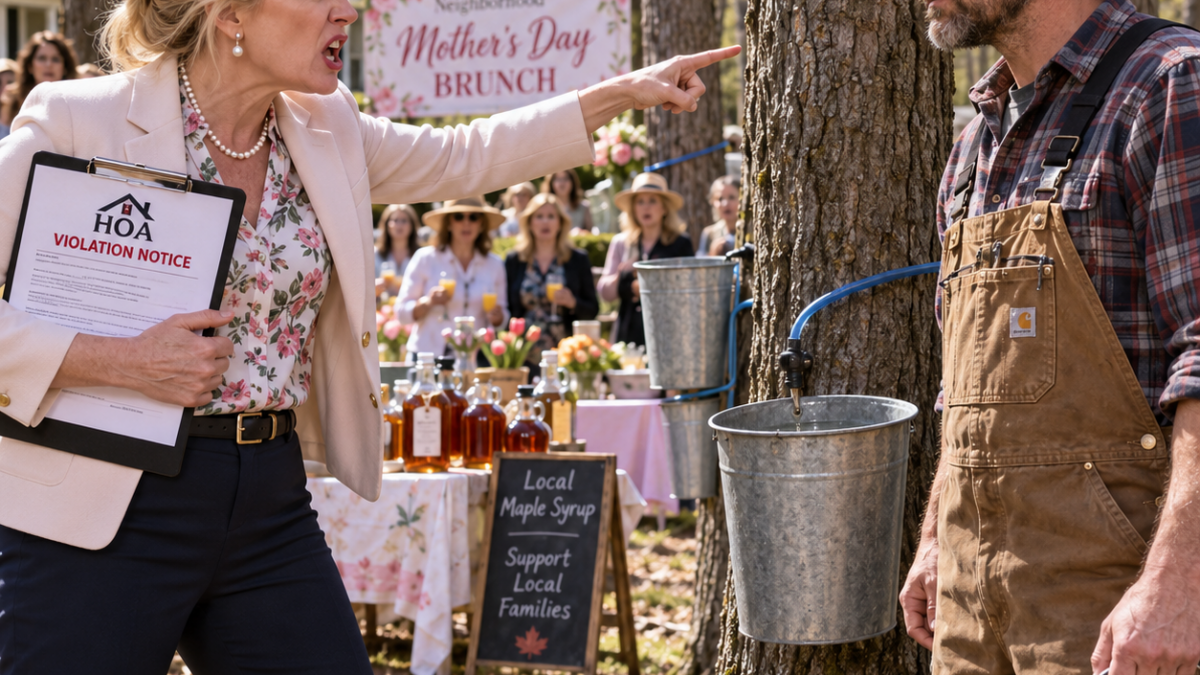
For ten years, my maple syrup had been the first thing families reached for at our neighborhood’s Mother’s Day brunch, and I had never charged the HOA a dime.
Then a new president stood outside my eighty-year-old sugar shack, called my family tradition an “illegal commercial operation,” and handed me $21,000 in fines like she was shutting down a meth lab instead of a Vermont maple harvest.
What she didn’t know was that the sweetest part of the season had nothing to do with syrup—and she was about to hand me everything I needed to prove it.
“This unpermitted commercial operation is a blight on Spring Meadows, and you will cease production immediately.”
Karen Kowalski stood in the snow with one hand on her hip and the other wrapped around a clipboard as if she had been elected governor of Vermont instead of president of a homeowners association with fewer than two hundred houses.
Steam rolled from the vents of my sugar shack behind me.
The evaporator was running hot.
Fresh sap hissed as it boiled down in the stainless-steel pans, filling the cold March air with that warm, woody sweetness every sugarmaker knows before he can even see the shack through the trees.
My grandfather had built that building eighty years earlier from timber cut on the same property.
My father had boiled there.
I had learned there.
My son had stood on an overturned milk crate in that shack at six years old, watching steam rise while my father explained why forty gallons of sap might give you only one gallon of syrup if the trees were feeling generous.
Karen looked at it and saw a violation.
I looked at her pink winter jacket, fur-lined boots, laminated rule sheet, and the two miserable board members standing behind her.
Then I looked back at the paper she had shoved into my hand.
Three violations.
Unapproved outbuilding.
Unauthorized commercial enterprise.
Aesthetic nuisance.
Five hundred dollars per violation per day.
Retroactive fourteen days.
Total due:
$21,000.
I read the number again.
“Twenty-one thousand?”
Karen smiled.
“Currently.”
“Currently?”
“The fines continue until you cease operations and submit a remediation plan.”
Behind her, Todd Benson shifted uncomfortably.
Linda Shaw stared at the snow.
Neither looked proud of what they were doing.
Karen looked delighted.
I raised the notice.
“You understand this building was here before Spring Meadows existed.”
“That’s irrelevant.”
“It predates the HOA by decades.”
“Old structures still have to comply with current community standards.”
“This is an agricultural property.”
“This is a residential community.”
“The subdivision was built around my farm.”
Karen exhaled through her nose.
“You always say that as though age gives you special rights.”
“It sometimes gives property legal rights.”
Her smile tightened.
“Mr. Callahan, the board has authority here.”
I almost corrected her pronunciation of my last name.
Again.
I didn’t.
Twenty years in the Army Corps of Engineers had taught me not to waste ammunition on targets that didn’t matter.
Instead, I folded the violation notice once.
Slowly.
“Karen.”
Her eyes narrowed because I used her first name.
“You have absolutely no idea what you’re doing.”
She laughed.
“Oh, I think I do.”
Then she turned toward the sugar shack.
“And your little syrup factory is the first thing we’re cleaning up.”
That sentence changed something in me.
Not because she insulted me.
I had been called worse by people with more impressive résumés.
Because for ten years, every March, I donated twenty gallons of my best Grade A amber syrup to Spring Meadows.
Free.
The HOA bottled it in little glass containers.
Printed custom labels.
Sold some.
Served the rest over pancakes and waffles at the annual Mother’s Day brunch.
The proceeds helped pay for playground repairs, community events, summer cookouts, and little projects the HOA never wanted to fund out of dues.
The syrup had become part of Spring Meadows.
Children came to the sugar shack every spring to watch it being made.
Parents took pictures.
Older residents remembered my father.
Former HOA president George Whitmore used to joke that Patriot’s Gold—the name my father gave our syrup—was the only thing keeping the neighborhood civil.
Now Karen was threatening to shut down the very operation that supplied her biggest fundraiser.
And she was smiling while doing it.
She walked back toward her SUV.
Todd and Linda followed.
I watched them leave.
Then I looked at the notice in my hand.
The evaporator crackled behind me.
Steam rolled across the trees.
A drop of condensed water fell from the roof and struck the snow.
I had no intention of stopping the boil.
Not that day.
Not for Karen.
Not for anybody.
But I also knew something she clearly didn’t.
In a fight over rules, the loudest person rarely wins.
The person with the better documents usually does.
And my grandfather had loved documents almost as much as he loved maple trees.
PART 2
The first person I called was George Whitmore.
George had been president of the Spring Meadows HOA for almost fourteen years.
Not because he craved authority.
Mostly because nobody else wanted the job.
Under George, HOA meetings lasted forty minutes.
Sometimes thirty if everyone behaved.
The board fixed roads.
Organized the summer barbecue.
Collected dues.
Maintained the playground.
Sent polite reminders when somebody left a broken camper beside the road for six months.
That was basically it.
George’s philosophy was simple.
“Don’t create a rule for something that can be solved by talking to your neighbor.”
I missed George.
Unfortunately, George had retired to Florida.
He answered on the fourth ring.
“Jack?”
“George.”
“Maple season?”
“Yes.”
“How’s the run?”
“Good.”
“Then why do you sound like someone backed over your dog?”
“Karen wants to shut down the sugar shack.”
Silence.
Then:
“What?”
I repeated it.
George let out a long breath.
“Of course she does.”
“She cited building restrictions and commercial-use covenants.”
“The shack?”
“Yes.”
“The old shack?”
“There’s only one.”
“I know. I’m trying to understand how a human being could be that stupid.”
I smiled despite myself.
“She says the HOA can condemn it.”
George made a sound that was not quite a laugh.
“Jack, your grandfather had that property protected before the developer signed the first subdivision agreement.”
“That’s what I thought.”
“No. You don’t understand.”
His tone changed.
“Walter Callahan did not trust developers.”
“I know.”
“He really did not trust homeowner associations.”
“That I also know.”
“When he sold the surrounding acreage in the seventies, he made them sign an agricultural exemption.”
I turned toward the house.
“Where?”
“Master deed addendum.”
“You’re sure?”
“I signed board documents referencing it for fourteen years.”
“Which box?”
George laughed.
“Your grandfather had forty boxes.”
“Exactly.”
“Look for one labeled deeds and covenants. Green metal file box if it hasn’t rusted through.”
I knew the one.
“George.”
“Yeah?”
“Karen just fined me twenty-one thousand dollars.”
“What?”
“Retroactive daily penalties.”
Another silence.
Then:
“Does she know you donate the syrup?”
“She knows.”
“For the brunch?”
“She’s running the brunch.”
“Oh, this is going to be spectacular.”
“What?”
“Nothing.”
I heard a golf cart in the background.
George lowered his voice.
“Jack, find that addendum.”
“I will.”
“And don’t stop boiling.”
“I wasn’t planning to.”
“Good.”
Before hanging up, George added:
“Your grandfather used to say something every time the developers complained about his cows.”
“What?”
“Paper beats promises.”
I remembered that.
Granddad had said it about everything.
Land boundaries.
Contracts.
Loans.
Marriage licenses.
Military orders.
He believed memory could be argued with.
Paper couldn’t.
I shut down the evaporator after the current batch reached density.
Then I went inside.
Sarah was at the kitchen island cutting vegetables.
She looked up.
“Karen?”
“How’d you know?”
“You have your Karen face.”
“My what?”
“The expression you make when someone has just said something so stupid you’re trying to decide whether to correct them or study them.”
I placed the violation notice on the counter.
She read it.
Then read it again.
“Twenty-one thousand dollars?”
“That’s today’s number.”
Her eyes lifted.
“What does that mean?”
“Fifteen hundred a day.”
Her knife stopped.
“Jack.”
“I know.”
“Can they do this?”
“I don’t think so.”
“That is not the answer I wanted.”
I kissed her forehead.
“George says Granddad put an exemption in the original deed.”
“George remembers that from forty years ago?”
“Apparently.”
Sarah put the knife down.
“Where?”
“Green file box.”
She stared at me.
“The one in the basement?”
“Yes.”
“With the dead spiders?”
“Yes.”
“You’re going alone.”
Fair.
Four hours later, I was sitting on the basement floor surrounded by documents that smelled like mildew and history.
Tax maps.
Receipts.
Old forestry reports.
Letters from the developer.
Handwritten notes in Granddad’s blocky handwriting.
Then I found it.
ORIGINAL SPRING MEADOWS MASTER DECLARATION—AGRICULTURAL EXEMPTION.
My heart rate changed.
I opened the folder.
There it was.
Recorded 1974.
Parcel 7A.
The Callahan homestead.
Exempt from Articles 12 through 28 of the future association covenants.
Architectural review.
Agricultural structures.
Aesthetic regulations.
Land-use restrictions.
Accessory buildings.
Farm operations.
There was even language recognizing ongoing seasonal agricultural activity.
Granddad had not merely protected the sugar shack.
He had protected the entire working character of the property.
I laughed.
Sarah called from upstairs.
“You alive?”
“Yes!”
“Found it?”
“Yes!”
She came down three steps.
Then remembered the spiders.
“That good?”
“Very.”
I carried the file upstairs.
We spread everything across the kitchen table.
The HOA charter.
The exemption.
My state farm registration.
Town agricultural zoning.
Fire inspection.
Maple producer paperwork.
I went line by line through Karen’s violations.
Section 17.4.
Not applicable.
Section 21.2.
Not applicable.
Section 33.8 was more complicated because it involved home businesses.
But our maple operation was not a suburban home business.
It was agricultural production.
Trees.
Sap.
Boiling.
Bottling.
A farm product.
Our county zoning code recognized it.
State law recognized it.
I sat back.
Sarah looked at me.
“She’s wrong.”
“Yes.”
“How wrong?”
“Comprehensively.”
Sarah smiled.
“That is your favorite kind.”
The next morning, I built the response.
Not emotionally.
Methodically.
Violation one.
Quoted.
Counterpoint.
Exhibit.
Violation two.
Counterpoint.
Exhibit.
Violation three.
State agricultural classification.
Municipal zoning.
Prior use.
HOA exemption.
I called George and asked him to write an affidavit confirming the HOA’s historical recognition of the sugar operation.
He emailed it within two hours.
At the bottom he added one sentence.
For more than a decade, the HOA has knowingly accepted maple syrup produced at Parcel 7A as an in-kind contribution for association fundraising activities.
That line mattered.
It showed knowledge.
Acceptance.
Benefit.
I included it.
The final package ran thirty-six pages.
Sarah read the cover letter.
“You sound terrifying.”
“I sound polite.”
“That’s why it’s terrifying.”
I ended with ten business days to retract the fines and confirm no further enforcement against protected agricultural activity.
Then I printed five complete packets.
One for each board member.
Certified mail.
Return receipt.
I also sent copies to the town planning office.
Not as a complaint.
As documentation.
Then I went back to work.
Sap doesn’t care about HOA politics.
The weather had turned ideal.
Cold nights.
Warm days.
Pressure shifted in the trees.
The sap ran hard.
The woods clicked and dripped from sunrise until evening.
Tubing lines glistened between trunks.
Collection tanks filled.
The sugar shack ran almost around the clock.
That was my favorite part of the year.
The transformation.
Clear sap looked like water.
Tasted faintly sweet.
Nothing special.
Then heat removed what didn’t belong.
Steam rose.
Sugar concentrated.
Color deepened.
Flavor emerged.
Forty gallons became one.
Sarah always said sugaring was the only thing I did patiently without realizing I was being patient.
Maybe she was right.
Five days passed.
Nothing from Karen.
Then seven.
Still nothing.
I started hoping somebody on the board had finally opened the documents and said:
We made a mistake.
That would have been enough.
I didn’t need an apology.
I certainly didn’t need revenge.
Just withdraw the fines.
Leave the shack alone.
Life continues.
On the tenth business day, I walked to the mailbox.
There was a thick envelope from the HOA law firm.
I opened it beside the road.
The lawyer acknowledged my submission.
The board was reviewing the issue.
No determination yet.
Fine.
Then I found Karen’s letter.
One page.
The board does not accept your interpretation of historical documents.
My jaw tightened.
The current board is not bound by informal or outdated arrangements entered into by prior leadership.
It wasn’t informal.
It was recorded.
She continued.
The property remains subject to the uniform governance necessary for the preservation of Spring Meadows standards and values.
Then the number.
Outstanding fines:
$51,000.
I blinked.
She had kept the meter running.
Then came the last page.
NOTICE OF LIEN.
I stopped reading.
Not because I was scared.
Because I had reached the point where anger becomes useful only if you convert it into work.
I called Dave Miller.
Not related to Karen despite the surname.
Corporate attorney.
Neighbor.
Golden retriever owner.
Garden-gnome husband.
He answered.
“Tell me she surrendered.”
“She filed a lien.”
Silence.
“Say that again.”
“She filed a lien.”
“When was the first fine?”
I told him.
“When did she send notice of intent?”
I told him.
“That’s too early.”
“I thought so.”
“It is.”
“How early?”
“By weeks.”
I could hear him moving papers.
“The bylaws require sixty days plus board review before lien initiation.”
“She’s not even close.”
“Jack.”
“Yes?”
“She just created a second problem.”
“What’s the first?”
“The fines.”
“And second?”
“Wrongful lien.”
He sounded almost cheerful.
“You lawyers are strange.”
“No argument.”
That evening, Dave came over.
He brought documents and his dog.
Sarah brought wine.
We sat at the dining table.
Dave read everything.
Then he leaned back.
“She’s trying to scare you.”
“I know.”
“She thinks once the title is clouded, you’ll panic.”
“I’m not selling.”
“She doesn’t know that.”
“I’m not refinancing.”
“She doesn’t know that either.”
“So the threat doesn’t work.”
“The threat may work on most people.”
That bothered me more than my own case.
“What do you mean?”
Dave tapped the lien notice.
“Imagine you’re seventy-five. Fixed income. You receive this.”
I thought of Mrs. Gable.
“Or you need to refinance medical debt.”
I thought of families around Spring Meadows.
“Most people don’t hire counsel.”
I looked at him.
“Who else has she done this to?”
Dave’s expression changed.
“That is the right question.”
I started talking to neighbors.
Mark Hensley first.
Retired contractor.
Oil stain violation.
Fence violation.
Snowblower-storage violation.
He showed me a drawer full of letters.
“Why didn’t you fight?”
“I did.”
“What happened?”
“She sent the attorney.”
“How much did it cost?”
“Three grand.”
“To defend an oil stain?”
Mark shrugged.
“Eventually I paid the fine because it was cheaper.”
That sentence became a pattern.
Cheaper to pay.
Cheaper to comply.
Cheaper to remove.
Cheaper to repaint.
Cheaper to stay quiet.
Mrs. Gable’s bird feeder had been declared an “avian nuisance attractor.”
I read that phrase twice.
“Who wrote this?”
“Karen.”
“What did you do?”
“Took the feeder down.”
“Why?”
Her eyes lowered.
“My husband built it.”
I looked toward the empty hook outside her kitchen window.
“He died last year.”
“I’m sorry.”
“She said if I left it up, fines would start.”
That made the fight personal in a different way.
Not because Karen targeted me.
Because she had learned that fear worked.
At the next house, a young couple showed me the letter ordering removal of their child’s swing set.
Wrong wood tone.
Another neighbor had been told his basketball hoop had to be moved behind the garage despite there being no such requirement in the covenants.
A veteran down the road had received warnings over a small flagpole.
Nothing alone sounded catastrophic.
That was the genius of petty tyranny.
It arrives in portions too small to justify war.
Fifty dollars.
A bird feeder.
A mailbox.
A swing.
A tree.
A roof.
A fine.
By the time everybody realizes it’s a system, everybody has already learned to keep their heads down.
Sarah saw me building a spreadsheet.
“You’re doing it again.”
“What?”
“Army Jack.”
“I’m retired.”
“Your corkboard disagrees.”
I had converted the spare room into what she called Tactical Suburbia Command.
Timeline.
Board members.
Contracts.
Violations.
Neighbors.
Exemptions.
Dave came over one night.
Saw it.
Whistled.
“You know normal people watch Netflix.”
“Normal people don’t file fake liens.”
“Fair.”
The neighborhood Facebook group became Karen’s next weapon.
Her post appeared on a Wednesday morning.
Dear Spring Meadows Residents,
The Board wishes to address concerns regarding an unpermitted industrial operation currently functioning within the community.
Industrial.
She described fire hazards.
Fuel storage.
Traffic.
Environmental runoff.
Commercial production.
She never said maple syrup.
Not once.
She made the sugar shack sound like an illegal refinery.
Comments appeared immediately.
Is this safe?
Which house?
Why wasn’t the board dealing with this sooner?
Are there chemicals involved?
Sarah found me reading.
“Don’t answer.”
“I wasn’t going to.”
“Yes, you were.”
“I was considering.”
“Your face says you were about to type something involving the phrase ‘willful misrepresentation.’”
“It fits.”
She pulled the laptop away.
Sarah had spent fifteen years in corporate communications before leaving to consult from home.
She understood something I didn’t.
Facts don’t automatically win if somebody else defines the story first.
“We need pictures.”
“Of what?”
“Your grandfather.”
I looked at her.
“The shack.”
“The brunch.”
“What are you doing?”
“Making Karen regret social media.”
An hour later, Sarah had built a post.
A Little Sweet History: The Story Behind Patriot’s Gold.
It opened with a black-and-white photo of Granddad beside his original wood-fired evaporator.
Next:
My father.
Then me at eight years old holding a metal sap bucket.
Then neighborhood children visiting.
Then ten years of Mother’s Day brunch photos.
Pancakes.
Families.
Patriot’s Gold bottles.
Custom Spring Meadows labels.
Sarah wrote about tradition.
Agriculture.
The old homestead.
The annual donation.
Then safety.
Current fire inspection.
Agricultural registration.
No fuel tanks.
No industrial chemicals.
No factory.
Just maple sap, wood heat, stainless steel, and eighty years of history.
At the end:
For the past ten years, the Callahan family has been proud to donate approximately twenty gallons of real Vermont maple syrup each spring to the Spring Meadows Mother’s Day Brunch at no cost to the HOA.
I read that line.
“Too aggressive?”
Sarah shook her head.
“Not aggressive enough.”
We posted.
Twenty minutes later, the first comment:
Wait. That is where the Mother’s Day syrup comes from?
Then:
My kids love visiting the sugar shack.
Then:
Karen’s post made this sound like a factory.
Then:
Why is the Board fining the operation that provides our fundraiser syrup?
Then:
Is the $21,000 fine real?
I didn’t answer that.
Mark did.
It’s over $50K now.
The comments exploded.
Karen appeared.
This matter involves confidential enforcement activity.
Someone replied:
Then why did YOU post about it publicly first?
I laughed out loud.
Sarah pointed.
“That one.”
“What?”
“That is why you never pick a fight with mothers on Facebook.”
Karen stopped replying.
The public-relations battle had turned.
But the money bothered me.
Why?
Why attack my syrup now?
She could have chosen dozens of targets.
Why a tradition the HOA actively benefited from?
Dave said what I was thinking.
“Follow the replacement.”
“What replacement?”
“What happens to the brunch if you stop producing?”
“They buy syrup.”
“From who?”
That became the question.
I filed a formal request to inspect current-year HOA financial records.
Karen denied it.
Vendor confidentiality.
Ongoing negotiations.
Sensitive commercial information.
Dave read her response.
“She cannot do that.”
“You’re smiling again.”
“She keeps making my job enjoyable.”
Second demand.
State statute.
HOA bylaws.
Five-business-day deadline.
This time the HOA lawyer intervened.
I was allowed two hours of supervised inspection.
No copying.
Notes permitted.
The law office conference room felt deliberately hostile.
Cold.
White walls.
Camera in corner.
Paralegal watching me.
I opened accounts payable.
Landscaping.
Snow removal.
Insurance.
Printing.
Catering.
Then:
GOURMET GOLD LLC.
Twenty gallons.
Artisan Vermont Maple Syrup.
$140 per gallon.
Total:
$2,800.
My hand stopped.
I read the vendor address.
Karen’s house.
I wrote down the invoice number.
Date.
Amount.
Description.
Approval authority.
K. Kowalski.
I kept moving because the paralegal was watching.
But I already knew.
That night, Dave and I searched public business filings.
Gourmet Gold LLC.
Registered two months earlier.
Owner:
Stanley Kowalski.
Karen’s husband.
Business purpose:
Specialty food distribution.
Sarah stared at the screen.
“She’s replacing free syrup with her husband’s syrup?”
“At $2,800.”
“Why would the HOA approve that?”
“It may not have.”
Dave found the spending rule.
Event chair.
Emergency discretionary expenditures below $3,000.
No full-board vote required.
$2,800.
Just under the threshold.
That number suddenly looked less accidental.
I leaned back.
“She picked the price.”
Dave nodded.
“And the fine campaign gives her justification to stop using your donation.”
Sarah’s eyes hardened.
“She didn’t attack the sugar shack because she hates syrup.”
“No.”
“She attacked it because your syrup was free.”
Exactly.
That explained Brenda.
Brenda Ellis chaired the events committee.
Quiet woman.
Always volunteered.
Never argued.
I saw her near the mailboxes two days later.
“Brenda.”
She looked nervous immediately.
“Hi, Jack.”
“How’s brunch planning?”
“Fine.”
“New syrup?”
Her eyes moved.
“Everything is handled.”
“Brenda.”
“I can’t discuss vendors.”
“Why?”
She swallowed.
“I signed something.”
“What?”
“Nothing.”
“An NDA?”
Her face answered.
I nearly laughed from disbelief.
“For a neighborhood brunch?”
“Karen said vendor negotiations were confidential.”
“Did you approve Gourmet Gold?”
“I really can’t—”
“Brenda, I’m not asking you to break anything.”
She looked close to tears.
“She told me my shed was in violation.”
I went quiet.
“She said if I cooperated with event planning, she’d handle it.”
“What does that mean?”
“She made the fine disappear.”
There it was.
Karen wasn’t managing volunteers.
She was trading fear for obedience.
I did not press Brenda further.
I told Dave.
He said:
“Document that conversation privately. Don’t publish it.”
“What do we do about Gourmet Gold?”
“First we prove what it is.”
One of our neighbors, Julie, volunteered.
She approached Karen claiming relatives were visiting and asked whether she could buy a couple bottles of the new premium syrup early.
Karen sold them.
Forty-five dollars each.
Julie delivered one unopened bottle to me.
I held it under the kitchen light.
Too pale.
Too thin.
Real maple syrup varies.
But experience gives you instincts.
I poured a small spoonful from the second bottle.
Tasted it.
Corn.
Artificial flavor.
Maybe some maple.
Not much.
Sarah watched my face.
“That bad?”
“Worse.”
“How sure?”
“Sure enough to test.”
We sent the sealed bottle to a university food lab.
Chain of custody.
Receipt.
Lot number.
Photographs.
Dave laughed.
“You are testing pancake syrup like evidence in a murder trial.”
“Karen started a war over breakfast.”
Fair.
Meanwhile, Karen tried town enforcement.
A week before Mother’s Day, her SUV came down my driveway followed by a municipal pickup.
Code officer Pete Reynolds climbed out.
He looked embarrassed before he reached me.
“Mr. Callahan?”
“Jack.”
“We received a complaint.”
“I can guess.”
Karen stepped forward.
“This is the illegal structure.”
Pete looked at the shack.
“The eighty-year-old one?”
Karen’s face tightened.
“Its age is irrelevant.”
Pete sighed.
“Can I inspect?”
“Absolutely.”
That surprised Karen.
I walked him inside.
Post-and-beam frame.
Evaporator.
Firebrick.
Stainless pans.
Chimney.
Extinguishers.
Fire inspection certificate.
Agricultural registration.
Historical photos.
Town records.
Pete became genuinely interested.
“Your grandfather built this?”
“With his brother.”
“He knew framing.”
“He was better at trees.”
Pete walked outside.
Checked clearances.
Looked at the wood storage.
Reviewed the documents.
Then he turned to Karen.
“Ms. Kowalski, there is no town code violation here.”
Her face changed.
“What about commercial use?”
“Agriculture.”
“What about fire danger?”
“Inspected.”
“Building permit?”
“Predates modern permitting.”
“You’re saying this shack is legal?”
Pete looked at me.
Then back at her.
“I’m saying this agricultural structure appears compliant with the regulations that apply to it.”
Karen pointed toward the evaporator.
“He is operating a commercial factory in a residential subdivision.”
Pete’s patience vanished.
“Boiling sap from trees on agriculturally zoned land does not become industrial manufacturing because you dislike the appearance of steam.”
I looked down so she wouldn’t see me smile.
Karen left furious.
Before getting into her SUV, she turned toward me.
“I will see you in court.”
“You’ve been saying that.”
“You’ll lose this property.”
That bothered Sarah when I told her.
It bothered me too.
Not because I believed Karen.
Because the words sounded less like enforcement and more like desire.
Maybe she wanted me gone.
Maybe the sugar shack was simply the first lever.
The lab result arrived forty-eight hours before the brunch.
Dave came over.
Sarah printed three copies.
I opened the report.
Composition analysis.
High fructose corn syrup.
Artificial maple flavor.
Coloring.
Estimated authentic maple content:
Less than ten percent.
I stared.
“Gourmet Gold.”
Sarah laughed without humor.
“More like Gourmet Fraud.”
Dave took the report.
“Do not call it fraud publicly yet.”
“Of course you’d say that.”
“I’m literally here to stop you from getting sued while ruining her day.”
“What can we say?”
“That the product does not match how it was represented.”
“Boring.”
“Lawyers survive by being boring.”
We built the presentation.
Slide one:
Gourmet Gold registration.
Stan Kowalski.
Karen’s husband.
Slide two:
$2,800 HOA invoice.
Karen authorization.
Slide three:
Market comparison.
Slide four:
Laboratory analysis.
Slide five:
Callahan donation history.
Ten years.
Twenty gallons annually.
Cost to HOA:
$0.
Dave looked at the slides.
“Do you want to expose this at a board meeting?”
“No.”
“Why?”
“Because she’ll control the microphone.”
Sarah smiled.
“I know where you want to do it.”
Mother’s Day brunch.
Karen’s showcase.
The same event she had manipulated the syrup conflict to profit from.
It felt almost too perfect.
But I had one concern.
“My mother would have hated drama at a Mother’s Day event.”
Sarah looked at me.
“Your mother would have walked Karen out by the ear.”
True.
So we waited.
Mother’s Day arrived clear and warm.
The clubhouse parking lot was full by nine.
Pastel banners.
Flowers.
White tablecloths.
Coffee.
Bacon.
Pancakes.
Waffles.
Children carrying handmade cards.
Families dressed nicer than usual.
Karen stood near the entrance wearing a floral dress and the expression of a woman who believed she was hosting the governor.
She greeted everyone.
Accepted compliments.
Directed volunteers.
Stan hovered near the buffet.
I noticed boxes under the syrup table.
Gourmet Gold.
Professionally printed labels.
GOLDEN VERMONT TRADITION.
SMALL-BATCH ARTISAN MAPLE.
I picked up one bottle.
Same contents.
Same lie.
Karen approached.
“Jack.”
“Karen.”
“I’m surprised you came.”
“I’m a member.”
She smiled.
“I hope you enjoy the improved brunch.”
“I’m looking forward to the syrup.”
Her smile widened.
“Professional product.”
“Clearly.”
She moved away.
Sarah whispered:
“You’re enjoying this too much.”
“Not yet.”
We sat near the back.
Dave had his laptop.
Presentation loaded.
The lab report in a leather folder.
Our allies were scattered around the room.
No mob.
No plan to shout.
Only documents.
Breakfast started.
People poured syrup.
The reaction happened faster than I expected.
A teenager at the next table frowned.
“Mom, this tastes like IHOP syrup.”
His mother tasted it.
“Don’t be rude.”
Then she tasted again.
Her face changed.
Across the room:
“Did they change syrup?”
“Yes.”
“Why?”
“It’s weird.”
“Too sweet.”
“It tastes fake.”
Karen heard.
She took the microphone.
“Good morning, Spring Meadows!”
Applause.
Not as strong as she expected.
She continued.
“I am thrilled to welcome everyone to our biggest and best Mother’s Day brunch ever.”
More applause.
“This year, our board made several improvements, including partnering with a premium professional supplier to elevate the quality of our signature maple syrup.”
I looked at Sarah.
She raised an eyebrow.
Karen continued.
“A significant upgrade over informal home production.”
There it was.
Not enough to say she replaced me.
She had to insult the tradition too.
Dave stood.
“Karen.”
She stopped.
“Yes?”
“I have a question about that supplier.”
Her face changed immediately.
“This isn’t a board meeting.”
“No.”
Dave walked slowly toward the projector.
“But residents paid for the syrup.”
Karen tightened her grip on the microphone.
“Vendor selection is an administrative matter.”
“Then it should be easy to explain.”
“Sit down, Dave.”
He didn’t.
I stayed seated.
This was deliberate.
If I stood first, Karen would call it personal revenge.
Dave was a lawyer.
A resident.
A dues payer.
He connected his laptop.
The family slideshow disappeared.
Slide one filled the screen.
GOURMET GOLD LLC.
Owner:
Stanley Kowalski.
The room went quiet.
Karen’s face froze.
Dave spoke.
“For anyone who doesn’t recognize the name, Stanley Kowalski is Karen’s husband.”
Whispers.
Stan looked toward the door.
Slide two.
Invoice.
Twenty gallons.
$2,800.
Approved by Karen.
Dave continued.
“Spring Meadows paid one hundred forty dollars per gallon.”
Someone shouted:
“For syrup?”
Another voice:
“Jack donated it!”
Dave nodded.
“For the last ten years, the Callahan family donated approximately twenty gallons each year.”
Karen grabbed another microphone.
“This is inappropriate.”
Dave ignored her.
Slide three.
Comparable Vermont bulk maple pricing.
Far lower.
Karen raised her voice.
“Premium artisan products command premium pricing.”
Dave looked at her.
“I anticipated that answer.”
Click.
Slide four.
University food laboratory analysis.
Highlighted conclusion:
PRIMARY SWEETENER: CORN SYRUP.
AUTHENTIC MAPLE CONTENT: LESS THAN 10%.
The room inhaled at once.
Not figuratively.
I actually heard it.
Then chaos.
“What?”
“Fake syrup?”
“You charged us for corn syrup?”
“Karen!”
Stan began moving toward the exit.
Dave raised one hand.
“I’m not finished.”
People quieted slightly.
“This is not speculation.”
He pointed toward the screen.
“Gourmet Gold was formed two months before the HOA purchase.”
Click.
“Business address is Karen and Stan’s residence.”
Click.
“The purchase price was placed just below the threshold requiring a full-board vote.”
That mattered.
Board members looked at one another.
Todd stood.
“What?”
Karen turned.
“Sit down.”
Todd didn’t.
“What do you mean below the threshold?”
Dave brought up the policy.
“Event expenditures under three thousand dollars can be approved by the president without a board vote.”
$2,800.
Todd stared at Karen.
“You told us the committee selected the vendor.”
“I said the vendor was secured.”
“You never said Stan owned it.”
Karen’s face flushed.
“This is a coordinated attack.”
Then Brenda stood.
The events chair.
Hands shaking.
Tears already falling.
“No.”
Karen looked at her.
“Brenda.”
“No.”
It was a small word.
But it stopped the room.
Brenda walked toward the front.
“She knew.”
Karen’s face went white.
Brenda continued.
“She told me Jack’s syrup operation was going to be shut down.”
The room quieted.
“She said we needed a replacement.”
Karen interrupted.
“Brenda, you signed a confidentiality agreement.”
That was the worst thing she could have said.
Everybody heard it.
A man near me whispered:
“For syrup?”
Brenda began crying harder.
“She told me if I didn’t cooperate, she would reopen the violation against my shed.”
Someone cursed.
Karen pointed.
“That is not true.”
Brenda looked directly at her.
“You made me approve the event paperwork.”
“I made no one do anything.”
“You told me Stan’s company was approved.”
“It was qualified.”
“It didn’t exist two months before!”
Stan reached the doorway.
Mark happened to be standing nearby.
He did not physically block him.
He simply said:
“Leaving?”
Stan glared.
“Move.”
“You have plenty of room.”
That was all.
A local news reporter entered through the side door.
Sarah had tipped her off days earlier that a community-governance issue might become public.
She had not promised fraud.
Had not promised drama.
Just told her the neighborhood had questions about HOA spending.
The reporter looked at the screen.
Then the room.
Then Karen.
Her cameraman raised the camera.
Karen saw him.
That was the moment her reign actually ended.
Not the vote later.
Not the audit.
Not the lawsuit.
The camera.
Karen had controlled Spring Meadows by controlling which version of events people heard.
Now she could not control the room.
The reporter approached.
“Mrs. Kowalski, can you explain why the HOA paid your husband’s company twenty-eight hundred dollars for a product laboratory testing indicates is primarily corn syrup?”
Karen stepped backward.
“This is a private event.”
“It appears HOA funds were used.”
“No comment.”
“Did the board approve the transaction?”
“No comment.”
“Were residents informed of the family relationship?”
“No comment.”
Stan pushed through the doorway.
A volunteer carrying croissants moved at exactly the wrong moment.
Stan clipped the tray.
Croissants went everywhere.
The camera followed him across the lawn.
I wish I could say I felt triumphant.
Mostly I felt stunned that something so ridiculous had reached this point.
Ten years of free syrup.
One woman wanted control and money badly enough to destroy a community tradition so her husband could sell fake maple syrup back to the same people.
Karen left through the kitchen.
The brunch continued for another hour.
Not normally.
People stopped eating.
Groups formed.
Questions.
Anger.
Board members called Dave aside.
Residents asked me what was true.
I showed anyone who wanted to see the documents.
No speeches.
No gloating.
At one point, a little girl came over holding a pancake.
“Mr. Callahan?”
“Yes?”
“Do you have the good syrup?”
Her mother looked mortified.
I laughed.
“In my truck.”
I had brought six bottles for friends.
Within fifteen minutes, they were empty.
People passed them table to table.
That image later appeared on the news.
A bottle of Patriot’s Gold beside the fake Gourmet Gold label.
You could not have designed better symbolism.
The emergency meeting happened forty-eight hours later.
Seventy-five percent of homeowners signed the petition.
Karen didn’t attend.
Neither did Stan.
Their house was dark.
Cars gone.
The clubhouse was packed.
Dave stood at the front.
First motion:
No confidence in Karen Kowalski.
Unanimous.
Second:
Removal from the board.
Unanimous.
Todd voted yes.
Linda voted yes.
Everyone.
Then Todd stood.
His hands shook.
“I owe all of you an apology.”
Nobody spoke.
“I let her make decisions because I didn’t want conflict.”
He looked toward me.
“I saw the fines against Jack.”
Then Mrs. Gable.
“And others.”
He swallowed.
“I told myself if the president and lawyer said it was legal, it was legal.”
He looked down.
“That was cowardice.”
That honesty mattered.
Linda apologized too.
Then both resigned.
New board elections were held temporarily.
Dave became president.
Mark vice president.
Someone nominated me treasurer.
I laughed.
Then realized they were serious.
“Why?”
A man in the back shouted:
“Because you’re the only person here who knows exactly how much syrup costs!”
Laughter broke the tension.
Sarah whispered:
“Do it.”
“I don’t want HOA responsibility.”
“Maybe that’s why you should have it.”
I accepted for one year.
Our first vote rescinded Karen-era fines still under dispute.
Second:
Withdraw my lien.
Immediately.
Third:
Independent forensic audit.
Fourth:
Suspend all related-party vendor contracts until review.
Then Dave proposed something I did not know about.
“Patriot’s Gold Provision.”
I stared at him.
He read it.
The provision recognized Parcel 7A’s historical agricultural status and the sugar shack as a protected heritage feature of Spring Meadows.
I stood.
“Dave.”
He smiled.
“Sit down.”
“I already have legal protection.”
“I know.”
“Then this is unnecessary.”
“It’s symbolic.”
“I hate symbolic bylaws.”
Laughter.
Mrs. Gable raised her hand.
“I like it.”
That ended the debate.
Nobody votes against Mrs. Gable.
Passed unanimously.
The lien disappeared within days.
I received a formal written retraction of every fine.
Then the audit started.
Karen’s syrup scheme was not the only problem.
Landscaping invoices tied to friends.
Questionable consulting payments.
Personal purchases mixed into HOA expenses.
Reimbursements without receipts.
Not millions.
But enough.
Enough to prove that secrecy had been profitable.
The board sued Karen and Stan to recover improper payments.
Their attorney negotiated.
They repaid the syrup purchase.
Additional disputed vendor amounts.
Legal costs.
The state attorney general’s consumer protection office reviewed the Gourmet Gold labeling and related transactions.
I stayed out of most of it.
That was the strange thing.
For months, Karen had occupied my mind.
Then suddenly I wanted nothing from her except distance.
She and Stan listed the house.
It sold.
One morning, I saw moving trucks.
Karen stood beside the driveway.
No pink jacket.
No clipboard.
Just jeans and a sweatshirt.
I was driving to the feed store.
Our eyes met.
She looked away first.
I kept driving.
Sarah asked later:
“Did that feel good?”
“No.”
“Really?”
“I thought it would.”
“What did it feel like?”
“Over.”
She nodded.
“Maybe that’s better.”
It was.
Spring Meadows changed slowly.
Not because one tyrant disappeared.
Because people had to relearn how to talk.
The first board meeting under Dave lasted three hours.
Everyone suddenly had opinions.
Mailbox colors.
Drainage.
Road salt.
Playground repairs.
Budget reserves.
It was messy.
I loved it.
At one point, two residents argued for twenty minutes over whether seasonal decorations should have any rules.
Finally I said:
“How about don’t block the road and don’t burn the place down?”
That became almost the entire policy.
The garden gnomes returned.
Dave’s wife bought three more just to celebrate.
Mrs. Gable rehung her bird feeder.
Within a week, chickadees came back.
She called me.
“You need to come see.”
I walked over.
She stood by the window.
A small black-capped bird landed on the feeder her late husband had made.
Her eyes filled.
“Henry loved them.”
I didn’t say anything.
Sometimes victory is not dramatic.
Sometimes it weighs six ounces and eats sunflower seeds.
Brenda stayed on the events committee.
At first she wanted to resign.
Sarah convinced her not to.
“You didn’t create this.”
“I signed the paperwork.”
“You were pressured.”
“I should have said no.”
“Then say no next time.”
Brenda did.
She became one of the strongest voices for transparency.
Every vendor relationship posted publicly.
Every event budget available online.
No NDAs.
No secret suppliers.
No relatives without disclosure and competitive review.
The following March, maple season came again.
That winter had been hard.
Deep snow.
Cold January.
Then late February softened.
Cold nights.
Warm afternoons.
Perfect run.
I walked the sugar woods at sunrise.
Trees dark against snow.
Sap lines full.
Clear liquid moving through tubing toward collection.
I had walked those woods thousands of times.
That year felt different.
Not because the trees knew anything had happened.
Trees don’t care about HOAs.
They care about temperature.
Sun.
Water.
Season.
There was comfort in that.
Karen had spent a year acting as though rules could redefine reality.
But spring came on its own terms.
The maples ran when they were ready.
The shack filled with steam.
The evaporator roared.
Neighbors began visiting again.
At first cautiously.
Then constantly.
Kids.
Parents.
Older residents.
New families.
I started Saturday open-house hours.
Not because the HOA asked.
Because I wanted to.
Leo—my nephew’s kid, not my son; Sarah and I never had children—helped with bottles.
Mark stacked wood.
Dave pretended to work and mostly drank coffee.
Mrs. Gable sat near the warmest corner.
One Saturday, a new family arrived.
Two little boys.
Their mother looked embarrassed.
“We moved in after all the Karen stuff.”
“Congratulations.”
She laughed.
“My boys wanted to see where syrup comes from.”
I handed them small paper cups.
Warm syrup fresh from finishing pan.
Their eyes widened.
“This is maple syrup?”
“Real one.”
The older boy tasted again.
“Why does the store stuff taste different?”
Dave called from behind me:
“Corporate corruption.”
I threw a glove at him.
“Don’t listen to the lawyer.”
The mother laughed.
That was what the sugar shack was again.
Not evidence.
Not violation.
Not symbol.
A place.
By May, the Mother’s Day brunch returned.
This time, I almost didn’t donate syrup.
Not because I was angry.
Because something about the previous year still felt contaminated.
Sarah understood.
“You don’t owe them.”
“I know.”
“You can say no.”
“I know.”
“You keep saying that like you’re waiting for me to argue.”
I looked at twenty gallons of finished amber syrup in the storage room.
“For ten years it was a gift.”
“It still can be.”
“What if it feels like proving something?”
“Then don’t.”
I thought about Granddad.
He never sold syrup to neighbors who helped during harvest.
He traded.
Gave.
Shared.
The syrup had become part of Spring Meadows because generosity made it part of Spring Meadows.
Karen’s mistake was believing a tradition belonged to the institution instead of the people who created it.
I called Dave.
“You still need syrup?”
He waited one dramatic second.
“We were considering corn syrup.”
I hung up.
He called back laughing.
“Yes.”
“How much?”
“Whatever you want.”
“Twenty gallons.”
“Price?”
“Same as always.”
“Free?”
“Free.”
He went quiet.
“Jack.”
“Don’t make it weird.”
“It’s already weird.”
“No HOA label.”
“Agreed.”
“No board logo.”
“Agreed.”
“Callahan family label only.”
“Done.”
“And one bottle for every family.”
“That’s more than twenty gallons.”
“I have more.”
“You’re impossible.”
“See you Sunday.”
The brunch was smaller.
Simpler.
No grand entrance.
No president’s speech.
No premium-vendor banner.
Pancakes.
Eggs.
Bacon.
Coffee.
Children.
Mothers.
Flowers.
On a table near the entrance stood rows of Patriot’s Gold.
Deep amber.
Simple label.
CALLAHAN FAMILY MAPLE SYRUP
MADE IN SPRING MEADOWS SINCE 1944
FREE—PLEASE TAKE ONE.
Families lined up.
People shook my hand.
That made me uncomfortable.
One older woman hugged me anyway.
“You saved this place.”
“No.”
“Yes.”
“Dave did paperwork.”
“I heard that.”
“He needs attention.”
She laughed.
Mark’s wife came over.
“People aren’t scared anymore.”
That sentence mattered more than anything else.
Not scared.
People planted gardens.
Painted doors.
Built normal playsets.
Asked questions at meetings.
Disagreed with Dave openly.
Nobody received a surprise violation the next day.
That was success.
At noon, Dave tapped a spoon against a glass.
I pointed at him.
“No speech.”
“Not a speech.”
“It better not be.”
He stood.
“I just want to thank everyone who helped rebuild this community.”
Applause.
“Especially our events committee.”
Brenda smiled.
“And the Callahan family for once again donating the syrup that is apparently powerful enough to overthrow governments.”
Laughter.
I covered my face.
Sarah whispered:
“You deserve this.”
“I deserve pancakes.”
Dave continued.
“Last year taught us something.”
The room quieted.
“Community standards are meaningless if the people enforcing them have no standards of their own.”
That was good.
I hated admitting it.
“And tradition has value not because it is old.”
He looked toward me.
“But because people choose to carry it forward.”
Then he sat.
Short.
Perfect.
After brunch, Sarah and I walked home.
The road was warm.
Snow long gone.
Maples green.
We stopped at the sugar shack.
Evaporator cold.
Buckets cleaned.
Season finished.
For a moment, neither of us spoke.
Then Sarah said:
“Do you remember her standing right there?”
“Yes.”
“Pink jacket.”
“Unfortunately.”
“Twenty-one thousand dollars.”
“Eventually fifty-one.”
She shook her head.
“Over syrup.”
“Not syrup.”
She looked at me.
“No.”
“Control.”
She nodded.
We went inside.
The shack smelled of wood smoke even months after the fire died.
Granddad’s old tools still hung on one wall.
My father’s hydrometer case sat near the finishing pan.
Three generations.
Eighty years.
Karen had called it a blight.
The town officer called it beautiful.
The community eventually called it heritage.
I just called it the sugar shack.
That was enough.
The financial audit was finalized later that summer.
Karen and Stan settled the civil claims.
The exact terms were partly confidential, but Spring Meadows recovered the improper vendor payments and enough additional money to cover audit and legal costs.
The attorney general required changes to Gourmet Gold’s labeling and business practices.
The LLC disappeared not long afterward.
Nobody missed it.
We amended HOA procurement rules.
Any vendor connected to a board member or immediate family member had to be disclosed publicly.
Competitive bids required over modest thresholds.
No president-only expenditures except true emergencies.
Receipts posted monthly.
Residents could inspect records electronically.
Dave complained:
“You’ve turned our HOA into the Pentagon.”
“No.”
“The Pentagon hides more.”
Fair.
I served one year as treasurer.
Exactly one.
At the final meeting, Dave nominated me again.
“No.”
“Why?”
“I have suffered enough.”
People laughed.
I handed the books to a retired CPA named Melissa.
She reviewed my spreadsheets.
“You color-coded vendor relationships.”
“Yes.”
“You cross-referenced invoice dates with authorization minutes.”
“Yes.”
“You know this is a neighborhood HOA.”
“Corruption starts wherever people stop checking.”
She stared.
“Were you always like this?”
Sarah answered from the back.
“Yes.”
I retired from retirement and went back to maple trees.
George visited the following winter.
He came up from Florida looking offended by snow.
We stood inside the sugar shack.
He touched one of the old beams.
“Still here.”
“Apparently.”
“Karen almost condemned it.”
“So I heard.”
“You heard?”
“The entire state of Vermont heard.”
I groaned.
He laughed.
Then we poured two small cups of hot syrup.
He raised his.
“To Walter.”
I lifted mine.
“To Granddad.”
George drank.
Then made a face.
“Too hot.”
“You lived here seventy years and learned nothing.”
He pointed at me.
“That mouth is why Karen hated you.”
“She hated documentation.”
“Also true.”
George became serious.
“I’m sorry.”
“For what?”
“I should’ve written stronger protections into the modern bylaws.”
“You didn’t know.”
“I knew people like Karen existed.”
“So did Granddad.”
George nodded toward the old deed copy framed on the wall.
“Smart bastard.”
“The smartest.”
Years passed.
Spring Meadows became boring.
Beautifully boring.
Road budget debates.
Snowplow contracts.
Playground inspections.
Summer barbecue.
Brunch.
No scandals.
No emergency liens.
No aesthetic nuisance task force.
A neighborhood should not be exciting because of its governing body.
The best HOA meeting is one you forget by breakfast.
One winter evening, Mrs. Gable died peacefully in her sleep.
Ninety-one.
Her daughter asked if they could hold a small memorial at the clubhouse.
Of course.
Afterward, she brought me the bird feeder.
“Mom wanted you to have this.”
I stared at it.
Henry’s feeder.
The one Karen had forced down.
“I can’t take that.”
“She wrote your name on the bottom.”
I turned it over.
Small shaky letters.
FOR JACK—THANK YOU FOR BRINGING THE BIRDS BACK.
I couldn’t speak for a minute.
Sarah put her hand on my shoulder.
We hung the feeder outside the sugar shack.
First bird to land there was a chickadee.
Of course it was.
That feeder meant more to me than any legal victory.
Because Karen’s real damage had never been the fines.
It was the way she taught people that ordinary joy might be punished.
A bird feeder.
A swing.
A garden gnome.
A maple shack.
Once that fear disappeared, Spring Meadows looked less uniform.
More alive.
That was the best outcome.
Not perfect lawns.
People living.
Several years after Karen left, a local reporter called.
She was writing a follow-up.
“Whatever happened to the maple syrup HOA story?”
I laughed.
“You mean my worst spring?”
“It was one of our highest-read local stories.”
“Wonderful.”
“Would you talk?”
“No.”
“Why?”
“Because the interesting part already happened.”
“What’s the interesting part now?”
“Nothing.”
“That’s not a story.”
“Exactly.”
She laughed.
Then asked:
“Do you still make the syrup for the brunch?”
“Yes.”
“For free?”
“Yes.”
“After everything?”
“That’s why.”
She went quiet.
“What do you mean?”
“The brunch didn’t do anything wrong.”
Neither did the families.
Neither did the mothers.
Neither did the kids.
Karen had tried to convince everybody that institutions own traditions.
They don’t.
People do.
I was not going to let her take generosity from me just because she abused it.
The reporter said:
“That’s probably the story.”
I told her not to quote me.
She quoted me.
Of course.
Another maple season came.
Then another.
The trees aged.
So did I.
One of the biggest old sugar maples finally came down in a windstorm.
Granddad had tapped that tree.
Dad had tapped it.
I had tapped it for forty years.
I stood beside the fallen trunk the next morning.
Sarah joined me.
“You okay?”
“It was just a tree.”
She looked at me.
“Liar.”
I put my hand on the bark.
The old tap scars were visible.
Decades.
Tiny marks.
Each season left one.
We milled part of the trunk.
I used the wood to build a long table for the sugar shack.
That table became where children sat during tours.
Where neighbors drank coffee.
Where we bottled.
Where board members sometimes met when they wanted to remember why the heritage provision existed.
Nothing wasted.
That felt right.
Karen’s old house eventually sold twice.
The second family had no idea who she was.
One afternoon, the new owner knocked on my door.
“Are you Jack?”
“Depends who’s asking.”
He laughed.
“Tom. I bought the place at number eighteen.”
“Welcome.”
“My daughter’s class is doing a Vermont agriculture project.”
I knew where this was going.
“She wants to see syrup being made.”
“Bring her Saturday.”
He hesitated.
“Someone told me the woman who used to own our house tried to shut this place down.”
I looked toward the sugar woods.
“Long time ago.”
“What happened?”
“She lost.”
He waited.
“That’s it?”
“That’s enough.”
His daughter visited.
Loved it.
She made a school poster.
FROM TREE TO TABLE.
At the bottom was a photograph of Patriot’s Gold.
No Karen.
No HOA.
No conflict.
That felt like progress.
Eventually even the story became history.
A funny neighborhood legend.
“Remember Brunchgate?”
Dave loved that name.
I hated it.
At each Mother’s Day brunch somebody inevitably mentioned fake syrup.
One year, Mark placed a bottle of grocery-store pancake syrup on my table as a joke.
I threw it away.
He rescued it.
“Evidence.”
“Go home.”
The children who had once visited my sugar shack became teenagers.
Then college students.
Some came back with their own kids.
One little boy asked:
“Mr. Jack, why is it called Patriot’s Gold?”
I looked at the old label.
My father named it after I enlisted.
Not because maple syrup was patriotic.
Because Dad was sentimental and terrible at branding.
I told the boy:
“My father thought everything needed a dramatic name.”
He nodded.
“Patriot’s Gold is cool.”
“Thank you.”
“Better than Gourmet Gold.”
I stared at Dave across the shack.
He was laughing.
“You told him?”
“I educate future generations.”
I pointed toward the door.
“Leave.”
Even I had to laugh.
That was the final gift of time.
The thing that once made my blood pressure spike became a joke.
Not because it wasn’t serious.
Because it stopped having power.
Karen’s name no longer produced fear.
Just eye rolls.
Sometimes laughter.
Mostly nothing.
That is what happened to her empire.
It became irrelevant.
One Mother’s Day, almost a decade after the fight, I stood in the clubhouse watching families pour Patriot’s Gold over pancakes.
Sarah joined me.
Her hair had more gray.
Mine had less hair.
“Do you realize you’ve donated more than two hundred gallons to these people?”
“I try not to.”
“At retail price?”
“Don’t.”
She pulled out her phone.
“Actually—”
“Sarah.”
She smiled.
“You could have bought a boat.”
“I have a canoe.”
“That is not a boat.”
“It floats.”
Dave approached carrying pancakes.
“Still arguing?”
“Always.”
He poured syrup.
Then looked around.
“You know, Karen did one good thing.”
I stared at him.
“Careful.”
“She made people appreciate this.”
“No.”
“She did.”
“We appreciated it before.”
“Not like now.”
I thought about that.
Maybe.
But I refused to give Karen credit.
“She accidentally highlighted existing value through incompetence.”
Dave nodded.
“Engineer translation.”
“Correct.”
He ate.
We stood in silence.
Children laughed.
Coffee poured.
Someone dropped a fork.
Nothing dramatic.
Exactly right.
Later, I walked home alone.
The sugar shack stood among the maples.
Old.
Dark.
Unimpressive to anyone who didn’t know.
I opened the door.
Sunlight came through dusty windows.
The evaporator sat cold until next spring.
I ran my hand over the old beam where Granddad had carved 1944.
Karen once told me this building damaged property values.
Maybe she genuinely believed that.
People like Karen often confuse uniformity with value.
Anything that doesn’t match becomes a threat.
Old wood.
A farm.
A bird feeder.
A swing set.
Different roof color.
But communities are not valuable because everything looks the same.
They are valuable because people care whether their neighbors are okay.
The year Karen left, people started caring again.
That was worth more than matching mailboxes.
I took the framed deed exemption off the wall.
The paper had yellowed.
Granddad’s protection.
The document that stopped Karen from rewriting history.
At the bottom, his signature.
Walter Callahan.
I used to think the lesson of that whole fight was:
Know your rights.
And yes.
Know them.
Read deeds.
Read contracts.
Save letters.
Ask where the money goes.
Demand records.
Document everything.
Those things matter.
But that wasn’t the deepest lesson.
The deepest lesson was that generosity without boundaries eventually gets mistaken for obligation.
For ten years, I donated syrup.
Karen began treating that tradition as something the HOA owned.
Then when she found a way to replace it with a product that benefited her family, she decided she could destroy the source.
That was entitlement.
The answer wasn’t to stop being generous.
The answer was to remember generosity only has meaning when it is voluntary.
I still donate the syrup.
Nobody demands it.
Every February, Dave sends one email:
Jack, if you’re willing, the brunch would be honored to receive Patriot’s Gold again this year.
Every year I answer:
Happy to.
That tiny exchange matters.
Ask.
Choose.
Give.
That is community.
Not taking.
Not threatening.
Not fining.
Asking.
One spring, sap production was terrible.
Warm nights.
No freeze.
Trees barely ran.
I only made half our normal volume.
I called the board.
“I can’t give twenty gallons.”
Dave said:
“How much can you spare?”
“Maybe eight.”
“Then give zero.”
“What?”
“Keep it.”
“The brunch—”
“We’ll buy real syrup.”
I laughed.
“From who?”
“Not Stan.”
Fair.
They purchased local syrup from another Vermont producer.
Paid market price.
Disclosed the vendor.
Nobody complained.
I still brought two gallons.
Because I wanted to.
That mattered too.
Eventually Dave retired from the board.
The new president was Melissa.
The CPA.
First meeting, she announced:
“Our goal is to be so boring nobody writes a news story about us.”
Unanimous applause.
I told her:
“Best platform I’ve heard.”
She pointed at me.
“You’re still banned from being treasurer.”
“I resigned.”
“I know. I’m making it permanent.”
“Thank you.”
Spring Meadows continued.
Not perfect.
Never perfect.
Neighbors argued.
Dogs barked.
Kids left bicycles in the road.
People complained about snow removal.
Somebody painted a front door bright orange.
Three residents hated it.
Nobody fined him.
The world continued turning.
On the twentieth anniversary of Patriot’s Gold at the brunch, the events committee surprised me.
A small plaque.
Not on the sugar shack.
I refused that.
They mounted it inside the clubhouse.
THE CALLAHAN FAMILY
TWENTY YEARS OF SWEETENING SPRING MEADOWS
NO CORN SYRUP REQUIRED.
I stared at Dave.
“You did this.”
He looked innocent.
“I’m retired.”
“Mark?”
Mark whistled.
Sarah laughed so hard she cried.
I pretended to be offended.
I loved it.
That plaque is still there.
Karen once wanted plaques and rules to define what belonged.
In the end, one joke told the history better than any legal order.
A few years after that, George died in Florida.
His daughter called me.
“He wanted you to have something.”
A package arrived.
Inside was his old HOA president’s gavel.
I laughed for five straight minutes.
There was a note.
Jack,
You proved what I always suspected.
The best HOA president is the one who knows when to put the gavel down.
Also, never trust anyone who pays $140 a gallon for syrup.
—George
I hung the gavel in the sugar shack.
Beside Granddad’s hydrometer.
Beside Dad’s old tin cup.
Three different kinds of history.
One taught me land.
One taught me syrup.
One taught me governance.
None expected to.
There are people who still ask if I got revenge.
I understand why.
The story has all the ingredients.
A power-hungry HOA president.
Absurd fines.
A wrongful lien.
A family business.
A fake syrup scheme.
Public humiliation.
A news camera.
A unanimous vote.
Lawsuits.
A house sale.
From the outside, that looks like revenge.
But revenge would have been destroying the brunch.
I could have refused syrup forever.
Could have sued everyone.
Could have made Spring Meadows pay for Karen.
Could have enjoyed watching the tradition collapse.
That would have punished innocent people for one woman’s choices.
Instead, the brunch survived.
The syrup returned.
The community improved.
Karen disappeared.
That is better than revenge.
That is replacement.
You replace fear with transparency.
Control with consent.
Secrecy with records.
Humiliation with humor.
Fake syrup with the real thing.
One cold March morning, years after all of it, I was boiling alone.
Snow outside.
Steam inside.
The same sweet smell.
I turned off the feed for a moment and listened.
The shack creaked.
Fire crackled.
Sap simmered.
No phone.
No letters.
No Karen.
I suddenly remembered the day she first stood outside.
“This unpermitted commercial operation is a blight on our community.”
I looked around.
Old wood.
Evaporator.
Granddad’s tools.
George’s gavel.
Mrs. Gable’s bird feeder visible through the window.
Children’s thank-you drawings taped to one wall.
Twenty years of brunch labels in a frame.
A blight.
I smiled.
People who worship appearances often cannot recognize value until somebody gives it a price.
Karen saw a shack.
The community eventually saw a tradition.
She saw an unapproved business.
The town saw agriculture.
She saw something to shut down.
Her husband saw something to replace and monetize.
I saw my grandfather.
Maybe that was why I never backed down.
Some things are worth more than the argument that threatens them.
That evening, Sarah joined me.
She poured two small cups straight from the finishing syrup.
We stepped outside.
Sunset turned the snow pink.
She raised her cup.
“To the illegal industrial operation.”
I raised mine.
“To the blight.”
We drank.
Too hot.
Perfect.
One drop ran over the rim and stuck to my glove.
Sarah laughed.
“Justice?”
“No.”
“What?”
“Syrup.”
She smiled.
That was the point.
After all the fines.
All the documents.
All the meetings.
All the drama.
It was syrup again.
Nothing more.
Nothing less.
The thing itself had survived the fight.
That is the ending I wanted.
Not Karen broke.
Not Karen gone.
Not me standing victorious with legal papers.
Just sap flowing through old maples.
Steam rolling from the roof.
Neighbors arriving with children.
Mothers eating pancakes in May.
A bottle of Patriot’s Gold on every table.
The sugar shack still standing exactly where Granddad built it.
And nobody—absolutely nobody—asking whether the color of the smoke matches the neighborhood aesthetic.
Karen tried to ban my maple harvest because she thought rules made her powerful.
Then she replaced ten years of free real syrup with overpriced fake syrup from her husband’s company.
She believed nobody would ask questions.
She believed nobody would read the invoices.
She believed fear would keep everyone quiet.
She was wrong on all three.
The community found its voice.
The books were opened.
The fake syrup was exposed.
The fines vanished.
The lien disappeared.
The board changed.
The shack stayed.
And every Mother’s Day since, when somebody twists the cap off a bottle of Patriot’s Gold and pours it over a stack of pancakes, I’m reminded of one simple truth my grandfather understood long before I did:
You can fake a label.
You can fake authority.
You can fake a story for a while.
But sooner or later, people taste the difference.