PART 2: HOA Banned My Maple Sap Harvest—I Make The Syrup For Their Annual Mother’s Day Brunch
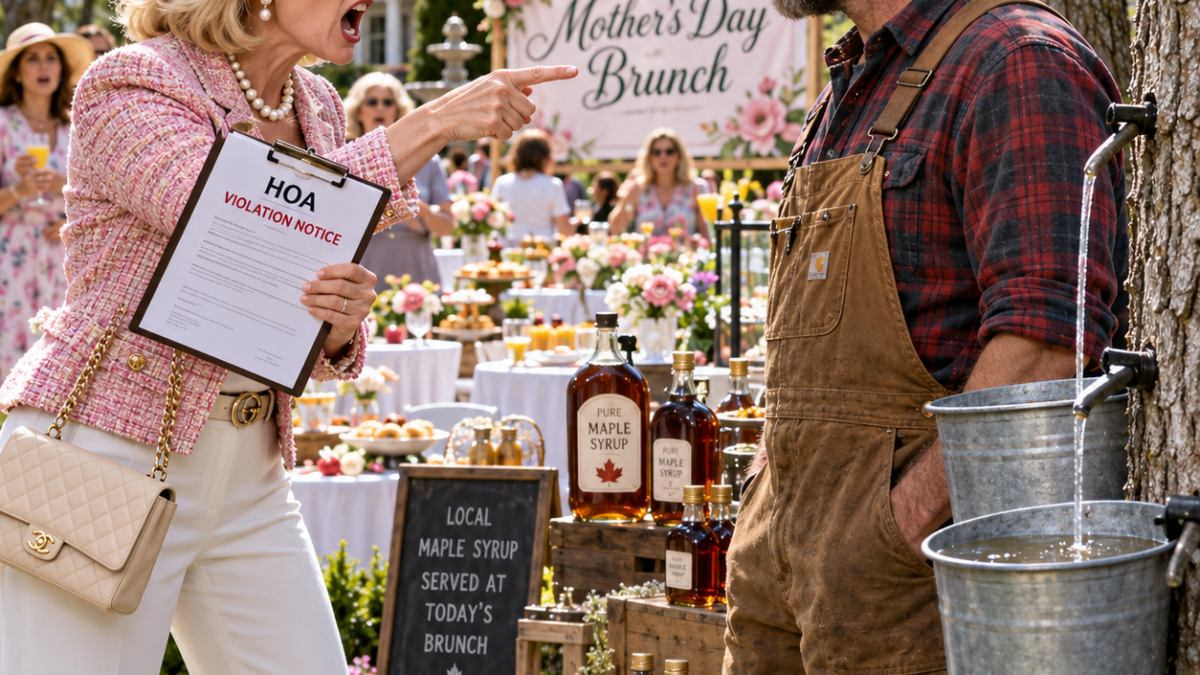
PART 2
The first call I made was to George Whitmore.
George had served as president of the Spring Meadows HOA for almost fourteen years before retiring to Florida, and under him the association had been exactly what a neighborhood organization should be: boring.
Road maintenance.
Snowplowing.
Playground repairs.
Summer barbecue.
Mother’s Day brunch.
If someone painted a door an ugly color, George assumed they had eyes and knew what they had done.
If a trash can stayed at the curb overnight, nobody convened an architectural hearing.
His favorite line at meetings was, “If it can be solved with a conversation over coffee, don’t solve it with a lawyer.”
Then George moved to Naples.
Karen ran for president.
And Spring Meadows discovered how much damage one person could do with a rulebook and too much free time.
George answered while apparently standing on a golf course.
“Jack!”
“You busy?”
“Trying to ruin a perfectly good afternoon with golf.”
“I need a question answered.”
His tone changed.
“What happened?”
“Karen issued violations against the sugar shack.”
Silence.
Then:
“She did what?”
“She says it’s an unauthorized outbuilding and commercial operation.”
“The sugar shack?”
“That one.”
“The one your grandfather built?”
“I only have one eighty-year-old sugar shack, George.”
I heard him exhale.
“Of course she did.”
“She fined me twenty-one thousand dollars.”
The background noise disappeared.
“Say that again.”
“Twenty-one thousand.”
“How?”
“Three violations. Five hundred each per day. Retroactive.”
“Jack, that parcel is exempt.”
“I thought it was.”
“No. Not thought. It is.”
He started talking faster.
“When your grandfather sold the surrounding acreage to the developer, he insisted on an agricultural carve-out. It was one of the reasons the developer hated negotiating with him.”
“I remember the stories.”
“Walter made sure the house, sugar woods, barns, and farm operations couldn’t later be regulated into extinction.”
“Where is it?”
“Master declaration addendum. Nineteen seventy-four.”
“I have boxes of Granddad’s records.”
“Green metal box.”
I paused.
“You remember the box?”
“Your grandfather brought it to every board meeting for twenty years as if he expected somebody to challenge him to a duel.”
That sounded right.
George continued.
“Articles twelve through twenty-eight should be excluded.”
Karen had cited seventeen and twenty-one.
I wrote that down.
“What about commercial activity?”
“You’re an agricultural producer.”
“I know.”
“State protections.”
“I know.”
“Then why are we having this conversation?”
“Because Karen apparently doesn’t.”
George laughed.
Then stopped.
“Wait.”
“What?”
“She’s organizing the brunch, isn’t she?”
“Yes.”
“And she knows you donate the syrup?”
“Yes.”
There was another silence.
“That makes even less sense.”
“That’s what bothers me.”
“Did she mention replacing you?”
“She said they could get syrup elsewhere.”
George whistled softly.
“She already has something planned.”
“Maybe.”
“Jack.”
“Yeah?”
“Do not stop boiling.”
I looked toward the shack.
“Wasn’t planning to.”
“Good.”
Then George added something that stayed with me.
“Walter used to say the same thing every time a developer promised him something.”
“What?”
“Paper beats promises.”
After I hung up, I went inside.
Sarah was standing at the kitchen counter chopping onions.
She had already seen Karen’s SUV leave.
“What did she want?”
I placed the fine notice beside the cutting board.
Sarah read it.
Stopped chopping.
Read it again.
Then:
“Twenty-one thousand dollars?”
“That’s the opening bid.”
Her eyes lifted.
“What do you mean opening?”
“Fifteen hundred a day.”
Her knife went onto the counter.
“Can she do that?”
“I don’t believe so.”
“That answer needs more confidence.”
“George says Granddad protected the parcel in the original developer agreement.”
“Do we have it?”
“Basement.”
She looked toward the basement door.
Then at me.
“Enjoy.”
“You’re not helping?”
“There are spiders down there large enough to qualify for the HOA.”
I went alone.
The basement smelled like old stone and furnace oil.
Granddad had never thrown anything away if it involved land.
I found survey pins from the 1960s.
Receipts for fencing.
Correspondence with foresters.
Old tax assessments.
Maps.
Then the green metal box.
PROPERTY DEEDS AND COVENANTS.
Inside, beneath a stack of yellowed plats, was the document.
Recorded February 11, 1974.
Spring Meadows Development Agreement.
Parcel 7A.
The Callahan homestead.
I sat on the concrete floor and read.
Then read it again.
Articles 12 through 28 of any future homeowners association regulations would not apply to Parcel 7A insofar as those articles regulated agricultural use, barns, outbuildings, landscaping, exterior materials, accessory structures, or traditional farming operations.
It went farther.
The document specifically acknowledged:
seasonal maple sap collection,
processing of farm products,
storage of agricultural tools,
farm-related structures existing or constructed in continuation of historic use.
My grandfather had not merely protected the sugar shack.
He had anticipated Karen fifty years before meeting her.
I laughed so loudly Sarah called from upstairs.
“Found something?”
“Yes.”
“Good something?”
“Granddad was paranoid.”
“That good?”
“The best kind.”
At the kitchen table we built the file.
Original exemption.
Certified parcel map.
Town agricultural zoning.
State farm registration.
My voluntary fire-safety inspection certificate.
Photographs showing the shack had existed for decades.
Then I called George.
He emailed a signed affidavit.
He had served as board president.
He confirmed Spring Meadows had recognized the exemption for decades.
He also confirmed the association had knowingly accepted syrup from my operation for its fundraiser for ten consecutive years.
That last paragraph was beautiful.
Sarah read it.
“She fined an operation the HOA has been publicly benefiting from.”
“Yes.”
“Please tell me you’re going to use that sentence.”
“Professionally.”
“You are no fun.”
The response package ran thirty-two pages.
Each violation was quoted.
Each was answered.
Section 17.4.
Exempt.
Section 21.2.
Exempt.
Section 33.8.
Inapplicable to state-protected agricultural production.
Attachments.
References.
Recorded instrument numbers.
My closing paragraph requested withdrawal of all fines within ten business days and written assurance that protected farm activity would not be harassed.
I mailed copies to every board member.
Certified.
Karen.
Todd.
Linda.
Treasurer Martin Hale.
Secretary Brenda Ellis.
I sent another copy to the town planning office.
Then I went back into the woods.
Maple season waits for nobody.
Cold nights and warm afternoons create pressure inside sugar maples. When temperatures climb above freezing, sap moves.
Some seasons give you weeks.
Some give you days.
A power-hungry HOA president does not get a vote.
For five days, nothing happened.
Steam rolled from the shack.
Buckets filled.
Tubing lines shimmered in the sun.
The evaporator ran late.
Sarah bottled while I monitored density.
I started believing the board might quietly fix Karen’s mistake.
Then day ten arrived.
The mail contained an envelope from the HOA attorney.
They acknowledged receiving my documentation.
The matter was “under review.”
Fine.
Then I saw Karen’s letter.
The current board, she wrote, considered the agricultural exemption an “archaic instrument whose enforceability is ambiguous in light of modern community needs.”
I stared at that phrase.
Modern community needs.
As if a board could erase recorded property rights because beige mailboxes required ideological consistency.
Then I reached the fine total.
$51,000.
Sarah was reading over my shoulder.
“Fifty-one?”
“They kept counting.”
“After getting the documents?”
“Yes.”
Then I pulled out the final page.
NOTICE OF LIEN.
Sarah went silent.
A lien was different.
Fines were paper threats.
A lien attached the dispute to our title.
It could interfere with refinancing.
Future sale.
Credit.
It transformed Karen’s tantrum into something that could follow the property.
I called Dave Miller.
Dave lived two streets over, worked as corporate counsel for a manufacturing company, and had recently received an HOA warning because his wife owned four ceramic garden gnomes.
Karen called them “inconsistent ornamental displays.”
Dave called them “grounds for regime change.”
He answered:
“What did she do?”
“How do you know she did something?”
“You only call me at dinner when Karen has done something.”
“She filed a lien.”
Silence.
“How long since the original notice?”
I gave him the date.
He asked for the lien date.
I gave that too.
Then:
“She can’t.”
“Thought so.”
“She’s almost six weeks early.”
Sarah leaned closer to the phone.
“Meaning?”
Dave explained.
The HOA’s own procedures required a cure period.
Notice.
Opportunity to contest.
Formal board review.
Only after those steps could collection escalate.
Karen had skipped them.
“She wanted the intimidation effect,” Dave said.
“She got my attention.”
“Good.”
“That sounded enthusiastic.”
“She has transformed a questionable fine into a potentially wrongful lien.”
“You lawyers enjoy strange things.”
“We enjoy documents.”
“So do engineers.”
“That is why Karen is doomed.”
I didn’t feel victorious.
I felt angry.
Not hot anger.
The colder kind.
Because I began wondering who else had seen letters like mine and paid simply because fighting was more expensive.
I visited Mark Hensley.
Retired contractor.
Two houses down.
Mark had lived in Spring Meadows longer than Karen.
He looked at my fine notice.
Then the lien.
Then whistled.
“She tried to fine me for an oil stain.”
“What?”
“Called it unauthorized ground discoloration.”
“You’re kidding.”
“I wish.”
“How much?”
“Started at two hundred.”
“You fight?”
“For three months.”
“How much did that cost?”
“Attorney wanted a retainer. I paid Karen four hundred and pressure-washed the driveway.”
He laughed bitterly.
“It was cheaper.”
Cheaper.
That word appeared everywhere.
Mrs. Gable removed the bird feeder her dead husband built because fighting a violation cost too much.
The Patels removed a plastic playset because Karen considered bright yellow inconsistent with woodland aesthetics.
A retired teacher moved his basketball hoop.
A widow repainted her door.
A family delayed a wheelchair ramp.
Not because Karen was right.
Because resistance cost time, money, energy.
Karen’s real power wasn’t the covenants.
It was exhaustion.
She could create ten hours of work with one letter.
People with jobs and children eventually paid just to make her stop.
I went home and started a spreadsheet.
Sarah saw it.
“No.”
“What?”
“You have the face again.”
“What face?”
“The one that means our spare bedroom is about to become military intelligence.”
“It’s a spreadsheet.”
“Today.”
By Friday, I had a corkboard.
Sarah walked in.
“Operation Maple Freedom?”
“I did not name it.”
“You wrote KAREN in the center.”
“For organizational purposes.”
“You are retired.”
“Technically.”
She kissed my cheek.
“I love you. You’re insane.”
The community Facebook group became Karen’s next battlefield.
One morning she published a long post warning residents about a “large-scale unpermitted industrial operation” operating inside Spring Meadows.
She mentioned open flame.
Commercial production.
Fuel storage.
Environmental concerns.
Traffic.
Property values.
She never once said maple syrup.
New residents panicked.
A factory?
In Spring Meadows?
Is this safe?
Can the town inspect it?
Why hasn’t the board shut it down?
Karen responded with carefully vague comments.
The board is pursuing enforcement.
Resident safety remains our priority.
Legal matters prevent disclosure.
Sarah read the thread over breakfast.
“She knows exactly what she’s doing.”
“I know.”
“You cannot ignore this.”
“Why?”
“Because people believe the first story they understand.”
“The documents—”
“Nobody reads thirty-two-page legal packets with coffee, Jack.”
She turned the laptop toward herself.
“We need to show them what she is talking about.”
Sarah had spent fifteen years in corporate communications.
I built bridges.
She built narratives.
Our marriage worked because each of us knew when the other was operating in superior terrain.
“What do you need?”
“Photos.”
“Of what?”
“Your grandfather.”
“The shack?”
“Yes.”
“You as a kid.”
“No.”
“Absolutely.”
“Sarah.”
“Tiny Jack with the sap bucket is non-negotiable.”
I lost.
We built a post.
A LITTLE SWEET HISTORY: THE TRUTH ABOUT PATRIOT’S GOLD MAPLE SYRUP.
Black-and-white photo of Granddad beside his evaporator.
My father bottling.
Me at eight with a bucket almost as large as my torso.
Children visiting the shack.
Ten years of Mother’s Day brunch photographs.
Bottles carrying Spring Meadows labels.
Families eating pancakes.
Then facts.
Agricultural registration.
Fire certificate.
No chemicals.
No factory.
No industrial tanks.
And finally:
For ten years, the Callahan family has donated approximately twenty gallons of real Vermont maple syrup each spring to the Spring Meadows Mother’s Day Brunch at no cost to the HOA.
We posted.
The response was immediate.
Wait, THAT is the “industrial operation”?
My kids went there last year.
That’s where the brunch syrup comes from?
Why would we shut this down?
Someone asked:
Why didn’t Karen mention the HOA has been accepting this syrup for ten years?
Another:
Can the board explain why it described this as a fire hazard when the current inspection certificate says otherwise?
Mark wrote:
Also, Jack’s current fines exceed $50,000.
The comments detonated.
Karen appeared.
This is an ongoing confidential enforcement matter.
A resident replied:
You made it public first.
I laughed so hard I almost spilled coffee.
Sarah smiled.
“Never underestimate suburban mothers with internet access.”
Karen stopped posting.
That should have been enough warning.
It wasn’t.
My question remained:
Why?
Why target the syrup?
There were easier people to bully.
Why risk a tradition everyone loved?
Then Dave said:
“Follow the replacement vendor.”
That changed everything.
If my syrup disappeared, the brunch still needed syrup.
Karen had already said they could “obtain it elsewhere.”
Maybe elsewhere mattered.
I filed a formal financial-records request.
Karen denied it.
Vendor confidentiality.
Competitive negotiations.
Sensitive commercial data.
Dave nearly applauded.
“She cannot deny member inspection rights like that.”
He drafted a second demand.
Five business days.
State law.
Association bylaws.
Failure to comply would trigger a formal complaint.
Three days later, the HOA law firm scheduled my records review.
Two-hour window.
Supervised.
No copying.
Notes only.
I arrived with a legal pad.
The paralegal brought binders.
I started with accounts payable.
Insurance.
Snow removal.
Landscaping.
Printing.
Pool maintenance.
Catering.
Then:
GOURMET GOLD LLC.
I stopped.
Invoice date:
Three weeks earlier.
Twenty gallons artisan maple syrup.
$140 per gallon.
Total:
$2,800.
Authorized by:
Karen Kowalski.
I copied every detail.
Vendor address.
It looked familiar.
That night Dave searched state business registrations.
Gourmet Gold LLC had been created two months earlier.
Owner:
Stanley Kowalski.
Karen’s husband.
Business address:
Karen’s house.
Sarah stared at the screen.
“She’s replacing free syrup with syrup from her husband.”
“Yes.”
“At $140 a gallon.”
“Yes.”
“What does real bulk maple cost?”
“Far less.”
Dave said:
“Roughly forty, depending on grade, quantity, market.”
Sarah slowly sat.
“So Karen manufactures violations against you, tries to shut down your donation, then uses HOA money to buy replacement syrup from her husband.”
“That appears to be the sequence.”
Dave raised a finger.
“Do not say fraud yet.”
Sarah and I both looked at him.
He sighed.
“Yes, it looks awful. We still prove it.”
Our next clue came from Brenda Ellis.
Events committee chair.
Quiet.
Dependable.
The woman who had been organizing Mother’s Day brunches for years.
I saw her by the community mailboxes.
“Brenda.”
She startled.
“Jack.”
“How’s brunch planning?”
“Fine.”
“Gourmet Gold?”
Her face changed.
That was enough.
“Brenda.”
“I can’t talk about vendors.”
“Why?”
She looked toward the road.
“I signed something.”
“An NDA?”
Her eyes filled.
I almost laughed at the absurdity.
Then I saw she was genuinely frightened.
“It’s okay.”
“No, it isn’t.”
She lowered her voice.
“She’s making everything impossible.”
“Karen?”
“She took over the budget.”
“What about the syrup?”
Brenda wiped her eye.
“She said your operation was being closed.”
“And?”
“She said Stan had found a supplier.”
“Stan is the supplier.”
Her mouth opened.
“You know?”
“Yes.”
She looked sick.
“She told me it was independent.”
“Did you approve the invoice?”
“She told me to sign event paperwork.”
“Why?”
Silence.
Then:
“She said my garden shed could become a problem.”
I stood very still.
“How much?”
“What?”
“The threatened fine.”
“Five thousand.”
Karen had leveraged a shed to force a volunteer to help process an invoice benefiting her husband.
I wanted to confront her immediately.
Dave stopped me.
“Not yet.”
“When?”
“When we can prove the product.”
That required one bottle.
Julie Morrison volunteered.
She approached Karen pretending her sister was visiting from Massachusetts and wanted to buy the new premium syrup Karen had promoted online.
Karen sold her two bottles.
Forty-five dollars each.
Julie brought them to me.
The label was beautiful.
GOURMET GOLD.
SINGLE-ORIGIN VERMONT ARTISAN MAPLE SYRUP.
I held the bottle to the light.
Too pale.
I opened one.
Poured a spoon.
Tasted.
Corn syrup.
Artificial maple.
Maybe a little real syrup mixed in.
Sarah tasted it.
“Oh.”
“That good?”
“That bad.”
We sent the unopened bottle to a university food laboratory.
Full compositional analysis.
Chain of custody.
Lot number.
Photographs.
Receipt.
Then we waited.
While we waited, Karen tried to get the town involved.
A week before Mother’s Day, her SUV rolled into my driveway behind a white municipal pickup.
Code Enforcement Officer Peter Reynolds stepped out.
He looked like a man who had already regretted accepting the complaint.
Karen followed him wearing sunglasses and victory.
“Mr. Callahan,” she announced, “Mr. Reynolds is here to inspect the illegal structure.”
Peter looked at her.
“I’m here to follow up on a complaint.”
“Of course.”
I opened the sugar shack.
“Come in.”
Karen looked disappointed by my cooperation.
Inside, I showed Peter everything.
Firebrick.
Evaporator.
Chimney.
Extinguishers.
Agricultural registration.
Fire inspection.
Original deed.
Historical exemption.
Photos from the 1940s.
Newspaper clipping from 1989 featuring Dad.
Peter became interested.
“Your grandfather built this?”
“Yes.”
He ran a hand over one beam.
“This is beautiful work.”
Karen shifted impatiently.
“What about the code violations?”
Peter continued reading.
Then went outside.
Measured.
Checked setback records.
Reviewed zoning.
Returned.
“Mr. Callahan, I don’t see a town violation.”
Karen’s face tightened.
“The commercial enterprise?”
“Agriculture.”
“The fire risk?”
“Inspected and compliant.”
“Unpermitted structure?”
“Predates modern permit requirements and is documented as agricultural use.”
Karen’s face reddened.
“You’re saying this is legal?”
“I’m saying I have no basis to cite him.”
“The HOA rules—”
“Private covenant dispute.”
He handed me my folder.
“Not my office.”
Then he smiled.
“Good syrup?”
“The best.”
Karen waited until his truck drove away.
Then she turned toward me.
“This isn’t over.”
I leaned against the doorway.
“You say that a lot.”
“You think these old papers will save you.”
“They seem to be doing pretty well.”
“I’ll see you in court.”
“Bring the deed.”
Her eyes narrowed.
“You’ll lose everything.”
That sentence finally made me angry.
Not for myself.
For Granddad.
For Dad.
For Sarah.
For every winter this shack had survived before Karen moved into Spring Meadows and decided history needed architectural approval.
I stepped forward.
Not threatening.
Just enough that she stopped smiling.
“Karen.”
She waited.
“You can dislike me.”
Silence.
“You can dislike this building.”
Silence.
“You can even waste HOA money trying to fight it.”
Her mouth tightened.
“But you do not get to rewrite ownership because you’re angry.”
For a moment she said nothing.
Then she turned and left.
The lab report arrived two days before Mother’s Day.
Dave came over.
Sarah printed it.
We opened the document together.
Primary sweetener:
Corn syrup.
Artificial flavoring detected.
Estimated genuine maple content:
Less than ten percent.
The room went quiet.
Gourmet Gold wasn’t premium Vermont maple syrup.
It was cheap pancake syrup dressed for a fundraiser.
Dave finally said:
“Well.”
Sarah looked at him.
“You’re going to say we still can’t use the word fraud.”
Dave smiled.
“Now we can use it more confidently.”
We built four slides.
Gourmet Gold corporate registration.
Stan Kowalski.
$2,800 HOA invoice.
Market-price comparison.
Laboratory report.
Then Sarah added a fifth slide.
Ten years of Callahan donations.
Estimated gallons:
200.
Cost to HOA:
$0.
That slide hurt more than I expected.
Not because of the money.
Because I had never thought of the syrup as a transaction.
It was something we did.
Granddad shared syrup.
Dad shared syrup.
I did too.
The neighborhood turned it into a tradition.
Karen had looked at generosity and seen a revenue obstacle.
That was the difference between us.
Mother’s Day morning arrived warm and clear.
The clubhouse was decorated in pale flowers and pastel banners.
Coffee.
Bacon.
Pancakes.
Children carrying handmade cards.
Nearly every household attended.
Karen wore a flowing floral dress.
She floated around the room accepting compliments as if she had personally invented motherhood.
Stan stood near the buffet wearing a sports coat.
The syrup table sat in the center.
White linen.
Glass bottles.
GOURMET GOLD.
Small cards read:
PREMIUM SINGLE-ORIGIN VERMONT MAPLE.
I stared.
Sarah touched my arm.
“Don’t.”
“I’m not doing anything.”
“You’re staring aggressively.”
“That’s not illegal.”
“Yet.”
We took seats near the back.
Dave had his laptop.
Mark sat two tables away.
Brenda stood near the kitchen, pale.
Breakfast began.
Families poured syrup.
At first:
Normal conversation.
Then a boy at the next table tasted his pancake.
“Mom.”
“What?”
“This syrup tastes weird.”
“Eat.”
“It tastes like diner syrup.”
His father tried it.
Frowned.
Across the room another woman said:
“Did they change brands?”
Someone else:
“This is thinner.”
Another:
“I liked Jack’s better.”
Karen heard.
Her smile tightened.
She grabbed the microphone.
“Good morning, Spring Meadows!”
Applause.
“Happy Mother’s Day to all of the wonderful mothers here today.”
More applause.
“We’re thrilled to bring you what I believe is our finest brunch yet, with upgraded food service and our exciting partnership with a premium artisan maple supplier.”
She gestured toward Gourmet Gold.
“A significant improvement over the informal syrup arrangement of previous years.”
Sarah looked at me.
I slowly placed my fork down.
Dave stood.
“Karen.”
Her eyes snapped toward him.
“Yes?”
“I have a question about the syrup.”
Her smile disappeared.
“This is not a business meeting.”
“I think residents deserve to know how association money was spent.”
“Sit down, Dave.”
“I’d prefer to stand.”
A few people laughed nervously.
He walked toward the projector.
Karen moved toward him.
“Do not hijack this event.”
Dave plugged in his laptop.
The family slideshow vanished.
Slide one appeared.
GOURMET GOLD LLC.
Owner:
Stanley Kowalski.
The room went silent.
Karen froze.
Dave faced everyone.
“For anyone unfamiliar with the name, Stanley Kowalski is Karen’s husband.”
People turned toward Stan.
He stopped chewing.
Click.
Invoice.
$2,800.
Twenty gallons.
Karen authorization.
“Spring Meadows paid Gourmet Gold one hundred forty dollars per gallon.”
Someone whistled.
A woman said:
“You’re kidding.”
Dave continued.
“Comparable real Vermont maple syrup purchased in bulk sells for dramatically less.”
Click.
Market comparison.
Karen grabbed the microphone.
“This is deliberately misleading.”
Dave looked at her.
“How?”
“Gourmet Gold is a premium artisan product.”
“That’s interesting.”
He clicked.
Lab report.
Corn syrup.
Artificial maple flavor.
Less than ten percent genuine maple.
Nobody spoke.
Then somebody near the front said:
“Oh my God.”
Another voice:
“It’s fake?”
A mother lifted her syrup bottle.
“We paid $2,800 for corn syrup?”
Karen’s face went white.
“This laboratory analysis is unauthorized.”
Dave blinked.
“Unauthorized chemistry?”
Laughter erupted.
Karen raised her voice.
“This is a coordinated personal attack by a disgruntled homeowner.”
Dave clicked one more time.
The donation record.
Ten years.
Twenty gallons annually.
Zero dollars.
Then he said the sentence that broke the room open.
“For a decade, Jack Callahan supplied this brunch with real maple syrup free of charge. After Karen began trying to shut down his maple operation, the HOA suddenly paid her husband’s new company twenty-eight hundred dollars for a replacement product that testing indicates is mostly corn syrup.”
Chaos.
People stood.
“What?”
“Karen!”
“Did the board approve this?”
Todd shot to his feet.
“No.”
Everyone turned.
Karen stared at him.
“Todd.”
“We never voted on that invoice.”
“You knew about the supplier.”
“You said the events committee selected it.”
Linda stood too.
“I never saw the invoice.”
Karen pointed toward them.
“Do not do this.”
Todd looked at the screen.
“You used the emergency event-purchase rule.”
Dave answered.
“Under $3,000.”
A homeowner shouted:
“And the invoice is $2,800!”
People started talking over one another.
Brenda began crying.
Then she walked toward the front.
Karen saw her.
“No.”
Brenda picked up the spare microphone.
“It’s true.”
The room stopped.
Karen stepped toward her.
“Brenda, think carefully.”
“I have.”
Her voice trembled.
“She told me Jack’s syrup operation was being closed.”
Karen shook her head.
“That is not what I said.”
“You told me we needed a replacement.”
“I told you to plan responsibly.”
“You told me Gourmet Gold had been approved.”
“It had.”
“By who?”
Karen said nothing.
Brenda continued.
“You made me sign the event paperwork.”
“Because you’re event chair.”
“You threatened my shed.”
People gasped.
Karen’s eyes widened.
“I did no such thing.”
“You said if I didn’t cooperate, you would reopen the violation and fine us five thousand dollars.”
Brenda started crying.
“My husband told me not to sign anything. I did it anyway because I was scared.”
Karen looked around.
For the first time since I had known her, she looked genuinely alone.
Then the side door opened.
A reporter walked in.
Behind her, a cameraman.
Sarah whispered:
“Perfect timing.”
I stared at her.
“You called them.”
“I said there might be a governance story.”
“You are terrifying.”
“Thank you.”
The reporter looked at the screen.
Then at Karen.
“Mrs. Kowalski, can you comment on allegations that HOA money was paid to your husband’s company without disclosure?”
Karen backed away.
“This is a private event.”
“Were residents informed of the relationship?”
“No comment.”
“Did the board approve the purchase?”
“No comment.”
“Is Gourmet Gold genuine Vermont maple syrup?”
Stan started walking toward the door.
The reporter saw him.
“Mr. Kowalski?”
He accelerated.
Mark moved slightly.
Not blocking.
Just watching.
The reporter followed.
“Are you the owner of Gourmet Gold LLC?”
Stan pushed through the doorway.
His shoulder struck a volunteer carrying a tray of croissants.
The tray tilted.
Croissants went everywhere.
Stan broke into a half-run across the lawn.
The camera followed him.
The absurdity was complete.
Karen dropped the microphone onto a table.
Feedback screamed through the speakers.
She disappeared through the kitchen.
Nobody stopped her.
The brunch never recovered.
For the next hour nobody cared about pancakes.
People gathered around Dave’s slides.
Homeowners photographed the invoice.
Photographed the lab report.
Asked questions.
Todd and Linda stood together looking shell-shocked.
Brenda sat with Sarah.
I remained near our table.
A little girl approached.
Maybe seven.
She held one half-eaten pancake.
“Mr. Callahan?”
“Yes?”
“Do you have the real syrup?”
Her mother looked mortified.
“I’m sorry—”
I laughed.
“As a matter of fact.”
I had six bottles in the truck.
Within ten minutes, all six were circulating through the room.
One bottle moved from table to table.
People poured only a little so everyone could taste.
That image became the evening-news thumbnail.
Gourmet Gold on one side.
Patriot’s Gold on the other.
The headline:
HOA SYRUP SCANDAL ERUPTS AT MOTHER’S DAY BRUNCH.
Spring Meadows residents called it Brunchgate.
I hated the name.
Dave loved it.
Within forty-eight hours, homeowners representing more than seventy-five percent of the neighborhood signed a petition demanding an emergency meeting.
Karen and Stan did not attend.
Their house was dark.
The meeting took place in the same clubhouse.
No flowers.
No waffles.
No pastel decorations.
Just chairs.
Documents.
Angry residents.
Dave opened.
“First motion: vote of no confidence in President Karen Kowalski.”
Unanimous.
“Second motion: removal from the board.”
Unanimous.
Todd voted yes.
Linda voted yes.
Martin voted yes.
Brenda cried quietly.
In less than five minutes, Karen’s official authority disappeared.
Then Todd stood.
“I resign.”
People murmured.
Linda followed.
Then Martin.
They admitted Karen had dominated the board.
They admitted they stopped challenging her.
They admitted they approved things without reading closely because doing so was easier than becoming her next target.
Todd looked directly at the homeowners.
“That is not an excuse.”
He paused.
“We failed you.”
That honesty changed the room.
People were angry.
But anger softened.
The community understood something important.
Karen had built the system.
Others had allowed it.
Both mattered.
An interim board was nominated.
Dave became president.
Mark became vice president.
Then somebody nominated me for treasurer.
I shook my head.
“No.”
A voice from the back:
“Jack, you’re the only man here who proved he knows what syrup should cost.”
Laughter.
Sarah elbowed me.
“Do it.”
“I don’t want power.”
“That’s precisely why you should.”
I accepted one year.
Our first vote:
Every disputed Karen-era fine would be reviewed and suspended immediately.
Second:
My lien was withdrawn.
Third:
All fines against my maple operation rescinded.
Fourth:
Independent forensic audit.
Fifth:
All vendor relationships involving relatives of board members frozen pending review.
Then Dave stood.
“One final motion.”
I saw his smile.
I didn’t like it.
“The Patriot’s Gold Provision.”
“No.”
People laughed.
Dave continued.
“This amendment formally recognizes the Callahan sugar shack and maple operation as a protected Spring Meadows heritage asset.”
“I already have a deed exemption.”
Mrs. Gable raised her hand.
“I like this better.”
I turned.
“Mrs. Gable.”
She stared at me.
I surrendered.
The amendment passed unanimously.
The sugar shack went from violation to heritage asset in roughly ninety seconds.
Granddad would have found that hilarious.
The audit took six weeks.
The syrup invoice was only the beginning.
Two landscaping contracts tied to Karen’s friends had inflated pricing.
Consulting expenses lacked documentation.
HOA credit-card charges included personal fuel.
Meals.
Retail purchases.
A weekend hotel charge Karen labeled “leadership planning.”
No board meeting had occurred.
The total wasn’t enough to make national news.
It was enough to prove a pattern.
The new board sued Karen and Stan for reimbursement.
Their lawyers settled.
Money came back.
The $2,800.
Additional disputed payments.
Audit costs.
Part of the legal expense.
The state attorney general’s office opened a consumer-protection inquiry into Gourmet Gold’s labeling and sales practices.
Stan shut the company down.
Karen listed their house.
A month later, moving trucks appeared.
I saw her once.
I was driving home with feed.
She stood near the garage watching movers load furniture.
No pink tracksuit.
No clipboard.
No audience.
She saw me.
I slowed instinctively.
For one moment I considered stopping.
I had imagined that confrontation.
Karen apologizing.
Me delivering the perfect line.
Her finally admitting what she had done.
Instead, I kept driving.
Sarah asked that evening:
“Did you see her?”
“Yes.”
“Did she say anything?”
“No.”
“Did you?”
“No.”
“Regret it?”
I thought.
“No.”
“Why?”
“Because there’s nothing I need from her anymore.”
That was the first moment I knew the fight had ended.
Not when Karen lost the vote.
Not when the lien disappeared.
Not when Gourmet Gold collapsed.
When I no longer needed her to understand why she had been wrong.
Spring Meadows became noisy after Karen left.
Not acoustically.
Politically.
Everybody suddenly had opinions.
Budgets.
Snow removal.
Playground maintenance.
Mailboxes.
Road shoulders.
Tree trimming.
The first new-board meeting lasted three hours and twenty minutes.
George called me from Florida.
“How’s freedom?”
“Exhausting.”
He laughed.
“Democracy usually is.”
“I miss your forty-minute meetings.”
“You had to overthrow a syrup dictatorship first.”
“Please never say that again.”
He ignored me.
Our reforms were simple.
Vendor relationships published.
Conflicts disclosed.
Competitive bids above set amounts.
Financial records posted online.
No liens without documented procedure and independent review.
No fines imposed by a single person.
Homeowners guaranteed appeal rights.
Architectural rules reduced to actual health, safety, and material property concerns.
The garden gnomes returned.
Dave’s wife placed five along their driveway.
One held a tiny sign reading:
COMPLIANT ENOUGH.
I pretended not to notice.
The Patels rebuilt the swing set.
Bright yellow.
Their children screamed on it every afternoon.
Nobody measured the color.
Mrs. Gable rehung Henry’s bird feeder.
The first chickadee returned two days later.
She called me.
“You have to see.”
I walked over.
We stood by the kitchen window.
The feeder hung from the maple near the porch.
A small bird landed.
Mrs. Gable covered her mouth.
“Henry used to sit right there.”
She pointed toward an old chair.
“He would drink coffee and complain that the squirrels were stealing everything.”
I smiled.
“Did he stop them?”
“Never.”
She laughed.
Then cried.
I stood quietly.
That moment taught me something the big public victory hadn’t.
Karen’s fines had not merely cost money.
They had trained people to remove pieces of themselves.
Bird feeders.
Swings.
Paint colors.
Gardens.
Things too small to fight over individually.
That was the real damage.
Restoring those things mattered.
By winter, Spring Meadows looked different.
Less uniform.
More alive.
The following February, the maples started waking again.
Cold nights.
Warm afternoons.
I walked the woods at dawn checking lines.
Sap moved clear through the tubing.
The sugar shack waited.
When I lit the evaporator for the first boil, I stopped for a moment.
Same firebox.
Same pans.
Same beam Granddad carved.
Same smell.
Last year, the building had been evidence.
This year, it was simply home.
Neighbors came.
Lots of them.
Children watched the sap boil.
Parents asked questions.
Mark stacked firewood badly.
Dave drank coffee professionally.
Mrs. Gable claimed the chair closest to the evaporator.
Sarah handled visitors better than any of us.
One Saturday, Brenda arrived carrying muffins.
She hesitated outside.
“You can come in.”
“I know.”
She looked embarrassed.
“I still feel guilty.”
“For what?”
“The invoice.”
“Karen threatened you.”
“I signed it.”
“Then learn from it.”
She stared at me.
“That’s it?”
“What else do you want?”
“I don’t know.”
“Then help Sarah with bottles.”
She smiled.
Brenda eventually became one of the strongest transparency advocates on the events committee.
No secret vendors.
No NDAs.
Every expense published.
Sometimes people become better after fear leaves.
By April, the board began planning Mother’s Day.
Dave called.
“I have a delicate question.”
“No.”
“I haven’t asked.”
“It’s syrup.”
Silence.
“Yes.”
I leaned against the kitchen counter.
For the first time in eleven years, I wasn’t sure.
“I don’t know.”
“That’s fair.”
“I need to think.”
“Take your time.”
No pressure.
No entitlement.
No assumption.
That mattered.
Sarah found me later staring at bottles in storage.
“You don’t have to donate.”
“I know.”
“You can make them buy syrup.”
“I know.”
“You keep saying that.”
“For ten years it was ours.”
“What was?”
“The tradition.”
She nodded.
“Then Karen happened.”
“Yes.”
“And now you’re thinking if you donate again, you’re letting them take advantage.”
“Maybe.”
Sarah walked closer.
“Jack.”
“What?”
“You weren’t generous because the HOA deserved it.”
I looked at her.
“You did it because you wanted families to have something good.”
Silence.
“She doesn’t get to take that from you too.”
That settled it.
I called Dave.
“Twenty gallons.”
He paused.
“Really?”
“Yes.”
“Cost?”
“Same.”
“Free.”
“Free.”
“No HOA branding?”
“Absolutely not.”
“Callahan label?”
“Yes.”
“One condition.”
“What?”
“I get first bottle.”
“No.”
“Abuse of office?”
“Definitely.”
At the Mother’s Day brunch one year after Brunchgate, the clubhouse looked almost the same.
Pastel decorations.
Coffee.
Pancakes.
Flowers.
But the atmosphere was completely different.
No speeches.
No president holding court.
No secret vendors.
No fear.
Near the entrance stood rows of Patriot’s Gold.
Simple glass bottles.
Simple label.
PATRIOT’S GOLD
REAL VERMONT MAPLE SYRUP
CALLAHAN FAMILY SUGAR WOODS
DONATED WITH GRATITUDE.
One bottle per household.
Free.
People lined up.
Some hugged me.
I hated that part.
An older woman held a bottle against her chest.
“You saved this neighborhood.”
“No.”
“You did.”
“A lot of people did.”
She smiled.
“But you stood up first.”
That sentence stayed.
Even residents who once supported Karen came to me.
One man named Richard had commented under her original Facebook post calling my operation dangerous.
He approached carrying a plate.
“Jack.”
“Richard.”
“I owe you an apology.”
“You don’t.”
“I do.”
He looked uncomfortable.
“I believed her.”
“A lot of people did.”
“I repeated things I didn’t verify.”
“That happens.”
“I’m sorry.”
I shook his hand.
“Thank you.”
No humiliation.
No victory lap.
People are allowed to be wrong if they’re willing to become right.
Dave eventually tapped a spoon against his glass.
I groaned.
“No speeches.”
“One minute.”
“You lawyers don’t understand time.”
He stood.
“Last year, this brunch became memorable for all the wrong reasons.”
Laughter.
“This year, I want to recognize the people who turned that mess into something better.”
He thanked Brenda.
Mark.
Sarah.
The audit committee.
The homeowners.
Then:
“And Jack Callahan, whose family has now donated real maple syrup to this community for eleven years.”
Applause.
I stared at the table.
Dave continued.
“Last year taught us that community standards mean nothing when the people enforcing them lack standards themselves.”
That line quieted everyone.
“And it reminded us that traditions survive because people choose to carry them forward.”
He raised his coffee cup.
“To Patriot’s Gold.”
Everyone raised cups.
Someone shouted:
“No corn syrup!”
The room exploded in laughter.
Even I laughed.
After the brunch, Sarah and I walked home.
Warm May afternoon.
Trees fully green.
The sugar shack sat quietly near the edge of the woods.
We stopped.
“You remember where she stood?”
Sarah pointed.
“Yes.”
“Pink tracksuit.”
“Yes.”
“Twenty-one thousand dollars.”
“Eventually fifty-one.”
“She really thought she could shut this place down.”
I looked at the shack.
“She almost made me hate it.”
Sarah turned.
“What?”
“Not the building.”
I searched for the words.
“The tradition.”
Because for months, every bottle reminded me of Karen.
Every HOA event reminded me of Karen.
Every time somebody mentioned Mother’s Day syrup, I remembered invoices and fines.
That was her final theft.
She had almost contaminated something good.
Sarah squeezed my hand.
“Not anymore.”
She was right.
Inside, the evaporator was cold.
The season had ended.
But the familiar smell of smoke and sugar remained in the wood.
Granddad’s initials were still carved into the post.
I ran my thumb across them.
Karen had called the shack a blight.
Town code called it legal.
The HOA now called it heritage.
Granddad would have ignored every label.
It was simply the sugar shack.
Over the next few years, Spring Meadows became pleasantly uneventful.
Dave served two terms.
Then refused a third.
Melissa Grant, a retired CPA, became president.
Her campaign slogan was:
MAKE THE HOA BORING AGAIN.
She won almost unanimously.
I served one year as treasurer.
Exactly one.
At my final meeting, Dave nominated me again.
“No.”
“Motion made.”
“I decline.”
Mark seconded it.
I stared at him.
“Traitor.”
The room laughed.
Melissa rescued me.
“I refuse to accept Jack as treasurer.”
“Thank you.”
“His spreadsheets are terrifying.”
Also fair.
Our financial practices became stronger.
Monthly statements online.
Receipts.
Conflict disclosures.
Competitive bids.
If a board member had a relative involved with a vendor, everyone knew before any vote.
The reforms were not glamorous.
That was precisely why they worked.
Power thrives in mystery.
Accounting does not.
The attorney general’s review of Gourmet Gold eventually ended with consumer-protection penalties and labeling restrictions rather than dramatic criminal charges.
Stan shut the company down.
Karen and Stan moved out of state.
For years, residents speculated about where they went.
I never looked.
I had learned enough about Karen.
One winter, George returned from Florida.
He walked into the sugar shack wearing shoes completely inappropriate for Vermont snow.
“You still haven’t modernized this death trap?”
“You still haven’t learned winter footwear?”
He hugged me.
Then looked around.
Steam.
Old beams.
Fire.
Children watching from the doorway.
“Looks the same.”
“That’s the idea.”
He touched the deed exemption I had framed on the wall.
“Walter.”
“Yep.”
“Meanest negotiator I ever knew.”
“Compliment?”
“Highest.”
We poured hot syrup into two small cups.
George raised his.
“To old paperwork.”
“To paranoid grandfathers.”
We drank.
He burned his tongue.
Some things never change.
Mrs. Gable died several years later.
Ninety-one.
Peacefully.
Her daughter came to see me after the funeral.
She carried Henry’s bird feeder.
“Mom wanted you to have this.”
I stared.
“No.”
“She wrote your name under it.”
She turned it over.
In shaky handwriting:
FOR JACK.
THANK YOU FOR BRINGING THE BIRDS BACK.
I had to look away.
We hung the feeder beside the sugar shack.
The first chickadee arrived within days.
Dave said:
“Non-compliant avian activity.”
I threatened to throw him into a snowbank.
That feeder became one of the most important objects on the property.
More important than the plaque.
More important than the framed deed.
Because it reminded me what bureaucracy can erase when nobody pushes back.
Not just money.
Joy.
Memory.
Tiny rituals.
A widow watching birds.
Children playing.
A farmer boiling sap.
One of the old maples fell during a windstorm a few winters later.
Granddad had tapped that tree.
Dad tapped it.
I tapped it.
The trunk measured nearly three feet across.
I stood beside it after the storm.
Sarah found me.
“It’s just a tree.”
“I know.”
“You’re lying.”
“Yes.”
We milled part of the trunk.
I built a long table for the sugar shack.
Children sat there during tours.
Neighbors bottled syrup there.
Board members sometimes met there.
The tree stopped producing sap.
Then became a place where people gathered.
Granddad would have liked that.
By the twentieth anniversary of my first syrup donation, the HOA surprised me at the brunch.
A plaque.
I immediately said:
“No.”
Dave grinned.
“Too late.”
They unveiled it.
THE CALLAHAN FAMILY
TWENTY YEARS OF SWEETENING SPRING MEADOWS
REAL MAPLE. REAL NEIGHBORS.
NO CORN SYRUP REQUIRED.
I stared at Dave.
“You did that last line.”
“Prove it.”
Sarah laughed until she cried.
The plaque hangs inside the clubhouse.
Not the shack.
I would never allow that much HOA decoration near Granddad’s evaporator.
George died in Florida not long afterward.
His daughter mailed me a package.
Inside was the wooden gavel he had used during his years as HOA president.
A note:
Jack,
The best association president is the one who remembers the gavel belongs to the members, not to him.
Also, never pay $140 a gallon for syrup.
—George
I hung the gavel inside the sugar shack beside Dad’s hydrometer.
Sometimes the strangest objects become family history.
A gavel.
A bird feeder.
A deed.
An old maple table.
None had anything to do with syrup.
All belonged there.
People still occasionally ask about Karen.
Usually new residents.
They hear fragments.
“Is it true an HOA president tried to shut down your syrup operation?”
“Yes.”
“Because it violated the rules?”
“She thought so.”
“Then she replaced your syrup with her husband’s fake syrup?”
“Yes.”
“At the Mother’s Day brunch?”
“Yes.”
“What happened?”
“She moved.”
They always look disappointed.
They want the long dramatic ending.
House seized.
Prison.
Public destruction.
Real life was both less theatrical and more satisfying.
Karen lost authority.
Lost reputation.
Repaid money.
Faced legal consequences.
Sold the house.
Left.
But that wasn’t victory.
Victory was not thinking about her.
Victory was a spring where I boiled sap and forgot her name for an entire week.
Victory was Brenda approving brunch vendors without fear.
Victory was Melissa publishing financial records before anyone asked.
Victory was Mrs. Gable’s feeder.
Victory was bright yellow swing sets.
Victory was children visiting the sugar shack because their parents wanted them to understand where syrup came from.
Years after the fight, maple season had one terrible year.
Warm nights.
Hardly any freezing.
Sap barely ran.
Production dropped by more than half.
I called Melissa.
“I can’t supply twenty gallons.”
She said:
“Okay.”
I waited.
“That’s it?”
“What else?”
“The brunch.”
“We’ll buy syrup.”
“From where?”
“Another local producer.”
I almost laughed.
“How much can you donate?”
“Maybe six gallons.”
“Keep them.”
“What?”
“You don’t owe us syrup.”
Silence.
Melissa continued.
“If you want to give something, give something. If not, don’t.”
That sentence almost made me emotional.
Not because of syrup.
Because that was exactly what Karen never understood.
A gift is only a gift when no one can demand it.
I donated four gallons.
The board bought the rest from a local farm.
Real syrup.
Fair price.
Vendor disclosed.
Nobody died.
The next year our trees ran hard and I donated twenty-five.
Choice.
That was the whole difference.
One Mother’s Day, decades after Granddad built the shack, a little boy stood near the bottle table.
He looked up at me.
“Mr. Jack?”
“Yeah?”
“Why is it called Patriot’s Gold?”
I smiled.
“My father named it after I joined the Army.”
“That’s cool.”
“He was dramatic.”
The boy looked at the amber bottle.
“Was it always called that?”
“No.”
“What was it called before?”
“Maple syrup.”
He considered that.
“Patriot’s Gold is better.”
“Dad would be pleased.”
Then he whispered:
“My dad says there used to be fake syrup.”
I looked across the room.
Dave was watching us.
Grinning.
“You’ve been talking to Mr. Miller.”
The boy nodded.
I pointed.
“He exaggerates.”
Dave shouted:
“Lab-certified history!”
Everyone laughed.
That was when I knew the story had finally become harmless.
It had turned into neighborhood folklore.
A ridiculous chapter.
The year of fake syrup.
The Karen era.
Something people joked about because nobody feared it anymore.
Time had stripped the power out of it.
That is what healing looked like.
Not forgetting.
Shrinking the memory until it no longer controlled the present.
I am older now.
The sugar shack is older too.
One beam has been reinforced.
We replaced part of the roof.
The evaporator is newer.
The tubing system is more efficient.
But every spring, the first boil feels the same.
Snow outside.
Steam rolling from the roof.
Sweet smell in the air.
Fire.
Sap.
Waiting.
The first bottle of each year still goes onto the shelf above Dad’s hydrometer.
We don’t sell it.
At the end of the season, Sarah and I open it.
A private tradition.
One March evening we sat on the bench outside the shack.
Sun lowering through bare maples.
Smoke drifting.
Sarah handed me a cup.
“Remember Karen calling this a factory?”
“Yes.”
“A blight?”
“Yes.”
“She threatened to condemn it.”
“Yes.”
“Fifty-one thousand dollars.”
“Yes.”
Sarah sipped.
“Crazy.”
“Comprehensively.”
She laughed.
Then we sat quietly.
I looked at the grove.
Trees do not hurry.
They do not argue.
They do not care who controls a board.
They respond to seasons.
Cold.
Warmth.
Pressure.
Light.
That has become comforting.
Karen once believed she could stop a maple harvest with paperwork.
For a while, paperwork caused real pain.
But the trees kept running.
The shack kept boiling.
History outlasted her.
I used to believe the lesson was:
Read your deed.
Still true.
Know your rights.
Absolutely.
Document everything.
Definitely.
But the longer I lived after the fight, the more I understood another lesson.
Do not let a bully decide what kind of person you become.
Karen tried to weaponize my generosity.
The easiest response would have been to stop giving.
Never donate another bottle.
Never attend another brunch.
Never help the HOA.
Let everybody suffer for choosing her.
That would have made sense.
It also would have allowed her to change me.
So I kept making syrup.
Kept donating when I wanted.
Kept opening the shack to children.
Kept helping neighbors.
Not because the HOA earned it.
Because I wanted that life.
Karen didn’t get to take it.
That is what revenge stories often miss.
There is a difference between defeating someone and becoming free of them.
Defeat happens when they lose.
Freedom happens when their choices stop controlling yours.
Karen lost at the brunch.
I became free a year later when I donated syrup again without thinking about her.
That was the real ending.
On the twenty-fifth anniversary of Patriot’s Gold at the Mother’s Day brunch, Melissa asked if I wanted to say a few words.
“No.”
She laughed.
“Expected.”
Then she gave the microphone to Sarah.
Betrayal.
Sarah stood.
“My husband hates speeches.”
Everyone laughed.
“He also hates HOA committees, decorative plaques, social media, being thanked publicly, and anyone suggesting there is such a thing as too much maple syrup.”
More laughter.
I covered my face.
“But for twenty-five years, Jack and his family have shared something with this neighborhood that started long before Spring Meadows existed.”
She looked at me.
“The syrup is wonderful.”
Pause.
“But that isn’t the gift.”
The room quieted.
“The gift is continuity.”
I looked up.
Sarah continued.
“His grandfather boiled sap in that shack before most of these houses were built. His father continued. Jack continued. Children who visited that shack years ago now bring their own children.”
She smiled.
“Communities spend a lot of time trying to create traditions.”
She looked toward the bottles.
“Sometimes the smartest thing we can do is recognize the good ones already standing in front of us.”
She handed the microphone back.
I hated how good the speech was.
Dave leaned over.
“You’re crying.”
“Steam.”
“We’re indoors.”
“Shut up.”
After brunch, I carried empty boxes home.
I stopped outside the sugar shack.
The building leaned exactly as it always had.
Henry’s bird feeder hung beside it.
George’s gavel rested inside.
Granddad’s initials remained in the beam.
The old maple table had scratches from dozens of children.
I thought about Karen standing in the snow all those years earlier.
“This little syrup factory is the first thing to go.”
She believed power meant deciding what should disappear.
She learned otherwise.
The shack remained.
The maple grove remained.
The deed remained.
The brunch remained.
The neighborhood remained.
Karen did not.
That’s not because I was tougher.
Not because I yelled louder.
I rarely yelled at all.
It happened because facts accumulated.
Documents.
Invoices.
Witnesses.
Neighbors.
One piece at a time.
Like sap collecting in a bucket.
One drop seems insignificant.
Enough drops fill forty gallons.
Boil away everything unnecessary and what remains becomes concentrated.
Clear.
Impossible to mistake.
Truth works like that too.
Karen thought she could hide behind rules.
Then money.
Then secrecy.
Then fear.
But once people started asking questions, everything unnecessary boiled away.
At the end, all that remained was simple.
My farm was protected.
Her fines were invalid.
The lien was premature.
Her husband owned the vendor.
The HOA paid him.
The syrup was mostly corn syrup.
She had lied about why my operation needed to disappear.
Nothing dramatic was required after that.
The truth was dramatic enough.
I sometimes imagine Granddad watching the whole thing.
He would not have liked Facebook.
He definitely would not have understood PowerPoint.
He would have understood the deed.
And he would have understood the brunch.
He might have looked at Gourmet Gold, tasted one spoonful, and thrown the bottle directly into the trash.
Then charged me for wasting his time.
Dad would have laughed.
Those thoughts matter more as I get older.
People leave.
Traditions become the language we use to keep talking to them.
That is what the sugar shack always was.
Karen could not understand it because she only saw structures as compliant or noncompliant.
Approved or unapproved.
Aesthetic or nuisance.
But a home is more than its rule classification.
A neighborhood is more than a row of properties.
A sugar shack is more than a building.
Sometimes it is a grandfather’s hands.
A father’s voice.
A boy carrying a bucket.
A wife laughing while bottling syrup at midnight.
A widow watching birds.
Neighbors learning not to be afraid.
That is why the fight mattered.
Not because Karen deserved to lose.
Because those things deserved to survive.
Tonight, there are bottles of Patriot’s Gold on kitchen shelves throughout Spring Meadows.
Some will be poured over pancakes.
Some given to grandparents.
Some saved too long because the owners think the bottles look nice.
Next spring, the maple trees will run again.
I’ll light the evaporator.
Steam will rise.
Someone’s child will ask why it takes so much sap to make so little syrup.
I’ll explain.
Forty gallons in.
Roughly one gallon out.
The kid will stare.
“That’s a lot of work.”
“Yes.”
“Why do you do it?”
That question gets easier every year.
Because my grandfather did.
Because my father did.
Because I still can.
Because some things are worth continuing even when they are inefficient.
Because not everything valuable needs to be optimized.
And because every Mother’s Day, when I watch someone pour real amber maple syrup onto a stack of pancakes, I remember the year an HOA president tried to ban my harvest so she could replace a free family tradition with overpriced fake syrup from her husband’s company.
Karen thought she was eliminating a nuisance.
Instead, she exposed herself.
She thought the sugar shack was my weakness.
It became the thing that brought the neighborhood together.
She thought fear would keep people quiet.
It taught them to ask questions.
She thought paper belonged to whoever had the biggest letterhead.
My grandfather’s fifty-year-old deed proved otherwise.
And she thought nobody could tell the difference between a beautiful label and what was actually inside the bottle.
That may have been her biggest mistake.
Because sooner or later, somebody always tastes the syrup.
And once people know the difference between what is real and what is fake, it becomes very hard to fool them again.