PART 2: HOA Accused Me of Stealing Their Water—Then the 1928 Deed Proved I Owned the Entire Reservoir
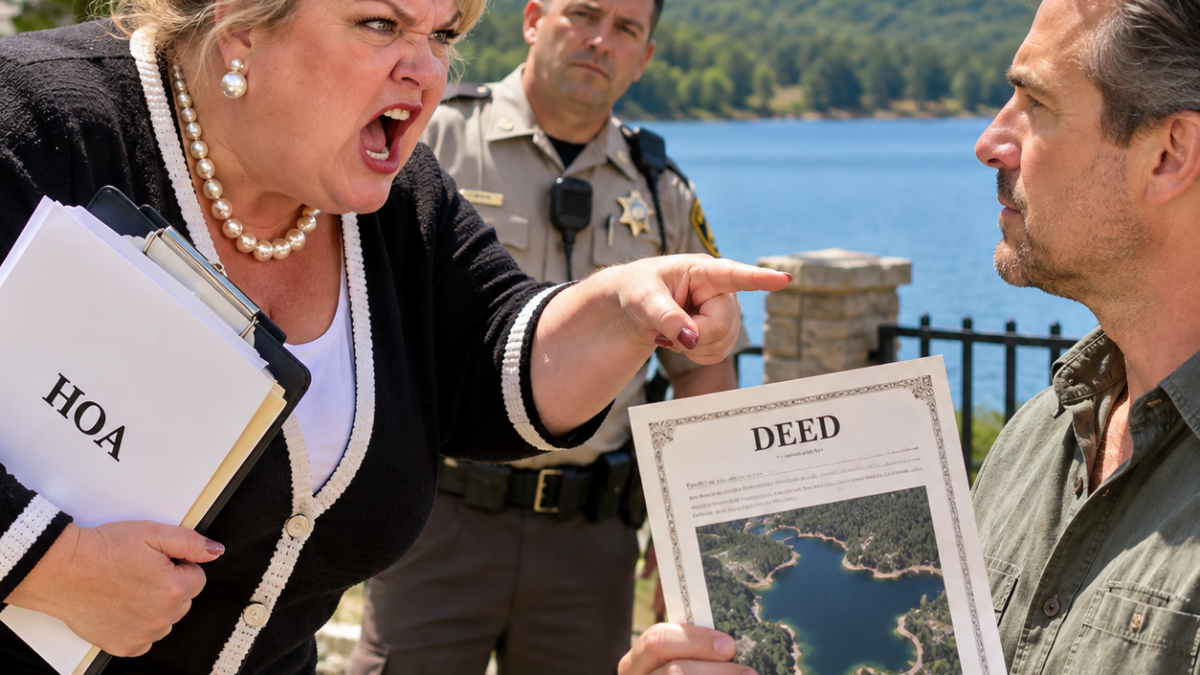
The HOA president stood on my lawn, accused me of stealing water from hundreds of families, and gave me forty-eight hours to pay ten thousand dollars before she “made an example out of me.”
She had brought an inspector, a board member, and enough paperwork to make the whole thing look official, which was exactly why half the neighborhood was watching from behind their curtains when she threatened to put a lien on my home.
What Karen didn’t know was that somewhere beneath ninety-eight years of forgotten paperwork was one sentence that would turn her victory lap into the worst mistake of her life.
“My office has documented proof that you have been illegally tapping into the Lakeside Meadows community water system,” Karen Whitmore announced.
She stood at the edge of my front walk in a bright floral pantsuit, gripping a thick violation packet like a prosecutor holding a murder weapon.
Beside her stood Todd Mercer, one of her most loyal board members, wearing the smug half-smile of a man who enjoyed watching somebody else get punished.
The third person was a nervous-looking man in a blue polo shirt with a clipboard.
Karen introduced him as a certified water systems inspector.
I would later discover that “certified” was doing a remarkable amount of work in that sentence.
“Theft of community utilities is a serious offense,” Karen continued. “The initial penalty is ten thousand dollars, excluding inspection expenses, legal fees, and potential criminal prosecution.”
Ten thousand dollars.
She paused after saying it.
She wanted the number to land.
She wanted my face to change.
I had seen that tactic before.
Twenty-five years in the Army Corps of Engineers teaches you many things, but one of the most useful is how to recognize someone who mistakes intimidation for authority.
I looked past her toward the street.
Curtains moved.
A garage door that had been half-open slowly lowered.
Mrs. Gable, my elderly neighbor, stood beside her mailbox pretending to examine a piece of junk mail while listening to every word.
Karen had planned this carefully.
This was not simply a violation notice.
It was theater.
She wanted Lakeside Meadows to see me accused.
She wanted everybody to understand what happened to people who challenged her.
“My water?” I asked.
“Community water,” she corrected sharply.
She pulled a photograph from the packet.
It showed an old galvanized pipe rising near the edge of my vegetable garden and disappearing into the brush running downhill toward the reservoir.
“This pipe,” she said, tapping the image, “has been identified as an unauthorized connection.”
I studied the picture.
Then I looked at the inspector.
“You identified this?”
He shifted his weight.
“Our preliminary assessment indicates—”
“Did you excavate it?”
“No.”
“Pressure test it?”
“We took readings.”
“Where?”
He glanced at Karen.
That answered more than his words could have.
I looked back at the report.
The pipe had been there longer than any house in Lakeside Meadows.
It was part of the original Miller farm irrigation system, installed decades before developers turned the surrounding pastureland into rows of beige houses, manicured lawns, and identical mailboxes.
I knew because the old schematics were sitting in a filing cabinet inside my study.
But Karen didn’t need to know that yet.
Information is like ammunition.
You don’t empty the magazine during the first five minutes of a fight.
“That pipe predates your HOA by several decades,” I said.
Karen laughed.
Not because anything was funny.
Because contempt was one of her favorite tools.
“I don’t care if George Washington installed it himself. It wasn’t approved by our architectural committee.”
“My property isn’t governed by your architectural committee.”
Her mouth tightened.
That was the source of most of our problems.
The old Miller farmstead had existed nearly a century before Lakeside Meadows.
When I bought the thirty-acre property five years earlier, I also inherited something Karen hated almost as much as weeds in a front yard.
Independence.
My land was not part of her HOA.
I paid a contractual road-access contribution because the only paved route to my property crossed neighborhood streets, but that agreement gave the association no architectural authority over my farm.
Karen had never accepted that.
She had complained about my fence.
My vegetable garden.
My barn.
The height of grass near my pasture.
Every time, I responded with the same thing.
Show me where your covenants apply.
She never could.
This time, though, she had changed tactics.
She wasn’t accusing me of violating HOA rules.
She was accusing me of stealing.
“That pipe is drawing from the reservoir,” I said.
“Exactly,” Karen replied.
Her smile widened.
“Our reservoir.”
Something about the way she said those two words bothered me.
Not because she was aggressive.
Because she sounded completely certain.
She stepped closer.
“You have forty-eight hours to pay the ten-thousand-dollar penalty, reimburse inspection expenses, and authorize our contractor to cap the illegal connection.”
“And if I don’t?”
“We will initiate lien proceedings.”
“You can’t lien property outside your jurisdiction.”
“For theft of community resources, our attorneys believe otherwise.”
Todd nodded enthusiastically.
Karen continued.
“We will also notify law enforcement and shut off your authorized water service.”
That was when I pulled my phone from my pocket.
The recording indicator was already glowing.
Karen’s expression flickered.
“For clarity,” I said, “are you stating on behalf of Lakeside Meadows HOA that you intend to interfere with my water access, enter my private property, place a lien against my home, and refer me for criminal prosecution based on this report?”
Her confidence wavered for perhaps half a second.
Then pride took control again.
“I am informing you of the consequences of stealing from this community.”
I nodded.
“Good.”
“Good?”
“Now I know exactly what you’re claiming.”
Her eyes narrowed.
I folded the violation notice once.
“I’ll respond.”
“You have forty-eight hours.”
She turned toward the golf cart parked at the curb.
Todd followed.
The inspector hesitated, gave me an apologetic glance, then hurried after them.
I watched the cart disappear down the street.
Mrs. Gable looked over from her mailbox.
“Jack?”
“Yes, ma’am?”
“Are you in trouble?”
I looked at the paper in my hand.
Then toward the reservoir glittering below the hill.
“I don’t know yet.”
I turned toward my house.
“But I’m about to find out who really owns that water.”
PART 2
I went straight to my study.
Of all the rooms in the old farmhouse, it was the only one I had significantly modernized after moving in.
The rest of the house still had thick plaster walls, uneven oak floors, old brass fixtures, and windows whose frames had probably survived six presidents before I was born.
My study was different.
Two large monitors.
A document scanner.
Locking filing cabinets.
Shelves of engineering manuals.
Survey maps.
County plats.
Binders.
Years of military service had permanently changed the way I approached problems.
Some people become less organized after retirement.
I became more organized because for the first time, I had enough time to do it properly.
I placed Karen’s violation notice in the middle of my desk.
Then I made coffee.
Black.
No sugar.
By the time I returned, my anger had cooled into something useful.
I scanned the entire packet.
The inspector’s report was six pages long and looked impressive if you didn’t know what you were reading.
There were photographs.
Measurements.
Several paragraphs about pressure fluctuations.
A diagram supposedly showing the HOA water main.
The problem was that the diagram was wrong.
Not slightly wrong.
Wrong enough that I stared at it for almost a minute wondering whether I had missed something.
I opened the survey from my property closing.
The Lakeside Meadows primary distribution line ran along the southern service corridor.
My old irrigation pipe sat roughly fifty feet away.
Different alignment.
Different depth.
Different direction.
If the pipe had actually tapped their main where Karen’s inspector claimed, it would have needed to turn underground at nearly a right angle and cross terrain where no trench had ever existed.
More importantly, the pipe pointed downhill.
Toward the reservoir.
I picked up the phone.
There are people you call because they are friends.
There are people you call because they are experts.
Dave Jensen was both.
We had spent years together in the Corps.
He was one of those civil engineers who could look at a culvert, squint at the soil, kick a retaining wall once, and tell you exactly which contractor had cut corners.
After retiring, he started a consulting company that handled municipal drainage, utility design, and infrastructure investigations.
I texted him photographs of the pipe and Karen’s report.
My phone rang less than two minutes later.
“Jack.”
“Dave.”
“What clown wrote this?”
I smiled.
“Hello to you too.”
“I’m serious. What am I looking at?”
“A certified hydro inspector’s finding.”
“Certified by who? Neptune?”
I leaned back.
“Tell me what you see.”
“I see an old galvanized agricultural line, probably mid-century. Maybe earlier depending on the couplings. I see a guy pretending pressure numbers mean something when he doesn’t state where they were taken. I see soil conclusions without excavation. And I see a diagram that looks like somebody drew a water main based on vibes.”
“That was roughly my assessment.”
“What’s the fight?”
I told him everything.
Karen.
The ten-thousand-dollar fine.
The lien threat.
The criminal accusation.
The proposed pipe cap.
When I mentioned shutting off my water, Dave stopped joking.
“Jack, don’t underestimate them.”
“I’m not.”
“I know you aren’t. But homeowner associations have money collected from everybody else. They can spend ten grand fighting you without personally feeling like they spent a dime.”
“I know.”
“And if they’ve convinced themselves that pipe connects to their system, arguing engineering details could take months.”
“So what do you suggest?”
“Find something cleaner.”
“Cleaner?”
“A fact so simple that even an HOA attorney billing four hundred dollars an hour can understand it.”
He paused.
“Something that ends the argument instead of improving your side of it.”
I looked toward the file cabinet.
A thick accordion folder sat in the second drawer.
**MILLER FARMSTEAD — ACQUISITION.**
I pulled it out.
“I may have something.”
“What?”
“History.”
“That sounds expensive.”
“Usually is.”
I spread the contents across my desk.
My deed.
Title insurance.
Closing survey.
Old aerial photographs.
The road-access agreement with Lakeside Meadows.
Property-tax records.
The title abstract.
The abstract alone was more than a hundred pages.
When I bought the farmstead, I had read it carefully enough to confirm that the title was clean and that the HOA had no jurisdiction over the land.
I had not cared much about every ancient easement or handwritten reference because most of them seemed irrelevant.
Now I started from the beginning.
Or technically, the end.
My purchase.
The prior owner.
The Miller estate.
Land transfers in the 1980s.
Subdivision transactions in the 1970s.
I read for two hours.
At some point the sun moved across my study floor.
My coffee turned cold.
I kept going.
In a 1974 transfer, I found a reference to the reservoir.
Not ownership.
Just an easement.
I highlighted it.
Another reference appeared in 1962.
Then 1951.
Then finally, buried within a deed summary from 1929, I saw a phrase I had never noticed before.
**Subject to and benefiting from the Miller Reservoir Compact, recorded November 12, 1928.**
I read it twice.
Then I searched the digital county records.
Nothing.
Too old.
The document had never been scanned.
I called the clerk’s office.
A woman answered who sounded exhausted before I even introduced myself.
“I’m trying to locate a recorded instrument from November 12, 1928.”
“You have a book and page?”
“No. Name is Miller Reservoir Compact.”
A sigh.
“You’ll have to come in.”
“Today?”
“We close in ninety minutes.”
The courthouse was twenty-seven minutes away.
I made it in nineteen.
The records archive occupied part of the basement.
There are certain smells that vanish from modern life until you encounter them somewhere old.
Carbon paper.
Dust.
Leather bindings.
Dry glue.
The archive smelled like all of them.
A clerk in glasses helped me locate the 1928 index.
“Miller,” she said, running one finger down a page.
“Miller, Miller…”
Then she stopped.
“Reservoir Compact. Book 41. Page 318.”
My pulse increased.
She pointed toward a row of bound volumes.
“Those don’t leave the table.”
“I understand.”
I found Book 41.
It weighed almost twenty pounds.
The leather cover cracked softly when I opened it.
Page 318 began with elaborate legal language typical of its era.
The Millers had dammed Willow Creek across their own land.
The reservoir had been constructed entirely at private expense.
Its purpose was agricultural irrigation, livestock supply, fire reserve, and household use.
Nothing surprising yet.
Then came a section titled:
**Reservation and Appurtenant Rights Upon Future Conveyance.**
I leaned closer.
The words were formal and old-fashioned, but the meaning was unmistakable.
Any parcel later sold from the original Miller farm could receive a perpetual right to obtain domestic water from the reservoir.
But ownership of the reservoir itself would remain attached to the original farmstead.
The compact described what that meant.
The reservoir basin.
Lakebed.
Dam.
Spillway.
Control structures.
Primary riparian interests.
Appropriated water rights.
Everything stayed with what the document called the **dominant estate**.
The original homestead and unsold farm acreage.
My land.
I read the section once.
Then again.
On the third reading, I whispered one word.
“Oh.”
The clerk glanced over.
“Everything okay?”
I looked toward her.
“Potentially much better than okay.”
I kept reading.
Later transfers confirmed the arrangement.
When parcels were sold, the purchaser received access to water.
Not ownership of the source.
When the large tract that eventually became Lakeside Meadows was transferred to developers, that same language appeared in the chain of title.
They had a permanent water-use right attached to their land.
But the reservoir had never been conveyed.
Not to the developer.
Not to a utility district.
Not to the HOA.
I sat back.
For decades, Lakeside Meadows had treated the reservoir as if it belonged to the neighborhood because everybody used it.
The HOA arranged testing.
The HOA managed distribution infrastructure.
The HOA billed residents for treatment and maintenance.
The HOA probably believed it owned everything because nobody had ever forced anyone to check.
But using something and owning it are not the same thing.
Karen had walked onto my lawn and accused me of stealing water from her reservoir.
The deed history said I owned the reservoir.
My pipe was not stealing from their source.
Their entire community was drawing water from mine under a recorded access right.
I started photographing pages.
Then I asked for certified copies.
The clerk raised an eyebrow when I told her how many.
“Legal fight?”
“Probably.”
“HOA?”
I stared at her.
“How did you know?”
She smiled without humor.
“Been working county records eighteen years.”
I laughed for the first time all day.
Outside in the parking lot, I called Dave.
He answered immediately.
“Well?”
“You wanted a cleaner fact.”
“I did.”
“I own the reservoir.”
Silence.
Then he laughed.
Not a polite laugh.
The kind that forces someone to move the phone away from their mouth.
“No.”
“Yes.”
“Jack.”
“I have the 1928 compact in my hand.”
“Read it.”
I read the relevant section.
He stopped laughing.
“Send me everything.”
I photographed the certified copy and sent it.
Five minutes passed.
Then my phone rang again.
His voice had changed.
“Oh, this is beautiful.”
“Your professional opinion?”
“My professional opinion is that Karen picked a fight with the only man in the valley she absolutely should not have accused of stealing water.”
“So I’m reading this correctly?”
“Yes. Subject to actual legal review, obviously, but as an engineering and title framework? They have an appurtenant right to use water. You hold title to the source infrastructure and reservoir estate described in the compact.”
“The pipe?”
“Your pipe appears to be exactly what you said it was. Historical farm infrastructure drawing from a source attached to your property.”
“So she can’t cap it.”
“She can try.”
“What happens if she does?”
“Call me so I can watch.”
I smiled.
Then he became serious.
“You need a lawyer.”
“I know.”
“A very good one.”
“I know.”
“Not a general practice guy who also handles divorces and writes wills. Somebody who understands easements, riparian rights, old water compacts, and hostile property litigation.”
“I know somebody who knows somebody.”
That somebody was General Thomas McCabe.
He wasn’t actually a general anymore, but men who served under him rarely stopped calling him that.
McCabe had been one of those officers who remembered everyone.
Birthdays.
Wives’ names.
Which lieutenant had once wrecked a Humvee in Germany.
I called him.
We exchanged five minutes of insults disguised as greetings.
Then I explained the problem.
When I finished, he said, “You need Arthur Vance.”
“Who?”
“Property lawyer. State capital.”
“Good?”
“Expensive.”
“That wasn’t my question.”
“Very good.”
“How good?”
“He once spent seven years fighting a commercial developer over a twenty-foot easement because they annoyed him.”
“That sounds unhealthy.”
“It was magnificent.”
I got Arthur Vance’s number.
To my surprise, he answered himself.
“This is Vance.”
“Mr. Vance, my name is Jack Callahan. General McCabe suggested I call.”
“That either means you have an unusual problem or Tom owes you money.”
“Unusual problem.”
“Go ahead.”
I told the story.
When I reached the part about the 1928 compact, he interrupted for the first time.
“Stop.”
I stopped.
“Do you have that document?”
“Certified copy in front of me.”
“Recorded?”
“Yes.”
“Referenced through your title chain?”
“Yes.”
“Send it.”
I emailed everything.
For almost five minutes, he said nothing.
I could hear typing.
Then a chair creaked.
“Mr. Callahan.”
“Yes?”
“You have made my afternoon significantly more interesting.”
“That good?”
“That depends on whether you enjoy watching arrogant people discover basic property law.”
“I’m developing an appreciation for it.”
He gave a low laugh.
“Come to my office tomorrow.”
Vance’s office occupied the upper floor of a building downtown.
He was in his late sixties, tall, silver-haired, and dressed so perfectly that I became suddenly aware my blazer had survived at least three weddings and one funeral.
He had arranged the documents across a conference table.
“Sit.”
I sat.
He pointed toward Karen’s violation notice.
“This is insulting.”
“Agreed.”
He pointed toward the inspector’s report.
“This is worse.”
“Also agreed.”
Then the 1928 compact.
“This is extraordinary.”
“That sounds better.”
“It is.”
He folded his hands.
“Your first instinct is probably to send this to the HOA president today.”
“It crossed my mind.”
“Don’t.”
That surprised me.
“Why?”
“Because she has given you an opportunity.”
“To do what?”
“To determine whether this is ignorance or malice.”
I frowned.
“She accused me publicly and threatened criminal prosecution.”
“Yes.”
“But right now, she can claim she relied on a consultant and made an innocent mistake.”
“Innocent?”
“I said she can claim it.”
He leaned forward.
“We send a demand for retraction. We explain that the report is technically unsound. We state that the pipe is historical infrastructure and that you deny any theft. We give them time to withdraw.”
“But we don’t mention the compact.”
“Correct.”
“You want her to double down.”
“I want her to make a fully informed choice about whether to double down.”
I considered that.
“So we warn her without showing our strongest evidence.”
“Exactly.”
“And if she retracts?”
“Then you get what you said you wanted.”
“To be left alone.”
“Yes.”
“And if she escalates?”
Vance smiled.
“Then she does it after receiving a lawyer’s written warning that her factual basis is disputed.”
I understood.
This was not about revenge.
Not yet.
It was about building a record.
The letter went out the next morning.
Vance dismantled the inspector’s report with surgical restraint.
No insults.
No accusations.
He pointed out that the pipe’s age had not been established.
The report failed to demonstrate physical connection to an HOA-owned water main.
The mapping contradicted recorded survey information.
No excavation had occurred.
No reliable basis existed for the accusation of theft.
The letter demanded withdrawal of the fine and written confirmation that no one would enter my property or interfere with the pipe.
They had ten business days.
On day one, nothing happened.
Day two, nothing.
I saw Karen twice during that period.
The first time she passed in her golf cart.
She waved.
Not warmly.
The kind of little wrist movement royalty might use toward peasants.
The second time, she stopped near Mrs. Gable’s house while a contractor measured a mailbox.
Karen noticed me watching.
She smiled.
Then tapped her wrist as if reminding me of a deadline.
I smiled back.
The tenth business day passed.
Nothing.
On day eleven, a courier delivered an envelope.
I opened it at the kitchen table.
The first page stated that the board had reviewed my response and rejected it.
My fine was now twenty thousand dollars because of continuing noncompliance.
A contractor would arrive the following Tuesday to enter my property and cap the pipe.
The HOA would bill me for the work.
Then came the final paragraph.
Karen had reported me to the county sheriff for theft of community water.
I read that paragraph twice.
Then I called Vance.
“They reported it.”
“What exactly?”
I read the language.
He was silent.
Then he asked, “Do you have the sheriff’s report number?”
“Not here.”
“I’ll get it.”
“Arthur?”
“Yes?”
“I think she just crossed your line.”
“No, Mr. Callahan.”
His voice was almost cheerful.
“She crossed several.”
The restraining-order filing went out that afternoon.
Vance sought to prevent the HOA, its contractors, and agents from entering my property or altering the historic pipe until ownership and water rights could be adjudicated.
At the same time, he prepared a detailed submission to the district attorney’s office and county investigators.
That filing included everything.
Karen’s accusation.
The inspector’s report.
Her lien threats.
The warning letter.
The HOA’s refusal to retract.
The police report.
The title abstract.
And the Miller Reservoir Compact.
But Vance was not finished.
“You’ve spent fifty years maintaining a system without a modern source agreement,” he said.
“I haven’t. They have.”
“Exactly.”
“What are you thinking?”
“Who regulates the community water system?”
The answer was the state Department of Environmental Quality.
Vance drafted another letter.
It was not theatrical.
That made it worse.
He notified the agency that a legal title dispute had revealed that Lakeside Meadows’ primary water source was situated on privately owned property under a historical access compact and that no current agreement appeared to exist between the HOA and the titleholder governing modern operations, maintenance responsibilities, testing access, infrastructure control, liability, or emergency procedures.
He requested regulatory review.
A separate letter went to the HOA’s insurance carrier.
It placed the carrier on notice that the board had threatened intentional entry onto private property after receiving written legal objection and had escalated a disputed civil matter into a criminal accusation.
Potential personal liability was mentioned.
So were intentional-act exclusions.
I read the draft and called Vance.
“Is this excessive?”
“No.”
“You just brought state regulators, prosecutors, and their insurance company into a pipe dispute.”
“They brought the sheriff.”
Fair point.
The first person to panic was not Karen.
It was the HOA’s lawyer.
His name was Bill Peterson.
He called me directly, which Vance later described as “the legal equivalent of forgetting which direction the gun points.”
“Mr. Callahan?”
“Yes.”
“This is William Peterson. I represent Lakeside Meadows.”
“I’m represented by Arthur Vance.”
“Yes, yes, I’m aware.”
His voice sounded tired.
“I was hoping perhaps we could clear up what appears to be a misunderstanding.”
“I’m sure Mr. Vance would be happy to speak with you.”
“Well, before we escalate things unnecessarily—”
I looked at Karen’s twenty-thousand-dollar demand sitting on my counter.
“Bill?”
“Yes?”
“Your client filed a theft complaint against me.”
A pause.
“Yes.”
“She plans to send contractors onto my property.”
“Well, that action is currently under review.”
“Your client accused me of stealing her reservoir.”
Another pause.
This one longer.
“I believe there are… complicated title issues.”
I almost laughed.
“Did you read the 1928 compact?”
Silence.
Then, “I received it this morning.”
“And?”
“Mr. Callahan, as I said, there are complicated issues.”
“They become less complicated after page four.”
He exhaled.
“I think perhaps our lawyers should speak.”
“I think that’s a very good idea.”
I ended the call.
Two days later, every homeowner in Lakeside Meadows received notice of an emergency meeting.
The subject line said:
**URGENT LEGAL AND WATER SYSTEM MATTER.**
Mrs. Gable called me.
Her voice shook.
“Jack, are they shutting off our water?”
“No.”
“Karen says there’s a legal attack on the neighborhood.”
“There’s a title issue.”
“What does that mean?”
“It means everybody should attend the meeting.”
“Will you?”
“Yes.”
She lowered her voice.
“Karen says you’re trying to take control of the water.”
I looked out toward the reservoir.
“Mrs. Gable?”
“Yes?”
“I don’t have to take control of something I already own.”
Silence.
“Oh.”
“Come to the meeting.”
“I will.”
The clubhouse was full when I arrived.
Not just full.
Standing-room-only.
People lined the walls.
Families who normally ignored HOA meetings had shown up because nothing motivates civic participation quite like the possibility that your faucets might stop working.
Karen sat at the front with Todd and three other board members.
Todd looked terrible.
His face was damp.
Karen looked angry.
Anger was easier for her than fear, so whenever she became frightened, she simply became more aggressive.
Peterson stood at a podium.
He gave a five-minute explanation that contained almost no information.
“Historical title complexity.”
“Unforeseen archival instrument.”
“Regulatory clarification.”
“Active legal discussions.”
People became more agitated with every phrase.
A man near the front shouted, “Are we losing the reservoir?”
“No,” Peterson said.
A woman yelled, “Then who owns it?”
He hesitated.
That was enough.
The room exploded.
Karen grabbed the microphone.
“Everyone needs to calm down.”
Someone shouted, “Answer the question!”
“I will not allow this meeting to descend into chaos.”
“Who owns the water?”
Karen glared at the crowd.
“The association has operated the Lakeside Meadows reservoir system for decades.”
I stood.
Peterson saw me.
His shoulders dropped.
I walked toward the resident microphone.
Karen immediately said, “This is an internal HOA meeting.”
“I pay for road access under a recorded agreement.”
“You are not a member.”
“Then perhaps your board should stop accusing me of stealing member property.”
Applause broke out.
Not everyone.
Enough.
Karen’s face reddened.
Peterson quietly said something to her.
She handed me the microphone.
“My name is Jack Callahan.”
The room settled.
“I live at the old Miller farmstead above the reservoir.”
Most people knew that.
I had deliberately brought no dramatic props except one large mounted copy of the relevant 1928 document.
I held it up.
“About three weeks ago, your HOA president came to my home and accused me of illegally taking water from what she called the community reservoir.”
A murmur moved through the room.
“She fined me ten thousand dollars.”
Todd stared at the table.
“She later doubled it to twenty thousand.”
The murmur became louder.
“She threatened to place a lien against my property, cut off water access, send contractors onto my land, cap a pipe that has existed for decades, and report me to law enforcement.”
I looked at Karen.
“She ultimately did report me.”
People turned toward her.
Karen snapped, “Because theft is a crime.”
I nodded.
“It is.”
Then I raised the 1928 compact.
“So let’s talk about ownership.”
I explained the Miller farm.
The dam.
The reservoir.
The sale of surrounding parcels.
The developer.
The access rights.
I kept it simple because complexity is often where people hide from obvious truths.
“When the Miller family sold portions of its farm, buyers received the right to draw domestic water from the reservoir.”
I pointed to the enlarged paragraph.
“They did not receive ownership of the reservoir.”
Someone asked, “Then who did?”
“The compact states that ownership remains attached to the original farmstead.”
I paused.
“My property.”
For several seconds, nobody spoke.
The reaction was strange because you could almost feel people processing the sentence in waves.
First confusion.
Then disbelief.
Then alarm.
A man in a baseball cap stood.
“You own the lake?”
“Reservoir.”
“The whole thing?”
“The recorded compact places ownership of the reservoir basin, dam, spillway, associated structures, lakebed interests, and the stated water rights with the dominant farm estate.”
“And that’s you?”
“Yes.”
Karen grabbed her microphone.
“This is misleading!”
I turned toward her.
“Which part?”
“Our homeowners have deeded water rights.”
“They do.”
That surprised people.
I continued.
“Every homeowner should understand this clearly. Nobody is saying your lawful water-use rights vanish.”
Some shoulders relaxed.
“Your deeds provide access to water. What they do not provide is ownership of the source.”
Karen laughed bitterly.
“You’re splitting hairs.”
“No.”
I looked toward the residents.
“If you have a right-of-way over your neighbor’s driveway, you have a right to cross it. That doesn’t mean you own the driveway.”
A woman said, “Then why has the HOA been managing the reservoir?”
“That is one of the questions the state is now asking.”
The room erupted.
Karen slammed her hand on the table.
“You contacted regulators?”
“Yes.”
“You are trying to destroy this community!”
“No.”
My voice stayed level.
“You accused me of stealing my own water.”
More applause.
“Then you threatened to send people onto my property after my attorney warned you the accusation was disputed.”
“You hid this document!”
That was almost impressive.
I stared at her.
“I hid a document recorded at the county courthouse in 1928?”
“You knew.”
“I found it after you accused me.”
“That’s convenient.”
“It’s also why competent people conduct title research before filing criminal complaints.”
That landed.
Todd looked at Karen.
Karen looked at Peterson.
Peterson looked like he wanted the floor to open.
Then a voice came from the second row.
“Karen.”
Mrs. Gable stood.
She was seventy-eight.
Small.
Gray-haired.
Quiet.
I had seen her step away from arguments at neighborhood picnics because she hated confrontation.
Karen had fined her twice.
Once because her birdbath exceeded an ornamental-height rule.
Once because her grandson left a basketball hoop beside the driveway during a holiday visit.
Her hands trembled around the back of the chair in front of her.
“You fined me two hundred dollars for my birdbath.”
Karen sighed.
“This meeting is not about—”
“Yes, it is.”
The room became quiet.
Mrs. Gable continued.
“You told me rules were rules.”
Karen’s expression tightened.
“You told me your job was protecting our property values.”
No response.
“You threatened my son when he argued about that basketball hoop.”
“Mrs. Gable—”
“You made people afraid to talk to you.”
Her voice grew stronger.
“And now you want us to believe Mr. Callahan is destroying the neighborhood because he proved you didn’t know who owned our water.”
Someone clapped.
Mrs. Gable looked directly at Karen.
“You called the police on him.”
Karen opened her mouth.
Mrs. Gable did not stop.
“For stealing something he owns.”
The applause became thunderous.
That was the moment the meeting changed.
Until then, residents had been frightened about water.
Now they were angry about leadership.
A man named Robert stood and described being fined because his trash cans remained visible after pickup.
A mother described receiving a violation over chalk drawings her children had made on their driveway.
Another resident accused Karen of selective enforcement.
A retired couple described spending thousands replacing landscaping the board had previously approved.
People did not need encouragement.
They had stories stored for years.
All they had lacked was a moment when everyone realized they were not suffering alone.
Karen shouted for order.
Nobody listened.
Todd finally raised his microphone.
“Karen.”
She turned.
“Not now.”
“We need to recess.”
“No.”
“I think we need—”
“I said no.”
He swallowed.
Then did something nobody expected.
He stood.
“I didn’t know about the compact.”
The crowd quieted.
Karen stared at him.
“Todd.”
“You told us the water system belonged to the association.”
“It does.”
“Apparently it doesn’t.”
Her face became almost purple.
“You voted for the enforcement action.”
“Because you told us the inspector confirmed theft.”
The inspector wasn’t there.
I wondered whether he had suddenly become very difficult to reach.
Todd looked toward me.
“Mr. Callahan, were we warned before the fine was doubled?”
“My attorney sent a written demand challenging the findings and asking the board to retract.”
Todd looked at Peterson.
“Did you see that?”
Peterson nodded reluctantly.
“When?”
“Before the second notice.”
Todd closed his eyes.
The room exploded again.
Karen had lost them.
Not because I had outshouted her.
Because she had finally created a problem too large to hide behind rules.
The meeting ended after nearly three hours.
No resolution.
No vote.
Just fury.
Outside, Mrs. Gable caught my arm.
“Jack.”
“Yes?”
“You’re not going to shut our water off, are you?”
Her question hurt.
Because beneath everything else, she was scared.
I turned fully toward her.
“No.”
She studied my face.
“Promise?”
“As long as I have a lawful way to prevent it, nobody is losing water because Karen and I had a fight.”
Her shoulders lowered.
“Thank you.”
“That doesn’t mean the HOA gets to keep pretending nothing happened.”
“I understand.”
She smiled faintly.
“I hope you make them sweat a little.”
I laughed.
“Go home, Mrs. Gable.”
The collapse began the next morning.
Vance called at 7:12.
“County investigator wants to interview you.”
“About the report?”
“Yes.”
“Good or bad?”
“Neither. Answer questions. Tell the truth. Do not editorialize.”
“You remove all the fun from litigation.”
“That is why you pay me.”
The interview took an hour.
I provided recordings.
Letters.
Dates.
The inspector’s report.
The title documents.
I did not claim Karen knew I owned the reservoir when she first accused me.
I couldn’t prove that.
What mattered was what she did after receiving notice that the claim was disputed and technically unsupported.
The criminal side belonged to investigators, not me.
Vance emphasized that repeatedly.
“We pursue the civil and property issues. We do not manufacture criminal exposure because we dislike someone.”
“Understood.”
“Good.”
“What about the state?”
“They have questions.”
That was an understatement.
The regulatory review exposed years of assumptions.
The community’s water-use rights were legitimate.
That was important.
Nobody was suddenly an illegal water user.
But modern operations had developed far beyond anything contemplated in 1928.
Pumps.
Treatment.
Testing.
Distribution mains.
Maintenance access.
Emergency repairs.
Dam inspection.
Insurance.
There was no clear contemporary agreement defining who could enter which property, who controlled source infrastructure, where responsibility shifted, or how the old compact interacted with modern regulatory requirements.
The HOA had been operating on institutional inertia.
Everyone simply assumed the existing arrangement was proper because it had existed for a long time.
Karen’s accusation forced somebody to examine it.
That examination created a mess.
The state demanded documentation.
The insurance carrier demanded documentation.
Title attorneys began calling.
Peterson stopped calling me entirely.
All communication went through Vance.
Then came a letter from the HOA’s directors-and-officers insurer.
Vance read it aloud in his office.
The carrier reserved rights concerning several board actions and warned that intentional or knowingly unlawful conduct could fall outside coverage.
“Translation?” I asked.
“They’re worried.”
“About Karen?”
“About everybody.”
“Are the board members personally exposed?”
“Potentially. Depends on facts, law, coverage, indemnification, and exactly what each member did.”
“So Todd has a problem.”
“Todd has insomnia.”
The board scheduled another emergency meeting.
Karen did not preside.
That told me almost everything before I walked in.
Peterson sat at the front.
Todd sat four chairs away from Karen.
Two other board members did the same.
The physical distance looked intentional.
Peterson opened.
“Following consultation with counsel, the board has voted to suspend enforcement action against Mr. Callahan pending resolution of the title matter.”
Someone shouted, “Suspend?”
Another voice: “Cancel it!”
Peterson raised both hands.
“The twenty-thousand-dollar assessment is withdrawn.”
Applause.
Karen sat rigid.
“The association will not enter Mr. Callahan’s property or interfere with the disputed irrigation line.”
More applause.
Then Todd moved to the microphone.
“Additionally, I am making a motion that President Whitmore be temporarily relieved of executive authority pending independent review.”
Karen’s head snapped toward him.
“You coward.”
The microphone carried it through the room.
Todd looked at her.
“No, Karen.”
“You voted with me.”
“Yes.”
“You signed the letter.”
“Yes.”
She smiled viciously.
“Then you’re just as responsible.”
He looked sick.
“That may be true.”
The honesty surprised everyone.
“But continuing to make it worse isn’t going to make me less responsible.”
The motion passed.
Four to one.
Karen cast the one.
She stood immediately.
“You are destroying this board.”
Mrs. Gable called from the audience.
“No, dear. I think that happened earlier.”
The room laughed.
Karen turned toward her.
For once, Mrs. Gable didn’t look away.
Three days later, Vance called me.
“They want to settle.”
“Who?”
“The HOA.”
“Karen?”
“No.”
“Then who authorized it?”
“The remaining board.”
“What do they want?”
“Their water problem solved.”
“And what do we want?”
He laughed.
“That depends on how angry you are.”
“I don’t want revenge against two hundred families.”
“I know.”
“I want the false accusation withdrawn.”
“Yes.”
“My legal expenses paid.”
“Yes.”
“Permanent recognition of ownership.”
“Yes.”
“And something that prevents another Karen.”
Vance paused.
“That one interests me.”
We spent nearly six hours building the settlement framework.
The water agreement was the most important part.
I refused Vance’s first suggestion on pricing.
“You could charge a substantial annual fee.”
“No.”
“Jack.”
“They’ve used the system for generations under the assumption it was theirs.”
“Incorrect assumption.”
“Still.”
“You have leverage.”
“I don’t want leverage over families.”
He leaned back.
“You understand most clients require me to convince them not to overreach.”
“I spent five years wanting peace. I haven’t changed.”
“What amount?”
“One dollar.”
He stared at me.
“One dollar annually?”
“One dollar.”
“That is absurd.”
“Perfect.”
“No, legally absurd and economically absurd.”
“Symbolically clear.”
He sighed.
Then smiled.
“Fine.”
The proposed lease term was ninety-nine years.
The association would pay one dollar annually in recognition of the source ownership.
Residents’ existing deeded water rights would remain respected.
The HOA would maintain agreed distribution infrastructure.
Source access, maintenance, safety, insurance, inspection, and regulatory responsibilities would be clearly defined.
No arbitrary shutoff.
No retaliatory interference.
No board member entering my property without lawful authority or emergency necessity.
And one provision mattered personally.
The association could not use its water-management role as a pretext to claim broader jurisdiction over my farmstead.
The farm remained outside the HOA.
Forever, as far as that agreement could secure.
Vance also drafted what he jokingly called the “Good Neighbor Clause.”
His first version was aggressive enough to start a small war.
I made him rewrite it.
The final language provided that material intentional interference with my property rights could trigger dispute procedures and, if uncured, suspension or termination of contractual privileges not independently protected by deeded rights or law.
That was less dramatic than “I can shut off the neighborhood.”
It was also more responsible.
I wasn’t interested in threatening children’s drinking water.
I wanted legal boundaries.
The board needed them.
So did I.
The settlement conference took place in Vance’s office.
Todd attended.
So did the other board members.
Karen did not.
Her own attorney had apparently advised her to stay away while questions surrounding the police report remained unresolved.
Peterson looked ten years older than when this started.
Vance began.
“My client’s position is straightforward.”
That sentence from a lawyer should terrify anyone sitting on the opposite side of the table.
“First, all fines, assessments, inspection fees, lien threats, and enforcement findings against Mr. Callahan arising from the water accusation are permanently withdrawn.”
Peterson nodded.
“Agreed.”
“Second, the association issues a written public apology acknowledging that it lacked a factual and legal basis to accuse Mr. Callahan of stealing community water.”
Todd shifted.
Peterson said, “We would prefer ‘insufficient factual basis.’”
Vance looked at me.
I shook my head.
“No.”
Peterson sighed.
“Fine.”
“Third,” Vance continued, “the association reimburses Mr. Callahan for legal and expert costs caused by this dispute.”
He slid the invoice across.
Todd’s eyes widened.
“That much?”
Vance did not blink.
“You doubled a ten-thousand-dollar fine, threatened a lien, retained contractors, generated emergency filings, triggered title research, forced regulatory response, and involved law enforcement.”
Todd looked down.
“Right.”
“Fourth, the HOA formally acknowledges Mr. Callahan’s ownership interest in the reservoir property and associated rights as reflected in the recorded chain of title.”
Peterson nodded.
“Subject to the residents’ existing access rights.”
“Of course.”
“Fifth, both parties execute the ninety-nine-year operating agreement.”
They had reviewed it already.
No objection.
“Sixth, the current board agrees to an independent governance review followed by a special election.”
One board member frowned.
“Why dissolve the whole board?”
Before Vance could answer, Todd spoke.
“Because we all signed it.”
Everyone looked at him.
He kept his eyes on the table.
“We all signed the twenty-thousand-dollar notice.”
Karen had pushed.
Karen had dominated.
But Todd understood something important.
She hadn’t acted alone.
The board had enabled her.
He continued.
“I think residents should decide whether any of us stay.”
I respected him for saying it.
The sixth term remained.
Then came Karen.
Vance said, “Ms. Whitmore’s resignation is required.”
Peterson rubbed his forehead.
“She has already been relieved of authority.”
“Resignation.”
“There are procedural issues.”
“Resolve them.”
“She may refuse.”
Vance leaned back.
“Then we litigate.”
The room went quiet.
Todd finally said, “She’ll resign.”
“How do you know?”
“Because if she doesn’t, we’ll remove her.”
It was almost sad.
Weeks earlier, he had stood on my lawn repeating her accusation like a loyal deputy.
Now he had finally understood where loyalty without judgment leads.
The settlement was signed.
One dollar changed hands.
Vance insisted on putting it in an envelope.
On the front he wrote:
**ANNUAL RESERVOIR LEASE PAYMENT — YEAR ONE.**
I stared at him.
“You enjoyed that.”
“Immensely.”
The apology was another matter.
The draft from the HOA sounded like something written by people apologizing for bad weather.
“Certain statements may have caused misunderstanding.”
I sent it back.
The second draft was better.
Not enough.
The final version said plainly that the association had accused me of illegally taking water without adequate factual or legal basis, imposed fines that were later determined to be unjustified, threatened enforcement beyond what was appropriate, and caused unnecessary legal and personal harm.
It apologized.
Not “regretted.”
Not “acknowledged concerns.”
Apologized.
The letter went to every homeowner.
It was posted online.
It was printed in the next newsletter.
At the next community meeting, Todd read it aloud.
His voice shook.
When he finished, he looked toward me.
“I’m sorry, Jack.”
That part wasn’t scripted.
I nodded.
“Thank you.”
Karen’s resignation arrived the same week.
No apology from her personally.
I didn’t need one.
Some apologies are worthless when they are extracted from people who still believe they were right.
The legal investigation into the police report continued independently.
Months later, the local paper published a short court notice stating that Karen had resolved the charge through a plea arrangement.
Probation.
Fine.
Community service.
When Mrs. Gable brought me the newspaper clipping, she looked almost disappointed.
“That’s it?”
“What were you hoping for?”
“I don’t know.”
She sat at my kitchen table.
“Something dramatic.”
“Like prison?”
“No.”
She thought.
“Maybe they make her spend two hundred hours measuring birdbaths.”
I laughed so hard I nearly spilled my coffee.
Mrs. Gable smiled.
“There. That’s justice.”
The special HOA election happened on a Saturday morning.
Turnout was enormous.
Years earlier, twelve homeowners might attend.
Now almost everybody came.
Karen’s era had taught them a lesson.
A neighborhood association becomes most dangerous when nobody except the people who enjoy power has time to participate.
The new president was a retired school principal named Linda Morris.
I had met her only twice.
She was calm.
Organized.
And possessed the most important qualification imaginable.
She didn’t particularly want the job.
Mrs. Gable became secretary.
When her nomination was announced, she tried to refuse.
Half the room chanted her name.
She eventually stood.
“All right,” she said. “But nobody asks me to use Excel.”
The vote was nearly unanimous.
Todd did not run.
I saw him outside after the election.
He approached carefully.
“Jack.”
“Todd.”
“I owe you an apology too.”
“You already apologized.”
“At the meeting.”
“That counts.”
“No.”
He shook his head.
“I stood on your lawn.”
I remembered.
The smug smile.
The repeated accusation.
He looked nothing like that man now.
“I enjoyed it.”
That was painfully honest.
“Enjoyed what?”
“Watching Karen go after somebody who couldn’t be controlled.”
He looked toward my hill.
“You made her crazy because she couldn’t fine you.”
“That wasn’t my goal.”
“I know.”
He shoved his hands into his pockets.
“I thought being close to her made me important.”
I said nothing.
“She liked having people around who never challenged her.”
“That tends to be true of people like Karen.”
“I should have challenged her.”
“Yes.”
He looked surprised by my bluntness.
I added, “But you eventually did.”
“Too late.”
“Late is better than never.”
He held out his hand.
I shook it.
The new board’s first months were mostly boring.
That was wonderful.
They reviewed enforcement policies.
They established written appeal procedures.
Residents could inspect more financial documents.
Large legal expenditures required expanded board review and notice.
Violation decisions required documentation.
Board members with personal disputes had to recuse themselves where appropriate.
The neighborhood did not descend into chaos.
Property values did not collapse because someone painted a door blue.
Civilization survived an unapproved basketball hoop.
Mrs. Gable bought a new birdbath.
It was taller than the old one.
Deliberately.
I measured it once.
Thirty-seven inches.
She caught me.
“Problem?”
“Potentially dangerous.”
She narrowed her eyes.
“I know who owns the reservoir.”
I raised my hands.
“I’ll be leaving.”
The water agreement took longer.
Engineers from the HOA and state walked my property with me.
We mapped infrastructure.
Some lines were older than expected.
Others had been replaced without documentation.
There were valves nobody had labeled properly.
A pump house needed electrical work.
The spillway inspection records were better than I expected.
The distribution records were worse.
It became clear that the conflict had accidentally done something useful.
For decades, maintenance had happened in fragments.
A contractor fixed one thing.
Another contractor replaced another.
Institutional knowledge lived in people’s memories.
The regulatory review forced everyone to create a coherent system.
I worked with them.
Not because I had to.
Because I was an engineer.
And because somewhere beneath my anger, I still believed systems should work.
Linda came to my house one afternoon carrying a binder.
“I have something for you.”
“What?”
“A complete reservoir operations manual.”
I opened it.
Maps.
Inspection schedules.
Emergency contacts.
Water-quality responsibilities.
Dam procedures.
Insurance details.
Valve locations.
“Who did this?”
“Everybody.”
I flipped through it.
“This is actually good.”
She smiled.
“That sounds like high praise.”
“It is.”
She sat at the table.
“There’s something else.”
“What?”
“The board wants to reimburse you for the inspection work you’ve been doing.”
“No.”
“Jack.”
“I don’t work for the HOA.”
“You’ve spent weeks helping.”
“I own the source.”
“That doesn’t mean you owe free engineering work.”
“It means I have an interest in not waking up one morning to discover the spillway has failed.”
She considered that.
“At least submit your mileage.”
“No.”
“You’re difficult.”
“I’ve heard.”
She looked around my kitchen.
“Karen really picked the wrong house.”
I smiled.
“She picked the wrong accusation.”
Spring arrived.
The reservoir changed color.
Winter gray became blue-green.
Trees filled the shoreline.
Ducks returned.
The vegetable garden came back.
One morning, I opened the old irrigation valve Karen had tried to cap.
Water moved through the galvanized line with a familiar low vibration.
It emptied into the garden channel.
Nothing dramatic happened.
No alarm.
No attorney.
No inspector.
Just water.
I stood there longer than necessary.
That pipe had probably carried water when Dwight Eisenhower was president.
Some Miller farmer had turned the same valve while sweating under the summer sun.
Children had probably run through irrigation streams.
Cattle had drunk nearby.
Then developers arrived.
Houses appeared.
The world changed.
The pipe stayed.
There was something comforting about that.
The first neighborhood barbecue happened in May.
I hosted it.
Not because the HOA asked.
Because Mrs. Gable did.
She appeared at my door three weeks beforehand.
“You should have a party.”
“Why?”
“Because people like you now.”
“That sounds temporary.”
“Jack.”
“I’m listening.”
“Everyone has spent six months arguing about water.”
“Yes.”
“We should enjoy it.”
I looked toward the reservoir.
“What are you suggesting?”
“Food.”
“That’s your answer to everything.”
“It works.”
She was right.
We set tables near the barn.
Linda brought folding chairs.
Todd volunteered grills.
Residents brought food.
Children ran across my lawn.
Several of them wandered too close to the irrigation channel until their parents shouted.
I didn’t care.
For years, my relationship with Lakeside Meadows had been simple.
They were down there.
I was up here.
I paid road-access fees.
They left me alone.
Karen had destroyed that arrangement.
Ironically, what came after was better.
People knew my name.
I knew theirs.
Not all of them became friends.
That would have been unrealistic.
But they became neighbors.
There is a difference.
Mrs. Gable approached carrying apple pie.
“I made this for you.”
“For owning a reservoir?”
“For not shutting off my sink.”
“You have deeded water access.”
“Yes, but ‘thank you for honoring my appurtenant utility rights’ doesn’t fit nicely on a pie.”
“Fair.”
We stood overlooking the water.
Sunlight moved across the surface.
Children were throwing a football nearby.
“You know,” she said, “I’ve lived here twenty-three years.”
“That long?”
“My husband and I bought when the development was still expanding.”
She smiled sadly.
“He loved that view.”
I knew her husband had died seven years earlier.
“He used to say we were lucky to live near water.”
“You are.”
She looked at me.
“Your water.”
“Our view.”
She smiled.
“That’s better.”
Across the lawn, Linda waved.
“Jack!”
“What?”
“We need the landlord!”
I frowned.
“What now?”
She pointed toward a folding table.
A framed dollar bill sat in the center.
Someone had added a small engraved plate beneath it.
**FIRST ANNUAL LEASE PAYMENT
LAKESIDE MEADOWS RESERVOIR
PLEASE DON’T SPEND IT ALL AT ONCE**
I looked at Vance, who had driven in for the barbecue.
He raised his drink.
“That was not me.”
“Liar.”
He smiled.
I kept the framed dollar.
It hangs in my study today.
Right beside the certified copy of the 1928 compact.
For a while, I thought that old document was the most valuable thing Karen had forced me to find.
Later, I realized it wasn’t.
The valuable thing was what happened after.
Residents became involved.
Board members learned they were representatives, not rulers.
People stopped treating violation letters as divine commandments.
Neighbors started asking each other for help before calling enforcement.
Linda created an informal mediation process.
Many conflicts vanished before becoming official disputes.
The community changed because fear changed.
For years, Karen’s authority had depended on uncertainty.
People didn’t know their rights.
They didn’t know whether anyone else was being targeted.
They didn’t know what would happen if they resisted.
So they complied.
Then Karen chose a fight whose facts could be written on a single page.
**You cannot steal your own reservoir.**
That sentence became almost a joke around Lakeside Meadows.
Someone printed it on a mug and gave it to me at Christmas.
Vance wanted one.
I told him he could buy his own.
He billed too much to receive free mugs.
One afternoon about a year after the settlement, I received a letter.
No return address.
Inside was a single sheet.
The handwriting belonged to Karen.
I knew because I had seen her signature on enough violation notices.
Jack,
I doubt you want to hear from me.
You probably believe I deserved what happened.
Maybe I did.
I have had a great deal of time to think.
I believed the board existed to maintain order. Somewhere along the way I stopped distinguishing order from control.
I still believe I was given bad advice regarding the pipe.
But I also know I made decisions because I did not like being challenged.
I should never have allowed the matter to become what it became.
I am sorry for the damage caused.
Karen
I read the letter twice.
Then I put it down.
It wasn’t perfect.
There were qualifications.
Excuses.
The sentence about bad advice irritated me.
But another sentence mattered.
**I stopped distinguishing order from control.**
That was more insight than I expected.
I did not write back immediately.
For two weeks, the letter stayed beside the framed dollar.
Eventually I wrote three sentences.
Karen,
I received your letter.
I appreciate that you sent it.
I hope wherever you are now, you have found some peace.
—Jack
That was all.
No victory speech.
No reminder.
No cruelty.
People sometimes imagine revenge as a perfect ending.
The person who hurt you loses everything.
They cry.
You smile.
Credits roll.
Real life is messier.
Karen had already lost what mattered most to her.
Authority.
Status.
Certainty that everybody else would obey.
Nothing I wrote could punish her more usefully than consequences already had.
And punishment had stopped being my goal.
A few months later, I was working near the barn when I heard a truck approaching.
Todd pulled up.
“Need something?”
“Maybe.”
He got out carrying an old cardboard box.
“My father died.”
“I’m sorry.”
“Thanks.”
He set the box on my workbench.
“He used to own one of the first houses in Lakeside Meadows.”
“I didn’t know that.”
“Before me. Before Karen.”
He opened the box.
Old photographs.
Receipts.
Neighborhood newsletters.
Then he handed me a black-and-white photograph.
It showed the reservoir in 1954.
A man stood beside the old pump house.
Behind him was farmland.
No subdivision.
No paved streets.
No clubhouse.
Just fields.
“Found this in Dad’s things.”
I turned the photograph over.
Written in pencil:
**Miller Reservoir — summer 1954.**
Todd pointed toward the man.
“That’s not my dad. He said it was Mr. Miller.”
I stared at the photograph.
“Which Miller?”
“Don’t know.”
Maybe the original owner’s son.
Maybe grandson.
The photograph showed an irrigation line running across the ground.
I looked closer.
Same style of galvanized pipe.
Possibly the same line.
Todd said, “Thought you should have it.”
“Why?”
“Because it belongs with the rest of the story.”
I nodded.
“Thank you.”
He turned to leave.
“Todd.”
“Yeah?”
“You doing okay?”
He shrugged.
“I’m not on any boards.”
“That’s a promising start.”
He laughed.
“I coach Little League now.”
“Less politics?”
“You have clearly never coached Little League.”
Fair point.
The photograph went into the farmstead file.
That file had become something different over time.
At first, it contained documents proving what I owned.
Now it contained photographs, settlement papers, maps, the water lease, Karen’s letter, newspaper clippings, and an absurd printed photograph of Mrs. Gable standing beside her oversized birdbath with both thumbs up.
History does that.
It starts as records.
Then it becomes memory.
Two years after the conflict, the state completed its final review.
The water system was fully compliant.
The operating agreement was recognized.
Required upgrades had been completed.
The ownership and access structure was documented.
Linda brought a copy of the final state letter to my porch.
“We’re official.”
“You were always official.”
“No. Before, we were apparently surviving through ninety years of habit and hope.”
“Those are surprisingly durable.”
She sat beside me.
The reservoir stretched below.
“Can I ask you something?”
“You usually do.”
“Did you ever consider charging us real money?”
“Yes.”
She looked surprised.
“When?”
“The first day Vance suggested it.”
“How much?”
“He gave me numbers.”
“And?”
“I hated them.”
“Why?”
I thought about that.
“Because money would have changed the story.”
“What do you mean?”
“If I charged the neighborhood a fortune after discovering the compact, Karen would have become right in some people’s minds.”
“About what?”
“That I wanted power.”
Linda nodded slowly.
“I didn’t.”
“You could have.”
“That’s the trap.”
“What trap?”
“Having the legal right to do something doesn’t mean doing it is wise.”
She smiled.
“You should run for the board.”
I stood.
“Time for you to leave.”
She laughed.
“I’m serious.”
“That’s why you have to leave.”
I never joined the HOA.
That mattered to me.
Not because I hated Lakeside Meadows.
Because the arrangement finally made sense again.
My farm was my farm.
Their community was their community.
The reservoir connected us.
Not politically.
Physically.
Historically.
Water had moved from Miller land to surrounding homes long before Karen and I were born.
The compact understood something both of us initially forgot.
Separate ownership does not require hostility.
People can share a resource without owning one another.
That lesson stayed with me.
Five years later, Mrs. Gable passed away.
Her daughter called.
Mrs. Gable had been eighty-three.
She died in her sleep.
Peacefully.
The news hit me harder than expected.
At the memorial, her daughter spoke about family.
Linda spoke about the neighborhood.
Todd told a story about Mrs. Gable threatening to throw a board binder into the reservoir during one particularly long meeting.
Then her daughter approached me.
“She left something for you.”
She handed me an envelope.
Inside was a photograph.
Mrs. Gable and I stood beside the reservoir at that first barbecue.
She held apple pie.
I held a paper plate.
Both of us were laughing.
Behind the photograph, she had written:
**Jack — Thank you for reminding an old woman that being afraid and being polite are not the same thing. Keep the water clear. —M.G.**
I had to sit down.
Of everything Karen’s fight changed, that sentence may have mattered most.
Fear and politeness are not the same thing.
People confuse them constantly.
We remain silent and call it being civil.
We accept mistreatment and call it avoiding drama.
We surrender boundaries and call it keeping the peace.
Real peace is different.
Real peace requires boundaries people respect even when they dislike them.
Sometimes maintaining peace means saying no before resentment becomes war.
Karen never understood that.
At least not until too late.
I framed Mrs. Gable’s photograph.
It hangs beside the dollar bill now.
The reservoir is still there.
Of course it is.
Water does not care about HOA elections.
It doesn’t care about legal arguments.
It doesn’t care who signs a violation notice.
It follows gravity.
Rain falls on the hills.
The creek fills.
The dam holds.
The reservoir rises.
Pumps move water toward homes.
Families make coffee.
Children brush their teeth.
Gardens grow.
Life continues.
Every once in a while, a new homeowner learns the story.
They usually hear some exaggerated version first.
“Is it true the HOA tried to arrest you for using your own lake?”
Not exactly.
“Is it true you threatened to shut off the whole neighborhood?”
No.
“Is it true you own every drop of water in Lakeside Meadows?”
Also not how water law works.
Then they look disappointed.
People prefer legends.
Reality is more useful.
The HOA accused me of taking something it believed it owned.
I checked the records.
The records showed the HOA had use rights while ownership of the source remained attached to my property.
Karen refused to back down.
The dispute expanded.
Investigators, regulators, lawyers, insurers, residents, and the board itself became involved.
The association corrected its mistake.
Karen lost her position.
The neighborhood changed.
Nobody lost water.
That should have been enough of a story.
But I understand why people add drama.
Because the basic truth sounds too simple.
A bully relied on everyone else being too intimidated to check the paperwork.
One person checked.
That was all.
The most powerful moment wasn’t the settlement.
It wasn’t Karen’s resignation.
It wasn’t the criminal case.
It wasn’t the public apology.
It was the moment in the courthouse basement when I read a ninety-eight-year-old document and realized the accusation against me was upside down.
I remember the exact feeling.
Not joy.
Not revenge.
Relief.
Because until then, I had been defending myself inside Karen’s version of reality.
Her reservoir.
Her pipe.
Her rules.
Her accusation.
Her deadline.
The document changed the frame.
Suddenly the correct question was not:
**Why is Jack taking HOA water?**
It was:
**Why is the HOA threatening the owner of the reservoir?**
That is what good evidence does.
It does not merely answer an accusation.
It replaces the question.
One summer morning, many years after the dispute, I walked down to the water before sunrise.
Age had slowed me.
The hill felt steeper.
The old irrigation pipe had finally begun leaking near one coupling.
Nothing lasts forever.
I shut the valve and knelt beside it.
For a minute, I considered replacing the entire line.
Modern PVC would be easier.
Then I remembered Dave joking that the galvanized pipe belonged in a museum.
I called him.
“Need engineering advice.”
“That’s expensive.”
“You’re retired.”
“Still expensive.”
“My old irrigation line is leaking.”
He laughed.
“That pipe finally surrendered?”
“Small coupling.”
“Replace the section.”
“Galvanized?”
“If you’re sentimental.”
“I’m not.”
“You called me about a seventy-year-old pipe instead of replacing it with plastic.”
“Shut up.”
We repaired it with galvanized steel.
Of course we did.
When the work was finished, I opened the valve.
Water surged through.
A little rusty at first.
Then clear.
It flowed into the irrigation channel exactly as it had before Lakeside Meadows existed.
I sat on the grass.
The first houses below were beginning to wake.
Lights appeared.
A dog barked.
Somewhere, a garage door opened.
I thought about the Miller family.
People I never knew.
In 1928 they had built a dam because farms need reliable water.
Then they created legal language because they understood land would eventually change hands.
They could not have imagined Karen.
Or me.
Or an HOA.
Or state water regulations.
Or subdivision streets.
Yet their careful words survived all of us.
That humbled me.
People like to believe ownership is about control.
The older I get, the less I believe that.
Ownership is often stewardship.
You inherit something.
You care for it.
Eventually somebody else will.
The reservoir is legally tied to my property.
But it does not feel like a possession in the way a truck or rifle or kitchen table does.
It feels like a responsibility.
Two hundred families depend on it.
Wildlife depends on it.
The creek feeds it.
The dam restrains it.
My name happens to be on the current chapter.
That is all.
I stood and walked along the shoreline.
The water was glassy.
My reflection moved beside me.
Older now.
More gray.
Less angry.
I reached the place where Karen’s inspector had photographed the pipe years earlier.
There was almost nothing remarkable about it.
A piece of metal.
Some weeds.
A valve.
That little spot had triggered lawyers, fines, meetings, investigations, news articles, an election, and a complete rewrite of how two hundred families understood their water supply.
All because Karen wanted to win.
That was her real mistake.
Not misreading a map.
Not trusting a bad inspector.
Not failing to find the 1928 compact.
Those were errors.
Errors can be corrected.
Her real mistake was believing backing down would make her weak.
So every opportunity to stop became another escalation.
When I told her the pipe was old, she mocked me.
When I said it wasn’t connected to her water main, she threatened me.
When my lawyer warned her, she doubled the fine.
When I disputed her authority, she called the sheriff.
Every step gave her a chance to choose accuracy over ego.
She chose ego.
Until there were no choices left.
I have seen that mistake made by colonels.
Executives.
Politicians.
Engineers.
HOA presidents.
The scale changes.
The pattern doesn’t.
People rarely destroy themselves with the first bad decision.
They do it by protecting the first bad decision with a second one.
Then a third.
Then a fourth.
Soon they aren’t defending the original issue anymore.
They are defending their pride.
That is how a disagreement over a two-inch pipe becomes a fight over an entire reservoir.
I reached the spillway.
Water moved steadily over concrete built before anyone alive in Lakeside Meadows had been born.
The sound was constant.
Calm.
Almost indifferent.
Mrs. Gable used to say justice was water finding its level.
At the time, I thought she was being poetic.
Now I think she was right.
You can push water aside for a while.
Block it.
Redirect it.
Hold it back.
But pressure accumulates.
Eventually it finds somewhere to go.
Truth works similarly.
Karen had authority.
Paper.
A title.
A board.
An inspector.
A golf cart.
She had every visible symbol of power.
I had an old farmhouse, an old pipe, and enough stubbornness to open a filing cabinet.
Then I found the deed.
Everything changed.
People sometimes ask whether seeing Karen fall was satisfying.
Yes.
For a while.
I am not going to pretend otherwise.
When she sat in that clubhouse realizing the neighborhood no longer believed her, some part of me enjoyed it.
When the twenty-thousand-dollar fine disappeared, I enjoyed that too.
When the apology arrived, I read it more than once.
When the framed dollar went onto my wall, I laughed every time I saw it for a month.
But those feelings faded.
The reservoir stayed.
That is how I know which victory mattered.
Revenge is loud.
Peace is quiet.
Revenge gives you a story you tell people.
Peace gives you mornings you don’t need to tell anyone about.
My best mornings now are boring.
Coffee.
Porch.
Birds.
Reservoir.
Sometimes Linda walking her dog.
Sometimes children fishing from the permitted shoreline area.
Sometimes nobody.
No violation notices.
No sheriff.
No lawyers.
No Karen.
Just stillness.
The exact thing I came home looking for.
One day, a young couple who had recently purchased a house below stopped by.
They had heard the story.
The husband looked embarrassed.
“Can I ask a stupid question?”
“Usually the best kind.”
“If you own the reservoir, do we technically need your permission every time we turn on the faucet?”
His wife elbowed him.
I smiled.
“No.”
“Oh.”
“Your property has protected water-use rights, and the operating agreement handles everything else.”
“So you can’t just shut us off?”
“No.”
He looked relieved.
His wife said, “I told you.”
He shrugged.
“The internet said he could.”
“The internet also says putting onions in your socks cures the flu.”
They laughed.
Then the woman looked toward the water.
“It’s beautiful.”
“Yes.”
“Must feel good owning that.”
I thought before answering.
“It feels good knowing nobody can bully me with it again.”
That was more accurate.
They left.
I sat on my porch.
The framed dollar was visible through the study doorway.
Mrs. Gable’s photograph beside it.
Karen’s letter inside the farmstead file.
The certified compact locked safely away.
All artifacts of a war that began because somebody mistook restraint for weakness.
The sun lowered toward the reservoir.
Gold spread across the water.
For a second, the entire surface seemed lit from underneath.
I remembered Karen standing on my lawn.
Ten thousand dollars.
Forty-eight hours.
Grand theft.
Criminal prosecution.
She had spoken as though the future were already decided.
That is another habit bullies have.
They narrate your defeat before you have agreed to participate in it.
Sometimes the most important thing you can do is refuse the script.
Not with shouting.
Not with threats.
With facts.
With patience.
With one more page of the deed.
Karen came to my house believing she controlled the reservoir because her HOA had managed it for decades.
She believed institutional habit was ownership.
She believed confidence was evidence.
She believed a clipboard made an inspector correct.
She believed a board vote could turn assumptions into facts.
Most dangerously, she believed my silence meant fear.
She was wrong about every one of those things.
I was never stealing her water.
I was drawing water through an old farm pipe from a reservoir legally tied to the land beneath my own feet.
The neighborhood was not my enemy.
The families drinking that water were not my enemy.
Even the board, eventually, was not my enemy.
The enemy was unchecked authority convinced it had no obligation to verify itself.
Once that disappeared, the rest became repair work.
And engineers understand repair.
You assess damage.
Identify failure.
Remove what cannot be saved.
Reinforce what can.
Document everything.
Then test the system under pressure.
Lakeside Meadows survived its test.
So did I.
Years after Karen disappeared from neighborhood life, Linda asked permission to install a small plaque near the permitted viewing area overlooking the reservoir.
I hated the idea immediately.
“No monuments.”
“It isn’t a monument.”
“What does it say?”
She handed me a draft.
**MILLER RESERVOIR
Established 1928
Private source serving the historic farmstead and the Lakeside Meadows community through recorded shared water rights.
Maintained in cooperation for the benefit of present and future neighbors.**
I read it twice.
“No names?”
“No names.”
“No story about Karen?”
“Definitely no Karen.”
“No giant picture of me looking heroic?”
“We considered it.”
I stared at her.
She laughed.
“Kidding.”
I looked at the reservoir.
“Fine.”
The plaque went up.
Small.
Bronze.
Simple.
I visit it occasionally.
Not because I need to read it.
Because I like the last word.
**Neighbors.**
That is what the 1928 compact ultimately created.
Not landlord and tenants.
Not master and subjects.
Neighbors sharing water while respecting different property rights.
Karen almost turned that relationship into war because she saw every boundary as a challenge to her authority.
The rest of us learned something better.
Your neighbor does not need to obey you to cooperate with you.
You do not need to own something to benefit from it.
You do not need to dominate someone to be safe.
And when you are wrong, backing down early is almost always cheaper than doubling the fine.
I still keep the original violation notice.
Ten thousand dollars.
Grand theft.
The paper has yellowed slightly.
Sometimes I take it out when people ask how everything started.
I place it beside the certified copy of the reservoir compact.
One document represents assumption.
The other represents fact.
The difference between them cost Lakeside Meadows a small fortune.
It cost Karen her position.
It cost me months of peace.
But the lesson was worth preserving.
Not every official-looking letter is correct.
Not every person with a title understands their authority.
Not every threat deserves panic.
And sometimes, before you pay the fine, before you surrender, before you let someone convince you that you have done something wrong, you need to go back to the beginning.
Read the deed.
Read the agreement.
Read the map.
Read the fine print.
History may be waiting there.
Mine was waiting in a dusty courthouse basement on page 318 of a leather-bound book nobody at the HOA had bothered to open.
Karen reported me for stealing water.
The deed showed I owned the reservoir.
But that was only the legal victory.
The real victory came later.
It came when Mrs. Gable stopped being afraid to speak.
When Todd learned loyalty does not excuse cowardice.
When the new board discovered transparency worked better than intimidation.
When children played beside the water without knowing a fight had once threatened to divide every house around it.
When I could open the old irrigation valve without wondering who would arrive with a clipboard.
When I could sit on my porch with coffee and look over a reservoir that connected my historic farm to a neighborhood that had finally learned how to act like neighbors.
That was the ending I wanted.
Not dry faucets.
Not ruined families.
Not revenge that poisoned everything it touched.
Just boundaries.
Accountability.
A little humility.
And peace.
Late one evening, I walked down the hill as a storm approached from the west.
Thunder rolled beyond the ridge.
Rain began striking the reservoir in scattered drops.
Then harder.
The surface transformed from glass into thousands of tiny ripples.
Water entered from the creek.
Water fell from the sky.
Water moved through the spillway.
Water fed the neighborhood.
I stood beneath an old oak and watched.
Karen had tried to turn water into a weapon.
Instead, it became the thing that exposed her.
Maybe that was fitting.
Water has no interest in pride.
It goes where gravity and structure allow.
Give it a proper channel and it sustains life.
Try to control it carelessly and it eventually shows you every weakness in the system.
People are not so different.
For years, Lakeside Meadows had allowed frustration to collect behind the dam of fear.
Karen mistook silence for stability.
Then one accusation cracked the wall.
Everything came through.
The fines.
The resentment.
The humiliation.
The questions.
The stories.
And once people began speaking, she could not force them back into silence.
The storm passed quickly.
A beam of late sunlight broke beneath the clouds.
For a moment, the reservoir became silver.
I reached into my jacket pocket.
Mrs. Gable’s photograph was there.
I sometimes carried a copy.
I looked at her handwritten line again.
**Being afraid and being polite are not the same thing.**
I smiled.
“No, ma’am,” I said quietly.
“They sure aren’t.”
Then I walked back toward the farmhouse.
Behind me, the reservoir kept filling.
Ahead of me, lights came on one by one across Lakeside Meadows.
Two hundred homes.
Two hundred families.
All drawing from water Karen once accused me of stealing.
I could have spent years feeling bitter about that.
Instead, every light reminded me of something better.
I had won without becoming her.
I had defended what belonged to me without destroying people who had nothing to do with the fight.
I had used the truth as a shield before I ever used it as a sword.
And when I finally had all the leverage, I chose one dollar instead of revenge.
That mattered.
Because victory does not reveal your character nearly as much as what you do once your opponent can no longer stop you.
Karen had power and used it to make people smaller.
For a brief moment, I had power too.
I decided to make the agreement bigger than the fight.
That is why the water still runs.
That is why the neighborhood survived.
That is why the reservoir remains peaceful.
And that is why, when people ask whether I ever regretted standing up to the HOA, my answer has never changed.
Not once.
Because Karen came to my door convinced I was stealing from her community.
She threatened my home.
My reputation.
My water.
My peace.
She gave me forty-eight hours to surrender.
Instead, I opened an old file.
Then another.
Then a courthouse ledger almost a century old.
And at the bottom of everything, beneath her threats, her fines, her board title, her inspector, and all that manufactured authority, I found the one thing she had never bothered to look for.
The truth.
The reservoir was mine.
The rights were recorded.
The pipe was lawful.
The accusation collapsed.
And the woman who had spent years teaching an entire neighborhood to fear official-looking envelopes finally received one she could not intimidate her way out of.
For me, though, the best part came long after the lawyers left.
It came on an ordinary morning when I stepped onto my porch.
No reporters.
No meetings.
No angry golf cart.
Mist hovered over the reservoir.
A heron stood in the shallows.
The old irrigation pipe hummed softly somewhere below.
I poured another cup of coffee and sat down.
Nobody wanted anything from me.
Nobody threatened anything.
Nobody needed to know who had won.
The water was exactly where it belonged.
So was I.
And after everything Karen had tried to take from me, that quiet morning felt richer than any revenge ever could.