PART 2: He Waited 287 Days While Everyone Walked Past—Then a 68-Year-Old Woman Pointed at His Kennel
—
PART 2
Diesel hadn’t always been the dog people saw behind that kennel door.
When animal control first brought him to us in late 2020, we barely knew what kind of dog was hiding underneath the fear.
The officers had received several calls about a large dog living near an abandoned warehouse at the edge of town.
Truck drivers reported seeing him underneath parked trailers.
Someone left food occasionally.
Someone else complained.
For several days, officers tried to locate him.
Diesel was good at disappearing.
He moved beneath trucks.
Behind pallets.
Into weeds.
Anywhere human hands couldn’t reach.
When they finally cornered him safely, he didn’t attack.
He simply froze.
That was Diesel’s pattern.
He rarely fought.
Fear made him disappear into himself.
The first officer who handled him told me later that his body seemed prepared for a blow before anyone even touched him.
He arrived underweight.
His ribs showed beneath a dull black-and-tan coat.
Several scars crossed his shoulders.
One ran along his muzzle.
His left front paw turned slightly outward because of an old injury that had never been treated correctly.
The veterinarian guessed he was around three years old.
No microchip.
No collar.
No one reported him missing.
We called him Diesel because of where he had been found among trucks and machinery.
During the first week, getting him to eat was difficult.
Not because he lacked appetite.
Because he wouldn’t eat if anyone watched.
We would place food inside his kennel.
He would stare at us.
We would leave.
Only after the hallway emptied would we hear the bowl move.
He did the same with water.
The same with toys.
The same with everything.
He watched first.
Trusted later.
If at all.
One volunteer, Marcus, began sitting outside Diesel’s kennel every evening.
No touching.
No talking at first.
He simply sat.
Sometimes reading.
Sometimes looking at his phone.
Diesel stayed against the back wall.
After several nights, Marcus began reading aloud.
Sports news.
Weather reports.
Random articles.
Diesel didn’t care about the words.
He cared about the voice.
Calm.
Predictable.
Nothing demanded from him.
One night, Marcus brought a blue rubber ball.
He rolled it gently into the kennel.
Diesel stared at it.
Marcus left.
The next morning, the ball was beside Diesel’s bed.
That ball stayed with him for nearly a year.
He never played fetch.
Never chewed it much.
He simply carried it between resting places.
At night, he tucked it under his chin.
We joked that it was his security system.
But none of us really joked.
We understood.
For a dog who had almost no control over anything, that little blue ball belonged to him.
His kennel became the same way.
Diesel liked order.
Blanket folded toward the left.
Food bowl toward the right.
Ball near the bed.
When staff cleaned, he waited.
Then he inspected.
If something wasn’t where he expected it, he moved it.
Those routines gave him something predictable.
And Diesel needed predictable more than affection.
Progress came painfully slowly.
First, he allowed staff to leash him.
Then a few trusted volunteers.
Then he learned the exercise yard.
The first time we took him outside, he stayed along the fence.
Wouldn’t play.
Wouldn’t explore.
Three weeks later, he sniffed the grass.
It sounds insignificant.
It wasn’t.
Another month passed before he accepted a treat from Marcus’s hand.
People imagine rehabilitation as dramatic breakthroughs.
Usually it isn’t.
It is six months of tiny decisions.
A dog remains in the same room instead of retreating.
A tail rises half an inch.
A treat is taken.
Eye contact lasts two seconds longer.
A sleeping dog doesn’t wake when you stand.
Those were Diesel’s victories.
We celebrated every one.
Then came adoption photos.
That was harder.
Diesel hated cameras.
Probably not the cameras themselves.
The movement.
The attention.
People leaning toward him.
So we photographed him from a distance.
One picture showed him sitting under a tree.
Another showed him looking toward Marcus.
One even caught his ears relaxed.
We posted:
MEET DIESEL.
THREE-YEAR-OLD ROTTWEILER MIX.
SLOW TO TRUST.
LOYAL ONCE COMFORTABLE.
LOOKING FOR A PATIENT HOME.
Days passed.
Nothing.
We posted again.
Nothing.
Then a couple visited.
They looked promising.
Experienced with large dogs.
Fenced yard.
No children.
They asked to meet Diesel.
We prepared carefully.
Neutral room.
Two staff members.
Treats.
No pressure.
Diesel entered.
Saw the man.
Froze.
The man reached toward him too quickly.
Diesel backed away.
“Come here, boy.”
I raised my hand.
“Give him a little space.”
The man laughed.
“He needs to know who’s boss.”
My stomach tightened.
Diesel’s body lowered.
I stepped between them.
“This isn’t the right match.”
The man looked offended.
“You’re refusing us?”
“Yes.”
“Because I reached for him?”
“Because of what you said afterward.”
They left angry.
Diesel returned to his kennel.
He picked up the blue ball.
Carried it to his bed.
Laid his head down.
That evening, Marcus sat outside his door.
“You dodged one, buddy.”
Diesel stared at him.
Weeks passed.
Then months.
Visitor after visitor stopped.
Read the warning.
Moved on.
Some didn’t even reach his kennel.
Large black dogs are often overlooked.
Add scars.
Add nervous behavior.
Add special handling instructions.
Diesel became almost invisible.
Day 100.
Day 150.
Day 200.
We stopped counting publicly.
It felt cruel.
But the computer tracked everything.
Every morning, his profile displayed the number.
245.
261.
273.
287.
Then Eleanor arrived.
I didn’t take her into Diesel’s kennel immediately.
That would have been too much for him.
We used the meeting room.
Large enough for distance.
Quiet.
No other dogs visible.
I brought Diesel in first.
He walked to the far side.
Then Eleanor entered.
She ignored him.
That was the first thing she did right.
Most people stared.
Called his name.
Crouched.
Reached.
Eleanor sat on the bench.
Placed her hands in her lap.
And waited.
Diesel watched.
Five minutes passed.
Nothing.
I started explaining his history.
She raised one finger gently.
“Can we be quiet?”
I stopped.
She smiled.
“Sorry.”
“No. You’re right.”
So we waited.
Diesel took one step.
Then stopped.
Another.
Eleanor looked toward the wall rather than directly at him.
His ears shifted.
He walked several feet closer.
Then sat.
Not beside her.
Not even close.
But closer than I expected.
Eleanor smiled.
“You’re trying very hard to figure me out, aren’t you?”
Diesel tilted his head slightly.
I nearly laughed.
Eleanor glanced at me.
“Was that good?”
“For Diesel?”
“Yes.”
“That was practically a marriage proposal.”
She laughed.
Diesel jumped.
The laugh had surprised him.
Immediately, Eleanor lowered her voice.
“Sorry, sweetheart.”
She didn’t reach.
Again, correct.
When she left after twenty minutes, Diesel watched the door.
Eleanor turned to me.
“What now?”
“Now you go home and think.”
“No.”
I blinked.
“No?”
“I’ll think. But I’m coming back tomorrow.”
She did.
And the next day.
On the second visit, Diesel stayed closer.
On the third, Eleanor tossed treats rather than offering from her fingers.
On the fourth, he sat near the kennel door before she arrived.
Marcus noticed first.
“He’s waiting.”
“For who?”
Then I saw Eleanor walking down the hall.
Diesel stood.
His tail moved.
Once.
Marcus looked at me.
“Well, I’ll be damned.”
Eleanor entered.
“Good morning, handsome.”
Diesel approached the bars.
She smiled.
“Were you expecting somebody else?”
By the sixth visit, he took a treat from her hand.
Slowly.
His lips barely touched her fingers.
Eleanor didn’t react dramatically.
That mattered.
She simply said:
“Thank you.”
As if Diesel had handed her something.
Maybe he had.
On the seventh day, we took them outside.
Diesel walked several feet ahead at first.
Then stopped.
Looked back.
Eleanor continued slowly.
He waited.
She caught up.
They walked side by side.
Not close.
But together.
I followed behind.
Eleanor said, “You know, I don’t walk very fast either.”
Diesel glanced toward her.
“So maybe we can limp together.”
I stopped.
She noticed.
“What?”
“Nothing.”
“You’re making a face.”
“I’m not.”
“You are.”
“I think he likes you.”
Eleanor looked at Diesel.
“I like him too.”
Then came the paperwork.
I still wasn’t completely comfortable.
Not because of Eleanor’s age.
Because I wanted her to understand exactly what she was taking home.
Diesel might have separation anxiety.
He might regress.
Visitors could be difficult.
Vet appointments required planning.
Sudden handling scared him.
He was strong.
Large.
Emotionally fragile.
“Eleanor.”
“I know that tone.”
“What tone?”
“The tone where you’re about to try talking me out of something.”
“I’m not.”
“You are.”
“I need to make sure.”
“Then make sure.”
So I asked.
“What happens if he growls?”
“I give him space and call you.”
“If he hides for three days?”
“I wait four.”
“If he destroys something?”
“I buy another one.”
“If he won’t let guests near him?”
“Then the guests can survive without touching my dog.”
I smiled despite myself.
“What if this takes months?”
She leaned back.
“I spent forty-two years working before retirement.”
I waited.
“I think I can manage patience.”
Then I asked the most important question.
“Are you worried?”
“Yes.”
That answer surprised me.
She saw it.
“You wanted honesty.”
“I did.”
“I’m worried I’ll make mistakes.”
“You will.”
“So will he.”
“Probably.”
She looked through the glass toward Diesel.
“At my age, I’ve learned the best relationships usually take a little work.”
That was it.
I signed the approval.
Diesel’s adoption day was not cinematic.
He didn’t leap into Eleanor’s arms.
He didn’t somehow understand that the paperwork meant home.
He walked through the shelter door cautiously.
Rain had stopped.
Eleanor’s car waited outside.
She had placed blankets across the back seat.
Diesel stood by the car.
Wouldn’t get in.
Five minutes.
Ten.
Eleanor waited.
“Do we lift him?” she asked.
“No.”
“Okay.”
Fifteen minutes.
Diesel sniffed the car.
One paw up.
Down.
Again.
Then finally he climbed inside.
Eleanor looked at me.
“Did I pass?”
“So far.”
Diesel sat in the back.
Blue ball between his paws.
Marcus stood beside me.
Neither of us said much.
Eleanor rolled down the window.
“I’ll send pictures.”
“You better.”
She pointed toward Diesel.
“And if he hates me?”
“He doesn’t.”
“How do you know?”
I looked at the dog who had waited near his kennel door six mornings in a row.
“I know.”
They drove away.
The kennel remained empty.
That was one of the strangest parts of shelter work.
You spend months wishing for an animal to leave.
Then when they finally do, their empty space hurts.
Marcus went inside.
Diesel’s blanket was gone.
Food bowls removed.
Name card taken down.
Only the hook remained where the behavior notice had hung.
Marcus stared.
“Two hundred eighty-seven days.”
“Yeah.”
“Think she’ll keep him?”
“Yes.”
I said it confidently.
I did not feel confident.
The first update came four hours later.
A photograph.
Diesel standing in Eleanor’s living room.
Not relaxed.
Tail low.
Eyes alert.
Blue ball on the rug.
Message:
“He has inspected every room twice. He does not approve of my vacuum cleaner.”
I laughed.
Day two:
“He slept beside the front door. I slept on the couch because I didn’t want him waking alone.”
Day three:
“He finally ate while I was in the kitchen.”
Day five:
“He followed me upstairs and then seemed offended to discover there were more rooms requiring inspection.”
Day seven brought the first problem.
Eleanor called.
“He panicked.”
“What happened?”
“I went to get the mail.”
“How long?”
“Maybe two minutes.”
“And?”
“He scratched the door. Knocked over a table.”
“Is he hurt?”
“No.”
“Are you?”
“No.”
“Okay.”
She exhaled.
“I think he thought I left.”
“That’s probably exactly what he thought.”
Silence.
“What do I do?”
We made a plan.
Tiny departures.
Ten seconds.
Come back.
Thirty seconds.
Come back.
One minute.
Return before anxiety exploded.
No dramatic goodbye.
No dramatic greeting.
Teach him a simple truth:
People leave.
People return.
The first week was exhausting.
Eleanor did everything.
She put on her coat.
Walked outside.
Returned.
Again.
Again.
Again.
Diesel watched.
At first he followed her to the door.
Then waited.
Then one afternoon, Eleanor called me laughing.
“He didn’t get up.”
“What?”
“I went outside for three minutes.”
“And?”
“He stayed on the rug.”
“Eleanor, that’s good.”
“I know. I’ve never been so happy to have someone ignore me.”
Progress.
Then came visitors.
Her niece stopped by.
Diesel hid behind Eleanor.
The niece reached.
Diesel growled.
Everyone froze.
Eleanor stepped forward.
“No.”
The niece backed away.
“Did he just growl at me?”
“Yes.”
“He could bite.”
“He could.”
“Then why do you have him?”
Eleanor’s voice changed.
“Because growling is communication.”
“Eleanor—”
“He told you he was uncomfortable. You listened. Problem solved.”
Her niece wasn’t convinced.
“I think you made a mistake.”
That sentence hurt more than Eleanor admitted.
She called me afterward.
“Did I?”
“No.”
“You can’t know that.”
“You’re right.”
Silence.
“What if she’s right?”
“Do you feel unsafe?”
“No.”
“Do you understand Diesel better than you did three weeks ago?”
“Yes.”
“Is he improving?”
“Yes.”
“Then don’t let one uncomfortable moment erase three weeks of progress.”
She was quiet.
Then:
“I’m keeping him.”
“I know.”
“I just needed to say it out loud.”
A month passed.
Diesel changed.
Not dramatically.
But enough.
He slept farther from the door.
He stopped inspecting every room.
He learned the porch.
He learned Eleanor’s schedule.
Morning coffee.
Walk.
Breakfast.
Eleanor read after lunch.
Diesel slept beside the chair.
Evening walk.
Dinner.
Television.
At night, he carried the blue ball to a rug near her bed.
He became obsessed with routine.
Eleanor loved routine too.
They fit.
Then something happened no one expected.
Eleanor stopped needing us.
Not completely.
She still sent updates.
But the anxious calls became rare.
She was learning Diesel.
Diesel was learning her.
When thunderstorms came, he paced.
Eleanor sat on the floor.
When Eleanor cried over her brother, Diesel approached.
At first he didn’t understand tears.
He stood several feet away.
Watched.
Then walked closer.
Placed his head against her knee.
She sent me that story in a message.
“He didn’t try to fix it. He just stayed.”
I stared at the words for a long time.
Dogs are often very good at the thing humans struggle with most.
Staying.
Two months after the adoption, the shelter door opened.
Eleanor walked inside carrying a framed photograph.
“Please tell me you’re not returning him.”
She looked horrified.
“Absolutely not.”
I laughed.
“What’s that?”
She handed me the frame.
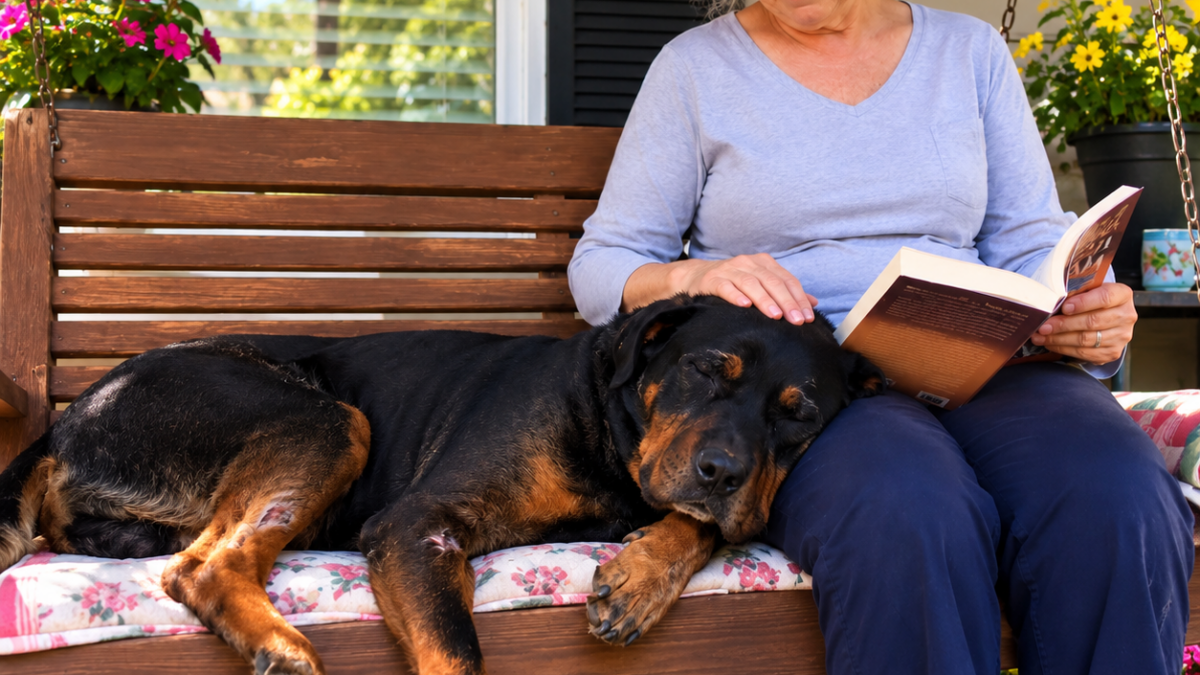
Diesel lay stretched across a porch swing.
His eyes were closed.
His body completely loose.
His head rested against Eleanor’s leg.
Eleanor was looking down at him.
She looked different.
Not younger.
Lighter.
There was peace in her face.
I remembered the woman who first entered our shelter talking about a house that had become too quiet.
This woman did not look lonely.
“He gets on the swing?”
“He owns the swing.”
“Of course.”
“He allows me a corner.”
I looked closer at the photo.
Diesel’s blue ball sat beneath the swing.
“He still has it.”
“Oh, yes.”
She smiled.
“Carries it everywhere.”
I swallowed.
“Can we put this up?”
“That’s why I brought it.”
We hung the photograph near the front desk.
Underneath, I added:
DIESEL — ADOPTED AFTER 287 DAYS.
Visitors saw it.
Some asked about him.
Some remembered walking past his kennel.
One woman stared at the photograph.
“Is that the big Rottweiler who used to be at the end?”
“Yes.”
“I was scared of him.”
“So were most people.”
“He looks so gentle.”
I looked at Diesel sleeping against Eleanor.
“He always had that in him.”
She said nothing.
That became the first piece of emotional justice.
Not humiliation.
Proof.
Every scar people had interpreted as danger had actually been evidence of survival.
Every nervous reaction they treated as a defect had been something Diesel learned to protect himself.
He hadn’t been impossible.
He had needed somebody patient enough to discover him.
Then came a stranger twist.
The couple we had previously rejected—the man who said Diesel needed to know who was boss—returned months later looking for another dog.
He saw the framed photograph.
Stopped.
“That’s Diesel?”
“Yes.”
“He got adopted?”
“Yes.”
“By her?”
He pointed toward Eleanor in the photograph.
“Yes.”
The man laughed.
“She can handle him?”
I looked at him.
“She doesn’t handle him.”
“What does that mean?”
“She understands him.”
He didn’t appreciate the distinction.
I did.
He looked at the photo again.
“Never would’ve worked for us.”
I nodded.
“No.”
His wife glanced at me.
“You seem pretty sure.”
“I am.”
We helped them consider other dogs.
But I never forgot that moment.
The dog they had approached as something to dominate was thriving with a woman who never once tried to prove she was stronger than him.
There was justice in that too.
Eleanor kept sending updates.
Diesel learned car rides.
At first he hated them.
Then discovered car rides led to quiet trails.
Soon he stood beside the vehicle waiting.
He learned snow.
The first snowfall confused him.
Eleanor sent a video.
Diesel stepped outside.
Sniffed the ground.
Lifted one paw.
Looked at Eleanor.
Then charged into the yard.
A seventy-pound Rottweiler mix transformed into a puppy.
He rolled.
Jumped.
Barked.
Actually barked.
Eleanor laughed so hard the camera shook.
I watched the video three times.
Diesel had rarely barked in the shelter.
Fear had made him quiet.
Safety made him noisy.
What a beautiful problem.
Then Eleanor had a difficult anniversary.
One year since her brother’s death.
She told me later she woke that morning planning to stay in bed.
Diesel disagreed.
At seven, he appeared beside the mattress.
At seven-ten, he nudged her arm.
At seven-fifteen, he brought the leash.
At seven-twenty, he brought the blue ball.
“I think he was threatening me,” she said.
“Sounds serious.”
“So I got up.”
They walked two miles.
Eleanor cried during part of it.
Diesel stayed beside her.
When they returned, she made breakfast.
The day continued.
“That’s what grief does,” she said. “It convinces you stopping is easier.”
I waited.
“Diesel doesn’t let me stop.”
That was when their story became something larger.
People at the shelter began using Diesel as an example when adopters asked about shy dogs.
We didn’t romanticize behavioral issues.
We explained them honestly.
Patience.
Management.
Training.
Boundaries.
Safety.
But we also showed the photograph.
A dog in a kennel is not necessarily the dog you will know six months later.
Shelters are stressful environments.
Behavior can change dramatically once an animal feels secure.
One afternoon, Eleanor attended an adoption event with Diesel.
I worried it would be too much.
Crowds.
Dogs.
Noise.
We gave them a quiet area.
Diesel wore a yellow bandana signaling that people should ask before approaching.
He stayed close to Eleanor.
Visitors noticed him.
A little boy asked:
“Why does he have scars?”
His mother looked embarrassed.
Eleanor crouched.
“We don’t know.”
“Did somebody hurt him?”
“Maybe.”
The boy frowned.
“Is he mean?”
Eleanor looked at Diesel.
“No.”
“Then why did people think he was?”
She smiled.
“Sometimes people confuse scared with bad.”
The boy considered that.
Then asked:
“Can I give him a treat?”
Eleanor looked at Diesel’s body language.
Relaxed.
Curious.
She handed the boy a treat.
“Hold your hand flat.”
The boy did.
Diesel stepped forward.
Took it.
The child smiled.
“He’s nice.”
“Yes.”
Diesel retreated toward Eleanor.
The boy ran back to his mother.
I watched Eleanor rub Diesel’s shoulder.
“You see that?” she whispered.
Diesel looked up.
“One down.”
Maybe she was talking about people who judged him.
Maybe she was talking about fears.
Either way, I understood.
Then came the biggest test.
Eleanor fell.
It happened in winter.
Nothing dramatic.
Ice near the back steps.
She slipped.
Hit the ground hard.
Diesel was outside with her.
She told me later the first thing she remembered was him standing over her.
Not panicked.
Watching.
She tried to get up.
Couldn’t.
“Diesel.”
He leaned toward her.
“I need help.”
Obviously, he didn’t understand the sentence.
But he understood something was wrong.
Eleanor’s back door was open.
Diesel ran inside.
Her phone was on a table near the kitchen.
He didn’t retrieve it.
He wasn’t trained for that.
But he did something else.
He barked.
Again.
Again.
Again.
Diesel rarely barked continuously.
The neighbor heard.
Came outside.
Saw Eleanor.
Called emergency services.
She had fractured her wrist.
Nothing worse.
When paramedics arrived, Diesel became anxious.
Large strangers.
Equipment.
Sudden movement around Eleanor.
One paramedic stopped.
“Dog secure?”
The neighbor took his leash.
Diesel watched every movement.
No lunging.
No aggression.
Just fear.
And restraint.
Eleanor looked at him.
“It’s okay.”
His ears lifted.
The neighbor brought him inside.
Eleanor spent the afternoon at the hospital.
It was the longest she had been away since adoption.
Diesel paced.
The neighbor called me.
I came over.
He knew me.
That helped.
But he didn’t settle.
Not until Eleanor returned.
The moment she entered with her arm in a cast, Diesel froze.
Then his whole body softened.
He approached.
Sniffed the cast.
Looked at her face.
Eleanor sat.
Diesel rested his head carefully against her good hand.
She cried.
The neighbor did too.
I pretended not to.
Later, Eleanor told me:
“Everyone thought I adopted him because he needed someone.”
I smiled.
“I’ve heard you say something like that before.”
“I wasn’t finished.”
She looked at Diesel.
“He has become my reason to come home.”
That sentence stayed with me.
Shelter staff sometimes become too focused on adoption statistics.
Length of stay.
Return rate.
Capacity.
Intake.
Outcome.
Numbers matter.
They keep organizations functioning.
But Diesel reminded us what the numbers actually represent.
287 days was not a statistic.
It was 287 mornings Diesel woke behind bars.
287 nights he carried the same ball to bed.
287 days of hearing families choose somebody else.
287 chances for a stranger to say no.
Then one yes.
One person.
That was all it took.
Years passed.
Diesel aged.
The scarred black muzzle slowly became gray.
The old paw bothered him more in winter.
Eleanor adjusted their walks.
Shorter.
Slower.
More stops.
“You really did mean it when you said you could limp together,” I told her once.
She smiled.
“I keep my promises.”
Diesel received supplements.
Then arthritis medication.
He gained a padded orthopedic bed.
He refused to use it.
Instead, he slept on Eleanor’s rug.
So Eleanor moved the expensive bed onto the rug.
Diesel then slept beside it.
She called me furious.
“I spent one hundred eighty dollars.”
“He appreciates the gesture.”
“He is sleeping on the floor.”
“Emotionally, he’s on the bed.”
“That is nonsense.”
“Yes.”
Eventually, he surrendered and used it.
Eleanor sent photographic proof.
Their porch swing remained his favorite place.
Every spring, she sent the same photograph in some variation.
Diesel.
Eleanor.
Swing.
Sometimes blue ball.
Sometimes book.
Always together.
One summer afternoon, Eleanor brought Diesel back to the shelter.
Not for an event.
Just a visit.
The kennel building had been renovated.
Diesel walked inside.
I wondered if he remembered.
At first, nothing.
Then we reached the old hallway.
His body slowed.
I saw it instantly.
Eleanor did too.
“Diesel?”
He stopped.
Looked toward the kennel where he had lived.
Different dog inside now.
A young shepherd.
Nervous.
Pressed against the back.
Diesel stared.
The shepherd stared back.
For several seconds, nobody moved.
Eleanor crouched beside Diesel.
“You okay?”
His tail lowered.
I considered turning around.
Then Diesel stepped closer.
Not toward the kennel door.
Toward Eleanor.
Pressed against her leg.
She rested one hand on his shoulder.
The shepherd watched.
I felt something in my chest tighten.
Years earlier, Diesel had been that dog.
Back corner.
Watching.
Waiting.
Visitors passing.
Now he stood on the other side.
Collar.
Leash.
Person.
Home.
Eleanor whispered:
“You don’t live here anymore.”
Diesel looked up.
“You’re going home with me.”
His tail moved.
That was one of the most satisfying moments of my shelter career.
The building hadn’t changed Diesel.
Time hadn’t magically erased his memories.
But the kennel no longer owned him.
We walked outside.
The shepherd stayed behind.
A week later, Eleanor called.
“What’s the shepherd’s name?”
“Rusty.”
“Still there?”
“Yes.”
“Can I pay his adoption fee?”
I paused.
“Eleanor.”
“I’m not adopting another seventy-pound project.”
I laughed.
“Then why?”
“Because Diesel was once the dog in the back.”
She paid the fee anonymously.
Three weeks later, Rusty went home with a young couple.
I sent Eleanor the picture.
She replied:
“Tell Diesel his account is settled.”
I laughed.
But there was something beautiful about it.
Diesel’s rescue created another rescue.
And then another.
Eleanor began sponsoring long-stay dogs every year.
Not all of them were difficult.
Not all were large.
Her only rule:
“Pick someone people keep walking past.”
Sometimes the adoption fee was the obstacle.
Sometimes publicity helped.
Sometimes the dog simply needed one extra push.
We started a small shelter program inspired by her.
287 Project.
Long-stay animals received additional training, foster opportunities, photography and promotion.
We didn’t name it publicly after Diesel at first.
Eleanor insisted.
“He doesn’t need celebrity.”
But people asked where the number came from.
Eventually, we told the story.
Diesel had waited 287 days.
The project’s first year helped seventeen long-stay animals find homes.
The second year, twenty-three.
Eleanor attended one small celebration.
Diesel came too.
He was older.
Gray.
Slower.
But when visitors entered, he no longer retreated.
He simply stood beside Eleanor.
One woman recognized him from our old adoption post.
“Oh my God. Diesel?”
Eleanor smiled.
“Yes.”
The woman covered her mouth.
“I remember him.”
I knew what was coming.
“I almost adopted him.”
Eleanor glanced at me.
The woman continued.
“I saw the warning sign and got nervous.”
No judgment.
Just fact.
“I’m glad he found you.”
Eleanor stroked Diesel’s back.
“So am I.”
The woman crouched.
“Can I pet him?”
Eleanor looked at Diesel.
He sniffed.
Relaxed.
She nodded.
The woman touched his shoulder.
Diesel remained still.
Then leaned slightly toward her hand.
Her eyes filled.
“I really misjudged you.”
Eleanor smiled.
“He gets that a lot.”
There it was again.
Justice.
Not anger.
Not humiliation.
A person realizing the frightened dog she had once rejected was capable of extraordinary gentleness.
Diesel didn’t care about vindication.
He cared whether Eleanor had treats.
Dogs are wiser that way.
Then came the day I had always known would come.
Diesel was old.
Much older than the frightened three-year-old we had first met.
His arthritis worsened.
His walks shortened to the end of the block.
Then half.
Then sometimes just the yard.
Eleanor bought a ramp.
He hated it.
She trained him slowly.
Treat on the first step.
Then second.
Eventually, he accepted it.
“He has spent his entire life making simple things complicated,” she told me.
“Consistency is important.”
“Apparently.”
His appetite remained good.
Eyes bright.
He still carried the blue ball.
The original had become worn almost smooth.
I offered to replace it once.
Eleanor looked horrified.
“Absolutely not.”
“It’s falling apart.”
“He has standards.”
The ball remained.
One autumn afternoon, I visited.
Diesel was on the porch swing.
Of course.
Eleanor sat beside him.
He raised his head when he saw me.
Tail moved.
I sat.
“Hey, old man.”
His muzzle rested against Eleanor.
She looked at me.
“The vet says we’re getting close.”
My chest tightened.
“How close?”
“She won’t give me a date.”
“She can’t.”
“I know.”
Eleanor looked toward the yard.
“I thought after my brother died that I understood grief.”
I waited.
“I don’t want to do this again.”
There was nothing useful to say.
So I didn’t try.
Diesel taught us that sometimes staying is enough.
I stayed.
After a while, Eleanor said:
“You know what scares me?”
“What?”
“That people will say I rescued him.”
I smiled sadly.
“They already do.”
“That makes it sound like I gave him everything.”
She looked at Diesel.
“I got years.”
Her hand moved slowly across his head.
“I got mornings.”
Diesel closed his eyes.
“Walks.”
She swallowed.
“A reason to buy groceries because somebody was waiting at home.”
Her voice broke.
“I got someone who noticed when I was sad.”
I looked away.
“He gave plenty.”
She nodded.
“More than plenty.”
Diesel lived several more months.
Good months.
Not perfect.
But good.
Short walks.
Long naps.
Porch afternoons.
Blue ball.
Then one morning Eleanor called.
Her voice told me before the words did.
“It’s time.”
I drove over.
Diesel was lying on his bed.
The expensive one he had eventually accepted.
His breathing was slow.
Eleanor sat beside him.
I knelt.
“Hey, buddy.”
His eyes opened.
Tail moved once.
That nearly broke me.
The veterinarian came to the house.
That was what Eleanor wanted.
No clinic.
No bright lights.
No metal table.
Home.
His porch door open.
Eleanor beside him.
Blue ball beneath his chin.
Before the veterinarian began, Eleanor whispered something into his ear.
I heard only part.
“You don’t have to wait anymore.”
Diesel relaxed.
Eleanor held him.
And the dog who had once slept underneath trucks because nowhere felt safe left this world in the safest place he had ever known.
Home.
For a long time afterward, Eleanor didn’t move.
Her hand remained on his shoulder.
Then she looked at me.
“Two hundred eighty-seven days.”
I nodded.
“He waited two hundred eighty-seven days for this?”
“For you.”
She shook her head.
“No.”
She looked toward his blue ball.
“We were both waiting.”
Diesel’s photograph remained near the shelter entrance.
We updated the plaque.
DIESEL
LONG-STAY RESIDENT.
BELOVED COMPANION.
INSPIRATION FOR THE 287 PROJECT.
But Eleanor asked us to add one more line.
I already knew what she wanted.
NEVER CONFUSE FEAR WITH A LACK OF LOVE.
We added it.
Months later, Eleanor returned.
Alone.
She stood in front of Diesel’s photo for a long time.
I approached.
“You okay?”
“No.”
I appreciated the answer.
Then she smiled.
“But I’m getting there.”
We walked through the kennels.
She insisted she wasn’t adopting.
“I’m serious.”
“Sure.”
“I am not emotionally available.”
“Understood.”
“Do not give me the look.”
“I’m standing normally.”
Then we reached the far row.
An older dog lay quietly near the back of a kennel.
Small this time.
Ten years old.
Cloudy eyes.
His card read:
OWNER DECEASED.
SHY.
PREFERS QUIET HOME.
Eleanor stopped.
I said nothing.
She read the card.
Looked at him.
The dog looked back.
Five seconds.
Ten.
Then Eleanor glanced at me.
“Absolutely not.”
“I didn’t say anything.”
“I know what you’re thinking.”
“I’m thinking about lunch.”
“You’re a terrible liar.”
She sat on the bench.
The little dog remained inside.
Eleanor folded her hands.
Waited.
I walked away.
Twenty minutes later, she found me.
“I’m only fostering.”
“Of course.”
“Temporarily.”
“Absolutely.”
“This is different.”
“Completely.”
She narrowed her eyes.
“You’re enjoying this.”
“A little.”
The foster became permanent six weeks later.
His name was Henry.
Eleanor sent me a photograph.
Henry asleep on the porch swing.
Same place Diesel had slept.
Beside Eleanor.
Underneath, she wrote:
“The swing had an opening.”
I cried.
Not because Henry replaced Diesel.
He didn’t.
Love doesn’t work that way.
He occupied a new space.
Diesel had taught Eleanor that grief and love could live in the same house.
That was perhaps his final gift.
Years later, people still asked about the dog in the photograph.
Some assumed Diesel had been abused.
Maybe.
We never proved it.
Some asked whether his behavior ever became “perfect.”
No.
He remained cautious with strangers.
Disliked fireworks.
Needed slow introductions.
Never enjoyed crowded places.
And that mattered.
Because his happy ending wasn’t that Eleanor transformed him into a different dog.
She let him become a safer version of himself.
There is a difference.
Too many rescue stories imply an animal is healed only when every scar disappears.
Diesel kept scars.
Physical and emotional.
But scars stopped controlling the whole story.
He learned a front door could mean Eleanor came back.
He learned hands could bring treats.
He learned laughter wasn’t danger.
He learned cars could lead to hiking trails.
He learned thunder ended.
He learned beds belonged to him.
He learned someone could know every difficult thing about him and still choose him again the next morning.
That was healing.
And Eleanor?
She learned something too.
After retirement and loss, she had believed the meaningful part of her life might be over.
Then a scarred seventy-pound dog with a blue ball gave her appointments to keep.
Walks to take.
Medication schedules.
Training sessions.
Vet visits.
Neighbors to meet.
Stories to tell.
A reason to get up.
People sometimes laughed when she told them Diesel had rescued her.
She stopped correcting them.
Because the truth was simple.
On that rainy Tuesday, everyone thought Eleanor had walked into our shelter looking for a dog.
She had.
But Diesel had been waiting for a person.
For 287 days, nobody stopped long enough.
They saw:
Large.
Scarred.
Nervous.
Difficult.
Warning label.
Eleanor saw something else.
She saw a dog standing behind a door trying desperately to understand whether the next human would hurt him, leave him, or finally stay.
And instead of asking:
“What’s wrong with him?”
She asked:
“What happened to him?”
That single difference changed everything.
The people who passed him never saw Diesel asleep on a porch swing.
They never saw him press his head against Eleanor’s knee when she cried.
They never saw him bark until a neighbor came when she fell.
They never saw him race through snow.
They never saw him patiently accept a treat from a child.
They never saw him become the reason dozens of other overlooked shelter dogs found homes.
They only saw the kennel card.
That was their loss.
Not Diesel’s.
Diesel eventually received exactly what he needed.
Not everyone.
One person.
And Eleanor received exactly what she had asked for that morning.
Someone who needed her as much as she needed him.
The framed photograph still hangs at the shelter.
I sometimes see visitors stop.
They read his story.
Then they look down the long hallway.
Sometimes one of them asks:
“Which dogs have been here the longest?”
Whenever that happens, I think about Diesel.
The blue ball.
The kennel corner.
Day 287.
Eleanor’s gray raincoat.
And one sentence that changed two lives:
“I’d rather meet the one everyone keeps passing by.”
That sentence still changes lives today.
Because sometimes the best dog in the building isn’t the one jumping at the kennel door.
Sometimes he is sitting quietly in the back.
Watching.
Waiting.
Hoping that eventually someone will stop long enough to see past the warning sign.
Diesel waited 287 days.
Eleanor waited sixty-eight years to meet him.
Neither of them knew they were waiting for each other.
But when they finally met, one frightened dog found home.
One lonely woman found purpose.
And everyone who had walked past Diesel’s kennel was proven wrong in the only way that truly mattered.
He didn’t need to become easier to love.
He only needed someone willing to love him long enough to understand him.
And in the end, Eleanor’s words beneath that porch photograph told the whole story better than any shelter description ever could:
“Everyone thought I rescued him.
But I think we probably rescued each other.”