PART 2: He Said the One-Pound Puppy Wasn’t Worth Saving—Then Rico Survived and Made the Whole Town Face the Truth
PART 2
The puppy looked too small for the amount of suffering already inside him.
When we reached the clinic, Evan didn’t wait for me to fully stop. He was out of the car before I had shifted into park. The glass doors flew open, and the receptionist’s face changed the moment she saw what was in his arms.
“We need help!” Evan shouted. “He’s six weeks old. Head injury. He’s barely breathing.”
The staff moved immediately.
A technician took Rico from him. Another rushed toward the back. Someone asked his weight. Someone else asked what happened. Evan started explaining, his words tumbling over each other, but then a veterinarian appeared and took one look at Rico.
“Treatment room two,” she said. “Now.”
The door swung shut behind them.
And suddenly there was nothing to do but wait.
Waiting is a strange kind of punishment. You can’t fight. You can’t fix. You can’t bargain with time. You just sit there with your hands clenched and your mind replaying the same image again and again until it becomes almost unbearable.
Evan paced the small lobby. His backpack sat forgotten near a chair. His hands shook every time he stopped moving.
I signed the intake form because no one else was there willing to take responsibility, and when the receptionist asked for the puppy’s name, I looked at Evan.
“Do you know it?”
He swallowed.
“I heard the guy call him Rico.”
So we wrote it down.
Rico.
One name on one form, attached to one pound of life fighting behind a closed door.
Twenty minutes passed.
Then forty.
Then an hour.
At some point, an animal control officer arrived. A police officer came with her. They asked questions in low voices. Evan told them what he had seen, and I told them what I had heard. Another woman from the street had followed us and said she had recorded part of the argument on her phone.
The officer asked to see it.
She watched the video without blinking.
Then she asked, “Where is the owner now?”
“Still near the street when we left,” I said.
The officer’s mouth tightened.
“We’ll find him.”
When the veterinarian finally came out, she was wearing the kind of expression that makes your heart prepare for bad news before your ears hear it.
Her name was Dr. Meredith Lane, and I would later come to think of her as one of the strongest people I had ever met. She was calm, direct, and deeply kind in a way that never softened the truth.
“He is alive,” she said.
Evan covered his face with both hands.
“But he is critical,” she continued. “He has a severe traumatic brain injury. He’s unconscious. We’re seeing signs of internal trauma, and his breathing is compromised. He also has pneumonia, which makes everything more dangerous.”
“Can he survive?” I asked.
Dr. Lane looked from me to Evan.
“I won’t lie to you. His chances are low. Maybe thirty percent. Maybe less if the swelling in his brain worsens.”
Evan lowered his hands.
“He’s a baby,” he whispered.
“I know,” she said.
“What caused it?” the animal control officer asked.
Dr. Lane hesitated for half a second, then answered like someone placing a heavy stone on a table.
“The injuries are consistent with blunt force trauma. Based on the bruising pattern and the witness statement, it could be from a hard-soled shoe.”
The room went quiet.
A shoe.
Something ordinary.
Something people wear to walk to the mailbox, to the store, to work.
Something that should never have been used against a puppy small enough to fit in two hands.
Evan turned away and pressed his fist against his mouth.
I felt heat rise behind my eyes, not just sadness, but anger so sharp it scared me. I thought of the man in the street, standing there without remorse, saying Rico was always sick, saying he didn’t want him anymore.
As if suffering were a reason to abandon someone.
As if weakness made cruelty acceptable.
As if a puppy had to earn mercy.
Dr. Lane looked back toward the treatment area.
“We’re starting IV fluids, antibiotics, oxygen support, and medication to control swelling. The next forty-eight hours are critical. If he wakes up, we’ll know more. If he doesn’t…”
She didn’t finish.
She didn’t have to.
That night, I didn’t go home right away.
Neither did Evan.
We sat in the clinic lobby under fluorescent lights while rain began tapping against the windows. The police found the owner before midnight. His name was Caleb Voss. He lived two blocks from where Rico had been found, in a rented duplex with peeling paint and a broken fence. He told the officers Rico had been sick since he got him, that he had spent too much money already, that the puppy was “useless.”
Useless.
When the animal control officer came back to update us, she said that word carefully, as if even repeating it made her feel contaminated.
“He said he doesn’t want custody,” she told us. “He signed a surrender form.”
Evan stared at her.
“So Rico doesn’t have to go back?”
“No,” she said. “He won’t go back.”
I watched Evan’s shoulders drop, just a little. Not relief, exactly. Nothing about that night felt like relief. But one door had closed behind Rico, and this time it was the right one.
The officer continued, “The investigation is ongoing. With the veterinary report and witness statements, this may become a criminal animal cruelty case.”
“May?” Evan said.
His voice went hard.
The officer met his eyes.
“I know how that sounds. But cases need evidence strong enough to hold up. We’re building it.”
Evan nodded, but I could see he hated the answer.
I hated it too.
But over the next two days, I learned how slow justice can feel when a life is hanging by a thread.
Rico remained unconscious.
The clinic let us visit for short periods. Not to touch too much, not to interfere, just to stand near him and speak gently so he might hear something kind if some part of him was still reachable.
The first time I saw him after intake, he looked even smaller than he had in the street.
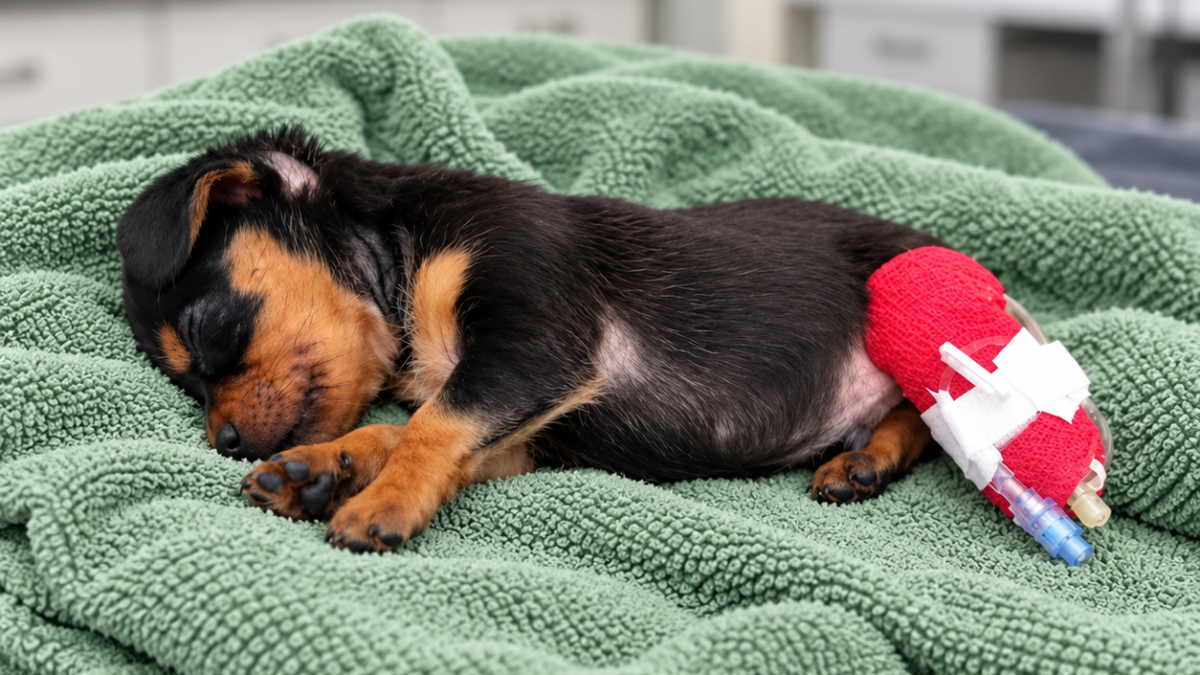
He lay inside a warming unit, wrapped in soft blankets with an IV line running into one fragile leg. A tiny catheter had been placed. His breathing was supported, and his chest rose and fell with frightening delicacy. His fur had been cleaned, but the injuries made him look older somehow, as if pain had stolen even his puppyhood.
Evan stood beside me, gripping the edge of the counter.
“Hey, Rico,” he whispered. “It’s me. I’m the guy who yelled a lot. Sorry about that.”
I almost laughed, but the sound turned into a sob I swallowed.
Evan leaned closer.
“You don’t know us yet,” he said. “But you’re not alone anymore. You hear me? You’re not alone.”
Rico did not move.
The monitor beeped.
Dr. Lane came in quietly.
“Talk to him,” she said. “Even if he doesn’t respond.”
So we did.
I told Rico about the weather. About the rain. About how the clinic smelled like disinfectant and coffee. Evan told him he was terrible at math but good at carrying puppies in emergencies. One of the nurses, Jasmine, told him she had already assigned herself as his favorite aunt whether he liked it or not.
The staff began calling him “little fighter.”
But fighting looked nothing like people imagine.
It wasn’t dramatic.
It wasn’t loud.
It was a tiny body staying warm through the night.
It was oxygen moving in and out.
It was a heart not stopping.
It was a puppy who had every reason to let go, but somehow didn’t.
On the third day, Rico’s condition remained unstable. His pneumonia worsened before it began to respond to antibiotics. His brain swelling stayed dangerous. He had no purposeful movement. Dr. Lane explained that if he survived, there could be neurological damage.
“What kind?” I asked.
“Vision loss. Motor problems. Seizures. Difficulty walking. Behavioral changes. We won’t know unless he wakes up.”
Unless.
That word became the center of everything.
Unless Rico woke up.
Unless the swelling decreased.
Unless his lungs cleared.
Unless his body could endure what had been done to it.
On the fourth day, Caleb Voss walked into the clinic.
I was there when it happened.
He came in wearing a work jacket and heavy boots, his hair damp from the rain, his expression irritated rather than ashamed. The receptionist recognized his name immediately from the file and stood straighter behind the desk.
“I’m here about the dog,” he said.
Evan was sitting beside me, elbows on knees. His head snapped up.
“What do you want?” he asked.
Caleb looked at him like he was dirt.
“I want to know who’s paying for all this.”
The receptionist said, “Sir, Rico was surrendered. You no longer have ownership.”
“I know what I signed,” Caleb said. “I’m not paying thousands of dollars for a dog that was already half-dead.”
Something inside the room changed.
Even the people waiting with their cats and dogs went still.
Evan stood.
“He wasn’t half-dead until you put him there.”
Caleb’s face twisted.
“You don’t know anything.”
“I know I saw enough.”
“You saw a sick puppy fall.”
Evan took one step forward, and I grabbed his arm.
Not because Caleb didn’t deserve the fear that flashed across his face.
Because Rico deserved better than Evan getting arrested in a veterinary lobby.
Dr. Lane came out before it escalated further.
“Mr. Voss,” she said, calm as steel. “You need to leave.”
“I have a right to know—”
“You surrendered Rico. You are not authorized to receive medical updates. Any questions can go through animal control.”
His jaw tightened.
“That dog was worthless.”
Dr. Lane did not raise her voice.
“No living creature who comes through my doors is worthless.”
For a moment, Caleb looked like he might say something else. Then he glanced at Evan, at me, at the receptionist already reaching for the phone, and walked out.
But before he left, he smiled.
It was small.
Ugly.
Confident.
Like he believed nothing real would happen to him.
That smile stayed with me for months.
Because at the time, I was afraid he might be right.
On the fifth day, Rico woke up.
It began with a phone call at 6:17 in the morning.
I had fallen asleep on my couch fully dressed, my phone on my chest. When it rang, I grabbed it so fast it slipped from my hand and hit the floor.
The screen showed the clinic number.
My heart stopped.
“Hello?”
It was Jasmine.
“He opened his eyes,” she said.
For a second, I couldn’t speak.
“He’s awake?” I whispered.
“He’s awake.”
I drove to the clinic with tears blurring my vision.
Evan was already there when I arrived, hair sticking up, hoodie inside out, eyes red from either crying or lack of sleep. Maybe both.
“He woke up,” he kept saying. “He woke up. He actually woke up.”
But when we saw Rico, joy became something more complicated.
His eyes were open, but unfocused. His little head moved weakly from side to side. His body trembled under the blanket. He didn’t lift himself. He didn’t wag. He didn’t recognize anything, not really.
Still, he was there.
The difference between unconscious and awake was the difference between a closed door and a cracked one.
“Hi, baby,” I whispered.
Rico’s ear twitched.
That was all.
And it was enough to make Jasmine cry.
The next days were not a miracle story.
They were harder than that.
Miracles are clean in the telling. Rico’s recovery was not clean. It was messy, slow, frightening, and full of setbacks. There were mornings when his breathing sounded better and afternoons when it worsened again. There were times he tolerated tiny amounts of food and times his body rejected it. His catheter had to stay in. His medications had to be adjusted. His temperature dipped once and sent the staff rushing. His brain swelling remained a constant threat.
By day fifteen, he was still fighting pneumonia.
By day fifteen, the swelling in his brain had not fully resolved.
By day fifteen, the puppy who should have been running clumsily across someone’s kitchen floor was still learning how to sit up without collapsing.
But he tried.
That became the thing everyone talked about.
Rico tried.
He tried to lift his head when we spoke.
He tried to swallow.
He tried to push his paws beneath him.
He tried even when his body shook so badly that Jasmine had to support him with both hands.
One afternoon, I arrived to find Evan standing outside the treatment room window, completely still. He didn’t turn when I walked up.
“What happened?” I asked.
He pointed.
Inside, Rico was sitting.
Not well. Not straight. Not comfortably. His tiny body leaned against a rolled towel, and his head bobbed slightly with the effort of holding himself upright. But he was sitting.
Dr. Lane knelt beside him with one hand hovering near his side.
“Look at him,” Evan whispered.
Rico blinked slowly, wobbled, and stayed up.
Something broke open in my chest.
Not sadness this time.
Awe.
Because survival is not always beautiful when it starts. Sometimes it is crooked, trembling, and covered in medical tape. Sometimes it looks like a one-pound puppy sitting for five seconds while everyone in the room silently begs the universe not to knock him down again.
But Rico sat.
And from that day forward, the clinic changed.
People brought him tiny blankets. Someone donated a soft stuffed lamb larger than he was. One of the technicians taped a sign near his kennel that read: RICO’S RECOVERY TEAM, AUTHORIZED CUDDLES ONLY.
He became a name people asked about at the front desk.
“How’s Rico today?”
“Did he eat?”
“Any improvement?”
The same town that had watched him lie in the street began watching him fight his way back.
But the cruelty case moved slower.
The animal control officer, Denise Rowe, kept gathering evidence. She returned to the street. She interviewed neighbors. She collected Evan’s statement twice, then mine. She obtained Dr. Lane’s medical report, which was detailed, clinical, and devastating. The injuries did not match a simple fall. They did not match rough handling. Rico had trauma to his skull, internal bruising, and neurological signs consistent with repeated blunt force.
Still, Caleb denied everything.
His version changed three times.
First, Rico had been sick and collapsed.
Then Rico had been dropped accidentally.
Then Rico had “jumped” and hit something, though no one could explain what a six-week-old, one-pound puppy had jumped from in the middle of a street.
Each time Denise told us about another denial, Evan grew quieter.
That worried me more than his anger.
One evening, I found him sitting on the curb outside the clinic, staring across the parking lot.
“You okay?” I asked.
“No,” he said.
I sat beside him.
For a while, neither of us spoke.
Then he said, “When I saw him do it, I froze.”
I looked at him.
“You didn’t freeze. You saved Rico.”
“I froze first.”
His jaw clenched.
“I saw him raise his foot. I saw it. And for one second, I didn’t understand what I was seeing. My brain just stopped. If I had moved faster—”
“Don’t do that.”
“But it’s true.”
“No,” I said. “What’s true is that Caleb was responsible for what he did. Not you.”
Evan wiped his face with the heel of his hand.
“I keep seeing it.”
I didn’t ask him to describe it.
Some truths don’t need more details to become heavier.
Instead, I said, “Then keep showing up. Every time you see that moment, come back here and see Rico sitting up. See him breathing. See him eating. Don’t let Caleb own the whole story.”
Evan looked at me for a long time.
Then he nodded.
The first time Rico ate from a small dish on his own, we all acted like he had graduated from college.
It was a soft recovery meal, carefully measured, prepared so his fragile body could handle it. Jasmine placed the dish in front of him and steadied his chest. Rico sniffed. His nose twitched. For several seconds, nothing happened.
Then his tongue flicked out.
Once.
Then again.
Then he started eating.
Slowly. Messily. Determinedly.
Food smeared his tiny muzzle. His front paws slid outward. His head dipped too far once, and Jasmine helped him recover. But he kept eating like some instinct deep inside him had made a decision.
Life.
He wanted life.
Evan laughed through tears.
“That’s it, buddy,” he said. “Take everything back.”
And Rico did.
Not quickly.
Not easily.
But piece by piece.
His pneumonia began to clear. His breathing improved. His catheter came out. He gained a few ounces, then a few more. His fur looked softer. His body still showed the effects of trauma, but something puppy-like began to return to him. He made small sounds in his sleep. He nuzzled blankets. He chewed weakly on the corner of the stuffed lamb.
Then came the walking.
At first, it wasn’t walking at all.
It was struggle.
Rico would push himself onto all four paws, sway, take one crooked step, and collapse into waiting hands. His back legs sometimes crossed. His front paws landed wrong. His head tilted. He seemed confused by where the floor was.
Dr. Lane warned us again.
“Neurological damage is likely,” she said. “We need to monitor his vision, coordination, and nerve responses.”
Evan looked at Rico, who was currently trying to bite his own blanket and missing.
“He’s still in there, though.”
Dr. Lane’s face softened.
“Yes. He is very much still in there.”
Over the next weeks, we learned Rico had a habit.
He walked in circles.
Always to the left.
At first, we thought it was weakness or confusion. But even as he grew stronger, the circling remained. When he tried to move toward a sound, his body curved away. When he got excited, he spun. When he felt uncertain, he circled tighter and tighter until someone gently redirected him.
Then we noticed his eyes.
They were open, bright, and beautiful.
But they did not follow movement.
A hand waved in front of him, and he did not blink.
A toy rolled past, and he did not track it.
Light changed, and he did not react.
I remember standing in the exam room while Dr. Lane performed the tests. Evan held Rico wrapped in a blanket. I watched the doctor’s face carefully, hoping for some tiny sign that we were wrong.
But hope does not change test results.
Dr. Lane lowered the small light.
“I’m sorry,” she said.
Evan closed his eyes.
“He’s blind?”
“Yes.”
The word entered the room and sat there between us.
Blind.
Rico, who had survived the street, the brain injury, the pneumonia, the swelling, the unconscious days, now had to learn a world he couldn’t see.
“Will it come back?” I asked, though I already knew from Dr. Lane’s expression.
“We can consult specialists,” she said. “But based on the damage to the optic nerves and neurological pathways, I don’t want to give false hope.”
Evan held Rico closer.
Rico, unaware of the new grief forming around him, licked Evan’s thumb.
That undid me.
Because he didn’t know what he had lost.
He only knew warmth. Voice. Smell. Hands that didn’t hurt.
We took him to specialists anyway.
A veterinary neurologist two towns over reviewed his scans and examined his responses. An ophthalmologist confirmed the damage. Another doctor offered the same conclusion with different words.
Rico’s sight could not be restored.
Every time we heard it, I felt like someone was stealing from him all over again.
But Rico didn’t mourn the way we did.
He adapted because animals do not waste energy resenting the shape of survival. They grieve in their own ways, yes, but they also move forward with a purity humans often lack. Rico learned the map of the recovery room through smell and sound. He learned that Jasmine wore lavender lotion. He learned Evan’s footsteps were quick and uneven. He learned my voice meant warm hands and soft food. He learned the squeak of his stuffed lamb and the rustle of the blanket he loved.
He bumped into things.
He fell.
He circled when he got confused.
But he also stood up again.
Every time.
The first time Rico walked across the therapy mat without collapsing, the entire clinic staff gathered in the doorway.
Dr. Lane placed him at one end. Evan knelt at the other, tapping the floor softly.
“Come on, Rico,” he said. “Follow my voice.”
Rico lifted his head.
His ears twitched.
He took one step.
Then another.
His paws spread wide for balance. His head tilted left. His body started to circle, but Evan gently tapped again.
“This way, buddy.”
Rico corrected.
Two more steps.
A stumble.
A pause.
Then he kept going.
When he reached Evan’s hands, he pressed his nose into Evan’s palm and wagged his tail.
Not a big wag.
Not yet.
Just a tiny uncertain flutter.
But it was the first tail wag any of us had seen.
Jasmine started clapping and crying at the same time.
I covered my face.
Even Dr. Lane had to turn away for a moment.
That video went into the case file.
Not because the prosecutor needed emotional proof.
Because Denise said the judge should understand what Caleb had tried to erase.
By then, charges had been filed.
Aggravated animal cruelty.
Failure to provide care.
Abandonment.
Caleb Voss was arrested on a Thursday morning.
I found out from Denise, who called me at work.
“They picked him up,” she said.
I sat down so fast my chair rolled backward.
“Is he in jail?”
“For now. He’ll have a bond hearing.”
I thought I would feel joy.
I didn’t.
I felt something heavier. A grim kind of relief. The feeling you get when a door finally opens, but you know there is still a long hallway ahead.
Caleb bonded out the next day.
And then the harassment started.
Not directly at first.
A fake account commented under the clinic’s public update about Rico, calling the story “dramatic” and saying people cared more about animals than humans. Another account claimed the clinic was exaggerating injuries to raise money. Someone left a one-star review accusing Dr. Lane of “stealing pets.”
The clinic didn’t respond publicly.
But we all knew.
Then someone spray-painted the side fence behind the clinic with one word:
LIARS.
Jasmine found it at 6 a.m.
By 6:30, Evan was there with a bucket, gloves, and so much anger in his face that Dr. Lane told him to take three breaths before touching anything.
I arrived while he was scrubbing.
“Don’t,” I said gently.
He looked back at me.
“Don’t what?”
“Don’t let him drag you down to where he lives.”
Evan threw the brush into the bucket.
“He hurt a blind puppy and now he gets to call everyone else liars?”
“For now,” I said.
His eyes narrowed.
“For now?”
I looked at the painted fence, then at the clinic windows where Rico was sleeping somewhere inside, safe and unaware.
“Yes,” I said. “For now.”
Because that was when I made my own decision.
I was not a lawyer.
I was not a police officer.
I couldn’t prosecute Caleb.
But I worked in communications for a nonprofit before I left to care for my mother. I knew how records worked. I knew how public meetings worked. I knew how silence protects people who rely on everyone else getting tired.
So I started documenting everything.
Every fake comment.
Every review.
Every threat.
Every appearance Caleb made near the clinic.
Every time he tried to twist the story into a misunderstanding.
I did not post wild accusations. I did not name-call. I did not embellish. I kept dates, times, screenshots, witness names, and copies of official reports that were public record. When people asked what happened, I told the truth clearly and without drama.
The truth had enough drama on its own.
Meanwhile, Rico became stronger.
He was moved from critical care to medical foster inside the clinic network. Dr. Lane asked if I would consider taking him home temporarily once he was stable enough.
I said yes before she finished the sentence.
Then I panicked for three days.
Blind puppy care was not simple. Rico needed a safe layout, soft barriers, medication, scheduled meals, follow-up appointments, neurological monitoring, and physical therapy exercises. He needed someone to guide him without making him helpless. He needed consistency. He needed patience. He needed a home that would not move furniture every week or leave shoes in random places where he could trip.
I turned my spare room into Rico’s room.
Foam mats on the floor.
Low bed.
Water dish in the same corner.
Soft gates.
No sharp edges.
A little bell on the door so he could learn where entrances were.
When I brought him home, Evan came with us.
Rico rode in a padded carrier on the passenger seat, wrapped in his favorite blanket. He was bigger now, though still tiny compared to any normal puppy his age. His ribs were no longer sharp under my fingers. His fur had begun to shine. But his head still tilted when he listened, and when I opened the carrier in the house, he stepped out carefully into darkness only he could understand.
He sniffed the air.
One paw forward.
Pause.
Another paw.
His nose touched the foam mat.
He circled once, slow and uncertain.
I sat on the floor.
“Hi, Rico,” I said. “This is home for now.”
He turned toward my voice.
Evan sat across from me and tapped the floor gently.
Rico froze, listening.
Then he took three crooked steps and bumped into Evan’s knee.
Evan laughed so softly it almost hurt.
“Hey, buddy.”
Rico climbed halfway into his lap and fell asleep there within minutes.
That first night, I barely slept.
Every sound made me sit up.
Every rustle from Rico’s room made me check on him. He woke twice confused and whining, circling in the dark. I sat beside him and spoke until his body relaxed.
“You’re safe,” I told him. “You’re safe. You’re safe.”
I said it so many times that eventually I realized I was saying it for both of us.
The next weeks became a new rhythm.
Rico learned the house through repetition. I kept a soft tapping pattern whenever I approached. Two taps on the wall before entering. Three taps on the floor when calling him to food. One gentle clap near his bed when it was time to rest.
He learned “step” for thresholds.
“Careful” for obstacles.
“Left” and “right,” though right was harder because his body still wanted to turn left.
He learned the scent of chicken broth, the sound of my coffee maker, the creak in the hallway, the warmth of morning sun on the mat even though he couldn’t see the light.
And he learned joy.
That was the part no injury could take from him.
He loved fleece blankets.
He loved the squeaky lamb.
He loved being held against someone’s chest where he could feel a heartbeat.
He loved food with a seriousness that made Evan call him “Sir Rico of Dinner.”
Every meal was treated like a celebration.
Every ounce gained was announced to the clinic group chat.
Every new skill felt like a victory no court could award.
But the case kept moving.
And Caleb kept smiling.
At the preliminary hearing, he arrived in a pressed shirt with an attorney beside him. He looked clean, organized, and calm. If you had not known what he was accused of, you might have mistaken him for someone caught in an unfortunate misunderstanding.
Evan sat on one side of me in the courtroom. Denise sat two rows ahead. Dr. Lane was called as a witness.
I had never been inside a courtroom for something that mattered so personally. The air felt too still. Every cough sounded loud. The judge sat above us with a face that revealed nothing.
Caleb’s attorney argued that the evidence was emotional but incomplete.
He suggested Rico had preexisting health issues.
He suggested witnesses had misinterpreted what they saw.
He suggested Dr. Lane could not state with absolute certainty exactly when every injury occurred.
The word “accident” appeared again and again, dressed in legal language.
Evan’s hands curled into fists.
I leaned close and whispered, “Breathe.”
Dr. Lane took the stand.
She did not tremble.
She did not dramatize.
She did what good witnesses do.
She told the truth.
She explained Rico’s weight, his age, his condition, the brain trauma, the internal injuries, the pneumonia, the swelling, the neurological damage, the blindness. She explained why the injuries did not fit a simple collapse. She explained that while pneumonia had complicated Rico’s survival, it did not cause blunt force trauma.
Caleb stared at the table.
His attorney asked, “Doctor, isn’t it true that a very young puppy can injure himself by falling?”
Dr. Lane answered, “A puppy can be injured by many things. But Rico’s injuries were not consistent with a minor fall from standing height.”
“Can you say under oath that my client intentionally caused every injury?”
“I can say under oath that Rico suffered severe blunt force trauma, that the trauma was consistent with the witness accounts, and that without emergency intervention he likely would have died.”
The courtroom went quiet.
Then the prosecutor played the short video from the street.
It did not show everything.
Thank God.
But it showed enough.
It showed Evan yelling.
It showed Caleb standing over Rico.
It captured Caleb’s voice saying, “He’s always been sick. I don’t want him anymore.”
I watched the judge’s face change for the first time.
Not much.
But enough.
The case was bound over for trial.
Outside the courthouse, Caleb walked past us with his attorney. For one second, he looked directly at Evan.
“This isn’t over,” he said.
Evan stepped forward.
I grabbed his sleeve.
“No,” I said.
Caleb smirked.
I looked at him and felt something inside me become very calm.
“You’re right,” I said. “It isn’t.”
He stopped smiling.
Two days later, the local newspaper called the clinic.
Then a regional station.
Then a rescue page with hundreds of thousands of followers asked permission to share Rico’s recovery story.
Dr. Lane was cautious. She refused anything that could interfere with the case. But she agreed to share general updates without graphic details, without exaggeration, and without turning Rico into entertainment.
The first post showed Rico standing on his therapy mat, blind eyes open, little legs trembling, Evan’s hands near him but not touching.
The caption was simple:
Rico survived. Now he is learning.
The town responded like a dam had cracked.
Donations came in for Rico’s medical bills.
Messages arrived from people with blind dogs, disabled dogs, rescue dogs, dogs who had been hurt and healed and loved anyway.
A retired man built Rico a custom padded ramp.
A teacher sent a box of textured mats so Rico could learn different surfaces.
A child mailed a drawing of Rico wearing a cape.
At night, I read some of the messages out loud to him.
“You have fans,” I told him.
Rico chewed his lamb’s ear and ignored fame completely.
Then came the message that changed everything.
It was sent anonymously to the rescue email account.
I was at the clinic when Dr. Lane opened it.
Her face drained of color.
“What?” I asked.
She turned the screen toward Denise, who happened to be there for a follow-up statement.
The message said:
You should ask what happened to the puppy before Rico.
Attached was a blurry photo of Caleb holding another small dog, black and white, maybe four months old.
Denise became very still.
“Forward this to me,” she said.
Within a week, she had found two former neighbors.
Then a former girlfriend.
Then a man who had once worked with Caleb at a warehouse.
The story that emerged was not clean, and not all of it could be charged. But it painted a pattern that made my skin crawl. Animals appeared around Caleb and disappeared. A small dog had been “given away,” though no one knew to whom. A kitten had “run off.” Another puppy had been seen limping before it vanished.
Nothing had been proven then.
No one had wanted to get involved.
People had wondered, suspected, whispered, looked away.
Rico had not been the first warning sign.
He was just the first one to survive long enough for everyone to listen.
The prosecutor amended the case strategy. Prior acts would be difficult to use, but the investigation strengthened the argument that Rico’s injuries were not an isolated accident. Caleb’s attorney pushed back hard. Hearings multiplied. Dates shifted. The process became exhausting.
During those months, Rico grew.
Not into a normal puppy.
Into himself.
He remained small, but sturdy. His blindness stayed permanent. His leftward circling never fully disappeared, especially when he was tired or excited. Sometimes his balance failed, and he would sit abruptly as if the floor had moved under him. Loud noises startled him. New places overwhelmed him.
But inside familiar spaces, he became brave.
He learned to follow a sound ball.
He learned to climb onto his low bed.
He learned to find my hand by smell.
He learned that when I said “wait,” it meant something was in front of him.
He learned Evan’s laugh.
And Evan learned Rico.
At first, Evan came by every day “just to check on him.”
Then he brought food.
Then he built a small sensory path in my backyard with grass, smooth stones, rubber matting, and wood, each section separated by scent markers.
Then he started falling asleep on my couch with Rico curled on his chest.
One night, I walked into the living room and saw them there, both sleeping, the television still on mute. Rico’s head rested under Evan’s chin. Evan’s hand lay protectively over Rico’s back.
I stood there for a long time.
Because some people enter a story as witnesses and become family before anyone says it out loud.
The trial date arrived in early spring.
By then, Rico weighed six pounds.
Six pounds felt enormous to us.
His fur had grown thick and soft. His body had rounded out. His ears had lifted slightly at the tips. He still looked fragile to strangers, but to us he looked like victory with paws.
The prosecutor asked if we would be comfortable allowing a short video of Rico’s progress to be shown at sentencing if Caleb took a plea or was convicted.
Not a sentimental montage.
Not music.
Just documentation.
Day one: unconscious.
Day five: awake.
Day fifteen: sitting.
Week four: attempting to stand.
Month three: walking toward Evan’s voice.
Month six: navigating the sensory path.
I agreed.
Evan agreed.
Dr. Lane agreed.
Caleb did not go to trial.
Three days before jury selection, he accepted a plea.
I thought that would feel like an ending.
It didn’t.
It felt like being handed a sealed envelope and told the ending was inside, but not being allowed to open it yet.
He pleaded guilty to felony aggravated animal cruelty and failure to provide necessary care. The abandonment charge was folded into the agreement. His attorney asked for leniency, arguing that Caleb had no serious criminal record, that he had been under stress, that he had surrendered the dog, that he had cooperated after the fact.
I almost stood up when I heard that.
Cooperated.
He had stood in a clinic lobby and called Rico worthless.
He had tried to smear the people saving him.
He had smiled outside court.
But the prosecutor was ready.
At sentencing, the courtroom was fuller than I expected. Clinic staff sat together. Evan sat beside me. Denise sat near the aisle. A few townspeople came too, including the woman who had brought the sweatshirt that first day.
Rico did not come.
I refused to put him through that.
He had already given enough.
Instead, he stayed at home with my neighbor, sleeping in a blanket nest and probably dreaming about breakfast.
Dr. Lane spoke first.
She described the medical facts again, but this time she allowed herself to speak not just as a doctor, but as someone who had fought for Rico’s life.
“Rico was six weeks old,” she said. “He weighed approximately one pound. He had no ability to defend himself, escape, or seek help. Every day he survived required intensive care. His blindness is permanent. His neurological damage is permanent. His recovery is real, but it does not erase what was done.”
Then Evan spoke.
I had not known what he planned to say.
He stood at the podium in a dark shirt, hands shaking slightly, and looked at the judge instead of Caleb.
“I used to think courage meant doing something big,” he said. “Running into fire. Fighting somebody. Making a scene. But Rico taught me courage can be one step. Then another. Then another, even when your body doesn’t work the way it should and the world is dark. He was hurt by someone who was supposed to protect him. But he still trusts us. That trust is not weakness. It is the strongest thing I’ve ever seen.”
He paused.
Then he turned, briefly, toward Caleb.
“You said he was worthless. He isn’t. But what you did showed the value of your character.”
Caleb stared straight ahead.
Then the prosecutor played the video.
No music.
No captions beyond dates.
Just Rico.
Tiny and unconscious.
Awake and trembling.
Sitting with effort.
Falling.
Trying again.
Walking toward Evan’s voice.
Eating from his little dish.
Standing in the backyard with his nose lifted to the wind.
By the end, even the bailiff looked down.
The judge removed his glasses.
When he spoke, his voice was quiet, which somehow made it stronger.
“Mr. Voss, the fact that this animal survived is not evidence that the harm was minor. It is evidence that others intervened where you failed, and that the victim endured what he never should have been forced to endure.”
Victim.
Some people hate that word for animals.
The judge did not.
He sentenced Caleb to jail time, probation, mandatory mental health evaluation, community service not involving animals, restitution for a portion of Rico’s medical bills, and a long-term ban on owning or living with animals. The felony conviction would stay on his record.
Caleb’s face changed then.
For the first time, the confidence cracked.
He looked back toward the gallery, not at me, not at Evan, but at the clinic staff, at Denise, at everyone who had refused to forget.
And I thought of that smile in the lobby.
That ugly little smile that said he believed nothing real would happen.
Now something real had.
It was not enough to undo Rico’s blindness.
It was not enough to erase his pain.
But it was something.
Outside the courthouse, reporters waited.
Dr. Lane gave a brief statement about animal cruelty and reporting abuse. Denise reminded people to call authorities when they suspected harm. Evan refused to speak on camera.
I didn’t blame him.
We walked to the parking lot in silence.
Then he stopped beside my car and looked at me.
“Can I come see him?”
“You don’t have to ask.”
When we got home, Rico was awake.
He heard Evan’s footsteps before the door opened and lifted his head from the blanket nest.
His tail started thumping.
Not the tiny uncertain flutter from months ago.
A real wag.
Fast and crooked and joyful.
Evan dropped to the floor.
“Hey, buddy,” he said, voice breaking. “Guess what? He can’t hurt you anymore.”
Rico stumbled toward him, bumped into his knee, and climbed into his lap with the absolute confidence of a dog who knew exactly where he belonged.
That night, we celebrated with a small cake for humans and a carefully measured treat for Rico.
Rico ate his treat with solemn focus.
Evan watched him like he was witnessing a miracle.
After dinner, Dr. Lane called.
“There’s something we should discuss,” she said.
I already knew.
So did Evan, I think.
Rico’s medical foster period was ending. He was stable. He was adoptable, though not to just anyone. He needed a home prepared for lifelong disability. He needed someone who understood his cues, his triggers, his medical history, and the way his courage sometimes outran his coordination.
Dr. Lane said gently, “We’ve had applications.”
My chest tightened.
Evan looked at me from across the room.
Rico was asleep between us, paws twitching.
“Good applications?” I asked.
“Yes,” Dr. Lane said. “Some very good.”
I swallowed.
“That’s great.”
The lie sounded terrible.
Dr. Lane was quiet for a moment.
“Do you want me to process them?”
I looked at Rico.
I thought about the first day in the street. The clinic lights. The IV line. The first time he sat. The day we learned he was blind. The nights I whispered safety into the dark. The mornings he found his food dish by memory. The way his tail wagged when Evan arrived. The way my house no longer felt like mine alone.
Before I could answer, Evan said, “No.”
I turned.
He stood there with tears already in his eyes.
“No,” he repeated softly. “He’s home.”
Dr. Lane heard him through the phone.
“I thought you might say that.”
The adoption paperwork was signed one week later.
But not by me alone.
Evan and I became co-adopters officially, though Rico lived with me because my house was already set up and Evan’s apartment had stairs. Evan came every day. He handled appointments when I couldn’t. He paid what he could toward care. He became, in every way that mattered, Rico’s person.
A few months later, he moved into the small guest unit behind my house.
He said it was for cheaper rent.
We both knew it was for Rico.
Life settled into something beautiful.
Not perfect.
Beautiful.
Rico had bad days. Some mornings his balance was worse. Sometimes he circled until I gently placed a hand near his shoulder and helped him reset. During storms, he shook unless Evan sat with him. Vet visits made him tense. New voices required slow introductions.
But he also had days so full of ordinary joy that they felt like gifts.
He learned the backyard completely.
He found the sunny patch by the fence every morning.
He discovered that fallen leaves were excellent enemies.
He barked once at a garden statue and then avoided that corner for two weeks.
He developed a habit of stealing socks from the laundry basket and hiding them in his bed, though “hiding” for Rico meant placing them proudly on top of his blanket where everyone could see.
His appetite became legendary.
His confidence grew.
And his world, though dark, became rich with everything cruelty had failed to destroy.
Scent.
Sound.
Touch.
Routine.
Trust.
Love.
The community did not forget him either.
The clinic created a fund in his name for emergency care in abuse and neglect cases. They called it Rico’s Second Chance Fund. The first month, it helped a senior beagle with untreated infection. Then a kitten found in a drainage ditch. Then two puppies surrendered from a backyard breeder.
Every time the fund helped another animal, Dr. Lane sent us a note.
Rico helped another one today.
I would read it aloud, and Rico would wag because my voice sounded happy.
One year after the day we found him, we returned to the clinic for his anniversary checkup.
Not the anniversary of what Caleb did.
We refused to give that man ownership of the date.
It was Rico’s survival day.
The clinic staff decorated the exam room with a little banner that said ONE YEAR STRONG. Jasmine cried before Rico even got on the scale.
“He’s huge,” she said.
“He’s nine pounds,” Dr. Lane said.
“Huge,” Jasmine insisted.
Rico tolerated the exam with dignity until someone opened a treat bag, at which point dignity ended.
His neurological damage remained. His blindness remained. But his lungs were clear. His weight was healthy. His heart sounded strong.
Dr. Lane placed both hands on the exam table and looked at him for a long moment.
“I remember when I didn’t know if you’d make it through the night,” she said.
Rico licked the air near her hand and missed.
She laughed and wiped her eyes.
After the appointment, Evan and I took Rico to the small park behind the clinic. It was quiet there, with a walking path and a few benches under maple trees. Rico wore his soft harness, the one with BLIND DOG printed on the side, and walked between us with his head high.
He still veered left.
He still bumped my ankle twice.
He still paused when a bicycle passed too close.
But he kept walking.
Step.
Step.
Step.
The sun was warm on my face. Leaves moved overhead. Evan held the leash loosely, trusting Rico to navigate with our voices guiding him.
At one point, an older woman stopped near us.
“What a sweet dog,” she said. “What happened to his eyes?”
Evan looked at me.
I looked at Rico.
For a long time, I had answered that question with pain.
“He was hurt badly as a puppy.”
“He survived abuse.”
“He has permanent brain and nerve damage.”
All true.
But that day, I found I did not want Rico introduced by the worst thing that had happened to him.
So I said, “He’s blind, but he knows his way.”
The woman smiled.
Rico sniffed her shoe.
“That’s wonderful,” she said.
And it was.
It was wonderful.
Not because everything had been made right.
Some things cannot be made right.
Rico would never see sunlight. He would never chase a ball by sight across a yard. He would never know the world the way he was meant to know it before someone took that from him.
But he knew the world another way.
He knew Evan’s voice in a crowd.
He knew my hand by scent.
He knew the path from his bed to his bowl, from the kitchen to the back door, from fear to safety.
He knew that when thunder came, someone would sit beside him.
He knew that when he stumbled, hands would help instead of hurt.
He knew that if he walked in circles, no one would laugh, no one would yell, no one would give up. We would simply guide him back and let him try again.
And Caleb?
Caleb lost the one thing cruel people depend on most.
He lost the protection of silence.
His name became attached not to power, not to intimidation, not to the excuses he had made, but to the truth of what he had done. He paid restitution. He served time. He reported to probation. He could not legally own animals. Landlords saw the conviction. Employers saw it. Neighbors knew. The world he thought would shrug with him did not shrug.
That was the revenge.
Not violence.
Not hatred.
Not becoming like him.
The revenge was Rico alive.
Rico loved.
Rico walking through a park on a warm day while the man who had called him worthless had to live with a record proving who was truly without value in that moment.
Months later, I found the old sweatshirt from the woman at the scene folded in a storage box. We had washed it and meant to return it, but she told us to keep it for Rico. It was too worn now for anything practical, but I couldn’t throw it away.
That sweatshirt had been the first soft thing around him after the street.
I cut a small square from it and sewed it into a corner of Rico’s favorite blanket.
He found it immediately.
Pressed his nose to it.
Sniffed.
Then curled up with his chin resting on that patch of fabric as if some part of him remembered being carried away from the worst day of his life and toward every good thing that came after.
That night, Evan sat on the floor beside him.
“You know,” he said, “I used to think I saved him.”
I looked over.
Rico was asleep, paws tucked under his chest, ears twitching at some dream only he could see in whatever way blind dogs dream.
“You did save him,” I said.
Evan shook his head.
“No. I picked him up. The doctors saved him. You gave him a home. Everybody did something.” He reached down and touched Rico’s blanket. “But he saved me from becoming someone who just watches.”
I didn’t answer right away.
Because I understood.
Before Rico, I had been tired in a way I didn’t say out loud. Tired of bad news. Tired of people hurting each other. Tired of feeling like kindness was always arriving late, always trying to clean up damage after cruelty had already walked away.
Rico did not make the world gentle.
But he proved gentleness could still win ground.
One trembling step at a time.
The last time I saw Caleb Voss was almost two years after sentencing.
I was leaving the feed store with a bag of special food under one arm when I noticed him near the parking lot. He looked thinner, older, with a beard that didn’t suit him and eyes that moved away as soon as they met mine.
For a moment, anger rose in me so fast I could taste it.
Then I looked down.
Rico stood beside me in his harness, nose lifted, listening to birds in the distance. He didn’t know Caleb was there. He didn’t stiffen. He didn’t tremble. He didn’t carry that man inside him the way the rest of us sometimes still did.
Rico was interested in the breeze.
In the smell of dog treats from the store.
In the possibility of lunch.
Caleb crossed to his truck without a word.
No smirk.
No threat.
No power.
Just a man trying not to be recognized beside the living proof of his cruelty.
Rico sneezed.
I laughed.
And then we went home.
That evening, the sky turned gold over the backyard. Rico wandered along his sensory path, paws moving from grass to rubber mat to smooth stones. Evan sat on the porch steps, tapping lightly when Rico drifted too close to the edge. I watched from the doorway with a cup of tea cooling in my hands.
Rico paused in the center of the yard.
His head lifted.
His blind eyes faced the sunset he could not see.
The wind moved through his fur.
For a second, he stood perfectly still, balanced and calm, no circling, no trembling, no fear.
Just Rico.
Alive.
Whole in the ways that mattered.
Then Evan called, “Dinner.”
Rico turned so fast he nearly tipped over, recovered with absolutely no embarrassment, and trotted toward the porch like a champion entering a stadium.
We both laughed.
He found the first step with his paw.
“Step,” Evan said.
Rico climbed.
“Good boy,” I said.
His tail wagged.
Inside, his bowl waited in its usual corner. His blanket waited by the couch. His stuffed lamb waited where he had left it, half under the table and half in the walkway because Rico believed interior design should include obstacles.
Everything was ordinary.
That was the miracle.
Not that Rico became what he would have been if none of it had happened.
He didn’t.
He became something else.
A blind little dog with a crooked walk, a huge appetite, a stubborn spirit, and a whole town’s worth of people who had learned from him that mercy is not weakness, that silence helps the wrong side, and that the smallest life can force the truth into daylight.
Sometimes people ask me if Rico remembers.
I don’t know.
Maybe his body remembers. Maybe thunder, sudden footsteps, or certain sharp sounds bring back shadows he cannot name. Maybe some part of him still carries the street, the pain, the moment before Evan’s hands lifted him away.
But I know what he knows now.
He knows breakfast comes every morning.
He knows Evan’s voice will guide him.
He knows my hand will find him gently.
He knows the clinic smells like treats and people who cried for him.
He knows the world is dark, but not empty.
And every night, before I turn off the lamp, Rico circles once on his blanket, finds the soft patch from that old sweatshirt, and lowers his head with a sigh so deep and peaceful it feels like an answer.
He was only one pound when cruelty left him in the street.
He was given only a thirty percent chance to live.
He woke up blind, damaged, and weak, with a future no one could promise would be easy.
But Rico lived.
He learned.
He loved.
And in the end, the man who tried to throw him away had to watch the whole world choose him.