PART 2: He Gave Away My Blind Cat Two Days After Our Wedding — But He Forgot the Shelter Made Him Sign One Form
PART 2
I sat in my car with the engine running and my hands locked around the steering wheel.
For one terrible moment, I could not move.
The street outside my apartment looked exactly the same as it had that morning. Same parked cars. Same bakery window glowing on the corner. Same woman across the road pulling her grocery cart over the uneven sidewalk.
But my home had been split in two.
Before Thursday.
After Thursday.
Before I knew a man could kiss me goodbye in the morning, wait for me to leave for work, carry my blind cat out the door, and still set two plates on the table as if dinner would fix it.
After I understood that marriage did not make someone safe.
I forced myself to breathe.
Then I started calling shelters.
The first one had no senior gray cat.
The second one asked if he had a microchip. He did. They checked and told me no.
At the third, I repeated, “Fifteen years old. Gray. Nearly blind. His name is Marius.”
Nothing.
At the fourth, my voice began to shake.
The woman on the phone was kind, which almost made it worse.
“I’m sorry,” she said. “We don’t have a cat matching that description.”
I parked outside a small café because my hands were no longer steady enough to drive. Rain began tapping against the windshield. Not hard. Just enough to blur the streetlights into long golden smears.
I called the fifth shelter.
A man answered.
I said the sentence again.
“Fifteen years old. Gray. Almost blind. His name is Marius.”
There was a pause.
Then he said, “Hold on.”
My heart stopped.
I heard papers rustling.
A door opening.
A muffled voice in the background.
Then a woman came on the line.
“Madam, can you describe him again?”
“He’s gray,” I said. “Medium fur. White spot under his chin. One ear is a little torn at the tip. He walks slowly. He’s nearly blind, but he responds to my voice. Please, did someone bring him in today?”
Another pause.
Then she said, “We received a senior gray cat this morning.”
I gripped the edge of the café table.
“Is he blind?”
“Visually impaired, yes.”
“Has he eaten?”
“I don’t think so.”
I closed my eyes.
“What shelter are you?”
She gave me the address.
It was thirty minutes away.
I made it in twenty.
I do not remember the drive clearly. I remember red lights. Wet pavement. My phone sliding across the passenger seat. My own voice saying, “Hold on, Marius,” again and again, as if he could hear me from wherever he was.
When I reached the shelter, I ran through the rain without closing my car door properly.
A woman at the front desk looked up.
“I called about the senior cat,” I said.
Her expression softened at once.
“This way.”
Her name was Anne. She led me down a hallway that smelled of disinfectant, dry food, and frightened animals. Dogs barked somewhere behind a closed door. A kitten cried from another room.
Marius had never liked loud places.
My chest tightened.
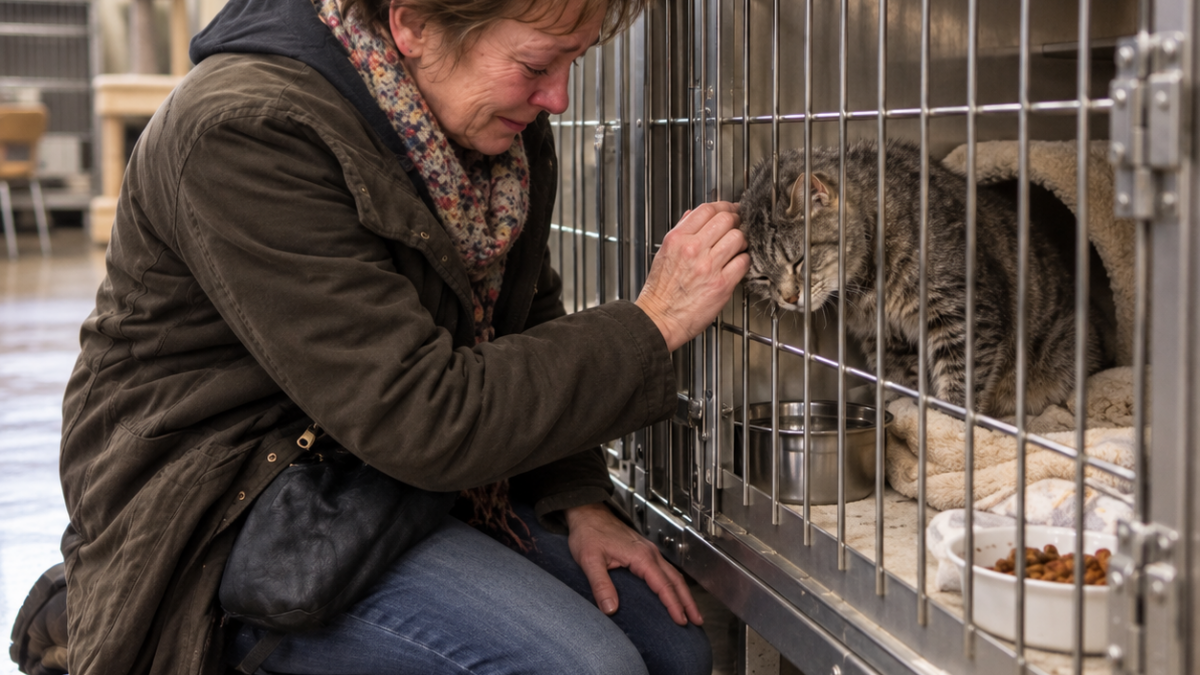
Anne stopped in front of a small glass-fronted enclosure.
“There,” she said gently.
At first, I barely recognized him.
He was in the far back corner, pressed against the wall, his body curled tightly around itself. His head was low. His whiskers trembled. There was a bowl of food near him, untouched, and a little dish of water he had not found.
He looked smaller.
That was what broke me first.
Not sick.
Not injured.
Smaller.
As if being removed from home had shrunk him.
I knelt in front of the glass.
I did not shout his name.
Blind animals do not need panic added to fear.
I just said softly, “Marius.”
His head lifted.
Not all the way.
Just enough.
I placed my hand against the glass.
“It’s me, sweetheart. I’m here.”
For a second, he did not move.
Then his ears came forward.
He stood.
Slowly.
One paw first.
Then the other.
He bumped his shoulder into the side wall, corrected himself, and followed my voice.
When he reached the front of the enclosure, he pressed his forehead against the glass where my hand was.
That was when I broke.
I sat on the cold shelter floor and cried so hard Anne had to crouch beside me.
“I’m sorry,” she whispered. “We didn’t know.”
I could barely speak.
“He’s never been away from home.”
“We were told you had agreed.”
I froze.
I turned toward her.
“What?”
Anne’s face changed.
“The man who brought him in said the family had made the decision together.”
My grief sharpened into something colder.
“Did he sign anything?”
“Yes.”
“I want a copy.”
She hesitated.
“I don’t know if—”
“That is my cat,” I said, my voice shaking. “He was taken from my home without my consent. I want every document he signed.”
Anne looked toward the office.
“I’ll get the director.”
While she went to find him, I stayed with Marius.
They opened the enclosure for me, and I slipped both hands around his thin old body.
He pushed into me so hard his claws caught in my coat.
I did not care.
I held him against my chest.
He smelled like stress and unfamiliar bedding.
“My baby,” I whispered. “I’m sorry. I’m so sorry.”
He tucked his head beneath my chin the way he had done years ago when I first brought him home.
Fifteen years.
Some people hear that and say, “It’s just a cat.”
But fifteen years is not “just” anything.
Fifteen years is my first husband’s long illness.
Fifteen years is the empty chair after the funeral.
Fifteen years is my daughter leaving Angers for work in Lyon and calling me every Sunday because she knew the evenings were too quiet.
Fifteen years is coming home after double shifts, heating soup I did not want to eat, and finding Marius waiting on the armchair like the world had not completely emptied out.
He was there when I learned how to sleep alone again.
He was there when grief came back without warning.
He was there when I met Didier, when I let myself believe that maybe my life could open a new door without closing every old one.
And Didier had put him in a carrier while I was at work.
The shelter director arrived with a folder.
He was a serious-looking man in his sixties named Monsieur Bellanger. He spoke carefully, not defensively.
“Madame, we are very sorry for what happened.”
“What did he tell you?”
“That the cat belonged to his household. That he and his wife had discussed surrendering the animal because of age-related care difficulties.”
“My wife?” I repeated.
“He said you were recently married.”
I laughed once.
It did not sound like laughter.
“We were married Tuesday.”
Bellanger lowered his eyes.
“I understand.”
“No,” I said. “I don’t think anyone understands yet.”
He handed me a copy of the intake form.
There it was.
Didier’s name.
His signature.
And beneath the section marked reason for surrender, written in his neat black handwriting:
Owner cannot manage senior cat. Animal disturbs household. Wife agrees surrender is best.
Wife agrees.
I stared at the words until they blurred.
“May I keep this?”
“Yes,” Bellanger said. “Since you are reclaiming the animal and alleging an unauthorized surrender, we will note it in our records.”
“Unauthorized?” I repeated.
“That is the proper term.”
It sounded too polite.
Too clean.
Nothing about this felt clean.
I signed Marius out. I paid the fees. I updated the shelter record and confirmed his microchip information. Bellanger told me they would flag the file in case Didier ever tried to surrender or claim an animal again without proper documentation.
Before I left, Anne brought me a towel warmed from the dryer.
“For him,” she said.
I wrapped Marius in it inside his carrier.
He stopped shaking only when I spoke.
“You’re coming home,” I told him. “You’re coming home.”
When I pulled up outside my apartment, Didier’s car was still there.
For one second, I thought about calling him and telling him to leave before I came upstairs.
Then I looked at Marius in the carrier beside me.
No.
Didier had not given me warning.
He had not given Marius mercy.
He had not earned the comfort of avoiding my face.
I carried the carrier upstairs.
My keys shook in the lock, not from fear now, but rage.
When I entered, the apartment smelled like roasted chicken and wine.
Didier had lit the small lamp in the living room. The table was set with two plates. A folded napkin lay beside each one.
He stood when he saw the carrier.
“You found him.”
I placed Marius gently beside the armchair.
“Yes.”
His shoulders dropped as if this were a relief to him.
“Good. Good. Now we can talk.”
I stared at him.
“Now we can talk?”
“I made a mistake.”
I took the shelter form from my purse and laid it on the table between the plates.
He looked at it.
His face changed.
“You asked them for paperwork?”
“You wrote that I agreed.”
“Corinne—”
“You lied.”
“I was trying to make it easier.”
“For whom?”
He rubbed his forehead.
“For us.”
There it was again.
Us.
A word he used like a blanket to cover what he had done alone.
I opened the carrier door.
Marius did not come out at first. I reached in and touched his head.
“It’s okay.”
His nose lifted.
He stepped out carefully, felt the floor with one paw, then found the edge of the rug. He knew that rug. He knew the shape of home. He walked slowly toward his basket, turned twice, and lowered himself into it with a sigh so deep it sounded almost human.
Only then did I look back at Didier.
“You took a blind cat from the only place he can navigate.”
“He’s old,” Didier said weakly.
“Yes.”
“He wanders.”
“Yes.”
“He keeps us awake.”
“He keeps you awake.”
“I live here too now.”
“No,” I said. “You stayed here two nights.”
His eyes narrowed.
“We are married.”
I removed my wedding ring.
His face went pale.
“Corinne, don’t be dramatic.”
The ring was still warm from my finger when I set it beside the shelter form.
“You do not get to take something I love and decide it no longer belongs in my life.”
“I apologized.”
“You apologized because I found him.”
“That isn’t fair.”
“What was your plan if I hadn’t found him tonight?”
He said nothing.
The silence answered for him.
I thought of Marius curled in the back of that glass enclosure, too frightened to eat, too blind to find the water bowl.
“What was your plan, Didier?”
He looked away.
“You would have calmed down eventually.”
I stepped back as if he had touched me.
That was the moment something inside me closed.
Not because he had made a mistake.
Mistakes are forgetting to buy milk. Misplacing keys. Saying the wrong thing when you are tired.
This was not a mistake.
This was a decision.
He had counted on my grief fading faster than his inconvenience.
I walked to the bedroom, took his small suitcase from the wardrobe, and placed it on the bed.
“What are you doing?” he demanded from the doorway.
“You’re leaving.”
“This is ridiculous.”
“You’re leaving tonight.”
“I’m your husband.”
I looked at him.
“For two days, yes. And in those two days, you showed me exactly what kind of husband you are.”
He stared at me, stunned.
Then anger moved across his face.
“You’re ending a marriage over a cat?”
I zipped the suitcase.
“No. I’m ending it because you waited until I was gone, removed a helpless animal from his home, lied to a shelter, lied to me, and then expected dinner.”
He opened his mouth.
Closed it.
I handed him the suitcase.
“Go back to your apartment.”
He did not move.
So I added the one thing I knew would hurt his pride more than shouting.
“If you do not leave, I will call my daughter. Then I will call the police and explain that you took my microchipped cat without my permission and falsified my consent on a surrender form.”
His eyes dropped to the paper on the table.
For the first time, he understood what that signature meant.
He left twenty minutes later.
Not quietly.
Not humbly.
He slammed drawers. Muttered about embarrassment. Said I was unstable. Said I would regret choosing “an animal” over a marriage.
I stood by Marius’s basket the entire time.
When the door finally closed behind Didier, the apartment became silent.
Marius lifted his head.
I knelt beside him.
“He’s gone.”
The old cat blinked slowly, his cloudy eyes pointed just to the left of my face.
I laughed through tears.
“Yes,” I whispered. “I know. You never liked him either.”
That night, I slept on the sofa beside Marius’s basket.
I did not sleep well.
Every time he shifted, I woke.
Every time he stood, I guided him to water.
At three in the morning, he climbed onto my chest the way he had not done in years. He was too old for graceful jumping, so it was half climb, half collapse.
His paws pressed into my ribs.
His purr started slowly.
Then grew stronger.
I lay there in the dark, one hand on his back, and understood something I should have understood before the wedding.
Love does not ask you to erase your old life as proof that you deserve a new one.
The next morning, Didier called seven times.
I did not answer.
He texted.
We need to talk.
You’re overreacting.
I panicked.
I said I was sorry.
You can’t throw away a marriage after two days.
Then, near noon:
People are going to ask what happened. Think carefully before you make us both look foolish.
That one made me sit up.
Not because I was afraid.
Because it showed me the next stage.
He was no longer trying to repair.
He was preparing the story.
By that evening, I knew I was right.
My sister called first.
“Corinne, what happened?”
I closed my eyes.
“What did Didier say?”
She hesitated.
“He said you threw him out because he suggested the cat might need care you couldn’t provide.”
I laughed once.
“No.”
“He said Marius was sick and suffering.”
“He surrendered him without asking me.”
Silence.
“What?”
“He took him while I was at work and left him at a shelter.”
My sister inhaled sharply.
“He didn’t say that.”
“Of course he didn’t.”
“He said you became hysterical.”
I looked toward Marius, who was asleep in the armchair, exactly where he belonged.
“I have the shelter paperwork.”
More silence.
Then my sister said, very quietly, “Send it to me.”
I sent it.
By midnight, three more people had called.
Didier had moved fast.
He told friends I had chosen “a cat over a man.” He told his cousin I was emotionally unstable because of my first husband’s death. He told a mutual acquaintance that he had only tried to get help for an animal I was neglecting.
Neglecting.
That word nearly made me sick.
I had changed my work schedule when Marius’s vision worsened. I had placed textured rugs in the hallway so he could feel his way through the apartment. I kept his bowls in the same place, never rearranged furniture without guiding him, and learned how to trim the fur near his paws so he did not slip.
Marius was old.
He was not neglected.
But Didier understood something cruel people often understand well.
If you cannot defend what you did, attack the person you did it to.
At first, I wanted to call everyone.
I wanted to explain.
To cry.
To demand they choose a side.
Instead, I called my daughter.
Léa answered on the second ring.
“Maman?”
The moment I heard her voice, I broke.
I told her everything.
She listened without interrupting.
When I finished, she said, “I’m coming.”
“No, you don’t need to—”
“I’m coming tomorrow morning.”
“Léa, you have work.”
“I’ll take the train.”
“I’m all right.”
“No,” she said. “You are strong. That is not the same thing as being all right.”
She arrived the next afternoon with a small suitcase, wet hair from the rain, and fury in her eyes.
Marius was in his basket when she came in.
She dropped to her knees.
“Oh, my old man.”
Marius raised his head.
“Léa’s here,” I whispered.
He stood slowly and shuffled toward her voice.
When he reached her hand, he pressed his forehead into her palm.
Léa covered her mouth.
Then she looked up at me.
“I might kill him.”
“No killing,” I said.
“Fine. Legally ruin him?”
“That sounds better.”
I almost smiled.
Then she saw the shelter form on the table.
She read it twice.
Her expression went cold in a way that reminded me of her father when he was angry.
“He wrote you agreed.”
“Yes.”
“Did he sign anything else?”
“I don’t know.”
“We’re going back to the shelter.”
“Léa—”
“We are going back to the shelter.”
I was tired.
But she was right.
The next morning, we met Monsieur Bellanger at the shelter.
He remembered me, of course.
So did Anne, who squeezed my hand at the reception desk and asked how Marius was.
“He ate breakfast,” I told her.
Her face lit up.
“That’s good.”
Bellanger invited us into his office.
Léa placed the copy of the form on the desk.
“My mother needs a complete record of the surrender attempt,” she said.
He looked at me.
“She is my daughter.”
Léa added, “And I work in administrative law. I know exactly what records you can provide to the legal owner of an animal who was surrendered without authorization.”
Bellanger nodded.
“I understand.”
He provided copies of the intake paperwork, the time stamp, Didier’s written statement, and the staff notes.
One note made me stop breathing.
Male surrendering cat stated wife was “too attached” and would “make a scene” if present.
I read it again.
Too attached.
Make a scene.
He had known I would say no.
He had not misunderstood.
He had planned around my refusal.
Léa saw my face and took the paper from me.
Her jaw tightened.
“That’s enough.”
“For what?” I asked.
“For everyone who thinks this is about a cat.”
She took photos of the documents with her phone.
That evening, Didier made his next mistake.
He sent a long message to a family group chat.
It was written like a speech.
He said he was heartbroken. That marriage required compromise. That I was unable to move forward because I was “emotionally trapped in the past.” That he had tried to make a difficult but compassionate decision about Marius. That the cat was old, confused, and unhappy. That I had humiliated him for trying to build a peaceful home with me.
Then he wrote:
I hope Corinne eventually understands that love means choosing the living marriage over clinging to a dying animal.
I stared at that sentence for a long time.
Léa read it over my shoulder.
“Oh,” she said softly. “He wants public.”
I looked at her.
“What?”
“He made it public enough.”
She typed for several minutes.
Then she handed me the phone.
Her response was simple.
Didier, you took a nearly blind fifteen-year-old cat from his home while my mother was at work, surrendered him to a shelter without her consent, falsely wrote that she agreed, and told staff she would “make a scene” if present. That is not compassion. That is control. Attached are the shelter records. Do not lie about my mother again.
Below it, she attached the form.
The staff note.
The surrender statement.
Then she asked, “Send?”
My hand hovered over the screen.
For years, I had been careful.
Careful not to make family uncomfortable.
Careful not to sound bitter after widowhood.
Careful not to be the older woman people pitied.
Careful not to seem too attached, too emotional, too much.
Marius stirred in his basket.
He stood, turned carefully, found the blanket, and settled again.
I pressed send.
The group chat went silent.
For ten minutes, nothing.
Then Didier’s cousin wrote:
Is this true?
Then my sister:
I spoke to Corinne. It is true.
Then Didier’s own brother:
You surrendered her cat without asking?
Didier left the chat.
That was the first small justice.
Not revenge.
Not yet.
But the first time his story failed in public.
The legal process was not dramatic at first.
No courtroom thunder.
No immediate punishment.
Just appointments, paperwork, signatures, and the slow unraveling of something that had lasted only two days but somehow required weeks to undo.
Because the marriage was so new, my lawyer explained options for separation and possible annulment arguments, though the exact process would depend on the facts and court standards. What mattered most to me was simple: Didier would not live in my home, would not touch my belongings, and would not come near Marius.
The lawyer, Madame Vasseur, was small, elegant, and terrifyingly calm.
She read the shelter documents with no expression.
Then she looked up.
“Do you own the apartment?”
“Yes. I bought it before the marriage.”
“Good.”
“He wants some compensation,” I said.
“For what?”
“The wedding costs. Furniture he helped choose. He says I made him move out.”
Her mouth tightened.
“He lived there two nights.”
“Yes.”
“And during those two nights he removed your animal from the home without permission.”
“Yes.”
She placed the papers in a neat stack.
“Then I suggest Monsieur Didier becomes very cautious about what he demands.”
For the first time in days, I felt something close to relief.
But Didier was not finished.
A week later, he came to the apartment while Léa was out buying groceries.
I had just finished giving Marius his medication when the doorbell rang.
Through the peephole, I saw Didier standing in the hall holding flowers.
Flowers.
As if this were a disagreement about a forgotten anniversary.
I did not open the door fully. I kept the chain on.
“What do you want?”
His face softened into an expression I once would have mistaken for regret.
“Corinne, please. Can we talk like adults?”
“No.”
“I made a terrible mistake.”
“Yes.”
“I panicked. The cat was making me feel like there was no room for me.”
“There was room for you. There was not room for what you did.”
He glanced down the hallway, embarrassed by the possibility of neighbors listening.
“Can I come in?”
“No.”
His voice lowered.
“I am still your husband.”
The old fear tried to rise.
Not fear of violence.
Fear of pressure.
Fear of being worn down by someone who spoke in reasonable tones while moving the ground beneath your feet.
Then Marius appeared behind me.
He had heard Didier’s voice.
The change was immediate.
His body lowered.
His tail tucked.
He backed away from the door and bumped into the edge of the rug.
My heart broke all over again.
Didier noticed.
“He’s fine,” he said.
I turned back to him.
“No. He remembers you.”
His face flushed.
“That’s absurd.”
“You need to leave.”
“I brought flowers.”
“You brought flowers because witnesses can see flowers.”
His eyes hardened.
There he was.
The man under the apology.
“You’re letting your daughter poison you against me.”
“My daughter did not surrender my cat.”
“This again?”
“Yes,” I said. “This forever.”
He stepped closer to the door.
“Corinne, open this door.”
Marius let out a small, frightened sound behind me.
Something in me became perfectly still.
I took out my phone and began recording.
“Didier, I am asking you to leave my home.”
His face changed as soon as he saw the phone.
“Are you recording me?”
“Yes.”
“You are unbelievable.”
“You removed my cat without consent. You lied on shelter paperwork. You lied to our families. Now you are at my door after I told you not to come. Leave.”
He looked down the hallway again.
An elderly neighbor, Madame Fournier, had opened her door a crack.
Didier saw her.
He forced a smile.
“This is a private marital matter.”
Madame Fournier, who had lived across from me for eleven years and loved Marius almost as much as I did, opened her door wider.
“No,” she said. “It sounds like harassment.”
Didier’s smile vanished.
She lifted her chin.
“And I already called the building manager.”
He left.
This time, he did not slam anything.
The recording went to my lawyer.
So did the messages.
So did screenshots of the family chat.
So did the shelter records.
Madame Vasseur listened to everything and said, “Good.”
“Good?”
“People like him rely on private pressure. Documentation turns pressure into evidence.”
That sentence became another kind of comfort.
Documentation turns pressure into evidence.
So I documented.
Every message.
Every call.
Every attempt to rewrite what happened.
Meanwhile, Marius slowly returned to himself.
The first two days after the shelter, he barely ate. I had to sit beside his bowl and tap it gently with a spoon so he could locate the sound. At night, he woke and cried in the hallway, disoriented, as if part of him was still in that glass enclosure.
I moved nothing.
Not a chair.
Not a rug.
Not a lamp.
I left soft night-lights plugged in even though he could barely see them, because maybe shadows were easier than total darkness.
Léa stayed four days, then had to return to Lyon.
Before she left, she knelt beside Marius.
“Take care of her,” she whispered to him.
He blinked.
I smiled.
“He thinks he always has.”
After she left, the apartment felt quiet again.
But not empty.
There is a difference.
For the first time since the wedding, I sat in my armchair at nine o’clock.
Marius stood beside his basket.
He turned his head toward me.
“Come on,” I said softly.
He took seven careful steps.
Stopped at the edge of the rug.
Turned slightly.
Reached out with one paw until he found the base of the armchair.
Then, with great effort and almost no dignity, he climbed onto the cushion beside me.
I laughed and cried at the same time.
“You’re getting old, my grand old man.”
He placed one paw on my thigh and began to purr.
The sound filled the room.
It was small.
Uneven.
But it was home.
Didier’s final public humiliation came three weeks later.
Not because I planned it.
Because he could not stop trying to control the story.
A mutual friend, Nathalie, invited me for coffee. I almost said no, but she had been kind after my first husband died, and I trusted her enough to meet.
We sat near the window of a small café close to the river.
Nathalie looked uncomfortable before the waiter even took our order.
“Didier asked me to speak to you.”
I leaned back.
“Of course he did.”
“He says you won’t answer him.”
“That is true.”
“He says he wants mediation.”
“He has a lawyer.”
She twisted her napkin.
“Corinne, I know what he did was wrong.”
“Do you?”
“Yes. But he says you are making it sound like cruelty, and he thought he was helping.”
I took a slow breath.
“Did he tell you he wrote that I agreed?”
She looked down.
“Yes.”
“Did he tell you he told the shelter I would make a scene if I were present?”
Her eyes lifted.
“No.”
I took the documents from my bag.
I had begun carrying copies because Didier’s lies traveled faster than the truth, and I was tired of chasing them empty-handed.
I placed the staff note in front of her.
She read it.
Her face changed.
“Oh.”
“That is not help. That is planning.”
Nathalie covered her mouth.
“I’m sorry.”
“It’s all right.”
“No. It isn’t.”
She looked through the café window, then froze.
I followed her gaze.
Didier was outside.
Walking toward the door.
I laughed softly, but there was no humor in it.
“You didn’t invite me for coffee,” I said.
Nathalie went pale.
“Corinne, he said if you saw him in public you might be calmer.”
I stood.
“Didier thinks a lot about how to corner people.”
The café door opened.
He entered wearing a gray coat and the same wounded expression he had perfected.
“Corinne,” he said softly.
Several people looked up.
Good.
Let them.
I did not sit back down.
“What are you doing here?”
“I just want to talk.”
“No, you wanted an audience.”
He glanced around, lowering his voice.
“Please don’t make this ugly.”
I took the shelter form from the table and held it up.
“You made it ugly when you wrote my consent on a form I never saw.”
His face tightened.
Nathalie whispered, “Didier, you told me she was exaggerating.”
He shot her a look.
“I told you this was complicated.”
“No,” I said. “It is very simple.”
The café had gone quiet.
I should have been embarrassed.
The old me would have been.
The woman who avoided scenes.
The woman who apologized when someone else bumped into her.
The woman Didier thought he had married.
But something about seeing him try to stage-manage my pain in public loosened the last knot of shame inside me.
I turned to the room, not loudly, but clearly.
“This man married me on Tuesday. On Thursday, while I was at work, he took my fifteen-year-old blind cat from my home and surrendered him to a shelter. He told the shelter I agreed. I did not. When I found my cat terrified and refusing food, this man had dinner waiting and expected me to get over it.”
Didier’s face went red.
“Stop.”
“No.”
The word came out clean.
Small.
Final.
“No, Didier. I will not protect your reputation from the truth anymore.”
Nathalie stood too.
“I think you should leave,” she told him.
He stared at her.
“You too?”
She handed him the staff note.
“I read what you told them.”
He looked at it.
Then at me.
For a moment, I saw the same expression he must have worn when the shelter handed him the intake form.
Annoyance that reality had paperwork.
He left the café without another word.
That story spread too.
But this time, it spread correctly.
Not because I begged people to believe me.
Because they had seen him.
They had seen me stop bending myself into silence for his comfort.
A month later, the legal separation moved forward. Didier’s requests became smaller. His lawyer’s tone became less aggressive. Madame Vasseur told me that documented behavior had a way of encouraging realism.
“He is no longer claiming you forced him out without cause,” she said.
“Because he knows we can show cause.”
“Exactly.”
“And the shelter?”
“They have banned him from surrendering animals without proof of ownership and consent. They also filed an internal warning with their network.”
It was not a prison sentence.
It was not cinematic revenge.
But it mattered.
Because somewhere in the future, another animal might be safer because Didier’s name had been written down in the right place.
That was enough for me.
Almost.
The final settlement was reached quietly.
He collected what little property he had left in the apartment through a scheduled arrangement supervised by the building manager. I was not there. Marius was not there. Madame Fournier kept him in her apartment for the afternoon, feeding him small pieces of cooked chicken and telling him he was a brave gentleman.
When I returned, Didier’s things were gone.
So was the wedding photograph from the hallway.
I had removed it myself the night before.
Not angrily.
Not dramatically.
I simply took it down, slid it into an envelope, and placed it with the other papers from a marriage that had lasted less time than some flowers stay fresh.
In its place, I hung a framed photo of Marius.
It was an old picture, taken when he could still see. He was sitting on the windowsill, gray fur glowing in the afternoon light, looking out over Angers as if he owned the whole city.
Maybe he did.
Or at least he owned my little piece of it.
Winter came slowly that year.
Marius grew weaker, as old cats do. He slept more. Ate less. Needed help climbing onto the armchair. Some days, he seemed confused when he woke, and I would speak until he found me.
“I’m here,” I would say. “You’re home.”
Those words became our ritual.
I’m here.
You’re home.
One evening, while cleaning, I moved his old armchair a few inches to vacuum behind it.
I forgot to put it back.
That night, at nine, Marius came from his basket.
Seven careful steps.
The edge of the rug.
The turn.
He reached one paw forward.
There was nothing there.
He froze.
His paw hovered in the air, searching.
My chest tightened.
I stood immediately and moved the chair back exactly where it belonged.
The wooden leg touched the spot on the floor it had occupied for years.
Marius stretched his paw again.
This time, he found it.
He touched it with his nose.
Then climbed up slowly, turned twice, and settled into the cushion.
I stood there for a long time.
That was when I finally understood why Didier’s betrayal had cut so deeply.
It was not only that he had taken Marius.
It was that he had looked at a fragile world, a world built carefully around age and grief and memory, and decided it was disposable because it inconvenienced him.
Marius did not ask for much.
A bowl in the same place.
A blanket that smelled familiar.
A voice at the door.
A chair that had not moved.
The mercy of not having his world rearranged by someone who did not care how he would find his way through it afterward.
And maybe humans are not so different.
Maybe after loss, after loneliness, after the long work of rebuilding a life, we need the same thing.
To know the people we let inside will not start throwing away pieces of us and calling it a fresh beginning.
Spring arrived.
Marius made it to his sixteenth birthday.
Léa came home with a ridiculous little cake from a pet bakery and a candle we did not light because Marius hated smoke.
Madame Fournier came over with a gift bag containing a soft blanket and a card addressed to Monsieur Marius.
We laughed more than I expected.
Marius slept through most of his own celebration, which felt appropriate.
Later, Léa and I sat on the balcony while he dozed inside.
“Do you miss him?” she asked.
“Didier?”
She nodded.
I thought about it.
“No.”
“Not at all?”
“I miss who I thought he was.”
“That’s different.”
“Yes.”
The evening light touched the rooftops.
I looked through the open balcony door at Marius asleep in the armchair.
“I think I was lonely,” I said. “And loneliness can make kindness look deeper than it is.”
Léa reached for my hand.
“You wanted love.”
“Yes.”
“That isn’t wrong.”
“No,” I said. “But next time, love has to be kind when it is inconvenient.”
She smiled sadly.
“That should be embroidered on a pillow.”
“Maybe on Marius’s blanket.”
We both laughed.
Months passed.
The divorce became final.
Didier sent one final letter through his lawyer, cold and formal, accusing me of turning a private disagreement into public humiliation.
Madame Vasseur asked if I wanted to respond.
I did.
Not legally.
Personally.
She advised against direct contact unless necessary, but said I could write a letter and keep it.
So I did.
I wrote:
Didier,
You still believe the humiliation was that people found out what you did. That is not humiliation. That is consequence.
You took Marius because you thought his age made him powerless. You lied because you thought my love for him made me weak. You expected me to choose silence because you mistook my gentleness for permission.
You were wrong.
I hope someday you understand that starting a new life with someone does not mean cutting away everything that existed before you arrived.
Marius is home.
So am I.
Corinne
I never sent it.
I folded it and placed it in the folder with the shelter form.
Not because Didier deserved my words.
Because I did.
A year after the wedding that should never have happened, I walked past the shelter where I had found Marius.
I had not planned to stop.
But something made me turn in.
Anne was still there.
She recognized me immediately.
“How is he?” she asked.
“Old,” I said. “Very spoiled.”
Her smile softened.
“Good.”
Monsieur Bellanger came out of his office when he heard my name.
He shook my hand warmly.
“We changed our intake policy after your case,” he told me.
I blinked.
“What do you mean?”
“When someone surrenders an animal that is microchipped to another person, we now require additional verification before intake unless it is an emergency. We also flag senior and disabled animals for owner confirmation whenever possible.”
I felt my throat tighten.
“So this won’t happen as easily again?”
“That is the goal.”
I looked toward the hallway where I had first seen Marius curled in fear.
“Thank you.”
“No,” Bellanger said. “Thank you. You insisted when it would have been easier to simply take your cat home and disappear.”
I thought about that on the walk home.
There are many kinds of revenge.
Some are loud.
Some are legal.
Some are social.
Some simply make it harder for the next cruel person to do the same thing.
I liked that kind best.
Marius lived another year and three months.
By then, he was nearly seventeen.
His world had become very small.
Basket.
Water bowl.
Armchair.
My bed on cold nights.
The patch of sun near the balcony door.
He no longer came to the entryway when my key turned, but his ears still moved when I called his name.
On his last morning, I knew.
People say that sometimes, and before it happens to you, you wonder how they can be sure.
But I knew.
He did not want breakfast.
He did not lift his head when I opened the curtains.
When I sat beside him, he pressed his forehead weakly against my hand.
I called Léa.
She came that afternoon.
Madame Fournier came too, with no words, only tears.
Our veterinarian, who had cared for Marius for years, came to the apartment so he would not have to leave home again.
That mattered to me more than I can explain.
The last place Marius saw, or sensed, or remembered, was not a shelter cage.
Not a car.
Not a strange room.
It was his blanket.
His chair.
My hand.
My voice.
I held him and whispered the words he knew best.
“I’m here. You’re home.”
He left quietly.
The apartment felt impossibly still afterward.
For days, I heard him in places he was not.
A soft step near the hallway.
A small sound near the bowl.
A shift in the armchair.
Grief is strange that way.
It fills silence with echoes.
But beneath the sadness, there was peace.
Because he had not ended his life frightened behind shelter glass.
He had not spent his final months wondering why I never came.
He had come home.
And home had kept its promise.
I buried his ashes beneath a small lavender plant on the balcony. Léa bought a little marker with his name.
MARIUS
Loved for seventeen years.
I added one more line beneath it.
Always home.
Sometimes people still ask about Didier.
Not often now, but occasionally someone hears a shortened version of the story and says, “So you left him because of the cat?”
I used to explain.
Now I simply say, “No. I left him because he showed me what he would do with something helpless when it stood between him and what he wanted.”
That usually ends the conversation.
My life did not become lonely again after Marius died.
Quiet, yes.
Different, yes.
But not empty.
There is a kind of solitude that comes from being abandoned, and another kind that comes from choosing peace.
They are not the same.
I learned that from an old blind cat who knew the apartment better than most people knew my heart.
A few months after Marius passed, I received a call from Anne at the shelter.
“I know this may be too soon,” she said.
I smiled sadly.
“You have a cat.”
“We have a twelve-year-old female. Partially blind. Her owner died, and the family couldn’t keep her. She’s eating, but she’s scared. I thought of you.”
I closed my eyes.
“What’s her name?”
“Lucie.”
I looked toward the empty armchair.
My first feeling was no.
Not because I did not care.
Because loving an old animal means agreeing to heartbreak sooner than later.
Then I thought of Marius in the shelter enclosure.
How he had lifted his head when he heard my voice.
How no creature should have to spend its final chapter wondering where home went.
“I’ll come meet her,” I said.
Lucie came home the next week.
She was smaller than Marius, black with white paws and a cloudy left eye. She did not replace him. Nothing could.
She made her own map.
Her own routines.
Her own little demands.
The water bowl stayed where Marius had taught me to keep it.
The armchair stayed in place.
The apartment, once again, adjusted around someone fragile.
And I did not mind.
One evening, Lucie climbed awkwardly onto the armchair, turned twice, and settled in the cushion where Marius had slept for so many years.
For a moment, pain moved through me.
Then peace followed.
I sat beside her and opened a book.
Outside, Angers settled into evening.
Inside, the apartment was warm.
The chair was exactly where it should be.
And I understood, finally, that Didier had not taken anything lasting from me.
He had taken Marius for one terrible day.
But he had not taken my ability to love.
He had not taken my home.
He had not taken my voice.
In fact, he had given me one thing I never expected.
Proof that I could protect my peace without apologizing for it.
Marius could barely see in the end.
But he always knew where home was.
After that Thursday, so did I.