PART 2: For Months, He Couldn’t Even Lie Down—Then I Cut His Chain and Watched Him Do One Thing
PART 2
The animal welfare officer arrived fifteen minutes later.
Her name was Camille.
She had worked cruelty and neglect cases long enough that she no longer showed shock easily.
That day she did.
She walked into the yard carrying a medical bag and stopped halfway to the dog.
“How long has he been like this?”
“Neighbor says months.”
Camille looked at the post.
Then the chain.
Then the dog’s legs.
“Has he actually been unable to lie down?”
“That appears to be the case.”
She closed her eyes for a second.
Then professionalism returned.
“Owner?”
“Not home.”
“Permission to enter?”
“The neighbor contacted the property manager. He’s on his way. Given the immediate welfare risk, I’ve documented the condition.”
I nodded.
Everything mattered now.
Photographs.
Measurements.
Chain length.
Attachment height.
Dog condition.
Water.
Food.
Shelter.
We photographed the entire yard before moving anything.
A plastic bowl sat just outside the dog’s small radius.
Empty.
Another container held greenish rainwater.
There was no proper shelter.
Only a broken wooden panel leaning against a wall too far away for the dog to reach.
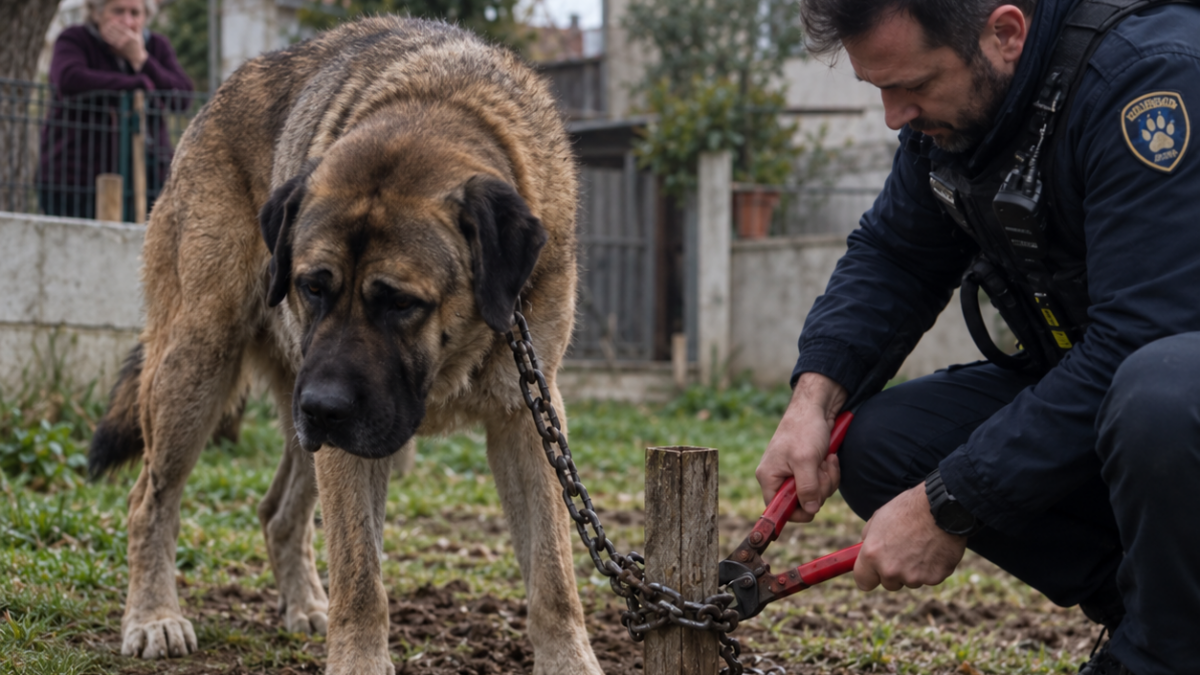
I crouched again.
The dog watched the bolt cutters in my hand.
I kept them low.
Metal tools make noise.
Frightened animals make choices fast.
“Easy.”
Camille moved around to his other side.
“He’s not showing aggression.”
“No.”
“He may collapse once he’s released.”
That sentence caught me.
“You think he can stand because the chain forces him to?”
“Possibly.”
I looked at his swollen legs again.
“Then we support him.”
The property manager arrived with keys and confirmed the tenant was the registered occupant.
He stared at the dog and said nothing.
Camille asked him not to disturb the scene.
I positioned the cutters around one link several inches from the collar.
The dog flinched when metal touched metal.
“Easy, buddy.”
I squeezed.
Nothing.
The chain was heavier than it looked.
I repositioned.
Pressed harder.
The link bent.
Camille rested one hand lightly against the dog’s shoulder.
“Again.”
I squeezed.
The metal gave.
Snap.
The loose end fell into the dirt.
For the first time, there was nothing connecting the dog to the post.
I expected him to step away.
Maybe sniff the yard.
Maybe panic.
Instead, he stood completely still.
As though his body hadn’t understood yet.
I moved the broken chain away.
Camille loosened the collar.
It was so stiff from dirt and weather that the buckle barely moved.
Beneath it, his fur had worn away.
The skin was raw in places.
The collar came off.
Still the dog did not move.
“Come on,” I whispered.
He looked at me.
Then something changed.
His front legs bent.
Slowly.
So slowly that at first I thought he was collapsing.
Camille reached toward him.
I stopped her gently.
“Wait.”
The dog lowered his chest.
Halfway down, he froze.
His body trembled.
He seemed confused by the movement.
Like he had forgotten how far the ground was supposed to be.
Then he tried again.
His elbows touched dirt.
His back legs folded awkwardly beneath him.
And finally—
he lay down.
Just lay down.
Nothing more.
No dramatic run.
No burst of freedom.
He stretched one front leg forward.
Then the other.
His head lowered onto the ground.
And he released a sound I still hear sometimes.
Not a whine.
Not a bark.
A long, shaking exhale.
Like his whole body had been waiting months to make it.
Monique covered her mouth.
Camille turned her face away.
The property manager stared at the post.
I remained crouched.
The dog closed his eyes.
He didn’t sleep immediately.
He just rested his head on the dirt.
Free.
That was his first choice.
Rest.
Not escape.
Not food.
Not revenge.
Rest.
I don’t know why that hit me harder than almost anything I’d seen in uniform.
Maybe because freedom is supposed to look like movement.
Running.
Leaving.
Distance.
For him, freedom meant finally being allowed to stop standing.
I took off my jacket and folded it under his head.
He opened one eye.
Didn’t resist.
“That’s better.”
Camille checked his gums.
“Pale.”
She touched his legs.
The dog tensed.
“Painful.”
“How bad?”
“Very.”
She listened to his heart.
“Dehydrated too.”
“Can he walk?”
“We’ll find out, but not far.”
The animal transport van arrived shortly afterward.
We needed to move him without forcing weight onto the swollen joints.
Two technicians brought a stretcher.
The moment we tried sliding it near him, he lifted his head and became anxious.
Not aggressive.
Just uncertain.
I sat beside him.
“It’s okay.”
He looked at me.
I placed my hand near his muzzle.
He sniffed once.
Then, very lightly, pressed his forehead against my wrist.
Monique began crying.
“I should have called sooner.”
I looked back at her.
“You called.”
“But months—”
“You called.”
She shook her head.
“I kept thinking maybe I was overreacting.”
That sentence mattered.
People hesitate because suffering doesn’t always arrive with blood.
Sometimes there is no scream.
No broken bone visible from across a fence.
Just something that feels wrong.
A dog always standing.
A bowl always empty.
A body slowly getting thinner.
Cruelty often depends on everyone waiting for certainty.
Monique stopped waiting.
That saved him.
We lifted the dog.
He was lighter than he looked.
A mastiff mix his size should’ve required effort from four people.
Three of us carried the stretcher easily.
That frightened me more than his ribs.
His body had been built for weight.
Power.
Muscle.
There was hardly any left.
Inside the van, Camille asked:
“Does he have a name?”
The property manager checked a copy of the lease documents.
“No pet information.”
No identification tag.
No paperwork.
No chip scanner available until the clinic.
I looked at the dog.
“We’ll find out.”
The veterinary clinic was twenty minutes away.
I followed in my patrol car.
I wasn’t required to.
My official role at that stage was nearly done.
Animal welfare had custody.
The case could be documented.
Owner could be interviewed later.
I could’ve returned to patrol.
I told dispatch I was following for the report.
That was true.
It just wasn’t the whole truth.
I wanted to see him lie down somewhere soft.
At the clinic, four people met the van.
The dog was transferred directly to a padded examination area on the floor.
No table.
The veterinarian, Dr. Fournier, examined him carefully.
I stood in the doorway.
Weight first.
Forty-one kilograms.
Camille frowned.
“What should he be?”
“Depending on his frame, probably fifty-five. Maybe sixty.”
Nearly twenty kilograms missing.
Blood drawn.
Temperature.
Heart.
Lungs.
Skin.
Paws.
Joints.
The dog endured everything quietly.
Too quietly.
Dr. Fournier said:
“Sometimes people interpret this as good behavior.”
“What is it?”
“Exhaustion.”
He gently flexed one rear leg.
The dog flinched.
“Severe inflammation.”
“Permanent?”
“Too soon to know.”
X-rays came next.
Then more waiting.
I sat in the hall with Camille.
She looked at my uniform.
“You have somewhere else to be.”
“Probably.”
“You’re not leaving.”
“No.”
She smiled slightly.
“Good.”
An hour later, Dr. Fournier returned.
The findings were worse than I expected.
Severe muscle wasting.
Inflamed joints.
Pressure-related swelling.
Skin infection beneath the collar.
Overgrown nails.
Dehydration.
Parasites.
Signs of chronic nutritional deficiency.
His rear legs showed changes consistent with prolonged standing and lack of normal movement.
I asked the question I didn’t want answered.
“How long would he have to be restrained like that for his legs to get this bad?”
Dr. Fournier looked at the images.
“Not a few days.”
“Weeks?”
“At minimum.”
“Months?”
“Entirely consistent.”
That would matter later.
“Will he walk normally again?”
“Maybe.”
“Lie down normally?”
The veterinarian looked at me strangely.
“Yes. If pain can be controlled.”
I nodded.
It felt ridiculous that this counted as good news.
“Does he have a chip?”
“Yes.”
That changed the room.
“Name?”
Dr. Fournier checked the screen.
“Rocco.”
Rocco.
The dog lifted his head when the veterinarian said it.
We all noticed.
Dr. Fournier tried again.
“Rocco.”
One ear moved.
There he was.
Not “the dog.”
Rocco.
Registered to the tenant whose property we had just entered.
The owner was a thirty-eight-year-old man named Julien Vasseur.
The address matched.
The microchip database showed no recent transfer.
Vaccinations outdated.
No veterinary record uploaded for years.
Camille looked at me.
“Now we talk to him.”
Rocco stayed at the clinic.
He needed fluids, nutrition, pain control, anti-inflammatory medication, treatment for parasites, and monitoring.
Before I left, I walked back into the room.
Rocco was asleep on thick blankets.
Completely flat on his side.
His legs extended.
Head supported.
For several seconds, I just watched his chest rise and fall.
Dr. Fournier stepped beside me.
“First proper sleep?”
“Maybe in months.”
He looked at Rocco.
“Then let him have it.”
I left.
The owner returned home that evening.
Another officer and I met him there.
Julien Vasseur didn’t look like the monster people imagine when they hear animal cruelty.
That is worth saying.
No sinister appearance.
No threatening voice.
Work boots.
Blue jacket.
Tired face.
Ordinary.
Cruelty often looks ordinary because people who do terrible things still buy groceries, go to work, complain about traffic, and greet neighbors.
He seemed irritated more than concerned.
“Where’s my dog?”
“Receiving veterinary care.”
“You took him?”
“He was removed due to his condition.”
“He was fine.”
I had heard those exact words from Monique’s account.
“He was unable to lie down.”
Julien stared at me.
“What?”
“The chain prevented him from lying down.”
“No, it didn’t.”
“We measured it.”
“He lies down.”
“When?”
“All the time.”
I let the silence sit.
“You have photographs?”
He folded his arms.
“He’s a guard dog.”
“That wasn’t my question.”
“He likes being outside.”
“Where is his shelter?”
“He broke it.”
“When?”
“I don’t know.”
“Where was his food?”
“I feed him.”
“When did you last feed him?”
“This morning.”
His answer came quickly.
Too quickly.
We had photographed the yard early afternoon.
No food.
No evidence of recent feeding.
Camille’s team later searched the area properly.
There was old fecal matter.
No suitable bedding.
No functioning shelter.
The water container was contaminated.
I asked:
“How long has he been on that chain?”
“A few days.”
“Why?”
“He was getting out.”
“A few days?”
“Yes.”
I thought about Dr. Fournier’s X-rays.
Monique’s weeks of observations.
The bare circle.
“Three days?”
“Something like that.”
“And before that?”
“Longer line.”
“Where is it?”
Julien’s expression changed.
“I threw it away.”
“Recently?”
“I don’t remember.”
My partner wrote everything down.
I asked:
“Why did you attach the chain high enough that he couldn’t lie down?”
“I didn’t.”
“Who did?”
“I don’t know.”
“It is your property.”
“My cousin sometimes deals with him.”
“Name?”
Another hesitation.
The interview went on.
Excuse after excuse.
Rocco was difficult.
Rocco was strong.
Rocco destroyed things.
Rocco pulled.
Rocco barked.
Rocco had become “a problem.”
Every sentence described inconvenience.
None described the dog.
I asked:
“How old is he?”
Julien paused.
“Seven?”
The chip record said Rocco was nearly nine.
“What does he eat?”
“Dog food.”
“Which kind?”
“I don’t know.”
“Medication?”
“None.”
“Veterinarian?”
“He doesn’t need one.”
The dog we had just hospitalized apparently needed nothing.
That was the moment my anger sharpened.
Not because Julien shouted.
He didn’t.
Not because he threatened me.
He didn’t.
Because Rocco’s suffering had been reduced in his mind to maintenance.
An object tied outside.
Fed sometimes.
Ignored mostly.
Standing became normal because nobody inside the house cared enough to ask why he was always standing.
We ended the interview.
I told Julien an animal welfare investigation was underway and that Rocco would remain in protective custody pending evaluation.
He became angry then.
“You can’t steal my dog.”
“Rocco isn’t being stolen.”
“He belongs to me.”
The phrase hit hard.
Belongs to me.
As though ownership meant unlimited authority.
I looked at the chain still lying in the yard.
“No,” I said. “Ownership comes with responsibilities.”
He started arguing.
I stopped him.
“The investigation will determine what happens next.”
That was all.
No threats.
No dramatic speech.
No revenge.
Police work is often disappointing to people who expect cinema.
You document.
You preserve.
You interview.
You wait.
Then you do it again.
The next morning, Monique gave a formal statement.
She brought something I hadn’t expected.
Photographs.
Dozens.
“I started taking them because I thought no one would believe me.”
Different dates.
Different times.
Morning.
Afternoon.
Evening.
Rocco in the same position.
Standing.
Chain visible.
Some photos taken weeks apart.
Same bare circle growing wider and harder.
In one image, rain fell heavily.
Rocco stood.
In another, frost covered the grass outside his circle.
Rocco stood.
Another showed darkness through the fence.
Rocco’s silhouette beside the post.
Standing.
“How long?”
Monique checked the dates.
“First picture was November.”
We had found him in March.
Four months.
My throat tightened.
“Were you sure he never went inside?”
“I can’t be sure every minute.”
“Of course.”
“But I checked at night sometimes.”
“Why?”
She looked down.
“Because I couldn’t stop thinking about him.”
That sentence eventually became important in court.
Not because emotion proves a crime.
Because persistence created evidence.
Another neighbor came forward after police began asking questions.
Then another.
One said Rocco had once lived inside.
Years earlier, when Julien’s former partner lived at the property.
Rocco went on walks.
Slept indoors.
Played with children.
Then the relationship ended.
The partner moved away.
Something changed.
Walks became rare.
Then stopped.
Rocco moved outside.
First to a kennel.
Then chain.
Then shorter chain.
Gradual.
Exactly the kind of cruelty I had been thinking about before I met him.
Not one explosive act.
A slow shrinking of life.
Room became yard.
Yard became circle.
Circle became standing.
What shocked me most was how easily suffering can become architecture.
A post.
A collar.
A chain.
Four meters of yard reduced to less than one.
No one needs to hit a dog if the environment itself does the hurting every second.
At the clinic, Rocco’s first days were difficult.
Not medically dramatic.
Emotionally.
He didn’t know how to rest.
Dr. Fournier explained it when I visited on my lunch break.
Rocco would lie down.
Then, within minutes, jerk awake.
Stand.
Circle.
Try to find tension that wasn’t there.
“He keeps acting like the chain is still attached.”
“Habit?”
“Partly. Pain. Stress. Learned behavior.”
Rocco walked three tight circles on the padded floor.
Then stopped.
“There,” Dr. Fournier said.
“What?”
“He’s checking his radius.”
There was no radius anymore.
But his body remembered one.
He took another step.
Stopped.
Another.
Then looked back toward where a post should have been.
Nothing.
I felt angry all over again.
“Can that go away?”
“Probably.”
“Probably?”
“Don’t demand a schedule from trauma.”
That sentence stayed with me.
Recovery doesn’t care what would make humans feel better.
Rocco had spent months learning one set of rules.
Stand.
Shift.
Turn.
Don’t lower too far.
Don’t expect relief.
Now we wanted him to learn the opposite immediately.
Lie down.
Stretch.
Sleep.
Walk away.
Trust.
That takes repetition.
Camille found him a foster placement with a retired veterinary technician named Anne and her husband, Michel.
They lived outside town.
Large fenced garden.
No stairs on the ground floor.
Experience with giant breeds.
Quiet house.
Perfect.
Rocco moved there after ten days.
The first afternoon, he refused to cross the living room.
He walked in.
Stopped near the wall.
Stayed standing.
Anne placed an orthopedic bed six feet away.
Rocco looked at it.
Nothing.
She didn’t call him.
Didn’t pull.
Didn’t lure.
She sat on the couch and read.
Twenty minutes.
Rocco shifted weight.
Thirty.
One rear leg trembled.
Anne closed the book.
Moved the bed closer.
Rocco sniffed.
Then carefully lowered himself.
The moment his chest touched the cushion, he looked startled.
Michel filmed ten seconds for the rescue file.
Not social media.
Progress documentation.
I watched the video three times.
Rocco lay down.
Looked around.
Then stretched his front legs.
Farther than the chain had allowed.
His paws extended over the edge.
He sighed.
Same sound as the yard.
Only softer.
That became his favorite bed.
Recovery started there.
Not with running.
Resting.
For the first month, he slept more than anyone expected.
Six hours.
Wake.
Eat.
Short walk.
Sleep.
Wake.
Outside.
Sleep.
Anne called it “repaying a sleep debt.”
Maybe that isn’t medical terminology.
Emotionally, it made sense.
How much exhaustion accumulates in a body that cannot fully lie down?
How many nights had Rocco dozed while standing?
How often had his legs nearly given way, forcing him awake?
We would never know.
Now he slept.
Sometimes so deeply Anne checked his breathing.
I understood.
I had done the same at the clinic.
His appetite improved.
Weight increased slowly.
Too fast would’ve stressed his body.
Forty-one kilograms became forty-four.
Then forty-seven.
Muscle took longer.
Hydrotherapy helped.
His first session went badly.
Rocco hated the pool.
Massive mastiff mix.
Terrified of twelve inches of controlled water.
Anne laughed.
“He survived four months chained outside and now he’s offended by a swimming pool.”
Rocco stood frozen on the ramp.
The therapist waited.
No forcing.
Eventually one paw entered.
Then another.
The water supported his joints.
He moved.
Awkwardly at first.
Then with more confidence.
Over several weeks, his rear legs strengthened.
Swelling decreased.
He could lie down and stand without assistance.
Then came the first thing that looked almost like play.
A tennis ball rolled across Anne’s garden.
Not thrown for him.
It had belonged to her neighbor’s dog.
Rocco saw it.
His head lifted.
The ball stopped near his front paw.
He sniffed.
Pushed it.
It rolled.
He followed.
Pushed again.
Anne filmed.
Rocco moved faster.
One step.
Two.
Then a clumsy bounce.
She laughed.
The sound made him stop.
He looked at her.
Then picked up the ball.
Carried it inside.
That ball became his.
A dog described in the cruelty report as lethargic and physically compromised began carrying a filthy tennis ball from room to room.
I bought him three new ones.
He ignored all three.
Of course.
Apparently freedom doesn’t improve taste.
The investigation continued.
Veterinary experts documented that Rocco’s injuries were compatible with prolonged restraint.
Monique’s photographs established dates.
The additional neighbors corroborated the pattern.
One produced security-camera footage from his back garden.
Rocco was visible in the distance.
Same post.
Same chain.
Week after week.
One clip mattered more than the rest.
Recorded at 2:13 a.m.
Rain.
Rocco stood beside the post.
He lowered his front legs.
Chain tightened.
He rose again.
Tried a second time.
Same result.
Then he remained standing.
I watched once.
Never again.
Julien’s attorney later argued the chain had been altered by someone else.
Evidence didn’t support that.
Julien changed his story too.
First a few days.
Then a few weeks.
Then he said Rocco “preferred standing.”
That claim made Dr. Fournier visibly angry when he heard it.
He said:
“Dogs do not voluntarily avoid lying down for months until their joints deform.”
Simple.
Clinical.
Devastating.
The prosecutor authorized cruelty charges.
Rocco remained legally seized.
Julien challenged that.
He wanted the dog returned while proceedings continued.
The request was denied.
That was the first moment I felt something close to relief.
Not victory.
Relief.
Because legal processes move slowly.
Dogs live in real time.
Rocco couldn’t wait a year to learn whether someone was going to attach him to the post again.
Protective custody gave him certainty before court did.
The first time I visited Anne’s home, Rocco didn’t recognize me immediately.
That hurt more than I expected.
He walked toward the gate.
Looked.
Sniffed.
Then his whole body changed.
Tail.
One wag.
Then another.
He came closer.
Pressed his head against my chest.
I laughed.
“Okay.”
Anne smiled.
“You’ve been remembered.”
Rocco leaned harder.
He was heavier now.
Much heavier.
“Easy, giant.”
No interest.
He pushed.
I put both arms around his shoulders.
The dog who had once barely acknowledged my presence now almost knocked me over.
When he stepped away, he walked straight toward his bed.
Turned twice.
Lay down.
Casually.
Without fear.
Without checking for tension.
That might sound ordinary.
It was not.
I watched him settle.
Anne noticed.
“You’re staring.”
“I know.”
“He does that all day.”
“I know.”
“Then why are you emotional?”
I looked at her.
“You didn’t see the first time.”
She became quiet.
“No.”
I sat beside Rocco.
His breathing slowed.
“What are you going to do with him when the case ends?”
Anne smiled.
That answer worried me.
“Don’t.”
“What?”
“You’re thinking about adopting him.”
“I am not.”
Michel walked through the room.
“You are.”
Anne pointed at him.
“See?”
I laughed.
Rocco opened one eye.
“Everybody is making decisions for you.”
Tail thump.
The months that followed built a life.
Not dramatic.
Routine.
Rocco liked breakfast at 7:00.
Not 7:15.
Seven.
If Anne was late, he stood in the kitchen.
Silent.
Judgmental.
He hated carrots.
Loved chicken.
Feared umbrellas opening indoors.
Liked children if they sat quietly first.
Despised bicycles for reasons nobody knew.
Loved sleeping near the radiator.
He developed an obsession with towels.
Not chewing them.
Collecting them.
Bathroom towel left too low?
Rocco.
Kitchen towel?
Rocco.
Laundry basket?
Opportunity.
Anne would find three towels piled on his bed.
“Why?”
Rocco would stare.
Maybe after months with nothing soft, fabric became treasure.
Maybe he just liked towels.
Not everything needs a trauma explanation.
That mattered too.
At some point, rescued animals deserve to be allowed quirks without every behavior becoming a symptom.
Rocco wasn’t only what had happened to him.
He was funny.
Stubborn.
Greedy.
Affectionate.
Terrible at catching treats.
Excellent at finding the warmest spot in any room.
He became a dog.
Not a case.
Not evidence.
Not “the chained mastiff.”
Rocco.
The court hearing took place almost nine months after we found him.
Monique attended.
So did Camille.
Anne wanted to but stayed home with Rocco.
I testified.
Police officers testify often.
Facts.
Measurements.
Photographs.
Observations.
You keep emotion out.
I explained the height of the post attachment.
The chain length.
The dog’s inability to lower himself.
His swollen joints.
The absence of adequate water and shelter.
The conditions.
Then the defense asked:
“Officer, are you a veterinarian?”
“No.”
“So when you say the dog could not lie down, that was your interpretation?”
“No.”
He paused.
“What do you mean?”
“We measured the available chain length against the dog’s body position. We also observed him attempt to lower himself.”
“You cannot know how he behaved when you weren’t present.”
“No.”
“So he may have been able to lie down differently?”
The prosecutor objected.
The judge allowed me to answer carefully.
I said:
“If there was a way for a dog of his size to place his chest and hindquarters on the ground without exceeding the physical length of that chain, I did not observe one. Neither did the animal welfare officer. Neither did the veterinarian when reviewing the setup.”
The defense moved on.
Monique testified.
Her voice shook.
She brought her photographs.
The defense asked why she’d waited months.
That hurt her.
I watched.
“I thought maybe I was wrong,” she said.
“Wrong about what?”
“That it was as bad as it looked.”
“Did the owner ever threaten you?”
“No.”
“Prevent you from calling?”
“No.”
“Then why wait?”
Monique looked toward the judge.
“Because ordinary people spend too much time telling themselves somebody else’s suffering is probably not their business.”
The room went quiet.
She continued.
“I should have called sooner.”
The prosecutor asked:
“And why did you finally call?”
Monique’s eyes filled.
“Because I woke up at three in the morning thinking about that dog standing in the rain.”
No drama.
Truth.
Dr. Fournier’s testimony was clinical.
Months of restraint.
Joint damage.
Muscle wasting.
Chronic stress.
Medical consequences.
He was asked whether all of Rocco’s condition could have come from age.
“No.”
Malnutrition alone?
“No.”
An energetic dog’s preference to remain standing?
“No.”
The defense attorney said:
“The owner states the dog damaged multiple shelters provided to him.”
Dr. Fournier replied:
“A damaged shelter does not make prolonged physical restraint medically appropriate.”
The case didn’t depend on one emotional moment.
It depended on layers.
Witnesses.
Photos.
Measurements.
Medical evidence.
Contradictory statements.
That’s how legal accountability usually works.
Slowly.
Boringly.
Piece by piece.
Julien was convicted on animal cruelty and neglect charges.
The sentence did not feel dramatic enough for some people.
It rarely does.
A fine.
A suspended custodial sentence with conditions.
Mandatory reimbursement of a portion of veterinary and care costs.
And the part that mattered most:
A multi-year prohibition on owning or keeping animals.
Rocco was permanently removed from his ownership.
No appeal would return him while that order stood.
When the judge said Rocco’s name, not “the animal,” I felt something release in my chest.
Outside the courthouse, Monique cried.
“I thought I’d feel happier.”
Camille understood.
“Court doesn’t undo anything.”
Monique nodded.
“Then what does it do?”
I said:
“It stops him from going back.”
That was enough for that day.
Thierry—there is no Thierry in this story; ignore. Need clean artifact. We shouldn’t mention. Continuing carefully.
The owner walked past us on the courthouse steps.
He looked angry.
Monique stepped closer to me.
Not out of fear exactly.
Instinct.
Julien saw us.
For one second I wondered whether he’d say something.
He didn’t.
He kept walking.
That was better.
There was no satisfying confrontation.
No speech where he suddenly understood.
No apology.
Real life doesn’t reliably produce remorse.
Sometimes justice has to function without it.
I watched him leave.
Then called Anne.
She answered immediately.
“Well?”
“He’s yours.”
Silence.
“What?”
“Rocco. Permanent removal confirmed.”
Anne started crying.
Michel shouted something in the background.
Then I heard barking.
“Is that him?”
“He thinks we’re insane.”
I smiled.
“Tell him he’s not going back.”
Anne’s voice broke.
“I will.”
That evening, she sent a photograph.
Rocco asleep on his back.
Completely upside down.
Four legs loose.
Belly exposed.
Mouth slightly open.
Tennis ball near his head.
The dog who had been unable to lie down was sleeping in the most vulnerable position possible.
I stared at that picture for a long time.
Then I sent it to Monique.
She replied:
**This is all I needed.**
That became our revenge.
Not Julien suffering.
Not humiliation.
Not punishment for punishment’s sake.
This.
Rocco taking up more space than necessary.
Sleeping with his legs in the air.
Leaving half his breakfast because he knew dinner would come.
Collecting towels.
Ignoring expensive tennis balls.
Walking into rooms and choosing where to lie down.
The chain had once defined every movement.
Now he made choices nobody else controlled.
That is what freedom looked like.
Anne and Michel adopted him officially.
The paperwork was almost anticlimactic.
Rocco had already decided months earlier.
The first night after the adoption became final, Anne put a new collar on him.
Soft leather.
Loose enough for two fingers.
Small brass tag.
**ROCCO**
Their phone number.
Nothing dramatic.
But when she sent me the photo, I noticed something.
No chain attachment.
Just a collar.
Identification.
Belonging without restraint.
I liked that.
Rocco’s physical recovery continued for more than a year.
The veterinary team couldn’t reverse every joint change.
Some damage remained.
Cold mornings hurt.
He limped after too much activity.
He took anti-inflammatory medication as needed.
Hydrotherapy continued.
But the body adapted.
Muscle returned.
Weight stabilized around fifty-four kilograms.
His coat became thick and glossy.
People who had only seen the rescue photos barely recognized him.
One of my colleagues saw a new picture.
“That’s the same dog?”
“Yes.”
“Seriously?”
“Yes.”
“He looks enormous.”
“He was always enormous. He was just disappearing.”
That sentence stayed with me.
Neglect can make a life disappear while it remains physically present.
Rocco had been there the whole time.
Standing in the yard.
Visible.
Alive.
Yet gradually reduced.
Freedom didn’t create him.
It allowed him to return.
Monique visited a few months later.
She was nervous.
“What if he remembers me from the fence?”
“He probably does.”
“Is that good?”
“Let’s find out.”
Anne brought Rocco into the garden.
The moment he saw Monique, he stopped.
She froze.
Then Rocco walked toward her.
Slowly.
She held out a hand.
He sniffed.
Then leaned his entire head into her stomach.
Monique folded over him.
Cried.
“I am so sorry.”
Rocco stood there.
No idea what apology meant.
He licked her wrist.
She laughed through tears.
“You should be angry with me.”
I said quietly:
“He doesn’t need you to punish yourself.”
She looked at me.
“Then what?”
“Keep noticing.”
She did.
Monique became one of the local animal welfare group’s most reliable callers.
Not dramatic.
Not obsessive.
Just attentive.
Loose dog near a dangerous road.
Horse without visible water during heat.
Cat injured behind a store.
She called.
Sometimes nothing was wrong.
That’s okay.
Concern can be checked.
Silence can’t help anyone.
About a year after Rocco’s rescue, she reported another case.
Different neighborhood.
Two dogs living in a yard behind broken fencing.
This time conditions were bad enough for intervention.
No one had been chained like Rocco.
But food was inadequate.
One dog needed medical treatment.
The owner accepted help before charges became necessary.
Rescue provided fencing.
Food assistance.
Vet care.
The dogs stayed safely with the family.
When Monique told me, she smiled.
“I called the first day.”
“Good.”
“I didn’t wait.”
“Good.”
Rocco’s suffering didn’t become worthwhile because Monique changed.
Suffering is never justified retroactively.
But lessons can still be pulled from it.
That matters.
Rocco’s story began circulating locally after the court case became public.
I disliked some versions.
Headlines made everything simple.
**POLICE RESCUE DOG FORCED TO STAND FOR MONTHS**
Technically true.
Emotionally incomplete.
People sent angry messages about the owner.
Some wanted harsher punishment.
Some suggested things I won’t repeat.
I understood the anger.
I didn’t encourage it.
The goal wasn’t creating another mob.
The goal was making people recognize neglect before four months passed.
Camille asked whether Anne would allow the rescue to use Rocco’s story in an education campaign.
She agreed under one condition.
“No picture of him chained as the main image.”
Camille asked why.
Anne answered:
“Because that’s not who he is anymore.”
They used the sleeping photo instead.
Rocco on his back.
Paws in the air.
Caption:
**Freedom can look like finally feeling safe enough to rest.**
That was perfect.
The campaign focused on tethering safety.
Adequate movement.
Shelter.
Water.
Daily interaction.
Veterinary care.
What chronic restraint does to joints and behavior.
How to report welfare concerns.
Practical things.
Useful things.
Rocco became known.
Not famous.
Local-famous.
The large sleepy dog people recognized at rescue events.
He sometimes attended quiet outdoor fundraisers.
He wore a harness that said:
**I LIKE SPACE. ASK FIRST.**
People respected it.
Children especially.
Funny how children often understand boundaries faster than adults when they’re clearly explained.
A child would ask:
“Can I pet him?”
Anne would look at Rocco.
If his body was relaxed, she’d say:
“Let him come to you.”
They’d crouch.
Rocco would sniff.
Sometimes lean in.
Sometimes walk away.
Both answers were accepted.
Choice.
Always choice.
That word became central to his life.
Choose the bed.
Choose the room.
Choose whether to greet.
Choose whether to go outside.
Choose when to stop walking.
Choose where to sleep.
After months with almost no choices, ordinary autonomy became sacred.
One winter evening, Anne called me.
“Come over if you’re nearby.”
“Something wrong?”
“No.”
That sounded suspicious.
“Then why?”
“Just come.”
I drove over after shift.
Rocco was in the living room.
A new piece of furniture stood near the fireplace.
A huge dog couch.
Not bed.
Couch.
Custom-built low platform with thick cushions.
I stared.
“What is that?”
Michel looked proud.
“His sofa.”
“You built a mastiff a sofa?”
“He doesn’t like the floor when it’s cold.”
“He has four beds.”
“Five.”
Anne corrected.
“Five.”
Rocco climbed onto the couch.
Turned.
Lay down.
Michel crossed his arms.
“See?”
I laughed.
“You two have lost control.”
Anne shook her head.
“No. We gave it to him.”
That sentence was more profound than she intended.
They gave control to Rocco.
The exact thing he’d lacked.
Over the next several years, Rocco became older.
His muzzle grayed.
Arthritis slowly progressed.
His walks shortened.
But something remarkable happened.
I stopped thinking of him as a cruelty case.
Completely.
At first, every visit triggered the yard in my mind.
Post.
Chain.
Bare dirt.
Standing.
Years later, I arrived and saw:
Towels.
Tennis ball.
Dog couch.
Garden.
Rocco.
The past stopped entering first.
That is healing too.
Not forgetting.
Reordering.
One spring afternoon, we took Rocco to a quiet field.
Anne, Michel, Monique, Camille, and me.
No special occasion.
Good weather.
Rocco walked slowly through tall grass.
At one point, he stopped.
Then lowered himself.
Right there.
No bed.
No cushion.
Just grass.
He rolled onto his side.
Then his back.
Wiggled.
Grass sticking to his fur.
Michel laughed.
“He’s disgusting.”
Anne said:
“He’s happy.”
Rocco rolled again.
Four legs moving.
I stood watching.
The dog who once couldn’t place his chest on dirt now rolled across an entire field because he could.
That image replaced something inside me.
Years earlier, the bare circle had felt like the entire truth.
Now there was this field.
No radius.
No post.
No chain.
Only distance.
Rocco chose where to stop.
Then got up and chose where to go next.
That was enough justice for me.
The annual veterinary exams remained good considering his history.
Heart strong.
Weight controlled.
Kidneys normal.
Joints managed.
Dr. Fournier joked:
“He has become medically inconvenient.”
“What does that mean?”
“He refuses to behave like a doomed rescue dog.”
Rocco tried stealing a treat from the counter.
“Evidence,” I said.
Dr. Fournier laughed.
His history still mattered medically.
Long-term joint damage.
Old pressure scars under the neck fur.
One paw remained slightly deformed from years of poor stance.
But history was not destiny.
This distinction matters.
Rescue stories often become fantasies of complete repair.
Everything heals.
Animal becomes perfect.
Trauma disappears.
That’s rarely true.
Rocco carried damage.
Physical.
Behavioral.
Metal sounds could still make him tense.
If a chain rattled unexpectedly, his head snapped up.
If something pulled against his collar, he froze.
So Anne changed equipment.
Harness for walks.
Light collar only for identification.
No tethering.
Ever.
Once, at a picnic, someone casually looped Rocco’s leash around a fence post while helping with food.
Anne saw.
“Please don’t.”
The person looked surprised.
“He’s fine.”
“I know. Untie it.”
“It’ll be thirty seconds.”
“Untie it.”
There was something in her voice.
The leash came off.
Rocco hadn’t panicked.
Maybe he wouldn’t have.
That wasn’t the point.
Safety isn’t only responding after fear appears.
Sometimes it’s respecting history enough not to test it unnecessarily.
Rocco trusted people.
We didn’t need proof through discomfort.
By the fourth anniversary of his rescue, Monique brought a gift.
A framed photograph.
Not Rocco.
The patch of yard where the post had stood.
The property had changed tenants after Julien moved.
New people rented it.
They removed the metal post.
Replanted grass.
Built a small vegetable garden.
Monique had taken a picture.
She showed us.
“I don’t know if this is strange.”
I looked.
The bare circle was gone.
Tomatoes grew there.
Rocco sniffed the frame.
No interest.
Anne smiled.
“I like it.”
Michel said:
“Good use of land.”
I stared at the photograph.
Places don’t apologize.
But sometimes seeing something used differently helps.
The ground that had recorded thousands of painful steps was growing food.
Life over memory.
I liked that too.
Rocco never returned to the property.
We never saw a reason.
He didn’t need a confrontation with the past.
Humans love symbolic returns because they make good stories.
Dogs don’t always need them.
Home was enough.
Eventually, the owner completed his court requirements.
Fines paid.
Probationary conditions.
Animal-ownership prohibition remained for the ordered period.
People asked whether I thought justice had been enough.
I never had a satisfying answer.
What would enough look like?
Four months unable to lie down converted into how much punishment?
One year?
Five?
Money?
Prison?
There is no equation.
Punishment serves purposes.
Accountability.
Deterrence.
Protection.
But it cannot purchase Rocco’s lost months back.
That is why I stopped measuring justice through Julien.
I measured it through Rocco.
Was he safe?
Yes.
Could he be reclaimed?
No.
Could Julien legally obtain another animal during the prohibition?
No.
Did authorities now have documented history if future concerns arose?
Yes.
Was Rocco living freely?
Yes.
Then justice was doing something useful.
Maybe not emotionally symmetrical.
Useful.
I prefer useful.
Rocco became almost twelve.
Then thirteen.
Large dogs don’t always get that far.
Every birthday after ten felt borrowed.
Anne made meatloaf shaped like a bone.
Michel bought him a new towel.
Not a dog towel.
A human bath towel because apparently Rocco preferred those.
I brought tennis balls.
Ignored.
Monique brought chicken.
Accepted.
Priorities.
At thirteen, Rocco’s hips weakened significantly.
The old damage had finally compounded with age.
He needed a support harness on bad days.
The first time Anne slipped it under his abdomen, Rocco looked offended.
“Don’t start,” she told him.
He stared.
“You’re thirteen.”
More stare.
“You stole my bath towel yesterday.”
Tail wag.
“Exactly.”
He adapted.
Short walks.
More garden time.
Hydrotherapy returned.
Not to rebuild him now.
To maintain comfort.
The focus changed.
Not recovery.
Quality of life.
That was hard for all of us.
Rocco’s life had begun in our minds as rescue.
Action.
Fix.
Improve.
Now we had to accept another phase.
Support.
Adjust.
Let age be age.
You can’t rescue someone from time.
You can only make time gentler.
His favorite place became the dog couch near the fireplace.
He slept there most afternoons.
Sometimes on his back.
Even old.
Especially old.
I loved seeing that.
Because every time I did, some part of the first yard lost a little more power.
One evening, after a long shift, I visited.
Anne made coffee.
Michel complained about politics.
Rocco slept.
Ordinary.
I looked at him.
“Do you ever think about the day we found him?”
Anne asked.
“Less.”
“That good?”
“Yes.”
She nodded.
“I used to.”
“And now?”
“Now I mostly think about how loudly he snores.”
Right on cue, Rocco snored.
We laughed.
That’s success.
When trauma becomes biography instead of identity.
Rocco’s final decline began quietly.
Appetite first.
He left half of breakfast.
That had happened before.
No panic.
Then again.
Then difficulty standing even with help.
Bloodwork showed kidney changes.
Age.
Medication adjustments helped for several months.
He had good days.
Very good days.
One morning, Michel sent a video.
Rocco carrying three towels at once.
I replied:
**Clearly terminal.**
Michel:
**Crime remains strong.**
Humor helps when fear begins creeping in.
Then the pattern changed.
More difficult days.
Less interest in food.
Restlessness at night.
Pain despite medication.
Dr. Fournier had known Rocco almost his entire rescued life.
He came to Anne’s home for an evaluation.
After examining him, he sat on the floor.
Rocco’s head rested on Anne’s foot.
“What are we looking at?” she asked.
Dr. Fournier took his time.
“We can adjust medication again.”
“For how long?”
“Maybe weeks.”
“Good weeks?”
Silence.
Michel looked away.
That was the answer.
Anne cried without making a sound.
Rocco lifted his head.
She immediately wiped her face.
“I’m okay.”
He didn’t know.
Or maybe he knew emotion, not reason.
He leaned into her leg.
The dog once denied rest was now teaching us the hardest kind.
When to let someone rest permanently.
Anne wanted one final good day.
Not a bucket list.
Not a party.
Rocco disliked crowds.
Just good.
They invited the small group.
Camille.
Monique.
Dr. Fournier would return the next morning.
I came after shift.
Rocco was in the garden.
Sun.
Spring air.
His favorite old tennis ball beside him.
Still the first one.
Somehow.
Monique sat on a chair near him.
She looked older too.
We all did.
“How is he?”
She whispered.
Anne said:
“Comfortable today.”
Today.
That word matters near endings.
Rocco ate pieces of roast chicken.
Drank.
Slept.
Woke.
Accepted affection.
At one point, I sat beside him.
His eyes opened.
Cloudier now.
I offered my hand.
He sniffed.
Then slowly pressed his forehead against my wrist.
Exactly like the first day.
I stopped breathing for a second.
“You remember that?”
Of course he didn’t understand.
Maybe his body did.
Maybe it was simply his habit now.
It didn’t matter.
I placed my hand against his face.
“I do.”
That evening, Monique gave Anne an envelope.
Inside was the first photograph she’d ever taken of Rocco.
November.
Standing beside the post.
Anne looked once.
Then closed it.
“I don’t want this displayed.”
Monique nodded.
“I understand.”
“But I want to keep it.”
“Why?”
Anne looked at Rocco asleep in the grass.
“Because he deserves witnesses to what happened.”
Then she added:
“But he also deserves not to be remembered only that way.”
The photograph went into a box.
Not the wall.
On the wall was Rocco sleeping upside down.
That was the image visitors saw.
The next morning, Dr. Fournier came.
Rocco had eaten a little cheese.
Refused breakfast.
Anne opened the back door.
He walked outside with assistance.
Lay in the sun.
No rain.
No post.
No chain.
Just grass.
They brought his dog couch cushion outside.
Rocco settled.
Camille couldn’t come.
Work emergency.
Monique did.
I was there off duty.
Michel sat beside Anne.
Dr. Fournier explained the medications.
Even when people know, explanation matters.
Control matters.
No surprises.
Rocco watched us.
Maybe annoyed by the gathering.
Anne laughed through tears.
“He hates meetings.”
Tail moved once.
Dr. Fournier gave the sedative.
Rocco relaxed slowly.
His head grew heavier in Anne’s lap.
I looked at his legs.
Loose.
No shifting.
No searching for a less painful standing position.
Nothing requiring effort.
Monique covered her mouth.
“I should’ve called sooner.”
All these years later.
Still.
I leaned toward her.
“You called.”
She looked at me.
“You always say that.”
“Because it’s true.”
Anne stroked Rocco’s forehead.
Then said:
“You don’t have to stand anymore.”
That sentence broke us.
Not loudly.
No one wailed.
Just the kind of grief that makes everybody suddenly stare at the ground because faces become unbearable.
Rocco’s breathing slowed.
Anne kissed his head.
Michel kept one hand on his chest.
I rested my fingers against one giant paw.
Monique touched his shoulder.
Dr. Fournier administered the final medication.
One breath.
Another.
Then stillness.
Peaceful is an overused word.
That morning it was accurate.
Rocco died lying down.
That sounds like such a small thing.
It wasn’t.
His life with us had begun because he couldn’t.
His final moment happened in the opposite condition.
Body supported.
Legs resting.
People around him.
Nothing pulling against his neck.
No metal post defining his world.
He was lying in sunlight on the softest cushion in the house.
Free until the final second.
Afterward, nobody moved for a long time.
A bird landed near the fence.
Cars passed somewhere beyond the property.
Ordinary world continuing.
Anne finally whispered:
“He got so good at resting.”
We laughed.
And cried harder.
Rocco’s ashes came home several weeks later.
Anne placed them beneath the photograph of him on his back.
The first collar was never returned to the family.
It remained part of the case property until disposal.
Good.
They didn’t want it.
No symbolic burning.
No trophy.
No relic.
The collar belonged to the worst chapter.
Let it disappear.
His soft identification collar remained.
Anne hung it near the photograph.
**ROCCO**
Simple.
Enough.
The rescue organization later asked whether they could establish a small emergency fund in his name for tethered and chronically neglected dogs.
Anne agreed.
The **Rocco Rest Fund** paid for orthopedic beds, medical evaluations, transport, and temporary boarding for animals removed from unsafe restraint.
The name made me smile.
Rest.
The thing he had needed first.
The first dog helped by the fund was an elderly shepherd mix found living on concrete.
No bedding.
Severe arthritis.
The rescue bought a thick orthopedic mattress.
Claire—no, Camille in this story—sent a photo.
The dog asleep.
I looked at it.
Then at Rocco’s old photo on my phone.
Life doesn’t repay suffering.
I don’t believe in that kind of neat accounting.
But one life can change how the next life is treated.
That matters.
Monique volunteered with the fund too.
Every year on the anniversary of the call, she sent me the same message:
**I almost didn’t call.**
And every year I replied:
**But you did.**
Eventually I added:
**That’s the part that counts.**
The yard where Rocco had been chained changed completely.
The tenant left.
The post was removed.
New renters planted vegetables.
Kids played there.
Once, during patrol, I drove past and saw a small dog lying in the grass.
Loose.
Sleeping.
I slowed.
Not because I was suspicious.
Because the image hit me.
Dog.
Grass.
Lying down.
Nobody else would understand why that was beautiful.
I did.
I didn’t stop.
Didn’t need to.
The dog lifted its head.
Then went back to sleep.
Good.
Years in police work taught me that some victories look embarrassingly ordinary.
A child goes home.
A missing person eats dinner.
A frightened victim sleeps through the night.
A dog lies down.
That’s all.
And that’s everything.
People who heard Rocco’s story often focused on the owner.
“What happened to him?”
“What sentence?”
“Was he sorry?”
I understand the questions.
But over time they bothered me.
Because they kept centering the person who caused the harm.
Julien did not deserve the largest role in Rocco’s memory.
So I began answering differently.
If someone asked:
“What happened to the man?”
I’d say:
“He lost the dog.”
Then I’d tell them what happened to Rocco.
He gained weight.
He slept.
He stole towels.
He learned tennis balls.
He rolled in fields.
He became old.
He died at home.
That was the story.
The man was paperwork.
Rocco was the life.
There was no revenge scene.
No moment where I confronted Julien years later and delivered the perfect speech.
I never needed one.
Every photo of Rocco sleeping was the speech.
Every walk beyond the radius of that old chain.
Every towel on his bed.
Every meal he left unfinished because he trusted more would come.
Every time Anne opened the garden gate and Rocco stayed because he wanted to.
Think about that last one.
The first time Rocco’s world became physically unlimited, he didn’t run.
His body didn’t know freedom yet.
Years later, Anne could open the front gate while carrying groceries and Rocco would stand inside watching.
He could leave.
He didn’t.
The difference between confinement and home is not whether someone stays.
It’s whether they are allowed to choose.
Rocco chose.
That was enough.
I still have one photograph on my phone.
Not the evidence photos.
I deleted those from my personal device after the case.
This one Anne sent me after his first year.
Rocco stretched across his custom dog couch.
Front legs extended.
Back legs behind him.
Occupying an absurd amount of space.
Sleeping.
The caption she wrote was:
**Apparently he has decided lying down is his full-time job now.**
Whenever the case comes back to me, I look at that photograph.
Because memory likes the first image.
Standing dog.
Metal post.
Bare circle.
Chain.
I refuse to let that be first forever.
So I replace it deliberately.
Couch.
Towels.
Grass.
Sunlight.
Rocco asleep.
People sometimes say you can’t undo the past.
True.
But you can prevent it from owning every image that comes after.
Rocco taught me that.
So did Monique.
She taught me something else.
Concern does not need courtroom-level proof before you make a phone call.
You don’t have to know exactly what’s happening.
You can say:
“I might be wrong, but something worries me.”
Then let the right people check.
Maybe everything is fine.
Good.
Being mistaken is survivable.
Ignoring real suffering because you’re afraid of being nosy can be worse.
Monique waited.
She regretted it.
Then she called.
That single choice changed everything that came after.
Sometimes the person who saves a life isn’t the veterinarian.
Or the officer.
Or the foster.
It’s the neighbor who finally says:
This isn’t normal.
That’s why I never let Monique call herself a coward.
She wasn’t.
She was late.
Late is not the same as never.
Rocco needed somebody.
Eventually, she became somebody.
Then Camille.
Then me.
Then Dr. Fournier.
Then Anne and Michel.
Rescue works like that.
Nobody does the whole thing.
One person notices.
One person documents.
One person cuts.
One person treats.
One person fosters.
One person adopts.
One person stays.
Rocco’s life was restored through a chain too.
Just a different kind.
Not metal.
People.
Each holding the next part.
That’s the only chain I want associated with him now.
I sometimes think about the exact second the cutters snapped through the metal.
At the time, I assumed that was the rescue.
It wasn’t.
Cutting the chain took seconds.
Teaching Rocco he was free took months.
Healing his body took longer.
Giving him a life took years.
That’s another mistake people make about rescue.
We love the dramatic moment.
Door opens.
Chain cut.
Animal carried out.
But freedom isn’t an event.
It’s an environment repeated until fear believes it.
Rocco needed thousands of ordinary proofs.
Food again.
Water again.
Bed again.
Person returns again.
Leash doesn’t trap.
Collar doesn’t tighten.
Door opens.
Nothing bad happens.
Lie down.
Wake up.
Still safe.
Again.
Again.
Again.
Eventually the body accepts what the brain couldn’t at first.
That is why the final photograph matters.
Rocco on his back.
No defensive posture.
No readiness to stand.
Nothing in him expecting the ground to be taken away.
Safe enough to become careless.
Careless sleep is a luxury.
He earned it.
If I could return to that March afternoon and speak to the dog beside the post, I wouldn’t tell him everything.
He wouldn’t understand.
I wouldn’t promise he was going to have years.
We didn’t know.
I would crouch where I did.
Keep my hands low.
Cut the link.
Then wait.
Let him make the first choice.
And when he lowered himself to the dirt, trembling, confused, finally able to rest—
I wouldn’t hurry him.
That’s what I remember most now.
Not my badge.
Not the investigation.
Not court.
Not even the sentence.
The moment after the chain fell.
Rocco didn’t ask for food.
Didn’t try to escape.
Didn’t attack the person nearest him.
He simply folded his exhausted body toward the ground.
His first act of freedom was to rest.
Years later, his last act was almost the same.
He lay in the sun.
Head in the lap of the woman who had given him a home.
Legs loose.
No tension.
No chain.
No reason to stand.
Between those two moments was a whole life.
A life nobody in that yard could see yet.
Towels.
Tennis balls.
Hydrotherapy.
Chicken.
Fields.
Winter mornings.
The radiator.
Monique’s visits.
Anne laughing.
Michel building furniture for a dog.
Age.
Gray fur.
Love.
That’s why I no longer think of Rocco’s story as a story about cruelty.
Cruelty is how it began for us.
It is not what the story became.
It became a story about space.
First, too little.
Then enough.
Then more than enough.
A circle of dirt became an entire garden.
A standing body became a dog who slept wherever he pleased.
A chain became a collar with a name.
A complaint became a life.
And the man who once controlled every inch Rocco could move eventually became irrelevant to him.
That may be the most complete form of justice I know.
Not revenge.
Irrelevance.
Julien’s choices stopped determining whether Rocco ate.
Where he slept.
How far he walked.
Whether he received medical care.
Whether someone touched him gently.
Whether tomorrow was safe.
His control ended the afternoon that chain snapped.
Everything after belonged to Rocco.
So when people ask me whether I still remember the sound of those bolt cutters, I do.
Very clearly.
Metal under pressure.
Then one sharp crack.
But the sound that matters more came a few seconds later.
That long exhale as Rocco’s body finally touched the ground.
The sound of an animal discovering that, for the first time in months, he didn’t have to hold himself up anymore.
I have heard sirens.
Gunshots.
Crashes.
People screaming.
Doors breaking.
Radios calling my name.
But I don’t think I will ever forget that breath.
Because sometimes freedom doesn’t roar.
Sometimes it sounds like a tired dog finally being allowed to lie down.
And staying there because he knows nobody is going to make him stand again.