PART 2: Everyone Feared Bruno’s Growl—Until I Felt a Tiny Heart Beating Beneath His Old Blanket
PART 2
For several seconds, nobody moved.
Marc stood behind me.
I could hear him breathing.
Bruno’s growl remained low in his chest.
Luna was asleep.
Completely asleep.
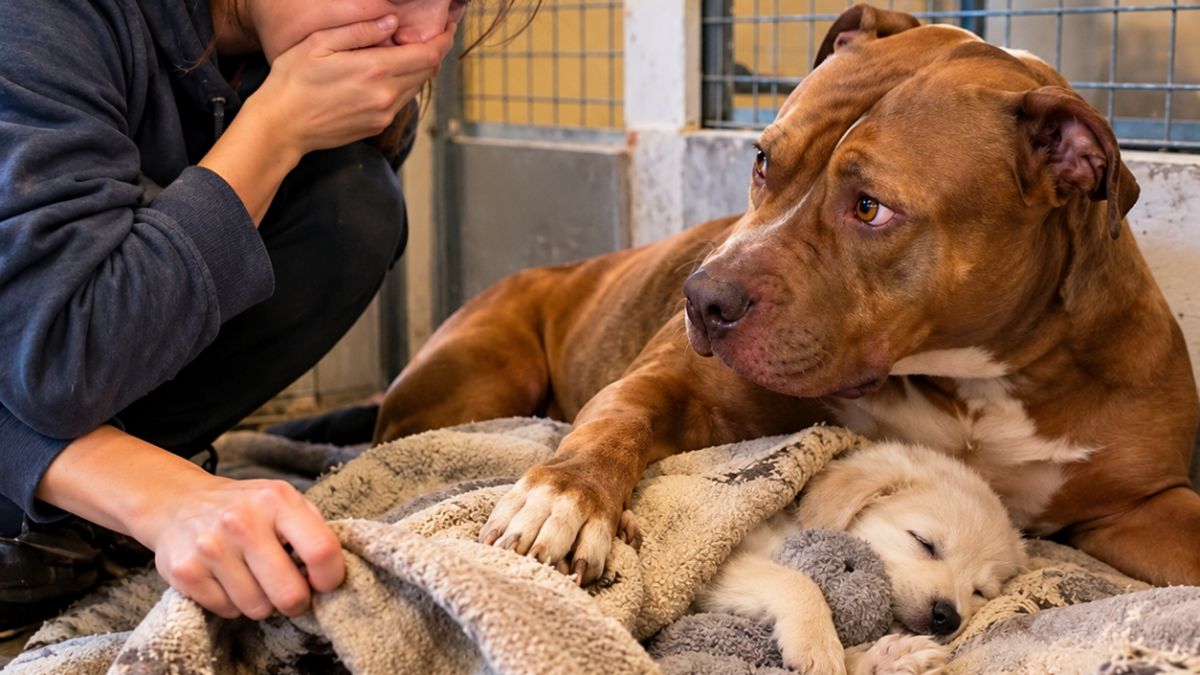
Her tiny cream-colored body was tucked beneath Bruno’s front legs as though she’d always belonged there.
One paw rested over his wrist.
Her nose was buried against the old beige fabric.
I looked at Bruno.
Then at the puppy.
Then back at him.
“She’s okay.”
His eyes stayed on my hand.
“I know.”
I slowly withdrew my fingers.
The moment I stopped touching the blanket, Bruno stopped growling.
Just like that.
Marc whispered:
“That’s…”
He didn’t finish.
I did.
“Not resource guarding.”
Bruno lowered his head.
Luna remained asleep.
Marc crouched carefully outside the kennel.
“He let her in?”
“Looks like she got through the divider.”
“But he covered her.”
I nodded.
The camera footage showed it clearly.
When Luna squeezed through, Bruno stood.
Sniffed her.
Then moved his blanket.
Not randomly.
Over her.
The same blanket he’d carried from one side of his kennel to the other whenever anxious.
The object we’d labeled as a resource.
The thing he supposedly guarded selfishly.
He had used it to warm a blind puppy.
I felt sick.
Not because we’d been completely careless.
Behavior labels are often safety tools.
Growling matters.
Teeth matter.
Context matters too.
And we’d written the first half without understanding the second.
I called Dr. Perrin, our shelter veterinarian.
She arrived twenty minutes later.
“Don’t separate them yet.”
That surprised Marc.
“Isn’t that unsafe?”
“For whom?”
“The puppy.”
Dr. Perrin looked through the bars.
Bruno was lying still.
Luna’s back rose and fell against his chest.
“He’s shown no aggression toward her.”
Marc pointed.
“He growls at us.”
“When we approach her.”
Silence.
Exactly.
Dr. Perrin sat on the floor.
Bruno watched.
She didn’t reach in.
Didn’t stare.
Didn’t challenge.
“Bruno.”
One ear moved.
“You’re making us look stupid.”
His tail tapped once.
I laughed.
The sound startled Luna.
She lifted her head.
Turned toward my voice.
Then bumped directly into Bruno’s jaw.
Bruno raised his head.
Luna sniffed.
Found his cheek.
Licked it once.
Something about that tiny gesture broke the tension in the room.
Marc smiled.
“Okay.”
“What?”
“I may have misjudged him.”
“May have?”
He ignored me.
We repaired the divider that afternoon.
Not because we wanted to separate them emotionally.
Because a ten-week-old blind puppy squeezing between kennels unsupervised was dangerous.
But after that, something changed in Bruno.
Luna moved into a small pen inside our quiet-room area.
Bruno could see and smell her from his kennel during the day.
At night, when she cried, he stood by the divider.
So we tried something experimental.
Supervised time together.
The first meeting happened in room three.
Neutral space.
Two handlers.
Bruno on a loose leash.
Luna free.
I sat on the floor.
Bruno entered.
Luna heard his nails on the tile.
Her tail began moving immediately.
She walked toward the sound.
Too far left.
Corrected.
Bumped gently into his chest.
Bruno froze.
I held my breath.
Luna sniffed upward.
Bruno lowered his head.
Touched her back with his nose.
Then sat.
Luna walked between his front paws.
Turned twice.
Lay down.
Bruno looked at me.
I swear his expression said:
Are we done making this complicated?
Over the next week, we learned the truth about his so-called possessiveness.
Bruno didn’t guard food.
He didn’t guard toys.
He didn’t guard sleeping spaces.
He guarded vulnerability.
If Luna stumbled and somebody moved toward her too quickly, he tensed.
If another dog barked sharply near her, Bruno positioned himself between them.
If Luna cried during handling, his entire body became alert.
The same pattern appeared with the elderly spaniel.
The recovering kitten.
Even one frightened pigeon brought into the treatment room after hitting a window.
Bruno saw distress.
Then became a wall.
That did not make him harmless.
It did not mean we ignored growling.
Protection can become dangerous if the dog decides every human intervention is a threat.
We had to teach him that helping did not always mean hurting.
But now we finally understood the problem we were actually solving.
Trust.
Not possession.
I updated his file.
Deleting behavior history entirely would have been dishonest.
So I rewrote it.
Bruno vocalizes when distressed animals are handled. Behavior appears protective/context-specific rather than generalized resource guarding. Requires structured introductions and experienced handling. Shows strong affiliative behavior toward vulnerable animals.
Marc read it.
“That’s a lot longer than ‘possessive.’”
“Reality usually is.”
The word spread through the shelter.
The dangerous dog was apparently babysitting a blind puppy.
Visitors started stopping longer.
Some thought it was adorable.
Some still saw the scar.
The jaw.
The warning labels.
Bruno didn’t become instantly adoptable because of one emotional discovery.
That’s another thing people get wrong about rescue stories.
Understanding a dog does not automatically make him easy.
Bruno still disliked hands reaching over his head.
Still froze around metal chain sounds.
Still backed away if somebody approached too directly.
Men wearing heavy work jackets bothered him more than women.
He hated raised voices.
And if Luna became frightened, his instincts overrode training.
We needed to know why.
Three weeks after Luna arrived, Bruno’s microchip finally gave us something.
It had been damaged or difficult to detect during intake.
A second scanner picked it up.
Registered name:
Bruno.
So at least we’d gotten that right.
Owner:
Jean-Marc Duret.
Address:
an old warehouse property outside Décines.
The phone number had been disconnected.
We contacted municipal records.
The property had been rented for years to a private security subcontractor.
The company had closed eleven months earlier.
Something in my stomach tightened.
Security dog.
Broad chest.
Scar.
Torn ear.
Rusty collar.
Fear of work jackets.
Metal sounds.
I asked animal welfare officers to check old records.
Two days later, they called.
Bruno had been registered as a guard dog.
Not a family pet.
Not formally.
His company record described him as:
Perimeter deterrence animal.
I hated the phrase.
A living warning sign.
The records were incomplete.
The company had gone bankrupt.
Several dogs had been transferred.
Two disappeared from paperwork.
Bruno was one of them.
A former employee eventually agreed to speak.
His name was Patrick.
He came to the shelter after closing.
The moment he saw Bruno through the glass, he stopped.
“Oh.”
Bruno saw him too.
Every muscle tightened.
No growl.
Worse.
Stillness.
Patrick raised both hands.
“I won’t go closer.”
I stood beside him.
“You know him?”
“Yes.”
“How well?”
“Enough.”
Patrick looked ashamed.
“He wasn’t supposed to be like that.”
“Like what?”
He pointed.
“Afraid.”
I waited.
Patrick explained.
Bruno had been purchased young by the security company.
At first, he worked with one handler.
An older man named Gérard.
Gentle.
Experienced.
Gérard trained by routine.
Voice.
Reward.
Clear boundaries.
Bruno did well.
Then Gérard had a stroke.
A new supervisor took over.
Michel Renaud.
Different methods.
Chains.
Isolation.
“Pressure work,” Patrick called it.
“What does that mean?”
He looked down.
“Making the dog feel he has no option except compliance.”
My jaw tightened.
“Specifics.”
“Short tether.”
“Punishment?”
“Yes.”
“Physical?”
Patrick hesitated.
That was enough.
But I waited.
“Yes.”
Behind the glass, Bruno began pacing.
Luna, resting in her nearby pen, heard him.
She stood.
Walked toward the sound.
Touched her nose to the barrier.
Bruno stopped pacing.
Pressed his muzzle to the opposite side.
Patrick stared.
“He always did that.”
“What?”
“Protected the small ones.”
I turned.
“What small ones?”
Patrick sat.
The company kept other dogs.
One was a female Belgian Malinois named Tess.
She had puppies unexpectedly.
The company never intended to breed.
Nobody wanted the litter on site.
Management planned to remove them quickly.
“Remove?”
Patrick looked at me.
“Rehome.”
The way he said it made me distrust the word.
Bruno became obsessed with the puppies.
Not aggressive.
Watchful.
He slept outside their enclosure.
If a handler grabbed one too roughly, Bruno growled.
That created conflict with Renaud.
“He called Bruno unstable.”
Of course.
“What happened to the puppies?”
Most were placed.
One sick pup died.
Bruno had stayed beside the body until someone removed it.
Patrick swallowed.
“After that he changed.”
“How?”
“More protective.”
There it was.
Not mystery.
History.
Bruno had learned that smaller, weaker animals disappeared when humans approached.
His growl wasn’t dominance.
It was fear wearing muscle.
I looked at Luna.
Blind.
Small.
Vulnerable.
To Bruno, she probably made perfect sense.
A creature who needed someone larger to stand between her and danger.
Patrick told us something else.
When the company closed, the dogs were supposed to go to contracted kennels.
Bruno was listed for transfer.
But a transport document had been signed and never completed.
Patrick suspected Renaud simply abandoned him near the industrial zone.
Could he prove it?
Not yet.
Animal welfare officers investigated.
Old GPS logs from a company van placed it near where Bruno was later found.
A former dispatcher found messages.
No kennel wants the scarred mastiff.
Drop him with municipal services.
Then another:
Not our problem after Friday.
No direct confession.
But enough for scrutiny.
Renaud denied abandoning Bruno.
Claimed another employee handled transport.
That employee had emigrated.
Convenient.
Legal accountability moved slowly.
Bruno didn’t care.
His life was happening in real time.
Luna began sleeping beside him during supervised rest periods.
We gave them matching beds in the quiet room.
Luna ignored hers.
Bruno’s bed became both of theirs.
He would lie on one side.
She curled against his ribs.
Sometimes under his neck.
Sometimes between his front paws.
The old beige blanket always covered part of her.
We stopped trying to wash it every day.
Bruno tolerated laundering if we replaced it before bedtime.
But if the blanket vanished completely, he became restless.
We eventually found out why.
Patrick recognized it.
“That came from Tess’s puppy pen.”
I stared at the worn fabric.
“The Malinois?”
“Yes.”
Apparently it had been an old moving blanket cut into sections.
Bruno had slept beside one during the litter.
Somehow, years later, a piece remained with him.
Maybe he carried it after the company closed.
Maybe somebody threw it into the yard.
Maybe coincidence.
We couldn’t prove the entire path.
But Bruno treated the fabric like memory.
Not property.
Memory.
That changed how I touched it.
One afternoon, an adoption application came for Luna.
Wonderful family.
Retired couple.
Quiet home.
Secure garden.
Experience with blind dogs.
Everything we wanted.
Except Bruno.
They had no interest in a large adult dog with behavioral history.
That was reasonable.
Still, the meeting terrified me.
We had to know whether Luna could live separately.
So we tried.
Two hours.
Luna met the couple in another building.
Bruno remained in his kennel.
For the first thirty minutes, both were fine.
At forty-five, Luna began pacing.
At fifty, she stopped responding to treats.
At one hour, Bruno stood at the west side of his kennel and refused to lie down.
At ninety minutes, Luna started whining.
Bruno began making the same low, broken sound he’d used when she first arrived.
Not a growl.
Not a bark.
A call.
We ended the test.
Luna heard Bruno from the corridor.
Her entire body changed.
Tail.
Head.
Direction.
She ran toward the sound.
Hit the doorway.
Recovered.
Kept going.
Bruno met her through the gate.
Pressed his nose against her face.
Then turned away.
Calm again.
The retired couple watched.
The woman started crying.
“I can’t take her.”
I expected disappointment.
Instead she said:
“Not without him.”
Her husband looked at Bruno.
Then at Luna.
“We cannot manage him safely.”
I respected that.
The woman crouched near Luna.
“I’d be taking something away from her.”
They withdrew the application.
Before leaving, they donated toward Bruno’s veterinary care.
Good people.
Not every loving person is the right adopter.
That distinction matters.
We hired a behavior consultant.
Elena.
She spent four hours observing them.
Her conclusion:
“Bonded, but not in the simplistic ‘they must touch every second’ sense.”
“What then?”
“Mutual regulation.”
She explained.
Luna used Bruno as a physical and emotional landmark.
His breathing.
Smell.
Body position.
Bruno used Luna as confirmation that his environment was safe.
When Luna relaxed, he relaxed.
When she explored confidently, he watched rather than guarded.
They were helping each other’s nervous systems settle.
“Can they be separated eventually?”
“Maybe.”
“Should they?”
Elena looked at me.
“Why is separation the goal?”
That stopped me.
Because shelters are built around placement.
One dog.
One family.
One contract.
Bonded pairs are harder.
A large adult dog plus a blind puppy?
Much harder.
But difficulty is an operational issue.
Not automatically a welfare justification.
So we changed the goal.
Find a home for both.
Applications dropped to almost zero.
Then came the incident everyone later called the turning point.
A fire alarm.
Not a real fire.
Electrical fault in the laundry area.
But the alarm was deafening.
Kennel doors.
Barking.
Staff moving animals.
Chaos.
Luna panicked instantly.
Blind dogs can adapt beautifully to predictable spaces.
Sudden sound turns maps into noise.
She bolted from a handler during transfer.
Straight toward an open service corridor.
At the end of that corridor was an exterior loading door.
A delivery van was backing in.
I saw Luna running.
I shouted.
She couldn’t see the van.
The handler lunged.
Missed.
Then Bruno appeared.
He had slipped his lead during evacuation.
My heart stopped.
A seventy-pound muscular dog with behavioral warnings loose in chaos.
Everyone froze.
Bruno did not run toward people.
He ran toward Luna.
Cut across the corridor.
Placed his body sideways in front of her.
Luna hit his shoulder.
Stopped.
The van’s reverse alarm screamed.
Bruno pushed her with his chest toward the wall.
I reached them.
“Bruno.”
His head snapped toward me.
Not aggressive.
Focused.
I clipped his lead.
Luna pressed underneath him.
The van stopped.
Nothing happened.
Nothing—
because Bruno made sure it didn’t.
Afterward, one of the volunteers sat on the floor shaking.
Marc looked at me.
“The difficult dog.”
I said nothing.
He added:
“He just saved her.”
Bruno didn’t know.
Luna didn’t know.
They wanted the alarm to stop.
That evening, we rewrote the emergency handling plan.
And Bruno’s file again.
The security camera footage circulated among staff.
Then, with permission, the shelter posted a short version online.
Not sensational.
No “dangerous dog becomes hero.”
We refused that framing.
Bruno had never become something else.
We had finally seen what he already was.
The post explained his protective behavior.
His history.
Luna’s blindness.
Their bond.
Applications arrived.
Many were emotional.
“I cried.”
“I want to save them.”
“I have a big heart.”
None of those sentences answer practical questions.
Do you have space?
Experience?
Funds?
Can you manage a large dog with trauma history?
Can you manage a blind adolescent dog?
What happens if Bruno guards Luna from a veterinarian?
Can you separate safely for medical procedures?
Are there children?
Other pets?
Fencing?
Emergency support?
Love starts the conversation.
Logistics decide whether love survives Tuesday morning.
Most applications failed.
Then came Sophie and Julien Martin.
Not the same Julien as any earlier story; new names are fine.
Sophie was a veterinary physiotherapist.
Julien repaired agricultural machinery.
They lived outside Bourgoin-Jallieu on a fenced property with one level downstairs.
No children at home.
One older calm cat.
Experience with large dogs.
Experience with disability.
And, importantly, they did not arrive saying:
“We have to have them.”
They arrived saying:
“We want to see whether they want us.”
That caught my attention.
The first meeting was boring.
Perfectly boring.
Sophie sat sideways.
Ignored Bruno.
Julien rolled a treat across the floor rather than offering from his hand.
Luna explored.
Bumped Sophie’s shoe.
Sophie said:
“Hello.”
Luna’s tail moved.
Bruno watched.
No growl.
Julien did not approach him.
After fifteen minutes, Bruno walked over.
Sniffed his work boot.
Then the hem of his pants.
Julien remained still.
Bruno stepped away.
Good.
Second visit, they brought a blanket from home.
Third, they walked Bruno.
Luna followed using a light harness and voice cues.
Fourth, Sophie handled Luna’s paws while Bruno watched.
Bruno stiffened.
Sophie noticed before the growl.
She stopped.
Turned sideways.
Gave Bruno distance.
Waited.
Then resumed more slowly after I rewarded calm.
That told me everything.
She didn’t need Bruno to “submit.”
She needed information.
Julien’s biggest concern was honest.
“What happens when Luna grows up and becomes more independent?”
Elena answered:
“Then we let the relationship change.”
“What if she stops needing Bruno?”
“That would be success, not betrayal.”
He nodded.
“And Bruno?”
“He may need her less too once the home becomes predictable.”
Exactly.
The home assessment passed.
Quiet house.
Wide hallways.
Non-slip floors.
Fenced garden.
Baby gates.
Separate feeding zones.
Two crates left open as optional retreats.
No chain tethering.
Ever.
When Julien showed me the outdoor setup, I noticed something.
No metal chains anywhere.
Leashes.
Long lines.
Harnesses.
Fencing.
But no chains.
He saw me looking.
“I read his history.”
Good.
The adoption was scheduled.
Then Michel Renaud appeared.
Bruno’s former supervisor.
Not to apologize.
To claim ownership.
He had seen the shelter post.
He arrived with old company papers showing Bruno listed as business property.
Our director met him in the office.
I was there.
Renaud wore a dark work jacket.
Bruno saw him through the glass.
Instant reaction.
Body low.
Tail tucked.
Then Luna made a small sound.
Bruno moved in front of her.
Growl.
Renaud smiled.
“See? Same dog.”
I hated him immediately.
He pointed.
“He was always unstable.”
I said:
“He’s afraid of you.”
Renaud looked at me.
“You don’t know what you’re talking about.”
Maybe.
But Bruno knew exactly what he was looking at.
The legal issue became complicated.
The security company no longer existed.
Ownership of assets had gone through liquidation.
Bruno’s microchip remained under the company contact.
Renaud claimed he had purchased equipment and animal assets before closure.
He produced one incomplete document.
Our legal adviser said:
“No dog leaves while this is unresolved.”
Sophie and Julien agreed to wait.
Bruno didn’t understand waiting.
Neither did Luna.
For two weeks, adoption froze.
Renaud returned once.
Bruno growled from twenty feet away.
Renaud said:
“He needs firm handling.”
Elena replied:
“No. He needs you farther away.”
That ended the visit.
Animal welfare investigators reopened the abandonment question.
Former employees were interviewed.
Patrick gave a statement.
So did two others.
One produced a photograph of Bruno tethered on a short chain in a concrete yard.
Another showed a younger dog lying near him.
A puppy.
Bruno standing between the camera and the pup.
Same posture.
Years earlier.
Same behavior.
Not random.
Renaud had documented his own misunderstanding.
Then came the message that mattered most.
A former dispatcher recovered archived company texts.
Renaud:
No kennel will take B.
Another employee:
Municipal shelter?
Renaud:
Too much paperwork. Drop him near Vaulx zone and remove company tag.
That was enough to destroy the ownership claim.
Also enough for abandonment proceedings.
Renaud said it was “dark humor.”
Investigators disagreed.
Combined with van GPS data and testimony, the case moved forward.
He was eventually charged with abandonment and animal cruelty-related offenses.
The punishment was not cinematic.
Fine.
Suspended sentence.
Animal-ownership restrictions.
Professional consequences involving animal handling.
More importantly:
His claim to Bruno disappeared.
The shelter became legal custodian.
Bruno could be adopted.
Sophie and Julien came the next morning.
Two leashes.
One broad harness.
One small yellow harness with a bell.
The bell was for Luna.
Julien had attached it to himself during home practice so she could locate him by sound.
I smiled.
“You’ve been training without the dog?”
He shrugged.
“Machinery requires preparation.”
Of course.
Before they left, I knelt beside Bruno.
He watched my hands.
Still did.
Some things remained.
I touched the old beige blanket.
He looked at Luna.
Then back at me.
“Can I?”
No growl.
I lifted it.
Folded it.
Placed it inside the travel bed.
Bruno sniffed.
Accepted.
Progress.
Sophie clipped Luna’s harness.
Julien clipped Bruno’s.
For one second, Bruno refused to cross the shelter threshold.
Luna stepped forward.
Her bell made a tiny sound.
Bruno followed.
Not because she dragged him.
Because they had learned to move together.
Home was not instantly easy.
The first week, Bruno guarded Luna’s bed from Julien.
Not aggressively.
But enough to stop him.
So they worked.
Julien tossed treats away from the bed.
Sophie moved Luna voluntarily.
They taught Bruno:
Humans approaching Luna did not equal danger.
Touch.
Treat.
Release.
Repeat.
No confrontation.
No punishment for growling.
The growl was information.
Suppressing it would’ve removed the warning, not the fear.
Three months later, Bruno allowed Sophie to examine Luna’s ears while he lay six feet away.
No growl.
Julien sent video.
I watched twice.
Then cried at my desk.
Marc walked in.
“You crying?”
“No.”
“You are.”
“Paper dust.”
“No paper.”
“Leave.”
Luna changed too.
She became bold.
Too bold.
Blind puppies become blind adolescents with opinions.
She learned the entire garden.
Ran full speed along memorized paths.
Used wind and sound.
Barked at the cat.
The cat ignored her.
She no longer slept beneath Bruno every night.
Sometimes she chose her own bed.
First time that happened, Sophie worried.
“Is the bond weakening?”
I smiled.
“No.”
“Then?”
“She feels safe enough to sleep three feet away.”
That’s what security does.
Distance stops meaning danger.
Bruno watched Luna become independent.
At first, he followed every movement.
Then less.
One afternoon, Julien sent a photograph.
Luna in the garden.
Thirty feet from Bruno.
Bruno asleep on the porch.
Caption:
He didn’t follow her.
That was enormous.
The protector had learned protection did not require surveillance.
A year passed.
Bruno gained healthy weight.
The scar remained.
Torn ear.
Honey eyes.
Still powerful.
But his body softened.
Not physically.
Emotionally.
He started greeting visitors.
Slowly.
Preferred women.
Eventually accepted Julien’s brother.
Still disliked dark work jackets.
So guests learned.
Take jacket off.
Approach sideways.
Let Bruno choose.
Simple accommodations.
Nothing heroic.
Luna learned verbal direction cues.
Left.
Right.
Step.
Stop.
Careful.
She became astonishingly competent.
Sophie took her to a canine enrichment instructor specializing in blind dogs.
Luna loved scent games.
Bruno joined.
Terrible at them.
He cheated by following Luna.
Fair.
Then something happened nobody expected.
Bruno began helping at the physiotherapy clinic.
Not officially as a therapy dog.
Just occasionally accompanying Sophie after hours.
One elderly client had a recovering spaniel who panicked during treatment.
Bruno lay nearby.
Spaniel relaxed.
Another frightened rescue dog stopped shaking when Bruno entered.
Sophie called me.
“He’s doing it again.”
“What?”
“Protecting without protecting.”
I understood.
His presence had become regulation instead of defense.
That was healing.
He no longer needed to growl to make safety.
He could simply be calm.
The old behavior didn’t disappear entirely.
During a thunderstorm, Luna panicked.
Sophie approached too quickly.
Bruno growled.
She stopped.
Waited.
Then sat nearby.
Five minutes later, Bruno relaxed.
Progress isn’t perfection.
It is recovery speed.
It is having a different second response even when the first response comes from old fear.
The second anniversary of adoption came with bad news.
Bruno developed a mass near his shoulder.
Biopsy.
Cancer.
Low-grade but invasive.
Surgery possible.
Risk acceptable.
We all hated how familiar fear felt.
Sophie called me.
“What would you do?”
I refused the trap.
“I’m not his owner.”
“You know him.”
“So do you.”
“What if surgery changes him?”
“Everything changes us eventually.”
Silence.
They chose surgery.
Bruno recovered.
Luna slept near his crate.
When the incision hurt and he became irritable, she gave him space.
Interesting.
Their bond had matured.
She no longer crawled into him automatically.
She read him.
He read her.
Two independent dogs choosing proximity.
That’s better than dependency.
The cancer stayed away.
For a while.
Bruno turned nine.
Then ten.
Gray appeared around his muzzle.
The dog everyone thought too dangerous to place had become old enough for arthritis.
I found that strangely beautiful.
Old age is a privilege many neglected animals never receive.
His hips stiffened.
Luna adapted before humans did.
When Bruno slowed on walks, she slowed too.
Not always.
Sometimes she’d sprint ahead on the secure trail.
Then circle back.
Touch his shoulder.
Continue.
Bruno’s role reversed gradually.
The protector became the one who needed patience.
Luna gave it.
One winter, Bruno’s hearing declined.
His sight remained good.
Luna’s never existed.
So between them they had one full set of senses.
Julien joked:
“Combined dog.”
Sophie said:
“Don’t let them hear that.”
Technically only one could.
We laughed.
Their story became locally known.
The shelter used it carefully.
Not:
Aggressive dog becomes hero.
Instead:
Behavior has context. Growling is communication. Ask what the dog is afraid will happen.
That message mattered.
We trained volunteers differently.
No more casual “possessive” label without context.
We documented triggers.
Body language.
Antecedents.
What happened before the growl?
What happened after?
Was the dog guarding an object?
A space?
Pain?
Another animal?
Distance?
Labels became descriptions.
Descriptions became better plans.
Bruno changed our shelter.
Not by being perfect.
By forcing us to become more precise.
Years later, Marc admitted:
“I used to think a growl meant a bad dog.”
“What do you think now?”
“A growl means stop guessing.”
Good answer.
Renaud’s case concluded quietly.
He did not go to prison.
Some people were furious.
Sophie wasn’t.
She said:
“Bruno doesn’t need him in prison. Bruno needs him nowhere near animals.”
The ownership restriction mattered more to her.
Patrick testified.
The old company records helped.
The court recognized abandonment and improper treatment.
Renaud lost legal access to animals in his professional work for a period and faced financial penalties.
Was it enough?
Depends what you think justice is for.
Nothing could erase Bruno’s chain scars.
Nothing could bring back the sick puppy Patrick remembered.
Nothing could refund years.
But Bruno was safe.
Future dogs were safer.
The shelter had documentation.
Renaud’s control ended.
That was useful justice.
Sophie once asked me:
“Do you think Bruno remembers him?”
“Yes.”
“Do you think he hates him?”
I looked at Bruno asleep with Luna nearby.
“No.”
“How can you know?”
“I don’t.”
Then I added:
“But hatred requires a lot of attention.”
Bruno had better things to do.
That became my version of revenge.
Not Renaud suffering every day.
Bruno forgetting to organize his life around fear.
The old blanket lasted astonishingly long.
Sophie washed it carefully.
Repaired holes.
Cut loose threads.
Eventually it became too fragile.
One day, Bruno lay beside it rather than on it.
Luna sniffed.
Walked away.
Sophie called.
“What do I do?”
“What do you want to do?”
“Keep it forever.”
“Human answer.”
“What would Bruno do?”
We watched.
Bruno stood.
Walked to a new blanket.
Lay down.
Luna joined him ten minutes later.
Sophie laughed.
“Apparently I am the one resource guarding now.”
Exactly.
She folded the beige blanket.
Placed it in a memory box.
Bruno did not protest.
That was another milestone.
The object had done its job.
Safety had moved from fabric into environment.
By twelve, Bruno was old.
Really old.
Large dogs age unfairly.
Arthritis.
Muscle loss.
Longer naps.
He still positioned himself between Luna and unfamiliar dogs sometimes.
But now the posture had no growl.
Just habit.
Luna, at six, had become confident enough to ignore him when unnecessary.
She’d walk around.
Bruno would look mildly offended.
Their relationship had become almost comedic.
He’d try to escort her.
She’d leave.
He’d sigh.
Parenting a teenager.
One afternoon, Sophie sent me a video.
Bruno was lying in the garden.
Luna ran past.
He lifted his head.
Considered getting up.
Did not.
Caption:
Retirement.
Perfect.
His final decline began after his thirteenth birthday.
Heart disease.
Nothing connected to his past.
Age.
Another privilege.
Medication helped.
For months.
Then kidney values changed.
Appetite fluctuated.
Good days became mixed.
Sophie and Julien tracked quality of life.
Food.
Comfort.
Sleep.
Interest.
Mobility.
Connection.
No single bad day decided anything.
Patterns.
Bruno still wanted breakfast.
Still followed Luna’s scent trail into the garden.
Still leaned into Julien’s leg.
Still greeted me when I visited.
Good.
Then one morning, he didn’t stand when Luna barked at the gate.
That mattered.
Not because guarding was required.
Because interest had changed.
Two days later, he refused chicken.
Bruno had never refused chicken.
Sophie called Dr. Perrin.
Home visit.
Medication adjustment.
Small improvement.
A week.
Then less.
We all knew.
Luna knew something too.
Not death as concept.
Change.
She stopped running far from him.
Slept beside him again.
Not under.
Beside.
Like the beginning, but not the same.
Sophie told me:
“She hasn’t done that in years.”
I visited the next day.
Bruno lay on a thick bed near the open garden door.
Luna’s head rested against his ribs.
I sat several feet away.
He lifted his head.
Honey eyes cloudy now.
Still him.
“Hey, big man.”
Tail moved once.
I remembered the first growl.
The scar.
My fingers under the blanket.
Tiny heartbeat.
I sat closer.
Bruno lowered his head.
No tension.
I touched the side of his neck.
He exhaled.
Trust can be measured in inches.
Years earlier, my hand under that blanket had made his entire body become a warning.
Now my hand rested against the same chest.
No growl.
Nothing to protect from me anymore.
Sophie sat beside us.
“I keep thinking about Luna.”
“After?”
“Yes.”
“She’ll grieve.”
“I know.”
“She’ll search.”
“I know.”
“She’ll also have you.”
Sophie nodded.
“And Julien.”
“Yes.”
“The house.”
“Yes.”
“Her routine.”
“Yes.”
A life with more than one pillar.
That’s what we’d hoped.
Bruno had been everything at first.
Then safety expanded.
That would matter now.
The final day came on a mild morning.
Bruno had not eaten since the previous afternoon.
Breathing harder.
Unable to settle.
Dr. Perrin came.
Examined him.
Then gave Sophie the look no one wants.
Sophie asked:
“Can we get another week?”
Dr. Perrin answered honestly.
“Probably.”
“Would it be a good week?”
Silence.
Julien looked at the floor.
Sophie covered her face.
Bruno watched.
Luna was curled near his front paws.
Finally Sophie said:
“Today.”
They chose home.
Garden door open.
Sunlight.
No clinic.
No kennel.
No metal bars.
Bruno lay on his favorite bed.
Luna stayed nearby.
We debated whether she should remain.
Dr. Perrin said:
“Let her choose.”
Always.
Choice.
I sat near Bruno’s head.
Julien on one side.
Sophie on the other.
Luna stood.
Sniffed everyone.
Then stepped over Bruno’s front leg and lay beside his chest.
Exactly where she had slept under the beige blanket years earlier.
Sophie broke.
She cried into both hands.
Bruno lifted his head weakly.
Luna touched his chin.
He rested again.
Dr. Perrin gave the sedative.
Bruno’s muscles softened.
Breathing slowed.
I whispered:
“You don’t have to guard anybody now.”
Sophie placed one hand on Luna.
“We’ve got her.”
Bruno’s ear moved.
Maybe coincidence.
Maybe sound.
Enough.
The final medication went in.
His breathing became slower.
Then stopped.
No growl.
No fear.
No warning.
Just stillness.
Luna stayed pressed against him.
For several minutes, nobody moved.
Then she stood.
Sniffed Bruno’s face.
His mouth.
Chest.
Paws.
She nudged him.
Nothing.
Again.
Nothing.
Luna turned toward Sophie’s crying.
Walked to her.
Pressed her blind face into Sophie’s lap.
That was the moment I understood something Bruno had taught all of us.
Protection isn’t always standing in front.
Sometimes protection is making sure the one you love has somewhere else to go when you no longer can.
Bruno had done that without knowing.
By trusting Sophie.
Julien.
Me.
The house.
He had helped Luna build a world large enough to survive him.
The first week after Bruno died, Luna searched.
Bed.
Garden.
Hallway.
She paused where his food bowl had been.
Whined twice at night.
Then slept beside Sophie.
The second week, she ran in the garden again.
The third, she stole Julien’s sock.
Sophie called me.
“She seems happy.”
There was guilt in her voice.
“Good.”
“Too soon?”
“For what?”
“To be okay.”
“Bruno didn’t protect her so she’d be broken forever.”
Silence.
Then Sophie cried.
But differently.
That was grief too.
Permission.
The shelter held no public memorial.
Sophie didn’t want Bruno turned into a sad poster.
Instead, she donated the old beige blanket.
Not physically.
The actual blanket stayed in her memory box.
She funded a training program under its name.
The Blanket Project.
Its purpose:
Teach shelter staff to interpret growling, guarding, fear, and context before reducing a dog to a label.
The first workshop began with one sentence on the screen:
A growl is information, not a verdict.
Marc taught part of it.
Yes.
The volunteer who once stepped backward and said:
“He’s guarding something.”
He told new volunteers:
“I was right about one thing.”
Everyone looked.
“Bruno was guarding something.”
Then he showed a photograph of Luna asleep under Bruno’s chest.
“He just wasn’t guarding what we thought.”
The program changed our intake process.
Behavior notes became more specific.
Growls when hand enters food area became:
When?
Whose hand?
What posture?
What happens if distance increases?
Protective became:
Toward whom?
Under what trigger?
Can dog disengage?
Can we reinforce alternate behavior?
Precision made dogs safer.
People safer too.
Years passed.
Luna became a senior dog.
Blind her entire life.
Confident her entire adult life.
She never needed another Bruno.
That was success.
She loved other dogs.
But differently.
No dependence.
No panic.
She used voice cues.
Scent paths.
Memory.
Sophie once told me:
“He taught her the world was safe long enough for her to learn it herself.”
Exactly.
When Luna was ten, she began working informally with foster puppies.
Not as a protector.
As a calm adult presence.
She couldn’t see them.
Didn’t matter.
They climbed on her.
She sighed.
Sometimes walked away.
Boundaries.
Good.
One frightened puppy hid beneath a blanket during a thunderstorm.
Luna walked over.
Lay beside it.
Sophie sent me the photo.
No caption.
Didn’t need one.
I stared at it for a long time.
Not because I believed Bruno’s spirit was somehow controlling events.
I don’t need magic to find meaning.
Behavior spreads.
Safety spreads.
What one dog teaches another becomes part of what that second dog carries forward.
Bruno had protected Luna.
Luna learned calm.
Later, another frightened animal received some of that calm.
That’s enough.
Michel Renaud eventually disappeared from our lives.
Which is exactly where he belonged.
No revenge scene.
No final confrontation.
No perfect apology.
He became a name in archived paperwork.
Bruno became:
Training protocols.
A home.
Luna’s confidence.
The Blanket Project.
Photographs.
Stories.
A safer way we handled frightened dogs.
One man once tried to turn Bruno into a deterrent.
A piece of security equipment.
Something that frightened people away.
Bruno’s real legacy became the opposite.
He taught people to approach more carefully.
Listen more closely.
Look twice.
That’s better than revenge.
That’s transformation.
I still have one photograph on my desk.
Not Bruno growling.
Not the scar.
Not the kennel.
It was taken six months after adoption.
Bruno is lying on the floor.
Luna is asleep on her own bed about four feet away.
Nothing is happening.
That’s why I love it.
Bruno isn’t guarding.
Luna isn’t hiding.
Nobody is touching anyone.
No crisis.
No need.
Safety is so complete that both dogs can rest separately.
That photograph would have meant nothing to me before I met them.
Now it means everything.
People often assume the goal of rescue is affection.
Dog finally cuddles.
Dog kisses rescuer.
Dog sleeps in bed.
Sometimes.
But the deeper goal is choice without fear.
Come close.
Move away.
Sleep alone.
Sleep together.
Growl when necessary.
Relax when safe.
Bruno began with almost no trust.
He believed approaching hands might take something vulnerable away.
Luna began with no visual map of the world.
She believed darkness was endless because darkness was all she knew.
Together, they built something.
Then humans joined carefully.
Eventually, Bruno no longer needed to stand between Luna and us.
Eventually, Luna no longer needed to sleep beneath Bruno to feel safe.
That’s the real ending.
Not that Bruno stopped growling forever.
He didn’t.
Not that Luna stopped being blind.
She didn’t.
Not that bad things were erased.
They weren’t.
The ending is that neither condition controlled every future choice.
Bruno’s growl became communication.
Luna’s blindness became information.
Not identity.
That is how I remember them.
The dog everyone feared.
The puppy who couldn’t see.
One old blanket.
One tiny heartbeat beneath my fingers.
And the moment I finally understood:
Bruno had never been saying,
“This is mine.”
He was saying,
“Please don’t hurt what is smaller than me.”
For years, nobody had taught him there was another way to say it.
We did.
Slowly.
And in return, Bruno taught us something much harder.
Before you punish the warning, understand what the animal believes is about to happen.
Before you call a dog dangerous, ask what made him afraid.
Before you separate two animals because one appears dependent, find out what they give each other.
And before you decide the growl is the whole story—
look under the blanket.
You may discover a heartbeat there.
Everyone at the shelter thought Bruno was warning us to stay away.
Then one night, I watched the security footage and realized his growl had never meant what we thought it meant.
But it wasn’t until I lifted the corner of his battered old blanket and felt a tiny heartbeat beneath my hand that I understood what Bruno had been trying to protect.
My name is Camille, and by the time Bruno had been at our shelter for three weeks, almost everyone had already formed an opinion about him.
Dangerous.
Possessive.
Difficult.
Not suitable for an inexperienced family.
On paper, those conclusions made sense.
Bruno was six years old and built like a dog people noticed before they noticed anything else in the room.
Broad chest.
Massive skull.
Heavy shoulders.
A scar above his muzzle.
One ear torn along the edge.
Honey-colored eyes that almost never stopped tracking movement.
He had been found wandering alone near an industrial zone east of Lyon.
Thin.
Dusty.
Exhausted.
Around his neck was a collar so tight and rusted that the buckle had to be cut away.
Nobody knew how long he’d been outside.
Nobody reported him missing.
Nobody came to claim him.
On his first night, he refused treats.
Refused touch.
Refused every gentle attempt we made to convince him that the kennel was safe.
He simply lay near the door and watched people pass.
The following morning, one of our employees reached inside to remove an empty food bowl.
Bruno growled.
Not loudly.
But deep enough to make the man stop.
The first note went into his file.
Resource guarding.
Three days later, a volunteer tried to pull a strip of beige fabric from Bruno’s bed.
Bruno growled again.
Second note.
Possessive behavior around bedding.
Then a visitor moved too quickly toward his face.
Bruno backed away, showed his teeth, and made that same low sound.
After that, the descriptions multiplied.
Difficult dog.
Experienced handler only.
Use caution.
Visitors stopped in front of kennel fourteen.
Read the card.
Looked at Bruno’s jaw.
Then kept walking.
Bruno rarely watched them leave.
But I started noticing something that didn’t fit.
He never growled when I filled his bowl.
Never when I removed a tennis ball.
Never when I moved his bed to clean.
The sound appeared in very specific situations.
The first time, a recovering kitten had been placed temporarily near his kennel.
When someone reached between the bars too quickly, Bruno growled.
The second time, an elderly spaniel trembled during a thunderstorm and pressed herself against the divider.
A volunteer tried to move her.
Bruno growled.
Then Luna arrived.
She was ten weeks old.
Cream-colored.
Mud-stained.
Small enough to fit beneath one arm.
A couple had found her inside a cardboard box beside a country road about thirty kilometers away.
The first thing I noticed wasn’t her size.
It was her eyes.
They were open.
But they didn’t follow movement.
I passed my hand gently in front of her face.
Nothing.
Then I spoke.
“Hello, baby.”
Her head turned directly toward my voice.
Our veterinarian confirmed it that evening.
Luna was blind.
Probably from birth.
She adapted better than anyone expected.
She learned voices quickly.
Memorized the location of her food.
Used her nose to map walls.
Tapped unfamiliar objects with her muzzle before stepping forward.
During the day, she was brave.
At night, everything changed.
Once the shelter lights went out and most of us left, Luna cried.
Not barking.
Not screaming.
Just a soft, repetitive whine.
Sometimes for forty minutes.
Sometimes longer.
We tried warmer bedding.
A ticking clock.
A stuffed toy.
A radio.
Nothing worked.
Then one morning, I reviewed the overnight security footage because Luna had been strangely quiet.
At 12:47 a.m., she began crying.
At 12:51, Bruno stood.
He walked to the side of his kennel closest to hers.
Luna kept whining.
Bruno picked up his old beige blanket.
The one everyone believed he guarded.
Then, using his teeth, he dragged one corner through the gap beneath the divider.
Luna found it.
She crawled toward the fabric.
Bruno lay down on the other side.
Their bodies separated by metal.
The blanket between them.
Luna stopped crying.
I watched the footage twice.
Then a third time.
The next night, Bruno did it again.
And on the fourth morning, when I reached toward the blanket to pull it back into his kennel, Bruno stepped between me and the corner.
His chest vibrated.
Low growl.
“Easy, Bruno.”
Marc stood behind me.
“You see? That’s what I was talking about. He’s guarding something.”
I didn’t answer.
Because something beneath the blanket moved.
Very slightly.
I crouched.
Bruno’s growl deepened.
But he didn’t lunge.
Didn’t bare his teeth.
He simply refused to move.
I slid two fingers beneath the edge of the fabric.
And felt warmth.
Then—
a heartbeat.
Tiny.
Fast.
Alive.
I froze.
Slowly, I lifted one corner.
Luna was curled beneath Bruno’s old blanket, pressed against his front legs.
Somehow, during the night, she had squeezed through a loose section at the bottom of the divider.
Bruno wasn’t guarding the blanket.
He was guarding her.
— END OF FACEBOOK OPENING / CONTINUE BELOW —
For several seconds, nobody moved.
Marc stood behind me.
I could hear him breathing.
Bruno’s growl remained low in his chest.
Luna was asleep.
Completely asleep.
Her tiny cream-colored body was tucked beneath Bruno’s front legs as though she’d always belonged there.
One paw rested over his wrist.
Her nose was buried against the beige fabric.
I looked at Bruno.
Then Luna.
Then Bruno again.
“She’s okay.”
His eyes remained fixed on my hand.
“I know.”
I slowly withdrew my fingers.
The moment I stopped touching the blanket, Bruno stopped growling.
Just like that.
Marc whispered:
“That’s…”
He didn’t finish.
I did.
“Not resource guarding.”
Bruno lowered his head.
Luna slept on.
Marc crouched outside the kennel.
“He let her in?”
“She found a loose section under the divider.”
“But he covered her.”
I nodded.
The security footage confirmed it.
Luna had squeezed through sometime after midnight.
Bruno had stood.
Sniffed her.
Then used his nose and front paws to move the blanket over her body.
The same blanket we had repeatedly described as something he guarded selfishly.
He had used it to warm a blind puppy.
I felt embarrassed.
Not because we’d been completely irresponsible.
Behavior notes exist for a reason.
A growl matters.
Teeth matter.
Distance matters.
But context matters too.
And somewhere between safety protocol and assumption, we’d turned a warning into a personality.
Dr. Perrin arrived twenty minutes later.
She watched through the kennel bars.
Then looked at me.
“Don’t separate them yet.”
Marc frowned.
“Isn’t that risky?”
“For whom?”
“The puppy.”
Dr. Perrin pointed.
“Does Luna look frightened?”
No.
Quite the opposite.
Bruno looked more anxious than she did.
Dr. Perrin sat on the floor outside the kennel.
“Bruno.”
One ear moved.
“You’ve made fools of us.”
His tail tapped once.
I laughed.
That woke Luna.
She lifted her head.
Turned toward my voice.
Then bumped directly into Bruno’s jaw.
He moved his face aside before she could hit him harder.
Luna sniffed.
Found his cheek.
Licked it once.
Marc smiled.
“All right.”
“What?”
“I judged him too quickly.”
“That’s closer.”
We repaired the loose divider that afternoon.
Not because we wanted to destroy their connection.
A ten-week-old blind puppy wandering between kennels without supervision was dangerous.
Instead, we began scheduled introductions.
The first happened in the quiet room.
Bruno wore a loose leash.
Luna was free.
I sat on the floor.
Marc stayed near the door.
Dr. Perrin watched from behind the observation glass.
Bruno entered first.
He inspected the room.
Then Luna was brought in.
The moment she heard his nails against the tile, her tail began beating the floor.
She walked toward the sound.
Too far left.
Corrected.
Bumped gently into his chest.
Bruno froze.
So did everyone else.
Luna sniffed upward.
Bruno lowered his muzzle.
Touched the top of her head.
Then sat.
Luna walked between his front paws.
Turned twice.
Lay down.
Bruno looked at me.
I remember thinking his expression almost seemed offended.
As though he wanted to ask why we had turned something so obvious into an investigation.
Over the next week, the pattern became undeniable.
Bruno didn’t guard objects.
He guarded vulnerability.
If Luna stumbled and somebody moved too quickly toward her, his body tensed.
If another dog barked aggressively near her, Bruno stepped between them.
If she cried during an examination, his eyes locked onto the person touching her.
We saw it again with an elderly spaniel.
Again with a recovering kitten.
Once even with an injured pigeon in the treatment room.
Bruno saw distress.
Then became a wall.
That did not make him harmless.
A powerful dog deciding who can and cannot approach another animal is still a safety problem.
Understanding the behavior didn’t erase the risk.
It gave us the correct problem.
Bruno did not need to learn that possession was unnecessary.
He needed to learn that humans could help without hurting.
So we started from there.
No punishment for growling.
No yelling.
No jerking the leash.
No forcing him to surrender space.
We taught distance.
Choice.
Predictability.
When I needed to handle Luna, Bruno received a mat several feet away.
Treat.
Touch Luna.
Treat Bruno.
Pause.
Repeat.
At first, his body stayed rigid.
Every muscle ready.
Then slowly:
Ears softer.
Mouth open.
Weight shifted onto one hip.
Eventually, he could watch me check Luna’s paws without standing.
The first time that happened, I almost celebrated.
Instead I quietly gave him a piece of chicken.
Too much emotion can be pressure too.
We updated his behavioral record.
I refused to delete the old notes.
History matters.
Instead I added:
Growling appears context-specific and primarily associated with perceived threat toward vulnerable animals. No generalized food or toy guarding observed. Behavior likely protective/fear-based. Needs controlled handling, distance, and positive association with care procedures.
Marc read it.
“That’s not exactly as catchy as ‘possessive.’”
“Exactly.”
Real behavior rarely fits neatly into one word.
As Bruno began trusting us, details emerged.
He disliked hands over his head.
Men wearing heavy industrial jackets made him freeze.
The sound of chain dragging on concrete caused immediate tension.
He refused to enter narrow metal runs unless Luna or I went first.
He didn’t like raised male voices.
And if somebody grabbed another dog roughly—even for harmless reasons—Bruno reacted.
Not always by growling.
Sometimes he simply stopped breathing normally.
That frightened me more.
Fear isn’t always noise.
Sometimes it’s stillness.
Three weeks after Luna arrived, a second microchip scan changed everything.
The first scanner had failed to read properly because Bruno’s chip had migrated low near his shoulder.
The number came back registered.
Name:
Bruno.
At least we’d gotten that right.
Owner:
Securipro Rhône Services.
Private industrial security subcontractor.
Business address near Décines.
The company had closed almost a year earlier.
My stomach tightened.
I looked at Bruno through the treatment-room glass.
Large dog.
Old scar.
Torn ear.
Rusty collar.
Fear of industrial clothing.
Chain noise.
Suddenly pieces aligned in ways I didn’t like.
We requested municipal records.
Old registration documents described Bruno as:
Perimeter deterrence canine.
Not companion.
Not working partner.
Deterrence canine.
A living threat display.
The company had employed several dogs.
Some transferred legally to other security contractors when the business collapsed.
Two did not appear on final transfer lists.
Bruno was one.
Finding people willing to speak took longer.
The first former employee hung up.
The second claimed not to remember.
The third was Patrick.
He agreed to meet us after closing.
The moment he saw Bruno through the glass, he stopped.
His face changed.
“Oh.”
Bruno saw him too.
His body went rigid.
No barking.
No growling.
He backed one step.
Patrick raised both hands.
“I won’t get closer.”
I watched Bruno.
“Do you know him?”
“Yes.”
“How well?”
“Enough.”
Patrick sat.
At first he spoke carefully.
Bruno had arrived at the company young.
Maybe eighteen months old.
He originally worked with an older handler named Gérard.
“Was Gérard rough?”
“No.”
The answer came instantly.
“He was old-school, but not cruel. Routine, food rewards, voice. Bruno trusted him.”
“What happened?”
“Stroke.”
Gérard left suddenly.
A supervisor named Michel Renaud took over several dogs.
Different methods.
Patrick used phrases like:
“pressure training.”
“compliance.”
“correction.”
I made him define every one.
Short tethering.
Isolation.
Leash jerks.
Physical intimidation.
Withholding food during certain training periods.
Metal choke equipment.
I stopped writing for a second.
“Was Bruno beaten?”
Patrick stared at the floor.
“Yes.”
Behind the glass, Bruno moved closer to Luna’s pen.
She heard him.
Walked toward the barrier.
Touched her nose to his.
Bruno’s shoulders relaxed slightly.
Patrick watched.
“He still does that.”
“What?”
“Looks after smaller ones.”
I turned toward him.
Patrick told us about Tess.
A Belgian Malinois kept by the company.
She became pregnant unexpectedly.
The litter wasn’t planned.
Management considered the puppies an inconvenience.
Bruno became fascinated with them.
He slept outside the enclosure.
Watched them.
If one cried, he stood.
If a worker handled one too roughly, Bruno growled.
Renaud hated it.
“He said Bruno was challenging handlers.”
“Was he?”
“No.”
Patrick shook his head.
“He was afraid for the pups.”
One puppy became sick.
The company delayed veterinary treatment.
By the time someone finally drove it to a clinic, it died.
Patrick’s voice dropped.
“They brought the body back because they had paperwork to finish.”
I swallowed.
“What did Bruno do?”
“He lay beside the box.”
“For how long?”
“Hours.”
Then something changed.
Bruno became increasingly reactive whenever vulnerable dogs were handled.
Not to food.
Not to toys.
To distress.
He had learned an association.
Hands come.
Small animal cries.
Small animal disappears.
That history didn’t excuse dangerous behavior.
It explained it.
And explanations give you somewhere to intervene.
Then Patrick noticed the beige blanket through the window.
His face changed again.
“Where did you get that?”
“It was with Bruno when he came in.”
He stared.
“That came from Tess’s puppy enclosure.”
I looked at the fabric.
Faded.
Frayed.
Nearly destroyed.
“You’re certain?”
“They cut up a stack of moving blankets. Beige with that red stitching.”
There was still one faint red seam.
Patrick touched the glass.
“Bruno used to sleep on one beside the puppies.”
I looked at Luna.
Curled against his chest.
Suddenly the blanket wasn’t just fabric.
It was history Bruno had carried physically.
Maybe from the security yard.
Maybe through abandonment.
We never learned exactly how.
But somehow it stayed with him.
That evening, when I went home, I couldn’t stop thinking about our first note.
Possessive around bedding.
How confident we’d been.
How wrong confidence can be when observation is shallow.
The investigation into the security company continued.
We learned that when Securipro Rhône Services collapsed financially, dogs were supposed to be transferred to licensed kennels.
Bruno had a transfer document.
But the destination kennel had no record of receiving him.
Patrick suspected Renaud.
A company van’s old GPS record placed the vehicle near the industrial zone where Bruno was found.
Then a former dispatcher found archived messages.
One read:
Kennel won’t take B. Says behavior risk too high.
Another:
Municipal intake means forms + fees.
Then Renaud’s reply:
Not our problem after Friday. Drop him near the east zone and remove the company tag.
My hands went cold reading it.
Renaud later claimed the message was a joke.
Nobody laughed.
While authorities handled that, Bruno and Luna had their own life.
Luna grew.
Fast.
Within weeks, she stopped moving like a fragile puppy and started moving like a small blind tornado.
She memorized the quiet room.
Then the corridor.
Then part of the enclosed exercise yard.
She learned voice cues.
“Step.”
“Left.”
“Right.”
“Slow.”
“Stop.”
Bruno learned them too by accident.
Sometimes I’d say “left” to Luna and Bruno would move left.
Marc called them a combined navigation system.
Luna began using Bruno as a landmark.
She would locate his breathing.
His nails.
His scent.
Then orient herself from there.
Bruno used Luna differently.
If she explored confidently, he relaxed.
If she slept, he slept.
If she became frightened, every protective instinct came back.
Our behavior consultant, Elena, watched them for several sessions.
Her conclusion surprised me.
“They’re not simply bonded.”
“What are they?”
“Mutually regulating.”
She explained that Luna used Bruno for physical orientation and emotional stability.
Bruno used Luna as evidence that his environment was safe.
“What happens if we separate them?”
“Depends how.”
“For adoption.”
Elena looked at me.
“Why are you assuming separation is the desired outcome?”
Because one dog is easier than two.
Because puppies get adopted quickly.
Because large adult dogs with behavioral histories don’t.
Because shelter systems reward simple placements.
I hated how practical my reasons sounded.
So we changed the goal.
They would be assessed as a pair.
The consequence was immediate.
Luna had already received five inquiries.
As a pair?
Almost none.
One family loved Luna but had two small children.
Not suitable for Bruno.
Another had experience with blind dogs but lived in an apartment with narrow stairs.
Not suitable for Bruno’s size.
A retired couple came close.
They were wonderful.
Quiet home.
Secure garden.
No children.
Experience with disabled animals.
But both had physical limitations.
They could handle Luna.
Not Bruno.
We arranged a separation trial anyway because we needed information.
Luna spent two hours with them in another building.
Bruno remained in the main shelter.
First thirty minutes:
Fine.
At forty-five, Luna began pacing.
At fifty, she ignored food.
At sixty, Bruno stood and went to the side of his kennel nearest the hallway.
At ninety, Luna began whining.
Then Bruno made a sound.
Not a growl.
Not a bark.
A low call.
The same broken sound he’d made at night when she was crying.
We ended the trial.
The moment Luna heard him from the hallway, she changed.
Tail up.
Head turning.
She ran toward the sound.
Hit the edge of a door.
Recovered.
Kept going.
Bruno met her at the gate.
Pressed his nose against her forehead.
Then walked away.
Calm.
The retired woman watched.
Tears filled her eyes.
“I can’t take her.”
I expected disappointment.
Instead she said:
“Not like this.”
Her husband nodded.
“We can’t safely manage him.”
She crouched beside Luna.
“And I don’t want her first experience in our house to be waiting for him.”
They withdrew.
Then donated enough money to cover one month of Bruno’s medication and training.
Not everyone who says no is rejecting an animal.
Sometimes no is an act of responsibility.
The incident that changed public perception happened six weeks later.
A fire alarm malfunctioned.
The laundry-room sensor failed.
Suddenly the entire shelter erupted.
Sirens.
Barking.
Staff moving animals.
Metal doors opening.
People shouting instructions.
Luna panicked.
Blind animals build mental maps from consistency.
The alarm destroyed every familiar sound at once.
A volunteer had her on a light lead.
Luna twisted.
The clip failed.
She ran.
Straight down the service corridor.
At the far end, an exterior loading door stood open because staff were evacuating crates.
A delivery van was reversing toward it.
I saw Luna.
Saw the van.
Saw the volunteer chasing her.
“Luna!”
Meaningless.
She knew her name.
She could not see the danger.
Then Bruno appeared.
His handler had dropped the leash during evacuation when another dog collided with him.
Bruno was loose.
For half a second, everybody froze for the wrong reason.
Large dog.
Behavior warning.
Chaos.
Then Bruno ran.
Not at the volunteers.
Not at the door.
At Luna.
He cut across the corridor.
Reached her two seconds before the loading area.
Turned his entire body sideways.
Luna crashed into his shoulder.
Bruno absorbed the impact.
The reversing alarm screamed outside.
He pushed Luna with his chest toward the wall.
She tucked underneath him.
I reached them.
“Bruno.”
His head snapped toward me.
I clipped the leash.
He let me.
No growl.
No resistance.
The van stopped.
Nothing happened.
Because Bruno had made sure nothing happened.
Marc sat down against the wall after the alarm ended.
His hands were shaking.
“The aggressive dog.”
I looked at him.
“He’s never been the dog we wrote down.”
That night, we reviewed security footage.
There it was.
Bruno intercepting Luna.
Positioning.
Blocking.
Moving her away from danger.
Not trained.
Not commanded.
Instinct shaped by history.
We posted a carefully edited version online.
Not:
Dangerous dog becomes hero.
I refused.
Bruno had not transformed in that corridor.
We had.
The shelter caption explained that protective behaviors can be misread when context is ignored.
The response was huge.
Too huge.
Messages flooded in.
Some wanted Bruno because he was a “hero.”
Those applications worried me.
Hero narratives are dangerous.
They replace one simplistic label with another.
A dog described as dangerous can be denied nuance.
So can a dog described as heroic.
Bruno still had triggers.
Still required skill.
Still weighed enough to injure somebody accidentally.
Still needed structured handling.
We wanted adopters who understood the whole dog.
Not the viral moment.
Then Sophie and Julien Martin applied.
Their form was almost boring.
That was good.
Sophie worked as a veterinary physiotherapist.
Julien repaired agricultural machinery.
Single-story rural home.
Secure fence.
No young children.
One elderly cat accustomed to dogs.
Previous experience with large breeds.
Savings for medical care.
They didn’t write:
We fell in love instantly.
They wrote:
We would like to meet them several times and determine whether our home is suitable for both.
I called Sophie.
She asked about Bruno’s bite history.
“None documented.”
“Near bites?”
“One air snap during intake when a visitor reached over his head.”
“What happened immediately before?”
I smiled.
That was the right question.
We arranged a meeting.
Sophie entered sideways.
No direct eye contact.
No reaching.
Julien sat on a low stool and rolled treats along the floor rather than offering them by hand.
Luna explored first.
She bumped Sophie’s shoe.
Sophie said softly:
“Hi, Luna.”
Tail.
Bruno watched.
No growl.
Fifteen minutes passed.
Bruno approached Julien.
Sniffed his boot.
Then the cuff of his pants.
Julien remained still.
Bruno moved away.
Perfect.
Second meeting:
Walk.
Third:
Handling exercises.
Fourth:
Luna navigating around Sophie while Bruno observed.
At one point, Sophie lifted Luna’s rear paw.
Bruno’s mouth closed.
Body stiff.
Sophie noticed instantly.
She stopped.
Put Luna down.
Turned slightly away from Bruno.
Waited.
Then tossed him a treat.
Several minutes later, she repeated the touch for one second.
Treat.
Release.
Bruno remained calmer.
She looked at me.
“He needs to know I stop when he asks.”
Exactly.
Not unlimited control.
Communication.
Julien asked:
“What happens when Luna grows up and doesn’t need him as much?”
Elena answered:
“Then we celebrate.”
“And Bruno?”
“He may learn that protecting her doesn’t require monitoring every breath.”
Home assessment passed.
Wide hallways.
Non-slip floors.
Two separate beds.
Optional crates.
Secure garden.
No outdoor tethering.
No chain collars.
Julien had removed a decorative hanging chain from his workshop entrance before we arrived.
“You didn’t have to.”
“I know.”
“Why did you?”
“Because he doesn’t.”
Simple.
I liked him.
Everything was ready.
Then Michel Renaud appeared.
Bruno’s former supervisor.
He’d seen the shelter post.
He arrived carrying old company paperwork.
Claimed Bruno had been part of business assets he personally purchased during liquidation.
If true, legal ownership became complicated.
I was in the office when he first walked past the kennel window.
Bruno saw him.
His entire body changed.
Tail tucked.
Head low.
Back legs stiff.
He retreated.
Then Luna made a small sound.
Bruno immediately moved in front of her.
Renaud smiled.
“See?”
I looked at him.
“What?”
“Same dog. Always unstable.”
Bruno growled.
Renaud stepped closer.
I stepped between them.
“Back up.”
“He won’t do anything.”
“That is not the standard.”
Renaud looked at me as though I were naive.
“He needs somebody who doesn’t let him think he’s in charge.”
“No.”
Elena had entered behind us.
“He needs you farther away.”
Renaud laughed.
“You people have turned him soft.”
Bruno’s growl deepened.
Luna pressed against his rear leg.
I said:
“Interview is over for today.”
The adoption froze.
Legally, we couldn’t transfer Bruno until ownership was settled.
Sophie and Julien could have adopted Luna separately.
They refused.
Sophie said:
“We said both.”
Luna stayed.
Bruno stayed.
Two more weeks.
For Bruno, waiting inside a shelter had already become familiar.
For me, it felt unbearable.
Then Patrick testified.
Two other former employees followed.
One produced photographs.
Bruno on a short tether.
Concrete yard.
A younger puppy behind him.
Bruno positioned between the puppy and the photographer.
Same posture.
Years before Luna.
Another worker recovered archived text messages.
Renaud:
No kennel wants the scarred mastiff.
Reply:
Municipal shelter?
Renaud:
Too much paperwork. Dump him near Vaulx zone. Remove company ID.
That destroyed his ownership claim.
More importantly, it created evidence in the abandonment investigation.
Renaud called it workplace humor.
Authorities didn’t.
The legal process continued for months, but Bruno no longer had to wait for the final judgment.
The company liquidation records showed Renaud had never legally purchased Bruno as an asset.
The shelter became lawful custodian.
Adoption approved.
Sophie and Julien came the next morning.
Two harnesses.
One large dark-blue harness for Bruno.
One smaller yellow harness for Luna.
A tiny bell was attached to Julien’s belt.
I pointed.
“For Luna?”
“She can locate me.”
He walked several steps.
Bell.
Luna turned toward him.
Good.
I knelt beside Bruno.
The beige blanket lay beneath him.
I touched one corner.
His eyes followed my hand.
No growl.
“Can I?”
He looked toward Luna.
She was sniffing Sophie’s shoes.
I lifted the blanket.
Folded it.
Placed it in the travel bed.
Bruno sniffed it once.
Then followed Luna toward the door.
At the threshold, he stopped.
Shelter behind.
Unknown world ahead.
Luna walked first.
Her head moved toward Julien’s bell.
Bruno watched her.
Then stepped through.
The first weeks were difficult.
Good adoption stories usually end too soon.
The photo at the front door.
The happy family.
The car ride.
Reality begins afterward.
On day three, Bruno growled when Julien tried to move Luna’s bed.
They adjusted.
No confrontation.
Julien tossed treats away from the bed.
Sophie called Luna toward her.
They moved the bed only once Bruno had disengaged.
On day six, Bruno refused to enter the workshop after hearing metal scrape.
Julien didn’t pull.
He sat in the doorway.
Read messages on his phone.
Waited.
Twenty minutes later, Bruno walked in.
On day eleven, Luna hit a garden chair at full speed.
Bruno ran over.
Sophie approached.
He stiffened.
She stopped.
“Bruno.”
He looked.
“I’m helping.”
She crouched at a distance.
Luna stood on her own.
Shook.
Tail moved.
Bruno relaxed.
One month.
Then two.
Then three.
Something extraordinary happened.
Luna started sleeping on her own bed.
Not every night.
But sometimes.
Four feet from Bruno.
The first time, Sophie sent me a photo at 11:43 p.m.
Is this bad?
I replied:
No. This is security.
Luna no longer needed Bruno’s body touching hers to believe she was safe.
Bruno no longer needed Luna under his chest to believe nobody was going to take her.
Their bond wasn’t weakening.
Fear was.
Luna became fearless in the garden.
She memorized the fence line.
Trees.
Steps.
Door.
Water bowl.
She ran.
Actually ran.
First time I visited, she shot past me so quickly I almost grabbed her.
Sophie laughed.
“Don’t.”
“She can’t see.”
“She knows exactly where she is.”
Luna reached the corner.
Turned.
Ran back.
Bruno lay on the porch.
He lifted his head.
Watched.
Considered standing.
Didn’t.
That may have been his greatest behavioral achievement.
He let her move beyond him.
Protection had become trust.
Bruno changed too.
His coat thickened.
Muscle returned.
The tense ridge along his shoulders softened.
He still disliked industrial jackets.
So Julien’s friends removed them before entering.
He still disliked chain sounds.
So no chains.
He still warned when overwhelmed.
Nobody punished him for warning.
Because a growl is useful.
It says:
I am uncomfortable.
Distance, please.
We taught humans to listen before Bruno felt he needed teeth.
He never bit anyone.
Not once.
The dog many visitors had assumed was one bad decision away from violence lived safely because people stopped trying to dominate his warnings.
A year after adoption, Sophie began bringing Bruno to her rehabilitation clinic after hours.
Not as a certified therapy dog.
Just because he enjoyed lying in the corner while she finished paperwork.
One evening, a frightened spaniel recovering from spinal surgery refused to enter the treatment space.
Bruno was there.
The spaniel saw him.
Stopped shaking.
Walked closer.
Lay down.
Sophie called me.
“He’s doing it again.”
“Doing what?”
“Making small frightened creatures think the room is safe.”
I smiled.
Bruno had spent years turning himself into a barrier.
Now he was learning that calm could protect too.
No growl required.
Sometimes just presence.
The criminal case against Renaud concluded later.
Animal abandonment.
Cruelty-related violations.
Professional restrictions involving animal handling.
Financial penalties.
Suspended sentence.
People online wanted something more dramatic.
Prison.
Public humiliation.
Violence.
I understood the anger.
But Sophie said something I never forgot.
“Bruno spent enough years organizing himself around that man’s behavior. Why should we spend the rest of his life doing the same?”
Exactly.
Renaud’s control ended.
That was the punishment that mattered to Bruno.
He would never handle him again.
Never chain him.
Never decide when he ate.
Never decide which frightened animal Bruno was allowed to comfort.
Bruno didn’t need revenge.
He needed irrelevance.
Renaud became paperwork.
Bruno became family.
The beige blanket lasted two more years.
Sophie repaired it repeatedly.
New stitching.
Trimmed edges.
Gentle washing.
Eventually it became more hole than fabric.
One day, she placed it beside a new fleece blanket.
Bruno sniffed the old one.
Then the new one.
Walked onto the new blanket.
Lay down.
Luna joined him later.
Sophie called me.
“He abandoned it.”
“You sound upset.”
“I am.”
“Why?”
“I thought it mattered.”
“It did.”
“Then why doesn’t he need it?”
I smiled.
“Because maybe the memory moved somewhere else.”
Safety had once lived in one piece of fabric.
Then in Luna.
Then in Sophie.
Julien.
The house.
Routine.
Bruno’s world had become large enough that one object no longer had to carry everything.
Sophie folded the beige blanket and put it in a box.
Not because Bruno needed it.
Because she did.
“Who’s resource guarding now?” I asked.
She laughed.
“Me.”
Years passed.
Bruno became old.
Gray around his muzzle.
Then almost white.
His hips stiffened.
The scar above his nose remained.
His torn ear softened at the edges.
Honey eyes became slightly cloudy.
Luna remained young and energetic.
Their roles shifted.
Now Bruno moved slower.
Luna began waiting for him at doorways.
When he fell behind on walks, she stopped.
Turned toward the sound of his breathing.
Then continued only when he reached her.
The blind dog became the guide.
Not visually.
Emotionally.
She taught him pace.
Patience.
Return.
Bruno turned twelve.
Then thirteen.
Large dogs don’t often receive many extra years.
We treated each one as borrowed without saying so around Sophie.
His heart weakened.
Arthritis progressed.
Kidney values changed.
Medication helped.
Then helped less.
The quality-of-life calendar appeared on the refrigerator.
Green:
Good.
Yellow:
Mixed.
Red:
Hard.
At first mostly green.
Then more yellow.
A few red.
Sophie called after every red day.
“Does one day mean something?”
“No.”
“What does?”
“Pattern.”
She knew.
She just needed to hear it.
Bruno still wanted food.
Still followed Luna into the garden.
Still leaned his entire body against Julien when asking for scratches.
Still growled at the vacuum cleaner.
Fine.
Then one morning he didn’t get up when Luna barked.
He lifted his head.
Nothing more.
The following day he refused chicken.
That changed everything.
Dr. Perrin made a home visit.
Adjusted medication.
Bruno improved for a week.
A beautiful week.
He ate.
Went outside.
Lay in the sun.
Even tried to follow Luna across the yard.
Then decline returned.
Harder.
On his last full day, I visited.
Bruno lay beside the open garden door.
Luna was against his ribs.
I hadn’t seen her sleep there in years.
I sat several feet away.
“Hey, big man.”
His eyes opened.
Tail moved once.
I approached.
Slowly.
Always.
Some habits become respect.
I placed my hand on his chest.
Years earlier, my fingers approaching something beneath his blanket had made him growl.
Now nothing.
His breathing moved beneath my palm.
Slow.
Heavy.
I remembered the first tiny heartbeat I’d felt.
Luna’s.
Now Bruno’s was the one under my hand.
Sophie sat beside me.
“I don’t know how to do this.”
Nobody does.
“You don’t have to know.”
“What happens to Luna?”
“She grieves.”
“What if she stops eating?”
“We help.”
“What if she searches for him?”
“She probably will.”
“What if she never gets over it?”
I looked at Luna.
Then Sophie.
“Bruno didn’t spend his life protecting her so that losing him would become the end of hers.”
Sophie cried.
Quietly.
The following morning, Bruno couldn’t stand without assistance.
Breathing was difficult.
He rejected food.
Dr. Perrin returned.
Sophie asked the question every loving owner asks even when they know the answer.
“Can we have another week?”
Dr. Perrin waited.
“Probably.”
Sophie swallowed.
“Would it be a good week?”
Silence.
Julien covered his face.
Sophie looked at Bruno.
Then Luna.
“Today.”
They chose the garden room.
Door open.
Sunlight.
No clinic smell.
No metal kennel.
No chain.
Bruno lay on his favorite bed.
Luna stayed nearby.
Dr. Perrin let her choose.
At first Luna paced.
Then she crossed the room.
Stepped over Bruno’s front paw.
Curled beside his chest.
Exactly where she’d slept beneath that beige blanket years before.
Sophie broke.
She pressed both hands to her mouth.
Bruno lifted his head weakly.
Luna touched her nose to his chin.
He rested again.
The sedative went in.
His muscles softened.
His breathing slowed.
I sat near his head.
Julien had one hand on his shoulder.
Sophie held Luna.
I whispered:
“You don’t have to guard anybody anymore.”
Sophie added:
“We’ve got her.”
Bruno’s ear moved.
Maybe the words.
Maybe the sound.
Maybe nothing.
I don’t care.
The final medication went in.
One breath.
Another.
Then stillness.
No growl.
No warning.
No need.
Luna remained beside him.
For several minutes, nobody moved.
Then she stood.
Sniffed Bruno’s face.
Mouth.
Chest.
Paws.
She nudged him once.
Waited.
Again.
Nothing.
Then Luna turned toward Sophie.
Walked to her.
Pressed her head into Sophie’s lap.
Sophie wrapped both arms around her.
I watched and realized Bruno’s greatest act of protection had happened long before that morning.
He had allowed Luna to build a world beyond him.
Sophie.
Julien.
The house.
The garden.
Her voice cues.
Her routines.
Her own confidence.
He hadn’t made himself the only thing she could trust.
He had helped her trust enough things that she could survive losing him.
That is love without possession.
The first week, Luna searched.
Bruno’s bed.
Hallway.
Garden.
She stood beside his food bowl.
Whined twice at night.
Sophie left his bed in place.
No rush.
No forced closure.
On the eighth day, Luna ran in the garden.
Sophie cried watching.
Then felt guilty.
She called me.
“She was happy.”
“Good.”
“It felt wrong.”
“Why?”
“Because Bruno is gone.”
“Luna doesn’t honor Bruno by staying broken.”
Silence.
Then:
“I know.”
Two weeks later, Luna stole Julien’s sock.
He sent me a picture.
She had fallen asleep with it.
Caption:
Crime has returned.
Good.
Life does that.
Returns in embarrassing ways.
The shelter didn’t create a public memorial for Bruno.
Sophie didn’t want his face turned into another tragic advertisement.
Instead, she funded a training initiative.
We called it:
The Blanket Project.
Its first principle appeared on every slide.
A growl is information, not a verdict.
Marc taught the first session.
The same Marc who had once stood behind the kennel and said:
“You see? He’s guarding something.”
He opened his talk with that sentence.
Then showed a photograph.
Luna sleeping beneath Bruno’s chest.
He said:
“I was right.”
Everyone laughed nervously.
“He was guarding something.”
Then his voice softened.
“I was wrong about what.”
The program changed how we recorded behavior.
We stopped writing:
Aggressive.
Without context.
We wrote:
What happened immediately before?
Distance?
Body posture?
Was pain involved?
What was the dog protecting?
Food?
Space?
Another animal?
Itself?
Could the dog disengage?
What reduced the behavior?
Labels became observations.
Observations became plans.
Plans saved dogs.
Not every dog with a growl became adoptable.
Not every aggressive behavior had a hidden noble reason.
That would be another dangerous fantasy.
Sometimes aggression is severe.
Sometimes management isn’t enough.
Sometimes safety requires difficult decisions.
Bruno didn’t teach us to romanticize warning behavior.
He taught us to investigate it.
Precision is compassion too.
Luna became a senior years later.
She remained blind.
Of course.
Nothing miraculous happened to her eyes.
She simply became incredibly good at being Luna.
Voice cues.
Scent games.
Memorized spaces.
Confident travel.
She liked other dogs.
She didn’t need another Bruno.
That was the success.
Once, Sophie fostered a terrified puppy.
Tiny black mixed breed.
The puppy hid beneath a blanket during thunderstorms.
One night, Sophie sent me a photograph.
Luna lying beside the blanket.
Not touching.
Not pushing.
Just there.
I stared.
No mystical explanation required.
Behavior travels.
Safety travels.
Bruno had taught Luna that fear could be shared without being increased.
Now another animal received that lesson.
Years after Bruno died, Michel Renaud’s name stopped coming up entirely.
That felt right.
He became an archived file.
Bruno became something else.
A change in shelter protocol.
A training program.
A blind dog’s confidence.
A home where people learned how to listen.
A photograph on my desk.
Not Bruno growling.
Not Bruno in the kennel.
Not Bruno saving Luna in the corridor.
A boring photograph.
My favorite.
Six months after adoption.
Bruno lying on the floor.
Luna asleep on a separate bed four feet away.
Nothing happening.
No crisis.
No contact.
No guarding.
No fear.
Both sleeping.
Separately.
Safely.
Before Bruno, I might not have understood what made that image special.
Now I do.
People think rescue culminates in affection.
The dog finally kisses someone.
Climbs into bed.
Wags.
Sometimes.
But the deeper goal is choice.
Come close.
Walk away.
Sleep beside someone.
Sleep alone.
Warn.
Relax.
Trust.
Bruno’s world had once taught him that if he did not control what happened around vulnerable animals, something terrible might occur.
So he tried to control distance with a growl.
We didn’t punish the sound out of him.
We changed what he believed would happen next.
Human hand approaches Luna.
Nothing bad.
Veterinarian touches paw.
Luna returns.
Blanket disappears for washing.
Blanket comes back.
Door closes.
Door opens.
Person leaves.
Person returns.
Again.
Again.
Again.
Eventually fear ran out of evidence.
That’s rehabilitation.
Not one dramatic breakthrough.
Thousands of boring safe repetitions.
Luna learned the world differently.
She had no visual proof.
Never would.
Her world came through smell.
Sound.
Texture.
Memory.
Bruno’s breathing had been one of her first landmarks.
Then Camille’s voice.
Sophie.
Julien’s little bell.
Doorways.
Grass.
The hum of the refrigerator.
The click of a food bin.
Her map expanded.
Eventually Bruno became one landmark among many.
That is why she survived him.
And maybe that’s Bruno’s real legacy.
He started as a dog everybody thought wanted to keep things for himself.
Food.
Blanket.
Space.
Control.
In reality, nearly everything important he did moved in the opposite direction.
He gave Luna warmth.
Gave her his body as a wall.
Gave her confidence.
Gave her time to learn the world.
And eventually, without knowing it, gave her enough safety that she no longer needed him every second.
The dog labeled possessive spent his best years teaching another animal independence.
I think about that every time someone wants a single word to explain an animal.
Aggressive.
Stubborn.
Dominant.
Broken.
Difficult.
Sometimes those words describe a moment.
They rarely describe a life.
Bruno had a scar.
A growl.
A powerful body.
A frightening history.
He also had extraordinary restraint.
Memory.
Fear.
Tenderness.
Protective instinct.
The ability to learn.
The willingness to trust again after humans had given him good reasons not to.
All of those were true at the same time.
Complexity isn’t an excuse.
It is the starting point.
The last time I saw Luna, she was eleven.
Gray around her muzzle.
Sophie brought her to the shelter for a Blanket Project anniversary.
We opened the quiet room.
The old divider was gone.
Renovations years earlier.
But Luna entered and stopped.
Her nose moved.
She walked slowly toward the place where Bruno’s kennel had once been.
Sophie looked at me.
“Does she remember?”
I don’t know.
Maybe scent memory.
Maybe room shape.
Maybe nothing.
Luna stood there.
Then lay down.
For less than a minute.
Afterward, she stood and followed Sophie’s voice toward the door.
No crying.
No searching.
Just a pause.
Then forward.
I didn’t need to decide what it meant.
Some moments become smaller when you force an explanation.
I touched the empty wall after they left.
And remembered Bruno’s first morning.
His eyes tracking hands.
That low vibration in his chest.
Our caution.
Our assumptions.
Then the blanket.
My fingers beneath the edge.
Warmth.
One tiny heartbeat.
That heartbeat changed Bruno’s file.
Then his future.
Then Luna’s.
Then ours.
Years later, new staff members who never met Bruno still learned his lesson.
They didn’t know the exact sound of his growl.
Didn’t know how his torn ear folded when he slept.
Didn’t know he hated carrots and loved chicken skin.
Didn’t know he once stole Marc’s sandwich after six months of refusing food from male volunteers.
Yes.
That happened.
Marc left the sandwich on a bench.
Bruno walked over.
Took the entire thing.
Marc shouted:
“Seriously?”
Bruno swallowed half before we could trade him for treats.
I laughed so hard I had to sit down.
That memory matters too.
Because I refuse to let Bruno become only a symbol.
Symbols are tidy.
Dogs aren’t.
He drooled.
Snored.
Stole food.
Rolled in mud.
Once refused to come indoors for twenty minutes because there was a frog near the step.
He was frightened of a frog.
A dog whose jaw scared grown men.
Afraid of a frog the size of a walnut.
Sophie had to move it.
Bruno then entered pretending nothing had happened.
Those are the pieces that make a life.
Not just trauma.
Not just rescue.
Ordinary ridiculous details.
That’s what Renaud failed to understand.
He had seen Bruno as equipment.
Deterrence.
Muscle.
Threat.
We initially made a softer version of the same mistake.
We saw risk.
Label.
Problem.
Then Luna showed us the dog.
The final legal punishment Renaud received mattered.
The restrictions mattered.
Documentation mattered.
But none of it satisfied me as much as one photograph Sophie sent years later.
Bruno asleep on his back.
Belly exposed.
Luna several feet away chasing something in the grass.
A person can control a dog with a chain.
But they cannot force that dog to feel safe enough to sleep like that.
Safety has to be built.
That was the revenge.
Not hurting the man who hurt him.
Making that man irrelevant to Bruno’s nervous system.
Every relaxed muscle was revenge.
Every night Bruno slept without listening for boots.
Every time somebody approached Luna and he chose not to growl.
Every time he let Julien touch his scar.
Every time he walked away from a chain sound instead of freezing.
Every time Luna ran beyond him and he allowed her.
The past said:
Be ready.
Home taught:
You can rest.
Eventually home became louder.
That’s justice I understand.
If Bruno could have spoken on the first day, I don’t think he would have told us his whole story.
Animals don’t owe us explanations.
He would probably have asked for distance.
A quiet place.
The blanket.
Time.
Maybe that’s why I think so often about the moment beneath that fabric.
I went looking for evidence of guarding.
Instead I found Luna.
Warm.
Blind.
Sleeping.
Her heart beating beneath my fingers.
Bruno had positioned his entire body between her and a world he did not yet trust.
And for once, his instinct was correct.
She did need protection.
Just not protection from us forever.
Our job was to prove that.
His job was eventually to believe us.
Luna’s job was simply to grow.
They all succeeded.
So when somebody asks me now what Bruno’s growl meant, I don’t say:
“He was protecting Luna.”
That’s true.
But incomplete.
I say:
“It meant he thought protection was still his job alone.”
Then I tell them the rest.
How he learned to share that responsibility.
How Luna learned to navigate without his body beneath hers.
How Sophie and Julien became safe enough that Bruno could sleep while Luna explored.
How the old blanket went into a box because nobody needed it anymore.
How a dog once described as possessive became the reason our shelter stopped mistaking labels for understanding.
And how, at the end of his life, Bruno died with Luna beside him and humans close enough to touch him without fear.
That last part still gets me.
On his first days with us, a hand moving toward something he loved produced a growl.
On his last day, three human hands rested on him.
Mine.
Sophie’s.
Julien’s.
Luna against his chest.
And Bruno simply breathed.
No warning.
No need.
The world had finally become safe enough that he could stop being the wall.
I don’t know whether there is a more satisfying ending for a dog like Bruno.
Not that he became harmless.
Not that he forgot.
Not that blindness disappeared.
Not that justice erased the past.
Something better.
He was understood.
Then trusted.
Then loved accurately.
That matters.
A lot of animals are loved for who people want them to be.
Bruno was eventually loved as he actually was.
Large.
Scarred.
Protective.
Sensitive.
Sometimes difficult.
Often gentle.
Afraid of certain sounds.
Ridiculously patient with Luna.
Terrible around frogs.
Obsessed with chicken.
Capable of warning.
Capable of choosing not to.
Capable of change.
All of it.
The whole dog.
And Luna?
She never saw his face.
Not once.
She never knew how frightening Bruno looked to visitors.
Never saw the scar.
The torn ear.
The broad skull.
The teeth that made people step back.
She knew him through warmth.
Breathing.
Scent.
The vibration of his body when he moved.
The softness of the blanket he shared.
Maybe Luna had the advantage.
She never had to get past how Bruno looked.
She met him exactly where he was.
And maybe that’s why she understood him before any of us did.
Years later, I still tell new volunteers one thing before they read a difficult dog’s file.
“Read the notes.”
Then I add:
“But meet the dog.”
Because paperwork preserves risk.
It does not contain the entire animal.
Sometimes the most important detail hasn’t been written yet.
Sometimes it happens at midnight.
Sometimes it appears on security footage.
Sometimes it is hidden under an old beige blanket.
And sometimes, if you’re patient enough to look beneath the thing everyone else is afraid to touch, you find not aggression—
but a tiny heart beating safely beside the dog everyone misunderstood.