PART 2: Eleven Minutes Before Closing, an Old Saint Bernard Pushed His Only Friend Toward a Stranger—Then Turned to Face the Wall
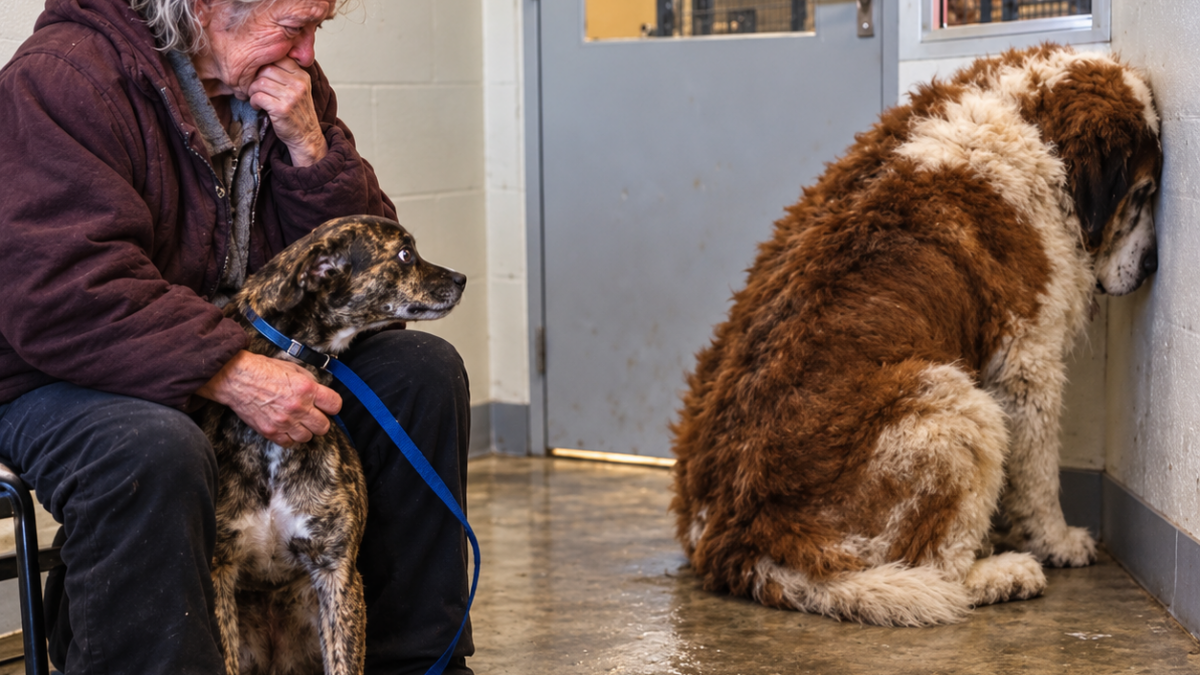
PART 2
Laurent held the door open for his mother.
Madeleine walked inside with her cane.
One blue leash hung over her left arm.
The second was red.
New.
The price tag was still attached.
I looked at them.
Then at Laurent.
He looked like a man who had lost an argument before breakfast.
“My mother would like to speak with you.”
Madeleine lifted her chin.
“I can speak for myself.”
“I know, Mom.”
“Then stop announcing me.”
Laurent closed his eyes.
I hid a smile.
Madeleine placed both leashes on the counter.
“I want to meet them again.”
Laurent added quickly:
“Meet them.”
Madeleine looked at him.
“Yes.”
“Not sign anything.”
“I heard you in the car.”
“Good.”
“I was sitting next to you.”
“Mom.”
I raised one hand.
“Let’s slow down.”
That was partly for them.
Mostly for me.
Adopting two bonded dogs was not something we pushed casually.
Especially when one was an enormous senior with mobility problems and uncertain vision.
Especially when the adopter was seventy-nine and used a cane.
Emotion mattered.
So did logistics.
Madeleine understood that.
More than Laurent seemed to think.
She opened her handbag and removed a folded sheet of paper.
“I made a list.”
Laurent sighed.
“She made three lists.”
Madeleine ignored him.
“Food cost.”
She pointed.
“Veterinary insurance does not make sense at his age, so I called my bank about setting aside an emergency fund.”
I blinked.
“Already?”
“I was awake at four.”
Laurent muttered:
“So was I.”
She continued.
“My house has no stairs except the front step. Laurent says he can build a ramp.”
“I said I could ask someone to build a ramp.”
“You own tools.”
“That does not make me a carpenter.”
Madeleine moved on.
“I measured my hallway. Basile will fit.”
Laurent looked at me.
“She actually measured the dog from the website photograph.”
Madeleine said:
“I estimated.”
“You measured the television screen.”
“It was to scale enough.”
I liked her immediately.
But liking someone isn’t the same as approving an adoption.
I sat with both of them in the office.
“Madeleine, I need to be difficult for a few minutes.”
“Good.”
Laurent looked surprised.
She said:
“I don’t trust people who make important things easy.”
So I explained.
Basile might become expensive.
His hips could worsen.
His vision might deteriorate completely.
A dog his size could not simply be picked up if he fell.
He might need medication for the rest of his life.
Possibly physical therapy.
Possibly surgery.
Nina was younger and easier physically, but she had her own issues.
She became anxious if separated from Basile for too long.
She had refused food during the first twenty-four hours after intake unless he was nearby.
Laurent interrupted.
“That is exactly why one dog makes more sense.”
Madeleine turned.
“For whom?”
“For you.”
“Or for your peace of mind?”
Laurent’s jaw tightened.
I recognized the look.
Adult child.
Aging parent.
Love disguised as control because control feels safer.
He wasn’t cruel.
He was scared.
“My mother fell eighteen months ago,” he told me.
“I know.”
“She couldn’t get off the bathroom floor for almost two hours.”
Madeleine looked away.
He continued.
“My father was still alive then. He called me. What happens if Basile knocks her over?”
Madeleine said quietly:
“What happens if I trip over a rug?”
“Mom.”
“What happens if I fall carrying laundry?”
“That isn’t the same.”
“No. It isn’t.”
She folded her hands over the cane.
“I am old, Laurent. You keep trying to negotiate with that fact.”
He flinched.
She softened.
“I know why.”
Silence.
Then she said:
“But being careful and being finished are not the same thing.”
Laurent looked at the floor.
I gave them a minute.
Finally he asked me:
“Can you guarantee the Saint Bernard won’t hurt her?”
“No.”
He looked up.
“Can you guarantee Nina won’t?”
“No.”
“Then what can you guarantee?”
“Nothing.”
That answer frustrated him.
It was also true.
Adoption is not a warranty.
I said:
“What I can do is arrange a home assessment. We can have a veterinary behaviorist evaluate the bond. We can get Basile’s eyes and hips properly examined before any adoption is finalized.”
Madeleine nodded.
Laurent asked:
“And if the evaluation says two dogs are unsafe?”
“Then we don’t do it.”
Madeleine’s mouth tightened.
But she nodded again.
“Fair.”
We brought Basile and Nina into the meeting room.
This time there was no leash at first.
Nina saw Madeleine and went straight to her.
Not running.
Just certain.
Basile stood more slowly.
He lifted his nose.
Madeleine said:
“Hello, big man.”
Basile’s head turned immediately.
That mattered.
He walked toward her voice.
Not perfectly straight.
His shoulder brushed a chair.
He corrected.
Reached Madeleine.
Then stopped.
She placed one hand on his face.
His eyes closed.
Laurent watched.
I watched Laurent.
Fear is strange.
Sometimes it breaks all at once.
Sometimes it develops a crack.
That was the first crack.
Nina sat against Madeleine’s left leg.
Basile stood on the right.
Madeleine between them.
Too small for either one physically.
Exactly centered emotionally.
Laurent said:
“This is ridiculous.”
Madeleine didn’t look at him.
“Probably.”
Basile lowered himself.
Nina curled against his chest.
Madeleine kept one hand on each dog.
Laurent sat.
For ten minutes, nobody tried to convince anyone.
That was better.
Then Basile did something we hadn’t seen before.
Nina stood to drink water.
She crossed the room.
Basile lifted his head.
His nose moved.
He stood.
Took one step.
Then stopped.
He didn’t know where she was.
Not approximately.
At all.
His eyes moved without finding her.
Nina noticed.
She returned.
Touched her nose to the side of his mouth.
Then walked toward the water bowl again.
Basile followed.
Exactly behind her.
Laurent leaned forward.
“What was that?”
I answered honestly.
“I don’t know.”
But something in my stomach tightened.
Nina reached the bowl.
Drank.
Then turned.
Touched Basile’s leg.
He turned with her.
They walked back.
Not side by side.
Nina half a step ahead.
Basile tracking her body.
Laurent looked at me.
“You said he had vision problems.”
“Yes.”
“How bad?”
“We haven’t done the specialist exam yet.”
Madeleine said:
“He’s not just watching her.”
No.
He wasn’t.
Later that afternoon, we called the veterinary ophthalmology clinic.
By some miracle, a cancellation opened the next morning.
Basile went.
Nina went too because transporting him without her had become increasingly difficult.
I went with them.
So did our shelter veterinarian, Dr. Perrin.
The specialist, Dr. Lemaire, examined Basile’s eyes for nearly an hour.
Cataracts.
Retinal degeneration.
Chronic inflammation.
One eye had almost no useful vision.
The other could probably detect light, movement, and vague shapes.
Maybe more on a bright day.
Maybe less in unfamiliar environments.
Madeleine had asked us to call immediately.
I did.
She answered on the first ring.
“Well?”
I hesitated.
She said:
“Don’t soften it.”
“He’s nearly blind.”
Silence.
Then:
“I thought so.”
“You did?”
“I watched him yesterday.”
I heard paper moving.
She was probably adding something to a list.
“Can it be fixed?”
“Not completely.”
“Can he live comfortably?”
“Yes.”
“With Nina?”
I looked through the exam-room window.
Nina was standing beside Basile.
Whenever he shifted, she touched him.
Shoulder.
Muzzle.
Chest.
Tiny contact.
Directional.
Repeated.
“Yes.”
I said it more slowly.
“Yes. I think with Nina matters more than we understood.”
The specialist agreed.
Nina had become a guide.
Not formally trained.
Not in the way service dogs are trained to guide humans.
But functionally?
Absolutely.
She positioned herself in narrow spaces.
Returned when Basile became disoriented.
Used physical contact to redirect him.
Walked ahead through unfamiliar doorways.
Waited at steps.
If Basile drifted toward furniture, Nina often placed her body between him and the obstacle.
Dr. Lemaire said:
“She has adapted to his blindness.”
Dr. Perrin asked:
“How long does that take?”
“No fixed answer.”
“Months?”
“Likely.”
I looked at Nina.
Four years old.
Small brindle body.
White paw.
The dog everyone wanted because she seemed easy.
She had been carrying far more responsibility than any of us realized.
Then Dr. Lemaire said something else.
“Have you checked whether they’re related?”
“No.”
“Not biologically.”
“What do you mean?”
“The older dog’s behavior around her isn’t only dependency.”
I looked through the glass again.
Basile had lowered his head over Nina’s back.
Protective.
“He yields food?”
“Yes.”
“Lets her enter spaces first?”
“Yes.”
“Positions himself between her and unfamiliar dogs?”
“Yes.”
Dr. Lemaire frowned.
“Do you know their history?”
“Very little.”
That was true.
They had arrived six weeks earlier.
Municipal services found them wandering together along a farm road after a storm.
No owner came forward.
Basile was chipped.
The chip information was outdated.
Nina had no chip.
The old phone number connected to Basile had been disconnected.
The registered address belonged to an empty farmhouse scheduled for sale.
We had attempted contact through municipal records.
Nothing.
At the time, the case had looked simple.
Two abandoned dogs.
One old.
One young.
Bonded.
No obvious acute abuse.
But now I wondered what we’d missed.
Back at the shelter, I pulled Basile’s intake file.
Old chip registration.
Owner: Henri Vallon.
Address: rural property outside Cluny.
I searched our internal notes.
One volunteer had written:
Property unoccupied. Neighbor believes owner deceased.
I called the municipality.
Henri Vallon had died fourteen months earlier.
I felt a chill.
“What happened to his property?”
“Estate transfer.”
“To whom?”
A nephew.
Name:
Étienne Vallon.
I wrote it down.
“Do you have contact information?”
They gave me a number from the property tax record.
I called.
No answer.
Left a message.
Then I called the neighbor listed in the shelter notes.
An older man answered.
When I mentioned Basile, he became quiet.
“You found him?”
“Yes.”
“And the small dog?”
“Nina?”
“I don’t know her name.”
“Yes. She’s here.”
He exhaled.
“Thank God.”
My pen stopped.
“What can you tell me?”
“Not over the phone.”
That was unusual.
“Why?”
“Because what I tell you, somebody should probably write down properly.”
I looked at Dr. Perrin.
She saw my face.
“What?”
I covered the receiver.
“I think our simple abandonment case just stopped being simple.”
The neighbor’s name was Marcel Girard.
He came to the shelter the next afternoon.
Seventy-one.
Work-worn hands.
Cap in both palms.
He asked to see the dogs before speaking.
We brought him to a quiet viewing area.
The moment Basile heard his voice, his head lifted.
Marcel said:
“Old boy.”
Basile stood.
Moved toward the sound.
Slowly.
Nina went with him.
Marcel crouched.
Basile placed his huge head against the man’s chest.
Marcel began crying.
No embarrassment.
No apology.
He wrapped both arms around the Saint Bernard.
“I thought you were dead.”
Nina stayed close.
Marcel looked at her.
“And you.”
I sat with him afterward.
He told us about Henri.
Henri Vallon had been a widower.
Retired mason.
Loved dogs.
Basile had been his for almost ten years.
Nina appeared three years earlier.
Not as a puppy.
As a stray.
Skinny.
Terrified.
Living near a drainage ditch.
Henri fed her for weeks before she entered his yard voluntarily.
Eventually she stayed.
Basile accepted her immediately.
Then Henri’s health declined.
Cancer.
Treatment.
Hospital.
He refused to leave the dogs.
Marcel helped.
Brought food.
Walked them.
Then Henri died.
His nephew Étienne inherited the property.
“What happened to the dogs?”
Marcel’s mouth hardened.
“At first, he said he’d handle it.”
“Did he?”
“For maybe two weeks.”
Then the gate stayed locked.
Marcel couldn’t enter legally.
He called Étienne.
No answer.
Food bowls sometimes appeared.
Sometimes not.
He left bags over the fence.
Then one day the dogs were gone.
“When?”
“About eight months ago.”
Eight months.
I frowned.
“But they were found six weeks ago.”
“I know.”
“Where were they for the other six months?”
Marcel shook his head.
“I don’t know.”
That was the first part of the secret.
The second came from something Marcel carried.
A plastic grocery bag.
Inside:
Photographs.
Veterinary papers.
And one notebook.
Henri’s handwriting.
Basile’s medical notes.
Vaccinations.
Hip supplements.
Eye appointments.
One entry dated almost a year before Henri’s death:
Basile bumping into furniture at dusk. Nina comes back for him.
Another:
Eyes worse. N. waits at every step.
Another:
If I’m gone before him, they must stay together. Nina is his eyes now. He is her courage.
I read that sentence twice.
Then again.
Nina is his eyes now.
He is her courage.
There it was.
Exactly what we’d witnessed.
Not coincidence.
Not sentiment.
A system built over years.
Basile helped a frightened stray learn humans and home.
Then when his vision failed, Nina returned the favor.
They weren’t simply bonded.
They had adapted around each other’s weaknesses.
Separating them wouldn’t just make them sad.
It would remove something each relied on to function.
Marcel turned another page.
Henri had written:
Étienne says two dogs are too much. I told him if he takes responsibility after me, both or neither.
That line changed the legal question.
Not proof by itself.
But context.
Marcel said:
“Henri was worried.”
“About his nephew?”
“Yes.”
“Why?”
“Étienne wanted the farmhouse sold.”
Marcel looked ashamed.
“I should’ve pushed harder after Henri died.”
I thought about Madeleine.
About Basile pressing his forehead into the wall.
Everyone in these stories seemed to believe they had waited too long.
Maybe sometimes they had.
But shame is useless if it only freezes people.
I asked:
“Would you give a formal statement?”
“Yes.”
“Do you have messages with Étienne?”
He pulled out his phone.
Months of them.
Marcel asking:
How are the dogs?
No answer.
I can take them temporarily.
No answer.
Henri wanted them together.
Reply:
Not your concern.
Then, several weeks later:
Dogs are handled. Stop contacting me.
Handled.
I hated that word instantly.
We contacted animal welfare investigators.
Because Basile’s chip had an identified owner history and because the inherited estate was involved, authorities had grounds to investigate further.
The farmhouse had changed hands recently.
But before the sale closed, neighbors had seen vehicles there.
One remembered barking from an outbuilding.
Another remembered Nina appearing at the fence.
Nobody had known whether she was supposed to be there.
Nobody had seen Basile outside after winter.
We requested records.
A local veterinarian provided something crucial.
Étienne had brought Basile in once after Henri’s death.
Complaint:
“Dog keeps running into things.”
Diagnosis:
Advanced cataracts.
Probable retinal degeneration.
Recommendation:
Specialist evaluation.
Pain assessment.
Mobility accommodations.
The invoice had not been paid in full.
No follow-up.
Nina had been mentioned in the notes because she became distressed when staff separated them during the exam.
One technician wrote:
Small brindle dog positions herself in front of Saint Bernard entering doorway. Appears to guide. Owner irritated by behavior.
Owner.
Étienne.
He had known.
He knew Basile was nearly blind.
He knew Nina helped him.
And the dogs later disappeared.
Animal welfare visited Étienne.
He claimed he had rehomed both animals.
“To whom?” investigators asked.
A man named Philippe.
Surname unknown.
No phone number.
No adoption transfer.
No written agreement.
No microchip update.
Convenient.
Then investigators found a classified listing from seven months earlier.
Posted from Étienne’s account.
Two dogs free to good home. Must go together. Large senior Saint Bernard partially blind + small female mix.
Interesting.
At least the “must go together” part survived.
But the listing had been removed after two days.
A private message thread showed someone offered to take Nina alone.
Étienne replied:
If you take the little one, you’ll need to take the big useless one too.
Big useless one.
I closed the screenshot.
Dr. Perrin saw me.
“Don’t.”
“What?”
“Let one ugly sentence become more important than the dogs.”
She was right.
Still, I remembered it.
The investigation revealed more.
A second listing four weeks later.
This one didn’t mention Basile by name.
Large old dog free. Needs yard.
No mention of blindness.
No mention of Nina.
Then nothing.
The final useful evidence came from a fuel station camera in a village almost thirty kilometers from the farmhouse.
Étienne’s van.
Rear door open.
Two dogs visible.
Basile.
Nina.
Date:
Six months before they were found.
After that, the trail went cold.
We didn’t know where they’d been.
Until a woman contacted authorities after seeing the investigation notice.
She ran a small informal boarding property.
Étienne had left the dogs there.
Not adoption.
Boarding.
Paid one month in advance.
Then disappeared.
Phone unanswered.
Payment stopped.
The woman kept feeding them.
Too long, perhaps, without reporting abandonment.
She admitted that.
She said she had been overwhelmed with animals and believed Étienne would return.
Three months passed.
Basile’s vision worsened.
Nina guided him constantly.
The woman eventually contacted Étienne.
He told her:
“Let them go. They’ll figure it out.”
She refused.
A week later, her gate was found open.
Both dogs missing.
She believed somebody had opened it at night.
Could she prove who?
No.
Was Étienne nearby?
Phone records later placed him in the area.
Not enough alone.
But investigators now had a pattern.
Henri died.
Étienne inherited dogs he didn’t want.
Ignored medical needs.
Tried to give them away.
Boarded them.
Stopped paying.
Told the boarder to “let them go.”
Then the gate mysteriously opened while he was nearby.
Weeks later, Basile and Nina were found wandering together.
Basile almost blind.
Nina leading him.
That was the terrible secret.
Not one dramatic act.
Months of being unwanted.
Passed from responsibility to responsibility.
Two dogs surviving because the only stable thing left was each other.
When I told Madeleine, she became completely still.
Laurent was beside her.
We had invited them in before moving forward with the home assessment.
Madeleine listened to everything.
Henri.
The notebook.
Basile’s blindness.
Nina guiding him.
Étienne.
The boarding property.
The months unaccounted for.
When I finished, Madeleine asked:
“Did their first owner love them?”
“Yes.”
I showed her a copy of Henri’s notebook entry.
She read:
Nina is his eyes now. He is her courage.
Her mouth trembled.
“That man knew them.”
“Yes.”
Laurent asked:
“And the nephew?”
“Investigation is ongoing.”
Madeleine handed the paper back.
“No.”
I thought she meant no adoption.
Then she said:
“No more talking about them like they’re a problem someone has to solve.”
Laurent looked at her.
“Mom.”
She turned.
“You heard what they survived.”
“I did.”
“And you still think the danger is my grocery bill?”
“That’s not fair.”
“No.”
Her voice softened.
“It isn’t.”
Laurent looked exhausted.
“I am afraid.”
There it was.
Not control.
Fear.
“I know,” Madeleine said.
“You are seventy-nine.”
“I know.”
“You fell.”
“I know.”
“Dad died.”
Her face changed.
“I know that too.”
Laurent covered his eyes for a second.
“I can’t lose you because you decide to bring home a dog the size of a sofa.”
Madeleine reached across the table.
Took his hand.
“You will lose me eventually.”
He looked up.
“Mom.”
“You will.”
Silence.
“But you do not get to lose me early by turning me into someone who is only allowed to be safe.”
That broke something open.
Laurent stared at his mother.
Then at the dogs visible through the office window.
Basile lying down.
Nina beside his head.
He asked:
“What would making it safe actually require?”
That was the question we’d been waiting for.
Not:
Can she?
But:
How?
We made a plan.
Home assessment.
Ramp.
Non-slip flooring.
Baby gates near unsafe areas.
Raised water station.
Large orthopedic bed.
Second smaller bed for Nina even though we correctly predicted she would ignore it and sleep against Basile.
Veterinary reserve account.
Laurent as emergency backup.
A neighbor with a key.
Pet camera.
Dog walker twice a week.
Harness for Basile with a rear-support handle.
Training with a behavior specialist on navigating a new environment.
And one requirement from me:
No one treated Nina like medical equipment.
She was still a dog.
She needed play.
Walks.
Time away from Basile when she chose it.
She helped him.
She was not obligated to spend every second working.
Madeleine nodded.
“Of course.”
Laurent asked:
“What if Basile’s hips get much worse?”
“We adapt.”
“What if he can’t stand?”
“We reassess.”
“What if my mother can’t manage?”
“We ask for help before crisis.”
Madeleine said:
“Write that one down for him.”
Laurent gave her a look.
She smiled.
Home assessment happened three days later.
Madeleine’s house was small.
Perfectly small.
One floor.
Wide hallway.
Enclosed garden.
Kitchen connected to living room.
No narrow staircase.
No polished stone.
The front step was the main issue.
Laurent had already built a ramp.
Badly.
But safely.
He stood beside it.
“Do not say anything.”
Madeleine tapped the railing.
“It leans.”
“It does not.”
“It does.”
I stepped on it.
Stable.
“It’s fine.”
Laurent looked triumphant.
Madeleine said:
“Ugly, but fine.”
Basile and Nina arrived for the trial visit.
The first twenty minutes were chaos in slow motion.
Basile bumped one chair.
Nina redirected him around the coffee table.
Madeleine nearly tripped over Nina once.
We moved the rug.
Laurent followed Basile as though guarding a head of state.
“Give him room,” I said.
“He’s going toward the wall.”
“He knows there is a wall.”
“He’s blind.”
“He has a nose.”
Madeleine laughed.
Basile reached the wall.
Sniffed.
Turned.
Laurent stared.
“Okay.”
Nina walked into the kitchen.
Basile stayed in the living room.
His nose lifted.
Nina returned.
Touched him.
Walked back.
Basile followed.
Madeleine whispered:
“She’s showing him.”
“Yes.”
They found the water.
Found the back door.
Found the garden.
Basile stepped onto grass.
Stopped.
Nina moved ahead.
He followed.
In the center of the garden, Nina suddenly ran.
Fast.
Full circle.
Tail up.
For the first time, Basile didn’t follow.
He stood.
Listened.
Nina ran around him again.
Then back.
Basile wagged.
Huge, slow sweeps.
Madeleine put one hand against her mouth.
Laurent looked away.
Nobody said anything.
That afternoon, Basile slept in Madeleine’s living room.
Not just dozed.
Slept.
On his side.
Nina curled against his stomach.
Madeleine sat in Marcel’s old chair with her cane beside her.
Laurent stood in the doorway.
He looked at me.
Then at his mother.
Then said:
“If this happens, I’m buying the food in bulk.”
Madeleine’s head snapped up.
“What?”
“Saint Bernard food.”
“You said—”
“I know what I said.”
Her eyes filled.
Laurent continued quickly:
“And I want emergency numbers by the refrigerator.”
“Yes.”
“And no walking Basile alone after dark.”
“I can—”
“Mom.”
She stopped.
Then nodded.
“Fine.”
“And if your hip hurts—”
“I call.”
“Not three days later.”
“I call.”
He exhaled.
Madeleine smiled.
“Are you giving permission?”
“No.”
“Good.”
“What?”
“I wasn’t asking.”
He laughed.
That was the moment.
Not adoption papers.
Not signatures.
That.
Fear turning into logistics.
The official adoption happened the following week.
Madeleine arrived with two leashes.
Blue for Nina.
Red for Basile.
The tags said:
NINA ROUSSEL
BASILE ROUSSEL
She placed them on the counter.
“I had them made early.”
Laurent said:
“She had them made before the home assessment.”
Madeleine shrugged.
“Confidence.”
I handed her the contracts.
She signed Nina’s first.
Then Basile’s.
When I opened the kennel, Nina came out immediately.
Basile stood.
Waited.
Madeleine said:
“Come on, big man.”
He followed her voice.
Nina walked beside him.
At the lobby door, Basile stopped.
Same threshold he had refused to cross alone weeks earlier.
Nina stepped outside.
Turned back.
Touched his muzzle.
Basile followed.
Madeleine stood on the other side holding both leashes.
One in each hand.
I remembered her whispering:
I only brought one.
Now she had two.
And somehow the two seemed less dangerous than the loneliness she’d arrived with.
The first month wasn’t romantic.
People prefer the adoption photo.
They don’t photograph 3:00 a.m.
Basile woke confused in the new house.
Panted.
Walked into furniture.
Nina sometimes became irritated with him.
Madeleine’s hip hurt from bending over food bowls until Laurent raised them.
Basile had an accident in the hallway.
Then another.
Madeleine cried the second time.
Not because of the floor.
Because she thought she’d failed.
She called me.
“He’s not settling.”
“How long?”
“Eight days.”
“Madeleine.”
“Yes?”
“Eight days.”
Silence.
“Oh.”
“His entire world changed.”
“I know.”
“Again.”
That word mattered.
Again.
Henri’s home.
Henri gone.
Farmhouse.
Boarding property.
Road.
Shelter.
Now Madeleine.
Basile had learned that places ended.
Madeleine needed to teach him that this one could stay.
Not by saying it.
By repetition.
Breakfast.
Same place.
Water.
Same place.
Back door.
Same path.
Bed.
Same corner.
Madeleine’s voice.
Same chair.
Nina.
Still there.
Again.
Again.
Again.
By week three, Basile could navigate from bed to water without Nina.
By week four, he found the garden door by himself.
Nina stopped checking him every time.
That was good.
She began playing more.
One morning, Madeleine called laughing.
“Nina stole my stocking.”
“Your what?”
“My compression stocking.”
I tried not to laugh.
“Where is it?”
“Under Basile.”
Perfect.
Nina had started doing young-dog things again.
Stealing.
Zooming.
Barking at pigeons.
Rolling in something disgusting.
For years, she had been Basile’s guide.
Now she was learning she could also simply be Nina.
Basile didn’t need her every second anymore because the house itself became predictable.
That was healing for both of them.
The ophthalmology follow-up showed no miracle.
His vision continued fading.
We had hoped one cataract might be surgically treatable.
Retinal damage made the benefit uncertain.
Madeleine asked the specialist:
“Would surgery make him see clearly?”
“No.”
“Would it cause stress?”
“Yes.”
“Pain?”
“Temporary.”
“Would he still need Nina and environmental cues?”
“Yes.”
She nodded.
“Then we don’t make an old dog suffer so I can say we tried everything.”
That decision impressed me.
Sometimes love isn’t doing every possible treatment.
Sometimes it’s knowing what outcome actually matters.
Comfort.
Function.
Trust.
Not technical victory.
Basile remained almost completely blind.
And lived well.
His hip treatment helped more.
Anti-inflammatory medication.
Weight management.
Hydrotherapy.
Short controlled walks.
Support harness.
The first time Madeleine attended hydrotherapy, Basile refused the water treadmill.
Completely.
A hundred and twenty pounds of stubbornness.
The therapist tried treats.
No.
Nina entered the shallow water.
Basile heard her.
Stepped in.
The therapist stared.
Madeleine said:
“I could’ve saved you twenty minutes.”
Nina walked once.
Basile followed.
After that, therapy improved.
He gained muscle.
Standing became easier.
Madeleine gained something too.
A schedule.
Tuesday hydrotherapy.
Thursday short walk with the dog walker.
Sunday Laurent.
Wednesday food pantry again because I had suggested she might enjoy volunteering near people.
At first, she refused.
Then one morning she showed up.
Cane.
Blue sweater.
Hair done.
She told me later:
“My house got too full of life for me to keep pretending I was finished.”
I thought about Marcel.
Her husband.
Henri.
The widower who had once written:
Nina is his eyes now. He is her courage.
Maybe grief creates similar houses everywhere.
Rooms that remember voices.
Chairs no one touches.
People surviving carefully.
Dogs do not understand memorial etiquette.
Nina slept in Marcel’s old chair.
The first time, Madeleine told her down.
Nina ignored her.
Madeleine tried again.
Nina curled tighter.
Madeleine looked at Basile.
“You are no help.”
Basile snored.
She let Nina stay.
A month later, a blanket appeared on the chair.
Officially:
“To protect the upholstery.”
Of course.
Laurent sent me a photograph.
His caption:
Dad lost his chair.
Then another message:
He would’ve loved this.
That mattered.
The criminal investigation into Étienne continued in the background.
Madeleine asked for updates but never obsessed.
I did more than she did.
Maybe because I still had the shelter’s intake photographs.
Basile disoriented.
Nina pressed against him.
Both underweight.
Wet from the road.
I wanted accountability.
Authorities charged Étienne with abandonment and animal neglect-related offenses based on the documented veterinary neglect, boarding records, messages, and evidence that he had knowingly relinquished care without securing a legal placement.
The suspected gate incident was harder.
Not enough direct proof for a stronger charge.
That frustrated people.
Including me.
But legal cases are built from what can be proven.
Not what we emotionally believe.
Étienne’s attorney argued that Henri had left no formal pet trust.
That Étienne never agreed to permanent responsibility.
That he had attempted to rehome the animals.
All partly true.
The prosecutor responded with the part that mattered:
You cannot accept custody, ignore known medical needs, abandon payment for boarding, instruct a caretaker to “let them go,” and then pretend responsibility vanished because it became inconvenient.
Marcel Girard testified.
He brought Henri’s notebook.
Not for drama.
For history.
The defense objected to portions.
Some were excluded.
Some were admitted as evidence of known care arrangements and condition.
The line:
Nina is his eyes now. He is her courage.
Was not the legal center of the case.
It became the emotional one.
Madeleine attended the hearing.
Laurent tried to talk her out of it.
Failed.
She wore a dark coat.
Carried the blue and red leashes in her handbag even though the dogs stayed home.
“Why bring those?” I asked.
She answered:
“Because I want to remember where they are.”
Home.
The court imposed fines.
Restitution for part of the veterinary and shelter costs.
A suspended sentence with conditions.
And a temporary prohibition on owning or being responsible for animals.
Some people wanted more.
There were angry comments online once the case became public.
People talked about revenge.
Violence.
Doing to Étienne what they believed he deserved.
Madeleine read none of it.
When I told her, she said:
“I have two dogs at home who spent enough time being controlled by one man’s decisions. Why would I spend the rest of their lives letting him control my emotions too?”
That was Madeleine.
Seventy-nine.
Five-foot-one.
Cane.
Stronger than half the people I knew.
Outside court, Étienne passed us.
He recognized Marcel first.
Then me.
Then Madeleine.
He had never met her.
He stopped.
“Are you the woman who took them?”
Madeleine looked up.
“Yes.”
He glanced at her cane.
Then said something he shouldn’t have.
“You took both?”
“Yes.”
He gave a small laugh.
“You’ll regret the big one.”
I felt my anger rise immediately.
Madeleine didn’t.
She opened her handbag.
For one ridiculous second, I thought she was going to hit him with something.
Instead, she removed her phone.
Found a photograph.
Held it out.
Basile asleep on his side in her garden.
Nina sprawled across his back.
Madeleine said:
“This is yesterday.”
Étienne looked.
She put the phone away.
Then said:
“The only thing I regret is that they spent one more day waiting for someone to choose them.”
Nothing else.
No insult.
No threat.
She turned.
Walked away.
Laurent whispered:
“Mom.”
“What?”
“That was terrifying.”
“I was polite.”
“You were five feet tall and terrifying.”
She smiled.
That was enough revenge.
Not pain.
Not humiliation.
Irrelevance.
Étienne no longer decided where Basile slept.
What Nina ate.
Whether their medical needs mattered.
Whether they stayed together.
His control ended.
Their life continued.
Basile changed slowly.
Not dramatically.
He never became young.
He never regained vision.
His hips never became perfect.
That wasn’t the point.
He learned the house.
Every corner.
Every rug edge.
The slight change in floor texture near the kitchen.
The smell of the back door.
The sound Madeleine’s cane made on tile.
Her slippers.
Laurent’s heavier steps.
Nina’s fast ones.
He built a map without eyes.
One evening, Madeleine called.
“Listen.”
“To what?”
Silence.
Then a bark.
Deep.
Huge.
Another.
“What am I hearing?”
“Basile.”
“Why is he barking?”
“The mailman.”
I laughed.
“He knows the mailman?”
“He knows someone is touching the gate.”
Another bark.
Madeleine sounded delighted.
“The blind old man is guarding the house.”
“Does he know from what?”
“No.”
“Excellent.”
Nina joined with a smaller bark.
Madeleine shouted:
“Enough!”
Both stopped.
She whispered into the phone:
“They listen to me.”
That might’ve been the proudest I’d ever heard her.
The first winter was hard.
Cold aggravated Basile’s hips.
Madeleine bought him a heated orthopedic pad after the vet approved one.
Laurent complained it cost more than his mattress.
Madeleine said:
“Then buy yourself a better mattress.”
Nina stole half the pad.
Basile tolerated it.
Snow was more complicated.
Basile couldn’t see edges.
Nina walked first.
Madeleine used a harness.
Laurent cleared a path.
Three generations of stubbornness moving one Saint Bernard ten yards into the garden.
It became a Sunday ritual.
One morning, Laurent slipped.
Landed in snow.
Nina climbed onto his chest.
Basile stepped on his boot.
Madeleine laughed so hard she had to sit down.
Laurent pointed from the ground.
“None of this is funny.”
Madeleine could barely speak.
“Your father would’ve loved this.”
Laurent stopped.
Then laughed too.
Grief had changed in that family.
Not left.
Changed.
That spring, Madeleine planted flowers for the first time since Marcel died.
Nina dug one up.
Basile walked through two.
Madeleine reconsidered gardening.
Then adapted.
Raised planters.
Fencing.
Exactly like everything else.
Life with Basile and Nina became less about rescuing them and more about adjusting together.
That’s the part rescue stories often skip.
After the dramatic adoption, the dog becomes “happy.”
The end.
Real life is less tidy.
Basile had bad days.
Nina had jealous days.
Madeleine had days her hip hurt too much to walk them.
Laurent had work.
Dog walker canceled.
Medication caused stomach upset.
Emergency vet at nine in the evening because Basile refused dinner and everyone panicked.
It turned out he’d eaten half a loaf of bread Nina had pulled from the counter.
Madeleine called me.
“The old blind one is innocent.”
“How do you know?”
“He can’t reach the counter.”
“Maybe Nina gave it to him.”
Silence.
We both considered.
Criminal partnership.
After that, food moved higher.
One year after adoption, we held a shelter reunion.
Madeleine initially refused to attend.
“Too many people.”
Then she agreed if she could arrive early.
She came with Laurent.
Nina walked beside her.
Basile wore a wide harness.
No cane that day.
She used Laurent’s arm instead.
When Basile entered the shelter lobby, he stopped.
His body stiffened.
Smells.
Echoes.
Memory.
Nina touched him.
Madeleine said:
“You’re not staying.”
Basile’s head turned.
She repeated:
“We’re visiting.”
He moved again.
We brought them to meeting room two.
Same room.
Same scratched glass.
Madeleine sat in the same chair.
Nina approached her.
Basile stood beside the wall.
For a second, everyone went quiet.
I remembered him facing that wall.
Giving Nina away.
Madeleine remembered too.
She stood.
Slowly.
Crossed the room.
Placed one hand on his face.
“You idiot.”
Basile wagged.
“You thought you were staying.”
Nina moved between them.
Madeleine looked at me.
“I still hate this room.”
“So do I.”
Then she laughed.
We took a photograph.
Not staged perfectly.
Madeleine seated.
Basile’s head in her lap.
Nina standing on her back legs trying to steal a treat from Laurent.
That became one of our shelter’s favorite adoption photographs.
We used it later in a bonded-pair campaign.
Headline:
Sometimes “one dog” is not the whole family.
We were careful with that message.
Not every adopter can take two.
Not every bonded pair must always remain together at any cost.
Housing.
Money.
Safety.
Health.
All real.
But in Basile and Nina’s case, the bond was functional as well as emotional.
They had built themselves around each other.
Respecting that mattered.
The campaign led to three bonded-pair adoptions that season.
An elderly pair of spaniels.
Two Chihuahuas surrendered after their owner entered hospice.
And two mixed breeds raised together.
Madeleine heard.
She said:
“Basile is finally earning his food bill.”
Laurent replied:
“Impossible.”
By the second year, Basile’s hearing began declining too.
Blindness had already changed his world.
Hearing loss made navigation harder.
We worried Nina would become overburdened.
Instead, something unexpected happened.
Madeleine became part of the guidance system.
She developed signals.
A gentle tap on Basile’s shoulder before touching.
Her cane against the floor near doorways.
A specific phrase:
“Easy step.”
He learned.
Nina no longer carried everything.
Madeleine didn’t replace her.
She joined her.
A triangle.
Basile trusted both.
Nina relaxed more.
Sometimes she went into the garden alone while Basile slept.
At first, she returned every minute.
Then every five.
Eventually she could chase birds for twenty minutes without checking.
Independence didn’t weaken their bond.
It made it less anxious.
That was important.
Basile had once pushed Nina toward Madeleine because he seemed to believe letting her go was an act of love.
Years later, Nina could walk away from him for a while because she finally trusted she could come back.
Maybe that’s what safety does.
It turns clinging into choice.
Madeleine understood that better than I did.
She had spent seventeen months after Marcel’s death making her world smaller because smaller felt less dangerous.
Basile and Nina did the opposite to her.
They expanded the house.
The schedule.
The budget.
The garden.
The number of people stopping by.
Dog walker.
Vet.
Neighbors.
Shelter volunteers.
Laurent more often.
Madeleine began hosting Sunday lunch again.
Not just Laurent.
His wife.
Grandchildren.
Sometimes me.
Frankly, Basile was the social one.
He positioned himself in the middle of the living room and forced everyone to walk around him.
Nina stole napkins.
Madeleine complained.
Loudly.
Happily.
One Sunday, Laurent stayed after everyone left.
He sat in Marcel’s old chair.
Nina slept near his feet.
Basile nearby.
He told his mother:
“I thought they would take too much from you.”
Madeleine poured tea.
“They did.”
He looked surprised.
She smiled.
“Money. Time. Floor space. Sleep.”
“That’s not what I meant.”
“I know.”
She sat across from him.
“They also gave me places to put things I had too much of.”
“What things?”
“Time.”
She paused.
“Silence.”
Laurent looked down.
Then asked:
“Loneliness?”
Madeleine didn’t answer immediately.
Finally:
“Yes.”
Not cured.
Given somewhere to go.
That distinction mattered.
Basile’s third year with Madeleine was his hardest medically.
He was around thirteen.
Huge dogs age unfairly fast.
His hips worsened.
Standing became difficult.
He started having episodes where his rear legs slipped.
Madeleine called me one night.
“I can’t lift him.”
Her voice shook.
“Is he injured?”
“I don’t know.”
We contacted the emergency vet and Laurent.
By the time Laurent arrived, Basile had stood with help from the support harness.
X-rays showed advanced arthritis.
No fracture.
No sudden spinal injury.
But decline.
Dr. Perrin talked with Madeleine.
“Medication can help.”
“For how long?”
“No one can promise.”
“Can he still be comfortable?”
“Yes.”
“For now?”
“Yes.”
Madeleine looked at Basile.
Nina beside him.
“What does he still enjoy?”
The vet answered:
“Food.”
Madeleine nodded.
“Obviously.”
“Your voice.”
Her face changed.
“Garden.”
“Yes.”
“Nina?”
“Absolutely.”
“Then we continue.”
No heroic treatment.
No fantasy.
Pain control.
Physical support.
Shorter outings.
More rugs.
A sling.
Basile’s world became smaller again.
But unlike before, smaller did not mean neglected.
It meant adapted.
Garden instead of long walks.
Living room instead of car trips.
Food puzzles by scent.
Sunlight.
Touch.
Nina.
Madeleine.
Enough.
One afternoon, I visited.
Basile lay on his side near the open garden door.
Nina was outside chasing something invisible to us.
Madeleine sat knitting.
I asked:
“Where’s Nina?”
“Committing crimes against insects.”
Basile lifted his head when Nina barked.
Then relaxed.
He no longer stood every time she moved.
Trust.
I sat beside him.
His gray fur felt coarse.
He leaned into my leg.
Madeleine watched.
“Do you remember the wall?”
“Yes.”
“I think about it less.”
“Good.”
She looked at Basile.
“I don’t think he thinks about it at all.”
Maybe.
Dogs remember differently.
But they live powerfully in the present when the present becomes safe.
That was enough.
Nina’s health remained excellent.
Which raised a fear nobody wanted to discuss.
What happens when Basile dies?
Madeleine asked first.
Of course she did.
“What will happen to her?”
Dr. Perrin said:
“She’ll grieve.”
“How badly?”
“We don’t know.”
“She depended on him.”
“Yes.”
“He depended on her.”
“Yes.”
Madeleine looked at Nina.
“Can you prepare a dog for grief?”
“No.”
That answer hurt.
But it was honest.
“You can strengthen the rest of her world.”
So we did.
Nina spent more one-on-one time with Madeleine.
Walks without Basile.
Visits with Laurent.
Time with another calm dog owned by the neighbor.
Training games.
Not because we were replacing Basile before he died.
Because Nina needed a life with more than one pillar.
That’s true for humans too.
Madeleine knew.
Marcel had been too many of hers.
When he died, everything collapsed at once.
She didn’t want that for Nina.
The decision may have saved Nina later.
Basile reached fourteen.
Against expectations.
His birthday wasn’t exact, so we used his chip registration month.
Madeleine bought a cake from a dog bakery.
Ridiculous.
Laurent bought a paper crown.
More ridiculous.
Basile wore it for six seconds.
Nina stole it.
Best photograph of the day.
Madeleine whispered to me:
“I didn’t think we’d get this long.”
Neither did I.
That is the danger of senior-dog adoption.
You know time may be short.
That knowledge can either poison every day or sharpen it.
Madeleine chose the second.
Mostly.
Not always.
Sometimes she called because Basile slept too long.
Sometimes because he refused breakfast.
Sometimes because his breathing sounded “different.”
Anxiety never disappeared completely.
Love and fear often share an apartment.
You manage them.
Then came winter.
Basile stopped wanting the garden in the morning.
Cold.
Pain.
We adjusted.
He ate later.
Slept more.
Nina began bringing toys to his bed.
Not to play.
Just dropping them.
One by one.
A rope.
Stuffed duck.
Tennis ball.
Basile didn’t care.
Madeleine called it “inventory.”
One evening, Nina brought the blue leash.
The original one.
The one Madeleine had brought for one dog.
She dragged it from the hallway and placed it beside Basile.
Madeleine sat down on the floor despite her hip.
She cried.
Not dramatically.
Quietly.
Basile rested his head against her knee.
Nina curled on the other side.
Madeleine later told me:
“I thought I brought that leash to take Nina away from him.”
She looked at the blue fabric.
“Turns out it brought me to both.”
Basile’s final decline came in early spring.
He stopped eating breakfast.
Then chicken.
That scared us.
He loved chicken with criminal intensity.
Dr. Perrin came to the house.
Examined him.
Heart slower.
Kidneys worsening.
Pain harder to control.
His back legs barely supported him.
Madeleine asked:
“Can he have another week?”
The vet paused.
“Probably.”
“Would it be for him?”
Silence.
Madeleine closed her eyes.
There it was.
The question everyone eventually faces if they’re lucky enough to love an animal to old age.
Can we make more time?
Different from:
Should we?
Madeleine looked at Nina.
Nina lay with her back pressed against Basile’s chest.
He rested his chin over her neck.
Same pair.
Different ending.
Madeleine said:
“I need one day.”
Dr. Perrin nodded.
“One good day is reasonable.”
We came.
Laurent.
His wife.
Me.
Marcel Girard, Henri’s old neighbor, too.
He had stayed in touch.
When Basile heard Marcel’s voice, his tail moved.
Marcel knelt.
“Old boy.”
Basile pressed his head into the man’s hand.
Marcel cried.
“You did all right.”
Madeleine corrected him.
“He did better than all right.”
True.
Nina stayed close.
But not panicked.
She walked into the garden with Laurent once.
Came back.
Touched Basile.
Lay down.
Her world had expanded.
That was our final gift to her.
That evening, Madeleine cooked steak.
Laurent protested.
“Salt.”
Madeleine said:
“He is fourteen.”
“Mom—”
“He can have steak.”
Basile ate three pieces.
Refused the fourth.
That told us more than any test.
The next morning, Dr. Perrin returned.
Basile lay on the large orthopedic bed in the living room.
Madeleine’s chair beside him.
Blue leash on the armrest.
Red leash on the floor.
Nina lay near his front paws.
We debated whether Nina should be present.
The vet said yes, if she chose.
Choice.
Always.
Madeleine sat.
Placed both hands around Basile’s massive gray face.
His cloudy eyes couldn’t see her.
But he knew exactly where she was.
“Do you remember the first time we met?”
Basile breathed slowly.
“You tried to give me the wrong dog.”
Nina lifted her head.
Madeleine laughed through tears.
“You stubborn old fool.”
The sedative went in.
Basile relaxed.
His head grew heavy in Madeleine’s lap.
Nina stood.
Sniffed his face.
Then lay down again.
Madeleine whispered:
“You don’t have to look after her now.”
Her voice broke.
“I’ve got her.”
That was the sentence.
The promise Basile seemed to have been waiting years to hear.
Not because he understood every word.
Because Madeleine had already proved it.
Daily.
The final medication came.
Basile’s breathing slowed.
Stopped.
No fear.
No wall.
No shelter gate.
No need to push Nina toward somebody else and stay behind.
He left from home.
With Nina beside him.
Madeleine’s hands on his face.
The red leash unused.
Because he didn’t need to go anywhere.
For several minutes, Nina stayed still.
Then she stood.
Walked around Basile.
Sniffed his muzzle.
His paws.
His side.
She waited.
Nudged him once.
Nothing.
Again.
Then she stopped.
Sat.
Madeleine cried silently.
Nina looked at her.
Walked over.
Pressed her body against Madeleine’s legs.
Not replacing Basile.
Not forgetting.
Choosing the living person who remained.
Madeleine bent.
Held her.
“I know.”
Nina stayed.
The first week was difficult.
She searched.
Doorways.
Garden.
Basile’s bed.
At dinner she waited.
Wouldn’t eat until Madeleine moved the bowl to a different place.
We removed nothing immediately.
Not the bed.
Not the harness.
Not the red leash.
Grief needs time before organization.
Nina slept on Basile’s bed.
For ten nights.
Then one night, she climbed into Marcel’s old chair.
Madeleine found her there in the morning.
Curled.
Safe.
She sent me a photograph.
Caption:
We are learning.
That was grief.
Learning.
Not recovering as if something were wrong.
Learning the new map.
Nina had taught Basile how to move without sight.
Now Madeleine taught Nina how to move without Basile.
And Nina taught Madeleine, once again, how to move without Marcel.
Lives folding into one another.
Not healing neatly.
Continuing.
Several months later, Basile’s ashes came home.
Madeleine placed them on a shelf near Henri’s copied notebook page.
She had asked permission to keep a copy.
Under it, she framed one sentence:
Nina is his eyes now. He is her courage.
Then she added her own line beneath:
For a while. Then we became each other’s.
That was the whole story.
Almost.
Because Étienne returned to it one final time.
Two years after the conviction, animal welfare authorities received a complaint that he was keeping two puppies on a rural property despite the temporary prohibition.
Inspection confirmed it.
That mattered.
His original sentence had conditions.
Violating them triggered consequences.
The dogs were removed.
Étienne faced additional penalties and extension of the ownership prohibition.
Madeleine heard through Marcel.
She didn’t celebrate.
I expected anger.
Instead she asked:
“Are the puppies safe?”
“Yes.”
“Good.”
“That doesn’t make you happy?”
She looked at me.
“The puppies make me happy.”
“What about him?”
“He still isn’t my job.”
Perfect.
That was the end of revenge.
The person who had treated animals as disposable lost access again.
The animals were safe.
No need for hatred to remain employed.
Nina aged.
More slowly than Basile had.
She was only four when Madeleine adopted her.
At eight, she was still energetic.
At ten, her muzzle grayed.
Madeleine was eighty-five.
Laurent’s anxiety returned.
Now differently.
“Mom, maybe Nina should start spending nights with us.”
Madeleine said:
“Why?”
“In case.”
“In case I die?”
“Mom.”
“We have discussed this.”
They had.
A plan existed.
Laurent would take Nina.
No shelter.
No uncertainty.
Madeleine had written it into her will.
Veterinary fund attached.
Emergency contacts.
Everything Henri had wanted for Basile and Nina but never formalized, Madeleine formalized.
She learned from the gaps that hurt them.
That was another kind of justice.
The first time I saw the paperwork, I smiled.
“You planned everything.”
“Not everything.”
“What did you miss?”
“Death refuses appointments.”
Fair.
Madeleine remained sharp.
Stubborn.
Independent.
She used a walker eventually instead of a cane.
Nina adjusted.
Walked slower.
Stayed close.
At eighty-seven, Madeleine stopped driving.
Laurent visited more.
Groceries delivered.
Dog walker daily.
The house still worked.
Then Madeleine fell again.
Not badly.
But enough.
Three days in hospital.
Nina stayed with Laurent.
For the first night, she paced.
Second night, slept.
Third day, Madeleine came home.
Nina heard her voice from the hallway and ran.
Not like a puppy.
Like an old dog remembering how.
Madeleine sat in the entry chair.
Nina jumped halfway into her lap.
Too big.
Too old.
Perfect.
Laurent cried openly.
Madeleine said:
“You’re becoming sentimental.”
He replied:
“This family ruined me.”
True.
Nina lived until almost thirteen.
Madeleine was eighty-eight.
Her final months were gentle.
Arthritis.
Kidney disease.
No dramatic crisis.
When it became time, Madeleine asked for a home visit.
Same veterinarian.
Same living room.
Different dog.
Basile’s ashes still on the shelf.
Henri’s sentence framed nearby.
Nina lay in Marcel’s old chair because of course she did.
Madeleine sat beside her.
Laurent on the floor.
I attended because Madeleine asked.
“Full circle,” she said.
I didn’t correct her.
Life rarely circles perfectly.
But sometimes close enough.
Nina’s breathing was slow.
Madeleine held the blue leash in one hand.
Original.
Worn soft.
The clasp scratched from years.
“I brought one leash that day,” she said.
Laurent nodded.
“I remember.”
“I thought one dog was safer.”
He smiled sadly.
“You were wrong.”
“No.”
Madeleine looked at him.
“I was incomplete.”
That was better.
The vet gave the sedative.
Nina relaxed.
Madeleine stroked her brindle face.
“You looked after him.”
Tears fell.
“Then you looked after me.”
Laurent put his hand on his mother’s shoulder.
“And we looked after you.”
Nina’s eyes closed.
She died quietly.
No shelter.
No separation.
No stranger choosing between them.
Home.
When Nina was gone, Madeleine did something I didn’t expect.
She gave both leashes to our shelter.
Blue.
Red.
We framed them in meeting room two.
Not as decoration.
As a reminder.
Underneath, a small plaque:
SOME BONDS ARE PART OF THE MEDICAL HISTORY.
ASK BEFORE YOU SEPARATE THEM.
Every staff member understood.
Basile and Nina changed our intake process.
Bonded animals received behavioral assessment earlier.
Medical dependency was documented.
Guide behaviors were noted.
Senior pairs received targeted promotion.
We created a small fund to help adopters with first-year medical costs for bonded seniors.
Madeleine donated the first five hundred euros.
Laurent matched it.
He complained.
Madeleine called him cheap.
The fund later helped:
Two old Beagles.
A blind Spaniel and his younger companion.
A diabetic Poodle pair.
A senior shepherd and the cat he’d lived with for eleven years.
Yes.
Cat.
We adapted.
Madeleine came to the shelter on the fund’s first anniversary.
Walker.
White hair.
Sharp eyes.
She stood in front of the two framed leashes.
Blue.
Red.
I asked:
“Do you regret taking both?”
She looked offended.
“Of course.”
I laughed.
“What?”
“My floors were never clean again.”
“Anything else?”
“Food bills.”
“Anything meaningful?”
She considered.
Then said:
“I regret believing love had to fit the size of the leash I brought.”
That sentence went on the fund brochure.
With her permission.
She made me remove her photograph.
“I’m not the story.”
She was wrong.
But I respected it.
Madeleine died peacefully at ninety.
Laurent called me.
Her house had been sold.
Marcel’s chair went to his daughter.
Basile and Nina’s ashes went with Laurent.
He kept them together.
Of course.
At the funeral, Laurent told one story.
Not about his father’s death.
Not about his mother’s fall.
About the day she came home and said:
“I may have adopted two dogs.”
Laurent had replied:
“No.”
She had said:
“Too late.”
Everyone laughed.
Then he said:
“I thought my job was to keep my mother safe.”
His voice broke.
“She taught me my job was to help her keep living.”
That stayed with me.
Because the story was never really about whether a seventy-nine-year-old woman could afford two dogs.
Or whether a blind Saint Bernard was adoptable.
Or whether Nina was small enough.
Those were practical questions.
Important ones.
But beneath them was another question:
How much life do we remove in the name of avoiding risk?
Madeleine could have chosen Nina alone.
She would have had companionship.
Nina would’ve had a good home.
Basile might eventually have been adopted.
Maybe.
But we now knew something we hadn’t known eleven minutes before closing.
Nina was not merely his friend.
She was part of how he understood the world.
And Basile wasn’t merely a burden she carried.
He was the dog who had taught a frightened stray that safety existed before his eyes failed.
He had been her courage first.
Then she became his sight.
Their bond wasn’t weakness.
It was adaptation.
Interdependence.
A survival system built out of loyalty.
And when Basile believed Nina had a chance to leave the shelter, he did the most devastating thing I have ever seen a dog do.
He pushed her toward it.
Away from himself.
Then faced the wall.
People like to say animals are selfish because they act on instinct.
Maybe.
But I have spent years thinking about that room.
The blue leash.
The metal click.
Basile pushing Nina once.
Twice.
Three times.
His paw across the doorway.
His forehead against the wall.
Did he understand adoption?
No.
Not in human terms.
Did he understand that Madeleine represented safety?
I think so.
Did he understand that Nina might have a chance he wouldn’t?
I can’t prove that.
I don’t need to.
I know what I saw.
A dog who depended on Nina still tried to let her go.
That was enough.
The part people don’t know is what happened the next morning.
Madeleine arrived with two leashes.
That became the first step.
The harder step was everything after.
Vet bills.
Ramps.
Fear.
Blindness.
Arthritis.
Court.
Grief.
Old age.
Goodbyes.
Love is rarely the dramatic decision.
The dramatic decision gets you through the door.
Love is what you keep doing once the door closes behind you.
Madeleine kept doing it.
Breakfast.
Medication.
Walk.
Hydrotherapy.
Voice cue.
Support harness.
One dog.
Then the other.
Years.
Until one died.
Then years again.
That’s why I consider her decision extraordinary.
Not because she adopted two dogs at seventy-nine.
Because she accepted the full weight of what “both” meant.
And Laurent did too.
Eventually.
Maybe that was Madeleine’s secret strength.
She never confused courage with recklessness.
She planned.
Asked for help.
Accepted limitations.
Built ramps.
Used dog walkers.
Called her son.
Changed medications.
Changed routines.
She didn’t prove independence by refusing support.
She proved it by choosing what kind of support allowed her to keep living the life she wanted.
Basile taught us something similar.
Blindness didn’t end his life.
It changed how he navigated it.
Nina.
Smell.
Sound.
Routine.
Madeleine’s cane.
Furniture placement.
Different tools.
Same life.
People came to see him as tragic.
He wasn’t.
Not after adoption.
He was old.
Blind.
Arthritic.
And happy.
Those conditions can coexist.
Nina proved something else.
Helping someone doesn’t mean disappearing inside their needs.
She guided Basile.
Then learned to run in the garden without checking him every second.
She loved him.
And still became more fully herself once safety made that possible.
Then after he died, she grieved.
And continued.
Not betrayal.
Life.
That’s what Madeleine did after Marcel.
That’s what Nina did after Basile.
That’s what Laurent did after Madeleine.
Continuation is not disloyalty.
It is what love leaves us able to do.
The last time I stood in meeting room two, the shelter had renovated most of the building.
New paint.
New flooring.
Better lighting.
But we kept one section of the old scratched glass.
Mounted on the wall beneath the leashes.
People asked why.
Because sometimes evidence of an old view matters.
Through that glass, I had once watched Basile give away the only thing he trusted.
Years later, through photographs sent by Madeleine, I watched him gain far more than he expected.
A garden.
A family.
A voice to follow.
An old woman’s hand on his face.
A small dog beside him.
A home where nobody asked him to choose between love and safety.
That’s the ending I keep.
Not the wall.
Not the shelter gate.
Not the nephew.
Not the months of abandonment.
The ending is Basile asleep in Madeleine’s living room.
Nina curled across his front paws.
Madeleine in Marcel’s chair.
One blue leash.
One red leash.
Both hanging by the door.
Unused.
Because everyone who belonged there was already home.